




Abstract
This study examined the longitudinal associations of Hispanic youths’ 9th-grade math expectancy-values and their subsequent participation (course taking and advanced course taking), performance, and preparedness (high school graduation and university eligibility) across 9th to 12th grades. Gender moderation associations of expectancy-value and participation, performance, and preparedness were evaluated. Students’ socio-demographic characteristics and previous math experiences (achievement and curricular track) were controlled. The study sample (n = 1,116) was 53% female, 46% English learner, and 84% low income. Males reported higher expectancy, interest, attainment, and cost values. Females completed more math courses and advanced courses, achieved stronger course grades, and were more likely to complete math preparation requirements for high school graduation and college. Associations of expectancy-value, and participation and performance were observed along with gender-moderated associations with preparedness. The odds of graduation preparedness were increased for females with high attainment value, whereas the odds of university preparedness were increased for males with high utility value.
Introduction
Hispanic 1 youth make up 25% of the student population in the United States (National Center for Educational Statistics, 2016, 2018, n.d.). They are motivated, optimistic, and place high value on educational and occupational attainment (Hill & Torres, 2010; Langenkamp, 2017; Perreira, Fuligni, & Potochnick, 2010). Hispanic youth also have one of the lowest high school completion rates and are disproportionately overrepresented in below-grade curricular tracks, vocational curricula, and community colleges (Finkelstein & Fong, 2008; Fry & Taylor, 2013; Kim & Nuñez, 2013; Kao & Thompson, 2003). Underpreparedness and limited math proficiency hinder postsecondary opportunities, such as attending or graduating from college (Fry & Taylor, 2013; Kim & Nuñez, 2013; Long, Iatarola, & Conger, 2009).
Various social, cultural, and structural explanations have been offered for these trends, such as parental education and socioeconomic status, differential curriculum tracking, unequal school funding, racism, cultural mismatch, and stereotype threat, among many others (Crisp, Taggart, & Nora, 2015). Educational psychologists, like Eccles and her colleagues, attribute the downward trend in math performance and engagement to the math motivations of students and, more specifically, the success expectations and task values of students (Jacobs, Lanza, Osgood, Eccles, & Wigfield, 2002). However, the associations of math motivations and achievement-related behaviors for Hispanic youth remain largely understudied and require further attention. I address this research gap by examining whether and in what ways the endorsement of math success expectancies and subjective task values (STVs) among Hispanic youth translate to their math participation, performance, and long-term preparedness.
Theoretical Framework
Eccles et al.’s Expectancy-Value Theory of Achievement Motivation
The Eccles et al. (1983) expectancy-value theory (EVT) postulates that gendered achievement-related choices are a function of students’ expectations for success (beliefs about the likelihood of success or sense of personal efficacy to master the task: “Can I do it?”) and the value students attach to achieving success in the task (desire to achieve: “Is it worth it?”). Expectancy-value beliefs are formed by social, cultural, and historical experiences throughout development (Eccles et al., 1983). They are task and domain specific, and mean-level declines in math-related expectancy-values are consistent across middle and high school (Jacobs et al., 2002; Watt, 2004; Wigfield et al., 1997).
Expectancy for Success
Expectancy for success informs performance, effort, and persistence on tasks (Eccles & Wigfield, 2002) and is often measured using scales of self-efficacy or self-concepts of ability—both empirically indistinguishable among adolescents (Wigfield, Eccles, Schiefele, Roeser, & Davis-Kean, 2006). The associations of expectancy for success and math achievements are well documented (Simpkins, Davis-Kean, & Eccles, 2006). These associations are positive, robust, and sustained over time (Steinmayr & Spinath, 2009) and are replicated with early-adolescent Hispanic youth (Safavian & Conley, 2016). Mean-level group differences across expectancies are also documented in math (c.f. Wigfield, Tonks, & Eccles, 2004). Hispanic students report lower self-efficacy and higher math anxiety relative to their non-Hispanic peers, but they also report fewer mastery experiences and less verbal praise received, both sources of efficacy (Stevens, Olivarez, & Hamman, 2006).
It is less clear whether the variation in math achievement is consistently explained by success expectations in Hispanic populations. For example, one study found that 50% of the variation in White students’ high school math performance was explained by self-efficacy, prior achievement, and ability, whereas this was 29% for Hispanics (Stevens, Olivarez, Lan, & Tallent-Runnels, 2004). This finding challenges whether and to what extent the associations of efficacy and achievement are reproduced with Hispanics as documented with White populations. The significantly weaker efficacy and achievement association could be a reflection of adolescents referencing different sources for self- and social comparisons (Graham, 1994). More research is needed to better understand these mechanisms.
Subjective Task Values
STVs are theoretically composed of four components: attainment value (or importance), interest (or intrinsic value), utility value (or usefulness), and cost (Eccles et al., 1983; Wigfield & Cambria, 2010). They are associated with course taking (Watt, Eccles, & Durik, 2006), time invested in learning, and educational and occupational aspirations, all of which are also linked with achievement (Bong, 2001; Simpkins et al., 2006). Math importance and interest are associated with course grades (Fuligni, 1997), and utility values are associated with course grades and enrollments (Hulleman, Godes, Hendricks, & Harackiewicz, 2010; Simpkins et al., 2006). Cost values are associated with self-regulation, course taking, and enrollment plans (Berger & Karabenick, 2011; Luttrell et al., 2010; Perez, Cromley, & Kaplan, 2014).
The STVs of Hispanic youth and their non-Hispanic peers (most often White peers) differ at the mean level (Conley, 2012; Fuligni, 1997, 2001; Graham, Taylor, & Hudley, 1998). For example, Hispanic youth report lower math interest and importance (Safavian & Conley, 2016) and higher utility values (Stevens et al., 2006) than non-Hispanic youth.
Some associations of STVs and achievement-related behaviors observed in White youth are replicated in Hispanic populations. Hispanic students spent more time studying math and received higher grades when they positively endorsed math importance, interest, and usefulness (Fuligni, 1997). Hispanic students’ math achievement was associated with math interest, utility, and attainment values (Safavian & Conley, 2016). Math interest and attainment values were also linked with their math enrollments (Safavian & Conley, 2016). The math interest and achievement association was statistically weaker for Hispanic than for non-Hispanic, Asian, and White youth (Safavian & Conley, 2016). In contrast, Hispanic students’ math cost values were associated with performance avoidance goals and lower math grades (Conley, 2012).
Gender and Moderated Associations of Expectancy-Values
The Hispanic gender disparity in motivation and achievement is significant and necessitates a greater understanding of students’ expectancy-value beliefs and motivated choices (Else-Quest, Mineo, & Higgins, 2013; Martinez & Guzman, 2013). Few studies have addressed the Hispanic gender gap in math (Else-Quest et al., 2013; Martinez & Guzman, 2013), although gender differences are documented in achievement attitudes (e.g., Alfaro & Umaña-Taylor, 2015), academic achievement (e.g., Cole & Espinoza, 2008), and aspirations (e.g., Catsambis, 1994, 2005). Hispanic females report higher educational motivation (Alfaro & Umaña-Taylor, 2015; Gillock & Reyes, 1999; Plunkett & Bámaca-Gómez, 2003) Bámaca-Gómez, enroll in college in higher proportions (Zarate & Burciaga, 2010), and are also higher achievers in college (Cole & Espinoza, 2008) relative to their male peers. In contrast, they report less interest and lower confidence in math relative to their male peers (Catsambis, 1994, 2005). They take fewer advanced math courses and take math courses to meet high school requirements rather than by preference (Catsambis, 1994, 2005).
There is mixed empirical support for gender as a moderator of expectancy-value associations and achievement behaviors (Guo, Marsh, Parker, Morin, & Yeung, 2015; Korhonen, Tapola, Linnanmäki, & Aunio, 2016). For example, gender-moderated associations of self-concept, interest value, and advanced course enrollments are supported among German high school students (Nagy, Trautwein, Baumert, Köller, & Garrett, 2006). Watt and colleagues (2012) also documented gender-moderated associations of math interest and educational aspirations among Australian high school students (Watt et al., 2012). In contrast, they were unable to replicate those gender-moderated associations in U.S. and Canadian samples. Hypothesized gender-moderated associations of expectancy-values and high school course enrollments among U.S. middle class White youth were also inconclusive (Simpkins et al., 2006).
Fewer studies have specifically examined gender moderations in Hispanic youth—a critical step in understanding how to support the math participation and performance of males and females. There is emerging empirical support for gender-moderated associations with Hispanic youth. Stevens, Wang, Olivárez, and Hamman (2007) have reported statistically stronger associations of math self-efficacy with achievement and enrollment intentions for Hispanic males than for females. The associations of math interest with enrollment intentions were also stronger for Hispanic males than for females (Stevens et al., 2007).
The Current Study
There is a significant gap in scholarship on Hispanic youths’ math expectancy-values, the Hispanic gender gap in math as a function of expectancy-values, and whether the associations of expectancy-value beliefs can be replicated for Hispanic youth. This comes at a time when Hispanics represent one of the nation’s largest and fastest-growing minority populations (Flores, 2017), and the need to understand individual differences in their motivated choices is critical. Yet much of the scholarship emerges from studies of predominantly White and middle-class populations. In existing achievement motivation research, studies represent Hispanics as a small subsample of the population studied, they are comparative in nature and do not directly examine Hispanics’ math expectancy-values, or expectancy-values were not measured thoroughly. This study examines whether the documented associations of math expectancy-values, math achievement, and course taking can be replicated for Hispanic males and females.
An examination of this nature merits an understanding of achievement and course taking, yet there is little consensus on the criteria that best capture successful, motivated behavior in math. Single-use approaches to understanding success with respect to math are common. Math achievement is often examined via self-, teacher-, and district-reported classroom grades; numerical intelligence; or standardized test scores. Course taking is typically examined via the frequency of course enrollments, credits completed, or highest course taken. Each measure speaks to qualitatively distinct behavioral components that warrant examination. For example, math grade point average moderately represents math performance over time. Alternatively, the accumulation of math course credits and the types of math courses completed by students during their high school career speaks to their participation and persistence in math over time. These ultimately result in wider academic preparedness, such as satisfying eligibility standards for high school graduation or university admissions. Representations of preparedness are also critically important factors to better understand how to best facilitate academic success. Each approach offers a distinct contribution, but none of them single-handedly captures the complexity of students’ motivated achievement behaviors. Thus, multiple sources of math success are examined in this study (math performance, course-taking, and high school preparedness indicators) to fully understand the motivated choices of low-income Hispanic youth over time. As a result, the following research questions are addressed:
Research Question 1: Is there a Hispanic gender gap in math expectancy-value beliefs, participation, performance, and high school preparedness?
Research Question 2: Are math expectancy-value beliefs at the beginning of high school associated with math participation, performance, and preparedness over time for Hispanic males and females?
The hypothesized associations of math expectancy-values, course-taking, and achievement behaviors of Hispanic youth are informed by the Eccles et al. EVT framework and a review of the literature. It was hypothesized that males will endorse stronger math success expectations and STVs in consideration of the salient stereotypes that associate masculinity with math (e.g., Cvencek, Meltzoff, & Greenwald, 2011). No gender difference in performance is hypothesized in light of the narrowing gender gap in math achievement (Hyde, Lindberg, Linn, Ellis, & Williams, 2008). Females were hypothesized to be more prepared for graduation and college in light of the documented research on the higher graduation and college enrollment rates of Hispanic females relative to males (Rumberger & Rotermund, 2009; Zarate & Burciaga, 2010). Students’ expectancy-values were hypothesized to be positively associated with math participation, performance, and preparedness. There are no specific hypotheses with regard to gender-moderated associations of math expectancy-values and participation, performance, and preparedness in light of the mixed empirical research.
Methods
Data for this study were drawn from a large National Science Foundation–funded program investigating the impact of students’ math motivations on achievement. As part of the original study, students’ math motivations were surveyed using a cross-sequential design between 2004 and 2006. This study focuses on two ninth-grade cohorts of students for whom high school math course-taking data were collected retroactively.
Sample and Participants
The study sample consisted of 1,116 Hispanic students (53% female, 46% English learner, 84% eligible for free/reduced lunch) from two largely Hispanic high schools 2 in one school district. The sample consisted of two cohorts of students starting the ninth grade of high school in the academic years 2004–2005 (n = 583) and 2005–2006 (n = 533). The inclusion criteria were restricted to Hispanic 3 students for whom high school math course data were available for at least 2 years of high school (out of the 4 years, eight semesters, 2004–2008 and 2005–2009, respectively). Students of Asian, White, and other ethnic backgrounds were excluded from this study because their respective sample size was not adequate for meaningful subgroup analyses. 4 The school district’s composition was 53% Hispanic, 28% Asian, and 14% White, with 47% English learner and 60% eligible for free/reduced-price lunch. The school district was situated in a large Southern California urban area with 43% foreign-born residents, 39% from Latin and South America (of whom 84% emigrated from Mexico) and 59% who did not speak English at home. Thirty-two percent of the residents did not graduate high school and 15% were college educated (U.S. Census Bureau, 2000).
Measures
Students’ sociodemographic background, prior achievement, and course-taking history were retrieved from the school district records. Students’ math motivations were measured in their ninth-grade math classrooms in the spring of 2004–2005 and 2005–2006. All the students in the surveyed classrooms were invited to participate. Fewer than 1% opted out. Expectancy-value questionnaires were assessed using a 5-point scale. Online Supplemental Appendix A provides the survey items and their sources.
Expectancy for Success
Expectancy for success was operationalized using the Academic Efficacy Scale from the Patterns of Adaptive Learning Survey (Midgley et al., 2000). Five items assessed students’ judgments about their ability and confidence in math (e.g., “How sure are you that you can do the most difficult math work?”; α = .88).
Subjective Task Value
STV measures were derived from work by Eccles and colleagues (1983), supplemented by new items, and validated for this sample (Conley, 2012). Six items assessed task interest (e.g., “I enjoy the subject of math”; α = .95), four items assessed utility (e.g., “Math will be useful for me later in life”; α = .86), six items assessed attainment (e.g., “Thinking mathematically is an important part of who I am”; α = .87), and two items assessed cost (e.g., “I have to give up a lot to do well in math”; α = .77).
Participation
Math participation was examined in terms of cumulative math course taking and advanced course taking. Cumulative course taking was operationalized as the sum total of high school math course credits acquired. In accordance with school district policy, five course credits were assigned for every course completed with a passing grade of D or above. 5 Enrollment in a course beyond Algebra 2 (i.e., Statistics, Precalculus, or higher; 1 = enrolled in Statistics or higher, 0 = enrolled in Algebra 2 or lower) served as an indicator of advanced course taking and rigor of math participation.
Performance
Math performance was operationalized as the grade point average (GPA) of all high school math courses. Teacher-assigned course grades (a routine measure of performance in expectancy-value studies—e.g., Denissen, Zarrett, & Eccles, 2007) were obtained from the students’ records. Course grades ranged from A to F and were coded on a 5-point scale (0 = F, 4 = A), with higher scores reflecting stronger performance.
The use of high school math GPA was strategic. The challenge of studying performance using a single test score or course grade is that each variable on its own can be biased by various factors. The pressure to perform in a high-stakes or evaluative situation could introduce bias when using a student’s single test score (Stevens et al., 2006). Teachers’ expectations (Hardré, 2014) and prior knowledge of their students’ achievements and experiences (Rauschenberg, 2012) could introduce bias when assigning course grades. Course grades are also vulnerable to bias as a consequence of variation in grading practices (e.g., norm-referenced grading; Kaplan, 2016) and students’ classroom behaviors (e.g., compliance, disruption, effort; Randall & Engelhard, 2009; Willingham, Pollack, & Lewis, 2002). Using the students’ math GPA serves as a conservative reflection of performance over multiple math courses and tempers the biases introduced in using a single snapshot.
Preparedness
Preparedness was operationalized in two ways: (1) eligible to graduate high school (1 = satisfied graduation math requirements, 0 = did not satisfy requirements) and (2) university eligible (1 = satisfied math requirements, 0 = did not satisfy requirements).
High school graduation 6 eligibility was based on the California Department of Education’s criteria: (1) 1-year algebra course with a passing grade (D or above), (2) passing the California High School Exit Exam, and (3) completing 30 math course credits.
University eligibility 7 requirements were based on the University of California and California State University systems catalog criteria: (1) satisfaction of high school graduation requirements; (2) completion of 3 years of college preparatory math courses, including Algebra and Geometry or higher (with a grade of C or better); and (3) a minimum 2.0 (C) math GPA.
Student-Level Background Measures
Student-level background measures were gathered from district records and included school, gender, English fluency, and National School Lunch Program (n.d.; a free or reduced-priced school lunch program) eligibility. Students’ prior achievement experiences were addressed using prior achievement and curriculum-level tracking.
English fluency classification was determined by the California Department of Education. Students were aggregated into two categories: English learner (i.e., from a minority language home and not yet proficient in English) or English fluent (i.e., from an English-speaking home or determined to be fluent in English (1) on entering school or (2) after a period of study in a program for English learners).
Socioeconomic status was measured using district-reported National School Lunch Program (n.d.) eligibility as an indicator of economic disadvantage or poverty.
Prior achievement was measured using students’ eighth-grade performance on the statewide standardized math exam, administered annually—California Standards Tests (CSTs; California Department of Education, n.d.). 8 Scaled CST scores ranged from 150 to 600.
Curriculum-level tracking was operationalized using students’ eighth-grade math CSTs. Students took the criterion-referenced end-of-course exam for the highest math course completed. CST type was dichotomously coded to reflect students’ curriculum-level tracking: grade-level (on-track; Algebra or higher) or below grade-level (Pre-algebra) course enrollments.
Data Analysis
Analyses were conducted within a structural equation modeling framework using Mplus 7.1 (Muthén & Muthén, 2013). A multigroup confirmatory factor analysis (MGCFA) examined measurement invariance of expectancy-value beliefs for Hispanic males and females to ensure measurement reliability and validity. The MGCFA analytic procedure, determination of fit, and invariance analyses are detailed in the online Supplemental Materials.
Summary statistics, correlations, and mean comparisons of latent expectancy-value variables along with participation, performance, and preparedness were examined for males and females. Skewness and kurtosis of expectancy-values were examined and determined to be within an acceptable range of normality, with absolute values of skewness less than 1 and kurtosis, less than 3 (see Kline, 2015, for a discussion on data normality). Mean differences for each of the expectancy-value constructs were estimated by setting the latent factor mean for males to 0 while the mean for females was freely estimated. A Wald test evaluated significant gender differences in the means of the constructs.
Multigroup path analyses were estimated to investigate the longitudinal associations of expectancy-value beliefs (in Grade 9) with high school math participation, performance, and preparedness (by Grade 12) for Hispanic males and females. Gender was specified as the grouping variable using the KNOWNCLASS option in Mplus. The dependent variables (math participation [cumulative math course taking and advanced math course taking], performance, and preparedness [high school graduation and university eligibility]) were simultaneously regressed on each latent expectancy-value term along with students’ previous math experience (eighth-grade math achievement and curriculum-level track) and background characteristics (socioeconomic status, English fluency, and school). Expectancy-value constructs were modeled separately because of concerns of multicollinearity and suppression effects after observing moderate to high correlations among some of the latent expectancy-value factors. A series of Wald tests examined for differential associations of expectancy-values and dependent variables for males and females. Odds ratios (ORs) with 95% bootstrapped confidence intervals (CIs) were estimated for advanced course taking, high school graduation, and university eligibility.
Missing Data
Less than 1% of the sample were missing data on student-level background variables. Six percent of Cohort 1 and 8% of Cohort 2 were missing at least one motivation item. Less than 1% of prior achievement data were missing.
Transcript-reported course-taking data “missingness” was complex. 9 Fourteen percent of students were missing course data in one semester, 21% in two semesters, and 12% in four semesters (58% male, 61% English learner, and C and D math GPAs).
The Full Information Maximum Likelihood option in Mplus was invoked to correct for any remaining missing data.
Results
Scalar invariance across males and females was supported for a correlated expectancy-value model (i.e., expectancy for success and a four-latent-factor STV) (χ2 = 1556.907, χ2/df [degrees of difference] = 3.204, p < .01, CFI [comparative fit index] = 0.937, TLI [Tucker–Lewis index] = 0.934, RMSEA [root mean square error of approximation] = 0.063, SRMR [standardized root mean square residual] = 0.059) (see the online Supplemental Materials for MGCFA measurement invariance and model comparison results). Table 1 presents the correlations for expectancy-values by gender.
Correlations Between Latent Dimensions Math Expectancy-Value Beliefs by Gender

Note. Pairwise correlations for unstandardized variables are presented. Data for females are below the diagonal and for males, above the diagonal.
*p < .05. **p < .01. ***p < .001.
Results are presented thematically. Figures 1 to 5 present the results of the multigroup path analyses for math participation, performance, and preparedness, by expectancy for success (Figure 1), interest (Figure 2), utility (Figure 3), attainment (Figure 4), and cost values (Figure 5), controlling for students’ previous achievement experiences and socio-demographic background. Standardized female path coefficients and ORs of expectancy-values are reported before the slash and male path coefficients after the slash in Figures 1 to 5. Estimated path coefficients (including students’ prior math experiences and socio-demographic background variables) and the corresponding 95% CIs are presented in online Supplemental Tables S2 to S6 to simplify the presentation of the multigroup results. Results reported within the text also present standardized path coefficients, ORs, and 95% CIs and p values for females before the slash and for males after the slash.

Multigroup SEM results of students’ high school math performance, participation, and preparedness regressed on ninth-grade expectancy for success beliefs, controlling for students’ previous achievement experiences and socio-demographic background.
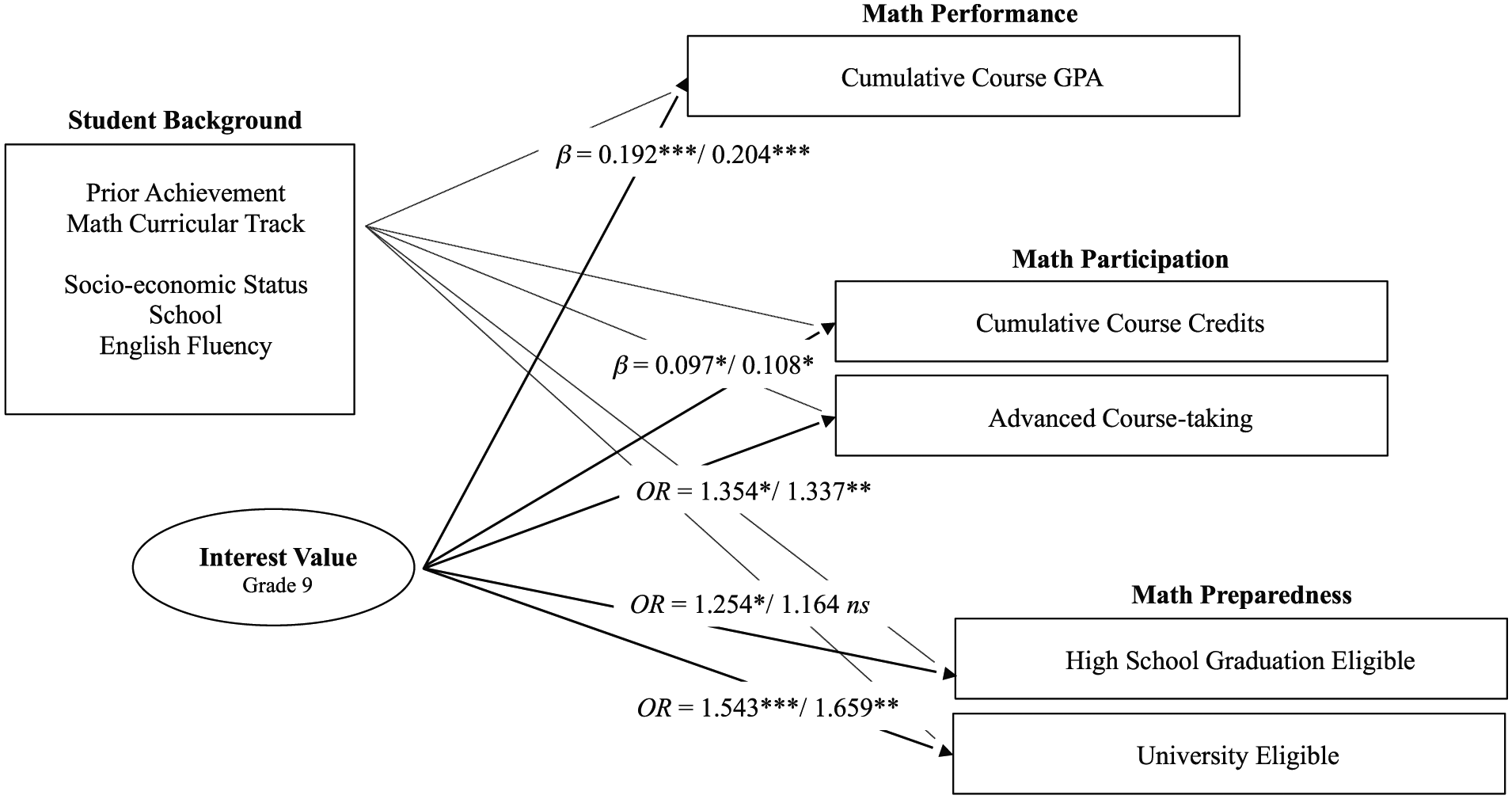
Multigroup SEM results of students’ high school math performance, participation, and preparedness regressed on ninth-grade interest value, controlling for students’ previous achievement experiences and socio-demographic background.
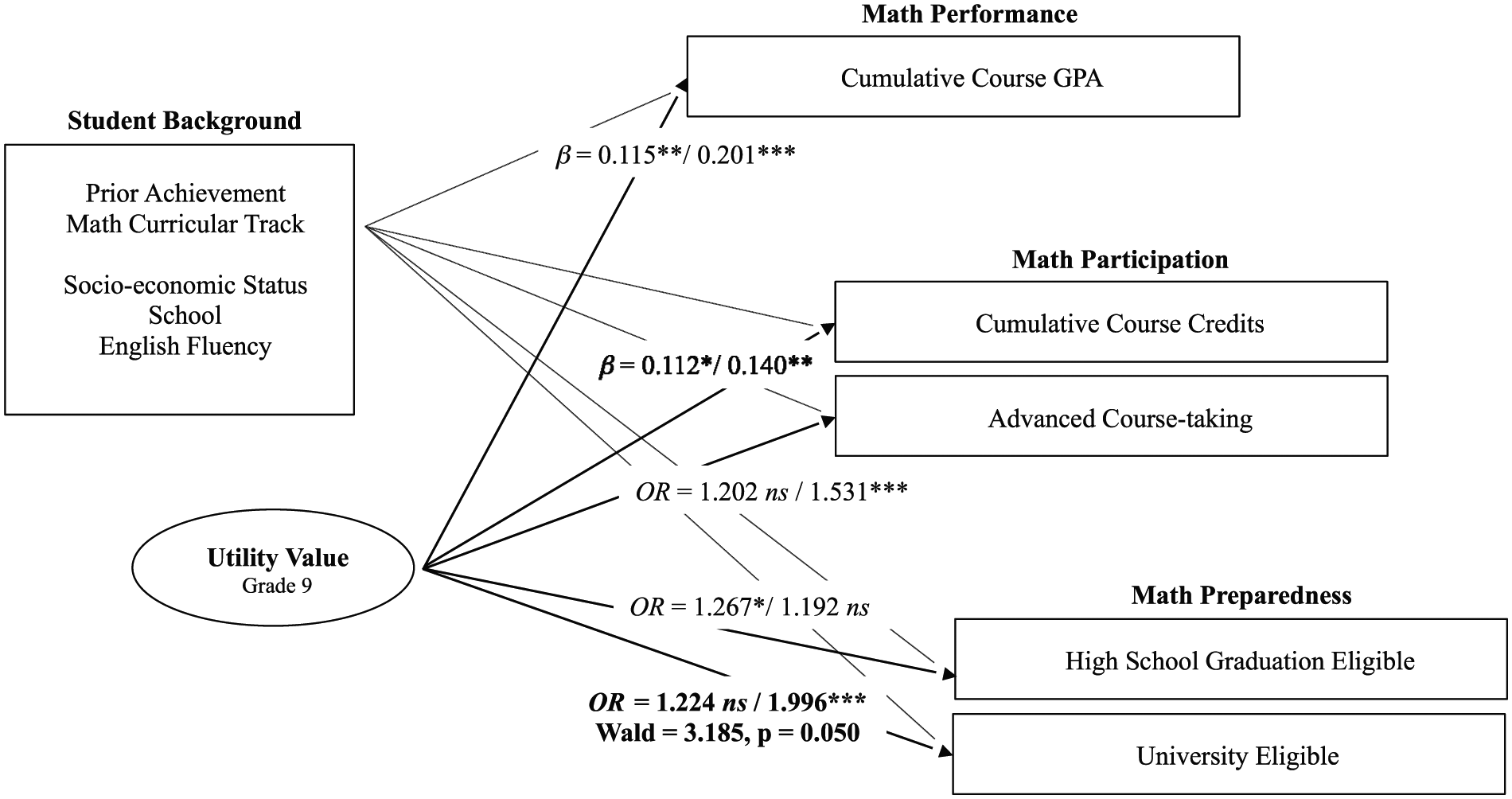
Multigroup SEM results of students’ high school math performance, participation, and preparedness regressed on ninth-grade utility values, controlling for students’ previous achievement experiences and socio-demographic background.

Multigroup SEM results of students’ high school math performance, participation, and preparedness regressed on ninth-grade attainment values, controlling for students’ previous achievement experiences and socio-demographic background.
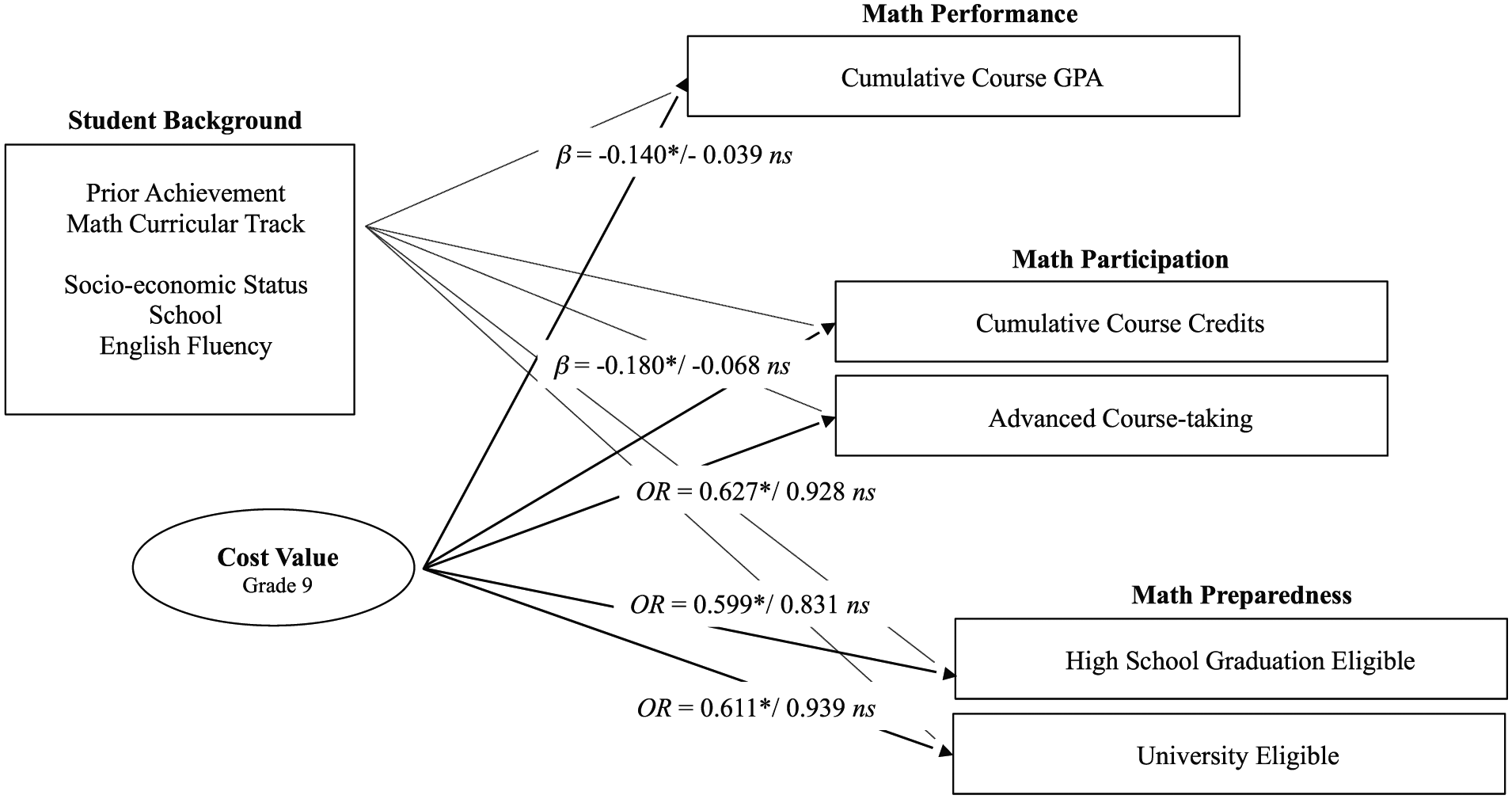
Multigroup SEM results of students’ high school math performance, participation, and preparedness regressed on ninth-grade cost values controlling for students’ previous achievement experiences and socio-demographic background.
Research Question 1: Is there a Hispanic gender gap in math expectancy-value beliefs, participation, performance, and preparedness?
Table 2 presents the summary statistics and comparisons of latent expectancy-value constructs along with math course taking and advanced course taking, GPA, and graduation and university eligibility for Hispanic males and females. With scalar invariance supported, analyses of latent factor means found that ninth-grade males reported significantly higher math expectancy beliefs, interest, attainment, and cost values relative to their female peers. Utility value did not differ by gender.
Summary of Math Expectancy-Values and Participation, Performance, and Preparedness

Note. Manifest means of expectancy-value constructs are presented to simplify interpretation of the latent construct. Wald statistic evaluated the latent mean comparisons. Means, with standard deviations in parentheses, are reported for math course credits and GPA. t-Test statistics evaluated the difference in means. Percentages are provided for students within each of the categories. Chi-square coefficient (χ2) and Cramer’s V (effect size) are reported. GPA = grade point average; df = degrees of freedom.
*p < .05. **p < .01. ***p < .001.
Preliminary analysis of eighth-grade achievement indicated no differentiation in the math performance of Hispanic males and females before entering high school. Average math performance diverged for males and females at high school. Hispanic females outperformed their male peers. On average, females had a statistically significant 0.25 grade point advantage.
Hispanic females also accumulated a greater number of math course credits, by an average of 2.91 credits—that is, nearly one additional semester of math. Gender was associated with advanced course taking, such that females pursued advanced courses in greater proportions: χ2(4, n = 1,420) = 30.45, p < .001, Cramer’s V = 0.17. Sixty-six percent of females took a course in Algebra 2 or higher relative to 51% of all males. Course enrollment patterns revealed that the proportion of female students increased with advancing math courses: Algebra 1 and equivalent courses, 14%; Geometry, 20%; Algebra 2/Trignometry, 34%; and Statistics, Pre-Calculus, and higher, 32%. In contrast, nearly half the males discontinued math courses after Algebra 1 and/or Geometry (48%), and fewer attempted Statistics, Pre-Calculus, and higher courses (20%).
Gender was also significantly associated with high school graduation and university eligibility. Females completed high school graduation (57%) and university eligibility requirements (27%) in significantly greater proportions.
Research Question 2: Are the math expectancy-value beliefs of Hispanic youth at the beginning of high school associated with their math participation, performance, and preparedness over time?
Figures 1 to 5 present multigroup structural equation model results of students’ high school math participation, performance, and preparedness regressed on ninth-grade expectancy-value beliefs, controlling for students’ previous achievement experiences and socio-demographic background.
Students with a previous record as strong math achievers and on-track course takers in the eighth grade accrued a greater number of math course credits and were more likely to take advanced courses across their high school career. They were stronger math achievers in high school and more likely to complete the math requirements to graduate and be university eligible. English learners had lower odds of satisfying graduation or university eligibility requirements.
Participation
The associations of ninth-grade expectancy-values with high school math participation were modeled in two ways: (1) cumulative course taking and (2) advanced course taking.
Cumulative math course taking
Students were more likely to take and pass a greater number of math courses if they felt more efficacious (expectancy: β = 0.215/0.208, 95% CI [0.147, 0.283/0.143, 0.310], p < .001/p < .01; Figure 1) and reported finding math interesting (β = 0.097/0.108, 95% CI [0.029, 0.166/0.032, 0.185], p < .05; Figure 2) and useful (utility value, β = 0.112/0.140, 95% CI [0.119, 0.264/0.055, 0.226], p <.05/p < .01; Figure 3). Increased math course taking over time was positively associated with ninth-grade math importance for females (attainment value, β = 0.192/0.062, 95% CI [0.119, 0.264/−0.020, 0.145], p < .001/ns; Figure 4). The attainment value and course-taking association was moderated by gender and marginally significant (Wald test = 3.569, df = 1, p = .058; Figure 4), with stronger effects for females. Course taking was negatively associated with cost values for females (i.e., a high perceived cost of math learning was associated with decreased course taking; β = −0.180/−0.068, 95% CI [0.036, 0.325/−0.042, 0.177], p < .05/ns; Figure 5). There were no significant effects for males. The difference in associations between males and females was not statistically significant.
Advanced math course taking
There was an increased likelihood of advanced course taking over time when ninth-grade males and females endorsed higher math efficacy (expectancy: OR = 1.549/1.421, 95% CI [1.221, 1.966/1.145, 1.763], p < .01; Figure 1), interest (OR = 1.354/1.337, 95% CI [1.106, 1.658/1.100, 1.625], p < .05/p < .01; Figure 2), and importance (attainment value, OR = 1.672/1.285, 95% CI [1.353, 2.066/1.050, 1.571], p < .001/p < .05; Figure 4). Males had a 53% higher likelihood of advanced course taking for a one standard deviation increase in utility value (OR = 1.531/1.202, 95% CI [1.219, 1.924/0.007, 0.140], p < .001/ns; Figure 3). No significant effects were present for females. Females had a 37% decreased likelihood of advanced course taking for a one standard deviation increase in cost value (OR = 0.627/0.928, 95% CI [0.436, 0.900/0.726, 1.187], p < .05/ns; Figure 5). The associations of expectancy-value beliefs and the likelihood of advanced math course taking did not statistically differ between males and females.
Performance
Hispanic males and females were more likely to achieve higher course grades over time (as reflected by their math GPA) if they felt efficacious (expectancy: β = 0.262/0.266, 95% CI [0.194, 0.329/0.203, 0.366], p < .001; Figure 1) and positively valued math (interest: β = 0.192/0.204, 95% CI [0.128, 0.256/0.137, 0.270], p < .001, Figure 2; utility: β = 0.115/0.201, 95% CI [0.045, 0.186/0.133, 0.270], p < .01, Figure 3; attainment: β = 0.188/0.103, 95% CI [0.119, 0.257/0.030, 0.177], p < .001/p < .05, Figure 4). A negative and significant association of ninth-grade math cost values and GPA was evident for females, such that an increase in cost value was associated with lower grades over time (β = −0.140/−0.039, 95% CI [0.020, 0.206/−0.050, 0.129], p < .05/ns; Figure 5). The difference in associations between males and females were not statistically significant.
Preparedness
The associations of expectancy-value beliefs with preparedness were modeled in two ways: high school graduation and university admissions eligibility.
High school graduation eligibility
The likelihood of completing high school graduation math requirements for females and males was significantly associated with students’ math success expectations—that is, the higher the expectancy for success in Grade 9, the higher the likelihood of graduation eligibility over time (OR = 1.644/1.453, 95% CI [1.307, 2.068/1.149, 1.837], p < .001; Figure 1). For females, graduation preparedness was significantly and positively associated with math interest (OR = 1.254/ 1.164, 95% CI [1.054, 1.493/0.966, 1.403], p < .05/ns; Figure 2), utility (OR = 1.267/1.192, 95% CI [1.038, 1.546/0.966, 1.470], p < .05/ns; Figure 2), and attainment value (OR = 1.598/1.075, 95% CI [1.301, 1.964/0.878, 1.315], p < .001/ns; Figure 4) and negatively associated with cost value (OR = 0.599/0.831, 95% CI [1.132, 2.461/0.634, 1.089], p < .05/ns; Figure 5). Math STVs and graduation eligibility were not significantly associated for Hispanic males. The difference in the associations of expectancy-values and graduation eligibility between males and females were not statistically significant, with the exception of attainment value. The association of attainment value and the likelihood of graduation eligibility was significantly higher for Hispanic females than for males (Wald test = 5.128, df = 1, p < .05; Figure 4). A one standard deviation increase in attainment value was associated with a 59% higher likelihood of graduation preparedness for females and an 8% higher likelihood for males.
University eligibility
The odds of satisfying math requirements to meet university admissions eligibility criteria was associated with students’ ninth-grade math expectancy for success (OR = 1.823/1.886, 95% CI [1.397, 2.379/1.338, 2.659], p < .001; Figure 1) and interest (OR = 1.543/1.659, 95% CI [1.261, 1.887/1.254, 2.196], p < .001/p < .01; Figure 2) for males and females. For females, university eligibility was also positively associated with attainment value (OR = 1.699/1.286, 95% CI [1.333, 2.165/0.950, 1.742], p < .001/ns; Figure 4) and negatively associated with cost value (OR = 0.611/0.939, 95% CI [1.077, 2.487/−0.109, 0.161], p < .05/ns; Figure 5). Females were associated with a 39% decrease in the likelihood of achieving university eligibility for every one standard deviation increase in cost value. The observed associations of expectancy, interest, attainment, and cost and university eligibility did not statistically differ between males and females. Gender-moderated associations of utility value and university preparedness were statistically significant (Wald test = 3.185, df = 1, p < .05). Ninth-grade math utility value was associated with an increased likelihood of satisfying university eligibility requirements for Hispanic males (OR = 1.996, 95% CI [1.418, 2.810], p < .001) but not females (OR = 1.224, 95% CI [0.971, 1.543], ns) (Figure 3). A one standard deviation increase in utility value was associated with a 99% increased likelihood of university preparedness for males and a 22% increased likelihood for females.
Discussion
This study examined the associations of Hispanic students’ math expectancy-values and their math participation, performance, and preparedness over time. Our findings highlight the significance and enduring impact of math expectancy-value beliefs for Hispanic students. This research also extends the theoretical and empirical associations of expectancy-values and achievement behaviors to a widely understudied, low-income, and largely first-generation Hispanic population. These findings have implications for how we can develop practices that foster students’ motivations within underserved communities.
Variation in Expectancy-Value Beliefs, Participation, Performance, and Preparedness
Ninth-grade males reported higher math expectancy for success, interest, and importance, and lower cost values—a math motivational advantage that is consistent with the documented higher math self-concept and interest among males (Watt, 2004). In contrast, Hispanic females outperformed their male peers by a quarter of a grade point on average over time. This finding supports the documented narrowing of gender difference in math achievement (Hyde et al., 2008), but it also extends the literature to a widely understudied Hispanic student population. Hispanic females participated and persisted in math more than males. They completed a higher number of courses (nearly an additional semester of math) and advanced courses. Hispanic females also completed graduation and university requirements in greater proportions relative to their male peers. The findings of this study support the scholarship on Hispanic females’ relatively higher educational aspirations and college enrollments (Marlino & Wilson, 2006; Zarate & Burciaga, 2010) by the way of their math course taking and their higher proportions of graduation and university preparedness.
Predictive Role of Expectancy Beliefs
The hypothesized association of Hispanic students’ math expectancy beliefs and performance was supported. Males and females completed more math courses, were more likely to take advanced courses, and earned higher grades throughout high school when they expected to succeed early on. They were also more likely to complete graduation and university eligibility requirements. These associations held true controlling for students’ prior achievement experiences and sociodemographic background. These findings complement the previous research on the associations of math expectancy beliefs and course taking for seventh-grade Hispanic and Asian students (Safavian & Conley, 2016), working and middle-class White youth (Simpkins et al., 2006), and eighth- and ninth-grade Mexican and White students (Stevens et al., 2007). The present study links math expectancy beliefs to math participation in novel ways by examining course-taking behavior via course enrollment records in two ways, namely, how much and how far students pursued their high school math course taking. Additionally, the focus on cumulative course credits captures two distinct important behaviors: enrollment and course completion. Simpkins et al. (2006) and Stevens et al. (2007) only reported students’ intentions.
These findings implicate Hispanic students’ expectancy beliefs in directing their course enrollments over time, whether directly, through voluntary course-taking preferences, or indirectly through other processes that lead to their placement in that course (performance, effort, etc.). The observed associations of ninth-grade success expectations and cumulative course taking underscore the importance of math self-concept (or confidence) in determining continued math engagement among Hispanics over their high school career. This highlights an important direction for future research: elucidating the mechanisms through which expectancy beliefs inform course-taking behaviors.
Hispanic females’ relatively low math expectancy for success beliefs compared with their male peers is intriguing. Their relatively low confidence did not, however necessarily translate into lower math success. They participated, persisted, achieved, and were overall better prepared to graduate and be college eligible. Their male peers were more confident in math but over time took fewer courses, earned comparatively lower grades, and were less prepared for graduation or college. The findings underscore a motivational resilience among females that necessitates greater understanding and further research. For example, identifying and disentangling the sources of success expectations for Hispanic youth and the mechanisms by which beliefs translate into achievement choices and behaviors would be particularly prudent.
Predictive Role of Subjective Task Value Beliefs
The hypotheses concerning the associations of STVs and math participation and preparedness were supported.
Interest Value
The observed association of math interest and course taking mirrors prior work with working and middle-class White youth (e.g., Simpkins et al., 2006). The findings also mirror a similar association of interest and course-taking intentions in math in eighth-grade Mexican American students (Navarro, Flores, & Worthington, 2007).
Attainment Value
Gender moderated the association of attainment value and course taking (marginally significant) and high school graduation preparedness. The associations were positive for females and not significant for males. This is a noteworthy contribution. This moderated association could be attributed to sociocultural and historical experiences as well as gender socialization of motives, which over time would have different effects on Hispanic males and females and their choices. For example, attainment value theoretically reflects salient dimensions of one’s core values. However, at any given time, and over time, different facets of one’s identity and values can be more or less salient than others, affecting choices differentially over time. One plausible explanation for the differential associations between endorsement of attainment value in the freshman year and graduation eligibility 4 years later is that Hispanic females and males might be negotiating qualitatively different experiences during adolescence. For example, males are more likely to receive disciplinary referrals or disability diagnoses and be disproportionately tracked into remedial education (Blanchett, 2006). Minority males are also particularly vulnerable to high school experiences with racial discrimination and negative academic stereotypes (Rosenbloom & Way, 2004). These experiences can accumulate adversely to hinder the course taking and achievement required to be graduation eligible, and attainment values may not be enough to counter such effects. By contrast, the stronger and more positive identification of Hispanic females with schooling and education may reflect several factors: an effort to challenge gender-based norms (Cammarota, 2004; Feliciano & Rumbaut, 2005), the opportunity to circumvent social controls imposed by parents at home (Feliciano, 2012), or parents’ academic expectations and aspirations for them (Feliciano & Rumbaut, 2005; Zhou & Bankston, 2001). Whether and how such experiences moderate the influence of attainment value on academic choices differentially for Hispanic males and females are unclear and necessitate further research.
Utility Value
The observed utility value and course-taking association is empirically supported by previous studies. For instance, STEM (science, technology, engineering, and mathematics) persistence intentions of gifted Hispanic students increased when they also endorsed high STEM utility values (Andersen & Ward, 2014).
Utility value was not associated with advanced course taking for Hispanic females. Advanced course taking across the 4 years of high school may be driven by motivations other than perceptions of math usefulness, and this association needs to be investigated further. Advanced math course taking is a requirement in the determination of eligibility for admission into the university system and is thereby highly correlated; as such, it is not surprising that utility was also not associated with university eligibility for Hispanic females. The utility value and university preparedness association was statistically moderated by gender, such that it was positive and significant for males and not significant for females. This gender-moderated association is particularly interesting in light of the emerging popularity of utility value–based interventions and suggests that intervening on utility values may have differential consequences for Hispanic males and female outcomes, as in this study.
One implication of these associations is that effective interventions targeting Hispanic students’ math STVs would benefit from focusing on the ninth grade. More research is needed to examine how value interventions, such as utility value interventions, could affect this population given how little is understood about the interrelations of STVs for Hispanic youth. For instance, whether the overemphasis on math utility and importance could also increase youths’ cost values and undermine math engagement over time is an empirical and important question to examine prior to intervening in the classroom.
Cost Value
This study found that ninth-grade females attributing high costs to learning math also took fewer math courses, received lower grades, and were less likely to be prepared for graduation or college over time. The associations were nonsignificant for males but also not statistically moderated by gender. Nonetheless, this development warrants further exploration as this study demonstrates that these associations are long lasting. The high costs associated with math can detrimentally impede the upward educational trajectory of students, especially academically vulnerable students. Whether cost values can offer insights into the differentiated educational and occupational pathways of Hispanic males and females is an empirical question of scholarly interest. At this time, the lack of research that examines cost values may be the reason for a crucial element missing in understanding Hispanic youths’ motivated behavior and choices. This could be particularly critical to understanding the underrepresentation of Hispanic women in STEM. For example, the intentions not to pursue graduate school by women (Battle & Wigfield, 2003) and not to major in STEM by college students (Perez et al., 2014) are both associated with cost values. Many of the studies at this time employed predominantly White and college-age populations. There is a need to investigate these associations with Hispanic youth.
Limitations, Strengths, and Concluding Remarks
Limitations
There are several limitations in this study. Treating all young people of Latin American backgrounds as a monolithic group homogenizes distinct political, social, cultural, and historical experiences. Sources of heterogeneity in Hispanics warrant further research including generational and immigration status, country of origin, and socioeconomic status, as well as the interplay of such factors in facilitating the understanding of how motivations materialize to achievement and attainment for Hispanic youth. Mexicans and Mexican Americans are the largest Hispanic population in the United States (Motel & Patten, 2012), but future studies could examine populations such as Puerto Ricans, Dominicans, and Salvadorans as studies suggest that achievement for these groups is informed by different factors—for example, recency of immigration to the United States, education, and income (Delgado, Ettekal, Simpkins, & Schaefer, 2016). The generalizability of findings may also not be applicable to Hispanic youth outside California or third-generation youth, with two U.S.-born parents—both valuable avenues of future research.
Using self-report measures also has its limitations, and future research should consider studying students’ motivated behaviors using cognitive interviews, open-ended questions, and qualitative studies that can complement and supplement these findings. The present study relied on data drawn from the only known available data set on Hispanic youth that includes comprehensive measures of expectancy-values and high school math course taking and achievement over time. The data were collected in the 2000s. However, the age of the data set does not diminish the contributions of the study as the current findings support past research with older, as well as recent, data on the associations of expectancy-values as previously discussed.
Strengths
This is the first comprehensive examination of the utility of EVT in understanding the gendered motivations and achievements of first- and second-generation Hispanic youth within a singular study. Complete and validated measures of expectancy-values were used—a critical first step that most examinations of expectancy-values with Hispanic populations have not executed. Central to the tenets of EVT, the study documented a long-term link between students’ endorsement of math expectancy-value beliefs (“Can I do it?” “Is it worth it?”) and how many and what kinds of math courses they completed, their performance across such math courses, and their preparedness for graduation and college. The associations of expectancy-values and math participation, performance, and preparedness over time are a substantial strength and extension of the achievement motivation literature to Hispanic youth. This research is also one of the few EVT-based studies on Hispanic youth that accounts for learners’ previous math experiences by using prior math achievement and curriculum tracking of learners.
The separate modeling of expectancy-value beliefs with math participation, performance, and preparedness is another strength of the study. Our findings yielded interesting gendered patterns of associations. For instance, gender statistically moderated the associations of attainment value with course taking and graduation eligibility. Attainment value emerged as a positive and significant predictor of math performance for females. This was also true for cumulative math course taking, advanced course taking, and graduation and college preparedness. For males, the associations of attainment value with course taking, graduation, and college eligibility were all nonsignificant. The relatively sizeable correlations of expectancy, interest, utility, attainment, and cost would likely mask these nuanced gendered findings when not examined separately.
The merits of the study also include the examination of multiple sources of math-related success: math GPA, cumulative and advanced math course taking, and preparedness with respect to high school graduation and university eligibility. Using math GPA was an appropriate strategy and a strength of the study in understanding the longitudinal association of expectancy-value beliefs with course-taking behaviors. The GPA variable captured students’ average performance across multiple math courses. Most studies do not discuss students’ achievement measures in great detail and often only account for a single snapshot in time. Moreover, understanding students’ minimum requirements for completion of high school graduation, as opposed to striving for university admission, depends on studying both cumulative math course-taking and advanced math course-taking behaviors. Differentiated patterns of preparedness would not be visible without examining graduation and university eligibility separately. Graduating high school and college eligibility have qualitatively different implications for a population that is less likely to attend college. Disentangling the associations of students’ motivations with different educational outcomes will benefit future research and could provide clues about how and in what ways to best target supports. These nuances are critical when trying to understand how best to support the motivated choices and achievement efforts of Hispanics.
Unpacking the role of gender in understanding these associations is another considerable strength. Hispanic males began high school with higher math expectancy-values than females. By comparison, females exceeded their male peers on math performance and participation. They were also increasingly more likely to satisfy graduation and university eligibility requirements. These findings beg the question “Why do Hispanic males persist less than females in math?” Given that males and females had equivalent achievement in the eighth grade and males endorsed stronger success expectations and values in their first year, what prevented these boys from achieving at the same rate as their female peers? Hispanic females’ relatively high levels of academic motivation are substantiated. They enjoy school and place a high value on the importance of education and receiving good grades (Graham et al., 1998; Plunkett & Bámaca-Gómez, 2003). By contrast, they feel less confident about math and rate it with less interest and importance relative to their male peers (Catsambis, 1994, 2005). This contradiction is curious and warrants further research. It suggests that there are unaccounted factors motivating math participation and persistence among Hispanic females. The observed gender-moderated associations echo the importance of further understanding for whom and in what ways the associations of expectancy-values and choice behaviors manifest.
Concluding Remarks
Our findings foreshadow the breadth of research necessary to the understanding of how gendered attitudes and processes influence choices for Hispanic populations. Gender differences in achievement attitudes could reflect the divergent gender socialization experiences of males and females within families (Azmitia & Brown, 2002). The pathways through which culture-specific variables, such as traditional gender roles (e.g., marianismo, machismo, and caballerismo attitudes) and the principles of familismo and respeto, inform the achievement-related attitudes of Hispanic youth merit further research. Understanding how key socializers (e.g., parents and family, teachers, and peers) shape the math-specific expectancy-values of Hispanic youth could illuminate how motivations also manifest. The experiences of peers and parents could also be critical to understanding the motivated choices of this collective and socially oriented population.
Eccles et al.’s EVT continues to be one of the most studied and applied theories of achievement motivation to date (Eccles, 2009; Guo et al., 2015). EVT-based educational interventions (e.g., utility value interventions; Gaspard et al., 2015; Harackiewicz, Canning, Tibbetts, Priniski, & Hyde, 2015) aiming to bolster the achievements of first-generation and underrepresented youth continue to increase in popularity. The scholarship on how and in what ways the associations of expectancy-value beliefs can be replicated with Hispanics is relatively nonexistent at a time when it is critical to understand whether these associations operate with first-generation and underrepresented youth as EVT theoretically postulates. The experiences of Latin/Hispanic Americans in the United States are uniquely distinct—social and culturally, historically and politically, and economically. It is prudent to understand the achievement associations of math expectancy-value beliefs for Hispanic populations rather than to derive inferences from research with European and Caucasian Americans. The findings from this study elucidate how math motivations translate to math-related choices for Hispanic youth. These understandings will ultimately create opportunities to refine our approaches to serving effective and targeted supports and interventions.
Supplemental Material
DS_10.1177_2332858419869342 – Supplemental material for What Makes Them Persist? Expectancy-Value Beliefs and the Math Participation, Performance, and Preparedness of Hispanic Youth
Supplemental material, DS_10.1177_2332858419869342 for What Makes Them Persist? Expectancy-Value Beliefs and the Math Participation, Performance, and Preparedness of Hispanic Youth by Nayssan Safavian in AERA Open
Footnotes
Acknowledgements
This research was supported by grants from the National Science Foundation to Jacquelynne S. Eccles, Nayssan Safavian, and Stuart Karabenick (Award No. 1535273) and Martin Maehr and Stuart Karabenick (Award No. 0335369). I thank Drs. AnneMarie Conley, Jacquelynne S. Eccles, and Anna-Lena Dicke for their support in bringing this research to publication.
Notes
Author
NAYSSAN SAFAVIAN is a research scientist in the School of Education at the University of California–Irvine. Her research applies the motivation lens of expectancy-value theory to approach issues of motivation and educational and occupational attainment in underrepresented communities.
References
Supplementary Material
Please find the following supplemental material available below.
For Open Access articles published under a Creative Commons License, all supplemental material carries the same license as the article it is associated with.
For non-Open Access articles published, all supplemental material carries a non-exclusive license, and permission requests for re-use of supplemental material or any part of supplemental material shall be sent directly to the copyright owner as specified in the copyright notice associated with the article.
