




Abstract
This study used the Eccles et al. expectancy-value (E-V) theory to test the influence of motivation on mathematics achievement and enrollment using data from a cohort of 926 seventh-grade prealgebra students (49% male, 76% Hispanic, 76% low income, and 55% English learner). E-V beliefs were assessed in seventh grade along with achievement, and enrollment was measured in eighth grade. Differential associations of motivation, achievement, and enrollment were examined across Hispanic and non-Hispanic populations. Expectancy for success and task value uniquely predicted seventh-grade achievement and eighth-grade algebra enrollment after controlling for prior achievement and a full set of demographic controls, including low socioeconomic status and English fluency. The association of interest value and achievement differentiated across Hispanic and non-Hispanic youth, suggesting that the effect of interest value on mathematics achievement was weaker for Hispanic youth than for non-Hispanics after accounting for success expectations and prior achievement.
Motivated students invest more time in educational tasks, expend greater effort, ask for help, and persist in the face of difficulty (Eccles, Wigfield, & Schiefele, 1998; Wang, Eccles, & Kenny, 2013). Over time, this culminates in improved skills and performance as well as increased and advanced course taking (Wigfield & Cambria, 2010; Wigfield, Tonks, & Klauda, 2009). Much of what is empirically understood about the positive associations between mathematics-related beliefs and achievement outcomes holds with White and African American youth but has seldom explored these relations within other ethnic-minority populations, such as Hispanics (Eccles & Wigfield, 2002; Graham, Taylor, & Hudley, 1998; Taylor & Graham, 2007; Winston, Eccles, Senior, & Vida, 1997). This study addresses this gap by applying one of the most widely studied theoretical frameworks of achievement motivation, the Eccles et al. (1983) expectancy-value (E-V) theory of achievement motivation and choice behavior, to an early-adolescent sample of Hispanic youth and their non-Hispanic peers to determine whether the associations between beliefs and performance and participation hold with these populations.
Eccles et al. E-V Theory of Achievement Motivation
According to Eccles et al.’s E-V theory, students’ achievement-related choices and academic attainment are direct functions of their expectation of success (perception of the likelihood of achievement, or “can I do this task?”) and subjective task values (STV; how much they value achievement, or “do I want to do this task?”) (Eccles et al., 1983; Wigfield & Eccles, 2000). These beliefs are highly correlated with each other and informed by previous achievement and success experiences (Wigfield et al., 2009). As a comprehensive sociocultural framework for understanding motivation, the Eccles et al. theory situates E-V beliefs as the most proximal predictors of achievement behaviors and choices while accounting for social, historical, and cultural experiences as key determinants of those beliefs. Socialization by parents, teachers, peers, and schools as well as perception of other’s expectations and attitudes (e.g., stereotypes) has direct and interactive effects on students’ E-V beliefs (Eccles et al., 1983; Wigfield et al., 2009).
Expectancy for Success
Expectancy for success represents beliefs about ability and the perceived likelihood of achieving success on a task in the proximal or distant future and is informed by self-schemas, affective memories, and previous and vicarious experiences (see Eccles et al., 1983, 1998; Usher & Pajares, 2008; Wigfield & Eccles, 2000). Expectancy for success, self-efficacy, and self-concepts of ability beliefs are empirically indistinguishable by children and adolescents (Eccles & Wigfield, 1995; Wigfield, Eccles, Schiefele, Roeser, & Davis-Kean, 2006).
Documented impacts of expectancy for success on mathematics learning and achievement receive a great deal of attention in the achievement motivation literature. Expectancy beliefs predict various measures of scholastic achievement, including course grades (Meece, Wigfield, & Eccles, 1990; Simpkins, Davis-Kean, & Eccles, 2006). These associations are robust and sustained over time and, in some cases, stronger and more reliable predictors of achievement than prior performance (Simpkins et al., 2006; Spinath, Spinath, Harlaar, & Plomin, 2006; Steinmayr & Spinath, 2009). Students’ mathematics expectancy beliefs precipitously decline with the middle school transition and continue on into high school (Jacobs, Lanza, Osgood, Eccles, & Wigfield, 2002; Wigfield et al., 1997).
Expectations of success differ across racial-ethnic groups (Elliot, Hufton, Illushin, & Lauchlan, 2001; Graham, 1994; Wigfield, Tonks, & Eccles, 2004; Winston et al., 1997). There is also a notable misalignment between success expectations and achievement across groups. The tendency to overestimate the likelihood of future success in circumstances where actual performance would indicate otherwise is evident among African American youth, and studies find that ability perceptions and achievement do not associate consistently (Graham, 1994). For example, African American and Hispanic youth report relatively positive achievement attitudes toward mathematics despite otherwise low levels of actual achievement (Castambis, 1994; Oakes, 1990). This pattern also replicates with African American primary school children (first, third, and fifth grades)—self-reporting as mathematically highly competent despite lower course grades (relative to their European American peers; Stevenson, Chen, & Uttal, 1990). Yet another study found no differences in mean levels of success expectations across high-ability African American, Hispanic, and White ninth graders (Andersen & Ward, 2014). Furthermore, Stevens and colleagues found that prior achievement, mental ability, and mathematics self-efficacy explained 50% of the variation in mathematics performance for White high school students but only 29% for Hispanics (Stevens, Olivarez, Lan, & Tallent-Runnels, 2004). They conclude that actual ability may not influence mathematics efficacy as strongly for Hispanic youth as is evidenced among White youth (Stevens et al., 2004). These findings support the postulation that adolescents’ efficacy beliefs differentiate depending on their referenced self- and social-comparisons groups (Graham, 1994). Incongruent associations of success expectations and performance across racial-ethnic groups implore further research. Much less is known about the success expectations of early adolescents of racial- and ethnic-minority backgrounds.
Subjective Task Value
STV relates to the question, “Why do I want to do this task?” Within the E-V theoretical framework, task value consists of four components: attainment value or importance, interest or intrinsic value, utility value or usefulness, and perceived cost (see Eccles et al., 1983). These components are domain specific and mean-level declines of STV are most pronounced in middle school (Jacobs et al., 2002; Watt, 2004; Wigfield et al., 1997). Consistent examinations of STV scales generally test three of the four components: interest, importance, and utility (Eccles, O’Neill, & Wigfield, 2005; Jacobs et al., 2002). Although Eccles and colleagues have provided theoretical and empirical guidelines for the specification and measurement of STV (Eccles & Wigfield, 1995; Eccles et al., 1993, 2005), few studies have simultaneously examined all four STV subcomponents (see Conley, 2012; Nagengast et al., 2011; Trautwein et al., 2012).
Task values are important predictors of enrollment decisions, time invested in learning, and educational and occupational aspirations (Eccles, Vida, & Barber, 2004; Simpkins et al., 2006; Updegraff, Eccles, Barber, & O’Brien, 1996; Watt, Eccles, & Durik, 2006), all of which are predictive of later achievement. Adolescents’ reports of math importance are stronger predictors of intentions to take additional mathematics courses than their expectation of success and are associated with reduced math anxiety in middle school (Meece et al., 1990). Task values are also linked to achievement (Bong, 2001; Fuligni, 1997; Simpkins et al., 2006). For example, importance and interest values have been linked to end-of-term math course grades across sixth, eighth, and 10th grades (Fuligni, 1997; Simpkins et al., 2006). Bong (2001) reported usefulness, importance, and interest ratings as stronger predictors of midterm scores and enrollment intentions than self-efficacy beliefs among college students. Classroom intervention studies also show that increases in the perceived utility value of a college course improved course grades and subsequent course enrollments in the same subject area (Hulleman, Godes, Hendricks, & Harackiewicz, 2010). These findings demonstrate the unique contributions of interest, utility, and attainment facets independently and separately. Relatively less is understood about costs.
Mean-level differences are also evident in adolescents’ STV beliefs across racial-ethnic groups (Chen & Stevenson, 1995; Conley, 2012; Fuligni, 1997, 2001; Graham et al., 1998). For example, Asian American high school students (relative to their White peers) report greater interest in mathematics, find the subject less difficult, and consider it more useful for their future careers (Chen & Stevenson, 1995). First-generation sixth- and eighth-grade students of Hispanic, East Asian, and Filipino backgrounds with stronger ratings of mathematics importance, utility, and interest values also spent more time studying, and their mathematics course grades were stronger than those of their co-ethnic peers (Fuligni, 1997). Findings also support the associations of STV and academic outcomes across groups, although relatively less is known about these associations among middle school minority populations. For example, science, technology, engineering, and mathematics (STEM) utility beliefs also predict STEM persistence among high-ability Hispanic ninth-grade students (Andersen & Ward, 2014). Even fewer published studies have examined early adolescents’ mathematics-related cost values in association with their achievement and particularly among minority populations. For example, early-adolescent Hispanic youth experiencing mathematics learning as a costly endeavor report highest levels of performance-avoidance goals and negative affect despite also reporting average levels of math competency, whereby performance-avoidance goals and negative affect are negatively associated with their mathematics achievement (Conley, 2012).
The Present Study
This study investigates whether associations previous studies have established with respect to mathematics E-V beliefs and achievement and subsequent course taking apply to an early-adolescent population that is generally understudied—English learner (EL), low-income, first- and second-generation racial- and ethnic-minority youth. This study differs from the recent scholarship on Hispanic and other racial- and ethnic-minority youth in several ways. For example, the work by Andersen and Ward (2014) focuses on high-ability ninth-grade students (i.e., Hispanic students scoring within the top 10% of their racial group on the mathematics achievement tests). These high-achieving students will presumably hold higher ability and task value beliefs given the well-documented correlations among achievement-related beliefs, such as E-Vs, achievement, and prior achievement experiences. Stevens and colleagues (2004) also study ninth- and 10th-grade students enrolled in algebra and geometry. In contrast, the current study population comprises relatively low-achieving prealgebra students as opposed to the aforementioned high-achieving students or algebra and geometry course enrollees. Eccles and her colleagues (e.g., Eccles, Wigfield, Midgley, et al., 1993; Jacobs et al., 2002) have also consistently documented the declines of middle school mathematics E-V beliefs, and yet, the associations of such motivations and performance and participation of Hispanic youth are largely examined with high school youth; in a few cases, children (e.g., Stevenson et al. 1990); and substantially less with middle school populations. Thereby it is particularly prudent to examine these mathematics-related motivations during middle school—arguably one of the most important transitional milestones of adolescence (Eccles, Wigfield, Harold, & Blumenfeld, 1993)—rather than to derive inferences from high school populations or children. This study also comes at a time when interventions aimed at boosting achievement are quite popular and the malleability of motivation has been the source of a recent surge in intervention efforts among social scientists (e.g., Gaspard et al., 2015; Harackiewicz, Canning, Tibbetts, Priniski, & Hyde, 2015; Hulleman et al., 2010; Hulleman & Harackiewicz, 2009; Johnson & Sinatra, 2013). These intervention efforts presume that the associations between achievement attitudes and achievement are generalizable to all groups—including racial-ethnic and immigrant minorities. However, this is an important empirical question to be examined, and this study does exactly that. By focusing on early-adolescent Hispanic youth, this study will address a research gap for the fastest-growing demographic group in the United States and within an academic domain that is essential to securing its long-term educational and labor market success.
The goal of this study was twofold: to replicate the associations of the Eccles et al. E-V beliefs and students’ mathematics performance and participation and, more importantly, to extend these important findings to early-adolescent Hispanic youth. We present three specific research objectives to examine (a) the associations between students’ seventh-grade E-V beliefs about mathematics and end-of-year mathematics achievement, (b) the associations between seventh-grade E-V beliefs and eighth-grade mathematics course enrollments, and (c) whether the associations between mathematics E-V beliefs and achievement and subsequent course taking are moderated by ethnicity. We first examine the associations between seventh-graders’ E-V beliefs about mathematics and their end-of-year mathematics achievement. By controlling for prior achievement, we specifically examine whether seventh-graders’ E-V beliefs are uniquely associated with a change in their achievement from the end of sixth to the end of seventh grade. We hypothesize students’ expectancy beliefs will be a robust predictor of their mathematics performance.
Second, we examine the associations between seventh-grade E-V beliefs and eighth-grade mathematics course enrollments after controlling for seventh-grade achievement. Efficacious students are more likely to experience positive emotions and less anxiety, invest greater effort and persist, ask for help, and practice various self-regulatory and cognitive strategies to enhance their learning (e.g., plan, check, and monitor themselves on tasks; Linnenbrinck & Pintrich, 2003). Students’ valuing of tasks is linked with persistence (Ainley, Hidi, & Berndorff, 2002), effort (Chouinard, Karsenti, & Roy, 2007; Cole, Bergin, & Whittaker, 2008), classroom engagement and in-depth learning (Kim, Jiang, & Song, 2015; Renninger, Ewen, & Lasher, 2002), use of cognitive and metacognitive strategies in the classroom (Pokay & Blumenfeld, 1990), and also academic performance (Bong, 2001; Schiefele, Krapp, & Winteler, 1992). Although the scholarship on course placement points to a number of meritocratic (e.g., test scores, ability) and nonmeritocratic (e.g., teacher recommendation, parent preference, and student choice) criteria that vary greatly across teachers and schools (Bernhardt, 2014), teachers are likely to appraise students’ behaviors inside and outside the classroom (e.g., perceived effort [raising a hand, asking questions, participating in group work], absenteeism, homework completion, etc.) as signals of their readiness—relying on subjective judgments of students’ motivation and engagement in making placement recommendations (Bernhardt, 2014; Oakes, Joseph, & Muir, 2004). Students’ mathematics enrollments will reflect the influence of teachers’ course recommendations. Should E-V beliefs serve as a motivational asset in fostering students’ course-taking enrollments, over and above the anticipated influence of academic performance alone, we would expect to uncover such effects across our analyses. We specifically hypothesize that STVs will be predictive of students’ subsequent course enrollment over and above the effects of prior achievement and expectancy beliefs.
Young people are situated within a number of powerful socialization contexts, including peers, parents, teachers, and schools, that influence their achievement-related beliefs and achievement behaviors (Eccles, 2015; Eccles Parsons, Adler, & Kaczala, 1982; Graham et al., 1998; Stone & Han, 2005). For example, Eccles and colleagues have demonstrated that gender socialization experiences (such as parents’ endorsement of culturally shared gendered stereotypes, e.g., boys are better at math than girls) differentiate the math- and science-related success expectations, values, achievements, and aspirations as well as the education and occupational choices of boys and girls over time (Eccles, 2015; Eccles, Wigfield, Harold, & Blumenfeld, 1993). Racial-ethnic and cultural socialization experiences also been linked to achievement-related outcomes of minority youth (A. Evans et al., 2012; Hughes, Witherspoon, Rivas-Drake, & West-Bey, 2009; Supple, Ghazarian, Frabutt, Plunkett, & Sands, 2006). Experiences of racial discrimination at school (whether from teachers or peers) are associated with lower academic achievement (Wang & Huguley, 2012; Wong, Eccles, & Sameroff, 2003), less positive perceptions of school climate (Stone & Han, 2005), and lower academic engagement and motivation (Chavous, Rivas-Drake, Smalls, Griffin, & Cogburn, 2008; Wong et al., 2003). Peer groups and teachers as sources of socializing contexts have also been linked to student engagement and motivation (Bouchey & Harter, 2005; Eccles Parsons et al., 1982; Graham et al., 1998; Wigfield & Harold, 1992).
Relative to their White peers, Hispanic youth are more likely to experience poverty (Hernandez, Denton, & MacCartney, 2007), negative school environments (Stone & Han, 2005), and lower levels of achievement and educational attainment (Reardon & Galindo, 2009). Moreover, they experience not only racial discrimination (Greene, Way, & Pahl, 2006) but also discrimination based on English fluency, negative stereotypes, social class, and skin color (Alfaro, Umaña-Taylor, Gonzales-Backen, Bámaca, & Zeiders, 2009; Edwards & Romero, 2008). The Eccles et al. E-V theory postulates that these sociocultural, economic, and even linguistic experiences of Hispanic youth inevitably inform their expectancy for success beliefs and the values they attach to achievement-related endeavors over time (Eccles et al., 1983). The confluence of these experiences could presumably differentiate the manifestation of E-V beliefs across groups.
Therefore, our third research question was exploratory in nature by taking into consideration the sociocultural and achievement backgrounds of our study population. Although mean-level differences in E-V beliefs have been observed between various racial-ethnic groups, whether the theoretically assumed associations of E-Vs and academic outcomes are comparable across middle school Hispanic and non-Hispanic youth is less understood. Thus, we test whether ethnicity moderates the effect of mathematics E-V beliefs on achievement and subsequent course taking (i.e., differential effects for E-V on outcomes). We offer no specific hypotheses here given the paucity of empirical research on the E-V beliefs of these particular populations.
Method
Data for this research come from a larger National Science Foundation–funded program investigating students’ mathematics and science achievement motivations.
Sample and Participants
The sample was drawn from a cohort of 926 seventh-grade students (51% female) enrolled in prealgebra courses across three urban middle schools (15 prealgebra teachers) in one large school district in Southern California. The school district was located in a large urban city with the following demographic characteristics: 43% of the population was born outside of the United States, 59% spoke a language other than English at home, and only 15% of parents were college educated (an additional 22% had a high school diploma, leaving 32% without; U.S. Census Bureau, 2000). Forty-three percent of the city’s residents were foreign-born, with 39% from Latin and South America (84% of whom emigrated from Mexico; U.S. Census Bureau, 2000). At the time of data collection, the district consisted of 53% Hispanic or Latino, 28% Asian (and predominantly Vietnamese), 14% White, 47% EL, and 60% free/reduced lunch–eligible students (California Department of Education [CDE], n.d.). Eighty-three percent of the schools in the city were designated as schoolwide Title I schools (DataPlace Beta, n.d.).
The study sample was largely Hispanic (76%), with minority populations of Vietnamese (13%), White (6%), and other (5%). 1 Over three quarters of the students were on federally funded free or reduced meal programs (76%), and over half (55%) of them were identified as ELs. We present the results of our largest population of students, Hispanics, and have aggregated the Vietnamese, White, and other populations (referenced as “non-Hispanic” from this point on) because the sample size is insufficiently small for meaningful subgroup analyses.
Measures
All 2004–2005 seventh-grade students within the participating prealgebra classrooms were invited to participate. Fewer than 1% opted out. 2 Trained research assistants administered the surveys in students’ regular mathematics classrooms. Scripted directions were read aloud, and a sample item was given to ensure that students knew how to indicate their responses. Research assistants read from scripted responses when questioned about the meaning of particular items. Students were told that the purpose of the 30-min confidential survey was to elicit their thoughts and feelings about mathematics.
Students’ E-V beliefs were assessed via questionnaires with existing, well-established scales. Questionnaires were administered approximately 4 weeks before the end of the academic 2004–2005 school year (end of spring term of seventh grade). All items were assessed using a 5-point scale (e.g., 1 = not at all true, 3 = somewhat true, 5 = very true). The appendix provides survey items and their sources.
Expectancy for success
Expectancy for success was operationalized and assessed using the Academic Efficacy Scale from the Patterns of Adaptive Learning Survey (Midgley et al., 2000). Five items assessed students’ judgments about their ability and confidence to perform adequately in math (e.g., “How sure are you that you can do the most difficult math work?”). 3 The scale had high reliability (α = .88). See the appendix.
STV
STV measures were derived from previous work by Eccles and colleagues (Eccles & Wigfield, 1995; Eccles, Wigfield, Harold, et al., 1993; Wigfield et al., 1997) supplemented by new items reported and validated for this sample in work detailed elsewhere (Conley, 2012; Conley & Karabenick, 2006). All scales showed high reliabilities: Six items assessed task interest (e.g., “I enjoy the subject of math,” α = .96), four items assessed utility (e.g., “Math will be useful for me later in life,” α = .86), six items assessed attainment (e.g., “Thinking mathematically is an important part of who I am,” α = .88), and two items assessed cost (e.g., “I have to give up a lot to do well in math,” α = .76). See the appendix.
Achievement
Mathematics achievement was operationalized using district-provided records of student performance on a statewide test administered annually—California Standards Tests (CSTs; CDE, n.d.). The CSTs are criterion-referenced end-of-course exams designed to measure students’ progress toward achieving state-adopted mathematics standards (a condition of meeting federal accountability requirements)—making mathematics achievement comparable across classrooms and schools as opposed to course grades, which are teacher idiosyncratic and whereby variations in grading practices complicate the comparability of achievement. Prior studies found that course grades weakly correlated with CST achievement (r = .20) and in some cases did not correlate at all with this sample (Conley, 2012). Participants took the general math CSTs that assessed grade-level prealgebra content standards for sixth- and seventh-grade mathematics courses at the end of their spring 2004–2005 academic term. Scores range from 150 to 600, with a score of 350 signifying proficiency.
Course enrollment. 4
Students’ eighth-grade mathematics course enrollments were collected from school district records. Districtwide policy-driven efforts to enroll nearly all students in algebra stratified students in one of two 1st-year algebra course sequences: Algebra GL (AlgGL, grade-level track) or Algebra GLB (AlgGLB, below-grade-level track). Course placement was determined by teacher recommendation along with students’ performance history on district benchmarks and state standardized tests according to the school district course catalog. Algebra GL was a 1-year-long (two-semester) course. The course aimed to prepare students to take geometry upon entering high school. Algebra GL served as the grade-level standard, and successful completion of this 1-year course satisfied the statewide algebra requirement (CDE, n.d.). Algebra GLB was a reduced-paced, 2-year-long (four-semester) algebra course sequence. Students on the AlgGLB track were matriculating below the statewide-recommended grade-level mathematics sequence. District guidelines for mathematics course-taking sequences followed standards set by the CDE (n.d.).
Sociodemographic background
School district records identified ethnicity, gender, school, English fluency, and eligibility for the National School Lunch Program (NSLP; a proxy for low socioeconomic status; NSLP, n.d.). Approximately 81% of all Hispanic and 59% non-Hispanic students were NSLP eligible. English fluency was classified according to the CDE (n.d.), and ELs were identified as students from language-minority homes who were not yet proficient in English. About 62% of all Hispanic and 31% of all other students were ELs, with Spanish and Vietnamese identified as the primary languages spoken at home.
Missing data
Extensive efforts were made to address the issue of missing data by gathering time-invariant variables from other available data. All analyses utilized the complete set of available data and cases were excluded only when the missing variables were necessary for the analysis. Sixth-grade achievement data were missing for 10% of the sample. Imputed values using multiple imputation regression estimates (taking advantage of all observed motivation, achievement, and sociodemographic variables) were used in place of missing sixth-grade achievement data. Missing data on NLSP, E-V beliefs, and seventh-grade achievement and eighth-grade enrollment variables represented less than 1% of the sample. The few remaining non-imputed missing data were treated using listwise deletion (a default in Stata).
Results
We examined the impact of early adolescents’ E-V beliefs on the mathematics performance and subsequent course enrollments of largely low-income first- and second-generation early-adolescent Hispanic youth and their non-Hispanic minority peers.
Data Analysis
Measurement invariance of STV across Hispanic and non-Hispanic subgroups was tested beforehand to ensure the reliability of the measure. A correlated four-factor model of STV (i.e., interest, attainment, utility, and cost) indicated a good representation of the four distinct latent structures of task value (χ2 = 461.75, p < .01, χ2/df = 3.58, comparative fit index = .96, root mean square error of approximation = .06). The STV factor structure did not differ between groups. In other words, Hispanic and their non-Hispanic peers distinguished between interest, utility, attainment, and cost. The procedure and the determination of fit and further results are detailed in the online Supplementary Materials.
Ethnicity, gender, NSLP, school, and English fluency were indicator coded (membership in a given category was assigned 1 [Hispanic, male, NSLP eligible, English fluent], and nonmembership was assigned 0). Enrollment in eighth-grade AlgGL was dichotomized where 1 = enrolled in grade-level algebra (AlgGL) and 0 = enrolled in AlgGLB. Sixth-grade achievement was used as a covariate of seventh-grade achievement, and seventh-grade achievement was used as a covariate of eighth-grade course enrollment. Descriptive statistics (means and variances) were generated for beliefs, achievement, course enrollments, and demographic data. Racial-ethnic differences in motivation and achievement were investigated using T-test statistics.
The associations between students’ E-V beliefs and achievement and subsequent enrollments were examined using a series of hierarchical multiple regressions. The association of mathematics E-V beliefs and achievement was tested using ordinary least squares (OLS) regression analyses. The impact of E-Vs on the binary outcome of eighth-grade AlgGL enrollment (i.e., likelihood of AlgGL enrollment) was modeled using logistic regressions. 5
Each series of hierarchical regression models (OLS and logistic analyses) started with a simple model. Sociodemographic background (ethnicity, gender, NSLP, English fluency, and school) and prior achievement appear in the first block. In the second block, expectancy for success was added. To examine the unique contributions of STV (interest, utility, attainment, and cost) to achievement and enrollment, each STV component was estimated using a separate series of models—first independently and second jointly with expectancy beliefs. 6 Ethnicity × Expectancy, Interest, Utility, Attainment, and Cost interactions were estimated to explore the differential associations between E-V beliefs and outcomes across groups.
Analyses were carried out using Stata 11 (StataCorp., 2009). All variables were standardized (i.e., mean of 0 and standard deviation of 1) to facilitate the interpretability of the regression coefficients. Robust standard errors were estimated using the Huber-White estimators (Hamilton, 2006) with cluster adjustments for classroom nesting. Postregression variance inflation factor and tolerance estimates were evaluated as a multicollinearity check (Allison, 1999; Fox, 1991). Leverage-versus-residual-squared plots were also examined. Incremental R-square is reported for each block of variables along with F test for its significance. Postregression Wald tests estimated the Ethnicity × Motivation interactions.
Findings
Data were inspected for univariate and multivariate normality and were well within the boundaries of normality. 7 Table 1 provides summary statistics of expectancy for success, task values, and mathematics achievement by ethnicity.
Summary Statistics of Mathematics Expectancy-Value Beliefs and Achievement

Note. Means provided with standard deviation in parentheses. CST = California Standards Test.
Unstandardized scores are presented. Scores range from 150 to 600 and proficiency is identified with a score of 350 or greater. Sixth- and seventh-grade students took the general math CST (equivalent to prealgebra).
p < .05. **p < .01. ***p < .001.
Hispanic youth received significantly lower mathematics scores in sixth and seventh grades than their non-Hispanic peers. They also reported significantly lower expectancy beliefs, interest, and attainment values. By the fall of eighth grade, significantly higher proportions of Hispanic youth were enrolled in the below-grade-level algebra course (AlgGLB) in comparison to their non-Hispanic peers, who were enrolled in the grade-level course (AlgGL). The three schools did not differ in mathematics achievement scores.
Table 2 provides zero-order correlations for expectancy for success, STVs, and achievement. Expectancy for success correlated moderately to strongly with interest, utility, and attainment (r = .44–.67, p < .001) and did not correlate with cost. Seventh-grade achievement was correlated moderately with expectancy beliefs, less strongly with interest and attainment values, and negatively with cost values.
Bivariate Correlations for Mathematics Expectancy-Value Beliefs and Achievements
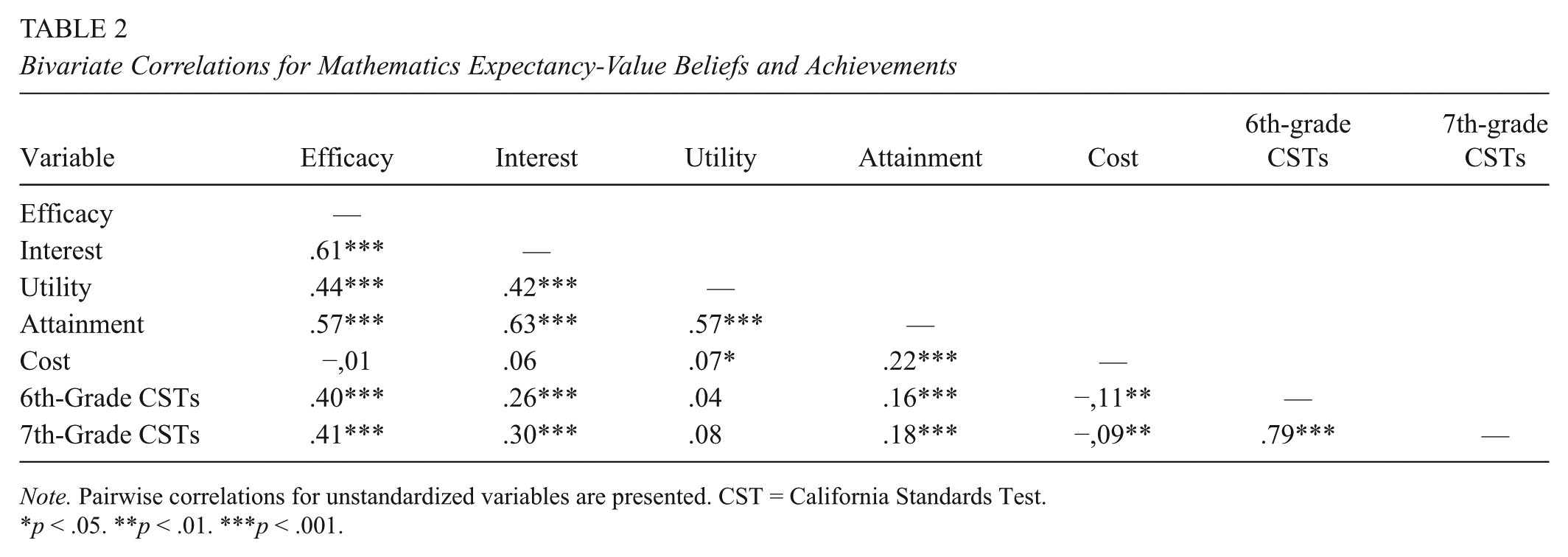
Note. Pairwise correlations for unstandardized variables are presented. CST = California Standards Test.
p < .05. **p < .01. ***p < .001.
Table 3 provides regression results for predicting change in achievement from sixth to seventh grade. Consistent predictors of mathematics achievement were gender, ethnicity, and expectancy for success. Hispanic students exhibited lower performance relative to their non-Hispanic peers (β = –.10–.11, p < .001). There were no associations between achievement and NSLP or English fluency.
Seventh-Grade Mathematics Achievement Regressed on Expectancy-Value Beliefs, Prior Achievement, and Sociodemographic Covariates

Note. Ordinary least squares regressions with standardized beta coefficients reported. Robust standard errors in parentheses. Sixth-and seventh-grade students took the same general math CSTs (prealgebra equivalent). CST = California Standards Test.
The reporting of sociodemographic covariates was omitted from this table to conserve space. Effect sizes are discussed in text.
p < .05. **p < .01. ***p < .001.
The baseline model regressed seventh-grade achievement (Model 1) on sixth-grade achievement along with sociodemographic characteristics. Prior achievement was an exceptionally strong and positive predictor of seventh-grade achievement and explained 64% of the variance in seventh-grade achievement.
Expectancy for success appears in the second block (Models 2 and 3). Seventh-grade achievement was regressed on expectancy for success controlling for sixth-grade achievement and covariates in Model 2. The strong and positive predictive effect of prior achievement persisted. Expectancy for success predicted achievement (β = .12, p < .001) even after accounting for the strong predictive ability of prior achievement (i.e., success expectations partially explain the change in math achievement from sixth to seventh grade). Model 3 explained 65% of the variance in seventh-grade mathematics achievement, F(8, 908) = 191.47, p < .001. The interaction of ethnicity (Hispanic indicator [1/0]) and expectancy beliefs was not significant (i.e., the correlation observed between expectancy beliefs and achievement did not differentiate in strength between Hispanic students and their non-Hispanic peers).
Task values were examined with and without expectancy beliefs in Models 3 through 10. Interest was entered in the third block (Models 3 and 4). The main effect for interest (independent of expectancy beliefs) was significant, explaining 65% of the variance in achievement when the model accounts for all background covariates and prior achievement. Controlling for students’ success expectations (Model 4) reduced the association between interest value and achievement while also increasing the variance explained in Model 3 and cumulatively capturing 66% of the variance in seventh-grade mathematics achievement, F(9, 907) = 172.54, p < .001.
The significant Ethnicity × Interest interaction (β = −.12, p < .05) indicated that interest was differently associated with achievement over and above the influence of interest (β = .17, p < .001), expectancy for success (β = .08, p < .05), prior achievement (β = .70, p < .001), and background covariates, F(10, 14) = 161.94, R2 = .66; ΔR2 = .002; F(1, 897) = 6.61, p < .01. The interaction was graphed according to Aiken and West (2001) to aid in interpretation (see Figure 1). The models were estimated separately across groups to facilitate the interpretation of the differential association. The main effect for the interaction refers to the effect of interest for the non-Hispanic students only (i.e., Vietnamese, White, and others). Hispanic youth showed a weaker association between interest and achievement (β = .05, p < .05), F(8, 14) = 231.33, R2 = .62, than their peers (β = .15, p < .001), F(8, 14) = 51.40, R2 = .65.

Graph represents the interaction between ethnicity and interest on standardized achievement. Lines on graph represent one standard deviation above and below the mean.
The same sets of analyses were conducted with utility value (Models 5 and 6), attainment (Models 7 and 8), and cost (Models 9 and 10). Utility was a significant predictor of achievement controlling for prior achievement. This significant association between utility and achievement was diminished after controlling for expectancy beliefs (Model 6). The significant association between attainment value and achievement also dissipated after controlling for expectancy beliefs (Models 7 and 8). Cost values were not correlated with achievement (Models 9 and 10). Utility, attainment, and cost values did not differentially associate with achievement.
Students’ E-V beliefs and their subsequent course enrollment
Logistic regressions estimated the association between E-V beliefs and grade-level algebra enrollment (i.e., the likelihood of enrollment in AlgGL). Table 4 provides logistic odds ratio (OR) along with their corresponding z values. Wald chi-square statistics were reported to estimate change in logistic models. The OR for predictors represents how E-V beliefs, prior performance (seventh-grade CSTs), and sociodemographic characteristics relate to the likelihood of AlgGL enrollment in the eighth grade (as opposed to being enrolled in AlgGLB and falling behind the state-recommended course-taking guidelines). The z statistic represents the ratio of the regression coefficient to the standard error (i.e., a pseudo t statistic indicating significance).
Eighth-Grade Algebra Course Taking Regressed on Expectancy-Value Beliefs, Prior Achievement, and Sociodemographic Covariates
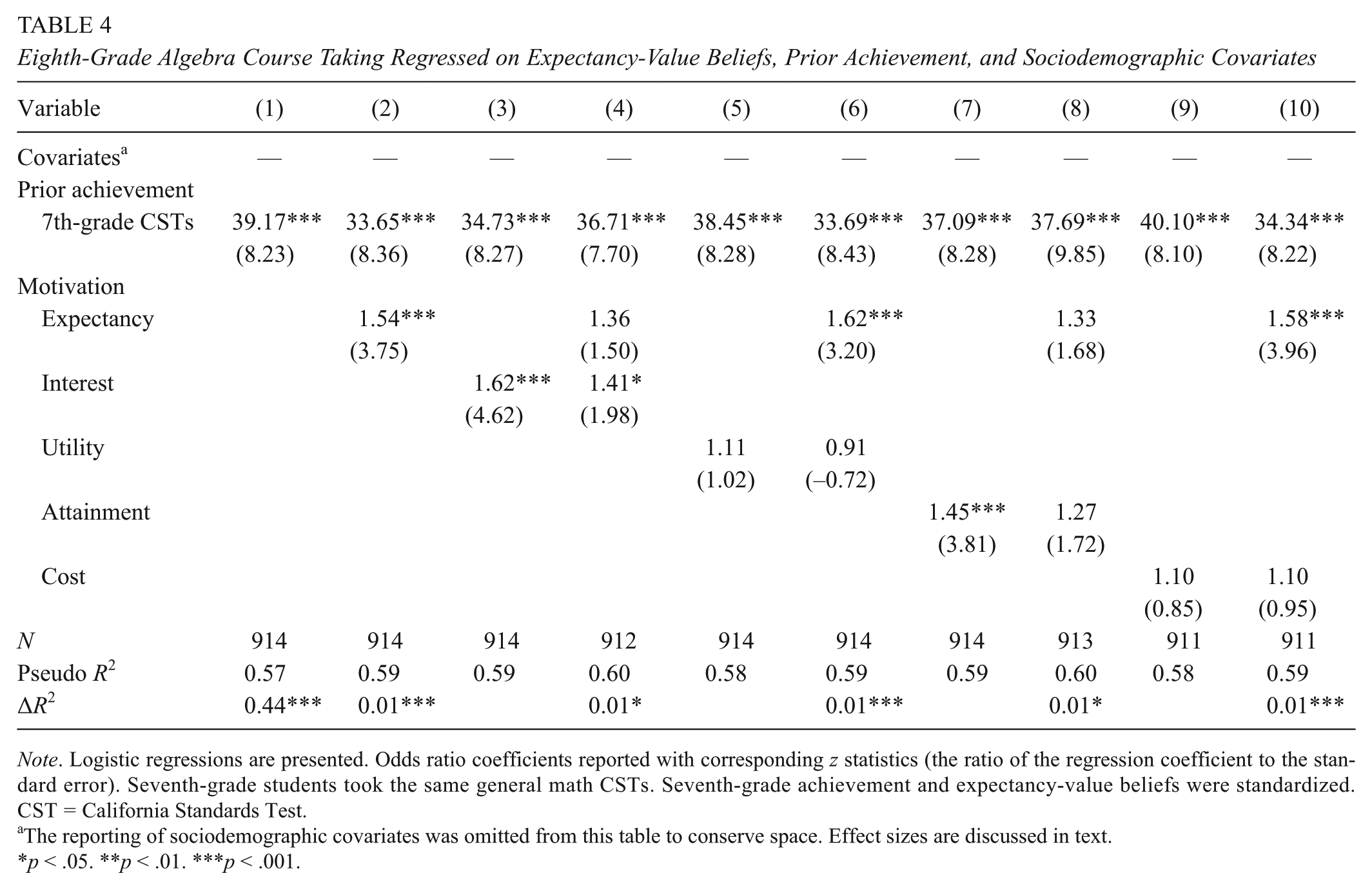
Note. Logistic regressions are presented. Odds ratio coefficients reported with corresponding z statistics (the ratio of the regression coefficient to the standard error). Seventh-grade students took the same general math CSTs. Seventh-grade achievement and expectancy-value beliefs were standardized. CST = California Standards Test.
The reporting of sociodemographic covariates was omitted from this table to conserve space. Effect sizes are discussed in text.
p < .05. **p < .01. ***p < .001.
The baseline model regressed AlgGL enrollment on prior achievement (seventh-grade CSTs) and sociodemographic variables. There was no association between the likelihood of AlgGL enrollment and NSLP or language fluency. High achievers in the seventh grade were more likely to be AlgGL enrollees in the eighth grade. Prior achievement was a strong and positive predictor of AlgGL enrollment in the eighth grade (OR = 39.17, confidence interval [CI] = [22.51, 62.00], p < .001; Model 1). The baseline (Model 1) explained 58% of the variance in eighth-grade AlgGL enrollment, Wald χ2(1) = 197.72, p < .001.
Ethnicity and prior-achievement main effects were consistent predictors of AlgGL enrollment. The one pattern of associations sustained across models: Controlling for E-V beliefs and prior performance, AlgGL enrollees were less likely to be Hispanic (OR = −.68−.70, p < .001) and more likely to be female (although not always significant; OR = 1.20–1.28).
Expectancy for success was entered in the second block (Models 2 and 3). In Model 3, AlgGL enrollment was regressed on seventh-grade expectancy for success beliefs, achievement, and demographic covariates. The main effect for expectancy was significant (OR = 1.54, CI = [1.23, 1.93], p < .001) despite the strong and positive influence of prior achievement (OR = 33.65, CI = [14.75, 76.75], p < .001). The likelihood of enrollment in AlgGL increased among students with positive success expectations for mathematics over and above the influence of their performance the year prior or any background demographic characteristics. Students with positive success expectations were 1.54 more times like to be in AlgGL. The main effects for ethnicity and gender were also significant. Female students were more likely (OR = 1.25) to be enrolled in AlgGL, and Hispanic students were less likely (OR = .68), after controlling for expectancy for success beliefs and prior performance. Expectancy beliefs did not differentially associate with eighth-grade AlgGL enrollment across groups (i.e., the estimated effect of expectancy beliefs on the likelihood of eighth-grade AlgGL enrollment did not statistically differ as a function of ethnicity). The addition of expectancy for success beliefs to Model 2 increased the variance explained, Wald χ2(1) = 12.33, p < .001.
The effects of task value on achievement were estimated with and without expectancy beliefs (Models 3 through 10). The main effect for interest (independent of expectancy beliefs) was significant (OR = 1.62, p < .001) and explained 59% of the variance in the model (Model 3). The interest effect on AlgGL was also mitigated by expectancy (Model 4) but significant (OR = 1.41, CI = [1.00, 1.98], p < .05), Wald χ2(1) = 5.02, p < .05.
The same sets of analyses were conducted with utility value (Models 5 and 6), attainment (Models 7 and 8), and cost (Models 9 and 10). Expectancy beliefs yielded a positive and consistent influence across all the models. Utility value, however, was not a significant predictor of AlgGL enrollment when accounting for prior performance and success expectations (Models 5 and 6). Attainment value (independent of expectancy beliefs) was a significant predictor of AlgGL enrollment (OR = 1.45, CI = [1.20, 1.75], p < .001; Model 7). However, the association of seventh-grade attainment value with eighth-grade algebra enrollment dissipated after accounting for success expectations (Model 8). Cost value did not predict AlgGL enrollment (Models 9 and 10). Values did not differentially associate with eighth-grade enrollment across groups.
We examined whether mean differences on E-V variables between Hispanic and non-Hispanic students might be driven by prior achievement or other variables as a check for robustness. We found that racial differences between Hispanics and non-Hispanics on expectancies, interest, and attainment value held even when controlling for prior achievement and other demographic covariates; see the online Supplemental Table 8 for more details.
Discussion
Our findings are consistent with the theoretical and empirical associations between early adolescent achievement motives and mathematics achievement. We made distinct contributions to the literature in extending this work to early-adolescent Hispanic populations by (a) establishing the reliability of the Eccles et al. STV construct, (b) replicating the associations between students’ E-V beliefs and achievement and subsequent enrollments within mathematics, and (c) demonstrating that the mathematics interest and achievement association functions differentially between Hispanics and their non-Hispanic peers.
Establishing Scale Reliability
The absence of STV reliability in studies with early-adolescent racial- and ethnic-minority populations compelled us to first confirm the structural and measurement invariance of the model across our two racial-ethnic groups. We replicated the four-factor structure of STV with Hispanic and non-Hispanic middle school youth. This finding is consistent with earlier validations of a four-factor STV measure with similar populations as well as with more recent ones with German university students (Conley, 2012; Trautwein et al., 2012). We find that STV as interest, utility, attainment, and cost is present with early-adolescent Hispanic and non-Hispanic youth as evidenced by observed factor structure across subgroups. This constitutes a unique and important contribution to the cross-cultural literature utilizing the Eccles et al. E-V theory with Hispanic and non-White early-adolescent populations.
Predictive Role of Expectancy Beliefs
Students with high success expectations were high achievers. Expectancy for success was a strong, robust, and consistent predictor of seventh-grade performance for both Hispanic and non-Hispanic youth, as hypothesized. By controlling for prior achievement, the change in student achievement from sixth to seventh grade was partly explained by students’ success expectations. This finding further supports the work that suggests ability-related beliefs are strong and robust predictors of achievement (and in some cases, course enrollments) when previous mathematics experiences are controlled (Guay, Larose, & Boivin, 2004; Marsh & Yeung, 1997; Pajares & Miller, 1995).
Students’ expectancy beliefs also emerged as robust and consistent predictors of eighth-grade AlgGL enrollment and stronger predictors of enrollment than interest, utility, or attainment value when E-V beliefs and prior performance were modeled simultaneously. Holding all else constant, students (Hispanic and non-Hispanic) anticipating mathematics success were also more likely to matriculate at the state-recommended grade level in mathematics (i.e., on track). The literature would have predicted otherwise—that STV would predict enrollments more strongly than expectancy beliefs (Joyce & Farenga, 2000; Updegraff et al., 1996). One explanation could suggest that the moderate to high E-V correlations are responsible for this finding (Eccles et al., 1998; Wigfield et al., 1997). Thus, the predictive power of STV inevitably weakens when expectancy and prior performance are simultaneously entered into the regression (Trautwein et al., 2012). Alternatively, related research grounded in self-efficacy theory suggests that efficacious students are more likely to experience positive emotions and less anxiety, invest greater effort and persist, ask for help, and utilize various self-regulatory and cognitive learning strategies (e.g., try to understand their homework or plan, check, and monitor themselves on assigned tasks; Linnenbrinck & Pintrich, 2003). This finding could also reflect a measure of course enrollment that is largely a function of prior performance and teacher recommendations and not necessarily an individual choice.
The underrepresentation of Hispanics in eighth-grade AlgGL is not surprising given the low mathematics success rate of Hispanic youth across the state of California (Latino Legislative Caucus, 2014). Our findings suggest that students’ expectancy-for-success beliefs (for Hispanics and their peers) play a critical role in their subsequent enrollments (either directly through course-taking behavior or indirectly through other processes that lead to their placement within that course, e.g., performance, effort, etc.). Thus, this finding constitutes an important direction for future research—to elucidate the mechanisms through which expectancy beliefs inform subsequent enrollments after achievement and STVs have been accounted for.
Predictive Role of STV Beliefs
The robust association of interest value and achievement, beyond the influence of expectancy beliefs and prior performance, is also notably important. This association aligns with the identified links between interest beliefs and mathematics achievement in the intrinsic motivation scholarship (Schiefele & Csikszentmihalyi, 1995). Stevens and colleagues (2004) have also replicated this link with Hispanic youth. Both of these studies were with high school populations. Studies that explicitly evaluate the associations between mathematics STV and performance with Hispanic and minority populations are largely limited and warrants research that understands the mathematics underachievement of these youth in concert with the indisputable decline of mathematics STVs at the middle school transition.
Our hypothesis about the associations of mathematics STVs and enrollment was partially supported. Interest and attainment values were positive predictors of AlgGL enrollment, whereas utility and cost were not. The interest and course enrollment association is well supported in the previous STV-related literature but also novel to the scholarship on early-adolescent Hispanic youth. The positive attainment value and AlgGL enrollment association is supported by the another study that also found science attainment value to predict persistence in STEM among high-ability Black, Hispanic, and White high school youth (Andersen & Ward, 2014). One explanation for the nonsignificant utility value associations could be attributable to a ceiling effect, as it may be the case that most students can unanimously agree on the usefulness of mathematics for future pursuits given that most mathematics teachers and course books attempt to communicate this message. Although cost values inversely correlated with mathematics achievement, those bivariate associations were small and dissipated after accounting for prior achievement and expectancy beliefs. One plausible explanation is that cost values are operating through other mediating mechanisms that inform achievements and later enrollments (e.g., performance avoidance goals). Much more work is needed in elucidating the associations of cost values and Hispanic youth’s achievement and course-taking experiences.
Differential Associations of E-V Beliefs
Identifying whether minority and immigrant students are differentially motivated to achieve will presumably aid us in strategically targeting the support of achievement-related motivations and behaviors and to do so more efficiently. We found the association between mathematics interest and achievement to statistically vary between Hispanics and their non-Hispanic peers such that the association was considerably weaker for Hispanics than for non-Hispanic youth. One plausible explanation could be that mathematics interest is not as relevant to Hispanic youth’s achievement-related behaviors as perhaps other motivational attributes once we account for prior mathematics performance and efficacy. This highlights the need to better understand how these mechanisms differentially operate across different racial-ethnic populations. Although moderator effects are generally difficult to detect in regression analyses and seventh grade may be early to detect such interactions, any gain in explaining the variation in achievement is noteworthy (M. Evans, 1985; McClelland & Judd, 1993).
Limitations
Findings should be considered in light of a few known limitations. Although the use of self-report survey methodology is common practice for empirical studies with this age group, how adolescents answer in self-report measures may differ from how they actually feel. Although this may be a problem for some constructs where objective measures may be more desirable, in this case, our construct is subjective in nature: Our explicit aim was to understand the E-Vs students subjectively attach to mathematics. Qualitative approaches to understanding achievement attitudes among these understudied populations could complement and supplement these findings in important ways. The examination of teachers’ and parents’ reports of their students’ attitudes could also lend additional insight into understanding students’ attitudes.
We must also be cautious about drawing comparisons between the findings for the non-Hispanic group and more commonly cited E-V literature utilizing samples of middle-class European American student population or, in a minority of cases, African American populations—neither of which is adequately comparable as the non-Hispanic reference group is predominantly Southeast Asian and White residing in a working-class immigrant community. Insufficiently sizeable samples of the Asian group prevent us from drawing conclusions about how E-V beliefs operate within these equally unique ethnic-minority populations. Furthermore, extending any of the findings from the non-Hispanic subgroup to the White student populations cannot not be warranted given the insufficiently limited samples of the White students and their unique residence within this particular community. We encourage more studies on early adolescents with similar demographics to understand if these results continue to replicate.
The causal interpretations of the coefficients are also inferential, and thereby we describe our findings in terms of “influence” or “association” that could be further examined. Alternatively, cross-lagged patterns of performance and participation data over multiple waves could empirically examine the temporal relations of E-V beliefs, participation, and performance.
Future Directions
The extension of the achievement motivation literature to these populations is very much needed and warranted (c.f., Graham & Weiner, 2011). Results from this study show that the theoretical associations of motivation and achievement as specified in the Eccles et al. E-V theoretical framework are generalizable to Hispanic middle school populations. We found that mathematics-related E-Vs account for some of the remaining variation in achievement and subsequent enrollments after prior achievement has explained the largest proportion of achievement variation. Thus, we replicated the link between motivation and performance and participation with largely low-income first- and second-generation Hispanic middle school youth, and more so, we did this using a theoretically comprehensive measure of STV that includes interest, attainment, utility, and cost. Our measure of achievement (district-reported test scores on grade-level mathematics standards) also serves as an explicit measure of students’ performance that is less sensitive to nonacademic considerations, such as classroom behaviors (e.g., attendance, effort, disruptiveness, and completion of assignments) or teacher expectations, perception of effort, and compliance, that can bias course grades (Randall & Engelhard, 2009; Willingham, Pollack, & Lewis, 2002).
With the exception of a minority of studies (e.g., Taylor & Graham, 2007; Urdan, 2009b; Urdan & Munoz, 2012), prior research examining E-V constructs use homogenous samples of primarily White/European adolescents (e.g., Eccles et al., 2004; Jacobs et al., 2002; Watt, 2004, 2006; Wigfield et al., 1997) or, alternatively, international populations. Demographics of our sample mirror the diversity within the region but also reflect the rapidly growing immigrant communities that are flourishing across U.S. schools. We are presenting a unique examination of motivation operating over time within an early-adolescent population that comprises largely EL, low-income, first- and second-generation racial-ethnic minorities.
Future studies would benefit from elucidating the ways in which sociocultural contexts inform mathematics motivations and moderate the influence of motivation on achievement strivings. The recent work by Stevens and colleagues (2004) with Hispanic youth supports the notion that non-ability factors could be driving the behavior of young people from communities that are collectively oriented. Non-ability factors could include the quality and quantity of opportunities that support the development of efficacy as well as availability of successful role models and mentors. Thus, the ability-driven culture that prevails throughout current academic settings may be ill suited to Hispanic youth (Stevens et al., 2004). This misfit would arguably lead to greater disenfranchisement of Hispanic students and increased feelings of frustrations for conditions that are perceived as unchangeable.
Similar factors could be presumably driving the development of STVs and possibly more susceptible to socialization and prior experiences as first postulated within the E-V theoretical framework. The degree of difference between construal of the self (independent vs. interdependent self) could also be influential in the development of STVs, in addition to the associations between E-Vs and outcomes (Markus & Kitayama, 1991). More research is needed with respect to understanding these processes.
Expectancy for success and STV beliefs may be less closely associated with end-of-the-year standardized assessments than teacher-assigned classroom grades (achievement measures that could have potentially yielded stronger effect sizes). Teacher-assigned grades reflect achievement-behaviors, such as perceived effort, persistence, help-seeking in class, disruptive behavior, and student compliance. Thus, behaviors that boost a student’s course grades may not consistently translate into high marks on standardized achievement exams. Additionally, whereas standardized assessments of achievement may be less vulnerable to bias than grades, performance on them is vulnerable to factors such as stereotype threat (Steele & Aronson, 1995) and test anxiety (Hembree, 1988). Further, the gross underrepresentation of Hispanics within eighth-grade AlgGL is partly due to the fact that teacher and district personnel recommendations and course grades, which are vulnerable to bias, are coupled with standardized test achievement to determine eighth-grade mathematics placement (Bitter & O’Day, 2010). Future research could speak to how E-Vs translate into the adaptive in- and outside-of-classroom behaviors that result in high marks and subsequent course-taking trajectories.
Students’ motivations to achieve along with their achievement-related behaviors and subsequent achievements are malleable and amenable to change (Urdan, 2009a). Demonstrating that mathematics motivations inform the performance and enrollments of early-adolescent Hispanic students despite the robust influence of their prior achievements is noteworthy with important implications for middle school teachers, parents, and administrators. Teacher professional development programs targeting classroom approaches to increasing students’ mathematics E-Vs and educating parents on the importance of mathematics-related beliefs are viable options. Encouraging students to generate their own connections to mathematics is another practice that is effective in increasing motivation. For example, utility value interventions demonstrate gains in students’ science interest and achievement after a brief writing activity that prompts the personal connection between the science classroom materials and their lives (Hulleman & Harackiewicz, 2009; Hulleman et al., 2010). Similar gains are evidenced across value interventions whereby students draw connections between the content learned and their personal goals (e.g., anticipated future careers) or generate examples about the personal relevance of the course content (Canning & Harackiewicz, 2015; Gaspard et al., 2015). These motivation-focused interventions are less costly and easier to implement than curriculum-based interventions aimed at boosting achievement. This can make them economically and politically viable options in circumstances where students are situated within low-performing and undersourced schools. The implications of these findings encourage continued research into the interplay of mathematics E-V beliefs and mathematics achievement and course taking within these largely disenfranchised and understudied communities at a time when declines in mathematics motivation render them particularly vulnerable for underachievement.
Footnotes
Appendix
Expectancy and Subjective Task Value Scale Items

| Efficacy for math a |
| How certain are you that you can learn everything taught in math?
a
How sure are you that you can do even the most difficult homework problems in math? a How confident are you that you can do all the work in math class, if you don’t give up? a How confident are you that you can do even the hardest work in your math class? a Even if a new topic in math is hard, how confident are you that you can learn it? a |
| Interest value |
| How much do you like doing math?b, c I like math.b, c Math is exciting to me. e I am fascinated by math. e I enjoy doing math. d I enjoy the subject of math. d |
| Utility value |
| How useful is learning math for what you want to do after you graduate and go to work?
b
Math will be useful for me later in life. e Math concepts are valuable because they will help me in the future. e Being good at math will be important when I get a job or go to college. e |
| Attainment value |
| Being someone who is good at math is important to me.
e
I feel that, to me, being good at solving problems which involve math or reasoning mathematically is (not at all to very important). e It is important for me to be someone who is good at solving problems that involve math. e It is important to me to be a person who reasons mathematically. e |
| Cost value |
| I have to give up a lot to do well in math.
e
Success in math requires that I give up other activities I enjoy. e |
Acknowledgements
This research was supported by grants from the National Science Foundation (NSF) DUE-0335369 (Principal Investigators Stuart Karabenick and Martin Maehr) and DUE-0928103 (Principal Investigators Stuart Karabenick, AnneMarie Conley, and Martin Maehr). We thank Drs. Jacquelynne Eccles, Anna-Lena Dicke, and Teomara Rutherford for their contributions to various parts of this research.
Notes
Authors
NAYSSAN SAFAVIAN is a research scientist within the School of Education at the University of California at Irvine. Her research applies the motivation lens of expectancy-value theory to approach issues of motivation and achievement in underrepresented communities.
ANNEMARIE CONLEY is an assistant professor in the School of Education at the University of California at Irvine. Her research interests include motivation in education, adolescent development, and person-centered approaches to studying change.
References
Supplementary Material
Please find the following supplemental material available below.
For Open Access articles published under a Creative Commons License, all supplemental material carries the same license as the article it is associated with.
For non-Open Access articles published, all supplemental material carries a non-exclusive license, and permission requests for re-use of supplemental material or any part of supplemental material shall be sent directly to the copyright owner as specified in the copyright notice associated with the article.
