




Abstract
To remedy the disparity between sexes in science, technology, engineering, and mathematics (STEM) fields, it is important to understand the factors critical to initiating and maintaining STEM interest. To this end, we created and administered a survey to almost 8,000 individuals in and outside of STEM fields. Our results shed light on the various factors that are critical for sparking STEM interest and persisting in STEM fields for each sex as well as the differences in movement in and out of STEM pathways for each. These results reveal that although there is no singular pathway into STEM fields, self-driven interest is a large factor in persistence, especially for males, and females rely more heavily on support from others.
There are calls at the federal level to increase the overall number of students pursuing STEM fields and for these fields to better reflect the demographics of the U.S. population (e.g., President’s Council of Advisors on Science and Technology [PCAST], 2012). However, drastic differences exist in the number of males and females that pursue degrees in STEM, with males dramatically outnumbering females in most of these fields, a pattern that goes back decades (National Science Foundation, 2017a).
Our previous research demonstrated that student interest in STEM course work, informal experiences, and career options plays a significant role in STEM persistence, above and beyond achievement and enrollment (e.g., Maltese, Melki, & Wiebke, 2014; Maltese & Tai, 2010, 2011; Tai, Liu, Maltese, & Fan, 2006). Other research suggests differences in STEM interest between sexes manifest as a larger number of females pursuing and completing advanced degrees in certain STEM fields (e.g., biology, chemistry) over others (e.g., physics, engineering) (National Science Foundation, 2017a, 2017b, 2017c; Sikora & Pokropek, 2012). Yet, the different factors that initiate and maintain STEM interest between sexes are as yet unclear. Given this, our research questions are as follows. First, what are the types of experiences responsible for generating and maintaining interest in STEM for males and females? Second, how do the nature and timing of these experiences relate to indicators of persistence for males and females? Our study seeks to address gaps in extant research and identify differences in the pathways males and females take toward degrees and careers in STEM fields. To accomplish this, we designed a survey to include the experiences that prior literature deemed most critical for development of early STEM interest. In our analysis, we sought to assess these factors’ importance for each sex as a means to tease apart how males’ and females’ STEM interests change over time from their initial point of interest to whether they eventually pursue a degree and career in these fields or pursue other pathways.
Framework and Literature Review
In this section, we review some of the rich literature surrounding sex and gender differences in STEM and share some of the frameworks we leverage when thinking about these issues.
Social cognitive career theory (SCCT; Lent, Brown, & Hackett, 1994, 2000) provides a useful framework for explaining why attitudes, interest, and engagement play a critical role in students’ decisions to pursue STEM. SCCT centers on the idea that academic and career choices are based on the interaction of personal (e.g., self-efficacy), environmental (e.g., supports, barriers), and behavioral (e.g., goal implementation) factors (Lent et al., 1994, 2000). Environmental variables are of particular concern to education researchers since these are the malleable factors that school teachers and administrators can influence (Lent et al., 2000). Researchers used SCCT in studies of student persistence and career choices within STEM, and findings support models that incorporate these factors (e.g., Byars-Winston & Fouad, 2008; Quimby, Seyala, & Wolfson, 2007). Factors related to STEM persistence included STEM self-efficacy; familial, peer, and school support; instruction (as barrier or support); availability of role models; and discrimination based on sex, race, or performance.
Along with SCCT, our analysis follows the four-phase model of interest development put forth by Renninger and Hidi (2016; Hidi & Renninger, 2006), who conceptualize interest as both the learner’s predisposition to engage with classes of content (i.e., objects, events, or ideas) and as a psychological state generally characterized by heightened attention and positive affect. In describing the processes by which situational and individual interest are developed, Hidi and Renninger (2006) proposed a four-phase developmental model including the following phases: (a) triggered situational interest for particular content, (b) maintained situational interest, (c) emerging individual interest, and (d) well-developed interest.
We also use the expectancy-value theory (EVT) to understand reasons for STEM persistence. This theory states that expectations for and the value placed on success are highly correlated with individuals’ persistence in and level of achievement (Battle, 1965, 1966; Eccles et al., 1983; Eccles & Wigfield, 1995; Wigfield & Eccles, 1992, 2000). This theory allows us to further understand why individuals may or may not continue along pathways toward STEM.
Recently, Eccles, Fredericks, and Epstein (2015) highlighted the synergies between the four-phase model of interest development and work on EVT, which we elaborate through a brief example here. Suppose a teenage girl has an experience (e.g., visit to a planetarium) that triggers an interest in space. Based on this experience, she may seek or be open to participating in other experiences in that domain (e.g., watching a video on space) or not. Each time she reengages with that domain (a sign of developing interest), she makes a choice based on her evaluation of expectancies and values (Eccles et al., 2015). Therefore, her interest and her success in understanding the domain inform her decisions to continue pursuing it or not. Understanding the interplay between motivation and value, along with other personal, behavioral, and environmental factors related to interest development and STEM persistence, provides the basis of analysis for this research.
Differences in the Nature and Timing of Triggering Experiences
Much of the research reviewed above reveals differences between sexes regarding maintaining STEM interest and the relationship between attitude, achievement, and career attainment. However, less is known about the specific experiences that trigger STEM interest and how they may relate to individuals remaining in STEM for longer periods. Research addressing the timing of initial interest in STEM for individuals (e.g., Dabney, Chakraverty, & Tai, 2013; Maltese et al., 2014) indicated that early childhood and elementary school are the most frequently cited times when STEM interest is sparked. However, these studies do not closely examine the differences that may occur between sexes in this regard. Other research (e.g., Lindahl, 2007; Maltese & Tai, 2011; Royal Society, 2004; Sadler, Sonnert, Hazari, & Tai, 2012; Tai, Liu, Maltese, & Fan, 2006) examined when individuals begin to settle on their prospective careers and concluded that the decisions to follow a STEM pathway made in middle school and high school lead to an increased likelihood of attaining a degree in a field associated with the intended career. Other research (Maltese et al., 2014) suggests that most individuals claim their interest in STEM was sparked prior to high school, there was no significant relationship between the timing of interest and increased likelihood of persistence.
Although a number of studies indicate that initial STEM interest occurred most frequently during K–12, researchers are only starting to unpack these experiences to explore the specific events that trigger STEM interest and how they differ for each sex. Previous studies (e.g., Gayles & Ampaw, 2011; Sadler et al., 2012; Seymour & Hewitt, 1997; Shapiro & Sax, 2011; Tyson, Lee, Borman, & Hanson, 2007; Wang, 2013) demonstrated that taking more STEM courses, especially those at higher levels, in high school is positively associated with STEM degree completion. The positive and negative experiences that occur in those STEM courses may also play a crucial role in encouraging individuals to persist in STEM or to change their major (Cleaves, 2005; Seymour, 1995; Shapiro & Sax, 2011; Wyer, 2003). Other important factors include the amount of work and effort required (Bøe & Henriksen, 2013; Seymour & Hewitt, 1997); the longer amount of time it takes to complete a STEM degree and the subsequent increased financial burden placed on the student (Seymour & Hewitt, 1997; Wang, 2013; Whalen & Shelley, 2010; Xu, 2013); and participation in informal learning activities, such as after-school clubs (Dabney et al., 2013). Although extant research suggests these activities play some role in maintaining students’ STEM interests, research has not compared these options across sexes to delineate how frequently they are reported as events that triggered students’ initial interests in STEM.
Differences in Who Played Key Roles in Triggering Experiences
In addition, other individuals often play key roles in why an individual chooses to pursue or leave STEM. Our prior research indicated that teachers, parents, and independent interest (i.e., no one else was responsible) are the most frequently cited sources involved in triggering and maintaining individuals’ STEM interests (Fouad et al., 2010; Maltese et al., 2014). Teachers can have either a positive or negative influence on students’ persistence in STEM, based on whether they actively support their students or deprive them of support and motivation (Gayles & Ampaw, 2011; Hall, Sullivan, Kauffman, Batts, & Long, 2009; Rask, 2010; Seymour & Hewitt, 1997; Shapiro & Sax, 2011). Fouad et al. (2010) indicated that teachers were prominent agents in increasing or decreasing the levels of students’ STEM interests throughout middle school, high school, and college, although in different capacities for each sex. A lack of teacher inspiration was a barrier for females in middle school and college, whereas the leading support for females was “the perception that teachers wanted them to do well” during middle school and high school (Fouad et al., 2010, p. 369). This support was mirrored for males, as their science teachers’ expectations were most frequently reported as their reason for persistence until their own interest motivated them in college. Males’ barriers included a lack of peer interest in the subjects, lack of inspiring teachers, and minimal help from parents. The supports and barriers are similar for males and females, although the findings suggest that females may be more frequently or strongly influenced by their teachers than are males. Other studies cite teachers as having a stronger impact on females’ STEM major decisions than on males’ (Maltese & Tai, 2010; Wyer, 2003).
Even though some studies indicated that students believe they selected their STEM major based on personal interest alone (Bøe & Henriksen, 2013; Holmegaard, Ulriksen, & Madsen, 2014), a number of studies suggest that parents and peers are influential, positively and negatively, in students’ pursuit of STEM (e.g., Crosnoe, Riegle-Crumb, Field, Frank, & Muller, 2008; Dabney et al., 2013; Ing, 2014; Leaper, Farkas, & Brown, 2012; Robnett & Leaper, 2012; Sjaastad, 2012; Stake 2006). For example, Ing (2014) sought to determine the relationship between perceived parent support, student achievement, and career attainment and concluded there is no relationship between perceived parental support and student achievement in science for either gender, but there is a positive relationship between these factors for males in math.
Present Study
The literature review makes clear that there are sustained differences in the proportions of females and males who pursue various STEM fields. Thus, in the current study, we seek to use survey data to inform the following questions: What are the types of experiences responsible for generating and maintaining interest in STEM for males and females, and how do the nature and timing of these experiences relate to indicators of persistence for males and females?
Research seems to clearly indicate that the differences in differential representation of males and females across STEM fields is based on a complex scenario, where multiple factors—both internal and external to an individual—play roles at the individual- and group-levels. In this study, we will not be able to settle these issues, but we do seek to add to this research base and further unpack the triggering of STEM interest and pursuit of STEM pathways. On the basis of previous research findings, we will evaluate and incorporate factors related to the timing, frequency, and nature of key STEM experiences; others who facilitated those experiences and provided support along the way; and movement in and out of STEM. These factors will be explored through basic descriptive comparisons and then through regression models, where we evaluate the interaction of variables.
Method
In this section, we describe the methods we employed toward answering our research questions. The section begins with a description of our survey, followed by an explanation of our sampling approach. Finally, we discuss the analysis we conducted with the data.
Survey Instrument
In this study, we sought to identify differences between sexes in the experiences that generated initial interest in STEM and understand how that interest was maintained over time. To do so, we developed our survey to include items such as common sources of early interest, experiences that maintained interest from an initial triggering event through university, exposure to STEM in informal settings, the most significant (positive or negative) experience in STEM, reasons for considering leaving a pathway toward STEM degree or career, and sources of support. Beyond early experiences, the full survey was constructed to evaluate a number of commonly made claims about the effects certain higher education experiences have on student persistence, as outlined in recent PCAST reports (Holdren & Lander, 2012).
The full survey had approximately 125 questions. Topics covered on the survey included, but were not limited to, respondents’ sources of early STEM interest, factors related to their persistence in STEM fields from middle school through college, the experiences they had with STEM in informal settings, any reasons for considering leaving STEM, and the amount of support they received for their STEM and non-STEM interests from parents and others (see online Supplementary Table S4 for the key item stems and response options used in this article).
The results presented in this article are almost exclusively from closed survey items that often included an other category as a write-in option. The survey included a number of open-ended items to collect more details on key events or for issues where we did not have prior data from which to create a closed item. In this article, only one open-ended item is presented in the analysis: To utilize the data from this item, members of our research team reviewed responses from 5,100 participants and used open-coding to classify their responses into categories. Initially, three coders reviewed a batch of a few hundred responses. On this basis, we decided on a set of initial categories for the responses. Two coders then used these categories to code a set of 500 responses. After reviewing their codes and coming to agreement, these coders then split the data file and coded the remainder of the data. This coding was incorporated into the analysis (Maltese et al., 2014).
Sample
Overall, we garnered data from 7,970 individuals. Approximately 70% of the sample came from colleges and universities, and the remaining 30% came from the survey link on the Scientific American website. The sample was 51% female, 72% U.S.-born, and 63% students. Of those who identified as students, 3% were enrolled in associate’s degree or certificate programs, 63% in bachelor’s programs, and 34% in graduate programs. The racial-ethnic breakdown of the sample was 8% Asian, 3% Black, 7% Hispanic, 77% White, 4% multiracial, and less than 1% from a native population. The mean age for sample participants was 35.5 years old (SD = 16), with the claimed age of respondents ranging from 18 to 92 years old.
We also categorized the individuals in the sample based on whether they were in STEM or non-STEM fields, which yielded 46% STEM and 54% non-STEM individuals (Table 1). This categorization was done by examining whether the individuals were in a STEM field for their most recent milestone we included in our study, namely undergraduate major or degree, graduate major or degree, and employment. If an individual was not in a STEM field in their most recent milestone, then they were included in the non-STEM grouping.
Comparison of Participants Based on Where They Were Born, Degree or Career Status, and Whether They Were in STEM or Non-STEM Fields

Note. Initial values are counts. Values in parentheses represent the percentages of those groups that identify as female. STEM = science, technology, engineering, and mathematics.
Those interested in greater detail regarding the survey instrument, testing, sampling procedure, and sample are directed to the online supplement.
Analysis
We ran two types of analyses to identify differences in results across sexes. First, looking for basic differences in the patterns of responses, we present descriptive statistics and used chi-square analyses to evaluate differences in response patterns across females and males. In order to address the issue of multiple comparisons throughout our analyses, we employed a Bonferroni correction, which is a conservative approach for ensuring that all comparisons within a set of tests are simultaneously below a chosen multiple comparison error rate, in our case, α = .05 (Agresti & Finlay, 2009).
Second, to understand the interactions of multiple variables with our outcome of interest, we conducted a set of hierarchical logistic regression models. The logistic models provide information about the associations between the predictor variables and the outcome of completing a major in a STEM field. We ran the regression separately for males and females because we wanted to determine the characteristics most closely associated with completing a STEM degree for each sex to answer our second research question, “How do the nature and timing of these experiences relate to indicators of persistence for males and females?” (Hosmer, Lemeshow, & Sturdivant, 2013). After establishing parsimonious models for each sex, we ran logistic regression models for both sexes combined so that we could look at interactions between the other predictor variables and sex. This allowed us to make comparisons of how each variable behaves between the sexes.
The first block of variables entered into the sex-specific models included demographic variables common to most analyses: race-ethnicity and parental education level as a proxy for socioeconomic status. The background variables were retained throughout the analysis regardless of significance. The second block of variables entered into the models included the amount of support individuals received from their parents; peers; and teachers, role models, or mentors. Specifically, the variables included were: the amount of support individuals received from their parents regarding their STEM and non-STEM interests as they were growing up, how frequently their parents did various STEM-related activities with them, and whether they had a peer and/or faculty role model or mentor within their major who gave them support. The third block of variables entered into the model included the when, what, and who that were associated with the event the respondents reported as being what first got them interested in STEM. This block of variables also included whether they intended to major in STEM upon entering college, their final grade in their first STEM course in college, their overall undergraduate GPA (self-reported), and whether they participated in research activities at the high school or college level.
After each block of variables was added and its variables’ levels of significance ascertained, nonsignificant variables were removed one at a time prior to adding the next block to make the model as parsimonious as possible.
Results and Discussion
In this section, we include results from analysis of the survey data and discuss their implications. Where appropriate, we evaluate the statistical and substantive significance of differences between the STEM and non-STEM groups, with particular focus on comparisons between males and females. Effect size calculations (Cramer’s V) were completed for all chi-square tests with statistically significant outcomes (i.e., p < .05) mentioned below using a method to correct for estimation bias (Bergsma, 2013). All resulting effect size values were in the small to medium range (M = .09, SD = .05, max = .22, min = .02) based on general rules of thumb for evaluating these figures for different degrees of freedom. These values are available upon request from the authors.
We want to make it clear to the reader that any discussion of significance presented here is of statistical nature and does not equate to practical significance. The large sample size can cause certain comparisons to manifest statistical significance when the actual difference between the groups is rather small and possibly without much meaning. For a lengthier review of these issues, readers should review Fan (2001).
Experiences Responsible for Generating and Maintaining Interest in STEM
Initial interest in STEM
Examining the times when respondents first became interested in STEM, we found the majority indicated their interests in STEM were initiated prior to Grade 6 (Table 2). The reported timings of initial interest were generally consistent across the STEM and non-STEM groups within and between sexes, as group comparisons yielded no significant differences. These similarities suggest that although there may be some slight differences between sexes and STEM versus non-STEM groups, those differences are not strongly associated with individuals’ degree or career pathways.
Timing of Initial Interest by STEM Group and Sex
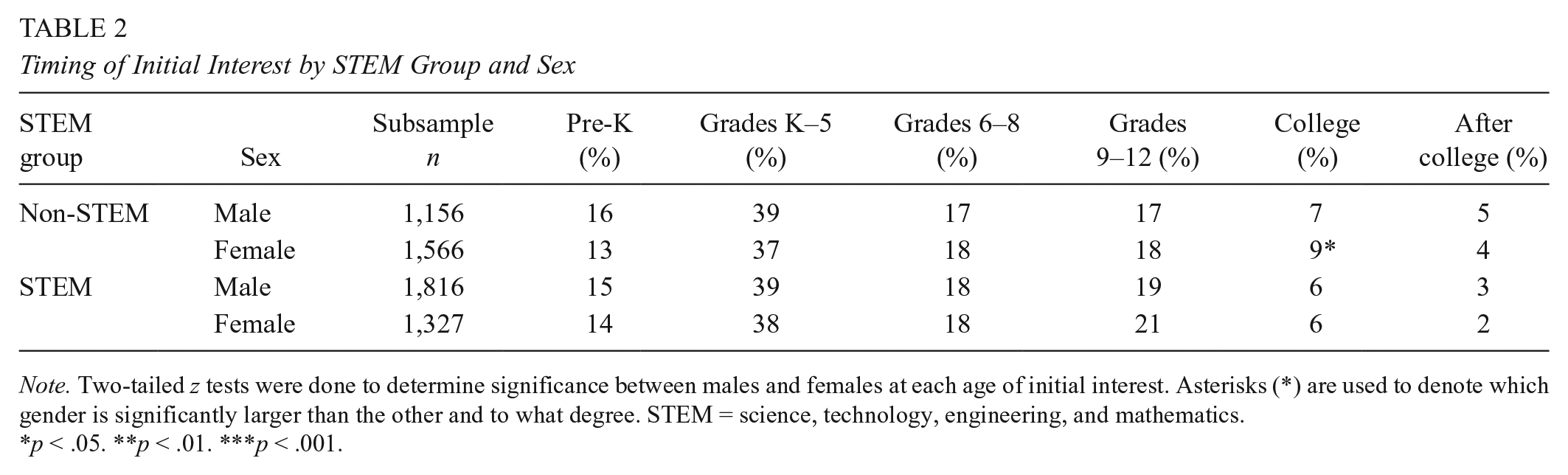
Note. Two-tailed z tests were done to determine significance between males and females at each age of initial interest. Asterisks (*) are used to denote which gender is significantly larger than the other and to what degree. STEM = science, technology, engineering, and mathematics.
p < .05. **p < .01. ***p < .001.
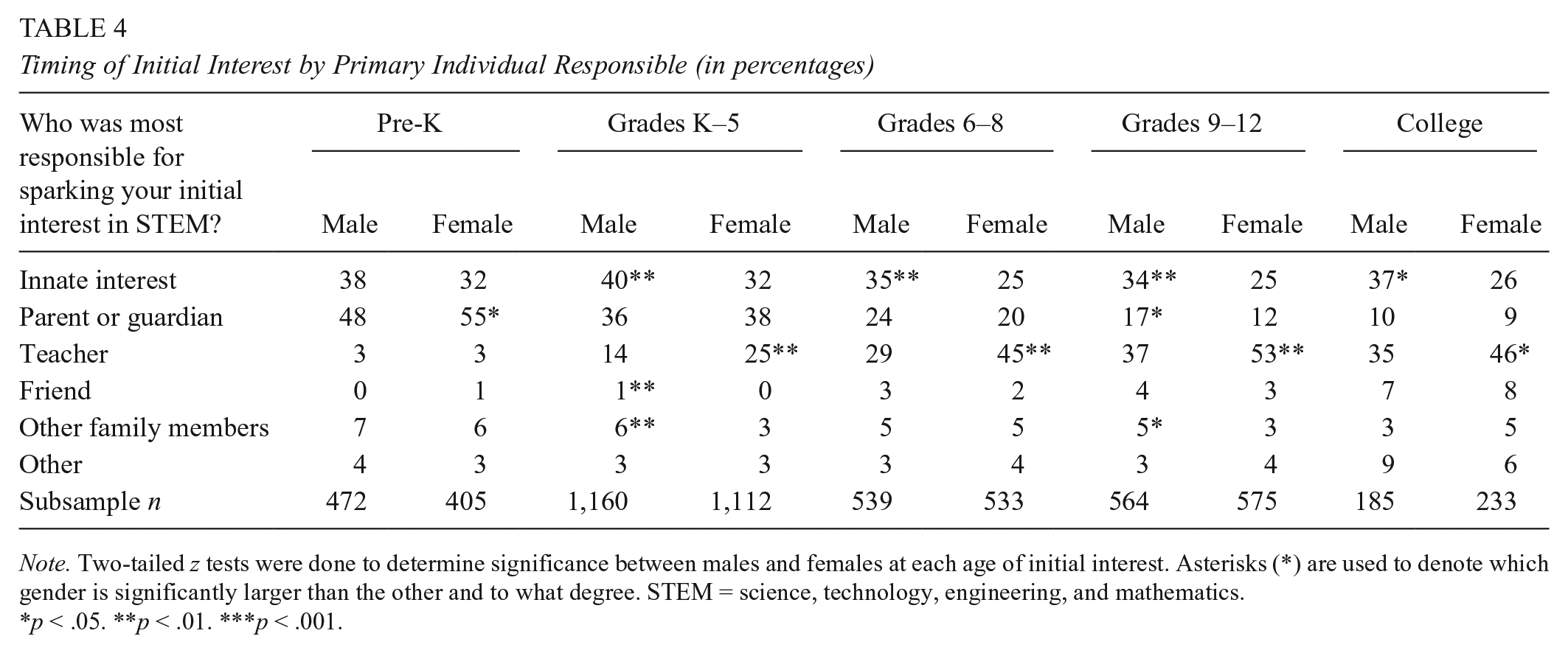
Given that a persistent question in STEM education research is whether males and females have different interests and predispositions, we sought to determine where differences might occur regarding what interested them in science, who was most critical in sparking this interest, and what factors were most significant for maintaining that interest. We found that there were both similarities and differences in what and who were associated with triggering interest among males and females (see Tables 3 and 4). Chi-square tests indicate that there are significant differences in the initial experiences reported within each age group: pre-K, χ2(10, 881) = 82.151, p < .001; Grades K to 5, χ2(10, 2280) = 173.045, p < .001; Grades 6 to 8, χ2(10, 1076) = 92.461, p < .001; Grades 9 to 12, χ2(10, 1142) = 94.758, p < .001; and college, χ2(10, 420) = 34.433, p < .001. Looking at STEM experiences across time (Table 3), the amount of reported independent interest (i.e., no one else was responsible) in STEM is not dominated by one sex. Instead, there is parity in the proportion of each sex reporting independent interest until middle school. In high school, significantly more males than females cite independent interest as their primary reason for STEM interest.
Timing of Initial Interest by Type of Experience (in percentages)

Note. Two-tailed z tests were done to determine significance between males and females at each age of initial interest. Asterisks (*) are used to denote which gender is significantly larger than the other and to what degree. STEM = science, technology, engineering, and mathematics.
p < .05. **p < .01. ***p < .001.
Timing of Initial Interest by Primary Individual Responsible (in percentages)
Note. Two-tailed z tests were done to determine significance between males and females at each age of initial interest. Asterisks (*) are used to denote which gender is significantly larger than the other and to what degree. STEM = science, technology, engineering, and mathematics.
p < .05. **p < .01. ***p < .001.
The most cited early experiences related to initiating STEM interest were building, tinkering, or taking apart mechanical objects or electronics; media; and playing or spending time outdoors. Males more frequently than females cited building, tinkering, or taking apart mechanical objects or electronics and media, whereas females more frequently referred to playing or spending time outdoors. Although tinkering and media remained significantly more commonly cited factors for males than females, across virtually all grade levels, the most prominent experiences for both sexes shifted over time.
Once respondents began their schooling, being interested in STEM through a class at school became one of the most cited experiences for both sexes. Across time periods, females more frequently reported having their initial interest triggered through a class at school than did their male peers, whose interests in STEM were initiated by a larger variety of experiences. Other experiences with significant differences between sexes include visits to a museum, zoo, aquarium, or nature reserve; interest in math problems or logic games; and participation in science fairs.
The individuals primarily responsible for students’ initial STEM interest correlate with the type and timing of students’ critical experiences (Table 4): pre-K, χ2(5, 877) = 8.386, p = .136; Grades K to 5, χ2(5, 2272) = 60.377, p < .001; Grades 6 to 8, χ2(5, 1072) = 32.261, p < .001; Grades 9 to 12, χ2(5, 1139) = 32.039, p < .001; and college, χ2(5, 418) = 9.508, p = .090. Prior to entering school, both males and females reported being interested in STEM primarily due to independent interest (i.e., no one else was responsible) or the influence of their parents or guardians—86% and 87% of these responses, respectively. At this age, females more frequently gave credit to their parents for initiating their STEM interest (55% to 48% of males). Once they enter school, females attribute an increasing amount of STEM influence to their teachers. Males, on the other hand, more frequently report independent interest in STEM throughout their education than do females.
Connecting back with the types of triggering experiences, those experiences most frequently reported by males appear to be more solitary activities driven by personal curiosity, whereas STEM interest in females appears to be more strongly associated with activities that involve others. These results provide internal consistency. We next sought to identify if this trend is maintained when examining the factors critical to individuals’ persistence in STEM fields.
Maintaining interest in STEM
We asked respondents to select the most important factors in maintaining their persistence in STEM between triggering initial interest and university. The resulting factors yield few significant differences between sexes when also considering our STEM groupings (Table 5): non-STEM, χ2(16, 1958) = 44.393, p < .001, and STEM, χ2(16, 2595) = 30.916, p = .014. At all three time points assessed (middle school, high school, and college), the factor cited most as influential in persisting in STEM was respondents’ interest or passion for the field. Furthermore, males refer to their own interest or passion for the field significantly more frequently than do females in middle school. These results coincide with Renninger and Su’s (2012) model of interest development in that those who continue to pursue STEM are those who are at more advanced phases of interest and who have the motivation and predisposition to reengage with the content of these fields. In terms of other important factors, there is a general shift from good grades and the influence of family during early time periods to whether classes were interesting, the influence of teachers, and the possibility of pursuing a career in STEM. The prominence of these factors is not significantly different between sexes except in middle school, when females cite good grades more frequently than males, and in college, when males cite the influence of their instructors more frequently than do females. The prevalence of good grades as a factor in STEM persistence correlates with Wigfield and Eccles’ (2000) EVT in that the good grades students receive may indicate to them their potential to succeed in STEM-related pursuits. Those who attained good grades likely felt that they could succeed in STEM and that it was valuable for them and others, which motivated them to continue pursuing it.
Factors in STEM Persistence in Middle School, High School, and College for Those Who Went on to Major or Earn Degrees in STEM

Note. The categories shown are the six with the highest percentages of answers, so percentages do not add up to 100%. Two-tailed z tests were done to determine significance between males and females at each age of STEM persistence. Asterisks (*) are used to denote which gender is significantly larger than the other and to what degree. STEM = science, technology, engineering, and mathematics.
p < .05. **p < .01. ***p < .001.
The shift in critical factors across time periods suggests that as individuals age, the primary motivating factors are initially external (e.g., good grades and pressure from family), but change to incorporate practical matters such as whether their pursuits give them positive feelings and the likelihood of obtaining a profitable career. We believe that this external-to-internal change of motivating factors likely reflects the situational to individual change in interest that is likely to lead to persistence in a field (Renninger & Hidi, 2016).
STEM pathway movement
Although comparisons of males and females at the levels described above indicate similar levels of interest at each time point, differences still remain in the numbers of males and females that pursue STEM degrees and careers. Although the point of divergence between males and females is yet unclear, our data indicate that there are interesting differences between males and females as they enter and move through their undergraduate years. Males (54%) made up a significantly larger portion of the group entering college with the intent to major in a STEM field than females, χ2(2, 5864) = 192.301, p <.001. Yet, the timing of individuals’ initial interests in STEM in relation to their intended major field of study largely remained the same (Table 6), as no group comparisons yielded any significant differences using chi-square tests. However, intentions do not always manifest into attainment.
Timing of Initial Interest by Intention to Major in STEM

Note. Two-tailed z tests were done to determine significance between males and females at each age of initial interest. Asterisks (*) are used to denote which gender is significantly larger than the other and to what degree. STEM = science, technology, engineering, and mathematics.
p < .05. **p < .01. ***p < .001.
Our data indicate there are many males and females who change majors into and out of STEM fields, with unexpected differences in the movement between sexes. Table 7 displays categorization of individuals based on their movement between fields (e.g., from STEM to non-STEM) during their time as undergraduates. Chi-square tests indicate that there are differences between males and females in movement, χ2(5, 3190) = 157.253, p < .001. Using two-tailed z tests for significance between sexes, our data indicate that 65% of males followed through with their intention to major in a STEM field in comparison with 44% of females (p < .01) with the same intentions; 13% of males followed through with their intentions to major in non-STEM fields in comparison with 26% of females who did so (p < .01). This does not necessarily mean that individuals failed in their attempts to attain a degree, but that there were more males pursuing STEM fields than females and that there was a large percentage of each sex that switched fields during their college years.
The Movement of Males and Females Into and Out of STEM Fields

Note. Two-tailed z tests were done to determine significance between males and females. STEM = science, technology, engineering, and mathematics.
p < .05. **p < .01. ***p < .001.
Results also indicate that a larger proportion of females than males leave STEM fields—10% of the males who changed majors were leaving STEM for non-STEM fields, whereas more females (13%) who changed majors were leaving STEM for non-STEM fields, supporting national trends (Chen, 2013). Interestingly, significantly higher proportions of females than males entered college with the intention to major in a non-STEM field before switching to a STEM field. Overall, this indicates that females more frequently report switching between STEM and non-STEM fields than do males and there is a higher proportion of males who obtain a STEM degree, whether they initially intended to or switched into these fields during college.
When looking deeper into the reasons behind why our respondents chose their majors and why they may have considered leaving a STEM major, the data are intriguing. Interest and enjoyment of the field was the top reason for picking any major, regardless of STEM or non-STEM designation, with 43% of males and 39% of females citing this as their primary reason. This makes sense with consideration of Renninger and Hidi’s (2016) model of interest development, as individualized interest is the phase of interest that would cause one to continue seeking information and pursuing a field. The ability of the major to prepare our respondents for their desired career was the second most cited reason, with 17% of males and 20% of females citing this reason as their deciding factor.
As this study and previous research demonstrate (Cleaves, 2005; Mosatche, Matloff-Nieves, Kekelis, & Lawner, 2013; Seymour, 1995; Shapiro & Sax, 2011; Wyer, 2003), early STEM school experiences are critical for students to develop initial interest in STEM. From these new data, we can also conclude that STEM experiences at progressive levels of education can influence students to continue their pursuit of the field or leave it, but there is no single experience that plays a significant role for everyone. Therefore, experiences in the college computer science classroom must be improved just as much as the elementary mathematics classroom or afterschool programming to help trigger and maintain students’ STEM interests.
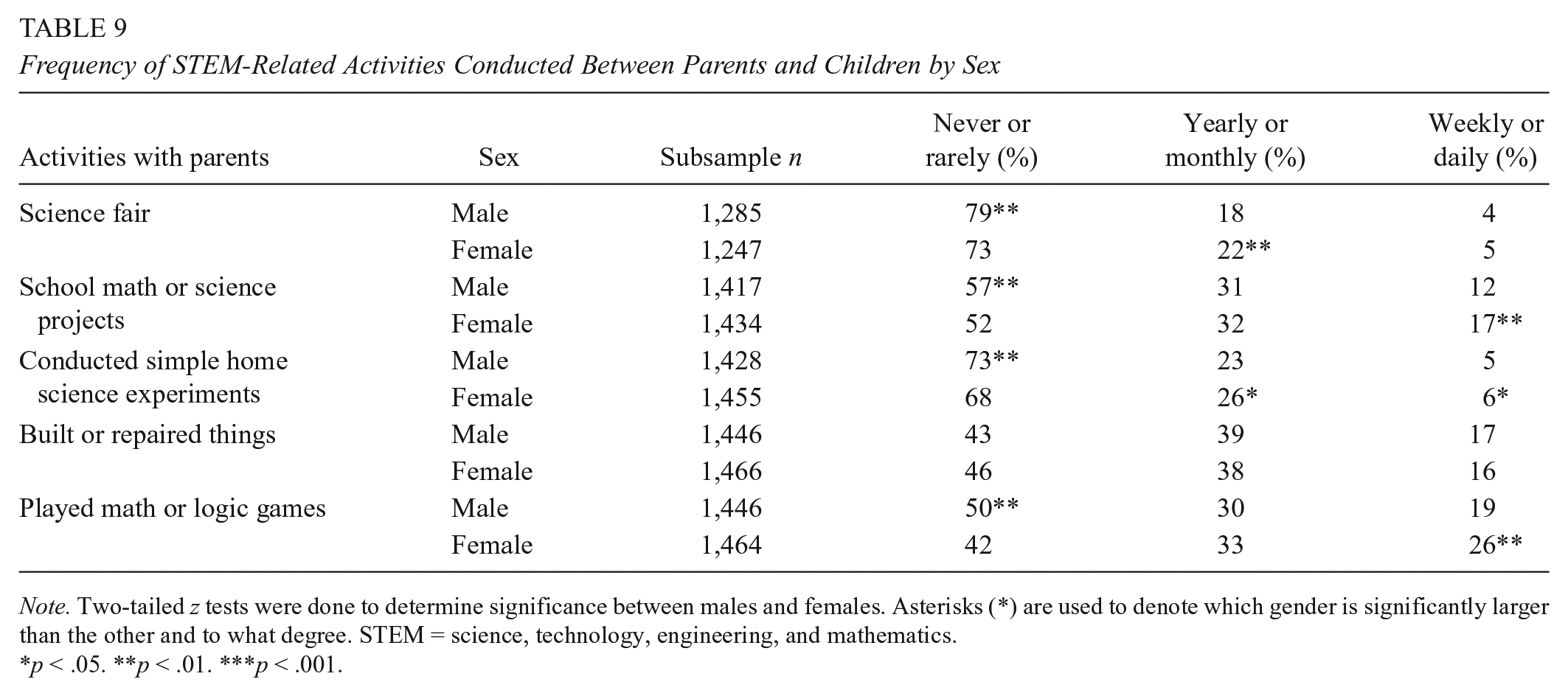
Looking at the patterns of movement from undergraduate field to graduate field and on to career, we see similar patterns (see online Supplementary Tables S2 and S3). The sex differences in flux may be attributed to a wide variety of factors that act as supports or barriers, including individuals’ motivations, differences in career opportunities for males and females, the effect of sex expectations upon marriage and careers, parental support of STEM pursuits, parents taking an active role in their kids’ STEM activities, parental STEM education, participants having a supportive peer in their field or having a role model or mentor in their field, among myriad other things. As shown in Table 8, parental support of STEM and non-STEM interests differed based on respondent sex, χ2(4, 5009) = 17.220, p = .002. A significantly greater percentage of females reported that their parents were not supportive of their STEM interests, and females were more likely to report that parents actively encouraged their non-STEM interests than males in our sample, which coincides with previous research indicating the important role that support from parents, as well as teachers and peers, plays in students’ lives (Crosnoe et al., 2008; Fouad et al., 2010; Leaper et al., 2012; Stake, 2006). Therefore, this may be a significant contributor to these respondents’ eventual pursuit (or not) of STEM, especially because the data we report above indicate that parents are one of the most influential groups in both males’ and females’ lives with regard to their initial STEM interest and persistence. However, as shown in Table 9, female respondents reported their parents’ participation in numerous STEM-related activities at a higher frequency than their male peers: science fair, χ2(2, 2532) = 12.312, p = .002; school math or science projects, χ2(2, 2851) = 17.017, p < .001; simple home science experiments, χ2(2, 2883) = 10.179, p = .006; played math or logic games, χ2(2, 2912) = 25.380, p < .001. The only category where there was no difference between sexes was built or repaired things, χ2(2, 2910) = 1.806, p = .405.
Parental Support of Their Children’s STEM and Non-STEM Interests by Sex

Note. Two-tailed z tests were done to determine significance between males and females. Asterisks (*) are used to denote which gender is significantly larger than the other and to what degree. STEM = science, technology, engineering, and mathematics.
p < .05. **p < .01. ***p < .001.
Frequency of STEM-Related Activities Conducted Between Parents and Children by Sex
Note. Two-tailed z tests were done to determine significance between males and females. Asterisks (*) are used to denote which gender is significantly larger than the other and to what degree. STEM = science, technology, engineering, and mathematics.
p < .05. **p < .01. ***p < .001.
Substantiating previous research (Crosnoe et al., 2008; Fouad et al., 2010; Leaper et al., 2012; Stake, 2006), our data (Table 10) indicate that more STEM females than STEM males reported supportive peers in their undergraduate major field: non-STEM, χ2(1, 1612) = 2.523, p = .112; STEM, χ2(1, 1673) = 21.515, p < .001. Females in STEM were also more likely than their male peers to report having a mentor in their major discipline: non-STEM, χ2(1, 1616) = 0.123, p = .726; STEM, χ2(1, 1718) = 6.011, p = 0.014. The differences that exist between sexes (e.g., the presence of a supportive peer) and the other significant variables discussed above may be among those that shape their attitudes (i.e., “expressed preferences and feelings towards an object”; Osborne, Simon, & Collins, 2003, p. 1054) toward STEM and their decisions whether to enter, continue, or leave STEM at any given stage of their education.
Percentage of Respondents That Had a Supportive Peer or Mentor During Their Undergraduate Major Program by Sex and STEM Group

Note. Two-tailed z tests were done to determine significance between males and females. Asterisks (*) are used to denote which gender is significantly larger than the other and to what degree. STEM = science, technology, engineering, and mathematics.
p < .05. **p < .01. ***p < .001.
Nature and Timing of Experiences Related to Persistence
Characteristics of male and female STEM majors
With many fundamental differences between males and females in the results above, we sought to further identify which characteristics and experiences were most closely related to pursuing a STEM degree for each sex. To accomplish this, we created logistic regression models to assess predictor variables including race; parents’ highest levels of education; presence of parent, peer, and mentor support; self-reported performance in science classes; and the when, what, and who that were associated with individuals’ initial interest in STEM. The dependent variable for all of these models was completion of an undergraduate degree in STEM (1 = STEM degree, 0 = non-STEM degree).
Models for males and females include slightly different variables because, even though they started out including all of the same predictors, they were iteratively removed to leave only those significant for each sex. Table 11 shows the variables that were retained in each model and indicates which of those were initially included but were removed from the final model due to lack of statistical significance (labeled as not significant). Variables that were initially included but were removed from all models due to insignificance were parent support of non-STEM interests, mentor support within major, parental assistance with the science fair, parent playing math or logic games with respondent, individual most responsible for initial STEM interest, overall undergraduate grade point average, and research experiences. Additionally, the global model was run to include sex as a predictor so that interactions between sexes could be assessed to determine where the differences were significant. Interactions that were initially included in the global model, but that were removed due to insignificance were sex by parent support of STEM interests, sex by parent support of non-STEM interests, sex by mentor support within major, sex by timing of initial interest, sex by initial STEM-interesting experience, sex by individual most responsible for initial STEM interest, sex by final course grade in first introductory college STEM class, and sex by research experiences. Readers interested in the full results from the models can find them in Table S4 in the supplemental materials online.
Logistic Regression Analysis Predicting Completion of a Degree in STEM: Critical Early Experiences for Males and Females

Note. Nagelkerke r-squared: male = .353; female = .399; global = .319. Subsample n: male n = 1,074; female n = 1,519; global n = 1,954. STEM = science, technology, engineering, and mathematics.
p < .05. **p < .01. ***p < .001.
The model for males to complete an undergraduate degree in STEM, as shown in Table 11, suggests that parental support of STEM interests, as reported by respondents, was associated with their pursuit of a STEM degree. Respondents whose parents were not supportive but did not actively discourage their STEM interests had lower odds of obtaining a degree in STEM than those whose parents actively encouraged their STEM interests. Similarly, respondents whose parents conducted simple home science experiments with them on a yearly or monthly basis had lower odds of completing a degree in STEM than if their parents never did these activities with them. A limitation of our data is that they do not reveal individuals’ feelings toward these activities. Because the odds of completing a degree in STEM decreased when males’ parents helped them on a yearly or monthly basis in comparison with never or rarely, this would suggest that—assuming these activities are done regardless of the amount of help received—having help from their parents with these activities is not associated with a male’s pursuit of STEM. This correlates with the lack of significance for males found in the peer and mentor support variables. Perhaps males generate a self-concept in STEM through independent interest and solitary activities that would not be deterred by the influence of others. Alternatively, it may be that males are simply more likely to ignore this external involvement when reflecting back on prior experiences. Our finding concurs with research indicating that peers do not deter males’ STEM drive as much as they do females’ (Crosnoe et al., 2008; Fouad et al., 2010; Leaper et al., 2012; Stake, 2006). It is also corroborated by research on motivation by Renninger and Su (2012), which indicates that individual interests and learning through personal inquiry develops deeper interest and understanding.
On the whole, the variety of initial experiences that sparked males’ STEM interest were not significantly different from the trigger of intrinsic interest in association with completion of a STEM degree, except in one instance. Males who became interested in STEM through the media or the science fair had much lower odds of obtaining a degree in STEM than were those who reported development of interest in STEM intrinsically. The lack of significance in the other possibilities for these variables does not mean that STEM-related activities, such as building structures, playing math or logic games, and visiting science museums, along with the involvement of certain individuals associated with these activities, such as parents, teachers, and friends, are not important for male students’ STEM interest development. Instead, it is just that they are not significantly different from independent interest in the odds that an individual will pursue a STEM major. When looking at the timing of interest, males who became interested in STEM during elementary school, middle school, high school, or the first or second year of college had greater odds of obtaining a degree in STEM than those who reported their interests were triggered prior to elementary school. Lastly, males who did not intend to major in STEM or were undecided in their major intentions had significantly lower odds of obtaining a STEM degree than did those who intended to major in it upon entering college.
The model for females to complete an undergraduate degree in STEM does not show any significant difference for one race or ethnicity over another, nor one level of their female or male parent’s education level over another. The degree of support that a female receives from her family is nearly significant (removed from the final model), but the support received from peers within a female’s major field is strongly associated with her completion of a STEM degree. Females had significantly lower odds of obtaining a degree in STEM if they did not have a supportive peer in their field than if they did. These results correspond with previous research indicating that relationships are strongly related to females pursuing a STEM major, perhaps more strongly than their male counterparts (Crosnoe et al., 2008; Leaper et al., 2012; Robnett & Leaper, 2012; Stake, 2006). This may indicate that females may be influenced more than males by positive and negative support regarding their interests and career ambitions. Females’ reports of the frequency by which they received parental assistance with science fair projects, school math or science projects, home experiments, building or repairing things, and playing math or logic games were not significant in relation to females’ odds of receiving a STEM degree nor was their timing of initial STEM interest or the experience that initiated it. Females who did not intend to major in STEM or were undecided had significantly lower odds of obtaining a STEM degree than did those who intended to major in it. Finally, females who received a B, C, D, or F grade in their first college STEM course had significantly lower odds of obtaining a degree in STEM than were those who reported receipt of an A grade. This final result coincides with the EVT (Wigfield & Eccles, 2000), in that females who received lower grades in their first college STEM course likely had lower expectancies of their aptitude and performance in future STEM courses and, subsequently, valued the field less and so discontinued their pursuit of the STEM degree.
Since the male and female models show differences in the variables that are significant in relation to each sex completing a STEM degree, we wanted to see which of the variables were significantly different for each sex. To do this, it was necessary to run a global model, which included all respondents with sufficient data and held sex as a background variable. This allowed us to test interactions between the sex variable and the variables we expected to produce differences between them. This global model indicated that certain variables are significant for each sex, however, some of the differences between the individual models were not significant when comparing the sexes, and others became significant. The reason this may happen is that even though the mean of the respondents’ answers were significant for a given sex, the confidence intervals surrounding each sex’s means may overlap, indicating that they are not significantly different from each other. It may be the case that the confidence intervals for both sexes are wide, which is causing the overlap. Another scenario, however, may be that the confidence interval of one sex’s mean for a given variable is small, although the other sex’s mean for that variable is wide, causing the overlap and lack of significance. There was one interaction, however, that yielded a significant difference.
The significant interaction was between sex and the presence of a supportive peer in the individual’s major field. Although the peer support variable, as a main effect, was not significant itself, it remained in the model because the interaction term was significant. This means that having a supportive peer in the field is not significant when including both sexes together. However, when comparing the significance of a supportive peer between sexes, of those individuals who did not have a supportive peer in their field, females manifest lower odds than males of completing a STEM degree.
All of these factors taken together indicate that males’ pursuit of a STEM degree is most strongly associated with parental support and the activities in which they participate, along with their internal drive to complete the degree without the help of others. The variables that are most strongly related to pursuit of a STEM degree for females involve the support and external feedback they receive from their peers as well as the grades they receive in their first STEM courses. In addition, comparisons between males and females along each of these variables indicate that significant differences lie in the effect that having a supportive peer in the field has on each sex’s completion of a STEM degree. These results give further credence to the notion that females’ pursuit of STEM degrees is more strongly associated with external factors and support than it is for males. We think this suggests that females’ interests in STEM are triggered by experiences that would fall toward the situational end of Renninger and Hidi’s model (Hidi & Renninger, 2006; Renninger & Hidi, 2016) of interest development and are based on more extrinsic reasons than those triggering experiences reported by males. Although the nature of triggering events is not the only reason for sex differences in pursuit of STEM, differences may also be due, in part, to the perception they have of their own abilities (Wigfield & Eccles, 2000).
Limitations
As with any study, there are limitations to our work and the conclusions we can draw. Since our data are generated from self-report, there are limitations based on the accuracy of the details respondents recount about their past experiences and based on the wording of items and response options. Although the results from our survey–resurvey are generally stable across a 1-year period, we understand that the remembered details of experiences are likely to change over time. On balance, we know of no other way to gather data from individuals that also provides crucial perspective on the importance of certain events that would be lacking from real-time data collection.
Similarly, through the survey we tried to be inclusive of topics that research indicates are associated with STEM persistence. There are limits on the depth and breadth to which data on these myriad factors can be collected. For example, although prior research demonstrates the importance of academic preparation and achievement on STEM persistence (Maltese & Tai, 2011; Tai, Liu, Maltese, & Fan, 2006), we felt that for most, remembering specific details about performance would be difficult and error prone. However, leaving these factors out of our models limits a more holistic evaluation. Further, although we understand there are likely to be multiple factors that trigger and maintain interest and persistence, at this stage of the research, we are seeking what the respondents consider the most significant events that fit the stated criteria. As we advance this research, we are working to address these limitations by collecting data and creating models that allow for the study of more complex relationships between factors and outcomes.
Another limitation to this study includes the difficulty in categorizing individuals into STEM or non-STEM due to shifts that occur between the various milestones used. Although we discussed these shifts, the changes individuals made between the STEM and non-STEM groups at various points must also be kept in mind when analyzing these and future results.
Conclusions and Implications
In this article, we present results from a large-scale study of factors associated with one’s initial interest and persistence in STEM—focusing specifically on differences in experiences for males and females. Although various aspects of STEM persistence have been researched previously, this study uses a large and broad sample, including individuals in and out of STEM, and a single instrument to collect rich detail about persistence along STEM pathways.
First, our findings reveal no real sex differences in the timing of initial interest in STEM. However, when parsed by the timing of initial interest and the types of experiences associated with these events, we see sex-associated differences. For example, males consistently reported that participating in building, tinkering, or making was involved in triggering their interests more frequently than females; conversely, females were more likely than males at every stage to report playing or spending time outdoors as a trigger. In terms of the individuals most associated with these initial experiences, there are strongly significant differences between sexes across K to 12. Males are consistently more likely to identify themselves as the only one associated with triggering interest, whereas females more frequently identify teachers, confirming some earlier work (Maltese & Tai, 2010). Although teachers must be aware of their interactions with all students to ensure they do not inadvertently dissuade them from pursuing STEM goals, it is especially important for teachers to be aware of how they may be tacitly encouraging or discouraging their female students’ STEM interests.
One novel contribution of this work is our investigation of how initial interest was maintained over time to contribute to STEM persistence. Interest (or passion) was identified as the most common factor for persisting in STEM, and this increases over time. Although some differences across sexes manifest, there are more similarities than differences in looking at the factors associated with persistence. It is interesting to note that we did see evidence for some shifting from external to internal factors across time periods when looking at persistence. This may provide some guidance toward intervention programs that trying to convince a fourth grader of the value of a career in STEM may not hold the value that it would for an 11th grader. On balance, looking at timing of initial interest related to their intentions to major in STEM showed essentially no important differences in timing of interest across sexes, indicating there is flexibility in the timing of interventions to trigger interest.
Moving to the university level, when asked about factors related to selecting a major, interest in the field was the top reason for picking any field, and there were no key differences across sexes. As they moved through college, a higher proportion of females reported switching majors in college, with females more commonly shifting into and out of STEM. Additionally, as has been a concern for years, more of both sexes shift from STEM fields to non-STEM fields than vice versa. Given that we focus on interest throughout much of this work, when participants were asked why they left or considered leaving STEM, loss of interest was rarely cited as a reason. Instead, respondents more frequently cited work-related concerns or issues, poor performance, or teaching and challenging classes, yet there were few key differences across sexes in their reporting of these factors.
Graduate school data indicate higher proportions of males leaving STEM and higher proportions of females entering STEM at this stage, which is counter to the conventional wisdom. Although the volume of each group is not equivalent, perhaps there are important things we can learn from studying those individuals who shift into STEM that can provide important new lines of investigation.
Focusing specifically on the role of parents in STEM persistence, our data indicate that parents were more likely to not encourage STEM (result is statistically significant but not large) and more likely to strongly encourage non-STEM activities (statistically significant and large difference between sexes). However, other results indicate that females were more likely to report frequent parent involvement in STEM-related activities, such as working on school science or math projects or playing math or logic games. This is an area that also requires further investigation to understand the dynamics at play here.
When looking at the role of peer and mentor support, we find that both are reported significantly more frequently for females than males in STEM, although there is no difference between sexes for those outside of STEM. Once of school age, females consistently reported teachers as associated with triggering their interests. In middle school and above, teachers were the individuals females reported as being most responsible, and at each of these levels, consistently more than males. It seems that the development of relationships and the support (or lack of) that females receive from various individuals who interact with them around STEM is related to their persistence, and likely more so than for men.
Given that females more frequently cite teachers, peers, and mentors as important to the triggering and maintenance of their STEM interests, our results suggest that interventions to increase the representation of females in STEM should focus on educating teachers, faculty, and other possible mentors about the value of their relationships with females. Further, part of this training or professional development should focus on how teachers, faculty, and other possible mentors can utilize these supportive relationships to promote the development of STEM interests in females.
Footnotes
Authors
ADAM V. MALTESE is an associate professor of science education at Indiana University Bloomington. His research focuses on the generation and maintenance of STEM interest and science learning.
CHRISTINA S. COOPER is an assistant professor of biology at Corban University. Her research focuses on science learning and the development of science interest.
References
Supplementary Material
Please find the following supplemental material available below.
For Open Access articles published under a Creative Commons License, all supplemental material carries the same license as the article it is associated with.
For non-Open Access articles published, all supplemental material carries a non-exclusive license, and permission requests for re-use of supplemental material or any part of supplemental material shall be sent directly to the copyright owner as specified in the copyright notice associated with the article.
