




Abstract
Academic achievement gaps between high- and low-income students born in the 1990s were much larger than between cohorts born two decades earlier. Racial/ethnic achievement gaps declined during the same period. To determine whether these two trends have continued in more recent cohorts, we examine trends in several dimensions of school readiness, including academic achievement, self-control, externalizing behavior, and a measure of students’ approaches to learning, for cohorts born from the early 1990s to the 2000–2010 midperiod. We use data from nationally representative samples of kindergarteners (ages 5–6) in 1998 ( n = 20,220), 2006 ( n = 6,600), and 2010 ( n = 16,980) to estimate trends in racial/ethnic and income school readiness gaps. We find that readiness gaps narrowed modestly from 1998 to 2010, particularly between high- and low-income students and between White and Hispanic students.
Racial, ethnic, and income disparities in performance on standardized tests of academic achievement are a stubborn feature of the U.S. educational landscape. The White-Black and White-Hispanic achievement gaps in math and reading in Grades 4 to 12 range from roughly 0.50 to 0.85 standard deviations in recent years; the gap in achievement between kindergarten students from high- and low-income families was roughly 1.25 standard deviations in 1998 (Hemphill, Vanneman, & Rahman, 2011; Reardon, 2011; Reardon, Robinson-Cimpian, & Weathers, 2015; Vanneman, Hamilton, Baldwin Anderson, & Rahman, 2009). These disparities are present when children enter kindergarten, and they persist as children progress through school (Fryer & Levitt, 2006; V. E. Lee & Burkham, 2002; Reardon, 2011).
These academic achievement disparities are not immutable social facts, however. Indeed, they have changed substantially in the last few decades. The White-Black and White-Hispanic achievement gaps were considerably larger in the 1970s than they are today; these gaps narrowed sharply in the 1970s and 1980s, before plateauing through much of the 1990s and then beginning to narrow again in the last 15 years (National Center for Education Statistics [NCES], 2013; Reardon et al., 2015). The income achievement gap, in contrast, was considerably smaller in the 1970s than it is today but grew by roughly 40% between cohorts born in the mid-1970s and the mid-1990s (Reardon, 2011). The causes of these changes are not well understood.
In this article, we provide new evidence on very recent trends in these achievement gaps. In particular, we use newly available data to describe the trends in the magnitude of racial/ethnic and income gaps in math and reading skills among students entering kindergarten from the fall of 1998 to the fall of 2010. We focus on income-related gaps, rather than gaps related to parental education, occupation, or more general socioeconomic status, for comparability with the earlier income academic achievement gap trends reported by Reardon (2011). We also describe trends in racial/ethnic and income gaps in students’ self-control, approaches to learning, and externalizing behavior. Because almost all other evidence on trends in academic achievement gaps is based on math and reading tests given to students in Grades 3 to 12 and because there has been little emphasis on income disparities in children’s behavioral school readiness, our analyses fill several important lacunae in the literature. Moreover, they indicate whether the trends among birth cohorts from the 1970s to 1990s in the income academic achievement gap documented by Reardon have persisted among more recent cohorts. Finally, they may help us to better understand the sources of the continuing decline in elementary school racial/ethnic achievement gaps. It is important to note, however, that our analyses here are fundamentally descriptive, not explanatory; we are able to identify patterns of change (and stability) in school readiness gaps, but we do not attempt here to present definitive explanations for these patterns.
Recent Trends in Academic Achievement Gaps
White-Black and White-Hispanic academic achievement gaps have been declining for the last decade or more. Over the past 15 years, the gaps in fourth-grade math and reading skills, as measured by the National Assessment of Educational Progress (NAEP), have narrowed by roughly 0.10 to 0.20 standard deviations, depending on the subject, group, and data source (see Figure 1). Similar patterns are evident in eighth grade (Reardon et al., 2015). Nonetheless, although it is clear that racial/ethnic achievement gaps have narrowed in the fourth and eighth grades, it is not clear to what extent this is a result of (a) gaps being smaller when children arrive in kindergarten or (b) gaps now changing differently during the early elementary grades. The former suggests that the causes of the declines in Grade 4–8 racial/ethnic gaps cannot be found in changes in opportunities provided by the K–12 educational system; the latter suggests that they might be.

Trends in academic achievement gaps: age 9 and Grade 4. Gap estimates are based on data from the National Assessment of Educational Progress (NAEP) as reported in Reardon, Robinson-Cimpian, and Weathers (2015).
At the same time, the academic achievement gap between children from high- and low-income families widened considerably—by about 40%—between cohorts born in the 1970s and the 1990s (Reardon, 2011). Reardon (2011) argued that because the income achievement gap does not appear to grow during the schooling years, the reasons for its increase must be found in trends over time in the size of achievement gaps at kindergarten entry. It is unclear if the income achievement gap at kindergarten entry has changed in the last decade, however. The most recent cohorts in Reardon’s data were born in 1992/1993 and 2001 (entering kindergarten in 1998 and 2006/2007, respectively). The sampling designs for these two cohorts were not strictly comparable, however, making estimation of the trend in the income achievement gap for cohorts born after the early 1990s difficult. Newly available data, however, provide a nationally representative sample from the kindergarten class of 2010 (who were mostly born in 2004/2005) that is quite comparable to the 1998 kindergarten sample. These data will provide information on whether the income achievement gap has continued to grow in recent cohorts.
Behavioral School Readiness
Cognitive skills have played a dominant role in research on educational and social inequality, as early academic skills are thought to provide a foundation to support ongoing engagement in learning throughout schooling (Magnuson, Duncan, Lee, & Metzger, 2016). Cognitive skills at kindergarten entry are strong and consistent predictors of later academic achievement (G. J. Duncan et al., 2007) and predict adult earnings (Chetty et al., 2011). Yet studies have highlighted the importance of other behavioral domains of school readiness for later academic achievement, such as self-control, attention, and externalizing behaviors (G. J. Duncan et al., 2007; Jones, Greenberg, & Crowley, 2015; Turney & McLanahan, 2015). Children who lack the self-control and attentional processes necessary to focus on educational material tend to exhibit challenges in learning and engaging with classroom activities (Blair, 2002). There is consistent evidence that the ability to control and sustain attention predicts academic achievement during elementary school, after controlling for children’s academic ability (Claessens & Dowsett, 2014; G. J. Duncan et al., 2007).
Children’s externalizing behavior problems are also thought to affect individual learning and school engagement, yet empirical support for this is mixed. Some studies find a strong relation between the two (Burt & Roisman, 2010; Turney & McLanahan, 2015), while others find a weak or null association (Claessens, Duncan, & Engel, 2009; G. J. Duncan et al., 2007). It remains unclear whether disruptive behavior leads to reduced academic achievement or whether failures in academic achievement may contribute to escalations in externalizing behavior problems (Burt & Roisman, 2010; Claessens & Dowsett, 2014).
In contrast to the extensive literature examining racial/ethnic and, more recently, income achievement gaps, few studies have examined gaps in behavioral skills. Using data from the Early Childhood Longitudinal Study–Birth Cohort (ECLS-B) at age 4, Waldfogel and Washbrook (2011) found that, on average, children in the poorest and wealthiest income quintiles scored at the 55th and 44th percentiles on measures of hyperactivity, respectively, where higher scores indicate greater incidence of problem behavior. Similar income differences were found on a measure of conduct problems. Using data from the Early Childhood Longitudinal Study–Kindergarten Cohort (ECLS-K) from 1998, G. J. Duncan and Magnuson (2011) report White-Black kindergarten gaps in externalizing behavior that are roughly the same as the gaps between children from families of high and low socioeconomic status (0.31 and 0.26 standard deviations, respectively), while White-Hispanic gaps are nonexistent (see also Magnuson & Duncan, 2005). Furthermore, Black-White and socioeconomic status gaps in attention and engagement are substantial at kindergarten entry (0.36 and 0.63 standard deviations, respectively).
These studies do not provide evidence about the trends in income and behavioral skill gaps. By comparing cohorts of first-time kindergarteners in 1998 and 2010, this study describes recent trends in income and racial/ethnic gaps in academic and behavioral indicators of school readiness. An understanding of the trends in gaps in measures of self-control, approaches to learning, and externalizing behavior problems, in addition to academic achievement, provides a more complete picture of children’s school readiness gaps. Moreover, the behavioral school readiness gap trends may help to explain why academic achievement gaps changed over the same cohorts.
Why Might Racial/Ethnic and Income School Readiness Gaps Have Changed Since 1998?
There are a number of reasons to suspect that racial/ethnic and income school readiness gaps might have changed from 1998 to 2010, including changes in the income distribution (including changes in racial income disparities), changes in parental investments in children, changes in residential segregation, changes in preschool enrollment patterns, and changes in social policies that affect children. We consider the potential impact of these on school readiness gaps here.
Income inequality grew moderately from the 1990s through 2010. Among families with children, the ratio of the 90th percentile of the income distribution to the 10th percentile grew from an average of 9.3 in 1993–1998 to an average of 9.8 in 2005–2010 (based on our calculations from Current Population Survey data). The 1998 kindergarten cohort grew up (from birth to age 5) in a period of strong economic growth; the 2010 cohort spent half of its early childhood in the Great Recession (which officially lasted from December 2007 to February 2010 but the effects of which certainly persisted beyond then). The recession disproportionately affected the employment and earnings of low-income families and contributed to growing wage inequality.
Racial/ethnic disparities in family income narrowed sharply in the 1990s before growing somewhat in the 21st century (Monnat, Raffalovich, & Tsao, 2012). The Black-White difference in child poverty rates declined from 29 to 24 percentage points between 1993–1998 and 2005–2010; the Hispanic-White difference declined from 27 to 20 percentage points during the same period. 1
These changes in income distribution patterns may have led to changes in income and racial/ethnic school readiness gaps, possibly through the operation of a “virtuous cycle” in which declining inequality in one generation leads to more equal educational outcomes in the next (Long, Kelly, & Gamoran, 2012). Family income has been shown to affect children’s cognitive abilities and social-emotional competence (Dahl & Lochner, 2012; G. J. Duncan, Morris, & Rodrigues, 2011); as a result, rising income inequality may lead to growing income-related disparities in children’s cognitive and social-emotional development. Conversely, the narrowing racial/ethnic differences in child poverty may have led to narrowing racial/ethnic gaps in school readiness.
These effects of family income on children likely operate through family contexts and parental behaviors (Gershoff, Aber, Raver, & Lennon, 2007). With increased income, parents may invest money and time into their children to provide educational and developmental “inputs” that influence children’s developmental outcomes (Becker, 2009). In fact, along with an increase in income inequality, the time from the mid-1990s to the 2000–2010 midperiod saw a substantial increase in average parental spending on children, with the largest increases coming from higher spending on young children (ages 0–5) and college-age children. Data from the nationally representative Consumer Expenditure Surveys show that high-income families increased their spending on children over this period by 27%, as compared with a 12% increase among low-income families (G. J. Duncan & Murnane, 2011; Kornrich & Furstenberg, 2013), with higher-income families spending more money on child care and cognitive enrichment activities and resources (Kaushal, Magnuson, & Waldfogel, 2011).
The amount of time that parents spent with their children also grew from 1994 to 2008, but the increase was much greater among college-educated parents than those without a college degree, according to data from the nationally representative American Time Use Surveys (Guryan, Hurst, & Kearney, 2008; Ramey & Ramey, 2010). Kalil, Ryan, and Corey (2012) showed not only that a college education resulted in mothers’ greater time investments in children but that these mothers also adjusted the composition of time spent with their children depending on their developmental stage. Notably, college-educated mothers spent more time in basic care and parent-child play during ages 0–2, when this type of play is most developmentally appropriate, and they transitioned to spending more time in teaching-related activities when children were in preschool (ages 3–5), a developmental stage when time spent in learning activities, such as reading, increase children’s school readiness. If these mothers are spending more time exhibiting positive regard to their young children, providing greater environmental and cognitive stimulation, and scaffolding their children’s activities in developmentally appropriate ways, these parenting behaviors may also promote young children’s cognitive, social-emotional, and behavioral well-being (Fay-Stammbach, Hawes, & Meredith, 2014; Raver, 2002; Tamis-LeMonda, Shannon, Cabrera, & Lamb, 2004).
Both of these increased disparities may be a result of growing income inequality: Higher incomes provide families with more disposable income to invest in children and may also provide greater opportunity for parents to spend time with their children. Together this body of evidence provides an additional reason to suspect that there may have been an increase in the income gap in school readiness at kindergarten entry.
A second factor that may affect school readiness gaps is residential segregation. Economic residential segregation grew from 1990 to 2009 (Bischoff & Reardon, 2014). Given the positive association between neighborhood conditions and children’s cognitive development and educational outcomes (Brooks-Gunn, Duncan, & Aber, 1997; G. J. Duncan, Brooks Gunn, & Klebanov, 1994; Klebanov, Brooks-Gunn, McCarton, & McCormick, 1998; Leventhal & Brooks-Gunn, 2000) and between physical/psychosocial stressors and children’s self-regulatory difficulties (Evans & English, 2002; McCoy, 2013; McCoy & Raver, 2014), increasing economic segregation might have led to increasing income disparities in kindergarten readiness. New evidence from a randomized housing voucher program is consistent with this, showing that living in a high-poverty neighborhood negatively affects young children’s long-term educational outcomes (Chetty, Hendren, & Katz, 2016).
Although income segregation grew from 1990 to 2009, racial/ethnic segregation declined from 1990 to 2010 (B. A. Lee, Iceland, & Farrell, 2014). Moreover, the average poverty rate in the neighborhoods of Black and Hispanic households declined by 2 to 3 percentage points from 1990 to 2009, while the average poverty rate in White households’ neighborhoods increased slightly (Logan, 2011). This modest reduction in racial/ethnic disparities in exposure to neighborhood poverty may have led to smaller racial/ethnic kindergarten readiness gaps.
Another factor that may have affected income and race/ethnic gaps in school readiness is the increasing availability (and perhaps quality) of preschool programs. Historically, White and higher-income children are more likely to attend preschool than non-White and lower-income children (Magnuson & Duncan, 2014; Magnuson, Meyers, & Waldfogel, 2007). Although preschool enrollment has increased for high- and low-income children, the increase has been greater for low-income children, narrowing the income enrollment gap since the early 1990s (Magnuson & Duncan, 2014; Magnuson & Waldfogel, 2016). Magnuson and colleagues (2007) argue that the increase in enrollment rates and the decline in the enrollment gap between high- and low-income children are largely due to increases in public funding for preschool programs over this period. The increased enrollment of children from low-income families in preschool programs may have led to a reduction in the school readiness gaps at kindergarten entry.
The Hispanic-White gap in preschool enrollment also narrowed over the last two decades, again because Hispanic enrollment rates rose much more rapidly than White enrollment rates. Black and White enrollment rates have been roughly equal and rising at the same rate since the 1970s (Magnuson & Waldfogel, 2016). The narrowing Hispanic-White preschool enrollment gaps might suggest that the corresponding school readiness gap has narrowed as well. Moreover, given the evidence that preschool programs increase school readiness more for low-income and minority children than for higher-income children—likely because, in the absence of preschool, higher-income children may have better access to developmentally stimulating experiences (Bassok, 2010; Magnuson, Meyers, Ruhm, & Waldfogel, 2004)—overall increases in preschool enrollment rates may reduce school readiness gaps, even if there were no narrowing of the enrollment rate gap.
A final reason to think that income school readiness gaps may have narrowed in the last decade is the expansion of publicly funded health insurance for children since 1997. The 1997 Children’s Health Insurance Program law expanded public funding for children’s health insurance for families with incomes too high to qualify for Medicaid but who cannot afford private health insurance (see http://www.medicaid.gov/chip/chip-program-information.html). Between 1997 and 2010, the proportion of uninsured children in the U.S. declined from 14% to 8% (see http://kff.org/health-reform/issue-brief/childrens-health-coverage-medicaid-chip-and-the-aca/). The evidence on whether the expansion of health care coverage for low- to middle-income children during this period improved health outcomes is mixed, although it does show that the expansion reduced child hospitalization and mortality (Howell & Kenney, 2012). Limited research on the effects of health insurance expansion on educational outcomes indicated that eligibility at birth was related to increased reading scores in the fourth and eighth grades (Levine & Schanzenbach, 2009), while expansions when children were already in school improved long-run educational outcomes, such as high school completion (Cohodes, Grossman, Kleiner, & Lovenheim, 2014). Given this early evidence, one might expect increased health care coverage to lead to improvements in a range of developmental outcomes. If that is the case, then the expansion of publicly funded children’s health insurance since 1997 may have led to narrowed income school readiness gaps—and possibly to narrowed racial/ethnic gaps as well, given that the families affected by the Children’s Health Insurance Program expansion are disproportionately Black and Hispanic.
This is far from an exhaustive list of factors that might influence racial/ethnic and income school readiness gaps, but it does suggest that it is not clear whether one should expect the school readiness gaps to have widened or narrowed between 1998 and 2010. To investigate if and how these gaps have changed in that period, we examine data from several nationally representative samples of kindergarten students in 1998 to 2010. Using these data, we measure income and racial/ethnic gaps in children’s academic and behavioral skills at kindergarten entry.
Method
Data
We use data from three studies conducted by the NCES: two ECLS-K studies, which include children who entered kindergarten in fall 1998 (ECLS-K:1998) and fall 2010 (ECLS-K:2010), and the ECLS-B, which includes children who entered kindergarten in fall 2006 or 2007. These studies are multimethod and multi-informant, providing measures of children’s academic skills, behavior, and early school experiences. We describe the studies’ key features here; various technical reports provide detail on their design and measures (Snow et al., 2009; Tourangeau et al., 2001; Tourangeau et al., 2013). 2
To a great extent, the measures used in the ECLS-K studies draw from similar domains to allow for comparison of the characteristics and experiences of these two cohorts who were in kindergarten more than a decade apart. Because the kindergarten data collection of the ECLS-K:2010 and ECLS-B was designed to be comparable to that of the ECLS-K:1998, much of the content, measures, and data collection procedures of the three studies were the same or similar. Direct child assessments and items from the teacher and parent surveys were often used or modified directly from the ECLS-K:1998. Unfortunately, it is not possible to use the ECLS studies to measures changes in absolute levels of academic and behavioral skills from 1998 to 2010, because the child assessments and survey scales were not scaled the same way in the three studies. Instead, we standardize the scores within each study and compute school readiness gaps in these standardized scales. The gaps are therefore measured relative to the population standard deviation of the measures at each point in time.
ECLS-K:1998
The ECLS-K:1998 followed a nationally representative sample of 21,400 children from their 1998–1999 kindergarten year through eighth grade (note that all sample sizes are rounded in accordance with NCES guidelines). We use outcome data from fall and spring of kindergarten, as collected through direct child assessments, computer-assisted parent interviews, and self-administered teacher surveys.
ECLS-K:2010
The ECLS-K:2010 tracks a nationally representative sample of 18,170 children who entered kindergarten in the 2010–2011 school year through fifth grade. We use data from the first two waves of data collection: fall and spring of kindergarten. The data collection procedures for the ECLS-K:2010 were the same as in the ECLS-K:1998.
ECLS-B
The ECLS-B includes a nationally representative sample of 10,700 children born in the United States in 2001 and followed through kindergarten. We use data from the final wave of the study, collected in the year when children entered kindergarten. Roughly one-third of the ECLS-B sample was not observed in the final wave of the study, due to sample attrition; we use poststratification weights constructed by the NCES to weight the remaining sample so that it is representative of its cohort. Seventy-five percent of the sample remaining in the study’s final wave entered kindergarten in 2006, while the remaining 25% entered in 2007. Direct assessments were conducted from September 2006 through March 2007 for the kindergarten 2006 wave and October 2007 through March 2008 for the kindergarten 2007 wave. As a result, we examine gaps at only one time point for these children. We do not include teacher- and parent-reported measures from this sample.
Measures
Language screener
The ECLS-K made efforts to include children who spoke a language other than English. In the ECLS-K:1998, the Oral Language Development Scale (OLDS) language screener was administered to children who were determined to have a non–English language background. The OLDS consisted of three parts adapted from the Preschool Language Assessment Scale (preLAS 2000; S. Duncan & De Avila, 1998). If children passed this screener, they received the full direct child assessment in English. Children who did not pass were administered a reduced version of the direct assessments. In the event that a child spoke Spanish, he or she was administered an alternate form of the language screener, the Spanish version of the OLDS. If the student passed, he or she was administered a Spanish-translated form of the mathematics assessment. Regardless of their native language, children not meeting the English proficiency threshold were not administered the reading assessment.
In the ECLS-K:2010, all children, regardless of home language, were administered the language screener as the first component of the direct cognitive assessment. The screener consisted of two tasks from the preLAS 2000 (S. Duncan & De Avila, 1998). All children also received the first section of the reading assessment, referred to as the English Basic Reading Skills (EBRS) section, regardless of their home language or performance on the preLAS 2000 tasks. The reading assessment ended after this first section if a child’s home language was not English and he or she did not score at least 16 (out of 20) points on the combined preLAS 2000 and EBRS assessments. Spanish speakers who did not pass were administered a short reading assessment in Spanish (Spanish Basic Reading Skills) as well as a translated mathematics assessment. Those children whose home language was neither English nor Spanish and who did not pass the preLAS 2000 and EBRS were not administered any of the remaining cognitive assessments after the EBRS.
The ECLS-B used Spanish translations of measures for Spanish speakers who did not pass an English fluency screening measure. A Spanish preLAS 2000 was given to assess the language skills of non-English speakers who spoke Spanish. A translated mathematics assessment was administered as well as a Spanish Peabody Picture Vocabulary Test (Dunn & Dunn, 1997).
Even though the studies excluded some children from the assessments, we imputed all children’s outcome scores using the method described below to make maximum use of the data. Nonetheless, we do not report trends in White-Hispanic reading gaps, because differences in screening procedures render comparisons among the surveys invalid. Imputed scores for students not administered the reading assessment are used in the computation of the income reading gaps, but the results are robust to the exclusion of these students as well. Because all Spanish-speaking students were administered the math test in all three studies, we do report White-Hispanic math gap trends.
Reading achievement
In all studies, direct child assessments in reading measured basic reading skills, such as print familiarity, letter recognition, beginning and ending sounds, rhyming sounds, word recognition, and receptive vocabulary. Reading comprehension items targeted initial understanding, developing interpretation, personal reflection, and demonstrating critical stance.
Mathematics achievement
In all studies, direct child assessments in mathematics measured conceptual knowledge, procedural knowledge, and problem solving through items related to number sense, number properties, operations, geometry and spatial sense, data analysis, statistics, probability, patterns, algebra, and functions.
Self-control
The Self-Control Scale used in the ECLS-K studies is drawn from the Social Rating Scale, a measure adapted from the Social Skills Rating System (Gresham & Elliott, 1990), which includes items that assess children’s ability to control their behavior. Four items completed by teachers via self-administered surveys assessed children’s ability to respect the property rights of others, control their tempers, accept peer ideas for group activities, and respond appropriately to pressure from peers. Five items reported by parents via computer-assisted interviews included positively and negatively worded behaviors, such as “the frequency with which a child fights, argues, throws tantrums, or gets angry.” All items were rated on a 1–4 scale from never to very often.
Approaches to learning
The Approaches to Learning Scale used in the ECLS-K studies is also adapted from the Social Skills Rating System (Gresham & Elliott, 1990). This scale measured behaviors that affect children’s ability to benefit from the learning environment. Teachers rated six items regarding children’s attentiveness, task persistence, eagerness to learn, learning independence, flexibility, and organization. Parents rated six items on children’s eagerness to learn, interest in a variety of things, creativity, persistence, concentration, and responsibility. All items were rated on a 1–4 scale from never to very often. While the Approaches to Learning scale was the same across the ECLS-K studies, teachers answered one extra item in the ECLS-K:2010 because an item on whether the child “follows classroom routines” was added in the first-grade round of ECLS-K:1998.
Externalizing behavior
The Externalizing Behavior Scale was asked of teachers in only the ECLS-K studies and was designed to assess children’s acting-out behaviors. It too was adapted from the Social Skills Rating System (Gresham & Elliott, 1990). Five items rate the frequency with which a child argues, fights, gets angry, acts impulsively, and disturbs ongoing activities. All items were rated on a 1–4 scale from never to very often.
Because the scales measuring self-control, approaches to learning, and externalizing behavior are comparable in the ECLS-K studies, we can examine trends in behavioral gaps at kindergarten entry. Nonetheless, since they are reported by parents and teachers, these scales are not standardized in the way that task-based measures are and so may include reference bias. Parents in different communities may assess their children’s behaviors differently, using relative comparisons to evaluate children’s behavior (Miller, 1995), and they may have different norms about school readiness. We therefore include parent-reported outcomes in our set of measures only because they yield information on changes in parents’ relative perceptions of school readiness; that is, we do not think that they should be interpreted as providing definitive evidence of changes in school behavioral readiness.
For this reason, we emphasize the teacher-reported behavioral measures over parent-reported outcomes in this study. Yet even teacher reports may suffer from reference bias if teachers assess children’s readiness relative to their schoolmates rather than against national norms. Indeed, Bassok, Latham, and Rorem (2016) found that kindergarten teachers in schools enrolling high proportions of non-White or poor students were more likely to say that children should know their alphabet and have formal math and reading instruction before kindergarten and should be able to read in kindergarten. Moreover, teachers’ school readiness expectations increased from 1998 to 2010. These differential expectations of school readiness will upwardly bias teacher-reported estimates of readiness gaps and will downwardly bias estimates of trends in children’s readiness levels. But the trends in the readiness gaps—which is our focus here—will be biased only if teachers’ readiness expectations change differently between 1998 and 2010 in high- and low-poverty or high- and low-minority enrollment schools. Bassok and colleagues found no consistent evidence of such differential changes. Nonetheless, because of the potential for other differential changes in factors affecting teachers’ reports of children’s kindergarten readiness, we suggest cautious interpretation of the trends based on these measures.
Income and race
Children’s primary race/ethnicity and household income were reported by parents during the parent interviews in each study. In the data sets, we classified children as Hispanic if their parents indicated that they were Hispanic, regardless of how parents reported their race. Children not classified as Hispanic were classified as White, Black, Asian, or “other”—a category that included a small percentage of children whose parents reported multiple racial categories. Family income was reported by the parents in the kindergarten year in each study. Income was reported as a continuous variable in the ECLS-K:1998 and as an ordered categorical variable in the ECLS-B and ECLS-K:2010 (with 13 and 18 categories, respectively).
Data Analysis
Sample restrictions
We restrict the sample to first-time kindergarteners because of our interest in assessing kindergarten readiness gaps. In the ECLS-K studies, we dropped from the sample children who were repeating kindergarten, as reported by parents (850 children in the 1998 cohort, 840 in the 2010 cohort). Among students whose parents did not answer the question on kindergarten repetition, we dropped those born prior to June 1 in 1992 or 2004 (who would have been at least 6.25 years old by September 1 of 1998 or 2010). Although some of these children may have been first-time kindergarteners whose parents “redshirted” them (i.e., delayed their kindergarten entry for a year beyond when they were initially eligible), redshirting is uncommon among children born this early in the calendar year (Bassok & Reardon, 2013), so it is likely that these children were repeating kindergarten (n = 260 in the 1998 cohort, n = 210 in the 2010 cohort). Children born after May 1992 or 2004 whose parents did not answer the question about repeating were included, although it was not clear whether they were redshirters or repeaters; very few children were included for this reason (n = 110 in 1998, n = 50 in 2010).
In the ECLS-B, this restriction was straightforward, since parents reported on the year that children entered kindergarten. We dropped children who were not enrolled in school in 2006 or 2007, who entered straight into first grade, or who were homeschooled (n = 350).
We also dropped cases for whom race or gender information was missing. We dropped 80 children from the 1998 cohort (missing race, n = 70; missing gender, n < 10), and 150 from the 2010 cohort (missing race, n = 80; missing gender, n = 70). In the ECLS-B, we dropped <50 missing cases for race and none for gender.
These restrictions resulted in a final sample size of 20,220 children in the ECLS-K:1998 (from an original sample of 21,400), 16,980 children in the ECLS-K:2010 (from an original sample of 18,170), and 6,600 children in the ECLS-B (from 10,700 in the original sample, 7,000 of whom who remained in the study at kindergarten entry). We use the ECLS-B poststratification weights to adjust for sample attrition. Nonetheless, the attrition in the ECLS-B makes the estimates from that study less certain than those from the ECLS-K studies, which have no sample attrition because the samples were drawn in fall of kindergarten.
Multiple imputation
Multiple imputation was conducted through the mi commands in Stata 13.0, with chained equations and 20 iterations. The imputation model for all three studies used a regression model that included child age, gender, race, income, and a socioeconomic status composite included in the data sets. The imputation models also included all the math, reading, and behavioral measures administered during kindergarten and first grade (when available). The ECLS-K:1998 imputation model also included the OLDS English proficiency screener score, while the ECLS-K:2010 imputation model included the EBRS English proficiency screener score. The ECLS-B imputation model included a variable to designate whether children entered kindergarten in 2006 or 2007, as well as prekindergarten measures of school readiness administered in 2005 when the children were age 4.
Computing school readiness gaps
Although the assessments in the three studies were designed to measure the same domains and although they used many of the same items, the tests were scaled differently. We therefore standardize the readiness measures within each wave of each study before computing school readiness gaps in each study and wave.
To standardize the outcome scores within each study and wave, we fit, for each outcome variable Y, the regression model

using the appropriate sample weights. This yields an estimate of the age-adjusted variance in the outcome scores,

By construction, the
To compute income gaps in school readiness, we estimate the difference in average scores between children at the 90th and 10th percentiles of the family income distribution, using the method described by Reardon (2011). This “90/10 income achievement gap” measure is conceptually very similar to estimating the difference in average scores between children in the first and fifth income quintiles. Because income is reported categorically in two studies (in categories that do not correspond neatly to income quintiles), we cannot identify each child’s income quintile and so cannot readily compute the between-quintile difference in average scores. The 90/10 income achievement gap can, however, be estimated accurately from ordered income data via the cubic regression method described by Reardon. We also compute the 50/10 and 90/50 income gaps for each readiness measure.
To compute the racial/ethnic school readiness gaps, we regress the standardized outcome score (
Reliability disattenuation
Although standardizing the outcome scores solves the primary problems of the comparability of gaps measured with different instruments, measurement error in outcome scores will tend to inflate the variance of the test score distributions, thereby biasing the estimated gaps toward zero. Measurement error in the income measure will further attenuate the income gap estimates. To correct gap estimates and standard errors for measurement error, we multiply each gap estimate and standard error by

where ri is the reliability of the instrument and rg is the reliability of income or race, as appropriate. We use rg = 0.86 for income reliability (Marquis, Marquis, & Polich, 1986; Reardon, 2011) and rg = 1 for race reliability (assuming that race is measured without error). For ri, we use instrument reliabilities as reported in the ECLS technical reports (Snow et al., 2009; Tourangeau et al., 2001; Tourangeau et al., 2013). Table 1 provides information regarding the reliability of the instruments used in each study. This reliability disattenuation yields estimates of the true gaps (and scales their standard errors appropriately), and it eliminates any bias in the trend that may arise from differential reliability of the tests.
Descriptive Statistics, Demographics, and School Readiness Measures

Note. All descriptive statistics based on the full sample, with multiply imputed data; reliabilities were obtained from the ECLS-K and ECLS-B technical reports (Snow et al., 2009; Tourangeau et al., 2001; Tourangeau et al., 2013). Note that scales of the direct assessments and the teacher- and parent-reported readiness measures are not comparable across studies. They are, however, comparable between the spring and fall assessments within a study, with the exception of the math and reading assessments in the ECLS-K:1998 (which are based on scores standardized within assessment wave). α = Cronbach’s alpha; ECLS-B = Early Childhood Longitudinal Study–Birth Cohort; ECLS-K:1998 = Early Childhood Longitudinal Study—Kindergarten Cohort (children who entered kindergarten in fall 1998); ECLS-K:2010 = Early Childhood Longitudinal Study—Kindergarten Cohort (children who entered kindergarten in fall 2010); IRT = item response theory.
Rounded to nearest $1,000.
Statistical significance of changes in readiness gaps
Because the ECLS-K:1998 and ECLS-K:2010 have very similar sampling designs and use very similar (or identical) measures, a comparison of the gaps in the two studies provides the best test of whether racial/ethnic and income school readiness gaps have changed. We compute the standard error of the difference between the 1998 and 2010 gaps and conduct t tests to determine if we can reject the null hypothesis that the gap is unchanged from 1998 to 2010. We do not formally test for changes between 1998 and 2005/2006 or 2005/2006 and 2010, because of concerns that the ECLS-B sampling design was not similar enough to the ECLS-K designs to allow for strict comparability. We do, however, report the gaps in all three waves.
Results
Sample Descriptive Statistics
Table 1 present descriptive statistics (e.g., means, standard deviations, scale, and number of items) for the imputed samples from the three ECLS studies.
Trends in Racial/Ethnic School Readiness Gaps
Table 2 reports the White-Black school readiness gaps in fall kindergarten as computed from the three ECLS studies. First, note that the estimated gaps in math and reading skills declined by roughly 0.08 standard deviations from 1998 to 2010. These are relatively small changes but are not trivial in comparison with the size of the gaps in 1998, which were 0.63 and 0.39 standard deviations, respectively. The change in the math gap is marginally significant (p = .08). Given the size of the standard errors of the estimates (0.035 and 0.029, respectively), the 95% confidence intervals for the estimated changes are relatively wide. In short, the estimates are too imprecise to tell us much about whether the trend is flat or declining, although it is clear that the gaps are not increasing at any meaningful rate.
White-Black School Readiness Gaps at Kindergarten Entry: First-Time Kindergarteners, 1998–2010

Note. Based on our tabulations from the Early Childhood Longitudinal Studies (Birth Cohort and 1998 and 2010 Kindergarten Cohorts). All gaps are measured in population standard deviation units. Standard errors in parentheses. Self-control, approaches to learning, and externalizing behavior are reported by teachers.
p < .10. * p < .05.
Second, note that the teacher-reported measures of White-Black gaps in self-control and approaches to learning show substantial declines. On both measures, the gaps declined by roughly 30% (p < .05). The White-Black gap in externalizing behavior was unchanged from 1998 to 2010. 3
Table 3 reports the White-Hispanic school readiness gaps in kindergarten fall. Here, note that the estimated gap in math skills declined by roughly 0.11 standard deviations from 1998 to 2010 (p < .05), about a 14% reduction from the 1998 gap of 0.78 standard deviations. Table 3 does not include estimates of the White-Hispanic reading gap from the ECLS-K:1998 or the ECLS-B studies, given the differences in the reading test screening criteria in those studies. As a result, we cannot estimate the trend in the White-Hispanic school readiness gap from these data.
White-Hispanic School Readiness Gaps at Kindergarten Entry: First-Time Kindergarteners, 1998–2010

Note. Based on our tabulations from the Early Childhood Longitudinal Studies (Birth Cohort and 1998 and 2010 Kindergarten Cohorts). All gaps are measured in population standard deviation units. Standard errors in parentheses. Self-control, approaches to learning, and externalizing behavior are reported by teachers.
p < .05.
As with the White-Black gaps, the White-Hispanic gaps in teacher-reported measures of self-control and approaches to learning narrowed substantially (approximately a 40% to 50% reduction from 1998 to 2010). Only the change in the gap in the approaches to learning measure is statistically significant (p < .05), however. There was no significant White-Hispanic gap in externalizing behavior in either 1998 or 2010 and, hence, no significant change in the gap. 4
Trends in Income School Readiness Gaps
Table 4 reports the gaps in school readiness in kindergarten fall between children whose family incomes are at the 90th and 10th percentiles. These income achievement gaps declined by 0.13 standard deviations (p < .001) in math and 0.21 standard deviations (p < .001) in reading from 1998 to 2010. These correspond to reductions of 10% and 16%, respectively. In contrast to the race/ethnicity gaps, we find a significant increase from 1998 to 2010 in teacher-reported externalizing behaviors by 0.09 standard deviations (p < .05). None of the other teacher- or parent-reported school readiness gap measures showed a significant change from 1998 to 2010.
Income (90/10) School Readiness Gaps at Kindergarten Entry: First-Time Kindergarteners, 1998–2010
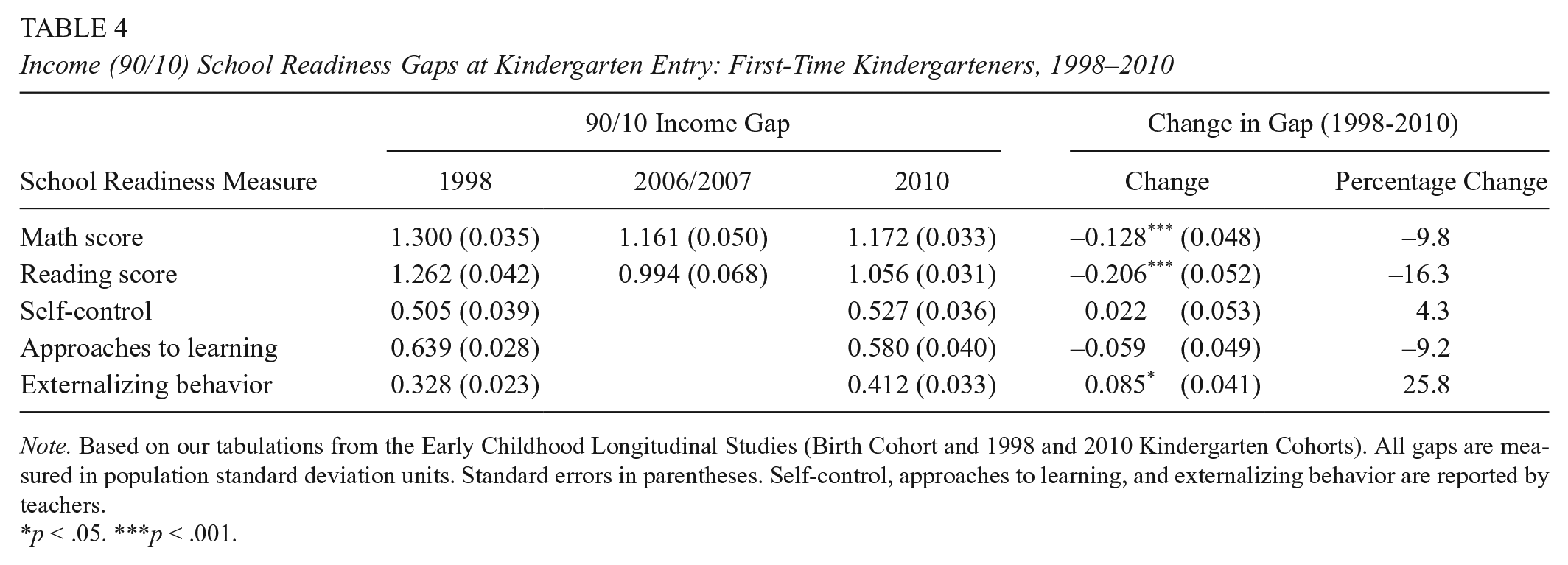
Note. Based on our tabulations from the Early Childhood Longitudinal Studies (Birth Cohort and 1998 and 2010 Kindergarten Cohorts). All gaps are measured in population standard deviation units. Standard errors in parentheses. Self-control, approaches to learning, and externalizing behavior are reported by teachers.
p < .05. *** p < .001.
Table 5 decomposes the changes in the math and reading income achievement gaps in kindergarten fall into components representing (a) the gap between children from low- and middle-income families (the “50/10 income achievement gap”) and (b) the gap between children from middle- and high-income families (the “90/50 income achievement gap”). Reardon (2011) showed that the increases in the 90/10 income achievement gaps in reading and math were driven largely by changes in the 90/50 income achievement gap. The point estimates indicate that at least some of the reduction in the 90/10 reading gap is due to a decrease in the 50/10 gap (p < .05); the estimates are too imprecise to determine how much of the reduction is due to changes in the 90/50 gap. Likewise, the estimates are too imprecise to determine to what extent the 90/10 math gap declined because of changes in the 90/50 or the 50/10 gaps.
Income (50/10, 90/50) School Readiness Gaps at Kindergarten Entry: First-Time Kindergarteners, 1998–2010

Note. Based on our tabulations from the Early Childhood Longitudinal Studies (Birth Cohort and 1998 and 2010 Kindergarten Cohorts). All gaps are measured in population standard deviation units. Standard errors in parentheses.
p < .05.
Changes in Math and Reading Gaps From Fall to Spring of Kindergarten
In both the ECLS-K:1998 and ECLS-K:2010, children were assessed in math and reading skills in the fall and spring of their kindergarten year. The two assessments allow us to determine whether achievement gaps narrow or widen during the kindergarten year and whether these patterns changed between the two cohorts. Although this analysis does not directly bear on the issue of school readiness gaps, we include it because it indicates whether the changes in school readiness gaps persist through the kindergarten year. Figure 2 illustrates the gaps in fall and spring of kindergarten for the 1998 and 2010 cohorts (detailed estimates are in Table A1).

Fall and spring kindergarten achievement gaps: 1998 and 2010 cohorts.
It is clear from Figure 2 that there is no evidence that the change in racial/ethnic or income achievement gaps from fall to spring of kindergarten year was different for the 2010 cohort than for the 1998 cohort. The 90/10 income achievement gaps in math and reading narrowed from fall to spring by 0.10 to 0.14 standard deviations in both cohorts (the narrowing income achievement gap in kindergarten in the 1998 cohort has been described elsewhere; see Reardon, 2011; Reardon et al., 2015). The difference between cohorts in the fall-spring change in gaps was small and not statistically significant (see Table A1).
The estimated White-Black gaps in math and reading increase very slightly (0.06 to 0.08 standard deviations) from fall to spring, but these increases are not statistically significant and do not differ between cohorts. The White-Hispanic gap in math declined from fall to spring of kindergarten by 0.07 standard deviations in the 1998 cohort and by 0.12 standard deviations in the 2010 cohort; the difference between the two cohorts in the rate of decline was not statistically significant. In sum, Figure 2 shows that the reduction in school readiness gaps evident between the 1998 and 2010 cohorts appears to have persisted through the end of kindergarten. 5
Discussion
Data from three large, nationally representative samples of kindergarten students indicate that on standardized tests, income and, to some extent, racial/ethnic gaps in school readiness have narrowed over the last dozen years (see Figure 3 for summary of these trends). The declines in income gaps and White-Hispanic gaps in academic skills at kindergarten entry are moderately large and statistically significant; the estimated declines in White-Black math and reading gaps are somewhat smaller, are not statistically significant in reading, and are only marginally significant in math. The evidence regarding trends in gaps in other measures of school readiness are less clear. Racial/ethnic gaps in teacher-reported measures of self-control and approaches to learning declined by 25% to 50%, while the income gap in teacher-reported externalizing behavior increased by 25%.

Math and reading kindergarten readiness gaps: 1998–2010.
How meaningful are these changes? The income achievement gaps in kindergarten entry math and reading declined at the rate of 0.008 and 0.014 standard deviations per year, respectively, over the 1998–2010 period. To put this into context, Reardon (2011) found that the 90/10 income achievement gap grew by roughly 0.020 standard deviations per year among cohorts born in the mid-1970s to those born in the early 1990s. So the rate of decline in the kindergarten readiness 90/10 income gaps appears to be somewhere between 40% and 70% as rapid as the rate of increase in the gap in the prior two decades. Looked at this way, the rate of decline from 1998 to 2010 is not trivial. Nonetheless, the gaps were roughly 1.25 standard deviations in 1998; at the rates that the gaps declined in the last 12 years, it will take another 60 to 110 years for them to be completely eliminated. The rates of decline in the White-Hispanic and White-Black math gaps are similar in magnitude.
It is also useful to compare the trends in the income and racial/ethnic gaps at kindergarten entry with the trends in the same gaps as the children progress through school. Our analyses show that the trends persist through kindergarten. Moreover, the NAEP data reported in Figure 1 suggest that the racial/ethnic achievement gaps trends that we observe at kindergarten entry persist through fourth grade. Figure 1 shows that White-Black and White-Hispanic math and reading fourth-grade (or age 9) gaps declined by roughly 0.15 standard deviations between the cohorts born in 1993 and 2005, corresponding to a rate of decline of about 0.012 standard deviations per year, similar to the rate of change of the White-Hispanic kindergarten entry gap and 50% larger than the rate of change of the White-Black kindergarten entry gap. That is, the achievement gaps in fourth grade declined at roughly the same rate as, or moderately faster than, the kindergarten entry gaps. This suggests that the primary source of the reduction in racial/ethnic achievement gaps in fourth grade (evident in Figure 1) is a reduction in school readiness gaps, not a reduction in the rate at which gaps change between kindergarten and fourth grade. The finding that the racial/ethnic gaps change at the same rate during kindergarten in the 2010 and 1998 cohorts provides some corroborating support for this conclusion. Nonetheless, this conclusion is tentative, given the considerable uncertainty in the estimated rates of change of the kindergarten entry gaps. Fortunately, both the ECLS-K:1998 and ECLS-K:2010 will have followed students through elementary school; once the Grade 1–5 data from the 2010 cohort are available, it will be possible to test more rigorously whether racial/ethnic and income achievement gaps develop similarly as children progress through school in the 1998 and 2010 kindergarten cohorts.
In some ways, the findings here are surprising, particularly the declines in the income gap in academic school readiness. Given the sharp increase in the income achievement gap in the prior two decades (Reardon, 2011), as well as the continued increases in income inequality, income segregation, and income gaps in parental investments in children (Bischoff & Reardon, 2014; G. J. Duncan & Murnane, 2011; Kornrich & Furstenberg, 2013; Piketty & Saez, 2013; Ramey & Ramey, 2010), one might have suspected that the income gap in school readiness would have grown as well. But the data here indicate the opposite; it has declined.
The most obvious candidate explanation for this decline is perhaps the changes in preschool enrollment patterns over this period. Both the income gap and the White-Hispanic gap in preschool enrollment rates declined since the early 1990s; the White-Black gap in preschool enrollment was unchanged over the same period (Magnuson & Duncan, 2014; Magnuson & Waldfogel, 2016). These trends are consistent with our finding here that the income and White-Hispanic school readiness gaps declined significantly, while the White-Black gap declined less (and at a rate not distinguishable from zero at conventional levels of significance). Of course, the correlation of preschool enrollment gap trends and school readiness gap trends does not prove that the first caused the second, but it does suggest that further investigation of preschool enrollment trends as a possible primary cause of the narrowing readiness gaps would be informative. We also suggest that increases in child health insurance rates among the near poor may have played a role in these improvements. Another category of explanation might be cultural changes in parenting practices that have increased low-income children’s exposure to cognitively stimulating activities at home. An investigation of these possible causes is beyond the scope of this article, however.
The decline in academic school readiness gaps is a positive trend from an equity perspective. It is not clear, though, to what extent the gaps have narrowed because of (a) improvements in school readiness among low-income and Black and Hispanic children or (b) declines in readiness among higher-income and White children. It would be hard to consider it an improvement if readiness gaps have narrowed because of lowered readiness among high-income and White children and stagnant readiness among low-income and minority children. At present, the ECLS-K data do not enable us to compare absolute levels of readiness, because the 1998 and 2010 assessments are not scaled similarly; such a comparison will be possible, however, when the NCES releases equated versions of the scores.
Until then, several pieces of evidence lead us to suspect that readiness gaps have narrowed because of more rapid gains in readiness among low-income and non-White students rather than because of decline or stagnation of high-income and White students’ readiness. A number of factors associated with school readiness—including preschool enrollment, parental spending on children, parental time spent with children, and child health insurance—have increased for all racial/ethnic groups and among children from all family income levels; many of them have increased more rapidly for minority and low-income children than for others (Kornrich & Furstenberg, 2013; Magnuson & Duncan, 2014; Magnuson & Waldfogel, 2016; Ramey & Ramey, 2010). These trends suggest increases in absolute levels of school readiness; there is nothing in these trends to suggest declines in readiness among any subgroup.
Fourth-grade NAEP data also provide a hint of what the trends in school readiness levels might be. NAEP data indicate that the narrowing of the White-Black and White-Hispanic gaps evident in Figure 1 is not due to any decline in White students’ test scores. Indeed, average NAEP scores have increased since the 1990s among White, Black, and Hispanic students, but they have increased faster among Black and Hispanic students than among White students (Hemphill et al., 2011; Vanneman et al., 2009). In other words, the declines in racial/ethnic achievement gaps in fourth grade are not the result of declines or stagnation in White students’ scores. Although the NAEP does not collect detailed information on family income, average scores for poor students (free-lunch eligible) and nonpoor students have increased in the last two decades, suggesting that any narrowing of the income achievement gap is likewise not the result of declining scores among high-income students.
In sum, it appears that despite widening income inequality, increasing income segregation, and growing disparities in parental spending on children, disparities in school readiness narrowed from 1998 to 2010. This was likely due to relatively rapid increases in overall school readiness levels among poor and Hispanic children, coupled with less rapid increases in readiness among higher-income and White children, though this remains to be confirmed once the appropriate data become available. It will be important for future research to identify the forces that have led to these improvements in school readiness and reductions in readiness gaps so that they may be sustained.
Footnotes
Appendix
Math and Reading Gap Estimates: Fall and Spring Kindergarten, 1998 and 2010 Cohorts

| 1998 Cohort |
2010 Cohort |
Between-Cohort Difference |
|||||||
|---|---|---|---|---|---|---|---|---|---|
| Fall K | Spring K | Fall-Spring Change | Fall K | Spring K | Fall-Spring Change | Fall K | Spring K | Fall-Spring Change | |
| 90/10 income gap | |||||||||
| Math | 1.300 | 1.201 | −0.099 † | 1.172 | 1.046 | −0.125 ** | −0.128 ** | −0.154 ** | −0.026 |
| (0.035) | (0.046) | (0.058) | (0.033) | (0.032) | (0.046) | (0.048) | (0.056) | (0.074) | |
| Reading | 1.262 | 1.131 | −0.130 † | 1.056 | 0.928 | −0.128 ** | −0.206 *** | −0.203 ** | 0.002 |
| (0.042) | (0.056) | (0.070) | (0.031) | (0.029) | (0.042) | (0.052) | (0.063) | (0.082) | |
| White-Black gap | |||||||||
| Math | 0.624 | 0.701 | 0.077 | 0.547 | 0.611 | 0.064 | −0.077 † | −0.090 † | −0.013 |
| (0.035) | (0.034) | (0.049) | (0.029) | (0.034) | (0.045) | (0.046) | (0.049) | (0.067) | |
| Reading | 0.393 | 0.454 | 0.061 | 0.319 | 0.392 | 0.073 | −0.074 | −0.062 | 0.012 |
| (0.040) | (0.040) | (0.056) | (0.040) | (0.031) | (0.051) | (0.057) | (0.051) | (0.076) | |
| White-Hispanic gap | |||||||||
| Math | 0.782 | 0.713 | −0.069 | 0.672 | 0.549 | −0.123 ** | −0.109 * | −0.164 *** | −0.054 |
| (0.035) | (0.037) | (0.051) | (0.033) | (0.032) | (0.046) | (0.048) | (0.049) | (0.069) | |
| Reading | 0.559 | 0.522 | −0.038 | ||||||
| (0.034) | (0.039) | (0.051) | |||||||
Note. Based on our tabulations from the Early Childhood Longitudinal Studies (Birth Cohort and 1998 and 2010 Kindergarten Cohorts). All gaps are measured in population standard deviation units. Standard errors in parentheses. K = kindergarten.
p < .10. *p < .05. **p < .01. ***p < .001.
Acknowledgements
We thank Demetra Kalogrides for excellent research assistance.
Funding
Ximena A. Portilla’s work on this article was supported by a grant from the Institute of Education Sciences (R305B090016) during her graduate training at Stanford University (Sean F. Reardon, principal investigator). The opinions expressed are ours and do not represent views of the institute or the U.S. Department of Education. Any errors are our fault.
Notes
Authors
SEAN F. REARDON is the endowed professor of poverty and inequality in education at Stanford University, 520 Galvez Mall #526, Stanford, CA 94305-3084, USA;
XIMENA A. PORTILLA is a research associate in the Family Well-Being and Child Development policy area at MDRC, 475 14th Street, Suite 750, Oakland, CA 94612, USA;