




Abstract
Compliance to government-prescribed national ‘school-readiness’ performance measures, particularly in early numeracy and literacy, readies and governs early years children for primary schools’ test-based culture. Performance measures, such as the Early Learning Goals and the Phonics Screening Check, govern and steer early years teachers towards inappropriate ability-grouping practices to obtain required outputs and results. This research draws on the findings of an English nationwide survey of early years and primary Key Stage 1 teachers (n = 1373), four focus groups and four case study schools with 12 in-depth interviews. Early years teachers’ attempts to meet nationally imposed school-readiness performance measures are analysed as Foucauldian governance. Finally, the article examines ability-labelling and ability-grouping impacts on children’s well-being and aspirations.
School readiness and the Phonics Screening Check
School readiness operates as a governing ‘technology of normalisation’ (Moss, 2019: 95), reducing and measuring early years children against ‘the norm’ to assess whether or not they are ‘school-ready’. Compliance to government-prescribed national school-readiness performance measures, particularly in early numeracy and literacy, prepares and governs children ‘for the rapid acquisition of literacy and numeracy’ (Moss, 2012: 9) and to be primary school ‘test-ready’. The concept of readiness has a long history within early childhood education and care (Kay, 2018b), but what is relatively novel is its use to govern early years education through performance management standards and measures, with the potential threat of punitive sanctions if nationally prescribed pass rates and thresholds are not met (Wood, 2019). Governance encompasses the processes and means of governing or managing ECEC by the neoliberal state (Moss, 2019). This is achieved through firstly, the setting of explicit school readiness standards and measurement of performance, such as the PSC. Second, by making that performance visible and public through the publication of inspection reports and other information. Third, by means of governmentality, that process of governing the self or self disciplining, a process in which early years education accept school readiness performance measures as normal and necessary.
Through this neo-liberal governing process, school readiness reimagines and reconfigures the purpose of early years education as ‘readying’ children for primary schools’ test-based culture (Kay, 2018a; Wood, 2019). Neo-liberal governance and control of early years education is particularly strong in England, but readers in other countries may well recognize some of the features of neo-liberal governance apparent in this English case study. Within the English context, ‘school-readiness’ performance measures include attainment of the Early Learning Goals at age five and the pressures to ‘ready’ children to pass the Phonics Screening Check (PSC) at age six. The data presented in this article particularly focuses on the PSC performance measure and its impact in encouraging early years teachers to make children ‘ready’ for the PSC.
Within the Australian and New Zealand contexts, Press et al. (2018) have noted how neo-liberalism has ‘profoundly altered’ early childhood education. Similarly in England early childhood education ‘reforms’ have formalised early literacy and mathematics curriculum and pedagogy. For example, the anglophone countries of England, Australia, New Zealand and the USA (Campbell, 2018) have seen an increase in the teaching of systematic synthetic phonics and the PSC. This has led to ‘the most prescriptive, rigid and limited view of what it means to teach early reading to have appeared in England’ (Wyse and Styles, 2007: 41) and it has been ‘destructive of forms of professionalism’ (Ellis and Moss, 2014: 252), leading to calls to make the PSC voluntary (Clarke, 2018: 21). Nevertheless, the English Department for Education introduced the phonics test for five- and six-year-old children in 2011 to promote the teaching of ‘systematic synthetic phonics’ (Department for Education, 2012: 5). Similarly, in 2018, the PSC was trialled in the Australian states of Victoria, South Australia and New South Wales with a view to a national rollout in 2019 (Adoniou, 2017; Campbell, 2018). Clarke (2017) notes how this Australian policy decision was ‘likely to have been reinforced’ by Nick Gibb’s (the English Minister for Schools) visit to Sydney in April 2017, where Gibb advocated the use of systematic synthetic phonics. The English and Australian PSC is a standardized arbitrary pass/fail high-stakes test in which children decode ‘nonsense’ words. In England, it is retaken in Year 2 by those pupils who ‘fail’ to score an arbitrary mark of less than 32. The English Department for Education requires that schools’ percentage pass rates be increased annually and that schools’ results be posted on the Internet for accountability and comparison.
In the anglophone countries of England, New Zealand and Australia, the use of commercial phonics programmes is growing, including their use in preschools, where teachers feel obliged to provide evidence that they are engaging with ‘school readiness’ (Campbell, 2018; Campbell et al., 2014). Lewis and Ellis (2006: 20) state that ‘phonics is big business with financial rewards waiting for anyone who invents “the best” scheme or programme for teaching it’. So, for example, the federal Australian government has allocated AU$22,000,000 for the anticipated national rollout of the PSC (Adoniou, 2017). Within England, the two largest phonics programme providers are Letters and Sounds and the Ruth Miskin Read Write Inc. Phonics programme. The English Department for Education (2018a) subsidizes schools to purchase Read Write Inc. Phonics and promotes its uptake by stating that the ‘Ruth Miskin Read Write Inc. programme helps schools improve literacy through the teaching of phonics and early reading’. Both Letters and Sounds and Read Write Inc. Phonics are organized around grouping children by phonics ‘ability’, and have distinct phases and stages with their own assessments that children must pass through in order to move onto the next phase or stage. For example, Read Write Inc. Phonics stipulates that ‘pupils are grouped across the school in homogeneous groups’ (Ruth Miskin Training, 2017: 6), justifying and legitimating the use of grouping practices for phonics and adding to the sense that grouping is beyond the teacher’s control.
The study
The national research explored early years and Key Stage 1 teachers’ views of grouping practices for children aged between three and seven. A mixed-methods approach (Tashakkori and Teddlie, 1998) was utilized to gain both quantitative and qualitative understandings of the following research questions: (1) the extent and nature of grouping practices; (2) the first forms of grouping children experienced; (3) the teachers’ reasons for using grouping; and (4) to what extent there might be movement between groups. The data was collected over three distinct iterative phases: first, qualitative focus group discussions; second, a quantitative online survey; and, third, qualitative interviews based in four carefully sampled case study primary schools to represent socio-economic diversity.
In the first phase, the two researchers led four qualitative focus group discussions with Early Years Foundation Stage teachers (of nursery and Reception children aged three to five) and Key Stage 1 teachers (of Year 1 and Year 2 children aged six to seven) using a standardized interview schedule based on the research questions above. These four focus groups were made up of teacher delegates at the National Education Union conference in April 2017. Each focus group had between 8 and 12 teachers, lasted approximately 45 minutes, and was recorded and professionally transcribed. The teachers’ quotes used from these focus groups have been noted as Focus Group 1 to 4 in the findings section.
The two researchers inductively analysed the transcripts for emerging key themes, and the data was reduced to meaningful codes and names (Creswell, 2007). This was both an inductive bottom-up and deductive top-down interactive analytical process as the identified themes were influenced by Foucault’s governance theoretical framework.
In the second phase, the themes from the focus group discussions were also used to inform an online national survey using Opinio software, which was distributed via the National Education Union email databases and on social media. The survey used a Likert scale and some open comment boxes to ask teachers for their views on grouping by ability and the different subjects it was used for in their schools. There were 1373 respondents in total, with 9% nursery teachers; 22% Reception teachers; 20% Year 1 teachers; 18% Year 2 teachers; 14% Early Years Foundation Stage and Key Stage 1 phase leaders; 4% school leaders; and 11% support and other staff. The teachers’ quotes generated from these written online comments are labelled as ‘W’ in this article.
In the third phase, four case study primary schools were sampled for geographic and socio-economic diversity; they varied in terms of Ofsted (Office for Standards in Education, Children’s Services and Skills) rating. The schools were located in inner and outer London, a large northern city and a city in the Midlands. The schools were recompensed with funding for either a half-day or full-day of teaching supply cover (depending on the number of interviews), in order to reduce the impact of the research on the children. In total, nine early years and Key Stage 1 teachers and three school leaders were interviewed by two researchers over four days. University ethical approval was obtained and pseudonyms were used to maintain the participants’ anonymity.
The findings
Grouping for phonics begins in the nursery
Phonics groupings were begun in the nursery classes, almost three years before the PSC, and were reportedly at their highest in Reception and Year 1 as children were made ‘ready’ for the PSC at the end of Year 1.
The survey data in Table 1 suggests that grouping was most common in phonics (76%), mathematics (62%), reading (57%) and literacy (54%), as one might expect, given the dominance of these subjects in the early years ‘school-readiness’ curriculum and assessments. In the survey, 52% of the respondents agreed or strongly agreed with the statement that ‘Grouping raises attainment overall’, suggesting that the main reason for this early grouping is an attempt to raise attainment: As a professional I do like the idea of using mixed ability groups but feel pressures of targets/attainment at the end of the year means I do use grouping more than I should. (W) Grouping in a data driven world seems to be becoming the norm. This sadly takes away from child led play time as we are forced into writing and reading constantly. (W) The constant fixation on data results, means that grouping becomes necessary. (W) In a climate of results I also think it is a necessary means to an end in many circumstances. (W) There’s an incredible amount of pressure to get children to a certain level. (School 4)
Responses to the question ‘In your year group, do you regularly group children by ability for the following?’ by percentage of teacher year group.
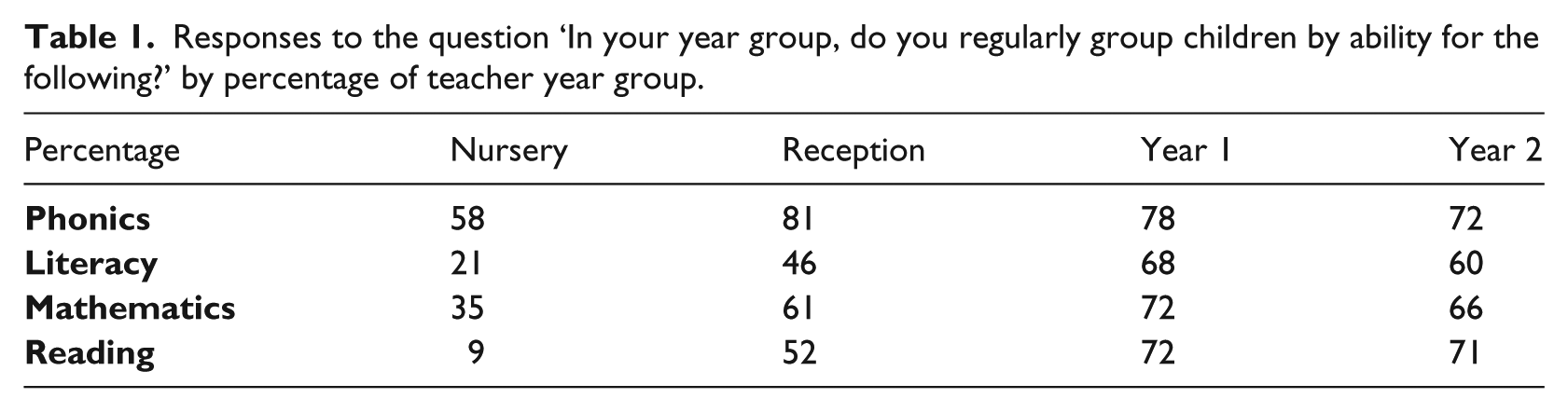
In their written comments, some of the teachers also noted that phonics grouping was part of the commercialized phonics schemes such as Read Write Inc. Phonics: They are streamed by ability for phonics because of the phonics test. (W) In Read Write Inc. we have to follow the scheme strictly despite believing that it goes against good practice in the early years. (W) Ability grouping shouldn’t be done. Read Write Inc phonics doesn’t work if you don’t though. (W) Basically, our reading results weren’t as high as they could be, so they decided we’d get a phonics scheme in … stream them and then every half-term they’re all assessed. (Focus Group 1)
For other teachers, however, the issues around grouping were complex and nuanced. The teachers identified many reasons for grouping students, including those based on children’s confidence: I think one of the positive things about grouping is that children often feel safe and secure within their own ability group to actually be able to share. They feel that much more confident, I think, if they’re in ability groups. There are definitely positives and negatives about groupings, whichever way you look at it. (Focus Group 4) Whilst it can make preparation for the teacher easier, I don’t think it’s particularly good for the children, especially those at the far ends of the spectrum. (W)
For some of the teachers, the regular assessment and movement of pupils between groups alleviated the negative effects of grouping and worked to resolve some of the tensions discussed above: Every six weeks, every half-term we reassess where they are up to: ‘Great, you’ve done well, you can go into the next group’. We have celebration assemblies where we get them all standing, ‘You’ve gone into…’, that sort of thing. So, the whole idea is everybody succeeds. (Focus Group 3) [In Reception] they’re fluid, so they can move. They’re dependent on what is being taught that week. If a child needs a bit more input, then they’re moved about. It’s just purely so that they can address the children’s needs and continuous provision. (Focus Group 4)
Despite the rhetoric of fluidity and movement between groups, other data from the interviews suggests that grouping was not fluid: Our phonics streaming with the Read Write Inc. programme, it’s not very fluid. They don’t move very often because if they move quite often, I mean it’s a big undertaking to the very structured assessments but also, where it’s a very structured programme, if they move often, you’ll find that they’ll miss out and there’ll be gaps. So, generally, when they’re in a set, they stay in it for quite a while unless they’ve made real accelerated progress and can move, but often they don’t move very much. (Focus Group 4)
This teacher’s view is supported by literature which suggests that, once labelled and placed into a particular group, there are limited opportunities for children to move to other groups. Being placed into a relatively fixed group has implications for children’s self-perception of their learner identity and their aspirations (Boaler, 2005; Campbell, 2013; Hargreaves, 2019).
Young children’s awareness of grouping
Sixty-five percent of the early years and Key Stage 1 teachers agreed or strongly agreed with the statement that ‘Children are aware which group they are in’ and, in both the interviews and the survey, stated that the children were aware of how and why their classrooms were hierarchically grouped: Children are aware of groups and it damages self-esteem and sets expectations that the more able can only do the more challenging work where the rest of the class can feel they have nothing to offer. (W) Children are very aware even at this age of the group that they are in, which can affect confidence. (W) I have been a full-time supply teacher in all primary year groups for 15 years. Children do know what group they are in however young they are. (W) Even if groups are moved around based on lesson work or assessments, children are still aware of basically a ranking system in the class and I don’t see how this is of benefit to the children. (W) My own son has been aware of what group he is in at his school since year 2 and it knocked his confidence. (W)
Hargreaves (2019: 57) has noted that such ‘segregation is blatantly obvious to pupils’, and research with older primary school pupils has also demonstrated that children are aware of which groups they are placed in and the reasons for this (Hallam et al., 2004).
Grouping reduces young children’s self-esteem and confidence
Among both the survey and interview respondents, there were clear concerns that ability grouping reduced children’s self-esteem and self-confidence. In the national survey, 45% of the teachers agreed or strongly agreed with the statement that ‘Grouping damages some children’s self-esteem’, whilst 29% disagreed or strongly disagreed. Although not asked to specifically comment on this issue on the survey, many of the respondents made comments in a general section on grouping, often using very emotive language such as ‘disgusting’, ‘distraught’ and ‘segregation’ to describe the potential impact: It is disgusting to label someone as ‘low ability’ at the age of 4. Maybe they can’t spell but who cares? It just damages their confidence and lets them down … Utter nonsense. We are ruining our own children. (W) Fixed ability groups are highly damaging to self-esteem and put a lid on the learning of all abilities. (W) It limits children and sometimes stops teachers having high expectations of pupils. It damages self-esteem and doesn’t provide models for other children. (W) It was deemed an efficient way to plan differentiated lessons but it made children very competitive and destroyed self-esteem in some pupils. (W) I do think it can really damage self-esteem – the children who spend their whole education in the bottom group. (W)
This was explored in more detail in the focus groups and interviews, where teachers saw being moved to a lower ability group as negatively affecting self-esteem and the child’s perception of themselves as a learner: that just would cause a drop in their self-esteem. If they go, ‘I’m not as good at maths or English as I thought I was because now look at where I am’. (Focus Group 2) There’s so much pressure on children … We’re really worried that our children write themselves off before they’ve started; they see themselves as failing. (Focus Group 3)
These findings suggest that early years grouping can create and produce negative learner identities. Hargreaves (2019: 57) has noted that children understand themselves as having been ‘judged’ as ‘less’ or ‘more’ according to which group they are placed in, with potentially long-lasting and damaging effects. Boaler (2013: 147) has noted that children ‘take a very clear message’ from ability-grouping practices: ‘some children are clever and some are not’. This suggests that early years ability grouping governs and controls young children’s conduct of themselves by creating ‘possibilities for who we are and might be’ (Ball, 2013: 98).
One teacher noted that once such a negative learner identity is produced, it is ‘extremely hard to shift’: So often it comes back to very, very early and it comes back to when they realized that they were ‘daft’, they were ‘dim’. Their self-image has been built up and it’s so much part of that. It’s from very early and it’s and it’s extremely hard to shift, extremely hard to shift. (Focus Group 2)
In one focus group, a teacher recalled how a girl’s aspiration to be a doctor, like her mother, disappeared when she was moved down a set: She said: ‘I used to want to be a doctor like my mum, but since I moved to the middle set I’ve realized that that’s not something I can do, because I’m not good enough, so I’m thinking about what else I might do in the future’. (Focus Group 2)
This demonstrates how ability grouping can act as a ‘psychological prison’ that ‘breaks ambition’ and ‘almost formally labels kids as stupid’ (Boaler, 2005: 135). Ability grouping may exacerbate the underachievement of disadvantaged children, children with special educational needs and summer-born children, particularly boys, because ability grouping systematically disadvantages children from poorer backgrounds (Francis et al., 2017). This suggests that performance management techniques such as ability grouping that attempt to close the gap between different socio-economic groups may not work within their own terms.
Ball (2016: 1054) argues that the governing power of performance measures such as the PSC has ‘ethically retooled’ some teachers. For example, the following Reception teacher reminisced about how, as a child, she was ability-grouped herself and placed on the ‘struggling table’, which she said was ‘horrendous’ for her self-esteem. Nevertheless, as a teacher, she was governed by the need to obtain the required performance measurements, and so ability-grouped her class: I remember when I was in Year 1, I was put on the table where the children were struggling and I still remember that, that I was put on the struggling table. It was horrendous for my self-esteem. I still remember it now. (Reception teacher, School 4)
This teacher has been governed and ‘burdened with the responsibility to perform’ and submit to the ‘new moral system’ (Ball and Olmedo, 2013: 88) of performance measurement. Her professional autonomy and ethics have become subsumed by an economy of student worth (Pratt, 2016), consigning some children to low ability groups and phases. Within a performative accountability culture, ‘efficiency’ and calculation trump and undermine early years teachers’ professional judgements, values and principles. The above teacher disregarded her early years professionalism and used ability grouping as a ‘solution’ to obtain the required performance measures. This pedagogical internal conflict leads to ‘values schizophrenia’ (Ball, 2003), as the teacher is required to satisfy national targets despite reflecting on the emotional damage it caused her as a girl. This early years teacher is no longer encouraged to have a rationale for practice, account of themselves in terms of a relationship to the meaningfulness of what they do, but [is] required to produce measurable and ‘improving’ outputs and performances, what is important is what works. (Ball and Olmedo, 2013: 91)
‘What works’ for this early years teacher is ability grouping, as she attempted to raise her class phonics performance measurement despite being painfully aware of the potential damaging emotional impact on the children.
Mental health, ability grouping and a politics of refusal
Teachers in two of the four focus group discussions referred to the impacts of ability grouping on young children’s mental health. The national survey did not ask about mental health and nor were there any references made to mental health in the survey’s open-ended responses. Nevertheless, the comments are discussed here, as they stood out as provocative and contested the dominant narrative of ability grouping.
It’s pressure on teachers that becomes pressure on young children. I really worry about the mental health issues … There’s children’s lives at stake. (Focus Group 3) What are we doing with grouping? I mean, what we’re going to have is loads of mental health issues with children. (Focus Group 3)
Hargreaves (2019: 57) has noted how ability grouping operates as a symbol for children’s perceptions of their own worth, so that they perceive themselves ‘only as valuable as their test scores’ and, if placed in a low ability group, as ‘less than other people’, thus negatively affecting their well-being. Similarly, the teacher above was critically aware of the potential well-being and mental health problems associated with ability grouping, particularly for those children assigned to lower groups. This critical thinking led to a staff meeting and the questioning of ability grouping throughout the primary school: It’s probably because mental health is quite big on the agenda now, isn’t it? Mental health of children even down to the age of four is a big thing at the moment. I think because that’s part of what we’re talking about at the moment, that’s what made us think, ‘Mental health, we’re affecting their mental health, let’s not do that’. (Focus Group 1)
Within the narrow constraints of performativity data and ‘hitting objectives’, ability grouping ‘worked’. However, the detrimental impacts that some children experienced when distributed to lower ability groups led the teacher above to question the dominant narrative of ability grouping and engage with a politics of refusal (Ball and Olmedo, 2013). Foucault noted that ‘as soon as one no longer thinks things as one formerly thought them, transformation becomes very urgent, very difficult and quite possible’ (Foucault, 1988, in Moss, 2019: 100). This was clearly the case with the teacher above, and provides optimism for contestation and alternative narratives.
Discussion
Early years education is being reimagined, reconfigured and repurposed as the first stage in a ‘delivery chain’ (Ball et al., 2012) to prepare and ‘ready’ children who can successfully perform in primary schools’ test-based culture. For example, the English revised Early Years Foundation Stage Profile, with its increasingly narrowed focus on mathematics and literacy, aims to ‘promote teaching and learning to ensure children’s school readiness’ (Department for Education, 2019: 7). Similarly, Ofsted’s ‘Bold beginnings’ curriculum document states that ‘the core purpose of the Reception Year’ is to teach systematic synthetic phonics in preparation for the Year 1 PSC (Department for Education, 2017: 7). ‘Bold beginnings’ praises early years settings that have based their literacy and mathematics on Year 1 primary school national curriculum expectations. Kay (2018a: 331) argues that there has been an ‘increasing formalisation of the early years and a narrowing of the curriculum … to be prepared for the rigour of Year 1 curriculum and achieving improved outcomes in mathematics and literacy’. A further example of governance is the English government’s proposed national standardized ‘Reception baseline assessment’ (Department for Education, 2018b), which directly aligns the early years with the end of primary school by measuring progress across a child’s seven years of primary schooling. All these techniques place early childhood firmly within the ‘school-readiness’ performativity discourse, exerting governing pressure on teachers to use inappropriate ability-grouping practices as they attempt to meet school-readiness performance measures.
The data presented suggests that early years pedagogy is increasingly colonized into preparing children for primary school so that ‘ability’ grouping, which is more normally associated with much older primary school children, is used to maximize the production of required attainment data. Through performativity data, schools, teachers and children are held to account against these ‘school-readiness’ measures, which ‘steer’ early years pedagogy (Lingard et al., 2013: 541) in the direction of more formal primary schooling. Ability grouping as a primary school pedagogy has cascaded down into the earliest phase of education, so that young children are increasingly labelled, classified and distributed according to their so-called different ‘abilities’ as the school attempts to achieve the arbitrary ‘readiness’ performativity data. Early years grouping practices are understood as ‘calculated technologies of performance’ (Ball et al., 2012: 518).
Some of the teachers in the study suggested that one of the unintended consequences of ability grouping was poor well-being and mental health. Similarly, Brown and Carr (2018: 261) have argued that ‘the neoliberal educational model itself creates the perfect platform for a mental health crisis in young people’. It is concluded that more international critical research on the consequences of the neo-liberalization of early childhood education and care is needed so that we can explore its impacts and its contestation, and hence ‘move beyond the atomisation and individualisation of benefit, success and achievement’ (Press et al., 2018: 337).
Footnotes
Acknowledgements
Thanks to Dr. Alice Bradbury who worked on the 2018 project with me. Thank you to Prof. Peter Moss for his advice on an earlier draft of this article.
Funding
The author(s) disclosed receipt of the following financial support for the research, authorship and/or publication of this article: The author received financial support from the National Education Union (NEU).
