




Abstract
Parents’ decision making about whether to send their children to a traditional public or charter schools has been studied mostly in urban, low-income areas. Few studies have focused on the decisions of high-income, suburban families. In a sample of Core Knowledge charter schools in a predominantly White and socioeconomically advantaged set of suburbs in Denver, Colorado, we are able to examine both the closed- and open-ended responses of parents who reported the importance of various factors in the decision-making process. Similar to findings from urban, low-income areas, we find that parents rely on their social networks in choosing schools and report the importance of effective teachers, distance to school, and academic quality, which our open-ended responses reveal means different things to different parents. Contrasting previous research, we also find that high-income parents “do their research” on schools to which they are applying.
A free-market approach to education assumes that choice will increase competitive pressure on individual schools to deliver higher-quality education (Betts, 2005; Chubb & Moe, 1990). Further, this perspective assumes that parents will seek out information on schools to make choices that best match their family preferences and/or child’s needs to the school (Chubb & Moe, 1990; Coons & Sugarman, 1978; M. Schneider et al., 2000). Because families want the best match, families who have choices have more incentive to gather information about schools, as compared with parents who are limited to sending their child to the local neighborhood public school (Kisida & Wolf, 2010). Although there are limitations and critics of the free-market approach to education (Buckley & Schneider, 2003; Henig, 1994; Holmes, 2002; Goyette, 2008; Lareau & Goyette, 2014; Ravitch, 2010, 2013), it is important to extend research on parent decision making about schools to examine whether the assumptions of the market perspective are empirically grounded, especially among charter schools that have been understudied—those in suburban, high-income areas.
Multiple Factors Involved in Parents’ Charter School Decision Making
Prior research based on parent surveys and interviews reveals that parents engage in a complex, dynamic, and multistep process of choosing a school for their child (Stein, Goldring, & Cravens, 2010). As Goyette (2014) suggests, school choices are interrelated and dependent on family resources, such as access to transportation and childcare or reliance on public transportation and relatives.
In what follows, we review what researchers have found about the factors parents consider when making choices between traditional public schools and charters, including academic quality, social networks, safety and discipline, distance between home and school, and the racial/ethnic composition of the school. We then describe our data and methods (including the closed- and open-response format on the parent survey), present results, and discuss implications.
Academic Quality
One of parents’ main concerns when choosing a school is academic quality (Bauch & Goldring, 1995; Buddin, Cordes, & Kirby, 1998; Figlio & Stone, 2001; Goldhaber, 1999; Goldring & Hausman, 1999; Hausman & Goldring, 2000; Henig, 1995; Kleitz, Weiher, Tedin, & Matland 2000; Lankford & Wyckoff, 1992; Lankford, Lee, & Wyckoff, 1995; Lee, Croninger, & Smith, 1996; B. Schneider, Schiller, & Coleman, 1996; M. Schneider et al., 2000; Schneider, Marschall, Teske, & Roch, 1998; Stewart & Wolf, 2014; Witte & Thorn, 1996). Yet, research can be somewhat vague about what parents mean by academic quality. For example, in a study in Indianapolis that relied on parent surveys of school choice preferences and longitudinal student administrative records (i.e., demographics, achievement, and enrollment), Stein et al. (2010) found that 63% of parents reported that academics was an important factor in their choice of charter schools. However, on the basis of test score data, they found that although some students switched from lower-performing schools to higher-performing ones, many more switched from higher- to lower-performing schools. They also found that nearly 40% of parents who switched from a traditional public school to a charter school selected schools that failed to make adequate yearly progress under No Child Left Behind (NCLB).
Some research shows that parents who are given detailed information about school quality (e.g., test scores) are more likely to select higher-achieving schools than parents who gather information on their own (Hastings & Weinstein, 2008; Kisida & Wolf, 2010). For example, in their study in the Charlotte-Mecklenburg Public School District, Hastings and Weinstein (2008) analyzed whether clear, easily accessible information about school-level performance is related to the schools parents choose. In their randomized experiment, the treatment included (a) schools providing one-page information sheets to parents that contained clear statistics on the schools’ academic achievement or (b) schools providing the NCLB-mandated academic information about the school because it was under NCLB sanctions; the control group included schools that gave out no academic information. They found that when provided with test score information, parents chose higher-scoring schools. These findings suggest that increased choice alone does not promote active selection of higher-achieving schools.
School decision making may also differ by socioeconomic status (SES). For instance, lower-SES families have a more limited set of options for both housing and available schools (Rhodes & DeLuca, 2014). In fact, housing decisions tend to be the first ones lower-SES families make, and school decisions follow. Researchers have also found that lower-SES families tend to think that the available school options are all quite similar when they may differ in important ways (Lareau, 2014; Rhodes & DeLuca, 2014).
By contrast, research has shown that high-income White families focus more on the school’s general academic reputation and trustworthy, reliable social networks. In her qualitative study of nearly 50 White and African American families that spanned lower to upper-middle classes, Lareau (2014) found that middle-class parents actively pursued information when providing their children with out-of-school experiences but did not systematically examine schooling options by conducting research on test scores and visiting schools. Parents’ behavior for out-of-school experiences was consistent with what Lareau has called “concerted cultivation” (Lareau, 2011; see also Calarco, 2011)—that is, middle-class parents used organized activities (e.g., sports and arts), language development, and institutional interventions to develop their children’s interests, talents, and skills. Yet, middle-class parents did not actively pursue information or engage in the same thoughtful research when selecting a school. Thus, Lareau (2014) argues that middle-class parents engaged in concerted cultivation when parenting their children out of school, but they did not rely on similar behaviors when choosing schools—“one of the most economically and socially consequential decision of their lives” (p. 198).
Social Networks
Parents rely on their social networks when deciding among school options (Holmes, 2002; Neild, 2005; B. Schneider et al., 1996; Schneider, Teske, Roch, & Marschall, 1997). Within these networks, people tend to associate with others who are like them, whether by SES, race/ethnicity, values, age, religion, and/or cultural tastes (Bishop, 2008; McPherson, Smith-Lovin, & Cook, 2001). Trusted members and the information exchanged within these networks are highly valued (Bell, 2009a; Lareau, 2014; Stein, in press; Teske, Fitzpatrick, & Kaplan, 2007).
The social networks of low-income families may be restricted in the information they are able to provide and may also portray schools within the choice set as more similar than different. The many challenges that low-income families face both shape and limit their views of the costs and benefits of various school choice options (Rhodes & DeLuca, 2014; M. Schneider et al., 1997).
In contrast, higher-income families have a greater array of social resources and connections to trust when choosing a school, and making the choice seems almost effortless (Bishop, 2008; Lareau, 2014; M. Schneider et al., 1997). According to Lareau’s (2014) qualitative study, higher-income families had access to social networks that provided critical information about schools and where to live, which resulted in their having a higher quality of available choice options. These networks were secure and stable and helped families feel comfortable with and trust the schools they choose for their children. This is consistent with Roda and Wells’s (2013) finding that high-income families did not even tour choice schools if they had heard through their social network that they were good schools.
Safety and Discipline
Parents frequently report school safety and discipline as important aspects of school choice (Henig, 1995; Lee et al., 1996; Rhodes & DeLuca, 2014; M. Schneider et al., 2000; Stewart & Wolf, 2014). School- and state-level data are frequently available to parents to identify disciplinary infractions. However, there may be wide variability in the way parents (and schools) define safety and discipline. Although we know that parents are in favor of safety- and discipline-related goals and outcomes (Bryk, Lee, & Holland, 1993), we do not know how they assess social relationships among students, school staff, and parents or whether they use publicly available discipline data in choosing a school for their child.
How important school safety and discipline are in school decision making may differ by SES. Schneider et al. (2000) found that when making choices about schools, lower-SES parents were more focused on the “bedrock” values of schooling in order to have academic fundamentals in place for test performance, as compared with higher-SES parents.
Distance Between Home and School
For charter school families, transportation services are not provided. Although many families coordinate this task (e.g., participating in carpools), this is starkly different from the transportation services provided to traditional public school students. Not surprisingly, then, distance to the school influences parents’ school choice (Lareau & Goyette, 2014). For some parents, it may be more important than programmatic features, school quality, and school staff (Bridge & Blackman, 1978). Furthermore, school-age siblings increase the complexity for families of their transportation-related decisions. Often, families will attempt to place both children in the charter school where the kindergarten-bound student applied and was accepted. However, space is not always available for the older sibling. When this is the case, many families report transportation complexity as a tipping point to decision making in choosing a school. Recently, education researchers have used geocoding, a computer-programmed application that determines distance points (e.g., between families’ residences and the schools their children attend), to understand the potential impact of transportation on school choice (see Bell, 2009b; Henig, 2009; Lubienski & Dougherty, 2009; Lubienski, Gulosino, & Weitzel, 2009).
How distance between home and school plays out in parent decision making may also differ between low- and high-income families. In their longitudinal, qualitative study of low-income African American families in Mobile, Alabama, Rhodes and DeLuca (2014) found that residential moves for families are often abrupt, resulting in a stressful search for housing. In these instances, families are more likely to focus their choices on a place of residence that is safe and provides access to childcare and transportation. In other words, the primary driver of their choice is housing, not schools. Overall, low-income families have a more limited set of options for housing, personal transportation, and available schools (Rhodes & DeLuca, 2014). District size and lack of adequate transportation are significant barriers to choice for many low-income families (Phillips, Hausman, & Larsen, 2012). In New Orleans, Harris and Larsen (2014) find that distance plays as large of a role as school quality in decision making for low-income families. In stark contrast, the array of social networks and resources available to high-income families increases their ability to consider a wider variety of options that include schools farther from their home (Lareau, 2014).
Racial/Ethnic Composition of the School
Studying the role of a school’s racial/ethic composition in parental school choice is difficult because parents’ beliefs about integration do not always match their actions. Survey data indicate that 66% of White parents report diversity as an important component of an effective school (Farkas, Johnson, Immerwharh, & McHugh, 1998). Analyzing the important school decision-making factors based on visitors to a school website that provided the number of “hits” to different school information (racial/ethnic composition, test scores, location, etc.) and gathered information on visitors’ educational level, M. Schneider and Buckley (2002) reported that the racial/ethnic composition received the largest number of hits (nearly 30%), compared with location (23% of website hits) and test scores (18%). College-educated parents were more likely to report school racial/ethnic composition as an important factor (31%) compared with parents with no college (22%). Further, in their analyses of nationally representative data in the Schools and Staffing Survey, Renzulli and Evans (2005) found that as the level of racial/ethnic integration within a school district increases, so does the percentage of White students enrolled in predominantly White charter schools. Lankford and Wykoff (2006) note increased segregation based on neighborhood choice by White families. Increased choice in those neighborhoods led to increased segregation in urban schools and inter- as opposed to intradistrict segregation, described as “White flight.” Other researchers have found that White families identify “good” schools as nondiverse and mostly non-Hispanic White (Holmes, 2002; Johnson & Shapiro, 2003; Saporito & Lareau, 1999; Wells et al, 2009). Thus, the racial/ethnic composition of the school can be an important factor for parental choice. In our study, however, because the choice sets for parents were suburban, high-income, predominantly White schools, we are not able to examine this factor.
Overall, the school choice literature contains limited research on the complex and multifaceted process by which high-SES parents choose charter schools. 1 Our study fills this gap in the literature. Specifically, we address the following research questions with qualitative and quantitative analyses of survey data from our population of suburban, socioeconomically advantaged parents:
How do parents become interested in charter schools?
What are the most important reasons why parents apply to charter schools?
What sources of information do parents use when applying to charter schools?
Data and Methods
Setting and Participants
Participating parents applied to one of six Colorado elementary charter schools located in four different school districts in suburban areas to the south and north of Denver. The districts in the study were predominantly White. In one district where three of the study schools were located, 75% of the students were White, and the percentage of White students in the study schools ranged from 76% to 84%. In the three other districts, the percentages of White students in the district and in the study school (in parentheses) were 67% (71%), 74% (75%), and 75% (81%). In contrast, in nearby Denver County, an urban district, just 22% of the students were White, which is typical of most of the lottery-based studies of charter schools that have been conducted to date (Grigg & Borman, 2014). Additionally, at the six charter schools, the percentage of students receiving free or reduced-price meals ranged from 2% to 27% (M = 11%). In contrast, about 56% of students in the nation’s elementary schools are eligible for free or reduced-price meals, and about 58% of the students in the nation’s charter schools are eligible (authors’ calculations from Common Core of Data 2012–2013, https://nces.ed.gov/ccd/).
Beyond serving a socioeconomically advantaged group of families, the present study schools are unique because they are implementing the Core Knowledge curriculum. All of these charter elementary schools used lotteries to select children for kindergarten entry, and all of them had been implementing the Core Knowledge elementary curriculum for at least 6 years. Core Knowledge is a comprehensive K–8 curriculum for language arts, math, science, social studies, visual arts, and music that is intended to build knowledge, concepts, and vocabulary systematically from one grade to the next, leading to substantial progress in reading (Hirsch, 2006). There are more than 50 Core Knowledge charter schools in Colorado alone and more than 300 in the United States. To understand why parents choose to apply to charter schools, it is important to study specific kinds of charter schools, because charter schools are diverse and their achievement impacts vary widely (Angrist et al., 2011; Berends, 2015; Berends, Springer, & Walberg, 2008; Betts et al., 2006; Betts & Tang 2014; Gleason, Clark, Tuttle, & Dwoyer, 2010).
The sample of charter applicant parents was selected as follows. We collected lottery application data from the six Core Knowledge charter schools in 2010. When the data were aggregated across schools, there were 897 unique individuals who participated in at least one random admissions lottery for kindergarten entry. Most parents (84%) applied to only one of the six schools, but 14% applied to two study schools and 2% applied to three of the six schools. Offers of admission were extended to 42% of the applicants; 58% did not receive an offer of admission.
The schools provided us with names and contact information for all the parents or guardians who applied. We called parents in spring 2012, between 2.2 and 2.5 years after the lotteries had occurred, when their child was in first grade. We successfully obtained survey data from 553 parents, or 62% of the initial sample of lottery applicants.
Survey Instrument
Our survey examined parent decision making with closed-ended and open-ended survey questions that allowed respondents to describe what they mean when reporting on the importance of different factors (e.g., what parents mean when they say school quality or safety is important in making their choices). Specifically, the survey items included (a) an open-ended item asking parents to state why they became interested in a charter school education for their child, (b) 18 Likert-type and two open-ended items assessing parents’ reasons for choosing to apply to a charter school, and (c) items asking parents to indicate whether or not they used each of 14 different sources of information when applying to a charter school. Many of these items were modeled after items that were used in a charter school parent survey about parent decision making in Indianapolis (see Stein et al., 2010).
Survey Data Collection
Trained project staff members conducted telephone surveys. All of the callers were familiar with Core Knowledge charter schools. Initially, project staff contacted participants with e-mails and voicemails. Over a 4-month period, the project staff made a total of five attempts to contact each of the charter school applicants who constituted the initial sample. After telephone contact occurred, if the parent was amenable, the survey was completed immediately; otherwise, it was scheduled at a mutually convenient time. The callers followed an introductory script, offered a $50 gift card for survey completion, and explained confidentiality.
One limitation of this study is the timing of the survey. Parents responded to the survey items approximately 2.2 to 2.5 years after they were deciding whether to apply to a charter and which charter to apply to if they had access to more than one. It is possible that their responses were distorted by the passage of time or their intervening experiences with having their child in a charter or noncharter school (Tourangeau, Rips, & Rasinski, 2000). Although we cannot determine whether parents’ responses were different than they would have been at the time they were applying to the schools, there was little evidence that their responses were influenced by having won or lost the lottery. Across 18 items assessing reasons for applying to a charter school, there was just one significant difference. Parents who received an offer of admission rated ability grouping as a more important reason for applying to a charter (p < .01). Although this finding may mean that they appreciated the importance of ability grouping as a result of their experiences with a charter school, it may also be due to chance because 18 comparisons were made.
Results
The results that follow address each of our research questions in turn. We begin with how parents become interested in charter schools, and then we address the reasons why they apply and the sources of information used when applying to charter schools.
How Do Suburban, Socioeconomically Advantaged Parents Become Interested in Charter Schools?
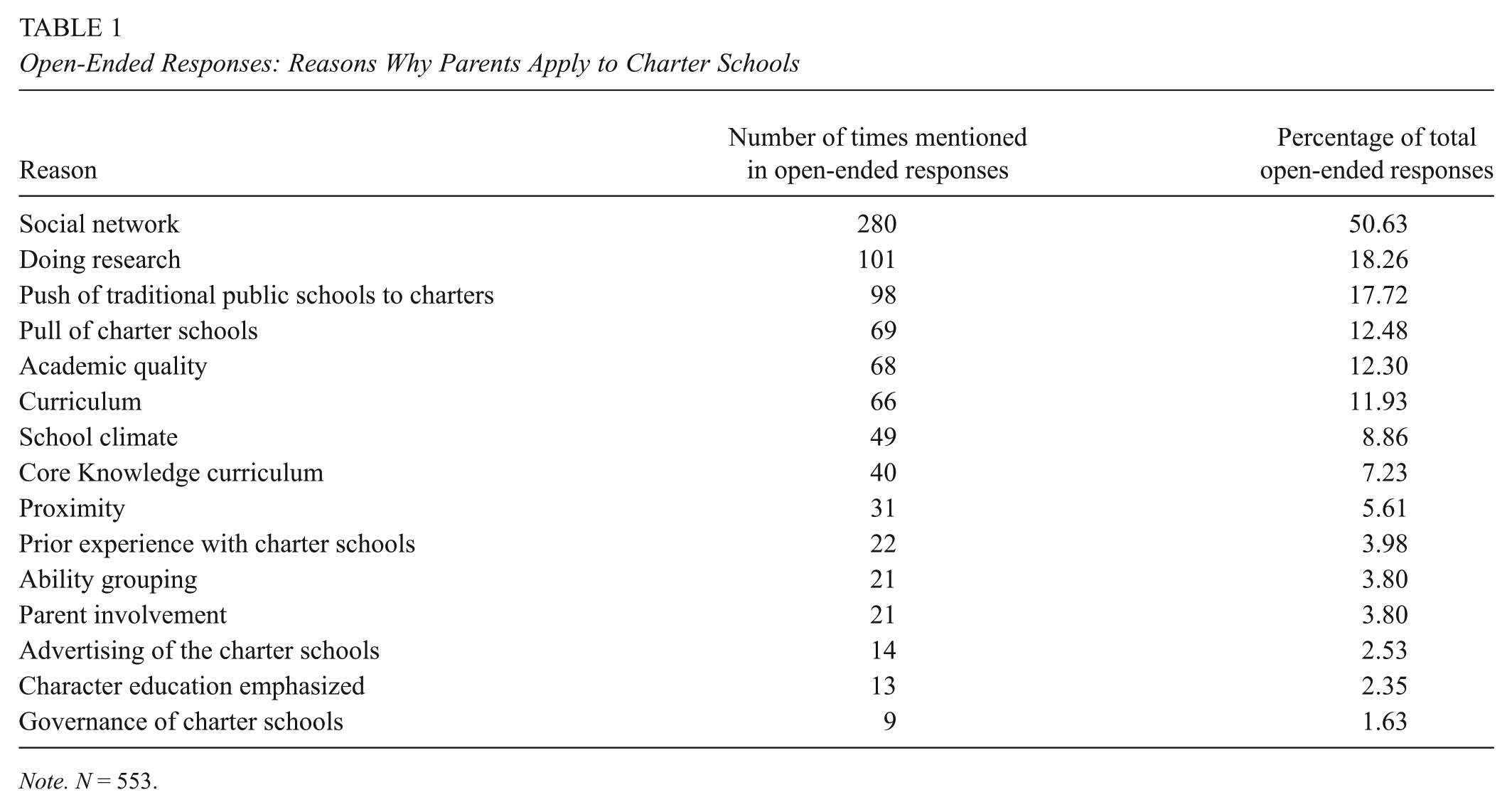
We asked parents the following question: “Thinking back to the time before you applied to a charter school, how did you become interested in this type of education for your child?” We wanted an open-ended question to probe respondents’ reasons for applying. Several themes emerged from our Atlas.ti analysis of the open-ended responses from the 553 parents. 2 Results are shown in Table 1, which displays the frequency with which each identified theme was mentioned. On the basis of these results, parent interests in applying to charter schools appeared to stem from, in order of frequency of mention, their social networks, doing research (e.g., school websites, Colorado Department of Education websites, and/or visiting the schools), the push of parents from traditional public schools because parents are dissatisfied, and the pull of the charter sector because of its perceived attractive qualities (e.g., academic quality and the curriculum). Less than 10% of the parents’ open-ended responses mentioned factors such as the Core Knowledge curriculum, proximity of school to home, ability grouping, and parent involvement (see Table 1). However, although these broad categories capture most of what parents expressed, the role of social networks, doing research, the push or pull of traditional public and charter schools, and academic quality in parents’ decisions is more nuanced, as revealed in the following sections.
Open-Ended Responses: Reasons Why Parents Apply to Charter Schools
Note. N = 553.
Social networks
Although previous research has pointed to the importance of social networks in seeking out and applying to charter schools (Lacireno-Paquet & Brantley, 2008; M. Schneider et al., 2000; Stein et al., 2010), our open-ended responses reveal just how important social networks are for piquing parents’ interest in charter schools and provide a richer understanding of the nature of the influential social networks. Just over 50% of the responses made some reference to the importance of social networks for getting parents to become interested in charter schools (280/553 = 50.63%), which far outweighed any other factor. On the basis of parent responses, the specific individuals in their social networks who help parents become interested in charter schools can vary. That is, parents find out about charter schools through friends, neighbors, school staff, other parents, and coworkers who compose their social networks and spark their interest in charter schools.
The following parent responses reveal the different types of social networks that help parents regarding their interest in charter schools. How did parents become interested in charter schools for their children?
“We already had kids in middle school, and we noticed that our neighbors had kids in charter schools, so we decided that we would apply since they were so happy.”
“We talked to other parents who put their children in charter schools rather than the public school and they were happy with the education that their children received.”
“A friend of mine was a founding board member for a different charter school and she gave me information about charter schools.”
“We have a number of people in our church who are on the board of the charter school near us so we looked into it for Lily.”
Doing research
Nearly one in five parents in our sample (18% in Table 1), when asked an open-ended question about how they became interested in charter schools, reported that they “did their research,” which ranged from visiting schools, talking with principals and teachers, attending school information meetings, looking at school websites, or the examining the school information provided by the Colorado Department of Education. This contrasts with Lareau’s (2014) qualitative study that suggested that upper-income parents do not engage in extensive research on the school but, rather, trust that the school is a good one because it is located in a upper-income district with trusted neighbors.
Examples of parent responses about how they engaged in research when considering charter schools include the following:
“We were buying a house and researching schools, and in the process we found out about charter schools.”
“I researched the charter schools, and I liked the Core Knowledge curriculum, the traditional school year, and the reputation of a charter school. We started to research schools and attended several informational meetings at charter schools.”
“We went to look at our neighborhood public school and received encouragement to seek out options. We learned from county district website about ‘other’ schools and we made phone calls to get educated.”
“I had done a lot research online and about charter schools in my area and charter schools in general: smaller class sizes, uniforms, and greater involvement for parents, and the schools going up to eighth grade.”
Push of regular public schools and pull of charter schools
For some parents, the interest in applying to charter schools involved both a push away from traditional public schools and a pull toward charter schools. That is, some parents responded that their perceptions and experiences in local public schools were unfavorable, so they became interested in charter schools as a viable option. For others, they had heard positive things about the charter schools in their area, so they were attracted and curious about how those may benefit their children. As shown in Table 1, about 18% of parents’ open-ended reports about how they became interested in charter schools revealed that they were being pushed away from traditional public schools toward charter schools; 12% of parents reported a pull toward charter schools. Within these responses, there was variation within parent responses of what factors were pushing them away from regular public schools and pulling them toward charter schools.
“A charter school principal was a neighbor, and through discussions with her and reviewing the curriculum, we became interested, especially as our public schools were being hit with major cuts.”
“I wanted something different than a public school, but private schools were too expensive, and I looked in the area at what else was offered in the area that would offer a better education.”
“The school he goes to I like that they had STEM [science, technology, engineering, and mathematics] and that he would have speech problems and that he would get help and he may have slipped through the cracks in a public school.”
“I did not want to place her in public school and I wanted something more academically challenging and I wanted something that was using a more challenging math program like Saxon Math.”
“We actually wanted something that was more academically challenging to give him better opportunities for the future, with not so many politics involved. All that public schools try to cram in, it seems that they get away from the fundamentals of reading.”
Academic quality
Prior research has shown that academic quality is important for parent decisions about charter schools (Lareau & Goyette, 2014; M. Schneider et al., 2000; Stein et al., 2010), and the qualitative findings from this study are consistent with this assertion. However, in responding to an open-ended question, only 12% of parents reported terms related to the general category of academic quality, which is below parent reports of the importance of their social networks (50%), doing research (18%), and the push of traditional public schools (18%) (see Table 1).
Moreover, on the basis of the parents’ own words and not preexisting categories, their responses below suggest that academic quality means different things to different parents when thinking about applying to a charter school. For some parents, it appears that a “decent” school is better than their current one:
“We were just looking for a school with decent ratings.”
For other parents, they were looking for “excellence” that was close to them:
“We were thinking that that she would get a better education at a charter school and Charter Academy was across the street from her preschool. Also saw that it was ranked number 1 in the state against all schools in the state.”
Other parents became interested in applying because they were looking for academic quality, but other factors were important, such as variety of the curriculum for their children, more challenging curriculum, and more of a focus on core academic subjects:
“I wanted a more disciplined approach and structure and the charter schools offered more choice and variety in what they teach.”
“A friend has kids in a charter school, and the school was more focused on kids, performed better. I wanted that for my kids.”
“Charter schools were more focused on math and science—more challenging, something I heard from other parents.”
“I guess it’s a different learning program, a different education. They are placing students according to level where they are at and a different curriculum.”
Although parents frequently mentioned the importance of social networks, doing research, the push of public schools and the pull of charter schools, and academic quality, other factors were important when considering applying to a charter school. These included the curriculum and the Core Knowledge curriculum in particular, school climate, proximity to school, prior experience with charter schools, ability grouping, opportunities for parent involvement, charter school advertising, character education, and the governance structure of charter schools. Compared with other factors, however, fewer than 12% of parents reported these factors in their open-ended answers. In this socioeconomically advantaged sample of suburban parents, it is noteworthy that none of the open-ended responses referred to school safety as a reason for why they decided to apply to a charter school.
What Are the Most Important Reasons Why Parents Apply to Charter Schools?
Parents report a variety of important reasons for applying to charter schools. In the telephone survey, parents were asked a series of open- and closed-ended questions. The first open-ended question asked, “What was the most important reason you chose to apply to a charter school or charter schools?” Then, the interviewers went on to ask, “Next, I will read from a list of reasons why people apply to charter schools. Thinking about yourself and your favorite charter school, please tell me whether each reason was very important, somewhat important, or not important.” There was a list of 18 reasons, including those related to academic quality, test scores, student discipline, parent involvement, and extra school services, and parents could also identify some other reasons not mentioned in the list. The next question in the interview protocol asked parents to select the “first most important reason” and the “second most important reason” from the list of “very important” reasons identified in the previous question. Together, these questions further our understanding of the reasons why parents decided to apply to a charter school.
Table 2 displays the results for the closed-ended question assessing the importance of reasons for applying to a charter school. Parents responded in ways that were consistent with their stated reasons for applying to a charter and prior research. For example, most of the parents reported that good teachers (92%), academic quality (91%), and safety (83%) were “very important.”
Closed-Ended Responses for Importance of Reasons for Applying to a Charter School (in percentages)

Note. N = 553 for most items. Items with an asterisk range from N = 533 to N = 543, due to missing responses.
When good teachers was mentioned in the open-ended responses, parents’ comments mentioned the importance of the following:
Quality of teachers
High performance of teachers with no tenure means that they must perform
Teachers caring more and teaching better
Parents’ open-ended comments about the importance of the school’s reputation for academic quality were often succinctly stated as “the quality of education” being the most important reason for why they decided to apply to a charter school.
Also as shown in Table 2, the “very important” reasons for applying to a charter school based on closed-ended responses on the survey included child’s safety (83.4%), small class sizes (78.3%), and well-disciplined students (64.7%). It is interesting that safety and discipline were rated as important on the closed-ended item on the survey, but “safety” was not mentioned at all in the open-ended responses about why they applied to a charter school. Perhaps these socioeconomically advantaged parents took safety for granted because they judged all of the schools they were considering to be safe.
Nearly 80% of the parents rated small class sizes as very important (Table 2). We reexamined the open-ended comments in an effort to understand why. The open-ended parent comments about the importance of class size included statements like the following:
“Smaller class sizes, which are more academically focused than socially focused.”
“Charter schools have fewer students in each class than in public schools.”
“Smaller class sizes provide the opportunity for one-on-one interaction between teacher and students.”
On the closed-ended item, nearly 60% of parents reported that ability grouping (59.5%) and the Core Knowledge curriculum (57.7%) were very important factors in the decision to apply to a charter school (see Table 2). Again, in an effort to understand this finding, we examined the open-ended responses. Following are some of the comments about ability grouping:
“I knew that in math and reading they break students out based on their ability in a charter school.”
“The ability grouping—teaching them where they are at instead of expecting them to all be at the same level.”
“I liked the ability grouping and the customizing the educational experience for him to make sure that he would not be bored or overwhelmed.”
“We wanted the best education for our child, and we liked the ability grouping that charter schools offered.”
Following are some of the comments about the Core Knowledge, which help us understand why it was rated as very important:
“This school follows Core Knowledge curriculum. It is solid; it is reinforced; and it builds.”
“We thought he would get more from a Core Knowledge education. He’s more on the advanced side for his age. Also, more attention due to smaller class sizes.”
“Mainly the charter schools around here follow the uniform concept, strict discipline concept, the Core Knowledge curriculum.”
“I liked the smaller class sizes, the Core Knowledge curriculum, and the fact that middle school is included.”
Although nearly 60% of the parents rated the Core Knowledge curriculum as a very important reason for applying to a charter, fewer than 10% of them mentioned it as a reason for applying to a charter. It is conceivable that most parents were not familiar with the Core Knowledge curriculum at the time they were applying to a charter school and that parents whose child subsequently enrolled in a Core Knowledge charter came to appreciate the importance of the curriculum. However, this hypothesis is not supported by the finding that the importance ratings of lottery winners and lottery losers were not different.
Over 50% of the parents reported that the factors discussed above were very important in their decision to apply to a charter school, but other factors also were reported as very important by a significant number of parents in our sample. As shown in Table 2, between 30% and 40% of parents reported the following were very important reasons for applying to a charter school: no tuition (49.2%), opportunities for parent involvement (47.4%), test scores (41.2%), level of parent involvement (41.2%), distinctive focus (e.g., Spanish, science; 40.9%), full-day kindergarten (31.8%), and services for special-needs students (e.g., special education or gifted and talented) (31.6%).
Factors that were “not important” in many parents’ decision making included whether the charter school had before- or after-school programs, a full-day kindergarten, or required uniforms. Fifty-nine percent of parents reported that before-/after-school programs were not important; 48% reported school uniforms were not important, and 45% of parents reported that full-day kindergarten was not important (although the full set of responses suggest a bimodal distribution for this item).
Proximity of the school to families’ homes was important for some families but not for others. Table 2 reveals that “distance to my home” was very important for 19% of parents, somewhat important for 60% of parents, and not important for 21% of parents. Some of the responses on our open-ended question confirm that at least for a few parents, proximity to school did play an important role in deciding whether to apply for admission to a charter school.
“What initiated our interest is it is the closest school, and a friend in our neighborhood told us about it, and we became interested. My best friend lives in Boise, her kids go to a charter school, and she was a wealth of information about charter schools.”
“Her local school had low test scores, and we checked into the charter school because it is a couple of blocks from our house.”
Overall, however, consistent with the quantitative finding that distance to school was not important for one in five respondents, the distance to school factor was mentioned in only 6% of the qualitative parent responses (i.e., 31 times out of 553).
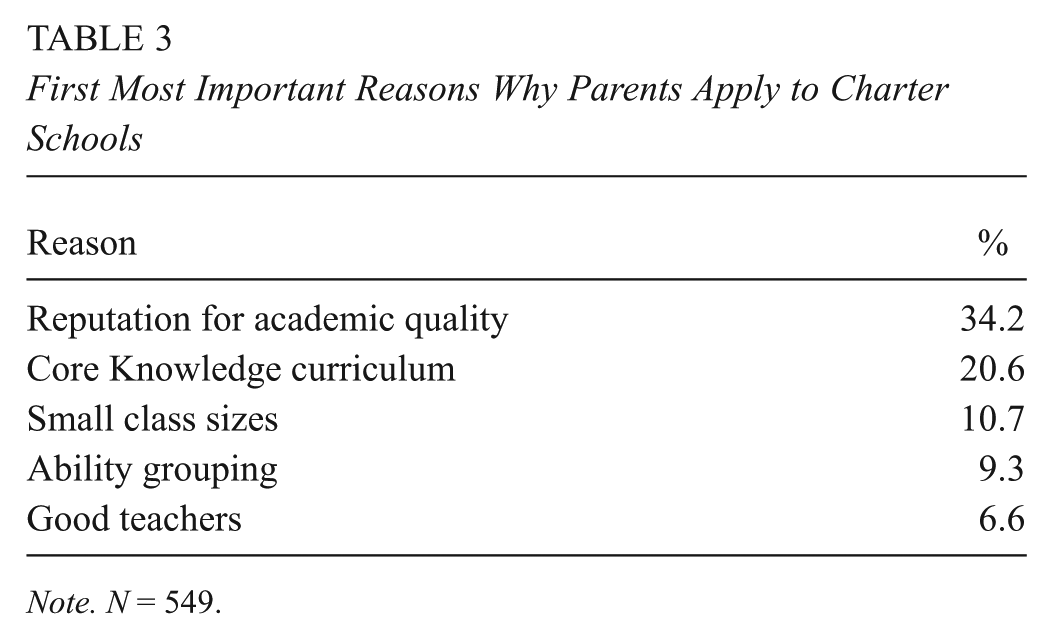
The survey followed this question listing multiple reasons to apply to a charter schools with questions that asked parents about what was the first and second most important reasons to apply. For most parents, the most important reason for applying to a charter schools was related to academic quality. As shown in Table 3, common most important top reasons included reputation for academic quality, the Core Knowledge curriculum, small class sizes, ability grouping, and good teachers.
First Most Important Reasons Why Parents Apply to Charter Schools
Note. N = 549.
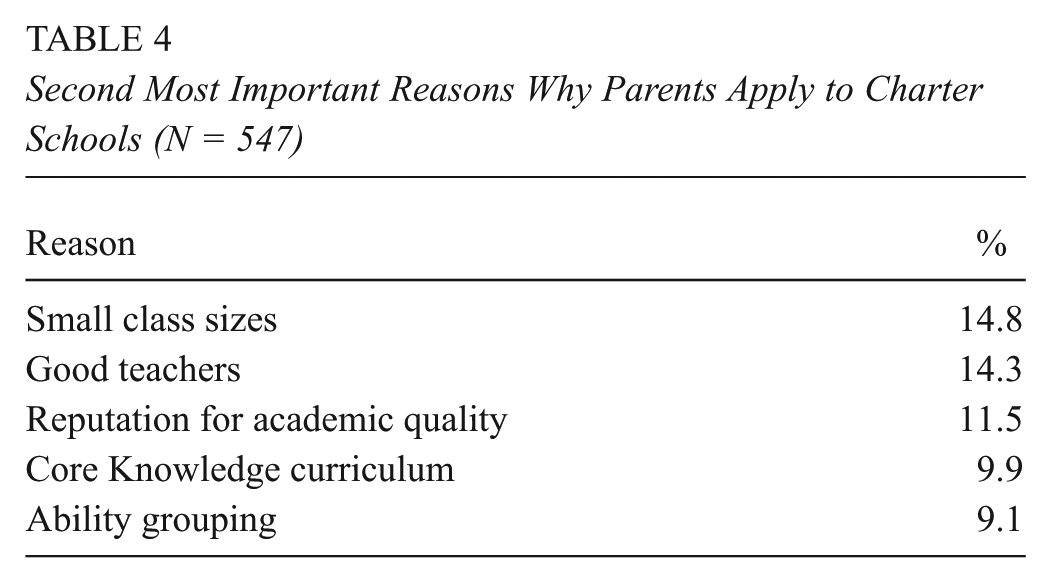
When asked about their second most important reason from the list, parents again focused on dimensions of academic quality (see Table 4). Compared to Table 3, the reasons are the same although the ordering is different. For 15% of the parents, a small class size in the school was the second most important factor in their decision making. The factor of ability grouping was very important for 60% of parents and also is mentioned as a first or second most important reason why parents apply to charter schools. Although what parents mean in their response about ability grouping is somewhat unclear, the open-ended responses above suggest that parents believe that charter schools’ use of ability grouping will better meet the needs of higher-achieving students. For example, when asked about the most important reason parent applied to a charter schools, they provided the following responses about ability grouping:
“Ability grouping, customizing the experience for him to make sure that he would not be bored or overwhelmed.”
“I liked the way they grouped by math and reading levels.”
“We saw things in our daughter that we thought were accelerated, and we wanted a school that would accommodate that.”
“The education and my daughter tested in the gifted and talented program, and I wanted her not be bored so she would be challenged.”
Second Most Important Reasons Why Parents Apply to Charter Schools (N = 547)
What Sources of Information Do Parents Use When Applying to Charter Schools?
Parents reported using a variety of sources of information when applying to charter schools, including relying on their social networks, websites (school and Colorado Department of Education), visits to the school, conversations with school staff, and experiences with other children. Parents were asked whether or not they used different sources of information when applying to a charter school. The results appear in Table 5. Over 95% of parents reported that they relied on talks with other family members, friends, neighbors, coworkers, and/or parents.
Sources of Information Used When Applying to a Charter School (in percentages)

Note. N = 553.
Ninety-three percent of parents reported the use of school websites to get information on performance data. Just over half (53%) reported that they considered school performance data on the Colorado Department of Education website. Only 22% of parents said that the student achievement growth data on the Colorado Department of Education website was a source of information used when applying to a charter school. Even socioeconomically advantaged parents, such as the ones in our sample, may find it difficult to understand what the growth model results mean. Chi-square tests revealed that parents’ ratings of the importance of test scores were positively related to their use of school performance data on the Colorado Department of Education website (p < .001), student achievement growth data on the Colorado Department of Education website (p < .01), and school websites to get performance information (p < .05).
In addition to school websites, 72% of parents reported that they relied on other education websites (e.g., GreatSchools.net, Colorado League of Charter Schools). Other important sources of information reported by parents included visits to the school (79% of parents reported this as a source); talks with teacher, principals, and other school personnel (61%); and experience with other children (56%). Social media and other media (radio, TV, newspaper) were infrequently reported as sources of information (less than 10%).
Discussion
The purpose of the present study was to add to the research on school choice by examining parent decision making within the context of charter schools located in socioeconomically advantaged, suburban areas. Some of our results are consistent with prior work on parents’ reasons for choosing a charter school and the factors that influence their choices. Specifically, parent responses reveal the importance of social networks in finding out about and applying to charter schools (Holmes, 2002; Lacireno-Paquet & Brantley 2008; Neild, 2005; M. Schneider et al., 1997, 2000; Stein et al., 2010).
In our study, what is striking is how frequently parents rely on social networks when first considering charter schools. Of the 553 parents, 51% stated on an open-ended question that social networks were important when applying to charter schools, and 95% reported on the survey that they relied on talks with other family members, friends, neighbors, coworkers, and other parents when applying to a charter school. The reliance of social networks in guiding parent decision making outweighs the importance of other factors, such as academic quality, school safety, and curriculum. Although these latter factors are still salient in decision making about charter schools, it is likely that higher-income parents rely on social networks because they are a trusted source of information for such factors as academic quality, effective teachers, and curriculum and instruction (Lareau, 2014).
In contrast to some previous research, our findings reveal that high-income parents do engage in doing various kinds of research on the schools (e.g., school visits, meetings with principals and teachers, examination of school websites) they are applying to. This finding contrasts with Lareau’s (2014) conclusion that middle-class parents trusted their networks and did not engage in research when making their school choice but relied “on either personal experience or information gleaned from trusted members of their social networks” (p. 183).
Although this may be what she found among the families in her study, our survey of over 550 suburban, socioeconomically advantaged parents reveals that parents do engage in careful research (see also Teske & Reichart, 2006). Social networks are important, but so too is doing research on the schools. In our sample, “doing research” meant different activities, such as visiting the schools, talking with teachers and principals, and investigating academic quality using school websites. Nearly one in five parents reported that they did these research activities when asked on an open-ended question about how they decided to apply to a charter schools. On the survey, 93% of parents reported relying on the school’s website and its performance data when applying to a charter schools. Our survey results also reveal that a substantial percentage of parents “did their research” by visiting the schools, visiting other education websites (e.g., GreatSchools.net, Colorado League of Charter Schools, Colorado Department of Education), taking with teachers, principals, and other school personnel. In part, parents doing their homework on schools may be due to the fact that these parents also entered their child in a lottery, which may have motivated them to do research on the schools to examine how they might meet the needs of their children.
Also similar to prior research, our parent survey results show that important factors in charter school decision making include schools having effective teachers, being academically rigorous, and having a safe and disciplined climate (Figlio & Stone, 2001; Hausman & Goldring, 2000; M. Schneider et al., 2000). However, only 12% of parents reported that academic quality was important when asked an open-ended question about why they decided to apply to a charter school. This is not to say that academic quality is unimportant to parents. It may be that, similar to safety, these parents took academic quality for granted because all the schools they were considering were perceived as being of good quality. Also, our results suggest that how parents perceive and value academic quality is more nuanced than previous school choice survey research has portrayed (see also Stein et al., 2010). When parents are asked open-ended questions, it becomes apparent that academic quality means different things to different parents, ranging from a “decent” to “excellent” school in terms of its academic performance.
Prior research has shown that distance between school and home can be important for parents when choosing a school for their children (Bell, 2009b; Bridge & Blackman, 1978; Lubienski et al., 2009). Our survey results show that “distance to my home” is important or very important for 79% of parents, whereas this factor is not important for 21% of parents. Proximity of the school to the families’ homes was mentioned in only 6% of the open-ended parent responses. Our findings about distance of the school to respondents’ homes are not as consistent with previous findings as we might have expected, which may be a reflection of our socioeconomically advantaged sample and the geographic location of the schools. The schools being considered by parents may have been closer together than in other studies. Or these suburban Colorado parents may be willing to drive greater distances to a charter school than parents in other locations.
With open-ended questions, we were able to learn about the categories of social networks, academic quality, the push away from public schools and the pull toward charter schools, and curriculum. Based on parents’ open-ended responses, we find that in many cases multiple factors are influencing their decisions. Thus, our study adds depth in researchers’ understanding of the thinking that parents’ decision making is both “multistep” (Stein et al., 2010) and “bundled” (Goyette, 2014). During the decision-making phase, some factors may come into play in a stepwise manner. Also at some points during decision making, several factors are considered all at once. The majority of the open-ended responses from parents about how they became interested in applying to charter schools revealed not only the importance of their social networks but also the importance of multiple factors when deciding.
Our study suggests that suburban, socioeconomically advantaged parents rely on their social networks of family, friends, neighbors, and coworkers for information about the school choice landscape. However, these parents also independently investigate school quality, curriculum, instruction, and other factors to see whether the school is a good fit for their child. These findings are consistent with market theory that argues that school choice will result in better matches between parents, children, and schools. However, the socioeconomically advantaged parents in our sample enjoy a rich set of resources, which may be very different from low-SES parents whose decision-making process is constrained (Rhodes & DeLuca, 2014), suggesting that market theory may have different applications in urban and suburban populations.
Footnotes
Acknowledgements
All opinions expressed in this paper represent those of the authors and not necessarily the institutions with which they are affiliated or the U.S. Department of Education. All errors in this paper are solely the responsibility of the authors. The authors are listed alphabetically, as this paper was fully collaborative. This research was supported by a grant from the U.S. Department of Education’s Institute of Education Sciences (R305E090003). We appreciate the helpful advice from Allen Ruby and members of our research team and the research assistance of Michelle Lacouture.
Notes
Authors
SHANNON ALTENHOFEN, PhD is a social psychologist and licensed school psychologist consulting in educational research and working in regular public and charter schools. Her research interests include early childhood development and caregiver-child relations.
MARK BERENDS, PhD is a sociology professor at the University of Notre Dame and the director of the Center for Research on Educational Opportunity. His research interests include sociology of education, school choice, research methods, and educational equity.
THOMAS G. WHITE, PhD is a senior research scientist at the University of Virginia in the Curry School of Education’s Center for Advanced Study of Teaching and Learning. His research interests include early reading and program evaluation.