




Abstract
Understanding speech in noise is a common challenge for older adults, often requiring increased listening effort that can deplete cognitive resources and impair higher-order functions. Hearing aids are the gold standard intervention for hearing loss, but cost and accessibility barriers have driven interest in alternatives such as Personal Sound Amplification Products (PSAPs). While PSAPs are not medical devices, they may help reduce listening effort in certain contexts, though supporting evidence remains limited. This study examined the short-term effects of bilateral PSAP use on listening effort using self-report measures and electroencephalography (EEG) recordings of alpha-band activity (8–12 Hz) in older adults with and without hearing loss. Twenty-five participants aged 60 to 87 years completed a hearing assessment and a phonological discrimination task under three signal-to-noise ratio (SNR) conditions during two counterbalanced sessions (unaided and aided). Results showed that PSAPs significantly reduced self-reported effort. Alpha activity in the left parietotemporal regions showed event-related desynchronization (ERD) during the task, reflecting brain engagement in response to speech in noise. In the unaided condition, alpha ERD weakened as SNR decreased, with activity approaching baseline. PSAP use moderated this effect, maintaining stronger ERD under the most challenging SNR condition. Reduced alpha ERD was associated with greater self-reported effort, suggesting neural and subjective measures reflect related dimensions of listening demand. These results suggest that even brief PSAP use can reduce perceived and neural markers of listening effort. While not a replacement for hearing aids, PSAPs may offer a means for easing cognitive load during effortful listening. ClinicalTrials.gov, NCT05076045, https://clinicaltrials.gov/study/NCT05076045
Introduction
Understanding speech in optimal conditions, such as a quiet environment, often feels effortless. In contrast, noisy settings impose greater demands on cognitive resources like attention and working memory, making speech comprehension more effortful (Mattys et al., 2012; Peelle, 2018). This is particularly the case for older adults with hearing loss, who often show lower performance and report higher levels of listening effort during speech-in-noise compared to their peers with normal hearing (e.g., Krueger et al., 2017; Schepker et al., 2016). Listening effort has been defined as “the deliberate allocation of mental resources to overcome obstacles in the pursuit of a goal when performing a [listening] task” (Pichora-Fuller et al., 2016, p. 10S). This concept aligns with capacity resource theory (Kahneman, 1973), which posits a limited pool of cognitive resources for task performance. Individuals with hearing impairments may require more resources for auditory processing during speech perception, leaving fewer resources for higher-level cognitive functions such as speech comprehension and memory. High levels of listening effort can result in mental fatigue, reducing cognitive performance, impairing concentration, and diminishing both the effectiveness and enjoyment of communication (e.g., Alhanbali et al., 2018; Hornsby et al., 2016; Perron et al., 2022). Managing listening effort in older adults with hearing loss is critical to mitigating its impact on daily life.
Conventional hearing aids remain the gold standard for addressing hearing loss, providing sound amplification tailored to individual needs. Research has demonstrated that these devices improve speech-in-noise performance and reduce self-reported listening effort (e.g., Rovetti et al., 2019; Vaisberg et al., 2024; Wu et al., 2019), highlighting the potential of hearing aid technologies to improve speech perception and alleviate the associated cognitive effort. Unfortunately, hearing loss remains significantly undertreated, with an estimated 22.9 million hearing-impaired older adults in the United States who do not use hearing aids (Chien & Lin, 2012). This is likely due to the significant cost of hearing aids (Jilla et al., 2023), which are not covered by most insurance companies (Kochkin, 2012). Furthermore, stigma, lack of awareness, concerns about the comfort of the device and difficulties associated with the complexity of fitting and adjustment may also play a role (for a discussion, see Valente & Amlani, 2017).
In recent years, the hearing healthcare industry has undergone significant changes, with the introduction of over-the-counter (OTC) hearing aids. These devices were introduced in response to the U.S. Food and Drug Administration (FDA), enabling consumers to purchase hearing aids directly without needing a prescription or consultation with an audiologist. Another category of OTC hearing instruments, personal sound amplification products (PSAPs), has also gained significant attention. PSAPs resemble hearing aids but are designed for individuals with normal hearing who wish to amplify sounds in specific situations, such as watching TV or listening to distant conversations. They are more affordable than both conventional and OTC hearing aids. While PSAPs are not intended for individuals with hearing loss, many use them as a low-cost alternative to hearing aids. For example, Kochkin (2010) estimated that 1.1 million people in the United States use PSAPs to address their hearing loss. However, because PSAPs are not designed for clinical use, their effectiveness in reducing listening effort remains uncertain. More empirical research is needed to evaluate their potential benefits and limitations.
In a recent study, we showed that PSAP use significantly improved speech-in-noise perception, enhancing both sentence comprehension and phonological discrimination compared to no device use (Perron et al., 2023). While the benefits varied across individuals, one important finding was that most participants reported reduced listening effort when using the PSAPs, suggesting that these devices help alleviate the cognitive load associated with speech-in-noise listening. These results are consistent with those of other studies showing a reduction in self-reported listening efforts in PSAPs users (e.g., Chen et al., 2022; Cho et al., 2019). However, these results should be interpreted with caution, as they rely on self-reported measures. Self-reported measures of listening effort can be biased, as individuals may base their responses on perceived performance rather than the actual cognitive demands of the task (Moore & Picou, 2018). It is also possible that participants reported less listening effort because they believe the devices should improve their hearing (i.e., placebo effect). Objective measures of listening effort are necessary to draw firmer conclusions about the impact of PSAPs.
Scalp recording of neuroelectric brain activity provides a means to measure listening effort objectively. For instance, alpha power (8–12 Hz) is one of the most prominent frequency bands and has consistently been linked to variations in listening and cognitive effort (e.g., Dimitrijevic et al., 2017; Obleser et al., 2012; Paul et al., 2021; Weisz & Obleser, 2014; Wöstmann et al., 2015). When individuals perform tasks requiring sustained attention, alpha power often increases relative to baseline or a control condition (i.e., event-related synchronization or ERS) in regions associated with attention and working memory. Notably, cochlear implant users showed alpha ERS in the left inferior frontal gyrus (Dimitrijevic et al., 2019) and centroparietal scalp region (Paul et al., 2021), which correlated positively with subjective ratings of listening effort. Similarly, in individuals with mild to moderate hearing loss, Petersen et al. (2015) reported an increase in alpha ERS over the centroparietal scalp region as a function of background noise and degree of hearing loss. The alpha ERS associated with listening effort is thought to reflect the brain's attempt to suppress activity in task-irrelevant regions, thereby facilitating task-relevant processing (Jensen & Mazaheri, 2010; Klimesch et al., 2007; Strauß et al., 2014). During speech-in-noise tasks, Strauß et al. (2014) proposed that increased alpha activity plays a role in inhibiting the processing of background noise, thereby enhancing auditory selective attention to task-relevant speech targets.
In parallel, a decrease in alpha power relative to baseline or a control condition (i.e., event-related desynchronization or ERD) has also been observed under challenging listening conditions (e.g., Becker et al., 2013; Dimitrijevic et al., 2017; Wisniewski & Zakrzewski, 2023). This decrease is usually observed over temporal regions and is thought to indicate increased cortical excitability and sensory engagement, which support the processing of degraded speech. Temporal alpha ERD has been correlated with improved speech perception accuracy (Dimitrijevic et al., 2017). Together, these findings suggest that alpha oscillations serve complementary roles during challenging listening. Alpha ERS may reflect the suppression of distracting or task-irrelevant input, while alpha ERD may reflect enhanced recruitment of task-relevant sensory regions. As listening becomes more demanding, the brain appears to coordinate these domain-general and sensory-specific mechanisms in support of speech comprehension.
The current study used alpha-band activity to index listening effort and a data-driven approach to examine neurobiological responses to bilateral PSAP use during a speech-in-noise task. A data-driven approach was used because there are multiple sources of alpha activity in the brain, with regions such as the frontal, temporal, and parietal areas associated with listening effort (e.g., Dimitrijevic et al., 2017; Dimitrijevic et al., 2019; Paul et al., 2021). Specifically, we focused on alpha-band ERS/ERD changes and their relationship to self-reported effort. We hypothesized that increased background noise intensity (i.e., a decrease in SNR) would lead to greater alpha ERS, reflecting increased cognitive effort. We also expected that PSAPs use would moderate this increase in alpha power, reducing it relative to the unaided condition. Finally, we anticipated a correlation between alpha oscillatory activity and self-reported listening effort, supporting the association between alpha activity and self-reported listening, but more importantly, the potential of PSAPs to reduce the cognitive effort associated with listening in challenging conditions.
Methods
Participants
Participants were recruited between March and September 2022 through the Baycrest Academy for Research and Education's participant database, as well as via advertisements and word-of-mouth. The recruitment process is summarized in Figure 1. Eligibility of 72 participants was verified via self-report during a structured telephone screening. Participants were asked about their medical history, cognitive functioning, use of hearing devices, handedness, and language background. To be eligible, participants had to be right-handed, 60 years or older, and proficient in English (first language or acquired before age 5). Exclusion criteria included language impairment, significant medical or neurocognitive conditions, interventions affecting cognition, untreated visual impairment, tinnitus or otological disorders, known cerebrovascular disease, past or present experience with any hearing device, and contraindications to the PSAPs. Of the 72 individuals screened, 22 did not meet the inclusion criteria (10 due to tinnitus and 12 due to hearing aid use), 14 declined to participate, and four were excluded for other reasons, resulting in a sample of 32 participants. Four participants were unable to complete the study due to medical (N = 2) or personal (N = 2) reasons, one participant declined to participate in the EEG portion of the study, and two participants were excluded due to noisy EEG signals. The final sample consisted of 25 participants aged between 60 and 87 (M = 73.8, SD = 6.6, 17 females).
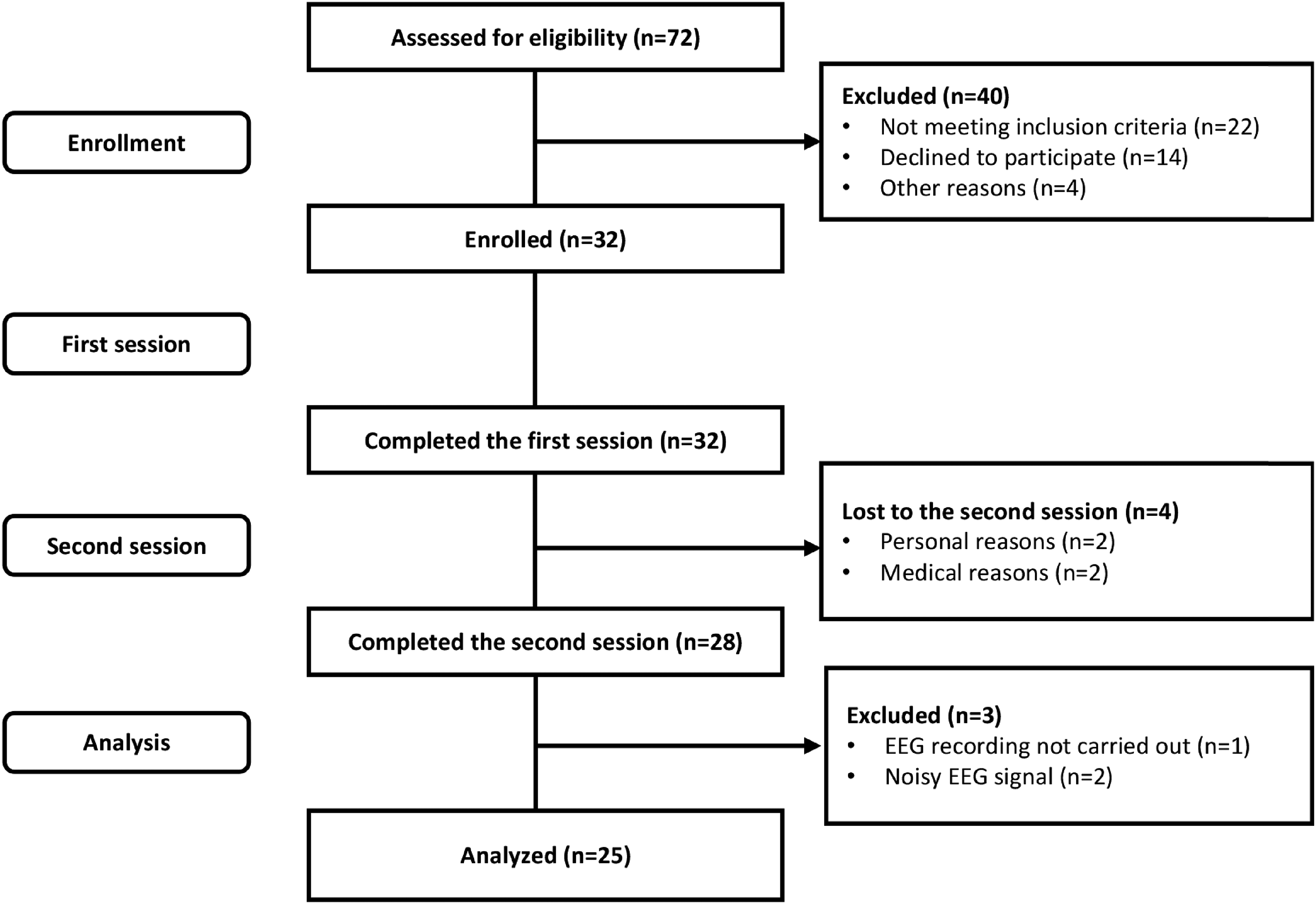
CONSORT flow diagram. Flow chart showing inclusion and participation throughout the study.
The study received approval from the Baycrest Research Ethics Board (project #21-32) and was registered with ClinicalTrials.gov (NCT03008174). All participants gave written informed consent and were compensated for their time.
Procedure and Design
A randomized crossover design was employed. Participants completed two 3h sessions, separated by at least 7 days. The first session began with obtaining written informed consent, followed by the completion of demographic and health questionnaires, a brief cognitive assessment, and pure-tone audiometry to assess peripheral hearing. In both sessions, participants performed speech-in-noise tasks, including the Quick Speech-in-Noise (QuickSIN) test (Killion et al., 2004) and a phonological (word) discrimination task. Self-reported listening effort was also measured during the latter task. In one session, the tasks were performed without PSAPs (i.e., unaided session), and in the other session, they were performed with bilateral PSAPs (i.e., aided session). The order of the sessions (unaided or aided) was counterbalanced by the first author and a research assistant using block randomization with blocks of three. Thirteen of the 25 participants performed the experiment with PSAPs in their first session, while 12 performed their first session unaided. All procedures were carried out in a double-walled soundproof room, and the study followed a consistent procedure throughout.
Hearing Status
Pure-tone air conduction hearing thresholds (in dB hearing level) were obtained using a calibrated clinical audiometer (GSI 61, Grason-Stadler, USA). Each ear was tested separately for the following frequencies: 0.25, 0.5, 1, 2, 4, 6, and 8 kHz. Hearing loss was assessed using the pure-tone average (PTA4: 0.5, 1, 2, and 4 kHz) for the better ear. According to this measure, 14 participants met the criterion of mild hearing loss (better ear PTA4 between 20 and 40 dB), and all other participants met the criterion of normal hearing (better ear PT4 < 20 dB) (Humes, 2019; Stevens et al., 2013). Sixteen participants had hearing thresholds that met the criterion of hearing loss in at least one ear.
PSAPs and Device Fitting
Participants were fitted with bilateral CS50+ PSAPs (Sound World Solutions, Park Ridge, IL, USA), high-end behind-the-ear devices featuring a 16-channel compressor, 16-channel noise reduction, feedback cancelation, and dual microphone directionality. Each device costs approximately USD 350. The CS50+ PSAPs are designed for personal use and are intended to be purchased and fitted without professional assistance. As such, the fitting process was designed to replicate the self-fitting experience that users of these devices would encounter in a real-world setting, without the involvement of a hearing healthcare professional.
Upon receiving the PSAPs, participants selected the appropriate ear tip size (small, medium, or large) based on personal preference and comfort. All ear tips were closed-fit domes, as provided by the manufacturer. Next, they completed a hearing test using the Customizer app (Sound World Solutions, Park Ridge, IL, USA), installed on an iPhone and connected to the PSAPs via Bluetooth. The app guided participants through a tone detection task similar to a standard pure-tone audiometry test. They were asked to press a button in response to pure tones of different frequencies presented separately in each ear. While participants were not provided with direct instructions during the test, they were supervised to ensure safety and accuracy. Although most participants were able to fit the devices independently, a few required occasional assistance during the process.
Following the tone detection task, the app automatically adjusted the gain prescription of the PSAPs according to the NAL-NL2 targets (Keidser et al., 2011). After the hearing test, the devices were set to “restaurant mode,” which activates the dual-directional microphone feature to improve speech clarity in noisy environments. In this mode, the CS50 + uses a fixed hypercardioid polar pattern, providing strong sensitivity at 0°, moderate sensitivity at ±45°, and attenuation near its null points around ±120°, with a small rear lobe of pickup at 180°. The device also implements an intelligibility-weighted gain reduction algorithm, which selectively suppresses noise in less speech-relevant frequency regions while preserving audibility in critical speech bands. These features exhibit a slow attack and fast release, meaning that noise reduction engages gradually and disengages quickly in response to changes in background noise. The settings (personal amplification and noise cancelation) were retained throughout the experiment. We relied on participants’ subjective feedback to confirm the level of amplification of PSAPs. Participants were asked to confirm whether they could hear the difference in amplification with the devices.
Phonological Discrimination Task
Participants performed a classic AX discrimination task in noise. The task involved discriminating 306 pairs of monosyllabic Canadian-English consonant-vowel-consonant (CVC) words. Words were selected from the MALD database (Tucker et al., 2019) and presented either as identical (e.g., /tap/-/tap/) or different (e.g., /bat/-/pat/) pairs, with phonological contrasts occurring equally across onset, nucleus, or coda position (33% each). Half of the word pairs were identical.
Stimuli were presented using Presentation Software (Neurobehavioural Systems, USA). Speech stimuli were delivered through two speakers positioned at the front corners of the room (±45°), while multitalker babble noise was presented through two rear speakers positioned at ±135°. All speakers were placed approximately 1.5 m from the participant at ear level. This spatial arrangement was chosen to approximate everyday listening environments, where speech rarely always comes directly from the front, and background noise generally comes from different directions. Although ±45° does not correspond to the optimal axis of sensitivity for the PSAPs’ hypercardioid microphone pattern, it remains within the forward-sensitive range. The ±135° positioning of the noise sources was chosen to closely align with the device's null regions, minimizing background noise pickup. To ensure consistent spatial input, participants were asked to fixate on a fixation cross displayed on a monitor and to minimize head movement throughout the task.
Three signal-to-noise ratios (SNR; Pressuresignal/Pressurenoise) were employed: + 3, 0, and −3 dB. The sound level of the words was kept constant at 70 dB SPL, while the background noise level varied. We manipulated the noise level rather than the speech level to better reflect ecologically valid listening conditions, where background noise fluctuates more than the speech signal during everyday conversations. This SNR range was selected based on previous work showing that these levels reliably elicit effects of age, hearing loss, and SNR on speech perception performance within a similar AX discrimination task (e.g., Brisson & Tremblay, 2021; Perron et al., 2021; Tremblay et al., 2019).
Participants underwent a brief practice session (16 trials) before starting the main task. Each session consisted of three 10min blocks, with short breaks in between. SNR conditions were randomized on a trial-by-trial basis within each block (i.e., mixed block design) to prevent predictability and order effects. Two versions of the same task were created and counterbalanced between sessions. In each session, participants heard 306 trials (102 per SNR condition). On each trial, the background noise began 1000 ms before word onset, followed by the two words separated by a 300 ms interstimulus interval. Participants had a maximum of 3 s to indicate whether the second word was the same or different from the first using a response box (RB-840, Cedrus Corporation, USA). A visual cue consisting of a white fixation cross during word presentation, followed by a green question mark, guided participant responses. Accuracy was calculated as the proportion of correct responses, and reaction time in millisecond was measured from the offset of the second word to the moment of button press. The intertrial interval was fixed at 1000 ms. All stimuli and experimental files are available on the Borealis repository (Perron, 2023; https://doi.org/10.5683/SP3/HTMDLI).
Self-Reported Listening Effort
After completing each of the three blocks of the phonological discrimination task, participants provided a self-reported measure of listening effort using a printed seven-point Likert scale (adapted from Johnson et al., 2015). The scale ranged from 1 (“No effort”) to 7 (“Extreme effort”). After each block, the experimenter asked: “Using the scale in front of you, can you estimate how much effort it took to understand the words in the presence of background noise? If you think the amount of effort was between two numbers on the scale, it is fine for you to pick a fraction.” This yielded three effort ratings per session. For analysis, listening effort was operationalized as the average of the three ratings within each session, as no interaction between block and session was found in previous analyses (Perron et al., 2023).
EEG Acquisition and Preprocessing
During the speech-in-noise task, continuous EEG data were collected using a 76-channel Active Two acquisition system (BioSemi V.O.F., Amsterdam, the Netherlands) at a sampling rate of 512 Hz and a bandwidth of DC-100 Hz. The recorded data were stored for offline analysis, using Brain Electrical Source Analysis software (BESA Research, version 7.1, MEGIS GmbH, Gräfelfing, Germany). The electrode montage consisted of 66 scalp electrodes, following the 10/20 system. It included an active Common Mode Sense (CMS) electrode and a passive Driven Right Leg (DRL) electrode, acting as the ground reference. Ten facial electrodes were also placed below the hairline to monitor eye movements and ensure uniform scalp coverage. These facial electrodes were positioned at specific locations, including both mastoids, preauricular points, the outer canthus of each eye, the lower orbit of each eye, and two additional frontotemporal electrodes.
Noisy channels were identified visually from the continuous recording and then interpolated using spherical spline interpolation. The EEG data were subsequently re-referenced to the average of all electrodes and digitally filtered. A 0.5-Hz high-pass filter with a zero-phase slope of 12 dB/octave and a 90-Hz low-pass filter with a zero-phase slope of 24 dB/octave were applied. Finally, artifacts from eye movements were corrected from the continuous recording using the following procedure: a set of eye movements was visually identified and used to generate spatial components to best account for eye movement artifacts. The spatial topographies were then subtracted from the continuous EEG to correct for lateral and vertical eye movements and eye blinks.
After correcting for eye movements, the EEG data were parsed into 2,500 ms epochs time-locked to the onset of the first syllable (Figure 2). The epochs were automatically scanned for artifacts (i.e., signal exceeding ±120 µV), which were marked and excluded from further analysis. At least 75% of the trials in each condition were included in the analysis for each participant.

Epochs. Continuous EEG data were segmented into 2,500 ms epochs time-locked to the onset of the first word. Each epoch included a 500 ms prestimulus baseline and a 2,000 ms post-stimulus period. Analyses were restricted to alpha activity elicited by the first word, focusing on the 0 to 500 ms window following stimulus onset.
Time-Frequency Analysis
Continuous EEG data were transformed into the time-frequency domain using BESA Research 7.1, with complex demodulation applied in 1 Hz frequency bins and 50 ms temporal resolution across the 2 to 50 Hz range. Baseline correction was performed by calculating the percent change in power at each time-frequency point relative to the mean power during the 500ms prestimulus interval. This yielded a temporal spectral evolution (TSE) representation, where positive values reflect ERS and negative values reflect ERD. All reported alpha power values reflect this percent change from baseline.
Outcomes and Statistical Analyses
For all analyses, an alpha level of 0.05 was used to determine statistical significance. The data distribution was visually inspected using histograms, confirming a normal distribution for all variables. No more than one outlier (values greater than 3 interquartile ranges) was identified in each analysis. Raw behavioral and EEG data are available in the Borealis database (Perron, 2023; https://doi.org/10.5683/SP3/HTMDLI).
As pre-registered, the primary outcomes were self-reported listening effort and alpha ERS/ERD during the first word. For self-reported effort, a paired-sample t-test was performed in R (version 4.1.1) to determine whether there was a significant difference in scores between the two sessions. Effect sizes were expressed using Cohen's d. To support interpretation of the EEG findings, we also re-analyzed accuracy and reaction time using linear mixed-effects (LME) models, restricted to participants included in the current study (N = 25). Session and SNR were entered as within-subject factors, with Participant included as a random factor.
For alpha activity, the analysis focused on ERS/ERD within the 0 to 500 ms time window of the first word to isolate the effects of listening effort without interference from additional processes, such as phonological differences or working memory demands associated with the second word. Statistical analyses of the time-frequency data were conducted using BESA Statistics 2.1. A data-driven approach was employed to identify significant clusters of electrodes in space, time, and frequency, using a Monte Carlo resampling technique to account for multiple comparisons. This approach was chosen because previous studies have shown variability in the source localization of alpha power related to listening effort (e.g., Dimitrijevic et al., 2017; Dimitrijevic et al., 2019; Paul et al., 2021). A significance level of 0.05 was used to form clusters, with 5,000 permutations applied to the analysis. This analysis was conducted in three steps. First, we identified electrodes where alpha activity exhibited sensitivity to changing SNRs, presumably reflecting changing speech-in-noise task difficulty. We used a cluster-based three-way permutation analysis of variance (ANOVA) to compare the three SNR conditions during the unaided session. Second, alpha ERS/ERD values were extracted for each cluster identified in the previous analysis for all three SNR conditions across both sessions. These values were then analyzed using LME models to assess the effects of Session and SNR.
All LME models (including those for behavioral accuracy, reaction time, and alpha ERS/ERD) were implemented in R using the lmer function from the lme4 package (version 1.1.27), with Session and SNR entered as within-subject factors and Participant as a random factor. Effect sizes were expressed using partial eta squared (ηp²).
Finally, we examined brain–behavior relationships to assess whether alpha ERS/ERD was associated with self-reported listening effort, phonological discrimination accuracy, and reaction time. LME models were used, with behavioral outcomes as dependent variables and alpha power as a continuous predictor (Behavior ∼ Session * Alpha). Session was included as a within-subject factor, and participants were modeled with random intercepts to account for individual variability. This approach tested both the main effect of alpha power on behavior and whether this relationship varied by session. In other words, the model assessed whether within-subject changes in alpha power predicted changes in behavioral performance across aided and unaided sessions. For significant results, both unstandardized (B) and standardized (β) coefficients are reported, along with 95% confidence intervals (CIs).
Results
Behavioral Results
Difference in Self-Reported Listening Effort
Of the 25 participants, 17 (68%) reported lower listening effort during the aided session than the unaided session. Four participants (16%) reported no change, while four (16%) reported greater effort in the aided session. A paired-samples t-test revealed a significant moderate difference in self-reported listening effort scores (Figure 3), t(24) = −2.96, p = .007, d = −0.59. Self-reported listening effort scores were lower in the aided session (M = 3.74) compared to the unaided session (M = 4.23), with a mean difference of 0.49 points on a seven-point scale (95% CI = [0.15, 0.84]).
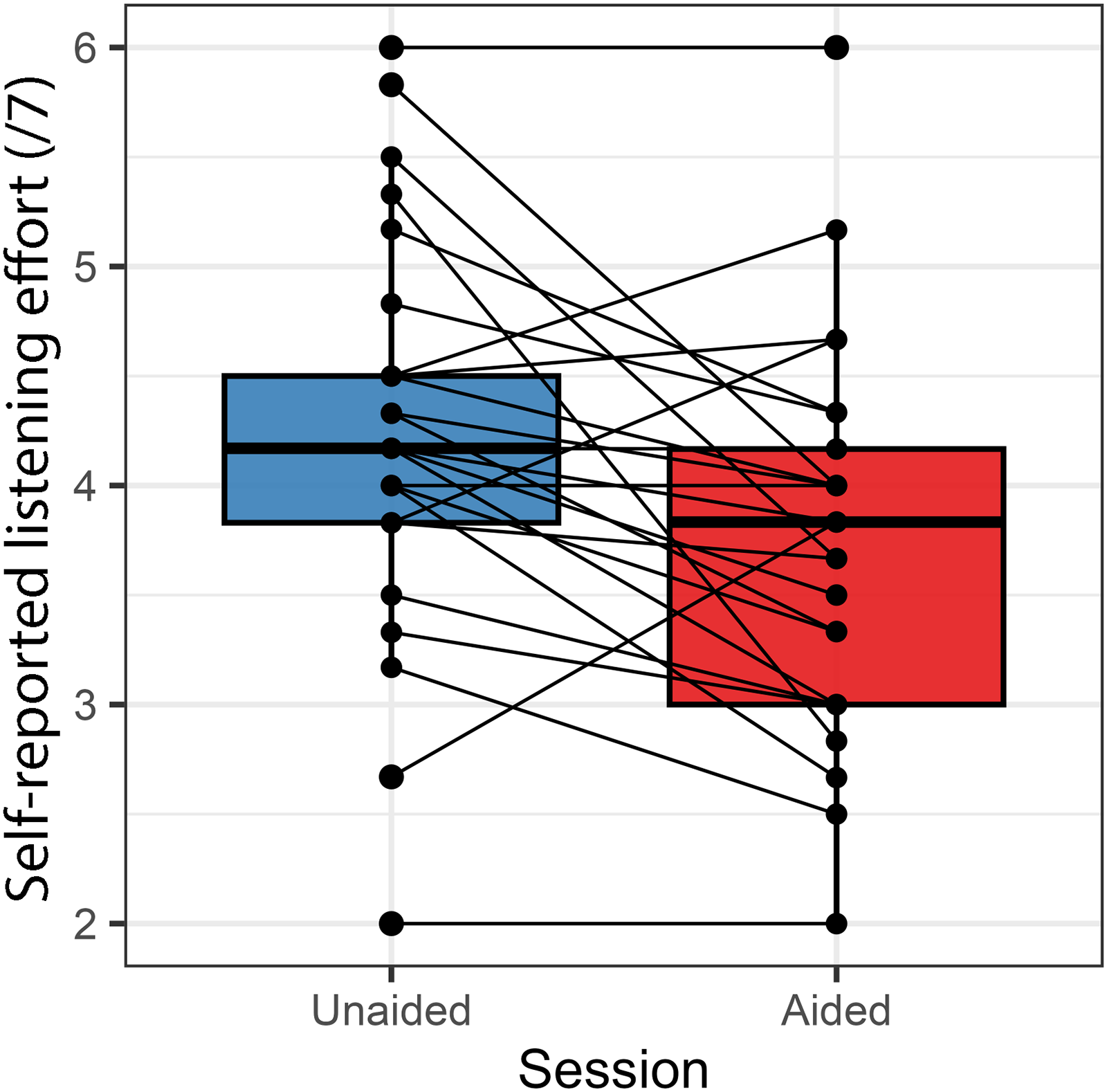
Self-reported listening effort scores for the unaided and aided sessions. Participants rated their perceived effort on a seven-point Likert scale, where higher scores indicated greater effort. A significant reduction in effort was observed in the aided session relative to the unaided session.
Difference in Accuracy and Reaction Time
To support interpretation of the EEG findings, we re-analyzed accuracy and reaction time data. For accuracy, we observed significant main effects of both Session, F(1,120) = 5.8, p = .02, ηp² = 0.05, and SNR, F(2,120) = 46.9, p < 0.001, ηp² = 0.4. Accuracy was higher in the aided session (M = 85.2%) than in the unaided session (M = 83.7%), and declined with decreasing SNR. No significant Session by SNR interaction was observed, F(2,120) = 0.2, p = .9, ηp² < 0.001. For reaction time, there was a main effect of SNR, F(2,116) = 3.9, p = .02, ηp² = 0.06, with slower responses at lower SNRs, but no effect of Session, F(1,116) = 0.7, p = .4, ηp² < 0.001, or interaction F(1,116) = 0.2, p = .8, ηp² < 0.001. Mean RTs were 534 ms in the aided session and 522 ms in the unaided session. These findings are consistent with those previously reported in Perron et al. (2023).
Neural Measures of Listening Effort
Modulation of Alpha-Band Activity by Noise-Related Task Demands
We performed a cluster-based three-way permutation ANOVA to examine alpha-band activity as a function of three different SNRs during the unaided session. The ANOVA revealed a significant main effect of SNR (maximum F-value = 7.98, p = .002) in a single parietotemporal cluster (FT7, C5, T7, TP7, CP5, P3, P5, P7, P9, and CB1) across the entire time window of interest (0–500 ms). The peak effect occurred at a latency of 150 ms, with the maximum effect observed at CP5. Overall, alpha power decreased relative to baseline (i.e., alpha ERD), and this desynchronization became less negative as SNR decreased, suggesting more positive alpha values with increasing noise. The mean alpha ERD for each SNR condition was as follows: SNR +3 dB = −0.12, SNR 0 dB = −0.07, and SNR −3 dB = −0.005.
Moderating Effect of PSAP Use on Alpha-Band Activity
Alpha values were extracted from all electrodes within the identified cluster for all three SNR conditions across both sessions. The TSE representations of alpha activity at the peak electrode (CP5) for all three SNR conditions in both sessions are shown in Figure 4. These data were analyzed using an LME model to test whether PSAP use moderated the impact of SNR on alpha ERD. The model revealed a significant main effect of SNR, F(2,120) = 5.91, p = .004, ηp² = 0.09, but no significant main effect of Session, F(1,120) = 2.74, p = .10, ηp² = 0.02. However, as expected, the interaction between the two factors was significant, F(2,120) = 3.75, p = .03, ηp² = 0.06. The scalp distribution of the alpha cluster used for analysis is shown in Figure 5.

Evoked neural oscillations over time, expressed as percent change from baseline. (A) Group mean temporal spectral evolution (TSE), time-locked to the onset of the first word, for all three signal-to-noise ratio (SNR) conditions in the unaided session. The spectrogram depicts a change in oscillatory activity recorded from electrode CP5. (B) Same as (A), but for the aided session. (C) Time course of alpha activity (8–12 Hz) across the epoch window. shaded areas around the lines represent the standard error of the mean. Positive values indicate event-related synchronization (ERS), reflecting increased alpha power relative to baseline, while negative values indicate event-related desynchronization (ERD), reflecting decreased alpha power relative to baseline.

Alpha-band activity (8–12 Hz) differences across signal-to-noise ratio (SNR) conditions and sessions. (A) Scalp topographies showing percent change in alpha-band activity relative to baseline for each of the three SNR conditions, as well as the contrast between the two extreme conditions (+3 dB vs. −3 dB), during the unaided session. Black dots indicate the significant cluster (FT7, C5, T7, TP7, CP5, P3, P5, P7, P9, and CB1) showing an effect of SNR in the unaided condition. (B) Same as (A), but for the aided session. (C) Scalp topographies showing the difference in alpha-band activity between the aided and unaided sessions for each SNR condition. (D) Statistical interaction between session and SNR on alpha-band activity averaged over the left parietotemporal cluster. Positive values reflect increased alpha activity (event-related synchronization, ERS), whereas negative values reflect decreased alpha activity (event-related desynchronization, ERD), relative to baseline.
Post hoc analysis of estimated marginal means revealed no significant difference in alpha ERD between the two sessions at SNR +3 dB, t(120) = 0.81, p = .42, and SNR 0 dB, t(120) = −0.65, p = .52. However, at SNR −3 dB, alpha ERD was significantly weaker in the unaided session compared to the aided session, t(120) = −3.0, p = .003, indicating greater alpha suppression when participants used PSAPs in the most difficult condition (Figure 5D). Within the unaided session, alpha activity increased significantly as SNR decreased, shifting from stronger ERD toward baseline levels. Significant pairwise differences were found between +3 dB and −3 dB (t = −4.3, p < .001), 0 dB and −3 dB (t = −2.3, p = .02), and +3 dB and 0 dB (t = −2.03, p = .045). In contrast, alpha ERD remained stable across SNR levels in the aided session (all p > .57). Altogether, this suggests that PSAP use attenuated the noise-related increase in alpha activity.
Brain–Behavior Relationships
We extracted average alpha values from all electrodes within the identified cluster used in the previous analysis, collapsing across SNR conditions. This approach was chosen because the self-reported listening effort was based on the overall task, rather than being specific to each SNR condition. We then examined how alpha activity related to listening effort, accuracy, and reaction time. Alpha activity significantly predicted self-reported listening effort, B = 5.02, β = 0.45, t = 2.25, p = .03, 95% CI [0.05, 0.85], with weaker alpha suppression (i.e., less ERD) in parietotemporal regions associated with greater reported effort (Figure 6A). The interaction between session and alpha activity was not significant, suggesting that this relationship held regardless of PSAP use (p = .09). Neither accuracy (Figure 6B) nor reaction time (Figure 6C) were significantly associated with alpha activity in either session (all p > .42). Interestingly, additional analyses examining the relationship between self-reported listening effort, accuracy, and reaction time revealed a significant negative association between effort and accuracy (B = −2.87, β = −0.07, t = −3.05, p = .005), but no relationship with reaction time (p = .74).
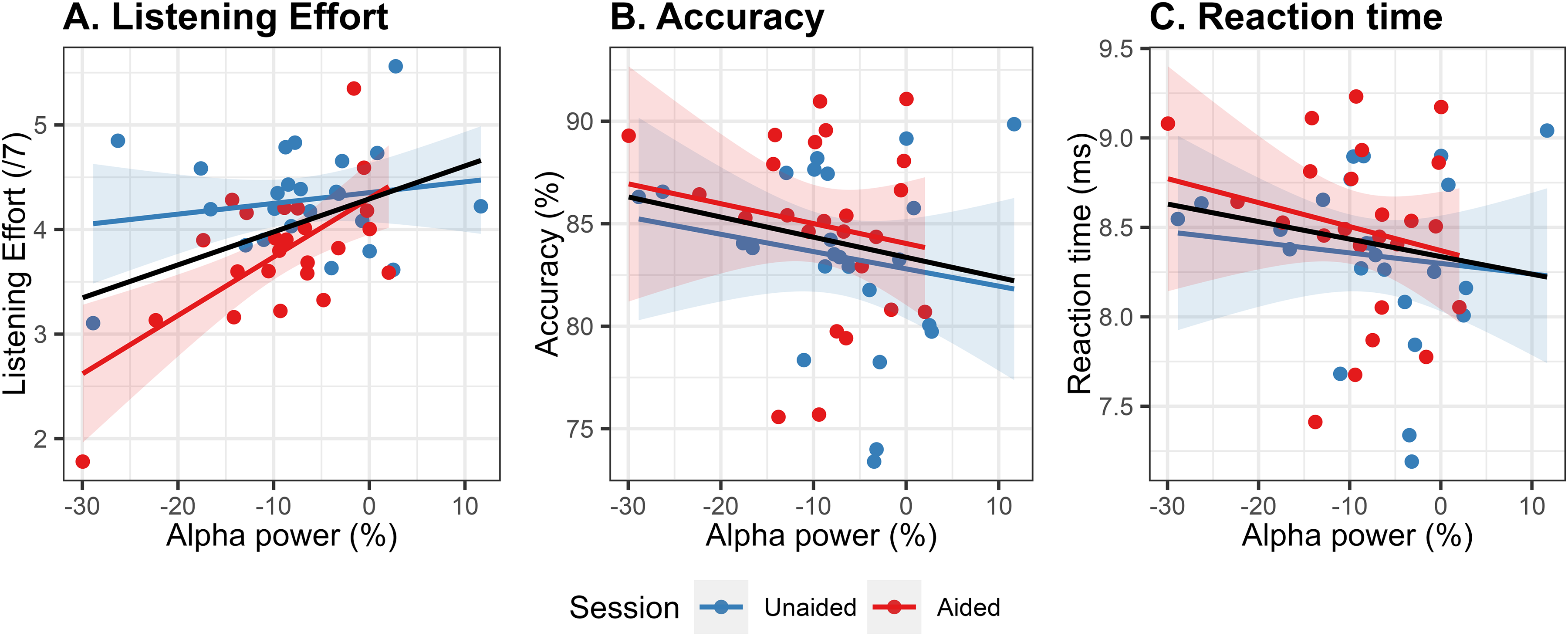
Predicted behavioral outcomes as a function of alpha-band activity (8–12 Hz), averaged across electrodes in the left parietotemporal cluster (FT7, C5, T7, TP7, CP5, P3, P5, P7, P9, and CB1). Predictions are derived from linear mixed-effects (LME) models treating alpha power as a continuous predictor. Each point reflects the model-predicted behavioral value for a given participant in each session (aided and unaided). Panels show predicted values for (A) self-reported listening effort, (B) phoneme discrimination accuracy, and (C) reaction time. Colored lines show the fixed-effect regression fits for each session. The black line represents the overall fixed-effect of alpha power across sessions. Shaded areas around the lines indicate the standard error of the estimate.
Discussion
The current study aimed to determine whether short-term use of bilateral PSAPs reduces listening effort at both neural and subjective levels in older adults with and without hearing loss. Our results show that PSAPs provide rapid benefits in both areas. After only 3 h of use, most participants reported significantly less listening effort. Importantly, PSAP use also led to measurable changes in neural oscillatory activity. Without PSAPs, increasing background noise was associated with reduced alpha suppression, with activity shifting closer to baseline levels. This pattern reflects a shift from ERD toward ERS, consistent with increased cognitive effort. When participants used PSAPs, this noise-related increase in alpha activity was significantly smaller, suggesting that the devices helped maintain stronger task-related alpha suppression in difficult listening conditions. The effect was most evident at the lowest SNR (−3 dB), where ERD was significantly greater in the aided session than the unaided session. In addition, alpha activity was significantly associated with self-reported listening effort. Participants who showed less alpha suppression reported greater effort. This finding supports the interpretation that alpha-band activity reflects the cognitive demands of speech-in-noise processing, and that PSAPs can help reduce this demand at both neural and behavioral levels.
Reduction in Self-Reported Listening Effort
The reduction in self-reported listening effort observed in the current study was expected, as we reported this effect in a previous publication based on the same cohort of participants (Perron et al., 2023). We also replicated the PSAP-related improvement in phonological discrimination accuracy. However, the current results strengthen the reliability of both findings by using a different analytical approach within a slightly smaller subsample (25 of the original 28 participants). Overall, our findings are consistent with a growing body of literature suggesting that PSAPs can reduce perceived listening effort and improve speech intelligibility for older adults (Brody et al., 2018; Chen et al., 2022; Cho et al., 2019; Choi et al., 2020; Maidment et al., 2025). For instance, Brody et al. (2018) reported that PSAP use resulted in significantly less self-reported listening effort than an unaided condition, which was also accompanied by improvements in speech-in-noise intelligibility. Similarly, a recent meta-analysis by Maidment et al. (2025) found that PSAPs improved speech intelligibility, with additional trends suggesting benefits for quality of life, listening ability and cognition.
Although the improvement in self-reported effort in our study may appear modest at 0.49 points on a seven-point scale, it is important to contextualize this effect. The magnitude of change is comparable to that observed in a previous study comparing unaided listening to basic and premium hearing aids using the same effort scale (Johnson et al., 2016). To evaluate its relevance, we considered the minimal important difference (MID), which refers to the smallest change in an outcome that an individual would identify as important. Using a standard distribution-based approach, the MID can be estimated at 0.46 points, calculated as half the standard deviation of unaided effort scores in our sample (SD = 0.92; MID = 0.5 × 0.92 = 0.46; Norman et al., 2003). The observed 0.49-point improvement slightly exceeds this threshold, suggesting it may be meaningful at a perceptual level. However, it remains difficult to determine whether this change is clinically meaningful without established criteria specific to listening effort or associated long-term outcomes. Understanding how improvements in effort translate into user behavior, satisfaction, and sustained device use will require longitudinal studies incorporating ecologically valid outcome measures and real-world listening conditions.
While our study focused exclusively on the effects of PSAPs, it is important to acknowledge evidence comparing PSAPs and hearing aids. Brody et al. (2018) found that hearing aids provided even greater subjective benefits than PSAPs, suggesting that hearing aids may afford better support overall. Nevertheless, objective measures of speech-in-noise performance appear to be comparable between the two device types, at least based on current meta-analytic evidence (Chen et al., 2022). Moreover, the degree of hearing loss has been shown to influence the benefits individuals can derive from PSAPs compared to hearing aids. Cho et al. (2019) have shown that while PSAPs may provide benefits comparable to hearing aids for individuals with mild hearing loss, hearing aids may provide greater benefits for individuals with severe hearing loss. Nevertheless, for individuals who face financial, logistical, or other barriers to accessing hearing aids, PSAPs may offer a more affordable and accessible alternative. Still, most studies to date have been cross-sectional, making it difficult to draw conclusions about long-term outcomes. Longitudinal studies directly comparing PSAPs, hearing aids and other OTC devices are needed to better guide clinical recommendations for individuals with different degrees of hearing loss.
Finally, it is important to note that our findings were based on a high-end PSAP model with advanced features such as noise reduction and directional microphones. Device quality likely played an important role in the observed benefits, as previous studies have shown that both customer satisfaction (Lakshmi et al., 2019) and speech intelligibility outcomes (Maidment et al., 2025) improve with higher-cost, higher-quality devices. Consistent with the hearing aid literature, features such as noise cancelation and directional microphones are key contributors to reduced listening effort (Fiedler et al., 2021; Slugocki et al., 2024; Winneke et al., 2020). As the PSAP model used in the current study included amplification, noise cancelation and other advanced processing functions, it is not possible to determine which specific component(s) is (are) primarily responsible for the observed improvements. Future research should directly compare models with different specifications to determine which device features most effectively support listening in challenging environments.
Alpha Power Modulation by SNR and PSAP Use
Although self-reported measures of listening effort provide valuable insight into participants’ subjective experiences, they are inherently susceptible to bias. For instance, participants often base their ratings on perceived performance rather than actual task demands (Moore & Picou, 2018). To address this limitation, we included EEG measures of alpha power as an objective index of listening effort.
Alpha power has been widely associated with cognitive effort during challenging listening conditions (e.g., Dimitrijevic et al., 2017; Dimitrijevic et al., 2019; Obleser et al., 2012; Paul et al., 2021; Petersen et al., 2015). According to the inhibition-timing hypothesis (Jensen & Mazaheri, 2010; Klimesch et al., 2007), increases in alpha-band activity reflect functional inhibition of cortical regions irrelevant to the task, thereby supporting goal-directed processing. In the context of speech-in-noise, Dimitrijevic et al. (2017) identified two distinct alpha responses: parietal alpha ERS, associated with self-reported listening effort, and temporal alpha ERD, linked to speech perception accuracy. Parietal alpha ERS is thought to reflect the suppression of background noise (Strauß et al., 2014), while temporal alpha ERD may indicate enhanced excitability in auditory regions, supporting more effective speech encoding.
Consistent with previous studies, we observed a general increase in alpha power as SNR decreased. However, this increase was not driven by the centroparietal ERS typically associated with listening effort, but instead emerged in left parietotemporal regions, where alpha activity was characterized by ERD. This left-lateralized pattern has been reported in prior work, where greater alpha ERD was associated with increased speech intelligibility (Becker et al., 2013; Dimitrijevic et al., 2017). Becker et al. (2013) have attributed this lateralization to the use of monosyllabic words, as opposed to bisyllabic or trisyllabic words used in other paradigms. Similarly, our study also used exclusively monosyllabic words, which may explain the consistent left-lateralized effect observed here. This pattern also aligns with evidence suggesting that phonological discrimination tends to be left-lateralized (Hickok & Poeppel, 2007; Perron et al., 2024). The increased left-hemisphere involvement may reflect greater demands on phonological processing in our task. In contrast, many earlier EEG studies have relied on digit identification tasks, emphasizing working memory and general auditory attention while placing lower demands on phonological processing. This may help explain why alpha activity in those studies was more often bilateral or centered over parietal regions. Importantly, our findings contribute to a growing body of literature showing that listening difficulty can elicit both increases and decreases in alpha power, depending on the neural circuits engaged (Wisniewski & Zakrzewski, 2023).
In our study, the effect of SNR on alpha activity peaked around 150 ms after word onset, suggesting that noise-related modulation occurred remarkably early, likely during the initial stages of phonological processing. This timing is earlier than what has been reported in some previous studies. For instance, Becker et al. (2013) showed that alpha suppression occurs between 462 and 633 ms following stimulus onset, even when using similar monosyllabic words. The reason for this difference is not entirely clear. It may reflect differences in task demands or analysis approach, but another likely factor is that background noise was already present during our baseline period. In this context, alpha modulation may have begun before word onset, with the 150ms peak reflecting a continuation of early auditory suppression processes already engaged by the presence of noise. This interpretation is consistent with studies showing that alpha levels during baseline can predict subsequent performance during speech-in-noise tasks (e.g., Alhanbali et al., 2018). An additional possibility is that the early peak reflects effort-related processing demands specific to our task. Participants were actively discriminating between syllables, which required attention to early acoustic cues. This increased attentional demand at word onset may have shifted the timing of effort-related neural activity to earlier in the trial.
Consistent with the former interpretation, Figure 5 shows that alpha activity began to diverge between aided and unaided sessions approximately 75 ms before word onset. This anticipatory effect may be related to the PSAP's directional microphone, which requires a brief activation period to adapt to background noise (i.e., a slow attack response). If this adjustment begins just before the stimulus is presented, it could alter the acoustic signal in time to influence early cortical encoding. The early alpha peak observed around 150 ms after stimulus onset may reflect the processing of critical acoustic cues for speech discrimination in the initial CV segment. To explore the behavioral relevance of this early alpha peak, we conducted an exploratory phoneme-level analysis using paired-sample t-tests to compare accuracy by phoneme position. Discrimination accuracy for first consonants improved by about 6.5% with PSAPs, though the difference was not statistically significant (p = .06). No benefit was found for vowels (−0.7%, p = 0.6) or final consonants (+0.4%, p = 0.9). This pattern suggests that the identified beneficial effect of PSAPs on accuracy may be primarily driven by improved perception of word-initial consonants, which are particularly vulnerable to noise masking and play a key role in lexical access (Meyer et al., 2013). Although this aligns temporally with the early alpha peak, the lack of a significant correlation between alpha ERD and accuracy indicates that this response, while plausibly reflecting perceptual engagement, was not directly predictive of behavioral performance in our dataset.
Indeed, if our findings were primarily driven by improved speech encoding, we would have expected temporal alpha ERD to correlate with speech perception accuracy, as reported in Dimitrijevic et al. (2019). However, in our study, alpha ERD was not related to accuracy, but was significantly correlated with self-reported listening effort. This discrepancy suggests that the early alpha ERD may indicate perceptual or attentional engagement, which supports, but does not guarantee, successful performance. Alternatively, it may reflect broader cognitive demands, such as attention or resource allocation, that align more closely with subjective effort. It is also possible that self-reported effort is closely related to participants’ perceived success in the task, and thus may indirectly reflect accuracy. Consistent with this idea, accuracy was significantly correlated with listening effort (although it was not related to alpha power).
We would also have expected PSAP-related reductions in alpha power across all SNR conditions, given our finding that PSAP use modestly improved phonological discrimination accuracy at all SNRs (main effect of Session without a Session by SNR interaction). However, here, alpha power differences between aided and unaided sessions were observed only at the lowest SNR. This suggests that neural indices of listening effort may be more sensitive to task demands than behavioral accuracy. In other words, although PSAPs enhanced perception across all SNRs, only the most difficult condition elicited enough cognitive effort for a measurable neural effect to emerge. This points to a partial dissociation between behavioral and neural indicators of listening success, consistent with the idea that effort and intelligibility are distinct constructs (Winn & Teece, 2021). Different types of perceptual error can increase listening effort even when accuracy remains stable. In line with this, alpha power was associated with self-reported effort but not with accuracy, supporting the interpretation that these outcomes reflect distinct neurocognitive processes. In sum, while PSAPs improved speech perception broadly, they only reduced cognitive effort when demands were highest. EEG alpha activity may therefore be more sensitive to the subjective and cognitive load of listening than to overt performance.
However, an important methodological consideration is that our EEG analyses focused on the first word of each stimulus to isolate perceptual effort and avoid confounds related to memory or phonological comparison. This may help explain the lack of association between alpha power and accuracy, as phonological improvements may rely on neural mechanisms not captured in early time windows. Future studies should explore the neurobiological correlates of these perceptual and phonological enhancements to clarify how PSAPs support listening success across different cognitive domains.
Other methodological choices are important to consider when interpreting the direction of alpha power changes (ERD vs. ERS) and their relationship to behavior. Indeed, most studies have used a paradigm with a silent baseline followed by speech presented in noise, whereas our task involved continuous background noise throughout the task. Because we baseline-corrected using a noisy time-window rather than silence, this could have altered the apparent direction of alpha power changes and made it more difficult to distinguish between ERS and ERD components. As a result, the observed desynchronization may reflect a mixture of both encoding-related and effort-related processes, shaped by sustained attention demands under continuous noise exposure. Consistent with this interpretation, the topography of the alpha activity change included electrodes in both temporal and parietal sites. Despite these differences, our overall pattern remains consistent with prior literature showing that alpha power increases with noise and decreases with hearing support. The devices used in the present study included noise-cancelation features and a directional microphone, which likely contributed to the observed effect by reducing background noise entering the ear and reducing the neural need to suppress irrelevant input at the cortical level. Supporting this interpretation, previous studies have shown that alpha power in parietal sites is reduced when microphone directionality is activated on hearing aids compared to when it is turned off (Slugocki et al., 2024; Winneke et al., 2020).
It is also important to note that some studies have reported an inverted U-shaped relationship between alpha activity and task difficulty, where alpha activity increases with moderate difficulty but drops at very high difficulty levels due to disengagement or overload (e.g., Paul et al., 2021; Ryan et al., 2022). In contrast, we observed a linear increase in alpha activity with decreasing SNR, with no evidence of a decline even at the most challenging level. This suggests that participants remained cognitively engaged throughout the task. This interpretation is supported by behavioral performance (not shown here, but see Perron et al., 2023), which remained relatively high, with accuracy averaging around 80% at the lowest SNR. PSAPs may help extend this range of engagement by improving signal quality, thus delaying the point at which cognitive overload or disengagement would otherwise occur. Future studies using a parametric design could test this hypothesis directly by examining whether PSAPs shift or flatten the alpha response curve at extreme difficulty levels.
Relationship Between Alpha Activity and Self-Reported Listening Effort
A key result relevant to our interpretation is the significant positive but moderate relationship between alpha power and self-reported listening effort. Participants who reported greater effort tended to have lower parietotemporal alpha ERD, consistent with the interpretation that neural inhibition mechanisms scale with perceived task difficulty. This moderate relationship suggests that alpha power and self-reported effort are related but not redundant, reflecting overlapping yet distinct components of listening effort. This finding is important given the ongoing debate about the correspondence between objective neural measures and the subjective experience of effort (for a review, see McGarrigle et al., 2014). Prior work has suggested that subjective ratings of listening effort capture broader dimensions of cognitive and emotional load, including frustration, motivation, and metacognitive awareness (Herrmann & Johnsrude, 2020; Pichora-Fuller et al., 2016), whereas neural measures such as alpha power more directly index cognitive resource allocation and sensory inhibition mechanisms. Importantly, this relationship held regardless of session (i.e., no significant interaction with session), indicating that the association between alpha power and perceived effort was stable across aided and unaided conditions. Our findings reinforce the view that subjective and objective measures capture related, but partially distinct, aspects of listening effort, highlighting the importance of using both measures to assess listening difficulty comprehensively.
Taken together, these findings provide the first neurophysiological evidence that short-term use of PSAPs can reduce cognitive effort during speech-in-noise listening. Although PSAPs are not a replacement for professionally fitted hearing aids, our results suggest that high-end PSAPs may offer meaningful support in real-world listening environments where amplification is needed but clinical intervention is not accessible or desired. Future work should explore the long-term effects of PSAP use and evaluate how different types of amplification devices influence both behavioral and neural measures of listening effort to better inform hearing support strategies.
Limitations
Several limitations need to be acknowledged. Although our sample size is comparable to that of similar studies in the field, it is relatively small, which limits the generalizability of the results. However, we used a within-subjects design, which helped reduce the influence of individual variability, partially addressing this concern. Nevertheless, future research with larger and more diverse samples is necessary to replicate and extend these findings. Including a larger cohort of individuals with moderate and severe hearing loss would be valuable in determining whether similar neural processing benefits are observed.
Our study examined a single high-end PSAP. Given the wide range of PSAPs available on the market, and as highlighted in previous studies, it is likely that device-specific features could influence the results. The distinction between high- and low-end devices is particularly important, as more affordable models may offer less sophisticated processing capabilities. Investigating the efficacy of different PSAP models would provide a more comprehensive understanding of the potential benefits and limitations of these devices. Future research should also include objective assessments of device performance, including measures of gain, to better elucidate the mechanisms underlying the observed effects.
Another limitation relates to the spatial configuration and timing of the task. The speech stimuli were presented at ±45 degrees, which falls within the forward-sensitive range of the PSAPs’ hypercardioid polar pattern. However, they were not presented at maximal sensitivity (0 degrees). A more centrally focused speech source might have enhanced the directional benefit. Additionally, although background noise was present throughout each trial, its sound level varied from trial to trial, whereas the level of speech remained constant. This choice was intended to reflect real-world conditions, in which noise tends to fluctuate more than speech. However, it raises the possibility that changes in SNR could be partly due to stronger sensory responses to louder noise, which could have influenced alpha activity. Several features of the design and results address this concern. Firstly, since noise was already present during the baseline period, general sensory responses were likely reduced through baseline correction. Secondly, if alpha activity were primarily driven by noise level, we would have expected to see similar increases across both the aided and unaided conditions, but this was not the case. Thirdly, alpha power was correlated with self-reported effort, which would not be expected under a purely sensory explanation. Taken together, these observations suggest that the observed alpha changes may reflect effort-related processing. Nevertheless, future studies should consider manipulating signal and noise levels independently to more clearly dissociate their respective contributions.
Due to the slow attack time of the noise cancelation feature of the PSAPs, it is also possible that the 1s interstimulus interval was insufficient for the noise reduction algorithm to fully adapt to each new noise level. This may have limited the impact of adaptive processing on neural responses. However, as Figure 5 shows, a small difference between the aided and unaided conditions emerged just before word onset, but not earlier in the baseline period. This suggests that partial adaptation may have occurred within the available time window. Future studies should consider using longer interstimulus intervals or blocked designs with stable noise levels to ensure the full engagement of adaptive processing features.
Finally, while our findings suggest that PSAP use can lead to rapid neurophysiological changes, the long-term effects of device use remain unknown. Longitudinal studies are needed to determine whether these changes are sustained over time and whether they translate into broader cognitive or perceptual benefits. Furthermore, examining PSAP use in real-world environments, where listening conditions and social contexts are more variable, will be essential for evaluating the ecological validity of these findings.
Conclusion
In conclusion, this study provides compelling evidence for the efficacy of PSAPs in reducing both subjective and objective measures of listening effort. The correlation between self-reported effort and reductions in alpha-band activity suggests that the benefits of PSAPs go beyond subjective experience and reflect genuine improvements in neural processing. These findings underscore the ability of the auditory system to rapidly adapt to amplified input, highlighting the potential of PSAPs as a readily accessible tool for improving communication in noisy environments. However, further research is needed to explore the long-term effects of PSAP use and the broader implications of these devices for auditory and cognitive health, particularly in comparison to more traditional hearing aids and other OTC assistive devices.
Footnotes
Acknowledgments
We thank Brian Lau and William Ji for their contributions to data collection. We are also grateful to all participants for their time and commitment.

Ethical Considerations
This study was approved by the Baycrest Research Ethics Board (protocol #20-36) and conducted in accordance with the Declaration of Helsinki.
Consent to Participate
All participants provided written informed consent prior to participation.
Consent for Publication
Participants provided informed consent for publication of anonymized data on an open-access website. No individual identifying information is included in this manuscript.
Funding
The authors disclosed receipt of the following financial support for the research, authorship, and/or publication of this article: This work was supported by grants to CA from the Natural Sciences and Engineering Research Council of Canada (Grant RGPIN-2021-02721) and the William Demant Foundation (Grant 20-1260). MP was funded by a Canadian Institutes of Health Research graduate scholarship.
Declaration of Conflicting Interests
The authors declared no potential conflicts of interest with respect to the research, authorship, and/or publication of this article.