




Abstract
The present study aimed to investigate the changing relationship between aided speech recognition and cognitive function during the first 6 months of hearing aid use. Twenty-seven first-time hearing aid users with symmetrical mild to moderate sensorineural hearing loss were recruited. Aided speech recognition thresholds in noise were obtained in the hearing aid fitting session as well as at 3 and 6 months postfitting. Cognitive abilities were assessed using a reading span test, which is a measure of working memory capacity, and a cognitive test battery. Results showed a significant correlation between reading span and speech reception threshold during the hearing aid fitting session. This relation was significantly weakened over the first 6 months of hearing aid use. Multiple regression analysis showed that reading span was the main predictor of speech recognition thresholds in noise when hearing aids were first fitted, but that the pure-tone average hearing threshold was the main predictor 6 months later. One way of explaining the results is that working memory capacity plays a more important role in speech recognition in noise initially rather than after 6 months of use. We propose that new hearing aid users engage working memory capacity to recognize unfamiliar processed speech signals because the phonological form of these signals cannot be automatically matched to phonological representations in long-term memory. As familiarization proceeds, the mismatch effect is alleviated, and the engagement of working memory capacity is reduced.
Introduction
It is a common observation among clinicians that there is a great deal of variance in the speech reception thresholds (SRTs) of individuals with similar pure-tone average (PTA) hearing loss (Pichora-Fuller & Singh, 2006). Some of that variance can be explained by individual differences in cognitive resources, such as working memory capacity, particularly as measured by reading span (for reviews, see Akeroyd, 2008; Besser, Koelewijn, Zekveld, Kramer, & Festen, 2013). Further, the ability to benefit from hearing aid signal processing has also been shown to be related to working memory capacity (Edwards, 2007; Lunner, Rudner, & Rönnberg, 2009; Ng, Rudner, Lunner, Pedersen, & Rönnberg, 2013). In the present study, we investigated for the first time how the relation between working memory capacity, measured using the reading span task, and SRT changes during the first 6 months of hearing aid use.
Hearing impairment has a negative impact on speech communication. Having a conversation in noise is always more difficult than in quiet, especially for individuals with hearing impairment. This applies even for listeners with mild hearing impairment, whose unaided speech recognition performance in quiet may be almost as good as individuals with normal hearing (Dubno, Dirks, & Morgan, 1984). Hearing aids are the most common treatment for hearing impairment. The primary goals of hearing aid fitting are to increase audibility, enhance speech intelligibility, and improve listening comfort. Self-reported hearing aid outcomes are usually satisfactory in quiet but not in noisy situations (Kochkin, 2000). This may be partly because hearing aids amplify unwanted noise as well as speech sounds.
A number of studies have demonstrated a relationship between cognitive abilities and speech recognition performance in experienced hearing aid users. For example, Gatehouse, Naylor, and Elberling (2003) found that better cognitive ability, measured using visual digit- and letter-monitoring tasks, was associated with better speech recognition in noise performance for experienced hearing aid users. Lunner (2003) also reported that experienced hearing aid users with better cognitive abilities (working memory capacity and phonological processing speed) performed better in speech recognition in both aided and unaided conditions than experienced hearing aid users with poorer cognitive abilities. Other cognitive abilities such as general processing speed; lexical access speed, which indicates efficiency of retrieving information from the mental lexicon; and phonological processing skills, which refer to the ability to detect and attend to the sublexical structure of language manifest in the patterning of speech sounds, are also found to be important in speech recognition (Hällgren, Larsby, Lyxell, & Arlinger, 2001; Larsby, Hällgren, Lyxell, & Arlinger, 2005; Lunner, 2003; Lyxell, Andersson, Borg, & Ohlsson, 2003; Rönnberg, Rudner, Foo, & Lunner, 2008).
Working memory, which is the capacity for simultaneous processing and storage (Baddeley & Hitch, 1974), is also related to speech processing and in particular the processing of phonological representations. Phonological representations are defined as the underlying sound structure of words stored in long-term memory (Locke, 1983). In working memory, task-relevant information can be maintained while complex cognitive tasks are performed. The Ease of Language Understanding (ELU) model of working memory proposes that the involvement of cognition in speech recognition varies depending on the difficulty of the listening conditions and that individual cognitive abilities can predict speech recognition in challenging listening conditions (Rönnberg, 2003; Rönnberg et al., 2013, 2008; Rönnberg, Rudner, Lunner, & Zekveld, 2010). When the listening conditions are favorable, speech input can be readily matched with the phonological representation in long-term memory. This processing is automatic and implicit. When listening conditions are challenging, a mismatch situation may arise. In such a situation, explicit processing is needed to match the degraded input with representations in the long-term memory store. The efficiency of such processing is dependent on working memory capacity. Further, it can be hypothesized that the more difficult it is to match incoming signals and phonological representations, the more explicit, deliberate processing is engaged. As a perceptual consequence of cochlear damage, individuals with sensorineural hearing impairment are exposed to distorted auditory inputs. Distorted incoming signals may not be readily matched with the phonological representations in long-term memory. In addition, individuals who have severe postlingually acquired hearing impairment are found to have degraded phonological representations (Classon, Rudner, Johansson, & Rönnberg, 2013). Thus, not only is the incoming signal distorted by cochlear damage, generating one source of mismatch, but the phonological representations themselves may also be degraded creating a further source of mismatch that may also lead to engagement of explicit processing in working memory. Listening in noise, which is common in real life, is another scenario where speech perception is challenging. When the incoming speech signal is masked by noise, a mismatch condition may arise. For individuals with hearing impairment, this creates a third source of mismatch, which may explain why they have disproportionate difficulty listening in noise. They may encounter mismatch conditions more frequently than individuals with normal hearing, and thus experience more explicit processing.
Use of hearing aids with adequate amplification and appropriate signal processing can make speech input more intelligible (or identifiable) for persons with hearing impairment. In terms of the ELU model, this improvement can be explained as a reduction in mismatch and a concomitant reduction in the involvement of explicit processing needed for disambiguating the input, making more resources available for higher level processing of auditory inputs. However, hearing aid signal processing may also have undesirable side-effects, such as generating unwanted artifacts in the auditory scene or distorting the waveform of the speech signal (Lunner et al., 2009; Wang, 2008). The processed speech input may, therefore, not be congruent with the nonaided phonological representations in long-term memory.
The challenge to listening caused by processing the speech signal may have a stronger impact when the hearing aid setting is new than after familiarization. When a user is new to hearing aid amplification, the incoming processed signal which is further distorted by cochlear damage may not be matched readily with the established phonological representations in long-term memory, which may be degraded as a result of hearing impairment. In many situations, the potential mismatch will be exacerbated by noise. When the user has become accustomed to the hearing aid amplification and setting, the degree of mismatch may decrease because new phonological representations that are congruent with the processed speech input may become established in the lexicon over time. It has been suggested that a familiarization period of between 4 and 9 weeks may be required to reduce cognitive load (Rudner, Rönnberg, & Lunner, 2011).
Rudner, Foo, Rönnberg, & Lunner (2009) tested the hypothesis that there would be a difference in the relation between cognitive capacity and speech in noise before and after 9 weeks of experience with a new compression setting (either fast- or slow-acting compression setting) in experienced hearing aid users. Speech recognition performance with both settings and in two types of speech material was measured before and after familiarization to the new setting. Cognitive function was tested using a reading span test (Daneman & Carpenter, 1980). It was found that reading span performance was the main predictor of aided speech recognition performance in noise with nonfamiliarized settings when speech materials of the matrix type (Hagerman sentences; Hagerman, 1982) were used. However, reading span performance did not explain any of the variance in aided speech recognition performance with matrix-type sentences and little of the variance in performance with more ecological Hearing In Noise Test (HINT) sentences (Hällgren, Larsby, & Arlinger, 2006) with the familiarized setting after the 9-week period. These results suggest that cognitive function plays a more important role in speech recognition when users are new to a hearing aid setting, especially when the speech materials are stereotypical as is the case with matrix-type sentences, than when they are accustomed to the setting. Therefore, we hypothesized that a similar situation would pertain for new hearing aid users: In the present study, we expected to find a significant association between cognition and speech recognition in first-time hearing aid users but that the association would become weaker as they became familiarized with their devices. In particular, working memory capacity was expected to have a stronger association with speech recognition performance using the Hagerman sentences when users are new to hearing aid amplification (a mismatch condition) than when they are accustomed to the amplification.
Method
Participants
Twenty-seven first-time hearing aid users (7 women and 20 men) took part in the present study. They were all recruited to an unpublished study of quality control of hearing aid fitting in the audiology clinic of the University Hospital of Linköping, Sweden. All had mild to moderately severe sensorineural hearing loss with mean PTA (at 0.5, 1, 2, and 4 kHz) of 42.8 dB HL (SD = 8.1; range 32.5 to 63.0 dB HL; see Figure 1). The average age was 67.2 years (SD = 11.8; range 48 to 84 years). Nine of them were fitted monaurally, and the rest bilaterally, with various brands and styles of hearing aids (shown in Table 1): Four out of the 27 participants had in-the-ear or in-the-canal fittings, and the rest had behind-the-ear hearing aids. Twenty-two participants had nonlinear hearing aid amplification, and five had linear amplification. All hearing aid fittings were verified with real ear insertion gain measurement. Reportedly, 62.5% of the participants used their hearing aids every day, 25% used them 3 to 5 days a week, and 12.5% used them at least 1 day a week. Over 90% of them reported that they wore the hearing aids for at least 4 hr a day. The participants were native Swedish speakers and reported normal or corrected-to-normal vision.
Average pure-tone thresholds for both ears. Error bars represent standard deviation. Brands and Models of the Hearing Aids Used by the Participants.

Cognitive Tests
The reading span test (Daneman & Carpenter, 1980; Rönnberg, Arlinger, Lyxell, & Kinnefors, 1989) was chosen to measure working memory capacity because it has consistently been found to be a good predictor of speech recognition performance in noise in hearing aid users (Akeroyd, 2008; Rudner et al., 2009; Rudner, Foo, Sundewall-Thorén, et al., 2008). In addition to the reading span test, cognitive tests that measure abilities related to speech understanding in challenging conditions were also administered (Rönnberg et al., 2008). These tests included measures of processing speed (physical matching), lexical access speed (lexical decision making), and phonological processing (rhyme judgment). All cognitive tests were visually based, and text stimuli were shown in the center of a computer screen.
Reading span test
The Swedish version of the reading span test was used (Rönnberg et al., 1989). This test indicates the ability to process and to store verbal information simultaneously and consists of two parallel tasks. The participants were told to judge whether each sentence in a list was sensible or absurd (Baddeley, Logie, & Nimmo-Smith, 1985). After each list of sentences, they were prompted to recall either the first or the final word of the sentences in the list. The three-word sentences were presented word-by-word at a rate of 800 ms per word with an interstimulus interval of 75 ms. Lists of three, four, five, and six sentences were presented in ascending order of length, and three lists were presented at each list length. A total of 54 sentences were presented. The test was scored by the total number of items correctly recalled irrespective of serial order.
Physical matching
The participants were required to judge whether two tokens of the same letter were identical in physical shape (e.g., A-A, but not A-a; Posner & Mitchell, 1967). Sixteen letter pairs were presented, and half of them were identical. This test measured general processing speed and was scored based on reaction time for correct trials.
Lexical decision making
The participants were required to judge whether a string of three letters shown was a real Swedish word (e.g., kub, which means cube) or not (e.g., tra, which is not lexicalised in Swedish). Forty letter strings were presented, and half of them were common real words. This test measured lexical access speed and was scored based on reaction time for correct trials.
Rhyme judgment test
The participants were required to judge whether two words shown on the screen rhymed or not (Baddeley & Wilson, 1985). In this test, there were four experimental conditions: the words (a) rhymed and were orthographically similar (e.g., fritt-vitt, [frit:]-[vit:]), (b) rhymed but were orthographically dissimilar (e.g., dags-lax, [dak:s]-[lak:s]), (c) did not rhyme but were orthographically similar (e.g., salt-saft, [sal:t]-[saf:t]), and (d) did not rhyme and were orthographically dissimilar (e.g., kalk-stol, [kal:k]-[sto:l]). Thirty-two word pairs were presented and were evenly distributed over the conditions that occurred in random order. This test measured the quality of the phonological representations in the lexicon (Lyxell, 1994) and was scored based on percentage correct.
Speech Recognition in Noise Test
The Hagerman sentences were used to determine SRT, which is the signal-to-noise ratio (SNR) yielding 50% speech intelligibility, using an adaptive test procedure (Hagerman & Kinnefors, 1995). This test uses a set of materials that are sometimes referred to as matrix sentences, and the corpus consisted of 10 lists of 10 low-redundancy five-word sentences. All sentence stimuli were presented in speech-shaped noise with a long-term frequency spectrum identical to that of the Hagerman sentences (Hagerman, 1982). The stimuli were presented through one single frontally located loudspeaker in an audiometric test room. The participants were told to repeat, after each sentence, as many of the words in that sentence as possible. The adaptive procedure was based on the number of words correctly repeated (between zero and five). The sentences were initially presented at 65 dB SPL (C-weighted equivalent level), and the noise level was adjusted upward or downward for each subsequent sentence according to participants’ response. There is no change of noise level when the score is 2 (two correct words in a sentence). If the score is below 2 (one and zero correct word), the noise level of the following sentence is decreased (by 1 and 2 dB, respectively). If the score is above 2 (three, four, and five correct words repeated), the noise level is increased (by 1, 2, and 3 dB, respectively). The SRT is defined as the average SNR the sentences were presented.
Procedures
Cognitive test performance and unaided SRTs in noise were obtained in a prefitting session, which took place at an average of 4 months before hearing aid fitting. The participants were allowed to try different models of hearing aids before they finalized their choice of hearing aids in the actual hearing aid fitting session (0 m). Aided SRTs were obtained in the hearing aid fitting session (0 m) and at 3 months (3 m) and 6 months (6 m) postfitting. For the Hagerman test, one practice list was administered, and the SRT was obtained using another two lists. It has been suggested that a familiarization period of between 4 and 9 weeks may be required to reduce cognitive load (Rudner et al., 2011). Therefore, measurements took place in two postfitting sessions, which were approximately 3 months apart. Informed consent was obtained from all participants. This study was carried out in accordance with the World Medical Association Declaration of Helsinki.
Results
Speech Recognition in Noise Test
As expected, the mean SRT improved (more negative) when tested aided compared with unaided. The mean unaided SRT was −0.89 dB SNR (SD = 3.94). Change in aided speech recognition performance over 0 m, 3 m, and 6 m was examined using a repeated measures analysis of variance (ANOVA). The main effect was significant, F(2, 52) = 6.30, MSE = 0.88, p < .05, and the pair-wise comparisons (Bonferroni adjusted for multiple comparisons at the 0.05 level) for this main effect showed that SRT at 6 m (M = −3.39 dB SNR, SD = 1.89) was significantly better than that at 0 m (M = −2.40 dB SNR, SD = 2.41) and 3 m (M = −2.69 dB SNR, SD = 2.59). A possible learning effect associated with repeated measurement over time has been accounted for in the present study by adding 0.14 dB, 0.28 dB, and 0.42 dB (0.07 dB for each test list, two lists for each test occasion, and two, four, and six test lists presented in previous test occasions, respectively; Hagerman & Kinnefors, 1995) to the SRT at 0 m, 3 m, and 6 m. Another ANOVA was performed on the adjusted SRT values, and the main effect remained significant, F(2, 52) = 4.28, MSE = 0.92, p < .05. The pair-wise comparisons for this main effect showed that SRT at 6 m (M = −2.97 dB SNR, SD = 1.89) was significantly better than that at 0 m (M = −2.26 dB SNR, SD = 2.41). SRT at 3 m (M = −2.43 dB SNR, SD = 2.53) did not differ from either that at 0 m or 6 m. The adjusted SRT values were used in the following analyses.
Cognitive Tests
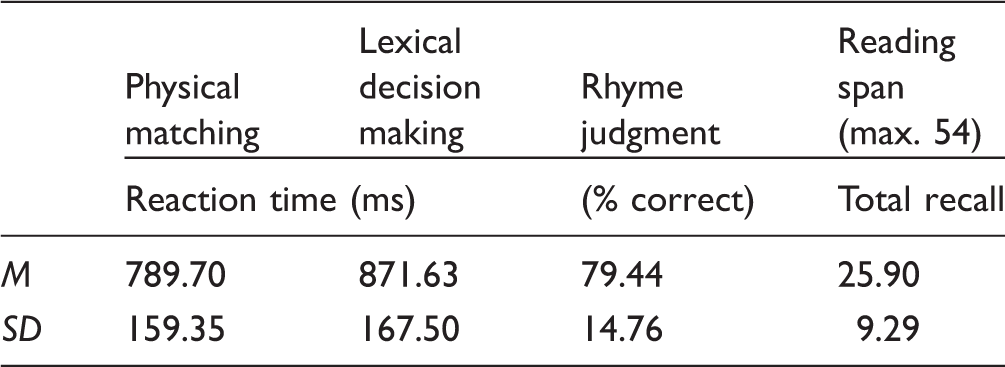
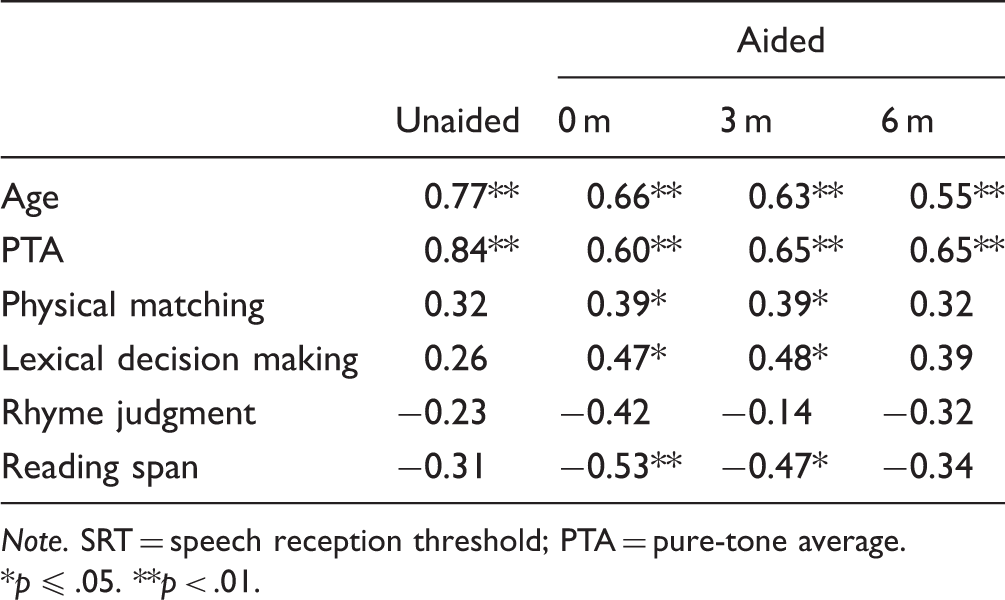
Table 2 shows the results of the cognitive tests. All participants performed all the tests, except for the rhyme judgment test, which was administered to 16 participants only. The results on the cognitive tests obtained in the present study were comparable with those reported in previous studies (e.g., Foo, Rudner, Rönnberg, & Lunner, 2007; Lunner, 2003; Rudner et al., 2009). To investigate the change in relationship between cognitive functions and SRT over time, correlation analysis was performed (see Table 3). Age and PTA were found to be significantly correlated with SRT at 0 m, 3 m, and 6 m. SRT significantly correlated with the cognitive measures (reading span, physical matching, and lexical decision making) at 0 m and 3 m. At 6 m, the correlations of SRT and lexical decision making (p = .06) and reading span (p = .07) were marginally significant. A trend of declining relationship between SRT and the cognitive measures was observed. In particular, the correlation between reading span and SRT was significantly weakened from 0 m to 6 m, z = 1.65, p < .05 (one-tailed; see Figure 2 for scatter plots). The change in correlations with other cognitive measures was not statistically significant.
Scatter plots showing the relationship between reading span (% correct) and aided SRT at 0 m (upper panel), 3 m (middle panel), and 6 m (lower panel). SRT = speech reception threshold; SNR = signal-to-noise ratio. Results of the Cognitive Tests. Pearson Product-Moment Correlation Coefficients Between Cognitive Tests and Unaided and Aided SRTs Obtained at 0 m, 3 m, and 6 m Postfitting. Note. SRT = speech reception threshold; PTA = pure-tone average. p ≤ .05. **p < .01.
Pearson Product-Moment Correlation Coefficients Between PTA and Cognitive Tests.

Note. PTA = pure-tone average.
p ≤ .05. **p < .01.
Multiple Regression Analysis for Unaided and Aided SRTs.

Note. SRT = speech reception threshold; PTA = pure-tone average.
p ≤ .05. **p < .01. ***p < .00.
Discussion
The results of the correlation analysis demonstrated that age, PTA, and cognitive abilities including processing speed, lexical access speed, and working memory capacity were related to SRT in new hearing aid users. There was a gradual decline over time in the strength of the relationship between working memory capacity and aided SRT in noise, such that the strength of this relationship at 6 months after fitting was significantly weaker than immediately after fitting. A nonsignificant trend of a declining relationship was observed between speech recognition and the other two cognitive measures. This pattern of findings is corroborated by the results of the multiple regression analysis, which indicates that the reading span test was the main predictor of aided speech recognition performance when hearing aids were first fitted, whereas PTA was the main predictor after the first 6 months of hearing aid use. One way of explaining this finding is that working memory capacity plays a more important role in speech recognition in noise before than after familiarization. This agrees with the results reported by Rudner et al. (2009) and is in line with our prediction based on the ELU model.
Working Memory Capacity and Speech Recognition Over the First 6 Months of Hearing Aid Use
In the present study, we demonstrated that the relationship between working memory capacity and aided SRT is strongest when hearing aids are first fitted and that the strength of this relationship declines over time. We have argued that there are three factors (the presence of noise, hearing impairment, and processed speech signal) that potentially create a mismatch between the incoming speech signal and phonological representations in long-term memory, thus making listening challenging. All these factors were assumed to be constant across time. Therefore, the observed change in the strength of the relationship over time could be explained by familiarization to the hearing aid amplification and settings over time.
This pattern of results supports our hypothesis that when the user is new to listening with hearing aids, there is a greater need for explicit cognitive processing and storage capacity. That is, when a person is first fitted with hearing aids and is not accustomed to the amplified and processed signals, mismatch arises because the phonological form of these signals cannot be automatically matched to phonological representations in long-term memory. In this situation, explicit processing, which is effortful in nature, is required to achieve successful matching (Pichora-Fuller, 2003; Rönnberg et al., 2008, 2013). The ELU model proposes that individuals with better explicit processing capacity are better at understanding speech in a mismatch listening condition. As the user becomes familiarized to the hearing aid, the engagement of explicit cognitive processing is reduced. This is because phonological representations that are congruent with the processed speech sounds and signals are successively becoming established in the lexicon. Consequently, the mismatch effect is alleviated, and the matching process becomes less effortful and less explicit (Rudner et al., 2008, 2009), even though mismatch caused by the other two factors (the presence of noise and hearing impairment) still pertain. In other words, the mismatch effect caused by the artifacts or distortion in the processed speech signals is reduced. Thus, less explicit cognitive processing is required to achieve speech understanding, and the strength of the relationship between speech recognition in noise and working memory capacity declines during the first 6 months of hearing aid use. This is a somewhat longer period than the 4 to 9 weeks proposed by Rudner et al. (2011). However, that estimate was based on familiarization to new hearing aid settings in experienced users. It does not seem unreasonable that new users need a longer time to become familiarized to hearing aids.
Speech Recognition and Other Cognitive Abilities
The correlational relationships between cognitive speed measures (general processing speed and lexical access speed) and aided SRT were found to be significant at 0 m and 3 m, which suggest that these cognitive abilities are related to general speech recognition (Rönnberg et al., 2008). In particular, these lower order cognitive abilities mediate matching of input signals with the phonological representations in lexicon. Thus, faster processing and lexical access facilitate the matching process and enhance speech understanding. Among all cognitive measures, only the reading span test showed statistically significant weakening of relationship with the SRT as the user became more accustomed to the signal processing of the hearing aid. The relationship between SRT and speech-related lower order cognitive skills also showed a similar trend, although it was not statistically significant. Moreover, these cognitive measures (processing speed and lexical access speed) did not emerge as significant predictors of SRT in the regression models. These results therefore strengthen our argument that the mismatch condition contingent on unaccustomed speech input is more specifically related to the explicit processing measured by the reading span task than to general, implicit speech processing skills.
Limitations of the Study
Lack of a control group
The Hagerman test was administered in every test session. Although the matrix sentences used in the test are syntactically identical and employ a limited number of words, they are semantically unpredictable, which allows test sentence lists to be repeated as often as needed (Hagerman, 1982, 1984). Therefore, there may exist a small intervisit learning effect (Hernvig & Olsen, 2005). In the present study, we attempted to take the learning effects into account by applying a correction that is estimated by Hagerman and Kinnefors (1995). However, the magnitude of learning effects may depend on individual factors such as age, cognition, or speech intelligibility performance. Thus, it is possible that differential learning effects over test sessions may have an impact on familiarization and variance in SRT over time. This may consequently alter the strength of correlations between cognitive abilities and SRT and influence the association with cognitive measures. Inclusion of a control group composed of experienced hearing aid users matched to the experimental group on age and cognitive abilities would have allowed us to investigate this.
Single measure of working memory capacity
In the present study, working memory was measured using the reading span test. The reading span test is designed in such a way that working memory is taxed explicitly and is established as a measure of working memory capacity and a predictor of speech recognition performance (see Akeroyd, 2008 and Besser et al., 2013, for reviews). However, all psychometric tests draw on multiple cognitive capacities. Given its complexity, the reading span test probably taps several cognitive abilities. Future studies should include measures of the individual executive functions deemed to be involved in speech understanding, including updating, shifting, and inhibition (Miyake et al., 2000; Rudner & Lunner, 2014; Rudner et al., 2011).
Measurement of cognitive test performance
The cognitive tests were performed before hearing aid fitting, and we assumed that cognitive performance remained unchanged over time. A few studies have shown small but significant improvements in performance on visually based cognitive tests after using hearing aids for 6 months (Choi, Shim, Lee, Yoon, & Joo, 2011; Lehrl, Funk, & Seifert, 2005), while other studies have shown no change (Pinheiro, Iório, Miranda, Dias, & Pereira, 2012; Tesch-Römer, 1997; van Hooren Anteunis et al., 2005). In a literature search reported by Kalluri and Humes (2012), it was concluded that there was no strong evidence for longer term effects (up to 2 years) of hearing aid amplification on cognition. Therefore, we do not expect a change in cognitive abilities over time related to hearing aid use.
Clinical Implications
The results of the present study may help to explain why new hearing aid users tend to report positive change in perceived sound quality as they become more accustomed to their devices (Ovegård et al., 1997). Our results suggest that such clinical observation may be explained by the fact that less explicit cognitive processing is engaged during speech understanding after familiarization.
Conclusion
The study demonstrated a significant decline in the strength of the relationship between working memory capacity and aided SRT in noise over the first 6 months of hearing aid use. This suggests that working memory capacity plays a more important role in speech recognition in noise before than after familiarization. We propose that when a user is still not accustomed to listening with hearing aids, there is a greater need for explicit cognitive processing to understand processed speech signals. As the user becomes accustomed to the processed speech signals, the engagement of explicit cognitive processing is reduced.
Footnotes
Declaration of Conflicting Interests
The author declared no potential conflicts of interest with respect to the research, authorship, and/or publication of this article.
Funding
The author disclosed receipt of the following financial support for the research, authorship, and/or publication of this article: This work was supported by the Swedish Research Council.