



Abstract
This paper explores how queer Asian American women negotiate their racial and political identities through racial dating preferences. I investigate a pattern of desire that has been consistently found in previous studies: Why are queer Asian American women more likely to prefer Asian women over white women? The analysis draws from 192 US-based online surveys and 22 interviews with queer Asian women ages 18–30. The participants were asked about their various preferences for female and (if applicable) male partners. I contribute to the racial dating preferences literature empirically by (1) extending the scope of analysis to queer Asian American women and (2) analyzing bisexuals’ preferences for both male and female partners. I contribute theoretically by (1) testing sexual fields theory against the gender white advantage hypothesis and (2) finding evidence to suggest that homonormativity, as a logic of desirability, is less operative in queer Asian American women’s sexual field. Rather, their sexual fields are defined by an alternative logic of desirability, “sticky rice” politics, that prioritizes dating Asian partners and avoiding white partners to resist and distance oneself from white supremacy. This was clear in Asian American respondents’ overwhelming preference for Asian American partners, even Asian American men, over white partners.
Keywords
Introduction
Sex and dating are sites of physical, social, and cultural union and power. Race as a social construct and structural investment in the body is partially negotiated in these sites of desire (Holland 2010; Fanon 2008). It is within the sexual and romantic imagination that individuals, communities, and nations make and remake themselves, orienting themselves in a larger racial system. Within this imagination, racial fantasies are fueled by a desire to construct the ideal self through desiring or averting contact with imagined racial bodies. Assimilation theory (Lee and Bean 2004) investigates these racial fantasies and posits that a group begins to assimilate into “American-ness” or whiteness through intermarriage. With their high educational attainment levels, income, and intermarriage with white partners (Lee and Bean 2004; Lee and Kye 2016; Portes and Zhou 1993), Asian Americans have been teetering on the precipice of whiteness for the past five decades in the assimilationist imagination.
Asian American desire and dating preferences, then, can be understood as practices in racial boundary making and self-making with theoretical and sociocultural consequences for assimilation. Heterosexual Asian American 1 women and gay Asian American men have consistently been found to prefer white partners over Asian partners (Curington, Lundquist, and Lin 2021; Tsunokai, McGrath, and Kavanagh 2014; Rafalow, Feliciano, and Robnett 2017; Tsunokai et al. 2019; Pyke 2010). This seemingly signals Asians Americans’ model minority status and movement toward assimilation.
However, this pattern does not hold across the Asian American diaspora. The few empirical studies that include queer Asian American women have found that their racial dating preferences are distinct from that of their racial peers (Rafalow et al. 2017; Curington et al. 2021; Tsunokai et al. 2019). Queer Asian American women are more likely to state preferences for Asian partners over white partners on online dating sites (Rafalow et al. 2017; Curington et al. 2021). They are also more likely to both initiate messages to and reciprocate messages from Asian American women over white women on dating platforms and more open to dating African American and Latino partners (Tsunokai et al. 2019). The instability of Asian American racial dating preferences suggests that assimilation might be mediated by the interaction between race, gender, and sexual orientation. Such patterns also suggest that larger preference for white partners may signal greater racial inequality rather than rising equity. This further casts doubt on assimilation theory’s ability to explain racial preferences and critiques assumptions of proximity to whiteness as racial progress.
Although previous literature finds that queer Asian women are more likely to prefer Asian partners over white partners (Rafalow et al. 2017; Curington et al. 2021), it remains unclear why this pattern exists. The current study uses data collected from an online survey (n = 192) and a set of qualitative interviews (n = 22) to explore queer Asian American women’s racial dating preferences. This research adds to a small yet growing body of literature on queer Asian women’s racial dating preferences and is one of the first studies to investigate both lesbians’ and bisexuals’ racial dating preferences. By investigating queer Asian women’s racial dating preferences, the study contributes to the larger discussion of how the intersection of race, gender, and sexual orientation informs racial boundaries and desire.
Theoretical Approaches to Racial Dating Preferences
Gendered White Advantage
Scholars have suggested that queer women of color are less likely than straight women and gay men to prefer white partners because partnering with white women does not offer comparable rewards to partnering with white men. This is the basic tenet of the gendered white advantage hypothesis. Curington and colleagues (2021) derived this hypothesis after finding that white men experience greater advantages than white women among online daters of color.
In a section labeled “Gendered White Advantage” in The Dating Divide, Curington and colleagues explain that white women may be less desirable than white men among daters because: “Society still emphasizes men’s socioeconomic status and women’s physical beauty. Thus, white men continue to hold most of the power and economic resources, while white women access power and economic status predominantly through their association with white men” (Curington et al. 2021:98).
This explanation posits that individuals make dating decisions based on the level of structural resources that potential partners will be able to provide. Since white men hold more economic and symbolic resources than white women and men of color, dating a white man would confer greater rewards. In contrast, dating a white woman would not provide an individual with comparable social and economic reward. This power differential between white men and women drives divergence in preference for white partners across gender and sexual orientation. Through this lens, queer Asian women’s lower preference for white female partners may be understood as an artifact of white women’s lack of status and resources rather than a result of different sexual cultures. A partner’s gender is key to this hypothesis. This hypothesis predicts that those who are attracted to men would prefer white men and those who are attracted to women would be less likely to prefer white women. Bisexual Asian women would more likely prefer white men than white women.
There seems to be great indirect support for this hypothesis. White men are greatly desired among queer men and heterosexual women when measuring both stated preference and behavior. Researchers found that minority gay men are far more likely to exclude their own race and prefer white partners compared to minority lesbians on dating websites (Lundquist and Lin 2015; Rafalow et al. 2017). Analyses of online personal advertisements (Phua and Kaufmann 2003), interviews (Han and Choi 2018; Callander, Holt, and Newman 2016), and online daters’ profiles and messaging habits (Lunquist and Lin 2015; White et al. 2014; Callander et al. 2012) have found that gay men are more likely than straight men to prefer white partners.
This pattern is also consistent among heterosexual women. Lin and Lundquist’s (2013) study of online dating messaging habits found that all races of heterosexual women have higher odds of responding to white men compared to most men of color. In fact, heterosexual Asian women are actually more likely to respond to white men than to Asian men in various studies (Lin and Lundquist 2013; Curington et al. 2021). Another study (Robnett and Feliciano 2011) has also found that women are much less likely to exclude white men over men of color than men are to exclude white women over women of color.
In contrast, heterosexual men and queer women of color do not prioritize white partners as heavily when dating. Heterosexual men and queer women of color are less likely to message white women over women of color on dating websites (Curington et al. 2021). Perhaps most striking given the consistent racial outdating of their peers, heterosexual Asian men and queer Asian women (Rafalow et al. 2017) are much less likely to state preferences for white partners than heterosexual Asian women (Robnett and Feliciano 2011) and gay Asian men (Tsunokai et al. 2014). Thus, it seems that white women experience less advantage than white men when dating.
Evidence to support the gendered white advantage hypothesis is indirect at best. Scholars have focused almost exclusively on monosexuals. 2 This has precluded the ability to test whether the same individual would be more likely to prefer white men than white women. To my knowledge, no scholars have studied bisexuals’ racial dating preferences for both male and female partners until this study. Without this comparison, the gendered white advantage observed in monosexual communities could be due to different sexual cultures rather than due to partner gender. That is, the level of preference for white partners may be due to distinct differences between heterosexual and queer dating cultures rather than socioeconomic resources. Under the gendered white advantage hypothesis, bisexuals would be more likely to prefer white male partners and less likely to prefer white female partners.
Sexual Fields Theory: Homonormativity and “Sticky Rice” Politics as Logics of Desirability
The level of preference for white partners may also be influenced by cultural differences between sexual communities or fields. Green (2013) first conceptualized sexual fields theory to address the erotic world. Sexual fields theory conceptualizes the erotic world as a collection of fields wherein sexual communities are bound and influenced by common logics of desirability (Green 2013). Logics of desirability are, in essence, sets of beauty standards and epistemologies that are historically and politically situated (Green 2013). These logics produce varying degrees of stratification in the field by privileging certain physical traits, attitudes, and habitus and marginalizing others (Green 2011). Actors within the field must negotiate the field’s logic of desirability, using it to identify desirable and undesirable partners as well as adjusting their own erotic habitus in the field. For example, Green (2011) states that while [a field] may have a logic of desirable that generally denigrates Blackness, some Black men may accrue erotic capital by emphasizing racial difference and performing “dangerous Black masculinity.” I argue that queer women similarly constitute a distinct sexual field with a different logic of desirability from that of other fields. Through this lens, differences in racial dating preferences between communities may arise from different logics.
Homonormativity
There are many different logics of desirability. One of the most dominant logics is that of homonormativity which privileges gender and sexual conformity. Lisa Duggan (2002) coined the concept “homonormativity” to critique the ways in which gay and lesbian communities were entering into a Faustian bargain for inclusion into heteronormative society at the cost of gender and sexual conformity. Homonormativity precludes radical change in favor of neoliberal causes which do not fundamentally challenge structures of power. Since then, scholars (Rafalow et al. 2017) studying racial dating preferences have expanded the concept of homonormativity to recognize the ways that gender and sexual normativity have been built around standards of whiteness. Drawing on canonical Black feminist scholars like Patricia Hill Collins (2004), Rafalow and colleagues (2017) unveiled the link between gendered racial stereotypes or “controlling images” and gay men’s exclusion of men of color.
These gendered racial stereotypes or controlling images (Hill Collins 2004) have gendered entire races in the US racial system. On either side of the hegemonic, binary gender spectrum, Blackness has been gendered as hypermasculine and dominant (Hill Collins 2004; hooks 1981; Bany, Robnett, and Feliciano 2014) while Asianness has been gendered hyper-feminine and submissive (Eng 2001; Han 2015; Leong 1995; Nguyen 2014). This gendering ultimately centers and privileges whiteness and renders non-white people as undesirable gender deviants.
When infused into a sexual field as a logic of desirability, homonormativity helps to marginalize Asian American men and Black women daters by linking racial preferences to gendered racial stereotypes (Robnett and Feliciano 2011; Bany et al. 2014; Feliciano, Robnett, and Komaie 2009). While there is no sexual field unmarred by homonormativity, there is evidence that suggests that racialized gender schemas are less stringently normative among queer women as they are among other sexual groups. A direct comparison of gay male and lesbian daters found that gay daters were significantly more likely to employ racialized gendered language online dating profiles when describing desired partners (Rafalow et al. 2017). Another analysis of woman-seeking-woman personal advertisements from American newspapers found that most advertisements lacked gender descriptors such as “butch/femme” (Smith and Stillman 2002). In contrast, studies of man-seeking-man advertisements found that they were littered with gendered references to “top/bottoms” and phrases like “straight acting,” often combined with racial preferences like one dater who wrote “into white guys…..Not into fats or fems! Like real men” (Robinson 2015; Phua and Kaufman 2003; Han 2021). Some even more explicitly state “no fats, no femmes, no Asians” (Eguchi 2011). These preferences reveal the relationship between gender, race, and desire which links Asianness with femininity and centers whiteness as the masculine ideal.
Heterosexuals similarly link racial preferences to racialized gender stereotypes. For example, scholars have found that men exclude Black women because they view Black women as masculine and overbearing (Bany et al. 2014). Further, heterosexual women, even Asian women, view Asian men as unattractive because of their femininity and failure to adhere to hegemonic masculinity (Wilkins, Chan, and Kaiser 2011; Pyke 2010; Nemoto 2009).
“Sticky Rice” Politics
Queer Asian women’s racial preferences may be more influenced by the logics of “sticky rice politics” which Cythia Wu described as set of imperatives and erotics concerned with revising North American standards of desirability, resisting white supremacy and assimilation, and building solidarity among Asian Americans through homophilous erotic desire (2018). As a logic of desirability, sticky rice politics creates alternate standards of desirability that privilege racial solidarity and the rejection of racial subordination. This simultaneously valorizes homophilous intimacy among Asian Americans and rejects the privileging of whiteness and white partners. Sticky politics have been employed by other communities of color (Han 2021; Muro and Martinez 2016; Childs 2005), most notably through the Black community’s “Black is Beautiful” movement (Craig 2002), to achieve similar ends. Such social and political imperatives continue to drive homophily between people of color and wariness of white partners (Buggs 2017). However, given the degree of heterosexual Asian women’s and queer Asian men’s racial outdating and lack of “stickiness,” queer Asian women’s employment of this alternative logic of desirability signals a dramatic departure from homonormativity and resistance to Asian American assimilation.
Based on patterns found in the literature, I predicted that if queer Asian American’s sexual fields are less defined by homonormativity, participants would not link racial preferences to gendered racial stereotypes. Further, if queer Asian women’s sexual fields are less defined by homonormativity, bisexuals’ preferences for male and female partners would not be mediated by race; that is, bisexuals would not be more likely to prefer Asian women over Asian men or Black men over Black women. Instead, I predicted that sticky rice politics would be a more powerful logic of desirability than homonormativity among participants. I expected that participants would frame their racial dating preferences as resistance to white supremacy and assimilation and a desire for racial solidarity.
Methods
I employed a mixed methods approach (i.e., online surveys and interviews) to investigate my research questions. I conducted US-based online surveys and interviews with women between the ages of 18–30 who were attracted to other women. I coded participants who indicated that they were also attracted to men as “bisexual” 3 and coded participants who did not indicate attraction to men as monosexual or “lesbian.” The use of mixed methods allowed for a more nuanced approach to studying dating preferences and data triangulation. Specifically, the interviews allowed for a productive reconceptualization of desire and allowed individuals to explain what it means for themselves, psychically and politically, to “prefer” a racial group (Nemoto 2009; Pyke 2010).
Survey
Participants were recruited through an open-access convenience sample through my own personal network and queer groups on Facebook, direct emails to student and community LGBT organizations, Craigslist, and queer subReddit threads. I chose to conduct online convenience survey samples because they are particularly apt when trying to capture the thoughts and experiences of elusive, stigmatized populations such as the LGBT community (Couper 2017). Furthermore, younger people are more likely to have Internet access in contrast to older age groups in America (Dillman, Smyth, and Christian 2014; Groves et al. 2009). I posted a call for participants detailing the eligibility requirements on each social media platform and email and provided a link to a short survey. Participants were offered a chance to win one out of three $25 gift cards for every 100 participants through a lottery system. The survey was adapted from an established instrument used in a previous study of heterosexual college students’ racial dating preferences which found evidence of the gendered exclusion of Black daters (Bany et al. 2014). I found the established instrument appropriate as a base template because it aptly captured racial preferences. Further, it was validated with participants in the same age range as mine. I collected 192 completed survey responses from Asian participants. Participants were asked questions regarding their racial, gender presentation, body type, height, political, educational, and assigned sex at birth preferences after providing basic demographic information. The adapted survey included questions about participants’ gender presentation and assigned sex at birth preferences. Additionally, it prompted bisexuals to indicate preferences for male partners as well as female partners.
The survey analysis primarily drew from a question asking about participants’ racial dating preferences for male and female partners. It was modeled after Bany and colleagues’ (2014) survey, asking participants “When dating (men/women), which of the following groups do you most prefer to date” before providing a list of racial/ethnic groups and a final option that states “Any/all/doesn’t matter.” Bisexual participants were asked separately to denote their racial preferences for both men and women, and lesbian participants were only asked to indicate their racial preferences for women. I created dummy variables for racial preference for each potential racial group. I then coded participants that either selected all racial groups or “Any/all/doesn’t matter” when asked about racial preference as having no racial preference. I conducted descriptive analyses, comparing the proportion of bisexuals stating a racial preference for female partners with the proportion of bisexuals stating a racial preference for male partners. From there, I compared the proportions of participants that indicated racial preference for each different racial group relative to all participants that stated a racial preference. I then repeated this for bisexual participants by partner gender and participant race. I conducted t-tests for all comparisons.
Finally, I used respondents from the question asking participants to indicate their gender presentation preferences which ranged from “very feminine” to “very masculine” with an option to select “any/doesn’t matter” to construct frequency tables. I constructed separate frequency tables for bisexuals’ preferences for male and female partners.
Interviews
The end of the survey prompted participants to leave their contact information if they were open to completing an interview in exchange for a $5 gift card. All Asians who indicated interest in completing an interview in their survey forms were contacted for one-on-one interviews. I conducted semi-structured qualitative interviews either in person or via Google Hangout in accordance with the geographic accessibility with 22 participants in total. Interviews lasted between 45 minutes and 1.5 hours, and interviewees were asked about their dating preferences and dating deal-breakers. I transcribed the audio-recorded interviews through online transcription services (Transcribeme and Otter.ai) and thematically coded these transcriptions with Dedoose, a qualitative data analysis software.
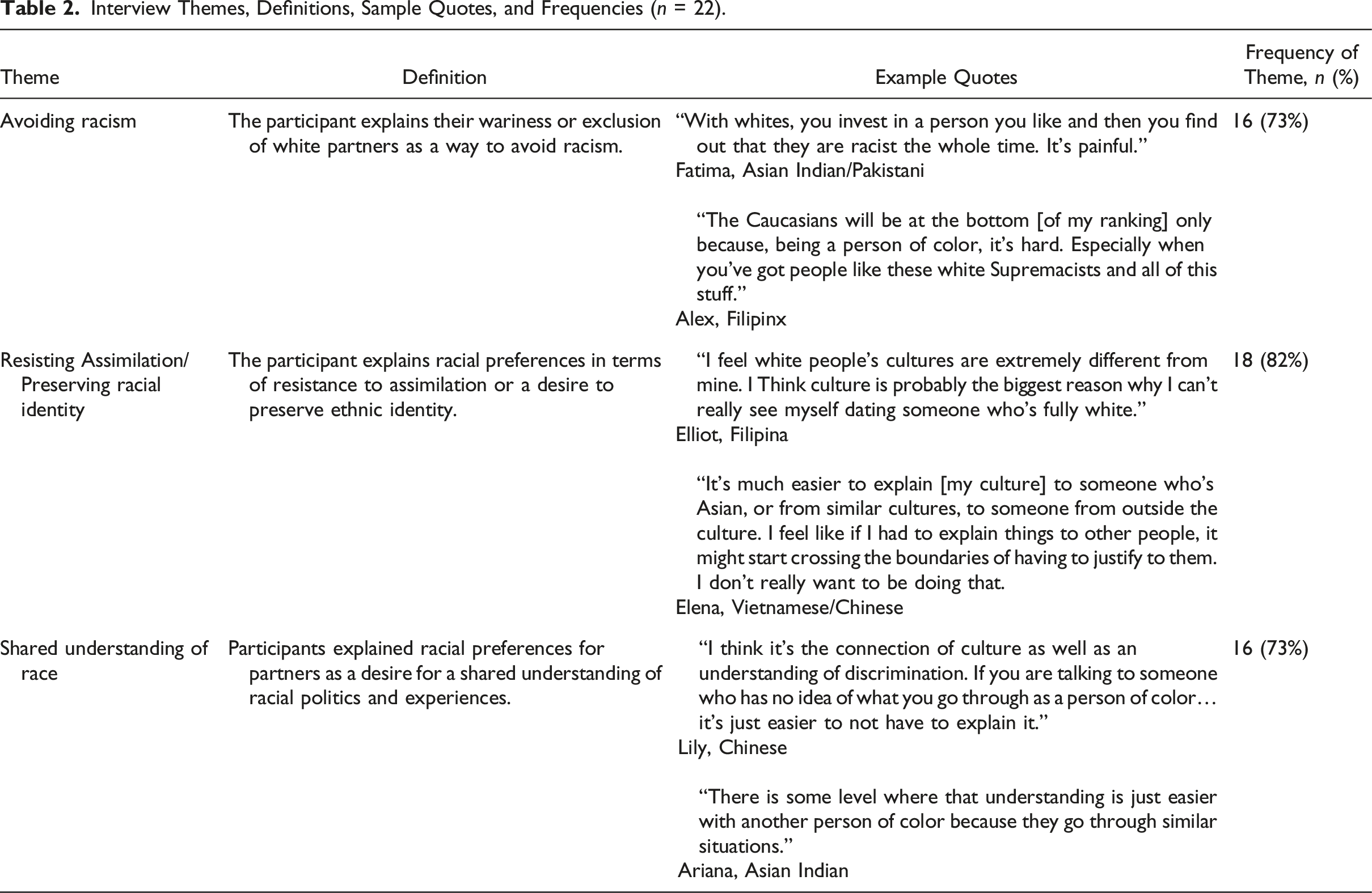
Modeling my coding analysis after Rafalow and colleagues (2017), I originally coded interview data through line-by-line open coding, creating various “parent codes.” I paid particular attention to any mention of or reference to race in interviewees’ dating lives or general life. From there, I created more focused, “child codes” which denoted whether participants stated a racial preference or a lack of racial preference. Next, I developed major themes for the most common reasons participants offered for having certain preferences (e.g. desire to avoid racism, cultural differences, etc.). I paid particular attention to whether or not participants related preferences to their own racial identities and whether justifications for racial preferences were tied to other preferences, especially gender presentation. I constructed a frequency table (Table 2) to present the most prevalent themes. The table provides a list of each named theme and a description and example quote of the theme.
Data
The analysis is based on 192 survey responses and 22 interviews. Survey participants were overwhelmingly liberal (89.1%), college educated (65.6%), bisexual (68.2%), and had college-educated parents (70.7%). 81.8% were monoracially Asian, and the rest (18.2%) indicated Asian ancestry in combination with another racial identification. In terms of Asian ethnic identification, most identified as Chinese (28%), Asian Indian (11.3%), or Vietnamese (16.7%). 15.1% of respondents identified with multiple Asian ethnic identities.
Interview participants identified as bisexual (68.2%), college educated (63.6%), and monoracial (81.8%) at similar rates to survey participants. Further, about the same proportion of respondents indicated that they had college-educated parents (72.7%). Interviewees were more likely to be liberal (95.2%) than survey participants. In terms of Asian ethnic identification, most interviewees identified as Chinese (22.7%), Filipino (18.2%), or Korean (18.2%). A more detailed breakdown of Asian ethnic identification can be found in the appendix (Table A1).
My study is strengthened in its grouping of mixed race Asian participants with monoracial Asian participants. While some researchers recommend separating out mixed raced respondents from their monoracial peers (Liebler and Halpern-Manners 2008), I decided to keep mixed Asian participants in the study along with monoracial Asian participants. Such inclusion did not significantly change the survey or interview data, possibly due to the limited sample size of mixed race Asian participants. Including mixed race Asian participants provides an important avenue through which to study the relationship between racial identification and desire (Buggs 2017) among subjects centered in assimilationists’ (post)racial fantasy (Lee and Bean 2004; Lee and Kye 2016; Portes and Zhou 1993; Chong 2013). While research on multiracials have found a stark erotic and political divide between non-Black and Black multiracials (Buggs 2017; Feliciano and Kizier 2021), most research focuses on heterosexuals and it remains unclear how queerness may inform Asian multiracials’ racial preferences.
Survey Participants Stating Racial Preferences by Sexual Orientation.

Note: *p-value <.01.
There is little to suggest that the sample’s overwhelming “liberal” identification is unrepresentative of young queer women. Nationally representative surveys have consistently found that LGB voters, especially women, overwhelmingly registered as Democrats and are left-leaning (Kiley and Maniam 2016; Pew Research Center 2018). Furthermore, the majority bisexual sample is expected given that studies have shown that bisexuals outnumber monosexuals in the queer community, especially among queer women (Diamond 2009; Compton and Bridges 2019; Gates 2011).
On Interviewing While Asian
I asked all participants at the end of each interview what race they perceived me to be and how that might have affected their responses, if at all. Most participants identified me as Asian and sometimes as “hapa” or mixed, stating that they felt more comfortable talking about racism and their unwillingness to date white partners because we shared the same race, implying that we would share the same understandings of race and racism. Some also stated that they wanted to participate because they knew that there are few studies that focus on queer Asian women and wanted to assist an Asian scholar.
Results
The investigation garnered two key findings. First, participants preferred Asian partners over white partners and framed their desire through the logic of sticky rice politics. Second, bisexuals’ racial preferences were not mediated by partner gender, and participants did not link racial preferences with gender presentation preferences. These findings support my prediction that homonormativity is not as dominant a logic of desirability as that of sticky rice politics. Survey and interview results will be interspersed through this section, ordered with common themes.
Sticky Rice Politics as a Logic of Desirability and Resistance to White Supremacy
A majority of survey participants stated racial preferences (Table 1). Bisexual survey participants were more likely to state racial preferences for male partners over female partners, but this was not statistically significant.
Out of the 107 survey participants that stated a racial preference, about 84% of them stated a preference for Asian women (Figure 1). Only 34% preferred white women (Figure 1). Survey participants were significantly more likely to prefer Asian women than white women (z = 7.22; p < 0.0001) (Figure 1). In fact, respondents' preferences for white women were not significantly different from their preferences for Black women (z = 1.81; p > 0.05) or their preferences for Latina women (z = -.43; p > 0.05) (Figure 1). While surprising, since Black women are similarly marginalized by both heterosexual white and Asian daters in other studies (Robnett and Feliciano 2011), non-significance should be taken with a grain of salt given the large confidence intervals, which are partially a result of the small sample sizes. It remains important to note, however, that, even within a small sample, Asian women are more likely to prefer Asian women over white women rather than self-exclude their Asian peers in favor of white partners like gay Asian male daters (Rafalow et al. 2017; Han and Choi 2018; Wat 2001). Percentage of participants stating preferences for different races of female partners.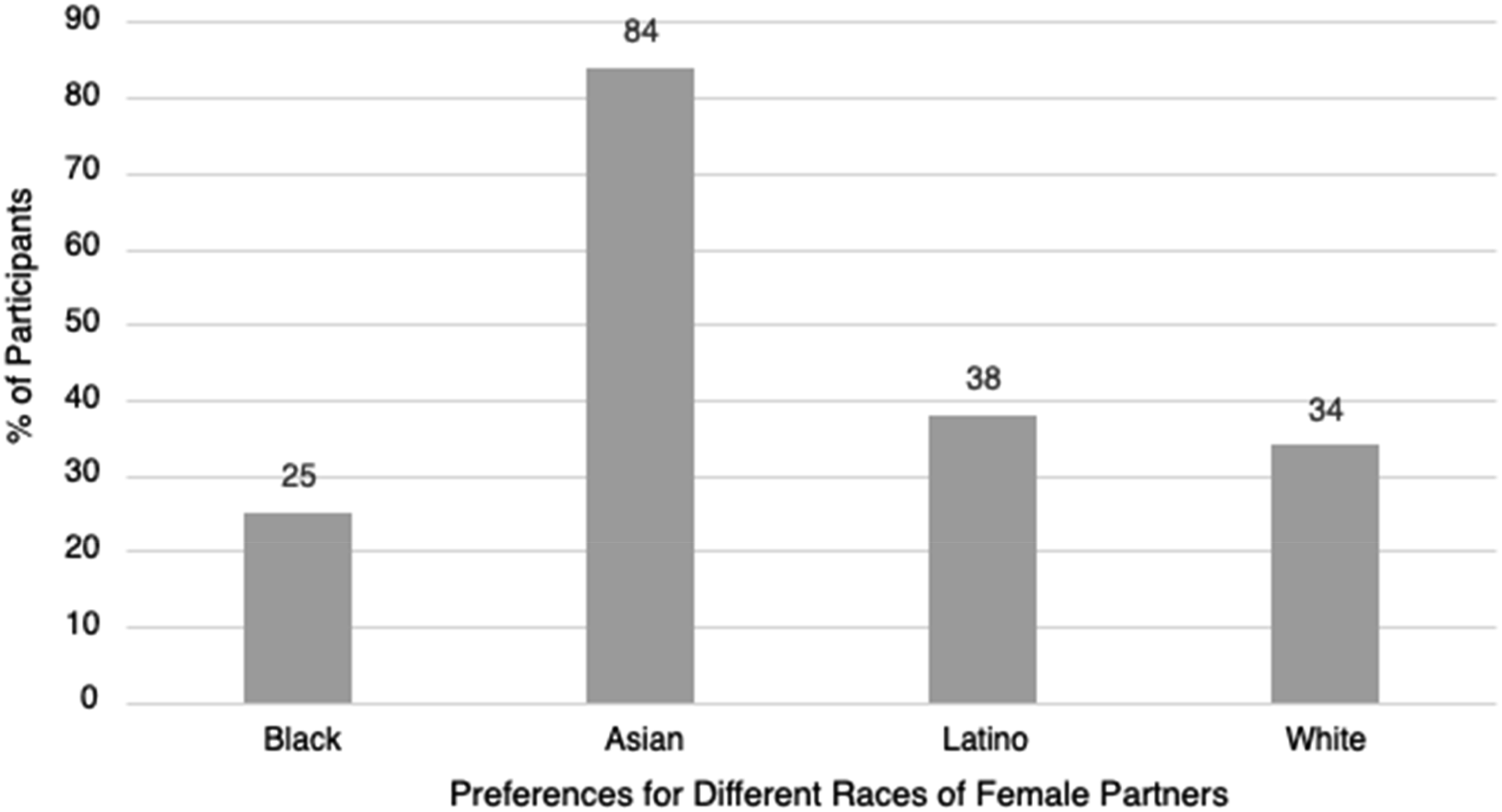
Interview Themes, Definitions, Sample Quotes, and Frequencies (n = 22).
Desire to Avoid Racism and Resist Subordination
Interviewees also framed hesitance and aversion toward dating white partners as a refusal to be subordinated under and subjected to white racism (Table 2). When asked if she would ever consider dating a white partner, Karen, a Korean American, expressed concern over racial fetishization: “As an Asian…. Look at me [gestures to eyes]... seeing white people, I don’t consider it. It's kind of like, the possibility of yellow fever is always in the background….I can either choose to date someone and grapple with that and [question] are they really or aren't they really like that or I can just not date white people. Yeah, I'm completely fine with that option.”
Like Karen, respondents would often preface their racial preferences, with “as an Asian” or “as a person of color.” Such phrasing often preceded statements of distrust toward white people, creating a link between Asianness and distrust toward white partners. In fact, participants rarely expressed concern about being racially fetishized by non-white individuals. This concern for racial fetishization was common even among those who were more open to such partnership. Its prevalence as a theme suggests that many interviewees understood dating as potential sites for racial subordination. In response, they expressed hesitancy or aversion to dating white partners to avoid racial fetishization.
Respondents also wanted to avoid more general forms of racism. Bisexuals, in particular, made distinction between the types of racism they expected from white men or white women. For example, Julia, a Pakistani American woman, reasoned “it’s easier to swipe left on white men [compared to white women] because there’s just so many. With queer women, there’s not a lot of them so my options are limited. But white men don’t attract me much physically, and also, mentally, they’re usually just shitty and racist. Not stupid, just shitty.”
Many bisexuals shared this view, reasoning that white men were more likely to enact a general “shitty” racism because of their white male privilege. White women’s racism, in contrast, was linked to hypocrisy. Gina, a mixed race Korean and Black woman, experienced this first hand: “I feel like we specifically have a distrust of white women. I went to a super liberal or whatever college, but I’d come across these spaces of white queer women only being cool with other white queer women. It was so othering. Like ‘we’re here, we’re queer, but also we’re only white.’ Then they’re like ‘you should just go to the Black thing. This is not the space for you.’”
While white men’s racism was generally expected, white women’s racism was seen almost as a betrayal. White women could simultaneously marginalize queer women of color and appropriate the verbiage of oppression and liberal politics to deny wrongdoing.
Rather than invest labor in and incur risk vetting potential white partners, most interviewees were more interested in dating non-white partners. In this way, interviewees both resisted subordination and renegotiated standards of desirability by framing white partners as racist and, thus, undesirable. This could be understood as a form of capital reinvestment as participants divest their desire, a form of erotic capital, from whiteness through avoiding white partners. While Green (2008b) conceptualizes erotic capital as “the quality and quantity of attributes that an individual possesses which elicit an erotic response in another”; I argue for the extension of erotic capital to refer to the desire an individual can possess for certain attributes. Reconceptualization allows for the recasting of Asian participants as desiring subjects, rather than objects of desire awaiting white appraisal, fetishization, or rejection. Desire as erotic capital, then, can either be invested in attributes consistent with an out-group or invested within one’s own group.
Desire for Culturally Competent Partners and Cultural Preservation
Beyond the desire to avoid racism, 86% of interviewees connected their racial preferences to a desire to preserve their cultural identities (Table 2). Alice, a Korean asexual and biromantic, states that she is “more attracted to Asians just because of the cultural aspect, not so much the race aspect, because then there’s just some things that culturally I don’t have to explain that they would also get. There’s a lot of my culture that is pretty important to me.” Participants valued the ability to have a shared cultural understanding. This included but was not limited to foodways, rituals, and child-rearing practices. As Thanh, a Vietnamese lesbian, put it “it’s about not having to have a debate about whether beans belong in desserts and shoes off in the house.”
A shared ethnic or racial background would make things “easier” or “relatable,” but this was not a requirement for any interviewee. Rather, interviewees wanted partners who could respect and support them in maintaining their culture even if they did not share the same background. This was especially important to Fatima, a bisexual Indian and Pakistani woman from the Bohra religious group, who expressed concern about finding a culturally supportive partner: “We have very distinct cultural practices which are important to me to continue. I don't care if my long term partner has faith and belief, but they have to be willing to do the cultural aspect of religion. It’s something we think about a lot because I think it'll be a struggle.”
Some expressed doubt that white partners could understand their cultural upbringing and may degrade ethnic cultural practices. Reflecting upon her multiracial upbringing, Melissa alluded to racial conflicts in the home when she explained her aversion to white partners “Unless [the white partner] is really exceptional [I’m not open to it.] I grew up with a white father and an Asian mom. I think it's just because of my upbringing… I don't want my kids to have the same experience. Part of me has this like oh ‘I want to make them more Asian.’”
Even though she was a child produced from a union so heavily valorized in assimilationist literature (Lee and Kye 2016; Qian and Lichter 2007; Portes and Zhou 1993), Melissa rejected the prescription to intermarry with white partners. Instead, she talked about the forms of racial degradation and microaggressions she witnessed growing up. Her father “made it seem like everything about [her Japanese] mom was backwards” and would “put down [her] mom.” She felt that her father’s white cultural imposition compromised her ability to fully claim an Asian identity and did not want to pass that to her future children. Anxieties surrounding cultural transmission have also been documented between white/Asian coupled parents who often stated that their racial conflicts started with the advent of their mixed race children (Chong 2013). The disagreements over their children’s racial and cultural identities would further be compounded by the Asian parents’ feeling of being “white-washed” themselves when their partners frustrated cultural transference. Thus, dating preferences act not only as a process of racial boundary formation for the present individual but maintain desired future group membership for themselves and their potential children.
Desire for Pan-Ethnic Solidarity Through Shared Racial Understandings
Beyond the desire to preserve racial/ethnic cultures, participants expressed desires for racial solidarity. Over three-quarters of interviewees expressed a preference for partners who could empathize with and share their racial experiences and politics, expressing doubt that white partners could fully empathize with them (Table 2). Christine, a Chinese bisexual, connected a lack of shared understanding with potential mistreatment: “If I date someone white and they’re not very conscious about all these racial issues, then how are we going to get there? How are you going to treat me? I feel like dating someone that’s not white would make it a little easier because I can really relate with someone like me from a marginalized group.”
It is important to note that participants did not necessarily view a shared understanding of racial politics and racism as mutually exclusive with white partners. Rather, they recognized that it was rarer since whites did not experience racial discrimination and empathy would require labor from both them and the white partner. Maria, a Filipina community activist, stated “white people just have such audacity which comes with privilege… If a person is willing to be accountable and to learn that will be great. But it’s complex. With white fragility I understand it’s real. At the same time it puts so much work on the other person. Why would I do all that work? Is this really worth it? I measure it in terms of worth and work, and sometimes it’s just not worth it. I can’t invest myself in this way if you are not going to, number one, be my ally and, number two, really engage with the way that I see the world.”
In contrast to their views of white partners, interviewees believed that partners of color would likely have a shared racial understanding based on their experiences of racial discrimination. Casey, a Chinese bisexual who was adopted by white parents, explained her racial preferences as: “I’ve noticed I tend to sweat more for East Asian women… I think one thing that subconsciously attracts me to women of color is the hope that they would be more racially more self aware than a white person. That’s something I look for. I wouldn’t say it's a cultural commonality because we obviously don’t have a cultural commonality, but the commonality of experience of being racialized is something I look for, and I feel a little bit safer.”
It is important to note the discursive slippages between the preferences for “Asian partners” and “people of color.” This indicates that queer Asian women’s “stickiness” is not necessarily limited to other Asian Americans but can extend to a larger “sticky politics” in search of racial solidarity. The power of political orientations in mediating racial preferences has also been documented among mixed race women (Buggs 2017) and Black daters (Childs 2005). Race is used as a shorthand for political attitudes to anticipate partners’ capacity for empathy and structural understanding of oppression.
Queer Asian women’s sexual fields are heavily influenced by the imperatives of sticky rice politics as a logic of desirability. Sticky rice politics valorizes racial homophily and rejection of white partners as divestment from white logics of desirability and resistance to white supremacy and assimilation. In racial homophily, Asian participants invest in their own political identities, cultural practices, and desirability both as individuals and as a racial group united against racism.
Diminished Importance of Homonormativity as a Logic of Desirability
Analysis of bisexual respondents’ preferences yielded little support for the gendered white advantage hypothesis and great support for the argument that homonormativity is less operative as a logic of desirability. A faithful interpretation of the hypothesis would expect that bisexuals are more likely to state a racial preference for male partners than for female partners since dating men would allow them greater access to institutional power and resources (Curington et al. 2021). Further, it would predict that bisexuals are more likely to prefer white men over men of color because of white men’s proximity to aforementioned resources and esteem. Yet, survey participants were not more likely to state a racial preference or exclusion depending on partner gender (Table 1). In fact, the bisexual women from this study seem to be even less likely to state a racial preference for men than the heterosexual women from other studies (Lunquist and Lin 2015; Lin and Lundquist 2013; Mendelsohn et al. 2014). When bisexual survey respondents did state a preference, they overwhelmingly preferred Asian men (79.3%) over white men (35.4%) (z = 6.30; p < .0001) (Figure 2). Additionally, they were not significantly more likely to prefer Asian women over Asian men, and neither were they more likely to prefer white men over white women. Percentage of participants stating preferences for different races of female partners.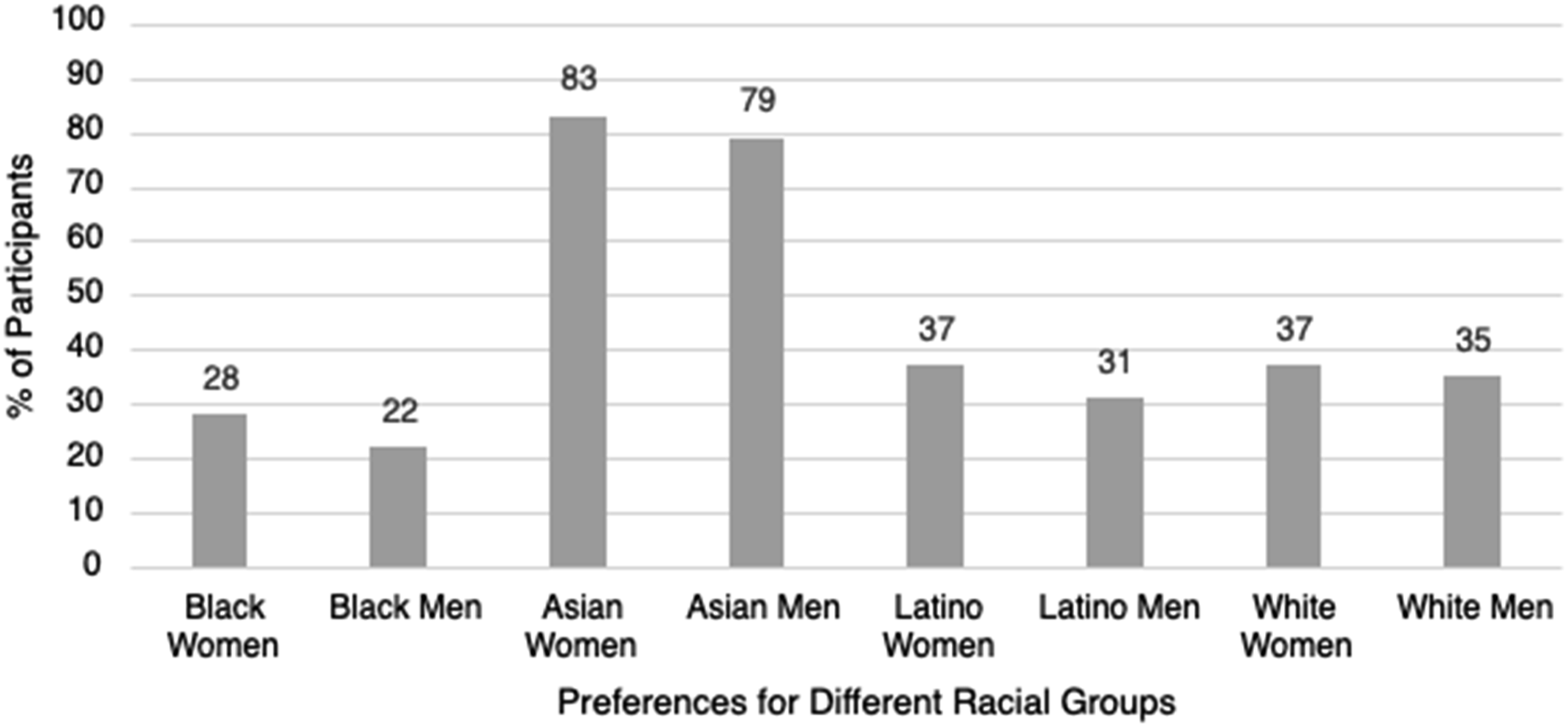
There was a similar dearth of evidence of homonormativity as a dominant logic of desirability among respondents. Evidence of homonormativity would have come in the form of participants linking their racial preferences to gendered racial stereotypes or “controlling images” (Rafalow et al. 2017; Hill Collins 2004). Yet, a chi-squared test showed no significant association between bisexuals’ gender presentation preferences and preference for white male partners in the survey data (Pearson chi2 = 5.998; p-value>.10). This was echoed among interviewees who generally did not connect their racial preferences to such stereotypes or gender presentation preferences. Rather, racial preferences were largely connected to the imperatives of sticky rice politics: a desire to resist racial subordination and assimilation and a desire for racial solidarity (Table 2).
Participant Gender Presentation Preferences for Female Partners.
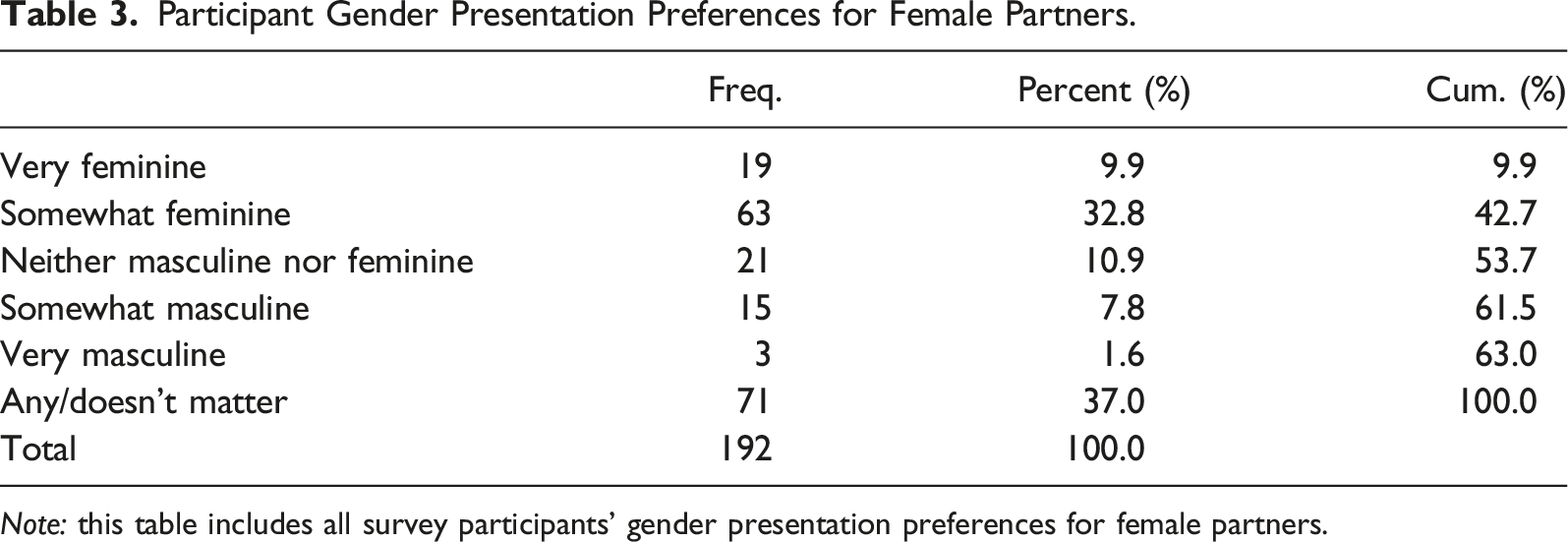
Note: this table includes all survey participants’ gender presentation preferences for female partners.
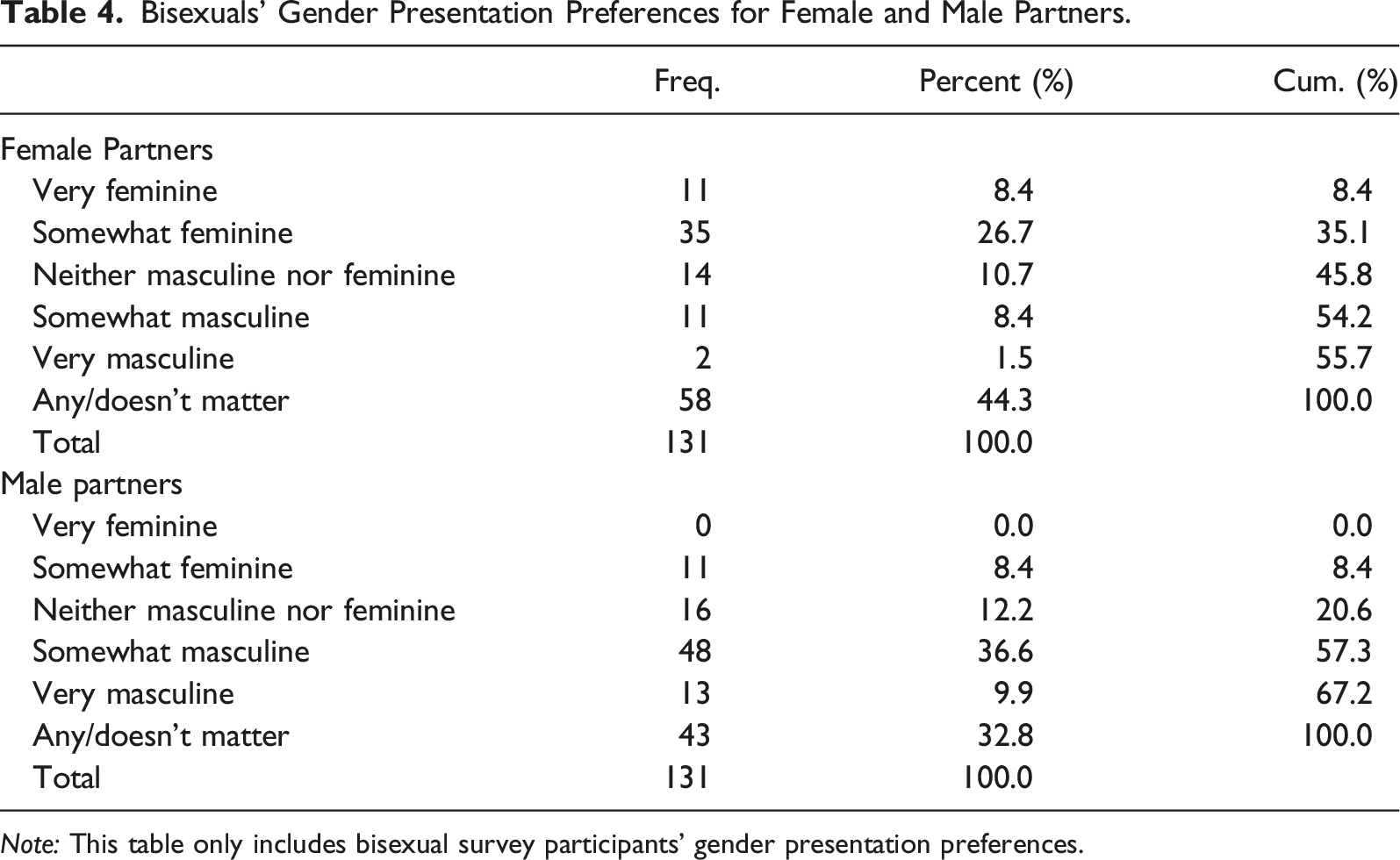
Bisexuals' Gender Presentation Preferences for Female and Male Partners.
Note: This table only includes bisexual survey participants’ gender presentation preferences.
The diminished importance of normative gender presentation was also reflected among interviewees. Nearly half of interviewees stated preference for androgynous or gender fluid partners with a mix of both feminine and masculine qualities. Interview participants often spoke about desiring strong, opinionated women and avoiding male partners who embodied “toxic masculinity.” Casey, like many others, associated “super masculine men” with “potential threats,” “sexual trauma,” and “sexism.” Such sexism ran in conflict with participants’ aspirations of safe, egalitarian relationships.
In contrast, desires for women were more linked to how individuals saw their own gender presentation. Alicia stated that she wants a partner who engages in “gender play… because [she] has always played with her gender, and there is a kindred spirit in seeing someone else do that.” Notable in these narrations was how the speaker would consistently relate their preferences to how they saw themselves. Rather than being meek women who desired the heteronormative relationships, they saw themselves as independent and valued partners who would flout gender norms with them.
While other studies have found that racial preferences are often intricately tied to gender presentation preferences, among queer Asian men (Rafalow et al. 2017; Han and Choi 2018) and heterosexual Asian women (Pyke 2010; Nemoto 2009; Curington et al. 2021), this was largely absent among my participants. This lends support to the argument for a diminished importance of homonormativity as a logic of desirability among queer Asian women’s sexual field. Findings suggest that the interaction between queerness and womanhood can reshape gender normative expectations and even the sexual field for women seeking men.
Discussion and Conclusion
Existing work has hypothesized that queer women of color’s greater preference for racial peers over white partners is due to a gendered white advantage that offers greater rewards for partnering with white men than for partnering with white women (Curington et al. 2021). Others have argued that this pattern is due to a sexual field that is less influenced by homonormativity (Rafalow et al. 2017). Scholars have been limited in their ability to directly test the former hypothesis through their exclusion of bisexuals. Further, to the author’s knowledge, none have tested gendered white advantage hypothesis against sexual fields theory. Ultimately, I found no evidence for the gendered white advantage hypothesis which would have predicted a preference for white men over Asian men and greater preference for white men compared to white women. However, bisexuals were more likely to prefer Asian men over white men (Figure 2), and they preferred white men and women at similar rates (Figure 2).
In contrast, I found ample evidence for the dominance of sticky rice politics and the decreased importance of homonormativity as logics of desirability in queer Asian women’s sexual field. This was demonstrated by interviewees’ characterization of their lack of preference or aversion for white partners as rising out of a desire to avoid racism, preserve cultural identity, and experience racial solidarity (Table 2). Their narratives frame white partners as undesirable because of their likelihood of enacting racism and lack of aptitude for racial empathy and cultural competence. This framing simultaneously renders an image of Asian and non-white partners more generally as desirable due to their racial progressiveness and cultural competence. Through their desires, queer Asian women racialize themselves as women of color and distance themselves from whiteness.
These findings run counter to the heteronormative and homonormative logics of desirability that find ample expression in heterosexual and queer male dating markets (Han 2008; Feliciano et al. 2009; Lundquist and Lin 2015) where heterosexual Asian women and queer Asian men have been found to prefer white men over Asian men (Pyke 2010; Rudder 2014; Curington et al. 2015; McClintock 2010). Scholars have documented the strong link between queer Asian men and heterosexual Asian women’s racial preferences and their deployment of controlling images (Rafalow et al. 2017; Bany et al. 2014; Pyke 2010; Hill Collins 2004). In contrast, most participants in this study do not link racial preferences with gender presentation preferences. In fact, the majority of participants do not even state preference for gender normative partners and express large levels of openness to different gender presentations (Table 3; Table 4). This calls into question the extent to which even a potentially non-racialized homonormativity is dominant within this sexual field.
Participants’ employment of progressive politics to explain their desire for racial homophily is fruitful to consider against heterosexual Asian women’s documented deployment of it to justify preference for white partners (Pyke 2010; Nemoto 2009). In addition to orientalist beliefs of racialized femininity, heterosexual Asian women have argued that their exclusion of Asian men and preference for white men is a tactic to resist Asian patriarchy which they bristle against as “Americans.” Both groups use racial dating preferences to racialize and orient themselves in the larger racial order; queer women as Asians opposing assimilation and heterosexual women as Americans working toward assimilation.
This study was an exploration of desire and racial boundary formation in queer Asian America. I have contributed to the racial dating preferences literature empirically by extending the scope of analysis to queer Asian women and analyzing bisexuals’ preferences for both male and female partners. The inclusion of bisexuals’ preferences allowed me to contribute theoretically by testing the gender white advantage hypothesis and sexual fields theory and finding evidence for the latter. It is limited by the non-probability survey design and its highly educated sample. Yet the findings raise important theoretical questions about the dialectical relationship between identity and desire. Ultimately, they suggest that racial dating preferences are not individual desires for whom they want to be with but who they want to be. Future researchers could further sample across gender and sexual orientation to directly compare heterosexual men and women to queer men and women. It is also fruitful to consider the relationship between beauty regimes for gender nonbinary partners and how that relates to larger systems of race as we contend with the rise of both queer and gender-nonconforming individuals as both sexual subjects and objects in sexual fields.
Footnotes
Acknowledgments
I would like to thank my faculty mentors and reviewers for their invaluable feedback and my study participants for their time and trust in me.
Declaration of Conflicting Interests
The author(s) declared no potential conflicts of interest with respect to the research, authorship, and/or publication of this article.
Funding
The author(s) received no financial support for the research, authorship, and/or publication of this article.

Notes
Appendix
Participant Asian Ethnic Identification. Note: Percentages may not add up to 100 due to rounding. Only data for 186 of survey participants are provided. 6 multiracial participants did not select “Asian” on the question asking about race, choosing instead to identify themselves as Asian in the “Other, please specify” text response. Thus, the survey display logic did not display this question on Asian ethnic identity for them.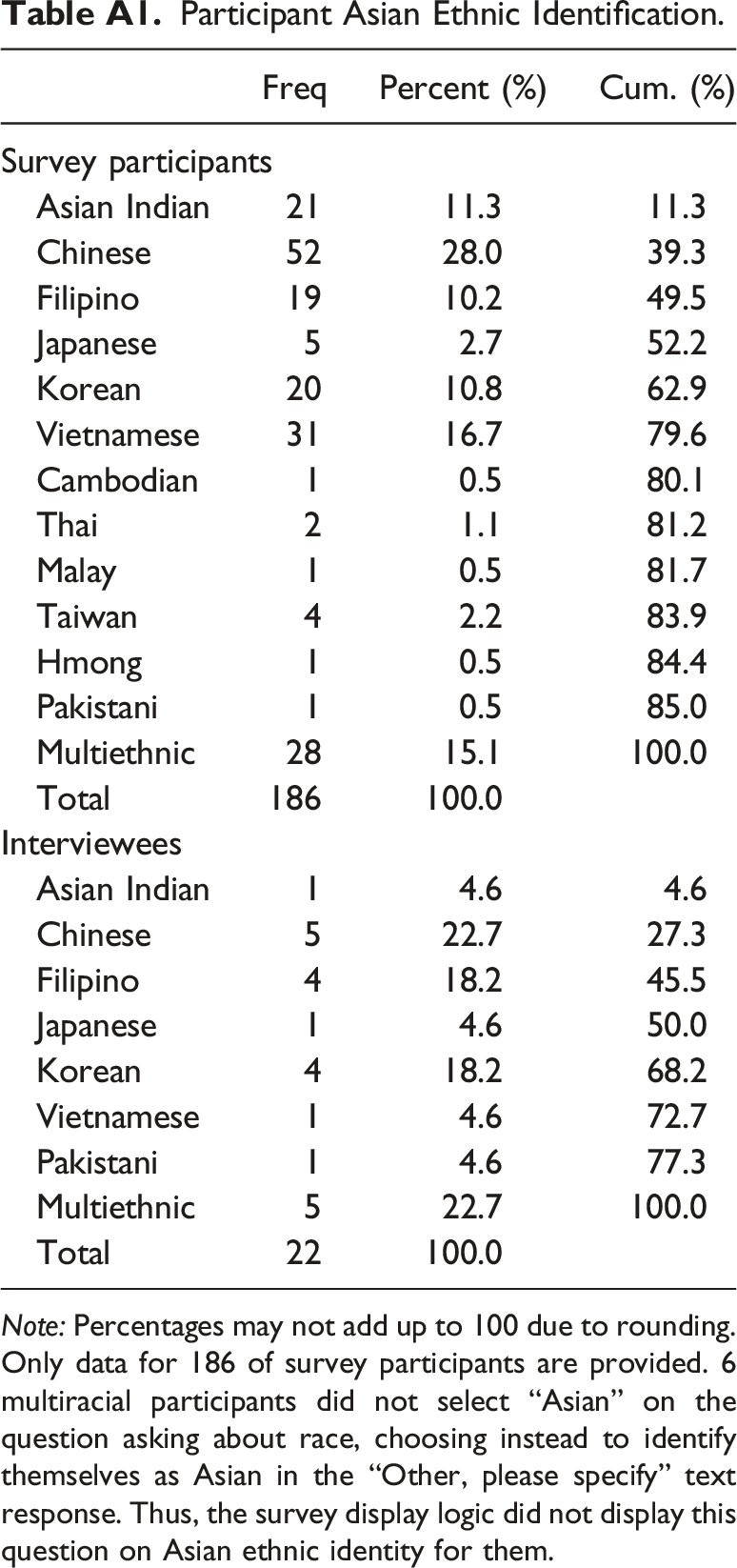
Freq
Percent (%)
Cum. (%)
Survey participants
Asian Indian
21
11.3
11.3
Chinese
52
28.0
39.3
Filipino
19
10.2
49.5
Japanese
5
2.7
52.2
Korean
20
10.8
62.9
Vietnamese
31
16.7
79.6
Cambodian
1
0.5
80.1
Thai
2
1.1
81.2
Malay
1
0.5
81.7
Taiwan
4
2.2
83.9
Hmong
1
0.5
84.4
Pakistani
1
0.5
85.0
Multiethnic
28
15.1
100.0
Total
186
100.0
Interviewees
Asian Indian
1
4.6
4.6
Chinese
5
22.7
27.3
Filipino
4
18.2
45.5
Japanese
1
4.6
50.0
Korean
4
18.2
68.2
Vietnamese
1
4.6
72.7
Pakistani
1
4.6
77.3
Multiethnic
5
22.7
100.0
Total
22
100.0