



Abstract
Socioeconomic success doesn’t yet mean social or sexual acceptance for Asian American men.

In January 2017, African-American comedian and talk show host Steve Harvey joked about a book titled How to Date a White Woman: A Practical Guide for Asian Men. He claimed that no one could possibly like Asian men. He said, “You like Asian men?… I don’t even like Chinese food, boy…. I don’t eat what I can’t pronounce.” Chef and author Eddie Huang (whose autobiography served as groundwork for the sitcom Fresh Off the Boat) later responded with a New York Times op-ed: “Yet the one joke that still hurts, the sore spot that even my closest friends will press, the one stereotype that I still mistakenly believe at the most inopportune bedroom moments—is that women don’t want Asian men.”
The landmark 2018 film, Crazy Rich Asians, is notable not only for its all-Asian leading cast, but for its portrayal of Asian Americans as attractive leading men. In a 2018 Washington Post article by Allyson Chiu about the film, Sinakhone Keodara (who is Laotian American and works in the entertainment industry) talked about his experiences on Grindr (a gay/bisexual dating app), saying, “It’s heartbreaking… it’s been really humiliating and degrading….” He was often told things like, “Asian guys are not attractive” and “Asian guys are not desirable.” In personal correspondence, actor Peter Shinkoda wonders, “I don’t know which is to blame—is it Hollywood and Western media perpetuating social preferences or is it the other way around? Either way, for Asian guys it’s a constant struggle having to deal with constant negative stereotypes surrounding us.”
Is it true Asian American men are seen as undesirable? Aren’t men largely evaluated on the dating market by their educational and occupational attainment? Looking back to the publication of William Petersen’s 1966 New York Times Magazine article touting the success of Japanese Americans just 20 years after their internment during World War II, Asian Americans have been heralded as the model minority. Historian Ellen Wu argues that this image might even be traced back to the 1940s, employed by Chinese and Japanese Americans to defend themselves from attack of their foreignness. Petersen and others who support the model minority idea argue that Asians exemplify what is possible for any ethnic minority group as long as they are willing to work hard (despite suffering from extreme discrimination). In fact, Petersen argued that, “(b)y any criterion of good citizenship that we choose, the Japanese Americans are better than any other group in our society, including native-born whites.” By 1984, President Ronald Reagan stated, “Asian and Pacific Americans have helped to preserve that dream by living up to the bedrock values that make us a good and a worthy people… it’s no wonder that the median income of Asian and Pacific American families is much higher than the total American average.”
This “success” narrative is still prominent today. In a well publicized 2012 Pew Research Report, Asian Americans are noted as the group with “the highest-income, best-educated… they are more satisfied than the general public with their lives, finances, and the direction of the country, and they place more value than other Americans do on marriage, parenthood, hard work and career success.” In fact, many social scientists implicitly believe that Asian Americans have assimilated to the U.S. mainstream and do not need to be studied because their overall well being, in terms of education, income, and health outcomes, is superior to other minority groups’ and, in many cases, better than Whites’. These arguments further suggest, implicitly, that the disadvantaged status of other minority groups is due to cultural deficits. In fact, like the Pew Report, many social scientists equate educational and income (socioeconomic status) success with assimilation and integration into U.S. society.
Asian American scholars have, of course, long questioned the portrait of Asian Americans as the “model minority,” but they do so largely by arguing that there are vast differences in Asian Americans’ education and income by ethnicity. Indeed, given that Cambodian and Hmong Americans have comparable poverty rates to Hispanics and Blacks, many scholars critique the lumping of all Asian Americans into a monolithic group as obscuring considerable socioeconomic and ethnic diversity. And yet, in terms of their demographic profile, most Asian American ethnic groups (with the exception of Cambodian and Laotian immigrants) can boast large shares of college-educated adults, and most Asian ethnic groups have higher median household incomes than those of Whites, Blacks, and Hispanics.
The socioeconomic advantages of Asian Americans are not only experienced within a single household, but through co-ethnic communities as they create a shared source of social capital. If a child is more likely to go to college because his/her parents went to college, that association is further reinforced if when all of the child’s parents’ friends also went to college. One could argue that even in the absence of college-going by one’s parents, the child may still benefit by belonging to an ethnic community whose members have high levels of education and income.
Earnings and education are critical in men’s marriage prospects, yet Asian American men, who have high levels of both, are marginalized in marriage markets.
Still, the idea that socioeconomic success is sufficient for the assimilation of any minority group overlooks the issue of social acceptance. Even early scholars such as Robert Park, Ernest Burgess, and Milton Gordon suggested that intermarriage was a more important indicator of assimilation than was socioeconomic success—perhaps they assumed that intermarriage was a proxy for more general social acceptance. Racial hierarchies dictate the relative social status of different racial groups, and gendered racial hierarchies reinforce the social desirability of men and women from different racial groups. Alongside these earlier scholars, we argue that by solely focusing on socioeconomic outcomes, social science researchers miss an important aspect of assimilation and everyday social integration: the desirability as a romantic partner by virtue of one’s race and gender. In other words, even if Asian American men are doing well in terms of their educational and occupational achievement, does this necessarily mean that they fare well on the straight (and gay) dating and marriage market?
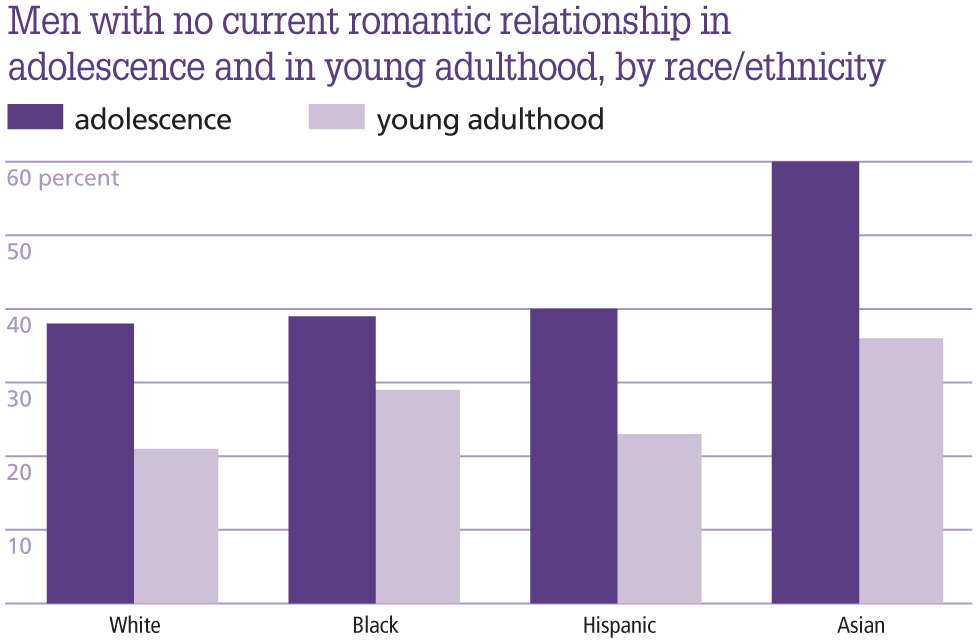
In our research, we find that Asian American men, in particular, are socially excluded from romantic relationships. In fact, we find that despite the higher education and income of Asian American men, there is evidence that they are systematically excluded from having romantic relationships during adolescence and young adulthood (see next page, left). The popular images of Asian American men as geeky and undesirable as potential mates are consistent with work on racial preferences among internet daters, as well as with our own research on the romantic relationship opportunities of adolescents and young adults (in which Asian American youth begin dating later than other racial groups). Given their marginalization in both straight and gay mate markets, Asian American men present a paradox to family sociologists and demographers, like Megan Sweeney, who find evidence that earnings and education are critical in men’s prospects of marriage.
Educational and Income Success among Asian American Men
Asian Americans are a broad panethnic group comprising Chinese, Filipino, Japanese, Korean, Indian, but also smaller groups such as Cambodian, Thai, and Laotian. The first Asian Americans came to the United States (mainland) in the mid-1800s; however, immigration from Asian stalled starting with the 1882 Chinese Exclusion Act, the 1907/1908 Gentlemen’s Agreement (with the Japanese government), and the Immigration Act of 1917 (also known as The Asiatic Barred Zone Act). Notably, the 1965 Immigration and Nationality Act (or Hart-Cellar Act) ended exclusion by national origin. The bulk of today’s Asian American population (approximately 90%) are individuals or descendants of individuals who arrived after Hart-Cellar. A non-trivial number of Asian Americans are descendants of earlier immigrants, though most hail from more recent immigrant families. Moreover, because most of today’s Asian Americans come from immigrant families, they are different in a number of ways from White populations that primarily come from non-immigrant families.
The immigration policies of the United States, the physical proximity of the sending country to the United States, and the complex histories between the country-of-origin and the United States interact to create very different immigration streams depending on country-of-origin. For example, Asian Indians in the United States are highly educated—approximately three-quarters of Indian adults have a BA or higher, compared to about 30% of the U.S. population. Notably, the Indian population in the United States is not similar to the Indian population in India, where fewer than 10% attend college and 40% of the populace is illiterate. Because of immigrants’ self-selection and many other reasons, many Asian ethnic groups in the United States are well educated because they come to the United States with high levels of education and wealth and because the advantages of immigrant parents are then passed on to their children.
Recent headlines suggest that Asian men have not only reached parity with White men in terms of education and earnings, they may have surpassed them. In 2016, Pew reported that Asian American men earned 117% of what White men earned. There is no doubt that Asian American men have higher levels of education and income than Hispanic and Black men. These patterns would suggest a considerable advantage of Asian American men in the dating market, because scholars agree that men’s economic success increases their desirability as partners. So why are Asian American men at such a dating disadvantage?
Dating
Most Americans begin to date in adolescence. Using a nationally representative data set of 90,000 students in 7th to 12th grades (National Longitudinal Study of Adolescent to Adult Health, or Add Health), researchers have documented patterns of romance for different racial groups, both in adolescence and in later periods of the life course. The figure above (left) reveals that among these youth, 60% of Asian males have never dated, compared to roughly 40% of White, Black, and Hispanic males. Girls are typically more likely than boys to date, but the sex gap in romantic involvement is especially pronounced among Asians.
Using data from the Youth Risk Behavior Surveillance System, Patricia Cavazos-Rehg and colleagues also found that Asian males had a later average age of sexual debut than their White, Black, and Hispanic counterparts. By age 17, 33% of Asian American males, compared to 53% of White males, 82% of Black males, and 69% of Hispanic males had lost their virginity (among girls, 28% of Asian American females, compared to 58% of White, 74% of Black, and 59% of Hispanic females had done the same). Because early sexual experience is associated with a number of negative outcomes, researchers have frequently interpreted the late sexual debut of Asian Americans as a healthy and desirable outcome. However, if Asian American men are interested but simply less successful in dating or having sex, then researchers ought to examine the possible sources of this marginalization.
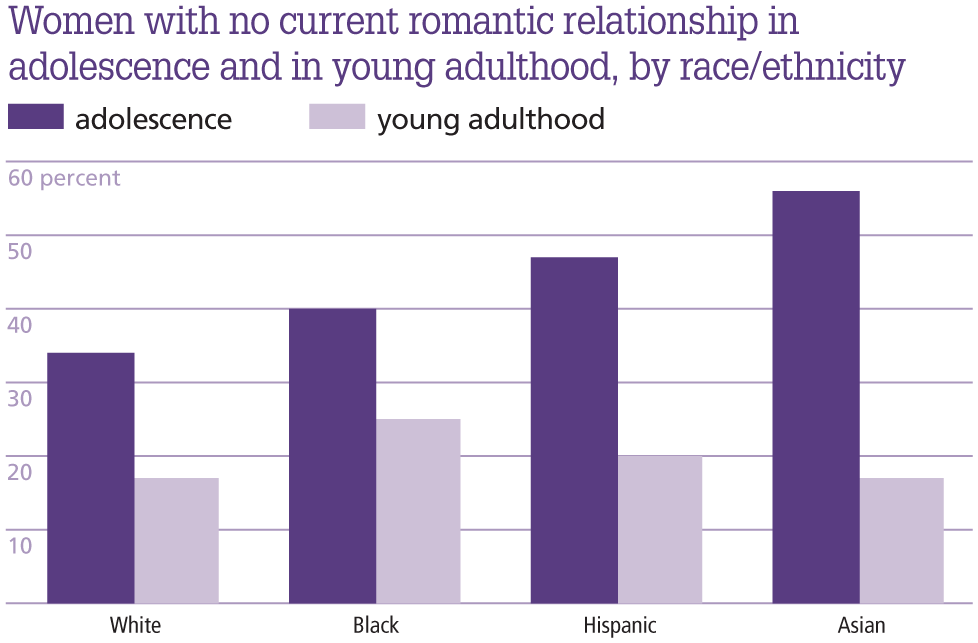
Starting to have sexual relationships later does not, of course, necessarily imply that Asian American males will be sexually marginalized as adults. Yet, in our work using Add Health, we found evidence that by ages 25-32, Asian American men continue to be excluded from romantic relationship markets. As revealed in our data (top left), these Asian American men are less likely than White, Black, and Hispanic men to be in a romantic and/or sexual relationship. One might argue that perhaps Asian Americans differ from other groups in terms of their cultural preferences. However, it is unlikely that cultural norms can account for the lower levels of romantic involvement of only men. In other words, if cultural norms dictated romantic relationship behavior, we would expect to find that Asian American women have similarly low levels of relationship involvement (perhaps even lower than Asian American men). That’s not the case. Asian American women have higher rates of being in a romantic relationship compared to Asian American men, as well as compared to their Black and Hispanic counterparts (above right). In preliminary work using U.S. Census Data, we find evidence that Asian American men are also disadvantaged in same-sex relationships; on average, when they are in interracial relationships, they partner with much older men.
We wondered if these differences applied only to foreign-born Asian Americans or if they reflected preferences for certain physical attributes (height for men) that might disadvantage these men. In statistical analytic models that account for these differences, we find that Asian American men are still less likely than other men to be in a romantic relationship. We found no differences for Asian American women relative to other women. The disadvantage is specific to Asian American men.
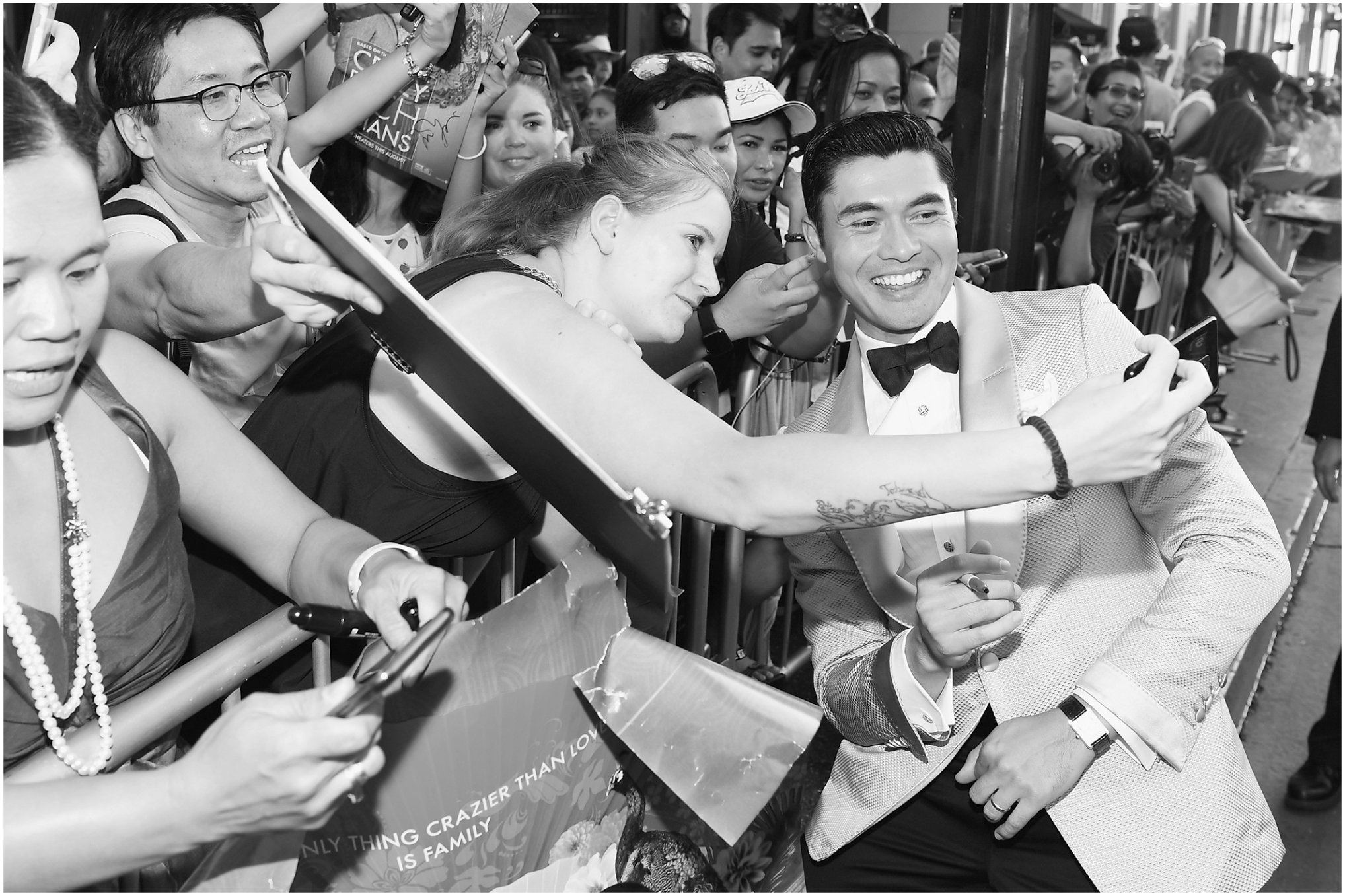
Crazy Rich Asians is groundbreaking for many reasons, including featuring Asian actors like Henry Golding (pictured) as its romantic lead. Golding was even named among [italics] People Magazine’s “sexiest men alive” in 2018.
Getty Images
The Question of Masculinity and Asian American Men
In his documentary, The Slanted Screen (2006), filmmaker Jeff Adachi shows that Asian American men are usually absent from Hollywood films. When they do appear, they are usually geeky and undesirable men, unable to attract women. Asian women sometimes serve as romantic leads, but they are rarely paired with Asian men. And though representations of interracial romance in films and television are still far less common than unions with individuals of the same race, in those films that feature an Asian/White romance, it is almost always a White man paired with an Asian female. Many of these storylines take place in Asia (think of The World of Suzy Wong, Sayonara, The Last Samurai, Shogun, or even the recent Netflix film The Outsider), and the White male characters inevitably fall in love with an Asian woman. Asian men are rarely romantic leads, whether with Asian women or women of any other race.
For those of us who went to high school in the 1980s, Long Duk Dong in Sixteen Candles (directed by John Hughes) is the brutal short-hand for Asian men’s undesirability. He is a foreign student who repeatedly (and unsuccessfully) hits on the movie’s White lead, Molly Ringwald—a geeky buffoon, painfully unaware of his inherent undateability. In the 2000 film Romeo Must Die, loosely based on Romeo and Juliet, the male lead (played by Chinese martial arts actor Jet Li) and the female lead (played by African-American singer Aaliyah), are supposed to kiss. However, that scene did not test well with focus groups, who stated they were uncomfortable seeing an Asian man kiss a Black woman. The scene was changed. Most recently, the CBS TV Show Two Broke Girls (2011-2017) featured an Asian American male character (Han Lee played by Matthew Moy) who owned the diner where the two main characters worked. Asian American writers argued that this character was retrograde and racist, but like Long Duk Dong, Han was still portrayed as short, unattractive, and lacking experience with women. Actor Peter Shinkoda says, concisely, “when it comes to casting Asian American males, Hollywood doesn’t make many opportunities for us.”
Between negative portrayals and complete absence, the foreclosure of Asian men’s sexual storylines in Hollywood have disturbing consequences for their dating experiences in real life. The disadvantage of Asian American men in the dating market is apparent in online dating sites. Cynthia Feliciano and colleagues used data from the early 2000s (on opposite-sex daters on Yahoo! Personals) and found that, among those who stated racial preferences, more than 90% of non-Asian women said they would not date an Asian man. Moreover, while less than 10% of Asian men who stated a preference said they would not date an Asian woman, 40% of Asian women said they would not date an Asian man. A 2005 Gallup Poll revealed similar trends: researchers found that just 9% of all women said that they had dated an Asian man (compared to 28% of all men who said that they had dated Asian women).
When dating site OK Cupid published five years’ worth of data on race, gender, and attractiveness, it showed that, while there were a few modest changes with respect to increasingly liberal attitudes toward dating people of different races in this period, there was little change in group-level patterns of attractiveness of different race/gender groups. Asian American men and Black women were consistently rated as “less attractive” than the average same-gender person by others (with the exception of their same-race counterparts). For instance, in 2009, White men rated Asian women 6% more attractive and Black women 22% less attractive than average. White women rated Asian men 12% less attractive than average, and Asian women rated White men 16% more attractive than average. The asymmetry in attractiveness scores is consistent across multiple data sources.
Some of the variation in desirability manifests in interracial marriage rates. According to data from the 2015 American Community Survey (ACS), 36% of Asian women compared to 21% of Asian men were married to someone of a different race. Sex gaps in interracial marriage are also prominent among Blacks, where 25% of Black men married someone of a different race compared to 12% of Black women. Thus, Asian women outmarry at higher rates than Asian men, and Black women outmarry at lower rates than Black men. These patterns are consistent with the stereotypes that emerge in the media as well as the attractiveness scales in online dating sites. Black women are stereotyped as being too masculine and Asian men are seen as not masculine enough. Perhaps this is what accounts for the asymmetry in interracial marriage rates. It is also possible that these stereotypes are reinforced by family members. Jessica Vasquez, in her study of Latino intramarriage, argues that surveillance and punishment by others reinforce racial romantic boundaries.
Comedian, writer, and actress Issa Rae (of HBO’s Insecure) notes that Asian men and Black women like her live “at the bottom of the dating totem pole.” In her memoir, she even jokingly suggests that smart Black women should start dating Asian men, because they are more their equals. We believe that more expansive media representations and opportunities for Asian American men (especially as romantic leads) might help mitigate these negative stereotypes. This is why the film Crazy Rich Asians has been met with such enthusiasm from many (East) Asian Americans, despite its problematic and puzzling exclusion of South and Southeast Asians in Singapore. After all, gendered racial hierarchies of desirability are as socially constructed as other racial hierarchies. Further work on same-sex pairings suggests that gay men may also subscribe to racial and gender hierarchies that view Asian men as more feminine than other men. Overall, it is certainly clear that for Asian American men, socioeconomic success does not bring additional dating or marriage opportunities.
Gendered racial hierarchies of desirability are as socially constructed as other racial hierarchies.