




Abstract
Scholars generally treat Asians as a homogenous, high-performing population. However, for Filipino Americans, this is not always the case. The analysis of why Filipino Americans are less likely than those in other large hyper-selected Asian groups to get to “third base” demonstrates the need to avoid treating Asians as a homogenous group.

Despite the heterogeneity in academic outcomes among Asian ethnic groups in the U.S., Asian Americans have become associated with educational upward mobility. Illustrative of this is media coverage on the second generation since the 1960s. For example, William Petersen’s well-known 1966 New York Times piece painted the Nisei, or second-generation Japanese Americans, as “model minorities” who, through hard work and discipline, accomplished incredible educational feats despite the racism they faced. Recent news stories on Asian Americans have complicated the model minority narrative, seen in present-day articles on COVID-19 related discrimination of Asians. However, more often than not, the media continue to portray second generation Asians as academically exceptional.
Scholars, too, generally treat Asians as a homogenous, high-performing population. One major reason why is that “Asian American” research has predominantly been on East Asian Americans, i.e., Chinese, Korean, and Japanese Americans. A theory that has gained prominence among assimilation scholars—the hyper-selectivity perspective developed by sociologists Jennifer Lee and Min Zhou—does just that: makes generalizations on Asians based on a study on one East Asian group, i.e., Chinese Americans.
In their book, The Asian American Achievement Paradox, Lee and Zhou explain why second generation Asians have surpassed the college degree attainment rates of their first generation counterparts. They argue, drawing on a baseball analogy, that second generation Asians get to “third base’ because they did not have to “run far at all”: Asian immigrant hyper-selectivity positions them close to third base. Lee and Zhou illustrate that the 1965 Immigration Act, in its preference for the highly skilled, brought in a disproportionate number of college-educated, middle-class migrants from Asia. Consequently, many Asian populations in the U.S. are, on average, more highly educated than their compatriots back home and the average American. The second generation has benefited from immigrant hyper-selectivity; as many middle-class members constitute their communities, youth are inculcated with the belief that to be successful means getting into an elite college and becoming a doctor, lawyer, scientist, or engineer. The second generation is likely to realize such ambitious goals, in part because they receive support and assistance from ethnic institutions in their communities. Lee and Zhou point to supplementary programs that provide test prep and other additional academic services as a key factor to the second generation’s success.
Filipino immigrants, by far, have the lowest rate of earning beyond a B.A.
The achievements of second generation Asians have produced racial advantages for this population. Teachers and administrators assume Asians are highly motivated and the highest achieving students, placing them in AP and honors courses, as well as offering them information regarding college admissions. Being racialized as academically successful, as Lee and Zhou argue, “boosts” second generation performance, as they come to believe that they, indeed, are what everyone in school believes they are: model minorities.
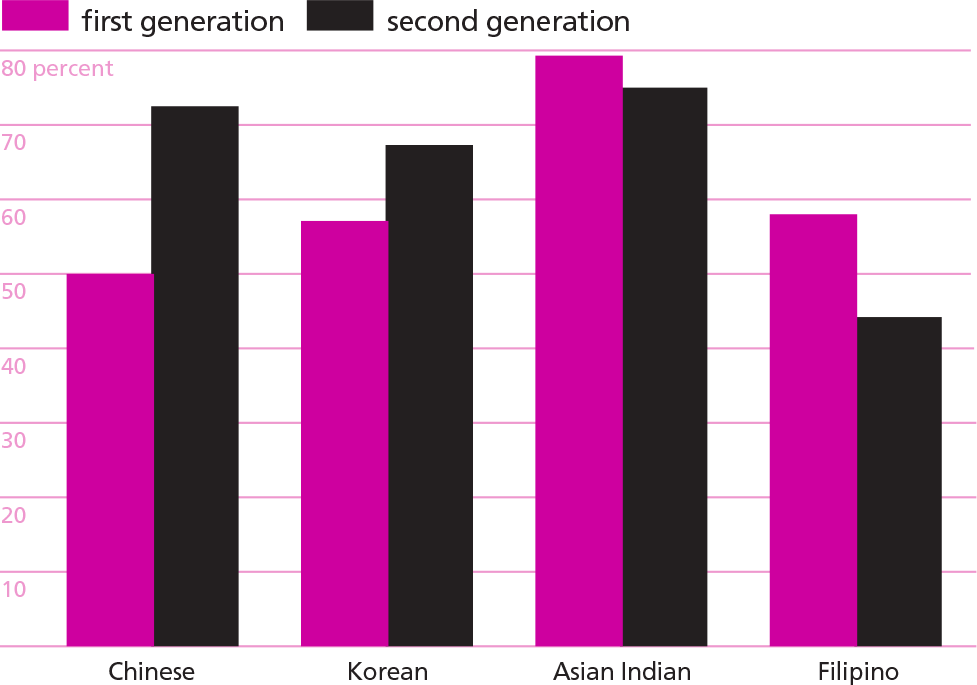
In Lee and Zhou’s view, hyper-selectivity should lead to upward mobility. Yet it does not for one particularly large hyper-selected group: Filipino Americans. As the figure above on the left indicates, among the four largest hyper-selected Asian groups, Chinese, Asian Indian, Korean, and Filipino Americans, Filipinos stand out in their educational outcomes. While about 70 percent of the second generation from the three former groups hold a college degree, only 44 percent of second generation Filipinos do. In addition, unlike Chinese and Korean Americans, second generation Filipino Americans are less likely to finish college than first generation Filipinos. While second generation Asian Indians, too, do not surpass the first generation’s educational levels, at a rate of 75 percent, the second generation succeeds in maintaining the first generation’s incredibly high level of education. Thus, second generation Filipinos are the least likely among hyper-selected Asians to earn a B.A.
Educational attainment of hyper-selected Asian-American groups, by generation
Source: ACS 5-year estimates (2012-2016]
Having earned at least a bachelor’s degree served as the educational attainment outcome variable. Individuals who were born abroad an arrived in the U.S. at the age of 25 or older constituted the first generation groups. To qualify for each foreign-born group, respondents needed to identify mono-ethnically and have been born in the country corresponding to that ethnicity (e.g., Filipinos born in the Philippines). The Chinese group was an exception; individuals who identified as Chinese, Taiwanese, or Chinese and Taiwanese and were born in China composed the Chinese population analyzed here. For simplicity, second and higher generation is referred to as “second generation.”
Why do Filipino American educational outcomes contradict what Lee and Zhou’s theory would predict? Why doesn’t the hyper-selectivity perspective, in its current form, account for second generation Filipinos’ lower than expected attainment? One major reason hyper-selectivity theory does not is that it utilizes a racial lens to explain ethnic outcomes. In Lee and Zhou’s study of Asian American mobility, they, as many scholars do, look at specific Asian ethnic groups—i.e., an East Asian group—to understand all Asians. My study of Filipino Americans—based on data from the census and an ethnographic project on Filipino families in New York City—illustrates the limitations of East Asian American-based studies and the importance of examining ethnic differences among Asians. In short, what Lee and Zhou describe as “Asian” American achievement may only apply to some Asian American groups.
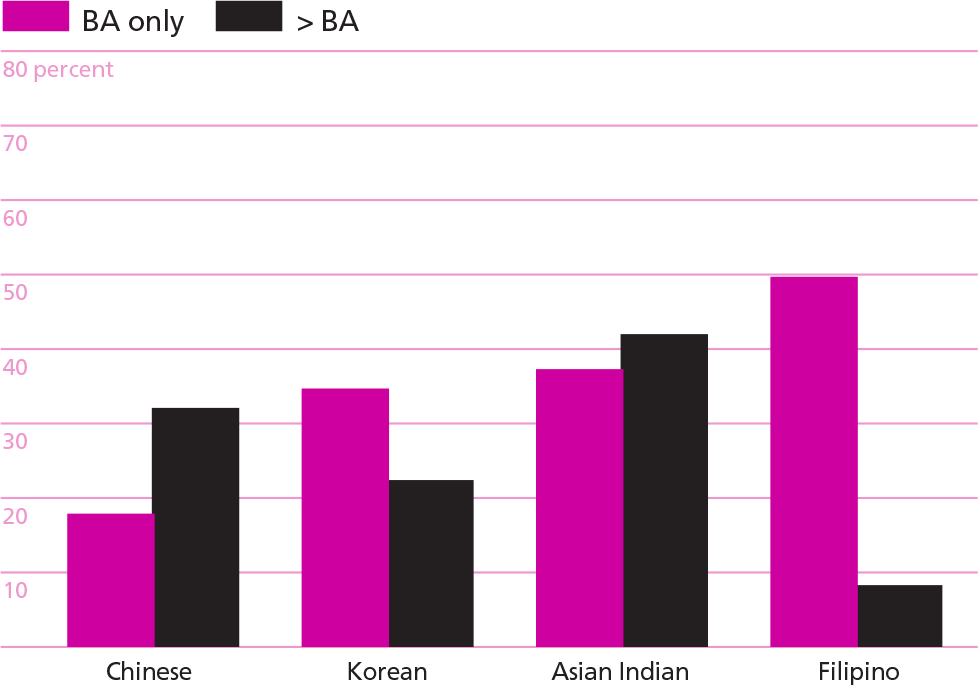
Educational attainment of Asian imigrants from hyper-selected groups, by ethnicity
Source: ACS 5-year estimates (2012-2016]
Having earned at least a bachelor’s degree served as the educational attainment outcome variable. Analysis included adults ages 25-65. Individuals who arrived in the U.S. at the age of 25 or older constituted the foreign-born groups. To qualify for each foreign-born group, respondents needed to identify mono-ethnically and have been born in the nation corresponding to that ethnicity (e.g., Filipinos born in the Philippines). The Chinese group was an exception; individuals who identified as Chinese, Taiwanese, or Chinese and Taiwanese and were born in China composed the Chinese population analyzed here.
Starting further from third base than other hyper-selected Asian Americans
In a 2014 online Slate article, author Mitch Moxley explains Jennifer Lee’s perspective on why Asian Americans “tend to end up on the third base of life”: “[T]heir parents are so highly educated, they start the race to get ahead on third base…[T] hey have certain advantages that other groups don’t have.”
Many Asian immigrants, in fact, are highly educated but, that does not mean their level of education is the same across groups. This is apparent when examining post-B.A. attainment among large hyper-selected Asian populations. Filipino immigrants exhibit a lower level of hyper-selectivity, a key factor in explaining their second generation children’s educational outcomes. As the figure above on the right shows, Filipino immigrants, by far, have the lowest rate of earning beyond a B.A. They are the least likely among hyper-selected Asian immigrants to be very highly educated, that is, to have earned more than a B.A.—about 8 percent of Filipino immigrants, compared to almost a quarter of Korean immigrants, a third of Chinese immigrants, and 42 percent of Asian Indian immigrants.
A 2017 Migration Policy Institute report indicated that Filipinos constituted the largest proportion of foreign-born nurses—30 percent—practicing nursing in the U.S., which requires, at minimum, an associate’s degree.
Bongbong Marcos
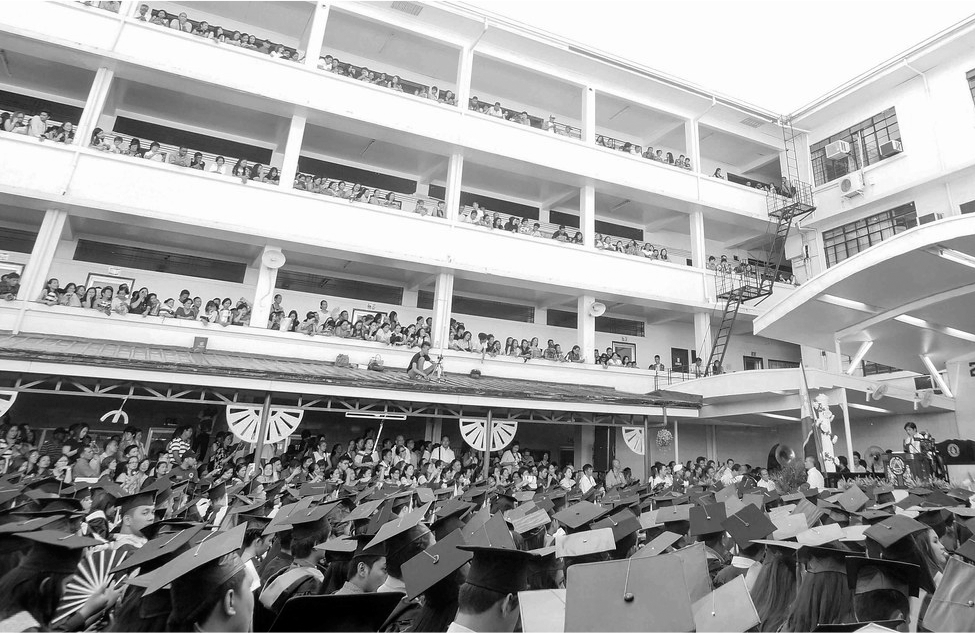
Filipino immigrants’ labor market incorporation reflects Filipinos’ lower hyper-selectivity vis-à-vis other large Asian groups. A census-based study conducted by sociologists Pyong Gap Min and Sou Hyun Jang revealed that Filipino immigrants are the least likely among all Asian immigrant groups to be in STEM occupations, which typically pay relatively high salaries. (The Bureau of Labor Statistics, for example, reported that in 2018 the average annual salary of a computer systems analyst was almost $90,000.) In contrast, Filipino immigrants, women in particular, were more likely to be nurses than other Asian immigrants. A 2017 Migration Policy Institute report indicated that Filipinos constituted the largest proportion of foreign-born nurses—30 percent—practicing nursing in the U.S., which requires, at minimum, an associate’s degree. Nursing is the most visible and prominent occupational niche for Filipino immigrants in the U.S. and one with a lower salary compared to that of IT technicians and physicians. For example, the Bureau of Labor Statistics indicated that the median salary for a nurse in 2018 was $71,000.
Another niche that reflects Filipino immigrants’ lower hyper-selectivity is the U.S. Armed Services. In 2018, Filipinos, along with Mexicans, made up the largest share of foreign-born veterans, each comprising 17 percent of the foreign-born total. Filipinos in their home society have historically joined the U.S. Navy in large numbers since the U.S. occupation of the Philippines at the turn of the 20th century. Filipino colonial subjects in the Philippines saw enlisting as an opportunity to “move up,” as it afforded relatively high pay and a chance to gain U.S. citizenship. With no college requirement, joining the navy was an easy route to upward mobility in the Philippines.
In summary, Filipino immigrants are far more likely than Chinese, Asian Indian, and Korean immigrants to have earned a bachelor’s degree and not gone beyond that. Their particular type of hyper-selectivity, to put it another way, has brought in highly educated immigrants but not the same high proportions of very highly educated immigrants as in the other large Asian groups.
Encouraged to Stay on Second
The Asian parents depicted in Lee and Zhou’s work expect their children to get to third base—to complete at least graduate school and to land a high-status job. The Filipino parents I met, however, want their children to stay on second: to get at least a college degree—a bachelor’s is preferred, but an associate’s is just fine—and to become a mid-level health care professional like themselves.
Family values involved in notions of success, I suggest, go a long way toward explaining these different aspirations for children. Unlike East Asians, Filipino Americans view academic performance as separate from, and sometimes at odds with, family expectations. Filipino parents I spoke with believed that to be successful one must have a family, that is, marry and have children. Albert Sabangan (a pseudonym, like other names used) explained that success for his sons would include them “having their own families.” Having children, in particular, was an important goal that Filipino parents had for their children. Priscilla Cagalawan, a nurse, felt strongly about this, believing that to decide to not have children is a “selfish choice.”
Keeping your family together is one form of success. If you can’t keep them together, it’s a failure. There is a stigma. Family togetherness is important. If one limb is gone, you’re not whole.
Filipino immigrant parents’ frame of success also involved keeping family together. Thus, a central goal that Filipino parents had for their children was not just having families of their own but also maintaining family relations by spending ample quality time with their spouses and children. Daily rituals such as hanging out with siblings after school and eating dinner with the family were important ways parents and their children maintained emotional ties with one another, as well as physical closeness. Children were expected to sacrifice certain extracurricular activities, like skipping basketball practice, to attend family gatherings and to choose a college close to home even if this meant opting out of attending a more prestigious university further away.
Filipino immigrants encouraged their children to go into occupations in Filipino niches to accomplish these family goals. Nursing, especially, was seen by parents as the ideal occupation to pursue. Given its decent salary, good health care benefits, retirement pensions, and flexible work hours, becoming a nurse meant that their children would later be able to provide stability and security for their future families, as well as carve out the time needed to maintain family ties. The medical profession that East Asian parents desire for their children—a physician—is an unattractive one for Filipino parents. In their view, it requires too many years of schooling that would most likely require a delay in having children and long work hours that would take time away from the family.
Some Filipino parents considered the military as another good option for their children. Joining the military meant their children’s college would be paid for and a variety of career opportunities would open up for them. One parent, Lydia Santos, a nurse whose husband and grandfathers— from both sides—are U.S. Navy veterans, encouraged both her daughter and son to join the military. She told her children, “You can go into research. You can teach. You can be a clinical instructor.” In fact, second generation Filipino Americans are more likely to have served in the military than the second generation in any other Asian American group as well as native whites. My analysis of the Add Health survey found that second generation Filipino Americans reported the highest rate of participation in the military—8.4 percent—compared to 4 percent of second generation non-Filipino Asians and 7 percent of native whites.
Filipinos get no special treatment that could pull them in the opposite direction, towards second base and not third.
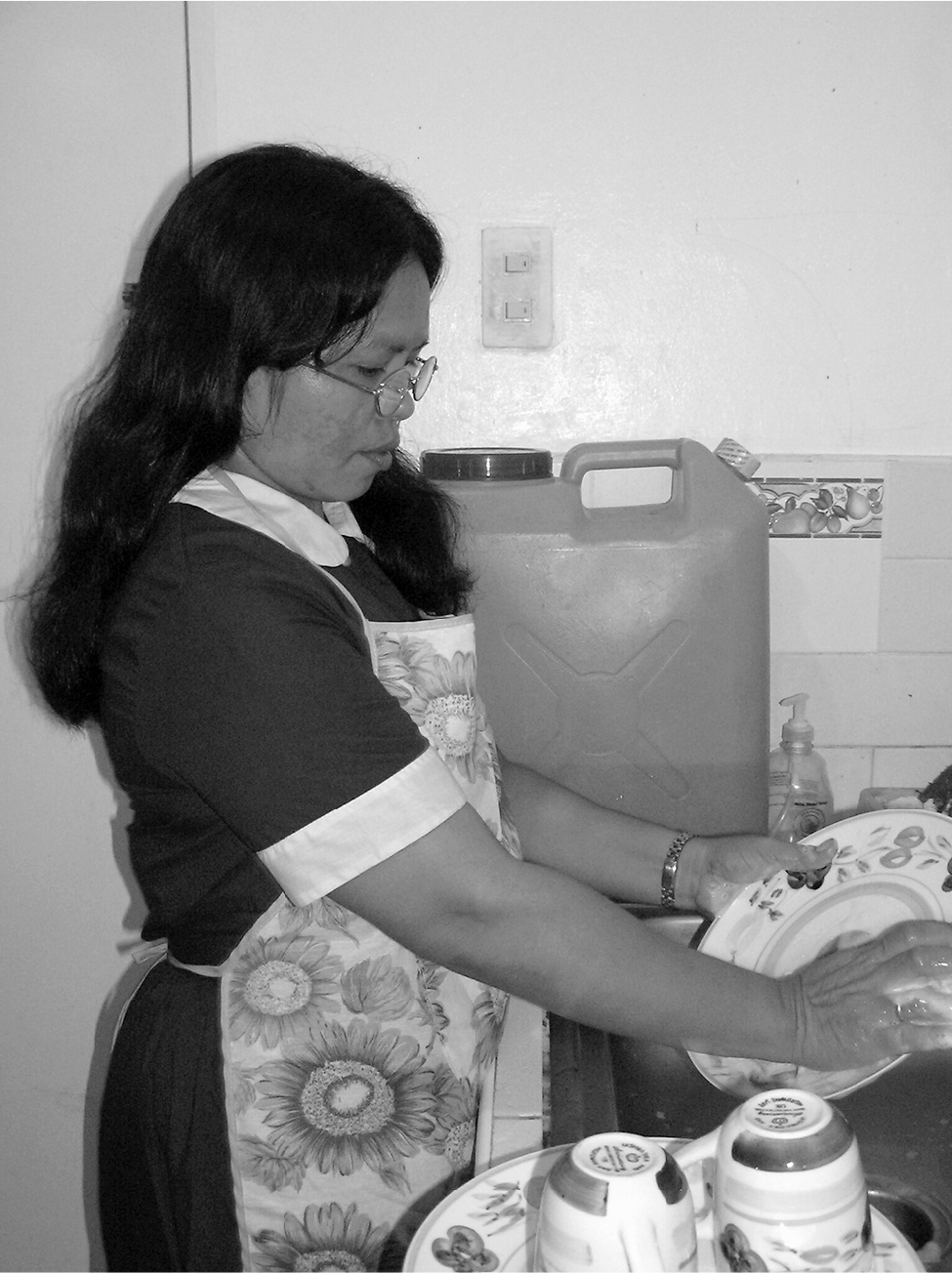
Why are the family goals I have described so important to Filipino parents? The emphasis on family togetherness in particular has to do with the interaction between Filipinos’ religious beliefs and the global context in which so many Filipino families operate today. Filipinos are largely Catholic, and their religion strongly encourages and supports beliefs in marriage, having children, and keeping the family together (as opposed to separation through divorce, for example). However, keeping the family together has become increasingly difficult for Filipinos in the Philippines due to its labor export economy. The Philippine government promotes and supports the outmigration of its citizens. Overseas workers are a large basis of the Filipino economy, as workers send remittances back home to their families. As millions of Filipinos, primarily women, have left the Philippines to work in places like Saudi Arabia and the United States, families are separated, fragmenting both emotional and physical ties among parents, children, and spouses. So, while Filipinos value family reproduction—having children—and family togetherness, the need to work abroad and the mass outmigration of Filipinos make it increasingly difficult to accomplish these goals. The common context of the Filipino transnational family has made having a family and keeping it together even more important for Filipino migrants. Priscilla, mentioned earlier, put it this way: “Keeping your family together is one form of success. If you can’t keep them together, it’s a failure. There is a stigma. Family togetherness is important. If one limb is gone, you’re not whole.”
Overseas workers are a large basis of the Filipino economy, as workers send remittances back home to their families.
ILO Asia-Pacific
Expected to Stay on Second Base
In my study, I found that Filipino students are often not identified as Asian and consequently not as a model minority. In U.S. society, being Asian tends to be synonymous with East Asian. Filipinos contradict the common image of Asians, both phenotypically and culturally. One major difference from East Asians is their darker skin color. Also, Filipinos are culturally different from East Asians due in large part to their Catholic religion and Spanish and U.S. colonial histories. In a study conducted by Anthony Ocampo, Spanish surnames and Filipino immigrants’ fluency in English were cited by Filipino college students as major distinctions between themselves and East Asians.
Filipinos’ phenotypical and cultural differences from East Asians play out in their ethnic and racial experiences in school. When Filipinos are identified as Filipinos in school, they are seen by their peers as being less intelligent, less ambitious, and less motivated than their East Asian counterparts. For example, Cesar Enriquez recalled that when he was in high school, Filipinos were considered only “kind of smart” by his classmates compared to Korean students. The belief that Filipinos were not as smart as East Asians came out in a story shared with me by Jennifer Castillo, a student at one of New York City’s elite public high schools. After getting exams back in their honors math class, Jennifer and her classmate discussed their scores. Jennifer explained, “I got a 70 and she got a 80. My classmate was complaining so I tried to comfort her by saying that I got an even worse grade. She said to me, ‘You don’t have to worry about that because you’re Filipino.’“
When peers could not ethnically identify Filipinos as Filipinos, they often identified them as Latino. Filipinos’ darker skin color and Spanish surnames were two things that led to this misidentification. As Joan Calderon noted, “Filipinos and Latinos basically look the same since we’re pretty much old Spanish blood.” Another student, Janelle Lopez, indicated a time when someone thought she was Dominican because she was “really tan.”
Not being readily identified as Asian suggests that Filipinos are not getting the advantages of being seen as model minorities, including the psychological boost of being seen as smart and high achieving that East Asians get. In addition, none of the Filipino students I met said that they were treated by teachers as a model minority. This may be the case because outsiders often mistake Filipinos as Latinos. Being misidentified as Latino by teachers may mean that teachers are not offering Filipino students the extra information about college or funneling them into AP and honors classes as they are doing with East Asian students. Thus, while East Asians receive tangible resources and a psychological push in school to reach their goal of getting to third base, Filipinos get no special treatment that could pull them in the opposite direction, towards second base and not third.
Conclusion
In the end, the analysis of why Filipino Americans are less likely than those in other large hyper-selected Asian groups to get to third base sheds light on the factors that shape Filipino Americans’ trajectories. It also demonstrates the need to avoid treating Asians as a homogenous group and to be sensitive to the heterogeneity of Asian American experiences. All too often, scholars overlook the disparities and the diversity among Asians and, as a result, reproduce the idea of a homogenized Asian racial group when, in fact, there are significant socioeconomic, historical, racial, and cultural differences among Asians.
In sum, the case of Filipinos has lessons not only for understanding trajectories of Filipino Americans themselves but also our understanding of the broader Asian American experience and U.S. ethnic and racial stratification today.
Note: ACS data used in the above analyses can be accessed at ipums.org.