



Abstract
The private food assistance network has expanded amidst a receding welfare state, signaling the privatization of food assistance and other social services. Simultaneously, the cultural association of poverty with morality characterizes some individuals as more “deserving” of assistance than others. As people seek social services, they must navigate programs embedded with these ideas of deservingness. I use data from 21 in-depth, semi-structured interviews with food bank clients and over 225 hours of participant observation at a California food bank and its partner agencies to examine how clients experience barriers to accessing private food assistance. I find that nonprofit program structures are designed to serve an unencumbered client, yet even populations characterized as “deserving” do not meet the characteristics of the unencumbered client. This nearly unattainable status of unencumbered client contributes to inequity emerging from the structural level that manifests as individuals try to access and use private food assistance. These structural barriers manifest in four ways at the food bank: material resources, nonprofit infrastructure and coordination, communication channels, and policing. Based on these findings, organizational practices of nonprofits are of key importance when considering the reproduction of inequality in society.
During the COVID-19 pandemic, public and private financial support for food banks has sharply increased (Spring, Garthwaite, and Fisher 2022). Since the 1970s, food banks have institutionalized, expanding in scale and scope, while government welfare and cash assistance have been cut (Daponte and Bade 2006; Spring et al. 2022). As key hubs in the U.S. private food assistance network, food banks are private, nonprofit organizations that source food from grocery stores, farms, the government, and private citizens. They then redistribute the food to other nonprofit organizations. Food banks were not designed to meet the needs of everyone experiencing food insecurity (Fisher 2017; Poppendieck 1998). Even with federal and private food assistance programs, 11.8% of U.S. households were food insecure at the time of this study in 2017, and some populations face higher food insecurity rates (Coleman-Jensen et al. 2018).
The U.S. government is increasingly outsourcing social service provision, channeling its resources into nonprofits (Lohnes 2021; Smith and Lipsky 2009). Historically, social services structures that allow for privatization and discretion have been used to inequitably support citizens along racial lines, disadvantaging people of color (Clemens 2017; Nadasen 2016). Both public and private social service provisions are rife with geographic inequalities in access to services, affecting areas based on their urbanicity and racial composition (Allard 2009; Kelly and Lobao 2021). Despite the private food assistance network’s expansion, the network is not sufficient, accessible, dignified, equitable, efficient, effective, or validating of food as a right (McIntyre et al. 2016; Poppendieck 1998).
Inequitable practices and interactions persist in food assistance programs, as the staff, volunteers, and funders of food banks generally occupy different classed, racialized, and gendered positions than food bank clients (Poppendieck 1998; de Souza 2019; Wakefield et al. 2012). These differences influence which organizations receive funding and practices designed to prevent clients from “ripping off” programs (Bolger 2022; Poppendieck 1998; de Souza 2019; Wakefield et al. 2012:439). Clients’ self-proclaimed needs differ from what program operators believe clients need (Dachner et al. 2009; Hamelin, Mercier, and Bédard 2008). Racialized “neoliberal stigma” in private food assistance emphasizes “individualism, hard work, and personal responsibility” as traits of deserving clients (de Souza 2019:3). Nutrition-focused programs target particular ethnic groups as a form of biopolitical governance (Carney 2015). Barriers to accessing services can be a mechanism of social control “to shame those in need” and deter “undeserving” people (Bolger 2022; Edin and Shaefer 2015:173).
Prior research has identified some programmatic barriers to accessing food assistance—transportation, scheduling, availability of information, frequency of programming, constrained food choices, wheelchair accessibility, identification requirements, and the quality, variety, and amount of food offered (Kissane 2003; Tsang, Holt, and Azevedo 2011). Subjective, cultural understandings also create barriers as food insecure individuals think programs are for others—people needier than themselves or different racial groups (Fong, Wright, and Wimer 2016; Kissane 2003). I find many of these same barriers in my research, suggesting their prevalence throughout private food assistance.
Bringing in organizational and workplace theories (Acker 2006, 2009; Ray 2019; Wooten and Couloute 2017), I theorize how organizations have embedded regimes that lead to programming being designed to serve an idealized, unencumbered client that sometimes contradicts conceptions of deservingness. The unencumbered client has access to ample resources (time, transportation, information, kitchen, etc.) to help them access and best use services while also not experiencing hardships or additional needs (homelessness, lack of transportation, disabilities and health issues, etc.) that lead to barriers accessing and using services. I explore how the ideal of the unencumbered client creates entrenched barriers for people who do not live up to the many expectations put onto those in need of assistance.
I draw on interviews and ethnographic research of a private food bank and its partner agencies to gain a better understanding of their food distribution programs and access barriers created by the structures of these programs. I primarily interviewed people experiencing homelessness while observations reflect the broader client population of predominantly housed people, providing context for how housing shapes the barriers clients experience. Two key research questions motivate this study: (1) What barriers do food insecure people face in accessing private food assistance in relation to other experiences of hardship? (2) How are these barriers tied to organizational practices and program structures? I argue discrepancies between actual nonprofit clients and the ideal of the unencumbered client lead to barriers as clients navigate programs that do not accommodate their circumstances.
Theoretical Framework: The “Deserving” Poor and the Unencumbered Client
Nonprofit organizations increasingly look more similar to organizations in both government and business sectors, blurring the lines between what were once distinct social structures (Bromley and Meyer 2017). More attention is needed to how these changing organizational structures impact people accessing nonprofit services. Building on Katz’ (2013) conception of the “deserving” poor in social welfare policy and Acker’s (2006, 2009) conception of the “unencumbered worker” in the business sector, I identify barriers to accessing nonprofit resources, particularly for people facing increased material hardship.
Social policies and programs are imbued with moral meanings that further stratify people (Brady, Finnigan, and Hübgen 2017; Katz 2013; Zelizer 1997). U.S. society has defined poverty as a moral condition since the early 19th century, leading to debates about who is “deserving” or “undeserving” of assistance (Katz 2013). These moral suppositions have been codified into assistance programs whose structures differentiate along these moral lines (Katz 2013; Zelizer 1997). Social welfare policies in the U.S. exact higher penalties on groups moralized to be “undeserving,” leading these groups to experience higher rates of poverty (Brady et al. 2017). Current public and private food assistance are largely tied to notions of “deservingness” built on personal responsibility and work (Dickinson 2019; Hays 2003; Katz 2013; de Souza 2019).
Organizational practices reflect the inequitable distribution of power within the organizational field itself. Coercive, inequitable interactions between organizations lead to more inequitable interactions between organizations and individuals (Wooten and Couloute 2017). U.S. nonprofits, including food banks, are in an especially susceptible position as they bend to the desires of powerful donors to attract resources (Bouek 2018). As charitable nonprofits are treated like corporations, they are often pressured to narrow their mission and focus on serving those considered “deserving” of assistance (Bouek 2018; Edin and Shaefer 2015; Katz 2013). This creates additional barriers for those in need and further cements the characteristics of who a food bank’s clients should be, although these clients may still face barriers to accessing assistance.
Acker (2009) uses an intersectional approach to argue that the workplace is organized around an unencumbered worker—typically a man who can work around the clock with no domestic or childcare obligations. The ideal of the unencumbered worker is one manifestation of an inequality regime, or “loosely interrelated practices, processes, actions, and meanings that result in and maintain class, gender, and racial inequalities within particular organizations” (Acker 2006:443). The enormous magnitude of organizations’ control over resources amplifies the impact of inequality regimes (Ray 2019; Tomaskovic-Devey and Avent-Holt 2019).
In this paper, I extend Acker’s concept of the unencumbered worker from the role of the employee to the social services client, developing the concept of the “unencumbered client”—an individual who has access to resources like ample free time, a kitchen, the internet, a phone, a car, and other resources that meet most of their food needs. Furthermore, the unencumbered client does not have a large household, have dietary restrictions (due to health, preference, or religion), belong to a community that has disproportionately experienced police violence, nor live with mental or physical health disabilities or chronic illnesses. Like Acker’s conception of the unencumbered worker, the ideal of the unencumbered client reflects inequality regimes and is embedded in specific racial, gendered, and classed frameworks.
Many of the notions of the unencumbered client match onto assumed cultural patterns of Acker’s unencumbered worker, which occupies a particular classed, racial, and gendered position of a middle-class, white, man. The notion of the unencumbered client importantly deviates from cultural notions of deservingness expecting individuals to be unattached, like the unencumbered worker. Although the working poor, families with children, and people with disabilities are all culturally considered “deserving,” these aspects of deservingness create external time demands and additional needs that lead to barriers as these individuals interact with nonprofit organizations.
People seeking food assistance must simultaneously confront both the morally imbued notion of the “deserving” poor combined with the ideal of the unencumbered client as they seek to obtain food. Therefore, the system is simultaneously targeting clients based on their “deservingness” while also contradictorily expecting them to be unencumbered. In this paper, I examine the barriers that individuals face, particularly people experiencing homelessness, as they seek to interact with a nonprofit system that is not designed to accommodate people with varied needs.
The Case
District Food Bank (DFB) is in a peri-urban area of California and serves a mid-sized county (population of 100,000–500,000). The food bank’s annual revenue is close to the median for California food banks. District Food Bank is a partner distribution organization of the Feeding America national food bank network, which provides DFB with a designated service area and access to exclusive donation contracts with large corporations.
Food banks redistribute food to other organizations, while food pantries solely distribute food to individuals and households. However, some food banks, including DFB, distribute food directly to both individuals and organizations, which is a trend that has increased amongst food banks during the COVID-19 pandemic (De Faria 2021). District Food Bank directly oversees the distribution of around 90% of the food in its service area, while about 10% of distribution is overseen by partner agencies. As part of DFB’s mission to “end hunger,” DFB collects food and then distributes it to other nonprofit organizations serving people in need. District Food Bank also distributes food directly through federal government programs, such as The Emergency Food Assistance Program (TEFAP), and DFB’s own specialized programs (see Figure 1). Organizational chart of District Food Bank (DFB).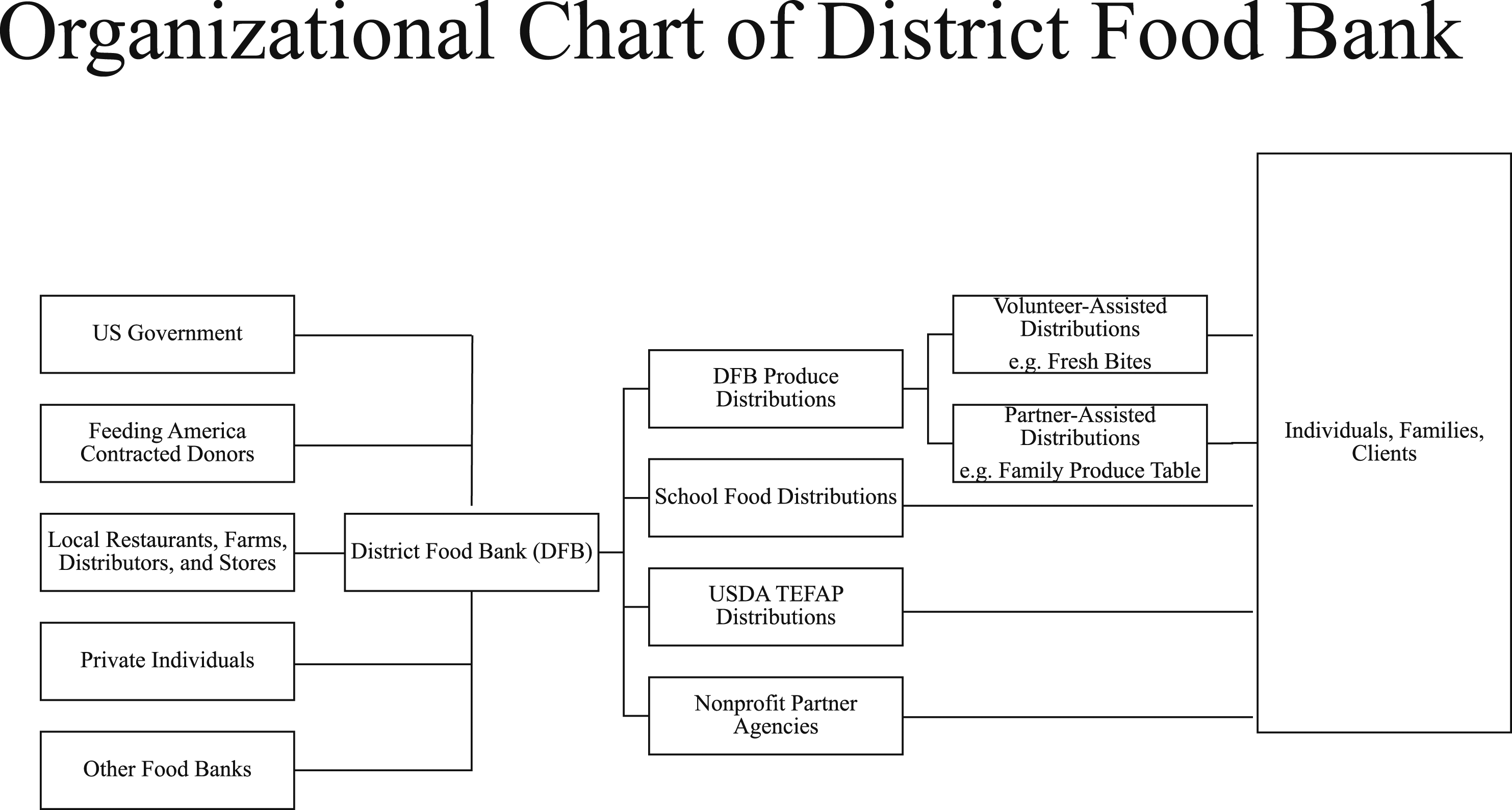
Ultimately, I focused observations on two of DFB’s weekly produce-focused distributions in the same town—a partner agency-assisted distribution and a volunteer-assisted distribution (see Figure 1). District Food Bank supplied the food for these programs and created the rules regarding eligibility and the types of food provided. A partner agency and volunteers directly managed the programs rather than DFB.
The partner agency-assisted program, which I call Family Produce Table, took place at a family-centered nonprofit organization. District Food Bank provided the food and suggested how many of each food-item to provide to clients. The partner agency coordinated the program operations, including the rules, scheduling, and staffing. Most of the partner agency staff at Family Produce Table were bilingual, with representation from several of the most common ethnic groups that attended the distribution. The group included both men and women, mostly under 40.
The volunteer-assisted program, which I call Fresh Bites, occurred at a local government building and DFB volunteers were in charge. A lead volunteer was responsible for organizing and overseeing the food distribution program, and DFB provided the food resources and assisted with volunteer recruitment. The volunteers at Fresh Bites were mostly white women who were monolingual English speakers, and many volunteers were also retired.
At both distributions, most of the clients did not predominantly speak English. Most clients were Eastern European immigrants or Latinx, while Black, Asian, Indigenous, and non-immigrant, white populations were in the minority. People experiencing homelessness were only a small portion of the programs’ clients. Both programs regularly had around 100 clients each week, although this fluctuated.
Methods
In 2017, I began collaborating with DFB, who sought information on reducing barriers to accessing their programs, specifically for people experiencing homelessness. Over approximately a year and a half, I explored structural barriers to food assistance offered by DFB and its partner agencies. I participated as a volunteer at five different food distribution programs (and observed an additional one), through which I recruited and interviewed 21 food assistance clients.
I draw on over 225 hours of participant observation that I conducted while attending 86 food assistance distributions. Most observations occurred at the Fresh Bites and Family Produce Table distributions. Typically, I would be present for about 2.5 hours for set-up, food dissemination, and cleanup of each distribution. While volunteering, I often had informal conversations and interviews with the staff, volunteers, and clients around me. I learned the formal rules and unofficial practices at the distributions and was able to observe how staff and volunteers responded to situations that did not conform to the rules. I also saw the responses to my own following, bending, and modification of the rules. I took field notes throughout the observations, focusing on program rules, practices, and barriers to accessing food assistance.
I also conducted 21 semi-structured interviews with clients of food assistance programs, most lasting 45 minutes to two hours. Interviews took place either at a public location or a commercial location of the respondent’s choosing. Initially, I recruited respondents who were currently experiencing or had recently experienced homelessness to focus on DFB’s interest in the barriers that specifically affected people experiencing homelessness. Respondents were considered to be experiencing homelessness if they self-identified during interview screening as experiencing homelessness or responded that they lacked permanent housing in the past 6 months, including people living on the streets; in a shelter, vehicle, or motel; and those who were “doubled up” or “couch surfing.” While 15 of the 21 respondents were experiencing homelessness, most of the clients of the food distribution programs I observed were housed.
I recruited respondents at food distributions and through referrals using purposive sampling, where I recruited based on their apparent and declared race, gender, and housing status, in order to ensure that I had a variety of perspectives and possible combinations of these variables that might affect barriers to using food assistance programs (Esterberg 2001). Since this was a public scholarship project, housing status was a central component of the study due to the desires of DFB. Other volunteers, staff, clients, and respondents who knew about my research also sometimes referred me to people experiencing homelessness. I asked the respondents about their experience using food assistance, the programs they had used, and details about their experiences with these programs. I contextualized these experiences with questions about material hardships and demographic characteristics.
Together, these methods provide a detailed account of how clients experience barriers to accessing food assistance based on the organizational structure of the food assistance programs. I analyzed the field notes and interview transcripts by iteratively coding them and pulling out themes in MAXQDA qualitative data analysis software, using an abductive approach (Timmermans and Tavory 2012). The quotations below are pulled from interview transcripts and fieldnotes.
People experiencing food insecurity and homelessness are in a particularly vulnerable position, and I took care to protect the rights of those who participated in the research. IRB approved the study, and I obtained informed consent before every interview. Respondents were not compensated, but I did offer to buy their meal before the interview. They were informed that they were still not obligated to participate after receiving the meal. While observing, I frequently mentioned my role as a university researcher working with DFB to identify barriers to accessing food assistance, although I could not feasibly tell every person who came through the food distributions. I gave the food bank and all participants pseudonyms to protect the confidentiality of the organization and participants.
By observing how people experienced barriers over the course of the research period, I was able to concentrate on structural barriers because the interpersonal barriers changed along with major staff and volunteer turnover. The combination of high staff and volunteer turnover during the research period provided a unique opportunity to focus on the durability of the structural barriers throughout personnel transition. Below, I outline four structural barriers to accessing food assistance that persisted throughout this period of transition.
Results
As the security guard unlocks the door of the local government building for the day, I approach a line of about 50 people with empty grocery bags and handcarts standing in a line under a sign that reads “PROBATION,” waiting for the Fresh Bites distribution to start. They all shuffle to mark their place in line so that the Fresh Bites volunteer who hands out laminated numbers will not give their spot in line to someone else. After she hands out numbers, the clients disperse with numbers in hand until the distribution starts. Most clients already waiting in line regularly attend the distribution and have learned to arrive early for the best selection of food.
Scott, a white man experiencing homelessness, offers me a friendly greeting despite having camped out all night for his place in line. After receiving his number to signify his place in line, Scott goes to look for work on a public computer in the same building, as he tries to work any odd job that he can find to make ends meet. Over an hour later when the distribution starts, the line has grown to about 100 people. As Scott goes through the line, he is constrained by a whole host of restrictions. He cannot store many perishable food-items without a refrigerator, especially in the hot summer. Therefore, he mostly only takes the food-items that he will eat that day from the produce-focused Fresh Bites program. He tells me that he wishes that he had a kitchen to make vegetable soups and other healthy, home-cooked meals, especially since he is an insulin-dependent diabetic and needs to watch his sugar intake. Instead, he leaves the distribution with a few random food-items, including bread and pastries.
Yvonne, an African American woman whom I met through her regular attendance, also attends the Fresh Bites distribution, updating me on how her family is doing. She is the main caretaker for three older adult relatives, and she frequently babysits her grandchildren as well. Caring for her large family limits her time availability and means she has more mouths to feed. Like Scott and millions of other people in the U.S., Yvonne is also diabetic. Yvonne does not receive SNAP, so she is dependent on private food assistance. I will see her later that week at the Family Produce Table. Yvonne explained to me that variation and scarcity of food are key reasons to arrive so early. She has learned to manage the inconsistency and make ends meet, frequently attending two food distributions a week. Unlike Scott, Yvonne can use her kitchen to prepare and store the food she receives. She explained, “I make soups, and whatever I get, I just find a way to use it.” She says that by attending both Fresh Bites and the Family Produce Table weekly she gets enough supplemental food to meet her needs. However, about half of respondents were not so lucky, and they said the available food distributions were not sufficient to meet their needs.
Neither Scott nor Yvonne can live up to the ideal of the unencumbered client, which shapes the food assistance they are able to access. While both managed to attend the distributions, their circumstances and resources shaped how much food they could take and consume. Building on previous research, I identify four dimensions along which structural barriers that reflected the ideals of the unencumbered client were embedded into the food assistance programs provided by DFB and its partner agencies: material resources, nonprofit infrastructure and coordination, communication channels, and policing. I found these barriers were exacerbated when clients did not conform to implicit expectations of the unencumbered client. These barriers were particularly cumbersome for people experiencing homelessness, who also had some of the greatest need for food assistance. Like Scott and Yvonne, no respondents fit the mold of the unencumbered client.
Material Resources: Food Scarcity and Inconsistency
Typical Distributions. Table 1 Shows the Median Number of Different Types of Food Offered at Both Fresh Bites and Family Produce Table to Each Eligible Person.
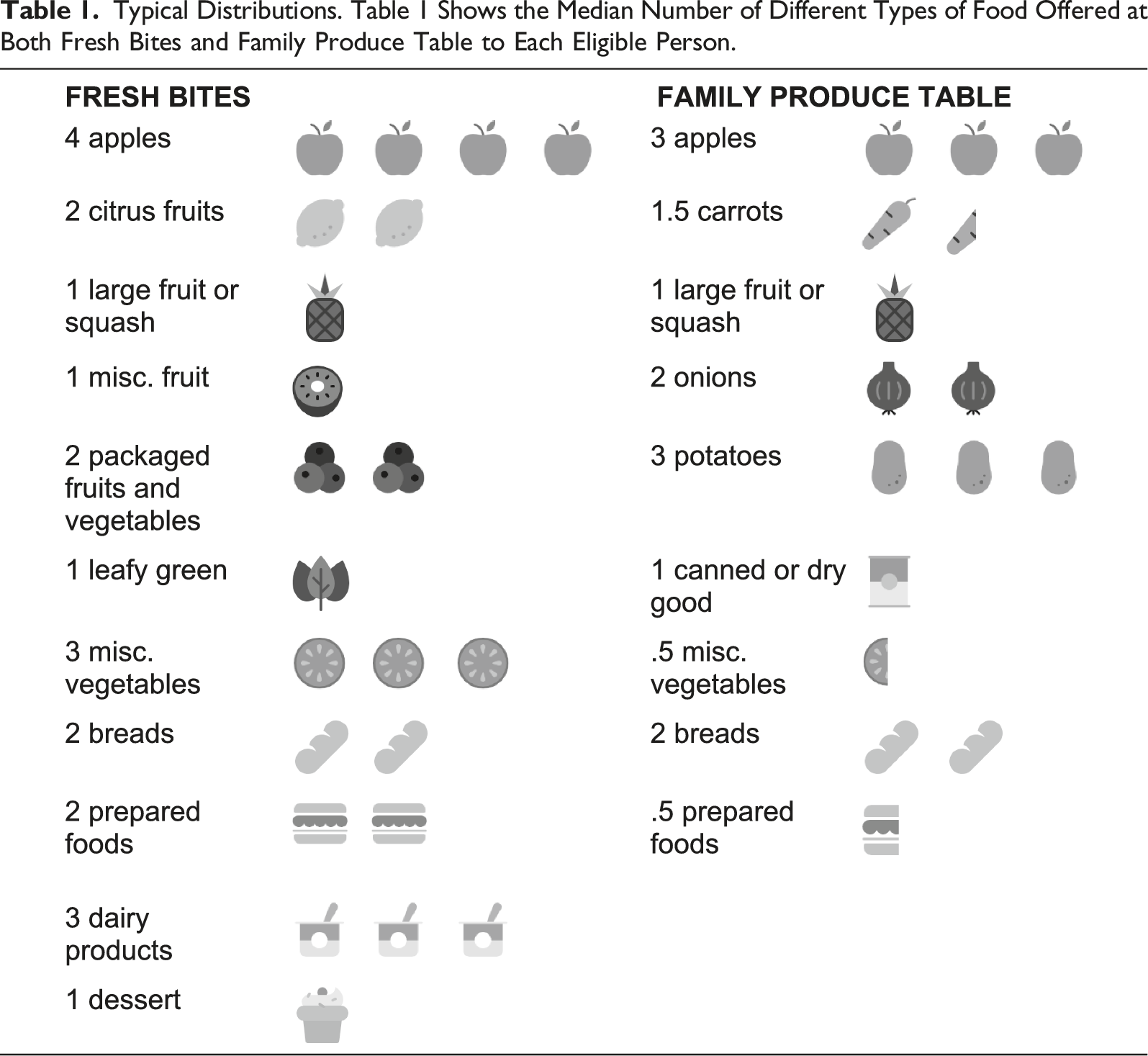
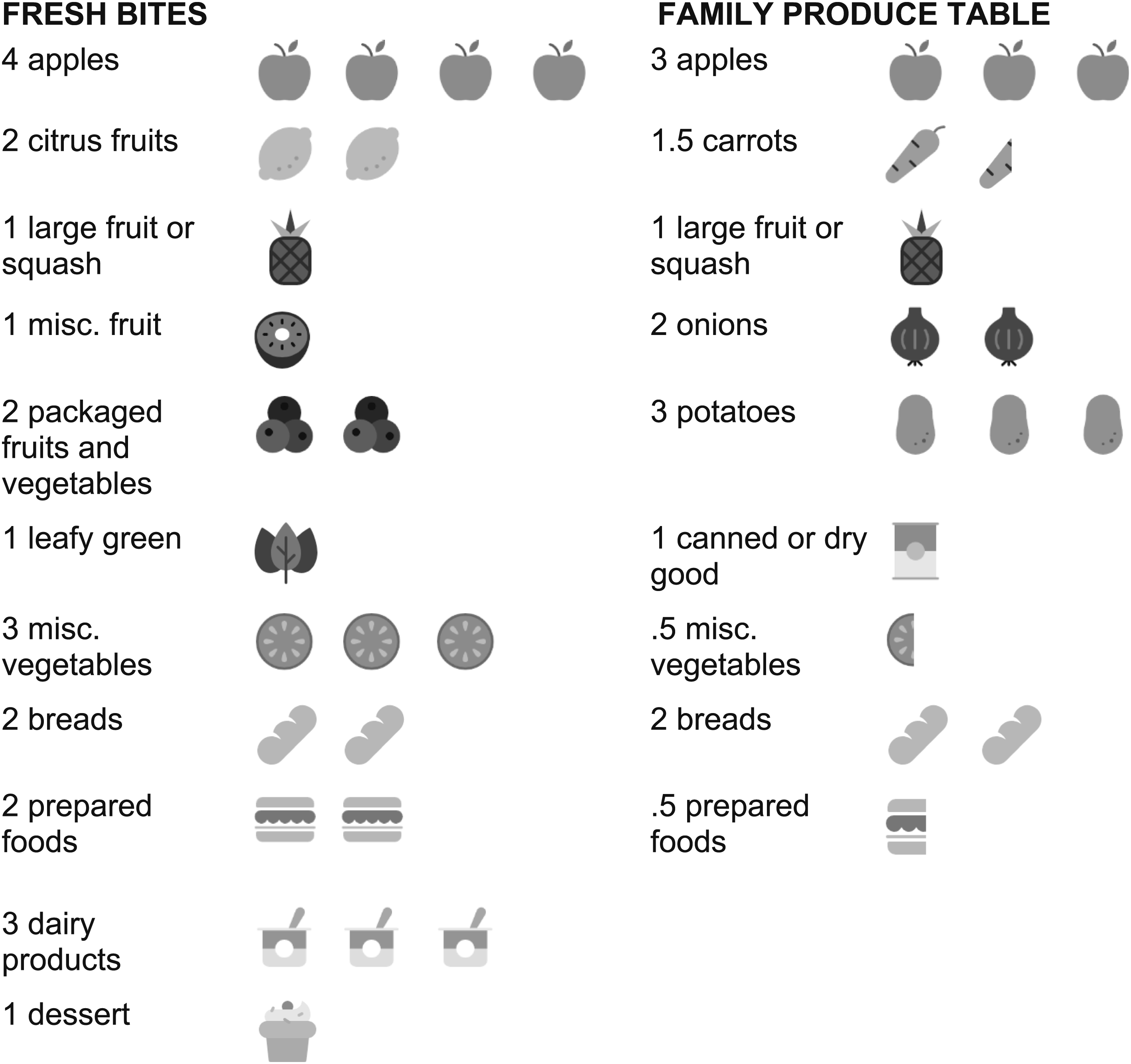
Each week, DFB sent a list to Family Produce Table with how many of each item of presorted food they expected clients should receive at the distribution. The partner agency staff generally followed these guidelines but would adjust the amounts based on the number of people who had registered before the distribution started. For the Fresh Bites program, food arrived unsorted, so volunteers would sort the food into categories and remove spoiled food. The lead volunteer would then determine how much each client could have from each category. At both distributions, the amounts of food offered would be adjusted throughout the distribution to make the food last throughout the whole distribution while also giving away all the food. While scarcity was a recurring theme, large variations in food also influenced whether the programs were able to meet clients’ needs. Some weeks clients received no bread while at other times bread was so abundant that clients could take up to 12 bread-items, if they could use, store, and carry them.
Both scarcity and inconsistency influenced the official rules of the DFB programs and the institutionalized practices of staff, volunteers, and clients. Below, I identify how these material constraints were embedded into the institutionalized rules and practices and how these structural reflections of scarcity created additional barriers for already disadvantaged groups who did not fit the mold of the unencumbered client.
Formal rules at Family Produce Table
The distribution rules perpetuated both scarcity and variability, which exacerbated existent inequities in clients’ access to resources. The partner agency staff at Family Produce Table rigidly followed the rules, so the staff’s preferences seemed to have little bias on the food that clients received. However, the rigidly applied rules combined with the scarcity of many food-items meant that the staff often did not meet the specific, varied food needs of clients. While the partner agency staff knew the specifics of many of the clients’ housing and family situations, they did not modify program rules to meet the specific needs of their clients. During the study period, the staff at Family Produce Table did allow participants in one of their educational programs (for mothers of young children) to access the distribution early. However, this opportunity was only extended to mothers of young children who were eligible to participate in the class—a population typically considered “deserving.”
Yvonne described a shift in the partner agency’s policy, telling me about her experience of rule rigidity when she had to take her brother to regular chemotherapy treatments: “I can remember the time where the [Family Produce Table] staff would stack groceries for people who couldn’t come and get it during the regular hours… When I asked [Luis] if they could put the food in a bag for me because I absolutely couldn’t come during that time, he said that people took advantage of the program, and they don’t do that anymore... So, I would just take my brother and take my chances, and sometimes at the beginning when I was first taking him, sometimes I didn’t get any food.”
Clients experiencing homelessness also experienced rule rigidity, being offered the same types and amounts of food as everyone else. When I asked what would make getting food easier, Nicole told me, “A lot of us [experiencing homelessness] can’t cook. So instead of providing [us] with like frozen food or like rice and stuff that you have to cook, [they] could either open up like a kitchen or something where [they] can cook it for us or give us the option… because a lot of us have trouble carrying things, so it’s where it’s not as large but we can still make it through the week.”
If clients could not use a food-item because they did not have a kitchen, they simply received less food. Similarly, clients with health issues that restricted their diets often ended up with less food. Paul, who lived in a motel with his wife, described how both of their health issues impacted which food they could take, “I got diet restrictions myself, so I can’t have too much salt. She can’t have too much salt, and also there’s a lot of things that she can have that I can’t have, lots of things that I can have that she can’t have.”
At Family Produce Table, the institutionalized practice of rule rigidity amplified the barriers that people faced, reinforcing inequity as they sought to access private food assistance. By treating all clients equally without recognizing the varied hardships already faced by their clients, the Family Produce Table’s organizational structure was least accessible to people facing the worst hardships, who diverged from the expectations of the unencumbered client. At Family Produce Table, the only adjustment to the rules was made to benefit mothers of young children, which fit with cultural ideas of deservingness.
Institutionalized practices at Fresh Bites
While Family Produce Table and Fresh Bites had very similar rules for food allocation, the volunteers at Fresh Bites bent the rules and practiced a culture of rule malleability. Fresh Bites volunteers showed more favoritism, and more frequently bent rules, institutionalizing new latent distribution practices.
In comparison with Family Produce Table, Fresh Bites volunteers had a more flexible approach to how many food-items clients should receive. Fresh Bites volunteers frequently adjusted the rules and made exceptions for their “favorite” clients or with clients who negotiated their own exceptions. Mark, a Fresh Bites volunteer would strictly enforce how much some clients would take while giving some clients extra, as seen in the following fieldnotes excerpt: “Today, I handed out bell peppers (2 to each client, then 3 at the end of the distribution) and corn (2 to each client)…I tried to let people pick their own produce… but Mark liked to hand people produce, and sometimes people would take it and sometimes they wouldn’t…To me, handing them corn or something was less of an issue than handing them an item from the mixed produce bin where they might like something different. Regular clients were more likely to know that they could take what they wanted, but newcomers didn’t know. Mark sometimes gave people extra of the peppers I was responsible for. However, he also grabbed an extra pepper out of another woman’s hand.”
Here, clients needed to have knowledge of the distribution rules to know that they could push back and choose their own item from an assortment of produce. Also, Mark would intentionally give some clients extra food, while grabbing the extra food that one client took directly from her hand.
Volunteers also became more sensitive to the food being offered when their “favorite” clients came through. In an excerpt from fieldnotes, two volunteers discussed how they realized the shrimp was far beyond the already lengthened date by which the food bank said it was okay to distribute:
“Tara and Maria pulled the shrimp because it was 4 days past the date. Later, Maria said she hadn’t noticed it, and Tara said she noticed it when one of her “favorite” clients started to take it.”
While this was a smaller incident, volunteers had a large amount of power. Volunteers decided when people could get food, which food they could pick from, how much food people would take, and even whether they could attend the distribution. Two respondents experiencing homelessness were later banned from Fresh Bites after they had a verbal dispute with a volunteer. Rule malleability based on favoritism disadvantaged clients who were least relatable to the volunteers. Based on observations, the volunteers more frequently made exceptions for clients who shared similarities based on nationality, ethnicity, gender, and/or age with the volunteers (mostly older, white, middle-class women). At one point, one volunteer’s xenophobia toward a large immigrant population was brought to the attention of the lead volunteer and monitored. However, more subtle instances of favoritism and bias persisted even after that volunteer was pushed to step down.
Volunteers also favored clients who expressed more gratitude to them. People experiencing homelessness were typically not among those that volunteers referred to as their “favorite” clients and most often did not receive extra food. Rule malleability around “negotiated advantage” contributes to class-based inequalities in school contexts (Calarco 2018). Clients at Fresh Bites sometimes received extra benefits if they asked (e.g., a grocery bag, a plastic spoon, or a special food-item). However, asking for these benefits was antithetical to the expectation of expressed gratitude, which sometimes led volunteers to rebuke some clients’ attempts to negotiate advantage.
Volunteers discriminated against certain clients based on discretion. Rachel, who identified as multi-ethnic and was experiencing homelessness, described how volunteer discretion was an issue at a partner agency meal program: “I don’t think it should be a deal where people are making decisions about what kind of food people are getting based on personal whatever… [At the meal program] that’s how it goes. The woman could develop a personal vendetta against you and decide not to feed you. It happened to somebody, okay.”
While the volunteers at Fresh Bites frequently bent the rules, they did not necessarily accommodate clients who faced barriers. People experiencing homelessness and those with health conditions often brought up issues of being able to access and use the food, but most were not accommodated. Instead, volunteers incorporated cultural ideas of deservingness as they used discretion and showed favoritism in the distributions. While Fresh Bites and Family Produce Table had different levels of rule malleability, both distributions’ treatment of rules led to inequitable access. Neither distribution had an institutionalized way to account for the varying needs of the clients, which led to the inability of the distributions to effectively meet the needs of the clients, particularly the most disadvantaged clients whose needs did not match those of the unencumbered client.
Clients’ institutionalized practice of line waiting
At both distributions, clients could choose a certain number of food-items from each category, but categories were often depleted before distributions ended. The clients at the beginning of the line generally had the greatest selection and could get food from every category. Yvonne told me, “The earlier you get there the better the food is. You really have to get there early. And if you don’t get there early, then they run out of certain foods.”
Clients began to line up the night before the weekly distributions, waiting up to 14 hours in their cars or outside, so that they could be one of the first people to enter the distribution. Those with dietary restrictions who needed certain types of food were aware that their choices would be more limited the later they went through the line. People experiencing homelessness also discussed further limitations of the food that they could cook, store, and carry. Volunteers reinforced the practice of line waiting, telling new clients to arrive 2 hours before the distribution.
The intense competition for the “first spots” in line was a barrier to clients encumbered by other time obligations, which kept them from conforming to the latent expectations of the programs. Clients mentioned work, childcare, medical appointments, and school as conflicts that prevented them from waiting in line. Physical and mental disabilities also affected people’s ability to stand outside in line for such lengths of time. Women were also concerned about safety when arriving early to wait in line, describing dark walks to the distribution site as dangerous. Some of these women shared that they carried weapons with them for protection.
Shannon, a white woman experiencing homelessness, explained to me that she had trouble getting to the distribution on time, much less early since she did not have an alarm. When I asked why she only attended the weekly distribution once a month, she said: “I have to be there. There’s no alarm or anything, there’s no way to wake up. It’s just hit and miss.”
Nicole, also a white woman experiencing homelessness, waited in line to get an earlier number by sleeping at the Fresh Bites distribution site. However, she did note that camping there was forbidden: “I mean being out here it’s rough enough to get some sleep as it is because there’s a lotta places we’re not supposed to sleep. So we don’t really get bothered too much over there, but the thing is, is we know we’re not supposed to be there, but you know what, there’s not a lotta places to sleep and we’re human beings, too.”
The people who would most benefit from an early spot in line often faced greater difficulties waiting in line. The same groups of people who had trouble waiting in line tended to also face greater barriers to the usability of food as health conditions imposed dietary restrictions. Some disabilities limited people’s ability to carry food, and experiencing homelessness made storing and preparing many foods difficult, if not impossible. Respondents experiencing homelessness, especially those with disabilities, identified the weight of food-items as a barrier, further limiting their selection of food-items, even as these same disabilities and experiencing homelessness could make waiting in line for a greater selection more difficult. In this way, the program structures imposed an expectation that clients could both spend extensive time waiting for food while also being able to transport and consume all food available to them. Inattention to clients’ varied needs and abilities contributed to the latent assumption of the programs serving an unencumbered client.
Nonprofit Infrastructure and Coordination
Insufficient food resources, inaccessible infrastructure, and lack of coordination each impacted barriers that appeared in the scheduling and locations of programs. Scheduling and location barriers made accessing programs more difficult for clients without access to reliable transportation. Clients with more severe food insecurity also disproportionately experienced these barriers because they needed to attend multiple distributions to meet their food needs. In this section, I examine all publicly accessible distributions in the same town as Fresh Bites and Family Produce Table. As the food bank that directly provides food and works with many partner agencies in the region, DFB has a leadership position with the potential to coordinate the region’s private food assistance efforts in pursuit of its mission to end regional hunger. I highlight both scheduling and geographic barriers, showing how nonprofit infrastructure and lack of coordination between food assistance providers impede access to food assistance in ways that amplified extant inequalities when clients deviated from the ideal of the unencumbered client.
Scheduling
The program scheduling of DFB and its partner agencies provided limited options, which included somewhat contradictory assumptions of who clients were. Program scheduling assumed that clients were not working and were readily available during work hours. Simultaneously, the programs expected that clients were available during standard work hours and only had minimal food insecurity needs that could be met with approximately one box of food per month, failing to accommodate clients with greater levels of food hardship and who could not store food.
Most programs took place on weekdays. Only a few churches provided food assistance on weekends, and some expected clients to sit through sermons. Nicole, a woman experiencing homelessness explained, “the biggest thing is they don’t feed on the weekends.”
Operating hours of programs also impeded access. Angela said the distribution times were convenient “only because I’m not working right now.” By expecting clients to be available in middle of the workday, the ideal of the unencumbered client did not accommodate the working poor. Even though the working poor are typically viewed as deserving of assistance, work directly prohibited people from conforming to the mold of the unencumbered client, showing the tensions between these two ideals. No programs were open for an entire day, and most were only open for short periods. All but two programs took place during standard working hours. The two programs available after 5 p.m. were church operated and only accessible once a month.
District Food Bank’s programs varied by town, and DFB specifically asked me to focus on one town where they were most worried about barriers to accessing their services for people experiencing homelessness. Shannon explained how programs in nearby towns were inaccessible to her with her limited access to transportation: “The food bank is in [another town], and it comes to [this town] once a week. I don’t get to the food bank, ever… I’m not sure but I think they’re open every day there, and I just can’t get to [that town.]” Shannon also went on to describe how even a bus pass would be hard to use, since she has a dog and no home to leave it at.
Infrequent operating hours and limited-use rules were prevalent in the food assistance programs connected to DFB. Half the available programs only occurred once a month or did not allow clients to use the program more than once a month. Such restrictions reflect both resource scarcity and the assumption that people only need food in “emergency situations.” These restrictions overlook the insufficiencies of the public safety net and the food precarity many Americans regularly confront. People experiencing homelessness did not meet the programs’ embedded expectations as they were unable to store food for several days, and those with disabilities and without transportation were unable to transport the amount of food needed for several days, meaning they needed to more frequently access distributions. Clients who deviated most from the embedded ideal of the unencumbered client had more trouble getting sufficient food from one distribution, exacerbating the scheduling barriers they faced.
Locations
Limited hours of food distribution compounded with inaccessible distribution locations. Many clients I interviewed did not have access to a car, and the costs of public transportation were prohibitive. Getting to distributions could prove cumbersome or impossible. Connie, a Native American woman living with a disability and experiencing homelessness, said that attending one distribution put her out of commission for 3 days, as she had to climb a hill to get to the distribution. Beyond making it difficult for her to get to the programs, Connie said that her disability made it difficult to carry food from the programs. She had to weigh the consequences of carrying more food from fewer distributions versus walking to more distributions and carrying less food. She suggested that DFB could formalize a system of accommodations for clients with disabilities where someone else could pick up food for them.
Many people experiencing homelessness without disabilities also faced difficulties carrying sufficient food since they often needed to fit the food into a backpack. These clients did not benefit when the food bank gave out larger amounts of food since they could only carry a limited amount of food with them. Even for those without a physical disability, the spread-out locations of distributions were still an issue. Trekking across town to obtain sufficient food is both exhausting and dehumanizing.
Ultimately, the scheduling and location of the distributions were prohibitive barriers to clients accessing food assistance. The above experiences belong to people who were able to access at least one food assistance program. However, the embedded latent expectations of the unencumbered client likely prevented many people from accessing programs at all due to limited transportation, disabilities, inflexible work schedules, and/or childcare needs. By assuming that clients are relatively unencumbered in terms of time availability, transportation, ability, and storage, the organizational structure of the programs generate inequitable access among those who are unable to overcome these impediments. Furthermore, these scheduling barriers contradict typical notions of “deservingness,” as work schedules, disabilities, childcare, and parenthood each make it more difficult to access the limited programs.
Communication Channels
Inadequate advertising of food assistance programs and changes to these programs presented another barrier. Respondents frequently found out about distributions through word of mouth or by happening upon them. The day I interviewed Ronny was his first time accessing Fresh Bites. He was a white man who told me he had experienced homelessness his whole life and that he had not eaten in 2 weeks. He learned about Fresh Bites by chance that day when someone told him about the program as he was getting water from a public building.
Clients often had misinformation about programs or were unaware of all available options as programs frequently changed. Shannon described her experience trying to access the list of available distributions at the local social services office. She was dissatisfied that the office did not maintain current program information. She ultimately tracked down up-to-date information for herself because the public information was so outdated: “They need to update the list in social services. I even updated it one time when I was calling them all, and they’re giving me new information and I’m writing down a list and they’re like, ‘Oh thanks.’ Somebody should– I mean it didn’t seem like it would take that long. Didn’t take me like even two hours to do that. They’re like ‘We haven’t done that in two years.’”
District Food Bank had two official communication channels: its website and a local social service text messaging service. However, these were unreliable and infrequently updated. Additionally, many respondents did not know about them or did not have regular phone and internet access. Obtaining up-to-date information was more difficult for people without social networks that were able to provide them with the needed information, the time to invest in tracking down the correct information, or the technological resources needed to locate information, further delineating the resources necessary to be an unencumbered client. Updated information was even difficult for me to obtain as a graduate student with a phone, internet access, and direct ties to DFB. Reliable information was inordinately rare, which was a barrier to all clients. However, heavy reliance on personal networks and technology exacerbated inequalities in access to information.
Security and Policing
Security and police were very prevalent at some of the distributions. Nearly one-fifth of the town’s food assistance programs, representing nearly half the distributions that occur in any given month, were at a location visible from the local police department. Few alternatives existed for food insecure populations, who have experienced histories of police targeting. Clients entered the Fresh Bites distribution by following a sign reading, “PROBATION ENTRANCE.” One partner agency had a security guard present for their own distribution, and in 11 of the 40 times I visited the Fresh Bites distribution, I observed or heard about police or security patrolling the site.
The incorporation of a strong police presence created a barrier to access that disproportionately fell on people of color and people experiencing homelessness. Several respondents referenced fraught relationships between the police and people experiencing homelessness. William, a white man experiencing homelessness, told me the local police “aren’t as nice here… these guys they love harassing the homeless.” I observed the aftermath of police brutality myself, when I helped with first aid for Raven, a woman of color I interviewed who was experiencing homelessness, after she was pepper sprayed by the police and deserted on the street. Rachel, who identified as multi-ethnic and was also experiencing homelessness, pointed out the security presence as an odd and dehumanizing barrier, saying, “I don’t know what the deal is and why they need the security guard there to hand out some pizza they found in the garbage to people that are homeless.” She said the security guard’s presence “has discouraged me from going there, and I’m sure it probably discourages other people from going there.”
While DFB did not officially incorporate security guards into its programs, some of its partner agencies and volunteers did by asking building security guards to watch the distributions. One volunteer at Fresh Bites repeatedly called the police on people waiting in line, which Yvonne said she thought scared people off. She told me, “It’s kinda hard to sit there and watch the policeman interrogate somebody.” Additionally, the choice of location latently embedded a strong police presence into the food distributions, creating a barrier for populations who disproportionately face police violence and harassment. These issues entwined with scarcity and line waiting, as William, a white man who lived in his car would arrive around midnight at the Fresh Bites distribution site. He told me, “The [local] cops don’t like it but if you don’t get here early, you’re not gonna get a good spot.” The choice was risky for people experiencing homelessness, particularly as Fresh Bites was visible from the police department.
Fresh Bites had a greater police presence than Family Produce Table, but this did not lead to clients feeling safer. Lisa, a Black woman who attended both Fresh Bites and Family Produce Table, discussed feeling unsafe at Fresh Bites, despite her employment as a security guard at a commercial location.
Policing is an inequitable practice in relation to race, gender, and housing status (Chaney and Robertson 2013; Desmond, Papachristos, and Kirk 2016; Zakrison, Hamel, and Hwang 2004). Policing at food distributions contributes to inequality regimes that affect clients’ and potential clients’ inequitable access to food resources. Police and security involvement at food distribution programs shaped how people were able to access programs and added an additional barrier for populations that disproportionately experience police violence, further coding who is an unencumbered client.
Conclusion
The programs of the nonprofit I studied best served an ideal “unencumbered client”—one who does have ample time, a kitchen, a car, and does not have disabilities, a large household, dietary restrictions, or a reason to avoid the police. The latent assumptions of the unencumbered client became particularly clear as I spoke with people experiencing homelessness, who experienced many barriers to access despite their heightened need for assistance. Many characteristics of the unencumbered client directly conflict with conceptions of who is culturally considered most “deserving” of assistance, based on employment status, age, and disability. Being employed and having children each make accessing services difficult due to scheduling barriers. Many seniors have transportation limitations as well as medical dietary restrictions, and many disabilities also prevent people from being an unencumbered client. When staff and volunteers brought in accommodations for clients, they tended to benefit populations considered more “deserving.” Despite deviating from societal notions of “deservingness” embedded in public social safety net programs (Dickinson 2019; Hays 2003; Katz 2013; Kelly and Lobao 2021), the ideal of the unencumbered client still simultaneously disadvantages many of the same people as public programs.
While the ideal of the unencumbered client is impacted by the actions of volunteers and staff, the barriers are often embedded in the organizational rules, practices, and structures. At DFB, programs’ implicit expectations of client resources and abilities persisted throughout a period of high staff and volunteer turnover, suggesting the durability of these barriers. In food assistance programs, inequality regimes manifest as access barriers that further disadvantage people from marginalized groups, who are disproportionately food insecure. Inequality regimes create and maintain the notion of an ideal unencumbered client, leaving those who do not fit within this mold with more barriers to surmount. Although inequality regimes are present throughout many organizations (Acker 2006, 2009; Ray 2019; Tomaskovic-Devey and Avent-Holt 2019; Wooten and Couloute 2017), they have important implications for nonprofit organizations that are explicitly working to combat inequality. Without direct reflection on the systemic inequities facing their clients, nonprofit organizations can easily perpetuate and deepen inequalities.
These findings are particularly important in the U.S. policy context that increasingly focuses on privatizing social services (Dickinson 2019; Edin and Shaefer 2015; Katz 2013; Lohnes 2021; Poppendieck 1998; Smith and Lipsky 2009). The privatization of food assistance administration to nonprofit organizations takes away from citizens’ rights to address issues of inequity as nonprofits have even fewer feedback mechanisms than the government (Riches 2018). Clients who did not meet the ideal of the unencumbered client had no clear mechanisms to express the inequitable barriers they faced. Nonprofits should work to incorporate more frequent and meaningful feedback mechanisms for clients, particularly involving them in program design and organizational decision-making processes while compensating them for their labor.
Through being reflexive about the implicit requirements of programs, food banks can work to structure their programs to better meet the needs of all people facing food insecurity. Food banks are increasingly turning to models with increased levels of client choice, which can help better meet client needs (Martin 2021). Since this research, DFB has implemented new policies including volunteer training regarding racial bias, holding weekend distributions to better serve working clients, using lottery systems to reduce wait times, holding drive-thru distributions, and creating food delivery programs.
These findings come from a case study of one California food bank and its partner agencies. I do not wish to give the impression that DFB perpetuates inequalities more or less than other food banks. Many of the barriers that I identified at DFB as contributing to the ideal of the unencumbered client are barriers that other scholars have identified throughout the private food assistance system, such as insufficient/inappropriate food, stigmatization, health concerns, lack of transportation, scheduling issues, lack of knowledge about programs, inaccessible spaces, and difficulty carrying food (Dachner et al. 2009; Dickinson 2019; Fong et al. 2016; Kissane 2003; Martin 2021; McIntyre et al. 2016; Poppendieck 1998; de Souza 2019; Tsang et al. 2011). I view DFB as an example of how these latent inequitable assumptions are embedded in nonprofit program structures and use this case to develop the concept of the unencumbered client to theorize how these privatized programs can reinforce and perpetuate inequities.
I identify barriers that clients face, which are shaped by nonprofit program structures, manifesting in the organization best serving an unencumbered client. Future research should examine how the expectations of the unencumbered client become embedded in programs and how to best change these practices. Existing scholarship suggests that food assistance structures and practices are broadly spread and shaped by both organizational networks and neoliberal ideologies of morality, which could be important mechanisms and ideas driving the ideal of the unencumbered client that should be further explored (Bouek 2018; de Souza 2019). Further research should examine how these inequitable structural barriers persist or might vary by location, organizational structure, and/or over time. While this research focuses on barriers in access to and use of services, more research should examine how these inequitable barriers affect people’s experience of food insecurity. The concept of the unencumbered client should also be further explored throughout other nonprofits and social services, particularly as it suggests different inequities than studies focusing exclusively on deservingness.
Along with other scholars, I suggest policy reforms that reduce inequality and recognize the human right to food (Carney 2015; Dickinson 2019; Lohnes 2021; Poppendieck 1998; Riches 2018; Spring et al. 2022). Within the social safety net, supports need to be increased and policies should be changed so that they do not discriminate along moralized lines, perpetuating inequalities (Brady et al. 2017; Dickinson 2019; Edin and Shaefer 2015; Kelly and Lobao 2021). These policies can drastically reduce the burden placed on food banks with scarce resources.
In a society that has shrunk the welfare state and relies on charitable organizations to meet people’s basic needs, understanding how nonprofit organizations perpetuate existing systems of stratification through implicit expectations of unencumbered clients is essential. Since food banks position themselves in public discourse as a solution to ending hunger, they should be held accountable for ensuring that everyone has access to food that will nourish them. Shifting towards a rights-based approach to food is one way to move away from systems that are designed for “deserving” and “unencumbered” clients. However, as long as society relies on private, means-tested programs for food assistance, we must continue to ask how programs addressing food insecurity might reduce inequitable access to food for the most marginalized groups.
Footnotes
Acknowledgments
Thank you to the organizers, panelists, and audience members at the 2018 meeting of the American Sociological Association and the 2019 meeting of the Pacific Sociological Association for their comments. Thank you also to Tom Beamish, Ryan Finnigan, Catherine Brinkley, Rafi Grosglik, Ming Cheng Lo, Drew Halfman, Nyenbeku George, Charlotte Glennie, Nadia Smiecinska, Robyn Rodriguez, Tessa Napoles, and Ada Haynes who read and provided suggestions to improve this paper in its various forms. Thank you also to the research assistants who worked on transcriptions for this project: Sanha Ali, Alyssa Alvarado, Juli Bautista, Ingrid Chang, Ashley Cabrera, and Evelyn Nguyen. Thank you to the UC Davis Humanities Institute’s Mellon Public Scholars Program and the UC Davis Sociology Program for financial support. Thank you also to the participants and the food bank for their participation and assistance.
Declaration of Conflicting Interests
The author(s) declared no potential conflicts of interest with respect to the research, authorship, and/or publication of this article.
Funding
The author(s) disclosed receipt of the following financial support for the research, authorship, and/or publication of this article: This work was supported from the UC Davis Humanities Institute's Mellon Public Scholars Program and the UC Davis Sociology Program.
