




Abstract
Food banks are organisations which occupy an uncomfortable position, being seen both as a manifestation of caring communities as well as an undesirable feature of neoliberal government. By focusing on the encounters between volunteers and food bank users within these organisations, we excavate their caring side to find three forms of compassion: compassion ‘for’, compassion ‘with’ and compassion ‘within’. We show that while compassion ‘for’ can lead to countless selfless acts, it remains embedded within neoliberal discourses. This can serve to reinforce distance and inequalities between giver (volunteer) and receiver (food bank user), creating a chain of indebtedness as compassion becomes part of a transactional exchange offered to those seen as worthy. Compassion ‘with’ others focuses on the person rather than the problem of food poverty and manifests itself in expressions of connection and responsibility which can, however, become possessive at times. Compassion ‘within’ is a form of compassion that, although less visible and demonstrative in response to the immediate suffering of others, provokes ethical and political reflection for individual volunteers who at times may challenge the very need for food banks. By grounding compassion in a specific social and organisational context, we highlight its relational nature and the dynamic and uncomfortable relation between different forms of compassion in the context of UK food banks. We conclude that compassion is a socially embedded and differentiated relationship which can activate affective, ethical and political responses to food poverty.
Introduction
The UK has been experiencing growing levels of food insecurity since 2008. This insecurity has been closely linked to decisions taken by successive governments following the financial crisis of 2008 and to the government’s subsequent focus on austerity and on reforming the welfare state (All Party Parliamentary Group, 2014; Garthwaite, 2017). Limits and adjustments to benefit entitlements have left recipients financially poorer and, as a direct result of reduced household income, many individuals are unable to purchase sufficient food and are in need of emergency food aid (Lambie-Mumford & Dowler, 2014). Despite a long-established welfare state in the UK, the Department for Work and Pensions (DWP), the UK government department responsible for welfare payments, has been criticised as being ‘detached’ from the food crisis (Livingstone, 2015). One consequence of this detachment is the rapid spread of food banks: organisations designed to meet the short-term needs of those with insufficient food to eat (Lambie-Mumford, 2103, 2014). Staffed mainly by middle-class volunteers (Caplan, 2016), food banks provide food packages that typically contain non-perishable food in tins or packets. Supplies are obtained through public donations and by working closely with large food providers, such as supermarkets and wholesalers, to recycle produce that can no longer be legally sold but is still fit for consumption.
The most well known food bank operator in the UK is the Trussell Trust, a network of food banks across the country that functions under one brand with common operational procedures. Various social, medical and employment agencies refer people to this organisation through the means of a voucher, which entitles the recipient to a food package estimated to provide three days’ worth of food. In addition to the Trussell Trust, there is a large number of non-affiliated organisations, so-called independent food banks (Loopstra et al., 2019). Research carried out by Goodwin (n.d.), on behalf of the Food Aid Network, finds there are at least 803 independent food banks in the UK. When added to the number of Trussell Trust outlets, the estimated number of food banks nationwide rises to over 2056 (www.foodaidnetwork.org.uk/independent-food-banks-map). While food banks are lauded by the government for addressing an important social need (Conservativehome.com, 2012), critics have argued that their presence is an undesirable feature of neoliberal government that obscures the effects of welfare cuts and diverts attention from the state’s duty of dealing with poverty and inequality (Caraher, 2017). Their existence is seen as consistent with a neoliberal ideology that places the blame primarily on the individual while dismissing the structural and social dimensions of food poverty.
As we show in this article, food banks warrant further research because they can be viewed as ‘spaces of encounter’ (Cloke et al., 2017), which can help overcome the distance that is often present between those in need and those who wish to provide help, by bringing them together under the same roof. Cloke et al. (2017) highlight the ethical and compassionate potential of the encounters generated through the mundane practices of food bank volunteers’ distributing food parcels to those in need. In this article we provide empirical insights into the ways in which compassion may manifest and develop as food bank volunteers and users reflect on their encounters with one another. The analysis reveals compassion as a relational concept (Nussbaum, 2001), which although inscribed in neoliberal discourses about poverty and the poor, stems principally from a concern for the other, an other whom is perceived to be suffering, but also from a concern for the self. Our discussion mobilises Larner’s (2000, p. 5) definition of neoliberalism as a ‘new form of political-economic governance premised on the extension of market relationships to all spheres of the social life’. Thus by extension, neoliberalism is a mode of self-governance that encourages the individual to take responsibility and self-perfect. As a post-Fordist mode of accumulation based on market dominance (Coburn, 2000) in which financial capital often prevails over other forms of capital (Dumenil & Levy, 2011), neoliberalism propagates economic growth as the main objective and views human interactions primarily governed by the ostensibly universally valid judgement of a free market logic expressed mostly in quantifiable terms.
Conducted in 19 food banks in the UK, our study examines experiences in which the food bank encounter is treated as a form of transactional exchange in which the volunteer aims to compensate for the failings of the marketplace. We label this as compassion ‘for’ others. We then highlight other forms of compassion such as compassion ‘with’ others, emerging from encounters that value and are structured by affective and personal connections with food bank users. Finally, compassion ‘within’ involves self-reflection and personal ethical transformation on the part of the volunteers in response to encountering the suffering of the other. In what follows, we examine the meaning of compassion and explain how food banks make possible the emergence of a variety of compassionate responses to suffering.
Food banks and compassion
Compassion can be understood in different ways, as an ideology of social control (Foucault, 1965), ‘a luxury of the privileged’ (Peterie, 2017, p. 362) or as a new moral self, rooted in market-driven values and political democracy (Sznaider, 1998). Acknowledging these differences, Simpson and Berti (2019) submit that compassion is replete with tensions and contradictions, although one recurring theme remains one’s response to the suffering of others. We derive theoretical insights from Nussbaum (2001) and view compassion as a way of being that is other-regarding. As such, compassion is interpersonal and involves a regard for the good of the other. But, unlike Blum (1980), for instance, who regards compassion as an attitude, we view it as relational because it can expand rather than reinforce the boundaries of the self (Nussbaum, 2001). Indeed, responding to or ignoring the other and their suffering is a decision that is both personal and political and is influenced by one’s moral impulses as well as dominant societal discourses.
Research on food banks tends to overlook these organisations as relational contexts for compassion. Instead, focus has been for example on how current popular and media discourses often portray food bank users as taking advantage of the opportunity to obtain free food (Bird, 2014; van der Horst et al., 2014), labelling them as ‘uneducated’ (Brahinsky et al., 2014), ‘unsanitary’ (Minkoff-Zern, 2014) and ‘undeserving’ (Hall, 2015). Such ‘discrediting’ (Goffman, 1963/1990, p. 13) can serve to stigmatise others but as Goffman argues, stigma is not the mark of a person but an outcome of a relationship that is realised in local practices situated within existing institutional and cultural contexts. This is clearly evidenced in Garthwaite’s (2016) study of health inequalities in the UK, which found that many food bank users felt stigmatised by the responses of others who perceived them as irresponsible, lazy and a burden to society. Other research has shown that responding to this stigmatisation can lead food bank users to self-isolate, feel ashamed and embarrassed, and to hide the details of their financial circumstances from others (Purdam et al., 2016).
The UK context has been characterised in recent years by institutions promoting austerity and welfare reforms, and by a culture that directs the blame for food poverty towards the individual. Research seeking to establish the relationship between austerity, sanctions and the rise of food banks in the UK finds that areas experiencing greater cuts in spending on local services and central welfare benefits and having higher unemployment rates contain a larger number of food banks (Loopstra et al., 2015). Despite these statistical data which expose the structural underpinnings of food poverty, negative readings of food bank users persist, partly because they are in receipt of others’ charity (Vitiello et al., 2015) and because they are seen as consuming food that is generally considered waste by the supermarkets. Notably, supermarkets attract positive coverage for their contribution towards alleviating food poverty and for their corporate social responsibility activity (Riches, 2011). And yet, in so doing, they enjoy a reduction in the cost of their waste disposal. The juxtaposition of individuals’ inability to feed themselves with the prominence of stories of corporate responsibility serves to validate further the neoliberal view that the individual is to blame for their food poverty. This ‘dark side’ of food banks (van der Horst et al., 2014) undermines human dignity (Chase & Walker, 2012; Minkoff-Zern, 2014) and alienates and stigmatises food bank users (Livingstone, 2015).
In this study we problematise this dichotomous view to discuss the diverse and at times contradictory understandings of self and other that can arise when food bank users and volunteers meet. Food banks are seen here as spaces of encounter that are ‘still in the making and open to contestation’ (Williams et al., 2016, p. 2291), which ‘potentially serve to articulate a newly emerging and not yet fully formed ethical and political response to welfare’ (Cloke et al., 2017, p. 704). Seen as ‘boundary zones’ (Preston-Whyte, 2004) between the state/corporate sector and the individual in need, food banks give rise to diverse, dynamic and contradictory encounters between food bank volunteers and users that shape multiple forms of compassion. We are less concerned with how compassion can be galvanised as an organisational resource (Worline & Dutton, 2017), which might enhance the productivity of food banking, and more with how compassion can arise from encounters in which the suffering of others is witnessed, stimulating caregiving and support (Nussbaum, 2001). Viewed in this way, we do not treat compassion solely as an individual affective state that triggers the desire to help a suffering individual, but rather as a relational form that can also question and expand the boundaries of the self in recognising the other. While the political possibilities and limitations of compassion have been explored in other contexts of need (Vitellone, 2011), there has been little research concerned with the potent role of compassion within food banks.
Research methods
This research involved 19 food banks situated in the post-industrial heartland of the UK. The decline and subsequent closure of large-scale industries coupled with recent austerity politics has led to an increase in food poverty and the need for emergency food aid in this area. Research participants included individuals who were experiencing, or had experienced food poverty, and those who volunteered or worked in these food banks. Seventeen food banks were part of the Trussell Trust and two were independent organisations. In addition to food parcels, one independent food bank provided hot meals and access to advice and support which was provided by health and social agencies. The other independent food bank was based in a local housing project that offered short-term accommodation to those currently experiencing mental distress.
The data for this research were collected over two phases from April 2014 to April 2015. The first phase ended in January 2015 and involved a series of arts-based participatory workshops, 10 of which were conducted in situ at food banks and two at a local theatre. The workshops were co-designed with and facilitated by an award-winning theatre, known locally and nationally for their work with marginalised groups and individuals. The community links the theatre had established over the years were an important factor in gaining access to the food banks and their users. In Phase 1, we visited the food banks, observed the interactions between volunteers and users, and spent time building relationships. Forty hours of participant observation resulted in over 100 pages of typed notes. The notes captured detailed information about the spatial arrangements in food banks, the general atmosphere, and the nature of encounters between volunteers and food bank users. During the workshops held at the food banks, participants were invited to decorate a wooden tree (see Figure 1) by writing messages on its leaves about their reasons for using the food bank and their hopes for the future. Feelings of stigma and marginalisation, along with the need for support, love and compassion were some of central themes of these messages.
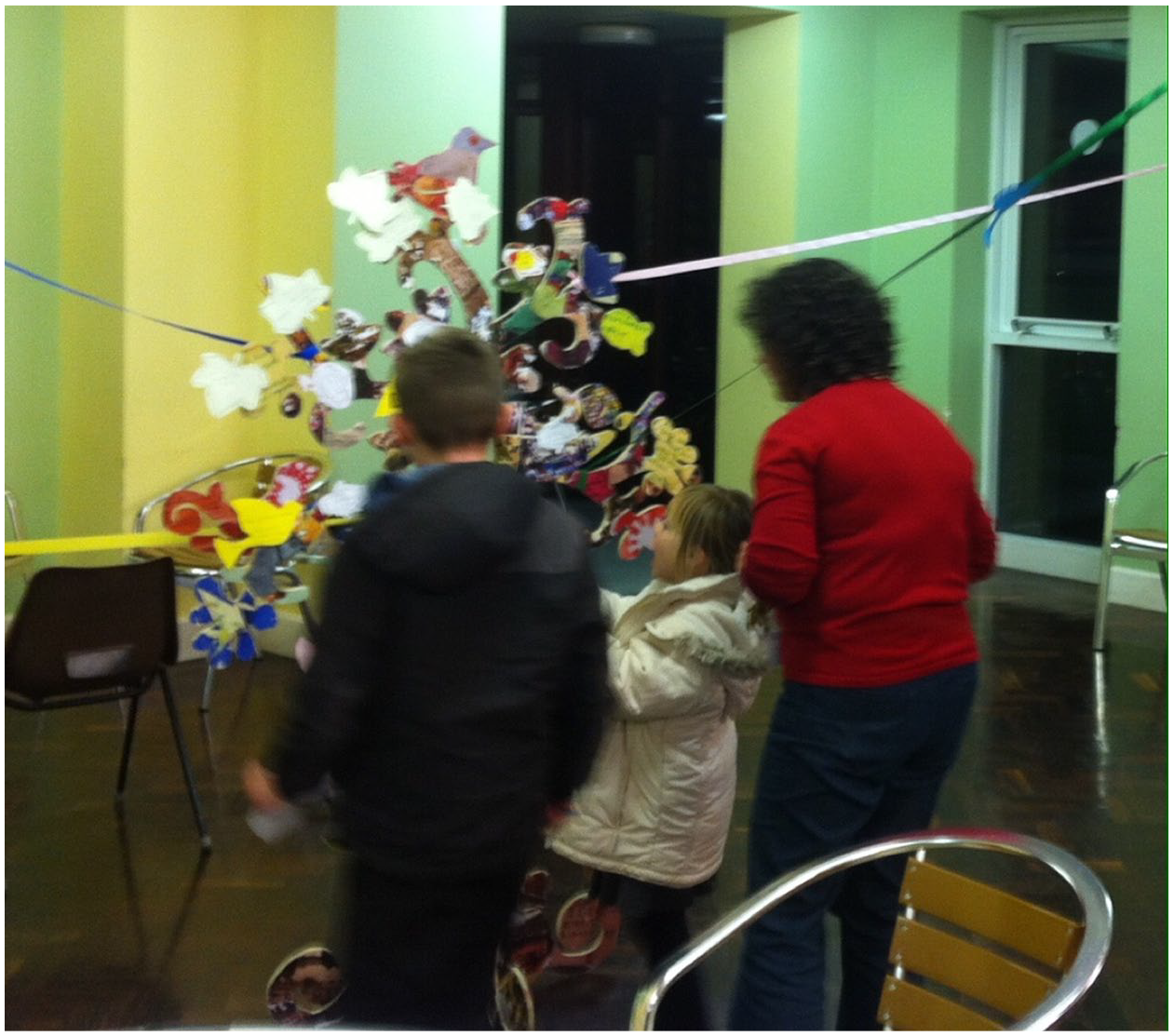
Food bank ‘Tree of Life’.
In Phase 2, we invited users and volunteers to attend two workshops held at the theatre, providing the incentives of free transport, lunch and refreshments. The workshops were facilitated by theatre practitioners working alongside academics. Photographs were taken (with participants’ consent) to record workshop activities. Similar themes emerged in these participatory workshops. For example, in addressing the question of what a world without food banks would look like and by mapping this world with the help of colourful buttons, participants identified ‘receiving help and support from others in the community’ as central to their wish list.
The creative participatory methodology used in these sessions allowed us to respond to Milbourne’s (2004, p. 561) call for ‘more sensitive accounts of the socio-cultural nature of poverty in particular spaces and places’. It enabled us to understand food poverty not simply as an object of study, but as a social phenomenon that touched us deeply at a personal level and engaged us affectively as human beings, not merely as social scientists. The workshops helped build trust between us, the theatre practitioners, food bank volunteers and users, making it easier for the latter to disclose their personal feelings. As one of the food bank users said: I only came to the theatre to eat some fresh food. I’ve not had any fruit or vegetables for four days but now that I am here, I want to stay for the rest of the day and tell you my story. You know, I was like you five years ago. I was in management; I had a nice house, a company car, a husband, then we were both made redundant, we lost the house, then split up and I hit the bottle big time . . . yes, I am an alcoholic, it’s my way of coping. (Field notes)
The key themes identified in Phase 1, namely the impact of welfare reforms, stigma and the need for human connection, were used to develop the focus of the semi-structured interviews in Phase 2. We interviewed 20 people who participated in Phase 1. The sample comprised four males and 16 females, with the majority aged between 50 and 60 years. The youngest was 35 and the oldest was over 70. Half of the sample comprised food bank staff and volunteers, and the other half either were or had been food bank users. All participants’ names are anonymised in the data presented below. The semi-structured interviews focused on eliciting food bank users’ experiences of food banks, what had brought them there, who they met, what happened, and how they felt. Staff and volunteers were asked about the reasons they supported the food bank, their opinions about food poverty, how they managed their encounters with the food bank users and any changes they had experienced in themselves from volunteering at the food bank.
The interviews varied in length, lasting between 30 and 90 minutes. They were recorded and transcribed. We used thematic analysis (King & Brooks, 2018) to analyse the interviews. We read the transcripts independently and, using 10 codes derived from the interview questions (one code per interview question), each of us pinpointed five recurrent themes (Creswell, 2013). We discussed and compared these themes and agreed on three main underpinning categories: compassion ‘for’, compassion ‘with’ and compassion ‘within’. The initial findings were presented to some of the participants to ascertain whether these categories resonated with their lived experience. Next, the categories were ‘thickened’ and given conceptual rigour by making reference to extant literature and field notes taken during the participatory workshops and observations within the food banks themselves.
Ethical approval for this research was provided by our University Research Ethics Committee. Participants were provided with an information sheet and asked to sign consent forms: the researchers spent time discussing the project with each participant, explaining that participation was voluntary, and they were free to withdraw at any point. A key ethical concern for the authors was our privileged positions as academic researchers. We sought to address this concern by working closely with the theatre practitioners to design the workshops in ways that enabled participants to share their personal stories in a safe environment. The techniques used were a blend of playful games, craft making, storytelling and short performances, which encouraged participants to share ideas and collaborate by expressing themselves in narrative, visual and bodily ways (Kelemen et al., 2018). The embodied and experiential nature of our activities was suitable for capturing data about sensitive issues and promoted equality, inclusion and trust (Eisner, 2008; Keifer-Boyd, 2011), ensuring the research was conducted ethically and reflexively.
Compassion in the food bank
The data suggest different forms of compassion emerge and develop in the encounters between the food bank volunteers/staff and users. Some of the compassionate responses resonate with a neoliberal ideology in which hunger is seen as a charitable concern, an intervention by predominantly middle-class volunteers to help people whom they see as poor (Caplan, 2016). In so doing, a chain of indebtedness is created between donors and food banks, and between food banks and individual users of their services. We begin by discussing this position further and illustrating it with examples from the data.
Compassion ‘for’ others
Supermarkets benefit when they divert their food waste from landfill to food banks. For example, food banks collect out-of-date produce from supermarkets free of charge, saving supermarkets the costs of disposal. Supermarkets may profit also from an enhanced image among consumers and other stakeholders for their socially responsible actions. This positive view of supermarkets was articulated by food bank volunteers who felt gratitude and indebtedness to supermarket chains.
Sainsburys are fantastic. We’ve got a bin at Sainsburys and we couldn’t manage without Sainsburys. We empty that each week, that’s usually a big yellow bin full. And they also give us their bread on a Tuesday night and on a Sunday night, bread that they were going to chuck in the bin because obviously it hasn’t been sold. (Interview with Tina, volunteer, independent food bank)
Other sources of food donations come from the public, schools and churches through collections. Regular food collections rely on cooperation with and permission of the supermarkets. For example, supermarkets may permit food bank volunteers to visit the store to encourage customers to purchase extra food items that can be deposited in a collection bin.
Described as ‘re-gifting depots that are part of the capital accumulation process’ (Lindenbaum, 2016, p. 376), foodbanks can (re)produce a sense of indebtedness among recipients. Food bank users’ reliance on the general public and businesses, even when the latter benefit from the disposal of their surplus produce, engenders an expectation of gratitude that is keenly felt by users. Indeed, some were horrified when they witnessed attitudes and behaviour they regarded as ingratitude in other food bank users.
When I was at X [another food bank] there was a guy there who, he was obviously in need of food, but he had a great long list of things he didn’t like. Oh I can’t have tomatoes, I can’t have this, I can’t have that. And I was thinking, you silly man, these people are giving up their time and they’re giving the food for free, you can’t turn your nose up at tomatoes just because you don’t like them; disguise them as something else, put curry powder in or, you know [. . .] I don’t think that’s fair. I think that’s ungrateful, I really do. I mean even if they gave me tongue, I’d eat it. (Interview with Martin, food bank user)
Other users felt rather resentful of the expectation to accept gratefully whatever was given in order for their suffering to be construed as genuine. In particular, personal tastes and preferences associated with everyday living outside of food poverty were expected to be suspended so that their suffering appeared genuine. As Deirdre, a food bank user explained: ‘I don’t want to appear ungrateful to them, you know, but it’s like no, I don’t want that [. . .] And you feel sort of obliged to take what they give you, really.’
Indebtedness and gratitude are sentiments that cut across the food bank supply chain: users appeared grateful to the volunteers and the volunteers were grateful to donors. This sense of hierarchy can create distance and detachment between those who are giving and those who are receiving. It is also reinforced through judgements made when volunteers, as custodians of scarce resources, discriminate between those who are genuine recipients with legitimate requests for help and those who are not.
Within the Trussell Trust network, the voucher system is generally seen as an effective way to distinguish between users and to determine need: users turning up without a voucher would be sent away, often referred to an agency or organisation that would be able to issue them with one. Users who did have vouchers were closely scrutinised; for instance, if information was missing on the voucher, they were asked to return to the issuing agency and get the problem rectified. However, this policy was the subject of much discussion by volunteers and staff of the Trust. Some expressed discomfort about having to turn people away, while others were exasperated at the behaviours they had witnessed, recounting examples of users who they felt had tried to ‘play the system’: I was told about a woman who had been given large amounts of food. ‘She claimed she had four kids but when we checked she only had two and one of those was a baby.’ The volunteer was rather incredulous. (Field notes)
To counteract such instances of playing the system, the food banks had a checklist of food products and quantities deemed appropriate to each type of user (e.g. individual, couple, family). Volunteers were required to weigh and account for all donations received and all produce dispensed to users. This quantitative culture of compassion, brokered and audited through a voucher system and metricised in volunteers’ weighing the donations received and distributed, is enacted by categorising the users according to a standard rubric of user type. The checks and balances within the system determining individual worthiness are entrenched in the neoliberal idea of individual responsibility (in relation to both users and food bank volunteers) and its centrality to the integrity and good governance of the food bank operation. This is illustrated vividly in the following quote from one food bank volunteer: It’s not safe for us as a charity to just hand out food to clients, it’s not good governance and it encourages dependency on us. We need to stop abuse because if it’s [the service] abused, where will the vulnerable people go? (Field notes)
However, adherence to these procedures did not prevent some volunteers exerting discretion at times. On occasion, a lot of thought went into producing the food parcels.
The lady just came in, she had two children, the volunteers gave a lot of thought as to what food the children might like before putting it in the package [which breakfast cereals]. They didn’t just work through the pro-forma. Then they gave them an extra big box of tea. (Field notes from Trussell Trust)
These small acts of kindness recognise and reinforce a sense of ‘shared humanity and interdependency’, as volunteers respond spontaneously to an individual’s needs (Brownlie & Anderson, 2017, p. 1224). They can coexist harmoniously with existing formal procedures that link individual volunteers’ biographies with the institutionalised efforts to alleviate strangers’ suffering (Flores, 2014).
Compassion in this instance is towards the user, defined as a category of hungry individuals whose hunger is deemed to be legitimate by the food banking system. The food bank user is interrogated to ensure compliance, and any attempts made by the user to circumnavigate the eligibility criteria, or express ingratitude, can mean the user is considered undeserving of help. Compassion ‘for’ others may be underpinned by good intentions, hard work and generous acts. Yet, the encounter between the volunteer and the person in need is constrained and governed by neoliberal discourses that judge the worthiness of individuals’ request for food, according to a prescribed formula that is underpinned by standardised metrics and guidance on how and when food banks and individual volunteers should respond.
Compassion ‘with’ others
A common feeling among volunteers from both independent and Trussell Trust food banks was that they volunteered because they were in a position to give something back to people who were in more need than themselves.
I guess when I first, when we first, started a food bank at church, it was wanting to do something to alleviate a problem in the community. (Interview with Ruth) I volunteer because I have time to do so, it’s a combination of things, it’s giving, making some contribution to society [. . .] I felt like it’s something that I could do to help those people who are less fortunate than myself. (Interview with Ian)
While these responses stemmed from compassion ‘for’ the plight of others, for some volunteers the encounters with users opened up opportunities to form a connection with the other, leading to a different form of compassion, compassion ‘with’. Here, compassion is not simply a commodity that is handed out with food parcels in exchange for gratitude, but also an expression of connection and responsibility. This connection entailed a greater affective investment of the self among volunteers, which enabled some to move beyond a dichotomous categorisation of users into deserving/undeserving types by establishing connections with users as people. A different type of compassion developed during the course of listening to the stories of others as Tina, a volunteer in an independent food bank, explained: ‘I just love helping other people, [. . .] I understand how people feel, and people just want to be listened to, don’t they?’
This compassion focuses on the person rather than the food problem the individual is facing, and was apparent in the way that the two independent food banks differentiated themselves from the Trussell Trust. Although many of the Trussell Trust volunteers who participated in this study tried hard to make users feel welcome, the eligibility checks engendered formality and bureaucracy that contrasted markedly with the ‘everyone’s welcome’ approach practised by the independents. In these food banks, anyone could receive a food package. The physical environment of the independent food banks was also conducive to forming connections, whether between volunteers and users or between users. Whereas the Trussell Trust’s operation was focused around transactions, the exchange of the voucher for a food parcel, independents encouraged people to stay longer and talk. They achieved this through the provision of hot food and support services such as health advice. This difference in approach was noted by the first author: ‘As I walk in, the place feels really busy, it’s buzzing. Lots of small tables with people sitting around them eating, the man in the kitchen is busy too, I can smell bacon cooking’ (field notes).
At this independent food bank, the first interaction on arrival emphasised choice (what the user would like to eat) rather than whether they qualified for help. Independent food banks can struggle to access food supplies and the quantity of food in their packages can vary as a result. What they were better able to guarantee was an offer of wider support to those in need. Users were referred to as ‘guests’ and the food parcel they could receive was seen as a supplementary benefit. As they were not assessed against eligibility criteria and were unrestricted in the number of times they could attend, many users had become regulars. Reflecting on her time as a volunteer in the food bank, Trish talked about ‘the good moments, like people who used to sit on their own, now they all go and sit together at a table and have a chat and [are] exchanging phone numbers’. Although commenting on the connection made between users, she too had become connected to them by watching their relationship develop and had witnessed this transition with a sense of satisfaction.
Compassion ‘with’ the other is not about a snapshot in time or a moment of exchange but is constitutive of a longer lasting connection that is formed (Nussbaum, 2001). For volunteers, the tangible difference they could make to the lives of food bank users by providing advice and care was important to feeling a sense of self-worth and fulfilment. For example, Donna, a volunteer in an independent food bank, said, ‘I just love doing it, I love making a difference [. . .] you can see a difference on a daily basis, yes, you can see it.’ A similar sentiment was echoed by Jess, another volunteer in an independent food bank: ‘I go in with one goal every day and that is to feed as many people as possible but also to make people feel a little bit better.’
The potential rewards and also the perils of forming these connections are evident in a story shared by volunteers at a Trussell Trust food bank. The story, recorded in field notes, told of how volunteers had ‘adopted one lady’. When she arrived, the volunteers told us that she had ‘dirty hair’ and had been deserted by her family after they moved to another country. The volunteers said, ‘We looked after her for a year. She was ours.’ Volunteers donated food but also other items specifically for this lady, who had also been given her own teacup to use when she visited. It was clear that the connection which had developed between the volunteers and this particular woman transcended the delivery of food and the emergency aid they were there to provide. They wanted to ‘look after her’ and to protect her. They also felt quite possessive of her, claiming that ‘she was ours’. From the perspective of the volunteers, the bond appeared very strong; hence, when the woman suddenly stopped visiting without warning or explanation, they were concerned, hurt, and expressed regret that they did not know what had happened to her: ‘I would have liked to have thought that she would come in, to let us know she was OK.’ Another volunteer said: ‘I like to think she found her family.’ Someone else disagreed, suggesting maybe she moved on to another food bank. Another said, ‘I’ll never forget her’ (field notes).
Compassion ‘with’ the other can thus prove both challenging as well as rewarding, especially when it is structured by possession of the other. This form of compassion can require a good deal of emotional work that can be overwhelming. Mary, a Trussell Trust volunteer, expresses this, saying that ‘it is difficult knowing when to switch off’ and that ‘as soon as you sit down and talk to a guest you don’t know what can of worms is going to open up and how much, well you know, when do you make a stop?’ Mary later revealed that this had started to take its toll on her, saying her role at the food bank was the most difficult volunteering experience she had ever had, and that she was often left uncertain about how to cope and felt exhausted.
Compassion ‘with’ others encourages food bank volunteers to connect ‘with’, rather than judge, the individual. It goes beyond repair work to maintain the fabric of the society and manifests itself in an affective and more embodied connection with the so-called guests. At times, these affective responses suggest self-interest and promote an individualised (even possessive) notion of compassion, as can be seen in the story of the ‘adopted lady’. The story implies that some volunteers feel they have a purchase on food bank users, both as their carers and as people who deserve to know the users’ movements, exposing the unequal power relations between the self and other.
Compassion ‘within’
For some volunteers, feelings of compassion went beyond the connection they made with others. These feelings served as a catalyst to encourage personal reflection about the macro situation that led to people experiencing food poverty. Compassion ‘within’ went beyond the immediate practical response to suffering, or caring about the suffering of users, to the questioning of the volunteers’ own values and attitudes towards poverty and the conditions which give rise to it.
For example, Jess (independent food bank) reflected on the situation of those who visit her to obtain free food: ‘People don’t understand when you say “people have nothing”. It’s literally nothing.’ She then went on to illustrate this by talking about the case of one individual. The food bank user she refers to is a midwife, whose husband is unwell and unable to work: he had a heart attack at the age of 38. ‘She works all hours but the numbers don’t add up. I’ve sat down with her and there is more going out than is coming in.’
Jess uses this example to challenge existing stereotypes about food bank users as scroungers and architects of their own misfortune. For Tina and Ruth, similar insights into food poverty appeared to lead to personal changes.
Before I wouldn’t speak to a homeless person, but now because I know them all by name and am aware of their problems, this makes me less judgemental. (Interview with Tina, volunteer, independent food bank) Probably [my] understanding of people’s situations is now better, having a greater awareness of what it’s actually like, living in a different world. (Interview with Ruth, Trussell Trust volunteer)
Volunteering at the food bank has had a profound effect on the way that both Tina and Ruth relate to and understand the world around them. Their interactions with the other trigger a form of compassion ‘within’ that has changed the way they think about and relate to people experiencing food poverty.
Other volunteers expressed wider scepticism about the role of the food bank. They were unconvinced about the public displays of compassion in these organisations, uncomfortable with the positive status of these institutions and critical of their own privileged positions as individuals within them.
You’re actually enjoying the fact that people are in crisis, but you’re not, you’re enjoying the fact you’ve helped somebody in crisis [. . .] And you think, hang on, should I be really happy that other people needed it [help at Christmas]? So, we should really be working to put ourselves out of existence. (Interview with Claire, volunteer, Trussell Trust)
By pointing out the irony of needing poverty in order to feel good about oneself, some volunteers questioned the compassion expressed in the encounters that took place within food banks. They recognised the inequalities reproduced through food bank eligibility criteria and how they created power differentials between users and volunteers. While pragmatic responses relieve suffering in the moment, they can perpetuate the status quo and prevailing social inequalities. Hattie’s reflections put the situation in a much broader perspective.
The problem around food poverty, I think is a much bigger issue about attitudes to people who are out of work, people who are in low paid work. And I’m a little bit scared that there seems to be a lot of ‘oh well, if only we could deal with supermarket leftover food more efficiently, it would help all these people going to food banks’. Because you’re then just entrenching benefit cuts, low wages, insecure employment. (Interview with Hattie, volunteer, independent food bank)
Hattie’s quote is reminiscent of Gans’s (1971) views on ‘the uses of poverty’. He argues that because the poor undertake unattractive forms of low paid work, their work subsidises an array of economic activities that benefit society as a whole, and in particular more affluent people, through the creation of jobs for other individuals to ‘service’ the poor. The volunteering and management roles within food banks may also be understood in this way: they enable predominantly middle-class volunteers to help the poor continue to labour in low income jobs and define themselves in opposition to the latter, thus enhancing their own social position and deepening the stigma attached to the poor. Needless to say, academics like ourselves could also be seen as profiteering from researching and writing about the poor, despite our reflexive and compassionate approach to this study.
In summary, compassion ‘within’ is not so visible and far less demonstrative as a response to the suffering of another. Yet, the data show the existence of food bank volunteers’ inner dialogues and reflections on their role in food banks as well as on the wider political and ethical issues around food banking. These personal reflections hint at the emergence of relational forms of compassion that are politically oriented.
Concluding discussion
Food banks have been subject to both praise, for instilling a sense of community spirit, and criticism, for legitimising the state’s paucity of action in relation to growing levels of food insecurity. Problematising this dichotomous view, this article regards food banks as contested and compassionate ‘spaces of encounter’ (Cloke et al., 2017, p. 719) which, in bringing together food bank volunteers and users, give rise to diverse and at times contradictory understandings of self and other. While recent sociological studies have explored food bank volunteering as a form of social resilience and collective empowerment that can challenge austerity practices (Monforte, 2019), our study focuses on the compassionate side of the food bank as it emerges in the encounters between volunteers and users.
Our empirically grounded taxonomy suggests the existence of three overlapping forms of compassion. Compassion ‘for’ others is evident in the volunteers’ working to meet the food bank’s objectives and the perceived duty to follow organisational standards in meeting the needs of the poor. Compassion ‘with’ others develops as volunteers form connections of a more affective and personal nature with users who are typically regarded as guests, but has its own constraints and contradictions. Compassion ‘within’ is less visibly demonstrable in encounters with others but transpires as a process of personal reflection about oneself and society. These are ideal types of compassion that serve as heuristic devices rather than reflecting a clear-cut reality. Food bank volunteers may display aspects of all three types of compassion across various encounters and in relation to different users, or may indeed learn new forms of compassion as their encounters with users develop.
The study finds that independent food banks are more conducive for volunteers to form relations of compassion ‘with’ and ‘within’. The Trussell Trust’s method of operation appears to constrain the development of closer ongoing connections between food bank volunteers and users. On occasion though, we did find instances where volunteers bent the rules to respond to users’ needs, and forged more personal relationships as a result. However, the independent food banks in the study made a concerted effort to distance themselves from the Trussell Trust food banks’ way of operating by not asking for referral vouchers. Although these food banks could not predict what food would be available to give away, and on some occasions ran out of food altogether, they worked hard to provide a welcoming environment for all ‘guests’. On many occasions, the encounter with the ‘guest’ led volunteers to re-evaluate the role of the food bank in perpetuating poverty and to reflect on their own place in an unequal society.
Our analysis shows that compassion is not a homogeneous or static experience but is dynamic and contextually contingent on shifting understandings of the self in relation to the other (Blum, 1980; Nussbaum, 2001). Furthermore, compassion can be contradictory, and it is not the case that an organisation with a caring mission operates always in a compassionate manner (Simpson & Berti, 2019). The food bank is a case in point. While this research has shown that food banks can be sites of caring and generous acts, some acts of compassion are structured by possession and control, for example when volunteers feel they are entitled to users’ gratitude and to knowledge of users’ lives outside the food bank. The prevailing economic and social climate may also influence the forms of compassion that evolve in and around food banks. As we write, the current global COVID-19 pandemic has unleashed a wave of panic shopping in the UK whereby, and despite reassurance from both government and supermarkets that supplies will not run short, consumers are stockpiling many household and food items. Thus at a time when food bank usage may well increase due to financial hardship, donations have drastically reduced as donors hold on to supplies for their own use (BBC News, 2020). Indeed, existing inequalities within the UK food system are being exacerbated further by the pandemic (Power et al., 2020). Exploring the impact of the COVID-19 pandemic on compassion during these unprecedented times represents an important avenue for future research.
While all three forms of compassion can coexist, compassion ‘with’ and ‘within’ provide empirical support to Cloke et al.’s (2017) assertion that contested organisational spaces such as those (re)produced in food banks make possible encounters between diverse types of people that trigger changes in their understandings of the self and the other. As these understandings are worked upon, refined, challenged, or transformed as part of these encounters, they may stimulate relations of compassion that contain political sensibilities towards food poverty. Here we may be hopeful that politically oriented forms of compassion can facilitate changes within food banks that can challenge how they organise notions of food poverty, categorise food bank users and perform a more positive role in society.
Footnotes
Funding
This research was funded in part by the EPSRC via the Communities and Culture+ (CCN+) research stream.