




Abstract
Using an evaluative approach within a professional communication service course, we used student documents and instructor feedback to uncover how students and instructors were understanding the rhetoric student learning outcome (SLO). Because rhetoric is central to the course, our driving questions were, Can we locate language that actualizes the rhetoric SLO in student documents? How does faculty feedback articulate the rhetoric SLO to facilitate effective revision? Overall, we found that whether identifying rhetoric in student documents or instructor feedback, the interpretation was varied and opens up room in pedagogical practices. We offer three implications for teaching: enhancing attention to teaching rhetoric, improving assignment design, and focusing on professional development for faculty.
Historically, student learning outcomes (SLOs) have been used to identify measurable areas of student achievement by the end of the course (Allan, 1996), and they have been central in institutional assessment related to accreditation (e.g., Allen, 2004; C. S. Johnson & Elliot, 2010; St. Amant & Nahrwold, 2007). However, more recently, scholars have advocated for an expanded use of SLOs that are more student centered. In the student-centered view, SLOs are used to help students understand the range of knowledge, skills, and abilities the course hopes to teach (e.g., Clegg et al., 2021; Driscoll & Wood, 2007; Griffith et al., 2023). We have adopted this student-centered approach to SLOs, and we take it a step further by using SLOs to guide course design and continuous improvement (Schreiber & Melonçon, 2019) in a technical and professional communication service course. The service course is defined as “introductory courses for nonmajors delivered primarily as a service to other departments and programs on campus” (Melonçon & England, 2011, p. 398). Service courses are ubiquitous across the United States (e.g., Bivens et al., 2020; Read & Michaud, 2018; Schreiber et al., 2018; Sonnenberg et al., 2023), and they appear at all types of institutions under a myriad of names such as business writing, business communication, professional writing, technical writing, and technical communication. These courses often focus on “real-audience needs, problem solving, and learning to communicate information that has real cultural, legal, and ethical obligations” (Melonçon, 2018, p. 208), as they prepare students to “adap[t] emergent knowledge to specific workplace or community-based contexts” (Scott, 2008, p. 382). To gain deeper insights into the learning goals of the service course, Griffith et al. (2023) gathered SLOs from courses across the United States and found that there were a common set of outcomes. They also found that the most common SLO was a rhetoric-based outcome.
Like the schools in Griffith et al.’s (2023) study, our service course program has a rhetoric outcome: Analyze and write in a specific context defined by purpose and audience. Since rhetoric is central to the goals of the course, we wanted to evaluate this outcome and its impact on teaching and learning. Scholars in technical and professional communication have examined SLOs related to assessment (e.g., Allen, 2004; Ilyasova & Bridgeford, 2014; Mallette & Hawks, 2020; Newmark & Bartolotta, 2021; Say, 2015; Sonnenberg et al., 2023) rather than our goal of evaluating an outcome based on teaching and learning. Distinct from program assessment, which is mandated by an institutional initiative and focuses on outcomes after students have produced deliverables, program evaluation is an iterative process that evaluates how outcomes, assignments, and courses impact student learning as the program functions in real time.
Thus, in this entry, we go back to the basics and focus on teaching and learning by tracing a “learning event.” A learning event allows faculty and program administrators the opportunity to observe the manifestation of an outcome through concrete language in the student draft and instructor feedback, thereby connecting the concept to its instantiation during the revision process. Looking across our large service course program, we began with two questions: Can we locate language that actualizes the rhetoric SLO in student documents? How does faculty feedback articulate the rhetoric SLO to facilitate effective revision? We begin by situating our study in existing literature and then move to describing the practice-based methodology, the institutional context, and the approach to analyzing data. We then present the findings to our two research questions. The final section discusses three implications for pedagogical practices in teaching rhetoric in the business, technical, and professional communication classroom. By tracing these “learning events,” our study collects and analyzes data spanning the student revision process (student draft to instructor feedback to student final) to delineate student learning and of the rhetoric outcome and to offer suggestions to improve the teaching of rhetorical concept in business, technical, and professional communication classrooms. The study also offers administrators and faculty a model on how to evaluate teaching and learning in progress and in context.
Literature Review
We confine the focus of our literature review to scholarship that directly discuss the teaching of rhetoric. We start with textbooks since they are often a key indicator of what a field values as they mark the codification of effective teaching practices (e.g., Barker & Matveeva, 2006; Chong, 2016; McGarrity & Crosby, 2012). Some of the first textbooks in the field had a rhetorical approach. For example, in the early 1970s, Houp and Pearsall (1973) started by explaining a rhetorical approach The rhetorical emphasis continues in recent textbooks (e.g., Johnson-Sheehan, 2021; Markel & Selber, 2021; Rentz & Lentz, 2021), as well as open education resources (e.g., Bennetch et al., 2021; McKinney et al., 2022; Reardon et al., 2019). In her landmark work establishing a pedagogical framework for teaching technical and professional communication, Cook (2002) identified six key literacies. One of her literacies was rhetorical, which helped students identify and respond to purpose, audience, and design (p. 10). But, as H. M. Lawrence and Hutter (2021) argued, technical and professional communication has failed to critically examine literacy frameworks, leading to a methodological stasis. This stasis is evident when looking specifically at the rhetorical dimension of Cook’s framework. An exception, however, can be found in the work of Getchell and Lentz (2018), whose edited collection on rhetoric and business communication provided a “heuristic for instructors of business communication to use as they consider how rhetorical theory informs their own teaching philosophy and practices” (p. 8). Building from Getchell and Lentz (2018), we propose that another way to consider how rhetorical theory may inform teaching practices is through SLOs.
Since SLOs are a marker of what students should take away from the course, Maid and D’Angelo (2012) pondered if rhetoric was the über-outcome, “the most important among the others, but also one that . . . has a tendency to influence other outcomes” (p. 258). The results of their examination of capstone portfolios in a degree program did not result in a clear answer on whether rhetoric was an über-outcome, but it did show that students were aware of the need to discuss rhetoric and their awareness of purpose and audience in their portfolio reflections. Maid and D’Angelo (2012) seemed to anticipate Clegg et al. (2021), who found that rhetoric was a key outcome in their fieldwide examination of degree program learning outcomes. More specific to our goals here, Griffith et al. (2023) found rhetoric was the most common outcome in their fieldwide examination of service course SLOs. They argued that a rhetoric outcome identified “an emphasis on rhetorical awareness” (p. 10) and was coded as such when it “focused on traditional rhetorical elements such as purpose, audience, context, and the rhetorical situation” (p. 10). The ubiquity of a rhetoric SLO suggests the importance of rhetorical skills in teaching writing and communication.
Moving to scholarship that is classroom and pedagogical based, Lucas and Rawlins (2015) described a pilot study of a curricular implementation of competency-based education in a single section of a business communication course. They explained their framework consisted of two guiding principles: goals oriented (purpose) and receiver-centric (audience) (p. 173). While Lucas and Rawlins laid out transfer of rhetorical skills as an ultimate goal for students, their study did not track rhetorical transfer, which attests to how well students are retaining knowledge and skills and transferring the knowledge and skills to and in another situation.
Transfer of rhetorical knowledge, including purpose and audience, is an important goal of the service course. For instance, Ford (2004) examined engineering students’ transfer of rhetorical knowledge, which she defined as “audience awareness, sense of purpose, organization, use of visuals, professional appearance, and style” (p. 302). Ford (2004) found that students did not lean on “awareness of audience or sense of purpose”; instead, they used “concepts that were more tangible to them, model-based tactics,” such as template and formats (p. 310). Ford’s finding is concerning if rhetoric is indeed a key outcome for the service course and necessary for students to transfer rhetorical awareness between academic courses. Adding to concerns about rhetorical knowledge transfer, Schieber’s (2016) work found that the transfer of knowledge of rhetorical skills was often unintentional (p. 482). Another example is from Shaver (2011), who discussed an analysis report assignment to “determine a text’s rhetorical purpose and the relationship between purpose, audience, and content” (p. 223). Shaver explained that the goal was ultimately to “bridge these two worlds [academy and workplace] by honing many of the writing, rhetorical, and critical-thinking skills that students will ultimately use in their careers” (Shaver, 2011, p. 231, emphasis added). Rhetorical knowledge as a key to career success also aligns with Cyphert et al. (2019), who concluded that students’ career success “would ultimately require rhetorical competence to engage in the strategic communication tasks intrinsic to management or leadership positions” (p. 176). For instructors in the business, technical, and professional writing classrooms, transfer hinges on whether instructors and students understand rhetorical principles such as purpose and audience.
In addition to the focus on transfer, there is also scholarship that looks at the specific ways in which rhetoric is explicitly included in assignments. For example, Cárdenas (2012) explained the results of a community-based assignment where students were able to experience “misunderstandings, rhetorical challenges within the process of document creation, and cultural tensions that thwart their goal to disseminate information to the community” (p. 143). Relatedly, Vealey (2015) argued for the use of “problem forums” (p. 201) as a form of rhetorical work. He explained that these forums were “occasions for students to reflect on and discuss—indeed, to get comfortable discussing—rhetorical, technical, logistical, or collaborative difficulties that have either slowed or halted their work as a team” (p. 201). Additionally, H. Y. Lawrence et al. (2019) highlighted the difference between proposal writing and proposal instruction. They argued that the rhetoric of proposal writing should “expand to not only engage the nuanced processes, audiences, and tasks . . . but also to complement the larger range of ethical concerns that proposals for funding include” (p. 48). Shifting from assignment design to instructor feedback, Doan (2019) found that, although instructors “spoke about teaching professional communication rhetorically, emphasizing context, audience, and genre theory” (p. 124), much of their feedback “focused more on micro-level issues of correctness in tone, grammar, and formatting” (p. 124). This disconnect between stated values and actual practice in feedback underscores what we see as a sizable disconnect between scholarship on rhetoric and teaching practices. In each of the cases above, the authors moved to consider rhetoric as a key part of the classroom goals and assignments, but they also lacked a specificity on how to achieve the rhetorical goals they were advocating for. This is not surprising since the focus of each piece was not on teaching rhetoric, yet the authors assumed a rhetorical focus within the classroom. There seems to be a tacit assumption of the importance of rhetoric as a foundational skill and ability. As our study uncovers, pedagogical practices are most effective when instructors can locate what a rhetoric outcome looks like in student writing, and then use that information to assist students in making connections between the idea of rhetoric as a learning goal and what that looks like in their own work. Thus, we wanted to take a close look at the learning event that brings together the rhetoric SLO, student drafts, instructor feedback, and student finals.
Methodological Approach
This research study started as program evaluation, which has been emphasized in recent scholarship in TPC (Schreiber & Melonçon, 2019, 2023; Sonnenberg et al., 2023) As an iterative process, program evaluation helps program administrators and faculty understand their programs more deeply and from different viewpoints in an effort to continuously improve. Program evaluation is separate from, yet distinctly related to, program assessment and other types of assessment (such as those done for accrediting agencies). Schreiber and Melonçon (2023) created a taxonomy of research questions to guide programmatic evaluation in technical and professional communication. We focused on practice questions since they “are designed to gain insights into what may be working or not and why programs may be doing things a certain way” (Schreiber & Melonçon, 2023, p. 8). To trace the learning event focused on the rhetoric SLO, we investigated two questions:
• Can we locate the language that actualizes the rhetoric SLO in student documents?
• How does faculty feedback articulate the rhetoric SLO to facilitate effective revision?
We also followed Schreiber and Melonçon’s (2023) recommendation that “practice questions should include at least two perspectives and multiple data points to draw conclusions” (p. 8). Therefore, we examined the student learning event through student and instructor perspectives by tracing the teaching of an SLO through feedback to the learning of the SLO in student writing. This teaching and learning connection is the learning event we wanted to understand better.
Institutional Context
This study took place at the University of South Florida. The Professional and Technical Communication Service Course Program resides in the English department. It teaches ~4,500 students a year in three courses: Technical Writing for Health Sciences, Communication for Engineers, and Professional Writing. The focus of this study is limited to the Professional Writing course in the academic year 2022-2023, which would include 82 sections teaching ~1,500 students. All instructor and student data are used in accordance with the University of South Florida’s Institutional Review Board (Study 002887). The document series assignment is the first of the term, and it introduces students to the rhetorical principles of purpose, audience, and design, known locally as the PAD approach. Students are given multiple problem-based scenarios (Melonçon, 2018), and they choose one (http://writeprofessionally.org/tech-comm/assignments/business-correspondence/). The scenarios ask students to address a single problem for three different audiences and purposes, producing three short documents. The rhetoric SLO is the main focus of this assignment, and it was revised in a curricular revision in 2018, and further revised in collaboration with faculty and learning designers in 2019. We know the outcome is measurable, but what is less known is how the outcome is demonstrated across the program in student work.
Programmatic approach to formative feedback and SLOs
Formative feedback “includes both general principles, and discipline specific elements that comprise the formal and informal materials, collaborative processes, ways of knowing, and habits of mind particular to a content domain” (Cizek et al., 2019, p. 14). Programmatically, we see SLOs as a manifestation of these “habits of mind” and a way to help both teachers and students clearly see the goals of the assignment. The service course program uses a “collective” approach to purposefully align feedback with SLOs rather than providing individual feedback to students. Here we use the term collective feedback (CF) to refer to a single feedback document given to the entire class that highlights common areas to assist students with the revision process. The CF is divided into categories (i.e., purpose, audience, design, etc.) and often contains 6-8 issues that students should consider when revising their documents. With a CF, every student receives the same feedback, which encourages the meta-cognitive work students do to apply the CF to their documents, using critical thinking to figure how to improve their writing. Each CF issue has three parts:
• A student example that is representative of an issue that can be improved
• A description of why the examples can be improved
• An explanation of how to improve it
This type of formative feedback aligns with existing research on effective practices (e.g., Doan, 2019; King & King, 2020; Still & Koerber, 2009; Taylor, 2011) that asks instructors to be more directive in suggestions. CF also provides a transparency that ties instructor feedback and revision strategies explicitly to the goals of the assignment and SLOs. Deliberately connecting feedback to revision through SLOs encourages faculty to approach teaching and learning differently than they might have considered before. Since CF data are gathered from faculty, it provides a rich source of information to be read alongside student data for insights into how to improve teaching and learning within the program.
Sampling documents for analysis
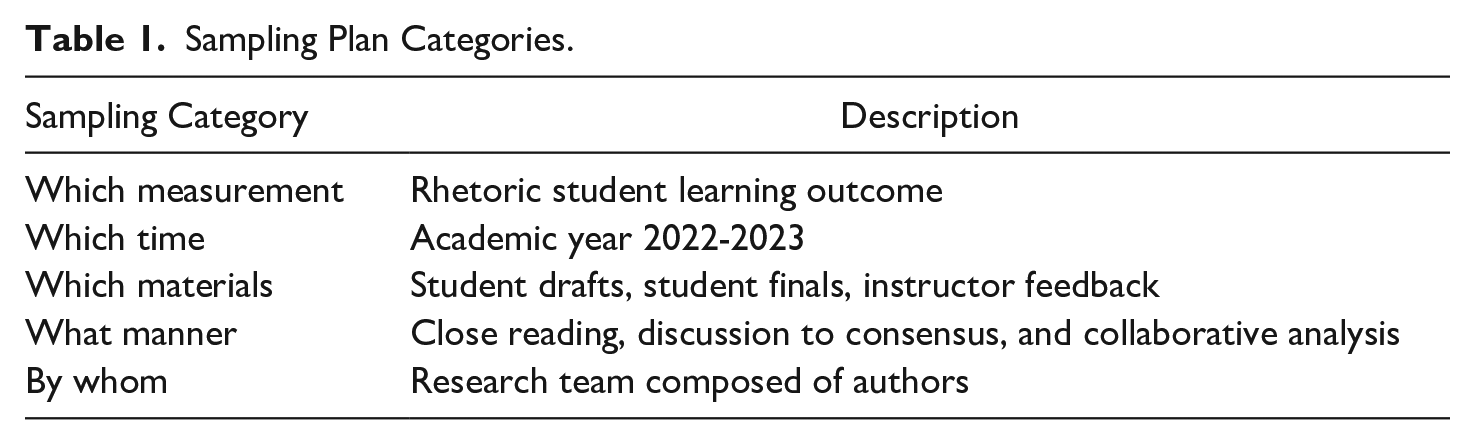
Most often, sampling is only discussed in relation to quantitative studies to explain the amount of data, how it was collected, and from whom it was collected. Our study is more qualitative so we take a sampling plan to be a “detailed outline of which measurements will be taken at what times, on which material, in what matter, and by whom” (Stimson, 2018, p. 305). Table 1 represents each of these categories for this research study.
Sampling Plan Categories.
When it comes to the use of student work for research purposes, researchers (and instructors) have not settled on a common sampling technique nor common sample sizes, particularly in pedagogical and programmatic qualitative studies. For example, in the last few years in this journal, research was published that examined two group presentations (Baker & Baker, 2023) and 77 final case study critiques (McDonough et al., 2021). Even when using the same artifact as the sample, there can be a wide range in the number used in analysis; for example, when looking at student reflections, Sharma (2021) examined 117, while Schieber and Robles (2019) analyzed 27. This range of student documents helped us to consider our own sampling plan in relation to our research questions.
Since student learning starts with effective teaching, we randomly selected 30% (n = 9) of our instructors. For the nine instructors, we included all the students that chose the same problem-based scenario, Matt’s One-Hour Heating and Air Conditioning (N = 90 students; 90 drafts and 90 finals = 180 total documents). As Sonnenberg et al. (2023) noted, “The relational nature between student drafts, instructor feedback, and student finals could shed insights into where the assignment may not be working in ways that previous research had not been able to do” (p. 7). We examined the student draft, instructor feedback, and student final, and this presents a discrete learning event in which instructors identify outcomes and students create work tailored to specific applications of those outcomes. The credibility of our qualitative analysis reflects a contextualized view of the object of the study—a rhetoric SLO—situated within the writing process. Analysis of these learning events helps to visualize how outcomes facilitate the development of student writing and to show the rhetoric SLO without losing the context of the teaching environment. Looking at individual illustrations of the writing-feedback-revision loop sheds light on how students and instructors understand SLOs. (Refer to Figure 1.)
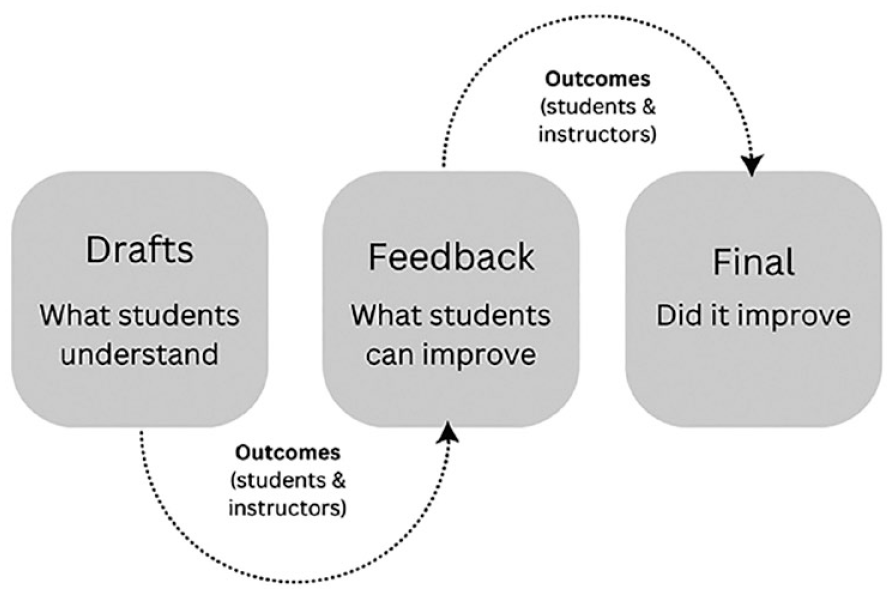
Interactions between feedback and how students understand the outcomes.
The key is that instructors and students can see that there is some evidence of recognition of the outcome so that pedagogical approaches can be created to help students progress on the learning continuum.
Can We Locate the Language That Actualizes the Rhetoric SLO in Student Documents?
The document series is the first assignment of the term and reinforces this outcome by including rhetoric as a specific goal and emphasis. Here we only focus on the first deliverable, the document to the customer. The problem-based scenarios are written so that students find them meaningful (Eodice et al., 2016). They are meaningful because students might have encountered an issue in their own lives, making it easier to see how instruction in rhetoric helps them to produce effective prose and communication. We use this as our example because it asks students to perform critical thinking and problem solving, such as considering authority, while remaining empathetic and understanding of the rhetorical situation. Figure 2 shows the assignment instructions.
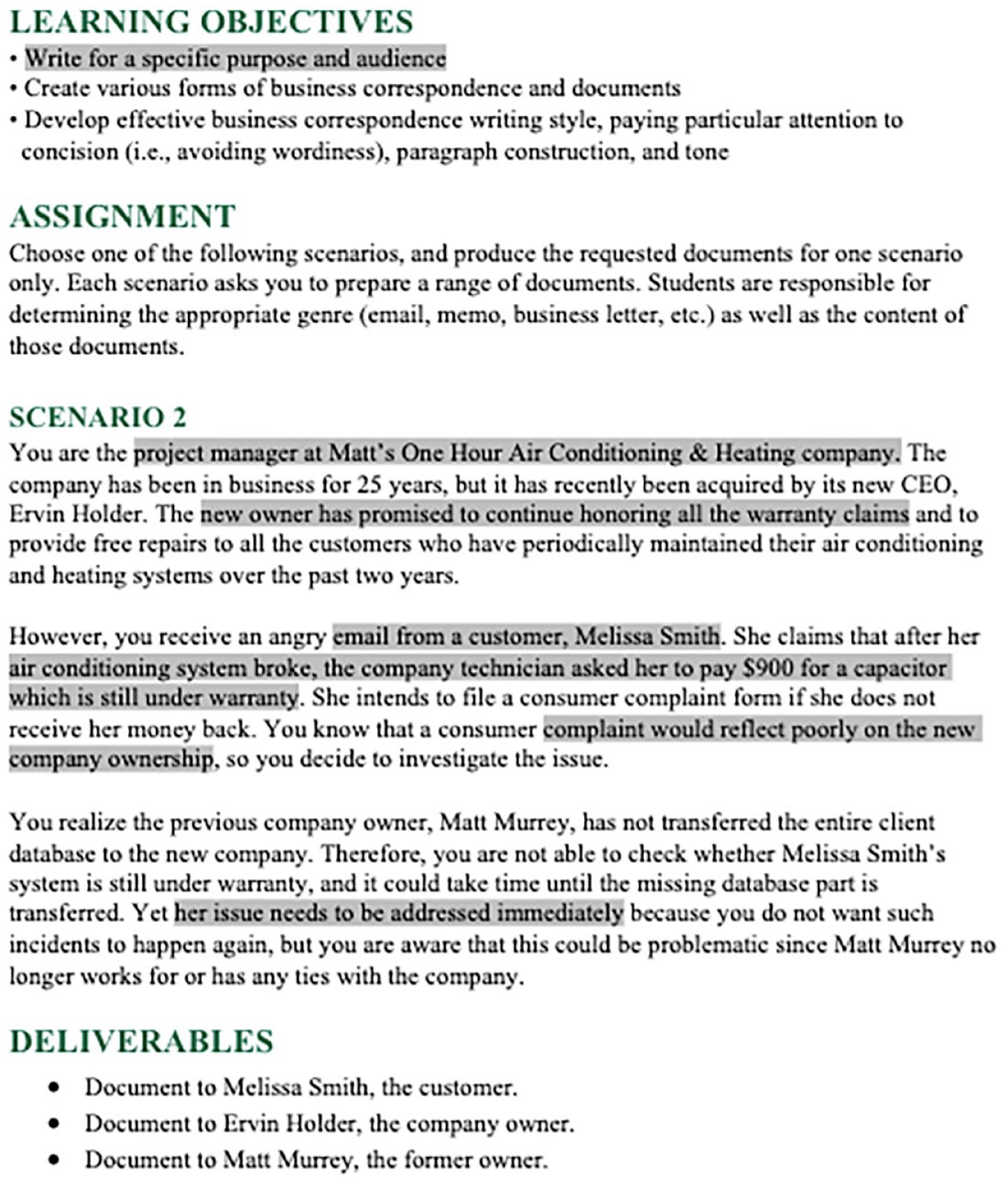
Assignment sheet with highlights that provide insights for the students specific to purpose and audience.
The highlighted portions visualize where the rhetoric SLO is actualized in the assignment, which helps to show a through line from abstract outcome to assignment design. We approached looking at the student documents by following our research question: Can we locate language that actualizes the rhetoric SLO in student documents? Understanding that purpose and audience are intimately linked, we sought to identify concepts that we felt would answer our question by demonstrating how students understood purpose and audience in context of the problem-based scenario. Research team discussions considered what would indicate a student’s awareness of rhetoric—purpose and audience—in the client document for the assignment and we determine the following four concepts:
• Purpose ○ A language awareness that states thank you for getting in touch and/or bringing the problem to our attention ○ An awareness that some action needs to be taken to address the problem
• Audience ○ A language awareness that offers an apology ○ An awareness to stand by the warranty or to maintain high levels of customer service
The language awareness associated with purpose highlight the need to communicate as an organizational entity, or what Debs (1993) referred to as the “corporate authority.” In this scenario, not only does the student need to recognize that they are part of the organization, but offering a thank you and promising action are two things that need to be said to make their clients happy or satisfied. The language awareness associated with audience focus on what must be communicated to retain her as a client. In other words, what does Melissa Smith need to hear to be satisfied (e.g., apology and a commitment to stand by the original warranty). While these four points were what we coded for as a way to trace the learning event, there is no set taxonomy for tracing rhetoric outcomes. These four concepts would change based on the assignment. Each of the three scenarios for this course all require similar moves around purpose and audience, but they are not the same moves. This is why we limited our examination to the same scenario because other scenarios would require different conceptual moves than the four we identified above.
Our research team’s goal was to identify some level of achievement toward the outcome, while also allowing students to interpret and write in a way that suited their own understanding of rhetorical awareness. That is, there is no single correct way to say thank you or to show the organization’s stance of standing by their service. This approach aligns with meeting students where they are and helps to ensure a more equitable and just approach to feedback and assessment.
Table 2 shows the breakdown of students who included moves toward the rhetoric outcome.
Concepts Included in Student Sample Final Documents (n=90).
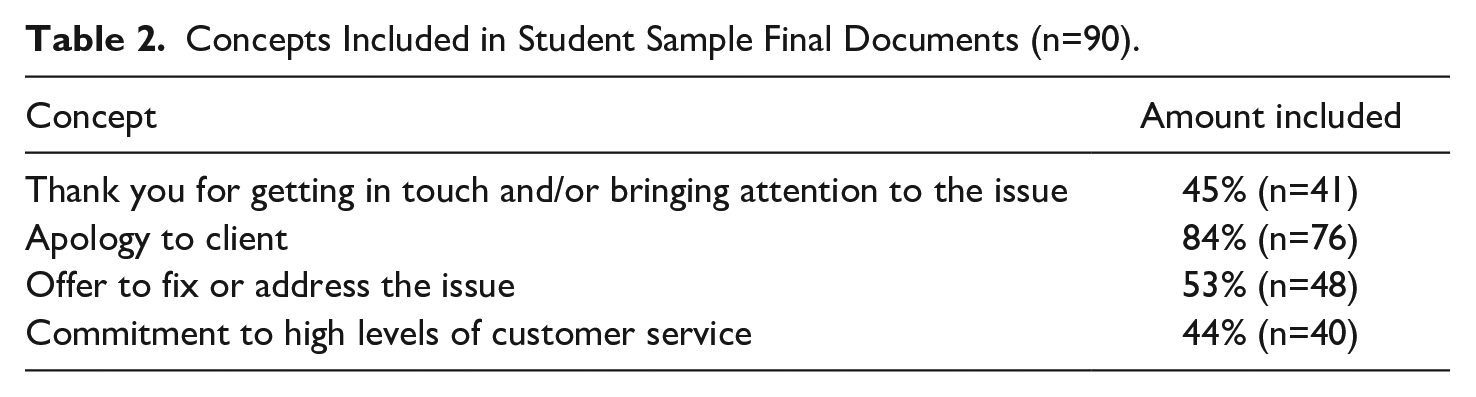
As Table 2 illustrates, 45% (n = 41) of students included a thank-you to the client for getting in touch. Meanwhile 44% (n = 40) of students emphasized their commitment to better service (e.g., hope we will “continue to see you as a regular customer”) and 53% (n = 48) suggested ways to correct the problem. Finally, the most successful instantiation of the outcome were students offering an apology, 84% (n = 76). Table 3 provides representative samples of successful student approaches to the four rhetorical concepts. The examples show the range of how the SLO can be achieved in different ways.
Representative Examples of Concepts Used in Student Documents.
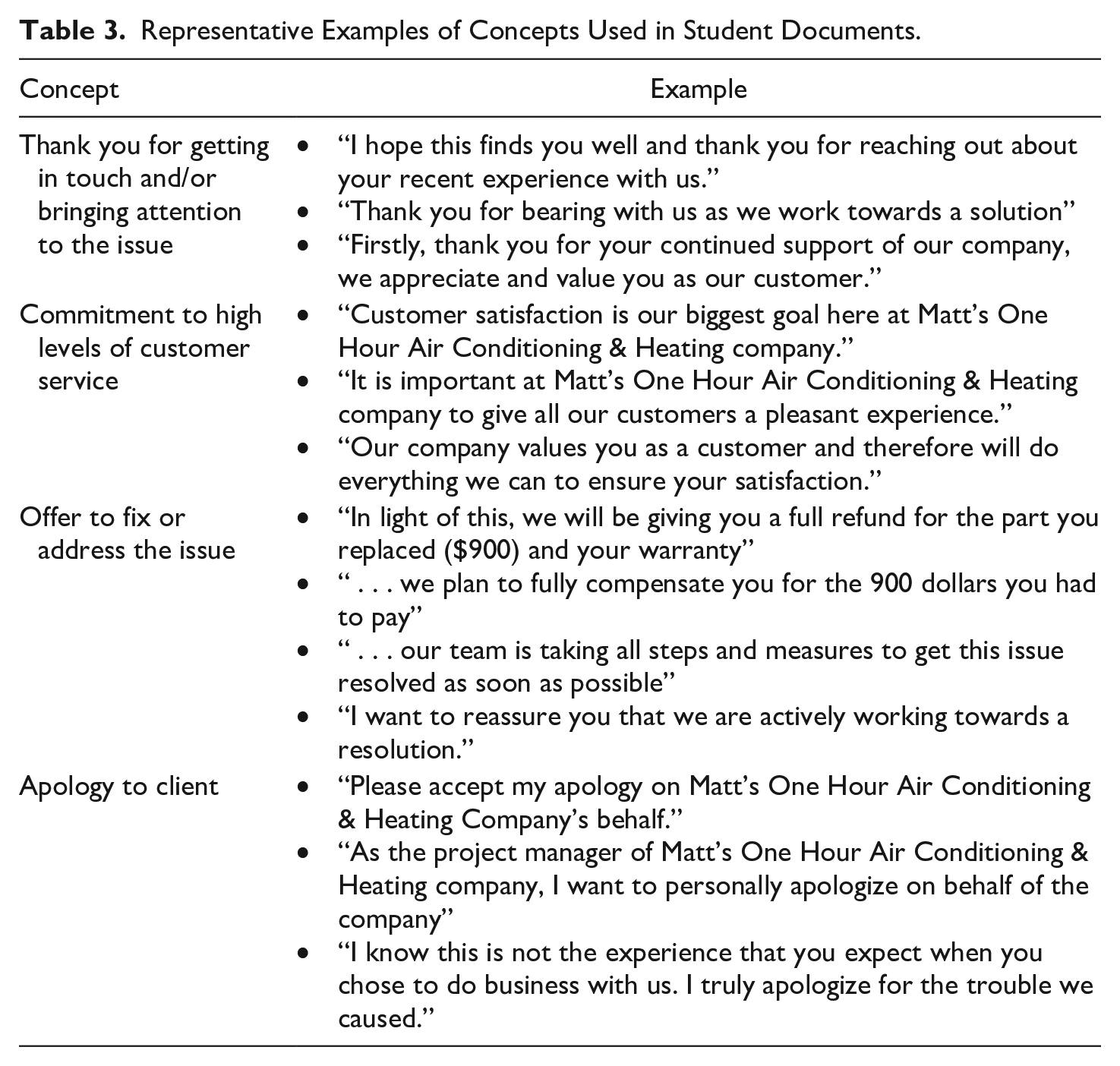
The data in Table 3 illustrate that there is no single way to respond to these scenarios. It was evident that students were able to recognize the need for an apology of some sort, but it brings to light the issue of only half of the students incorporating the other goals (thank you, fix the issue, commitment to service). In addition, there is a need to further explore new pedagogical approaches to improve this learning event, so that students continue to move toward their own understanding of the rhetoric outcome.
While each of the students in our sample tried to respond to the purpose and audience, only 18% (n = 17) included all four conceptual approaches to purpose and audience. Figure 3 is a representative sample of these students.
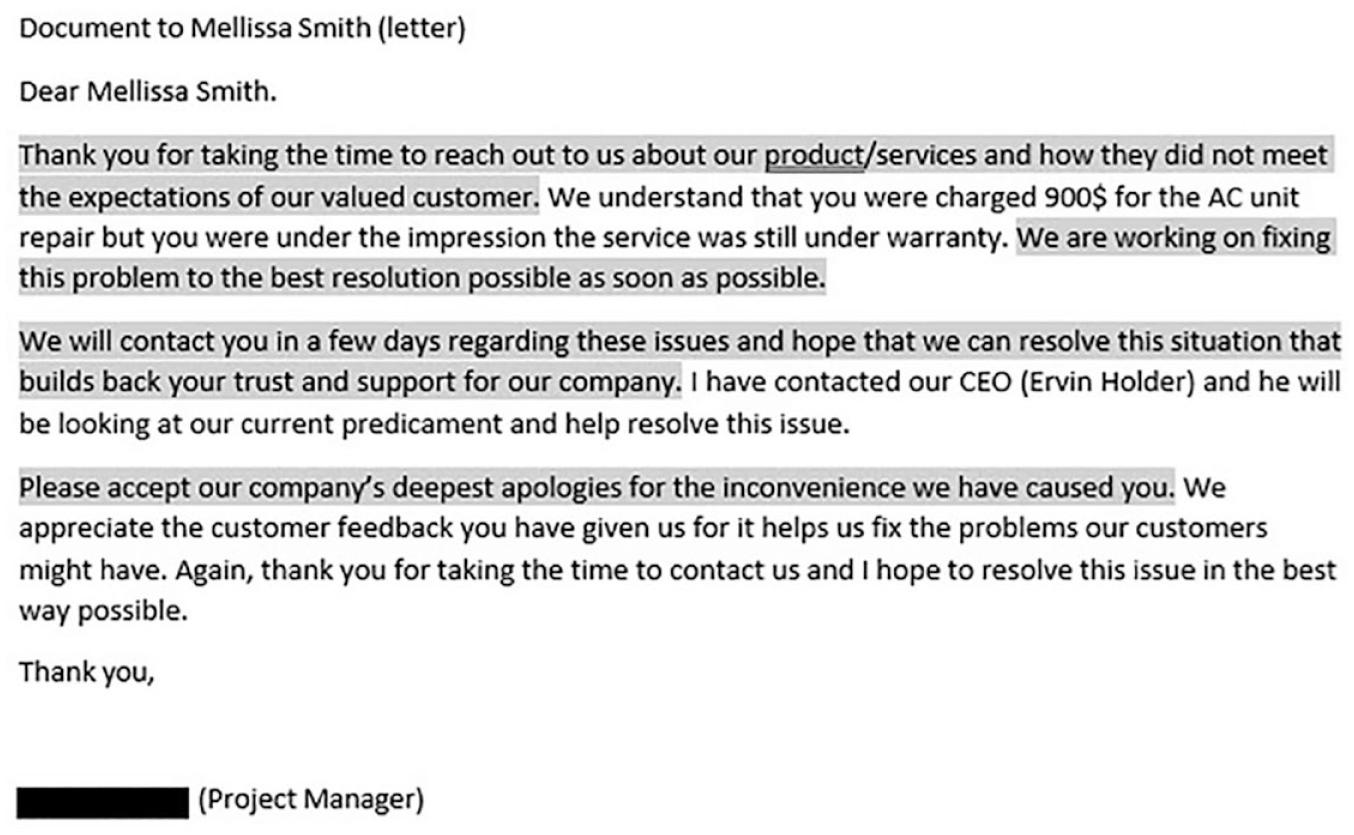
Sample student document that included all four categories.
Figure 3 is the full document to the client, and includes annotations of the four conceptual approaches.
When evaluating a learning event qualitatively, we also took note of examples where students included information that indicated a lack of rhetorical awareness, as seen in Table 4.
Missing Rhetorical Awareness in Student Documents.
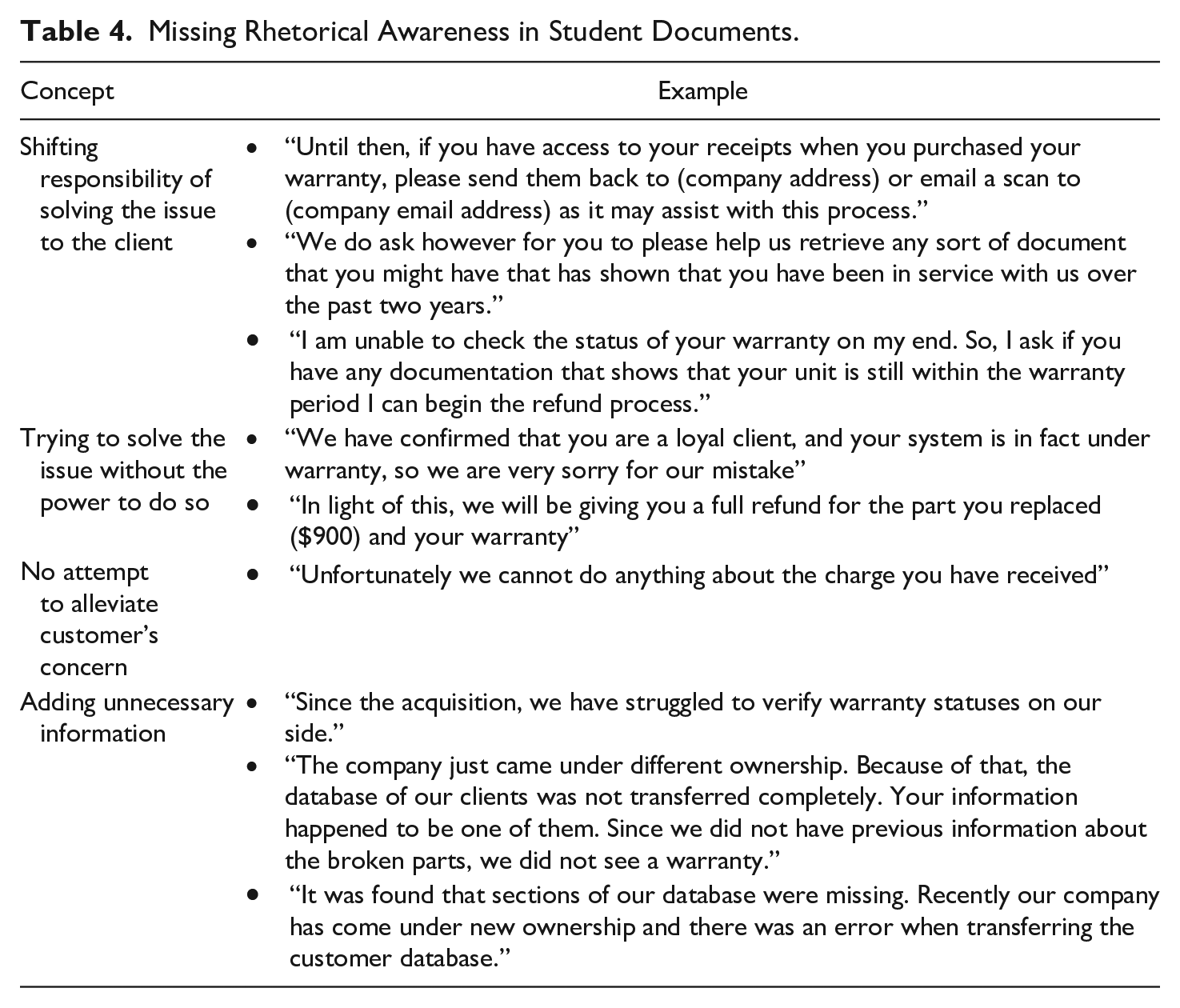
The student examples of shifting work responsibility to the client means that not only is the customer inconvenienced, but the communication they receive from the company makes it seem like it is the customer’s responsibility to correct the problem that they did not create. The second common theme of not having the organizational power to solve the issue suggests that students missed part of purpose because they did not understand the limitations of their role. Some of the documents did not even attempt to alleviate the customer’s concern, which signals that the student completely failed to develop even the most basic understanding of purpose and audience. Another common theme found in the student documents was when unnecessary information was added. These student examples indicate students did not fully consider the “corporate authority” and what clients would really need to know.
We were able to locate the rhetoric outcome in student work. However, our data show varying levels of student learning regarding purpose and audience. While the varying levels of success with the rhetoric learning outcome aligns with our programmatic goal of meeting students where they are, the data suggest that there is room to enhance student learning. The most obvious start is to stress revision strategies since so few students revised the document. In addition, our evidence illustrates areas for enhancing instruction. For example, students were better able to recognize the need to thank Melissa Smith for getting in touch and to apologize, but they were less able to demonstrate learning around the more complex parts of the scenario relating to correcting the problem and establishing goodwill.
How Does Faculty Feedback Articulate the Rhetoric SLO to Facilitate Effective Revision?
When creating CFs, instructors first select a category (purpose, audience, design, etc.) and then describe the issue in their own words. In this study, every instructor used both a purpose and an audience CF category when creating their feedback with 43% (n = 34) of total CF comments addressing purpose and audience. Between purpose and audience, comments were split evenly. However, when looking closely at instructor feedback, we noted some instructor confusion, including how instructors identified or mismatched the category for the rhetoric SLO; a use of generic feedback that would not help students revise to better address purpose and audience; and the use of misleading feedback. Table 5 provides representative examples of these issues.
Representative Examples of Issues in feedback.
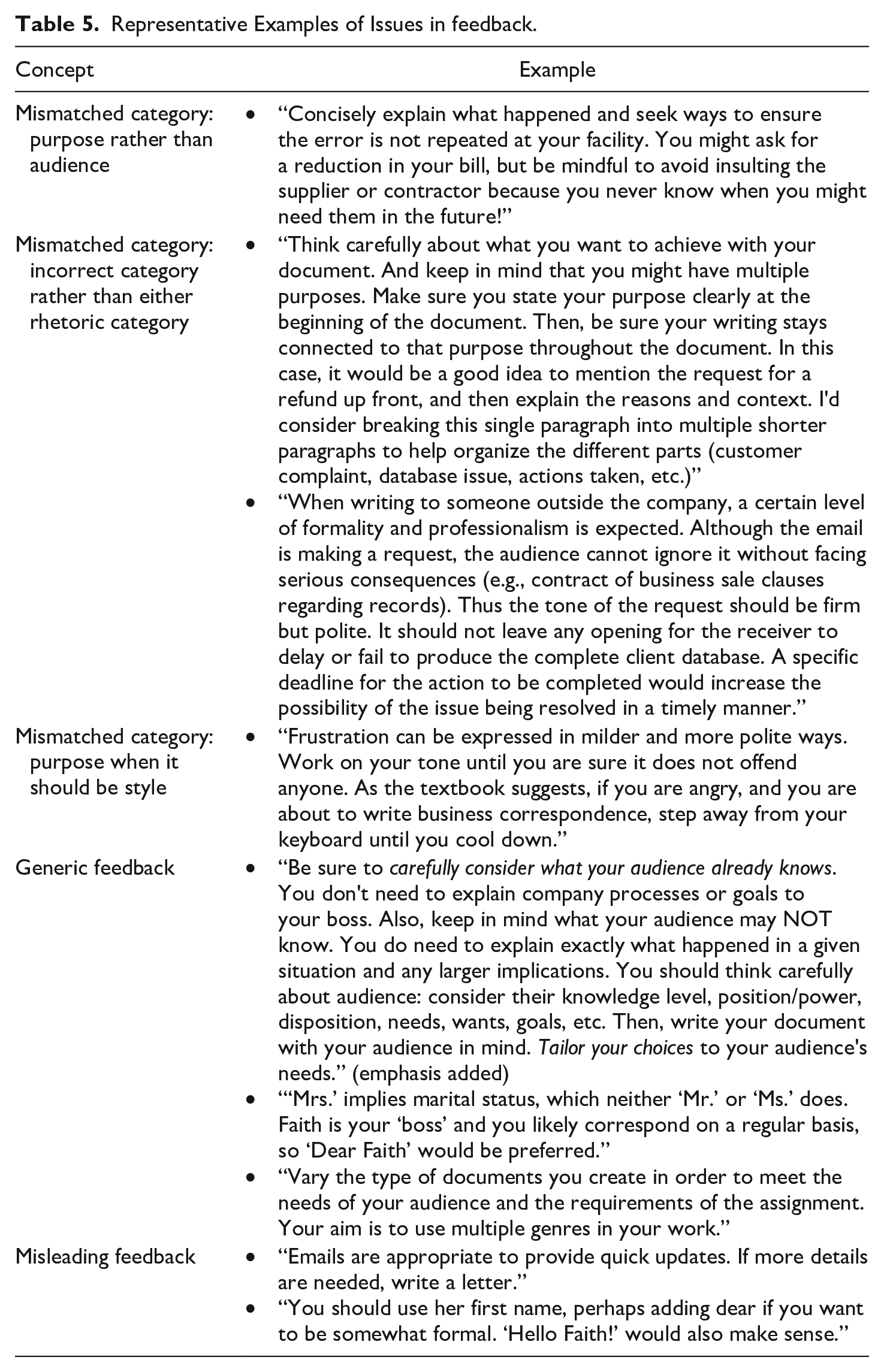
Mismatched categories obscure the connection between feedback and outcomes, and misdirects students in their attempt to revise. While generic feedback may on the surface look useful, it often does not include enough information to assist students’ learning. Without going further and explaining what it means to “tailor [their] choices to [their] audience,” simply telling students to “consider their audience” does not help them think through what an audience needs or understand how understanding an audience helps them achieve a document’s purpose. Generic comments about considering audience also fail to help students associate the critical thinking about audience and purpose with a clear explanation of what the outcome of purpose and audience may look like in their document. Instructors may need assistance in providing more detailed feedback rather than the general directives because the general or generic directives presuppose an understanding of rhetorical knowledge that students may not have. Misleading feedback illustrates a misunderstanding by faculty about the goals of the assignment. The misleading feedback is actionable, which is good on one hand, but because no rhetorical context is provided, the student may act inappropriately for the rhetorical situation.
Ultimately, these data illuminate the importance of effective feedback within the writing process, and its role in helping to move students toward revision. Feedback should be actionable and explicitly tied to outcomes as it serves a key role in facilitating a learning event. In the learning event process, feedback serves as a conduit between rhetorical concepts like purpose and audience and what those concepts look like in student work—that is, how students enact rhetoric in their own writing. To achieve these goals, it is the role of the instructor to observe rhetorical moves in student drafts and hone those moves. In the learning event, the instructor’s feedback should serve to identify rhetorical moves in the draft, connect them concretely to the rhetoric outcome and then provide guidance that helps the students make the connection between the concept and the writing they do in the draft. This is what we mean when we say feedback moves students toward effective revision. By observing the connection instructors make between outcome and action, students can think through the concept and apply it to their own specific writing situation. As feedback builds these connections, students enact the learning event as they move from draft to final deliverable.
Taking into consideration the role of feedback in facilitating the learning event, the significance of our research question—How does faculty feedback articulate the rhetoric SLO to facilitate effective revision?—becomes clear. Instructors appear to acknowledge the importance of providing feedback related to key rhetorical concepts of purpose and audience, which suggests that they know that explaining the rhetoric SLO is important. However, in examining our feedback sample, it is apparent that feedback sometimes falls short of achieving its core goal—to facilitate effective revision by building connections between the rhetoric SLO and student writing. Our evidence illustrates the ways in which inadequate, incomplete, or inaccurate articulation of the rhetoric SLO can disrupt the learning event process and render productive revision a challenge for students who may be unable to identify the rhetoric SLO, think through what it means, and then enact rhetorical moves in their own writing.
Implications for Pedagogical Practice
We offer three implications for pedagogical practice: being more specific about what rhetoric is and why it is important, designing clear assignments that engage critical thinking, and focusing on faculty professional development. These three ideas have been tested within our program, but they also can easily transfer to smaller programs or individual faculty. Each subsection will briefly define what it means and then move to explain how to implement it.
Enhancing the Teaching of Rhetoric
One of the implications of this program evaluation exercise was that it uncovered trends in the instructor data that would likely have been missed in traditional assessment. The instructor data indicated that there was an embedded assumption of what rhetoric is that seems to impede the teaching of it. This finding aligns also to our review of the literature. In some ways, rhetoric is difficult to teach because it can be seen as intuitive. A student or instructor can likely identify an audience by what they think they know about that audience, while issues of purpose often seem obvious (e.g., rebuilding goodwill after a complaint). However, when probed, audience and purpose often become more complicated than what is originally considered. If a key outcome in our business, technical, and professional communication classrooms is rhetoric, then getting students to become dexterous at analyzing purpose and audience and writing with that information in mind is paramount.
Program administrators and instructors need to start by ensuring a common definition of rhetoric and why rhetoric as a theoretical foundation is important to the work of writing and communication. This purposeful connection (Harris et al., 2019) between outcome and pedagogical practice assists students in learning the concepts, while also reminding faculty to make these connections. All instructors, no matter experience teaching or content expertise, can use a reminder to define common terms and explain their importance. The instructor feedback often lacked a clear connection to the purpose of revision, which is how our study complements the findings of Doan (2022). Her study revealed that instructors often approach the service course by “introducing students to rhetorical terminology such as audience and framing information and genres that students could transfer to other contexts” (Doan, 2022, p. 29), but a problem arose when she found that “reducing rhetorical terminology to understanding audience or audience analysis diminishes students’ opportunities to gain experience with how genres work in situations with competing moral or ethical exigencies” (p. 34). Doan’s participants failed to make connections for students that uncovered the depth and nuance of rhetorical exigencies in many writing situations, and we would argue that the same issues are affecting the instructors in our program. The need to uncover assumptions and make purposeful connections pedagogically is a key factor in helping instructors and students approach teaching and learning around rhetoric.
Purposeful strategies work toward meeting students where they are and helps move them toward long-term student learning and transfer of ideas. While readers have likely heard similar things and attempt to practice it in their classrooms, recent research identifies the main barrier to students’ academic success being the teaching style of the professor—specifically, the way expectations are communicated to students (Flaherty, 2023). Clear expectations do not simply mean explaining what is expected in the course, but more so, taking larger concepts, breaking them down into manageable pieces, and fully explaining them to help students build on and transfer their knowledge. The rhetorical goals of the first assignment are meant to transfer through to the latter stages of the course.
Other than encouraging faculty to make purposeful connections, we offer two additional approaches to teaching rhetoric more effectively. In much the same way as we have tried to explicate the learning event throughout this essay, we do similar work with the faculty in our program by asking faculty to locate the SLO in student work. This exercise helps to uncover the main goals of the assignment and to illustrate in concrete ways where learning is occurring (or not). Many assignments have multiple outcomes, but some outcomes are more important than others. In the assignment discussed here, the rhetoric outcome was the primary focus because this SLO is needed for subsequent assignments. If instructors understand what the outcome looks like in practice, they can gain a deeper understanding of their role in the learning event. Secondly, we ask that instructors go back to the beginning of their own understanding of purpose and audience. We have found success using the following exercise with instructors, which they can then use in their own classrooms.
• Describe what you know about you students, like who they are, what they value, what they may expect from the instructor.
At the most fundamental level, this simple prompt helps instructors begin to see what rhetoric may look like in practice. That is, in considering what instructors may know about students make concrete audience characteristics that can inform a specific purpose. This same sort of exercise for instructors in a program can be used in the classroom to help students think through the layers of audience and purpose.
Improving Assignment Design
Program evaluation and its emphasis on examining each aspect of the learning event exposed a weakness in our assignment. As the literature review section uncovered, the scholarship on rhetoric and pedagogical practices does not directly address assignment design, which is problematic because “assignments reflect the values of their designers and assignment designers uphold the values of TPC as a discipline” (Zarlengo, 2019, p. 22). One way that the values are exposed is through the SLO, which, as noted above, is referred to at every phase from program design to assignment design. Based on our data, both instructors and students seemed overwhelmed by the complicated nature of the Matt’s One Hour Heating and Air scenario (refer to Figure 2).
We realized the information about the previous CEO, Matt, added unnecessary complexity. Instructors were unable to accurately identify purpose and audience, while students were unsure how to use the facts of the scenario to accomplish the purpose of the correspondence to the audience’s satisfaction. To simplify the scenario, we removed Matt, the former CEO, from the scenario, making the problem with the customer database an internal technical issue. This edit moved the central problem in-house and under the purview of the author-student, thereby allowing the students to focus on the question “What does the audience want?” In this case, Melissa Smith wants an apology, and more so, she wants to know that her warranty will be honored. It is in assignment design that a bridge is built between what instructors understand about the goals of the assignment and how students interpret the task because “not all students are comfortable with the same level of detail, or perhaps with making decisions about which details are most important or what to do with the details, causing them to experience difficulty when writing to their audience” (Robles & Baker, 2019, p. 201). It falls to the instructor to facilitate connections between audience motives and communication purpose. However, as we learned with our own evaluation, our assignment was too complex.
We offer some general suggestions on how to design better problem-based assignments. The problem-based scenario must align the outcomes with what the learning event may look like for students. One can look for ideas from current events, experiences you’ve had, or updated historical examples. After the idea is generated, then comes time to consider the role of the student. A good problem-based scenario provides a context, but students provide the action or solution. When composing the scenario, think about the role of the student/author and what they need to do based on the SLOs of the assignment. Make sure they have sufficient authority and an appropriate position to enact the change or solve the problem at the core of the scenario. This means that they need to act in likely an entry-level position, to be part of a larger team that has a clear supervisory structure or to function in a role they completely understand (e.g., student, member of a club they belong to, or activist). Thinking through what could represent the outcome in a student document, much like our coding categories for purpose and audience, helps to create a stronger assignment. All details necessary to compose the communication should be included in the scenario such as who is involved and what happened. Students should not have to make up the details required to generate the correspondence or deliverable they develop. This means people, product, and organization names need to be provided. Finally, we would add the following tips:
• Provide structure but do not make it too prescriptive: only one course of action is indicated by the scenario—students should need to think critically to make decisions.
• Be specific: the scenario should focus on a single problem/event. Too many details obfuscate the core issue or problem. Too few details hinder the course of action because there is not enough information to understand the implications of the problem or actions that could be taken to enact a solution.
• Make it realistic: the events/circumstances in the scenario would not realistically happen in that context or to the people involved.
• Keep it focused: the problem should be easily identified as arising from a direct event or circumstance. Multiple factors contributing to the problem makes the scenario too complex.
Since service course students come from different disciplines, students will be going into highly varied workplace environments. Service course assignments should prepare students to write in any number of work-related contexts in a work world that does not yet exist. But a rhetorical foundation that enables students to understand purpose and audience will remain necessary no matter the workplace or the work.
Focusing on Faculty Professional Development
Since faculty are key to student learning and the learning event, understanding the faculty landscape to include who is teaching and what knowledge they bring to the classroom is important. As suggested by the data and highlighted by the first two implications, focusing on ways to reflect and improve pedagogical practices remain necessary. Thus, our last implication is an explicit call for more attention to professional development for faculty.
Research tells us, however, “for most college instructors, regular participation in their teaching development is neither a workplace expectation nor a professional obligation” (Haras, 2018, n.p.), but research also tells us that professional development is necessary. Education scholar Adrienne Kezar, who has spent her career examining faculty working conditions, and her collaborator Dan Maxey (Kezar & Maxey, 2015) noted, “All faculty members need professional development to stay vibrant, productive, and knowledgeable” (p. 42), because “there is an incredibly strong connection between faculty and their ability to support student success” (Kezar, 2020, n.p.). One segment of faculty who consistently ask for professional development opportunities to support student learning is contingent faculty. (e.g., Mechenbier et al., 2020; Melonçon, 2017).
We focus specifically on contingent faculty because business, technical, and professional communication service courses rely on contingent faculty (Melonçon et al., 2020; Moshiri & Cardon, 2020), with 87% of technical and professional communication service courses being taught by contingent faculty (Melonçon & England, 2011). This percentage is close to that of our instructional pool for the study period where we had 84% of sections taught by contingent faculty. Of the 33 faculty who taught during the study period, only 4 have expertise in technical and professional communication through a degree or extensive workplace practice, and for the 9 instructors in the study, none have expertise. What the data on contingency tells us is that many instructors would not meet the preferred qualifications for someone to teach business, professional, or technical communication if a national search was conducted (e.g., Ashe, 2010; Mechenbier et al., 2020), which is also validated by the contingent faculty’s own self-identification. For example, research found 45% of those teaching TPC service course programs do not consider themselves TPC scholars/teachers (Mechenbier et al., 2020, p. 77). This self-identification impacts the learning event because faculty may not feel confident with the content knowledge. As one of our faculty members expressed, “Obviously, the more I learn about PTC as (inter)discipline, as field, as writing with its own expectations, etc. the more effective my instruction becomes; my growing comfort level means I’m able to provide the pedagogical support for my students and the necessary formative and summative feedback to help them learn and work toward achieving outcomes.” For those instructors without deep content knowledge of technical and professional communication, complex assignments make it difficult to reinforce the most important aspects, such as rhetoric. Professional development needs to be authentic and connected to practice (Webster-Wright, 2009) and to the knowledge of the field. As noted above, we highlighted how to potentially enhance teaching rhetoric. Other topics to cover might be improving feedback strategies or how to teach revision more explicitly. For any topic, the how-to needs to be connected back to the why, which is directly connected to knowledge of the field. Administrators and all faculty need to be committed to reflection specific to improving the learning event, which includes faculty and their knowledge about the course’s content.
Conclusion: Moving Forward
Even though business, technical, and professional communication has used rhetoric as a key component of pedagogical approaches, scholars have little research that examines how well students are learning rhetorical principles. Using a set of student drafts and final documents alongside instructor feedback, we worked to uncover the learning event and answer two research questions: Can we locate the language that actualizes the rhetoric SLO in student documents? How does faculty feedback articulate the rhetoric SLO to facilitate effective revision?
We could locate evidence of the rhetoric SLO in student work and also see how faculty provided feedback on that same SLO. Further, our program evaluation showed us that we needed to revise the assignment because neither instructors nor students were fully succeeding at achieving the rhetoric outcome. The data also suggested three ways to improve pedagogical practices, such as being more specific about what rhetoric is and why it is important, designing clear assignments that engage critical thinking, and focusing on faculty professional development. Program evaluation allowed us to gain deeper and more meaningful insights about the actual learning event from both student and instructor perspectives. This sort of deep programmatic reflection can be painful (R. Johnson, 2004) because too often, administrators and instructors make broad assumptions about what may be working or not based more on intuition and experience rather than actual practice and evidence. Evaluation and reflection that is a data-driven, recursive process enables opportunities to find out in specific ways what is working and what is not and then plan ways to implement changes, even when those changes mean going back to the basics.
When Maid and D’Angelo (2012) argued that rhetoric was an über-outcome, they rightly posited that it influences other outcomes. We agree that advancing students’ understanding of rhetoric through purpose and audience and meeting them where they are is paramount for the service course. One of the strengths of our programmatic evaluation is that we are unafraid to reflect and to acknowledge when something is not working. By focusing on the learning event, we have shown a way to uncover teaching and learning that can be implemented in other locations at the program or individual course level. If we must go back to the basics to improve teaching and learning, then going back means moving forward.
Footnotes
Declaration of Conflicting Interests
The author(s) declared no potential conflicts of interest with respect to the research, authorship, and/or publication of this article.
Funding
The author(s) received no financial support for the research, authorship, and/or publication of this article.
