




Abstract
Job interviews require applicants to demonstrate two things: experience with direct value to the company and a fit with the team and company culture. A technique is detailed demonstrating how to develop this argument based on aligning credentials with corporate interests, developing advocacy-based themes, and synthesizing material into a convenient study guide. Designed for instruction in either the college classroom or corporate training center, the approach provides professional communication students with a unique, practical, and personally meaningful learning exercise assessing rhetorical situations, examining rhetorical constructs, and delivering persuasive arguments.
Professional communication textbooks often include discussion about the structure and substance of resumes—how to format them, the language to be used, and the information to be included. In comparison, there is relatively little discussion regarding the means of effectively preparing for the interview that may ensue. Rather, discussion, when provided, tends to concentrate on some variation of a limited number of preparatory activities: researching the company; studying the job description; and reviewing the substance of the candidate’s resume.
As for advice concerning the actual interview session, prospective job candidates are commonly encouraged to practice responding to (or even memorizing answers for) an alleged suite of commonly asked interview questions. And should the candidate be in doubt regarding what those questions might be, numerous articles propose anywhere from a dozen to well over a hundred possibilities.
Clearly, scripted responses and review of resumes have merit. However, they lack the appreciation and benefit gained by applying basic rhetorical principles that can be used to transform the interview into a session in which the candidate delivers a persuasive, substantive, and cohesive basis for selection. By presenting interview preparation as a framework for interpreting rhetorical situations, conducting a disciplined rhetorical analysis, and formulating cogent oral arguments, we can—whether in an academic or corporate setting—engage our students in a practical exercise that is unique and individually relevant. Whether our students are approaching the point at which they will be interviewing for their initial entry into the workforce or are seasoned professionals anticipating opportunity to pursue corporate advancement, the prospect of interviewing is a commonly shared experience.
Accordingly, redefining the practice of preparing for a job interview as a professional communication exercise introduces students to a real, personally meaningful demonstration of how rhetorical principles can be translated into the production of a powerful and sustained oral argument.
The Rhetorical Construct
The starting point for this lesson is explaining to students how, at heart, the activity of participating in a job interview follows a basic rhetorical construct. Namely, the elements of the interview, the exchange between interviewee and interviewer, are representative of the attributes of essentially all oral arguments and all deliberative rhetoric. The interview comprises
A rhetor—the job candidate, with responsibility to determine the message, the information presented, and the means of its delivery, An audience—the interviewer, who represents the company and is charged with ascertaining the candidate’s suitability for an advertised position, A topic—establishing the alignment between and applicability of the candidate’s experiences and credentials and the needs specified in the company’s job posting, A purpose—the candidate’s intent to demonstrate that particular relevance of experience along with a case for differentiation from other applicants, and A context—the final setting for an exchange between the candidate and a company representative.
Given this correspondence between the interview session and other forms of oral argument (e.g., presentations), it is reasonable that the same rhetorical principles and techniques apply in this context as well. Yet, the paucity of attention paid in the literature to rhetoric as a factor in job interviews suggests that the relationship and the opportunity it represents as an educational tool have gone largely unattended.
Rather, the limited scholarship regarding rhetoric as applied to job interviews has focused almost exclusively on delivery. Representative of this orientation, in perhaps the most extensive examination of rhetoric in conjunction with the job interview, a 2021 article in the International Journal of Academic Research in Business and Social Science surveyed how students expressed themselves during the interview. Describing performances in terms of Aristotle’s rhetorical theory, the researchers’ conclusion generalized that “the utilization of ethos, pathos and logos can offer a precise means of expressing vital information regarding a candidate that can support their employment process.”
As was the case with the scripting of answers to commonly asked questions, the insights provided in this study have clear value. Also as was the case with memorizing responses, in these discussions minimal attention has been assigned to the substance of the argument. Yet, the persuasiveness of the argument—not just attention to modes of expression or scripted answers—remains the central factor in determining a candidate’s success. In any argument—essentially any instance of deliberative rhetoric such as in a job interview—decisions are reached primarily based on portraying credible themes, assigning convincing evidence, and outlining a well-structured argument.
As such, in examining the rhetorical challenges of a job interview, we have a unique opportunity to demonstrate to our students the balancing of matter and style; to provide professional communication students—whether in the college classroom or the corporate training center—substantive insights into the real-life applicability of the tools, principles, and techniques we teach; and to offer practice in assessing rhetorical situations, conducting rhetorical analyses, and constructing persuasive oral arguments.
The Rhetorical Framework
The first step in this process is to have students isolate how basic rhetorical principles and structures of argument are at work in a job interview. Although various approaches to this analysis might be taken, the correspondences between the job interview and the elements and practices described in Cicero’s De Inventione—presenting oral arguments, balancing matter and style, examining the context for the presentation—make it an effective means for and a natural choice by which to have students explore the roles of rhetoric in this particular medium.
With the exception of needing to gain the audience’s attention (exordium), which is inherent in the interview logistics, constructing an effective and purposeful argument in a job interview (and hence in its associated preparation) can be readily explained using Cicero’s modeling of the rhetorical situation. Accordingly, after classroom discussion of what makes for a successful job interview, we cast those insights in terms of Cicero’s framework.
As the discussion sums up the process of interviewing, the applicant’s pronouncement proceeds from demonstrating a knowledge of the company as addressed in the posting and amplified by preinterview research (narratio) to establishing the individual’s contentions for selection (partitio). To be successful, accompanying these assertions, the candidate expands on the supportive reasoning (conformatio) and, in so doing, addresses any shortcomings in credentials while, at the same time, highlighting strengths that establish differentiation from other applicants (refutatio). And, ultimately, seeking to close the deal, the interviewee coalesces the lines of argument into a clear summation establishing unparalleled readiness to assume the assignment (peroratio).
Having arrived at this understanding of the rhetorical situation, attention turns to discussion of the attributes of persuasive oral arguments. To examine the essence of argument, we again rely on Cicero’s De Inventione.
In arriving at conclusions about the structure of oral argument, students are introduced to and discuss the five factors delineated in Cicero’s De Inventione, a construct that remains applicable whether arguing a case in the courts as was Cicero’s focus, pursuing a first job, or making the argument for promotion. As Cicero succinctly explains: Invention is the discovery of valid and seemingly valid arguments to render one’s cause plausible. Arrangement is the distribution of arguments thus discovered in proper order. Expression is the fitting of proper language to the invented matter. Memory is the firm mental grasp of matter and word. And delivery is the control of voice and body in the manner suitable to the dignity of the subject matter and the style.
Responding to this synopsis of the rhetorical situation might at first appear daunting to students as compared with an approach relying on preplanning answers to commonly asked questions. Yet, meeting this challenge, as they are shown, requires the same approach as should be familiar to students of professional communication. Namely, the rhetorical challenge demands an argument characterized by six attributes:
A set of themes of consequence to the interviewer,
A cohesively structured argument built around the established themes,
Claims and evidence purposely selected based on strength added to the assertions,
Lines of argument that are aligned with and support the flow of the interaction,
A presentation and delivery that complement the argument, and
A strategy that addresses all principal factors affecting acceptance of the proposition.
Stated in terms of the job interview, this understanding of the rhetorical situation, the structuring of oral argument, and the mastery of delivery are the factors that position the candidate to present the most sound, most substantive, and most cogent arguments in response to the three overarching questions that, as noted earlier, determine selection:
Is the candidate a good fit—technically and with company culture?
Will the candidate’s experience and expertise add substantive value to the company now and in the future?
How well will the candidate perform within the proposed parameters of the assignment (e.g., budget, staffing) and in the company environment (e.g., deadlines, politics)?
Answering these questions while tailoring the conversation to provide the strongest possible advocacy results from replacing a conversation composed of answers in isolation that the interviewer is left to assemble into a comprehensive picture with a tailored, convincing, cohesive argument for selection. Somewhat analogous to drafting a proposal the candidate might submit were this effort focused on pursuing a subcontract with the company rather than pursuing a position, the presentation must project a solid understanding of the company’s current situation, put relevant capabilities and experience in context, and establish a strong image of substantive and achievable contributions worthy of the company’s investment.
In practice, this objective means teaching students to take control of the discussion. It means creating opportunity to demonstrate appreciation of the company’s circumstances, its immediate and emerging challenges. It means teaching students to rely on a thematically organized presentation of credentials and potential contributions, contributions bolstered by the ability to articulate a substantive degree of equivalency between previous accomplishments and projected successes.
It means having students recognize, as Cicero summarized in the Topica, “The end of a deliberate speech [or in this case, a job interview] is advantage.”
It means reliance on a rhetorically based preparation methodology that has heretofore gone unexamined in the academic literature and has been absent from the college and corporate classroom.
The Interview Preparation Process
In keeping with the basic principles of oral arguments, the preparation process entails 10 tasks that for the purposes of instructing students can best be explained in terms of five modules:
Parsing the posting
Aligning credentials
Tailoring the research
Formulating interview themes
Planning the delivery
Before beginning the instruction, two considerations are explained to the class: (1) The process elements and the associated tasks can vary in sequencing and effort based on a candidate’s degree of experience in equivalent positions; familiarity with the prospective company and industry; perceived areas of strength and weaknesses; and the level of detail provided in the job posting. (2) For the purposes of illustrating the methodology, an actual job posting for a midlevel business manager at an international construction company is being used.
The reason for selecting this particular job posting is fourfold. First, job postings for positions at this corporate level tend to provide a level of detail that allows for a wide-ranging class discussion about aligning credentials and developing themes and claims. Second, this corporate level is an aspirational target for many students in both university and corporate professional communication courses. Third, choosing a popular industry and a job with diverse responsibilities allows increased student identification with key aspects of the scenario. Fourth, selecting companies, industries, and occupations that can be readily researched and with which students are often generally familiar tends to enhance discussion—allowing students to compare preparation strategies and introduce personal perspective. Equally important, choosing a well understood profession reenforces acknowledgement of the relevance of the principles, reasoning, and mechanics being examined. Figure 1 depicts the common sequencing of the 10 tasks.
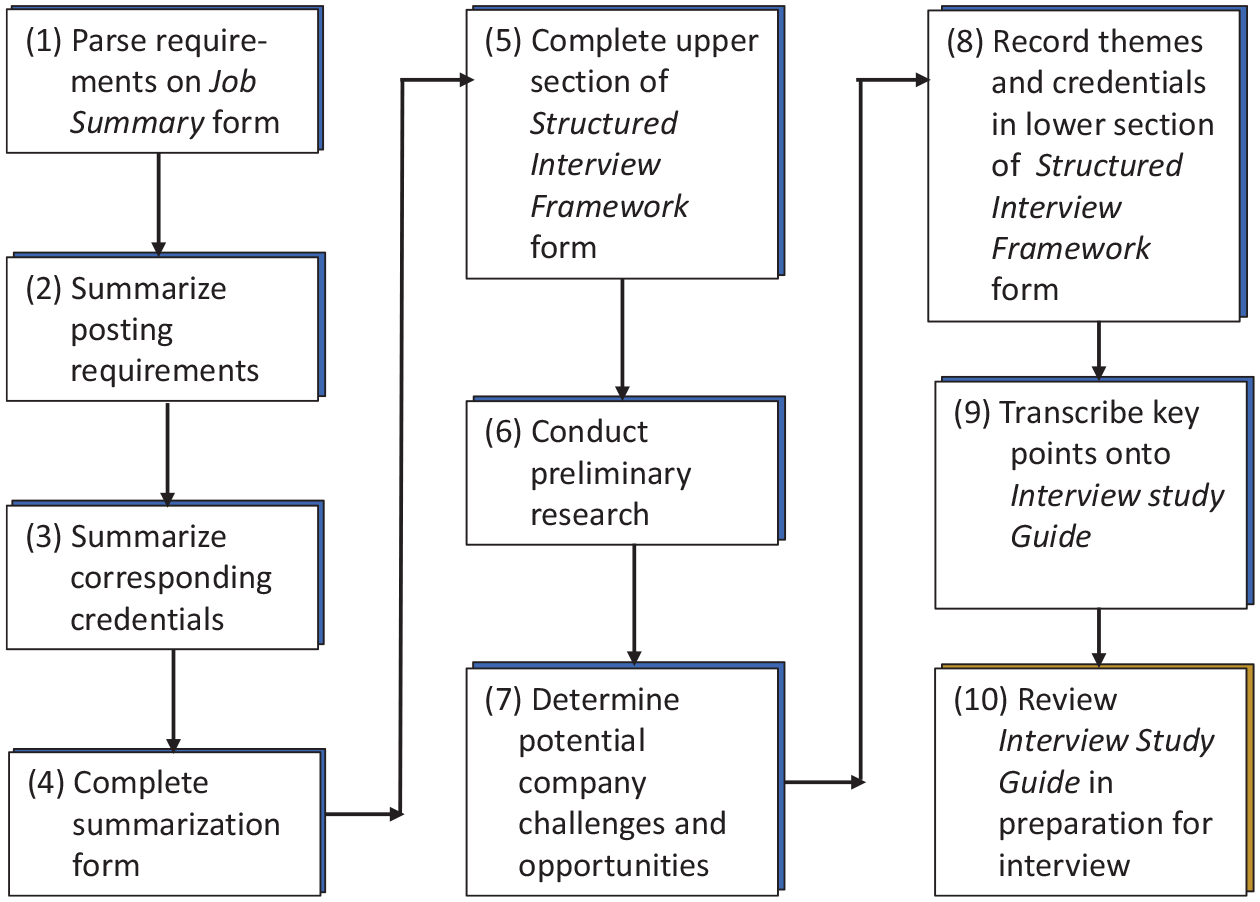
Interview preparation sequence.
Parsing the Posting
As a first step, students are taught to parse the job posting into four components: (1) details pertaining to the actual work to be performed; (2) information about the company and the assignment’s positioning within the company; (3) expected personal attributes (professional behaviors and work ethic); and (4) educational requirements.
The reason for clearly segregating each of the four components is to ensure students attend to all facets of the job. It is not good enough to focus exclusively on the applicant’s strengths given the fact that job descriptions rarely make evident which factors are of greatest significance or what characteristics will be most likely to differentiate an individual from the competition. Table 1 shows the form used to illustrate the parsing of the Business Manager job posting.
The Detailing of a Typical Job Posting.
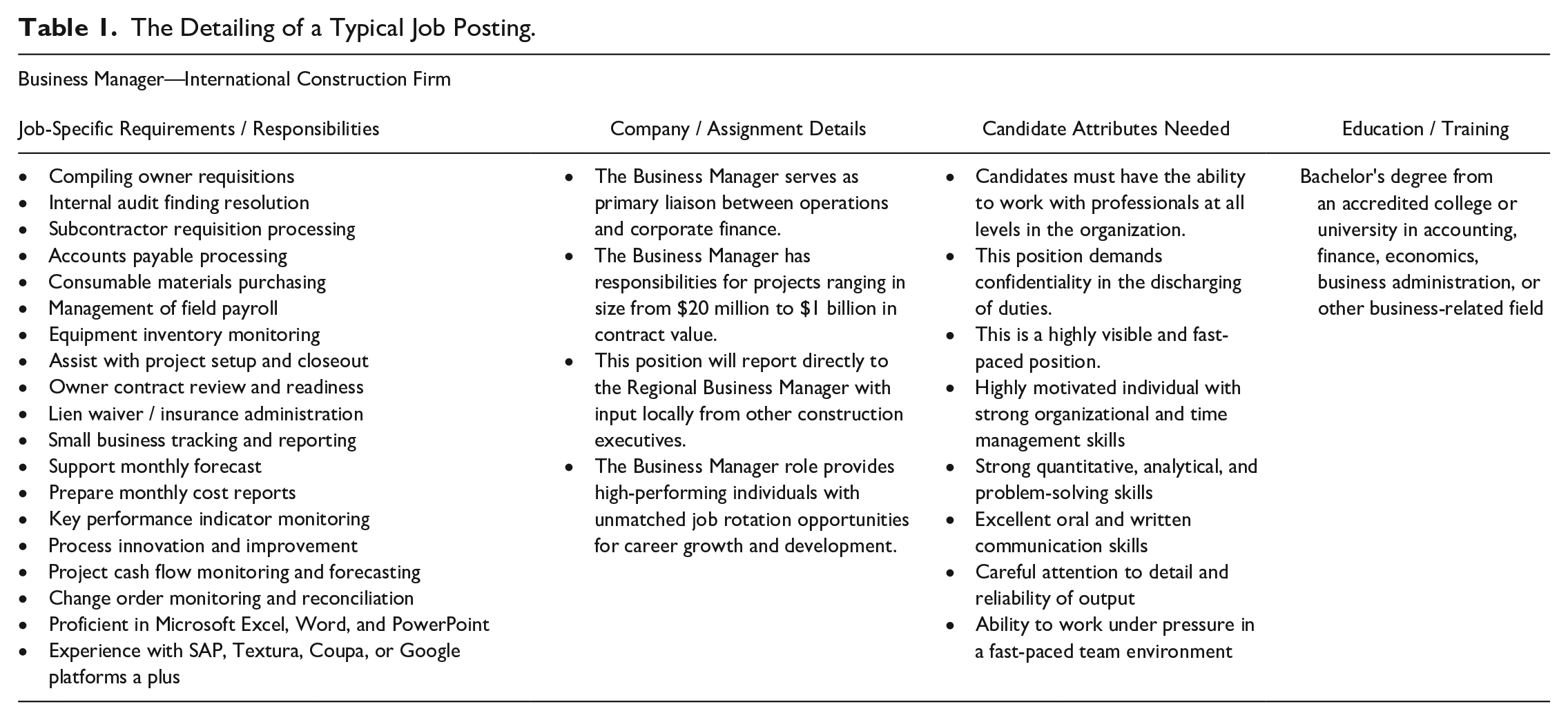
As indicated to the class, once completed, this form remains a reference for the remainder of the interview preparation process, used to confirm details regarding job requirements and expectations. This detailed capture also allows confirmation of the terminology used—as might be the case, for instance, if there was need to verify whether the posting had stipulated the monitoring of “socioeconomic performance” or the “performance of disadvantaged businesses.”
The value of having parsed the description into four distinct components (job functions, corporate details, performance expectations, and academic preparation) becomes readily apparent to students as we enter the next module: selection and alignment of credentials.
Selecting and Aligning Credentials
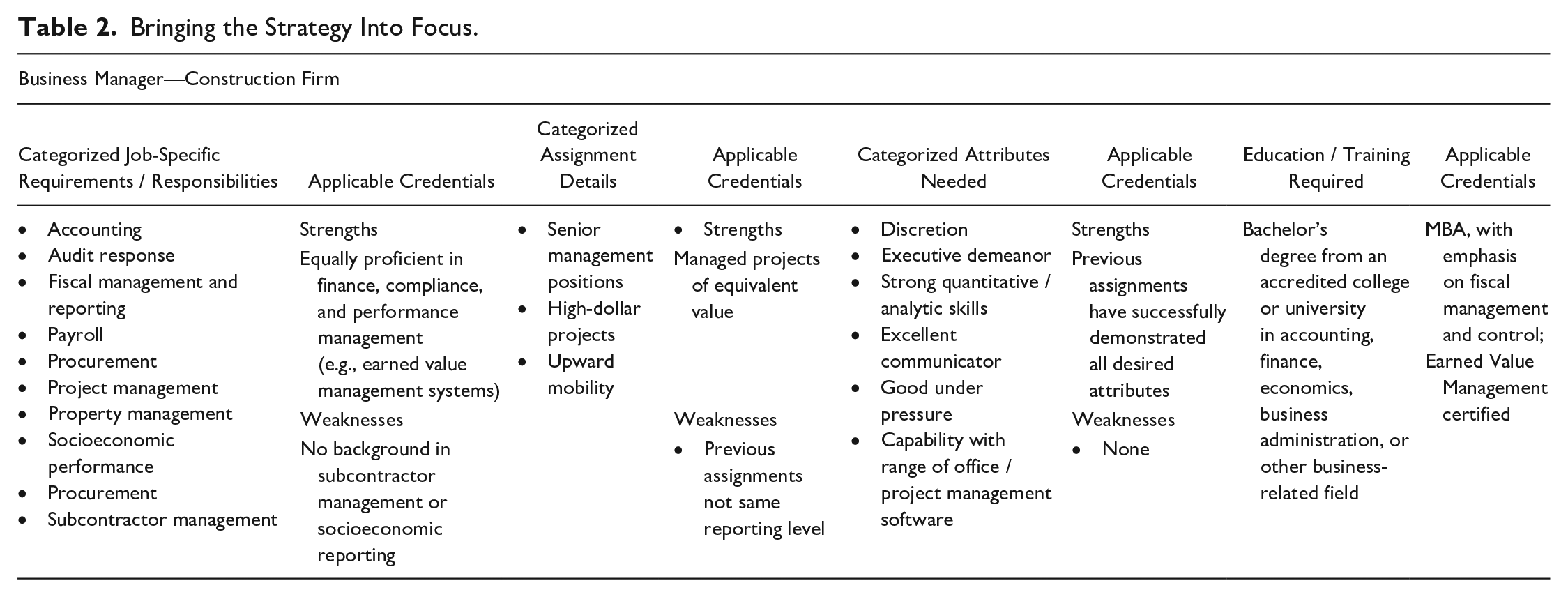
Aligning credentials is illustrated as a two-step process. On a second form, information is displayed using the same four columns as on the first form. However, the verbatim transcription in the first form is replaced by a summarization of requirements. The change in specificity is intended to reflect a wider band (e.g., an academic discipline as opposed to a specific specialty) by which to ascertain the relevancy of credentials and to facilitate fashioning correspondences and equivalencies between previous assignments and the advertised requirements of the posted position.
In addition to this summarization of requirements, an additional column is added adjacent to each of the four columns. These additional columns are used to summarize the candidate’s corresponding strengths and weaknesses. The rationale for summarization here is twofold: (1) The interviewer already has the resume. Therefore, rather than preparing to quote the resume, emphasis is on establishing context and characterizing evidence in terms of applicability and significance. The objective is not to repeat but rather to delineate precisely how examples add to the overall strength of the argument for selection. (2) The single goal at this point in the process is promoting a vision for the interviewer: not how impressive past performance might have been but, rather, how impressive a performance the applicant is prepared to deliver. Table 2 shows the completed summary form for the Business Manager position.
Bringing the Strategy Into Focus.
Tailoring the Research
Having completed the two forms, the next step is to conduct research that can provide further context to the lines of argument. As is evident, this is a step at which the process for students in a college classroom versus the process for attendees in a corporate training program diverges.
For candidates pursuing a new assignment within a company, researching is achieved principally by soliciting information from coworkers, reviewing company documents (e.g., procedures, policies, strategic plans), and considering generally known information about corporate performance and challenges.
Yet, even in a corporate setting, modeling the process—instructing students on it—using an external candidate (our Business Manager in this instance) allows for more fully illustrating and demonstrating the methodology and principles than would discussion of an internal candidate. Not only are the remaining steps in the process the same whether practiced by an internal or external candidate, employing the perspective of an external candidate makes for more candid class discussion, avoids subjects too sensitive for discussion with coworkers present, and ensures all attendees share a common frame of reference.
A discussion concerning the types of research using the example of an external candidate is also beneficial in invalidating the popular guidance that concentrates research attention on ascertaining details about the corporate culture. Rather, class discussion regarding corporate research invariably leads back to consideration of Cicero’s characterization of invention—attention to information that will yield “the discovery of valid and seemingly valid arguments to render one’s cause plausible.” That information, as the class typically concludes, most directly aligns with gaining an appreciation of company initiatives, challenges, and opportunities—elements against which credentials can be assigned to articulate the candidate’s potential for making contributions to the company.
Although affinity with the culture remains important, this insight into where better to focus research is accompanied by an important recognition of the broader rhetorical situation: Essentially all hiring is done with the goal of strengthening a company—improving upon already successful performance, allowing for growth, shoring up weaknesses, or minimizing risk. It is these insights regarding the rhetorical situation that unlock and illuminate potent strategies for approaching the interview.
Having gained this perspective, the class is informed that research conducted by our applicant for Business Manager has identified four pieces of information about the company with particular relevance: (1) the company is expanding rapidly, with emphasis on broadening its international presence; (2) the company, having previously been primarily engaged in large-scale commercial construction, is creating a new division devoted to clean energy projects, intending to pursue recently authorized Federal funding; (3) up to this point in its history, the company has had limited experience in government contracting; and (4) several high-profile projects have lost money in the last 2 years, largely owing to poor performance by the company’s subcontractors.
Rather than the commonly asked questions cited in the literature, the research now has defined a more compelling set of questions to address in advance of the interview: Which credentials speak most directly to the challenges and opportunities; which of the challenges and opportunities would the company consider most immediate; which of the candidate’s credentials would the company consider of highest immediate and strategic value; and which credentials have the greatest potential for promoting differentiation from other job candidates? It is response to these questions that need to underpin the interview strategy.
It is in the process of building those answers that experiences and expertise can be appropriately prioritized. In addition to validating previously identified strengths, other credentials may now warrant reconsideration. Experience and expertise that might otherwise have been assumed, at best, to be minor contributors to securing the assignment (and perhaps may have merited little to no attention on the resume already submitted), might be of greater value than previously thought. At the same time, the research may also prompt attention to credentials overlooked in the process of completing Table 2.
To illustrate this point, students are now informed of three credentials not recorded in the candidate’s summary of experience: (1) The candidate had a brief assignment on a corporate team that improved supply chain performance; (2) the candidate had completed courses in government accounting and contracting offered by the General Services Administration (GSA); and (3) while in graduate school, the candidate had a year-long internship on a hydrogen technologies project.
As is also pointed out in this re-evaluation of credentials, one item cited in Table 2 but not noted as a requirement or expectation in the job posting—a national certification in project control—now assumes elevated significance. Precisely because this qualification was not cited in the posting yet has potential application to all four opportunities and challenges determined in the research, this certification constitutes both a compelling factor arguing for selection as well as a clear point of differentiation from candidates who restricted their attention to parameters noted in the posting.
Even allowing for the fact that this certification would likely have been included on the resume, were it not for the tailored research, its significance and applicability would not have been known or recognized. Nor, as the next step in the process lays out, would it have become an integral component of the interviewing strategy.
Defining Interview Themes
Given the perspective gained from the research and the associated alignment of credentials, students now have the “matter” for developing a persuasive strategy. In creating these strategies, students are encouraged to translate the research into thesis statements, statements of corporate challenges or opportunities that will serve as the framework for the candidate’s primary lines of argument. In the case of our Business Manager, the four points identified by the research are translated into three thesis statements:
The company needs to recruit qualified staff with strengths in finance, contracts management, and project management if it is to deliver on its ambitions regarding expansion into new and international markets.
Project performance and project management need to be strengthened if overall financial performance is to be improved.
Specific attention is needed in enhancing the management of the company’s subcontractors, with particular emphasis on supply chain development and management.
Using these three topics, credentials can be assigned priorities based on degrees of relevance, value to the company, and magnitude of differentiation from other applicants. To this end, a small group exercise is used to explore the means to address each of the three lines of argument to be used as the focal points of the interview. Each of three groups is assigned one of the three statements; the teams’ goals are to select the credentials and personality attributes that maximize the applicant’s argument for selection and differentiation.
As is generally determined in response to the first identified challenge—supporting corporate expansion—students opt for highlighting the candidate’s graduate degrees in business management, project management certification, and government sponsored courses in contracting and property management. In addition, although the particular experience is limited, working on a hydrogen technology project is often suggested to assert practical knowledge of the clean energy industry and its markets. Collectively these credentials are used by students to assert the candidate’s breadth of experience, response to tight deadlines, and likelihood of fulfilling a number of corporate assignments during tenure with the company.
The second challenge—enhancing project performance—represents a prime example of both value to the company and differentiation. Here students generally opt to utilize the certification in project management as foundation of a professional capability applicable both to the research-identified opportunities and to the company-at-large. Expertise in areas such as cost and schedule control and performance management is also noted as a key differentiator. In addition, teams often point out this specific credential as evidence of the candidate’s discretion in handling sensitive information.
The final group—assigned the need for enhanced subcontractor management—also tends to identify the project management certification but amplifies its value by emphasizing the candidate’s tenure on the supply-chain management team—asserting a demonstrated history of assessing and enhancing coordination and performance of subcontractors. At the same time, this specific credential is also used by students to demonstrate the candidate’s capacity for teamwork and ability to promote collaboration.
Summarizing the intent and the lessons learned, the ensuing class discussion highlights the value of carefully considering the rhetorical situation and tailoring the research in defining the design and substance of a persuasive oral argument. Discussion also emphasizes how developing thesis statements allows credentials to be variously employed in promoting one’s candidacy.
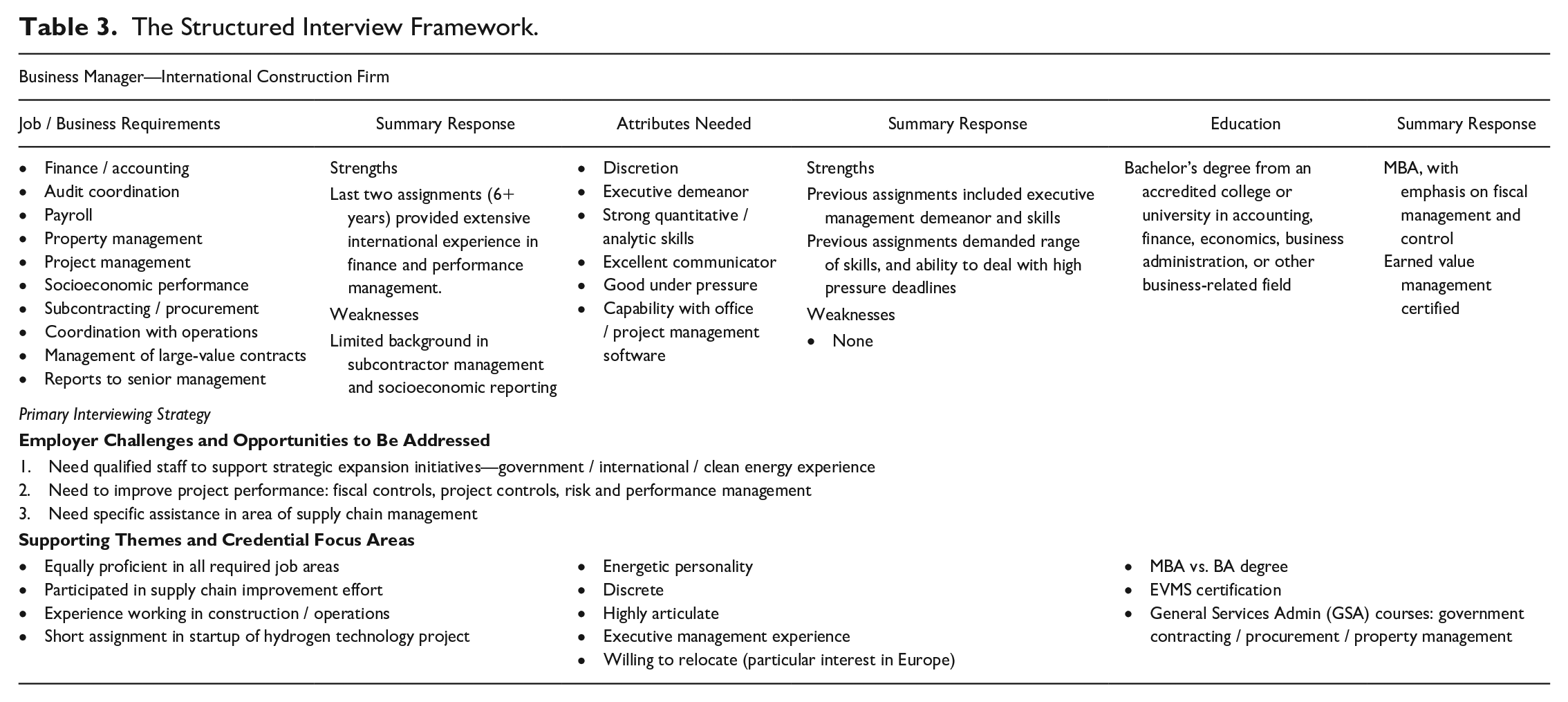
At the conclusion of this discussion, a third form is used to record the themes developed during the small group exercise (Table 3). Also recorded on this form are the supportive detail about job requirements and associated credentials, creating a consolidated portrayal of the complete interview strategy and the substance of the argument.
The Structured Interview Framework.
The remaining step in the process is to demonstrate to students how to prepare an easy and effective means by which to enhance the recall and delivery of the themes and evidence.
Planning the Delivery
As was the case in the process of transitioning from the fully detailed job description to the summarized information regarding requirements and corresponding credentials, so the process of summarization is again introduced at this stage; this time it is used as the means of making the interview themes and supporting detail easier to recall and more persuasively employed.
Given the volume of information and extent of detail in Table 3, it could be challenging for a candidate to formulate crisp, responsive answers on-the-fly while engaged in the interview. Rather, to maximize its effective use, the information must be translated into a manageable synopsis—effectively collapsing Cicero’s concepts of memory and delivery. This synopsis, which consists exclusively of material to be delivered during the interview, is accomplished by means of an interview preparation study guide.
Designed to emphasize the lines of argument, the study guide begins with abbreviated statements of the corporate challenges and opportunities, immediately followed by a summary of the candidate’s potential contributions. Following these elements of the interview strategy are key facts learned about the company, information that can be extremely helpful in guiding the direction of the conversation (e.g., “I read that the company is planning to enter the clean energy market”).
Lastly, as should always be part of any effective interview preparation, the study guide lists questions to ask the interviewer. To sustain the argument for selection, students are encouraged to develop questions that demonstrate understanding of the company’s perspective and that are suggestive of a professional commitment to the company. In the case of our Business Manager, for example, questions offered by students tend to inquire as to the long-term implications of company expansion on the position and opportunities for relocation and promotion.
Taken as a unit, the study guide’s design and level of detail combine to maximize its utility. To emphasize essential points and promote ease of retention, the five categories of information in the study guide (challenges, primary contributions, secondary contributions, information about the company, and questions to pose) are displayed with distinctive headings, separated by sufficient white space, and denoted using short, simple statements.
Complementing its design, the study guide is also constructed with an eye to providing maximum latitude and flexibility in how answers can be formulated. For instance, at some point in the interview applicants are likely to be asked about why the specific interest in joining the company. However, at what point and in what context the question will be posed cannot be predicted with certainty. As a consequence, relying on a pre-rehearsed response may result in simply repeating information already provided during the interview or offering a response that is disconnected from the flow of the conversation, has limited relevance to the company interests, or is too generalized to yield advantage or differentiation.
In contrast, based on the easily recalled and prioritized contents of the study guide, the interviewee can ensure the answer remains consistent with the intended lines of argument but also can be well fitted within the flow of the conversation. As example, using the information provided in our sample style guide, our applicant for Business Manager could offer several formulations of the response to this interview question. Based on the context in which the question is posed, our candidate might
Begin with discussion of one of the identified corporate challenges, followed by elaborating on the candidate’s pertinent experience and interest in the area of corporate development (i.e., discussing company expansion as a lead into discussion of the hydrogen project internship).
Begin by highlighting a particular capability of keen personal interest and then identifying the expectation of employing it broadly in the new assignment (i.e., discussing how the level of expertise in project management can be applied to improving corporate fiscal performance).
Begin with highlighting values and professional attributes denoted in the job posting and then offering substantive examples of the shared commitment to those characteristics (i.e., detailing how promoting teamwork and collaboration contributed to meeting all the milestones imposed on the supply chain improvement initiative).
As this attribute tangibly demonstrates to the class, purposely designing the study guide and concentrating exclusively on key themes and essential supporting detail offers a tool that aids recall, allows for flexibility in responses, and maintains focus on delivering arguments that argue for selection and differentiation.
Practicing the Principles
At this point in the instruction, class attention turns to personalizing the application of the interview preparation techniques. However, the keen differences in the audience and instructional logistics between college classroom and corporate seminar demand two distinctly different approaches.
Professional Communication Students: In advance of the class’s next session following discussion of the study guide, students select an active job posting of their choice and complete Tables 1 and 2, the position parsing and the assignment of applicable credentials. In class, using small groups, students share their forms and experiences—the level of detail in the job postings, how they addressed strengths and weaknesses in their credentials, and insights gained. The following class session, students bring the completed Table 3 and Figure 2 (the development of themes and the study guide). Using the same small groups, students review and critique each other’s strategies—examining how themes were derived, evidence selected, and the approach to delivery determined.
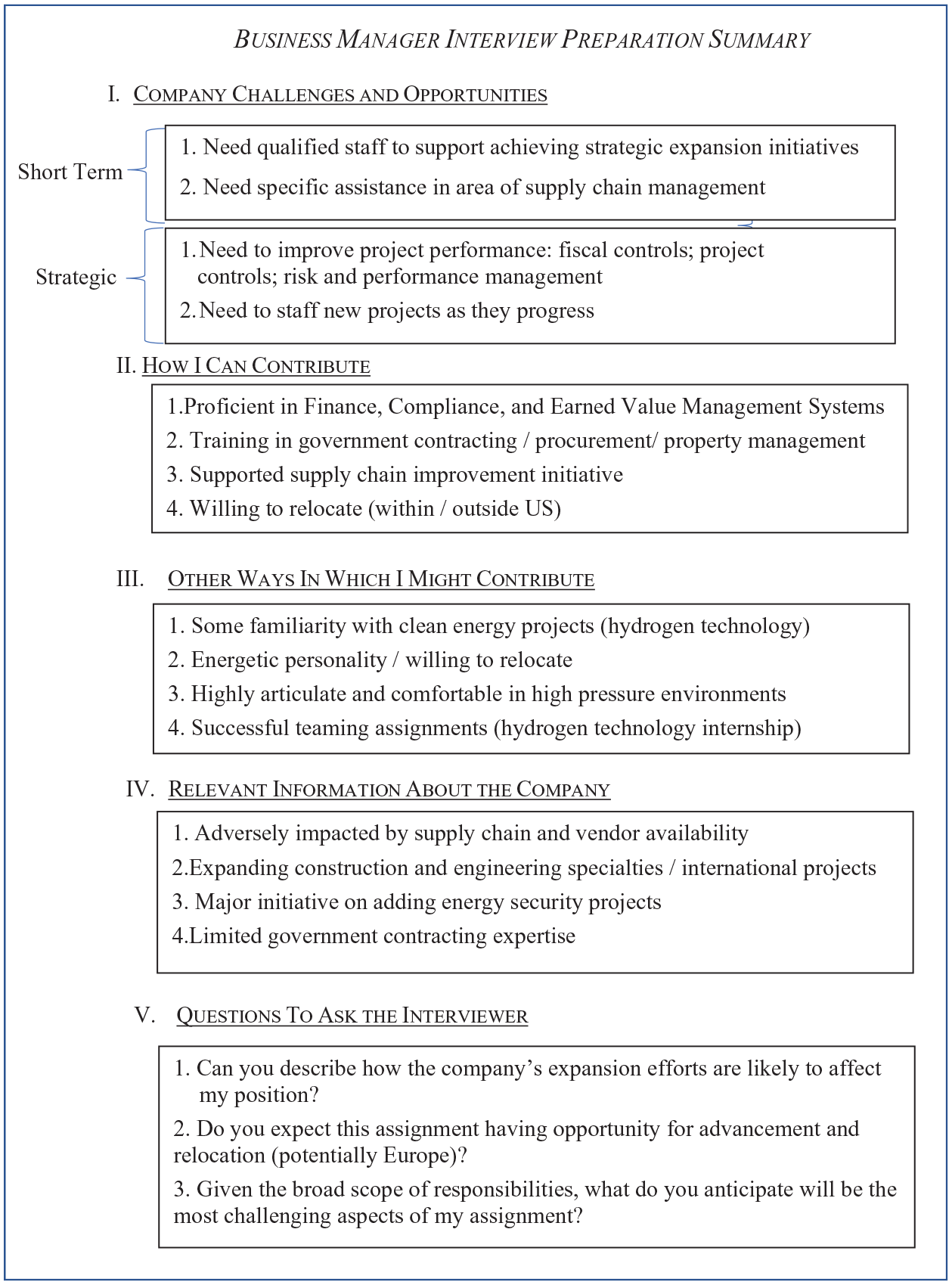
Interview study guide.
These two sessions culminate in a class discussion about the interview preparation process, the principles learned, and the opportunities for applying the principles and techniques to other professional communication products and challenges.
Corporate Training Classes: In the corporate setting, attendees share a common knowledge of the company, class is generally limited to a single session, and a potential sensitivity exists regarding sharing personal details among coworkers. There is also recognition, as noted earlier, that sequencing of process steps likely will differ among attendees. Therefore, having attendees fill out forms or participating in small group sessions is not practical.
As a consequence, similar to the sessions with professional communication students, the corporate seminar concludes with a class discussion about the principles learned, the methodology’s adaptability to corporate policies and practices, and (in general terms) discussions of corporate circumstances that might function as foundations for interviewing themes.
Conclusion
The job interview is the candidate’s sole opportunity to make a positive impression and to demonstrate technical compatibility as well as an appropriate fit with the company. To be successful, interviewees must be prepared to offer statements that speak directly to an understanding of the company’s challenges and opportunities; clearly establish the relevance and significance of experience and expertise; and convince the interviewer of a firm commitment to the company and a clear capability of substantive contributions to it.
Teaching a disciplined job preparation methodology that proceeds from a careful examination of the job posting and progresses through stages that define pertinent credentials, establish advocacy-oriented themes, and enhance delivery provides students with a powerful tool that increases their probability of success. In addition, working with the tools and methodology, students are offered a unique, personally relevant learning experience predicated on rhetorical principles that represent foundational elements common to all effective professional communications.
Footnotes
Declaration of Conflicting Interests
The author declared no potential conflicts of interest with respect to the research, authorship, and/or publication of this article.
Funding
The author received no financial support for the research, authorship, and/or publication of this article.
