



Abstract
Social media backlashes have emerged as important phenomena complicating how businesses communicate online and representing significant brand risk. This article demonstrates the value of content analysis and argumentation theory for understanding and responding to social media backlash events, using two examples from the UK fashion industry (hashtags #ThanksItsASOS and #boycottboohoo). The results provide lessons about the way backlashes operate in practice, how to analyze these effectively, and have implications for business approaches to communicating about Corporate Social Responsibility and managing social media. The authors conclude with suggestions for training on social media and CSR for businesses.
Introduction
From the perspective of businesses, the social media backlash is a feared phenomenon representing a sudden movement or reaction against corporate communication. It is unpredictable, “viral,” and potentially damaging, undermining brand value and corporate reputation (Brivot et al., 2017), causing shame, fear, and economic harm (Levmore & Nussbaum, 2011). There is growing evidence of an important role for social media in corporate communication on Corporate Social Responsibility (CSR) (ElAlfy et al., 2020; Gómez-Carrasco et al., 2021; Maiorescu-Murphy, 2022; Wang & Huang, 2018). There is less work exploring the ways in which real-world developments and the sometimes-unanticipated dynamics of the backlash can derail or disrupt carefully curated communications for individual firms, and how to equip professionals to deal with these more effectively.
One interpretation of the backlash celebrates it as an example of big business getting a well-deserved “slap in the face” from consumers, another revels in the backlash as evidence of incompetence on the part of the company. Ultimately it can be seen as a “litmus test” for brands and their corporate communications strategies. Burger King UK’s tweet “women belong in the kitchen” (on International Women’s Day in 2021), for example, provoked an “avalanche of comments and tweets” (Glenday, 2021). The company initially defended it as “intended to spark discussion around gender inequality in the restaurant trade” (cited in Glenday, 2021) but ultimately had to back down, delete, and apologize for any offence caused. The response of ASOS to news that a spelling error had been printed onto thousands of its plastic bags in March 2018 was to joke these items could become a valuable “limited edition,” but this fell flat as users instead raised concerns about environmental costs of bag disposal (Balabanova & Palmieri, 2020).
Business leaders must therefore understand the risk of backlash, which some argue can “make or break” a company (Bown, 2019; Bradley, 2021), and social media managers need to have the right strategy to deal with it when it occurs. But what is a backlash, and how does it differ from the normal discussions that occur on social media? Twitter 1 (now X) has emerged as a primary site for backlash, associated as it is with amplifying voices of the cynical (Almasi, 2019). It has also become synonymous with misinformation, polarization, poor quality of online discussion of social issues; a space where conversation is often characterized by hostility, personal attacks, and a lack of empathy (Wulczyn et al., 2017).
What makes a backlash and what does it mean for professionals in CSR and corporate communication, particularly in relation to Twitter? In teaching or training on these issues, analytical techniques can be used to identify the qualitative and quantitative differences between “regular” discussions of topics and those identified as a backlash. This article presents analysis of case studies on fast fashion in the United Kingdom (UK), 2019-2020. These show how methods from the field of communication studies can reveal the dynamic features and characteristics or “anatomy” of the backlash. The research is based on a compilation and comparison of several data sets including background debate and 2 specific examples of a backlash in relation to ethics and sustainability in the fashion industry. This approach enables a deeper look at the key topics, positions, purpose, and arguments expressed by users when engaging in the debate over ethics and sustainability in the fashion industry.
The evidence provides useful information for professionals about the way backlashes operate in practice, and how they differ from regular engagement with brands on social media in both qualitative and quantitative terms, which is normally dominated by marketing for “ethical” products. Moreover, the results provide lessons for strategy regarding the preference for nonengagement with ethics and sustainability over social media. A backlash initiates an intense and high profile public discussion of corporate responsibility issues that may be of strategic significance to the company’s policy. We argue that it provides a valuable opportunity to engage with stakeholders and how they think about the brand with long-term reputational implications. The research provides useful material for the classroom when discussing CSR communication strategy and options for businesses to manage and ensure positive engagement on ethics and sustainability via social media.
Corporate Social Responsibility Communication and Social Media
Social media—understood as “employ[ing] mobile and web-based technologies to create highly interactive platforms via which individuals and communities share, co-create, discuss, and modify user-generated content” (Kietzmann et al., 2011, p. 241)—can be important for stakeholder perceptions on CSR, and for awareness of these issues for the general public (Wang & Huang, 2018). Audiences are known to seek transparency, information on products and services, but also insights into the values and ethical (social and environmental) commitments of organizations (Jahdi & Acikdilli, 2009). Social media provide an opportunity to interact easily with a range of different audiences and potentially generate a dialogue. The benefits include the opportunity to strengthen and amplify messages by using visuals (Cho et al., 2009), boost credibility and a sense of belonging (Eberle et al., 2013), as well as provide a competitive advantage for organizations through the options for interaction with stakeholders (Fieseler et al., 2010). Despite these, research suggests companies choose to avoid dialogue and engagement on social media (Elving & Postma, 2017), particularly on issues related to CSR (Monfort et al., 2019).
Studies using large samples and content analysis across multiple firms’ outputs have shown how different tendencies are developing for use of social media on CSR, for example, alignment with broader human rights norms such as the Sustainable Development Goals (ElAlfy et al., 2020), or seeking to encroach on “activist” spaces (Maiorescu-Murphy, 2022). One common observation is the gap between firms’ preference for discussion to center on generalized, abstract, or “supplementary” issues while stakeholders want to focus on the core social responsibilities pertaining to the firms’ actual activities (Gómez-Carrasco et al., 2021). This links with more general preferences regarding business engagement strategies, where companies see social media as an outlet for information and marketing (“self-directed”), or as a means to gain data or feedback on products and performance (“mediated”), rather than an opportunity to engage in dialogue, deliberation, and negotiation around decision-making procedures (“dialogic”) (Colleoni, 2013). In turn, this thinking connects with different understandings of control of reputational risks. The options here range from the “beyond control” and “subveillance” frames (both advocating abandoning control of social media, but the former focusing on engaging in authentic, open, and spontaneous conversations with social media users whereas the latter, on mining the big data) to “deterritorialization” and “reterrritorialization” frames (the former suggesting staying away from social media and the latter, advising regaining control with the introduction of boundaries and hierarchical controls into the company’s social media world) (Brivot et al., 2017). Such preferences are based on awareness that public attention can put the spotlight on less responsible practices (Stohl et al., 2017), while also avoiding the “need to further legitimise CSR activities by disclosing them through alternate communication channels” (Bonson & Bednarova, 2015, p. 46).
As a social media platform, Twitter has been found to be a space where issues about social responsibility around labor and environmental protection are regularly disseminated (Chae & Park, 2018) and where there is a strong potential for direct dialogue with the general public (Etter, 2014) and “co-branded and co-created communication” (Burton et al., 2017). Companies use Twitter to build long-term relationships with their audiences and improve perceptions of their activities and values. However, despite the notions of democratic participation, digital citizenship, and accessibility associated with Twitter, it is also a platform ideal for “politics of outrage, scapegoating, hatred and attack” (Fuchs, 2017, p. 54). Because of its very nature—the shortness of posts, the need to attract “likes” to be visible, and the fast-moving pace—Twitter is most suitable for emotionally charged posts that are likely to simplify issues and avoid nuance and complexity (Engesser et al., 2016; Enli, 2017).
Ethics and Sustainability in the Fashion Industry
The case study for this article is online debate over ethics and sustainability in the fashion industry. The first example of a backlash concerns ASOS, a fashion business that has chosen to identify itself with these issues (House of Commons Environmental Audit Committee [HoC], 2019b). The second relates to Boohoo, one of United Kingdom’s biggest online clothes stores and one of the fastest-growing retailers in the country. These specific instances of social media backlash were selected to enable a comparison of different kinds of “backlash” in otherwise very similar contexts. Each received significant attention outside Twitter, for example, in the mainstream/mass media, and in each case activity on Twitter was reported to have created/amplified impacts on the company concerned.
The fashion sector is at the center of both the successful expansion of consumer-driven growth of production via complex global supply chains and growing evidence this is harmful, unsustainable, and inequitable. The business model of fast fashion, in particular, is “based on offering consumers frequent novelty in the form of low-priced, trend-led products” encouraging overconsumption and impulse buying while generating excessive waste (Niinimäki et al., 2020, p. 189). As with other economic sectors, these tensions are increasingly played out over social media. On the one hand businesses are shifting advertising online and exploiting the opportunities social media presents (e.g., by using “influencers”), while on the other hand social media usage is generating an overlapping set of risks that can have significant temporal and spatial consequences, blurring the boundaries between the business, professional, and the individual (Williams et al., 2021).
There has been “abundant criticism” of the fashion industry for “its limited consideration of social and environmental issues, placing the non-financial costs of fashion on the global public agenda” (Niinimäki et al., 2020, p. 189). The industry is one of the worst polluters in the world: producing around 10% of global greenhouse gas emissions (United Nations Climate Change, 2018); consuming huge quantities of water (estimated at 79 trillion liters annually) and contributing to the industrial water pollution through textile treatment and dyeing (Kant, 2012; United Nations Climate Change, 2018); and with “1 in 2 people . . . throwing their unwanted clothes straight in the trash” (ThredUp, 2020, p. 26) generating masses of textile waste that ends up in landfill or is being burnt (Brewer, 2019; United Nations Climate Change, 2018). The social cost of fashion industry is also substantial, with poor working conditions characterizing fashion supply chains abroad in countries like Bangladesh and Myanmar (Vaughn et al., 2019) and, increasingly, in UK-based production (HoC, 2019a; O’Connor, 2018).
Businesses in the fashion industry have gradually responded to these criticisms in the last 20 years by modifying their practices, incorporating messaging on these issues into their corporate communications and marketing, and through attempts to associate their brands with values around more ethical and sustainable consumption (Business of Fashion, 2021). There is, however, a lack of consistency or convergence on standards, making it difficult to assess how well companies are performing, and how effective their actions are (Hsin et al., 2021). There are some attempts to address this with new legal and regulatory requirements for businesses to standardize how they report on, for example, human rights due diligence and transparency in supply chains through an EU Due Diligence Act, but variation persists across different jurisdictions (Kifukwe, 2022). This means that while brands are increasingly obliged to communicate about ethics and sustainability, there remain multiple approaches—from minimal compliance with the regulations to a more genuine alignment of values and integration—within organizational structures and identity. Analysis of backlash as “litmus test” therefore offers an important source of evidence to illuminate these approaches, and a source of learning for businesses, when facing the challenge of developing corporate communications strategies on ethics and sustainability over social media.
Data Sets
The article uses four data sets from Twitter relating to discussion of ethics and sustainability in the fashion sector. Data Sets 1 and 2 relate to the baseline discussions across the months of July 2019 and July 2020 when two examples of backlash occurred (Data Sets 3 and 4). The first of these examples (Data Set 3) relates to a subverted marketing campaign run by ASOS (hashtag #ThanksItsASOS). On July 22, 2019, ASOS launched a competition offering Twitter users a chance to win a £500 voucher by following its account and tweeting what is on their wish-list using the hashtag #ThanksItsASOS. 2 Some Twitter users ignored the request and instead wrote critical posts, with several journalists picking this up and stating that ASOS received a “barrage of tweets criticising the poor working conditions of staff, including unfair contracts and pay, monitored toilet breaks and pollution levels associated with the company” (Hammet, 2019,). It became one of the long list of examples demonstrating the power of a social media backlash—apparently spontaneous and uncontrolled criticism of a company that becomes viral and/or has a wider impact beyond the platform itself with potentially serious real world effects.
Data Set 4 concerns a spontaneous campaign to boycott Boohoo instigated following news reports of poor practice in their production chain (hashtag #boycottboohoo). On July 5, 2020, the Sunday Times run a story based on the undercover investigation of one of their journalists in a factory in Leicester, UK, producing clothes for Boohoo. The article made allegations of poor pay, including poor working conditions amounting to “modern slavery”: workers were being paid significantly below the UK minimum wage, not wearing protective masks and not following social distancing rules despite government COVID-19 guidance at the time and localized lockdown restrictions (Wheeler et al., 2020). Boohoo made a statement acknowledging conditions in the factory were “totally unacceptable” (cited in Davies & Kelly, 2020) and committed to take immediate action (BBC News, 2020a), but the hashtag #boycottboohoo was already trending on Twitter, and major retailers dropped Boohoo from their websites (BBC News, 2020b). The story became one of “Boohoo battling growing social media backlash” (Whiterow, 2020). Reportedly, £1 billion of the company’s value was lost in the first week of July following the allegations being published, whereas the shares in Boohoo slumped by 23% the day after the story broke (Davies & Kelly, 2020).
Methods
In order to respond to the main research questions outlined earlier (what makes a backlash and what does it mean for professionals in CSR and corporate communication, particularly in relation to Twitter?), a multilevel coding scheme was designed for content analysis (White & Marsh, 2006) of the above four data sets. For each post, the main communicative goal was identified, followed by argumentative controversy (see Greco & De Cock, 2021) understood as comprising issues, standpoints (positions), and arguments (van Eemeren & Grootnedorst, 2004). The findings are organized and presented to demonstrate the difference between baseline or “background” debates on ethics and sustainability on Twitter, and examples of backlash addressing the following three subquestions:
• Do tweets serve different communicative purposes during a backlash?
• In what ways are the issues raised and type of engagement with businesses distinctive during a backlash?
• What is the difference in position and argument used in the backlash?
Data Collection
Historical Twitter data was obtained from Twitter API and the four data sets were compiled consisting of tweets only in English. Data Sets 1 and 2 included the Twitter conversations during July 2019 and July 2020 that contained at least one of the three hashtags: #fastfashion, #ethicalfashion, or #sustainablefashion. For 2019, a total of 13,178 tweets were collected, 5,671 of which were retweets. For 2020, a total of 13,523 tweets were collected, 6,414 of which were retweets. The number of tweets containing one or more of the three hashtags per day in 2019 ranged from just under 300 to close to 600, whereas in 2020 the daily average picked at 800 and was generally characterized by higher activity in the first half of the month.
Following a cleaning of the data in Data Sets 1 and 2, including removal of retweets, a subsample was selected containing reference to firms operating in the fashion industry. This reflected the particular interest in communication of CSR and engagement of businesses on Twitter. In 2019 less than 10% (725 original tweets) referenced a fashion company and out of these Zara topped the list with 143 mentions, followed by Stella McCartney, 59; Adidas, 44; and H&M, 37. ASOS was mentioned 18 times and Boohoo, 7. In 2020 the number of tweets mentioning a fashion company was significantly higher—2,882, equating to 34% of the overall sample. The company that topped the list of mentions was Boohoo 184 times, followed by FrenchSilkScarf_vintage, 141; Belacci, 43; NHUPPI, 33; THE CUT PROJECT, 30; and Wisi-Oi, 27. ASOS was mentioned 6 times in 2020.
Data Set 3 included responses to the ASOS tweet from July 22, 2019, over the next 4 days (July 22-26, 2019). A total of 8,675 tweets were collected from 8,164 contributors posted both in response to the original post and using the hashtag #ThanksItsASOS on its own. Almost all of these tweets did exactly what was asked: they listed items of desire, gave reasons why the user should win, and praised ASOS’s style and fashion. Only a relatively small number of tweets constituted the backlash: 75 original tweets that diverged from this trend and raised ethics and sustainability issues. Their reach, however, was amplified by the fact that some of the posts were retweeted on the same day (315 retweets) totaling 492 retweets altogether.
Data Set 4 consisted of posts containing the hashtag #boycottboohoo posted in the space of several days (July 6-14, 2020) after The Sunday Times story broke: 510 tweets from 368 contributors. Similar to the ASOS case, this was a relatively small number of posts and out of the 510 tweets, 207 were retweets.
Data Analysis
All tweets were read and manually coded according to a bespoke coding scheme (see Figure 1) that was designed to respond to the questions above. Accordingly, each tweet was coded for:
•
•
•
•
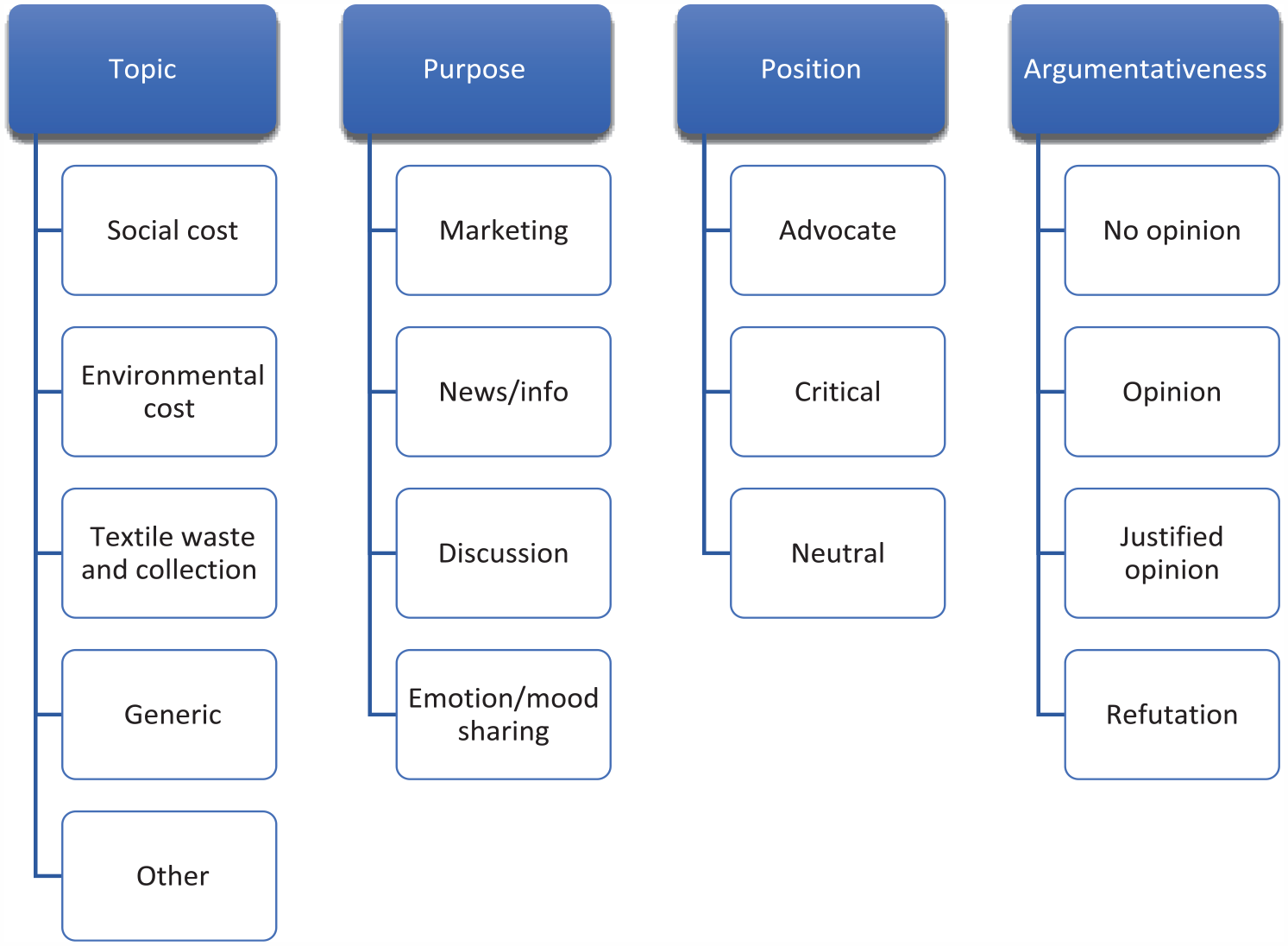
Coding scheme for the manual annotation of tweets.
Most coding was carried out by a single researcher after a sample (10%) was coded independently by two researchers. Cases of disagreement were discussed until consensus was reached. Interrater reliability was calculated at 0.93 using Holsti’s formula. All Twitter handles have been removed. The next section summarizes findings, which are organized around topic, purpose, position, and argumentation of the tweets.
TOPIC: Backlash Topics Distinctive From Everyday Discussions of Ethics and Sustainability
The data sets revealed clear differences in topics addressed when baseline discussions were compared with the examples of backlash. In Data Set 1 (July 2019), nearly half of the tweets (341, 47%) made generic reference to sustainability, whereas environmental costs were explicitly mentioned in 22% of the tweets, and textile waste and collection in 16% (see Figure 2). Social costs appeared in only 41 tweets (6%). Some examples of tweets are as follows: “Well done @ASOS for adding the ‘responsible’ section to the filters! #sustainablefashion” (generic) “Hemp is one of the most eco friendly materials we can grow. Having jeans made from #hemp would be a game changer for fashion. @LEVIS #fashion #innovation #sustainablefashion #fashrev #denim #jeans #wednesdaywisdom” (environment) “1% of clothing is recycled! Only 1%. I mean, what are we doing?’ @StellaMcCartney #recycle with @regainapp #sustainablefashion” (textile waste and collection) “@hm The only hazard is the low wages at H&M. Pay a living wages or rely on the hazardous mannequins to dress themselves #HM #FastFashion #LivingWage #retailproblems” (social cost)
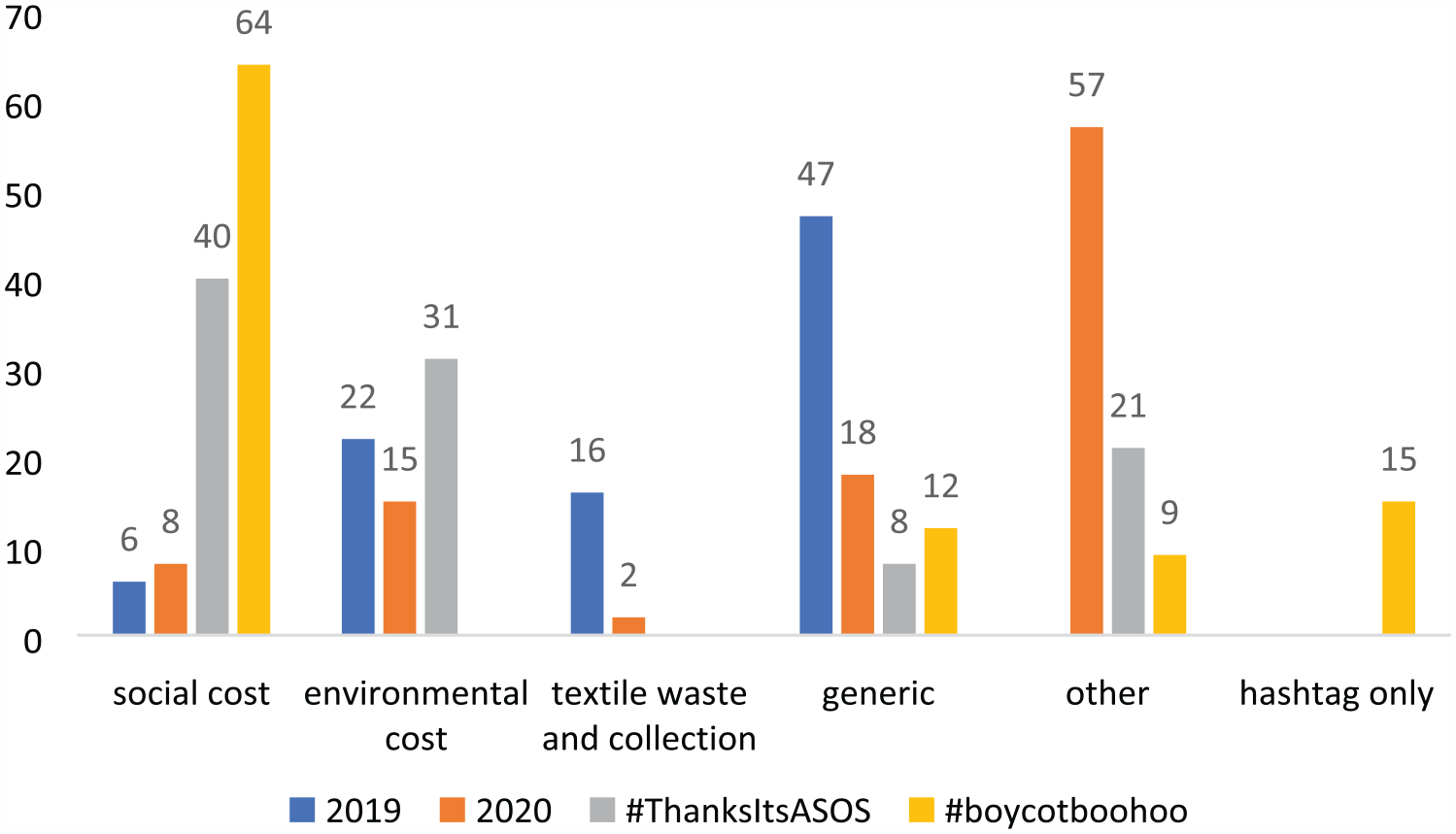
Topic of tweets as percentage, Data Sets 1 to 4.
Similarly, in Data Set 2 (July 2020), environmental costs (449, 15%) were again more prominent than social costs (227, 8%). Eighteen percent of the tweets (510) made generic references to sustainability, and only 2% focused on textile and waste collection (58 tweets). A significant majority of the tweets, 57% (1,638), were coded as other, where a hashtag on ethics and sustainability did not explicitly connect to the post’s main message: for example, “Wear the Eye of Horus talisman necklace by Common Era, an ancient Egyptian talisman of protection, regeneration and healing - don’t we all need that? #jewelry #sustainablefashion.”
In stark contrast to the corresponding baseline data, the social cost of fast fashion was the focus of the largest proportion of tweets (40%) for Data Set 3 (#ThanksItsASOS). Environmental costs were only brought up in 31% of the tweets, while generic references to ethics and sustainability appeared in 8% of the tweets. The remainder, 21%, raised different issues, mainly about delivery services. For example: “@ASOS Sign here if you want to stand in solidarity with ASOS workers up against poor working conditions, unfair pay and contracts, unnecessary levels of surveillance, and monitored toilet breaks #ThanksItsASOS” (social cost) “@ASOS #thanksitsASOS a lot a lot of dresses but until y’all evaluate your environmental impact I’ll stick to window shopping :(” (environmental cost)
When looking specifically at the issues that were being raised when discussing social cost, labor exploitation by far dominated—27 of the 30 tweets specifically focused on this issue. More than a third of the social cost tweets (12 of 30) also contained links to other media or organizations: Morning Star (7), BuzzFeed.News (2), and gmb.org.uk (3). Significantly, all these sources specifically referred to the GMB Union’s campaign between 2011 and 2016 that targeted the ASOS warehouse in Barnsley with allegations about poor working conditions. The message of the union was successfully amplified by Twitter users: 83% of the remaining 18 social cost tweets directly quoted or repeated in own words the claims made by the GMB.
Unsurprisingly, considering the origin of the #boycotboohoo hashtag, social costs accounted for the majority of tweets in Data Set 4 (193, 64%). There were only 38 generic posts (12%), which was markedly different from the baseline data. Fifteen percent of the tweets (46) contained only the #boycotboohoo hashtag and were coded as hashtag only. This is an example of a social cost post: “@boohoo This is just a cynical attempt to win back customers who ditched you and to divert attention from the way you exploit your employees. Pay your workers who make your products a real living wage! Paying people £3.50 an hour is disgusting, immoral and illegal. #BoycottBooHoo.”
When looking specifically at the issues that were being raised when discussing social cost, the vast majority of the tweets talked about cheap labor, forced labor, slave labor, and labor exploitation, reflecting the key issues raised by the mainstream media story (BBC News, 2020a).
Purpose: A Shift From Passive to Active, Emotional Engagement
Comparison of the data sets in relation to “purpose” reveals how marketing and sharing of information/news links become displaced by active engagement and emotion during a backlash. Business-driven marketing tweets were the most frequent in both years in the baseline data sets—286 (40%) in 2019 and 2323 (81%) in 2020 (Figure 3). In Data Set 1, sharing information or news was prominent (238 tweets, 33%) without any evaluation or critical comment. A smaller, but still significant, proportion were “discussion” (148, 20%), but only 7% of these openly expressed emotion or mood. In Data Set 2, marketing content was even more dominant. Tweets sharing news or information again came second, but this time accounting for only 10% (287 tweets). This was followed by discussion tweets—202 (7%) and then emotion sharing—70 tweets (2% of the sample). The below examples illustrate communicative purpose: “Beira creates timeless fashion in a gentle and nurturing manner. We aim to transcend the duality and polarity of the fashion industry in our cohesive approach to beautiful slow fashion. #circulareconomy #waste #responsibleluxury #sustainablefashion #sustainableluxury #jackets” (marketing) “Fast fashion has always been a feminist issues. Corporations like @hm have been exploiting women of color for years #payup #fastfashion” (discussion) “Loving this display in the window of @TheBHF in Cheltenham. Loads of preloved clothing transformed into completely new creations by local students to highlight the problem of fast fashion #fastfashion #Cheltenham #reduce #reuse” (emotion sharing) “Inditex promising to eliminate use of #plasticbags by 2020; of single use plastics by 2023; and @Zara (& others) promising to only sell #sustainableclothes by 2025 (& to include containers to recycle old clothes - 2021). #sustainablefashion” (news/info)
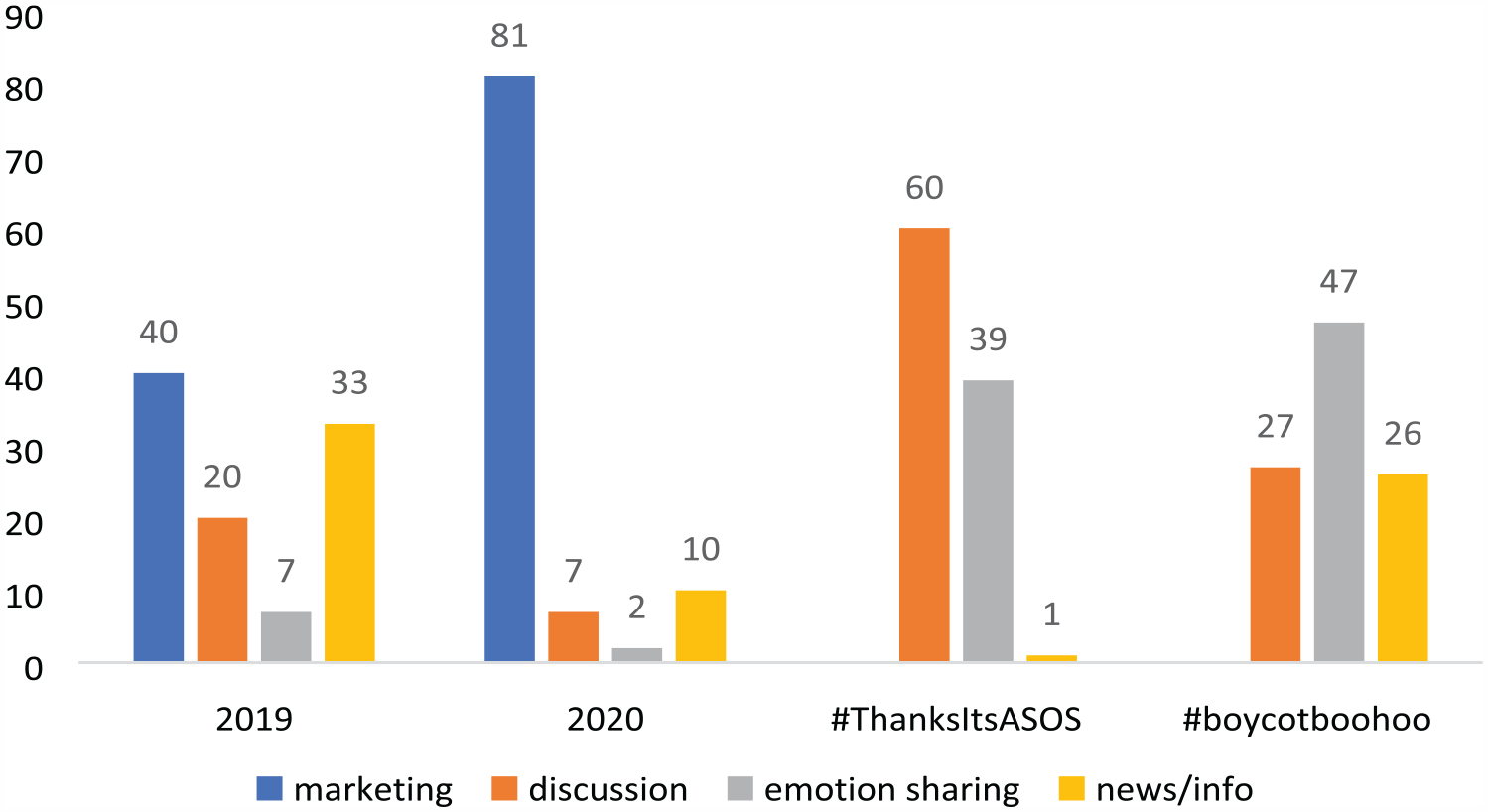
Purpose of tweets as percentage, Data Sets 1 to 4.
The purpose shifts markedly in the data sets relating to backlashes. In Data Set 3 the majority of the tweets (60%) containing the #ThanksIts ASOS hashtag engaged in or encouraged discussion around the topics they were raising, despite the intention for this to be purely marketing-related. This was followed by those that expressed emotion or mood (39%): “@ASOS Are you sure you’re able to ship £500 worth of gear if @ASOS warehouse staff are unable to take toilet breaks and are being fired for having panic attacks? #ThanksItsASOS” (discussion) “Wishing @ASOS treated workers a touch more fairly #ThanksItsASOS” (emotion sharing) “Noticed the other day that your bags are all recyclable #sustainablefashion #ThanksItsASOS” (news/info)
Likewise, in Data Set 4 the communicative purpose of the majority of the tweets (141, 47%) was to express emotion or mood. This was followed by discussion tweets that were either engaging in or encouraging a conversation (83, 27%) with a very similar number (78, 26%) simply sharing news or information: “@boohoo EVERYONE SHOULD JUST FLOOD THIS SECTION WITH #boycottboohoo” (emotion sharing) “Still don’t know what #boycottboohoo was all about? Jasmine Parker (@jasminellparker) explains the horrors of Leicester in today’s article, where workers are paid way less than the mininum wage to produce fast fashion. Check it out:. . .” (news/info) “Non stop with the giveaways since they’ve been exposed for their poor working conditions, unreal #boycottboohoo” (discussion)
Position: From Advocate to Critical
The baseline data sets illustrate how the majority of tweets using hashtags on ethics and sustainability were uncritical and dominated by positive messages. A majority were coded as “advocate,” that is, expressing support toward the subject, usually on the sustainability and ethical agenda, actions by companies or other actors (Data Set 1: 378, 52%; Data Set 2: 2292, 79%) (see Figure 4). A much smaller proportion were critical (Data Set 1: 102, 14%; Data Set 2: 218, 8%) with more coded as neutral (Data Set 1: 245, 34%; Data Set 2: 372, 13%). Examples: “Stella McCartney created the newest sneaker trend that is 100% vegan. These old but new sneakers are a must-have. Stella McCartney’s newest partnership with Adidas has changed sneakers forever! #SustainableFashion #EthicalFashion #StudentLife” (advocate) “#Adidas unveils running shoes that never have to be thrown away #sustainablefashion” (neutral) “#fastfashion is happening here, in Britain. It is no coincidence that Leicester has had to go on lockdown again - it is because the working class has been forced to work during #covid in horrific companies such as BooHoo for £3.50 an hour” (criticism)
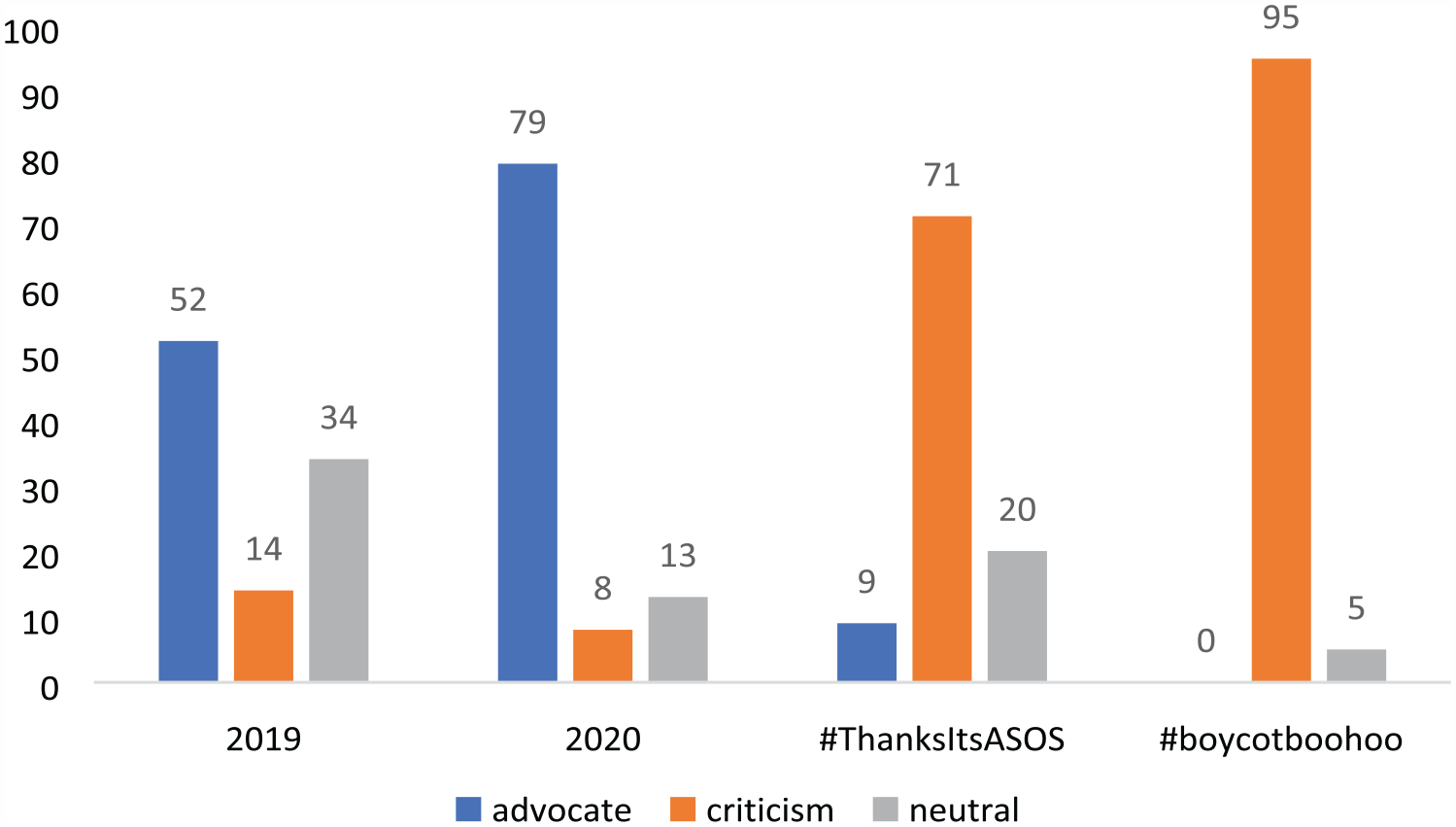
Position of tweets as percentage, Data Sets 1 to 4.
The frequency of neutral tweets in Data Set 1 is largely explained by the dominance of news/info tweets. One hundred ninety-two of these were coded as neutral (81% of all news tweets and 78% of all neutral tweets) (Table 1). These were where a user shared something without adding any explicit evaluation or taking a particular position vis-à-vis the link or media item in the actual tweet.
Relationship Between Tweet Purpose and Tweet Position, July 2019.
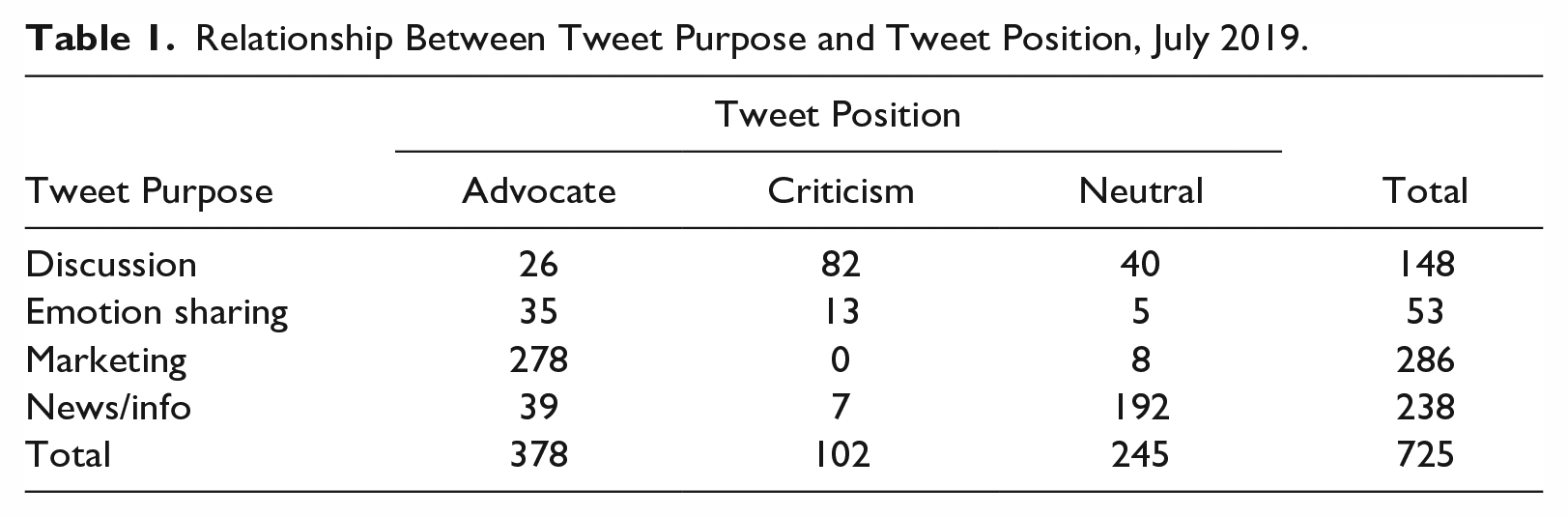
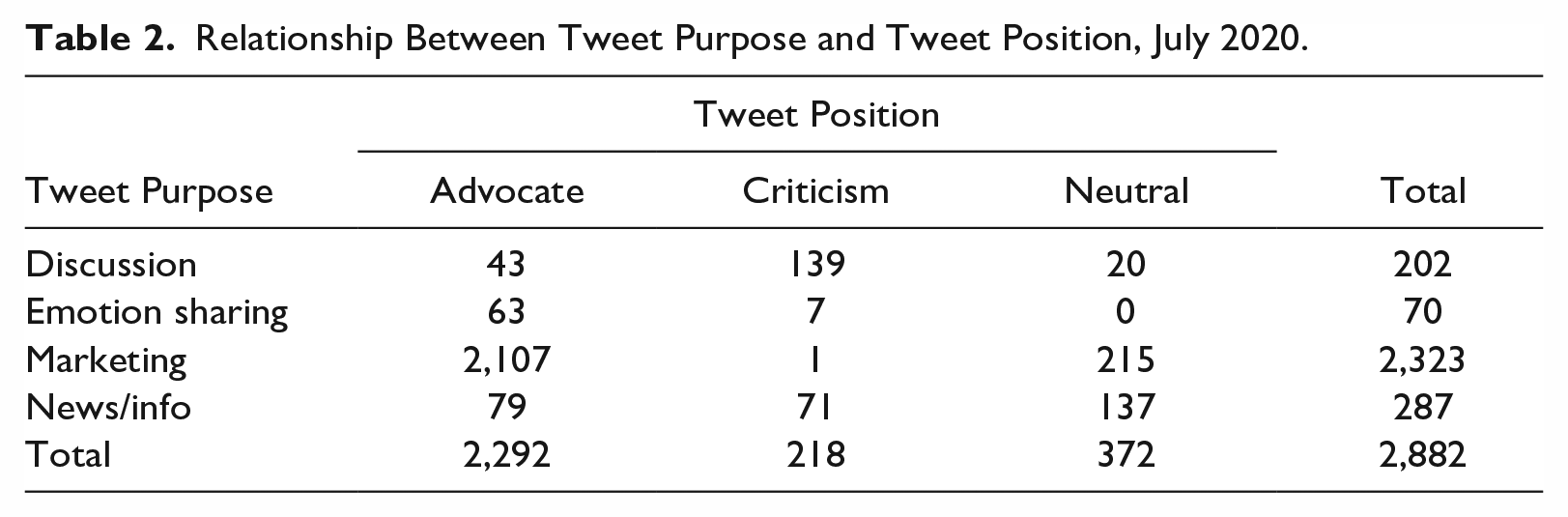
There is a clear polarization between business and user-generated content. As Tables 2 and 3 illustrate, most tweets coded as “advocate” for Data Set 1 were marketing related (278, 74% of all advocate tweets, 97% of all marketing tweets). The picture in Data Set 2 is very similar: the majority of tweets that advocate for the subject they are posting about are still marketing related (2107, 92% of all advocate tweets, 91% of all marketing tweets). Neutral tweets were for sharing news or information in Data Set 1, but were displaced by marketing in Data Set 2.
Relationship Between Tweet Purpose and Tweet Position, July 2020.
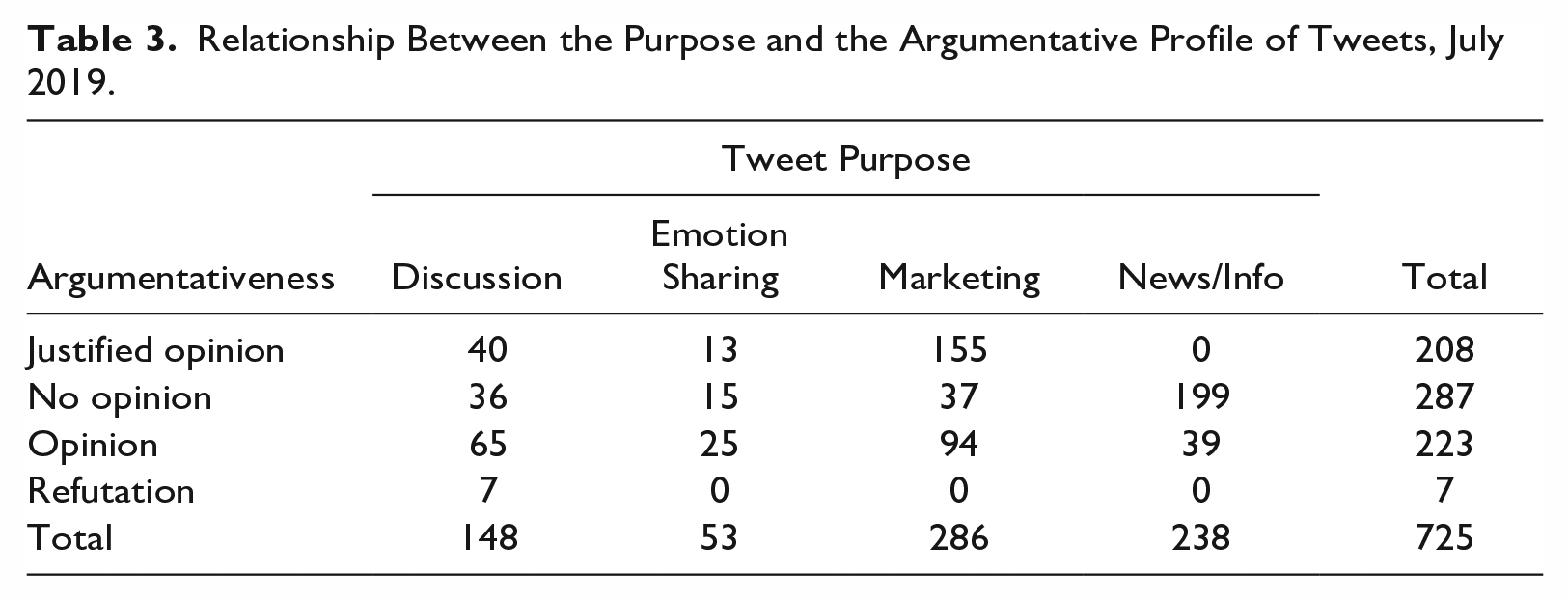
Relationship Between the Purpose and the Argumentative Profile of Tweets, July 2019.
By contrast, and again following the same pattern in both years, the majority of tweets that featured user-generated discussion were critical (Data Set 1: 82/148 [55%]; Data Set 2: 139/202 [69%]). However, when users shared emotion in their tweets, the majority were positive or advocating a fashion business, its policies or products (Data Set 1: 35/53 [66%]; Data Set 2: 63/70 [90%]), celebratory rather than challenging/questioning in tone.
The two examples of backlash are notable for a reversal of the patterns identified in the baseline data. In Data Set 3, the majority of tweets (71%) contained a critical stance toward ASOS, whereas supportive messages (“advocate”) represented only 9% of the sample. Twenty percent of the tweets were coded as neutral because ASOS was neither criticized nor defended or promoted. The following are tweets from the sample illustrating the range of positions: “Humiliating body searches, security guards posted in toilets and shift patterns which wreck workers’ lives? #ThanksItsASOS” (criticism) “In a bid to win the war against plastic these beauties are on my wishlist #ThanksItsASOS” (advocate)
In Data Set 4, almost all tweets (288, 95%) were critical toward Boohoo. Only 1 post was found to be supportive and only 14 (5%) were coded as neutral as they neither criticized nor supported the fashion retailer. It can be argued, however, that the very fact that they contained the #boycottboohoo hashtag suggested that they were taking a position against the company. Examples: “@boohoo This is just a cynical attempt to win back customers who ditched you and to divert attention from the way you exploit your employees. Pay your workers who make your products a real living wage! Paying people £3.50 an hour is disgusting, immoral and illegal. #BoycottBooHoo” “I’ve written an article about consumer power vs big business responsibility. Click the link to give it a read! #boycottboohoo”
Argument: Claims and Opinions, With Little Justification
Across all four data sets, there was a consistent pattern with a majority containing claims or opinions, but with these more likely to be deployed without justification. Data Set 1 had a 60:40 split, with 438 (60%) explicitly offering some kind of claim or opinion with Data Set 2 similar (65:35) (Figure 5). In Data Set 1, among the tweets making claims or stating opinions, around half (223/438) contained no justification, while 208 contained justifications and only 7 included refutations of an argument. Even though the total number of tweets involving some justification or argument (215, 30%) represents less than one third of the whole sample, this frequency is quite significant given the generally low presence of argumentation on Twitter (Addawood et al., 2017). In Data Set 2, the overwhelming majority, 90%, of the tweets containing claims or opinions offered no justification for those views (1706/1885), with only 176 containing views justified by arguments and 3 putting forward refutations. Example: “Festival season is here! Instead of buying new, why not shop your wardrobe and re-invent something? Better for the planet, and for your wallet. #sustainablefashion #secondhand #Repost @offsetwarehouse” (justified opinion)
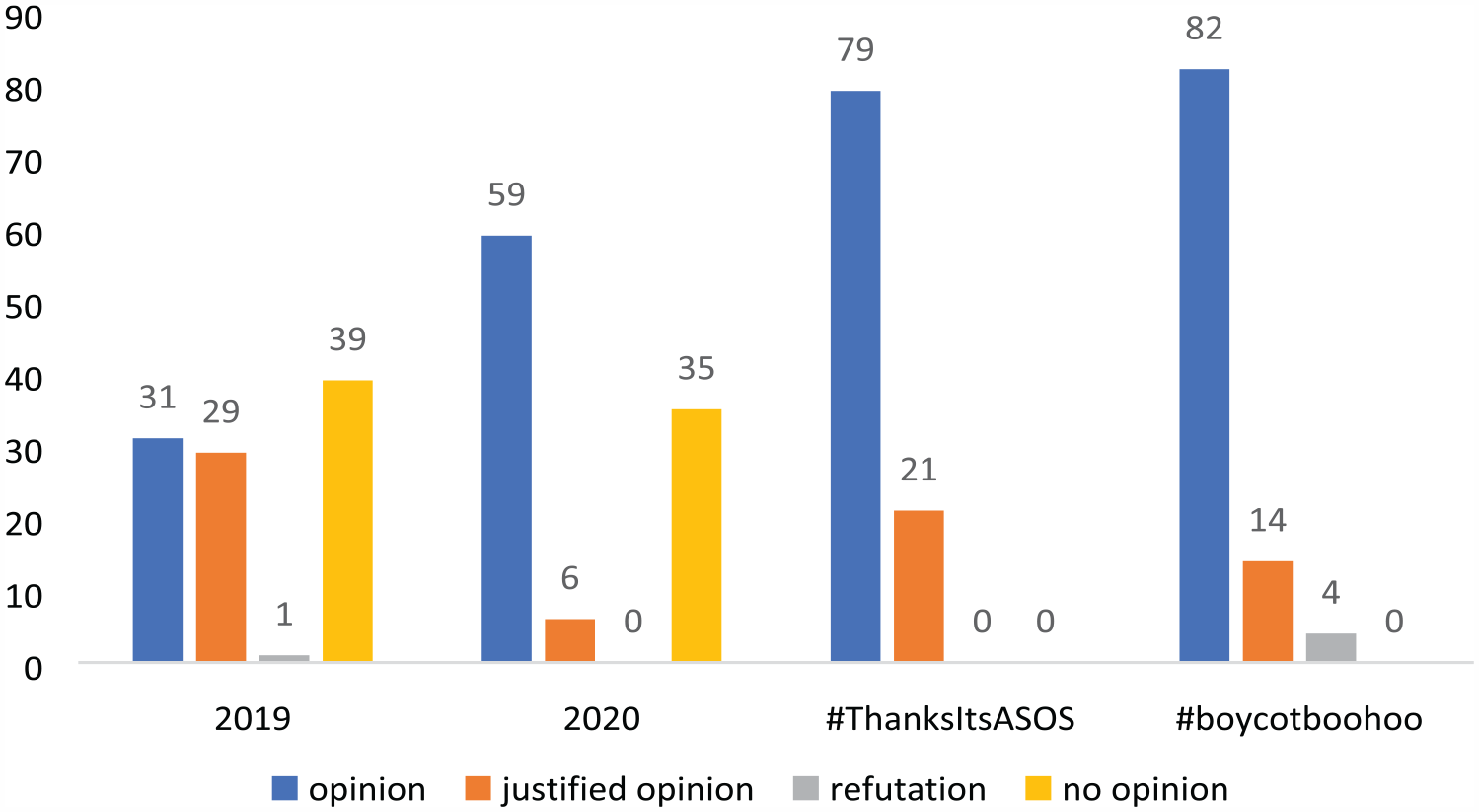
Argumentativeness of tweets as percentage, Data Sets 1 to 4.
In Data Set 1, the majority of tweets containing justified opinions were marketing-oriented (155; 75% of all justified opinion tweets) (Table 3). The main function of argumentation in such posts was to use sustainability/ethics to promote purchase (97/155). Marketing tweets putting forward justified opinions were less likely to propose reuse or donation of clothes (46/155) or highlight good practice in ethics/sustainability (17/155). Findings for Data Set 2 (Table 4) are similar. The majority of tweets containing justified opinions were for marketing (127, 72% of all justified opinion tweets), with sustainability and ethics overwhelmingly deployed to promote products (115/122). Companies were identified as examples of good practice relatively rarely (7/127).
Relationship Between the Purpose and the Argumentative Profile of Tweets, July 2020.
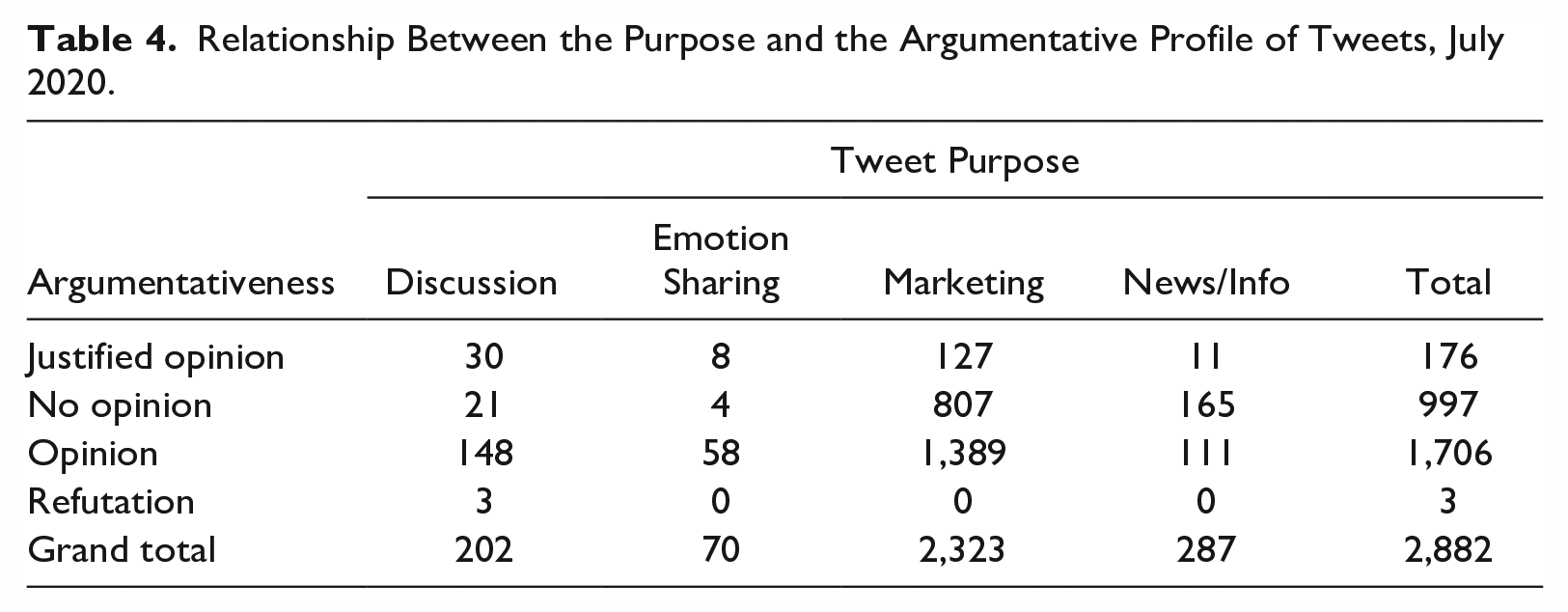
When tweets contained arguments and the purpose was to engage in, or generate, discussion about ethics and sustainability in the fashion industry (40, or 19% of total, in Data Set 1; and 30, or 17% of total, in Data Set 2) several topics were being raised. In Data Set 1, the main issues were product quality (e.g., materials used) (17/40), greenwashing (7/40), and low wages (6/40). In Data Set 2, most topics were labor-related referring to cheap labor, child labor, labor exploitations, modern slavery (22/30); environment (11/30); and poor customer service (1/30).
Noteworthy are the discussion tweets that do not contain an opinion: 36 (24% of all discussion tweets) in Data Set 1 and 21 (10% of all discussion tweets) in Data Set 2. At first glance, this might seem paradoxical: how can a message contribute to the discussion of an issue if it does not advance a claim? Once their content was examined, it became obvious that the predominant function of these tweets in both data sets was to raise an issue, typically by formulating a question expected to generate critical debate, for example, “ Can #fastfashion and #sustainability be stitched together?”
For Data Set 3, an overwhelming majority of tweets expressed an opinion (79%), but in only 21% of the cases were there any justifications provided for the opinion being put forward. This is in line with existing research (Addawood et al., 2017). These are two examples of opinion and justified opinion tweets: “@ASOS Are you sure you’re able to ship £500 worth of gear if @ASOS warehouse staff are unable to take toilet breaks and are being fired for having panic attacks? #ThanksItsASOS” (justified opinion) “Wishing @ASOS treated workers a touch more fairly #ThanksItsASOS” (opinion)
Similar to the ASOS example, the analysis of argumentation showed that the overwhelming majority of the #boycotboohoo tweets, 250 (82% of the sample), expressed an opinion, but only a very small number, 41 (14%), provided justifications for the opinions put forward: “Friendly reminder: if you’re opting to #BoycottBoohoo, this should (ideally) include their subsidiaries “I see you @boohoo - we are coming for you. And every fast fashion retailer. #Boycottboohoo - as you keep slaves in your supply chain” (justified opinion) ” (opinion)
Overall, the case study analysis shows that a backlash can be constituted by a very small proportion of critical posts, as was the case with the #ThanksItsASOS example. But these tweets can be substantially amplified, creating the backlash event. The amplification happens through a high level of retweeting, sometimes by a small number of users with high follower counts, and with help from the mainstream media that can spot the social media discussions and create a story narrative around them, thus reaching an even wider audience. One question is whether this constitutes an example of “fake news”? While Marketing Week’s (Hammet, 2019) description of a “Twitter flogging” may appear to give a misleading impression of scale, the relevance of the critical tweets to the brand identity means it passes the test of newsworthiness. This example also demonstrated the unpredictability of backlash on Twitter since the original post was an attempt to increase followers that was highjacked with users accusing the company of perpetuating poor working conditions, unfair pay, and polluting the environment. The research demonstrates how a union campaign was able to exploit the opportunity that social media provides, and has since raised these issues periodically. 3 Such events naturally raise challenges for companies such as ASOS that seek credibility and authenticity on the topics of ethics and sustainability—areas that are known to be of importance to their customer base. YouGov data from 2019 suggested that 60% of ASOS customers are “more likely than the average Brit (49%) to try to only purchase from companies who are social and environmentally responsible” and over two thirds (65%) claim to be happy to pay more for products that are good for the environment (Shakespeare, 2019).
In qualitative terms, the results demonstrate the dynamic terrain for a productive and fruitful discussion on social media. The baseline data from July 2019 and July 2020 was dominated by marketing tweets and sharing of mainstream media articles (self-directed). The data from the examples of backlash show that this can quickly turn into a vibrant and varied debate around ethics and sustainability. A significant proportion of the activity during a backlash included genuine attempts to spark discussion and share information and news. In this sense, the findings challenge the general “toxic” Twitter claim (Wulczyn et al., 2017). From the perspective of business, they support Colleoni’s (2013) dialogic model of business communication arguing for a modern, mixed strategy for social media to include avenues for listening and engaging in dialogue with audiences. Twitter is known to be populated by politically engaged audiences, and there is evidence they are ready to enter into dialogue about ethics and sustainability. An approach that avoids engagement, and/or chooses to “guide and educate” (Beighton, 2019), rather than listen, may be counterproductive.
Conclusions
The social media backlash represents the ultimate “teachable moment” for business leaders and communications professionals. It is also instructive for college students, policy analysts, and development professionals. This article provides material for the classroom by applying content analysis and argumentation theory to improve understanding of backlashes and how to respond to them. Students could use the tools and methods outlined here, perhaps on smaller and publicly available social media data sets, to carry out their own research projects. Policy analysts could use the findings to inform practice around business regulation, for example, on the implications of transparency and reporting requirements. The period (2019-2020) saw fashion businesses regularly drawn into online discussion and campaigns around the negative impacts of fast fashion. These examples of backlashes provide a useful means with which to teach about enduring gaps or dilemmas in communication on CSR. They highlight a tension between the preference of companies to focus on supplementary or peripheral issues, and for consumers and stakeholders to discuss companies’ core activities. This earmarks a potential difference in values and reenforces corporate tendency to emphasize profitability. We would expect to find similar phenomena with other big high-profile sectors such as food retailing where there are also supply chain issues and social media engagement with customers. It would be different for a less consumer-oriented sector such as international finance or logistics, where there are known issues around corporate responsibility but a lower profile on social media and less direct relationship with the general public. These can provide useful starting points for teaching about different options for communicative engagement: from companies’ traditional interest in self-directed or mediated communication to a more dialogic engagement, and how this varies by sector and organization.
Furthermore, there are insights that are useful for teaching about social media and how to manage backlashes when they occur. The results can be used to problematize the prevailing view that “rather than attempting to control social media conversations with the capacity to harm their reputation, organisations should focus their energy on trying to improve their products and services, since only the multitude of social media users will eventually decide whether a company deserves or not to survive” (Brivot et al., 2017, p. 811).
Standard social media analysis used by communications professionals tends to be dominated by data science techniques calculating impact via aggregate numbers, retweets, and followers, or reduce posts to their attitude or “tone” via sentiment analysis. Bringing in qualitative approaches from the field of communication studies can help identify key topics and drill down into communicative purpose, position, and arguments deployed by users, including the extent to which tweets employ the art of persuasion and make claims with, or without, justification. Similar considerations highlighting the value of qualitative analysis could apply to other social media platforms beyond Twitter, such as Facebook, Instagram, and YouTube.
The role of social media is a significant topic for teaching corporate communications: on the opportunities and risks around new communication platforms and how they are regulated, not least regarding misinformation, polarization, and the quality of online discussion of social issues. There are indeed increased risks for businesses to engage openly over Twitter, partly because of the culture that has developed on that platform, and partly because of the way that Twitter is managed in contrast with other platforms such as Instagram where user engagement can be more actively “curated” and negative comments obscured.
Business sharing of information on ethics and sustainability has become increasingly dominated by self-directed corporate communication, but nevertheless remains fertile ground for campaigns that can repurpose material when an opportunity arises. Finally, while this article did not explore financial impacts, these case studies could be a useful source for studying the scale and nature of these. In the case of Boohoo, the scandal was thought to have had “very limited residual social media effect – all is forgotten, back to business” (analyst Aneesha Sherman cited in Armitage, 2020). While both Boohoo and ASOS examples show that online interest in such a scandal can be very limited (the actual number of critical tweets was very small) and decrease very quickly (even the #boycottboohoo hashtag stopped trending after a few days), such episodes still provide an important teaching tool for exploring how businesses engage on social media on the topics of ethics and sustainability. More than simply a “litmus test,” they represent a learning opportunity for firms, consumers, and researchers.
Footnotes
Declaration of Conflicting Interests
The author(s) declared no potential conflicts of interest with respect to the research, authorship, and/or publication of this article.
Funding
The author(s) disclosed receipt of the following financial support for the research, authorship, and/or publication of this article: The study was supported by a University of Liverpool, UK, Knowledge Exchange and Impact Voucher.
