



Abstract
We gathered data from business practitioners to learn how they describe successful online business presentations. We found that many—but not all—successful examples were described in terms of classical rhetorical concepts (e.g., source credibility and content). We also found that about 20% of the examples were described as successful because of technology deployment, audience interactivity, or both. We conclude that professors of management communication should teach the online presentation, that such instruction should include classical rhetorical concepts (with some appropriate adjustments), and that instruction should be expanded to include technology and interactivity.
In the introduction to Rhetorical Theory and Praxis in the Business Communication Classroom, Lentz and Getchell (2019) say they posed the following question to chapter authors: “How does rhetorical theory drive pedagogy in your business communication classroom?” (p. 5). The question assumes both the availability and the relevance of rhetorical theory.
This article poses a different question: What rhetorical theory is available and relevant for teaching students about the online presentation? We do not believe that the rhetorical concepts currently driving the teaching of the in-person presentation suffice for the online presentation. In this article, we begin the process of identifying some needed adjustments—specifically discussions of technology deployment and audience interaction—and suggesting how these adjustments might be implemented.
The next section of this article provides a review of literature and culminates in a statement of our research questions—one a discovery question and one a pedagogy question (Boyer, 2016). We then devote a section to describing the methods and procedures for our study of the experiences of 61 midcareer business practitioners, including limitations. We draw three conclusions from the results, and we organize the subsequent and longest section in our article around those three conclusions. For each conclusion we summarize relevant data, discuss the data, and offer suggestions for teaching. Then, before bringing the article to a conclusion, we call for additional research and identify specific issues that seem worthy of attention.
Literature Review and Research Questions
Since ancient times (e.g., Aristotle, ca. 350 B.C.E./2007), humans have given and evaluated oral presentations. Today, we continue to regard oral presentations as an important business activity. However, many contemporary business presentations bear little resemblance to a traditional public speech. Pris Rogers, for example, noted that the business presentations she was observing in her field research did not resemble the public speeches she had studied as a graduate student. She argued (Rogers, 1988)—in an article that has received too little attention—that those who teach professional communication should understand themselves as teaching and studying “presentational speaking” rather than “public speaking.”
As developed by Rogers (1988), presentational speaking differs from public speaking in several ways, including smaller audiences, the continual possibility of audience comments and questions (i.e., interactivity), and greater reliance on visual aids. From this perspective, one can see that businesspersons occasionally give public speeches (e.g., Heracleous & Klaering, 2014; Kang & Van Ouytsel, 2023; Lambert & Landau, 2015; McCarthy & Hatcher, 2004; Myers & Kessler, 1980). But most of the occasions when a businessperson speaks to a group should be described as business presentations (e.g., Blazkova, 2011; Galbraith et al., 2014; Van De Mieroop, 2009). Thus, we focus on online business presentations.
It is time to begin thinking carefully about the characteristics of excellent online presentations and about how to best prepare students to deliver such presentations. But the specific question of how best to design and deliver a successful online presentation does not seem to have attracted scholarly attention in either online education literature or the media in business literature.
As online education became more prevalent in recent decades, universities began to offer online courses—for example, courses about English as a second language (e.g., Xu et al., 2021) and about public speaking (e.g., Broeckelman-Post et al., 2019; Ward, 2016)—that required students to make presentations. So far, however, studies of such courses have emphasized questions about online delivery of training for conventional face-to-face presentations (e.g., Ledford et al., 2023; Yee et al., 2022)—not the training of students to make online presentations.
As businesses began to make greater use of computer-based communication, scholars began studying the effects and user reactions to media in business. Much of that research has focused on text-based systems or one-to-one systems (e.g., Denstadli et al., 2012; Y. Lee, 2022; Steizel & Rimbau-Gilabert, 2013; Tomprou et al., 2021; Welch, 2014; Wilson, 2003). But the literature does not provide assessments of more (or less) successful presentations.
The Challenge We Face
We believe that the greater frequency of online presentations will change audience expectations. We believe, further, that changed expectations will affect how an audience receives and responds to any specific presentation. Educators should adjust to the new circumstances.
While discussing “TED Talks” as a potential educational tool, Kedrowicz and Taylor (2016) bring our concerns into focus. They write that “advances in digital media have made an impact . . . shifting expectations and norms associated with orality and public presentation” (Kedrowicz & Taylor, 2016, p. 353). They elaborate as follows: We see little evidence that presentation pedagogy has shifted to include detailed discussion of how computer-generated visuals can enhance the presentation experience. In short, rather than responding to advances in new technologies and attempting to reexamine the rhetorical tradition, speech pedagogy remains grounded in traditional ideas. (Kedrowicz & Taylor, 2016, p. 355)
As Kedrowicz and Taylor (2016, p. 370) recognize, TED Talks do not resemble typical managerial presentations. But the authors correctly speak of “shifting expectations and norms” and conclude that “public speaking pedagogy must engage with shifting expectations” (Kedrowicz & Taylor, 2016, pp. 353, 370).
We assume that, in the future, business practitioners will deliver a substantial percentage of their oral presentations by way of a computer-based video system (e.g., Lifesize, Teams, Webex, Zoom). We say that because of the growing prevalence of national and multinational organizations that employ geographically dispersed workers; because of the growing prevalence of distributed work in (post-COVID) domestic firms, which allows employees to work from home; because of better technology and more experienced users of video meetings globally; and because of the likely reoccurrence of challenges (e.g., pandemics) that may discourage face-to-face gatherings.
Rhetorical Concepts and Research Questions
Instruction for making in-person oral presentations has been driven by a cluster of neoclassical rhetorical concepts—the artistic proofs (ethos, logos, pathos), so called because they are produced by the arts of rhetoric and the rhetorical canons (content, structure, style, delivery, memory). Rhetoric is, of course, a much more expansive and diverse body of knowledge than the identified clusters of traditional concepts.
But, although some scholars have addressed changes in oratorical practice (e.g., Rossette-Crake, 2020), the modern developments in rhetoric seem to have had less impact on pedagogy. Frobish (2000), for example, describes “current speech texts [as] out of date” (p. 239). Rood (2013), after reviewing a selection of textbooks noted their reliance on a “neoclassical model of rhetoric” (p. 332) which, for public speaking textbooks, included a description of “the three rhetorical appeals (ethos, logos, and pathos), along with the five canons” (p. 336).
We might, therefore, state our discovery scholarship (Boyer, 2016) question as follows: Do forms of proof (i.e., ethos, logos, and pathos) and the canons of public speaking (i.e., content, structure, style, delivery, and memory) provide an adequate description of the effectiveness of online presentations? Concomitantly, we can state our pedagogy scholarship (Boyer, 2016) question as follows: Do the artistic proofs and the canons of public speaking provide an adequate framework for training students to make online presentations?
Methods and Procedures
To begin addressing these questions, we conducted a study (ruled exempt by the University’s Internal Review Board). For 2 consecutive years, we surveyed persons enrolled in a 14-month Executive Master of Business Administration (EMBA) program, asking each respondent to identify a successful online presentation that the respondent had observed and to answer questions about that presentation and the setting in which it occurred. Our study was a questionnaire study (Caamaño-Alegre & Caamaño-Alegre, 2019) using a convenience sample (Cresswell & Guetterman, 2019). We presented it to the students as an ungraded class assignment designed to stimulate thought and so prepare them for subsequent class discussions.
Our research objective was to learn inductively how experienced practitioners evaluate online presentations. We assumed that the EMBA students would be experienced practitioners because the admission requirements for the EMBA program include experience as a manager and the enrollees are typically between 30 and 40 years old. We developed a brief survey, using both open and closed questions (see Appendix A) and administered the survey using SurveyMonkey. To reduce demand effects that can distort responses (Zizzo, 2010), we distributed the survey on the first day of an elective course on “leadership communication” and requested responses prior to the next day of class. Students were given class time to complete the survey. We aggregated responses and prepared preliminary results for use in subsequent class periods.
Respondents
We collected data from two different cohorts (2021, 2022) and received responses from 63 persons. Thirty-six (57%) of the respondents were males; 27 (43%), female. They reported extensive experience with videoconferencing, estimating that 85% of their business meetings during the preceding 2 years had been conducted through videoconferencing. They estimated 13.85 (median) video meetings per week during the same period.
We summarized quantitative survey data with descriptive statistics and conducted a content analysis of the answers to open-ended questions (B. Lee, 2012; Saldaña, 2016; Tracy, 2013). Our processes were iterative and interpretative (B. Lee, 2012; Tracy, 2013, chap. 9), using the complete phrase as the unit of analysis. One rater performed the initial development of categories and a content analysis. A second rater then used the identified categories to analyze the data set. Comparisons of the two ratings provided an assessment of reliability; differences between the two independent ratings were resolved though discussion.
The survey data consisted of 257 comments, ranging in length from 2 to 124 words or, in a few cases, numerals. Some were answers to objective questions (e.g., “How many people were in the audience?”) requiring only the categorizing of responses. However, the most important question in the survey (i.e., “What factors made the presentation successful?) could not be analyzed so simply. Recognizing that “any corpus of rich data can be analyzed in multiple ways” (Tracy, 2013, p. 188), and to achieve our research objectives, we analyzed the explanations of online success three times, adopting a different focus for each effort. Our first two analyses focused on preidentified themes (forms of proof and the rhetorical canons, respectively); the third analysis was more interpretative and allowed other themes to emerge from the data (B. Lee, 2012, pp. 396-400). We include some additional details about method in the following sections.
We relied on the respondents to define “successful” (what “made the presentation successful”). Their responses indicated that they implicitly defined “success” either as satisfying the respondent or as appearing to achieve the presenter’s objectives. So, for example, we might paraphrase several of the responses as “I understood the new product I was supposed to sell,” “I understood the importance of not engaging in insider trading,” “I was reassured that management had a plan for surviving the pandemic,” or “I appreciated the significance of the recent security breach.” These descriptions came, of course, from members of the audience and we have no information about how the presenters assessed their own efforts.
Limitations
There are several limitations of this study. Most obviously, our sample consisted of people working in a specific region and doing so during the COVID-19 pandemic. It is, therefore, possible that the results have been skewed by atypical circumstances. Another limitation is the fact that the data are self-reports and retrospective—two factors that can distort responses. With regard to self-reports, we are limited to what the respondents wrote, and we cannot be certain, for example, that what a person untrained in speech assessment called “good organization” would have been so labeled by a professor of management communication. In several cases we also wished, while interpreting written answers, that we had been able to interview the respondents and probe more deeply when their answers seemed unclear or incomplete. Finally, there is always risk of demand characteristics distorting responses (Zizzo, 2010). In this instance, we collected data at the beginning of the course before instruction began; we asked for descriptions of personal experiences at work (rather than for opinions about items that would seem to have more- or less-desirable answers); and we asked no “threatening questions,” which are known to increase the risk of biased responses (Nederhof, 1985).
Findings
We received responses to our questionnaire from 63 persons enrolled in the course in either 2021 or 2022. The central question asked each respondent to identify and describe a “successful” online presentation. Two persons did not provide usable answers to that question. One woman explained, “I have not found virtual presentations to be successful” (#23). Another woman described the meeting she was focusing on as “a disaster” because the presenter was “working from home,” the “rest of the team was in the office,” and “half of the people in the meeting . . . didn’t understand what was on the screen and [should have been] obvious and kept asking questions” (#45). We do not know if this woman had misunderstood survey instructions or if the “disaster” she described was, in fact, the most successful online meeting she had experienced—but we decided not to include her responses as providing information about a successful online presentation. This left us with 61 usable responses.
We draw three broad conclusions from our data. We conclude, first, that online presentations now occur in many different business arenas; second, that neoclassical rhetorical concepts are necessary but not sufficient for explaining the success of online presentations; and third, that a comprehensive description of successful online presentations requires attention to technology deployment and audience interactivity.
We organize the remainder of this section of our article around those three conclusions. In each case, we will review the results we obtained and offer suggestions for teachers. We do not regard our efforts as providing a final or complete treatment of the pedagogical issues—we do believe that they provide a starting point. Since our data come from midcareer professionals enrolled in an EMBA program, we will address our conclusions to those who teach courses in management communication. We hope, of course, that instructors delivering other types of professional communication education (e.g., business communication, technical communication) may also find our work helpful.
Conclusion 1: Online Presentations Occur in Many Business Settings
The questionnaire asked each respondent to “select the most successful (or one of the most successful)” online presentation(s) that he or she had observed as an audience member and to answer a series of questions about that event. Because we wanted each respondent to focus on a specific example from personal experience, we began by asking about the size of the meeting and its purpose. Besides encouraging respondents to focus on concrete examples, the answers to questions about meeting size and purpose provide us with a profile of the meetings in which online presentations were made.
Results and discussion
The first questionnaire item concerned the size of the audience for the presentation that the respondent had observed. The smallest reported audience size was 3 (one occurrence); the largest was “10,000+” (one occurrence). For additional analysis, we sorted the responses into three groups of approximately equal size, labeling the meetings small (n = 19), medium (n = 20), and large (n = 22). Small meetings included 3 to 30 audience members; medium meetings included 35 to 100 audience members; large meetings included 101 or more audience members. Two persons failed to provide a numerical answer—following a normal process, we placed both meetings in the medium category.
The next questionnaire items asked the respondent to describe the purpose of the meeting and the roles of the participants. Based on specific phrases and words used by respondents (see Appendix B), we sorted some of the meetings into a discussion/decision-making category (e.g., considering and choosing among options), a persuasion/motivation category (e.g., selling products or motivating employees), and a training/education category (e.g., job or career-related learning). Initial codings agreed at rates of 90%, 100%, and 92%, respectively. The other 24 meetings were assigned to a residual, miscellaneous category. Table 1 summarizes the results.
Meetings Placed in Categories by Goal or Purpose.
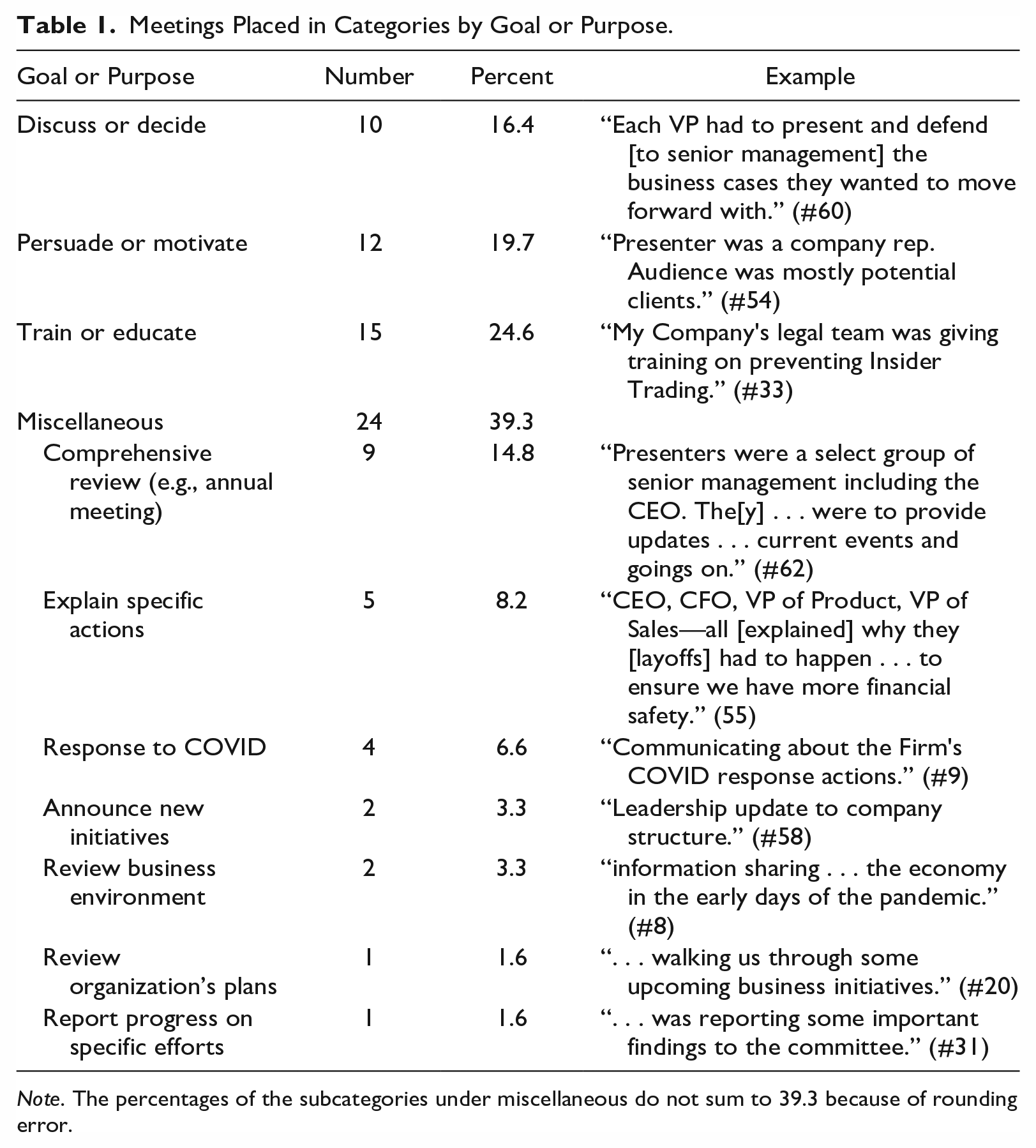
Note. The percentages of the subcategories under miscellaneous do not sum to 39.3 because of rounding error.
Respondents described the purpose of 16% (n = 10) of the events as discussion/decision making, the purpose of 20% (n = 12) as persuasion/motivation, and the purpose of 25% (n = 15) as training/education. The residual category, as suggested by the details included in Table 1, included a wide array of business activities, many of which might be described as information sharing.
A cross-tabulation of meeting purpose (Table 1) and meeting size showed a clear pattern. Discussion/decision meetings were most often (50%) small in size, persuasion/motivation meetings and training/education meetings were most often (40%) medium in size, and miscellaneous/information sharing meetings were most often (50%) large in size. However, the relationship between purpose and size did not achieve statistical significance (chi-squared = 5.10; df = 6).
These results show online presentations in meetings ranging from small to large; they show online presentations occurring in decision-making meetings, meetings intended to persuade customers or inspire employees, training and education meetings, and a very wide array of other meetings. In short, the data show that business has gone online. As previously noted, our respondents reported that they were frequently participating in online interactions, but that left open the possibility that online interactions were confined to one (or several) specific aspect(s) of business practice. The current data (meeting size and purpose) indicate that online interactions have become a standard part of business life and that those interactions include oral presentations.
What we have said so far does not address differences between in-person and online oral presentations. (We will take up those matters as we discuss our second and third conclusions.) We hope, however, that the information already presented will convince management communication instructors of the importance of teaching the online presentation. We offer the following suggestions.
Teaching suggestions
We suggest that management communication courses should include one or more online presentation assignments. The online presentation should be identified as an emergent genre that merits attention and instruction. A more complete explanation of our reasoning will emerge in the following portions of this article. But the first, foundational step is to create one or more assignments that provide students with online presentation experience and, concomitantly, allow instructors to begin gathering experience in teaching and grading the online presentation.
We suggest, additionally, that professors should differentiate between synchronous presentations (with opportunities for real time interaction) and asynchronous presentations (recorded and uploaded, allowing audience members to receive the presentation at times of their own choosing). Most of our respondents described synchronous presentations but a few described asynchronous or synchronous presentations that included recorded elements.
Conclusion 2: Concepts From Neoclassical Rhetoric Are Necessary but Not Sufficient
The key item in our questionnaire was the one that asked the respondent to explain what had made the chosen presentation a success. We analyzed the content of those answers three times, and report two of those analyses in discussing our second conclusion.
Artistic proofs: Ethos, logos, and pathos
The first content analysis was to determine if our respondents explained effectiveness in terms of the neoclassical artistic proofs, concepts that appear frequently in instructional materials for oral presentations (Frobish, 2000; Rood, 2013). Aristotle (ca. 350 B.C.E./2007, Bk. 1, chap. 2) argued that an advocate could, through the arts of rhetoric, produce three forms of proof including ethos, logos, and pathos, arguing that ethos was the most powerful. Ethos is an appeal to the audience’s respect for the credibility of the advocate; logos an appeal to the audience’s logic and reasoning; and pathos, to the audience’s emotions or feelings. Since we wanted to know whether our respondents used these concepts in judging an online presentation as successful, we began our content analysis with a list of synonyms for credibility, logic, and emotion. Our initial analysis showed respondents had mentioned credibility far more than the other two forms of proof. We, therefore, drew on quantitative research and divided credibility into expertise, character, and goodwill (McCroskey & Teven, 1999). We then followed an iterative process of examining the data, refining our list of terms and phrases (see Appendix B), categorizing responses, and reviewing our results for consistency. Agreements between the initial codings of respondent texts exceeded 80% in all cases as follows: expertise (90%), character (90%), goodwill (82%), logos (82%), and pathos (90%).
We summarize the results in Table 2. As shown, we found all three forms of proof referenced by respondents, sometimes as the sole explanation and sometimes in conjunction with other forms of proof. These results suggest that the traditional emphasis on artistic proofs continues to be valuable in the online arena. However, we note that the three forms of proof accounted for only 23 (38%) of the 61 successful presentations.
Canons of public speaking: Content, organization, style, delivery, and memory
For our second analysis of the explanations for success, we turned to another well-known set of categories from classical rhetoric (Kennedy, 2001, p. 111), the canons (or standards) that frequently appear in instructional materials (Frobish, 2000; Rood, 2013). These include content (the discovery or invention of things to say), organization or structure (decisions about the sequence in which materials should be presented), style (decisions about language), delivery (oral and physical performance), and memory (committing one’s preparation to memory so that it will be accessible when the occasion for speaking arrives).
Artistic Proofs as Explanations for Success.
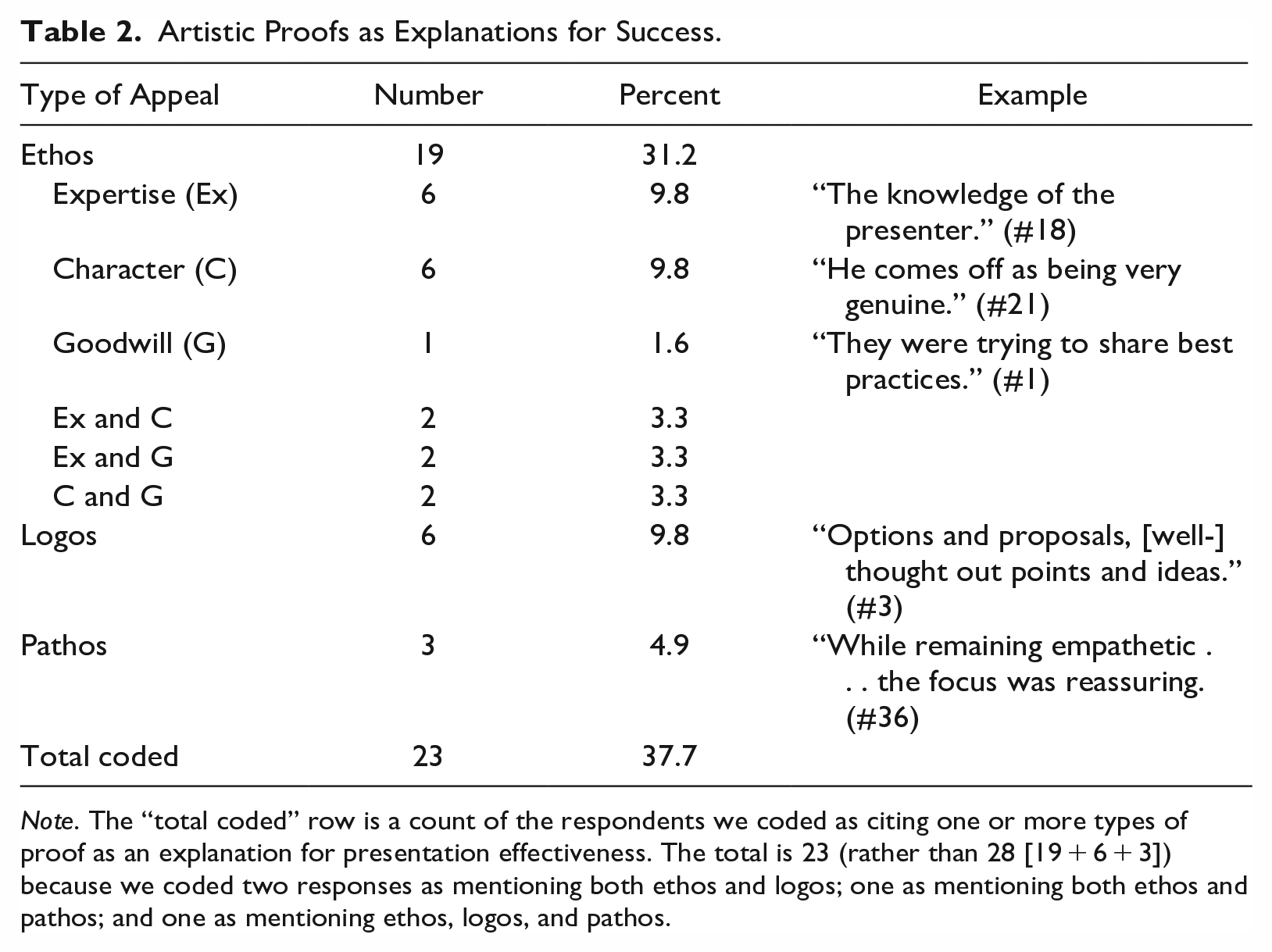
Note. The “total coded” row is a count of the respondents we coded as citing one or more types of proof as an explanation for presentation effectiveness. The total is 23 (rather than 28 [19 + 6 + 3]) because we coded two responses as mentioning both ethos and logos; one as mentioning both ethos and pathos; and one as mentioning ethos, logos, and pathos.
One of the canons—memory—has “by far suffered the largest scholarly decline over the intervening centuries” (Pruchnic & Lacey, 2011, p. 472) and is now in need of revival (Arellano, 2023; Pruchnic & Lacey, 2011). As documented by Pruchnic and Lacey, memory was originally a rich and multifaceted concept. Over time, however, it was reduced to mnemonic techniques (Kennedy, 2001, p. 113) that a speaker might use to speak without notes—we use “memory” in that narrow sense.
We began the content analysis process by identifying terms and phrases that referenced the specified concepts. We then iteratively searched the responses, revised our list of terms (see Appendix B), and checked for consistency. Initial codings agreed as follows: content (71%), organization (82), style (79%), delivery (69%), and memory (98%).
The results that we report in Table 3 show that respondents most frequently mentioned content—both as a complete explanation and in combination with other canons. Each of the other canons was also mentioned, either as a complete or partial explanation.
Canons of Rhetoric as Explanations for Success.
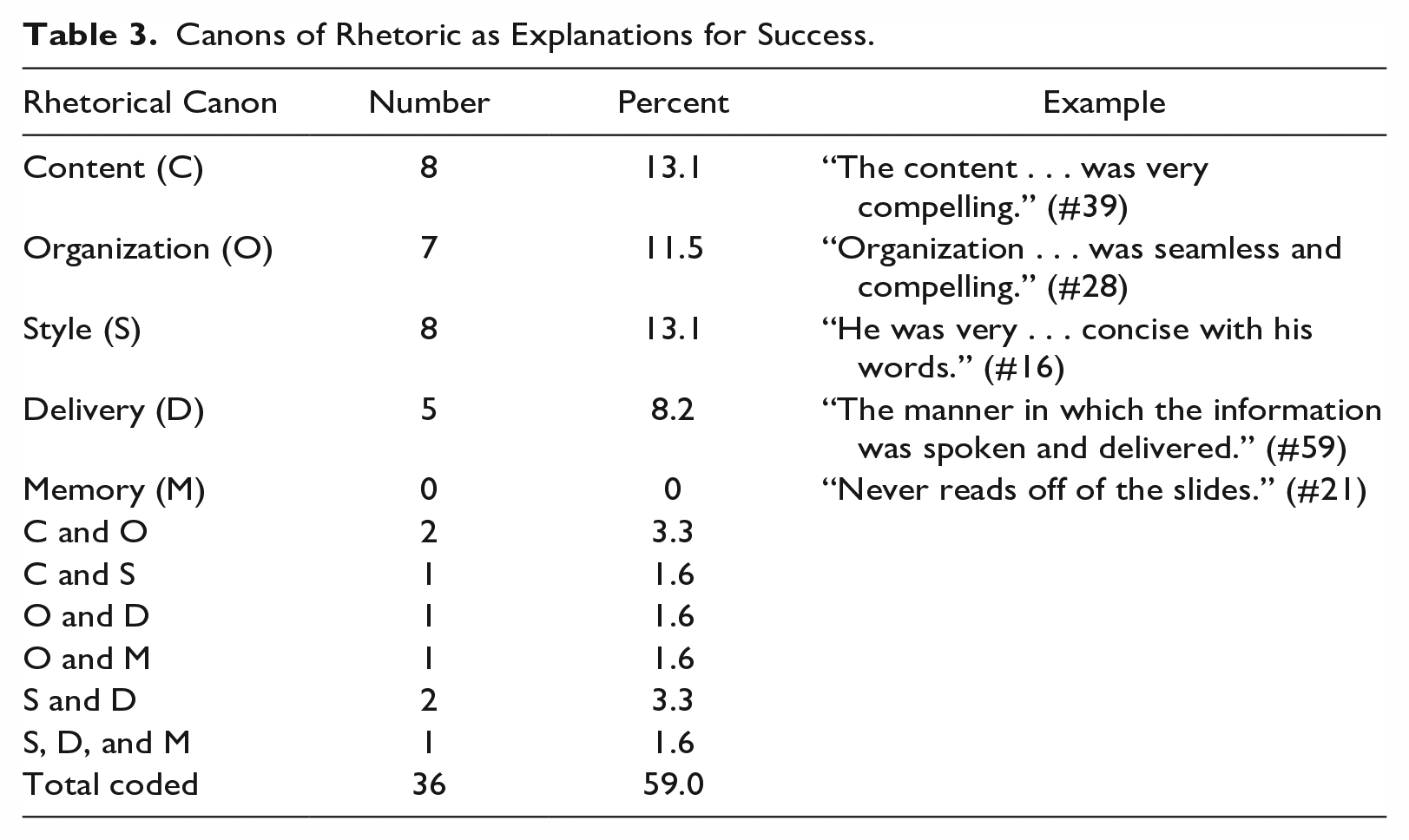
These results indicate that the canons remain a useful set of categories for explaining why a participant regards an online presentation as effective—and content, not surprisingly, was the most frequently cited canon. Once again, however, we note that our results do not account for all the presentations. Specifically, the analysis reported in Table 3 provides explanations for the effectiveness of 36 (59%) of the effective presentations.
Neoclassical rhetoric: Proofs and canons
Comparing the two efforts to account for presentation effectiveness indicated that 29 explanations were coded as mentioning both artistic proofs (Table 2) and rhetorical canons (Table 3) and an additional 20 explanations were coded as mentioning either proofs or canons. In sum, therefore, explanations of the success of 49 (80%) of the online presentations could be accounted for with the traditional rhetorical concepts included in our study. This means that those same concepts did not account for 12 (20%) of the online presentations. These results lead us to conclude that the specified rhetorical concepts (or their equivalents) are necessary but not sufficient to describe successful online presentations. On that basis, we offer the following suggestions.
Teaching suggestions
First, we believe that instructors should continue to use the neoclassical concepts that currently dominate instruction for in-person presentations—or their equivalents. As noted, some scholars regard the neoclassical concepts as outdated in comparison to the rhetorical concepts currently used in rhetorical criticism (Frobish, 2000; Rood, 2013). We believe that either the work of Burke (1969) or that of Perelman and Olbrechts-Tyteca (1969) could provide a viable alternative to the neoclassical approach. But, at present, both bodies of work (Burke, and Perelman & Olbrechts-Tyteca) seem more adapted to rhetorical criticism than to oratorical instruction. So, while we recommend the neoclassical concepts or their equivalents, our discussion will continue to rely on the former. The artistic proofs help students to understand in broad terms the sorts of rhetorical levers that are available to them; the five canons provide a list of issues to be considered in preparing a presentation.
Second, we also recognize that the move from in-person to online requires adjustments in the presentation of the neoclassical concepts. Focusing, for now, on canons, the three that require the largest adjustments are content, delivery, and memory. We believe that online presentation—to an even greater extent than the now-familiar PowerPoint—facilitates the use of nonverbal content in the form of visual images. The person preparing an online presentation can, for example, consider photographs, diagrams, or (in appropriately small doses) detailed tables of financial data, with the confidence that these images will be sharp and vivid (and displayed at an effective distance of about 18 inches) for audience members. We recognize that such nonverbal content can be presented in-person with hand-outs, whiteboards, PowerPoint, etc. But, in our experience, the online presentation facilitates the use of such content. Please note, we do not mean to treat such images as mere “visual aids” but rather as a category of content that presenters can now (more easily) deploy (Kosslyn, 1975; Kostelnick & Hassett, 2003; Tufte, 2001).
Another canon, delivery, will need to be adapted in multiple ways. Perhaps most importantly, delivering a presentation online has a completely different feeling (or “energy”) for the presenter, and students need to experience the difference. One way to introduce a student to the online presentation is to require the student to present the same material twice—once in a conventional classroom and once as an online presentation from the student’s home office. (Both presentations should be recorded for subsequent review.) This gives students personal experience with the two types of presentation. One could also require students to make a recording to be used as an asynchronous presentation—yet a third type of experience. Subsequent discussion and self-evaluation can explore the feedback that one receives (or not) during the various types of presentations, the differing levels of felt energy (mental arousal) that the student experiences in-person versus online or while making a recording, and the challenge of projecting energy to an online audience that is invisible (cameras off), or visible and nonresponsive, or merely anticipated as future viewers of one’s presentation.
Recordings of online presentations can also be used to explore other aspects of delivery by allowing presenters to see their presentations from the perspective of audience members. Guided by an instructor, presenters can consider “stage movement” (walking around in an in-person classroom, moving toward and away from a camera when online); the sorts of gestures that the online format precludes or facilitates; the impact of audience members having a full frontal, relatively closeup view of the presenter’s face; and the challenges of online “eye contact.” It is, of course, impossible to establish actual online eye contact. But by positioning the screen image of an audience member near the camera of one’s computer, and by looking at that image or directly at the camera, one can produce a facsimile of direct gaze.
As noted, we suggest recording both synchronous and asynchronous online presentations. The recordings can be used in at least two ways. One use (already mentioned) is to allow presenters to assess their own performances. A second use is to help a student better understand the dynamics of asynchronous presentations by, for example, watching a third party view one’s recorded presentation—perhaps moving at double speed and, at times, pausing and reviewing a passage. Seeing how other people respond to one’s presentation can enrich understanding of the ways in which audience members may “receive” a presentation.
A third canon which requires attention and adjustment is memory. The ancients discussed memory as a capacity for recalling prepared materials during public performance. In modern times, “speaking without notes” has become something of a fetish in some communities whereas, on the other hand, many business speakers rely on notes or a manuscript. The impact of presenting online is that audience members will have a close-up view of the speaker’s face and may become acutely aware of when and how presenters (with rapidly shifting eyes) consult their notes. Senior business executives may address this issue by acquiring teleprompters or creating notes on their presentation software. Others may rely on a built-in computer camera and paper notes. Regardless, presenters should consider both how to make their prepared materials easily accessible and how their chosen method will appear on the screens of audience members. We recommend that speakers have notes on or near the computer screen and that they practice and speak extemporaneously (i.e., from an outline rather than a text).
Conclusion 3: Describing Successful Online Presentations Requires Additional Concepts
Concluding that the neoclassical concepts included in our study did not fully account for factors that made online presentations successful, we undertook a third content analysis of our respondents’ answers. On this occasion, we adopted an “emergent” approach (Tracy, 2013, p. 184). We began by reading the responses and making notes about themes that did not duplicate the previously considered rhetorical concepts, iteratively revising our themes, and comparing them with response texts. By way of this process, two broad themes emerged: the deployment of technology and audience interaction (see Appendix B). Initial codings of the two themes agreed 89% and 97% of the time, respectively.
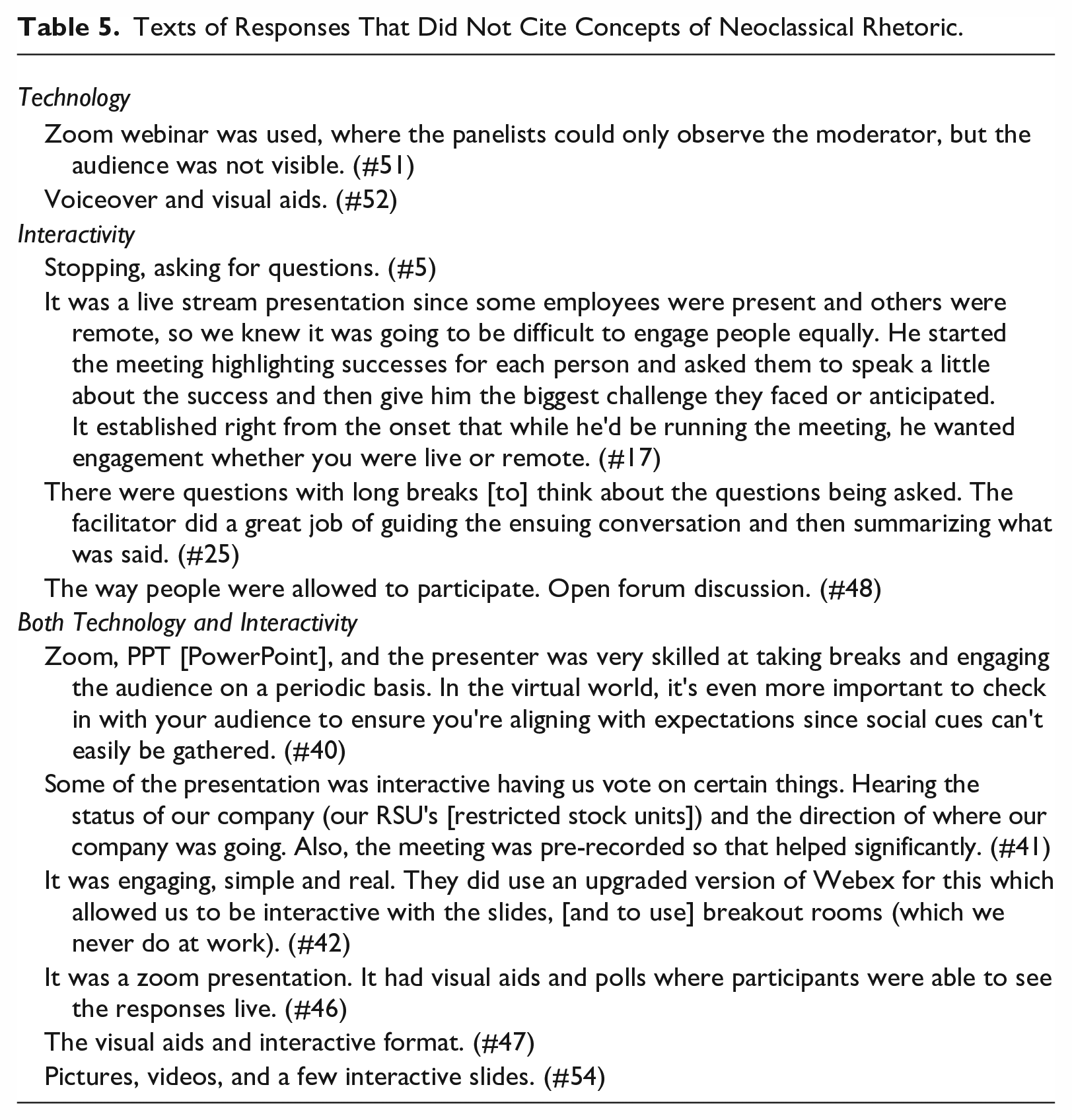
When we combine the results of the third content analysis with the two previous ones, we see (as reported in Table 4) that we can account for all 61 descriptions of an effective online presentation. While technology (n = 2, 3%), interactivity (n = 7, 12%), and a combination of technology and interactivity (n = 3, 5%) were not cited as often as the neoclassical rhetorical concepts, they were cited instead of the classical concepts in 20% of the examples. Table 5 includes the texts of the 12 responses as providing a technology and/or interaction explanation of presentation success. (The responses in Table 5 do not, of course, provide a complete view of the technology and interactivity themes. Those themes also appeared, along with artistic proofs and/or canons, in 29 additional responses.)
Proofs and Canons Plus Technology and Interactivity as Explanations for Success.
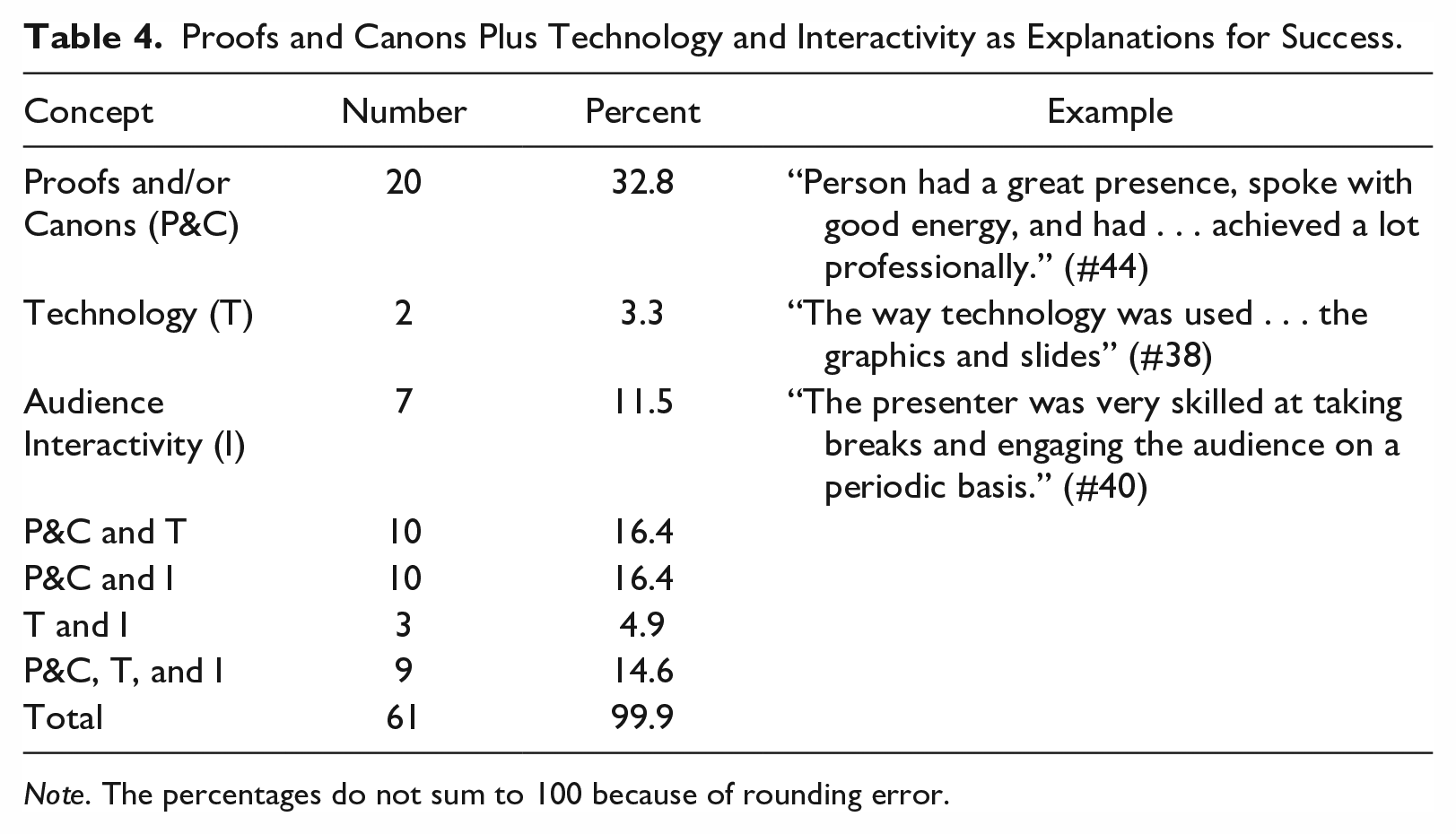
Note. The percentages do not sum to 100 because of rounding error.
Texts of Responses That Did Not Cite Concepts of Neoclassical Rhetoric.
Deployment of technology theme
The deployment of technology theme took a couple of surprising turns. Before conducting this study, had we been told that technology would emerge as an important theme for describing more successful presentations, we would have assumed this meant that the presenter had a well-designed PowerPoint deck (e.g., limited text and large font), an appropriately aimed camera, and a sensitive microphone. Our actual responses can be summarized in three subthemes, only the first of which we might have anticipated. (a) In many instances, respondents cited technology as making a presentation successful because the technology was used skillfully. (b) In some instances, respondents felt the presenter had achieved success by choosing to eschew the use of (some) technologies and to present a message in a less “slick” way. (c) And some respondents cited technology as making a presentation successful because the technology had been used to facilitate audience interaction.
Favorable comments about technologies included (besides one of the basic online video systems, such as Webex or Zoom), PowerPoint, chat, the “raise hand function,” polls, and break-out rooms. In many cases, respondents cited a technology without going into detail about what the technology contributed. For example, one person wrote positively about “the way technology was used . . . the graphics and slides” (#38).
In contrast, a few respondents called attention to what was not there: “The presentation was successful because of what was absent. There were no slides and there was not [a] script, but instead our boss had an honest conversation about the future and what we might expect” (#27). Another wrote, “It was not manufactured by our marketing department but shot from his [Divisional CEO’s] basement” (#14).
A similar comment about the absence of technology has the effect of helping us to see the “absent” technology. One respondent wrote that: “It was mostly his face i.e., not slides” (#9). This remark from respondent #9—and other similar remarks such as the immediately preceding quotations from respondents #14 and #27—remind us that these persons were (by way of video technology) seeing a senior manager from an apparent distance of about two feet (not from a front-row distance of 10 feet or a back-of-the-auditorium distance of 40 feet), and their view was typically straight on, face-to-face rather than the profile of someone ten-chairs down on the same side of the conference room table. The comments about the absence of technology reveal that video technology could “disappear” for some respondents as they looked directly in the face of an executive.
Other comments praised technology for its ability to allow interaction between presenter and audience or among audience members. For example, one person stated, “The technology being used was effective, it was easily controlled by an events team. . . . Audience participation occurred in real time through a chat system which was engaging” (#62). We now turn to the issue of audience interactivity,
The audience interactivity theme
Audience interaction appeared in several forms. Frequently, for example, respondents described it in terms of the presenter allowing or soliciting questions (“paused and asked for questions,” #5) either orally or by way of a “chat” function or allowing audience members to speak (“allowed people to speak if desired,” #6).
Other forms of audience participation included audience polls (with real-time results), opportunities to work directly with the presenter’s materials (“interactive slides,” #54) and the chance to interact with other members of the audience: “They . . . allowed us to be interactive with the slides, [and to use] break out rooms (which we never do at work)” (#42).
All these manifestations strike us as consonant with the argument of Rogers (1988) that teachers of professional communication should understand themselves as teaching and studying “presentational speaking,” a form of interaction that allows for continual interaction (e.g., questions and comments) among the participants.
In our current study, audience interaction emerged as an important criterion of presentation success. Perhaps our respondents meant to signal that they appreciated the effort to allow the same interactivity online that they had experienced in face-to-face meetings. However, we would argue that the factors driving the adoption of online technologies (e.g., dispersion of employees) also have the effect of reducing interpersonal contact among employees. This can produce a hunger for what might be called “professional conversation.” Even more powerful, in our estimation, is the desire to have one’s presence at a significant organizational event to be recognized by others (Hall & Davis, 2017; Steinmetz & Pfattheicher, 2017). In a face-to-face meeting, a participant is likely to make eye contact and exchange small talk with others—these are not easy to do online. Consequently, interactivity—if only that of completing an online poll—becomes more rewarding for the participant as a way of demonstrating one’s presence.
Furthermore, the emphasis on interactivity suggests a shifting understanding of audience participation—from a supplemental question-and-answer (Q&A) activity at the end of a presentation to a continual possibility. While polling can constitute presenter-initiated engagement, the online chat function creates the opportunity for the audience to interject comments, questions, and reactions throughout the presentation. They can discuss the presenter’s remarks while those remarks are being delivered.
It is, we might suggest, “a new virtual world.” As we attempt to adjust to the new environment, we offer the following suggestions.
Teaching suggestions
First, we suggest that management communication courses should require students to learn the technology. That is, one of the course objectives should be for each student to demonstrate a high level of skill in using at least one online system, including outgoing (microphone) and incoming (speakers) audio, artificial backdrops, transitions from presenter view to slide view, the chat function, signals (e.g., “hand raise”) available to audience members, et cetera. Moving back and forth seamlessly between slide view and presenter view can, for example, turn a static presentation into one that is more dynamic. Noticing and responding to an electronic raised hand can facilitate an engaging interaction with the audience.
Second, we suggest that students be encouraged to think of their online projected images (which they can access in their recorded presentations) in rhetorical terms. Specifically, they can evaluate the extent to which they appear well prepared (expertise), trustworthy (character), and motivated by goodwill (e.g., attentive and respectful). We recommend, for example, that while viewing recordings of one’s own presentations a person should consider whether their image and the backdrop support or detract from the intended message. Turner et al. (2020) have described the effects of the new video systems as converting portions of private homes into "intertidal" private/public zones: What was once, in Goffman’s (1963) terms “backstage” and private now toggles between backstage and front stage as we turn our camera off and on. In these circumstances, it is easy to overlook how one’s private backstage space looks when it is projected to a coworker, client, or supervisor.
Third, we suggest that management communication courses should teach interactivity by requiring students to give presentations rather than speeches (Rogers, 1988). In one sense, audience interactivity (in the form of Q&A sessions) is not a new concept for the professional communication classroom. But we believe the emergence of audience interactivity in this study indicates the need for fresh thinking.
Many teachers have required students to follow oral presentations with Q&A sessions. Those activities have typically been motivated by a desire to develop the speakers’ abilities to defend their ideas—a worthy goal. But in the current study, the opportunity for the audience to interact emerged as a standard for judging the success of online presentations—suggesting a different motivation for professors to teach, and for students to learn, the art of Q&A.
So, when we suggest presentation assignments, we have in mind activities that allow (or encourage or require) continual audience questions and comments. It is difficult, in a classroom, to duplicate the introduction of a new product to a sales force or the announcement of a change in vacation policies to employees, so educators will need to exercise their creativity to create assignments in which real interactivity might occur. One recommendation is that each student could “teach” a concept that is in, or that supplements, the course syllabus, or educate fellow students about a technical matter from the presenter’s work. Other students could comment or raise questions. Other alternatives include requiring audience members to ask questions, or the instructor taking on the role of questioner.
Fourth, educators should help students to think about interactivity as a way to retain audience attention. Online presentations typically allow audience members to monitor a presentation while remaining invisible (i.e., with the camera off). Online presenters, on the other hand, may have the power to insist that cameras should be on, or the power to call on people by name (as when a team supervisor briefs team members) or not (as when a manager briefs senior executives). Students should be encouraged to think creatively about the tools available to them for attracting and retaining audience attention in a variety of scenarios (cameras on or off, more- or less-powerful audience members, cross-cultural interactions, etc.). Educators have long emphasized the importance of a strong introduction to engage an audience’s attention. Now, it would seem to be important for presenters to not only start the presentation with a strong “hook” but also to find a way to encourage the audience to remain attentive.
Future Research
Our effort to explore the question of how to teach the online presentation—is more a beginning than an end. One data point, rather than a comprehensive account. If this article provides a small island of knowledge in a sea of uncertainty (and it does), it also reveals the need for research in many directions.
Future studies (while correcting the limitations of our work) could examine different populations of business practitioners than we did, use different research methods (e.g., interviews or experimental manipulations), and ask more specific and additional questions, including the mix of synchronous and asynchronous online business presentations. We also recommend exploring online presentation “failures” in addition to the successful presentations that we studied. And, as our knowledge of online effectiveness expands, we should pursue a concomitant research program aimed at better understanding how to best deliver our new knowledge—what should we teach and how should we teach it?
Ongoing research may prove to be especially important in the arena of online presentations. The business world already has a variety of video-conferencing systems, each with its strengths and limitations. We expect that competition among venders is likely to result in a continuing stream of tweaks, improvements, or even completely new systems. To remain abreast of the rhetorical options provided by this cornucopia of emerging video technologies will be a challenging task.
Regarding rhetorical research we believe that comprehensive pedagogical treatment of the online presentation would benefit from applying modern rhetorical concepts such as presence as developed by Perelman (1982)—a task that falls outside the scope of this article. Perelman (1982, p. 35) describes the process of producing effective presence as one of drawing the attention of an audience to things in a way that “prevents them from being neglected.” Presence might, then, provide a useful lens for examining several comments (e.g., “It was mostly his face”). The notion of presence has also been developed by K. M. Lee (2004a, 2004b), by Turner and Foss (Foss & Turner, 2020; Turner, 2022; Turner & Foss, 2018), and by others—social science (rather than rhetorical) perspectives that might complement Perelman’s work.
A larger opportunity for additional development of theory concerns the notion of “place” or “space” in the online arena. Conversations constitute organizations (Taylor & Van Every, 2000). The networks of conversations that connect individuals and teams, who gets to talk and where, create the infrastructure of an organization in more meaningful ways than the organization’s buildings and physical structures. This idea became clearer throughout the COVID pandemic when organizations and teams around the world connected only through their digital devices. During an online presentation, this concept is important because the physical space is not shared by individuals but is constructed by the presenter. The presenter could have help in constructing this space (in the form of a host, a technological shared platform, or a moderator) or the presenter might be the sole creator of that space (sends out the digital invitation from a technological platform and personally manages the chat and share screen functions). During an in-person presentation, the presenter does not have the pressure of being the sole creator of the environment because the physical space (chairs, tables, screens, lighting, walls) is shared by all participants. Management of audience participation and dialogue is an added burden for the presenter in an online presentation that is often not part of the calculus of whether a presentation is effective or not in person because the dialogue helps to create the actual space for the conversation.
Conclusion
The business world is changing. Online presentations are replacing many face-to-face presentations, a trend that seems likely to persist and accelerate. As educators in the field of management communication, we will need to monitor that trend, and to give more attention to educating students about online presentations and how to give them successfully.
We have tried, in this study, to arrive at tentative answers to what we regard as important questions. We would answer our discovery question (do the neoclassical concepts provide an adequate description of effective online presentation) with a no. Our data indicate that the neoclassical concepts (or their equivalents) are necessary but not sufficient for understanding how business practitioners evaluate the quality of online business presentations. One needs to supplement the neoclassical concepts with attention to technology deployment and audience interactivity. And, consequently, we do not believe (our pedagogy question) that the traditional neoclassical rhetorical concepts provide a sufficient basis for teaching the online presentation. We believe that instructors who teach the online presentation need to expand their repertoire of rhetorical concepts and principles to include both deployment of technology and audience interaction.
In short, if this data set provides a small island of knowledge in a sea of uncertainty, we not only need to do more research, we also need to help our students survive on the island.
Footnotes
Appendix A
Appendix B
Declaration of Conflicting Interests
The author(s) declared no potential conflicts of interest with respect to the research, authorship, and/or publication of this article.
Funding
The author(s) received no financial support for the research, authorship, and/or publication of this article.
