




Abstract
Digital transformation (DT) has reshaped organisations, evolving internal communication (IC) into digital internal communication (DIC). Despite growing interest, there is still a lack of comprehensive frameworks to guide organisations in developing DIC strategies triggered by DT. This study addresses this gap by expanding existing DIC conceptualisations, integrating new elements, such as applied Artificial Intelligence (AI), and incorporating a planned–organic dimension. Using a conceptual approach, the research presents a multidimensional view of DIC as a strategic management function that helps achieve organisational goals. The proposed DIC matrix combines technical elements (digital channels and platforms, policies, applied AI, and informal apps) with social aspects (digital leadership, capability development, culture, and collaboration) along the social–technical and planned–organic axes. This novel approach enriches strategic communication literature and fosters organisational competencies and digital trust, essential for sustainable success. The emerging DIC maturity model provides actionable guidance and a ready-to-use rubric, allowing leaders and communication professionals to design tailored DIC strategies, fully leverage digital tools, and align communication practices with strategic goals.
Keywords
Introduction
Increasing adoption of information and communication technologies (ICTs) has significantly transformed organisations over recent decades (Vial, 2019), influencing internal and external communication practices. Digital technologies now shape almost every facet of strategic communication (Moriarty et al., 2019), affecting advertising, public relations, and online interactions. Successful organisations align external communication strategies with their mission and vision and implement strategic communication plans to achieve defined objectives (Mahoney, 2023). Internal communication (IC) is similarly recognised as a strategic management function (Ruck, 2016; Welch & Jackson, 2007). IC is essential to organisational success (Murray, 2013); however, it remains underexplored despite its growing relevance and being one of the fastest-growing specialisations in public relations (Ruck & Men, 2021). Digital transformation (DT) has become a ‘force’ within organisational contexts (Noe, 2023), reshaping many aspects of how work is performed in organisations. The shift from analogue to digital has profoundly impacted IC and collaboration in the workplace (Riemke-Gurzki, 2017). The COVID-19 pandemic further accelerated this DT, fast-tracking the evolution of IC into digital internal communication (DIC; Wuersch et al., 2023), and increasingly pushed employees into digital workplace (DWP) environments (Andersson et al., 2023; Neher et al., 2025; Peter et al., 2023, 2024).
The growing DT of organisations influences their strategic communication (Verčič et al., 2024) and enhances efforts within an online digital ecosystem (Badham et al., 2022). Hence, digital strategic communication is an evolving form of strategic communication that intentionally utilises digital data and tools to support an organisation’s mission and goals, driven by the rise of ICT workplace applications (Badham et al., 2022). Therefore, organisations need DIC strategies tailored to DWP environments and aligned with broader strategic objectives. While there is significant literature on how to formulate an external communication strategy to achieve long-term objectives (e.g., Mahoney, 2023), the strategic development of DIC remains under-theorised (Riemke-Gurzki, 2017). Nambisan et al. (2017, p. 223) highlight a ‘critical need for novel theorising on digital innovation management’. Although the literature indicates a growing scholarly interest in DIC over the past three years (Verčič et al., 2024), a comprehensive exploration to help organisations develop DIC strategies that are effectively supported by DT processes and dynamics is still lacking (Peter et al., 2020).
To address this gap, this study draws on the DIC interplay model by Wuersch et al. (2023) and adopts Reese’s (2022) conceptual research methodology to propose a theoretical matrix and practical maturity roadmap for developing a DIC strategy. The matrix integrates digital technologies with the human dimensions of interaction and meaning-making within the workplace contexts of Industry 4.0 (since 2000) and Industry 5.0 (since 2020; Peter, 2024), thereby contributing to the business communication literature. The accompanying maturity roadmap (inspired by Neher & Miles, 2020) offers organisations a practical tool to engage with digital affordances and align them with strategic objectives. Together, this contribution supports managers and employees in cultivating a shared understanding of DIC through trust-based learning experiences that strengthen workplace relationships. Trust remains a cornerstone of organisational life (Welch, 2006), underscoring these models’ strategic purpose and value.
We provide an overview of current research at the intersection of DT and DIC, present the strategy development matrix and its various elements, and discuss their contributions to organisational strategic goals. We conclude with the maturity model for practical application, research limitations and future directions.
Theoretical Background
DIC Across Organisational Levels
IC can be defined as ‘all formal and informal communication taking place internally at all levels of an organisation’ (Kalla, 2005, p. 305). Existing conceptualisations of IC as the precursor to DIC utilise communication levels and dimensions (e.g., McQuail, 2010), or a pyramid that incorporates intrapersonal, interpersonal, group, institutional, and mass communication levels to describe organisational communication (Rogala & Bialowas, 2016). Others recommend using an IC matrix that outlines dimensions based on four internal stakeholder groups: employees and supervisors, team colleagues, project groups, and strategic management (Welch & Jackson, 2007). Recently, new conceptualisations of DIC have emerged as ‘tools and platforms’ that facilitate IC and collaboration within organisations (Verčič et al., 2024); as ‘media-arenas’ (Badham et al., 2022); and as socio–technical ‘interplay’ of organisational elements offering a multidimensional perspective on DIC (Wuersch, 2020; Wuersch et al., 2023). Embracing such a multidimensional perspective fosters a shared understanding of DIC on the intrapersonal, interpersonal, and organisational communication levels.
At the intrapersonal level, DIC involves biological and mental processes in which individuals form messages and create identity (Ruesch & Bateson, 1987), drawing on socially constructed beliefs (Lindgren et al., 2017). IC influences stakeholders’ thoughts, feelings, attitudes, values, and motivations (Maier et al., 2012), shaping employees’ self-worth. Positive self-evaluation can enhance interpersonal communication (Adler et al., 2013), fostering collaboration and workplace success (Welch, 2011). Digital tools can support a positive self-image, contributing to better interactions at the workplace.
At the interpersonal level, DIC involves communication between two or more people (Rogala & Bialowas, 2016), with supervisor-subordinate relationships being particularly impactful (Gray & Laidlaw, 2004). Strong supervisor-subordinate relationships improve organisational identification, job satisfaction, performance, and promotion opportunities (Kramer & Dailey, 2019; Neher & Maley, 2020; Yue et al., 2021). Effective leadership communication fosters trust, openness, and emotional commitment, all vital for organisational success (Bambacas & Patrickson, 2008). Leaders should embrace technology and pursue innovative practices (Dery et al., 2017), as digital tools can enhance collaboration and workplace relationships, positively impacting workplace success (Welch, 2011).
At the organisational level, DIC supports the development of organisational culture (Welch & Jackson, 2007), which is shaped by shared values and beliefs and guides staff behaviour (Al Saifi, 2015; Neher et al., 2018, 2022). Effective DIC plays a crucial role in fostering and sustaining a positive culture. It significantly influences performance (Neher & Maley, 2020), making culture a key focus for management (Singh, 2013).
In contemporary organisations, digital trust – a key aspect of DIC at all communication levels – reflects stakeholders’ confidence in data and privacy protection (Pietrzak & Takala, 2021). Trust is essential for effective functioning and success (Neher et al., 2024; Vokić et al., 2020). Relationships require trust (Welch, 2006) and underpin organisations (Shockley-Zalabak, 2014) – without trust, there is no organisation (Welch, 2006). Similarly, digital trust is a strategic asset linked to performance (Shockley-Zalabak & Morreale, 2011). Yet, despite existing IC models, the strategic leveraging of DIC in Industry 4.0 and 5.0 offers prospects for further exploration.
DIC Using a Socio–Technical System Approach
DIC can be examined through two key perspectives: the functional tradition focusses on technical aspects like communication channels, strategies, and structures, while the meaning-centred approach highlights social interactions between individuals and groups that shape organisational culture (Shockley-Zalabak, 2014). From a socio–technical systems perspective, organisations comprise four interrelated elements: structure and technology (technical), and tasks and people (social; Rogala & Bialowas, 2016). For example, implementing digital tools (technology) across hierarchies (structure) often requires staff training (people) to achieve business goals (tasks). Blending technical-procedural and socio–cultural DIC elements demonstrates their dynamic interdependence (Wuersch et al., 2023). As socio–technical theory posits (Appelbaum, 1997), such integration of technological innovation and social systems enhances learning processes (Wuersch et al., 2023) and helps organisations build competitive advantage. DIC tools, such as internal social media, video streaming, and online conferences, can significantly enhance staff empowerment, leading to increased dedication and a sense of meaning and purpose, contributing to stronger recognition and relationships (Ewing et al., 2019) and promoting continuous learning (Anders, 2016; R. L. Men & Bowen, 2016).
While communication models often still rely on Shannon’s (1948) sender-receiver framework, recent work reconceptualises DIC as a multidimensional socio–technical interplay, where meaning is co-created by social actors (social DIC elements), making sense of technical DIC elements, such as digital platforms (Wuersch et al., 2023). Thus, DIC is defined as ‘comprehensive human-focussed social constructions founded in a multileveled socio–technical framework to digitally transformed workplace environments’ (p. 3).
Emerging debates in IC, digital strategic communication, digital corporate communication, and DIC challenge traditional social–material dualisms (e.g., Andersson et al., 2023), where IC enhances organisational effectiveness through information flow, emotional connection, and motivating and engaging through shared meaning-making and knowledge creation (Verčič, 2020). Instead, current debates advocate for frameworks like the digital media-arena, which is a conceptual space of online interaction where stakeholders engage in discussion, debate, and contestation (Badham et al., 2022).
DT extends beyond mobile devices and apps, integrating with social elements such as digital leadership, culture, training, collaboration, and skills (Kraft et al., 2022; Wuersch et al., 2023). As a result, DT becomes more dialogic, interactive, and human-centred (Ewing et al., 2019), supporting strategic communication (Kent, 2022). In IC, dialogic communication fosters open, mutual conversations and decision-making, encourages interactions between the organisation and its employees, sets behavioural standards, and aligns employees with organisational goals (Qin, 2024; Ruck, 2021). However, further enquiry is required on how socio–technical dialogue within DIC can be strategically used to drive organisational goals.
DIC as a Strategy Contributing to Organisational Success
As the foundation of DIC, IC plays a strategic role in organisational operations and success (Rajhans, 2012; Ruck & Men, 2021; Verghese, 2017). IC enhances employee loyalty and workplace performance (Verghese, 2017) and has a strategic management function (Ruck, 2016; Welch & Jackson, 2007). However, IC includes both formal communication (e.g., top-down emails) and informal exchanges (e.g., casual conversations and gossip), meaning not all IC is inherently strategic (Welch & Jackson, 2007).
Strategic communication focusses on supporting organisational objectives (Mahoney, 2023). Welch and Jackson (2007, p. 184) define strategic IC as ‘the strategic management of interactions and relationships between stakeholders within organisations across a number of interrelated dimensions, including internal line manager communication, internal team peer communication, internal project peer communication and internal corporate communication’. Digital strategic communication involves navigating a digital landscape, where strategic communicators maintain ongoing roles, highlighting the need for strong collaboration between leaders and communication professionals regarding organisational structures, processes, shared meaning-making and mutual understanding (Wuersch et al., 2024). Hence, strategic DIC typically involves communication initiatives led by senior management or communication teams to achieve key organisational goals such as competitive advantage and sustainability.
Andersson et al. (2023) expand this perspective by describing DIC as both formal and informal communication through digital channels, strategically managed to continuously shape, negotiate, and challenge organisational realities. Despite IC’s recognition as a strategic management function (Ruck, 2016; Welch & Jackson, 2007), there is a need for further investigation into how DIC can be conceptualised to meet strategic objectives. Therefore, this conceptual study asks the following research question: How can DIC be conceptualised to advance organisational strategic goals?
Development and Discussion of a Matrix for DIC Strategy Development
Conceptualisation and Emerging Matrix
Foundations for New Conceptualising
Our conceptual study builds on Wuersch et al.’s (2023) invitation to further explore their multidimensional perspective through a strategic lens, thereby enhancing discussions on DIC. Their integrative review employed a combined lens – encompassing communication levels and the socio–technical approach – to investigate a sample of 79 scholarly works. The resulting DIC interplay model synthesises extant concepts into digital channels (platforms, apps, and interfaces), as technical DIC elements, and social and human-based DIC elements, comprising digital leadership, values and culture, digital training and collaboration, and digital skills, fostering trust, learning, and competency development.
Seminal communication theories – dialogic, structuration, and affordances – can explain aspects of the DIC interplay model. Dialogic communication theory, defined as ‘any negotiated exchange of ideas and opinions’ (Kent & Taylor, 1998, p. 325), involves a mutual exchange process of giving and taking, commonly used in public relations. It often employs websites, which are controlled media (Mahoney, 2025) and therefore lack ‘true dialogue’ (Uysal, 2018). Dialogic DIC, like the co-creative meaning-making process in IC (Verčič, 2020), can occur on the intrapersonal, interpersonal and organisational levels as a ‘simultaneous meaning-making process’ (Uysal, 2018, p. 101). However, it does not fully address the organic emergence of recent technological advancements like applied artificial intelligence (AI). Similarly, structuration theory (Giddens, 1979, 1884) distinguishes between systems as observable relationship patterns at various levels, and structures as the underlying rules and resources that guide these interactions. Structuration theory explains how social systems are continuously reproduced through interaction (McPhee et al., 2014); yet it remains unclear how it accounts for the organic dynamics at the human–machine interface of applied AI (Peter, 2024). Finally, affordance theory explores how an object’s use depends not only on its features but also on how individuals perceive and engage with it (Silva et al., 2024). The evolving nature of applied AI adds complexity to affordances, as user perceptions of its features vary across contexts and individuals (Silva et al., 2024).
With the rapid advancement of DT, especially the integration of applied AI and the use of informal apps requiring specific policy, there is a growing need to expand Wuersch et al.’s (2023) DIC interplay model and to incorporate an emerging ‘planned–organic’ dimension as a novel continuum, also in dialogic, structuration, and affordances theory. Combining the social–technical and planned–organic dichotomies within a DIC matrix offers a new communication space, similar to media-arenas (Badham et al., 2022), for emerging technological affordances, such as applied AI.
Emerging DIC Elements – Applied AI, Informal Apps, and Digital Policy
Applied AI is an emerging element in DIC, arguably requiring integration into DIC strategy development. The pace of integrating applied AI into DIC remains to be demonstrated, as some DIC elements, such as collaboration, culture, leadership, and structure, tend to change slowly, if at all (Madsen, 2021). To adapt these essential organisational elements to the new opportunities provided by digital channels and platforms for a comprehensive DIC, it is crucial to maintain open and honest dialogue among internal stakeholders (Pekkala, 2020). We use the term ‘applied AI’ to refer to the practical use of AI techniques to solve real-world problems across various domains (Pathak et al., 2019; Tabasssum et al., 2024). Unlike theoretical AI, which focusses on developing new algorithms and understanding intelligence, applied AI aims to improve efficiency, productivity, and decision-making in specific applications (Greif et al., 2025; Tabasssum et al., 2024), such as large generative models that create content like text, audio, images, or videos for different tasks like DIC. According to the European Commission’s (EC) AI Act (EC, 2025), applied AI can also be considered a form of general-purpose AI due to its ability to handle various tasks.
Furthermore, there is an ongoing discussion regarding the use of ‘shadow IT apps’ (Abbas & Alghail, 2023; Klotz et al., 2019) in organisations. Shadow IT refers to the use of information technology (IT) systems, apps, and services without the explicit approval or awareness of the organisation’s IT department (Klotz et al., 2019). Shadow IT often arises from factors such as the need for quicker solutions, bypassing bureaucracy, dissatisfaction with existing IT services, or a desire for greater flexibility and innovation. As such, we call these apps ‘informal apps’ to differentiate them from the organisationally approved ‘formal apps’ discussed as apps earlier in this study. In many cases, the organisations do not plan informal apps like WhatsApp, Signal, and Threema; instead, they emerge and develop organically within the DIC space.
Lastly, digital policy is a crucial matrix element, ensuring that organisations engage with communication technologies responsibly and ethically (Badham et al., 2022; Mattila & Seppälä, 2016). As DWPs expand, establishing clear expectations about how information is shared becomes increasingly important across all levels of the organisation. Social media policies, for instance, should articulate behavioural standards, define appropriate access, and outline guidelines for content sharing and tone of communication (Mazzei & Butera, 2016). Since employees’ online engagement shapes organisational credibility and collaboration dynamics, policy development and training play a central role in promoting consistent and constructive DIC (Mazzei & Butera, 2021; Mazzei et al., 2012).
Creating a Matrix With Social–Technical and Planned–Organic Dimensions
Applied AI as part of the ‘fifth industrial revolution’ promotes human-machine symbiosis (Peter, 2024), where automation (planned) can reduce working hours and enhance employee well-being (organic). Hence, some DIC elements can be ‘planned’, such as websites, which are controlled media (Mahoney, 2025), while other DIC elements are ‘organic’, evolving dynamically through interactions among organisational members, such as digital collaboration and culture. Managers and employees must share knowledge and foster a common understanding of DT, which promotes dynamic capabilities and organisational learning (Senge, 2006). Notably, human factors, rather than technology, pose the main challenges to DT; examples include the ‘always-on’ mindset enabled by digital tools, leading to ‘technostress’ (Heide & Simonsson, 2018), and employee resistance to DWP transformation, especially when technical errors disrupt daily tasks (Herrero et al., 2020).
Consequently, to incorporate the planned–organic dimension, we build on the existing socio–technical DIC conceptualisation (Wuersch et al., 2023) to create a matrix defined as ‘a two-dimensional array of elements of integer, double, or rational type, and manipulated through a small set of basic operations based on rows and columns’ (Aydoğdu et al., 2024, p. 25). It helps organise concepts into categories, making it easier to identify recurring patterns (Mehleb et al., 2021).
Our matrix for DIC strategy development (Figure 1) adopts a new perspective, encompassing the dimensions of ‘social–technical’ and ‘planned–organic’. These dimensions work together to enhance the competencies of internal stakeholders through trust-building interactions (Wuersch et al., 2023, 2024).
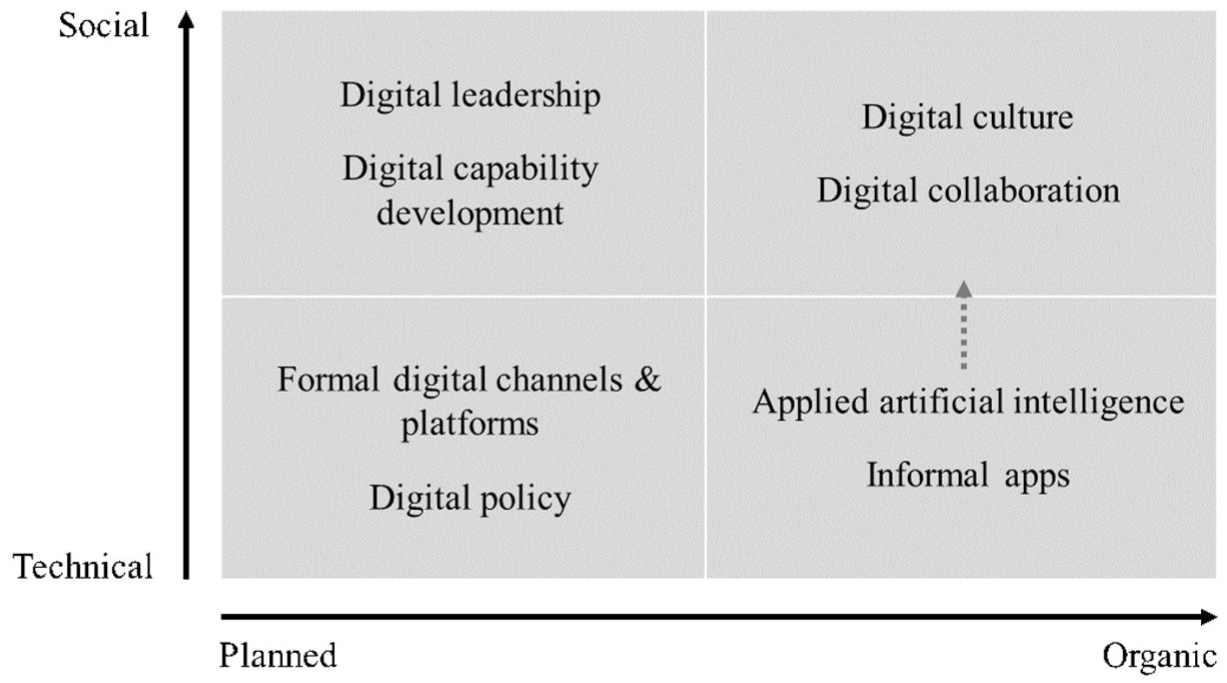
Matrix for DIC strategy development.
The matrix consists of four quadrants, in which the eight DIC elements are positioned. The first quadrant – technical/planned – includes two-way digital communication tools (‘formal digital channels and platforms’) for relationship building (L. R. Men et al., 2023) and internal ‘digital policies’ that guide their use across communication levels to support strategic goals (Wuersch et al., 2024). The second quadrant – social/planned – includes the DIC elements ‘digital capability development’ that supports stakeholder learning (Wuersch et al., 2024), and ‘digital leadership’ using digital platforms to engage with employees (Cardon et al., 2019) and other communication strategies, all aimed at building trust (Mishra et al., 2014). The third quadrant – social/organic – integrates ‘digital collaboration’ at the interpersonal level (e.g., Rogala & Bialowas, 2016) and ‘digital culture’ at the organisational level, shaped by shared norms and values (Yue et al., 2021), to support organisational strategic goals. Finally, the fourth quadrant – technical/organic – includes ‘applied AI’, which operates autonomously (Naidoo & Dulek, 2022) at the human-machine interface (Peter, 2024), as well as ‘informal apps’ used for personalised learning and communication (Padilla & Chen, 2025), to achieve strategic goals. Applied AI and informal apps are dynamic elements due to their adaptive nature (Mohammed et al., 2022), prompting other elements of the matrix to become more organic.
The following vignette exemplifies the five extant and three emerging DIC elements in an internal organisational workplace context.
At Zenith Corp, digital leadership reshaped DIC. Leaders prioritised digital capability development, training teams to navigate evolving tools with confidence. A strong digital culture emerged – open, agile, and innovation-driven. Employees engaged in digital collaboration via formal platforms like SharePoint and Microsoft Teams, while also connecting on informal apps like WhatsApp for quick updates. A new digital policy ensured clarity on tone, data security, and responsible communication. Applied AI summarised meeting transcripts, flagged sentiment trends, and even suggested knowledge resources. The transformation followed a socio
At Zenith Corp (pseudonym), DIC serves a strategic management function, as DIC and its eight elements are closely linked to the organisation’s strategic goals.
Strategic DIC
IC strategy influences employees’ cognition, emotions, motivation, and learning and development (Maier et al., 2012). Similarly, organisations in Industry 4.0 also require digital literacy and strategy to be successful. The development of ‘digital strategic communication’ (Badham et al., 2022) mirrors the shift from IC to DIC, involving an organisation intentionally leveraging digital technologies, data, and resources to align communication efforts with its mission and goals to effectively support and align DIC with strategic organisational objectives.
However, only a minority of businesses succeed in implementing DT according to a clearly defined strategy (Bughin, 2017). In response, our work draws on contemporary literature about strategic communication (e.g., Badham et al., 2022; Falkheimer & Heide, 2022; Ziegele & Zerfass, 2024) and DT (e.g., Chanias et al., 2019; Neher et al., 2025; Peter et al., 2023, 2024) to conceptualise DIC as a matrix linked to a strategy adaptable by any organisation. It enables senior management to tailor their DIC strategy by adjusting the matrix to fit their specific organisational needs.
In strategic communication, activities are strategically planned to maximise the chances of achieving positive and measurable results (Mahoney, 2023). ‘Planned DIC elements’ can be developed, approved, and implemented, including digital channels and platforms alongside relevant policies (technical), as well as digital leadership and capability development (social). Conversely, digital innovation entails new ways of organising, and ‘digital transformation is, without doubt, institutional change’ (Hinings et al., 2018, p. 55). Consequently, a primary strategic goal of DIC is to prepare employees for impending changes (following Rogala & Bialowas, 2016).
Next, we examine the eight elements of the strategic DIC matrix, offering rationale, operational definition, and placement within the quadrants.
Quadrant Technical/Planned (Bottom-Left)
Digital Channels and Platforms
Rationale
DT entails reconfiguring internal processes and structures to harness new technologies (Fenech et al., 2019). At the intrapersonal level, individualised DWP interfaces, such as personalised learning platforms, tailor development to employees’ strengths and weaknesses (Singh & Hess, 2017). As DT intertwines with social dimensions, communication becomes more conversational and humanised (Ewing et al., 2019), positioning dialogue as a strategic tool (Kent, 2022). At the interpersonal level, collaborative tools, such as formal employee recognition apps (Berges & Kon, 2019) and internal social media that facilitate idea sharing (Dery et al., 2017), promote learning, feedback, and innovation (R. Zhang, 2016). At the organisational level, internal social media transforms IC into DIC, strengthening relationships (L. R. Men et al., 2023) and empowering employee voice through digital platforms (Ewing et al., 2019), potentially generating a ‘spiral of voice’ that informs strategic decisions (Madsen & Johansen, 2019). Overall, digital channels and platforms offer opportunities for shared learning and participatory communication, but they remain underutilised (Andersson et al., 2023). Barriers like technostress – dissatisfaction, fatigue, and anxiety (Atanasoff & Venable, 2017; Camarena & Fusi, 2021) – highlight the need to develop digital skills.
Operational Definition
A communication channel in organisational contexts is any medium, digital, or traditional, that enables the creation of messages between employees and management, varying in directionality (one-way, two-way, or multidirectional) and degree of organisational control. For measurement, communication channels can be operationalised by identifying: (1) the type of platform used (e.g., email, instant messaging, internal social media, and discussion forums), (2) the level of interactivity it allows (unidirectional, bidirectional, or omnidirectional), and (3) the extent of organisational control over content (high, medium, or low).
Figure 1 Quadrant Position: Technical/Planned
Digital channels and platforms, although technically complex and requiring careful planning and implementation, are increasingly enabling social interaction. For example, call centre employees created Facebook groups to share ideas and collaborate across silos (Dery et al., 2017). As workplaces become more reliant on digital ICTs, these tools and platforms are central to IC (Tkalac Verčič et al., 2025), with their effectiveness depending on thorough planning, testing, and capability development. Therefore, we propose the following operational decision logic: If an organisation has high technical planned capacity but low social organic capacity, the matrix predicts a position in the bottom-left quadrant.
Digital Policy
Rationale
In contrast to digital channels and platforms, which enable two-way communication and relationship building (L. R. Men et al., 2023), digital policy involves disseminating information as a one-way form of communication (Grunig & Hunt, 1984, p. 22). Creating a digital policy is vital for responsible technology use in IC and fostering trust (Mattila & Seppälä, 2016). Such policies promote ethical online environments (Badham et al., 2022), align DWP with organisational goals, and set conduct standards (Ewing et al., 2019; Mazzei & Butera, 2016). Blurred boundaries between internal and external communication complicate stakeholder management (Kulik et al., 2012), underscoring the need for clear guidelines. Embedding policy into culture requires training, open dialogue (Ewing et al., 2019), and employee advocacy (Thelen, 2021). Since online behaviour affects reputation, digital policies should enable collaboration and crisis prevention, framed through dialogue rather than control (Gilsdorf, 1998; Stohl, 1986; Sussman, 2008).
Operational Definition
Organisational digital policy refers to the formal set of documented rules and guidelines governing how employees use digital technologies for internal processes and communication. It can be measured by (1) the presence of written policies (e.g., social media, email, and internal platforms), (2) the scope of coverage (technology use, information sharing, conduct, and tone/language), and (3) the degree of enforcement (e.g., monitoring, training, and sanctions).
Figure 1 Quadrant Position: Technical/Planned
Digital policy guides the responsible use of organisational platforms by restricting misuse and protecting confidential information, as illustrated by a U.S. energy company that prohibits unauthorised sharing of internal documents and communications (Mazzei & Butera, 2016; McDonald & Mitra, 2019). Beyond safeguarding information, such policies also provide frameworks that promote healthy workplace practices and support work-life balance (Atanasoff & Venable, 2017). While typically static, the rapid evolution of technologies like AI requires more adaptive, and thus more organic, policies to avoid hindering effective DIC. Therefore, the operational decision logic suggests that organisations with strong governance through policy but limited social organic capacity would fall into the bottom-left quadrant of the matrix.
Quadrant Social/Planned (Top-Left)
Digital Leadership
Rationale
Digital leadership integrates technology with leadership styles such as transformational leadership to enhance organisational performance (Bresciani et al., 2021; Shin et al., 2023). A core role of digital leaders is crafting a clear digital vision – a key driver of organisational success (Musundire et al., 2020; Singh & Hess, 2017). Organisations that embed technologies like big data, cloud computing, applied AI, Internet of Things, mobile, and social media, while maintaining a strong digital vision, achieve higher profitability and market value (Oduro et al., 2023; Schwertner, 2017). Leaders should ‘surf the digital wave’ rather than ‘get ahead of the digital tsunami’ (Chanias et al., 2019, p. 22). A strategic digital mindset fosters collaboration, digital culture, and resilience (Vial, 2019), as exemplified during COVID-19, when digital leadership enhanced communication and staff satisfaction (Bamberry et al., 2022).
Operational Definition
Digital leadership is the demonstrated ability of organisational leaders to integrate leadership behaviours (e.g., communication, vision-setting, and employee engagement) with digital competencies (e.g., technology use, digital literacy, and facilitation of online collaboration) to enhance organisational performance. It can be measured by (1) leadership behaviours displayed in digital contexts (e.g., openness, trust-building, and participation), (2) digital skills applied (e.g., platform use and data-driven decision-making), and (3) outcomes facilitated (e.g., employee engagement, knowledge sharing, and adaptability in digital environments).
Figure 1 Quadrant Position: Social/Planned
Digital leadership is a key social element of DIC, initially supported by hiring leaders with specific skills for defined roles. However, as strategic demands evolve rapidly, leaders must adapt organically, shifting from a primarily planned approach to a more flexible and organic one. For example, Apple highlights the importance of digital leadership on its platforms, guiding employees to consult leaders on policy matters (Mazzei & Butera, 2016). Thus, leaders need a proactive digital mindset to effectively drive DT and maintain competitiveness. As a result, the operational decision logic suggests organisations with strong planned digital leadership but limited organic capacity would be positioned in the top-left quadrant of the matrix.
Digital Capability Development
Rationale
Unlike digital strategic leadership, which emphasises leaders using internal digital channels and platforms to engage with employees to reach strategic organisational goals (Cardon et al., 2019), digital capability development is broader, encompassing individual, interpersonal, and organisational learning across all internal stakeholders (Wuersch et al., 2024). Understanding DT hinges on developing capabilities (Malchenko et al., 2020), not as a one-off application but as a strategic embedding of digital competencies (Pagoropoulos et al., 2017). We integrate ‘digital training’ and ‘digital skills’ into the broader concept of digital capability development, combining technical tools with social elements that foster empowerment and learning. Planned training enhances proficiency (Tkalac Verčič et al., 2025) and supports knowledge sharing, collaborative learning and motivation (Metin, 2019; Woo, 2021). Digital capability also demands adaptability, experimentation, and continuous learning (Iordache et al., 2017; Kovaitė et al., 2020) alongside hard skills (e.g., digital literacy, social media proficiency, and cybersecurity awareness) and soft skills (e.g., teamwork, leadership, and emotional intelligence). Training, education, and digital mindsets help overcome barriers to DT, fostering engagement, innovation, and organisational growth (Ewing et al., 2019; Scuotto et al., 2021).
Operational Definition
Digital capability development is the strategic process of building employees’ skills, knowledge, and behaviours to effectively use digital technologies for current and future organisational needs. It can be measured by (1) the availability and scope of digital training and development programmes, (2) employee participation rates in these programmes, (3) self-reported or assessed improvements in digital skills, and (4) alignment of these capabilities with future-oriented organisational goals.
Figure 1 Quadrant Position: Social/Planned
The matrix guides HRM in developing digital strategic capability plans aligned with DIC strategies to enhance employees’ digital skills (Wuersch et al., 2024). Training is crucial for integrating digital practices, particularly for long-tenured staff struggling to adapt (Lowndes & Fu, 2021). For example, 3M requires employees to complete training before engaging in business-related social media, highlighting the role of education in digital policy (Mazzei & Butera, 2016). Digital capability development, as a social element, must be carefully planned (Tkalac Verčič et al., 2025). Yet, the rapid pace of DT, particularly in applied AI, suggests a need for adaptability, with digital capability development shifting from a static ‘planned’ approach to a more adaptive, ‘organic’ one. Incorporating this adaptability is essential for effective strategic DIC planning. Hence, the operational decision logic suggests that organisations with well-developed digital strategic capabilities but limited social organic capacity would be positioned in the top-left quadrant of the matrix.
Quadrant Social/Organic (Top-Right)
Digital Culture
Rationale
Digital culture encompasses the values, norms, and practices shaping behaviour in digitalised societies (Shin et al., 2023). In DIC, it extends beyond technology to include organisational values and beliefs (Berges & Kon, 2019; Fenech et al., 2019). Core values such as digital literacy and training foster inclusion (Bejaković & Mrnjavac, 2020), digital authenticity (Neher et al., 2022), and culturally safe digital environments. Embedding DIC strategies demands cultural change driven by leadership that redefines norms (Barratt-Pugh & Bahn, 2015) and promotes accountability, reinforcing responsibility for employee actions and community building (Limwichitr et al., 2015). Modern organisations now view digitalisation as a dynamic interplay of technology, leadership, and culture, with ongoing capability development (Shin et al., 2023) vital for an organic digital culture (Schwarzmüller et al., 2018), enabling DIC (Wuersch et al., 2023).
Operational Definition
Digital culture refers to the shared set of organisational values, norms, and practices that guide how employees utilise digital technologies to collaborate, communicate, and innovate. It can be measured by (1) the extent of collaboration and knowledge sharing through digital platforms, (2) the degree of trust and openness in digital interactions, and (3) the presence of supportive leadership communication that encourages two-way digital engagement, thus dialogue.
Figure 1 Quadrant Position: Social/Organic
The social element of digital culture evolves organically rather than through detailed planning, with cultural shifts occurring frequently in the digital age (Martínez-Caro et al., 2020). For example, a French multinational employs human–machine interfaces and data analytics to enhance industrial performance. At the same time, its decentralised structure enables local centres to interpret guidelines independently, shaping digital culture through collaboration, innovation, and power distribution (Martínez-Caro et al., 2020). As culture is inherently driven by change, the rise of applied AI is expected to further accelerate organic cultural transformation. Therefore, we propose the following operational decision logic: If an organisation has a high level of technical and adaptive organic culture, the matrix suggests a position in the top-right quadrant.
Digital Collaboration
Rationale
In contrast to digital culture at the organisational level, which unifies members and guides their behaviour and interactions (Yue et al., 2021), digital collaboration occurs at the interpersonal level, involving communication between at least two individuals (e.g., Rogala & Bialowas, 2016). Technology is central to enabling digital collaboration, allowing leaders and employees to work seamlessly across distances (Salopek, 2000; Tkalac Verčič et al., 2025). Effective collaboration relies on devices such as computers, tablets, and smartphones that facilitate synchronous and asynchronous communication (Noe, 2023). Hence, organisations increasingly invest in DT to leverage digital tools that enhance agile collaboration (Gong & Ribiere, 2025). Interactive features like internal social media empower employees, foster dialogue, and enhance engagement (Anders, 2016; Ewing et al., 2019), thereby strengthening relationship building, knowledge sharing, and collaboration with management – all of which are vital to effective DIC. Social media platforms further enhance connectivity, team orientation, cross-organisational collaboration (Dery et al., 2017) and innovative cultures to meet the demands of the digital age (Bulińska-Stangrecka & Bagieńska, 2019). From a DIC perspective, effective communication and collaboration develop digital capability across organisational, interpersonal, and intrapersonal levels, supported, for example, by e-learning and mobile learning (Basak et al., 2018).
Operational Definition
Digital collaboration is the use of digital technologies that enable employees and leaders to work together synchronously or asynchronously across geographical boundaries. It can be measured by (1) the types of tools used (e.g., messaging apps, videoconferencing, and online communities), (2) the frequency and mode of use (synchronous vs. asynchronous), and (3) the extent of stakeholder participation and interaction (e.g., message exchange, joint projects, and knowledge sharing).
Figure 1 Quadrant Position: Social/Organic
Digital collaboration arises organically through digital affordances, enabling seamless interaction across geographical boundaries. For example, a large company introduced the StarMeUp app, allowing leaders and employees to thank colleagues and recognise organisational values (Berges & Kon, 2019). Increasingly, scholars emphasise AI–human collaboration (Fleming, 2019; Makarius et al., 2020), where applied AI and human intelligence are strategically combined to build a hybrid workforce that improves performance (Chowdhury et al., 2022). Consequently, applied AI is becoming embedded in digital organisational collaboration, driving new social organic developments. Therefore, the operational decision logic indicates that organisations with strong technical capacity and high adaptive organic collaboration would be positioned in the top-right quadrant of the matrix.
Quadrant Technical/Organic (Bottom-Right)
Applied AI
Rationale
Intelligent devices have transformed organisational communication, positioning strategic communication at the core of change and innovation (Aggerholm & Thomsen, 2016). Applied AI reshapes organisational structures (Verčič et al., 2024) and influences both external and IC through culture, leadership, and employee roles (Vial, 2019). Its success depends on technological readiness, defined as the capability to utilise technological assets (Parasuraman, 2000), supported by learning-oriented work environments (Ray et al., 2005). Employees with higher readiness integrate applied AI more effectively (Makarius et al., 2020). Confidence and trust are vital. Low digital skills hinder adoption due to a lack of confidence, leading to resistance (Y. Zhang et al., 2020). Meanwhile, trust, a key relational soft skill (Welch, 2006), underpins DIC, collaboration and leadership (de Graaf, 2016; Kovaitė et al., 2020). Yet, trust in AI remains difficult as systems lack empathy (Huang et al., 2019); thus, applied AI presents a critical test of digital leadership (Glikson & Woolley, 2020).
Operational Definition
Applied AI in organisational communication is the integration of AI-enabled technologies into human-led internal and external communication processes to enhance collaboration, decision-making, and performance. It can be measured by (1) the extent of AI tools adopted in communication workflows, (2) employee technological readiness (skills, confidence, and willingness to learn), (3) trust in AI systems (perceived reliability, transparency, and fairness), and (4) the degree to which AI facilitates two-way communication, knowledge sharing, and organisational cohesion.
Figure 1 Quadrant Position: Technical/Organic
Applied AI is typically viewed as a technical element of DIC, but its self-learning capabilities also enable organic evolution (Mohammed et al., 2022). Increasingly, applied AI is becoming a social–technical hybrid, shaping digital interactions and collaboration. For instance, the Emirati government’s plan to embed applied AI across its organisations aimed to streamline daily functions and maximise technological use (Farhi et al., 2022). The study revealed that benefits depend on sufficient technological readiness, as employees must possess the necessary skills and environment to adapt effectively (Makarius et al., 2020; Ray et al., 2005).
As human and AI roles increasingly converge, traditional work processes require re-evaluation to ensure positive worker experiences. Organisational competitive advantage ultimately rests on individuals’ capacity to acquire, share, and assimilate knowledge in collaboration with AI systems (Makarius et al., 2020). Therefore, applied AI evolves from a technical–planned to a technical–organic element, and eventually to the social dimension, reflecting the merging of human and AI contributions to organisational performance. Consequently, we suggest the following operational decision framework: Organisations that incorporate baseline applied AI beyond standard DT fall into the bottom-right quadrant, while those that also advance towards sophisticated self-learning practices are expected to eventually move into the top-right quadrant.
Informal Apps
Rationale
In contrast to rapidly advancing applied AI at the human-machine interface (Peter, 2024), which can perform tasks autonomously (Naidoo & Dulek, 2022), informal apps are digital tools used by organisational stakeholders for personalised learning (Padilla & Chen, 2025) and for facilitating interpersonal and organisational interactions. The adoption of formal digital communication and collaboration apps provides multiple organisational benefits, including enhanced communication (e.g., through messaging, video calls, and file sharing), collaboration, knowledge sharing, productivity, and employee engagement using centralised, interactive platforms, fostering open dialogue and community (Gonzalez, 2014; Mishra et al., 2019). Alongside formal apps, organisations increasingly rely on informal apps for flexible collaboration. At the interpersonal level, apps like WhatsApp, Signal, and Threema are used, and at the organisational level, platforms such as X, Google Meet, Teams, Zoom, and Confluence are employed (Neher et al., 2025). Informal apps often evolve into ‘communication places’, personalised, dynamic spaces shaped by purpose and emotion that influence communication and collaboration patterns and efficiency (Nouwens et al., 2017, p. 730). However, their organic use outside official channels entails risks (e.g., security threats, compliance issues, and shadow IT; Abbas & Alghail, 2023; Klotz et al., 2019), necessitating proactive management and governance within DIC strategies.
Operational Definition
Informal apps are unsanctioned or organically adopted digital tools that employees use to communicate, collaborate, and share knowledge outside formal organisational platforms, helping them remain agile and meet unmet needs. They can be measured by (1) frequency of use, (2) purpose of use (e.g., task coordination, knowledge sharing, and social interaction), (3) level of employee participation and engagement, and (4) potential risks or governance issues (e.g., security, compliance, and shadow IT).
Figure 1 Quadrant Position: Technical/Organic
Organisations can use various platforms and software solutions (technical) to support interpersonal and organisational collaboration and DIC (Neher et al., 2025). Informal apps often emerge organically as employees seek to meet unmet needs, either personal or overlooked by management. These platforms not only address functional gaps but also strengthen interpersonal connections and foster belonging (Mishra et al., 2019). Consequently, informal apps, while technical in origin, extend beyond their functional use and can become deeply tied to the social dimension of DIC. Therefore, the operational decision logic indicates that in organisations with a high technical-organic capacity and shadow IT, informal apps would be positioned in the bottom-right quadrant of the matrix, with the potential to move towards the top-right.
Demonstrated Worked Example
In conclusion to the discussion of the matrix for DIC strategy (Figure 1) development, we provide a ‘worked example’ (Appendix A) of a digital mentoring platform to complement the earlier vignette. It shows how the social–technical and planned–organic dimensions interact within the DIC matrix, ultimately fostering a sense of belonging, innovation, and trust. Relationships depend on trust, and trust is the foundation of organisational life – without trust, an organisation cannot function (Welch, 2006).
Contributions, Limitations, and Future Research Avenues
Answering the Research Question as a Contribution to Theory and Practice
Our research asks the question: How can DIC be conceptualised to advance organisational strategic goals? To answer this question, our study uses Reese’s (2022) methodology for conceptual research and introduces a matrix model with eight DIC elements linked to organisational strategic goals. Our study advances the theory of DIC by integrating applied AI, informal apps, and digital policy, and highlighting a planned–organic contingency. Whereas earlier work treated DIC elements primarily as technical or social, our model adds a second axis that differentiates between strategically designed and emergent elements. This crossing of axes exceeds the traditional social–material dualism (Badham et al., 2022) and creates four quadrants that capture the contingent and evolving nature of communication practices. Applied AI is positioned as a particularly dynamic and hybrid force, blurring the technical–social boundary and influencing both structured and emergent communication processes. This reframing offers a novel conceptual lens for understanding how organisations align their communication practices with broader DT processes to achieve their organisational strategic goals.
Building on these theoretical insights and as a practical contribution, we propose a practitioner’s maturity roadmap (Figure 2), which includes five steps for organisations seeking to strengthen their strategic DIC. Each subsequent step builds on the previous one.
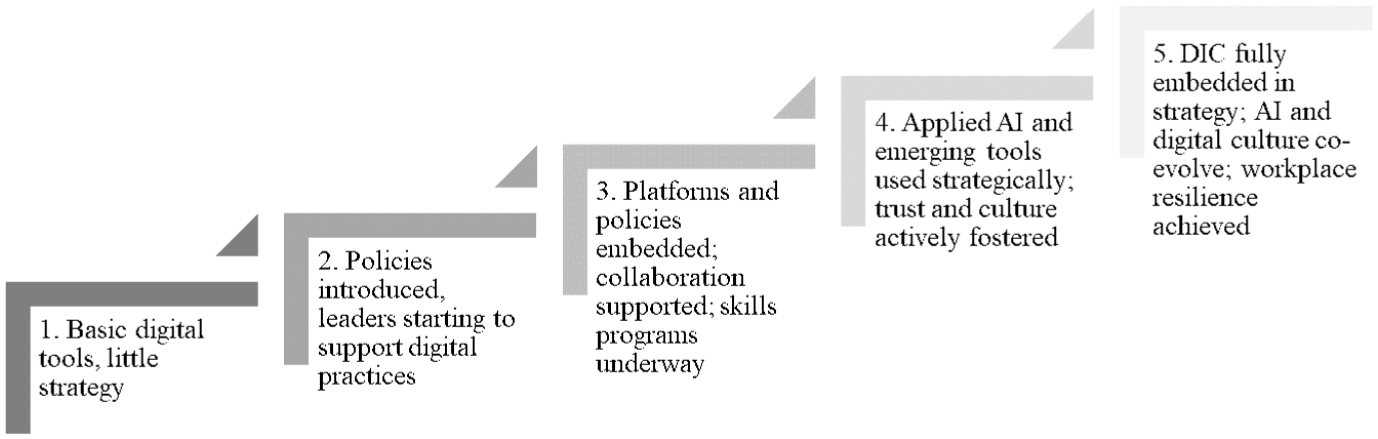
Practitioner maturity roadmap for DIC strategy development.
First, organisations should map social–technical elements to understand the interplay of planned and organic dimensions within their DWP (refer to Figure 1). Second, they should assess their development level by positioning themselves within the proposed matrix, which helps identify current strengths and areas for improvement. Third, organisations need to align DIC strategies with DT roadmaps, ensuring that communication practices are not treated in isolation but embedded within broader organisational goals. Fourth, organisations should incorporate applied AI responsibly, recognising its hybrid role in shaping technical and social dynamics, and implementing safeguards to support trust, ethics, and inclusivity. Finally, organisations must embed continuous capability development, fostering digital literacy, adaptive leadership, and collaborative cultures that enable resilience in the face of technological and organisational change. Together, these steps provide managers and communication practitioners with a structured yet adaptable pathway for leveraging DIC as a driver of organisational learning, trust-building, and long-term competitiveness.
Appendix B operationalises the maturity roadmap by providing an illustrative rubric that practitioners can immediately use alongside the five steps.
Limitations and Implications for Future Research and Practice
The research draws on existing literature and makes a novel contribution to strategic communication. However, the proposed strategic DIC matrix and the maturity roadmap have yet to be applied in practice, thus serving instead as a conceptual foundation for developing a comprehensive DIC strategy. In the practical realms of public relations and strategic communication, managers reevaluate the implementation and definition of DIC (L. R. Men, 2021). By applying the matrix to a multi-case study approach, practitioners can validate this theoretical approach and gain insights into the benefits of a DIC strategy, which could subsequently lead to enhancements of the matrix itself. This multi-case study may also provide a deeper understanding of the relationship between the social–technical and planned–organic dimensions of strategic DIC. At the same time, the proposed practical steps of the maturity roadmap to strengthen organisational DIC could be re-evaluated.
Further investigations into applied AI as a technical–organic DIC element would enhance our understanding of how a human-centred approach to DIC can be effectively extended in the digital age using applied AI. Future research could also explore how individuals interact with and learn from applied AI, as well as how digital trust is established in DWP environments that utilise applied AI. The development of organisational trust through IC has been variously studied (e.g., Vokić et al., 2020; Welch, 2006). These studies could be expanded to incorporate a digital dimension, including applied AI. Exploring the link between trust in organisational situations and strategic DIC may reveal new ways to enhance relationships and interactions within DWP environments of Industry 4.0 and beyond, extending into Industry 5.0.
Conclusion
Our conceptual research builds on existing scholarship to introduce a strategic DIC approach, providing a matrix as a practical resource for managers and communication practitioners. This tool guides the formulation of DIC strategies that integrate digital technologies and foster collaboration within Industry 4.0 DWP environments, including applied AI.
The proposed matrix extends Wuersch et al.’s (2023) technical and social DIC elements framework by incorporating the planned–organic dimension. Technical elements, such as digital channels, platforms, and policies, along with social elements like digital leadership and capability development, can be strategically planned with clear purposes and measurable outcomes. In contrast, applied AI, informal apps, digital collaboration, and digital culture represent organic DIC elements that evolve naturally through interactions with organisational members. Applied AI, in particular, blurs the boundary between technical and social, acting as a highly dynamic force. Together, the technical–social and planned–organic dimensions foster trust-building learning processes in DWP settings, forming a foundation for organisational functioning and success, thereby contributing to the organisation’s goals.
In summary, the study conceptualises how DT shapes both planned and organic social–technical DIC elements. Organisations are encouraged to adopt people-centred digital strategies, using the proposed matrix (Figure 1) to tailor DIC approaches for the digital age and to implement practical steps, including the maturity roadmap (Figure 2), for ongoing communication improvement.
Footnotes
Appendix A

Ethical Considerations
There are no human participants in this article.
Consent to Participate
Informed Consent is not required.
Funding
The authors received no financial support for the research, authorship, and/or publication of this article.
Declaration of Conflicting Interests
The authors declared no potential conflicts of interest with respect to the research, authorship, and/or publication of this article.
Data Availability Statement
This is a conceptual article. All material used is included in the reference list.