



Abstract
Digital transformation fundamentally changes the way individuals conduct work in organisations. In accordance with this statement, prevalent literature understands digital workplace transformation as a second-order effect of implementing new information technology to increase organisational effectiveness or reach other strategic goals. This paper, in contrast, provides empirical evidence from two remote-first organisations that undergo a proactive rather than reactive digital workplace transformation. The analysis of these cases suggests that new ways of working can be the consequence of an identity change that is a precondition for introducing new information technology rather than its outcome. The resulting process model contributes a competing argument to the existing debate in digital transformation literature. Instead of issuing digital workplace transformation as a deliverable of technological progress and strategic goals, this paper supports a notion of digital workplace transformation that serves a desired identity based on work preferences.
Introduction
In consequence of digital transformation, the ways contemporary organisations and their members understand and perform work have changed immensely (Nyman et al., 2023). With advancements in information technology (IT), this change is characterised by increasing automation (Rossi et al., 2020), algorithmic control (Grønsund and Aanestad, 2020), but also flexible work arrangements (Ajzen and Taskin, 2021).
Recent contributions to the Information Systems (IS) literature have come to understand digital workplace transformation in organisations as a reactive process that is activated by digital transformation and strategic goals such as increasing organisational effectiveness (Zimmer et al., 2023). This means that technological change in the environment or the organisation itself precedes transformational processes, which, among other things, result in changes of work practices (Baptista et al., 2020; Wessel et al., 2021). This interpretation renders digital workplace transformation as a second-order effect of digital transformation (Baptista et al., 2020). In addition to changes in work practices, digital transformation also redefines the identity of an organisation (Rahrovani, 2020), a mechanism that is also said to be downstream of technological change (Wessel et al., 2021).
At the same time, however, we can observe cases that contradict this view on digital workplace transformation. For example, some organisations sacrifice aspects of effectiveness or organisational culture to develop the identity of a remote-first organisation (Choudhury, 2022). In a remote-first approach, ‘the default work arrangement is for each team member to work in their own work space (e.g. a home-office, a coffee shop, a desk in a co-working space)’ (Santos and Ralph, 2022, p. 26). An organisation may or may not provide an additional centralised office space in this setting (Santos and Ralph, 2022). While this type of digital workplace transformation can facilitate opportunities for talent acquisition and business growth (Asatiani and Penttinen, 2019) and improve knowledge worker productivity (Asatiani and Norström, 2023; Choudhury et al., 2021), increased effectiveness and technological change inside the organisation are typically second-order effects of the desired remote-first identity, and not vice versa.
Since this type of digital workplace transformation is proactive rather than reactive, it cannot be explained by existing theory on digital transformation (Baptista et al., 2020; Wessel et al., 2021). Therefore, the purpose of this paper is to investigate instances of proactive digital workplace transformation in a remote-first context and how it relates to identity change and the implementation of new IT. Against this backdrop, we pose the following research question:
How do identity change mechanisms unfold in proactive digital workplace transformation?
In contrast to the competitive pressure that leads organisations to undergo digital transformation, becoming a remote-first organisation is not de rigueur unless it supports a desired identity (Van Riel and Balmer, 1997). However, we do not know who initiates this identity change and how it influences the implementation of new IT in the workplace.
To achieve our research objective of theorising the phenomenon of proactive digital workplace transformation, this paper investigates and contrasts two empirical case studies. We collected data through qualitative interviews and online participant observations within two remote-first organisations. The data collection and analysis were guided by principles of the grounded theory methodology (Glaser, 1978) and culminated in an inductive process model of proactive digital workplace transformation.
Our study contributes to knowledge by providing a perspective on digital workplace transformation that contrasts the prevailing view on the phenomenon that can be found in the digital transformation literature. In essence, we make the point that digital workplace transformation from a digital transformation standpoint is reactive and bound to this context. However, in the organisations we investigated, digital workplace transformation was proactive, that is, not a consequence of digital transformation but the result of a collective identity change. This proactive perspective on digital workplace transformation posits that introducing new IT in the workplace can be grounded in serving a desired (remote-first) identity rather than strategic goals of increasing effectiveness or undergoing digital transformation as an end in itself (Zimmer et al., 2023). Moreover, our process model sheds light on the role of the individual in the process of identity change, which is mostly overlooked by current digital transformation literature. In other words, our process model challenges the notion of digital workplace transformation as a strategic necessity that happens to a group of individuals who need to change how they work as a result. Instead, our model explains digital workplace transformation as a measure that a group of individuals happens to desire and serves their preferred way of working together.
Practitioners may find value in this paper as we identify important learnings from the cases of two medium-sized IT-consulting firms that transformed from onsite-only work and remote exceptions to become remote-first organisations. This includes the management and evaluation of identity conflicts that emerge from divergent preferences for the ideal digital workplace.
Background
(Reactive) Digital workplace transformation
Prevalent literature on digital transformation and digital workplace transformation are inextricably intertwined. To untangle how both streams are connected, but also to problematise this entanglement, we review relevant literature along the lines of two predominant assumptions.
The first assumption that underlies the current body of literature is that digital workplace transformation is reactive, making it a second-order effect of digital transformation. For example, Wessel et al. (2021) theorise that ‘transformation activities impose changes on the work practices of organisational members’ (p.118). This inference makes sense, given the analysed cases around large organisations with industrial age business models (Asatiani et al., 2021; Grønsund and Aanestad, 2020; Wessel et al., 2021) that strategically incorporate IT to streamline processes (Rossi et al., 2020) or to increase economic success (Berghaus and Back, 2017). The process of digital workplace transformation is typically theorised as subordinate or characterised as a second-order effect of digital transformation. This renders digital workplace transformation as a reactive or even unintended process (Baptista et al., 2020). The reason for this is that digital transformation replaces processes (that are not directly connected to the individual), which then affect work practices. In this context, digital workplace transformation is understood as a by-product of digital transformation. Therefore, the digital transformation literature has limited explanatory power with regards to the phenomenon of digital workplace transformation, in which work processes are proactively replaced with a clear intention. Moreover, our current understanding of (reactive) digital workplace transformation cannot explain IT-driven changes to work practices in organisations that never have been subject to digital transformation. Examples for such organisations are ‘born digitals’, which can be large organisations that rely on data-driven business models (Tumbas et al., 2017) or small and medium-sized entrepreneurial organisations that have no history of non-digital ways of doing business (Asatiani and Penttinen, 2019). Consequently, the tendency in the literature to predominantly investigate digital workplace transformation in the context of industrial age business models increases the number of ‘judgment calls’ we need to make when generalising findings from these contexts (Lee and Baskerville, 2003, 2012). For example, a digital workplace transformation in a ‘born digital’ organisation might unfold differently compared to an organisation undergoing digital transformation. Consequently, theoretical explanations of digital workplace transformation processes need to consider these contextual differences.
An overview of prevalent assumptions about digital workplace transformation.
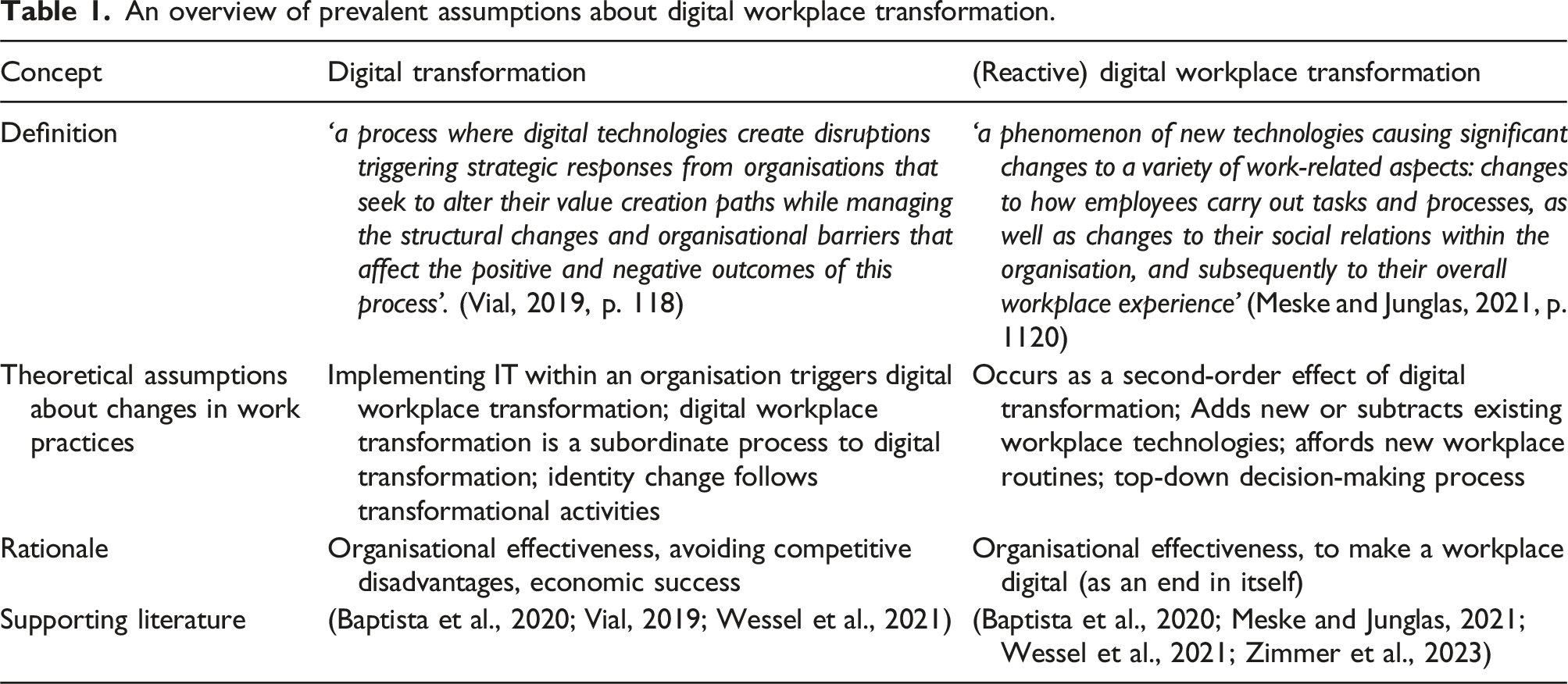
As Table 1 emphasises, the theoretical entanglement of digital transformation and digital workplace transformation does not provide a perspective that can explain instances of digital workplace transformation that occur independent of digital transformation. To develop the contrasting notion of proactive digital workplace transformation as a standalone process, turning to the construct of organisational identity is imperative. This is because it permeates two rather disunited research streams, that is, works on organisational-level digital workplace transformation (Poláková - Kersten et al., 2023; Zimmer et al., 2023) and literature describing individual role emancipations through digital work (Elbanna and Idowu, 2022; Vaast and Pinsonneault, 2021). Therefore, we now explore the concept of organisational identity, which will serve as a construct-in-use (Suddaby, 2010) for our theorisation of proactive digital workplace transformation.
Organisational identity
Forming an identity aims to answer the all-encompassing question of ‘Who am I?’ or ‘Who are we?’ (Burke and Stets, 2009; Carter and Grover, 2015). When posing those questions, organisations submit to principles that guide the formation of an organisational identity (Gioia et al., 2013). This posits that organisations create a concept of self that clearly distinguishes them from other organisations – with organisational members believing in this distinctive identity, whether objectively verifiable or not (Corley et al., 2006). However, the concept of organisational identity challenges the perception of the organisation as a social actor that evokes individual identity formation and resistance processes (Corley et al., 2006; Whetten and Mackey, 2002). Nevertheless, there is also agreement that organisational identity is significantly shaped by social influences (Gioia et al., 2000), changing work concepts (Wang et al., 2020), and (societal) changes of the presence (Ghislieri et al., 2018). Identity triggers interaction with organisational cues that enact constant social validation, constructing and enforcing central identity motives (Ashforth and Schinoff, 2016). Thus, the individual identity of employees affects the organisational identity and vice versa, hence the identity of the organisation and the identity of its members are mutually dependent (Gioia et al., 2013; Whetten, 2006).
Whether a phenomenological or societal perspective is applied to organisational identity, individual identity functions as a central anchor point for reciprocal identity formation processes. Regarding this conceptualisation, characteristics of an organisation are evaluated by its members towards the relevance of the organisation’s perceived self-image, the distinctiveness from other organisations, and its continuity (Gioia et al., 2013). Thus, internal individual self-beliefs might be intertwined with organisational identification processes. If there is a discrepancy detected, divergent actions can be initiated (Stets and Burke, 2000). Either the individual internal perception of the organisation or the external perception of the organisation must change, resulting in a congruent image (Gioia et al., 2000; Whetten, 2006). Thus, a positive identification within an organisation may lead to increased employee commitment and organisational citizenship behaviour that fosters a sense of belonging (Ashforth et al., 2008). In relation to work, theories on organisational identity are deeply intertwined with the assumptions of the Taylorist corporate 9-5 model, that is, workers are part of stable teams, share an office, and have similar work routines (Wang et al., 2020). In this context, identity is considered as a central concept in understanding why employees think and act in specific work environments the way they do (Ashforth et al., 2008). Thus, it is crucial to understand how digital workplace transformation impacts identity and vice versa.
Identifying as a remote-first organisation
As the subject of inquiry in this paper, we turn to remote-first organisations because they typically undergo digital workplace transformation but not necessarily digital transformation. In this context, prevailing theoretical assumptions made by digital transformation literature about reactive digital workplace transformation (see Table 1) may not apply. Hence, we need theory that explains how a proactive approach to digital transformation of work relates to organisational identity change and the implementation of IT.
Five tiers of remote organising.
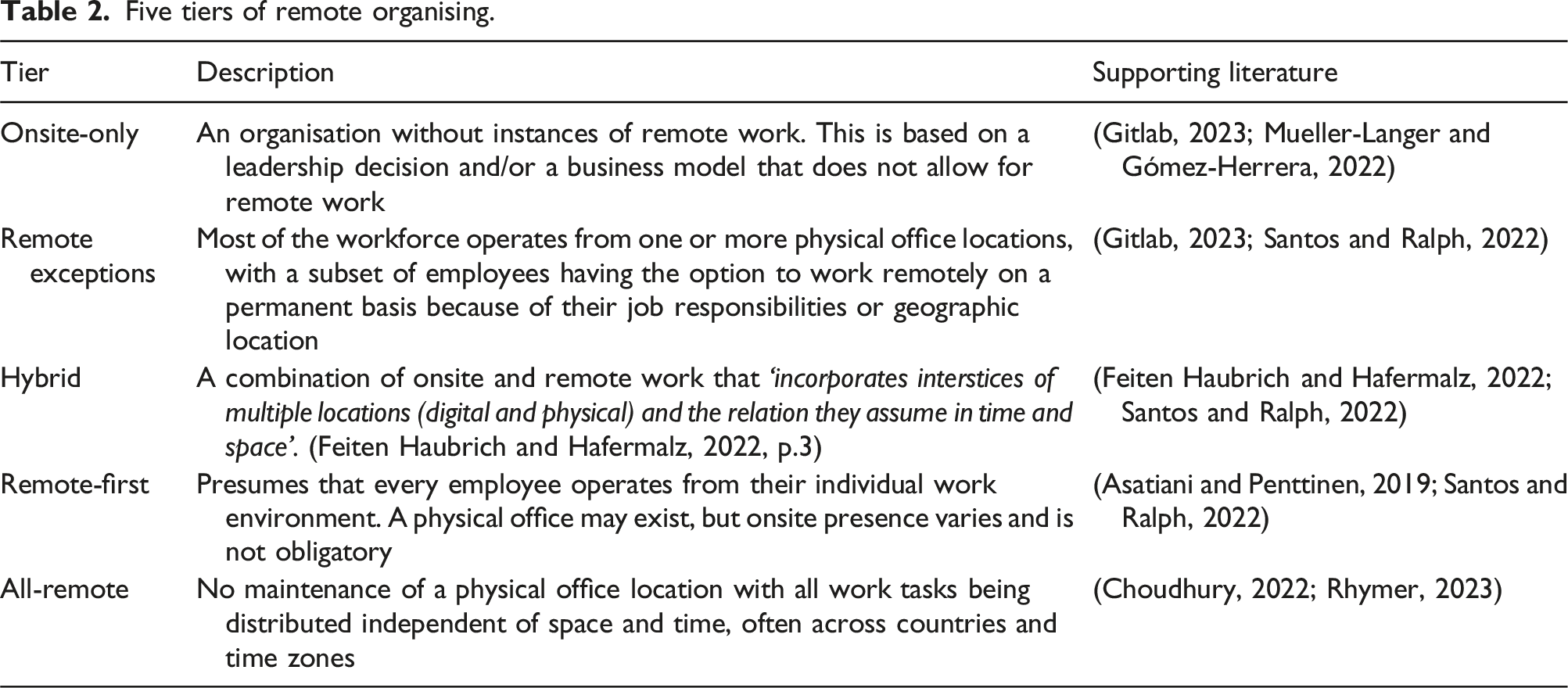
In this study, we focus on digital workplace transformation that involves a proactive change from either onsite-only work or remote exceptions to remote-first organising. All-remote organisations, in contrast, are often ‘born’ digital (Marx et al., 2021; Tumbas et al., 2017) or start their transformation from a hybrid or remote-first tier, which is again a different kind of digital workplace transformation than one towards a remote-first identity (Asatiani and Penttinen, 2019). Most literature blurs the concepts of remote-first and all-remote organising. However, a differentiation as shown in Table 2 helps to better understand the continuum of remote organising and different kinds of digital workplace transformations within this continuum. For a characterisation of remote-first organisations, we assume that remote work is the default mode of operating, with every employee operating from their own private place (Santos and Ralph, 2022). However, in contrast to all-remote organisations, they may have a physical office location and operate within a local perimeter rather than globally (Rhymer, 2023).
To operate in a remote-first fashion, the organisational structure needs to be configurated in accordance with the requirements of individuals to engage in full-time remote work (Baptista et al., 2020). The driver of this digital workplace transformation is often not to increase organisational effectiveness but to maximise employee well-being and job satisfaction (Asatiani et al., 2021; Choudhury et al., 2021). Although only a few scientific studies have investigated remote-first organisations (Rhymer, 2023), we know that the sociotechnical requirements of remote workers are often shaped by their prevailing (work) identities (Frick and Marx, 2021; Prester et al., 2023) and the perceived organisational identity (Dery and Hafermalz, 2016). We posit that investigating identity formation in organisations that understand themselves as or transform to remote-first organisations can yield valuable insights for the theorisation of proactive workplace transformation. Attaining this objective requires an approach that generates theory independent of previous assumptions.
Research approach
This inductive study takes ‘organisational identity’ as a construct-in-use (Suddaby, 2010) and analyses qualitative data collected within two remote-first organisations to theorise identity change mechanisms during their digital workplace transformations. Considering the individual perspectives within an organisational context, this study utilises the in-depth knowledge of individuals to broaden our understanding of the phenomenon. To this end, this research takes the perspective of an interpretivist ontology that ‘can help IS researchers to understand human thought and action in social and organisational contexts’ (Klein and Myers, 1999, p. 67). Our approach further rests upon the assumption that individuals ‘do not passively react to an external reality but, rather, impose their internal perceptions and ideals on the external world and, in so doing, actively create their realities’ (Suddaby, 2006, p. 636). To structure our data collection and analysis, we follow a grounded theory approach.
Grounded theory procedures
Grounded theory is a methodology that aims to build a new theory, a theoretical model or to provide rich descriptions while considering empiricism (Wiesche et al., 2017). It is characterised by iterative data collection, constant comparison, and interactive coding (Birks et al., 2013). The focus is on open idea generation within a research discipline, while at the same time adhering to a given set of methods (Urquhart et al., 2010). Despite its approachability and flexibility, grounded theory follows a rough sequence of specific methods to derive a theory, model or rich description (Birks et al., 2013; Wiesche et al., 2017). This paper adheres to the instructions provided by the Glaserian approach to grounded theory (Glaser, 1978). It suggests an iterative approach to the data collection and analysis, with a simultaneous adaptation to the research objective(s).
With basic background knowledge of the construct-in-use (‘organisational identity’), we collected data in the form of qualitative interviews by identifying two companies that underwent digital workplace transformation towards a remote-first structure. We made sure that our interview questions were open to offer space for unobstructed and informative answers. Theoretical sampling was applied to reduce sampling bias as well as to increase the saturation of codes (Glaser, 1978). This means that the development of our theoretical model on proactive workplace transformation guided the data collection, while linking the identified results to the existing body of knowledge (Wiesche et al., 2017).
As the first step of the coding procedure, we applied open coding, which describes the initial coding of all data according to the specific text of the transcribed interviews and observation notes. Subsequently, basic categories were defined inductively and reduced, while covering a large data pool, hence following the technique of selective coding. According to Glaser’s (1978) theoretical coding, further categories were formed as well, which were then connected with the main categories to be elaborated further (Wiesche et al., 2017). Two researchers involved in the data analysis followed the principles of constant comparison and memoing, which involved comparing the collected data to the previously formed codes or pre-existing theoretical background knowledge to ensure that the new discovery is indeed grounded. This step was necessary to adequately compare the individual interpretations of the organisational members and between the two cases. As a final step, the gained knowledge was used further fine-tune the data collection process for later rounds of data collection. In addition, the individual thought processes and ideas were recorded in detail during the analysis (in other words, memos were created) to ensure that the steps of theorising could be fully understood (Wiesche et al., 2017).
Data collection and analysis
To collect our data, we conducted qualitative interviews and participant observations within two remote-first organisations. The investigated organisations are similar, as they are both medium-sized businesses (<200 employees) operating in the same industry (IT-consulting) but also different in the sense of the experienced digital workplace transformation. The first organisation (hereafter referred to as Alpha) was founded in 2017 and employs around 30 individuals. It transformed from mostly onsite work with some remote exceptions and a small office location in Germany to a remote-first organisation. The second organisation (hereafter referred to as Beta) has about 120 employees at two locations in Germany and has been operating for 21 years. At the time of the data collection, it underwent a digital workplace transformation as the company aimed to change from an onsite-only concept to remote-first structures. At the time of the investigation, employees at Beta worked location-independently but could also use one of the two offices as they pleased. The long-term vision for the company is to create a workplace that functions entirely remotely.
The final dataset consists of 36 interviews (with 27 different employees) and observation notes from weekly team meetings. Each interview lasted between 30 and 60 minutes with the audio being recorded. Subsequently, the interviews were transcribed ad verbatim for further data analysis, which resulted in more than 200 pages of text (single-spaced, 10pt). The interview sample included the founders and CEOs of each organisation, chief executive officers, project managers, business developers, human resources managers, (digital) consultants, sales representatives, as well as inbound marketing employees and a team assistant (please see Table A in the appendix for an overview). Furthermore, observation notes were gathered during weekly team meetings via Zoom (attendance varying on average between 5 to 8 employees; length between 45 and 60 minutes) within both organisations over six months. These meetings included team meetings in the marketing department in Alpha and Beta, the human resources department in Beta, and company-wide meetings in Alpha.
Interviewing and observing individuals from different teams and hierarchy levels provided the opportunity to juxtapose individual interpretations that informed our theory building from complementary perspectives within the organisations. The interviews were conducted iteratively in 3 rounds of data collection in alternation with phases of data analysis (Glaser, 1978). A new round of data collection was opened as soon as the answers of the previous round started to duplicate, and no further relevant insights could be gained from one additional interview per organisation. The first round of data collection includes the interviewees Alpha/Beta-1 to Alpha/Beta-6, the second round includes Alpha/Beta-7 to 12, and the third round includes Alpha/Beta-13 to Alpha/Beta-18 (see Table A). These iterations helped us to follow the principle of theoretical sampling, that is, choosing the next interviewees based on their expertise in relation to our theory development. For example, after round 2 we had theorised that the initiative to transform the workplace to a remote-first model was largely driven by individual identity changes that resulted in the preference to work remotely more often. At the same time, our interviewees repeatedly emphasised the role of the founders and CEOs and their individual work identities in this process. Consequently, we included additional interviews with these individuals in round 3 (Alpha-15, Alpha-18, Beta-17) to deepen our understanding in this regard. The validation of the developed process model was supported by data and investigator triangulation as outlined below.
Validation
Triangulation is essential to secure the validity of a given theory as it is ‘used to refer to the observation of the research issue from (at least) two different points’ (Flick et al., 2004, p. 178). Therefore, we applied a multiple triangulation approach (Denzin, 2009). First, we identified two remote-first organisations in which we collected our empirical data. Moreover, informants for the interviews were chosen across hierarchical levels and departments within both organisations. Adhering to the principle of theoretical sampling, we chose our interviewees in round 2 and round 3 based on their expertise about blind spots we had in each iteration of our theory development. These considerations are building the prerequisite for the triangulation of data in qualitative research. In addition, the interviews were conducted iteratively over a time span of six months and were supplemented with the observation notes from weekly team meetings to support adequate triangulation of data that enables the transferability of our results that are not focussing on a single source (Patton, 1999). Second, we applied investigator triangulation to balance out subjective influences within the theorisation process (Clarke and Davison, 2020; Flick et al., 2004). Thus, two researchers were always involved in data collection and analysis. They coded the data independently and engaged in weekly discussions to align the coding. In each case, a designated researcher was responsible for the data collection within the assigned organisation. However, both researchers met on a weekly basis to discuss their findings, compared open codes, and developed the theoretical model in tandem. The theory development was stopped when two additional interviews (one per organisation) did not provide any further insights that informed the process model.
Individual drivers of proactive digital workplace transformation
The proactive digital workplace transformation toward remote-first structures in both, Alpha and Beta, was characterised by a focus on the implications for the individual rather than the organisational construct. A lot of contemplation about what this transformation means for oneself as an individual was salient in all hierarchical levels. This also included the CEO of Beta, who worried about maintaining relationships with other employees if remote work increases. As Beta is currently transforming to a remote-first structure, the organisation lost low barrier points of contact for social interactions at the workplace. Thus, it is more difficult to create a comprehensive understanding of ongoing activities and needs within different teams. ‘For me as a boss, it is simply much more difficult to understand what is going on in the teams because otherwise I can always walk through the house and say, “Hey, how are you doing, what is moving you right now?”’ (Beta-4)
These encounters used to be the foundation for social exchange and the development of team cohesion (Beta-2, Beta-4, Beta-5). The more remote work was implemented, the more the purpose of being at the office shifted from getting work done to maintaining social relationships and to engage in informal interactions among employees. Those needs were expressed by employees as well as executive managers. ‘Personal contact is totally important to me and that's why I'm there regularly in the company. I say I make myself available onsite and there are also a number of colleagues who regularly “date” me, who simply set me a lunch date and somehow, I always make that possible. I can only say that whenever I've been in the company, the feedback is that people are also totally happy and say it's great that we've seen each other again, it's great that we could talk again’. (Beta-17)
Members of Alpha reported about similar experiences. Although the remote-first setting was praised to support concentration and focus for the individual, it negatively affected the social exchange between co-workers (Alpha-1, Alpha-2, Alpha-5). ‘I can concentrate more in a remote setting, which leads to more efficient use of my working hours. But as soon as I need other people – and other people need me – personal exchange I think is terrible’. (Alpha-5)
Members of both organisations highlighted the importance of creating and maintaining a balance between the focus on individual work and the social climate within the organisation (Alpha-2, Alpha-5, Beta-4, Beta-7). This emphasises the importance of individual preferences for both work practices and social exchange if remote-first organising is set out to become a sustainable, company-wide arrangement. ‘I think when you feel comfortable you can perform better and there are tasks that I can do in sweatpants or sweatsuit sitting on the couch. I make use of this opportunity because it just doesn't draw as much energy. Yes, I can sit on the couch in leisure clothes with a coffee and I can get things done. At the same time, I can then also put on a shirt and do sales tasks – all on the same day, partly even alternately. And if I have to be in the office, I don't have that’. (Alpha-5)
In general, most individuals in both organisations report an impact on the sense of belonging and a general right of co-determination, which leads them to identify themselves with the organisation. Individuals of the Alpha organisation report a great match between their expectations and the remote-first identity that is exemplified by their CEOs. This match, according to most employees, has been supported since the organisation's foundation and encouraged as the organisation has grown. For example, the first individuals worked closely with the CEOs, adopted their values of autonomy, competence, but also togetherness, and are now passing them on to new individuals. ‘I can convey the values relatively well in interviews with applicants and show them that these are not just empty phrases that we use to tell them how we work here, but that this is actually the case. [...] So that the trust and the values that were given to me by the CEOs, that I now try to transfer them to new people who come into the team. Or not just to transfer them, but to show them that and to continue to live that, so to speak’. (Alpha-14)
Employees at Beta see their influence on the company vision in terms of the social dimension, too, but also an economic dimension (Beta-13, Beta-18). This includes the direct implementation of the vision with the customer, but also internally – through co-design (Beta-16). However, one of the individuals pointed out that the personal shaping of the company vision and the sustainability of the remote-first structures depends on their own contribution: ‘I think you can decide for yourself how significant the influence can be. You have to do it actively. If you don't do that and think, “Yes, but I don't like that,” nothing happens. But I think you can change something. There is also the offer that you can even participate in the strategy meeting. You are allowed to take the initiative, and you will feel that if that is the case, you can also gladly contribute your opinion this will have an influence’. (Beta-15)
These viewpoints show that strategic management decisions are mostly in alignment with individual preferences. Creating this alignment is also promoted by the management in the Beta organisation through intensive internal communication. ‘In the communication we do through the broad channels, like our updates, our Q&A sessions, really every individual is invited to ask questions- sometimes very concrete. Very direct questions come in and we try to answer them as much as possible and with as much honesty as possible [...]. And the other thing is that the company consists of several ecosystems, and we are there to carry the company's vision into the teams and to help the teams to become effective’. (Beta-17)
In this regard, one of the CEOs also pointed out that they offer a great variety of (digital) feedback channels, but that some employees use them more and others less (Beta-17). The CEOs of the Beta organisation are generally perceived as role models for the vision of the company: ‘The [CEOs] are anyhow the role models for the vision. They are the ones who remind everyone what we're here for and what we can stand up for and what we can be motivated about, who just set and define and keep repeating that vision’. (Beta-16)
Beta has three CEOs. The employees of Beta we interviewed report that the three CEOs differ in their focus of leading the vision (Beta-15, Beta-18). This creates challenges regarding the internal communication and the strategic alignment of the organisation towards the implementation of the remote-first structure. ‘It also always depends on with whom you are dealing with from the CEOs. That means regionally [...] but also in which department you are working, in which specific area and depending on that, you have to deal with different people. I would say [CEO1] is more the heart of [the company], the more emotional part, and [CEO2] is more like the face [...] that you can send ahead to hold an agency presentation, for example, to introduce the organisation’. (Beta-18)
In addition to the CEOs as direct and personal contact persons, employees at Beta also mentioned mediators who have an influence on the vision transfer and interpretation of the new remote-first structure. These include agile coaches, human resources managers, long-time employees, but also technology-such as digital feedback forms (Beta-13, Beta-15, Beta-16, Beta-17, Beta-18).
In Alpha, the CEOs exemplify the aspired values by regularly working from other locations and countries, encouraging their individuals to do the same if they want to. ‘They already live that. I know that [CEO1] often works remotely from some lake and [CEO2] is also on the road and doesn't work from home but flies somewhere to Greece and works from there for 2 weeks. I think that has a strong influence and that this also comes to us. And it is communicated right from the start that you have this freedom’. (Alpha-16)
In addition, even though everyone at Alpha works primary remotely, the CEOs support the in-person exchange between individuals by organising teambuilding meetings as well as team breakfasts in presence quarterly (Alpha-13, Alpha-17). Furthermore, long-time employees are also mediators for the individuals in the Alpha organisation, as they pass on the visions and values of the CEOs and thus influence the collective acceptance of the new remote-first structure (Alpha-13, Alpha-14). ‘I have a certain influence, of course, because I always onboard the new employees and thus show them the way a bit, so to speak, and also say what is possible and what is promoted in our company, and to what extent, so that they are also encouraged and told to “take advantage of the opportunity,” and accordingly I can prepare all the new employees for this’. (Alpha-13)
Organisational identity change and its implications for proactive digital workplace transformation
Intra-individual influences on remote-first identity verification
Individual values, norms, and self-believes of individuals contribute to the formation and verification of an organisational identity (Burke and Stets, 2009; Vignoles et al., 2011). This means that multiple identities that dynamically evolve on the base of past experiences and personal values shape how an organisation evolves, for example, towards becoming a remote-first organisation. In the context of proactive digital workplace transformation, this implies that individual identities are constantly matched against the emerging organisational identity. The outcome of this constant evaluation within the organisational environment triggers further behaviours and how much each individual identifies with the collective. However, prior to this evaluation, the individual must create a stable professional work identity – for example, the work identity of an onsite worker, a flexible hybrid worker, or a digital nomad (just to name a few prevalent identity ‘labels’). In our two case studies, the values, norms, and the self-concept of individuals were found to be particularly important for a proactive workplace transformation towards remote-first structures. One interviewee expressed the importance of their individual values for the organisation as a whole: ‘Autonomy is one of my biggest and most important values in my whole life. Autonomy is the reason why the company exists, because I wanted to work in an environment where I don't feel limited by external conditions that I have no control over’. (Beta-17)
However, the work identity that is currently held by an individual could also lead to conflict if it mismatches the lived experience in the organisation. Thus, a constant evaluation between individual values, self-believes, the desired (organisational) identity, and the trade-offs one is willing to make takes place. ‘Creating structure is difficult for me. I am a very creative person and I always feel structures as a restriction of my autonomy and are therefore alien to me and that's why I don't like to do that. I was very happy that I had [a colleague] by my side for the last few years who structured my day [...]. She's on parental leave and that's why I'm doing it myself right now but I'd rather do creative things than structured management and detail work’. (Beta-17)
In individuals who align with a remote-first identity, such limiting self-beliefs are addressed with digital technologies. For example, digital technologies enable employees to act autonomously in remote work by providing structure and reducing the dependence on other individuals. Individuals with autonomy as a core value expressed that they like to make decisions themselves, do not like to be restricted, stand up for themselves, are able to set boundaries, and can take responsibility (Alpha-14). An environment that makes individuals feel dependent (including digital technology) is rejected by these individuals in a remote-first context. ‘I think you are more independent. I think that's cool that you just have the freedom to say “I'll do it tomorrow” or I make myself a blocker and then don't work’. (Alpha-14)
The feeling of relatedness towards others was reported as a formative experience in the transformation towards remote-first structures. Again, digital technologies played a key role to achieve this feeling. However, tools such as Zoom or Microsoft Teams were used as means to maintain a feeling of relatedness despite physical distance rather than as enablers of physical distance that then creates a lack of relatedness. ‘So with your colleagues, there is actually no difference whether they live in the neighbouring town or whether they live in Munich or Hamburg or Berlin. You are on the same page with all of them. It doesn't matter what age differences there are, for example, but when you meet on site, it's as if you've known each other forever and it's just a nice way of working together and being nice to each other’. (Alpha-13)
Reflecting about this apparent tension of independent self-organised work and the feeling of a strong bond to the collective shows that individual employees could have multiple work identities in relation to their fundamental self-concept (Burke and Stets, 2009). These identities may adapt in accordance to the situation and needs of a remote-first environment. In this context, individuals also develop new values that emerge from the workplace transformation. ‘For the employee, this flexibility is the greatest possible opportunity for personal development. This naturally leads to satisfaction and appreciation as well as identification with the company’. (Alpha-13)
We also found that not all individual identities contribute equally to the change that led to the adoption of remote-first structures. For instance, multiple employees emphasised that they used their CEOs as exemplars to inform their own identity formation. In addition, the extent to which digital technologies supported employee’s aspired values (e.g. autonomy), the easier the matchmaking between individual work identity and organisational (remote-first) identify became. ‘I think it comes from the CEO’s conviction that remote work simply makes sense […], especially in the industry in which we find ourselves, and that you simply shouldn't do things by the book. You achieve that by giving individuals the freedom they want and not by controlling them but by trusting them [...]. With other organisations it's a bit like greenwashing, I have the feeling. They have to do it now and then say “yes, we have a super open culture and new work and remote work,” but I think many just do it because they have to and we are proof that we live that way because we did it before, before the pandemic. I think that definitely makes a difference, internally at least, because we are geared to it and have always worked that way’. (Alpha-14)
Inter-individual influences on remote-first identity verification
Organisations have a concept of self which clearly distinguishes them from other organisations. Additionally, this self-concept is shaped by social influences (Gioia et al., 2000). This means that the identity of individuals affects the organisational identity and vice versa, making them mutually dependent (Gioia et al., 2013; Whetten, 2006). Strategic leadership typically sets organisational boundaries within which employees operate. For example, in Beta, the CEO does not provide crisp boundaries but encourages its employees to work autonomously and proactively shape the organisation based on their individual preferences. ‘I would like to avoid having anything to do with day-to-day organisations, because with 35 people I simply wouldn't be able to do that [...]. I would rather have the motivation that people are keen to achieve things because then the organisation happens automatically’. (Beta-14)
In the case of Beta, everyone in the organisation was granted the authority to determine their own (remote) place of work rather than following a strategic motif. As remote-first structures heavily depend on autonomous work, individuals were given the freedom to organise their work themselves with little restrictions. Therefore, an important requirement for employees in Beta was the ability to complete and organise their tasks independently.
A crucial strategic component that impacted the remote-first transformations in both organisations (Alpha and Beta) were hiring decisions. Recruiting plays an essential role in the context of remote-first work since it determines which individual values enter the organisation via new hires (Gatewood et al., 1993).
At Alpha, the human resources team ensured early on in their transformation that applicants have a preference for remote work, whereas Beta did not explicitly recruit for remote work and therefore had to get used to the change. Recruiting for remote work was found to be a central mechanism for the formation of a remote-first organisational identity that materialises in the inter-individual dimension of the identity formation process. In this context, future and current employees take an important role in setting up organisational boundaries. For example, a human resources manager who worked closely with the CEOs, adopted their values of autonomy, competence, but also relatedness, and then passed them on to other employees during the recruiting and onboarding process. ‘I can convey the values relatively well in interviews with applicants and show them that these are not just empty phrases that we use to tell them how we work here, but that this is actually the case [...]. I can now transfer the trust and the values that were given to me by the CEOs to new people who come into the team. Or not just to transfer them, but to show them that and to continue to live that’. (Alpha-14)
The communicated vision and values of an organisation describe principles and how a remote-first organisation defines itself and its goals (Rhymer, 2023). For example, an organisation’s vision could be shaped by being a pioneer in remote work giving its individuals high degree of freedom, self-organised work and flexibility, or focussing on strong pro-individual mentality, which allows the individual to organise their working day as they wish and from almost any location, while keeping the focus on economic success: ‘Since I have a lot of experience in remote work, it was just important to me to give these advantages of remote working to others. I have never understood what sense it makes from 9 to 18:00 clock to go to the office only to sit down at the table to be present. It doesn't really make sense in many jobs that you have to go somewhere. And that was just such a waste of time for me that I said, I definitely want to set up the company with remote work and enable others to get to know the advantages of remote work’. (Alpha-18)
Dynamic identity verification: forming a desired remote-first identity
If not ‘born’ remotely, an organisation that aims to transform to a remote-first model must first desire this identity on a collective level. To this end, inter- and intra-individual verification processes need to result in matching identities. This evaluation is described by the dynamic verification process considering aspects such as aligning self-beliefs, and shared values and norms (Burke and Stets, 2009; Gioia et al., 2000). In this process, an individual cross-checks both domains, that is, their own expressions of individual work identity and the perceived boundaries and values specified within the intra-individual domain. The goal of this dynamic verification process is to accomplish a mutually desired organisational identity. ‘I am also very proud to be a part of this story. I started here when we were 17 employees [...]. I am proud to have been part of this journey. But of course, I also feel the pain that people feel when things don't go so well or there is an escalation somewhere. But I am also proud and grateful simply to be part of this group because here are just a lot of great people […] who share these values’. (Beta-14)
However, evaluating the alignment between individual and collective can result in two outcomes: an individual match or a mismatch. If there is a match between the desired remote-first organisational identity and one's own work identity, alignment is established. This means that one's own identity is verified, which will lead to an increased or protected self-esteem and in addition to an increased motivation to regularly question one's identity (Burke and Stets, 2009; Stets and Burke, 2000). Moreover, this leads to behaviour that protects and maintains the status of an organisation to become ‘remote-first’. ‘Here are great people who are simply active with a high level of expertise that meet the great challenges of our customers where you can simply solve things – solve challenges. And can also develop permanently, getting a new challenge particularly in a fast-developing market. That drives me – that is just fun’. (Beta-14)
The other possible outcome occurs when the individually expected attributes of the desired organisational identity do not match that of the current organisational identity. Then a discrepancy emerges. If there is a discrepancy, the individual needs to take action to solve this discrepancy. Those actions can be aimed at the intra-individual or the inter-individual domain. Regarding intra-individual domain, the employee has the possibility to (re)define their own values and self-beliefs to a possible extend or to neglect the discrepancies to keep their desired organisational identity and the intra-individual perceptions congruent (Burke and Stets, 2009; Stets and Burke, 2000). Such behaviours protect and maintain the current status quo within a remote organisation. However, if the employee is not willing adapt to the status quo of a remote organisation, the employee needs to initiate a proactive action that foster distinct changes such as the introduction of innovative technology.
Proactive digital workplace transformation through workplace innovation
If the identity verification results in a mismatch, individual and/or strategic actions follow to resolve these discrepancies. For example, an employee of Beta reported that the technological solutions were lagging behind the desired organisational identity, which is in stark contrast to what we know from reactive digital workplace transformation (Zimmer et al., 2023). In the case of Beta, the gap between technological requirements and the aspired remote-first structure was immense, as one employee explained it: ‘We are also aware that we still have our challenges in various places because our customer structure does not yet allow for this, our tools do not yet allow for this because the scope is somehow not yet there, so we also know that there are still many challenges’. (Beta-14)
One obvious reaction in our case companies to reduce this gap was to achieve workplace innovation by technological means. This means the acquisition of and training in digital technologies such as video conferencing tools, project management tools, and communications tools. These decisions to initiate workplace innovation were largely driven by the strategical goal to become a remote-company in both Alpha and Beta. However, instead of introducing these digital technologies in a top-down fashion, the leadership teams included teams and individuals in the decision-making process. On this micro-level, the openness towards this workplace innovation was already present in the mindset of most employees because they were hired against this backdrop or went through similar identity changes in comparison to the macro-level (the organisation). ‘I think you also must be willing or open to accepting such things and I believe that this is already a bit of a selection criterion: that you bring certain characteristics to the team that this corporate culture can also be lived. And I believe that this is also a characteristic that I, for example, can provide. That I say: “I am open to certain things.” Also, for changes that are pending – that you simply remain open to accepting things and participating in them’. (Alpha-17)
In both cases, we found a substantial degree of openness for technological change. This was because workplace innovation also affects the individual opportunities for employees at Alpha and Beta, for example, more flexible work arrangements. In this context, the identity change mechanisms within individuals and their organisation almost occurred in parallel, as they went through the same iterations of verification. ‘It is about the possibility to be able to offer the employee the greatest possible development possibility. Thereby satisfaction and appreciation of situations naturally increase the identification with the company […]. In any case, there is the fact that you should have a job and be happy with it […]. Because this job helps to realize your 5 big goals in life’.
1
(Alpha-13)
Digital workplace rejection
Whereas the previous section described technological change that occurs in concert with the desired remote-first identity change, there can be individuals who reject this change. This occurred in Alpha and Beta if an employee did not experience this identity change individually, which developed into a mismatch. The resulting action is often an expression of resentment, and can eventually lead to individual dropout, that is, terminating the employment. In the context of remote-first transformations, individual dropout can occur if a desired individual identity outgrows the organisational one. However, this was seldom the case in Alpha and Beta. Instead, some cases occurred in which individuals rejected the change because their own attachment with the established mode of organising was in conflict with a remote-first structure. In Beta, individual dropout occurred most often when an individual feels that they tried but failed to reduce the experienced identity mismatch. ‘We have succeeded quite well in finding people who also share this value course. We also notice that we tend to lose people who perhaps did not quite fit in and who do not somehow live exactly this element’. (Beta-14)
Such identity-driven rejection of a remote-first workplace can lead to negative consequences such as the loss of talent. On a strategic level, this effect is then mitigated through identity-base hiring and establish ‘identity matches’ from the beginning of an employment relationship.
A process model of proactive digital workplace transformation
The described mechanisms of identity change, transformation outcomes, workplace innovation and rejection are part of a broader process of proactive digital workplace transformation. The model assembles these mechanisms in a processual order and links them together. Figure 1 illustrates the developed process model. Process model of proactive digital workplace transformation.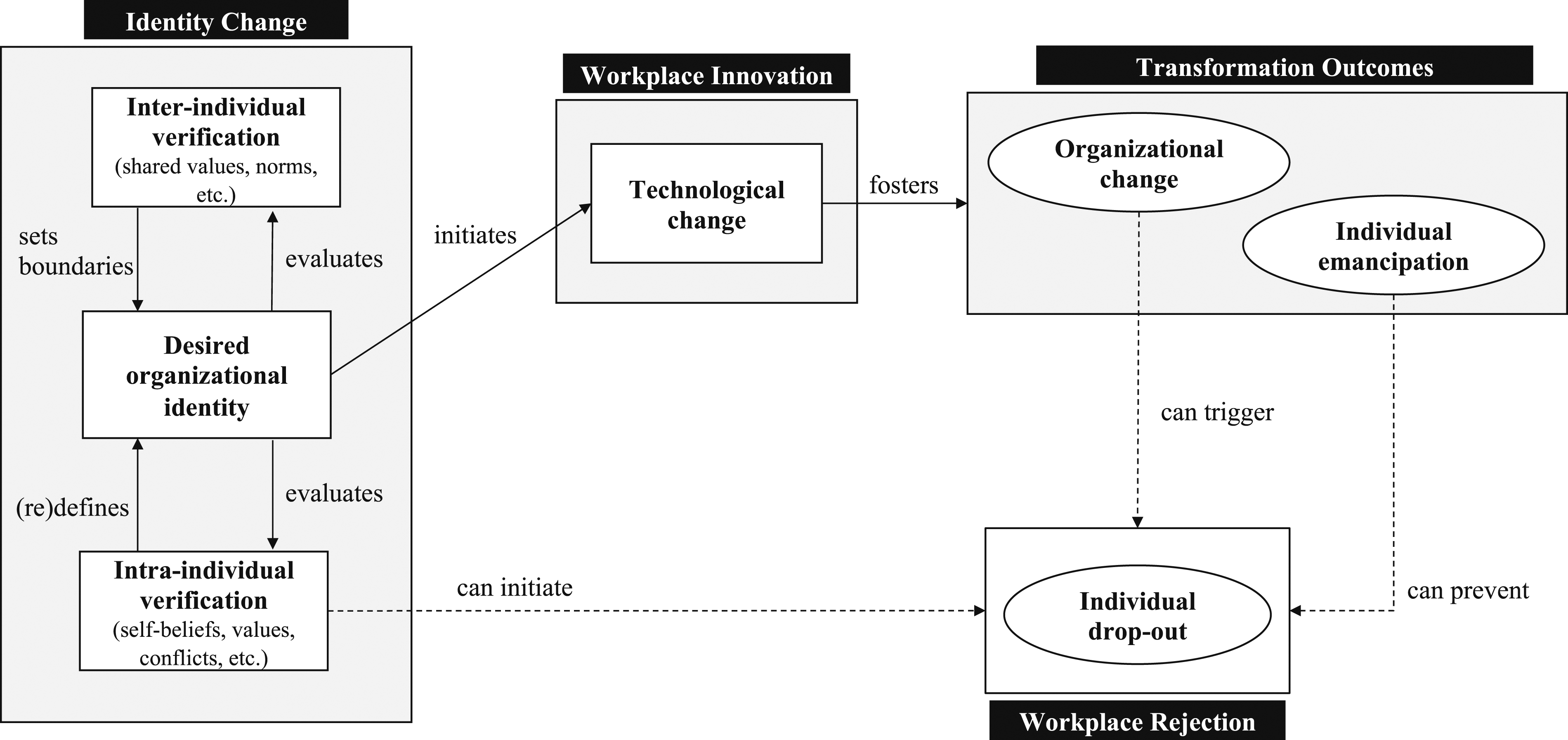
To make the process model of proactive digital workplace transformation more comprehensible to the reader and to provide more context about the theoretical relationships (solid arrows = main path of transformation process; dotted arrows = alternative path of transformation process), we synthesised the findings from our case analyses into two vignettes. Those vignettes are fictional but based on our observations and interviews within the two case organisations Alpha and Beta. The purpose of these vignettes is simply to illustrate the two pathways within the process model. The first vignette represents the alternative pathway within proactive digital workplace transformation (workplace rejection), which involves a mismatch between individual and organisational identities. The second vignette epitomises the main pathway of proactive digital workplace transformation. Meet Sarah, a highly autonomous and driven individual with a strong desire to contribute to the success of an organisation. She joins a well-established company that has a traditional and hierarchical organisational structure. The company's culture does not encourage or value individual influence, and decisions about digital workplace transformation are primarily made by senior management. During the initial stages of her employment, Sarah realises that her autonomous nature clashes with the organisation's rigid approach to implementing digital technologies. Whenever she suggests new ideas and technological solutions to solve problems, she encounters resistance from long-time employees who respond with statements like, ‘we have always done it this way’. This feedback increases the discrepancy between Sarah's individual identity, which values autonomy and contribution, and the organisation's identity, which restricts individual influence on workplace innovation. As a result, Sarah finds herself at a crossroads: she can either reject the organisational identity and continue to push for bottom-up technological change, or she can adapt to the circumstances and restrict her own autonomy to align with the existing organisational norms. In this case, Sarah accepts the risk of negative consequences for herself as she cannot live out her own identity within the boundaries of the current organisational identity. Ultimately, Sarah rejects her new (digital) workplace and drops out of the company to find another opportunity that is in alignment with her desired identity.Vignette 1
Vignette 1 describes the fictional employee Sarah as a highly autonomous and self-motivated person who values making a meaningful contribution to the success of an organisation. She is proactive, innovative, and willing to challenge the status quo by being open to technological workplace innovation. However, the salient organisational identity that other employees reinforce puts Sarah in a difficult position. The clash between Sarah's autonomous and driven nature and the organisation's rigid and hierarchical structure produces an identity conflict. Whether Sarah chooses resignation or proactive behaviour determines whether she goes along with the digital workplace transformation of the organisation or rejects it.
The second vignette places Sarah in a forward-thinking and innovative workplace that values individual influence and promotes a culture of autonomy. The company's identity is characterised by its openness to technological change and new ideas. Leadership staff actively encourages employees to take initiative and drive workplace innovation. The alignment between Sarah's identity and the organisation's identity creates a conducive environment for employees like Sarah to flourish and make a meaningful impact. As a result of this alignment, the organisational identity evolves and adapts with the individual expectations and preferences toward a digital workplace. The focus on innovation, individual influence, and bottom-up IT integration becomes more prominent, distinguishing the company's identity from traditional and hierarchical organisations. Sarah, with her highly autonomous nature, joins a forward-thinking and innovative organisation that values individual influence and supports a culture of individual autonomy. The company's organisational identity aligns with Sarah's individual identity, creating a match between her drive to contribute and the organisation's encouragement of individual impact. Moreover, the CEO actively supports workplace innovation and technological change that are driven by the workforce. This further supports the match between Sarah's individual identity and the desired organisational identity. The CEO's vision and actions initiate a digital workplace transformation, where new digital technologies and collaborative platforms are implemented to foster innovation and empower employees to contribute their unique ideas. In this example, the alignment between Sarah's individual identity, the organisational identity that promotes individual influence, and the CEO's support for workplace innovation lead to a proactive digital workplace transformation that serves an evolving organisational identity.Vignette 2
By contrasting these two vignettes, which were not representative for Alpha or Beta but occurred on an individual level in similar ways in both organisations, we can see how the match or discrepancy between an individual's identity and the organisational identity, as well as the support from leadership, can have major implications for digital workplace transformation.
Discussion
Over the course of 6 months, we followed two case organisations in the context of their digital workplace transformation toward a remote-first structure. While the study is in line with existing work about the bottom-up and democratic character of transformational activities in remote organising (Asatiani et al., 2021; Asatiani and Penttinen, 2019; Marx et al., 2021), it contrasts existing works that have theorised the concept of digital workplace transformation (Meske and Junglas, 2021; Zimmer et al., 2023).
Whereas it has been acknowledged that the technological change process can receive individual support by employees, this process has been characterised as ‘necessary’ (Meske and Junglas, 2021, p. 1120) for strategic reasons. In our case organisations Alpha and Beta, transforming the workplace was not ‘necessary’, because the ‘born digital’ business model (Tumbas et al., 2017) afforded no digital transformation that triggered a digital workplace transformation. Still, the transformation from onsite work to a remote-first structure meant a huge leap for employees as many work routines shifted to a digital mode, similar to reactive digital workplace transformation (Baptista et al., 2020; Zimmer et al., 2023). However, this leap was a change that was initiated, welcomed, and shaped by employees. If such digital workplace transformation occurs without the trigger of strategic digital transformation, what triggers it instead and what does that mean for theory about digital workplace transformation?
Although Alpha and Beta were chosen based on their apparent difference in size (120 vs. 30 employees) and the pre-existing structures of onsite office work (21 vs. 4 years), the transformation towards remote-first structures in both organisations was quite similar. Although Beta experienced more resistance to the transformation than Alpha, which impacted the speed and an intermediate arrangement (hybrid work), the mechanisms that initiated the process were quite similar. The re-evaluation of the desired organisational identity was not triggered by a strategic decision to make the organisation more effective or competitive. Instead, it evolved from a concurrent re-evaluation of individual identities. Simply put, most employees (including leadership staff) did not desire to work in the office anymore. As soon as this new desired identity became salient, the organisation arranged for the technological change that was needed so serve this new desired remote-first identity and started to experiment with digital technologies for workplace innovation.
Existing literature suggests that leadership staff is a critical element in this process. Even if most employees have changed their preferences about a digital workplace, it takes only one resistant manager to keep the organisation from transforming (Frick and Marx, 2021). In Alpha and Beta, however, the founders and CEOs, respectively, supported the change proactively. While this is true for other transformational activities (Zimmer et al., 2023), the motives of Alpha’s and Beta’s leadership teams were different. Instead of succumbing to pressure to digitise or to gain a competitive edge over other organisations, they simply solved their own personal problems. The existing mode of working did not align with how they wanted to live their personal lives. For digital workplace transformation to happen, they even accepted potential economic losses or the loss of talent (i.e. individual dropout). While both Alpha and Beta did experience resistance of single employees, they did not suffer from those issues as an organisation. However, they experienced the common social and cultural issues that are characteristic for ad-hoc remote work implementation (Hafermalz and Riemer, 2021). In this context, the experimentation with digital technologies to innovate an (already digital) workplace was of strategic importance (downstream).
In summary, our analysis of two remote-first organisations shows that there is a theoretical twin of digital workplace transformation that is not reactive and a second-order effect of digital transformation. This twin is characterised by a proactive upstream decision to transform a workplace, triggered by identity change mechanisms that precede technological change. Moreover, theorising proactive digital workplace transformation introduces the role of the individual and a micro-level analysis to the debate, which is often neglected (Zimmer et al., 2023), or theorised as passive (Meske and Junglas, 2021). The theoretical implications of our study are outlined below.
Theoretical implications
By developing an inductive process model of proactive digital workplace transformation, we provide an alternative perspective to the current understanding of digital workplace transformation, which renders the phenomenon as a reactive second-order effect of digital transformation (Baptista et al., 2020; Wessel et al., 2021; Zimmer et al., 2023). Based on a grounded theory approach, we develop an understanding of proactive digital workplace transformation that is initiated by an identification verification process within organisations. This means that in the context of proactive workplace transformation, identity change in is not triggered by technological change (Wessel et al., 2021), but vice versa. Moreover, we theorise that proactive workplace transformation does not follow the rationale of attaining strategic goals (Zimmer et al., 2023), but that strategic benefits can be a second-order effect of proactive digital workplace transformation. In this context, implementing digital technologies is not based on a strategic decision to digitise or automate business processes (Rossi et al., 2020) but on a strategic decision to implement digital technologies as a reaction to an evolved desired identity (e.g. remote-first). Furthermore, we theorise the dynamic identity work of individuals (Ashforth and Schinoff, 2016) as a proactive driver within the process of digital workplace transformation. This constitutes a novel contribution as existing literature on digital transformation and digital workplace transformation focus on an organisational level of analysis. The proposed process model of proactive digital workplace transformation supports the intertwined relationship of organisational identity and workplace innovation suggested by previous works (Dery and Hafermalz, 2016; Wessel et al., 2021) but theorises this relationship in an almost opposite direction. We assume that this finding can be explained primarily by the differences of the sampled case organisations. As Alpha and Beta are much smaller organisations than the cases that underly most theories of digital (workplace) transformation, the findings should not be generalised to large organisations that undergo digital transformation (Alpha and Beta did not, as they were mostly ‘born digital’). Moreover, the emergence of a desired identity and the transformational activities within an organisation are not as linear as prevailing process models suggest. Consequently, we would like to caution the reader when generalising our theoretical assumptions to different contexts (Lee and Baskerville, 2003). In comparison to case studies within similar contexts (e.g. Asatiani et al., 2021; Asatiani and Penttinen, 2019), our model extends this literature by unpacking the role of identity for digital technology implementation. Our study stresses the point that not all digital workplace transformations are created equal, and that context-specific theorising is important. We showed that digital workplace transformation can exist without its big conceptual sibling, digital transformation. Consequently, we encourage IS researchers to consider case organisations and contexts of remote-first or all-remote organisations (Choudhury, 2022; Marx et al., 2021) and other ‘born digitals’ (Tumbas et al., 2017) that help to nuance and develop the boundaries of theory on digital workplace transformation.
Managerial implications
This study helps individuals, managers, and founders of (future) remote-first organisations to gain important knowledge about potential challenges that can emerge during proactive digital workplace transformation processes. In general, it is difficult to present a one-size-fits-all solution. Remote-first organisations came in different shapes and sizes, either as organisations that have always operated with some degree of remote work or as organisations that transform from an onsite-only workplace. Here, the point on the remote organising continuum (see Table 2) from which an organisation transforms is important to consider. Moreover, different industries and organisational cultures attract different individual work identities. Even if individuals are hired based on cultural fit and a preference for remote work, a top priority for management is to ensure that digital technologies or sporadic, intensive onsite experiences afford social exchange, which is crucial for maintaining a shared organisational identity.
In general, management staff in remote-first organisations should identify the levels of autonomy employees desire and thrive under. Moreover, keeping track of what the desired identity or ‘future-self’ of the organisation looks like should involve every employee. Giving individuals the opportunity to have an influence on the transformation of their workplace is likely to increase satisfaction (Meske and Junglas, 2021) and avoids individual dropout. At the same time, individuals who do not prefer high levels of autonomy should be assisted so that the discrepancies between the desired organisational identity and the individual expectations are cleared up. Competencies such as self-leadership and the rules for communication need to be promoted by management.
Transforming to a remote-first organisation can involve the intermediate step of a hybrid work model if the desired organisational identity is too progressive in comparison to individual preferences or vice versa. Management is advised to address the prevailing individual preferences within the workforce. However, a development into two tiers of extreme preferences should be avoided (Sundermeier, 2022). Managers often deal with various characters (information systems) in the organisation. Some were previously recruited (implemented) with the expectation of conducting traditional onsite work, others for a hybrid model during the transformation process. Consequently, recruiting (implementing) new and training (updating) existing staff (information systems) to serve a desired organisational identity is vital.
Conclusion
In this paper, we investigated digital workplace transformations within two remote-first organisations. Based on the collection of qualitative data and techniques of the grounded theory methodology, we developed an inductive process model of proactive digital workplace transformation. The model posits that proactive digital workplace transformation is initiated trough identity change mechanisms that are primarily guided by bottom-up individual preferences for remote work. Moreover, in this context, the implementation of new digital technologies was a means to serve a desired identity (i.e. remote-first) and not vice versa. This model contributes to the IS literature by showing that proactive digital workplace transformation is subject to different theoretical mechanisms than the prevailing understanding of digital workplace transformation within a digital transformation context.
The results of this study should only be generalised to other contexts with caution (Lee and Baskerville, 2003). First, the derived model that resulted from this investigation is closely linked to the data it originated from. Therefore, readers are advised to make their own ‘judgement calls’ (Lee and Baskerville, 2012) to what extent the presented findings and theory apply to other types of organisations. However, the model provides a starting point for large-sample quantitative studies that may statistically generalise the unpacked relationships among the dimensions of proactive digital workplace transformation. As our process model is grounded in a qualitative examination of the identity formation in two remote-first organisations, future studies may utilise these findings to further examine emerging types of remote organisations. Therefore, studies are needed that investigate not only the revealed processes represented in the model, but also that compare and evaluate the identification processes for diverse organisations including various branches and structures. We encourage scholars to build on our findings to further develop the understanding of proactive and identity-driven digital workplace transformation that does not serve an abstract idea of how work should be done, but supports those who actually do the work.
Footnotes
Declaration of conflicting interests
The author(s) declared no potential conflicts of interest with respect to the research, authorship, and/or publication of this article.
Funding
The author(s) received no financial support for the research, authorship, and/or publication of this article.

Note
Appendix
Overview of interviewees in Alpha and Beta.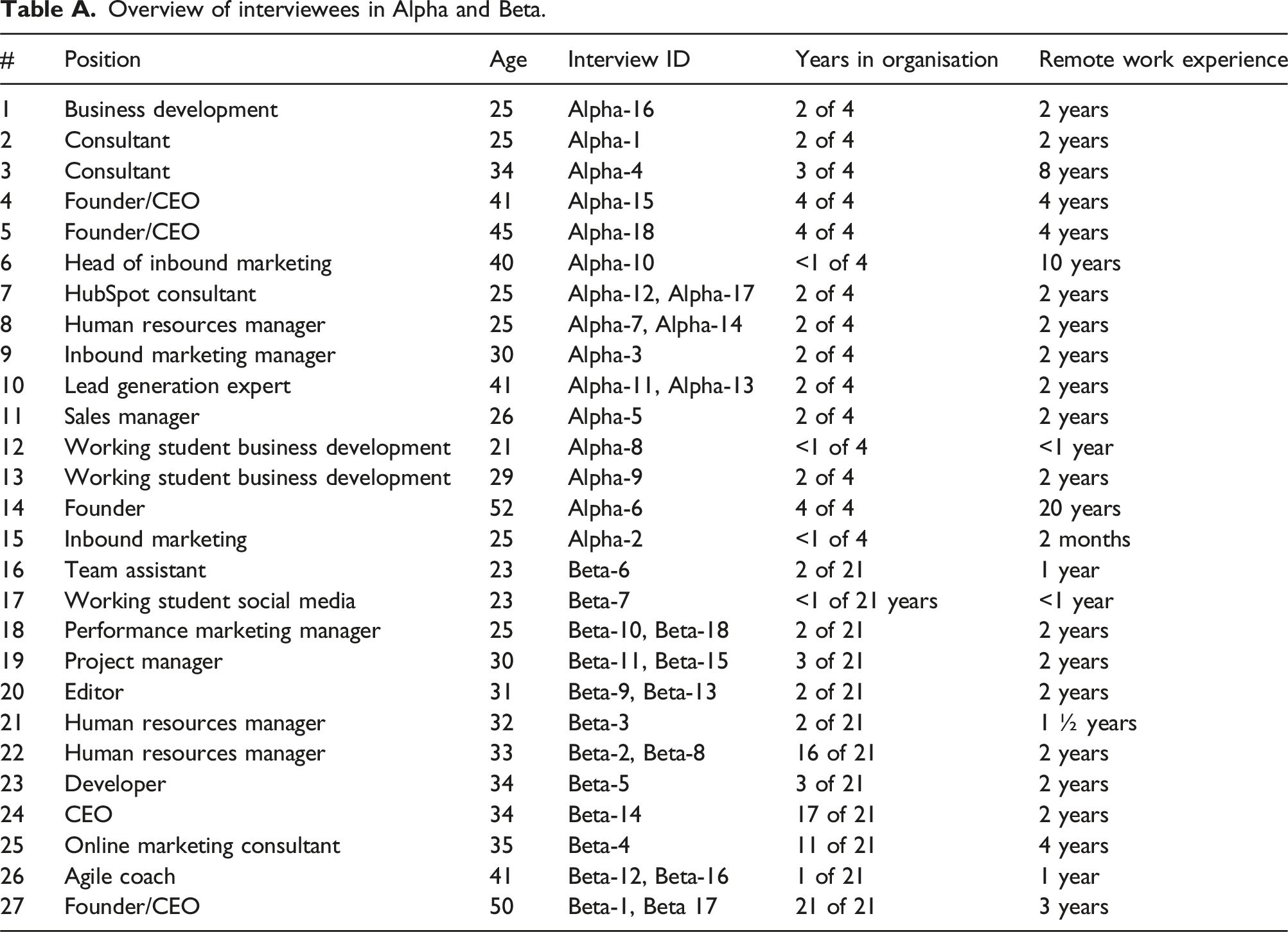
#
Position
Age
Interview ID
Years in organisation
Remote work experience
1
Business development
25
Alpha-16
2 of 4
2 years
2
Consultant
25
Alpha-1
2 of 4
2 years
3
Consultant
34
Alpha-4
3 of 4
8 years
4
Founder/CEO
41
Alpha-15
4 of 4
4 years
5
Founder/CEO
45
Alpha-18
4 of 4
4 years
6
Head of inbound marketing
40
Alpha-10
<1 of 4
10 years
7
HubSpot consultant
25
Alpha-12, Alpha-17
2 of 4
2 years
8
Human resources manager
25
Alpha-7, Alpha-14
2 of 4
2 years
9
Inbound marketing manager
30
Alpha-3
2 of 4
2 years
10
Lead generation expert
41
Alpha-11, Alpha-13
2 of 4
2 years
11
Sales manager
26
Alpha-5
2 of 4
2 years
12
Working student business development
21
Alpha-8
<1 of 4
<1 year
13
Working student business development
29
Alpha-9
2 of 4
2 years
14
Founder
52
Alpha-6
4 of 4
20 years
15
Inbound marketing
25
Alpha-2
<1 of 4
2 months
16
Team assistant
23
Beta-6
2 of 21
1 year
17
Working student social media
23
Beta-7
<1 of 21 years
<1 year
18
Performance marketing manager
25
Beta-10, Beta-18
2 of 21
2 years
19
Project manager
30
Beta-11, Beta-15
3 of 21
2 years
20
Editor
31
Beta-9, Beta-13
2 of 21
2 years
21
Human resources manager
32
Beta-3
2 of 21
1 ½ years
22
Human resources manager
33
Beta-2, Beta-8
16 of 21
2 years
23
Developer
34
Beta-5
3 of 21
2 years
24
CEO
34
Beta-14
17 of 21
2 years
25
Online marketing consultant
35
Beta-4
11 of 21
4 years
26
Agile coach
41
Beta-12, Beta-16
1 of 21
1 year
27
Founder/CEO
50
Beta-1, Beta 17
21 of 21
3 years