



Abstract
This study aims to shed light on an emerging organizational phenomenon in digitally mediated and multilocational workplaces—that is, workplace ghosting, defined as the abrupt termination of communication without warning or explanation. Drawing on frameworks from workplace incivility and job crafting, this study explores the mechanisms and contextual factors that enable and sustain ghosting behaviors in modern organizational settings. We interviewed 55 knowledge workers and employed a grounded theory approach to study remote workers’ perceptions of workplace ghosting behavior. This study proposes a typology of four types of workplace ghosting behavior: scheduling, disorganized, avoidance, and irritated behavior. We suggest that workplace ghosting behavior is task- or relationship-oriented but also highlight that this behavior emerges in planned and unplanned ways. Our study shows that ghosting challenges traditional norms of reciprocity as ghosting may benefit the ghoster but adversely affect the ghosted. Our findings expand our understanding of workplace ghosting beyond incivility and open new avenues for theorizing about social dysconnectivity in multilocational work. Specifically, the workplace ghosting typology provides an understanding of different types of ghosting behavior that vary in level of intent and focus.
Introduction
Ghosting is a common concept of online communication, especially recognized in the online dating context (Freedman et al., 2022; Kay & Courtice, 2022; LeFebvre & Fan, 2020; Powell et al., 2021), when one party in the relationship suddenly ends communication and ignores attempts for further interaction (Powell et al., 2021, p. 2227). Unfortunately, as DePaul (2021) noted: “it doesn’t take a dating app to get ghosted.” Indeed, ghosting increasingly creeps into professional contexts (Brazeau et al., 2024; Park & Klein, 2024; B. Robinson, 2025). For instance, in the recruitment process, ghosting may occur as a form of applicant withdrawal in which applicants fail to appear for scheduled interviews and completely cease all communication (Petric, 2023). Likewise, employers have ghosted applicants by cutting off contact during the hiring process (Christian, 2022). Similarly, ghosting has been identified among colleagues and peers who promise to finish the project but disappear without explanation (Brazeau et al., 2024; Park & Klein, 2024). Contemporary work environments characterized by digital communication and physically remote colleagues breed the emergence of “workplace ghosting” as employees are afforded more opportunities to manage their connectivity to work and colleagues.
Various studies have described how individuals actively set boundaries and pull away from demanding interactions (Harju et al., 2024) or reduce communication to gain focus on specific work tasks (Rofcanin et al., 2019). In addition, employees may vanish from conversations by setting their status in enterprise social media platforms to “away,” “busy,” or “offline” (Gibbs et al., 2013), or deliberately seize or delay their responses (Hafermalz & Riemer, 2020). Wajcman (2020) points out that digital technology contributes to our sense of an accelerated life, in which being busy and productive has become valorized. Employees may resort to various strategies to manage their attention in a society driven by a more-better-faster philosophy (e.g., Levy, 2016; Mauno et al., 2019; Stephens et al., 2017). In an era where scholarly attention has focused on the adverse consequences of technological devices, such as increasing stress, pressure, and lower well-being (Charalampous et al., 2021; Francis et al., 2015; Ruiner et al., 2023), it is easy to overlook that individuals have agency and discretion over how they connect to work and colleagues by exerting control over their technology use (Davis et al., 2023; Russo et al., 2019). Hence, while workplace ghosting—defined as the discontinuation of communication without warning or explanation—may not come as a surprise, its emergence in workplace communication dynamics warrants a deeper understanding of diverse interpretations and motivations of workplace ghosting.
Hence, this study proposes two refinements that are likely to advance theorizing about workplace ghosting. First, we engage with research on workplace incivility (Howard et al., 2020) and ostracism (Schilpzand et al., 2016) to highlight important conceptual differences and similarities between workplace ghosting and incivility and ostracism (Ferris et al., 2017). We argue that workplace ghosting provides a conceptually nuanced understanding of relational dynamics grounded in incivility and ostracism and is different from ghosting in social settings. This nuance allows us to develop a more fine-grained understanding of how the ghosted may experience workplace ghosting. Second, we draw on job-crafting literature (e.g., Wrzesniewski & Dutton, 2001) to develop a more thorough understanding of the potential motivations and targets of workplace ghosting. Job crafting is a potent framework for understanding workplace ghosting because of its inherent focus on how workers may contract (or expand) parts of their jobs to align their work tasks and relational demands to their individual needs (Tims & Bakker, 2010). Building on these insights, this study develops a typology of workplace ghosting informed by the degree to which ghosting is planned or unplanned and task or relationship-oriented.
Hence, we make two contributions. First, the typology of workplace ghosting advances conceptual clarity on this workplace phenomenon and opens avenues for theoretical exploration of its causes and consequences. To date, ghosting has been predominantly studied in the sphere of online dating as a relationship-ending strategy (Freedman et al., 2022; Freedman et al., 2024; LeFebvre & Fan, 2020; Kay & Courtice, 2022; Powell et al., 2021) or in a narrow organizational context, for example, communication ending between pharmacy faculty and students (Brazeau et al., 2024) or between patient and doctor (Petric, 2023). Second, the findings of this study are important for theorizing on the implications of multilocational work. These work settings may be particularly prone to workplace ghosting due to the heavy reliance on communication technology and lack of face-to-face communication. Ghosting may erode network bridges and leave individuals with the impression that others are unreliable, undermining partnership opportunities (Park & Klein, 2024). Hence, although individuals may struggle with overwhelming demands, limiting organizational communication by ghosting others can undermine organizational learning and collective effort central to organizing itself (Grant, 1996).
Theoretical Framework
Workplace Ghosting and Other Disengagement Behaviors
Ghosting behavior is largely deemed inappropriate as it relates to breaking up a relationship without explanation (Freedman et al., 2022; Timmermans et al., 2021). On the receiving end, ghosting behavior has been described as painful and disrespectful (Astleitner et al., 2023; Brazeau et al., 2024; Park & Klein, 2024; Petric, 2023). This draws attention to considering workplace ghosting through a lens of workplace incivility, a “low-intensity deviant behavior with ambiguous intent to harm the target” (Andersson & Pearson, 1999, p. 457). Uncivil behaviors are typically rude and discourteous (e.g., ignoring colleagues during conversations or not greeting coworkers), displaying a lack of regard for others, and violating behavioral workplace norms (Cortina et al., 2017; Schilpzand et al., 2016). As the majority of our communication is conducted through digital communication channels, uncivil behavior has taken new forms (e.g., rude emails and messages), giving rise to theorizing on cyber incivility (Lim & Teo, 2009; McCarthy et al., 2020; McCord et al., 2024; Niven et al., 2022; Torres et al., 2024). Interaction through technology has been shown to heighten incivility, as individuals feel pressed for time and perceive that impersonal communication does not necessitate politeness (Pearson & Porath, 2005). In addition, characteristics of technology-mediated communication, such as lack of back-channeling cues or signals that indicate the other person’s reactions and expression, leave the other one lacking contextual understanding (McCarthy et al., 2020), thus reinforcing the negative perception of intention.
The key characteristic of incivility is its ambiguous intent—it is not always clear whether the behavior was intended to harm, which differentiates it from more overt forms of workplace mistreatment like bullying or harassment (Cortina et al., 2017; Peng et al., 2016). Unlike most studies dealing with uncivil communication (Cortina et al., 2017; Torres et al., 2024), ghosting is a non-verbal act, leaving individuals confused and making the interpretation of behavior as uncivil less straightforward. Research on cyber incivility recognizes the phenomenon of ostracism—that is, “the extent to which an individual perceives that he or she is ignored or excluded by others at work” (Howard et al., 2020, p. 278)—that shares similarities with workplace ghosting. Cyber ostracism involves deliberately ignoring, shutting out of conversation, or leaving someone unanswered (S. L. Robinson et al., 2013; Torres et al., 2024). It is also described as a “silent treatment,” which involves withholding communication to express displeasure, punish, or control the other person (Ferris et al., 2008; Kalman et al., 2013; S. L. Robinson et al., 2013). However, studies on ostracism have focused on the effects, such as hurting individuals’ sense of belongingness (Pelliccio & Walker, 2022; S. L. Robinson et al., 2013), rather than understanding behavior from an interpersonal communication perspective (Jämsen et al., 2022; Pelliccio & Walker, 2022), thus leaving other than social or professional motivations out of consideration. Studies on incivility have shown that individuals with high workloads and under stress are more likely to engage in uncivil behavior as individuals struggle to cope (Francis et al., 2015).
Importantly, we argue that workplace ghosting, ostracism, and incivility represent distinct forms of workplace mistreatment that vary in their interactive nature and the social acknowledgment of the target. Ostracism is non-interactive often marked by passive exclusion or ignoring, leaving the target unacknowledged and isolated (Williams, 2007). Incivility, in contrast, is interactive and manifests as rude or condescending behavior. It acknowledges the target’s presence but in a negative, often disrespectful manner (Ferris et al., 2017). Workplace ghosting, which involves abruptly ceasing communication or engagement without explanation, shares the non-interactional nature of ostracism but includes a deliberate act of withdrawal akin to incivility’s intentional disregard. Finally, workplace ghosting is different from ghosting in social settings. For instance, relationships typically do not fully dissolve in workplace ghosting as future interactions are required due to structural interdependence. Hence, workplace ghosting provides a conceptually nuanced understanding of relational dynamics grounded in incivility, ostracism, and social ghosting.
In this scenario, the continuity of the workplace relationship, despite the ghosting episode, complicates the sense of finality that typically characterizes ghosting in personal contexts. Here, ghosting might be understood as an intermittent disengagement, where the ghoster temporarily cuts communication without explanation but may have to re-engage due to professional obligations. Furthermore, workplace ghosting differs from workplace ostracism, which involves persistent exclusion, often motivated by group dynamics and social rejection (Howard et al., 2020). In addition, unlike typical incivility, which may continue in future interactions in the form of rudeness or discourtesy, ghosting introduces a sharp break in communication that, when revisited due to professional demands, might generate heightened tension and uncertainty about how future interactions will unfold. Hence, workplace ghosting may create a unique strain on workplace relationships because it blends elements of ostracism (temporary social exclusion) with incivility (rude or discourteous behavior) while retaining the distinct feature of abrupt and unexplained disengagement.
Workplace ghosting as representing an on-again, off-again communication dynamic makes ghosting particularly harmful as it creates lingering ambiguity about intent, making it more disruptive than incivility, which usually involves lower-level, ongoing disruptions (Schilpzand et al., 2016). This raises the question of how employees may be interpreting workplace ghosting events:
RQ1: How do individuals experience workplace ghosting?
Workplace Ghosting and Job Crafting
Furthermore, given these conceptual differences, the motivations behind workplace ghosting remain an empirical question that needs further exploration. To address this question, we draw on job crafting literature because it informs us about how workers may manage the boundaries of their roles (Tims et al., 2012; Wrzesniewski & Dutton, 2001). Job crafting refers to how employees expand or contract their jobs’ tasks and relational demands to better align with their strengths or preferences (Demerouti, 2014; Tims & Bakker, 2010). As such, job crafting may help explain why a worker might selectively disengage (ghost) from certain relationships while maintaining others. By ghosting, individuals may be attempting to minimize relational overload or reduce stress from specific interpersonal demands (Bruning & Campion, 2018). Hence, workplace ghosting may be seen as an adaptive strategy to reshape their work environment’s social and task-related elements. Grounding workplace ghosting in job crafting literature also allows us to explore ghosting as a tactical withdrawal rather than purely negative behavior, as it enables workers to exert control over the relational and emotional energy they invest in their work and workplace relationships (Harju et al., 2024).
From a relational perspective, individuals craft to expand or contract their interaction with others at work (Rofcanin et al., 2019; Wrzesniewski & Dutton, 2001). Indeed, changes to the social environment can refer to building new networks and connections (Zhang & Parker, 2019) and restrict or decrease interaction (Rofcanin et al., 2019). For example, employees may limit their attendance at meetings or reduce communication with co-workers not involved in current projects. Job crafting theory also describes more task-based behaviors where employees may withdraw from unfavorable demands and stay “away from tasks or activities that will be depleting and involve excess effort” (Zhang & Parker, 2019, p. 132). Importantly, while job crafting is theoretically defined as proactive (Wrzesniewski & Dutton, 2001), Zhang and Parker (2019) state in their review that withdrawal-oriented crafting tends to be less active and is not necessarily a deliberate crafting strategy but relatively passive or reactive. Hence, drawing on job crafting, we examine what drives workplace ghosting and whether ghosting is necessarily relationship-oriented or could also be task-oriented. Therefore, our second research question is:
RQ2: How and why do employees engage in workplace ghosting?
Method
Study Design
We adopted a constructivist grounded theory approach (Charmaz, 2006; Charmaz & Belgrave, 2015) because we are interested in how participants construct meanings and actions from their experiences related to the phenomenon of workplace ghosting. Instead of pure induction in the classic form, we did not delay the review; we had already reviewed the literature in the beginning. Thus, our approach can be called an informed version of the grounded theory approach (Thornberg, 2012). While studying technology-mediated communication behavior, we looked for knowledge workers among whom remote work and digital communication are more prevalent. We interviewed 55 knowledge workers in different fields of business. One-to-one interviews were conducted in the year 2024 via Teams in Finnish. All the interviews were transcribed and analyzed in Atlas.ti. There were 37 females, and 18 males interviewed, aged between 22 and 64 years. All worked in expert level positions in different fields (HR, accounting, research, engineering, IT, and marketing) and had the possibility of working remotely in their organizations. Interviews are part of a larger interview study, which explores the phenomenon of workplace ghosting in digital communication; thus questions were not concentrated only on describing ghosting, but also generic questions on role of digital interaction in remote work and its impact on interaction were asked.
Interviews were conducted via Teams and lasted between 35 and 65 min. When the participants agreed to participate in the interview study, they received formal privacy statements, consent forms, and information on the use of the research data in the written form. Their responses were recorded at the beginning of the interview. Each interview was transcribed utilizing an AI-supported transcription tool provided by Teams. Interviews were semi-structured to guide individuals in describing their perceptions. Interviews followed the guidelines of grounded theory interviewing by posing general questions that were narrow enough to understand an individual’s narration (Charmaz & Belgrave, 2015). During the interview, we paid attention to the participants’ expressions and tried to “remain alert for interesting leads” (Charmaz & Belgrave, 2015, p. 353). If needed, we utilized probes and follow-up questions without forcing responses or leading the discussion (Charmaz & Belgrave, 2015). The participants were asked to describe what they consider ghosting behavior is and then continued to discuss how they experienced it. Furthermore, we asked whether they recall any specific situation of ghosting. Finally, we scrutinized individuals’ understanding of why people engage in ghosting behavior.
Data Analysis
We use the grounded theory framework as a “hybrid” rather than a purely inductive approach, spanning inductive and deductive approaches along the data collection and analysis (Murphy et al., 2017). We remained open to new insights that emerged during the data collection. Data was handled in ATLAS.ti, software for qualitative data analysis to support analysis and organizing data. In our study, we followed the coding paradigm of grounded theory (Charmaz & Thornberg, 2021). The first author began screening the data by listing data descriptions and organizing data while preserving the labeling and wording used by participants (Glaser & Strauss, 1967). In this phase, it was important to keep our minds free of preconceived literature and explore data as “investigative journalists” (Murphy et al., 2017, p. 294). This was followed by line-by-line coding that generated several sub-categories, such as managing one’s work, prioritizing tasks, and limiting availability (that led to the category of “disorganized behavior” in a later stage). At this focused coding stage, we continuously discussed data interpretations with the author team. This process informed four main categories describing different approaches to ghosting behavior. We recognized that participants interpreted four types of ghosting behavior at work: scheduling, disorganized, avoidance, and irritated ghosting behavior. In the final theoretical coding stage (Charmaz & Thornberg, 2021), we integrated and refined the categories developed during focused coding and identified the relationships between categories. This resulted in a typology of workplace ghosting along two dimensions: unplanned versus planned and task- or person-oriented (see Figure 1).
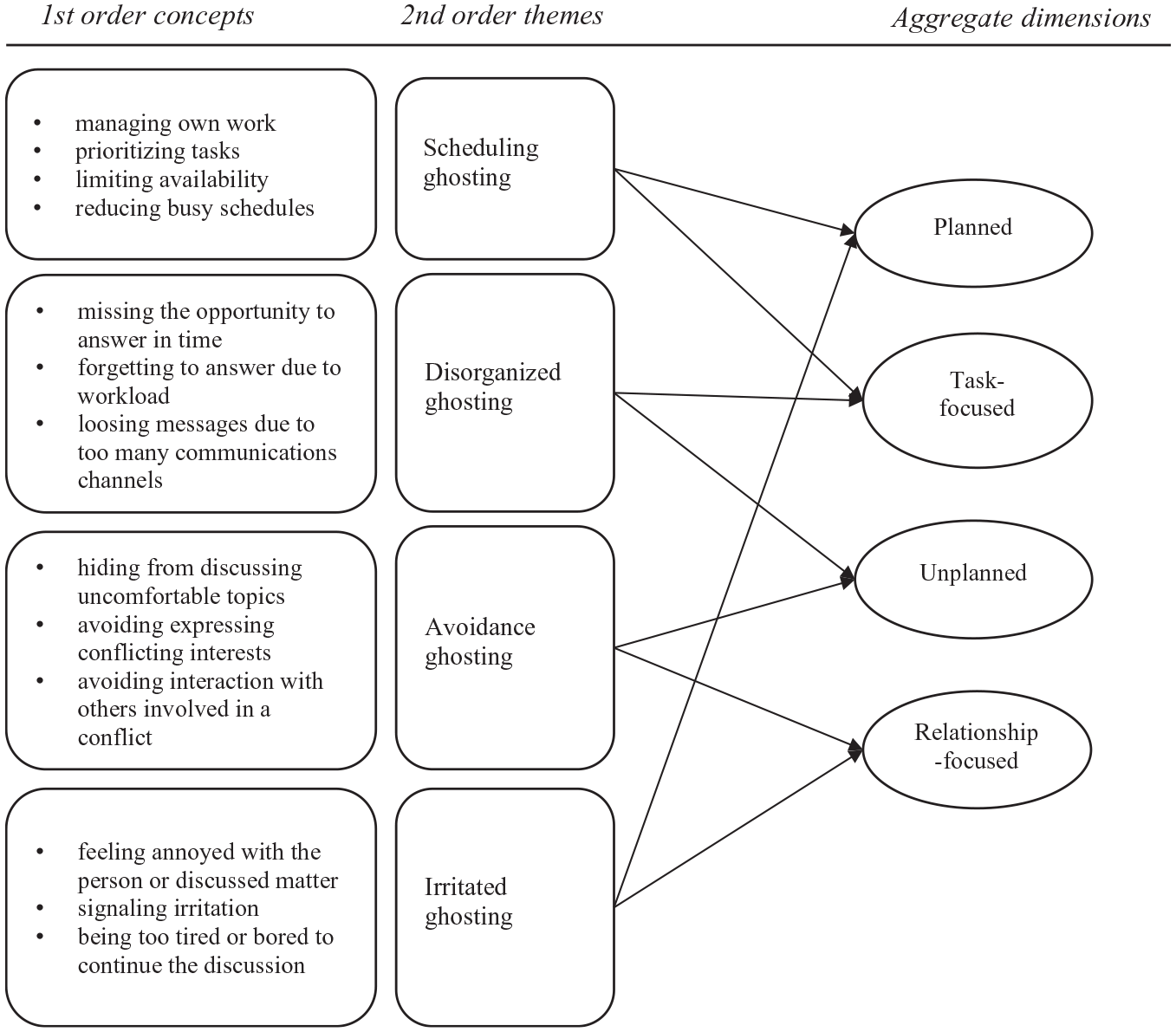
Coding steps.
Results
The data suggests that workplace ghosting shows similarities to other concepts that explain forms of uncivil behavior in terms of how workplace ghosting manifests itself, how technology acts as a “shield” that enables avoiding face-to-face encounters, and how recipients react to sudden changes in communication. However, workplace ghosting and its motives seem to be interpreted more versatilely, raising questions about acceptability and its effects on workplace interactions. In general, although online, the sudden ending of communication evokes conflicting feelings, partly because ongoing communication in interdependent work settings is often required for effective task accomplishment. However, workplace ghosting was described in more versatile forms than ending ongoing discussions. Participants also included non-responsiveness as a form of ghosting, as they understood that the recipient had chosen not to answer, although they had seen that someone was trying to contact them. Participants also recognized that in work context ghosting is often temporary and selective based on both person that try to connect but also on topic that connection is about. Some informants rationalized workplace ghosting as a way to deal with increased information overload and try to balance available attentional resources with experienced workplace demands. Hence, workplace ghosting seems to give rise to conflicting thoughts that inevitably reflect on further interaction with colleagues. The data shows that participants recognize four different types of ghosting behavior at work. We categorize these occurrences according to the dimensions of planned and unplanned behavior and task- or person-oriented behavior (see Figure 2).
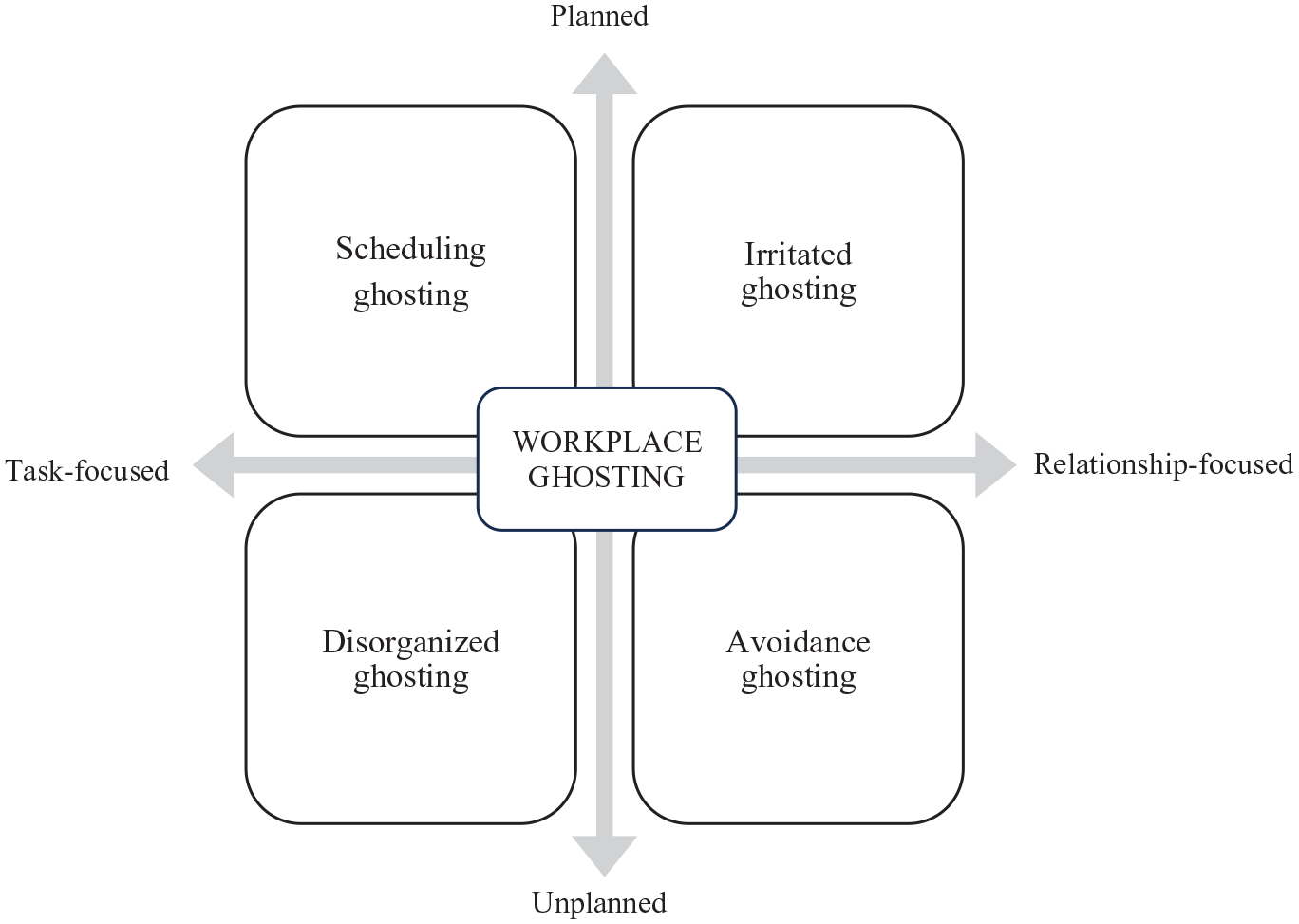
Dimensions of workplace ghosting behavior.
Scheduling Ghosting
Scheduling ghosting behavior refers to perceiving behavior as a strategic activity while an individual manages their work goals. As one of the informants mentioned: “It’s [workplace ghosting] a way to manage your work desk” (Participant 15). Other informants added that the decision to engage in workplace ghosting resulted from a continuous evaluation of requests for their attention and the workload they experienced. For instance, several informants shared reflections such as: “There are just sometimes so many emails waiting to be answered that I on purpose leave someone hanging and waiting for a better time [to respond]” (Participant 23). Scheduling ghosting was intentional and planned behavior of not replying to part of the messages to save own work time for other more important. Some were accustomed to leaving others without replying and found it even inevitable behavior in their work. For example, respondent in consultancy business with several contact requests in a day commented: “With hundreds of mails, you always first wait that person contacts you again, like raises the priority of that message and becomes visible - it’s the only way to manage the amount, you can’t reply to all” (Participant, 19). The temporary suspension of communication makes the workload more manageable.
Younger workers were particularly likely to limit their availability to others through acts of ghosting: “Especially for young people, it seems more natural that they decide when they interact, instead of being always available” (Participant 18). Scheduling ghosting behavior is also discussed as a deliberate choice in managing one’s connectivity and wellbeing by deciding when to respond to contact requests. These choices were mainly strategic, which became apparent when considering whom individuals decide to ghost. For instance, an informant stated: “It’s about the existing relationship whether one ghosts or not” (Participant 19). Specifically, ghosting behaviors were less likely to be directed at higher-ranked employees: “If the message comes from someone higher in the hierarchy, you consider that as authority to whom you have to answer” (Participant 23). Ghosting was also seen to reflect working culture where own needs come first: “we want to put our own work input before the needs of others, so that if someone demands something, we prefer to take care of our own tasks instead of spending time on something that is not so important to us, even if it would be useful for the other person” (Participant 50). Ghosting at work was seen to have a self-serving purpose as the decision to ghost was purely made based on one’s own needs.
Disorganized Ghosting
Disorganized ghosting behavior refers to unplanned and merely accidental acts sparked by feelings of losing control of one’s work situation. Disorganized ghosting emerged as individuals tried to keep afloat at work. In this case, ghosting behavior was seen as a by-product of an intense work overload: “I might ghost if I totally forget or miss answering on time. . .the number of incoming mails is horrible. . .it would be then accidental, not on purpose” (Participant 17). Many informants referred to increased organizational communication on various channels simultaneously. They found it challenging to manage the amount of communication and evaluate the importance of all the contact requests. From this perspective, ghosting results from the increased pace and amount of work. One informant described it aptly: “Probably the reason is that you are so busy at work that you don’t have time to answer or focus on something or at least not very quickly and then you forget it” (Participant 27).
One informant recognized that someone may interpret her delaying response as ghosting: “I might be also guilty for ghosting as I sometimes need time to process [message] and then I have accidentally left another to wait response for too long” (Participant 20). Which also suggests that ghosting is sometimes temporary and also taking time to reply without explaining that can be experiences considered as one form of ghosting. Workload was also found to affect negatively on our way to react and focus on incoming messages: “. . .messages just keeps coming so you’re already kind of like numb to all the communication and it just goes from one ear in and out from the other. . . so it can be just like unintentional, like, you have learned that something really needs to be ruled out” (Participant 52). Similarly, one other found that remote work is lonely and might impact on being responsive all the time: “So the workload has really increased, working alone remotely from others, affects whether you always have the energy to answer, whether you always have the energy to help others and be present for others” (Participant 33).
Irritated Ghosting
Irritated ghosting behavior refers to ghosting in response to negative emotions or as a way to purposefully insult the target of the ghosting behavior. It was characterized as a “hidden” or “silent” form of showing negative emotions due to the possibility of implicitly communicating discontent without having to face someone in person: “In the worst case, the situation may be that they may be irritated by something which they may not be able to express and just leaves unanswered” (Participant 30). Another participant recalled a situation where she had not replied because she felt that the discussion was not going anywhere, and she “got tired of insisting on the same thing. . .not replying and ignoring was a way to move forward in that situation” (Participant 25). However, it should be noted that she found this inappropriate behavior and regretted that she did not deal with the issue face-to-face. Similarly, one participant mentioned that constant asking can impact on irritation and lead to ghosting: “Of course, in some situations it can be something personal, that the other person gets annoyed by a person or is annoyed by their inquiry” (Participant 27). Also a bad relationship with the person was recognized to encourage people to ghost: “In some cases, it may be that the reason is personal chemistry, you don’t always respond to the other person, or you respond with a really long delay, and that’s it when personal chemistry just gets worse, and leads to vicious circle” (Participant 52).
Abruptly ending conversations was seen as offensive also due to the way individuals used power to ignore someone: “It’s a matter of using power. . .do I care to answer. . .like I have already got what I wanted. It’s upsetting and insulting” (Participant 11). Overall, more often, informants found that the communication culture has become tougher with remote work: “Distance between people enables rude behavior” (Participant 13), and “digitally mediated interaction has increased emotional coldness towards your colleagues” (Participant 11). Informants also discussed how technology-mediated communication has brought up new ways to be rude and act negatively toward others: “I have noticed that inappropriate behavior has increased by behaving ignorantly in different ways. . .ignoring question is about being a prick. . .” (Participant 6). In this category, ghosting was focusing on a person on the other end of the channel, however mediated communication offered a suitable channel to insult others without leaving clear traces and show silent resistance or signal irritation without facing other one and taking responsibility for actions.
Avoidance Ghosting
Avoidance ghosting refers to trying to avoid certain situations or unpleasant encounters. Individuals explained how remote work makes it possible to avoid meeting unfavorable persons, avoid conflict, or uncomfortable discussions: “These days individuals do not want to solve interpersonal issues, but rather put effort on avoiding encounters” (Participant 3). In a hybrid context, opportunities for avoiding are more widely available: “Hybrid work is so independent that it is so easy to steer clear from people you don’t get along with or whom you have not met before” (Participant 2). Likewise, the need to provide a negative answer was considered uncomfortable. Avoidance ghosting provided an easy way to bypass that: “Request can be either too demanding or people try to decrease workload, but those are all reasons that they struggle to say no and rather disappear and say nothing at all than refuse the request” (Participant 22).
An uncomfortable situation could also refer to certain tasks that may feel uncomfortable. As such, individuals may try to withdraw from the situation that requires such tasks. Informants talked about ghosting as a way of avoiding responsibilities: “It annoys me that people tend to hide behind the technology and thus work do not progress” (Participant 15). Similarly ghosting was recognized to happen if person found task too difficult: “Usually in things that you want to avoid, which are really laborious or you don’t know how to do those, then in such situations [people are ghosting]” (Participant 31). Participants also recognized that ghosting benefitted people and enabled people to get rid of tasks by simply withdrawing: “Organization is like a puzzle where everyone is needed. . .but if one is not speaking out and responding, rest of the group continues to proceed that matter, and one may get away with it easier” (Participant 24). In addition, technology was found making it easier to leave without response and intentionally hide from others: “It [workplace ghosting] is about the need to be unreachable because of too much work. . .and it’s easy to hide behind the screen” (Participant 14).
Task- Versus Relationship-Focused and Planned Versus Unplanned Behavior
Overall, the informants described ghosting behavior as a task- or relationship-focused behavior. Individuals interpreted ghosting as a way to manage their workload (i.e., tasks) based on their needs and preferences. Strategic and survival ghosting represented ghosting behavior that referred to task-focused action. In addition, relationship-focused ghosting behavior is related to managing workplace relationships, for instance, to signal disagreement with others or avoid uncomfortable encounters that require energy. Offensive and avoidance ghosting were relationship-oriented as these forms of ghosting behavior were motivated by interpersonal interactions.
In addition, workplace ghosting was seen as planned and unplanned, not depending on intentionality but rather occurring in response to a situation or incident. This aligns with reflections on task and relational job crafting that can be either planned (Tims & Bakker, 2010; Tims et al., 2013; Wrzesniewski & Dutton, 2001) or occur unplanned in response to changing contextual factors (Spitzmuller and Van Dyne, 2013). Strategic and offensive ghosting behaviors are planned as those actions were strategic or purposeful, requiring considerable deliberation. Survival and avoidance ghosting behavior were not thoroughly thought through and occurred spontaneously in response to a work situation. For instance, struggles with sudden spikes in workload or tasks and personal issues that needed attention but felt uncomfortable seemed to trigger these ghosting behaviors.
Discussion
In this study, we explored the phenomenon of workplace ghosting, which refers to the abrupt ending of online communication without warning or explanation (Lefebvre et al., 2019; LeFebvre & Fan, 2020). Ghosting is typically viewed as uncivil behavior (Timmermans et al., 2021), leaving the other party without knowledge about the reasons behind ending communication (Powell et al., 2021). However, ghosting is often more complex, while the lack of awareness makes interpretations of ghosting behavior less straightforward (Torres et al., 2024). Our study highlights that workplace ghosting behavior has become an easy way to limit interaction in mediated environments, particularly when avoiding face-to-face meetings and negative repercussions are unlikely. Our findings revealed that ghosting is a complex phenomenon, perceived from four perspectives as scheduling, disorganized, irritated, and avoidance ghosting behavior. Specifically, the workplace ghosting typology provides an understanding of different types of ghosting behavior that vary in level of intent and focus. These findings expand our understanding of workplace ghosting beyond incivility and open new avenues for theorizing about social dysconnectivity in multilocational work. We claim that workplace ghosting may contribute to the erosion of social relationships in multilocational work in two ways: by creating negativity in workplace interactions and emphasizing self-interest at the expense of collegiality.
First, research has demonstrated that ghosting may evoke negative emotions (Brazeau et al., 2024; Park & Klein, 2024; Petric, 2023). Our findings imply that workplace ghosting does not only elicit negative emotions on the targets of ghosting behaviors but also reflects on further interaction negatively and decreases reciprocity. Ironically, ghosting is also a strategy for employees to avoid (emotionally) tense situations. Indeed, individuals may avoid facing difficult situations and uncomfortable encounters, such as saying no or solving conflicting interests (Weisskirch & Delevi, 2013). However, ghosting as a strategy seems unlikely to better the situation and instead opens the door to more emotional labor. For instance, as individuals struggle to understand the reasons behind ghosting behavior, they may feel embarrassed and inflict self-blame as they try to figure out whether they had caused their communication break-up (Hershcovis et al., 2017; Tong et al., 2019). Both withdrawing and intentional rudeness indicate that ghosting behavior is also used as a means to demonstrate negative emotions in silent form (d’Astros & Morales, 2024; Cortina et al., 2001; Cortina et al., 2017), where technology-mediated communication offers a way to escape accountability (d’Astros & Morales, 2024).
Secondly, workplace ghosting seemed to be an attempt to manage the felt expansion in the pace and amount of work (Stephens et al., 2017), without considering others. Individuals acknowledged that the overwhelming demands catalyzed workplace ghosting. In that sense, workplace ghosting shows similarities with job crafting behaviors, which are seen as proactive work behaviors that influence work tasks and relationships so that they align more closely with individual needs and preferences. Similarly, our findings suggest that workplace ghosting can be task- or relationship-focused. In addition, the findings indicate that workplace ghosting serves as a means to intentionally avoid interactions typically with a specific person, for example, to avoid solving conflicts or resolving uncomfortable situations. This aligns with notions of job crafting, indicating that sometimes crafting can be solely withdrawing from relationships without improving one’s work (Rofcanin et al., 2019; Zhang & Parker, 2019). Similarly, individuals may evade responsibilities or tasks by withdrawing from communication. This seems more likely for younger workers and workers in higher hierarchical positions but seems to be also in connection with amount of work-related communication which increases the need to find ways to organize work by ignoring part of the communication. What makes it complicated is that ghosting as a crafting act can be seen purely self-oriented and from self-serving purposes as it does not consider influence on others while focusing on own needs and coping. Relational aspects and influence on others by this kind of behavior is not well understood, however studies imply that one’s withdrawal may increase other’s work demands (Aubé et al., 2009; Harju et al., 2024) and thus put unfair pressure to co-workers.
Importantly, we explicitly acknowledge that workplace ghosting can be planned and unplanned. Hence, workplace ghosting may be a more incidental response to changes in the work environment, such as spikes in workload. According to our results, individuals may struggle with their workload and ignore interactions to avoid additional tasks or have to navigate relational demands. Unplanned ghosting reflects a temporary solution to provide time to figure out how to solve things or how to organize; planned ghosting indicates strong agency and a sense of justification of being able to leave another one without a reply, for example, justifying ghosting behavior based on one’s hierarchical position. These findings align with research suggesting that workload contributes to stressful work conditions, leading individuals to engage in incivility more often (Francis et al., 2015).
Overall, these findings shed light on the emergence of workplace ghosting. Increasing reliance on mediated communication, decreasing face-to-face interactions, and a rising workload provide fertile ground for such ghosting practices. Indeed, under such conditions, workers may feel motivated to reduce task- and relational work demands and perceive opportunities to do so through ghosting practices. These behaviors go beyond managing one’s visibility at work—for example, setting your status to busy or offline on ESM (Gibbs et al., 2013). Whether considered uncivil or not, workplace ghosting may contribute to the erosion of social relationships at work. This is crucial for organizations, too, as communication breakdowns and ghosting behaviors may harm interpersonal relations and collaboration networks (Torres et al., 2024). As such, workplace ghosting necessitates a discussion about shifting norms in technology-mediated work environments (McCarthy et al., 2020).
We conclude with several recommendations and considerations for future research. In this study, ghosting was conceptualized from an individual perspective; however, participants raised concerns about its broader organizational implications. They suggested that ghosting behavior may alter social dynamics at work, fostering an inner circle of trusted co-workers with whom individuals collaborate while simultaneously creating an outer circle that enables disengagement from organizational development and cooperation. This raises important questions for future studies to explore ghosting behavior at the organizational level. For instance, adopting a social network perspective could help examine how ghosting impacts social ties, potentially harming trust and relationships among organizational members.
Moreover, our proposed framework highlights significant avenues for further research regarding workplace contexts in which ghosting behaviors emerge. Participants briefly noted generational differences in managing connectivity, with younger workers appearing more adept at limiting interactions while older workers often struggle to balance these demands. Future research could apply this framework in various organizational contexts to investigate how ghosting behaviors manifest across different roles and hierarchical relationships and whether generational differences in engagement with ghosting behaviors can be observed.
Our study illuminates the underlying causes of workplace ghosting, emphasizing the importance of prioritizing open and transparent communication within organizations. By understanding the multifaceted nature of ghosting behavior, organizations can identify patterns and address these issues before they lead to employee disengagement or turnover. Organizations can for example, implement training programs for managers and HR professionals to recognize and mitigate ghosting behaviors, fostering a more supportive and communicative workplace. Vagaš and Miško (2018) points out that training employees, particularly in handling difficult workplace situations, helps prevent internal ghosting and similar behavioral trends. Additionally, establishing clear communication guidelines, including norms and response times, can reduce misunderstandings and harmful interpretations.
Footnotes
Author Contributions
Jenni Kantola: Conceptualization, Methodology, Analysis, Writing—Original draft, and Reviews & Editing. Ward van Zoonen: Conceptualization and Writing—Reviews & Editing.
Data Availability
Data not available—participant consent.
Declaration of Conflicting Interests
The author(s) declared no potential conflicts of interest with respect to the research, authorship, and/or publication of this article.
Funding
The author(s) received no financial support for the research, authorship, and/or publication of this article.
Ethical Considerations
Our institution does not require ethical approval for reporting individual cases or case series.
Consent to Participate
Informed consent was obtained verbally before participation. The consent was video-recorded before interview began.
Consent for Publication
Not applicable.
