




Abstract
The current study contributes to the demand for more multilingual analyses of online reviews, comparing English and German-language hotel reviews on Booking.com. Specifically, it seeks to shed light on the linguapragmatic contrast of the German speaker showing a preference for more “content-orientation” and the English speaker more “person-orientation” by exploring the use of the first-person perspective (FPP) in online reviews. It further integrates cognitive linguistic theories of construal, considering whether the results implicate not only a difference in the assumedly intentional rhetorical preferences of speakers but also cognitive differences in ways of experiencing a hotel stay, which might also have important implications for how hotels tailor their language-specific responses and maybe even how hotels design their service and intended customer experience. The findings show that FPP did occur in more English reviews, indicating more personalization and thus a more personalized cognitive processing of the hotel stay. However, when FPP was identified in German reviews, it occurred at a similar frequency to English reviews, reflecting a similar degree of subjective involvement. The findings may thus indicate that while this contrast was robust on a whole, linguacultural differences may play an increasingly smaller role as online genres merge into more global styles, a trend that communications practitioners must increasingly consider.
Keywords
Introduction
It is now a widely recognized observation that online hotel reviews are written and viewed by travelers the world over (Cenni, 2022, p. 3); in 2022, for example, over 240 million reviews were published across 200 countries and territories on Booking.com alone (Booking.com, 2023). As hotels are so-called intangible or experience goods, meaning customer satisfaction is determined more by a chronological experience of the good and less by its technical specifications (compare buying a drill or digital camera), reviews of hotels are heavily relied upon by consumers to make purchasing decisions (cf., e.g., Mazzarol et al., 2007; Sparks & Bradley, 2017; Willemsen et al., 2012; Yin et al., 2014). Thus, their potential impact on revenue makes them very interesting to companies, perhaps even more so than traditional forms of advertising (Vásquez, 2014a, p. 2).
Interestingly and perhaps against general expectations, the “internationality” of online hotel reviews and the potential for a review to be read by anyone in the world has not meant that reviews are now only being left in the lingua franca English; indeed, online activity of all kinds is thriving in local languages. As Cenni and Goethals (2017) put it, instead of an English-language dominance, the internet “[. . .] is expected to become even more multilingual” (p. 23; see also Hale, 2016). Furthermore, customers may prefer reading reviews in their native language, due to the personal nature of the experience and a feeling of closeness or in-group identification (cf. Kuehn, 2011). For the linguistics community, then, it remains apparent that there is a great demand for studies comparing reviews of experience goods not only in English, but among different languages (cf. Cenni, 2022, p. 16), as linguistic contrasts may show differing communicative preferences across linguacultures, providing valuable information to hotels concerning whether (and if so, how) to tailor their response strategies in multilingual contexts.
The current study is a contribution to this demand as it compares English and German-language hotel reviews on the website Booking.com. Specifically, it seeks to shed light on the widely accepted linguapragmatic contrast of the German speaker as more impersonal, detached and content-oriented and the English speaker as more personal, involved and person-oriented (House, 2006). 1 It does so by comparing a German and English corpus of reviews regarding the use of the first-person perspective, henceforth called FPP. 2 Considering that readers perceive negative reviews to be more helpful than positive ones (e.g., Park & Nicolau, 2015), and that negative reviews have been found to have a greater impact on sales than positive ones (e.g., Chevalier & Mayzlin, 2018), this study focuses particularly on negative reviews, a growing field of interest for linguists. Finally, this study is a first attempt to integrate cognitive linguistic schools of thought from the field of construal (Langacker, 1999; Verhagen, 2010), considering whether the results implicate not only a difference in the rhetorical preferences of German and English speakers but also cognitive differences in ways of experiencing a hotel stay. 3
Theoretical Background and Previous Research
German and English Pragmatic Contrasts
House’s Dimensions of Communicative Contrasts
It was the seminal research of House (1977, 1982, 1996, 2006) that first comprehensively addressed German and English pragmatic differences in communicative preferences. House analyzed a wide range of spoken and written discourse types (House, 2006), finding specific patterns of language use that scholars widely recognize as the major dimensions of pragmatic differences of the two languages (cf. Kranich, 2016). Table 1 summarizes these five dimensions.
Dimensions of Communicative Contrasts Between English and German, House (1997, 2006, p. 252).
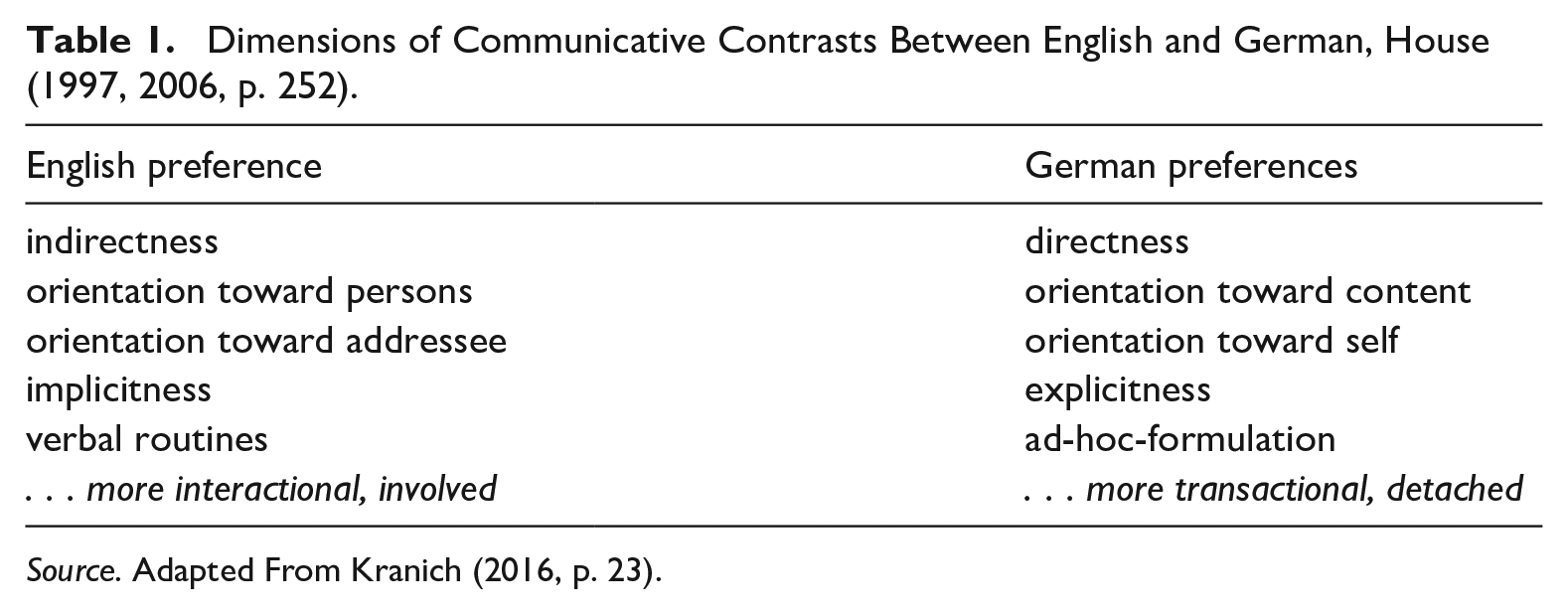
Source. Adapted From Kranich (2016, p. 23).
Using further empirical data, several scholars have conducted research to test these dimensions more or less explicitly in various domains of language use and using various methodologies. An extensive overview can be found in Kranich’s (2016) monograph (pp. 47–49). As Kranich (2016) maintains, though the studies vary widely with regards to the amount of data, the phenomena under investigation and degree of sophistication in methodology, most of them generally confirm the above communicative contrasts (p. 46). The findings of Kranich’s own study from this monograph also confirm the preferences studied to be robust on a whole.
Terminological Clarification of (Im)personalization
The dimension chosen for the present study is orientation toward persons versus content, which will hereafter be referred to as degree of (im)personalization or (im)personalization for the sake of syntactic clarity. Similar to many abstract concepts and accompanying terminology in the field of pragmatics, the terminology used to refer to this dimension is myriad: Examples of overlapping terminology include person/people-oriented versus content-oriented, relational/interpersonal versus transactional (e.g., De Clerck et al., 2019), involved versus detached (e.g., Trosborg, 1995), (inter)personal versus impersonal, and, terms which have themselves proven particularly problematic to define (cf., e.g., de Smet & Verstraete, 2006), subjective versus objective. In the literature, however, these word pairs are often used interchangeably (though Kranich, 2016, pp. 10–11 is one notable exception). In addition, the linguistic features used to analyze these dimensions vary to a great extent, diluting even more how these terms are defined and delineated. While a detailed discussion of the various terms and features is beyond the scope of the current study, it is important to define what is meant here by (im)personalization and why FPP as presently defined was chosen to operationalize this concept.
I argue that there is an important distinction to be made between, on the one hand, concepts like personal, involved, and subjective, and, on the other hand, concepts like addressee-oriented, relational, and interpersonal. The former rather relate to the self, while the latter refer to the self in relation to others (and has already been studied extensively in various [institutional] contexts, e.g., Holmes, 2000; Koester, 2006; Mullany, 2007). This study rather sets out to analyze the former idea, that is, how an individual experiences the world and manifests this experience linguistically. While the linguistic means to express personal and interpersonal meanings are, as maintained by Baumgarten (2008, p. 412), intertwined, the speakers’ linguistic manifestation of their relationship with others is not under analysis here. Thus, this study will only refer to the concepts henceforth analyzed as (im)personalization, (im)personal, as well as the dichotomies involved/detached and subjective/objective, deemed the closest alternatives in referring to the reviewer’s “cognitive position” in relation to their stay.
This specific aspect of (im)personalization, rather the “inwards-turning kind,” was chosen due to the significance the effects a more or less personalized review might have on the reader (considering the personal, experiential nature of a hotel stay) as well as what a particular construal might reveal about the cognitive experience of the reviewer themselves. The reader, for one, might be “caught” by a more personal and involved style of writing more than by a detached style; for example, the use of a more narrative style is widely known to draw in readers (cf. Vásquez, 2012, p. 119), an observation which has implications for the use of FPP, often regarded as one of the cornerstone features of narrative style (Derewianka, 1991, p. 42). On the other hand, if Germans are known to exhibit a preference for impersonalized representations, not only linguistically but also cognitively, it might follow that a more impersonal, detached review may be taken more seriously by the German reader, who may view a very personal review as overly subjective and emotional (cf. Meinl’s, 2013 discussion on perception of speech acts depending on linguaculture, p. 236).
No matter the interpretation, when viewed through a cognitive linguistic lens, the linguistic preferences of reviewers can be viewed as a window into their minds—how an experience of a hotel is coded in memory and then reproduced in written form for its most salient features.
FPP Through First-Person Pronouns and Ties to Cognitive Grammar
Functions of FPP in Complaints
This study operationalizes (im)personalization by analyzing a specific linguistic feature, namely the first-person perspective (FPP) through first-person pronouns. Functionally, pronoun usage in complaints marks personal involvement (Meinl, 2013, p. 91; see also Claridge, 2007, p. 97). Meinl (2013) argues that, while the use of the first-person pronoun in complaints can be seen as face-threatening to the reviewers’ own positive face, as they “thereby identify themselves as the complainer and thus take on the responsibility for issuing the face-threatening act” (p. 91), they can also be seen as an attack against the positive face of the complainee, that is, the company, since reviewers are in effect stressing that they had to “bear the negative effects of the complainable” (ibid.). Meinl’s specific wording coincidentally exposes a revealing perspective on language use in reviews. Referring to pronoun use in general, she writes, “. . . [T]hey may be used as a means to intensify or mitigate the facethreat of speech acts” (my emphasis, ibid.). The emphasized wording seems to indicate that, while writing reviews, reviewers consciously choose certain linguistic constructions to achieve certain rhetorical goals. While this is surely sometimes the case (the degree to which remains unknown), the current study argues that the linguistic realizations formulated by the average reviewer are rather a reflection of mainly two interplaying factors: genre conventions implicitly learned through language contact (which, while not the main focus of the current study, will be considered in the discussion of the results), and their own cognitive processes when recalling their hotel experience, which are again to a large extent linguaculturally conditioned and not necessarily known to the reviewers themselves. The next section addresses the latter.
Ties to Cognitive Grammar
With the possible exception of God, there is no such thing as a neutral, disembodied, omniscient, or uninvolved observer. (Langacker, 1999, p. 203)
According to Langacker (2008), no linguistic realization is arbitrary. Language cannot be viewed as a direct reference to the real world, but rather to a particular construal of that world (Boogaart & Reuneker, 2017, p. 188). As Langacker (2008) argues, “every symbolic structure construes its content in a certain fashion” (p. 55). The following examples of hotel reviews from the current English-language corpus show the wide variety with which a reviewer may construe their experience and how this might reflect their own conceptualizations 4 :
(+) Clean and comfortable bed good location. (−) The bathrooms need alot of TLC peeling paint, loose tiles on the floor, and the sink wasn’t working properly.
((+) The location was great so it was convenient to see the city. (−) The bed was extremely uncomfortable; I could feel the springs. It was very noisy, I could hear my neighbors and people passing by clearly.
The above reviews are comparable content-wise, displaying a focus on rather concrete, tangible elements (cleanliness, noise levels, location, etc.). In neither is there mention of people (e.g., staff or fellow guests). In example (1), the reviewer uses predominantly nouns and adjectives with modifying prepositional phrases, and impersonal or intransitive verbs. Grammaticality seems to have played a minor role in their considerations, as clauses and phrases blend together without punctuation or capitalization to indicate new points. The reviewer in example (2), in contrast, produces mostly simple independent clauses (ignoring comma splices) and includes the grammatically expected articles (e.g., “the bed” vs. “bed”). However, a closer look reveals an even more intriguing difference. In the latter, one person does make an appearance: The reviewer explicitly makes themselves a subject while recounting their experience. Langacker (1987) describes this as the conceptualizer of a given situation being “onstage,” or a part of their own conceptions. He even goes as far as to coin the term egocentric viewing arrangement, described as the following: “A conceptualizer can . . . go onstage as the profile (or focus of conception), as the speaker does in using the pronoun I . . . The onstage region (OS) expands to encompass all or part of the viewer” (ibid 1999, p. 211).
In a phrase such as “clean and comfortable bed” or even clauses such as “The bed was extremely uncomfortable,” in contrast, the conceptualizer is left “offstage” in their viewing arrangement, without an explicit conceptualizer of the bed. Constructions which omit the conceptualizer do so in a way that removes any awareness of the subject perceiving the scene, “limiting the conceptualizer’s viewing frame to the unfolding of the event itself” (Pleyer & Hartmann, 2014, p. 98). We could then argue that in recounting the hotel experience, the second reviewer construes the event in a more attached, personalized way, whereas the first reviewer stays offstage of the construal, in effect distancing themselves and placing the full focus on the external aspects under evaluation.
This is where the link to the dimension (im)personalization becomes evident. If we assume that writers are reflecting their experience of events through the linguistic constructions they produce, we might also consider that reviewers who use FPP have a more conscious conceptualization of their own selves being in the hotel and their subjective perceptions while processing the hotel experience. Those who omit FPP produce constructions which leave their selves “offstage” and thus have a more detached recollection of their experience, describing their stay as though the evaluations being made are of a factual nature rather than a very subjective one. In this way, the use of first-person pronouns is an important means by which we can judge the degree of (im)personalization, or the level of involvement or detachedness that the reviewers have in cognitively recalling and then linguistically recounting their hotel experiences.
Previous Multilingual Studies Into Negative Online Reviews and Responses
The recent surge in (linguistic) interest in negative online reviews and complaints is evident in the growing number of studies focusing on not only customers’ language use in negative reviews (e.g., Depraetere et al., 2021; Feng & Ren, 2020; Lutzky, 2021; Vásquez, 2011, 2012, 2014b) but also company responses to such complaints and reviews (De Clerck et al., 2019, Decock and Spiessens, 2017; Fuoli et al., 2021; Ho, 2017; Van Herck et al., 2022; Zhang & Vásquez, 2014), a practice often subsumed under such umbrella terms as webcare, service recovery, and customer complaint management. All these studies exhibit substantial differences in terms of the language(s) under investigation, the online platform(s) chosen, and the linguistic feature(s) analyzed. The following is a selective overview of some recent studies on negative online reviews, focusing mainly on those that take a multilingual or contrastive approach (see also Cenni, 2022, pp. 16–18 for a more comprehensive overview).
Vásquez (2011), who pioneered the study of online reviews from a linguistic perspective, used data from negative TripAdvisor reviews in English to study speech acts, (in)directness and negative evaluation, among others. She has further investigated such phenomena as narrativity features in negative TripAdvisor reviews (ibid. 2012), as well as constructions of identity (ibid. 2014). Cenni and Goethals (2017) explored multilingual contrasts in the online review genre, analyzing Dutch, Italian and English-language complaints on TripAdvisor for discursive features such as speech act distribution, politeness, evaluation, and hedging. While they found no large discrepancies among the languages, some intriguing differences did emerge in features such as more elaborate English reviews, more interpersonal evaluative comments in Italian, and fewer direct recommendations to hotel owners in Dutch reviews (ibid., p. 29). Staying focused on negative reviews among the three languages, but this time looking at company responses, Cenni and Goethals (2020) studied rhetorical moves as well as ideas from Rapport-management Theory, finding that English and Dutch strategies were similar but Italian responses took on a more confrontational and defensive style. Shifting to multilingual studies on Twitter, Decock and Depraetere (2018) used a corpus of Dutch and German complaints, developing detailed coding guidelines to measure complaint explicitness, which was also further elaborated by Depraetere et al. (2021) in a larger corpus-based analysis of French tweets written by French speakers in French and Belgian cultural contexts.
Zooming in on studies of German and English contrasts, while there is considerable research focusing on pragmatic differences, very little has been done in the field of online reviews. Meinl (2013) and Van Herck et al. (2021) are to my knowledge the only studies comparing English and German pragmatic differences in complaints and complaint management. Van Herck et al. (ibid., p. 204) focused on service recovery, that is, business email responses to complaints, investigating singular and plural first-person pronoun use as a measure of person and content orientation. The use of FPP in corporate responses, however, serves a different function than it does in the complaints themselves; indeed, the authors relate the use of these constructions to their representation of individual service agents or rather a larger corporate identity. Meinl (2013), on the other hand, focused on complaints on eBay, investigating a host of linguistic features including complaint strategies, various sentence modifiers, so-called “CMC” features like emoticons and capitalization, and, very pertinent to the present study, pronouns, including first-person pronouns. The results of her study show that British English complaints contain a higher number of pronouns than do German complaints. She attributes this difference to a higher degree of “personal involvement” (ibid., p. 114). My study can thus be considered to build on these first results, shifting from reviews of search goods to reviews of experience goods. Further, while Meinl’s (2013) study provides an initial analysis of FPP in German and English, it is only a small part of a much larger study and does not relate these results to their location or function in the complaint, nor tie in any potential cognitive implications. It further does not explain whether, and if so, features such as elided pronouns were coded in the analysis. It is thus apparent that there is a great need for more in-depth studies comparing German and English in the online review context.
Study Setup
Dataset
The small comparable corpora used for this study comprise reviews on the travel website Booking.com. These reviews are part of a larger corpus which was acquired through a Data Transfer Agreement with the French company Idixit SAS, whose subsidiary Hotelspeaker provides responses to online hotel reviews using a combination of AI and editors. The larger corpus spans a period of 3 years (2018–2021) and comprises over 370,000 hotel reviews from various platforms in over 20 languages. The corpus also includes valuable metainformation including a normalized review rating, the hotel name, user location (limited to country, state, or city), and language used, including many varieties (e.g., British English, Australian English, Swiss German, and Austrian German).
In order to effectively analyze a tertium comparationis, two small sub-corpora were collected which exhibit the following features:
German and English-language reviews left on the same platform (in this case Booking.com), ensuring that the structure and restrictions of the reviews are parallel in nature. Booking.com is unique to sites like TripAdvisor in that there is already a pre-given structure for writing reviews. Reviewers are provided with three fields, all of which are optional: one for positives signaled with a smiley emoji, one for negatives signaled with a negative emoji, and one for a short summary of the stay (the Title). In a study comparing the effects the allowances of Booking.com and TripAdvisor had on the linguistic manifestations in reviews, Ruytenbeek et al. (2021) showed that this pre-determined structure reduced complaint explicitness as well as degree of narrativity in reviews on Booking.com as compared to TripAdvisor reviews. 5
Reviews by users whose location was clearly within Germany and the UK, as a type of assurance that the reviewers speak the language either natively or near-natively (due to various degrees of written literacy of typical reviewers). The current study chose British English as used in the UK and Standard German as used in Germany, as these were also the major linguacultures investigated by House (2006) and Kranich (2016).
Reviews by users with locations in Germany/UK whose hotel stay also occurred in the same country (e.g., the Germany-based users all stayed in German hotels, and the UK-based users all stayed in UK hotels)
Using the relative rating scale, and following similar studies’ classifications (cf. Ruytenbeek et al., 2021, p. 293), reviews with ratings that were scored 50 or lower out of 100 points were considered negative
Enough reviews for a quantitative analysis in line with previous research (cf. the datasets used in Cenni, 2022 and Meinl, 2013) yet small enough to conduct an in-depth manual analysis and make some qualitative observations. Thus, after the corpus was narrowed down to contain the above features, it was further reduced to 160 reviews for each language by taking a random sample.
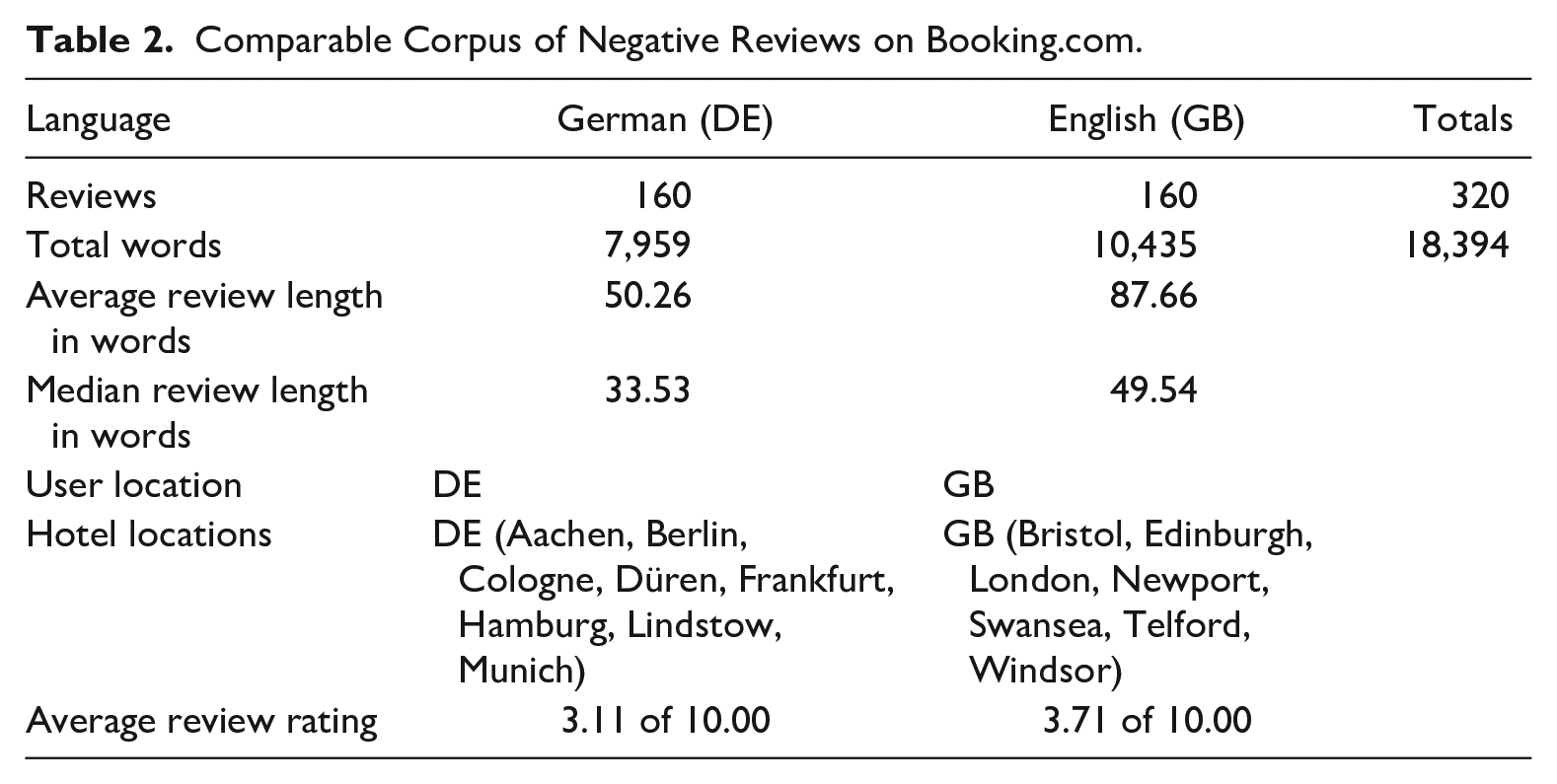
Table 2 summarizes some metadata about the resulting comparable corpora. As can be seen As can be seen above, the average English review length was over 35 words longer than the average German review length, with the median lengths also differing by 16 words. This result already seems to challenge one communicative preference put forth by House (2006, p. 251), that of the German speaker being more verbose.
Comparable Corpus of Negative Reviews on Booking.com.
Idixit SAS has granted selected researchers at Ghent University written permission to use this dataset, which is safely stored on university servers, and does not include sensitive information. To protect review writers’ privacy, the dataset does not contain any identifying information. In this publication, no other personal information is presented. Only linguistic realizations of reviews are shown.
Research Questions and the Tertium Comparationis
I formulate the following broad research questions, which will then be operationalized into specific, testable hypotheses presented in section 3.4.
Do German and English reviewers write reviews with different degrees of (im)personalization?
In which review components does (im)personalization occur and does this differ from German to English?
To study the phenomenon of (im)personalization systemically across both languages, the current study takes as its tertium comparationis the inclusion of FPP through the use of first-person pronouns in either subject (in German, nominative) or object (in German, dative or accusative) position of a complete clause. This section establishes the typological comparability of the concepts of first-person pronoun in subject and object positioning in both languages, to show its suitability as a tertium comparationis.
It can be said that in general, the concepts of subject and object, on the one hand, as well as nominative, accusative and dative, on the other, are functionally analogous in German and English, with the most obvious and commonly observed differences being noted in their degree of syntactical freedom and the greater differentiation of case markings with the German dative and accusative cases (Hawkins, 1986, p. 39). It is generally accepted that the loss of case distinctions in the English language made it more reliant on the linear order of SVO to understand the grammatical relations of the sentence participants (König & Gast, 2018, p. 130). As will be explained below in the methodology section, all instances of first-person pronouns in subject and object position were counted equally as instances of (im)personalization, regardless of their case markings or syntactical positions. For example, both “I (nominative case) was cold” and “mich (accusative case) friert” or “I (nominative case) liked it” versus “mir (dative case) gefällt es” were coded instances of FPP, even though English allows for the experiencer to be in subject position, whereas German allows it in object (in this case accusative and dative, respectively) position. 6
Methodology: Corpus Annotation
Coding of Instances of FPP
The method chosen for coding instances of first-person pronoun use was straightforward, with a few exceptions. The 320 reviews were read several times and all instances of nominative first-person pronouns, either in the subjective or objective case, were identified and counted. This included the following pronouns: I, ich, we, wir, me, mich, mir, us, uns. 7 Each review was first coded in a yes or no fashion as to whether it included any instances of FPP. Then, the number of tokens of FPP within the review was counted, as well as the overall number of words in each review. This ratio (the number of instances of first-person pronouns within a review over review length) was used to calculate the review’s so-called FPP saturation,with a higher instance-to-word-length ratio resulting in higher FPP saturation (examples in Table 3).
Coding of FPP and Related Phenomena.
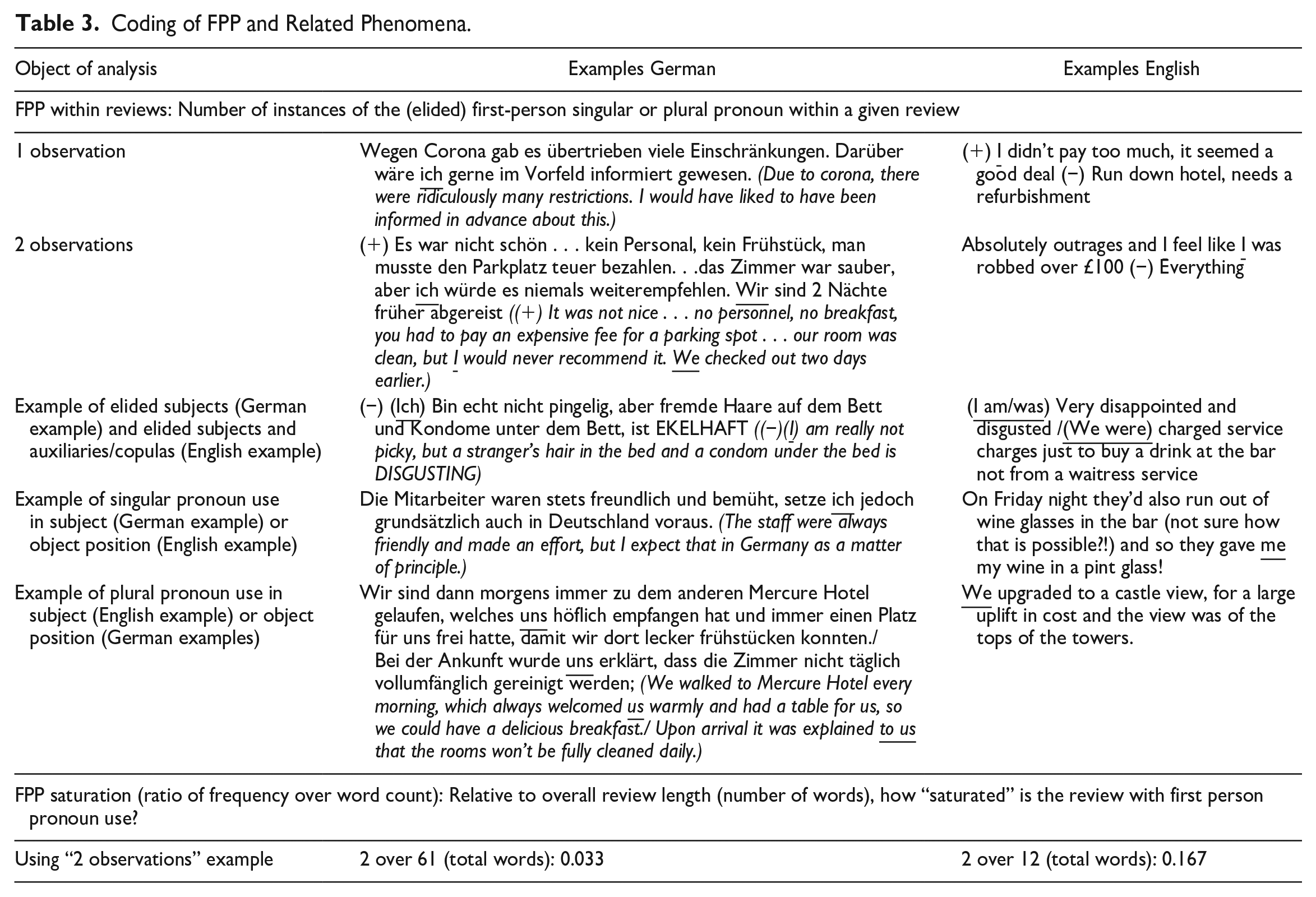
FPP saturation was measured for two reasons: First, it is an effective way of taking review length into account in the analysis. If, for example, a reviewer writes a 400-word review but only includes one instance of FPP, this can be interpreted as less personalized than if that reviewer only chose to write 30 words, for example. Second, the degree of review (im)personalization can be measured from two perspectives: 1. More personalization occurs in a given linguaculture when more reviews contain (any) instances of personalization (all or nothing principle); 2. Even if one language contains more personalization across reviews, the frequency of personalization within reviews is rather a better indicator of overall personalization, as the other language may contain fewer reviews with personalization but more frequent personalization in those reviews that do contain it. As both perspectives shed light on the linguistic and cognitive behaviors of reviewers in the respective linguacultures, both were measured in this study.
Cases in which
If we are to subscribe to the view that linguistic expressions reflect cognitive processes, then subject elision may be relevant to a cognitive linguistic interpretation of the results. More than a mere reflection of genre or register, it may signal a strengthened or lessened personalization of the speaker, in the sense that the speaker does (not) explicitly construe themselves in their conception of their experiences. Looking at subject elision in English from a pragmatic perspective, Nariyama (2004) analyzed sentence pairs with and without subject elision, such as “(I) dunno” versus “I don’t know,” arguing that the “subjectless” versions “imply casualness both in register and content” (p. 248). He uses the example that subjectless sentences like the example provided are unlikely to be used in a situation in which a person has lost their job and must respond to the question “What happened?” (p. 247). Providing a link to the cognitive dimension, I argue that this casualness can also be regarded as signal of emotional detachment, and can thus also be considered less personalized than subject-included constructions.
The subject elision that occurs in the corpora, namely the dropping of the first-person pronoun in verb-second (V2) sentences in which it can be linguistically or contextually derived, is uniform. Referred to as diary drop and deriving its name from its frequent appearance in personal diaries (Haegeman, 1990), it has spread to various informal online contexts (Scott, 2010). Diary dropping is possible in English and German (Haegeman, 2007), but as there are no known direct comparisons of the frequency or distribution of this feature, no predictions were made as to the frequency with which it will occur in both languages. 9
Further, first person pronouns in both the
Table 3 provides examples of the major aspects of the above coding.
Coding of Review Components
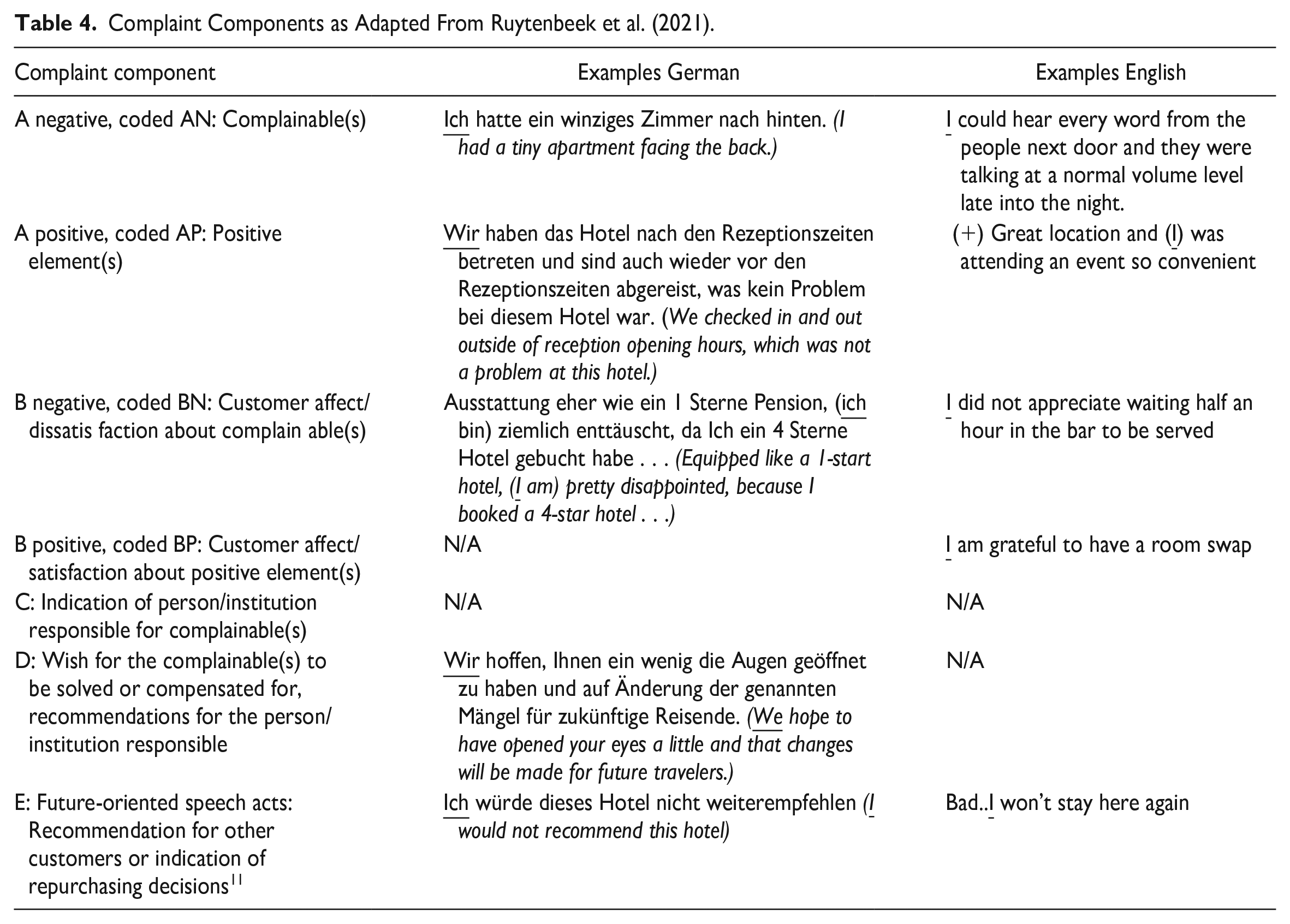
To acquire a more nuanced look at the phenomenon of FPP and its realization in negative online reviews in German and English, this study compares not only whether FPP occurs in the reviews but also its distribution among various review components. To analyze this, Ruytenbeek et al.’s (2021) classification of different components in negative reviews was used. This classification finds its roots in research on complaint structures by House and Kasper (1981) and Trosborg (1995) and was further developed for studies on complaint explicitness on Twitter by Decock and Depraetere (2018) and Depraetere et al. (2020). Ruytenbeek et al. (2021) extended the classification to be used on negative reviews. It is fitting for many reasons: it includes components signifying not only negative but positive information, as even clearly negative reviews sometimes include positive information (cf. Vásquez, 2011, p. 1714). Furthermore, the components make the important distinction between expressions of negative or positive information in reviews, that is, the act of complaining or praising, and expressions of negative or positive affect in relation to complaints or praise. This distinction is considered important to analyzing personalization, since expressions of affect, in which a reviewer expresses an internal mood state or emotion, are considered highly personalized, in comparison to, for example, the mere explaining of events as they occurred mainly through so-called material processes, which focus on outward actions taking place in the material world relating to “doing” and “happening” (Butt et al., 1994, p. 51). This method of coding was thus also considered more fine-grained and insightful than a distribution analysis of FPP occurrences in the pre-given sections in Booking.com (positives, negatives, title).
Table 4 summarizes of each instance of FPP was coded as occurring in one of the following complaint components.
Review Components as Adapted From Ruytenbeek et al. (2021).
The data went through several rounds of manual coding. While the coding process for complaint components was also relatively straightforward, there were some cases in which two components were realized within the same clause or sentence in which FPP was identified. In such cases, a decision was made as to which component the first-person element referred to most clearly, as will be illustrated in the following examples:
(3) Bin echt nicht pingelig, aber fremde Haare auf dem Bett und Kondome unter dem Bett, ist EKELHAFT (Really not that picky, but finding a stranger’s hair in the bed and a condom under the bed is DISGUSTING).
(4) Will not be returning!!!!
Example (3) was coded as B negative, as FPP was considered to be attached to the predicate of the main clause, that is, the sentiment of disgust, with the complainable itself being embedded in the middle. Hence, the “disgusted” affect despite a lack of “pickiness” (B negative) is considered a result of finding the hair and the condom (A negative). Example (4) was coded as E (future-oriented speech acts); even though the use of four exclamation points is a clear paraverbal indication of negative affect (cf. Depraetere et al., 2021), the use of FPP pertains most clearly to the statement regarding future actions (or lack thereof). The negative sentiment is seen rather as an added effect to the repurchasing decision which is clearly expressed via FPP. Unclear cases were also discussed and confirmed with a fellow linguist at my university.
Further, it should be noted that A negative included not only explicit complaints but also clauses that provided background information leading up to complaints, as well as clauses explaining the consequences of the complaint. Coding these separately was not pertinent to the overall research question, as all were considered a form of (mostly material) narration revolving around the complaint itself.
Example of FPP in background information providing context for the complainable:
(5) Es wurde uns angeblich ein Upgrade angeboten, was hieß, dass wir bis in den 4. Stock zwar mit dem Aufzug fahren mussten, aber dann noch ein Stockwerk hoch laufen mussten. Mein Mann ist gehbehindert,
Example of FPP expressing consequences of the complainable:
(6) Generell erinnern die Zimmer an eine winzige Zelle .
It is important to note that this analysis only identifies the complaint components as they occur with FPP and not as they occur in the reviews overall, which would go beyond the scope of this study. However, because some interesting insights can be gained by comparing components realized with FPP to their overall occurrences, when a statistically significant difference in components realized in FPP did occur between the German and English corpora, the corpora were then once more analyzed to compare the overall occurrences of these components.
Hypotheses
Due to the dimension of content versus person-orientation as well as the initial results of Meinl’s (2013) study presented above, I formulate my hypotheses as follows:
H1: There are significantly more English reviews than German reviews that contain FPP.
H2: English reviews are also significantly more saturated with FPP than German reviews are.
H3: FPP occurs in B positive and B negative more frequently in English reviews than in German reviews, as English speakers use FPP more to express affect.
H1 and H3 will be tested with Chi-square with Yates correction, while H2 will be tested with an unpaired two-sample Wilcoxon test on the assumption of non-normal data.
While no a priori hypotheses were formulated about the frequency of FPP features such as subject elision, grammatical number, and grammatical case, as well as the remaining components realized in FPP, a similar methodology to, for example, Cenni and Goethals (2017) was undertaken to compare these features for similarities and differences in use among the two linguacultures. Thus chi square tests with Yates correction were also performed as a form of exploratory hypothesis testing.
Results
Descriptive and Inferential Statistics for FPP
Table 5 contains descriptive statistics on the use of FPP in the German and English corpora. It also presents the average review lengths of the corpora in reviews with and without FPP. As in all the tables illustrating results, significant differences (p < .05) are highlighted using bold font, with the higher frequency in bold.
Table 5 shows that while German-speaking reviewers used FPP in fewer than half of the total reviews at 46.875%, English-speaking reviewers used it in almost two-thirds of the reviews at 65.21%. This difference was significant (p = .002), thus confirming H1 that significantly more English reviews contained FPP.
Descriptive and Inferential Statistics Regarding FPP.
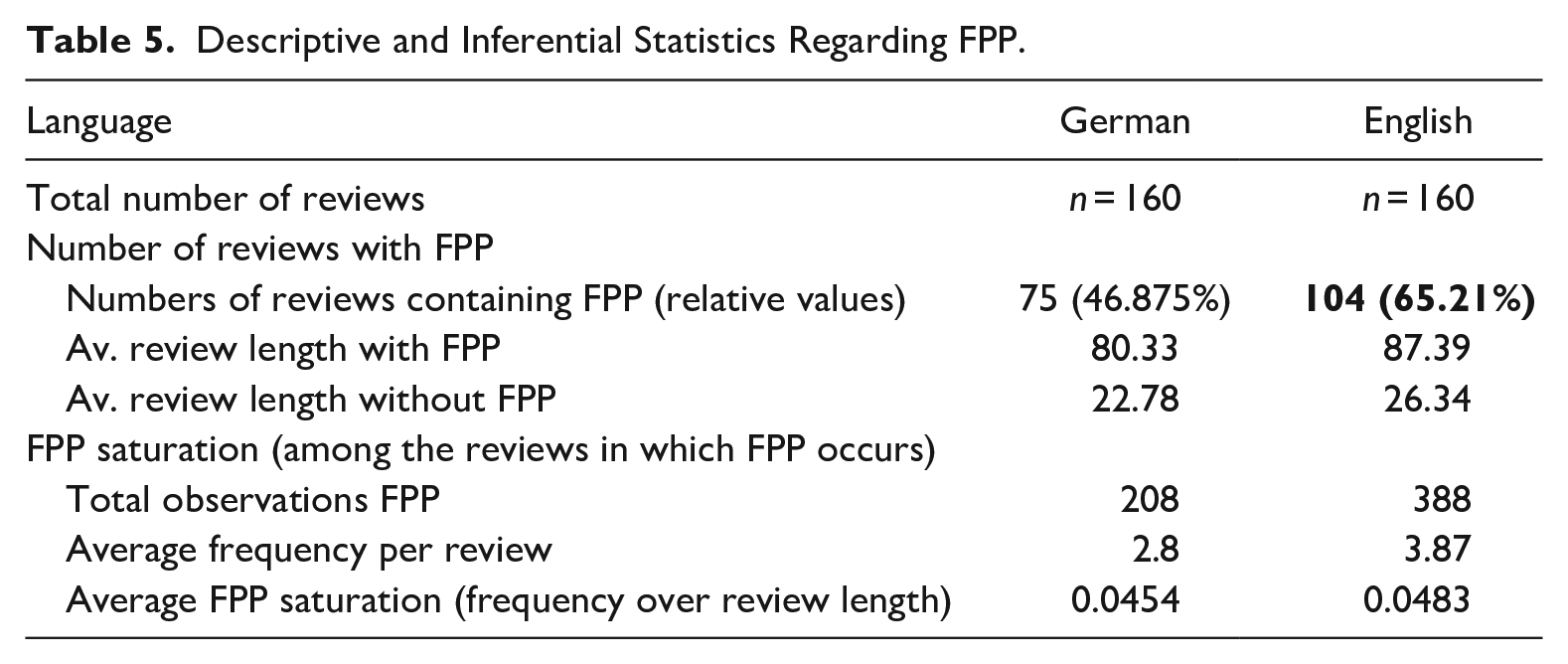
The average review lengths, for which English reviews were 27.4 words longer than German reviews, become even more striking when the reviews that contain FPP and those which do not are compared. Here, a significant difference in average review lengths within languages was identified—both fall from average review lengths in the 80s down to lengths in the 20s, indicating that reviewers in both languages who used FPP also tended to write longer reviews. 12 Analogous to review length averages overall, English-speaking reviewers tended to produce slightly longer texts; in the case of reviews with FPP, an average of seven words longer than their German counterparts.
In terms of overall observations of FPP, the 75 German reviews containing FPP contained 208 observations, whereas the 104 English reviews containing FPP contained 388 observations. For a more direct comparison, the average frequency of FPP per review was measured, which was found to be 2.8 times in German and 3.87 times in English. Thus, among the reviewers who did use FPP, English speakers used FPP about one more time on average.
However, there was a much less striking difference in FPP saturation, which can be explained by the longer English review lengths. The FPP saturation of German reviews was 0.0454, while English FPP saturation was 0.0483. A Wilcoxon rank-sum test showed no significant difference (p = .102), leading to a rejection of H2 that English reviews would also be more saturated with FPP. Instead, it appears that German-speaking reviewers, when they do use FPP, tend to use it about as often as English-speaking reviewers do.
The frequencies concerning grammatical number, subject elision and grammatical case are illustrated in Table 6. These frequencies were compared between languages and significant differences (p < .05) are again highlighted using bold font, with the higher frequency in bold.
Distribution of Grammatical Number, Subject Elision, and Location of FPP.
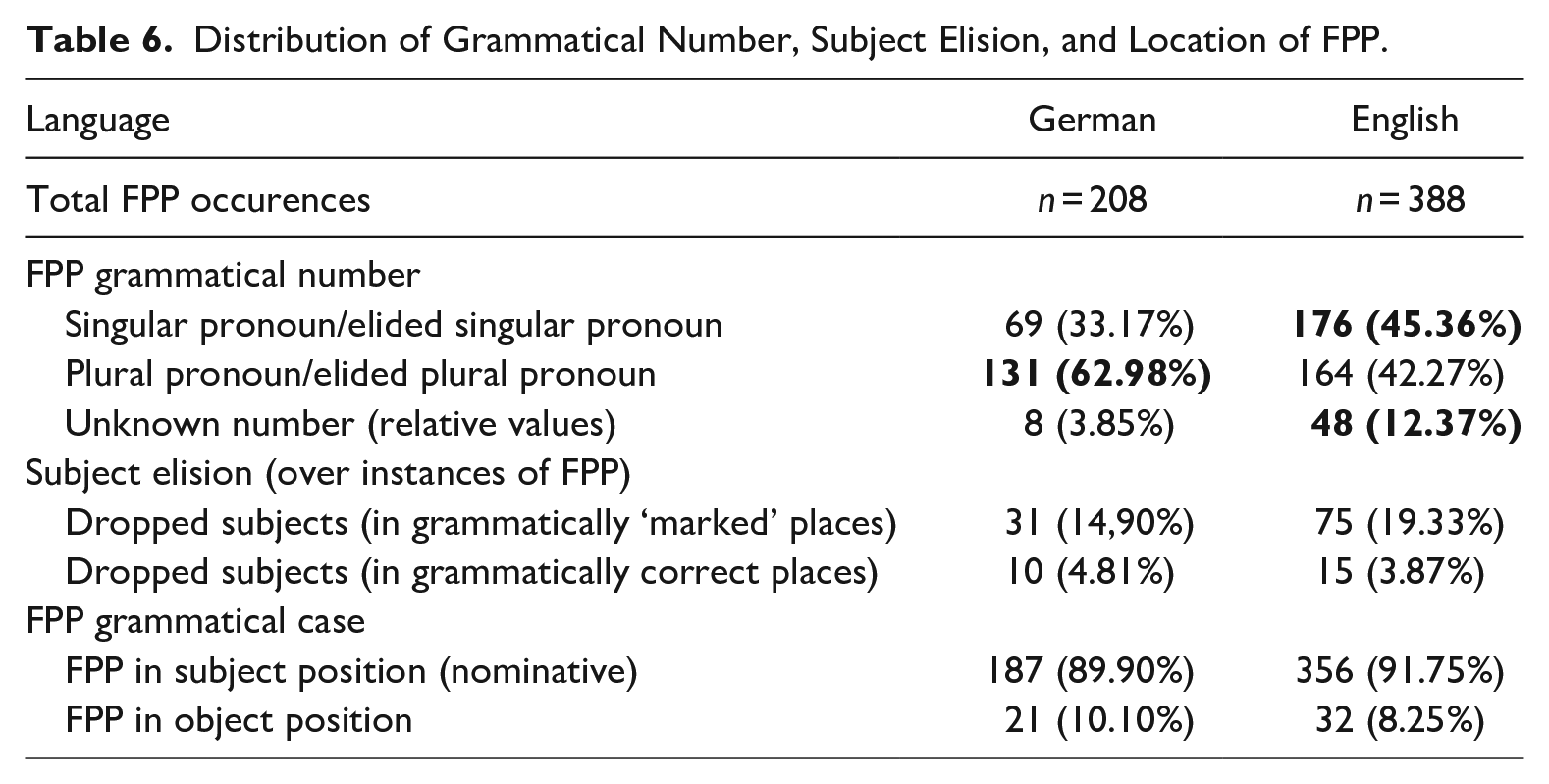
Table 6 shows that the singular pronoun is used significantly more in English (p = .005), whereas the plural pronoun is used significantly more in German (p = .00001). However, the number of unknown cases was also significantly higher in English with 12.37% (p = .001).
With regards to subject and subject + auxiliary/copula elision, while English-speaking reviewers elided subjects more than German-speaking reviewers, this result was not statistically significant (p = .217).
The results pertaining to grammatical case were strikingly similar between languages, as only 10.10% of German FPP observations and 8.25% of English FPP observations were in the objective case. This means that overwhelmingly, first-person perspective is used in subject position, with the distributions in German and English not differing significantly (p = .54).
Descriptive and Inferential Statistics for FPP in Review Components
Table 7 displays the absolute and relative values of FPP occurring across the various complaint components. 13 Significant differences (p < .05) between the two languages are again highlighted using bold font, with the higher frequency in bold.
FPP Distribution in Complaint Components.
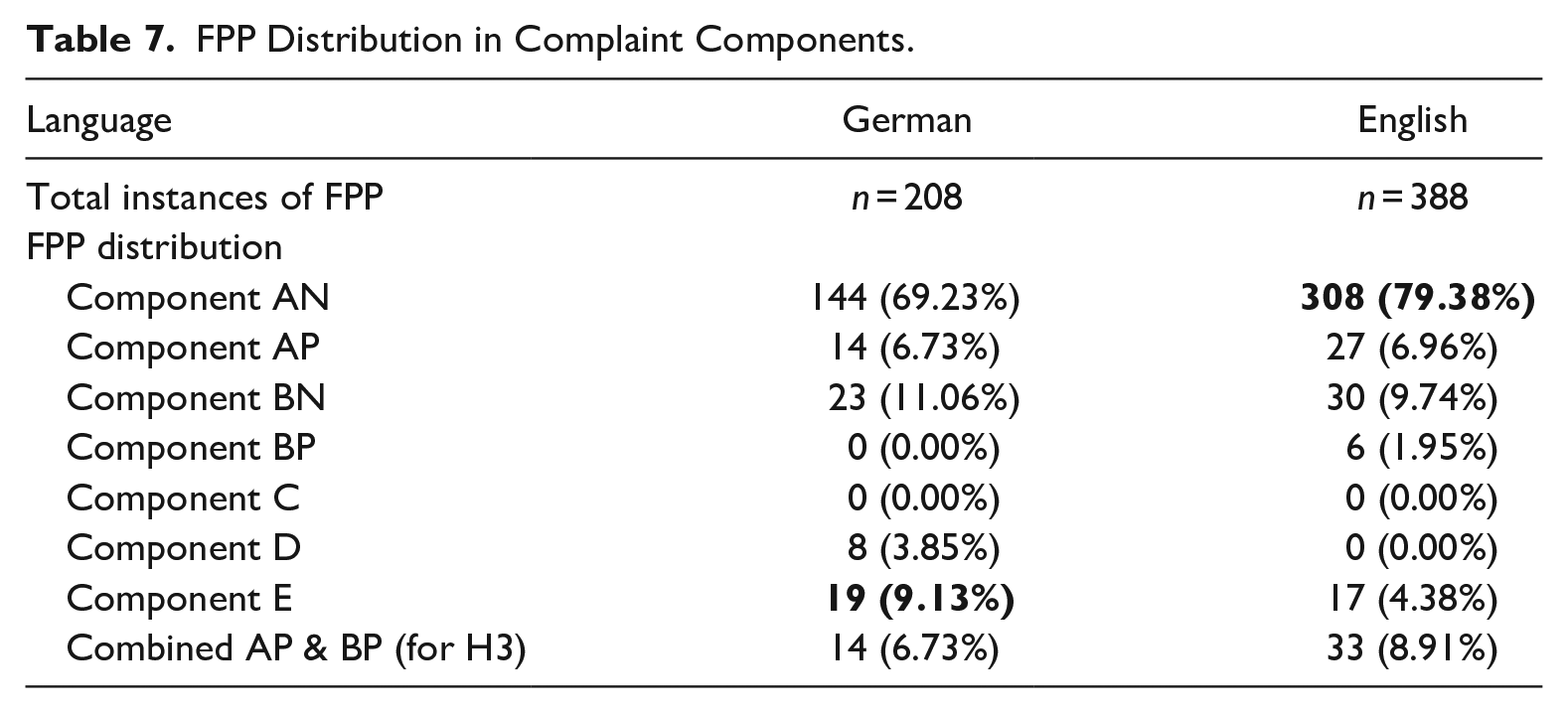
As can be seen above, frequencies of FPP were only significantly different in two components (AN and E). The results of each component will be broken down in the following.
Component AN
Table 7 clearly shows that in both languages, the vast majority of FPP observations occurred while reviewers were realizing component AN. Further supporting the “negative sway” FPP had in both corpora is the fact that the vast majority of FPP observations were found in Booking.com’s “negatives” section of the reviews (respectively for German and English, 70.67 and 62.50% of all FPP instances occurred in the negatives section).
Complainables with FPP often referred directly to unmet expectations, which could be easily identified in the distinctive sentence structures used. The translations below are syntactically parallel but not grammatically standard in English, to provide a sense of the structures:
(7) Apartment gebucht und einen versifften, heruntergekommenen Bungalow bekommen; (Apartment was booked and a filthy, run-down bungalow was received.)
(8) Gebucht war ein Deluxe Doppelzimmer mit Stadtblick usw. Bekommen haben wir ein winziges Zimmer mit Blick in einen Lichtschacht. (Booked was a deluxe double room with a city view, etc. Received was a tiny room with a view of a light well.)
These parallel structures were common in the German corpus. Example (8) is especially interesting in its structure as the reviewer uses a V1 structure to mark the contrast of what was expected and what actually happened. English reviewers tended to have a more straightforward and less eloquent approach to stating their unmet expectations:
(9) (−) The room is really small and the it’s so different from the pictures we saw on the website)
(10) the room I booked online was not a true representation of what we were given.
Despite the high(est) percentage attributable to AN, there is still a remarkable difference between English and German, in that AN with FPP occurred more than ten percentage points more frequently in the English corpus (79.38% of all FPP observations) than in the German one (69.23% of all FPP observations). This difference was also found to be significant (p = .008).
Due to this significant result, the entire corpora were again analyzed with regards to the occurrence of AN overall (see Table 8).
Distribution of Component AN.
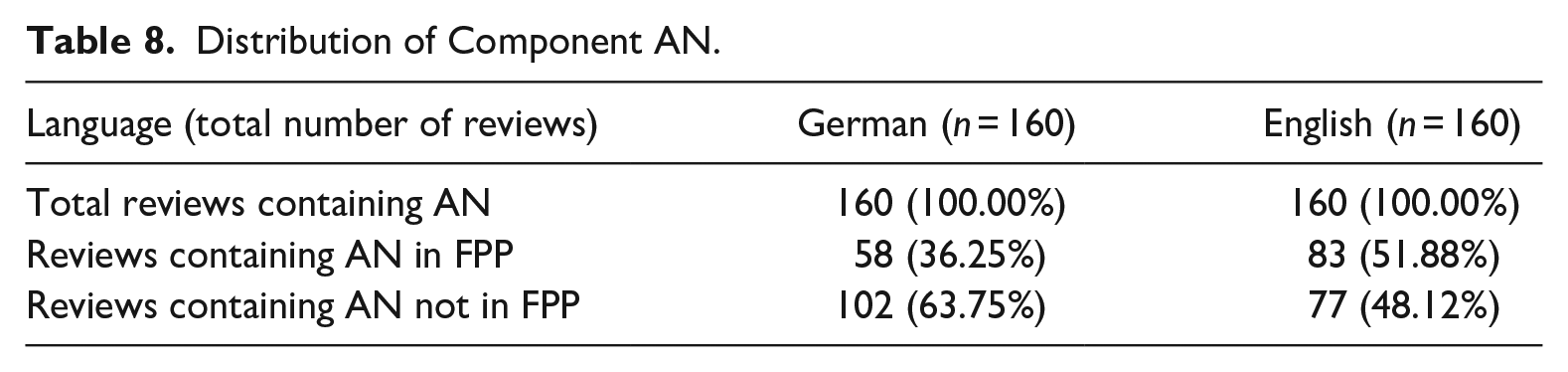
As expected, all reviews in both corpora contained some form of AN, 14 showing that in both linguacultures, including the complainable in some form is typical (if not necessary) of the genre. The overall results thus show that while German and English-speaking reviewers all include the complainable, English reviewers indeed tend to do so using a more personalized style, due to the overall larger number of AN with FPP that was found in the English corpus.
Component AP
AP with FPP was identified in only 6.73% observations in German and 6.96% in English, which was not significantly different (p = .948). When AP with FPP did occur, it sometimes was also used to refer to positive past experiences with the hotel, which then set the stage for the complainable and the ensuing disappointment (the more complete story arc of “unmet expectations”):
(11) Wir kommen seit ca. 10 Jahren immer wieder ins Berlin Berlin Hotel (Component AP). Wir waren diesmal extrem enttäuscht (Component BN), dass es beim Frühstück keinerlei Service mehr gab (Component AN—without FPP). (We’ve been coming to Berlin Berlin Hotel for ten years now (Component AP). We were extremely disappointed this time (Component BN) that there was no service during breakfast anymore (Component AN—without FPP).)
Component BN
Compared to the complainable itself, negative sentiment (BN) with FPP occurred relatively seldom in both corpora. With 11.06% in German and 9.74% in English, this difference was not found to be significant (p = .227), affecting the outcome of H3 presented below. When BN did occur with FPP, it mostly took the form of common complaint strategies referring to disappointment, anger, frustration, and the various synonyms, often with dropped pronouns and copulas. For example, of the eleven instances in which English-speaking reviewers referred to themselves as disappointed, only two explicitly included the personal pronoun “I.” In German with regards to “enttäuscht (disappointed),” in contrast, three of the five examples included the person pronoun “ich” or “wir.”
Component BP
Positive sentiment (BP) with FPP did not occur at all in the German corpus; in the English one, it occurred only 6 times, making it a generally rare occurrence.
Regarding H3, while the English reviews did contain more FPP in the affect-related components BP and BN than the German reviews did (6.73 vs. 8.91%, respectively), this result was not statistically significant (p = .073). Thus, H3 must be rejected, as English reviews did not contain more affect with FPP than German reviews did.
Component C
Component C was not identified in any use of FPP in either German or English. The nature of the component, that of placing blame on the hotel or hotel staff, makes it generally unlikely that FPP would be used in such instances.
Component D
Component D also appears to be a rather uncommon occurrence with FPP, with only eight German observations (half of which occurred in a single review) and 0 English observations identified. Similar to component C, the focus of attention in such components is rather on the hotel or staff, not the reviewer, so it is not very surprising that the identified instances of FPP were rarely found here. When they did occur in German, it was mostly to express wishes or recommendations to the hotel.
Component E
The last component, related to future-oriented speech acts such as recommendations and repurchasing decisions, showed a striking difference. FPP was found in component E more than twice as much in German, a significant result (p = .032).
Due to this result, a further analysis was undertaken in both corpora to identify all reviews containing E in any form. The results are depicted in the Table 9:
Distribution of Component E.
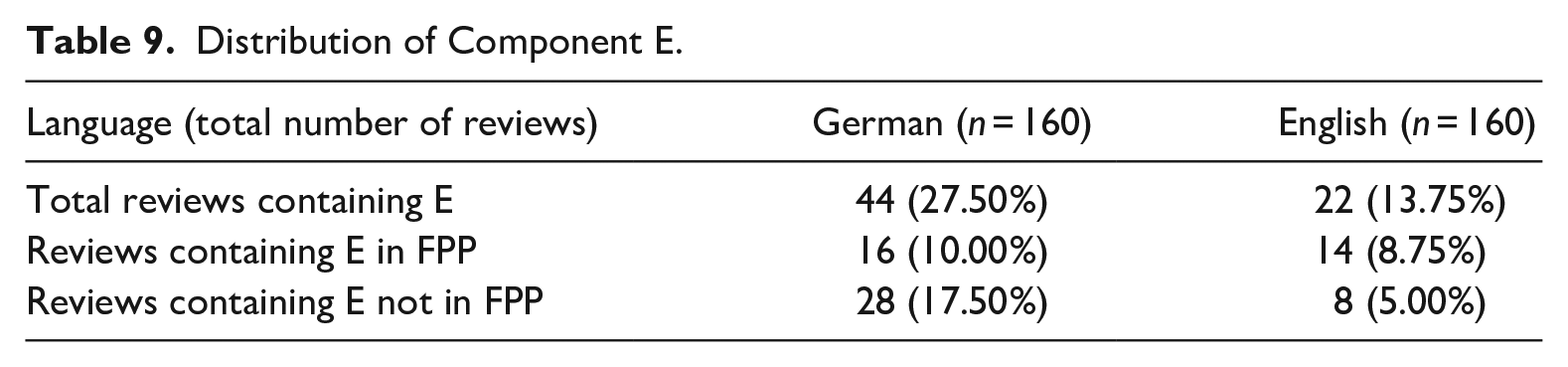
Table 9 reveals that E was identified in twice as many German reviews as English ones (27.50 vs. 13.75% of all reviews). While E in all forms is more frequent in the German corpus, only a little over one-third of German-speaking reviewers who included component E did so using FPP (16 of 44), while in English, almost two-thirds of reviewers who included component E used FPP in doing so (14 of 22). This difference was, however, not found to be significant (p = .066).
The most common German alternatives to FPP were “nie wieder (never again)” (14 observations) and “nicht zu empfehlen (not to be recommended)” (16 observations), whose English equivalents occurred only one time and zero times, respectively.
Discussion and Conclusion
Summary and Discussion
The current section will address the original research questions in light of the results presented in the previous section.
Do German and English Reviewers Write Reviews With Different Degrees of (Im)personalization?
This question has a multifaceted answer. When viewed in terms of a boolean “yes or no” regarding the occurrence of FPP across reviews, it can be said that English-speaking reviewers write more personalized reviews, confirming H1 and thus House’s dimension that English speakers communicate in a more “person-oriented” way than German speakers do. Over half of German reviewers included no FPP. In leaving themselves “offstage,” they instead focus on their “objective” appraisals of the hotel stay. From a cognitive perspective, then, German speakers seem to have a more detached construal of their experiences.
However, no difference could be identified between German and English in terms of FPP saturation, a rejection of H2 and evidence that some reviewers do construe their hotel stays with similar degrees of personalization across languages. This result may be best explained by looking at the “situatedness” of this very global genre (cf. Connor et al., 2008, p. 5). Due to globalization, hotel review styles may have increasingly less to do with linguacultural difference and more to do with an ever more similar, “international” review genre. Cenni and Goethals (2017) also attribute the similarities they found in English, Italian, and Dutch negative online reviews to an emerging homogenic review genre with rather cross-linguistic characteristics (p. 30). I further argue that English as lingua franca can be expected to have the greatest influence on (globalized) genre norms in other languages, as it can be assumed that English reviews are the most widely understood and read worldwide. To explain the results of FPP saturation, for example, we can imagine the German reviewer, who, after having read several English-language reviews (and having been exposed to possibly thousands of English-language reviews over their lifetime), proceeds to writing their own review in German, (subconsciously) being influenced by the English textual norms and thus producing more personalized reviews with more FPP. English-language reviews might thus have an impact on some German-speakers’ review writing, simply through their contact with English reviews in a multilingual environment (cf. Kranich, 2009, p. 27). Nonetheless, the results of this study cannot completely confirm this idea, as in any case, the results of H1 still confirm a robust linguacultural contrast among speakers.
The multifarious nature of personalization and its cognitive implications are further illustrated by the exact linguistic forms in which FPP was manifested, such as the frequent occurrence of subject elision and first-person plural pronoun usage in both corpora. Subject elision, for one, occurred commonly in both languages. 15 While this is certainly at least partly due to the online format having more informal, casual style (cf. Haegeman & Ihsane, 1999), it may also signal a more detached and distanced construal on the part of the reviewer. Moreover, the first-person plural pronoun, which was used significantly more in German reviews but occurred in both languages, while usually explained through a collectivistic versus individualistic lens, can also be seen to serve a depersonalizing function, generalizing the construal of individual experiences to a larger group. Both features, including their exact distribution and further interplaying factors, are deserving of more attention in research on construal in hotel reviews and differences linguaculturally.
On a whole, the above results regarding FPP frequency, as well as the specific forms of FPP identified, point to the interesting interplay between linguacultures, genre, and cognitive construal of experience. If globalization is leading to more personalized language, as the results of H2 might indicate, we might even argue that the (subconscious) learning of these textual norms through language contact is thus also influencing how reviewers construe their experiences, making them construe the world in a more personalized way. Informality features in online formats like subject elision may likewise be in some way depersonalizing the construal of certain experiences.
In Which Part of the Reviews Does This (Im)personalization Occur and Does This Differ From German to English?
To answer this question, the components adapted by Ruytenbeek et al. (2021) were used, for which each instance of FPP was coded for the component in which it was contained. The results showed a clear tendency of reviewers in both languages to use AN with FPP, the “complainable.” As a hotel experience takes place chronologically, reviews of hotels often take the form of a narrative, telling a (part of the) story of the reviewer’s stay (cf. Vásquez, 2012). The complainable is often the main “complicating action” of the stories, which is often expressed from a first-person, simple past-tense perspective. The fact that FPP overwhelmingly occurred in AN is thus not surprising. It is, however, notable that narrative structures generally occurred so frequently in the corpora (on the basis of AN, 144 times in 74 German reviews, and 308 times in 103 English reviews). Though they considered other features of narrativity besides FPP in their analysis, Ruytenbeek et al. (2021) also found that Booking.com contained fewer features of narrativity than Tripadvisor, due to its restricted structure. We might even surmise that reviewers, when using a site with less restrictions like TripAdvisor, would have thus used more narrativity features in their reviews. 16 Nevertheless, AN with FPP was used more in English than it was in German, in terms of both distribution among FPP across all components and relative frequencies over total word counts. This signals that while reviewers both linguacultures used narrative structures quite frequently, English reviewers used them more, telling longer stories to construe negative experiences.
The result concerning AP, which occurred infrequently in both corpora, is not surprising. In writing a negative review, the reviewer tends to be focused on the negative aspects and thus tends to summarize positive aspects with short phrases, then moving on to the negative aspects in a more detailed manner. This result provides further support for the idea that negative events are more salient in the minds of reviewers—the lack of FPP and thus relative detachment from the positive aspects of their stay signal an “overriding” of more detailed conceptualization of the positives in favor of the negative aspects, which are then encoded in a more attached manner.
At first glance, the relatively seldom occurrence of FPPs taking place in BN is unexpected, as negative affect is clearly a personal phenomenon that readily takes on a FPP form. The explanation for this occurring quite infrequently in both corpora might arguably be found in the structure of Booking.com, as the symbols (+) and (−) already indicate an evaluation of that which comes after them, rendering this “extra sentiment” using full clauses with FPP unnecessary. The same can be argued for the very seldom occurrence of FPP in BP in both corpora, raising the question if a similar distribution would be observed on other platforms that do not provide a pre-given evaluation.
Reviews in both languages showed a similar frequency of FPP in BP and BN, rejecting H3 that the “more attached” English speakers would use these more. This surprising result might also shed light on a more fine-grained distinction of personalization—while English reviewers wrote more personalized reviews by relaying their experiences more using FPP, they did not express their personal emotions more using FPP; indeed, German and English reviews seemed to relay their emotional experiences similarly in this way. An analysis and comparison of these components as realized by all features would help complete the picture of how emotional experiences are construed in negative online reviews in both linguacultures.
Where the two languages differed in FPP distribution, however, was in component E, which refers to repurchasing decisions and recommendations. Relatively speaking, German-speaking reviewers used these with FPP almost twice as much as English-speaking reviewers, and generally included this component in their reviews more often. Both recommendations and repurchasing decisions carry with them a real-life, financial consequence for the hotels, as the former is essentially a threat never to return, and the latter is an attempt to sway others to book elsewhere. The higher use of component E may be best explained through the lens of another of House’s (2006) dimensions of German-English communicative contrasts, namely directness. As is the case in the complaint context, both negative repurchasing decisions and negative recommendations are considered indications of greater directness (cf. House & Kasper, 1981) and German speakers are generally more direct as according to House (2006, p. 255; cf. also House & Kasper, 1981). This tendency may therefore rather account for the higher number of German reviews containing E on a whole. Regardless of the correct interpretation, the fact that, relatively speaking, fewer German reviewers who included component E did so using FPP than was the case for English reviewers also shows that the significant result seems to be an effect of this component occurring more overall than it is a reflection of greater personalization within this component in German.
Implications for Hotel Webcare Strategy
In terms of webcare strategy, the answers to the first research question may provide an indication to hotels as to the preferences of German-speaking versus English-speaking guests (and hence) reviewers—the more “detached” German-speaking reviewer may prefer a more “detached” response, and a more “personal” English-speaking reviewer probably a more “personal” one. However, the results were not so straightforward and thus a boilerplate response strategy based on linguacultures is not advised for hotels or business communication professionals. Instead, the intricacies of individual reviews, which reflect the individuality of the reviewer, must also be taken into account, and responses formulated based on the particular reviewer’s construal, be they German or English-speaking. Further, as the results indicate, linguacultural differences may play an increasingly smaller role as online genres merge into more global styles, a trend that communications practitioners must increasingly consider.
In fact, the results concerning the second research question, when supplemented with further research, might indeed be more useful to hotels as an insight into the minds of the guests and, most important, what exactly remains in their minds after a stay. More specifically, different subject matter might elicit different degrees of personal attachment in guests. For example, though many instances of BN with FPP referenced a general feeling of dissatisfaction due to unmet expectations, some were quite specific. Example (14) illustrates a case in which a reviewer writes a 65-word review, only using FPP in one instance:
(12) Was uns sehr gestört hat war ein Haar in der Gefriertruhe und Kühlschrank bedeute das Personal sollte da evtl Mal Rausputzen (what really disturbed us was a hair in the ice box and fridge, means staff should maybe clean there at some point).
Like many others, the above example shows that certain topics like hygiene issues might also elicit more FPP; in this particular case the guest even construes themselves in object position, a “victim” of the hair in some sense. If these are the topics that reviewers are thus more cognitively attached to, it offers hotels a sign for which issues to pay closest attention to when designing their hotel experiences. This study is thus one small contribution to the vast areas of exploration possible when looking at personalization through a cognitive linguistic lens.
Limitations and Future Research
This study is a contribution to the growing body of research investigating online reviews across languages, with the background that despite the dominance of the lingua franca English, reviews in native languages are flourishing and possibly indicate a preference for recounting experiences in the native tongue. This study looked at the language pair German and English and tested a cultural and linguistic stereotype which has also found empirical support in pragmatics research: the (in House’s terms) “content-oriented” German speaker and the “person-oriented” English speaker. It did so by taking comparable corposa containing reviews from Booking.com and analyzed the use of the first-person perspective. However, rather than a definitive confirmation of House’s dimension, this study serves as a first look into this dimension in the online review context and how it can be analyzed empirically. Some caveats and limitations need to be considered, and future avenues of research should be explored.
One limitation of this study is its small sample size—of the millions of hotel reviews that exist on Booking.com alone (cf. Ruytenbeek et al., 2021, p. 290), 160 reviews is but a drop in the bucket compared to the overall amount of linguistic material available for analysis. The size made it possible to conduct a fine-grained analysis, but to confirm preferences regarding, for example, FPP, a larger quantitative study looking at more data would be beneficial. Of course, the challenges that are present with such an undertaking are clear; for example, the frequent phenomenon of subject elision makes it such that a top-down corpus analysis of personal pronoun forms would miss many instances of FPP (cf. Baker, 2006, p. 19). Despite any methodological challenges, larger quantitative corpus analytical methods are in general highly beneficial to provide insights into cognitive linguistics questions (Stefanowitsch, 2011, p. 285) and present themselves as a promising potential avenue, also from a contrastive perspective.
As already discussed and as is always the case when operationalizing rather fuzzy, cultural concepts such as person versus content-orientation, the choice of the FPP operationalized as first-person pronouns in subject or object positions presents only a limited view of the vast realm of how this dimension may be represented linguistically. Many further linguistic constructions including a more in-depth analysis of impersonal constructions (e.g., impersonal pronouns) would contribute to empirically researching this dimension. As indicated in the conclusion, a study linking personalization to the specific aspects of the hotel under review would also further help hotels determine which aspects of the hotel stay are construed more personally than others.
What is more, diachronic studies looking at degrees of (im)personalization over time might indicate whether this genre of review is merging toward a more globalized style of online communication (cf. Cenni & Goethals, 2017, p. 30) or if some conventions remain stable over time, showing perhaps a “cognitive robustness” of speakers of different languages.
While the argument is made here that linguistic manifestations in reviews are less an intentional rhetorical choice (as seems to be inferred by, e.g., Meinl, 2013) but more a combination of automatized genre behaviors as well as a reflection of cognitive conceptualization, this cannot be directly verified without looking into the minds of the reviewers. Thus, more experimental, process-oriented research such as think-aloud protocols and explicit reflections may be interesting in gaining insight into the motivations behind the appearance of certain linguistic constructions in online reviews. Finally, studies into the effects these reviews have on the readers in each linguaculture would also contribute to a better understanding of how personalization is received by readers.
This study provided a novel approach to analyzing negative online reviews by being at the interface of contrastive pragmatics and cognitive linguistics, linking differences in linguistic realizations not only to pragmatic “preferences” but to how the speakers of these languages might see the world. If globalization is changing language use in various ways, for example by leading to more personalized language use due to English’s influence as lingua franca or by leading to more impersonalized language use due to the increase in subject elision, the effects that these changes might have on our construal of our experiences is also a generally interesting field of future study.
Footnotes
Declaration of Conflicting Interests
The author declared no potential conflicts of interest with respect to the research, authorship, and/or publication of this article.
Funding
The author received no financial support for the research, authorship, and/or publication of this article.