




Abstract
Workplace flexibility can lead to fewer physical encounters, impacting the extent to which employees can help others. This is important because giving help to coworkers facilitates engagement. This study draws on two-wave panel data from 329 employees to examine the relationship between workplace flexibility and engagement through helping behavior. Furthermore, the role of communication control—that is, an employee’s ability to regulate the use of work-related communication technologies—is examined, as it may buffer the negative associations between workplace flexibility and helping behavior. The results demonstrate that spatial flexibility is detrimental to engagement because it reduces helping behavior. Importantly, this negative impact may be alleviated by high levels of communication control (as opposed to low levels). Furthermore, the study provides insights into the independent effects of spatial and temporal flexibility on helping behavior and supports the notion that doing good may lead to feeling good, as helping behavior is positively associated with engagement.
Keywords
Although many organizations initially embraced workplace flexibility—flexibility in when and where employees work (Hill et al., 2008; Putnam, Myers, & Gailliard, 2014)—the pendulum started to swing back when Yahoo! announced a ban on telework in 2013, and many organizations followed (Swisher, 2013). Yahoo! decided to limit the possibility of working remotely because working “side-by-side” was necessary for the company to become “the absolute best place to work.” In the same year, the retail company Best Buy decided to end its “Results Only Work Environment” program (Perlow & Kelly, 2014) because employees needed to be in the office “to collaborate and connect” (Nisen, 2013). Hewlett-Packard is another example of a company that withdrew its telework policy in 2013 “to build a stronger culture of engagement and collaboration” (Parris, 2013). Honeywell, Bank of America, and IBM (Bibby, 2017) are other organizations that illustrate a remarkable swing from actively embracing workplace flexibility to limiting it a few years later. One of the shared reasons to limit workplace flexibility is that these organizations felt that it undermined collaboration processes.
Scholarly work investigating the relationship between workplace flexibility and work engagement studied underlying mechanisms related to the concerns raised in practice (Gerards, de Grip, & Baudewijns, 2018; Sardeshmukh, Sharma, & Golden, 2012; ten Brummelhuis, Bakker, Hetland, & Keulemans, 2012). For example, workplace flexibility was negatively related to work engagement because it limited social support and feedback to employees (Sardeshmukh et al., 2012). Additionally, several studies demonstrated that workplace flexibility increased social and professional isolation (Bartel, Wrzesniewski, & Wiesenfeld, 2012; Golden, Veiga, & Dino, 2008; Rockmann & Pratt, 2015) and decreased relationship quality (Allen, Golden, & Shockley, 2015). However, these studies focused on the perceptions of received support, overlooking the ways in which workplace flexibility may affect the extent to which employees are able to provide support to others—for example, helping behavior (Halbesleben & Wheeler, 2015; Van Dyne & LePine, 1998). Notably, helping behavior—the willing devotion of time and attention to assist with the work of others—is crucial for employee well-being (Sonnentag & Grant, 2012). Although helping behavior may have negative consequences (e.g., citizenship fatigue; Bolino, Hsiung, Harvey, & LePine, 2015), helping others is more often associated with positive effects (e.g., improving social contracts, receiving gratitude, increasing positive affect, buffering negative task and self-evaluations, vitality, meaningful work; Colbert, Bono, & Purvanova, 2016; Grant & Sonnentag, 2010; Halbesleben & Wheeler, 2015; Koopman, Lanaj, & Scott, 2016; Sonnentag & Grant, 2012; Weinstein & Ryan, 2010).
Against the backdrop of the concerns of organizations and scholars regarding the potential detrimental effects of workplace flexibility on collaboration and social interaction (Bartel et al., 2012; Golden & Veiga, 2015; Hislop et al., 2015; Morganson, Major, Oborn, Verive, & Heelan, 2010), this study aims to elucidate the role of helping behavior and communication control in the relationship between workplace flexibility and work engagement—that is, a positive, fulfilling affective-motivational state of work-related well-being (Bakker, Demerouti, & Sanz-Vergel, 2014).
This study contributes to the literature in two distinct ways. First, it adds to previous work that shows that offsite work arrangements (e.g., telework and remote work) adversely affect social ties and support (Rockmann & Pratt, 2015; Sardeshmukh et al., 2012). While these studies demonstrate the negative association between workplace flexibility and receiving support from colleagues, they have not examined the consequences of workplace flexibility for giving help to colleagues. Despite the established importance of helping behavior for well-being (Colbert et al., 2016; Sonnentag & Grant, 2012; Weinstein & Ryan, 2010), its role in the relationship between workplace flexibility and work engagement has not yet been examined. The present study demonstrates that workplace flexibility has negative consequences for work engagement through a decline in helping others. Importantly, a reduction in helping others led to diminished work engagement rather than the reverse, indicating that doing good leads to feeling good.
Second, this study answers the call to examine the role of communication control in the context of workplace flexibility (ten Brummelhuis et al., 2012). Communication control refers to the employee’s ability to regulate the use of work-related communication technology (e.g., e-mail, texts, instant messages, and phone calls). Previous work emphasizes that communication control is important for employee well-being (Piszczek, 2017), collaboration and effectiveness at work (Mazmanian, 2013). However, possible conditional effects of communication control remain underexplored, specifically in the context of workplace flexibility. Since communication control is found to enhance collaboration and work effectiveness (Mazmanian, 2013), it is argued that possible detrimental effects of workplace flexibility for helping behavior may be attenuated when employees experience greater control over when and where they are connected to work, compared with less communication control. This study illustrates the importance of employees’ communication control in the context of workplace flexibility to maintain the ability to help others and feel engaged themselves.
Theoretical Framework
The central feature of workplace flexibility is that “flexibility ostensibly provides employees with discretion over when and/or where work is completed” (Allen, Johnson, Kiburz, & Shockley, 2013, p. 349). These employer-provided benefits permit employees some level of control over two independent but related dimensions of work—that is, when (i.e., temporal flexibility) and where (i.e., spatial flexibility) work is conducted (Kelliher & Anderson, 2010). Hence, workplace flexibility is defined as the ability of employees to make choices that influence when and where they work (Hill et al., 2008).
Despite the potential advantages of workplace flexibility (Gajendran & Harrison, 2007), an often-voiced concern is that employees become isolated from their coworkers because they work in different timeslots and from different places (Allen et al., 2015). We argue that workplace flexibility may complicate helping behaviors for two reasons. First, compared with being colocated, being temporally and spatially distant complicates helping colleagues, as the distance may obstruct the work conditions that encourage employees to help others (Rockmann & Pratt, 2015). Sardeshmukh et al. (2012) demonstrate that the extent of teleworking is negatively related to social support and feedback, which are in turn related to work engagement. We suggest that workplace flexibility not only reduces the support and feedback received but also reduces the probability of providing help others, thereby reducing engagement.
Second, employees may feel unable to help others given their belief that they lack relevant information regarding the work tasks of others (Golden et al., 2008; Morganson et al., 2010). Because of temporal and physical distance, employees may feel out of the loop and less valued as workgroup members (Morganson et al., 2010). Similarly, employees may have difficulties in readily seeing how their work fits with the overarching team and organizational goals (Morganson et al., 2010). As Golden et al. (2008) note, isolated workers need but lack relevant information that is critical to helping others. Therefore, they tend to lack confidence in their ability to inform others. In other words, employees may be less confident in their abilities and knowledge, which makes them less likely to share their knowledge and skills with coworkers (Caprara & Steca, 2005).
Consequently, workplace flexibility may result in the inability of employees to reap the positive benefits of helping behaviors (Spitzmuller & Van Dyne, 2013), such as increased well-being (Glomb, Bhave, Miner, & Wall, 2011; Sonnentag & Grant, 2012), physical and mental health (Brown, Nesse, Vinokur, & Smith, 2003), and positive affect (Koopman et al., 2016). Hence, an important consequence of the reduction in helping behaviors that results from workplace flexibility may be reduced levels of work engagement (Bakker et al., 2014).
The idea that helping others might make one feel better and more engaged is not new and is reflected in the adage “doing good-feeling good.” “Doing good” may lead to “feeling good,” as has been shown in the context of altruistic behaviors, because engaging in acts of helping others improves one’s affective state (Glomb et al., 2011). The relationship between helping behavior and engagement can be understood by viewing helping behavior as a positive interpersonal activity likely to generate psychological resources (Halbesleben, Neveu, Paustian-Underdahl, & Westman, 2014). Helping others builds resources by fulfilling basic human needs such as relatedness (Bono, Glomb, Shen, Kim, & Koch, 2013; Weinstein & Ryan, 2010) and positive affect (Koopman et al., 2016). Indeed, helping others may increase affective and physiological energy (Spreitzer, Sutcliffe, Dutton, Sonenshein, & Grant, 2005). The above reasoning leads us to believe that helping behaviors are associated with positive benefits (Spitzmuller & Van Dyne, 2013) and that employees who take advantage of workplace flexibility may be excluded from those benefits.
Communication Control
Many studies show that the use of communication technologies for work can be a double-edged sword in regard to work-life boundaries, work effectiveness, and employee well-being (e.g., Butts, Becker, & Boswell, 2015; Leonardi, Treem, & Jackson, 2010; Mazmanian, 2013; Mazmanian, Orlikowski, & Yates, 2013; Piszczek, 2017; Sonnentag, Reinecke, Mata, & Vorderer, 2018; ter Hoeven, van Zoonen, & Fonner, 2016). Some studies show that communication technology use can accelerate, intensify, and extend the work day (Chesley, 2010, 2014), yet others show that such use can enhance perceived task accomplishment (Sonnentag et al., 2018), feelings of flexibility and control (Mazmanian et al., 2013), and workplace effectiveness (Chesley, 2010). Using communication technologies for work can evolve into different trajectories of use with negative and/or positive work outcomes (Sonnentag et al., 2018; ter Hoeven et al., 2016). Mazmanian (2013) demonstrates that these trajectories are not inherent to the technologies themselves; rather, the expectations and norms shape the eventual patterns of use. In some contexts, employees are expected to instantly respond to work-related messages, even after work hours. These expectations are found to negatively affect employee well-being (Piszczek, 2017). In other contexts, employees experience an individual sense of freedom to engage with the technology and do not expect a specific pattern of use from their colleagues. These communication patterns are referred to as stable heterogeneous patterns of communication (Mazmanian, 2013) or, here, communication control. Hence, we argue that the important issue is not the communication technology or its use but rather the extent to which employees feel in control of how and when they use these technologies for work, regardless of whether this sense of control is created by social norms or rationalized internally. Communication control typically enhances effectiveness at work by, for example, facilitating coordination of work with colleagues over a geographical distance while helping employees maintain their nonwork time (Mazmanian, 2013). Thus, to benefit from the advantages of communication technology use in the context of workplace flexibility, it is important that employees have control over their communication practices (Mazmanian, 2013; Piszczek, 2017).
While communication technology use is becoming more ubiquitous and thus activating related resources and demands (Sonnentag et al., 2018; ter Hoeven et al., 2016), communication control helps employees regulate the use of work-related communication technology, facilitating effective communication. This is comparable to boundary control, described as the ability to control the timing, frequency, and direction of transitions between different life domains (Piszczek, 2017). Piszczek (2017) states that communication technologies can create more flexible role boundaries by granting employees additional customization and control of their work time. As such, he explains that communication technology can function “as a job resource when the reason behind its use is to enhance employee control over when and where work tasks are performed” (Piszczek, 2017, p. 595). In an organizational context, resources include the physical, psychological, social, and organizational aspects of a job that help employees achieve work goals, reducing job demands and physiological and psychological costs as well as stimulating growth and development (Schaufeli & Bakker, 2004). Building on these insights, we argue that communication control is a job resource in the context of workplace flexibility and provides employees the ability to regulate the use of communication technologies. Communication control provides employees with the opportunity to transcend temporal and spatial boundaries at their discretion so that they can maintain meaningful interactions with colleagues (O’Leary, Wilson, & Metiu, 2014), making it easier to help colleagues remotely.
Method
Participants and Procedures
A two-wave panel study was conducted through an online survey administered by MSI research in 2012 and again 8 months later in 2013. In the first wave, 1,253 employees returned a completed questionnaire. In the second wave, 329 of these 1,253 employees returned a completed questionnaire. In the final sample (n = 329), the average age of the respondents was 45.24 (SD = 10.49), 62% of the respondents were male, and 44.3% had earned an advanced degree. The respondents indicated that they worked an average of 37.08 hours per week (SD = 7.46). The majority worked in one of the following industries: health care (18.2%), government/public administration (14.0%), business services (11.9%), industry (8.2%), trade/commercial services (7.9%), and education/science (6.7%).
We tested selective dropouts by comparing the scores of participants who responded to the queries at time T1 and T2 to those who participated only at T1 (n = 924). Men were slightly overrepresented in the follow-up data: 62% of respondents were male, while 55.6% of nonrespondents were male (χ2 = 4.23, p = .040). There were no age differences between respondents and nonrespondents (M = 42.68, SD = 10.94; M = 45.24, SD = 10.49; t = 0.92, p = .338). Conversely, the groups did not differ in temporal flexibility (M = 2.23, SD = 1.24; M = 2.30 SD = 1.18; t = 1.224, p = .269) and spatial flexibility (M = 1.97, SD = 1.11; M = 2.00 SD = 1.04; t = 1.790, p = .181). A small mean difference in communication control (M = 2.94, SD = 0.99; M = 2.99 SD = 0.91; t = 7.081, p = .008) and helping behavior (M = 4.04, SD = 0.63; M = 4.08 SD = 0.53; t = 5.40, p = .020) was detected between the groups. The groups did not differ in engagement (M = 4.93, SD = 1.32; M = 4.94 SD = 1.36; t = −0.116, p = .907). Cross-sectional multisample structural analysis of the relationships at T1 for dropouts and survivors separately indicated that disappearance from the sample was unlikely to result from different causal dynamics. Hence, selective dropout is unlikely to bias our results.
Measures
Workplace flexibility refers to employees’ experience with respect to when and where work is conducted (Allen et al., 2013). Temporal flexibility and spatial flexibility are measured using six items derived from the New Ways of Working scale (ten Brummelhuis, Halbesleben, & Prabhu, 2011). Communication control is conceptualized as an employee’s ability to regulate the use of communication technologies for work. The three items used to measure communication control are based on ten Brummelhuis et al. (2011) and ter Hoeven and van Zoonen (2015). Helping behavior is defined as social, assisting, and cooperative behavior toward coworkers (ten Brummelhuis, van der Lippe, & Kluwer, 2010). We measured helping behavior using three items based on the altruism scale developed by Goodman and Svyantek (1999), adopted by ten Brummelhuis et al. (2010). Engagement was measured using the nine-item Utrecht Work Engagement Scale (UWES-9; Schaufeli, Bakker, & Salanova, 2006). The items of the UWES-9 reflect the underlying dimensions of engagement (i.e., vigor, dedication, and absorption, with three items each). Table 1 includes the descriptive statistics, reliabilities, and correlations. Table 2 depicts all the measurement items, factor loadings, and average variance extracted (AVE).
Descriptive Statistics, Correlations, and Alpha Coefficients.
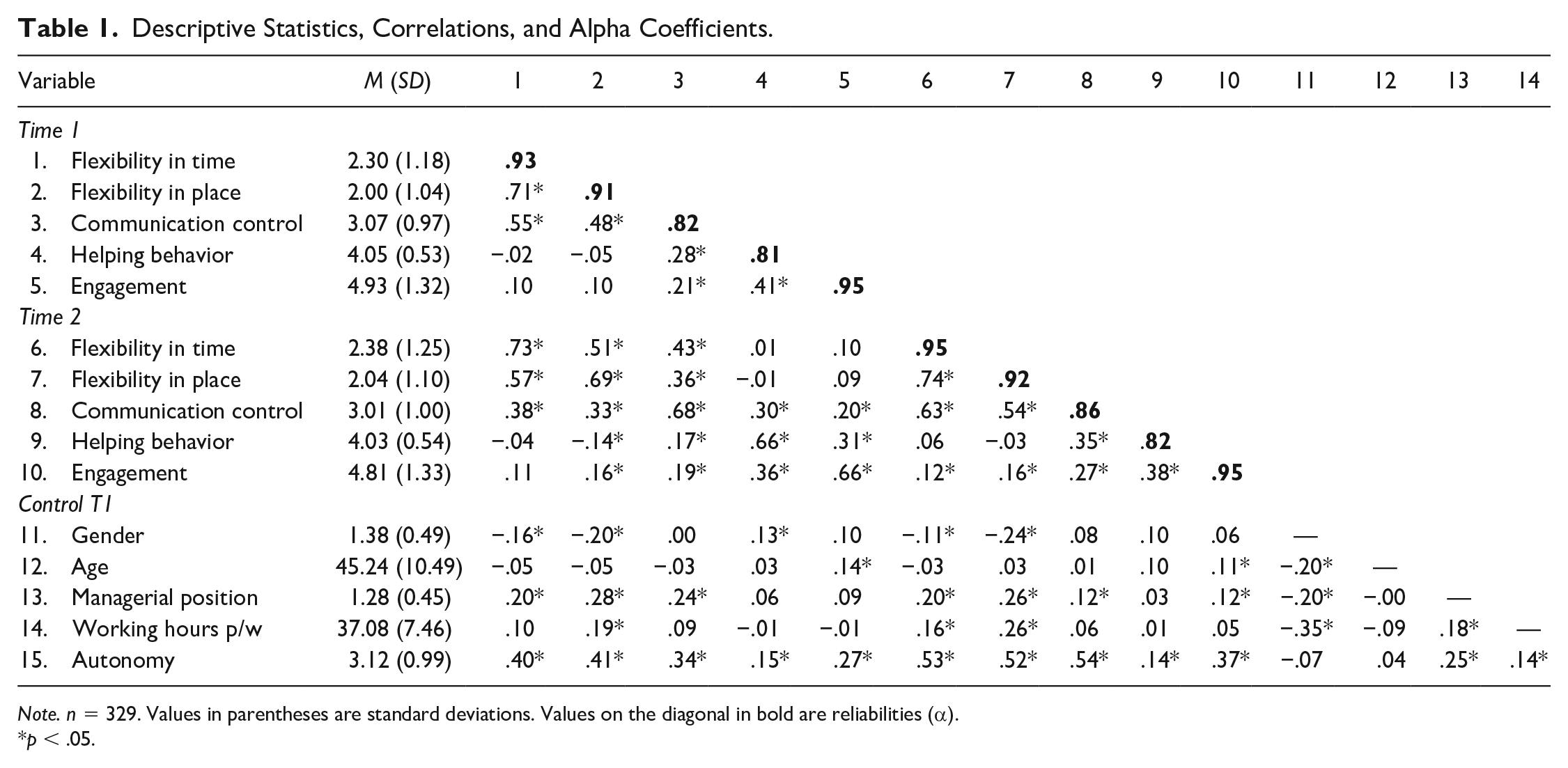
Note. n = 329. Values in parentheses are standard deviations. Values on the diagonal in bold are reliabilities (α).
p < .05.
Measurement Model.
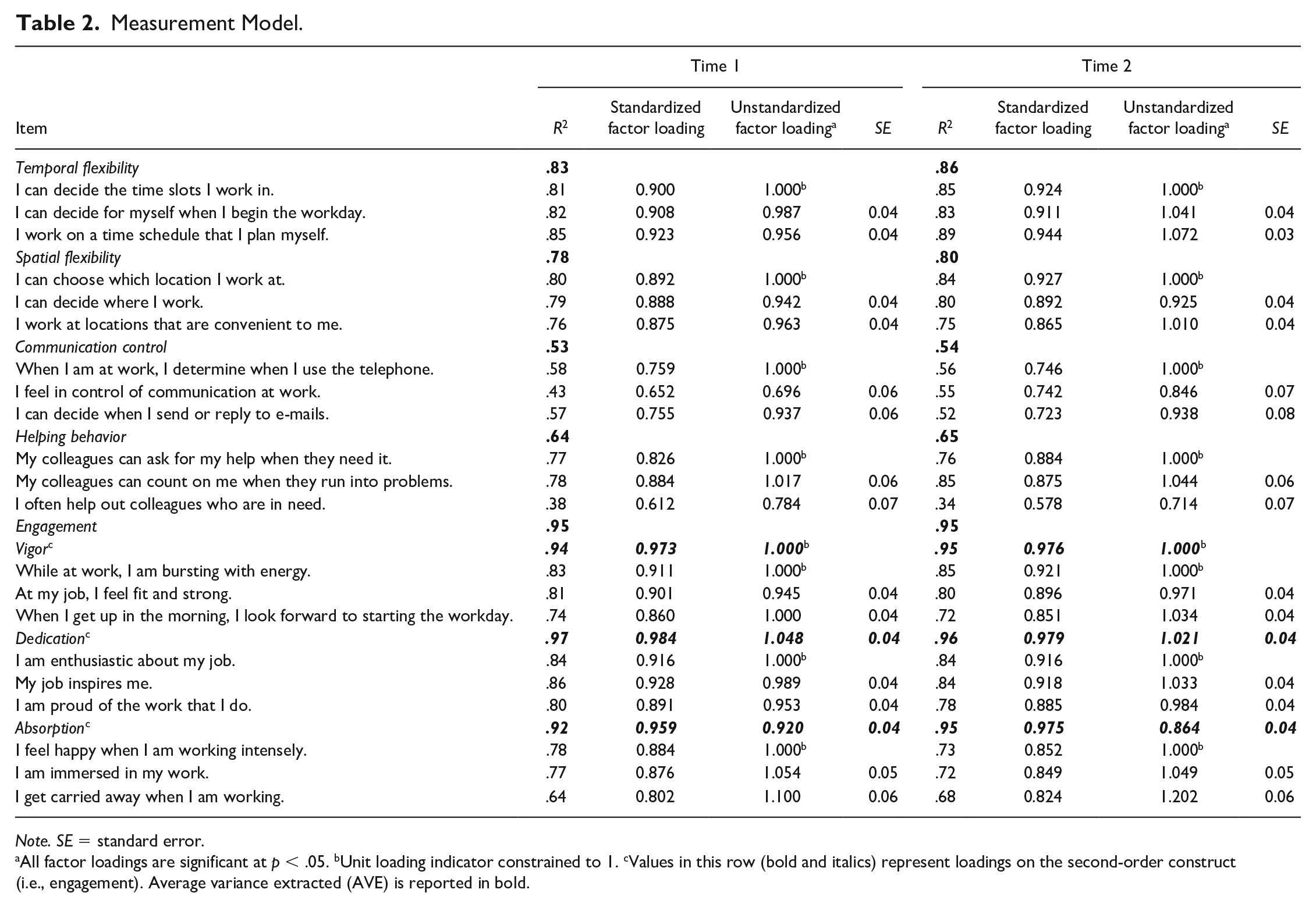
Note. SE = standard error.
All factor loadings are significant at p < .05. bUnit loading indicator constrained to 1. cValues in this row (bold and italics) represent loadings on the second-order construct (i.e., engagement). Average variance extracted (AVE) is reported in bold.
Control Variables
To control for possible alternative explanations, we included gender and age because these demographics correlate with helping behavior and engagement (Bolino et al., 2015; Van Dyne & LePine, 1998). In addition, we controlled for managerial position because managers are generally more responsible for facilitating interpersonal relationships, coordinating activities, and work performance. Work hours per week were included because this relates to work engagement (e.g., ten Brummelhuis, Rothbard, & Uhrich, 2017). Finally, workplace flexibility and communication control are linked to autonomy because these concepts imply a certain degree of discretion over when and where work is done and how communication technologies are used. Autonomy was examined using four items related to decision authority adopted from the Job Content Questionnaire (Karasek et al., 1998). Sample items include “I have a lot of freedom to decide how I will do my job.” When autonomy is added to the model, the effects of workplace flexibility and communication control persist. In sum, the analyses showed similar findings with and without control variables. We found that the magnitude and the statistical significance of all coefficients remained equivalent after removing all controls. For reasons of parsimony, we report the results from the analyses without controls.
Analysis
The hypotheses were tested using structural equation modeling in AMOS. Notably, we were unable to directly test mediation without at least three waves. Therefore, it is important (especially in two-wave panel models) to establish longitudinal factorial invariance (Cole & Maxwell, 2003)—that is, the mean, variance, and autocorrelation structure do not change over time. The idea is that when statistical properties are constant across waves, Path b in the mediation between M1 and Y2 would be equal to Path b between M2 and Y3 (in a three-wave design). Under this assumption, the product of ab (Path X1 M2 and Path M1 Y2) provides the estimate of the mediation effect of X1 on Y3 through M2.
The direction of the relationships between the predictor and mediator and between the mediator and outcome are established by comparing several alternative models. First, the baseline model M(baseline) was examined by including only autoregressive associations between the same factors at T1 and T2. Subsequently, three more complex models were specified and compared. The causal model M(causal) adds the hypothesized relationships between workplace flexibility at T1 and helping behavior at T2 and between helping behavior at T1 and engagement at T2. The reverse causal model, M(reversed), examines the opposite effects from work engagement at T1 to helping behavior at T2 and from helping behavior at T1 to workplace flexibility at T2. Finally, the reciprocal model M(reciprocal) includes all structural patterns from M(causal) and M(reversed).
The interaction between two variables (Hypothesis 2) was tested by adding a variable representing the product of the two observed indicators with the largest factor loadings on their initial latent construct (Cortina, Chen, & Dunlap, 2001). Preacher, Rucker, and Hayes (2007) offer a means of probing moderated mediation by quantifying an indirect effect conditioned on a value of the moderator by calculating the index of moderated mediation, that is, the product of the interaction effect on the relationship of X1 to M2 and the direct effect of M1 on Y2.
Results
Measurement Model
The measurement model showed a satisfactory model fit: χ2(769) = 1455.57; comparative fit index (CFI) = 0.95; Tucker-Lewis index (TLI) = 0.94; standardized root mean square residual (SRMR) = 0.04; and root mean square error of approximation (RMSEA) = 0.052 (confidence interval [CI: 0.048, 0.056]). Discriminant validity was examined through within-wave cross-factor correlations. The highest within-wave cross-factor correlation was .74 between temporal flexibility and spatial flexibility (at T2) and .72 for the same constructs at T1. Given these correlations, variance inflation factors were examined, and the results indicated no problems with multicollinearity. Additionally, a single-factor solution for flexible work yielded a significantly worse model fit (Δχ2 = 847.41 degrees of freedom [df] = 17). All other within-wave correlations ranged from −.05 to .70 (Table 1). Furthermore, the AVE ranged from .53 to .95, whereas the maximum shared variance ranged from .37 to .54, demonstrating the distinctiveness of the latent constructs in the model. High correlations between the same factor at T1 and T2, ranging from .61 to .72, indicate the relative stability of the factors at T1 and T2 (i.e., unchanging levels of variables over time). Convergent validity was assessed by examining the factor loadings and squared multiple correlations (Table 2). All the loadings on the intended first-order latent constructs were significant and sizable, with a range from 0.58 to 0.94, indicating satisfactory convergent validity 1 . The second-order loadings of the three engagement dimensions ranged from 0.96 to 0.98 in both waves. Hence, there were no validity concerns with the measurement model.
Longitudinal Factorial Invariance
Model comparisons indicated that the assumptions for all four levels of longitudinal factorial invariance were met: (a) factorial invariance, Δχ2(14) = 9.40, p = .805; (b) loading invariance, Δχ2 (35) = 27.54, p = .811; (c) intercept invariance, Δχ2 (52) = 37.98, p = .927; and (d) residual invariance, Δχ2(76) = 61.47, p = .887. The results therefore suggest that the fundamental meaning of the constructs did not change over time.
Autoregressive Cross-Lagged Structural Model
To test mediation in two-wave models, the hypothesized relationships were examined in three steps: (a) between workplace flexibility and helping behavior, (b) between helping behavior and engagement, and (c) between workplace flexibility and engagement through helping behavior (to estimate CIs for the hypothesized indirect effects).
First, the cross-lagged associations between workplace flexibility and helping behavior were examined. Table 3 shows that the causal model including cross-lagged associations between workplace flexibility at T1 and helping behavior at T2 (M1causal) was the best-fitting and most parsimonious model, compared with the baseline model, M1baseline; Δχ2(3) = 8.05, p = .044, and the reciprocal model, Δχ2(3) = 5.99, p = .112. Hence, the causal model was retained (see Table 3 for all model comparisons). The causal model suggested that spatial flexibility at T1 significantly predicts helping behavior at T2 (b* = −0.105, p = .010), indicating that increased spatial flexibility reduces helping behavior. Neither temporal flexibility (b* = 0.025, p = .549) nor communication control (b* = 0.054, p = .176) had a cross-lagged effect on helping behavior.
Fit Statistics for the Study Models.
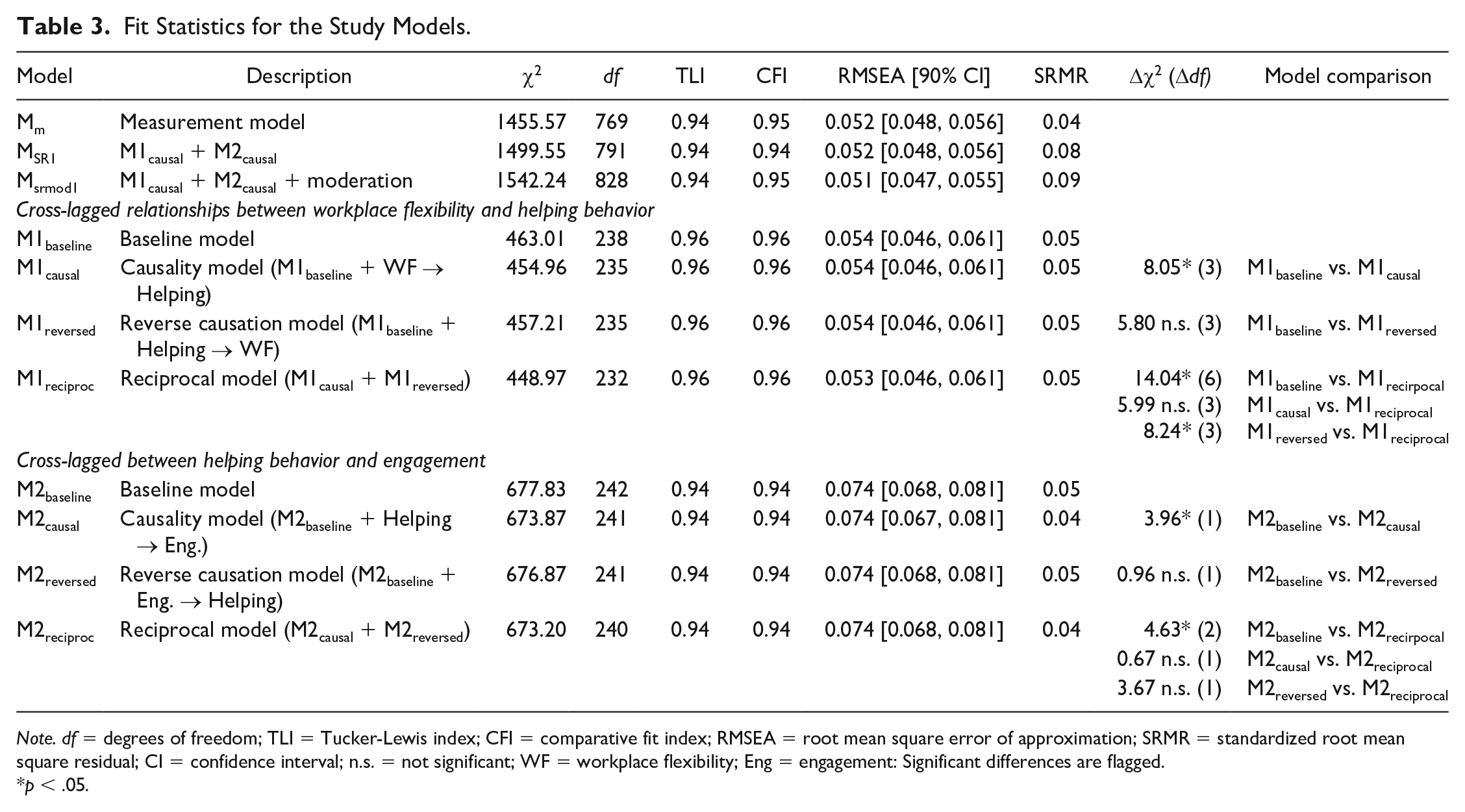
Note. df = degrees of freedom; TLI = Tucker-Lewis index; CFI = comparative fit index; RMSEA = root mean square error of approximation; SRMR = standardized root mean square residual; CI = confidence interval; n.s. = not significant; WF = workplace flexibility; Eng = engagement: Significant differences are flagged.
p < .05.
Second, we investigated the cross-lagged associations between helping behavior and engagement. Table 3 shows that the causal model including the cross-lagged path from helping behavior to engagement (M2causal) was superior to the baseline model, M2baseline; Δχ2(1) = 3.96, p = .046. It also had better fit indices than the reverse causation model (M2reversed). The reciprocal model (M2reciprocal) did not improve the model fit, Δχ2(1) = 0.67, p = .413. Accordingly, the best-fitting (and most parsimonious) model showed that helping behavior at T1 had a positive cross-lagged effect on engagement at T2 (Β = 0.274, p = .047).
Hypothesis Testing
Third, the full model was tested to examine the CIs for the mediation effects (Hypothesis 1) and the moderated-mediation effects (Hypothesis 2; see Figure 1). The full model (Msrmod1) consisted of M1causal + moderation and M2causal and showed an adequate model fit (see Table 3). The indirect effect of spatial flexibility on engagement through helping behavior was significant (Β = −0.033, CI 95% [−.101, −.001] p = .041). The indirect effect of temporal flexibility on engagement through helping behavior was not significant (Β = 0.009, CI 95% [−.011, .064] p = .353). The direct effect between temporal flexibility (Β = −0.093, p = .424), communication control (Β = 0.079, p = .442) and engagement was not significant. Spatial flexibility at T1 affected engagement at T2 (Β = 0.279, p = .013). This result suggests that the effect between spatial flexibility and engagement is partially mediated by helping behavior. These findings do not support Hypothesis 1a but do support Hypothesis 1b.
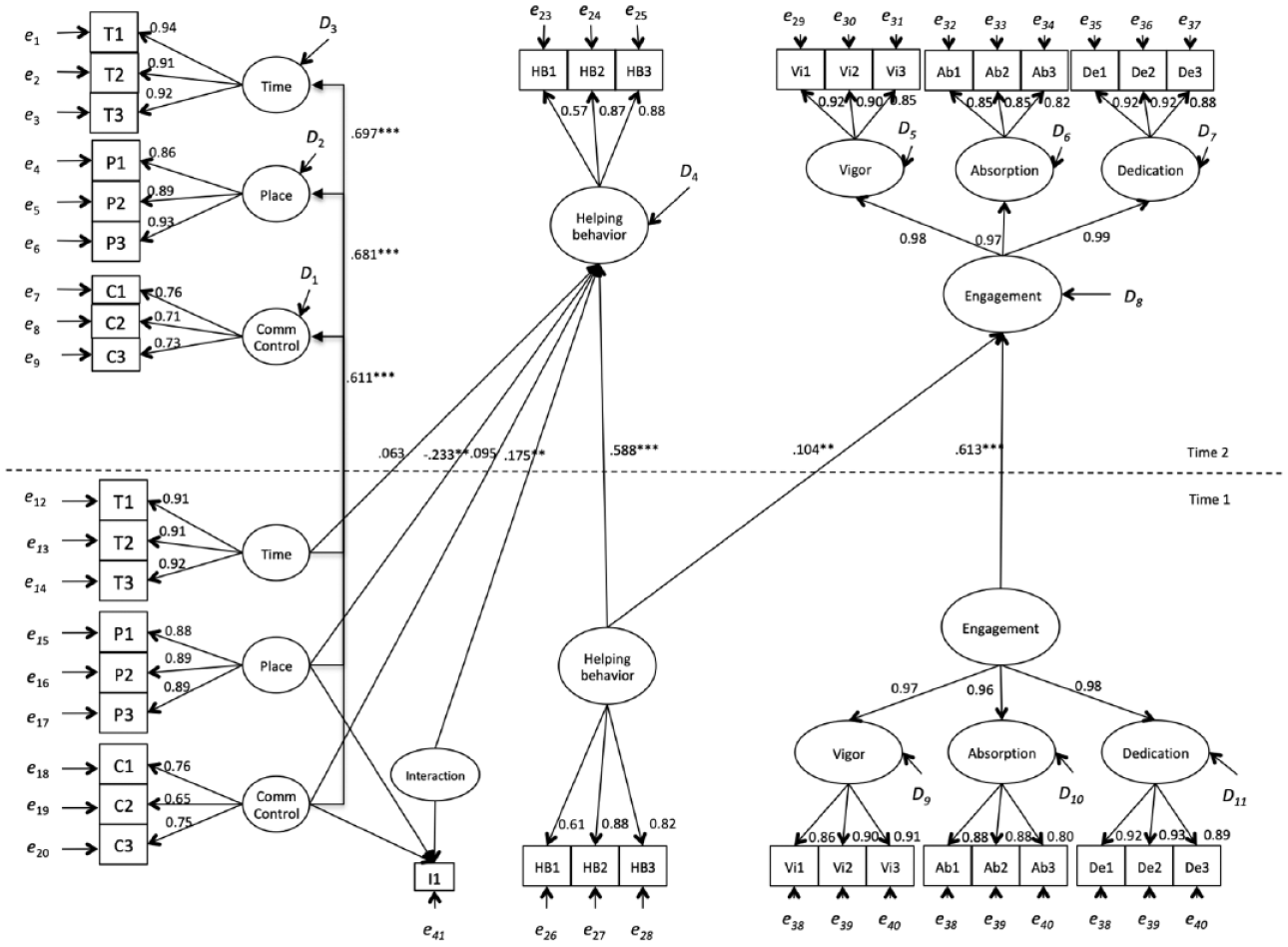
Standardized regression weights in retained structural model.
Finally, we examined the hypothesized moderation effects of communication control and temporal flexibility on helping behavior (Hypothesis 2a) and the moderation effect of communication control and spatial flexibility on helping behavior at T2 (Hypothesis 2b). The cross-lagged moderation effect of temporal flexibility and communication control on helping behavior was not significant (Β = 0.088, p = .296). The moderation effect (see Figure 2) of spatial flexibility and communication control showed a significant cross-lagged effect on helping behavior (Β = 0.087, p = .008). 2 The index of moderated mediation for temporal flexibility and communication control on engagement through helping behavior was not significant (Β = 0.048, CI 95% [−.040, .147] p = .271). The index for moderated mediation, comprising the moderation effect of spatial flexibility and communication control (Path a) and the effect of helping behavior on engagement (Path b), was significant (Β = 0.025, CI 95% [.001, .072] p = .039). Hence, Hypothesis 2a was not supported, but Hypothesis 2b was supported.
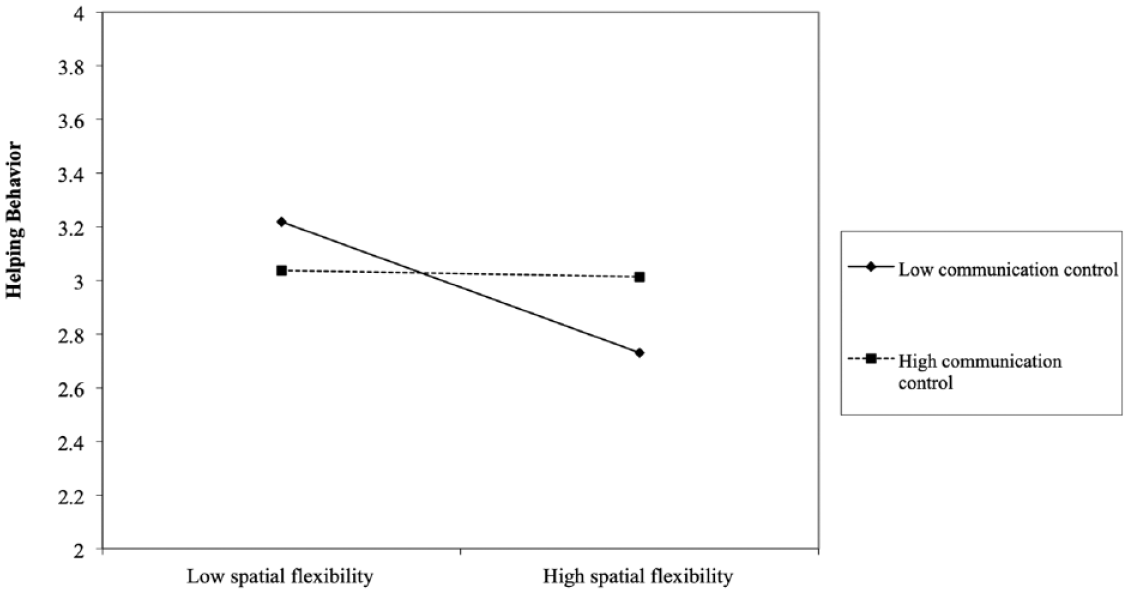
Relationship of spatial flexibility with helping behavior at low levels of communication control (diamond) and high levels of communication control (square).
Discussion
Based on concerns voiced by scholars and practitioners, we examined the consequences of workplace flexibility for helping behavior and work engagement. The findings indicate that spatial flexibility is negatively related to work engagement through a decline in helping behavior. In addition, we found that communication control buffers the negative association between spatial flexibility and helping behavior. Communication control helps employees use the technology in an effective way (Mazmanian, 2013; Piszczek, 2017), facilitating helping behavior, which eventually can benefit work engagement. Finally, our findings suggest that spatial and temporal flexibility may have independent effects on individual and organizational outcomes, as temporal flexibility did not affect helping behavior, while spatial flexibility diminished helping behavior. This result aligns with findings that in the process of attracting applicants, some dimensions of workplace flexibility may be more desirable than others (Thompson, Payne, & Taylor, 2015).
Theoretical Implications
The results of the present study advance the existing literature in three specific ways. First, this study demonstrates that communication control mitigates the negative association between spatial flexibility and helping behavior. This result supports earlier findings demonstrating that if employees experience a sense of freedom to engage with communication technologies, it can enhance effectiveness at work and coordination with colleagues (Mazmanian, 2013; Piszczek, 2017). By studying communication control, we answer a call by ten Brummelhuis et al. (2012), who indicate the need to understand the role of control over communication in the context of workplace flexibility, since uncontrolled communication, such as interruptions, can negatively affect work engagement (ter Hoeven et al., 2016). Importantly, when studying the frequency of communication technology use, there is no way of teasing out the intended and unintended uses of technology, whereas examining communication control allows a less ambiguous examination of effective communication technology practices. This finding contributes to the discussion about the trap of constant connectivity and its influence on employee well-being (Mazmanian, 2013; Mazmanian et al., 2013; Sonnentag et al., 2018). Barley, Meyerson, and Grodal (2011) report that e-mail use could lead to stress due to fear of overload and loss of control. Mazmanian (2013) indicate that whether employees experience loss of control and stress depends on communication norms regarding communication technology use. This study shows that communication control can be beneficial as it mitigates the negative association between spatial flexibility and helping behavior.
Second, the results show that the association between spatial flexibility and work engagement is partially mediated through a decrease in helping behavior. This finding contributes to earlier studies on the relationship between workplace flexibility and work engagement (Gerards et al., 2018; Sardeshmukh et al., 2012; ten Brummelhuis et al., 2012). Specifically, this study demonstrates that workplace flexibility is negatively related not only to receiving support (Sardeshmukh et al., 2012) but also to the ability to provide help to colleagues, which is associated with work engagement. Additionally, this study provides insights into the relationship between workplace flexibility and professional isolation (Golden et al., 2008; Morganson et al., 2010) and workplace relationships (Rockmann & Pratt, 2015) by showing that workplace flexibility not only contributes to personal feelings of isolation and exclusion (e.g., Golden et al., 2008) but also hinders extrarole behavior (in this case, helping others). Having relationships with others is a basic human need (Baumeister & Leary, 1995; Ryan & Deci, 2000) that can be compromised by too much physical and psychological distance between colleagues. As such, the findings of the current study address two of the three basic psychological needs that should be satisfied to achieve work engagement according to self-determination theory (Ryan & Deci, 2000). The need for autonomy implies the need to act with a sense of choice and volition and is captured in the spatial flexibility and temporal flexibility variables in this study. The need for relatedness is reflected in the degree to which employees display helping behavior. Interestingly, satisfying the need for autonomy to select work location can result in a decline in relatedness, or helping behavior here, if employees indeed have the freedom to work from another location to satisfy, for example, their family needs. Earlier studies show that managing the work-life interface comes with several tensions (Putnam et al., 2014). This might mean that working from home simultaneously satisfies a need for autonomy while failing to satisfy a need to help coworkers.
Finally, our results substantiate earlier findings on the influence of helping behavior on work outcomes (Colbert et al., 2016; Sonnentag & Grant, 2012; Weinstein & Ryan, 2010). More specifically, we demonstrate that helping coworkers increases work engagement. Interestingly, we also find that work engagement does not increase helping behavior. Earlier studies have claimed this reverse association, where work engagement is the antecedent of helping behavior (e.g., Rich, Lepine, & Crawford, 2010). However, these studies used a cross-sectional study design. The results of the current study emphasize that the ability to help others is fulfilling and can even lead to work engagement, whereas being engaged at work does not necessarily lead to helping others.
Practical Implications
As discussed earlier, concerns regarding the social consequences of workplace flexibility have led several organizations to withdraw their telework policies (e.g., Yahoo!, IBM, Hewlett-Packard). However, as a result, the possible advantages of workplace flexibility are also removed. Although these decisions to reduce access to technology may be understandable in some cases, based on our findings, it seems more useful to create a balanced flexible culture (Kossek, Thompson, & Lautsch, 2015) in which employees experience communication control (Piszczek, 2017; ten Brummelhuis et al., 2012). Our study offers some insights into how employees, managers, and organizations could mitigate the possible detrimental consequences of workplace flexibility.
First, our study shows a negative relationship between spatial flexibility and helping behavior. This result is in line with other studies showing that spatial flexibility is associated with increased perceptions of isolation and an unsupportive workplace culture (Kossek et al., 2015). According to the meta-analysis of Gajendran and Harrison (2007), the negative association between telework and coworker relationships becomes apparent when employees work outside the office for more than 2.5 days a week. Therefore, organizations and managers might encourage employees to come to the office at least 2½ days a week. Alternatively, team leaders can organize weekly meetings or (informal) events to ensure regular group discussion about work processes (Perlow, 2012). Such strategies keep employees aligned and up to date about the work of coworkers, facilitating conditions for helping behavior.
Second, our findings demonstrate that communication control can alleviate the negative association between spatial flexibility and helping behavior. Organizations can support employees’ communication technology use in a number of ways, for example, by providing appropriate (mobile) devices and IT support. However, since most employees currently use technological devices for work, it might be more beneficial if organizations try to establish organizational norms that promote heterogeneous trajectories of communication technology use, providing employees with control over their patterns of use. Mazmanian (2013) indicates “that in certain scenarios it is possible for individuals to develop socially stable heterogeneous patterns of communication that benefit them without having received a top-down mandate, such as a ‘no e-mail Friday’” (p. 1246) This is important because if organizations can facilitate an organizational culture that is supportive of heterogeneous patterns of communication technology use, this can both buffer the negative association between spatial flexibility and helping behavior and circumvent the trap of constant connectivity.
Some organizations have addressed the potential drawbacks of constant connectivity. For instance, in 2011, Volkswagen decided to stop its servers from sending e-mails to employees during nonwork time (Tsukayama, 2011). BMW and Deutsche Telecom have implemented similar policies (Strangler, 2015). Although such policies might mitigate the negative consequences of communication technology use, our findings also suggest that they hamper the ability of employees to engage in supportive behaviors across spatial boundaries. Although these decisions to reduce access to technology may be understandable in some cases, based on our findings, it seems more useful to create a balanced flexible culture (Kossek et al., 2015) in which employees experience communication control (Mazmanian, 2013; Piszczek, 2017; ten Brummelhuis et al., 2012).
Limitations and Future Directions
A few limitations of this study should be acknowledged. All the data for the variables in our model were self-reported, which may introduce common method bias issues. Future studies could benefit from multiple sources of data. For instance, supervisors or peers could evaluate employees’ helping behavior, and work engagement could be assessed through physiological measures.
In addition to communication control, there may be other conditions under which workplace flexibility influences helping behavior and work engagement. For example, at the macro level, Sirola and Pitesa (2017) report that in difficult economic periods, helping behavior decreases by promoting a more zero-sum construal of success. At the meso-level, Golden and Fromen (2011) find that the work experiences and work outcomes of employees with teleworking managers are generally less positive than those of employees with nonteleworking managers. The work arrangement of the manager might therefore play a role in the helping behavior and work engagement of employees. At the micro-level, some employees might need more context and face time than others to provide help. Future studies could focus on the interventions that Van Dyne, Kossek, and Lobel (2007) propose to enable helping behavior over physical distance: (a) collaborative time management, (b) redefinition of contributions, (c) proactive availability, and (d) strategic self-presentation.
In summary, our study demonstrates that spatial flexibility can have a detrimental influence on work engagement through a decline in helping behavior. Geographical distance and less knowledge about the work of colleagues seem to hinder opportunities to help others. Importantly, this study also found that the negative association between workplace flexibility and helping behavior can be alleviated by communication control. As such, this study provides insights that could optimize the outcomes of workplace flexibility.
Footnotes
Declaration of Conflicting Interests
The author(s) declared no potential conflicts of interest with respect to the research, authorship, and/or publication of this article.
Funding
The author(s) disclosed receipt of the following financial support for the research, authorship, and/or publication of this article: This work was supported by The Netherlands Organization of Scientific Research under Grant Number 451-13-012.
