




Abstract
What does work engagement mean to employees in contemporary work environments designed to be fun, highly engaging and productive? Engagement studies tend to focus on ‘being engaged’ rather than ‘doing engagement’ with little consideration given to organisational processes which influence employee agency in engagement. This study aims to contextualise the concept of engagement as a situated performance that involves navigating organisational discourses and expectations. Through in-depth interviews, we explore what engagement means to workers, and what performances are required in a contemporary technology company. Our analysis uncovers how ‘engagement’ functions as a discourse to normalise particular behaviours, moving the theoretical focus from the state-based focus on ‘being’ engaged to ‘doing’ engagement. We elucidate the discursive forces dictating what engagement means and the kinds of work/worker that hold value, providing an alternative to the current individualistic framing of engagement, illuminating a missing element in discussions on engagement - the performative element.
Introduction
In a competitive landscape many contemporary workplaces attempt to measure, and stimulate increases in, levels of worker engagement in the hope of realising bottom-line benefits. This pursuit has seen many organisations adopt ‘new ways of working’ characterised by worker autonomy, de-centralised control, team-based structures, remote working and a shift from ‘one size fits all’ to flexibility in work relations (Gerards et al., 2018). In parallel, we see increasing academic interest in the concept of engagement, with initial work devoted to defining the concept (Kahn, 1990; Macey & Schneider, 2008; Saks, 2006), followed by exploring engagement outcomes. Engagement is associated with increased levels of organisational performance, profitability and competitive advantage (Eldor, 2020; Harter et al., 2013). At the individual level, engagement is associated with higher levels of job satisfaction (Shuck et al., 2011); well-being (Radic et al., 2020; Truss et al., 2013); and job performance (Christian et al., 2011; Corbeanu & Iliescu, 2023). It also mediates the relationship between workload and performance (Montani et al., 2020), as well as the turnover intention–organisational citizenship behaviour relationship (Xiong & Wen, 2020). Given the potential for a win-win in terms of both productivity and improved outcomes for workers, it is not difficult to see why engagement is popular as a concept.
Notwithstanding the business and academic focus on engagement, recent reviews have argued that the concept remains ill-defined (see Bailey et al., 2017; Lemmon et al., 2020) and confusion over whether engagement is primarily a trait, state or behaviour is evident. Academic accounts tend to frame engagement mostly as a psychological state; however, as Shantz et al. (2013) point out, practitioners tend to frame it as a workforce strategy to produce desired employee behaviours. Furthermore, while much has been written about the antecedents of engagement, studies are in the main acontextual (Purcell, 2014). New ways of working may have been heralded as the key to unlocking worker engagement, but little is known about the impact of such practices (Gerards et al., 2018). Previous studies suggest that increases in autonomy (Peters et al., 2014); flexibility in time and place (Ten Brummelhuis et al., 2012); a focus on output, access to organisational knowledge, and an open workplace (Gerards et al., 2018); have the potential to enhance engagement. The idea, however, that some facets of the ‘new’ workplace may intensify the pressure on employees to behave and ‘engage’ in a commercially mandated way, has received limited attention. There is also a tendency to neglect conflicting interests and identifications of employees (Purcell, 2014), issues of power and control, and the contextual dimensions influencing employee agency in engagement. One notable exception is Garland (forthcoming, p. 6) who questions whether engagement is “really chosen” in a context where “the ‘flexible subject’ is required to ‘engage’ with everything that has been decided – and very much decided over and above them and without their agreement”. The emphasis in the literature has primarily been on ‘being’ engaged with little consideration given to organisational expectations and how these may shape, and indeed dictate, what engagement means and how engagement should be ‘performed’ in a given context.
In this paper we shift the emphasis from ‘being’ engaged to ‘doing’ engagement thereby acknowledging that engagement is not just a state that may manifest in behaviours but is a situated ‘performance’ that involves navigating organisational expectations and proffered engagement ideals and identities. We argue that engagement needs to be contextualised, not least to address how different settings (e.g., occupations or organisations) may call out different engagement performances. Building on Bailey et al.’s (2017) review, we argue for the need to re-conceptualise engagement as a situated experience inclusive of its performative elements. Our contextualisation of engagement goes beyond examining what engagement might look like in one setting (here a ‘new workplace’) by theoretically re-framing the concept of engagement not simply as a trait, state, or behaviour but as a set of situated discursive resources that construct situated practices and identity options.
We propose that ‘engagement’ is a discursive resource that guides “interpretations of experience and shape(s) the construction of preferred conceptions of persons and groups” providing a “horizon for future practice” (Kuhn et al., 2008, p. 163). Multiple discourses from a variety of contexts can shape the meaning of engagement including wider society, occupations and professions, and organisations. However, Kuhn (2006) notes that discourses can also be organisationally distinct. Here, by examining what engagement means to employees in a ‘new’ workplace, we illustrate how engagement can be conceptualised as a discursive resource, supplied by the organisation and interpreted, shaped and enacted by its members. The discourse of engagement acts to prescribe certain behaviours, ideals, and identities while simultaneously negating others. Similar to James et al.’s (2023) argument that discourses of ‘wellness’ are presented as unquestioned ideals in contemporary workplaces, and therefore offer little space for worker dissent, we propose that discourses of ‘engagement’ leave little space for workers to avow anything but high engagement. We show how on the one hand the engagement discourse places the locus of control and responsibility for workplace experiences (of engagement) firmly with the individual but at the same time communicates and constrains how they should behave, with subtle penalties applied if that behaviour or performance doesn’t fit.
We begin with a brief overview of how work engagement has traditionally been defined and how such conceptualisations have tended to underplay the role of context in shaping the meaning of engagement for those workers whose engagement is being measured. Here we ask – what meaning-making do employees construct around engagement and what communicative dynamics in this work context shape that meaning, performances of engagement and related ideals for selves in this setting? If we understand agentive capacities (such as engagement) as produced through material, affective and discursive relations (Fox & Alldred, 2016), then viewing engagement as just emanating from ‘within’ or as an individual trait/state, eclipses the influence of context in which engagement is performed.
Our study’s purpose firstly is to contribute to the literature on engagement by illuminating a missing element in discussions on engagement (i.e., the performative element). In doing so we are acknowledging worker effort in ‘doing’ engagement; examining, through their accounts, the requirements for engagement in a particular context; and taking a more critical view of engagement that recognises unobtrusive controls in the employment relationship. Our contribution is to provide an alternative to the current individualistic framing of engagement and to bring the influence of context and the discursive forces (Broadfoot et al., 2008) that dictate what kinds of work and worker holds value into focus. Thus, we make visible the performative element of engagement. Secondly, this study takes place in a ‘new’ workplace; consequently, we add to the emerging literature on the impact of new flexible workplace dynamics on ideals for engaged workers.
Making Sense of Engagement
Originally, Kahn (1990) offered a dynamic view of ‘personal’ engagement (and dis-engagement) at work as a phenomenon that ebbs and flows depending on context. In engagement “people employ and express themselves physically, cognitively, and emotionally during role performances” whilst in disengagement, “people withdraw and defend themselves” (Kahn, 1990, p. 694). He argued that three psychological conditions need to be met for people to be engaged: (1) meaningfulness (i.e., the feeling of receiving return on investments of one’s self in role performance); (2) psychological safety (i.e., feeling able to show and employ one’s self without fear of negative consequences); and (3) availability (i.e., the belief of having the physical and mental resources to engage the self at work) (p. 700). These conditions are influenced by the job, social environment, energy, and personal resources.
Since Kahn’s work, scholars have diverged on the locus, form, and dimensionality of engagement, leading to conceptual confusion. Engagement is used to refer to psychological states, traits and/or behaviours and to add to the confusion is differentially labelled as personal, work and employee engagement. Some assert that engagement is something the individual brings to the workplace, arguing for its relative stability. The Utrecht approach (Schaufeli et al., 2002) for example describes ‘work’ engagement in terms of a relatively stable (attitudinal) state of mind characterised by vigour, dedication, and absorption in work tasks. In contrast to Kahn’s conceptualisation of a momentary and specific state, engagement is seen as a more persistent affective cognitive state that is not focused on any event, individual, or behaviour. Others suggest that engagement is produced by drivers in the workplace (Harter et al., 2002) stressing the importance of management’s role in delivering ‘employee’ engagement. Schaufeli (2013) summarised the state of play - “we are stuck in a dilemma: either engagement is defined narrowly as an experience (i.e. purely psychological state) in which case its practical relevance is reduced, or it is defined in broader terms including its behavioural expression, in which case the concept gets fuzzy. A pragmatic solution could be to consider engagement as a psychological state in conjunction with its behavioural expression.” (p. 32).
Such pragmatic solutions can be seen in Saks (2006) and Macey and Schneider’s (2008) work bringing together both state and behavioural elements of engagement. Saks (2006) defines employee engagement as: “a distinct and unique construct consisting of cognitive, emotional and behavioural components associated with individual role performance” (p. 602). Macey and Schneider’s (2008) view on engagement brings together academic and business concerns by including trait, state, and behavioural outcomes in their framework. They propose that Trait Engagement (disposition based) gets reflected in State Engagement (energy, absorption) which is an antecedent to Behavioural Engagement (discretionary behaviour). Such work, which includes ‘behavioural engagement’, lays the foundation for our research. For if we are in the domain of including behaviours as a feature of work engagement then we are in the domain of considering performative elements in how we conceptualise work engagement (WE).
In contrast to Macey and Schneider (2008) however, we do not see the emergence of WE as a linear process flowing from trait to state, to behaviour, in a very traditional psychologised version of the person and what prompts their behaviour (moving from the inside out). Rather we adopt a social constructionist ontology where the interactions and contexts we participate in prompt both meaning-making and performances in an intertwined fashion. Furthermore, in Macey and Schneider’s work the behavioural dimension of engagement is not problematised as it is thought to flow authentically from antecedents and/or psychological states. In contrast, we examine how employees come to understand that certain performances of engagement are required and the degree to which they can give such performances. This is an important distinction as it opens the possibility that while at times experiences, for example of absorption, may align with required work performances, at other times required performances of engagement may not align with employees’ experiences of engagement. This prompts meaning-making by the employee to re-calibrate their sense of engagement to align to the organisational context or to simply display the required behaviours, without the attendant experience of being engaged. The idea of the performative self stems from the dramaturgical literature and work of Goffman (1959). He suggested that during social interaction, moment to moment, the individual is actively negotiating a course of action, they “hold in check certain psychological states” (Goffman, 1961, p. 93) to conform to social convention. Thus, actors actively manage outer impressions to conform to social rules of communication referred to as the ‘traffic rules of interaction’ (Goffman, 1967). As Visser et al. (2020) note, in performances, people aspire to make a positive, and avoid a negative, impression on an audience; they also strive to maintain an interaction order. This requires effort to understand the audience, their expectations and what behaviour/display is required to give a good performance.
Our focus on the performative and co-constructed sense of ‘engagement’ is an empirical and conceptual instantiation of Cooren et al.’s (2011) premise that studies in the ‘communicative constitution of organisation’ understand that every ‘performative’ communication (in this instance communication about engagement and any related policies, decisions, or artefacts) involves both the performance but also inferences about the performance made by those who interpret/respond to a performance. Thus, a constitutive view of organisational communication “takes into account how their meaning and action are negotiated, translated and/or debated.” (p. 1152). In this study we examine how organisation policies and practices around engagement are interpreted, enacted, or resisted in the accounts of engagement by organisation members and conversely how their performances of engagement emerge from, and are interpreted in, a given organisational context. Later, as we explore participant accounts of engagement, we examine if displays of engagement are constructed as flowing authentically from a given trait or a state of absorption in task or if workers speak of the need to ‘perform’ a role to be seen as engaged.
Part of our reconceptualisation of engagement is to argue that ‘engagement’ comes with context-specific requirements. Extant research has usefully pointed to some dimensions of the context for engagement which shape and influence performances such as, high levels of discretion and opportunity to use knowledge (e.g., Bakker & Demerouti, 2008); management practices such as leadership and a strong organisational culture (Aboramadan & Dahleez, 2020; McLeod & Clarke, 2009); or trust in senior management/relationship with line manager (see Alfes et al., 2013). Such research gives a partially contextualised account of engagement but one that is quite transactional where “engagement becomes a good bestowed by the individual in response to the perceived and experienced benefits from the immediate environment.” (Bailey et al., 2017, p. 41). We would argue that the setting for engagement doesn’t just provide demands and resources in a transactional fashion but requires performances of engagement which in turn shape possibilities for self (i.e., who you can display and be) in that context. Kuhn et al. (2008) discuss how meanings about work are derived not just from task activity or objective job characteristics but from a wide variety of discourses supplying discursive resources which provide differing possibilities for meaning-making. Therefore, many elements of organisational experience, rather than being reified as stable ‘entities’ objectively shaping engagement in a transactional manner (e.g., task characteristics, performance rules, management practices, leadership styles, organisational cultures), are recast in our framing as supplying potential discursive resources for making meaning and shaping performances in each organisational context. In addition to highlighting meaning-making about required performances, taking a discursive view of engagement allows us to consider meaning-making about ideals for engaged selves in this setting. As Kuhn (2009) puts it “the individual is the self-reflexive node at which a variety of cultural, institutional and organisational discourses meet.[which] shows how subjects are interpellated products of social institutions who simultaneously exercise agency, constrained though it may be” (p. 682). A discursive conceptualisation of engagement therefore allows us to consider how such discourses may regulate not just performances of engagement but possible ideals for identities in this setting.
Taking stock from the preceding review we summarise here the potential contributions flowing from our conceptual re-framing of engagement. Firstly, we answer calls from Purcell (2014) and Bailey et al. (2017) to contextualise engagement by considering the situated requirements for engagement in this contemporary workplace. Our conceptualisation moves from acontextualised accounts of employees ‘being’ engaged to employees ‘making sense of’ and ‘doing’ engagement in situated contexts. This contribution is strengthened based on our theoretical positioning of engagement as a discursive phenomenon. This offers not just a contextualised view of engagement but one which calls into question the accepted entitative, individual psychologised conceptualisation of engagement. Our study was guided by the following research questions: (i) In this contemporary workplace, what does ‘engagement’ mean and what performances are constructed as required to show engagement?; and (ii) to what degree do workers feel these performances fit, and what ideals for engagement and related identities are being constructed? Such questions address much needed contextualisation about how different occupations, organisations, contractual arrangements, gendered practices etc. are likely to construct different meanings and performances around engagement. Secondly, by attending to required performances of engagement we surface the often-invisible labour in showing engagement and allow for employee experiences of a disjuncture between what is felt and what may be displayed to surface. Thirdly, in contrast to much literature centred on trait or state psychologised perspectives on engagement, we posit a social constructionist theoretical re-framing of engagement as a situated relational accomplishment. We argue that members draw on organisational discursive resources to craft (and re-craft) legitimate engagement performances, practices and ultimately selves as engaged employees. We align to Kuhn et al.’s (2019) ontological positioning of relationality which “draws attention to the unfolding relations that brings things of all kinds into being.” (p. 102). Organisational requirements for employing the self in particular ways (here to demonstrate engagement) not only facilitate or constrain kinds of self-expression but can over time create the ‘engaged’ selves to be expressed in that context. Considering the purposeful design of many contemporary organisations to be ‘engaging’ workplaces, the risks of unobtrusive control are heightened (Garland, forthcomingGarland). Finally, while the organisational control and regulation of identities is not the key focus of this paper, by adopting a discursive view of engagement we allow for glimpses of the unobtrusive control organisations may have in contemporary workplaces.
Method
Research Design
Combining a social constructionist stance with a concern for the co-construction of situated meanings about performances and engagements, we argue for a discursive framework (see Willig, 2013) to underpin our work. We are guided by the view that language has the power to construct and frame people’s experiences. As Bardon et al. (2017) note “talk is an important form of social action, peoples ‘realities’ are linguistic constructions and such verbalisations are not accoutrements to, but constitutive of, their local worlds” (p. 945). Echoing Bencherki et al.’s (2020) proposal that everyday repeated communications can be constitutive of organisations, we ask - in this contemporary workplace how does organisational discourse about engagement function, what does it produce in this setting? Furthermore, how does talk and practices around work engagement open up particular meanings and ways of being, and close down others? We argue that how workers talk about engagement not only reveals their world as they understand it but is constitutive of that experience.
Here we elaborate on several key elements of our framing of engagement as co-constructed. Firstly, the intertwined relationship between the individual and the cultural context (both local/organisational and wider/societal) is at the heart of our meaning of co-construction. This perspective allows for both etic and emic accounts of cultural/contextual influence in terms of (i) wider discourses (about for example what it means to be a professional at work) but also (ii) situated discursive resources particular to this organisational context “that are commonly engaged in, and meaningful in particular ways, among people familiar with a certain culture” (Craig, 2006, p. 38, cited in Wieland, 2010, p. 512). Secondly, co-construction in the sense that engagement plays out both as dramaturgical performance (knowing situated scripts and presenting the self in accordance with audience expectations) but also such performances as actively accomplishing meaning and constructing ‘engagement’ and selves (see Wieland, 2010 for further elucidation of situated practices and resources). Thus, we argue that individual interviews are appropriate to explore context specific rules for legitimate performances. We do not consider interviews to be faithful pictures of past or future behaviours but rather “sites in which one can see the application of cultural scripts, impression management and the formative powers of discourse.” (Kuhn, 2009, p. 688). Thus, via interviews, we analyse how employees talk about engagement and their experiences of being (dis)engaged to understand their meaning-making and uncover aspects of the organisational and wider context that shape such experiences.
Case Context
Techco is a privately owned software development company, employing 270 people across 8 sites in 5 locations. The organisation has a flat structure, highly differentiated skill level, and high discretion roles among the predominantly male (74%) workforce. In this work context, engagement is strategically important. Techco deliberately design engagement as part of their workforce strategy. To promote positive workplace relationships, the management style is informal and personalised. Employees can readily communicate with company owners and there are multiple employee voice mechanisms. Internal online ‘chat’ systems are used to encourage employees to stay connected with each other and the company. Positive working relationships with colleagues are also encouraged through frequent social events. There is an emphasis on organisational values driving HR practices relating to recruitment, reward, and recognition. Employees are supported to learn and develop, given meaningful work, and there is a supportive work community where instances of good performance and citizenship are publicly acknowledged. Trust is demonstrated in the degree of flexibility (time/place) afforded to employees; the working environment is informal, with creative spaces to work. There is a play ethic and sense of a college campus (games room, pool tables, table tennis). The organisation actively seeks to forge a collective identification and belief amongst employees that it is unique and a better place to work than competitors. Employees are encouraged to “think and act like an owner” placing the best interests of the company at the heart of decisions and actions. In summary, Techco has embraced new ways of working and is designed to be a high-engagement workplace, and we see evidence of many of the antecedents of engagement reported in the literature. It is therefore particularly interesting to study this organisation and to examine the lived experience of employees in this context.
Data Collection
Participants.
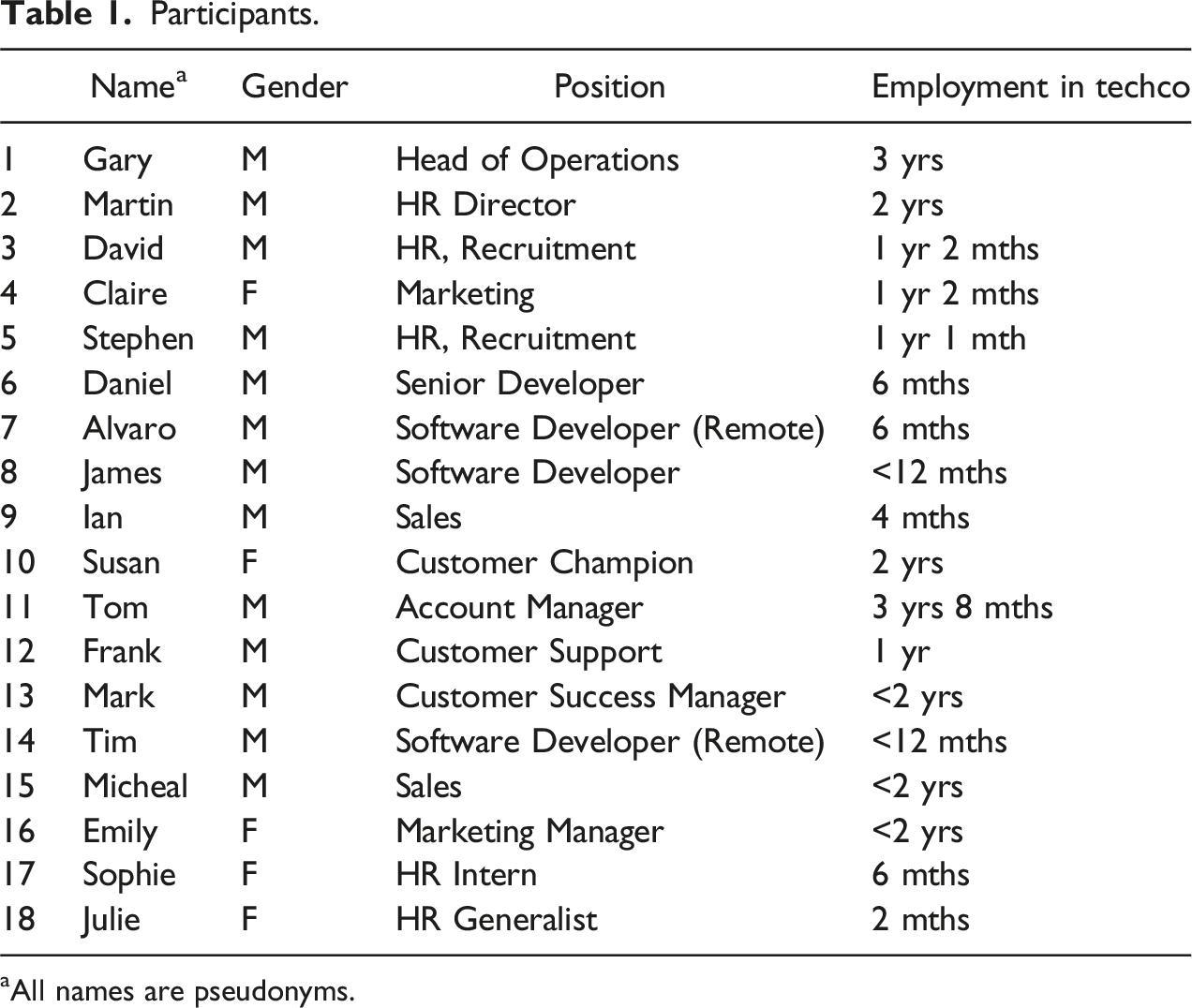
aAll names are pseudonyms.
Participants were initially asked about the nature of their work and role. Subsequently, they were asked what they understood by the term ‘engagement’ with probing questions to explore this (e.g., How would you know someone is engaged?; What are the behaviours of an engaged employee?; Is engagement recognised/rewarded in this company?). Similar questions were used to explore disengagement. Questioning moved on to participants’ experiences of being (dis)engaged (e.g., consider yourself in your current job role, in general would you consider yourself to be engaged?; If I were to ask other people in this company, would they say you were engaged?; What about people outside of work, would they view you as engaged?). To explore this further, participants were asked to describe the details of situations where they felt (dis)engaged. All interviews were audio-recorded and fully transcribed and pseudonyms assigned to all participants and the company.
Data Analysis
Interviews were analysed to explore how employees talk about their experiences of engagement and disengagement at work. Drawing on Willig (2013) we conceptualise language as both “constructive and functional” that is, attending to what meanings are being constructed via talk and how these function in accounts. Our analysis sought to explore patterns in discourse about engagement. Kuhn (2006) describes discursive resources as “concepts, expressions, and/or other linguistic devices that, when deployed in talk, present explanations for past and/or future activity that guide interactants’ interpretation of experience while molding individual and collective action.” (p. 1341). Resources are drawn from situated social practice and the surrounding ideological field. This intersection of situated practice and the wider ideological field allows for the consideration of big D dominant discourse, as resources for small ‘d’ discourse produced in the moment by a participant about engagement (James et al., 2023). Therefore, we were sensitised to looking for the patterns and functions in participants accounts that reveal their interpretations and experiences but also the dominant discourses they draw on.
In initial coding of the transcripts, guided by our first research question about what engagement means in this setting, we identified extracts that included language about behaviours, attitudes, and emotions in relation to engagement. We then analysed these sections of talk to tease out how participants construct engagement (i.e., what (dis)engagement means to them and what attitudes/behaviours/emotions they recount as visibly required to show engagement in this context). We engaged in an iterative process of individual analysis and joint dialogue about our interpretations to refine our analysis.
Having identified talk constructing meanings around (dis)engaged employees, in terms of how they should speak, act, and feel (the behaviours, attitudes and emotions), we next moved on to consider how such discourse functioned in this context to produce ideals for engagement and worker identity. This stage in the analysis uncovered discursive resources at work such as ‘going above and beyond’; ‘super social and connected’; ‘tooting the horn’. Finally, we considered how participants positioned agency in, and accountability for, engagement; that is, who or what was engagement stemming from in their accounts?
We moved on to examine how closely participants align themselves to the subject position of engaged employee, and we uncover instances where there is tension between personal meanings and performative ideals for engagement in this setting. We attended closely in the accounts to features of the context – how, when, where and with whom do participants feel engagement is created, maintained, damaged etc.? Interesting insights into the situated experiences of employees in a high-engagement workplace emerged from our data. We now turn to these findings.
Findings
Here we explore what engagement and disengagement means to workers in Techco and examine their engagement experiences. Engagement was constructed not only as experiencing but also demonstrating certain emotions, attitudes, and behaviours in line with company expectations. We elucidate these expectations to ‘perform’ engagement and how they function to signal an ‘ideal type’ to which employees should aspire. We conclude with a discussion of the implications of our findings for conceptualisations of engagement in contemporary workplaces.
What does Engagement Mean?
For employees in Techco, engagement was principally understood as connection to company and team rather than absorption in tasks and work. Engagement was seen as being delivered through positive people management practices with employees reciprocating through effort directed at achieving company goals. Note in the following extract that the usual sense of absorption in task via being “very good at developing software” is not foregrounded in how David understands engagement: you could be very good at developing software… but you mightn’t be very engaged with [Techco], you know, you could be doing that in any company. ……where a person just wants to do the role that they’re doing regardless of what, who signs their pay cheques.. (David, HR)
Like other participant accounts, engagement is understood to ‘be very engaged with [Techco]’.
As Tom succinctly puts it, engagement is multi-level. Multi-level, meaning connection with the task, team, and organisation, with the deepest level being with “the company’s vision”. For me there are a whole load of levels of engagement. For me the deepest engagement is with the company’s vision (Tom, Account Manager)
Since Techco works hard to align staff to their values and stresses the uniqueness of working with them (not just being a good coder “you could be doing that in any company”), it is not surprising such meaning-making around engagement emerges. This is a sensible recruitment and retention strategy for the company who rely on in-demand workers and want staff to feel aligned to something unique. However, it is interesting that these workers, who could be expected to feel high levels of meaningfulness in the exercise of their skills and absorption in challenging tasks, seldom mention such elements of engagement, and mostly focus on connection to others in the team, aligning to company values etc. For example, genuinely passionate about the place, the people…what the end goal is, why we’re all pushing as hard as.. (Claire, Marketing)
Clearly, engagement as an experience and set of practices needs to be contextualised to be understood.
In the main, engagement was positioned as deriving from management practices (based on management efforts at keeping people connected, showing trust in staff etc.). it [engagement] means looking after….. we have 3 offices here and then 40 remote people…but making sure that the culture is perceived the same way wherever we are....that employees get to know each other and they engage with each other but also with the company and the benefits and perks that we have (Gary, Head of Operations)
This echoes the emphasis in wider discourse on ‘employee engagement’ as a management practice, with management responsibility for delivering engaged employees. Engagement is also seen as reciprocated effort from employees for benefits provided. An emphasis on ‘fit’ to values emerged. I guess it's just simply having a group of people who know what the company's vision, policies are…. and values as well. Someone who kind of lives and breathes by them and someone who agrees with them as well obviously, which would go hand and hand with it. That's my understanding of what engagement is (Stephen, HR)
Participant accounts emphasised the homogeneity of people and culture at Techco and positioned it as different to competitors (“here it’s different”). Cohesion and alignment were emphasised above all else, as was the idea that only the right kind of person fits. Such accounts highlight the influence of wider discourses (e.g., industry-based emphasis on engagement as a workforce strategy) on how engagement is understood. Accounts also echo Kahn’s (1990) idea of ‘self-employment’, that is deploying self to fit organisational or role requirements. Here, in Techco, a self that is aligned to and serves organisational values. Self-expression, that is, authentic expression of personal values, features much less in these accounts. The company’s effort to engage employees was viewed positively. However, as the extract below shows, sometimes a hint of cynicism emerged and as will be further explored later, tensions appeared between personal and company expectations. I guess cynically I would be thinking engagement is like how to manipulate the workforce and engage them, that’s the cynical point of view. (Tim, Software Developer, Remote Worker)
Note that terms like ‘vigour’, ‘dedication’, or ‘absorption’ were not used by participants to describe engagement and if one were to interpret dedication in these accounts it would be dedication to company values rather than a task focus. We turn now to examine expectations to be, and be seen to be, engaged.
Performing Engagement in Techco
Sensitised to the performative self, particularly in relation to impressions (Goffman, 1959; Cooren et al., 2011; Visser et al., 2020), we considered aspects of participants’ accounts where they talked about how one is expected to behave in this context as an engaged employee. Three clear discursive repertoires emerged from the data. In Techco, performing engagement involved: going ‘above and beyond’; being ‘super social and connected’; and demonstrating engagement by ‘tooting the horn’. These are discussed below with illustrative data.
Above and Beyond
Across accounts, being engaged at work was constructed as going above and beyond in several ways for example, exceeding targets, helping others, going beyond one’s normal work role, making a significant contribution to the organisation, and discretionary effort. being engaged would be going about your tasks but going an extra bit as well, to show that you’re actually tuned in and getting on with your work but also having an interest in doing a bit more, just knowing what’s going on with the company (Sophie, HR Intern) caring and being engaged and going away even from my own job focus jumping in to help others (Susan, Customer Champion) we expect to see tasks ticked off, activity basically every day when someone comes in, they log in, they clock their time that’s the first thing. And then jump on their tasks that they have. And you would expect to see comments happening or messages shared…on chat…yes within their teams but also within the company channels that we have……do you out-perform others in your role? and do you actually hit your targets every quarter……go beyond what is asked and you see it in their performance reviews as well…a lot of them actually exceed our expectations as well (Gary, Operations Director)
Organisational practices such as monitoring tasks or messages on company channels, are instances of communicative practices that participants draw on to construct their understanding of what it means to be an engaged employee here and how they should perform to meet such expectations. Such discourse is reminiscent of critiques of team-based structures creating peer norms that are powerful in shaping work behaviours to meet targets (as above - caring for, helping others, not letting the team down). This is redolent of Barker’s (1993) early critique of concertive control in self-managed teams, as team members operated in line with value-based normative rules rather than formal systems of hierarchical and bureaucratic control.
Looking at the language around engagement in these accounts, our interest was to explore how this functions to produce a particular ‘reality’. Firstly, it functions to normalise “above average” performance which “exceeds expectations”, as routine, rather than occasional exceptional performances. On the positive side there is scope for being absorbed in meaningful tasks if someone feels “tuned in”, “having an interest” in their work and feeling “really engaged in” aspects of day-to-day work. However, set in the context of strong organisational expectations to ‘go above and beyond’ there is the risk of intensified patterns of working (“I’m not going to leave my desk until I finish this” or “My own project lead…I feel like he’s never off-line but that’s him as well”). Coupling accounts of engaged behaviours with earlier data on the need to feel aligned to team and company goals (“everybody’s on the one journey together to achieve their targets” and the importance of ‘fit’ to values), demonstrates a context supporting intensified expectations for workers, as fit to values can operate as a concertive (Barker, 1993) or unobtrusive control strategy.
Thus, we can see that performing engagement has several dimensions in this context. These include – (i) performance on task: being skilled and competent at your job ‘doing your stuff’; (ii) being the ‘recognised expert’ in a job role; (iii) performance across tasks/teams: contributing above and beyond their job, looking outward and across and ‘how we can do things better’; (iv) meeting (and exceeding) targets: not just in-role performance but the outputs/impacts of that performance. Many such performances have positive dimensions such as encouraging skill use, learning, and autonomy to change processes. All these resonate with accounts of engagement that emphasise absorption, vigour, dedication, mastery, and autonomy. However, there is a risk to such a discourse - it functions to normalise consistently high performance where going the extra mile is a matter of course.
Super Social and Connected
Across participant accounts it is clear that in Techco, the performance of engagement is about being social and connected. So in the company there is a whole social side of things, a very visible type of engagement
Expectations around being social engender certain behaviours which Tom went on to describe with a slight air of cynicism: They [engaged employees] are at every single event going, they are monitoring the internal chat systems all day long and they are hopping on every single chat message (Tom, Account Manager)
This does not look and feel like self-expression in Kahn’s terms but rather ‘self-employment’ to meet expectations. Performing engagement is also multi-faceted as it involves feeling and showing that one is for example passionate to work here, engaging in learning, engaging with others on task and social elements, hitting task and company targets and of course aligning with values. So the company’s way of working it’s very chatty super available….They want passionate people….there is a social thing going on there too. That they are engaged with their colleagues and engaged with the direction of the company, the company goals………and it’s almost like the pressure is being available. (Tim, Software Developer, Remote Worker)
As Tim alludes to, such expectations to be connected and ‘always on’ can exert pressure and lead to work intensification. Requirements around the performance of engagement also extended to non-work time including lunchbreaks. In Techco, there is an expectation to stay on campus and mingle with people otherwise you risk being considered disengaged which, as we will see, has a lot of negative connotations associated with it to the point that disengagement is almost pathologised. you can tell anyway by someone if they’re disengaged…even in chatrooms..you know if someone’s not responding in there, there’s something going on (Claire, Marketing) you’d see they [disengaged employees]have higher levels of absence, they have higher levels of working from home, they are coming into work late, they are not working the required hours…..not participating in let’s say some of the company events, so if someone was participating and suddenly not, maybe not going to lunch with their team, not speaking up at team meetings, not getting involved in lots of different things that we run, whether it’s not like social events it’s different activities, awards for example not nominating people……So people who choose not to go down to lunch for a free lunch you sort of go there is something not adding up there. (Martin, HR Director)
The last excerpt from Martin is very telling. Techco prides itself on flexible working practices (“any time, any place, anywhere”) and yet those who have higher levels of working from home, or come into work late, run the risk of being classified as disengaged. It appears that participation in the company’s engagement practices of social events, awards, and free lunches are obligatory if one does not want to be viewed negatively. Here we see how ‘engagement’ as a discourse shapes norms for ideal performances. The distinction between professional and public life becomes blurred, echoing Ross’s (2003) early concerns about the consequences of working in newer ‘no collar’ work environments. In some accounts, like Ian’s below, there was awareness that it is possible for an employee not to follow these ideals but still be performing, “doing work”. Overwhelmingly however, there was a strong message from participants that employees need to get onboard with company practices, be social and connected and be seen to be engaged. disengaging would be leaving the chat [room], very specifically. … and there is probably a balance between ok this person isn’t communicating but is still doing work, and this person isn’t communicating and they are not doing work. (Ian, Sales)
Tooting the Horn
The expectation to be ‘visibly’ engaged was voiced very strongly across all participant accounts with one participant referring to it as ‘tooting the horn’. This signals that in Techco, being engaged is insufficient, you must demonstrate engagement. there is actually two types [of engaged people]…There is like the super passionate people who like no matter what happens will always drive forward. So you see them say in our chat channels and talking, or happy to get up and talk about what they are working on. Then, we have like these monthly show and tell things where people can get up and talk about their job and I feel like those are people that are engaged. And then there’s also the people who are super focused, so then you might not see that until you actually go and like sit beside them because there are some people who are I suppose introverts as opposed to extraverts and mightn't want to necessarily, because I know, I mean just because I have had the opportunity to work with a lot of different departments, there are like some silent players that I know are making big impact. And then there are some noisy people who I know aren’t making impact…. And then you know the people who know how to talk or toot their own horn and stuff like that and that’s a balance between the two. And there is a cultural thing there as well about tooting horns (Ian, Sales)
The above extract from Ian’s account highlights several interesting tensions that were evident across interviews. Firstly, whether choice of displays of engagement (silence vs. tooting the horn) is situated with the individual (as a personality trait, introvert vs. extrovert; the super passionate vs. the super focused) or with the organisational culture. Secondly, a tension between whether ‘noisy’ individuals or ‘silent’ ones are making the most impact in the organisation. The key issue is that there may be some disjunction between personal experiences of engagement and those visible displays that may be organisationally required. Some held a quite cynical view that some employees make sure to be seen to be engaged, and they put this before the job. This is evident in the excerpts below:
[when asked to describe highly engaged behaviours] I think the most important type of engagement…is being able to engage effectively with the other teams to get the job done effectively... And having strong relationships with those groups. And then there's this other layer of people who engage first, it’s the engagement comes before the job. .. It’s like they are on every social committee going, they are at every single event going, they are monitoring the internal chat systems all day long and they are hopping on every single chat message going and they get their work done along-side that (Tom, Account Manager) what does an engaged person look like? I don’t think it’s enough that they are kind of super social and very happy and passionate. That it feels a bit shallow for me. Engaged is you are getting stuff done ……But it’s in direct tension with this concept of deep work and getting into the flow of things. And it’s actually quite frustrating. So the company’s way of working it’s very chatty, super available, but it goes in direct contrast with how to do deep work how to do real programming to achieve something (Tim, Software Developer, remote worker)
The possible tensions between what some participants may experience as personally engaging and what is required by the organisation to appear engaged is illustrated in Tim’s extract above. For this participant (also for Tom, Ian and others) there is some tension experienced between getting into the flow of work ‘deep work’ and the cultural requirement to visibly show engagement by connecting with others in chat rooms, at meetings, public events etc. Tim’s account comes closest to echoing state-based accounts of engagement with the theme of flow and deep absorption in a task. However, it is still contextualised within the need to ‘achieve something’ and meet task and organisational goals and is in tension with other contextualized expectations for ‘displaying’ engagement in a visible, sometimes noisy manner. This further evidences our argument that engagement is a multi-level, multi-faceted concept that is constructed and enacted in particular ways in a given context.
Perhaps most telling about how engagement is constructed and serves to control employee behaviour was in how ‘disengagement’ was talked about. In the accounts above we see how not conforming to behavioural expectations of engagement can lead to an employee being classified as disengaged. Disengagement is in turn almost pathologised to the point that it is framed as something wrong with the individual, they don’t ‘fit’ or they are not a competent performer. We explore this further below.
Dis-Engagement
While engagement was positioned as driven by company values and practices, disengagement was constructed as largely stemming from, and situated with, individual employees. Disengagement had a pejorative meaning and being perceived by others as disengaged threatened an identity as a competent and valued worker. So I think it [disengagement] would nearly come down to a cultural fit like that, it might be a personal thing for that particular person who's disengaged. It just mightn't be the right place for them. (Claire, Marketing)
Disengagement was positioned as personal and individualised, for example due to an employee’s performance issues, or someone not fitting in. Indeed, in participant accounts disengagement was at times constructed as ‘natural’ and trait like, as can be seen below. you might notice if a person is disengaged, they kind of see the negative in everything rather than seeing the positive. So if something happens they're like - typical or they're giving out and maybe like little water cooler conversations that are just basically just negative moans. Some people are just like that naturally and they might love their job but generally that's a warning sign when you're looking at a person that if they see the negative in a lot of what's happening, they'll tend to go for the downside rather than the upside of everything, glass half empty (Julie, HR)
Disengaged workers were described as “9 to 5ers” who just “do their job and leave and clock out” and “not meeting the standards”. They were seen as lacking interest in learning, developing and as not interacting with colleagues on task or in social activities. Disengagement was also equated with a lack of competence and motivation:
that person doesn’t care, they are not showing passion… they are not showing interest … they don’t agree with their direct bosses way of doing things….they are not a bad person but they might be frustrated (Tim, Software Developer, Remote Worker) so you can start to read the signs. So typically performance has been at a level and then it starts to drop….performance review every quarter…so if someone was in the meets expectation category and then they have dropped to the needs improvement category that would be a flag (Martin, HR Director)
There is an interesting dynamic in terms of how engagement and disengagement are understood. Both are couched in terms of the reciprocal relationship between employee and the company, and the degree to which ‘fit’ is achieved. In accounts of engagement the company’s values and practices are foregrounded as driving employee engagement; even in Tim’s more cynical description the company still has agency to ‘manipulate the workforce and engage them’. In contrast, for disengagement the greater focus on the person largely removes the company from the realm of responsibility for disengagement, it is positioned as “a personal thing for that particular person who is disengaged”. This discursive positioning of accountability for disengagement mostly absolves the company and emphasises the importance of employee alignment to company values and goals. With discourses of (dis)engagement pivoting around alignment to company values the emphasis is very much on the employee adjusting to the organisation (perhaps echoing Saks et al.’s (2022) emphasis on organisational engagement) rather than employees bringing a diversity of practices, values and attitudes to their role. Thus, while there is some agency in how employees construct and align to subject positions as ‘engaged’ workers, there is also threat here as venturing away from a position as ‘engaged’ threatens an identity as a valued worker.
The Ideal Type
It is evident that ‘engagement’, ‘dis-engagement’, and their attendant discursive repertoires function together to shape a work-place oriented identity. Accounts constructed a very strong sense of an ‘ideal’ type who “lives and breathes” company values. there's definitely a lot of focus about the type of person you are sometimes. There's some people here and every time you see them they're smiling, they're always smiling and if they see you need help, they offer to help you. They're my favourite people but then we also have a lot of developers and developers can have a different kind of personality sometimes. (Susan, Customer Champion)
Such language about engagement constructs the engaged employee as an ideal positive identity to aspire to - one who is passionate, enthusiastic, contributes a lot to the company etc. Attending to participants’ language around behaviours, attitudes and emotions draws attention to the multi-faceted nature of ideal engaged performances in this setting. In their accounts, participants did not really differentiate between what engages them personally and how they would expect an engaged employee to behave, so the expected behaviours, attitudes and emotions relate to both their sense making about personal engagement but also to organisational expectations i.e., “in this company an engaged employee would be…”. actually being involved in your work, that it’s not a brainless task, that you are actually, have to put in some thought and work on stuff, that you are a part of it as opposed to just being out for me (Frank, Customer Support)
This extract illustrates the risks and benefits of being engaged by your work. There is the experience of “being involved” in your work and that it is interesting “not a brainless task” where you can think and work out problems. In experiencing this “you are a part of it” and not just thinking of yourself “being out for me”. Again, this could be interpreted as positive in terms of people experiencing a sense of purpose and meaning to their work above instrumental personal career goals “just being out for me”. However, there is also the risk that work becomes the central core of meaning-making for them, “that you are a part of it as opposed to just being out for me”, and the processes of connecting and aligning that all participants spoke of means that self (and the non-work self) is effaced to being ‘part of’ this organisation. Think and act like an owner, and so based on your best judgement in the best interest for the company, do your work (Gary, Operations Director)
In Techco, we see evidence that both local and wider discourses of engagement are shaping a workplace-oriented identity that “ties a person’s feelings, thoughts and valuing in a particular direction” (Alvesson, 2002, p. 115). We have shown what engagement means to employees in Techco. Participants accounts construct a strong connection between a sense of engagement as both personal (I’m passionate about), and organisational (hitting targets, contributing to organisational success). This is indicative perhaps of a very successful organisational approach to employee engagement (as a workforce strategy) and identifies the ‘ideal employee’ as one who goes above and beyond, in effect shaping their identities as engaged employees in this setting.
Engagement has emerged here as multi-faceted involving the language of attitudes, emotions, and behaviours, but not in the sense of a stable and universal trait or state independent of context. Our participants construct engagement as being relational and contextual – both emerging from, and shaping, relationships with peers, managers, and the organisation itself – evidenced by the language of connecting, fitting and contributing above. In common with other conceptualisations engagement here involves a sense of purpose but one which involves organisational purpose as much as personal purpose. Indeed, it is often hard to see where one ends and the other begins in participants’ accounts. This has echoes for us of Ross’s (2003) early ethnographic work exploring ‘no collar’ internet organisations where he demonstrated how more ‘humane’ workplaces (non-traditional tech companies marked by greater autonomy and self-management for workers, more open communication etc.) ran the risk of not being ‘just’ workplaces (with security and attendant labour protections). As he put it “The paradox is that when work becomes sufficiently humane, we are likely to do far too much of it, and it usurps an unacceptable portion of our lives.” (p. 102). This early work on contemporary work organisations foreshadows some concerns with ‘engaging’ workplaces, that is, that they may bring negative consequences for highly engaged workers. Similarly, James et al. (2023) describe “feedback from highly identified organisational members and through organisational identification” (p. 546) as elements of unobtrusive managerial control. By attending to perceived organisational requirements for expressing engagement, we surface the risks for those identifying as highly engaged and illuminate elements of unobtrusive control stemming from ‘ideal types’ in this contemporary employment relationship.
Discussion
Our findings illuminate how a discourse of ‘engagement’ emerges and is put to work in the contemporary workplace. We uncovered the discursive resources in Techco (e.g., ‘being super social and connected’ or ‘tooting your horn’) making evident the contextualised construction of (dis)engagement. Our participant accounts reveal a discourse of engagement that sanctions appropriate behaviours, emotional expression as well as identities. This discourse focuses attention on a particular ideal type, one that is positive, passionate, open, and honest. The language of engagement in Techco also accords value to certain aspects of character such as being ‘super-social’ or extraverted. These, along with performing to behavioural ideals (e.g., ‘going above and beyond’; ‘always on the chat room’), can lead to the intensification of work demands; it is not enough to be engaged but one must be ‘seen to be engaged’(i.e., outwardly perform engagement in line with requirements). Such behaviours are normalised as everyday expectations and therefore not ‘exceptional’ and rare performances but almost as moral virtues that every employee should attain or strive towards.
As such it could be argued that engagement, with its attendant behavioural requirements and ideal identities, provides evidence of the psychologisation (Goddard, 2014) of work in which “ways of being, relating and understanding the self are produced” (Gill & Orgad, 2018, p. 478). Employees are encouraged to integrate the ideal template into their narratives of self which reduces the scope to constitute themselves and compels them to act in ways informed by organisational ideals. In Techco, the discourse and indeed the technologies (chat room, wins room etc.), act as powerful messages that convey to workers how they should feel, think, and act about themselves and in relation to others. In response we see the discursive identity work (Kuhn, 2006) that employees undertake to position themselves as ‘engaged’. Also evident is the conformist identity work (Bardon et al., 2017) as participants describe themselves in line with the ‘official’ discourse “living the values..decisions that uphold the values of the company”.
The individualisation and privatisation of responsibilities is further evidenced in how dis-engagement is constructed in Techco. In our participant accounts, while engagement is understood as social, deriving from company practices and social connections, dis-engagement is seen as a failing of the individual, it is de-socialised, without recognition of the possibility that systemic issues might be at play. We see accounts of dis-engagement characterised by individualism, if you are disengaged you are a ‘negative moan’. If workers do not comply with organisationally preferred feelings, thoughts, and behaviours, they run the risk of being blamed for not being engaged. This serves to reinforce the ideal image of a positive self that eschews any negative feelings about work and the company rather than challenging the structural sources of such feelings and dispositions. Such silencing of any critique of structure abdicates organisations of their responsibility for creating such disengagement. Our findings provide empirical evidence for the arguments advanced by Lemmon et al. (2020) against pathologising disengagement solely as an individual responsibility.
There is labour involved in engagement. Performing engagement (even when one ‘feels’ engaged) in a manner that conforms to ideals requires emotional, time and material resources. These resources are not infinite and come at a cost. Viewing engagement as coming from within (either as a ‘state’ or an authentic expression of self) obfuscates the labour required to perform it. Striving for excellence and visibly projecting the right type of emotions, such as passion, requires effort. In recognising the effort involved in ‘doing’ engagement we must also acknowledge the potential for negative implications. While there is some evidence that employees can experience burnout and health problems when they ‘engage’ too much (Welbourne, 2011, p. 97), the labour involved in performing engagement has generally not been acknowledged. This is particularly true when engagement is viewed as a psychological state emanating from within. In our participant accounts we see some evidence of the toll of performing engagement with participants at times needing to ‘take a step back’.
Future Directions and Implications
The engagement literature has fractured into two main approaches - work engagement (as a psychological state) and employee engagement (management delivering engaged employees) and in doing so has lost the essence of Kahn’s original conceptualisation of an individual experience embedded within work contexts. Perhaps this is why situational complexities in the employment relationship such as, power, control, conflicting interests, and identifications have been ignored (with the exception of a few e.g., Jenkins & Delbridge, 2013; Purcell, 2014; Townsend et al., 2013) in contemporary explorations of engagement. Consequently, there is little discussion of the challenges employees face in trying to enact ideals and how they might resist them. Problematising conceptualisations of engagement and processes of individualisation allows power and control in the employment relationship to be considered. Engagement is mobilised as a regulatory ideal which comprises a distinctive set of qualities, dispositions and behaviours deemed essential. Taking a critical stance engagement, and its ideological fit with neoliberalism, can be viewed as part of the broader ‘turn to character’ (Allen & Bull, 2018) in contemporary capitalism which highlights qualities and dispositions needed to thrive in the contemporary workplace (Gill & Orgad, 2018). Our participant accounts reveal a discourse of engagement that constructs rules for appropriate behaviour, emotional expression as well as identities. A practical implication of our work is to offer a note of caution to both academic and practitioner audiences against uncritically and wholeheartedly embracing work engagement interventions without consideration of what workers are being asked to engage with, and with what consequences.
Our work has foregrounded the previously neglected construction, and ‘doing’, of engagement in a contemporary workplace. It is of course not without limitations. Our account, like all social scientific accounts, is a contestable social construction. Our intention is to provide an interpretative portrayal with sufficient participant voice to illuminate their experiences. Also, we have focused on one specific organisational context and while we were seeking analytical (Yin, 1989) rather than statistical generalisation, future research is needed across a range of occupational/organisational contexts to examine how meanings of engagement and required performances are constructed differently and with what consequences for workers. This ‘contextualising’ of engagement is perhaps even more timely given contemporary migration to remote working. Future research should examine what expectations for doing engagement emerge across on-site, remote and hybrid working.
Recognising the performative element of engagement, rather than viewing it solely as a feeling state, allows for worker effort involved in ‘doing’ engagement to be acknowledged and in turn exposes the potential for a ‘dark side’ (George, 2011) of engagement. This more critical view of engagement allows the power dynamics inherent in the employment relationship to be considered. Engagement as a narrative focuses attention on a particular ideal type and thus reduces scope to constitute and express preferred identities. Furthermore, viewing engagement as enacted also raises the question of whether engagement is one more in the multiple axes of differentiation that influence women’s inequality in the workplace. The outward display of engagement (i.e., performative element) may be more difficult for women because of issues related to the ‘ideal’ and what is expected of an ‘engaged’ employee (going extra mile, additional effort, being visible, always on). Bailey et al. (2017) suggest that engagement may be gendered noting that “displays of engagement-related behaviours [are] potentially more integral to the expression of masculinity rather than femininity within the workplace.” (p. 37), this is an avenue for future research.
The contribution of this study is to shift the understanding of engagement from a self-reported universal state (stable, individual, and largely acontextual) to a socially constructed, situated performance, which can have both positive and negative dimensions and involves labour. We move the focus from an individual unit of analysis to a more contextual account of engagement in which individual meaning-making interacts with day-to-day practices and organisational requirements to produce understandings, and enactments, of engagement. We examined what engagement means to employees (as opposed to being subjects of engagement interventions only). Our work addresses Kahn and Heaphy’s (2013) call for more relational accounts of engagement, and Bailey et al.’s (2017) call for more contextualised investigations of engagement. It also speaks to Schaufeli’s (2013) concern about the disjunction in the literature between engagement as either a state or workforce strategy. By taking a situated view of engagement, we can see that it is both state and workforce strategy interacting in constructing experiences of engagement. The meanings, and ‘doing’, of engagement has implications for selves in this context, not just their expression or employment, but their very creation in line with expectations for ‘ideal engaged employees’.
Footnotes
Declaration of Conflicting Interests
The author(s) declared no potential conflicts of interest with respect to the research, authorship, and/or publication of this article.
Funding
The author(s) received no financial support for the research, authorship, and/or publication of this article.
