




Abstract
In the era of digitalization and remote work, employee surveillance has surged, and many workers feel tethered to their work through various technological devices. This study explores how communication visibility mediates the relationship between remote work and computer-mediated communication (CMC) frequency, supervisors’ surveillance practices, and employees’ connectivity to work. Analyzing data from 539 employees and supervisors at a multinational company, we found that remote work alone did not lead to increased supervisors’ surveillance ability. However, CMC frequency was positively associated with surveillance, both directly and indirectly, through enhanced communication visibility. Additionally, workplace flexibility and CMC frequency contributed to constant connectivity, regardless of communication visibility. These results contribute to theoretical understandings of visibility management and surveillance by highlighting how communication visibility provides opportunities for surveillance in flexible work environments. Practically, these findings emphasize the need to develop policies that balance the benefits of connectivity and flexibility with increased opportunities for surveillance.
Keywords
The demand for software to monitor at-home or off-site workers surged by 60% since 2019 (Migliano, 2023) due in large part to an “unprecedented COVID-19-induced explosion in digital surveillance” that reconfigured power relationships in professional settings (Aloisi & de Stefano, 2022, p. 289). These changes in monitoring practices are likely to have ongoing consequences because once surveillance practices are adopted throughout an organization, they are rarely reversed (Walsh, 2020). Shifts in surveillance are accompanied by broader increases in the digitalization of work, which has facilitated more diverse, fluid, and disparate forms of organizing among workers (Leonardi & Treem, 2020). Globally, organizations must grapple with the challenges and opportunities of decentralized workforces (Nurmi & Hinds, 2020) and digitized work environments that alter the ways communication among workers, and communication about work, is visible to observers (Leonardi, 2021).
These multi-locational and digital work arrangements highlight the importance of communication visibility as a double-edged sword, offering both the boon of enhanced opportunities for interaction and the potential bane of pervasive surveillance opportunities and practices (Cunha et al., 2023; Leonardi, 2021). As digital technologies dissolve traditional spatial and temporal boundaries, they simultaneously construct new panopticons of surveillance, where every digital footprint—such as timestamps for each click or keyboard stroke—becomes a potential metric for monitoring (Aaltonen & Stelmaszak, 2023; Armstrong et al., 2023). The rapid advancement and involvement of communication technologies within organizations make workplace surveillance increasingly granular and invasive (Allen et al., 2013; Stark et al., 2020).
The ubiquity of computer-mediated communication (CMC) in organizations also offers workers new opportunities for connection with others or information—i.e., interacting, collaborating, or using organizational resources (Nurmi & Hinds, 2020). Specifically, when in remote work contexts, workers signal their productivity, availability, and connectivity through CMC activity (Cristea & Leonardi, 2019). A consequence of this is that individuals’ behaviors are increasingly visible to others in the organization and can be documented, aggregated, and evaluated over time (Leonardi & Treem, 2020). This environment presents a dualism of control whereby CMC both enhances control by offering opportunities for surveillance, but also may dilute control by allowing employees to manage their visibility and connectivity (Cunha et al., 2023).
Historically, managers’ disinclination for remote work rests on concerns regarding control of employees’ behaviors (Kurland & Egan, 1999); however, less is known about these views in the current socio-material context of work that affords new possibilities for visibility management and monitoring (Leonardi & Treem, 2020). Because employees’ digital activities are easily visible and can be aggregated and evaluated in various ways, those activities become increasingly constitutive of how other organizational members and management may perceive employees’ work, behaviors, and identities (Flyverbom, 2022; Leonardi, 2021). This trend is aligned with, and an extension of, historical efforts by organizations to implement technologies to assert greater control and oversight over workers’ actions (Bernstein, 2017; Brayne, 2022).
Hence, both managers and employees face new challenges and opportunities in navigating surveillance and connectivity in remote and digital work environments. Scholars and practitioners have noted how CMC inevitably produces digital exhaust, digital footprints, or digital traces that can be used to monitor, analyze, and evaluate the behaviors of individuals (Armstrong et al., 2023; Leonardi, 2021) as well as promote the escalation of connectivity to work (Van Zoonen, Treem, & Sivunen, 2023). What remains uncertain is the extent to which surveillance activities by management are a product of the visibility of workers’ activities, the connectivity of workers, both, or neither. For instance, research on employee surveillance and monitoring typically adopts a technology- or employee-centric approach (Kellogg et al., 2020; Mettler, 2023) and documents the downstream impacts of surveillance (Ball et al., 2012; Botan, 1996; Marwick, 2022; Vitak & Zimmer, 2023) often failing to acknowledge managers’ perspective on surveillance (White et al., 2020). Our study focuses on both sides of this visibility management, i.e. actors’ attempts to influence what is made visible and observers’ attempts at surveilling what is visible.
We propose several refinements that could help us understand connectivity and surveillance in digital and remote work settings. First, we propose that communication visibility (Treem et al., 2020) represents an important mechanism explaining how remote work frequency and CMC use may result in tighter organizational surveillance. While remote work is often believed to increase the necessity to tighten managerial oversight, the increased reliance on CMC use that facilitates this way of working also increases the opportunity for such surveillance. As such, workers’ visibility management in remote work settings may create a tension between increasing one’s visibility and connectivity but also affording and facilitating their own surveillance in doing so (Ball, 2021; Levy & Barocas, 2018; Patil & Bernstein, 2022). In other words, we demonstrate how remote work and CMC use may impinge on employees’ privacy and autonomy by affording, and possibly necessitating, unprecedented surveillance and monitoring. These findings are important for organizational communication scholarship because they lay bare a difficult bind that emerges in contemporary digital and remote workspaces, one where workers’ efforts to enhance connectivity may inadvertently expand managerial surveillance. Finally, we position communication visibility as a critical lens for examining how the interplay between remoteness and CMC use drives these dual outcomes.
Theoretical Framework
For decades, scholars have studied teleworkers, remote workers, and distributed work, where individuals are reliant on the use of communication technologies to facilitate interaction and coordination (Bailey & Kurland, 2002; Olson, 1983; Raghuram et al., 2019; Ter Hoeven & Van Zoonen, 2015; Venkatesh & Vitalari, 1992; Wang et al., 2021; Woo et al., 2023). We define remote work as a flexible arrangement whereby workers conduct organizational tasks away from their central offices or at different times as their colleagues, necessitating the use of information and communication technologies (Wang et al., 2021). Hence, remote work comprises two dimensions—i.e., flexibility over time and place and technology use (Allen et al., 2013). Together, these dimensions can be viewed as a socio-material context that gives rise to new ways for workers to connect and for organizations to expand the surveillance of workers (Aloisi & De Stefano, 2022) through increased visibility of workers’ activities and networks (Leonardi, 2021). Several studies have considered how remote work and digitalization challenge existing notions of workplace control, expanding surveillance opportunities (Cunha et al., 2023; Grisold et al., 2024; Mettler, 2023; Vitak & Zimmer, 2023). Hence, we examine how these two dimensions of contemporary work facilitates connectivity and surveillance through communication visibility.
Communication Visibility and Supervisor-Rated Remote Surveillance
Surveillance has been a central aspect of managerial ideology since the early days of Taylor’s Scientific Management when organizations sought to dictate forms of embodied, physical labor. Today, employee monitoring and surveillance technologies assist management in measuring, shaping, and controlling a variety of behaviors of employees, for instance, through email or video monitoring (Aiello, 1993; Ball, 2022; Spitzmüller & Stanton, 2006; Stanton & Stam, 2006). Several studies have highlighted trade-offs between employee privacy management and organizational control and surveillance (Watkins Allen et al., 2007). Indeed, the proliferation of surveillance technologies has given rise to debates about the balance between protecting organizational interests and preserving individual privacy (Cox et al., 2005; D’Urso, 2006).
As remote work has become mainstream, concerns about the loss of managerial oversight have become more salient, giving rise to a desire to increase employee surveillance and monitoring (Ball, 2021; Leonardi, 2021; Sewell & Taskin, 2015). Broadly, surveillance is an organizing principle (Ball, 2022) referring to “management’s ability to monitor, record, and track employee performance, behavior, and personal characteristics in real-time (for example, internet or telephone monitoring) or as part of broader organizational processes” (Ball, 2010, p. 87). Hence, we focus on supervisors’ ability to surveil their employees. In the context of workplace flexibility, research indicates that digital technologies that enable flexibility present features that enable managerial control through previously unseen forms of remote surveillance (Sewell & Taskin, 2015).
One aspect of digital and remote surveillance (i.e., dataveillance) that differs from efforts to monitor physically embodied work, is that behaviors are inherently collected and available for surveillance as a byproduct of work itself (Clarke, 1988). Because employees are increasingly dependent on the use of software, databases, and digitally connected hardware, every click, entry, email, and document is available for potential observation and evaluation (Aaltonen & Stelmaszak, 2023). As a result, people can make communication more visible in more ways than ever through technologies, yet have far less control over how and by whom that communication is viewed (Treem et al., 2020). The increasing digitalization of work expands the potential scope and reach of surveillance to such a degree that it has become an important a priori condition for organizational control (de Vaujany et al., 2021). Research on dataveillance and IT monitoring has emphasized the need to consider what is made visible and how (Zorina et al., 2021). Flyverbom (2022) noted that the ubiquity of digital technologies makes our lives “overlit,” providing unprecedented and undesirable visibility into our activities that are used to make meaningful evaluations and judgments. This necessitates forms of visibility management that workers may be unaccustomed to or ill-prepared for. While organizations increasingly rely on monitoring employee data without detriment to performance or protests from employees, scholars caution against these practices (Patil & Bernstein, 2022).
This study builds on visibility management as an important set of dynamics in digital spaces and distributed organizational contexts (Flyverbom, 2022; Hafermalz, 2021). Broadly, managing visibility means attempting to act on the world by shaping possibilities for seeing, knowing, and governing (Flyverbom et al., 2016). As such, “visibility specifies how easy it is to monitor employees’ practices and performances” (Cunha et al., 2023, p. 206). Individuals seek to limit, shape, or shift how others observe them to align with situated goals and observe available information and communication in pursuit of those goals (Treem et al., 2020). Hence, visibility is a control process best understood as the mutual constitution of observers’ (managers) attempts at surveilling what is visible and actors’ (employees) attempts to influence what is made visible. Ganesh (2016) argued that increases in digital visibility gives rise to forms of surveillant individualism whereby monitoring of others (and how one is seen) becomes engrained in the daily practices of workers as they use various technologies. This dynamic is widely studied in the context of cybervetting (e.g., Berkelaar & Buzzanell, 2015). Though visibility management in CMC contexts has largely been associated with efforts of self-presentation and associated theorizations (see e.g. DeVito et al., 2017; Hogan, 2010), visibility management in contemporary organizations may differ in various ways.
First, digital communication creates a form of interdependence and relative visibility such that individuals are engaged in visibility management whether or not they are intentional, purposive, or strategic in their behaviors. In other words, invisibility is not possible for organizational members because the absence of activity is itself visible and comparable to the actions of peers or managerial expectations. Second, a self-presentation lens largely assumes a known, intended, or imagined audience for digital communication (Marwick & boyd, 2011). Yet the digitalization of work means that individuals’ activities are visible in more expansive, passive, and unknown ways – i.e., individuals produce visible communication as a byproduct of regular work practices and have little insight into how this communication is seen or used. Both employers and employees navigate visibility in a dynamic socio-material context, where different actors experience varying levels of visibility (Kim, 2018). However, organizations are asymmetrically advantaged, gaining insights into the activities of workers that offer a new visibility-based organizational control paradigm (Leonardi & Treem, 2020).
Workplace Flexibility, CMC, and Supervisor-Rated Surveillance
The visibility of information about work and employees has made surveillance more salient (Anteby & Chan, 2018; Leonardi, 2021). This creates an interdependent dynamic where organizations pursue heightened visibility of workers’ activities. In turn, employees need to make appropriate knowledge and connections visible to ensure they are evaluated, acknowledged, and recognized for their efforts (Ball, 2022). Importantly, individuals can exert a meaningful degree of agency over what data becomes visible and are likely to utilize this ability to manage evaluations that may be formed from that data (Endacott & Leonardi, 2022; Treem et al., 2020). Ball (2021) suggests that employees may “make themselves seen in order to be ontologically recognized as well as to expose their performance and limit the aspects of their person which are brought into the gaze” (p. 65).
Our discussion highlights how recent developments in work arrangements and reliance on technologies have propelled, or at least foregrounded, surveillance opportunities for managers and organizations. We emphasize the role of remote work (consisting of workplace flexibility and CMC) in driving supervisors’ ability to surveil their subordinates. Specifically, we suggest that workplace flexibility and technology use invite employee surveillance by highlighting a necessity (remote workers) and an opportunity (mediated work practices) to do so. This relationship is partly explained (i.e., mediated) by how employees make their knowledge and behaviors visible (i.e., create a target for surveillance).
Hence, we argue that remote work and CMC not only create a perceived need for surveillance (due to physical and temporal distance enabled by flexible work practices) but also a more accessible opportunity (through mediated work practices). While our mediation model suggests that this relationship is partly explained by employees’ visibility—where technology use and remote work make behaviors and knowledge more observable—it is unlikely that visibility alone fully accounts for the effect. For instance, the ability for surveillance is also likely to be shaped by organizational norms and expectations (Ball, 2010; Sewell, 1998). In addition, even when employees engage in minimal knowledge-sharing or self-presentation, digital trace data (e.g., logins, timestamps, keystroke monitoring) may still provide opportunities for surveillance (Leonardi, 2021). Thus, full mediation would be an overly restrictive assumption (one that is often untenable in practice; Maxwell et al., 2011), as it would ignore other potential drivers of surveillance that operate alongside visibility. Our expectation of partial mediation aligns with research suggesting that workplace monitoring is influenced not only by observable behaviors but also by structural and technological factors that independently contribute to surveillance practices. Specifically, we hypothesize:
Workplace flexibility (a) and CMC frequency (b) are positively associated with supervisors’ ability to surveil subordinates.
Workplace flexibility (a) and CMC frequency (b) are positively related to communication visibility, which in turn is positively related to supervisors’ ability to surveil subordinates.
Workplace Flexibility, Technology use, and Connectivity
Beyond the burgeoning surveillance and monitoring practices in the workplace, research has raised concerns about how workers seem unable to disconnect in the era of widespread communication visibility (Büchler et al., 2020; Van Zoonen, Treem, & Sivunen, 2023). Connectivity refers to “the mechanisms, processes, systems, and relationships that link individuals and collectives by facilitating material informational and/or social exchange” (Kolb, 2008, p. 138). Employees are linked together through technologies, creating a complete, closed network wherein all workers can potentially reach other workers, other content, or other tools (Kolb et al., 2012; Nurmi & Hinds, 2020). Yet despite technological advances, achieving requisite connectivity (i.e., ideal levels of connectivity) to facilitate optimal work in distributed work settings remains a prevalent and ongoing challenge (Hafermalz & Riemer, 2020).
Ironically, early concerns related to workplace flexibility revolved around efforts to increase workers’ connectivity, presence, and engagement. Currently, scholars note that digital technologies can make it difficult for workers to disconnect from work (Boswell et al., 2016). Digital technologies that enable workplace flexibility have increased the number of hours workers engage in supplemental work away from the office, creating states of perpetual or, more accurately, extended connectivity (Fenner & Renn, 2010; van Zoonen et al., 2021). Access to technologies that allow for connectivity is often interpreted as an implicit expectation for connectivity, and combined with the interdependence of work, this often expands response norms (van Zoonen et al., 2021). Research has suggested that digital technologies may represent an “electronic leash” (Büchler et al., 2020) that keeps workers tethered to work, whether out of their own volition or a felt pressure to stay connected.
However, we propose that individual’s choices to stay connected are more complex and are possibly driven by the extent to which behaviors and communication are made visible. In her influential study, Mazmanian (2013), demonstrated that observing how others used mobile work devices influenced expectations of appropriate use, leading to escalating engagement and a norm of constant availability. Seeing the information and networks of others may lead individuals to infer appropriate communication practices. In other words, connectivity is not an inherent outcome of flexible work arrangements, but when workers see others’ communication practices it can drive constant connectivity (Büchler et al., 2020).
In addition, research indicates that the visibility and persistence of communication in organizations may pressure individuals to engage with such communication, blurring the spatiotemporal boundaries of work (Van Zoonen, Treem, & Sivunen, 2023). The remote work context further fuels such pressures out of fear one may be left out, ignored, or shunned by organizational members (Hafermalz, 2021). Singh and colleagues (2022) have suggested that employees working remotely are compelled to stay visible online to demonstrate they are not shying away from work responsibilities while working from home. Hence, we suggest that workplace flexibility and CMC will likely increase workers’ connectivity to work partly through communication visibility (Büchler et al., 2020; Singh et al., 2022). As noted previously, other factors beyond visibility may explain how technology use and remote work may affect connectivity such as persistence (Van Zoonen, Treem, & Sivunen, 2023) and social norms (Mazmanian, 2013). Thus, visibility may explain part, but not all, of the relationship between remote work, CMC use and connectivity. Specifically, we hypothesize (see Figure 1): Hypothesized relationships.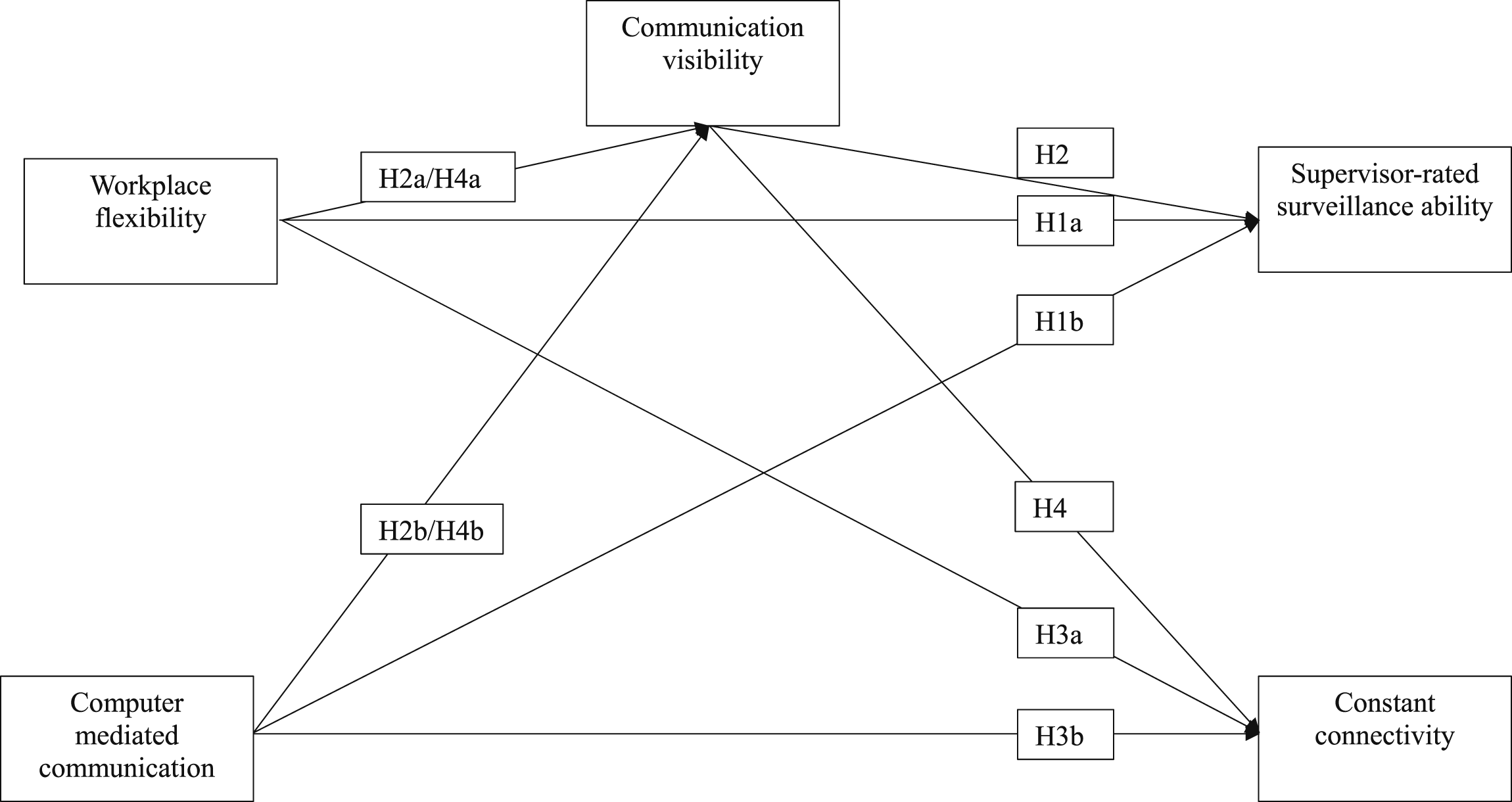
Workplace flexibility (a) and CMC frequency (b) are positively associated with constant connectivity.
Workplace flexibility (a) and CMC frequency (b) are positively related to communication visibility, which in turn is positively related to constant connectivity.
Method
Sample
Data were collected at a large multinational organization operating in the industrial machinery industry by providing automation and integration solutions to business clients. The organization is headquartered in the Nordics but operates in 300 locations in 50 countries. Employees worked in a team structure, where supervisors were responsible for annual personal development discussions with each employee. In addition to these official performance evaluations, employees were encouraged to discuss their performance and work climate in their teams continuously. Office personnel in all locations around the world could work remotely and adjust their work schedules. According to the company policy, a flexible working culture was embraced, consisting of flexible work schedules with a mix of office work, remote work, or hybrid work.
We obtained access to the organization through our company liaisons, who provided access to human resource data as well as the contact details of employees and supervisors who were targeted for an online questionnaire. We included only employee responses for which corresponding supervisor data was available. The response rate for the employee survey was 15.5% (N = 1127), while the response rate for the supervisor survey was 37.4% (N = 539). Employees were matched to their respective supervisors, resulting in 539 dyads. We ensured that each dyad was unique by retaining only one employee per supervisor in the dataset. This approach prevented non-independence in the data structure and allowed for a clear interpretation of the findings.
Most employees were male (74.8%), which aligns with the company demographics. The average age of the respondents was 43.40 years (SD = 10.92), and they reported an average organizational tenure of 8.42vyears (SD = 8.60). On average, they worked 39.55 hours per week (SD = 3.51) spread across 4.5 workdays (SD = 1.58). The data included responses from 38 countries, including the United States (22.6%), Sweden (7.4%), United Kingdom (6.7%), Italy (6.5%), China (5.4%), and Malaysia (4.5%).
The supervisor survey was administered two weeks after the employee survey was closed. The majority of supervisors identified as male (84%), and their average age was 47.19 years (SD = 8.54). They worked at the company for an average of 10.57 years (SD = 9.30) and reported an average work week of 39.79 hours (SD = 1.73). The supervisors were from 28 different countries as some employees had remote supervisors working in another country. The supervisors were from countries including the United States (23.6%), Sweden (8.5%), Italy (6.7%), China (5.6%), and Malaysia (4.5%).
Measures
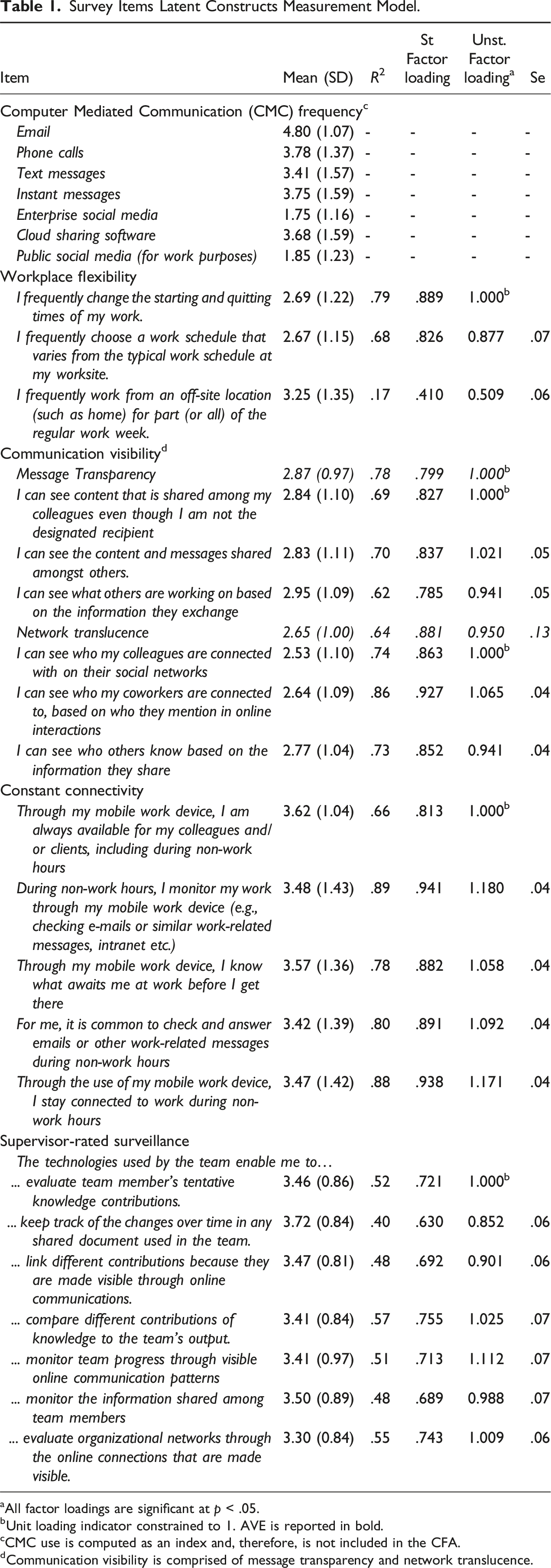
Survey Items Latent Constructs Measurement Model.
aAll factor loadings are significant at p < .05.
bUnit loading indicator constrained to 1. AVE is reported in bold.
cCMC use is computed as an index and, therefore, is not included in the CFA.
dCommunication visibility is comprised of message transparency and network translucence.
Workplace Flexibility
In this study, workplace flexibility refers to the flexibility employees have to adjust their work schedules and locations (Shockley & Allen, 2007). We measured workplace flexibility using three statements based on Halinski and Duxbury (2020).
CMC Frequency
CMC frequency refers to individuals’ self-reported frequency of organizational communication technology used to interact with their colleagues. We assessed the frequency of use of various technologies (ranging from (1) never to (6) hourly), including email, online conferencing, text or instant messaging, enterprise and public social media, and collaboration tools. In line with previous research on CMC and remote work, we created an overall index of CMC frequency by summing the responses related to individual technologies (Hoch & Kozlowski, 2014; Van Zoonen & Sivunen, 2022). Higher scores indicate a greater frequency of mediated communication with colleagues.
Communication Visibility
We conceptualize communication visibility as the extent to which CMC enables individuals to see what others know and whom others know (Leonardi, 2015). We adopted six items from van Zoonen et al. (2021).
Constant Connectivity
Constant connectivity refers to workers’ extended connectivity to work through CMC. We adopted five items from Büchler et al. (2020) to measure constant connectivity.
Supervisor-Rated Surveillance
Supervisors were asked to what extent the technologies used in the organization allowed them to engage in various surveillance and monitoring behaviors. We adapted seven items previously deployed by Malhotra and Majchrzak (2012) and Malhotra et al. (2007) to measure surveillance.
Analysis
To ensure the validity and reliability of our measurement instrument, we first estimated a measurement model. Subsequently, we tested our hypotheses by estimating a structural equation model. Indirect effects were estimated using bootstrapping procedures (5,000 resamples) to obtain bias-corrected parameter estimates and confidence intervals. Partial mediation was examined by exploring whether the direct effects remained significant when accounting for the mediator (i.e., communication visibility).
We evaluated the model fit of our models using various indices, including the chi-square/df ratio, Tucker-Lewis Index (TLI), Comparative Fit Index (CFI), Root Mean Square Error of Approximation (RMSEA), and Standardized Root Mean Square Residual (SRMR). A chi-square/df ratio below 3, TLI and CFI values greater than .95, and RMSEA and SRMR values less than .06 indicate a good model fit (Hu & Bentler, 1999).
Notably, we examined the influence of various control variables, including gender, age, tenure, supervisor age, supervisor gender, and supervisor tenure. However, because we did not hypothesize their influence, we do not have strong theoretical grounds for their inclusion, there is no assumption that their inclusion would “purify” the results (Spector & Brannick, 2011, p. 296), and they were not found to influence the hypothesized relationships, we present the results from the more parsimonious hypothesized model without the controls (Kline, 2023).
Results
Measurement Model
Reliability and Validity Statistics.
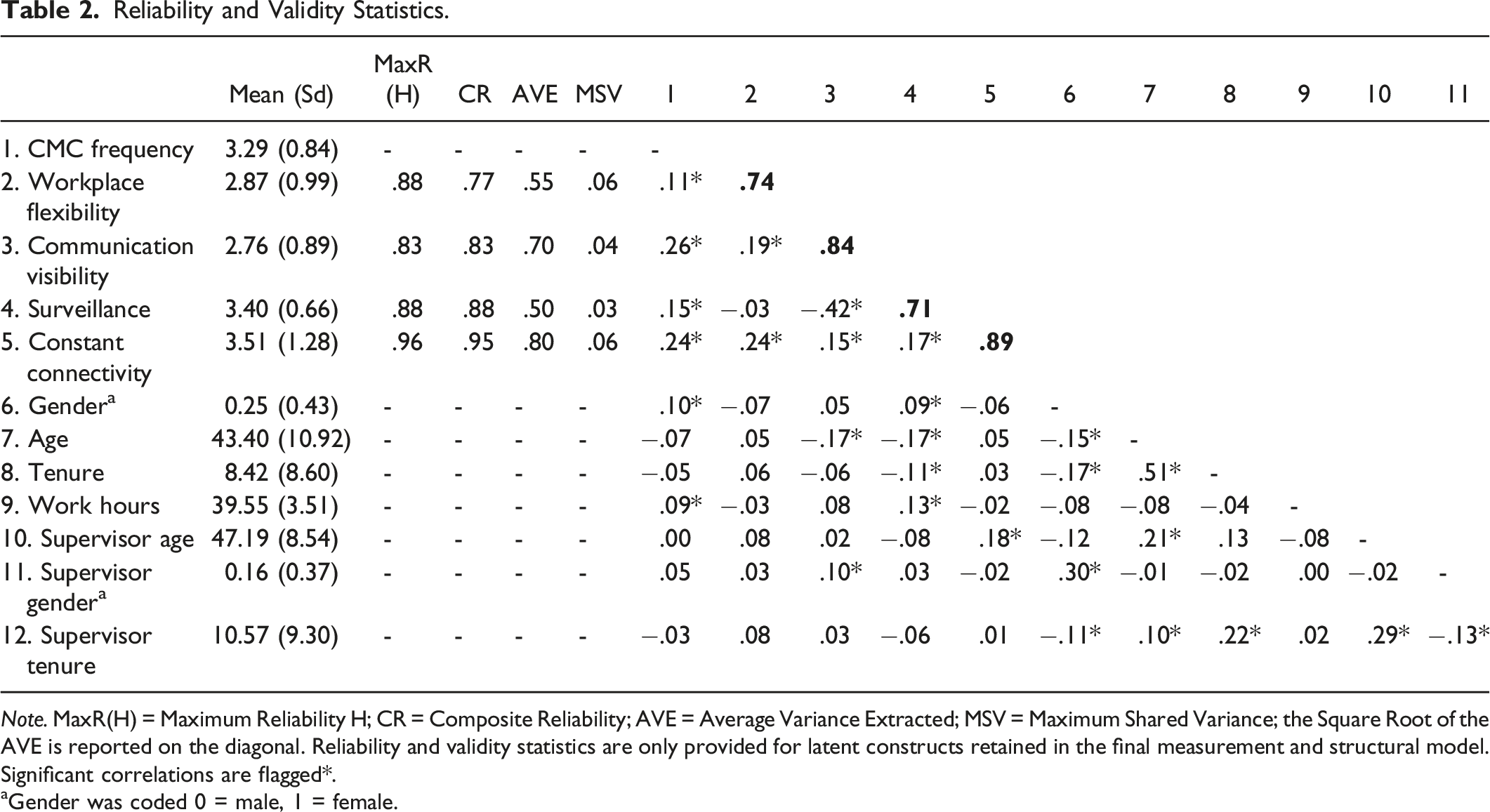
Note. MaxR(H) = Maximum Reliability H; CR = Composite Reliability; AVE = Average Variance Extracted; MSV = Maximum Shared Variance; the Square Root of the AVE is reported on the diagonal. Reliability and validity statistics are only provided for latent constructs retained in the final measurement and structural model. Significant correlations are flagged*.
aGender was coded 0 = male, 1 = female.
Structural Model
Hypotheses Testing
Hypotheses and Results.
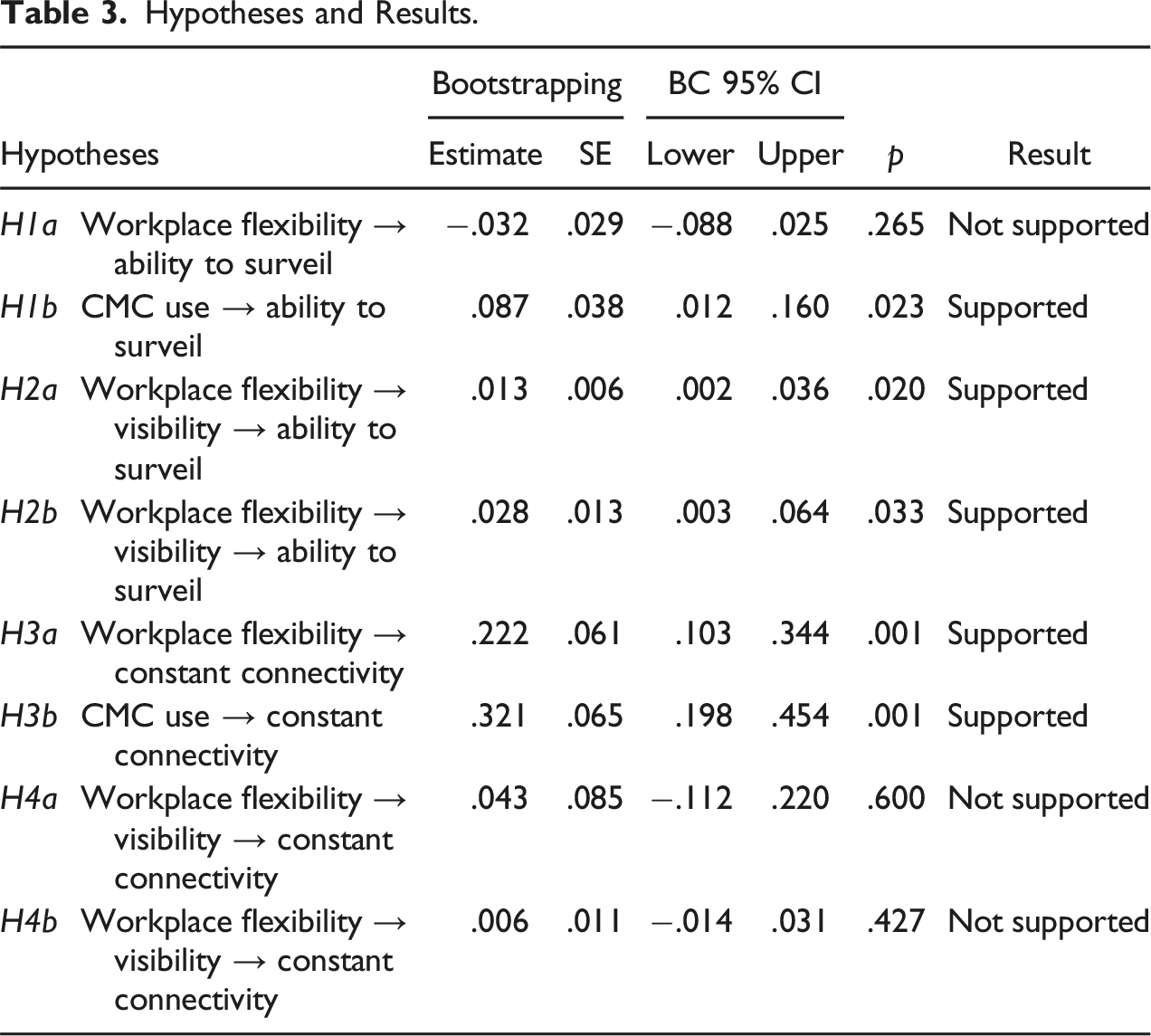
Hypothesis 2 reflects the assumption that workplace flexibility and CMC frequency positively relate to supervisors’ ability to surveil their subordinates through communication visibility. The findings demonstrate a significant relationship between workplace flexibility and supervisor-rated surveillance through communication visibility (B = .013, CI 95% .002; .036, p = .020). In addition, the findings demonstrate a positive and significant indirect relationship between CMC frequency and supervisor-rated surveillance through communication visibility (B = .028, CI 95% .003; .064, p = .033). These results support H2a and H2b.
Hypothesis 3 articulated that (a) workplace flexibility and (b) CMC frequency are positively associated with constant connectivity. The results indicate that workplace flexibility positively relates to constant connectivity (B = .222, CI 95% .103; .344, p = .001). In addition, CMC frequency is positively associated with constant connectivity (B = .321, CI 95% .198; .454, p < .001). These results support hypotheses 3a and 3b.
Finally, hypothesis 4 posits that workplace flexibility and CMC frequency positively relate to constant connectivity through communication visibility. Notably, the results indicated that communication visibility was not significantly associated with constant connectivity (B = .043, CI 95% −.112; .220, p = .600). As a result, the mediator does not carry an effect to the outcome resulting in the indirect relationships failing to reach significance. The findings indicate that the relationship between workplace flexibility and constant connectivity through communication visibility is not significant (B = .006, CI 95% −.014; .031, p = .427). In addition, the relationship between CMC frequency and constant connectivity through communication visibility was not significant (B = .013, CI 95% −.033; .061, p = .570). Hence, the findings do not support hypotheses 4a and 4b.
Discussion
This study reveals that workplace flexibility is not directly associated with supervisors’ ability to surveil and monitor employees. However, CMC frequency is positively and directly associated with supervisors’ ability to assess employees’ knowledge contributions and online interactions, as well as indirectly through communication visibility. Specifically, employees’ CMC enables supervisors’ surveillance, partly through higher visibility of knowledge and networks. For instance, supervisors reported being able to evaluate employees’ tentative knowledge contributions and link different contributions made visible through online communication. CMC frequency was related to supervisory monitoring abilities because it facilitated greater visibility into organizational networks and messages—that is, it enhanced supervisors’ ability to observe and evaluate workers’ communication and knowledge contributions. Furthermore, the findings suggest that workplace flexibility and CMC are directly associated with connectivity, irrespective of the extent to which these contexts facilitate communication visibility. This indicates that employees who work flexibly and rely on CMC tend to expand their connectivity by remaining accessible to colleagues and engaged with their work, regardless of how visible their communication is to others – including supervisors.
Theoretical Implications
The findings have several implications for theorizing about communication visibility in an age of workplace flexibility and mass employee surveillance. First, while technological advancements have been recognized as expanding computer-aided supervisory monitoring for at least three decades (Aiello, 1993), the increasing prevalence of workplace flexibility has led many organizations to double down on employee surveillance and monitoring (Aloisi & De Stefano, 2022). Interestingly, our findings suggest that greater temporal and spatial flexibility does not affect supervisors’ reported ability to surveil their subordinates. Employees’ CMC frequency was positively related to supervisors’ perceived ability to monitor and evaluate their team members. This aligns with recent findings that technology-mediated work practices may extend the scope and reach of employee surveillance (de Vaujany et al., 2021). Importantly, the mediating role of communication visibility in the relationship between work flexibility and supervisors’ perceived surveillance ability indicates that managers feel more capable of enacting surveillance practices as opportunities arise, not merely out of a need to supervise employees who work flexibly.
One might view the relationships in this study and the different effects of workplace flexibility and communication visibility as a distinction without a difference; after all, the same CMC that enables workplace flexibility also increases communication visibility. However, we argue that understanding communication visibility as a mediator of managerial surveillance abilities has two important implications. First, individuals may opt for non-traditional, distributed work arrangements for various reasons, such as meeting individual needs and preferences, balancing care and professional obligations, or protecting and enhancing personal well-being. This implies an inevitable tradeoff between flexibility and the level of surveillance, which paints a rather bleak picture of the future of work. Alternatively, when communication visibility is seen as a driver of surveillance, it offers more potential for workers to exhibit agency over the types of behaviors and networks they engage in and, in turn, how the organization evaluates those behaviors. Although the required CMC in remote work inherently makes communication visible in new and different ways, research demonstrates that when workers are aware that their behaviors and networks can be monitored by management, they can develop creative, situated ways to make their activities and connections more or less visible in a manner that reasserts control over work (Treem et al., 2023). Hence, centering communication visibility as the mechanism driving surveillance can offer new avenues for forms of visibility management by workers.
Second, viewing surveillance more as a product of opportunity—where supervisors perceive they can monitor employees because the information is readily available—rather than an inevitability required by the work arrangements indicates that managers’ decisions regarding surveillance practices are context-dependent and may be more malleable than previously thought. Although managerial surveillance is often attributed to efforts to control workers and extract optimal labor, many contemporary monitoring efforts may be driven by supervisors’ curiosity, perceived convenience, or even complacency. The multidimensional nature of communication visibility offers different avenues to counter the increased perception of surveillance capabilities among supervisors. One path is to communicate to managers more explicitly that they have agency in utilizing their perceived ability to surveil. Another option is to design the implementation of CMC to limit managers’ access to data regarding workers’ practices and connections, thereby affecting their perceived ability to monitor. The former approach encourages potential observers to manage visibility by consciously limiting what they see, and the latter leverages the material aspects of technology to manage users’ visibility. Both of these strategies demonstrate the theoretical value of a communication visibility perspective and indicate how research on visibility management can incorporate observers’ perceptions (e.g., managers’ reported ability to surveil) and the socio-material context of work (e.g., features of digital tools and the ways they are used), in addition to the common focus on actors’ activities and networks (e.g., ways that workers are visible).
More broadly, this study indicates how CMC frequency, communication visibility, surveillance, and connectivity all contribute to a logic of extraction among contemporary organizations in which companies seek to gather as much information as possible from technology users (Sadowski, 2019). As this study shows, when this data is available, organizations and their members are more likely to use it and see related outputs as valid representations of reality. The datafication of work then feeds into efforts to develop new metrics, rankings, scores, and other evaluative tools that quantify workers’ behaviors (Aaltonen & Stelmaszak, 2023). Ongoing work is needed to examine how aspects of communication visibility are adapted by organizations and managers as a means of evaluating workers and work practices.
The findings regarding a lack of association between connectivity and communication visibility was somewhat surprising considering previous evidence of this relationship (e.g., Büchler et al., 2020; van Zoonen et al., 2021, 2023). Research has argued that connectivity and supplemental work can result from the widespread availability of information (i.e., communication visibility) that creates an expectation (Mazmanian, 2013; Van Zoonen, Treem, & Sivunen, 2023) and pressure to act upon that information (van Zoonen et al., 2021). However, our findings indicate that workplace flexibility and CMC frequency are associated with constant connectivity to work regardless of increased communication visibility. Notably, while the bivariate correlations indicated a positive relationship between visibility and constant connectivity, this relationship did not hold in the structural models where CMC frequency and remote work directly and significantly predicted constant connectivity.
In addition, our findings demonstrate a moderate positive correlation between CMC use and constant connectivity. This implies that more CMC use is associated with higher levels of connectivity. Research has shown that CMC use enables different connectivity states, including requisite connectivity (i.e., connective flow: Dery et al., 2014), and also affords disconnection (Gibbs et al., 2013). In line with previous findings emphasizing that increased digital communication does not necessarily result in constant connectivity (Leonardi et al., 2010; Mazmanian, 2013), our results show a moderate relationship highlighting the need to consider how technology is enacted in practice.
Furthermore, our assumed partial mediation analysis tested whether visibility explained the link between CMC use, remote work, and connectivity, but the non-significant path between visibility and connectivity indicated that this assumption was not supported. Instead, CMC use and remote work emerged as direct and stronger predictors of connectivity, suggesting that they function as more immediate and robust drivers of constant connectivity than visibility. Our study aligns with earlier research, as evidenced by the positive and significant correlation between visibility and connectivity. However, the lack of a significant association in our structural models and mediation analysis suggests that scholars should consider competing or alternative explanations to more robustly assess the relationship between visibility and its implications—here, for connectivity. Future research should further examine whether visibility operates as a contextual condition rather than a direct driver, or whether its effects depend on unexamined moderators that shape how employees engage with visible communication.
Practical Implications
Interestingly, the findings of the study suggest that increased temporal and spatial flexibility within the workforce does not automatically lead to heightened surveillance and monitoring practices. While the abrupt transition to remote work during the pandemic drew an incredible amount of attention to employee surveillance and monitoring practices (Ball, 2021), our findings indicate that technological opportunities and communication visibility facilitate surveillance. Hence, organizations should be aware that technology use by all workers—remote, distributed, or co-located—can spark supervisors’ surveillance and monitoring practices, and they should consider implementing appropriate policies and guidelines to ensure ethical and effective monitoring practices (White et al., 2020).
Furthermore, our findings indicate that communication visibility is important in facilitating surveillance and monitoring practices. As such, organizations should recognize that increased visibility of communication and networks can lead to increased surveillance opportunities for supervisors. Both message transparency and network translucence are inherently performative, meaning employees have opportunities to curate their knowledge and the communication networks they seek to make visible. This also raises important questions about the target of supervisors’ surveillance and monitoring practices. For instance, organizations that view the results of surveillance efforts as objective reflections of workers’ practices risk rewarding the activities of employees who engage in misleading, deviant, or opportunistic practices designed to evade surveillance (Aaltonen & Stelmaszak, 2023). From the perspective of organizational policies, surveillance is shaped by a complex interplay of control and privacy concerns. D’Urso (2006) reminds us to consider how panoptic effects—the feeling of being constantly surveilled by communication technologies—are driven by both technological and organizational factors. Policies that govern employee monitoring may set expectations, while inconsistent enforcement or lack of transparency can lead to confusion and resistance from workers (Cox et al., 2005). Effective policies must balance organizational needs for security and productivity with employees’ right to privacy, ensuring clear communication and ethical practices in the digital workspace (D’Urso, 2006; Watkins Allen et al., 2007).
Finally, supervisors should be educated about the implications of digital surveillance and monitoring practices. The findings highlight that managers enact surveillance practices as they become opportune. Organizations should provide training and guidance to managers on ethical surveillance practices, respecting employee privacy, and avoiding excessive surveillance that can lead to distrust and disengagement. Relatedly, managers and organizations should acknowledge the likelihood, even inevitability, that workers engage in their own forms of surveillance, countersurveillance, and resistance in efforts to manage visibility (Ganesh, 2016). Competing efforts by workers and supervisors to manage visibility, navigate surveillance efforts, and influence evaluations can produce unintended consequences (Treem et al., 2023). While surveillance may be driven by increased visibility, organizations should be mindful of the potential negative, or unpredictable, effects on employees.
Limitations and Future Research Directions
Several limitations of the study should be considered. First, while we draw from multi-sourced data and the surveillance measure was taken two weeks after the initial survey, the employee survey was single-sourced and cross-sectional. This prevents us from drawing any conclusions about causality. Second, the findings reported here are based on a sample from a single organization. While employees were recruited from different branches of the organization across the globe, the generalizability of the findings beyond the context of this study may be limited. Third, the current study examined antecedents of supervisors’ surveillance practices. While we considered it important to measure employees’ perceptions of their visibility to study visibility management in remote work, our study is limited in showing how observers’ visibility (i.e. supervisors’ perceived visibility to their employees’ communication) may be associated with supervisors’ surveillance practices. Future research could explore whether supervisors actually perceive that their ability to observe workers’ communication through CMC has enhanced and what are the ramifications of this enhanced visibility to their surveillance practices.
It is also important to note that worker surveillance and monitoring issues are always intimately shaped by differences in power, positionality, and privilege. A more direct, explicit critical examination of surveillance practices in organizations is needed but beyond the scope of what is examined in this research. In particular, there is a need to examine surveillance and monitoring in non-capitalistic economies, the potential role of bias and prejudice in practices, and ways the relationships operate in more diverse organizational settings. Future research may seek to explore how cultural and contextual factors shape surveillance dynamics in the workplace. For instance, Kayas (2023) suggested that new insights on electronic surveillance could be developed by examining the context within which technology is adopted.
Furthermore, it will be interesting to explore to what extent organizations sort through or monitor the glut of digital traces employees leave behind as by-products of their work (Leonardi, 2021). Such studies may focus on how employees’ professional identities are shaped and represented in various data sources, and what information is made visible to whom in the organization. Different layers of communication visibility might exist in parallel in the same organization, if, for instance, certain information is shared among coworkers through communication technologies with restricted visibility compared to what is visible to supervisors. In addition, it is interesting to explore to what extent surveillance practices and perceptions of being under surveillance affect overall worker experiences in a datafied work environment.
Finally, future studies may explore how these dynamics are shaped by different organizational policies and legal frameworks. For instance, organizational policies are important in shaping how and when electronic surveillance is used (D’Urso, 2006) and, as a result, to what extent workers may engage in different compliance and resistance tactics, for instance, through privacy management (Watkins Allen et al., 2007). Ultimately, bringing organizational policies on surveillance into scope will help tease out how such structural aspects in the digital work environment help shape employee communication (e.g., connectivity behavior) and surveillance in mutually reinforcing ways. Similarly, the nature and extent of surveillance reflected in organizational policies may affect perceptions of privacy (Cox et al., 2005) and motivate employees to carefully consider when and what is made visible to whom in remote and digital work.
Conclusions
This study provides novel insights into surveillance practices, communication visibility, and constant connectivity in the context of workplace flexibility and CMC. The findings revealed a complex tradeoff for employees in which their reachability to colleagues through CMC also enhances supervisors’ reported ability to monitor them. We further demonstrate that communication visibility is an important mediator between workplace flexibility, CMC frequency, and supervisors’ perceived ability to surveil their subordinates. Hence, the extent to which communication is made visible provides important opportunities for supervisors to feel more capable of increasing their surveillance activities.
We hope this study inspires further exploration. For instance, this study raises broader questions about visibility-surveillance dynamics in a digitalized environment. The increasing reliance on communication technologies, regardless of work location, blurs the boundaries between remote and office-based work as CMC use produces a glut of data and digital exhaust that creates a challenge between privacy and monitoring (Leonardi, 2021). The intersection of flexibility, connectivity, and surveillance invites further inquiry into how organizations manage these tensions and how employees navigate the trade-offs between autonomy and monitoring. Future research should examine the implications of these dynamics across diverse organizational settings, considering how workers and managers adapt to and interpret the visibility of digital traces in their daily work.
Footnotes
Declaration of conflicting interests
The author(s) declared no potential conflicts of interest with respect to the research, authorship, and/or publication of this article.
Funding
The author(s) disclosed receipt of the following financial support for the research, authorship, and/or publication of this article: This study is supported by Kulttuurin ja Yhteiskunnan Tutkimuksen Toimikunta (356143).
