




Abstract
Background:
Adolescent baseball pitchers are vulnerable to upper-extremity injuries because of the repetitive, high-stress nature of throwing movements. While shoulder strength and range of motion (ROM) are commonly measured, they are often interpreted in isolation during injury prevention assessments.
Purpose:
To determine the relationship between clinical measures (shoulder ROM and strength) and throwing arm joint kinetics in adolescent baseball pitchers.
Study Design:
Descriptive laboratory study.
Methods:
This study was conducted in a laboratory setting. A total of 43 adolescent baseball pitchers (age, 15-18 years) were recruited through convenience sampling. Participants underwent clinical assessments of shoulder ROM and isokinetic concentric strength testing. Pitching biomechanics were analyzed to obtain elbow valgus torque, shoulder distraction force, shoulder internal rotational (IR) torque, and ball velocity. A stepwise linear regression analysis was performed to assess shoulder strength and ROM as predictors of pitching kinetics and ball velocity.
Results:
A stepwise regression analysis showed that elbow valgus torque (92.1 ± 24.9 N·m) was positively associated with increased shoulder IR strength at 60 deg/sec and negatively associated with total arc ROM (IR strength, 68.3 ± 17.3 N·m; total arc, 172.8°± 19.2°; adjusted R2 = .258; P < .001). Peak shoulder distraction force (1238.9 ± 361.2 N) was positively associated with shoulder external rotation (ER) strength at 60 deg/sec (41.3 ± 10.8 N·m; β = .465; adjusted R2 = .197; P = .002). Peak shoulder IR torque (113.7 ± 37.4 N·m) was positively associated with shoulder IR strength (β = .421; adjusted R2 =.157; P = .005). Higher ball velocity (125.9 ± 8.7 km/h) was linked with higher shoulder IR strength (β = .390; adjusted R2 =.131; P = .010). There were moderate to strong positive relationships between ball velocity and pitching kinetics (Pearson’s r value: valgus torque, 0.603; distraction force, 0.594; shoulder IR torque, 0.865; P < .001).
Conclusion/Clinical Relevance:
Pitchers with greater shoulder IR strength and reduced total arc ROM demonstrated increased elbow valgus torque at maximal shoulder ER during pitching. Although IR strength is crucial for generating ball velocity, maintaining total arc ROM within an optimal range will help reduce elbow joint stress. In addition, shoulder ER was positively associated with peak shoulder distraction force. Monitoring ER strength may help identify potential fatigue or imbalance, allowing for timely clinical attention.
The repetitive, high-intensity demands of pitching place baseball players, especially adolescents, place them at increased risk for upper-extremity injuries because of their unique developmental challenges. 27 In high school baseball, elbow and shoulder injury rates are 0.86 and 1.39 per 10,000 athlete exposures, respectively, with 25.3% of elbow and 15.7% of shoulder injuries resulting in removal from play for over 3 weeks. 26 Proper throwing mechanics, close monitoring, adjusting workloads, and physical adaptation are vital to minimize stress on the developing musculoskeletal system and prevent overuse injuries in adolescent athletes. 17
While external factors such as pitch counts and playing for multiple teams contribute to upper-extremity injuries, internal factors, such as shoulder range of motion (ROM) and strength, have been studied as modifiable risk factors.18,21,28,29,32,36 Throwing shoulders with a total arc glenohumeral ROM deficit of ≥5° increases elbow injury by 2.6 times, with a minimum total arc of 160° recommended to reduce risk.4,16,36 Internal rotation (IR) deficits (≥25°) also raise the likelihood of arm injuries 4-fold in high school baseball players, while the dominant arm lacking at least ≥5° external rotation (ER) compared with the nonthrowing arm is associated with a higher risk of upper-extremity injury and surgical intervention.7,28,37 Because of greater humeral retroversion, overhead-throwing athletes typically exhibit increased ER and decreased IR ROM, making total arc ROM a useful metric to account for bony adaptation.4,13,16,19,31 Recently, Strokes et al 30 reported that collegiate pitchers with a lower ER/IR ROM ratio experienced greater medial elbow loading and proximal shoulder forces. Baseball pitchers also demonstrate unique shoulder strength, with greater IR strength relative to ER strength in the throwing arm.14,15 Weakness of shoulder rotational strength, particularly in ER during preseason screening, has been linked to upper-extremity injuries—including some requiring surgery.3,6,29 To monitor the imbalances and assess injury risk, shoulder strength is often evaluated using the ratio of ER to IR. 8 These findings emphasize the importance of shoulder ROM and strength in injury prevention. However, it remains unclear how these factors, such as joint loads while pitching, impact injury risk in adolescent baseball pitchers.
Advances in 3-dimensional (3D) motion capture have enhanced injury-prevention research by enabling precise measurement of joint loading during pitching.2,14,20 Its application in adolescent pitchers has reinforced the importance of continued research to inform injury prevention in younger populations. 20 To better understand joint stress, shoulder ROM, and strength are often studied in conjunction with throwing mechanics.15,16 In adolescent baseball pitchers, IR strength is positively associated with shoulder ER moment during pitching, while decreased ER ROM is linked to higher elbow valgus torque. 15 However, in collegiate baseball pitchers, increased ER ROM is related to increased elbow valgus torque. 17 The findings indicate that both shoulder ROM and strength are critical contributors to joint stress during baseball pitching, but specific populations should be targeted and interpreted differently. The recent studies highlight the value of total arc differences, ROM ratios, and strength ratios in capturing the unique functional profile of the throwing arm.6,8,29,30,36 Building on this foundation, it is important to determine the most critical metrics and explore how they relate to joint kinetics during pitching in adolescent baseball pitchers. Such an understanding may help guide targeted interventions to reduce injury risk. Therefore, our study aimed to determine the relationship between clinical measures (shoulder ROM and strength) and throwing arm joint kinetics in adolescent baseball pitchers. Our primary hypothesis was that limited total arc ROM and decreased shoulder ER strength would be associated with increased elbow valgus torque at maximal shoulder ER during pitching. Our secondary hypothesis was that decreased total arc ROM and increased IR strength would be related to increased shoulder distraction force and IR torque during pitching.
Methods
Experimental Approach and Study Design
This study employed a cross-sectional, retrospective design using convenience sampling. A total of 43 healthy participants aged 15 to 18 years received clinical and biomechanical evaluations of pitching on the same day. Pitchers with a history of upper-extremity injuries, with or without surgical intervention, were included if cleared by their surgeons and fully returned to play. Participants were excluded if they had an ongoing injury with their throwing arm or could not pitch with maximum effort. Data were collected in the pitching laboratory at the University of Nebraska at Omaha. The institutional review board at the University of Nebraska Medical Center approved this study, and participants or their guardians provided consent documentation before data collection.
Procedures
Data collection began with a custom demographic questionnaire that included age, weight, height, and hand dominance. Participants had shoulder ROM and strength assessed first, followed by biomechanical pitching evaluations. Shoulder ROM of the dominant and nondominant arms was measured by 2 certified athletic trainers (T.I., S.J.W.) with >5 years of experience in overhead athlete assessment, using a standard goniometer. 16 Participants were positioned supine on a standard plinth with the shoulder abducted to 90° and the elbow flexed to 90°. The upper arm was kept parallel to the table to avoid horizontal abduction of the shoulder. For the IR measurement, the anterior shoulder was stabilized, and the arm was internally rotated until a firm end-feel was detected. To measure ER, the clinician stabilized the scapula's lateral border with their hand before rotating the arm externally to reach a firm end-feel. The dominant arm was assessed first, and each ROM was measured once.
Bilateral shoulder isokinetic concentric strength was measured using an isokinetic dynamometer (Biodex Medical Systems, Inc). A certified athletic trainer and a biomechanist (T.I., T.O.), both with >5 years of experience, conducted the strength assessments. The testing was performed at an angular velocity of 60 deg/sec. Participants were seated, with the shoulder abducted to 90° and the elbow flexed to 90° to ensure consistent alignment and ROM during testing (Figure 1). Each participant completed 5 maximal-effort repetitions of ER and IR for both arms, with a minimum of 2 minutes of rest between arms to minimize fatigue. Testing was standardized by assessing the right arm first for all participants, regardless of their dominant side. This protocol measured peak ER and IR strength for dominant and nondominant arms. These measurements were used to calculate strength ratios (ER/IR) and inter-arm strength deficits to assess functional asymmetry.

Shoulder strength positioning by Biodex with a seated position.
Biomechanical analysis of pitching was performed using a 3D motion capture system (Qualisys AB) and a custom force-plate array (1280 Hz, Bertec) embedded in the pitching mound.1,16 After placing and securing 41 reflective markers on anatomic landmarks (Figure 2), the participants completed a warm-up based on their self-selected routine. Once the participant was ready to pitch, they threw a baseball from the pitching mound to a pitching net with a strike zone 17 meters away. Participants threw roughly 20 pitches (5 fastballs, followed by 5-10 breaking and off-speed pitches, and then 3-5 additional fastballs). To reflect realistic bullpen-like conditions and allow pitchers to follow their typical warm-up progression, breaking and off-speed pitches were included between sets of fastballs. The type and distribution of breaking and off-speed pitches were self-selected by each pitcher. A motion analysis system with 18 high-speed marker-based motion capture cameras (Qualisys AB) operating at a sampling rate of 320 Hz was utilized to capture the pitching motion. Marker data were tracked using Qualisys Track Manager and exported via the project automation framework. The tracked marker data were processed using a 6th-order low-pass Butterworth filter with a cutoff frequency of 20 Hz. Ball velocity was measured using a radar gun (Stalker Radar).

Reflective markers placement on anatomic landmarks.
For kinetic outcomes, elbow valgus torque was measured at maximal shoulder ER (Figure 3). 2 Peak shoulder distraction force was measured following ball release (Figure 4). Additionally, peak shoulder IR torque was calculated to assess the rotational stress on the anterior shoulder, which typically occurs just before max ER.

Pitching biomechanical evaluation captured at maximal shoulder external rotation.
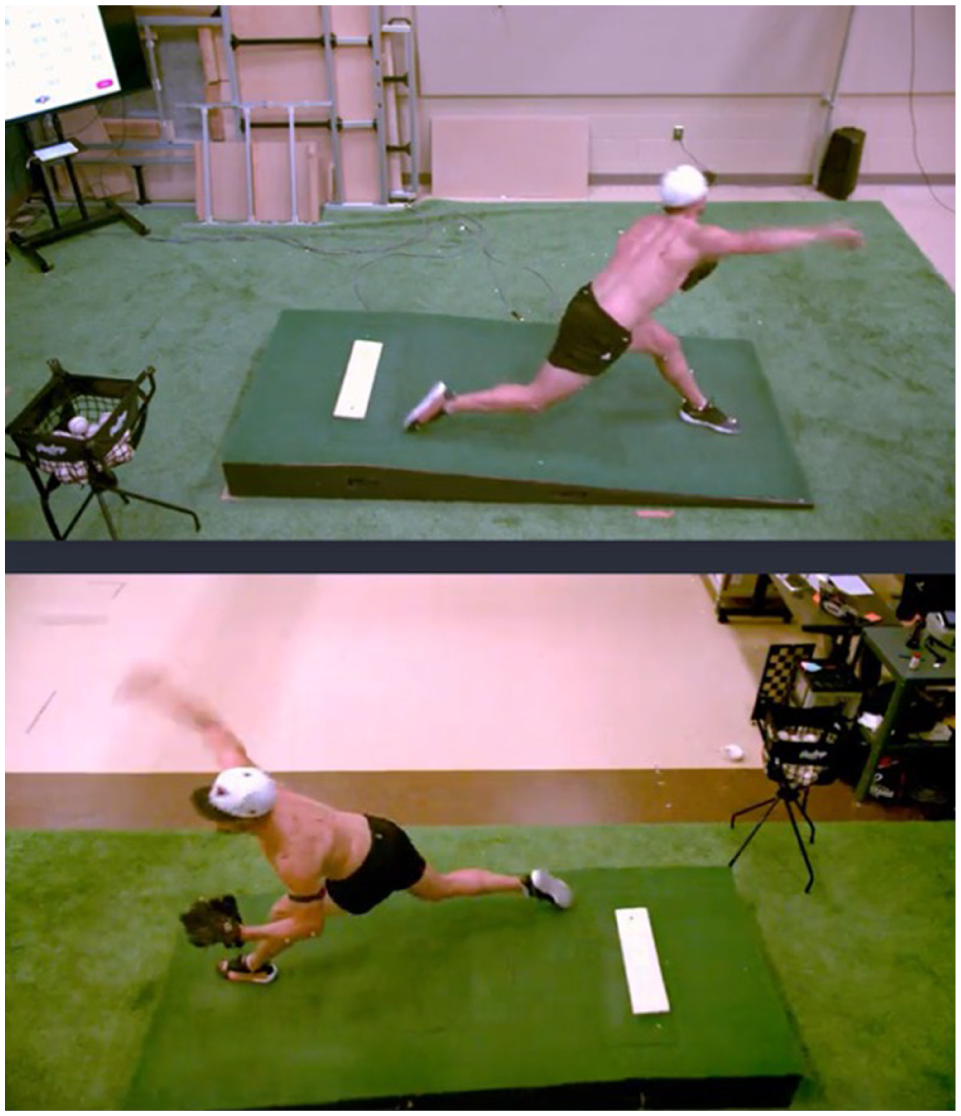
Pitching biomechanical evaluation captured at the moment of the peak distraction force.
Data Analysis
Clinical shoulder ROM variables included IR, ER, total arc of motion, ER/IR ratio, and the bilateral difference in total arc of motion. Total arc of motion was defined as the sum of ER and IR ROM, and the bilateral difference in total arc of motion was calculated by subtracting the nondominant arm from the dominant arm. The ER/IR ratio was calculated as ER divided by IR ROM on the dominant arm. 30 To facilitate data interpretation, all strength metrics were converted from foot-pounds (ft-lb) to newton-meters (N·m). Rotational angles corresponding to peak torque for ER and IR strength were recorded during isokinetic testing, with the neutral starting position defined as 0° (Figure 1). IR was defined as the positive direction from this position. Shoulder strength variables included peak torques of ER and IR, ER/IR ratio of the dominant arm, and ER and IR bilateral strength differences (calculated by subtracting the non-dominant arm from the dominant arm). Kinetic variables were extracted from the motion analysis report system (Qualisys Report AB). Kinetic outcomes and ball velocity were calculated using the mean of the 3 fastest 4-seam fastballs thrown by each pitcher.
A stepwise linear regression analysis was conducted to evaluate shoulder strength and ROM variables as predictors of elbow valgus torque, shoulder distraction force, shoulder IR torque, and ball velocity using IBM SPSS Statistics software Version 29.0 (IBM Corp). In total, 9 clinical variables—5 from shoulder ROM (IR, ER, total arc, ER/IR ratio, and total arc difference) and 4 from shoulder strength (peak ER, peak IR, ER/IR strength ratio, and bilateral strength differences)—were used as independent variables in the stepwise regression models. Significant predictors were identified based on standardized beta coefficients, while model adequacy was assessed using adjusted R2 values. Subsequently, Pearson correlation coefficients were calculated to examine the relationships between ball velocity and kinetic metrics as a secondary analysis to validate our biomechanical dataset. Statistical analyses were performed with an alpha level set at .05. Correlation coefficients (R) were interpreted as follows: 0.00 to 0.19 as negligible, 0.20 to 0.39 as weak, 0.40 to 0.59 as moderate, 0.60 to 0.79 as strong, and 0.80 to 1 as very strong. 11
Results
Physical Characteristics
A total of 43 adolescent pitchers participated in the study (age, 16.8 ± 1.07 years; mass, 83.3 ± 13.6 kg; height, 182.4 ± 5.7 cm) (Table 1). Among them, 14 participants were left-handed pitchers. The mean biomechanical variables for all participants are detailed in Table 2. The mean joint angle at which peak ER strength occurred was 37.4°± 7.9° IR from the starting position, while the mean angle for peak IR strength was 27°± 21.1° IR from the starting position for the dominant shoulder (Table 1).
Physical Characteristics of the 43 Participants a

Total arc difference was calculated by subtracting the nondominant arm total arc from the dominant arm total arc. ER, external rotation; IR, internal rotation; ROM, range of motion.
Biomechanical Variables a

IR, internal rotation; MER, maximal external rotation.
A stepwise linear regression revealed that higher elbow valgus torque (92.1 ± 24.9 N·m) was associated with increased shoulder IR strength at 60 deg/sec and decreased total arc of motion (IR strength, 68.3 ± 17.3 N·m; Total arc, 172.8°± 19.2°; adjusted R2 = .258; P < .001), with the IR strength being the primary contributor (Table 3). Peak shoulder distraction force (1238.9 ± 361.2 N) was positively associated with shoulder ER strength at 60 deg/sec (41.3 ± 10.8 N·m; β = .465; adjusted R2 = .197; P = .002) (Table 3 and Figure 5), and peak shoulder IR torque (113.7 ± 37.4 N·m) was positively associated with shoulder IR strength (β = .421; adjusted R2 = .157; P = .005) (Table 3, Figure 5). Additionally, higher ball velocity (125.9 ± 8.7 km/h) was linked with higher shoulder IR strength (β = .390; adjusted R2 = .131; P = .010) (Table 3, Figure 5).
Regression Model for Upper Joint Kinetics and Ball Velocity a

Bold P values indicate statistical significance. Beta (β) values are reported as β for the stepwise regression. ER, external rotation; IR, internal rotation; MER, maximal external rotation.
“Entered” refers to variables that were retained in the final stepwise regression model after meeting the statistical entry criteria (e.g., significance threshold). In other words, these variables were selected by the stepwise procedure as meaningful predictors in the model.

Scatter plots illustrating the relationships between shoulder strength measurements and ball velocity with upper-extremity kinetics while pitching.
As a secondary analysis, ball velocity showed a strong positive correlation with elbow valgus torque at maximal shoulder ER (r = .603; P < .001), a moderate positive correlation with peak shoulder distraction force (r = .594; P < .001), and a very strong positive correlation with peak shoulder IR torque (r = .856; P < .001) (Table 4, Figure 5).
Relationships Between Ball Velocity and Kinetic Variables a

Bold values indicate statistical significance. IR, internal rotational.
Discussion
The present study investigated the relationship between shoulder clinical measures and throwing-arm joint kinetics during pitching in adolescent baseball pitchers. Shoulder ROM and strength metrics were selected for data analysis based on previous studies and clinically relevant factors.6,8,16,29,30,36 We found that higher elbow valgus torque was associated with greater shoulder IR strength and reduced total arc of motion (IR strength, β = .454; Total arc, –.327; R2 = .258). The finding partially confirmed our hypothesis, as decreased shoulder ROM was expected to increase elbow valgus torque. However, greater IR strength, rather than ER strength, was associated with higher elbow valgus torque. Additionally, peak shoulder distraction force and IR torque were positively associated with shoulder ER and IR strength, respectively, while no shoulder ROM metrics were included in these associations.
Elbow valgus torque has been identified as a biomechanical risk factor for ulnar collateral ligament (UCL) injuries in baseball pitchers. 2 In high school baseball pitchers, Hurd and Kaufman 15 reported an inverse relationship between ER ROM and elbow valgus stress, suggesting that decreased passive shoulder ER may increase elbow valgus torque during pitching. A reduction in ER ROM could influence the total arc of motion when considered alongside IR. 16 Our study did identify the total arc of motion and IR strength as contributors to elbow valgus torque. This suggests that any loss of rotational motion can increase valgus stress at the elbow. Therefore, the total arc of motion may provide a more comprehensive reflection of shoulder mobility and help identify pitchers who are experiencing higher valgus torque, especially when combined with greater shoulder IR strength.
Shoulder IR strength plays a critical role in generating the high rotational velocities required during the acceleration phase of pitching,9,10 and its positive associations with elbow valgus torque (r = .433), shoulder IR torque (r = .421), and ball velocity (r = .390) in our study align with previous studies.8,9,15,33
Shoulder IR torque has been suggested as a potential mechanism for anterior shoulder stress and injuries such as superior labrum anterior and posterior (SLAP) tears, and peak IR torque occurs shortly before maximum shoulder ER, which coincides with the timing of the peel-back mechanism for type 2 SLAP tear described by Burkhart et al. 5 Given the significant influence of IR strength on upper-extremity joint kinetics, however, reducing shoulder IR strength is not a viable approach due to the association with important performance metrics and its essential role for shoulder dynamic stability during pitching.9,10 Instead, clinicians should be mindful of monitoring pitching workloads and recovery times to identify pitchers with overuse or arm fatigue. 23 Importantly, higher joint loads and stress are not inherently detrimental; rather, the concern arises when high stress is combined with excessive throwing frequency and insufficient recovery time. While IR strength should be recognized as both a key performance indicator and a potential risk factor, proper workload management ensures that its adaptive benefits are maximized while minimizing injury risk.
Peak shoulder distraction force occurs during the deceleration phase, with the posterior rotator cuff muscles absorbing the majority of that rotational energy. Although the age groups differed, the positive association between ER strength and peak distraction force found in our study (r = .465) is consistent with previous research. 8 Cross et al 9 used different speeds for isokinetic strength testing, and they reported that ER strength at both 90 deg/sec and 180 deg/sec was positively associated with the compression force (equivalent to distraction force). These results suggest that as the distraction force increases, the demand for ER strength may also increase to counter the deceleration. In addition, the posterior capsule has demonstrated thickening to counteract the distraction force in the throwing arm. If the posterior rotator cuff cannot effectively dissipate energy during arm deceleration, the posterior capsule may be required to absorb the remaining energy, leading to the compensatory adaptation. 31 Increased ER strength may also be an adaptive response to the repetitive distraction force, and weakness of ER strength may lead to further thickening of the posterior capsule, which has a negative effect on the shoulder IR ROM and arthrokinematics. 31 Additionally, youth baseball pitchers with lower ER strength have been shown to experience greater IR torque at MER and during the acceleration phase. 35 This suggests that ER weakness may contribute to compensatory increases in IR torque, placing greater mechanical demands on the shoulder during pitching. Most importantly, weakness of the ER strength has been reported as a significant risk factor for shoulder and elbow injuries.6,29 Therefore, identification of ER weakness may be an early sign of posterior shoulder fatigue. In fact, baseball pitchers frequently experience arm fatigue, and previous research has identified it as a risk factor for injury. 19 The measurement of fatigue poses a challenge because of the subjectivity of the measure. However, daily or weekly strength assessments can help with early identification of arm fatigue, allowing clinicians or coaches to intervene.12,23 Strength assessments should be performed in conjunction with ROM measurements over time as several studies have shown that preseason ROM screenings, such as IR, ER, and total arc of motion alone, are insufficient as 1-time assessments for injury prevention in high school baseball pitchers24,34 Therefore, regular assessments of shoulder ROM and strength are essential to optimize care for the throwing arm and reduce injury risk with considerations of joint loads while pitching over a competitive season.
Although not a primary aim of the study, we also confirmed associations between ball velocity and kinetic variables, which align with previous studies.9,22,25 There were moderate to strong positive relationships between ball velocity and each kinetic variable (elbow valgus torque, r = .603; shoulder distraction force, r = .594; shoulder IR torque, r = .856) (Figure 5). This supports the validity of our dataset and reinforces known biomechanical demands associated with increased pitching velocity, particularly at the shoulder and elbow. These findings feature the physical demands placed on pitchers as they strive for higher performance levels. The observed associations confirm the importance of kinetic variables as critical contributors to both pitching performance and potential injury risk. For instance, while necessary for increased ball velocity, higher elbow valgus torque and shoulder distraction forces have been linked to elevated stress on musculoskeletal structures, such as the UCL and rotator cuff.2,5 This reinforces the demand for balancing performance enhancement with injury prevention strategies, such as global shoulder strengthening.
Limitations
This study has several limitations that should be recognized. While we aimed to identify key metrics of shoulder ROM and strength and to evaluate their contributions to throwing-arm joint kinetics, the cross-sectional design limits the ability to assess true cause-and-effect relationships. To establish causation among shoulder ROM, strength, and joint kinetics, future studies should adopt a prospective design to monitor how clinical and biomechanical variables evolve over a season and their role in injury occurrence. In addition, future research should investigate the influence of varying evaluation time points and include additional clinical characteristics, such as adaptations in humeral retroversion and posterior capsule thickness, to develop a more comprehensive understanding of the joint loading in the shoulder and elbow during baseball pitching motion. Another important consideration is that we did not exclude pitchers with a previous history of upper-extremity injury, nor did we collect detailed injury history. While all participants were able to pitch at full effort, previous injury could have influenced their shoulder function or mechanics. Future studies should control for injury history or compare subgroups of previously injured and uninjured pitchers to better understand how previous injury status affects joint kinetics and clinical measures. Second, this study evaluated shoulder strength using isokinetic concentric ER and IR strength. Although the isokinetic testing was performed in a controlled setting, the observed peak torque angles suggest that peak IR strength was generated at approximately 27°± 21.1° from the neutral starting position. This may not reflect the extreme joint positions reached during pitching, particularly during late cocking or acceleration phases. Previous research has reported the importance of functional strength assessments, such as the concentric ER-to-eccentric IR strength ratio, which may better represent pitching demands. 8 These strength measures may provide more insight into the shoulder’s functional ability. Still, only 1 previous study investigated pitching biomechanics in conjunction with an isometric strength measurement using a hand-held dynamometer in high school baseball pitchers. 15 Additionally, our study focused on adolescent baseball pitchers and included a larger sample size compared with earlier research. Consequently, our findings contribute to a deeper understanding of the relationship between clinical measures and pitching biomechanics. Future studies should explore a wider range of age groups, skill levels, and athletic populations to develop findings that are more universally applicable.
Conclusion
Pitchers with greater concentric shoulder IR strength but reduced total arc of motion demonstrated increased elbow valgus torque at maximal shoulder ER during baseball pitching. Although IR strength is crucial for generating ball velocity, maintaining the total arc of motion within an optimal range will help reduce elbow joint stress during pitching and may serve as a useful marker for monitoring shoulder health in adolescent pitchers. In addition, shoulder ER was positively associated with peak shoulder distraction force. Regular assessment of ER strength, alongside other key shoulder metrics, may help identify fatigue or muscular imbalance early, allowing for timely interventions such as targeted strengthening or recovery protocols to mitigate the risk of shoulder injuries.
Footnotes
Acknowledgements
The authors acknowledge the assistance of the biomechanics laboratory personnel in conducting clinical assessments and processing motion capture data.
Final revision submitted August 5, 2025; accepted September 1, 2025.
The authors have declared that there are no conflicts of interest in the authorship and publication of this contribution. AOSSM checks author disclosures against the Open Payments Database (OPD). AOSSM has not conducted an independent investigation on the OPD and disclaims any liability or responsibility relating thereto.
Ethical approval for this study was obtained from the University of Nebraska Medical Center (IRB No. 0524-21-EP).
