




Abstract
Background:
There are a number of studies showing that fastball pitches place greater loads on the shoulder and elbow than the curveball; however, the results of these studies are inconsistent, especially in collegiate-level pitchers. There is also discussion that sliders may produce substantially greater loads than other breaking pitches, but there is little scientific evidence to support this claim.
Hypothesis:
The curveball and slider/cutter produce greater moments on the shoulder and elbow compared with the fastball and change-up.
Study Design:
Descriptive laboratory study.
Methods:
Thirty-six collegiate pitchers were evaluated using motion analysis techniques. All subjects pitched a fastball and a change-up, 29 pitched a curveball, and 20 pitched a slider/cutter. Kinematic data were collected, and kinetic (joint moment) data were computed using standard protocols. A random-intercept, mixed-model regression analysis was used to assess differences in joint moments between pitch types.
Results:
The greatest glenohumeral and elbow moments were found when pitchers were pitching the fastball (mean ± standard deviation: 80.8 ± 15.5 and 79.2 ± 16.9 N·m, respectively) and the lowest when pitching the change-up (73.2 ± 14.5 and 71.6 ± 15.0 N·m, respectively). The moments produced by the slider/cutter and curveball were similar (74.9 ± 16.4 and 75.6 ± 15.5 N·m at the elbow, respectively) and significantly lower than the moments produced by the fastball (P < .0001). Results also indicate that the change-up produced the lowest joint moments compared with other pitch types.
Conclusion:
This study shows that the fastball and not the curveball or slider/cutter produced the greatest moments on the college pitcher’s glenohumeral and elbow joints, as previously believed. The study also shows that the change-up may be the safest of the 4 pitch types analyzed.
Clinical Relevance:
There is a long-held belief that throwing breaking pitches, specifically the slider and curveball, places additional stresses on the shoulder and elbow of skeletally mature pitchers. However, these results show that pitching breaking pitches may not be as detrimental to a college-aged pitcher as currently believed.
Elbow and shoulder injuries are common problems for baseball pitchers and may limit or ultimately end pitching activities. Over the past 3 decades, the incidence of elbow and shoulder pain experienced by pitchers has increased. In 1976, reports indicated that 17% of pitchers had reported elbow symptoms, 6 and by 2001, reports showed that the incidence rate had grown substantially; 26% of pitchers reported having shoulder pain and 32% had elbow pain. 8 Understanding the possible mechanisms of shoulder and elbow injury is important for developing scientifically based recommendations to reduce the risk of injury to this population.
There are a number of causes that have been proposed to explain this increased incidence of injury. These include overuse, poor mechanics, and pitching breaking-type pitches prior to skeletal maturity. With the opportunity for year-round play, many pitchers are pitching too often, which can lead to potential overuse injuries from the accumulation of multiple microtraumas. 1,3,5,7 Breaking pitches, such as the curveball, slider, and cutter, thrown prior to skeletal maturity may lead to a greater incidence of injury because these pitches are believed to place greater stresses on the shoulder and elbow. 8 As a result, recommendations have been developed by the governing bodies of baseball regarding pitch count limits and the age at which pitchers can begin to throw breaking-type pitches. 8,10
Although several existing published studies indicate that the fastball places greater loads on the shoulder and elbow joints than the curveball, the results of these studies have been inconsistent. 2 –4,10 In youth pitchers, there are significantly greater elbow varus and shoulder moments during the fastball versus the curveball and change-up. 2 Similarly, in high school pitchers, significantly greater elbow varus and shoulder moments were found during the fastball versus the curveball. 10 However, Fleisig et al 4 did not find a significant difference in elbow or shoulder loads between the fastball and curveball in collegiate pitchers, although the trend was for higher loads in the fastball. In that study, the curveball and fastball showed significantly greater loads at the shoulder and elbow as compared with the change-up. 4 It is unclear why the pattern seen in the younger pitchers was not seen in the collegiate pitchers.
Biomechanically based data can be the basis to critically examine the current recommendations put forth by the governing bodies of baseball and can also lead to better understanding of injury mechanisms. Eventually, this type of analysis should lead to a reduction in pitching injuries. Current literature suggests that the fastball produces the greatest shoulder and elbow loads in comparison with other pitch types in adolescent pitchers. Since this statement affects coaching practice, it is important to further substantiate these findings with additional data, especially with collegiate-level pitchers. The purpose of this study was to further evaluate and clarify the differences in the moments placed on the shoulder and elbow when throwing a fastball, curveball, slider/cutter, and change-up in a college-aged population.
Methods
Subjects
This study was approved by the Connecticut Children’s Medical Center’s Institutional Review Board, and all study participants signed consent prior to data collection. A total of 36 college-aged pitchers were recruited. All participants in the study were between the ages of 18 and 24 years, played for a competitive collegiate baseball team at the time of evaluation, and were experienced in throwing a minimum of 3 different pitch types. Each pitcher was allowed to choose what they most commonly pitched in a game and felt most comfortable pitching. None of the pitchers included in this study had sustained a serious injury (defined as an injury that caused them to miss at least 2 weeks of practice or games) to their pitching arm in the 12 months prior to the analysis. In addition, none of the pitchers had any history of surgery to their pitching arm.
Data Collection
Anthropometric measurements, including segment lengths and joint widths, required for the model were obtained prior to analysis. A brief pitching and relevant medical history were also obtained for each participant prior to the pitching analysis. Each subject’s passive shoulder range of motion as well as isokinetic shoulder strength measures were measured and noted; however, the results of these tests are outside the scope of the current work. A total of 38 reflective markers were attached to specific bony landmarks to create a 16-segment biomechanical model as described by Nissen et al 9 (Figure 1). The marker placement allowed for estimation of joint centers and tracking of the motion of various body segments throughout the collection space. The joint angles were calculated using Euler equations of motion. All joints, with the exception of the glenohumeral joint, are based on a YXZ rotation sequence (sagittal, coronal, transverse), since this rotation sequence yielded the most physiologically relevant results. The glenohumeral joint uses an XYZ rotation (coronal, sagittal, transverse), again to ensure the kinematic data provide the most physiologically relevant data. A fourth-order zero lag Butterworth filter with a cutoff frequency of 15 Hz was used to smooth the raw maker data used for joint kinematics. An additional 2 markers were placed on the ball to calculate ball speed and joint kinetics. Joint kinetics were calculated using standard inverse dynamic techniques written into custom Matlab code (Mathworks, Natick, Massachusetts, USA). All moments presented in this work are presented as internal moments.

Marker placement.
Prior to data collection, each participant was given the opportunity to take as much time as required to feel adequately warmed up and comfortable with the testing procedure. All participants pitched from a 10-inch mound in the center of the data collection space toward a pitching target, with a designated strike zone 60 feet 6 inches away. All participants pitched between 21 and 28 pitches depending on the number of pitch types they were comfortable pitching. Each participant pitched 7 of each pitch type that they would commonly throw during a game (fastball, curveball, slider/cutter, and change-up). The pitches were sequenced in random order to simulate the pitch type variation of a game setting. Motion data were collected at 250 Hz using a Vicon 512 12-camera motion system (Vicon Motion Systems, Los Angeles, California, USA). The first 3 trials for each pitch type in which all reflective markers were visible throughout the pitch cycle were analyzed for each participant. Data collected from all pitches were used in the study regardless of whether the pitch was determined to be a strike, which allows the data to be more generalizable to the joint moments pitchers experience while pitching in a game. In the event where less than 3 trials were available, the available trials were used for analysis.
Data Analysis
The pitching motion was divided into 4 major phases (Figure 2) defined by the instant in which the lead foot contacts the mound (FC), the instant of maximal external rotation of the glenohumeral joint (MER), ball release (BR), and the instant of maximal internal rotation of the glenohumeral joint (MIR). Continuous kinematic data were computed for all joint angles throughout the entire pitch cycle, and then specific kinematic and kinetic parameters were extracted along with their temporal parameters. The initial data processing was performed in Workstation (Vicon Motion Systems) to reconstruct the marker data, to create the marker trajectories, and to generate joint kinematics as previously described. 9

Pitch cycle.
Statistical Analysis
Descriptive statistics were computed for kinematic and kinetic parameters. Two methods were utilized to determine statistically significant differences between pitching techniques. Kinematic data were analyzed by calculating the mean value of the individual trials for each pitcher. The resulting mean trial was based on specific kinematic parameters extracted from the continuous kinematic data to ensure that the resulting mean values were independent of their temporal components. These averaged trials were analyzed using analysis of variance (ANOVA) with an α level of .05. Those parameters found to have statistically significant differences were then further investigated using a Tukey HSD (honestly significant difference) post hoc test to determine which pitch types drove the significant finding. Kinetic data were analyzed using a random-intercept mixed-effects regression model with an α level of .05. This method was chosen because it allows comparison to a reference group, properly accounts for repeated measures from each participant, and provides greater precision by making use of each individual trial of data rather than averaging the individual trials for each participant. This model also takes into account the number of trials available for a particular pitching technique for a given participant. Since the purpose of this article is to accurately assess the differences between the kinetics of various pitching techniques, it was decided that all kinetic-based data would be analyzed using the mixed model regression. Therefore, the P values presented in this work for kinematic parameters are based on ANOVA, while those reported for the kinetic parameters are based on results from the regression models.
Results
A total of 36 pitchers were recruited for this study (Table 1). All 36 participants pitched a fastball and change-up, 29 pitched a curveball, 16 pitched a slider, and 4 chose to pitch a cutter. The average ball velocity for the fastball was 32.6 ± 2.0 m/s, significantly faster than the ball velocity of the other pitch types (P < .001) (Table 2). It was determined that the kinematic patterns of the glenohumeral and elbow joints for the slider and cutter were similar. Furthermore, there is very little difference between pitching a cutter or a slider; they both use similar mechanics, with the only noted difference of ball grip, to achieve a result in which the ball breaks down when it reaches the plate. Therefore, these pitching techniques were combined into 1 group for subsequent analysis.
Participant Demographics a

a Values are expressed as mean ± standard deviation.
Ball Velocity and Selected Peak Joint Angular Velocities and Timings a

a Values are expressed as mean ± standard deviation. GH, glenohumeral; PC, pitch cycle.
b Statistically significant differences compared to the fastball.
Kinematics
Analysis of the glenohumeral and elbow kinematics showed that motion and velocity profiles between the 4 pitch types were very consistent (Figure 3). There were no statistically significant differences between glenohumeral rotation angles, elbow flexion/extension angles, glenohumeral internal rotation velocity, or elbow extension velocity (Tables 2 and 3). It is important to note that the velocities at the glenohumeral joint were greatest with fastball pitches, and the greatest elbow extension velocity occurred when the participants pitched the slider/cutter.

Comparison of mean glenohumeral and elbow kinematics over the entire pitch cycle. The solid vertical line is ball release (BR), and the dotted vertical line is the instant of maximal external rotation of the glenohumeral joint (MER). Blue, fastball; red, curveball; green, slider/cutter; black, change-up.
Selected Glenohumeral (GH) and Elbow Joint Angle Parameters a

a Values are expressed as mean ± standard deviation. FC, instant in which the lead foot contacts the mound; MER, instant of maximal external rotation of the glenohumeral joint; BR, ball release; MIR, instant of maximal internal rotation of the glenohumeral joint.
Kinetics
The glenohumeral internal rotation and the elbow varus moment patterns for each pitch type were similar (Figures 4 and 5). However, peak moments at the elbow and glenohumeral joint were significantly greater with the fastball than for the other pitch types (Table 4). The fastball generated the greatest peak elbow varus moments and peak glenohumeral internal rotation moments (79.2 ± 16.9 and 80.8 ± 15.5 N·m, respectively), while peak elbow and glenohumeral moments were lowest with the change-up (71.6 ± 15.6 and 73.2 ± 14.5 N·m, respectively). The peak elbow varus moment was significantly higher for the curveball and the slider/cutter compared with the change-up; however, the fastball still showed the greatest moments. This pattern was also seen with peak glenohumeral internal rotation moment (Table 4). The peak elbow and glenohumeral joint moments with the fastball were approximately 5% greater than with the curveball or slider and almost 10% greater than the change-up. The curveball and slider/cutter show very similar moments at these joints.
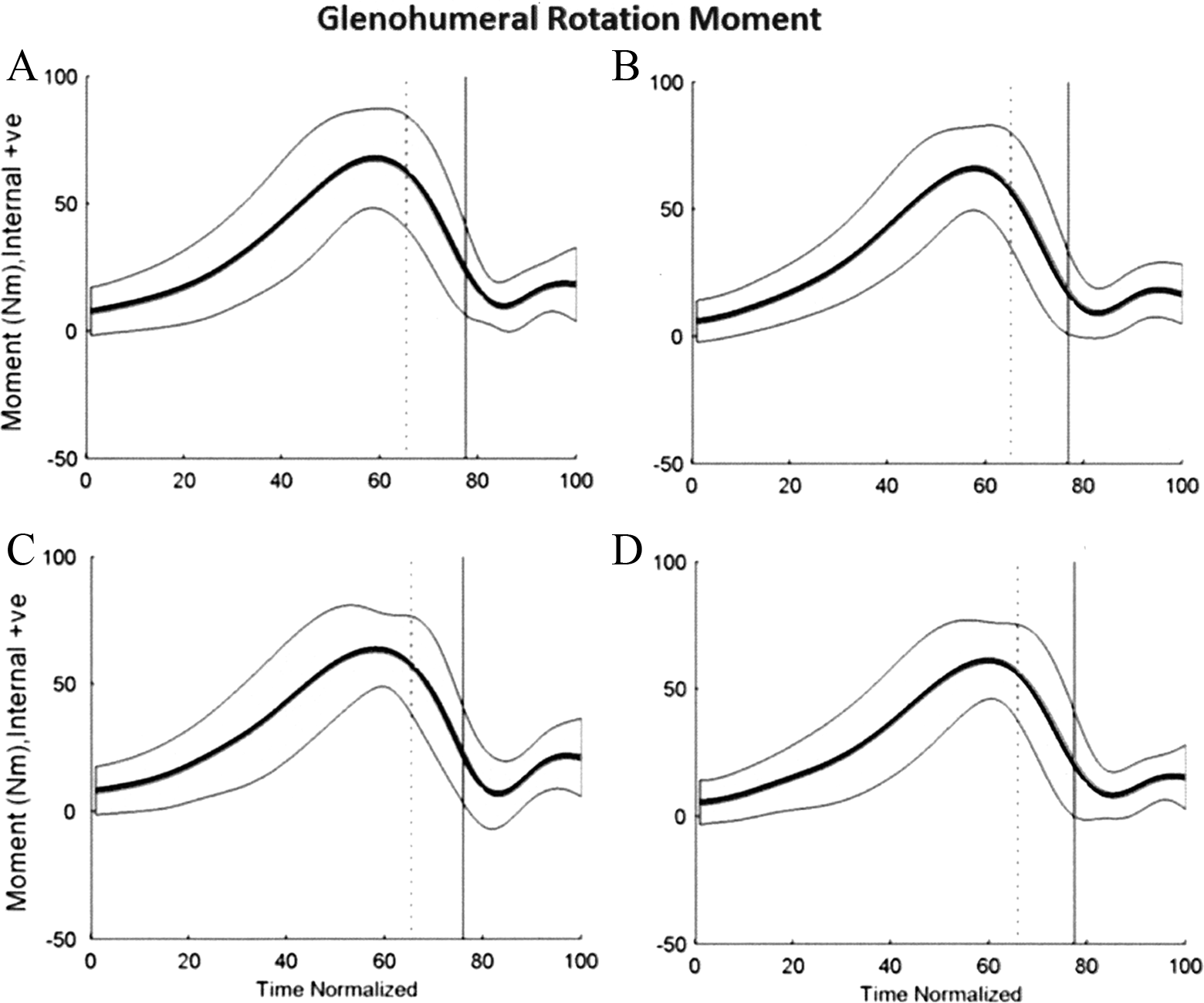
Comparison of the mean and standard deviation of the glenohumeral (GH) rotation moment over the pitch cycle. (A) Fastball; (B) curveball; (C) slider/cutter; (D) change-up. Dark line, mean; lighter shaded region, ±1 standard deviation; solid vertical line, ball release; dotted vertical line, instant of maximal external rotation of the GH joint (MER).

Comparison of the mean and standard deviation of the elbow varus moment over the pitch cycle. (A) Fastball; (B) curveball; (C) slider/cutter; (D) change-up. Dark line, mean; lighter shaded region, ± 1 standard deviation; solid vertical line, ball release; dotted vertical line, instant of maximal external rotation of the GH joint (MER).
Comparison of Kinetic Parameters Between Each of the Pitching Techniques a

a Values are expressed as mean ± standard deviation. GH, glenohumeral.
b Statistically significant differences compared to the fastball.
c Statistically significant differences compared to the change-up.
Discussion
This study examined the differences in joint kinematics and kinetics for the glenohumeral and elbow joints across multiple pitch types. No significant differences were observed between pitch types in terms of joint motion and velocity at the glenohumeral and elbow joints. However, the fastball and not the breaking-type pitches created the highest stresses as defined by net internal joint moments on the glenohumeral and elbow joints. The lowest moments at the glenohumeral and elbow joints were observed for the change-up. Therefore, this study does not support the current belief that breaking-type pitches are the most harmful pitches for collegiate pitchers.
The results of this study confirm some of the results previously published in the literature. In collegiate pitchers, Fleisig et al 4 reported that the fastball produced greater elbow varus and shoulder internal rotation moments than did the curveball, but these differences were not statistically significant. Fleisig et al 4 also found similar elbow varus moments produced by the slider and fastball (81 ± 5 and 82 ± 13 N·m, respectively) and similar shoulder internal rotation moments for the slider and fastball (84 ± 6 and 84 ± 13 N·m, respectively). The data presented in this article are not consistent with the data presented by Fleisig et al 4 in terms of the slider. Fleisig et al showed that the moments generated by the slider/cutter were similar to the curveball and were significantly lower than the fastball. In the current study, the moments generated by the fastball were significantly higher than the curveball. A possible reason for this difference is that the current work presents data for a larger sample for each pitch type. It is also possible that very few pitchers in this study pitched a true slider. Pitching coaches have observed that a pitcher may state he is throwing a slider but is actually throwing a hybrid technique that combines the pitching mechanics of both a slider and a curveball. In this work, it is unknown whether a true slider was thrown since the slider/cutter designation was based on what the pitchers indicated they had pitched. This is a potential limitation of the current work, as discussed below. Other discrepancies between the findings of the current work and those presented by Fleisig et al 4 may also be attributed to different statistical methods and differences in the biomechanical models.
The results of this study were consistent with other studies that evaluated multiple pitch types for younger and less experienced pitchers. Nissen et al 10 showed in high school–aged pitchers that the curveball produced lower moments than did the fastball. Dun et al, 2 in youth pitchers (12.5 ± 1.7 years), have also shown that the fastball produced the highest joint loads and the change-up produced the lowest joint loads. These findings imply that that the moments produced by collegiate-level pitchers in the current study follow a similar pattern to those of younger pitchers, which was previously unclear in the literature.
As previously mentioned, the results of this work show that the fastball produces the greatest moments at the glenohumeral and elbow joints compared with the other 3 pitching techniques studied. The implication of this finding is that the fastball pitch is the most potentially harmful pitch for collegiate pitchers. It is also important to note that the fastball is the most common pitch used during practices and games. Based on survey data collected at the outset of the pitching analysis, most of the pitchers indicated that between 50% and 70% of all pitches they pitch are fastballs. The increase in pitching-related injury may be due to repetitive loading and microtrauma accumulation caused by pitching the fastball, which is worsened by an increase in the frequency of pitching practice and year-round playing. There is already some evidence to point in this direction. 4,11 However, more work needs to be done to investigate this theory.
This work combined the data from slider and cutter pitches into a single group. These 2 pitch types are mechanically similar in both how they are thrown and the expected outcome when the ball arrives at the plate. There were no significant differences between the 2 pitch types, suggesting it was appropriate to combine the 2 techniques into a single group as done in this work.
Limitations
This study has several limitations. This is a laboratory study, and the effects of pitching with reflective markers as well as the controlled conditions of the laboratory may affect participant performance. However, this level of analysis is not viable in the field and is comparable to other motion-based studies currently in the literature.
Pitch type was determined by participant self-report only. Therefore, what the participant reported may not reflect the actual pitch type, as defined by a particular movement of the wrist and elbow. Preliminary evaluations are under way to determine if there are specific wrist and elbow kinematic parameters that could be used to objectively distinguish between pitch types, so as to reduce reliance on pitcher report.
It is assumed that the participants in this study were pitching using proper technique; therefore, the findings of this study reflect this assumption. It is unclear if poor pitching mechanics would affect the results of this study.
Conclusion
This study shows that the fastball and not the curveball, slider/cutter, or change-up produced the greatest stresses, as defined by joint moments, on a pitcher’s glenohumeral joint and elbow as previously believed. Therefore, the data indicate that for collegiate-level pitchers, pitching breaking-type pitches may not be any more dangerous than pitching a fastball. Further investigations are warranted, however, to determine if specific kinematic parameters can be found to help distinguish between different pitching techniques to produce a more scientifically based method of comparing pitching techniques or to distinguish between similarly thrown pitches such as the slider and cutter. Further work is also required to determine the effects of repetitive loading of these joints due to various combinations of these pitching techniques over the length of a game or an entire season.
Footnotes
One or more of the authors has declared the following potential conflict of interest or source of funding: Major League Baseball provided a grant to the authors’ institution to cover research-related costs.