




Abstract
Background:
Femoroacetabular impingement syndrome (FAIS) is one of the most common causes of hip pain. However, the epidemiology of FAIS in the Chinese population remains unknown.
Purpose:
To investigate the epidemiological characteristics, arthroscopic findings, and baseline hip function of Chinese patients undergoing arthroscopic treatment for FAIS and to identify potential factors influencing baseline hip function.
Study Design:
Cross-sectional study; Level of evidence, 3.
Methods:
Data between August 2016 and September 2022 were reviewed at a single institution. Patients who were diagnosed with FAIS and underwent hip arthroscopic surgery were included. Exclusion criteria were as follows: Tönnis grade >1, previous surgery of the lower limbs and spine, and concomitant hip conditions. Baseline characteristics including sex, age at surgery, affected side, body mass index, duration of symptoms, and previous surgery were collected. Radiographic measurements including alpha angle, lateral center-edge angle, and Tönnis grade were obtained. Intra-articular lesions and arthroscopic procedures were recorded. Preoperative patient-reported outcome scores including those for the modified Harris Hip Score (mHHS) and visual analog scale for pain were collected. Univariate and multivariate linear regression analyses were performed to determine the factors affecting baseline hip function.
Results:
A total of 1206 patients were included in the study. Among them, 50.5% were female, and 49.5% were male. The mean age was 37.4 years. Male patients had a larger alpha angle (65.8° vs 61.1°, respectively) and a higher prevalence of cam-type deformities compared with female patients (all P < .001), while the lateral center-edge angle and prevalence of pincer-type deformities were comparable (all P > .05). Higher proportions of femoral head (14.9% vs 10.2%, respectively) and acetabular (43.2% vs 38.4%, respectively) lesions were observed in male patients compared with female patients (all P < .05). Multivariate regression revealed that older age (beta = −0.111) and female sex (beta = −0.249) were significantly associated with inferior preoperative mHHS scores (all P < .05).
Conclusion:
The cohort of Chinese patients undergoing arthroscopic treatment for FAIS primarily comprised young and middle-aged adults, with a balanced sex distribution. Male patients had a larger alpha angle, higher prevalence of cam-type deformities, and higher proportion of cartilage lesions in the femoral head and acetabulum compared with female patients. Older age and female sex were associated with inferior baseline hip function.
Femoroacetabular impingement syndrome (FAIS) is one of the most common hip diseases and a recognized risk factor for hip osteoarthritis.9,13 The reported diagnostic incidence of FAIS is 54.4 per 100,000 person-years, with a majority of cases being female. 13 The disease is characterized by abnormal morphology of the femoral head-neck junction and the acetabulum, resulting in altered contact between the joint surfaces and intra-articular lesions that lead to hip pain. 11 Predictable patterns of the disease have been previously identified in which cam-type impingement is typically observed in active young patients and pincer-type impingement is more commonly described in female patients. 19 However, the majority of those epidemiological studies on FAIS have primarily focused on populations in Western countries, with limited literature reporting the epidemiological data of Asian or Chinese populations.
With a large population base and increased understanding of FAIS, there has been a growing number of Chinese patients diagnosed with FAIS as well as literature focusing on this disease. 48 The application of hip arthroscopic surgery for treating FAIS has rapidly developed and reached its peak in the past few years in China. 48 It has been reported that hip arthroscopic surgery could achieve satisfactory short-term to midterm outcomes and low rates of revision surgery and conversion to total hip arthroplasty in Chinese patients.10,16,26,39,40,46,47 However, in those studies, several demographic factors such as older age and female sex, as well as a longer duration of symptoms and lower preoperative patient-reported outcome (PRO) scores, were found to have correlations with inferior postoperative outcomes and poor achievement of clinical thresholds. Significant differences in hip anatomy have also been demonstrated between young Chinese and White populations, suggesting that race may contribute to distinct patterns of FAIS and influence hip function. 44 Therefore, clarifying epidemiological characteristics in an Asian or Chinese FAIS population is crucial for understanding the spectrum of this disease as well as facilitating better therapeutic interventions for these patients.
In the present study, we performed a cross-sectional study on a cohort of Chinese patients with FAIS who underwent arthroscopic treatment, aiming to investigate their epidemiological characteristics, arthroscopic findings, and baseline hip function. We also sought to identify potential factors influencing baseline hip function. It was hypothesized that the epidemiology of FAIS would be similar to that in previous studies reported in other countries and that some factors (female sex, older age, severe impingement, intra-articular lesions, etc) would have a certain effect on baseline hip function.
Methods
Patient Selection
After institutional review board approval, data were retrospectively collected between August 2016 and September 2022 at our institution. Patients diagnosed with FAIS based on clinical symptoms and radiographic findings were reviewed. 11 Patients were included if they underwent primary hip arthroscopic surgery after nonoperative treatment (physical therapy, activity modification, oral anti-inflammatory medication, and intra-articular cortisone injection) of at least 3 months had failed. Patients were excluded if they had any of the following: hip osteoarthritis of Tönnis grade >1; previous surgery of the lower limbs and spine; and hip conditions including avascular necrosis, Legg-Calvé-Perthes disease, osteoid osteoma, synovial chondromatosis, pigmented villonodular synovitis, and developmental dysplasia of the hip.
Data Collection
The patients’ characteristics were categorized by sex. The age at surgery, affected side, body mass index (BMI), and duration from the onset of symptoms to surgery were routinely collected. In addition, PRO scores including those for the modified Harris Hip Score (mHHS) 1 and visual analog scale (VAS) for pain 2 were obtained preoperatively for all of the patients.
Radiographic examinations were performed preoperatively to obtain the alpha angle in the 45° Dunn view, lateral center-edge angle (LCEA), and Tönnis grade in the anteroposterior view, as described by previous studies.14,28,30 A cam-type deformity was defined when patients presented with a typical pistol-grip deformity and/or an alpha angle >55°. 13 A pincer-type deformity was defined when patients presented with a crossover sign, coxa profunda, and/or an LCEA >40°. 13 Patients with an isolated cam- or pincer-type deformity were diagnosed with cam- or pincer-type impingement, respectively. Patients with concomitant cam- and pincer-type deformities were diagnosed with mixed-type impingement.
Hip arthroscopic procedures were performed by 4 senior surgeons (X.Z., X.J., J.W., Y.X.) with over 10 years of experience. Arthroscopic inspections of the labrum and cartilage were also performed, and arthroscopic procedures were recorded. Labral and cartilage lesions were documented if these structures appeared nonintact.
Statistical Analysis
All data were analyzed using SPSS Statistics (Version 27.0; IBM). The Kolmogorov-Smirnov test was performed to check for normal distributions. The Pearson chi-square test was used for comparing categorical data. For continuous data, the Mann-Whitney U test and independent t test were applied to compare skewed variables and normally distributed variables, respectively, between groups. Univariate and multivariate regression were used to identify potential factors affecting preoperative hip function. Linear regression models were built to determine the effect of potential variables on preoperative hip function. Statistical significance was defined when P < .05.
Results
Patient Characteristics
As shown in Figure 1, a total of 1206 hips were included in the study. The sex distribution of the patients was as follows: 50.5% were female, and 49.5% were male. Detailed characteristics of the included patients are shown in Table 1. The mean age at surgery was 37.4 years, with no significant difference between sexes (P = .125). The age distribution is illustrated in Figure 2A. Male patients had a higher BMI than female patients (P < .001). The distribution of BMI is presented in Figure 2B. The mean duration from the onset of symptoms to surgery was 20.4 months, with no significant difference between sexes (P = .472). Concerning the radiographic data, a larger alpha angle was measured in male patients compared with female patients (65.8°± 10.1° vs 61.1°± 9.2°, respectively; P < .001), while the LCEA was comparable between sexes (35.4°± 6.4° vs 34.6°± 5.4°, respectively; P = .105). Accordingly, male patients had a higher proportion of cam-type deformities compared with female patients (P < .001), while there was no significant difference in the prevalence of pincer-type deformities between sexes (P = .248). There was also no significant difference in the Tönnis grade between sexes (P = .628). As shown in Figure 2C, female patients had a higher prevalence of pincer-type impingement than male patients (13.6% vs 7.7%, respectively; P < .001). No significant difference was found in previous surgery on the ipsilateral and contralateral hips between sexes (all P > .05).
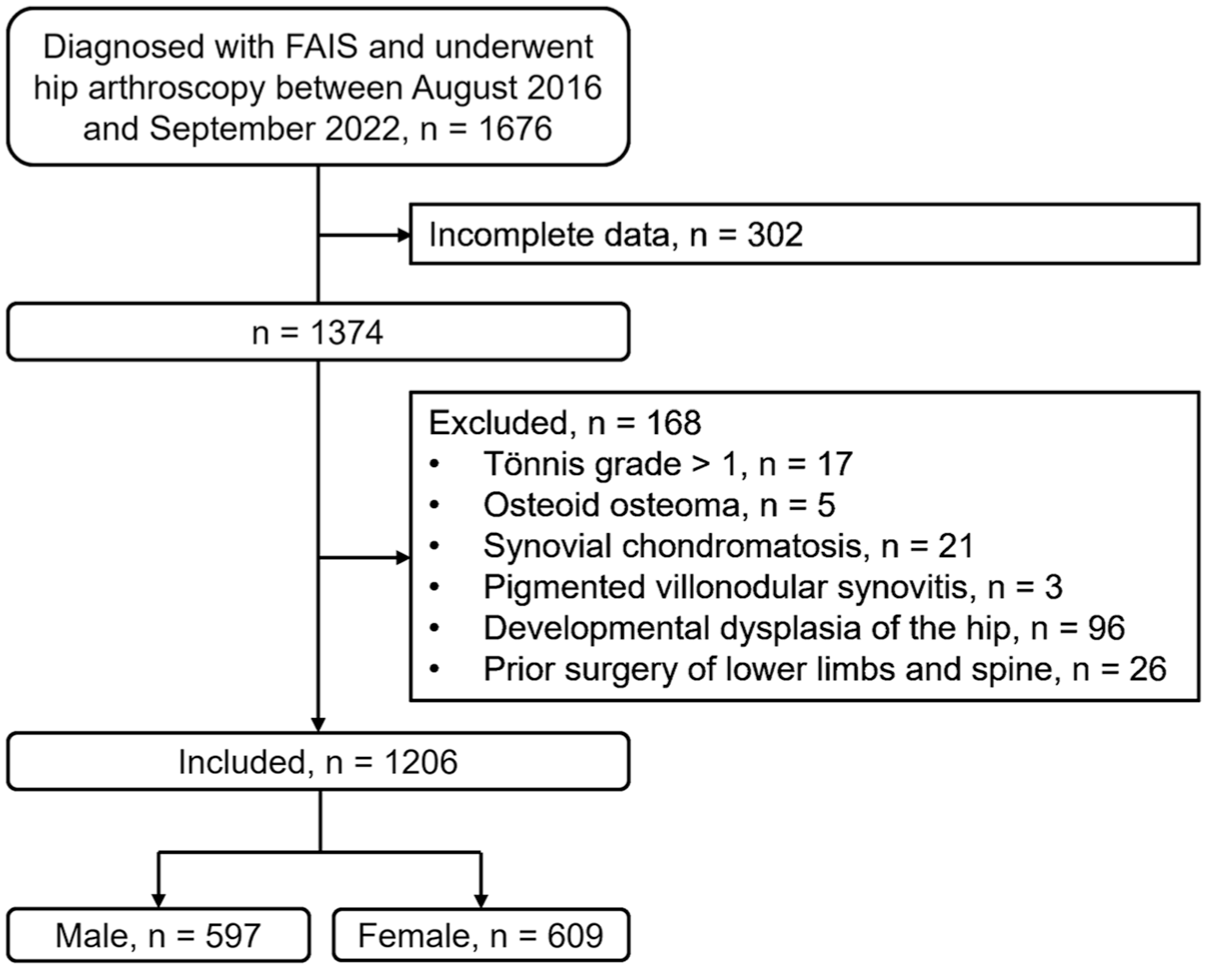
Flow chart of patient selection.
Patient Characteristics a
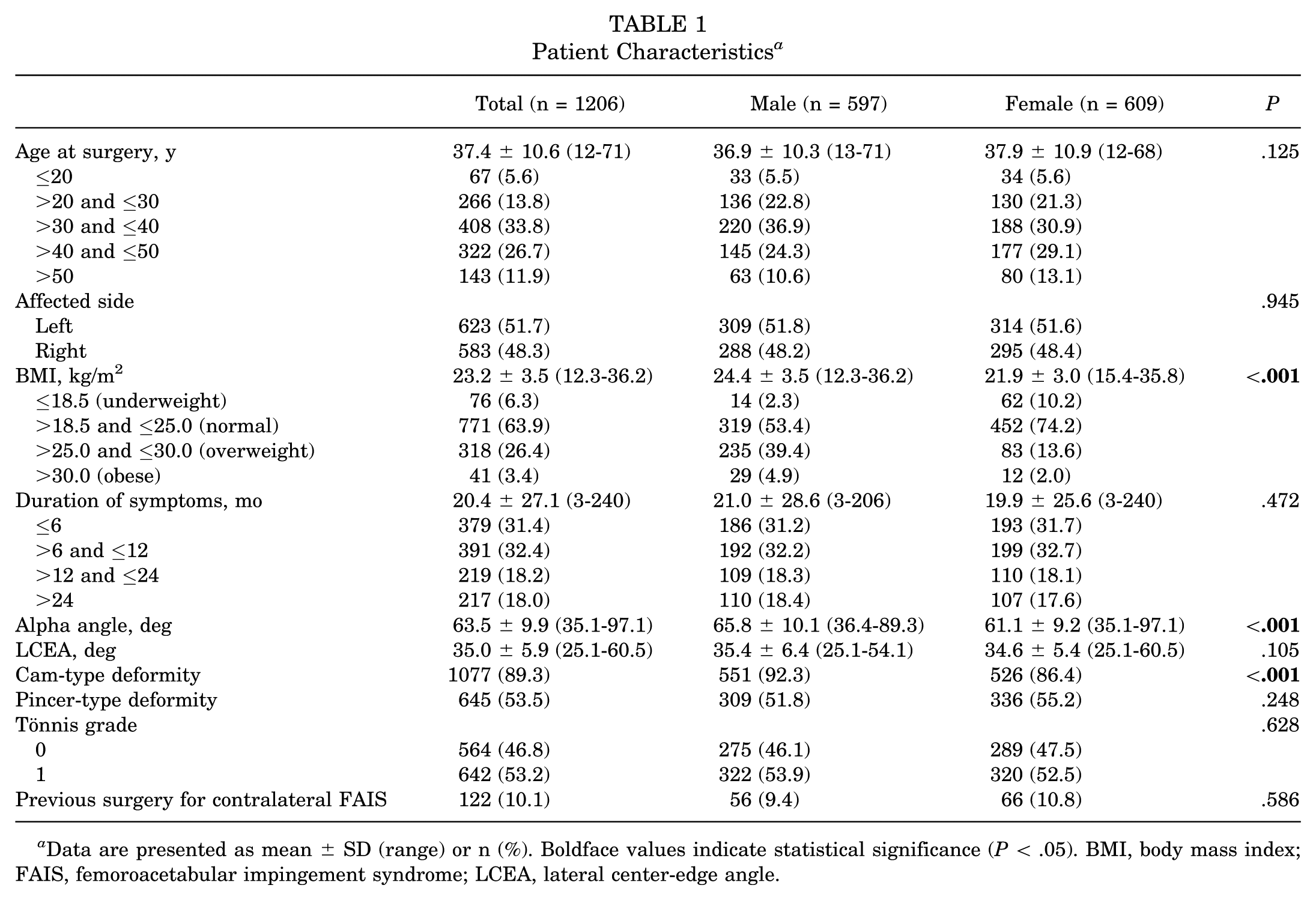
Data are presented as mean ± SD (range) or n (%). Boldface values indicate statistical significance (P < .05). BMI, body mass index; FAIS, femoroacetabular impingement syndrome; LCEA, lateral center-edge angle.
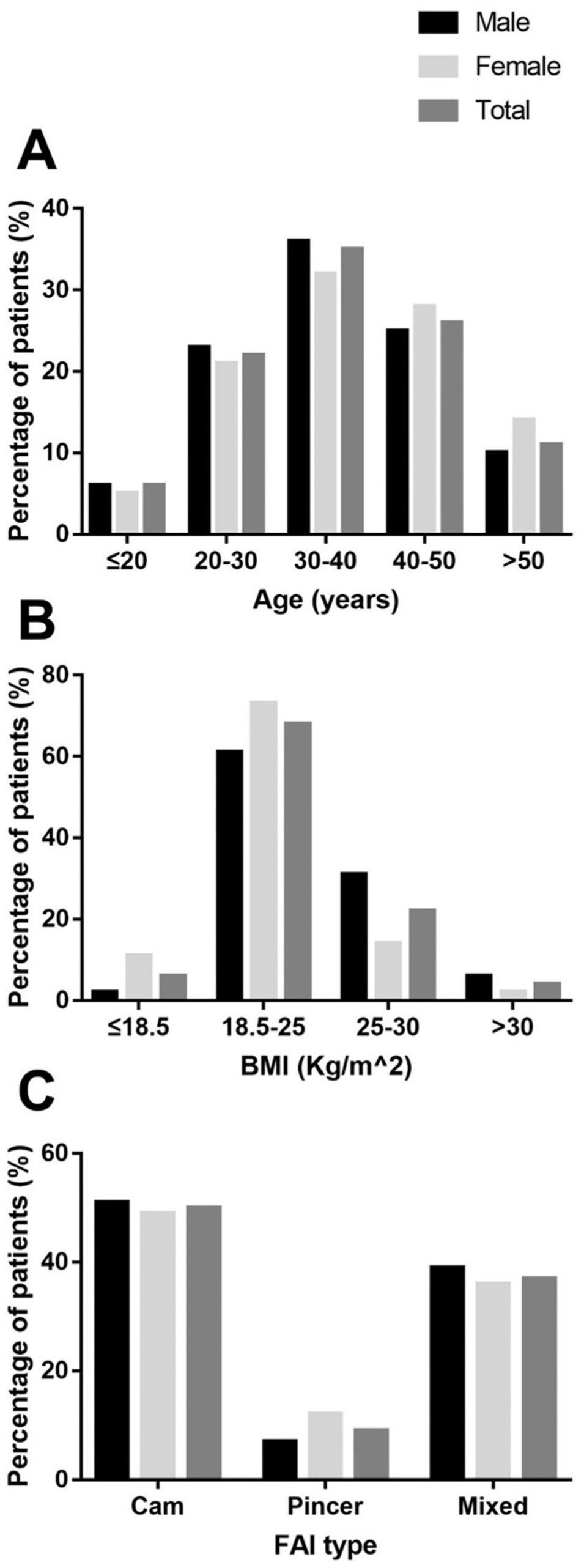
Distribution of (A) age, (B) body mass index (BMI), and (C) type of femoroacetabular impingement syndrome (FAIS). The data are presented separately for male, female, and all patients.
Arthroscopic Findings and Procedures
Arthroscopic inspections and procedures are shown in Table 2. Femoroplasty was more frequently performed in male patients compared with female patients (P < .001), while no significant difference in acetabuloplasty was observed between sexes (P = .248). Overall, 1184 (98.2%) patients had a labral tear. The distribution of labral tear location (Figure 3) was as follows: 1.4% at 8 o'clock, 9.4% at 9 o'clock, 34.7% at 10 o'clock, 53.1% at 11 o'clock, 83.5% at 12 o'clock, 97.2% at 1 o'clock, 97.2% at 2 o'clock, 66.4% at 3 o'clock, and 6.1% at 4 o'clock. There was no significant difference in the treatment of labral tears between sexes (all P > .05). Male patients had a higher prevalence of femoral head cartilage lesions (P = .003) and acetabular cartilage lesions (P = .004) compared with female patients.
Arthroscopic Findings and Procedures a

Data are presented as n (%). Boldface values indicate statistical significance (P < .05).
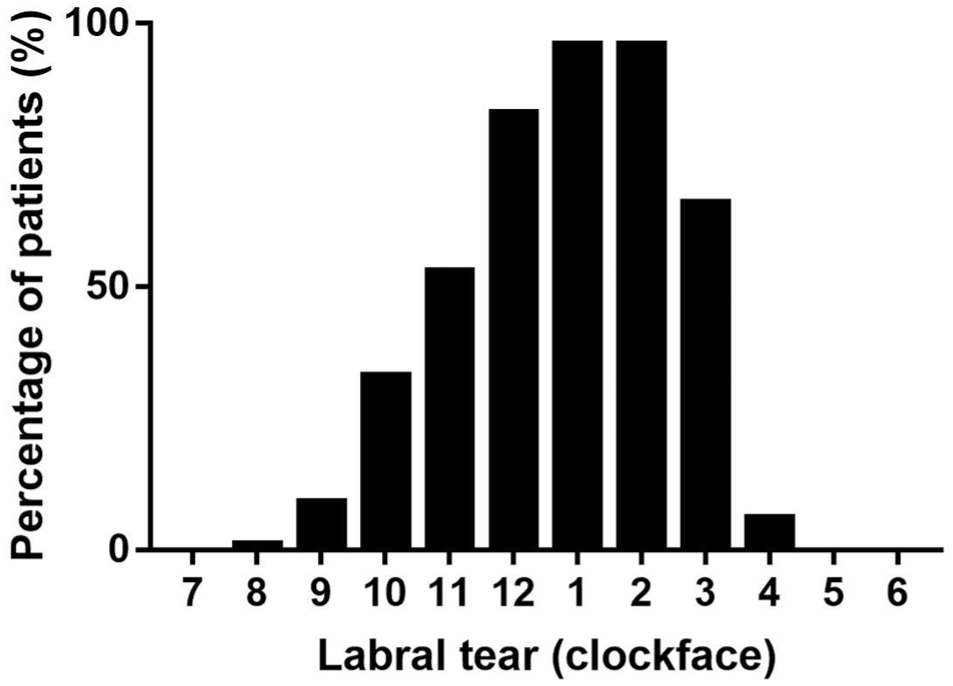
Distribution of labral tear location.
Clinical Outcomes
The preoperative VAS score was 3.9 ± 1.9 (range, 1-10), and the preoperative mHHS score was 67.1 ± 11.4 (range, 25-96). The regression model included potential factors such as age, sex, BMI, symptom duration, alpha angle, LCEA, and femoral head and acetabular cartilage lesions to determine their effect on the preoperative mHHS score. As shown in Table 3, multivariate regression revealed that older age (P = .035; beta = −0.111) and female sex (P < .001; beta = −0.249) were significantly associated with inferior preoperative mHHS scores, while other factors showed no statistical significance (all P > .05). Female patients demonstrated significantly inferior preoperative mHHS (64.9 ± 11.5 vs 69.4 ± 10.9, respectively; P < .001) and VAS (4.1 ± 1.8 vs 3.8 ± 2.0, respectively; P = .006) scores compared with male patients.
Factors Affecting Preoperative mHHS Scores a

Boldface values indicate statistical significance (P < .05). BMI, body mass index; LCEA, lateral center-edge angle; mHHS, modified Harris Hip Score.
Discussion
In the present study, we performed a cross-sectional analysis to describe the baseline characteristics of a cohort with FAIS. We found that the cohort primarily comprised young and middle-aged adults, with a balanced sex distribution. Male patients had a larger alpha angle, higher prevalence of cam-type deformities, and higher proportion of cartilage lesions in the femoral head and acetabulum compared with female patients. Older age and female sex were associated with inferior baseline hip function.
The initial interesting finding was a balanced distribution of sex. It should be noted that the study population consisted exclusively of Chinese patients. With regard to previous epidemiological studies on FAIS, most of them reported a higher incidence in female patients. Clohisy et al 3 conducted a multicenter epidemiological investigation in a North American cohort including 1067 patients with FAIS and found that its incidence in female patients was 55%. Hale et al 13 examined the Rochester Epidemiology Project database in Minnesota and found that female patients had an incidence about twice as high as male patients from 2010 to 2016. On the other hand, several studies have reported contrary results. Disegni et al 4 examined a national hospital discharge database involving 3699 French patients, with the majority of those with FAIS being male. Serong et al 38 investigated 362 patients from the German Cartilage Registry, with 246 (68.0%) with FAIS being male. Despite similarities in the study design and inclusion criteria, it is suggested that the sex distribution among populations with FAIS varies across different countries.
Sex was found to be associated with the type of FAIS. 19 Typically, a pincer-type deformity arises because of repetitive contact stress between a normal femoral head-neck junction and an abnormal area of the acetabulum, and it has been observed more frequently in female patients. 24 However, the present study revealed no significant difference in the prevalence of pincer-type deformities between sexes. A cam-type deformity commonly manifests in young male patients because of morphological alterations that may arise in the developing femoral head, resulting in shear forces exerted by the nonspherical region of the femoral head during its motion against the acetabulum. 13 Similarly, we found a higher prevalence of cam-type deformities in male patients. Multiple studies have reported that sports participation was associated with an increased radiographic prevalence and development of cam-type deformities.3,17,27,49 Fang et al 7 reported that Chinese female patients had significantly greater constraints than their male counterparts in terms of time availability, partner choices, psychological factors, knowledge acquisition, and interest in sports. Those factors related to sports participation may potentially account for the different prevalence of cam-type deformities between sexes in China.
It is generally believed that FAIS frequently occurs in the adolescent and young adult population.11,19 The surgical treatment of FAIS worldwide typically involves patients aged between 28 and 40 years.3,4,13,37,38 In the present study, we found that patients undergoing hip arthroscopic surgery primarily consisted of those aged between 20 and 50 years, with a mean age of 37.4 years. Unlike in most countries, patients aged ≤20 years were much fewer than middle-aged adults in our study cohort. Because sports participation is closely related to FAIS, insufficient physical activity among Chinese young people may be one of the possible reasons. It has been reported that a mere 13.1% of Chinese school-aged children and adolescents aged between 9 and 17 years achieved the recommended daily minimum of 60 minutes of moderate-to-vigorous physical activity; furthermore, a decline in physical activity levels from childhood to adolescence was also observed. 15 Potentially contributing to a low prevalence among adolescent patients, the attitude toward surgery could also exert a certain influence on delayed age at surgery. In the early stage of FAIS with moderate musculoskeletal pain, a certain number of Chinese patients prefer traditional Chinese medicine, acupuncture, and massage therapy rather than modern medicine. 31 Of note, only 10.1% of patients underwent surgical treatment for bilateral FAIS in the present study. The observed proportion was comparatively lower than that reported in a systematic review, which documented a range from 15.7% to 20.4%. 21
In addition, multiple studies have demonstrated the influence of racial differences on hip diseases. Developmental dysplasia of the hip has been found to be more prevalent and a primary etiological factor for hip osteoarthritis in Asian and Chinese populations, whereas FAIS has predominantly been associated with cases in the White population.5,41 The incidence of hip osteoarthritis and the rate of total hip arthroplasty were also significantly higher in a White population, with approximately 5 to 10 times and 20 times higher, respectively, proportions than in Chinese patients of the same age and sex.33,34 Furthermore, Van Houcke et al 44 compared radiographic parameters with a predisposition to FAIS in 201 young asymptomatic Chinese and White participants. It was found that the White participants had a less spherical femoral head than the Chinese participants (alpha angle: 56° vs 50°, respectively), while the Chinese participants had less lateral acetabular coverage than the White participants (LCEA: 35° vs 39°, respectively). These findings suggested that different patterns of FAIS may be present in Chinese patients. In the present study, we found a larger LCEA of 35.0° compared with 30.5° in a large cohort from the United States. 27 Correspondingly, the preoperative mHHS score was comparatively lower than that reported in studies conducted in Western countries.8,27,36 In addition, different measurement methods for the LCEA may lead to different results. 30
A labral tear rarely occurs without abnormal bony anatomy, with FAIS and developmental dysplasia of the hip being the most common causes. 45 In the present study, we observed that a labral tear was detected in the majority (98.2%) of patients with FAIS, predominantly located in the anterosuperior region. Similarly, Clohisy et al 3 found that 92.9% of patients with FAIS had labral abnormalities, and most of them were located at the anterior and superolateral labrum. Kapron et al 18 found that a chondrolabral injury predominantly occurred at the anterosuperior acetabulum, with the severity of injury being correlated to the extent of cam-type impingement. Femoral head and acetabular cartilage defects were also common intra-articular lesions in patients with FAIS. It was noted that male patients had a higher prevalence of cartilage lesions compared with female patients in the present study. A similar result was found by Utsunomiya et al 43 in that male sex was related to severe cartilage damage to the acetabulum, while Maldonado et al 27 reported a contrary result.
With regard to the efficacy of arthroscopic treatment for FAIS, numerous studies have reported favorable outcomes, while patients with risk factors such as older age and female sex may experience less benefit.12,20,23,32 However, few studies have concerned preoperative hip function. Huang et al 16 examined 159 Chinese patients with FAIS and found that lower preoperative PRO scores were associated with inferior postoperative PRO scores. Thus, factors affecting preoperative hip function may have prognostic value for postoperative outcomes. In the present study, we used the mHHS to evaluate hip function. The mHHS is one of the most commonly used hip-specific functional scales for patients undergoing hip arthroscopic surgery. For this particular patient population, it has shown high construct validity and responsiveness.25,29,42 We found that older age and female sex were associated with poorer preoperative hip function. For older patients, we believe that more severe joint degeneration and limited daily activity are the most important causes of inferior hip function. 6 For female patients, they may be more susceptible to the negative effects of FAIS. 35 However, the mechanisms underlying those phenomena require further investigation. Serong et al 38 reported similar results in a German FAIS population using the International Hip Outcome Tool (iHOT-33). These aforementioned factors were also reported to be associated with poor postoperative PRO scores. 22 Further research is warranted to determine whether these baseline factors or preoperative hip function exert a greater influence on postoperative outcomes.
The strengths of the present study include a relatively large sample size, the availability of complete baseline data, the performance of radiographic evaluations, and the collection of intraoperative findings. The findings of this study can provide valuable insights into the epidemiology of FAIS in China as well as facilitate better therapeutic interventions for Chinese and Asian patients.
Limitations
Several limitations must be acknowledged. First, given the nature of a retrospective study, selection bias was inevitable. Second, patients diagnosed with FAIS who successfully underwent nonoperative treatment were not included in the present study, thus limiting its generalizability to the entire FAIS population. Third, the present study was performed at a single center predominantly comprising patients from certain provinces in China. Therefore, caution should be exercised when generalizing the findings to the entire Chinese population. Further multicenter studies including patients from different regions across the country are warranted. Last, the assessment of hip function using the VAS and mHHS was oversimplified, as it failed to comprehensively evaluate overall hip function, particularly in terms of sports participation. Moreover, the effect of baseline factors on postoperative PRO scores was not examined because of the unavailability of these data.
Conclusion
The cohort of Chinese patients undergoing arthroscopic treatment for FAIS primarily comprised young and middle-aged adults, with a balanced sex distribution. Male patients had a larger alpha angle, higher prevalence of cam-type deformities, and higher proportion of cartilage lesions in the femoral head and acetabulum compared with female patients. Older age and female sex were associated with inferior baseline hip function.
Footnotes
Final revision submitted May 18, 2025; accepted July 15, 2025.
One or more of the authors has declared the following potential conflict of interest or source of funding: Funding for this study was provided by the National Key Research and Development Program of China, the Natural Science Foundation of Beijing Municipality, and Peking University Third Hospital. AOSSM checks author disclosures against the Open Payments Database (OPD). AOSSM has not conducted an independent investigation on the OPD and disclaims any liability or responsibility relating thereto.
Ethical approval for this study was obtained from Peking University Third Hospital (M2019193).
