




Abstract
Background:
Traditionally, hip arthroscopy has been performed with a perineal post, although risks associated with the use of a post include pudendal nerve injury, sexual dysfunction, and other soft tissue complications. Recently, some hip preservation specialists have switched to postless hip arthroscopy techniques to minimize these complications.
Purpose:
To reevaluate the current international trends in postless hip arthroscopy among hip preservation specialists and to compare these results to the same survey conducted in 2022.
Study Design:
Cross-sectional study.
Methods:
An anonymous 11-item survey was sent by email to members of ISHA—The Hip Preservation Society in November 2024. A reminder email was sent approximately 2 and 4 weeks later to facilitate a greater number of responses. The survey investigated ISHA members’ current use of perineal post-assisted or postless hip arthroscopy and any changes in their setup technique during their time in practice. Descriptive statistics were used to report the results of each question in the survey. Comparisons between 2022 and 2024 responses to various questions were made using a chi-square test.
Results:
A total of 132 surveys were completed from 845 (15.6%) ISHA members; 47% of surgeons currently use a perineal post, 44% use a postless technique, and 9% use either technique depending on the facility at which they are operating. Overall, 74% of perineal post users self-reported rates of postoperative groin-related complications of <1% compared with 97% of postless users (P = .006). A total of 54 respondents indicated changing their technique from using a perineal post to a postless technique during their time in practice. Of the respondents, 63% reported making the change due to pudendal nerve and/or soft tissue complications and 81% indicated that they have noticed a decrease in the rate of groin-related complications since making the change. In comparing the responses from 2022 to 2024, there were no significant differences found between questions.
Conclusion:
There has been an increase in the proportion of hip preservation specialists using a postless hip arthroscopy technique in the last 3 years. A majority of surgeons continue to report that they have made the switch from post-assisted to postless hip arthroscopy due to groin-related complications and have noticed a decrease in their complication rate after transitioning to the postless technique.
Hip arthroscopy has become increasingly popular as a surgical treatment that evolved from being solely for the purposes of debridement and removal of loose bodies to expanded uses such as labral repair/reconstruction, femoroplasty, and acetabuloplasty. 4 In addition to the wide range of applications for hip arthroscopy, there are also various techniques for patient positioning and surgical setup. 5 Traditionally, hip arthroscopy involved a perineal post, which was first described by Byrd in 1994. 2 The perineal post provides a counterforce to allow for adequate hip joint distraction during central compartment work. However, there are potential complications with the use of a perineal post, including risk of pudendal nerve injury, sexual dysfunction, and other soft tissue complications, which multiple studies have reported.3,6,9,10,13,14,30 One systematic review found that perineal post-related complications occurred with an incidence of 7.1%. 30
In response to these complications, various postless hip arthroscopy techniques have been introduced in recent years. 5 In 2022, Kraeutler et al 15 surveyed members of ISHA—The Hip Preservation Society and found that 33% of surgeons used a postless technique during hip arthroscopy. The purpose of this study was to reevaluate the current international trends in postless hip arthroscopy among hip preservation specialists and to compare these results with those of the same survey conducted in 2022. The authors hypothesized that there would be an increase in the utilization of postless hip arthroscopy techniques among ISHA members.
Methods
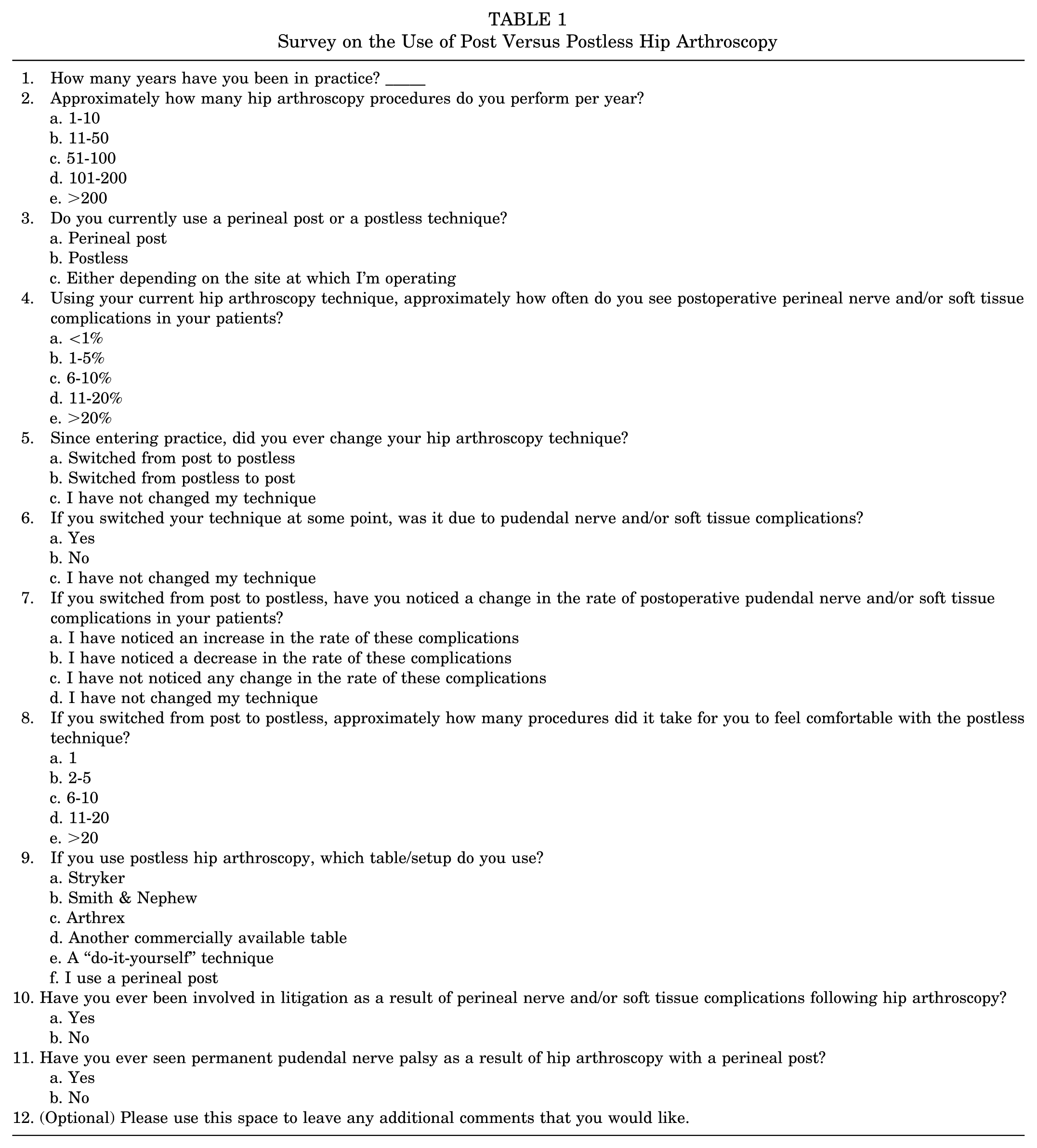
After institutional review board approval (IRB-FY2024-50), an anonymous 11-item survey (Table 1) was sent by email to all ISHA members in November 2024. A reminder email was sent approximately 2 and 4 weeks later to facilitate a greater number of responses. The survey investigated ISHA members’ current use of perineal post-assisted or postless hip arthroscopy, any changes in their setup technique during their time in practice, the reason for any changes, and their perceived rate of pudendal nerve and/or soft tissue injuries using their current technique.
Survey on the Use of Post Versus Postless Hip Arthroscopy
Statistical Analysis
Descriptive statistics were used to report the results of each question in the survey. The number of years in practice between post-assisted and postless users was compared using a Student t test. Categorical rates of pudendal nerve/soft tissue complications between post-assisted and postless users were analyzed using a Fisher exact test. Comparisons between 2022 and 2024 responses of questions 3, 4, 5, 6, and 7 were made using a chi-square test. Statistical analysis was performed using SPSS (Version 22; IBM). A P value <.05 was considered statistically significant.
Results
A total of 132 surveys were completed from 845 (15.6%) active ISHA members. 11 The results of the survey questions are provided in Table 2. Surgeons who responded to the survey reported being in practice a mean of 16.4 years (range, 1-40 years), with a nonsignificant difference between post-assisted (19.5 years) versus postless users (12.7 years) (P = .55). Respondents most commonly indicated that they had an annual hip arthroscopy case volume of 101 to 200 (29%), 11 to 50 (29%), and 51 to 100 (28%).
Gross Results of Survey Responses a

Data are presented as n (%) unless otherwise indicated. There were 132 responses unless otherwise indicated.
Data are given as mean (SD).
There were 54 respondents who selected that they switched from post to postless.
Overall, 47% of surgeons currently use a perineal post, 44% use a postless technique, and 9% use either technique depending on the facility at which they are operating. Of perineal post users, 74% self-reported rates of postoperative groin-related complications of <1% compared with 97% of postless users (P = .006) (Table 3). One perineal post user indicated an 11% to 20% incidence of groin-related complications.
Estimated Prevalence of Pudendal Nerve and/or Soft Tissue Complications in Perineal Post and Postless Users a

Data are presented as n (%). A statistically significant difference was found in the distribution of the 2 groups (P = .006).
A total of 54 respondents indicated changing their technique from using a perineal post to a postless technique during their time in practice. Of the surgeons who made this switch, 34 (63%) reported making the change due to pudendal nerve and/or soft tissue complications. Of these 54 surgeons, 44 (81%) indicated that they have noticed a decrease in the rate of groin-related complications since making the change. Overall, 43% of the 54 surgeons indicated that it took between 2 and 5 procedures before they began feeling comfortable using the postless technique, while 24% and 28% indicated that it took exactly 1 procedure and between 6 and 10 procedures before they felt comfortable, respectively. For the 70 surgeons who reported using a postless technique for at least a portion of their cases, a majority (51%) reported using the Stryker Pivot Guardian distraction table, while 34% reported using the Smith & Nephew postless hip positioning setup.
In comparing the responses of questions 3 to 7 from 2022 to 2024, there were no significant differences found between questions (question 3: P = .069; question 4: P = .88; question 5: P = .24; question 6: P = .43; question 7: P = .60).
Of the 132 respondents, 8% indicated that they have been involved in litigation as a result of groin-related complications after hip arthroscopy. In addition, 8% reported that they have seen permanent pudendal nerve injury as a result of hip arthroscopy with a perineal post.
Discussion
The most important finding of this study was that there has been a trend toward an increasing proportion of hip preservation specialists using postless hip arthroscopy techniques in the last 3 years. Respondents noted that the change from post-assisted to postless techniques was made largely to combat groin-related complications. Furthermore, respondents reported that adoption of a postless setup has been subjectively beneficial, as a majority (81%) have indicated a decrease in groin-related complications.
In this study, 80% of respondents indicated that with their current hip arthroscopy technique, postoperative groin-related complications are seen in <1% of patients. This number is in line with what our previous study demonstrated, as the number reported by respondents of that survey was 83%. 15 Interestingly enough, the reported rate of perineal post users that see groin-related complications of <1% was nearly the same in both the original study and this follow-up study (75% vs 74%). In contrast to both of these reported findings, previous studies have demonstrated groin-related numbness as high as 37% to 63% up to 1 week after hip arthroscopy using a perineal post.6,17,23 A more recent retrospective comparative study by Parkes et al 20 found that 18.8% of patients with perineal post-assisted procedures reported groin numbness, compared with only 1.1% of patients after hip arthroscopy with a postless technique. It is important to note that perineal post-related complications are reported at a 5 times higher rate in prospective studies than in retrospective studies. 30 Therefore, even systematic reviews, such as the one published by Habib et al 9 that reported pudendal nerve injuries occurring in only 1.8% of patients, should be considered with caution. In the current study, some surgeons reported that not only pudendal nerve injuries were problematic, but also cutaneous nerve injuries and sciatic nerve palsies.
The difference between self-reported groin-related complication rates can likely be attributed to multiple factors, one being the subjective nature of pain and numbness, as it may be underreported by patients who may not report mild symptoms. Similarly, patients might not be fully aware of the potential side effects associated with these procedures and may not consider mild groin numbness or discomfort as complications. Finally, hip preservation specialists may not have the same definition of what constitutes a complication, which can lead to misrepresentation and thus result in underreporting. Furthermore, this suggests that mild groin pain or temporary numbness may not be considered a complication and instead the term “complication” may be reserved for lasting issues such as chronic numbness or sexual dysfunction.
In the current study, 44% of ISHA members indicated that they perform hip arthroscopy only with a postless technique, while 9% indicated that they may use post-assisted or postless techniques depending on the surgical facility at which they are operating. These numbers have increased from our previous study, in which 33% and 6% of ISHA surgeons reported performing postless hip arthroscopy techniques exclusively and post-assisted or postless techniques depending on the facility, respectively. 15 Because of the novelty of postless techniques, the increasing number of hip preservation specialists making the switch in recent years is not surprising. Five ISHA surgeons commented that either they are in the process of switching from post to postless techniques or would like to in the near future pending proper equipment, citing wanting to either avoid groin-related complications or shorten the amount of traction time as their main reasons for making the change. A previous prospective study by Kraeutler et al 14 that compared patients undergoing arthroscopy by the same surgeon with a perineal post versus with a postless technique found significantly lower rates of postoperative groin and foot numbness in patients undergoing hip arthroscopy with a postless technique. Reasonably, these clinical findings can be attributed to the decreased amount of traction force needed to obtain adequate hip distraction for both maximal and holding traction forces when compared with a post-assisted system. 19
In our current study, of the 54 ISHA surgeons who indicated they made the switch from post-assisted hip arthroscopy to a postless technique, 43% said that it took them 2 to 5 procedures before they felt comfortable performing the postless technique. Similarly, this finding is approximately the same as the 46% of ISHA surgeons in our previous study who reported the same adjustment time. 15 A systematic review has previously delved into the learning curve for surgeons performing hip arthroscopy and indicated that it takes anywhere between 20 to 519 cases before traction/total operative time and complication rates normalize. 8 Previous studies have investigated the relationship between traction time and pudendal neurapraxia and have found that longer traction times are associated with pudendal nerve complications.1,9 These studies demonstrate how less experienced surgeons may be more likely to deal with pudendal neurapraxia due to longer operative and traction times. Additionally, one issue cited by surgeons with the postless technique is having to place the patient at nearly 15° of Trendelenburg. However, previous studies have described techniques by which hip arthroscopy can be performed effectively at just 5° of Trendelenburg. 29 Factors that correlate with a greater traction force during postless hip arthroscopy include male patients with reduced preoperative hip range of motion and elevated body mass index (BMI). 7 Because of these factors, it is recommended that surgeons adopting the postless technique for the first time begin with cases in which hip distraction is less difficult, typically female patients with a lower BMI. 27
By using the postless technique, less experienced surgeons have the opportunity to have longer traction times without the elevated concern of pudendal neurapraxia. One ISHA surgeon in our survey commented that not only did learning the postless technique allow them to perform more complex procedures, such as osteochondral allograft implantation, that they would not have considered with a perineal post, but the postless technique also allows for a better teaching environment. One surgeon commented that they think modern-day hip arthroscopists should be competent in post-assisted and postless techniques. Other surgeons indicated that after training with a perineal post, they now do not see a reason for utilizing a post because they have seen improvements in postoperative pain and less stress over groin-related injuries after switching to the postless technique. A recent prospective cohort study by Kraeutler et al 16 found that patients undergoing postless hip arthroscopy demonstrated significantly better patient-reported outcomes and clinically significant outcomes compared with post-assisted hip arthroscopy at short-term follow-up.
As with most procedures, the introduction of a new technique has certain factors that lead some surgeons to have reservations before making a change, and the postless hip arthroscopy technique is no different. Two ISHA surgeons in our survey indicated that they use lateral patient positioning, which hinders their ability to implement the postless technique. As stated in our previous study, 15 the postless distraction system was initially created for a patient in the supine position, but it is possible to use it for lateral positioning as well. The other problem cited by 2 other ISHA surgeons in making the switch from the post-assisted technique to the postless technique is the disposable cost associated with the postless technique, which was noted not to be cost-effective. In response, we note that there are recent innovations within the field that have allowed for more cost-effective postless techniques, solving the hesitations linked to cost.5,12,18,21,24,25,27 Some of these techniques require the use of no additional equipment, which can both keep cost low and allow for the surgeon to opt for lateral positioning of the patient.
The limitations of this study should be noted. The response rate of this survey (15.6%) is relatively low and is thus not representative of all hip preservation specialists. This low response rate could be due to ISHA members who are more familiar with postless techniques being more likely to respond. Regardless, the response rate of this study is similar to that of other survey-type studies that use large society memberships.22,26,28 Another limitation of this study was the likelihood of recall bias, as the surgeons who did respond may not accurately remember their past experiences with either technique, leading to the possibility of underreporting of complications. Similarly, the subjectivity of self-reported complications allows for underreporting, as those who completed the survey may have interpreted complications to be only more major or permanent ones. Lastly, this study did not validate ISHA member responses regarding quantitative measures for accuracy and did not compare surgeon characteristics or demographics.
Conclusion
There has been an increase in the proportion of hip preservation specialists using a postless hip arthroscopy technique in the last 3 years. A majority of surgeons continue to report that they have made the switch from post-assisted to postless hip arthroscopy due to groin-related complications and have noticed a decrease in their complication rate after transitioning to the postless technique.
Footnotes
Final revision submitted May 14, 2025; accepted June 13, 2025.
One or more of the authors has declared the following potential conflict of interest or source of funding: M.J.K is a paid consultant for Smith & Nephew. A.J.S. has received consulting fees from DePuy Synthes Mitek Sports Medicine; and holds equity of stock in Biomet, CONMED Corporation, Johnson & Johnson Services, Pfizer, Smith & Nephew, and Stryker. AOSSM checks author disclosures against the Open Payments Database (OPD). AOSSM has not conducted an independent investigation on the OPD and disclaims any liability or responsibility relating thereto.
Ethical approval for this study was obtained from St. Joseph's Health Institutional Review Board (IRB-FY2024-50).