




Abstract
Background:
Because the population of female baseball players has been increasing worldwide in recent years, it is important for female players to reduce the risk of elbow joint injuries, which occur frequently in baseball pitching. Although many biomechanical studies related to baseball pitching have clarified elbow joint loads, the participants in most of these studies were male baseball players, necessitating the expansion of investigations to female baseball players, particularly young female players.
Purpose:
The objective of the present study was to elucidate the pitching mechanics related to the elbow joint load in young female players by comparing them with young male players.
Study Design:
Controlled laboratory study.
Methods:
Overall, 295 participants, comprising 49 young female baseball players (mean age, 13.9 ± 2.0 years) and 246 young male baseball players (mean age, 14.3 ± 2.2 years), were included in the present study. Fastball pitching in the overhead style was assessed 3-dimensionally using a motion capture system and force plates. The pitching kinematics and kinetics were calculated, and sex differences were analyzed. Furthermore, multiple regression analysis evaluated the pitching kinematics and kinetics related to elbow varus moment (EVM).
Results:
Stride, shoulder kinematics, EVM, ground-reaction forces, and ball velocity in the pitching of young female players were significantly lower than those in young male players. On multiple regression analysis, EVM in the pitching of young female players was associated with shoulder kinematics, and contrastingly, EVM in the pitching of young male players was related to ground-reaction force with respect to the lower body.
Conclusion:
Although the pitching kinematics and kinetics in young female players were significantly lower than those in young male players, as in previous studies on adults, the pitching kinematics and kinetics that cause increases in the elbow joint load had a sex difference, and those in young female players depended on shoulder kinematics. This finding suggests that the mechanism of pitching injuries in young female players may differ from that in young male players.
Clinical Relevance:
Young female baseball players ought to learn proper pitching mechanics to reduce the injury risk, and the approach for learning in young female players should be different from that in young male players.
The player population in women's baseball has increased worldwide in recent years. In the United States, 1203 female players of high school age in 2015 increased 1.3 times within 7 years to reach 1555 female players in 2022. 17 Similarly, 698 female high school players in Japan in 2015 tripled within 7 years to reach 1524 in 2022. 25 Only 5 countries participated in the Women's Baseball World Cup, held for the first time in 2004; however, it will expand to 12 countries in 2024. 36 Because most of the players in women's baseball are younger than 19 years, 25 it is important to reduce the injury risk for the further development of women's baseball.
Overhead pitching in baseball applies a large load on the elbow joint and can result in serious injuries of the elbow joint, such as epiphysiolysis, osteochondritis dissecans, and ligament injuries, occurring frequently in young male players. 34 Women's softball has a much larger player population than women's baseball 17 and causes elbow joint injuries, even though the pitching style is underhand. 20 Furthermore, the frequency of elbow joint injuries in baseball is much higher than that in softball. 28 Therefore, elbow joint injuries in overhead pitching are predicted to occur frequently with a future increase in the female baseball player population.
Although many biomechanical studies have been conducted to clarify the elbow joint load during pitching,2,5,7,8,14,21 male players constituted most of the participants in these studies. One valuable study on female baseball players reported that the elbow joint load in the pitching of adult female players was significantly lower than that of adult male players, 6 and the lower ball velocity in female players probably led to this result. 8 In addition, the pitching motion in adult female players involves earlier rotation of the pelvis and thorax than that in adult male players and has a horizontal rotational movement pattern of the pelvis and thorax. 3 Moreover, the pitching motion in adult female players has a shorter stride and lower peak angular velocity of elbow extension on the throwing side in comparison with that in adult male players. 6 In other words, these previous studies found that the pitching kinematics and kinetics of adult female players are lower than those of adult male players for the whole body. This implies that the pitching injuries in adult female players may differ from those in adult male players. Further biomechanical investigations of female baseball players, particularly young athletes, are required to gain a better understanding of their needs and provide insight for their supporters, such as coaches, trainers, doctors, and other medical professionals.
In this context, we aimed to expand the information on pitching mechanics related to the risk of elbow joint injuries in young female baseball players. The objective of the present study was to elucidate the pitching mechanics related to the elbow joint load in young female players by comparing them with young male players. We hypothesized that the elbow joint load in the pitching of young female players would be lower than that of young male players and that the pitching kinematics and kinetics related to the elbow joint load in young female players would differ from those in young male players.
Methods
Participants
The present study employed a cross-sectional design and was conducted within 1 month of the last game of each regular season to assess better pitching performance. Inclusion criteria were (1) female and male players, (2) those aged 11 to 17 years, (3) those whose baseball playing career was ≥2 years in duration, and (4) those who had experience playing ≥1 time as a pitcher in a competitive game. The exclusion criteria were as follows: (1) players whose pitching style was established for <3 months, (2) players who had the sidearm throwing style or underhand throwing style, (3) players feeling fatigued after a recent game or physical training, (4) players with pain or injuries in the throwing arm, and (5) players with a history of surgery in the throwing arm. Furthermore, players who refused study participation for personal reasons were excluded from the study.
We recruited players from ≥5 female baseball teams and ≥65 male baseball teams in Japan, finally including a total of 295 participants with 49 female players (mean age, 13.9 ± 2.0 years; 41 right-handed and 8 left-handed) and 246 male players (mean age, 14.3 ± 2.2 years; 213 right-handed and 33 left-handed) who agreed to participate in the present study. Among the 49 female participants, 10 were 6th graders in elementary school (11-12 years), 21 were in junior high school (13-15 years), and 18 were in high school (16-17 years). Among the 246 male participants, 69 were 6th graders in elementary school, 56 were in junior high school, and 121 were in high school.
The present study was conducted according to a protocol approved by the Institutional Review Board of the Niigata Institute for Health and Sports Medicine (No. 65). The study objectives were explained to the participants, their parents, and team managers, and written informed consent was obtained before study participation.
Experimental Setup
The pitching motion was captured in an indoor laboratory. There were 2 force plates (Kistler) embedded horizontally on the laboratory floor to record ground-reaction force (GRF). A rubber plate was placed on 1 of the 2 plates that served as the artificial pitch mound. The leg ipsilateral to the throwing side was defined as the drive leg, and the contralateral leg was defined as the stride leg. The force plate with the pitch mound was placed under the drive leg, and the other plate was placed on the floor where the stride leg was in contact (Figure 1).

Experimental setup to evaluate the pitching motion. A total of 8 infrared cameras were set around the participant to capture the motion. There were 2 force plates horizontally embedded on the floor, and an artificial pitch mound with a rubber plate was fixed to 1 force plate to record the ground-reaction force of the drive leg. The target zone with a strike area of 0.4 m × 0.4 m was located 12.0 m away from the rubber plate on the pitch mound, the center of which was at a height of 1.0 m. A radar gun was placed on the other side of the target zone. ΣG was the global coordinate system of the capture space.
A motion capture system with 8 infrared cameras (Vicon) was placed around the pitch mound, and a global coordinate system, ΣG, was set in the capture space. The xy-plane of ΣG corresponded to the floor (y-axis of ΣG along the throwing direction from the pitch mound), and the z-axis of ΣG was defined as the superior axis of the floor. The x-axis of ΣG was determined as the cross-product of the y-axis and z-axis. The detection accuracy of the 3-dimensional position of the reflective marker after the camera calibration routine of the system was ≤0.1 mm (Figure 1).
A target zone with a strike area of 0.4 m × 0.4 m was located 12.0 m away from the edge of the rubber plate on the pitch mound, the center of which was at a height of 1.0 m. A radar gun (Stalker Solo 2; Radar Sports) was placed on the other side of the target zone, and the peak velocity of the released ball, that is, “ball velocity” (km/h), was measured. The detection accuracy was ±0.2 km/h (Figure 1).
Data Collection
After obtaining anthropometric measurements (height and body weight), the participants warmed up for 20 to 30 minutes to throw at their full strength. The warm-up process mainly included jogging, static and dynamic stretching, physical drills, and ground-level tossing. After the warm-up, the participants performed a warm-up pitch until an environment suitable for capturing the motion was attained.
After the warm-up pitch, participants were dressed in a sleeveless tight shirt (BIOGEAR [32MA1153]; Mizuno), tight shorts (BIOGEAR [32MB1151]; Mizuno), and fitness shoes with rubber soles. Female participants wore a T-shirt under the sleeveless shirt. Orthopaedic doctors and physical therapists marked the following 40 anatomic points with a pen: top of the head, 2 temples, back of the head, manubrium, xiphoid process, 7th cervical spine, 10th thoracic spine, 2 acromions, lateral and medial epicondyles of the left and right elbow joints, ulnar and radial sides on the left and right wrist joints, 3rd metacarpal bones on the left and right hands, 4 iliac spines, 2 greater trochanters, lateral and medial epicondyles of the left and right knee joints, lateral and medial malleoli of the left and right ankle joints, 2 toes, 2 heels, and 25th metatarsal bones. There were 2 investigators who attached reflective markers with a 15-mm diameter on the marked points. For capture of the pitching motion, we instructed participants to perform fastball pitches in a situation without base running, with 2 specific instructions: (1) throw the ball through the target zone and (2) assign 1 of 3 grades (excellent, good, or poor) as a self-pitching assessment immediately after every pitch. We captured the pitching motion of the fastball at a sampling rate of 500 Hz and recorded GRF at a sampling rate of 1000 Hz. A successful trial was defined as a pitch that satisfied the following requirements: (1) the ball passed through the target zone and (2) the participant assessed the pitch as excellent. Pitches were repeated until 3 successful trials and forcibly finished when each participant reached 10 pitches, even if they could not complete 3 successful trials. If a reflective marker fell off a participant during a successful trial, the trial was excluded. If 3 successful trials were not achieved after 10 pitches, the lack of a successful trial was supplemented by the trial with the fastest ball velocity among the trials in which the ball passed through the target zone. After motion capture of all trials was finished, static calibration of the participant in the T-pose was carried out, and shoulder, elbow, hip, knee, and ankle joint angles in the posture were set as 0° or 90°.
Data Analysis
Sequential data of 3-dimensional marker positions and GRF were smoothed using a fourth-order zero-lag Butterworth filter with 14- and 50-Hz cutoff frequencies, respectively.4,16 The centers of elbow, wrist, knee, and ankle joints were calculated as the midpoint between the lateral and medial markers. The shoulder and hip joint centers were estimated according to previous studies.9,11 The thoracic, humeral, and forearm coordinate systems were determined as previously described. 37 The shoulder and elbow joint angles were expressed as 3-axis rotations according to the joint coordinate system approach: flexion/extension and abduction/adduction in the shoulder joint or valgus/varus in the elbow joint and external/internal rotation in the shoulder joint or supination/pronation in the elbow joint. 37
Based on previous reports,11-13,22 the pitching motion was divided into 5 positions: (1) maximum knee height of the stride leg, (2) foot plant of the stride leg, (3) maximum external rotation (MER) of the shoulder, (4) ball release, and (5) maximum internal rotation of the shoulder. Foot plant of the stride leg was determined as the instant at which the toe and heel markers of the stride leg made contact with the floor. In addition, the intervals of pitching positions 1 to 2, 2 to 3, 3 to 4, and 4 to 5 were defined as the 4 pitching phases of push-off, arm cocking, acceleration, and follow-through, respectively (Figure 2).

Overall 5 positions and 4 phases of the pitching motion: (A) maximum knee height of stride leg, (B) foot plant of stride leg, (C) maximum external rotation (MER) of shoulder, (D) ball release, and (E) maximum internal rotation of shoulder. The intervals of pitching positions A to B, B to C, C to D, and D to E were defined as the push-off, arm cocking, acceleration, and follow-through phases, respectively.
In pitching kinematics, the distance between the ankle joint center of the stride leg and the edge of the rubber plate at foot plant of the stride leg was determined as “stride” (m), and the ratio of stride to the participant's height (m) was calculated as “HT” (Figure 3A). Shoulder internal rotation velocity (deg/s) was obtained by differentiating internal rotation of the shoulder joint over time (Figure 3B).

Pitching kinematics and kinetics: (A) ground-reaction force (GRF), stride, thorax rotation velocity, and elbow adduction moment and (B) shoulder maximum external rotation (MER) and shoulder internal rotation velocity.
In pitching kinetics, GRF (N) was expressed as 3 directional components with respect to the floor: lateral (first base/third base), throwing (target/braking), and vertical; the composition of these 3 components was also obtained as the resultant value of GRF. There were 2 resultant values of GRF generated by the drive and stride legs, defined as “push-off GRF” and “step-on GRF,” respectively (Figure 3A). The resultant value of GRF (N) was normalized by body weight (N) as “BW.” Elbow joint moment was calculated using 3-dimensional inverse dynamics and was defined as internal moment on the joint. 35 It was expressed as 3 components: flexion/extension, valgus/varus, and supination/pronation. The mass, center of gravity, and moment of inertia of the body segment were estimated according to a previous study in Japan. 1 The elbow joint load in the present study was determined as the varus component of elbow joint moment (elbow varus moment [EVM]) according to a previous study (Figure 3A). 7 EVM (N·m) was normalized by height (m) and body weight (N), expressed as “%BW*HT.” Furthermore, EVM depends on ball velocity 8 ; therefore, the ball velocity ratio of EVM was obtained by dividing the normalized value of EVM by ball velocity (km/h) and expressed as “%BW*HT*BV.”
Body mass index was calculated from the participant's height and body weight to assess body shape. Pitching kinematics and kinetics in the present study were represented by the following variables related to EVM: stride,21,31 push-off and step-on GRFs,22,23,33 shoulder MER, 10 and shoulder internal rotation velocity. 10 The maximum values of these variables in the push-off and follow-through phases were evaluated. EVM was defined as the peak near shoulder MER. Pitching kinematics and kinetics as well as ball velocity of each participant were presented as the mean of 3 successful trials.
Statistical Analysis
The normality of the distribution in participants’ characteristics, ball velocity, and pitching kinematics and kinetics was assessed using the Shapiro-Wilk test. Because the sample size of female players was smaller than that of male players as the control (female:male ratio = 1:5), differences in these variables between sexes were examined using analysis of covariance that set sex and age as main effects. Multiple linear regression (forced entry), accounting for sex, analyzed EVM as the response variable. On simple linear regression analysis, each variable was positively correlated with EVM. The 3 variables related to the lower body, namely, push-off GRF, step-on GRF, and stride, had cross-correlation; therefore, push-off GRF, which had the highest correlation coefficient of EVM among them, was defined as a representative variable of the kinetics of the lower body. Moreover, 3 variables (age, height, and body weight) were determined as confounders of EVM. Finally, the explanatory variables on multiple linear regression analysis were determined using the following 6 predictors: push-off GRF, shoulder MER, shoulder internal rotation velocity, age, height, and body weight.
All statistical analyses were performed using SPSS software (Version 24.0; IBM). The statistical significance level (α) was set at 5%. A priori total sample sizes for analysis of covariance (effect size [d] = 0.25; α = .05; power [1 –β] = 0.80) and multiple linear regression (effect size [f2] = 0.15; α = .05; power [1 –β] = 0.80) were calculated to be ≥128 and ≥98 participants, respectively.
Results
All parameters except for height and the normalized value of EVM by ball velocity demonstrated the normality of the distribution in both sexes. Table 1 shows differences in participant characteristics and ball velocity between sexes. The height and body weight of female players were significantly smaller than those of male players (P≤ .005). Although the body mass index of female players was significantly larger than that of male players (P = .030), the mean difference was small. The ball velocity in female players was significantly slower than that in male players (P < .001).
Characteristics and Ball Velocity of Participants a

Data are presented as mean ± SD (95% CI).
P < .05.
The differences in pitching kinematics and kinetics between sexes are shown in Table 2. The measured value (N·m), normalized value (%BW*HT), and ball velocity ratio (%BW*HT*BV) of EVM in female players were significantly lower than those in male players (P < .001). The measured value (N) and the normalized value (BW) of push-off GRF in female players were significantly lower than those in male players (P < .001). Although the measured value of step-on GRF in female players was significantly lower than that in male players (P = .004), the normalized value between the sexes was not different(P = .153). Stride and shoulder internal rotation velocity in female players were significantly lower than those in male players (P < .001). Shoulder MER between sexes was not different (P = .453).
Pitching Kinematics and Kinetics a
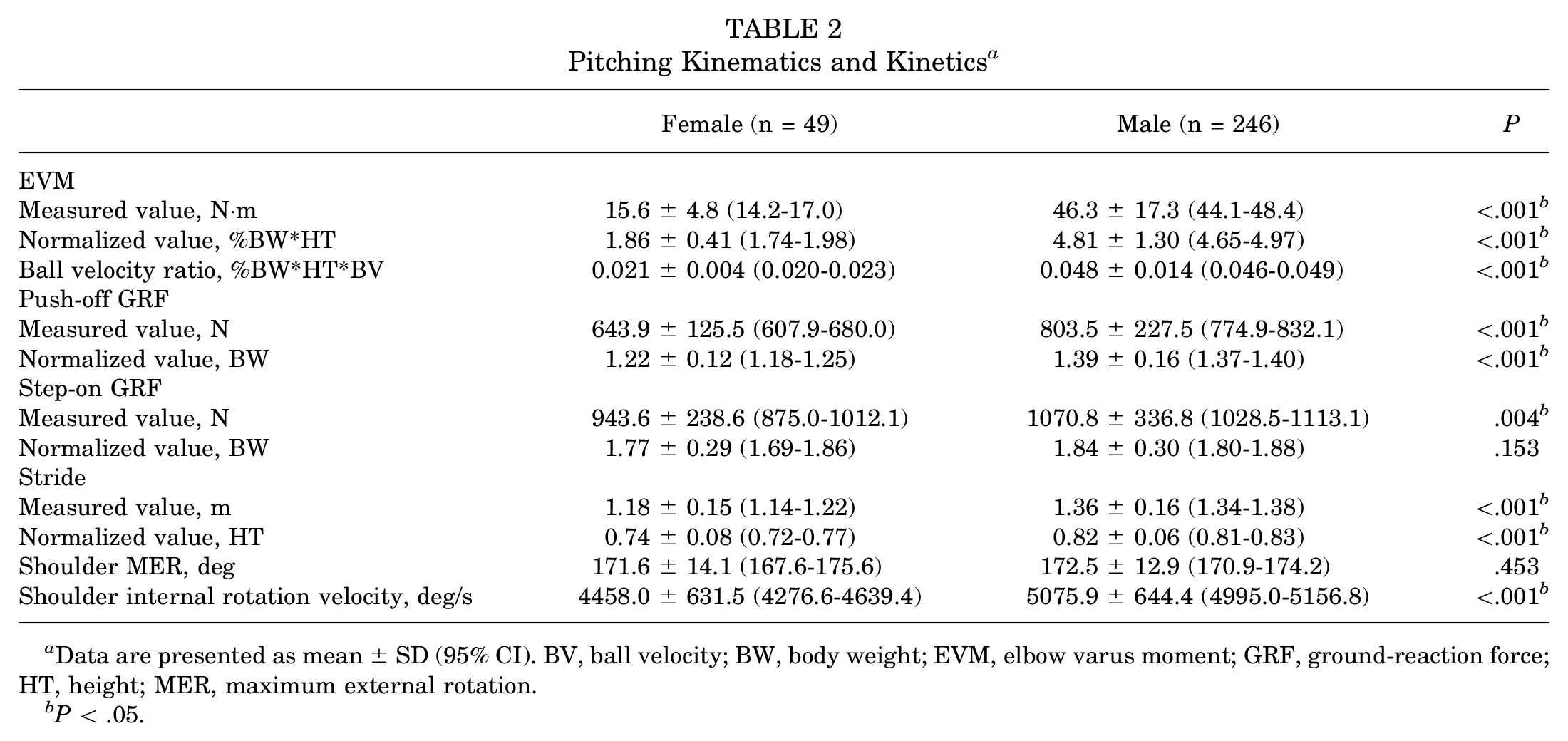
Data are presented as mean ± SD (95% CI). BV, ball velocity; BW, body weight; EVM, elbow varus moment; GRF, ground-reaction force; HT, height; MER, maximum external rotation.
P < .05.
Multiple linear regression analysis of EVM based on pitching kinematics and kinetics in young female baseball players is presented in Table 3. The adjusted coefficient of determination, R2, was 0.578, and the F value was 11.953 (P < .001). EVM was significantly associated with 2 explanatory variables: shoulder internal rotation velocity and body weight (β≥ 0.341; P≤ .011), and these variables were positively correlated with EVM. Although shoulder MER had no relation to EVM (P = .054), the effect on EVM was relatively substantial, considering β = 0.197.
Explanatory Variables of Elbow Varus Moment in Female Players a

Analysis was adjusted for height and body weight. B, standardized partial correlation coefficient; GRF, ground-reaction force; MER, maximum external rotation.
P < .05.
Multiple linear regression analysis of EVM based on pitching kinematics and kinetics in young male baseball players is presented in Table 4. The R2 was 0.540, and the F value was 49.026 (P < .001). EVM was significantly associated with 2 explanatory variables: push-off GRF and height (β≥ 0.261; P≤ .009), and these variables were positively correlated with EVM.
Explanatory Variables of Elbow Varus Moment in Male Players a
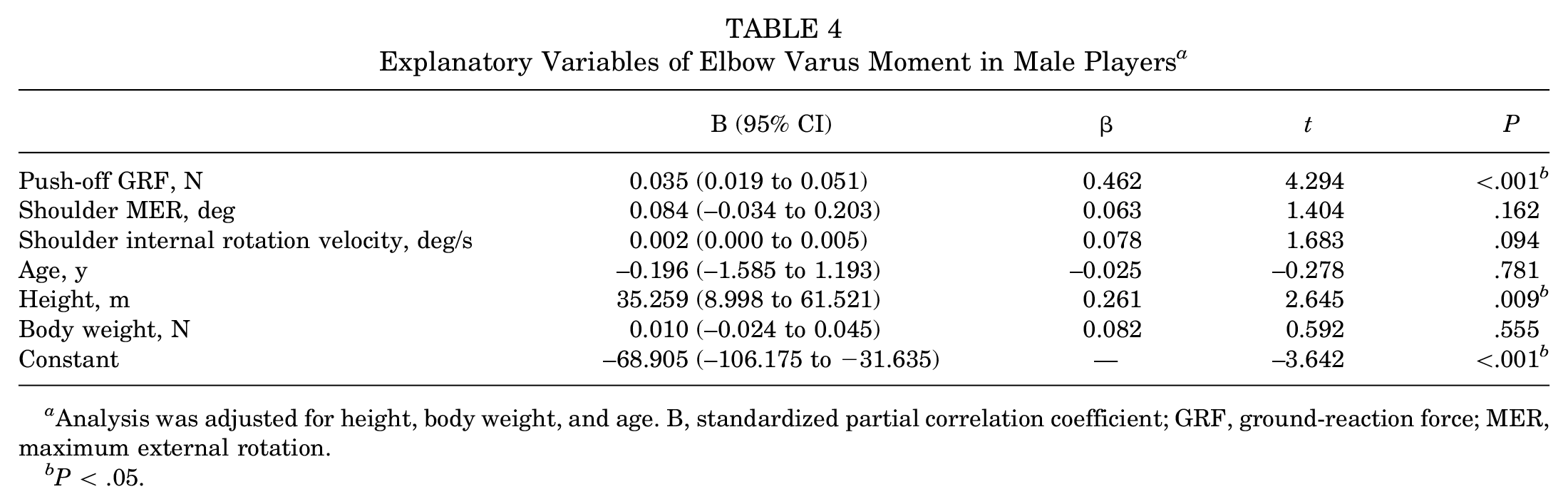
Analysis was adjusted for height, body weight, and age. B, standardized partial correlation coefficient; GRF, ground-reaction force; MER, maximum external rotation.
P < .05.
Discussion
The present study compared the pitching kinematics and kinetics related to the elbow joint load between young female and male baseball players. The main results showed that the elbow joint load in the pitching of young female players was significantly lower than that of young male players and that the pitching kinematics and kinetics related to the elbow joint load in young female players differed from those in young male players.
Although the BMI of young female players was as large as that of young male players in the present study, the height and body weight of young female players were significantly smaller than those of young male players. Ball velocity is the output of pitching and is associated with body size.31,32 A lower ball velocity in female players may be related to their smaller body size.
In a previous study of female baseball players, the elbow joint load was evaluated as axial force on the elbow joint and was found to be lower in female athletes than that in male athletes. 6 Although the elbow joint load in the present study was assessed as a different kinetic parameter from that in the previous study, the sex difference was the same as that in the previous study. 6 In addition, the elbow joint load during pitching in young female players was very low in the present study. Girls have the physiological characteristic in which the ossification age in joints is younger than that in boys and have high joint laxity.29,30 Accordingly, the pitching kinetics in young female players suggest that the risk of elbow joint injuries caused by continual stress to the epiphysis, such as epiphysiolysis and osteochondritis dissecans, may be low. Nevertheless, stress that occurs from repetitive pitching in young female players may continue to accumulate in soft tissue around the elbow joint, such as ligaments and muscles; therefore, there is reasonable concern that the injury risk in the elbow joint, which is different from that of young male players, is high. Furthermore, when young female players aim to increase ball velocity to improve their pitching performance, an increase in the elbow joint load probably occurs. Therefore, young female players should pay attention to the condition of the elbow joint during pitching in the same way as young male players, even if the present study found that the elbow joint load in the pitching of young female players was significantly low.
Push-off GRF moves the entire body in the throwing direction during the push-off phase. 23 The kinetic energy caused by this movement is converted to ball velocity. 23 Step-on GRF plays a role in stabilizing the lower body from the arm cocking phase to the acceleration phase18,27 and helps to effectively convert the kinetic energy into a large kinematic output of the upper body, that is, the kinetic chain. 18 The ball velocity increases through this mechanism.22,33 A lower GRF is related to ball velocity and the elbow joint load.12,23 Although GRFs during pitching provide important information for evaluating pitching mechanics, they have not been assessed in previous studies on adult female participants.3,6 The present study analyzed GRF during pitching in young female participants for the first time and found that push-off GRF, which was normalized by body weight, was significantly lower than that in young male participants. Although muscle strength of the lower body is one of the sources to increase GRFs, the muscle strength in female participants is lower than that in male participants. 26 Improving push-off GRF in young female players to the same level as young male players by enhancing muscle strength will not be easy.
Pitching kinematics showed that stride and shoulder internal rotation velocity in female players were significantly lower than those in male players; that is, the overall pitching kinematics in female players were low. This result is consistent with those of previous studies on adult female participants.3,6 Stride and shoulder internal rotation velocity are reflected by push-off GRF and throwing arm velocity, respectively,21,31 which are related to an increase in EVM. 10 When young female players aim to increase ball velocity, an improper approach of enhancing performance in only a part of the body may increase the elbow joint load. Proper pitching mechanics include the kinematics and kinetics of the entire body during pitching and have a low risk of pitching injuries.10,13,14 Therefore, it is necessary for young female players to improve the kinematics and kinetics of the entire body to reduce the elbow joint load.
Multiple linear regression analysis in the present study showed contrasting results between young female and male players. In young male players, push-off GRF was significantly related to EVM, and thereby, the other 2 variables that had cross-correlation with push-off GRF, stride and step-on GRF, would also be significantly associated with EVM. The enhancement of these variables is essential for increasing ball velocity,22,23,33 and a high ball velocity is correlated with an increase in EVM. 5 This means that young male players are at risk of a large load on the elbow joint when they aim to increase ball velocity to improve their pitching performance. Therefore, coaches should always consider the condition of the elbow joints.
EVM in the pitching of young female players was significantly associated with the kinematics of the shoulder joint, in contrast to young male players. An increase in EVM depends on an increase in ball velocity, owing to the enhancement of shoulder joint kinematics. 10 Moreover, pitching mechanics with increased shoulder internal rotation velocity are related to an increase in the shoulder joint load. 24 This finding suggests that pitching mechanics with a high elbow joint load in young female players may include a high shoulder joint load.
The present study found that EVM in the pitching of young female players was significantly lower than that of young male players. Furthermore, it was clarified that although EVM in the pitching of young female players was associated with pitching kinematics with respect to the upper body, contrastingly, that of young male players was related to pitching kinematics and kinetics with respect to the lower body. Thus, we were able to prove the hypotheses in the present study. Because there was a discrepancy in the pitching mechanics between sexes, pitching injuries may have a sex difference. When young female players aim to increase ball velocity to improve their pitching performance, a larger load may be applied on their shoulder and elbow joints. Considering the results of the present study, improving pitching kinetics of the lower body in young female players by some kind of approach is important not only to enhance their pitching performance but also to achieve proper pitching mechanics to reduce the injury risk, and additionally, the approach in young female players should be different from that in young male players. Moreover, young baseball players, who are in the growth process of the musculoskeletal system and of attaining skillful movements, often develop improper pitching mechanics because of fatigue due to repetitive pitching. 19 Repetitive pitching is strongly associated with overuse injuries of the shoulder and elbow joints; improper pitching mechanics might cause further loads on the shoulder and elbow joints. Therefore, in learning more proper pitching mechanics for young female players, it is necessary to manage their pitch count to reduce overuse injuries caused by repetitive pitching. 15
The present study had some limitations. First, although there was a much larger sample of female participants in the present study than in previous studies,3,6 sufficient power was not provided in statistical analyses. Second, the distance between the rubber plate and the target zone in the motion capture of pitching (12.0 m) was shorter than the regulation distance in an actual game (16.0 m in upper grade ages in elementary school, 18.44 m in junior high school and high school ages). Finally, we could not assess the physical characteristics underlying their pitching kinematics and kinetics, such as joint range of motion, flexibility, and muscle strength.
Conclusion
The present study compared pitching kinematics and kinetics related to the elbow joint load in young female and male baseball players. The stride, shoulder kinematics, elbow joint load, GRFs, and ball velocity in young female players were significantly lower than those in young male players. Furthermore, the elbow joint load in the pitching of young female players was associated with shoulder kinematics, and contrastingly, that of young males was related to push-off GRF. These findings suggest that the mechanism of pitching injuries in young female players may differ from that in young male players. Young female baseball players ought to learn proper pitching mechanics to reduce the injury risk, and the approach for learning in young female players should be different from that in young male players. In the future, we hope to clarify pitching kinematics and kinetics related to the risk of shoulder joint injuries in young female players.
Footnotes
Acknowledgements
The authors thank Kazuo Endo, MD, PhD, professor emeritus at Niigata University of Health and Welfare, who taught the statistical analysis method in this study to them. Furthermore, the authors are grateful to the staff of Niigata Rehabilitation Hospital and the Niigata Institute for Health and Sports Medicine, the students of Niigata University of Health and Welfare, and the managers of the young baseball teams for their great support of this study.
Final revision submitted January 24, 2025; accepted February 27, 2025.
One or more of the authors has declared the following potential conflict of interest or source of funding: This study was supported by Female Athlete Development and Support Projects 2022 and 2023 from the Japan Sports Agency. AOSSM checks author disclosures against the Open Payments Database (OPD). AOSSM has not conducted an independent investigation on the OPD and disclaims any liability or responsibility relating thereto.
Ethical approval for this study was obtained from the Institutional Review Board of the Niigata Institute for Health and Sports Medicine (No. 65).
