



Abstract
Background:
Research in the form of poster and podium abstracts is disseminated at subspecialty society meetings. The quality of this research can be defined by exploring the ultimate publication rate of the presented abstracts.
Purpose:
To investigate (1) the manuscript publication rate of abstracts presented at the American Orthopaedic Society for Sports Medicine (AOSSM) annual meeting; (2) whether abstract format (poster vs podium) influences overall or 2-year publication rates and time to publication; (3) the abstract factors that are associated with increased publication rate; and (4) whether publication quality as measured by journal of publication, level of evidence (LOE), and number of citations differs between posters and podiums.
Study Design:
Cross-sectional study.
Methods:
Poster and podium abstracts that were presented at the AOSSM annual meetings between January 1, 2016, and December 31, 2019, were included. The PubMed and GoogleScholar databases were searched by abstract title and authors to determine whether the related manuscript had been published. For published manuscripts, the journal, journal impact factor (IF), time to publication, authors, and LOE were recorded.
Results:
The manuscripts of 664 abstracts (341 poster, 323 podium presentations) were published during the study period. The overall publication rate was 52.4%. Publication within 2 years of the meeting was found to be higher in podium abstracts (45.8%) compared with poster abstracts (37.8%) (P = .0366). Podium abstracts had a shorter time to publication (P < .001), higher LOE (P = .0166), more citations (P < .0001), and were published in higher IF journals (P = .0028). Poster presentations were more likely to undergo a change in first author between the time of the conference and future publication (P = .0300). The most common journal of publication was the American Journal of Sports Medicine (36.8%).
Conclusion:
Abstracts presented at the AOSSM annual meeting had a high rate of publication within 2 years. There was no difference in publication rates between podium and poster abstracts, but podium abstracts had a shorter time to publication and more future citations and were published in journals with higher IFs.
In the field of orthopaedic surgery, specialty society meetings are important for the dissemination of current research. Abstracts presented at annual meetings allow for prepublication findings to be shared. However, previous studies have shown presenting at a conference can be challenging, in part due to a lack of clearly defined acceptance protocol, with a low acceptance rate (26.7%) of abstracts at the American Orthopaedic Society for Sports Medicine (AOSSM) annual meeting. 11 The Arthroscopy Association of North America (AANA) annual meetings from 2008 to 2012 demonstrated a higher rate of abstract acceptance for presentation (65%). 7 As the volume of abstract submissions continues to increase, there will be a larger number of high-quality abstracts with improved levels of evidence (LOEs), making acceptance of abstracts for presentation increasingly troublesome.7,13,17
One factor that may influence an author’s decision is the future publication rate of abstracts presented at various conferences. Previous literature has shown the future publication rate of abstracts presented annual orthopaedic meetings to be between 34.2% and 71%.1-5,7,8,11-13,16,17 The AOSSM annual meeting has been reported to have a publication rate of between 50.7% and 67%.8,11 These publication rates are comparable with the publication rates found for abstracts presented at the AANA annual meeting.1,7 While there has been a significant distinction between the publication rates of posters and podiums in review of other orthopaedic conferences, the most recent review of AOSSM conferences showed no difference in publication rate between these presentation types.2,3,7,8,11,12,17 Furthermore, Gowd et al 8 alluded that podium presentations may represent higher quality studies, given the higher impact factor (IF) of the journals that ultimately publish the full manuscript and the number of citations that reference the study.
In the current study, we aimed to answer the following questions: (1) What is the publication rate of abstracts presented at AOSSM annual meetings, and has this changed from previous studies? (2) Does abstract format (poster vs podium) influence overall publication rates, 2-year publication rates, or time to publication? (3) Which abstract factors are associated with an increased rate of publication? (4) Is there a difference between posters and podiums regarding the publication quality as determined by journal of publication, LOE, or number of citations?
Methods
The conference programs of the AOSSM annual meetings from 2016 to 2019 were obtained from publicly available sources and reviewed. There was no conference in 2020 due to the COVID-19 pandemic. 15 Conference programs from 2021 and 2022 were not included, as abstracts would have needed to be given sufficient time to assess for 2-year publication rates.3,11,17 Abstract titles, authors, type of presentation (poster or podium), and presence of award designation were recorded for each abstract. The abstracts were categorized by anatomic location central to the study topic as clearly described. Two independent reviewers (T.B.G. and T.S.) evaluated each abstract, with disputed anatomic categorization determined by a third reviewer (B.K.). Abstracts that evaluated multiple anatomic locations, general medicine concepts, and biochemical evaluations were excluded.
Two online publication databases, PubMed and Google Scholar, were queried independently by 2 authors (D.A.C. and T.B.G.) to determine whether the related study of each abstract was published, as performed in previous studies of abstract publication rates at orthopaedic conferences.1,7,8,11 To prevent the exclusion of manuscripts that underwent a title change between AOSSM abstract submission and publication date, each database was independently searched by 3 reviewers (D.A.C., T.B.G., and T.S.) for each author and abstract title.
For each manuscript published, we recorded the publication date, journal name, associated IF, authors, numbers of citations, and LOE were recorded. The LOE was determined based on the study design of the published manuscript. In addition, the overall publication rate and 2-year publication rate (within 24 months of conference date) of posters and podium abstracts were calculated. The journal IF was recorded directly from the corresponding journal’s website. Nonclinical studies, including animal, cadaveric, biomechanical, financial, and basic science studies, were not assigned an LOE and were excluded from associated calculations.
Statistical analysis was performed using Microsoft Excel (Microsoft) and Python (Python Software Foundation). Descriptive outcomes were described as means when appropriate. The associated variable’s independence was determined with t tests and Z tests for proportions. Factors predictive of study publication were evaluated using multivariable logistic regression analysis. Covariates entered in the model included number of authors, topic, presentation type (poster vs podium), and award reception.
Results
Overall, 664 abstracts (341 poster and 323 podium) were presented at AOSSM annual meetings between 2016 and 2019. There were a mean (±SD) of 85.25 ± 51.91 poster presentations and 80.75 ± 20.04 podium presentations per meeting. Of the abstracts presented, the full manuscript was published in 52.41%. While there was no significant difference in the overall publication rate between posters and podium presentations, podiums had a significantly higher 2-year publication rate (P = .0366), IF (P = .0028), LOE (P = .0166), and number of citations (P < .001) compared with posters. This difference suggests the superiority of the clinical impact of podium presentations to poster abstracts (Table 1).
Influence of Poster vs Podium Designation a
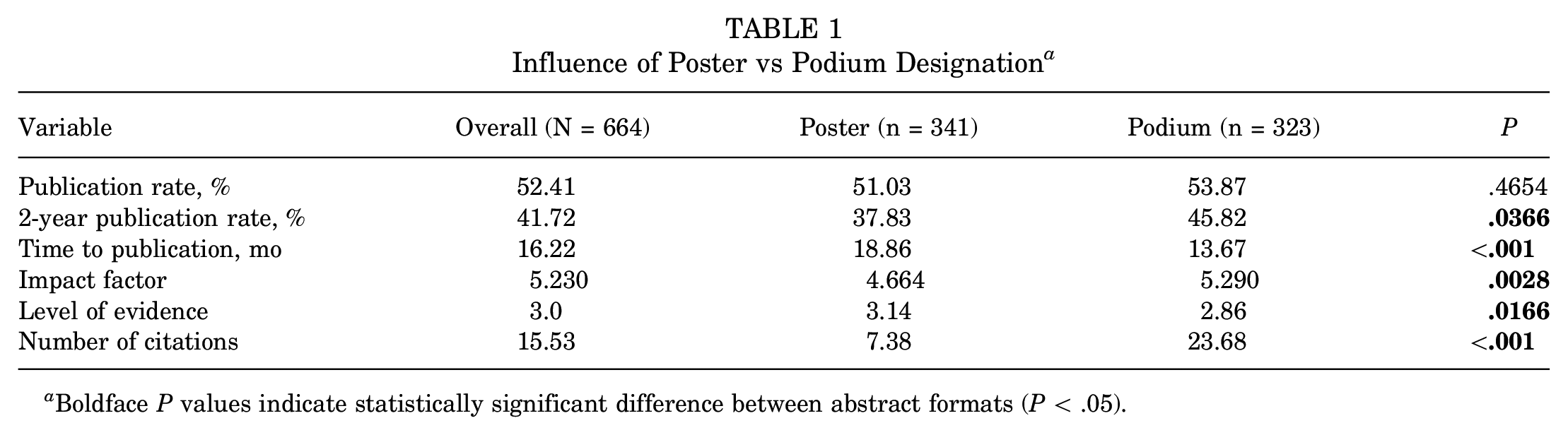
Boldface P values indicate statistically significant difference between abstract formats (P < .05).
Some manuscripts (7.18%) were published after abstract submission but before the conference presentation. Podium presentations that were designated with an award had a higher publication rate than podium presentations that were not given an award (76.0% vs 52.19%; P = .0220). Studies relating to the elbow had the highest publication rate (61.02%), followed by the foot and ankle (57.69%) and knee (53.78%). While there was an increased proportion of podiums compared with posters in nonclinical studies that approached clinical significance, no anatomic category provided a publication rate that was statistically significant when compared with overall abstract publication rate (Table 2).
Publication Rates by Anatomic Focus a

Dashes indicate areas not applicable.
Abstracts were published in a total of 39 journals. The average IF of the journals that published podium presentations was higher than that of poster abstracts (P = .0028). The American Journal of Sports Medicine (AJSM) was the most common journal of publication for manuscripts of both poster (28.74%) and podium (44.83%) presentations (P = .0019). There were no other significant differences among journals in publication rates of poster versus podium presentations (Table 3).
Publication Rates by Journal a

Only journals with a minimum of 5 publications were included in this table. Boldface P value indicates a statistically significant difference between poster and podium publication rates (P < .05). IF, impact factor.
Published podium abstracts that had won conference awards had a higher proportion published in AJSM (68.42%) than those without an award (41.94%) (P = .0285). Manuscripts of podium abstracts had a superior LOE than those derived from poster abstracts (P = .0166). The majority of published manuscripts provided Level 3 evidence (40.84%), followed by Level 4 (30.80%), Level 2 (16.96%), Level 1 (9.34%), and Level 5 (2.42%). The distribution of LOE between podium and poster publications remained within expected proportions (P = .0194). Nonclinical studies unable to be assigned an LOE composed 16.95% of total publications and were excluded from LOE calculations. No significant correlation was found between LOE and IF in all abstracts (r = 0.1153, P = .0504), poster abstracts (r = 0.1338, P = .0115), or podium abstracts (r = 0.0647, P = .4338). Podium abstracts generated more citations after publication than poster abstracts (P < .0001). There was a significant positive correlation between a publishing journal’s IF and the number of citations produced by the manuscript; all abstracts (r = 0.2147, P < .001), posters abstracts (r = 0.2225, P = .0074), and podium abstracts (r = 0.1952, P = .0170).
Abstracts presented at AOSSM had an average of 5.88 ± 2.25 authors per submission (posters: 5.91 ± 2.03, podium: 5.83 ± 2.46). There was no difference in the number of authors on the initial abstract between unpublished and published studies (P = .9780). In 32.47% of published studies (posters: 35.63%; podium: 29.31%), there was a change in the number of authors from that of the original abstract submission. More commonly, the number of authors at publication increased (84.96%) than decreased (15.04%) (P < .0001). The first author denoted at abstract presentation changed by final publication in 94 manuscripts (27.01%). Poster presentations (31.28%) were more likely to undergo a change in first author between conference and study publication than podium abstracts (32.18%) (P = .0300).
While the presentation format was not found to be a predictive factor of future publication, podium award designation and number of authors were found to be associated with higher odds of study publication. The results of multivariable logistic regression indicated that abstracts with 1 to 3 authors (odds ratio [OR], 1.18; 95% CI, 1.04-1.33; P = .009) and 4 to 5 authors (OR, 1.11; 95% CI, 1.02-1.21; P = .011) were associated with higher odds of publication compared with abstracts with >5 authors. In addition, abstracts that won an award were associated with a greater odds of publication compared with those that did not receive an award (OR, 1.36; 95% CI, 1.02-1.78; P = .031) (Table 4).
Factors Predictive of Publication Presented Abstracts a
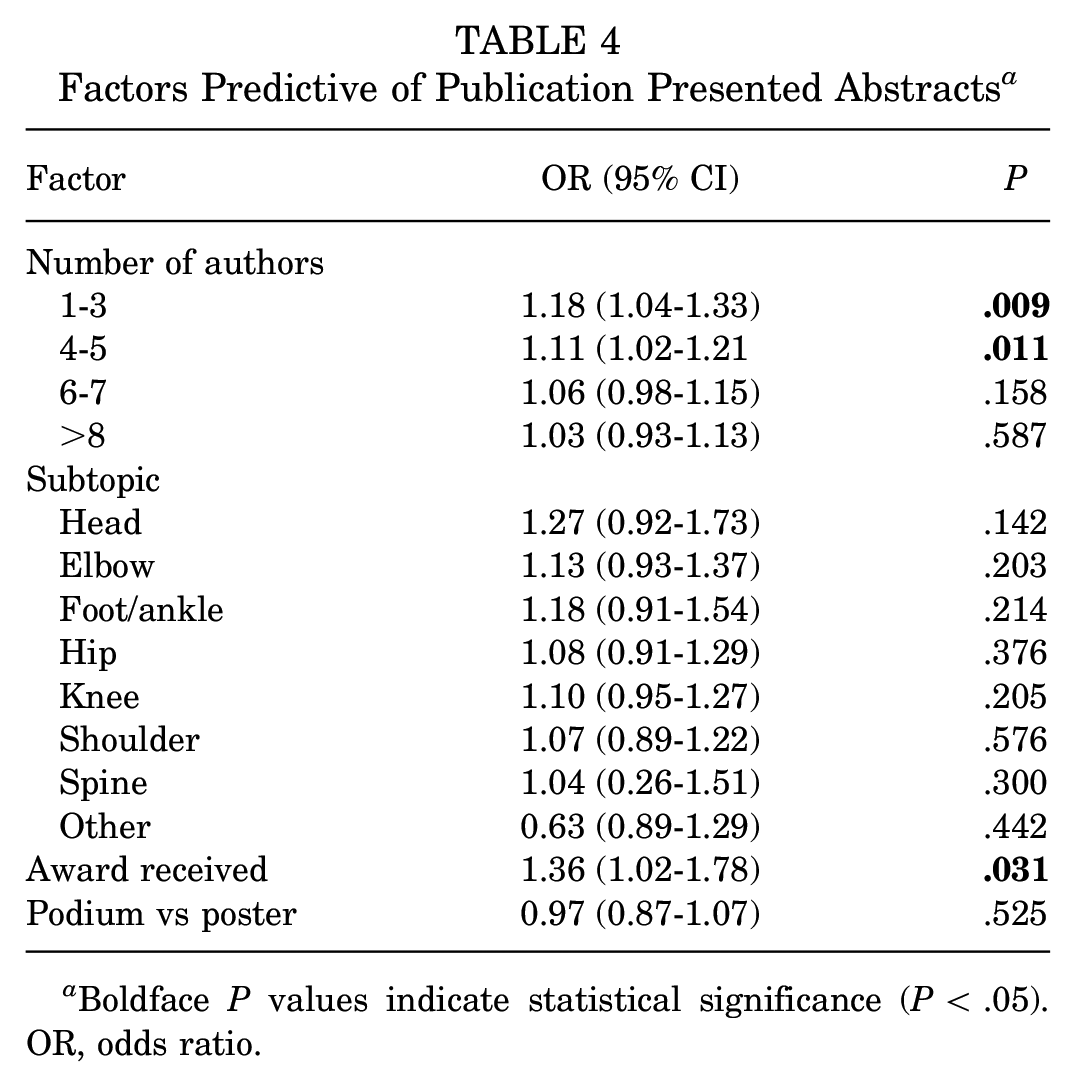
Boldface P values indicate statistical significance (P < .05). OR, odds ratio.
Discussion
The AOSSM annual meeting is one of the most extensive orthopaedic sports medicine subspecialty meetings and therefore high value for an abstract presentation. The publication rates of abstracts presented at this conference have been evaluated previously. However, there was discrepancy between previous manuscripts concerning the overall publication rate and between podium and poster presentations.8,11 An updated evaluation was performed with a continued trend toward evidence-based management and an emphasis on research in orthopaedic education. The current study may assist conference attendees in determining the validity of reported abstract findings when assessing which recommendations to incorporate into their practice. This study also provides those performing high-quality research with an evaluation of the quality of abstracts presented at the AOSSM annual meeting.
The overall study publication rate of poster and podium abstracts presented at the AOSSM annual meetings from 2016 to 2019 was 52.4%. While this is comparable with that of a recent review of 2011 to 2015 AOSSM abstracts by Gowd et al 8 (50.7%), it is notably lower than the publication rate initially described by Kinsella et al 11 (67.1%) from 2006 to 2010 meetings. The publication rate of abstracts submitted to the AANA annual meeting, another sports medicine subspecialty organization, has been reported at between 49.0% and 67.1%.1,7 Abstracts presented at conferences of other orthopaedic subspecialty organizations have reported publication rates between 43.8% and 71%.3,4,12,13,16
As previously reported by Gowd et al, 8 no difference was found between overall future publication rates of posters and podium presentations. However, Kinsella et al 11 demonstrated a 2.08 times increased likelihood of future publication with podium abstracts. In 2 previous reviews of AANA abstracts, one found podiums to be published more frequently (OR, 1.809) than posters, while the other found no difference.1,7 Inconsistent statistical differences between podium and poster presentations have been demonstrated through reviews of multiple orthopaedic subspecialty meetings.2,3,5,12,17 Whereas there was no difference between podiums and posters in future publication rates, our review found that podiums were more likely to be published within 2 years of presentation and had a shorter average time to publication. Previous literature did not find a difference in time to publication between posters and podiums.1,7,8 As the time to publication is an independent predictor of inconsistencies between the initial abstract and future manuscript (titles, authors, sample size, results, and outcomes), abstracts with a prolonged time to publication may provide incomplete conclusions and caution should be made when implementing this presented literature into clinical practice. 2 Therefore, podium presentations may be more reliably implemented into patient management since there is a lower risk of change to the initial findings.
The quality of manuscripts can be objectified by evaluating the LOE of study design, the IF of the publishing journal, and the number of citations of the published manuscript. AOSSM podium abstracts have superior LOE, higher journal IFs, and greater future citations when compared with poster presentations. Gowd et al 8 also found that podium abstracts are published in journals with higher IF than poster presentations. Previous literature reviewed AANA annual conferences and found that LOE was not correlated with abstract publication rate. There was no difference between the proportion of Level 1 studies between published and unpublished podium presentations.1,10 However, the LOE of abstracts has been linked to publication rate and journal IF at other orthopaedic subspecialty conferences.9,10,13,16
The organizations hosting annual conferences are often affiliated with their own academic journals and may be more likely to publish studies previously presented at their conference. In the case of the AOSSM conference, all abstract submissions presented at the annual meeting are considered the property of the AOSSM and are not permitted to be submitted to other journals unless the manuscript has been denied by the AJSM. Due to the right of first refusal policy by the AOSSM, manuscripts of presented abstracts were more likely to be published by AJSM than any other journal. In addition, as also demonstrated by a previous review, podium presentations were more likely to be published in AJSM than poster presentations. 8 The second most common journal of publication was the Orthopaedic Journal of Sports Medicine (OJSM), an open access journal affiliated with the AOSSM. This demonstrated a large increase compared with 2011 to 2015 when only 4.8% of published abstracts were accepted by OJSM. 8 While the right of first refusal policy does not apply to OJSM, authors are likely encouraged to submit their manuscript to OJSM if they are not accepted into AJSM. While other organizations may not have an official policy regarding a right of first refusal, presented studies are displayed for conference attendees who may be potential reviewers or editorial staff members. In all previous literature regarding the future publication rate of conference abstracts, the affiliated journal of the hosting organization was the most common journal of publication for future manuscripts.1,3,4,7,12,13,17
Podiums with an award designation had a higher future publication rate than those podium presentations without an award designation, which was also demonstrated in previous reviews.8,12 As the conference committee recognized these awarded abstracts for demonstrating high quality or unique research, it is no surprise that these manuscripts would have a higher publication rate. Whereas previous studies found the number of authors on a submitted abstract to be a positive predictive factor for future publication, this was not demonstrated in our study.6,8,14 However, posters were found to be more likely to change the first author when compared with podium presentations. Studies with more authors may have been performed at institutions with a more resources, thus more likely to complete the associated manuscript. There was no anatomic subcategory associated with a higher rate of publication. In a previous review of abstracts presented at the North American Spine Society, podiums commonly presented biopsychosocial and socioeconomic topics, while posters more commonly presented subjects relating to deformity and imaging/technology. 12
Limitations
This study has some limitations. While every effort was made to identify all published manuscripts associated with abstract titles and authors, including the use of multiple independent reviewers, there may have been studies that were published that should have been identified during our search. This may have resulted from human error in identifying an associated manuscript or if a manuscript was only included in databases not utilized in this study. As only abstract titles and authors were available for search, those studies that underwent significant change in title or authorship may not have been noticed. However, including any of the missed manuscripts would have further increased the high future publication rate, demonstrating the value of presenting abstracts at the AOSSM conference. Due to the evaluation of recent abstracts, this review considered a publication window of 3.5 to 6 years. While previous literature has demonstrated that most abstracts are published within 3 years of presentation, the publication rate of abstracts may be underestimated as these projects still have potential for publication. Although this study measured the quality of abstracts by a shorter time to publication, acceptance to journals with higher IF, and a greater number of future manuscript citations, it must be considered that bias may exist in future publication as the research becomes unblinded after presentation.
Conclusion
The AOSSM annual meeting remains an attractive location for presenting abstracts, given the high future publication rate of abstracts presented. The findings of this study indicated that, while there was no difference in overall publication rates, compared with poster abstracts the manuscripts of podium abstracts had a shorter time to publication, they were accepted to journals with higher IFs and had a more significant number of citations.
Footnotes
Acknowledgements
The authors acknowledge Aidan Papalia for his assistance with data interpretation and statistical analysis.
Final revision submitted May 6, 2023; accepted June 20, 2023.
One or more of the authors has declared the following potential conflict of interest or source of funding: R.G.T. has received education payments from Gotham Surgical Solutions & Devices, Arthrex, and Smith & Nephew. R.M.C. has received education payments from Gotham Surgical Solutions & Devices. AOSSM checks author disclosures against the Open Payments Database (OPD). AOSSM has not conducted an independent investigation on the OPD and disclaims any liability or responsibility relating thereto.
Ethical approval was not sought for the present study.