



Abstract
Background:
Kickoff plays in American football are associated with an increased risk of concussion compared with other play types. In 2018, the National Collegiate Athletic Association (NCAA) Football Rules Committee altered the kickoff rules so a fair catch inside the 25-yard line results in a touchback, with the ensuing drive starting on the 25-yard line. The intention was to decrease the number of kickoff returns with a corresponding decrease in the rate of concussions on kickoff plays.
Purpose:
To determine whether the 2018 rule changes had the intended effects in an NCAA Division 1 Conference.
Study Design:
Cohort study; Level of evidence, 3.
Methods:
The study population included football athletes in the NCAA Pacific-12 (Pac-12) Conference. Data on the total number of plays, punts, kickoffs, touchbacks, and fair catches were obtained for all in-conference games from the 2016 to 2021 seasons. The number of game concussions and the play type were provided by each conference institution. Incidence of concussions occurring during kickoff plays before (2016-2017) and after (2018-2021) the rule change were compared with a difference-in-difference analysis using Poisson general linear models.
Results:
There were 242 concussions in 108,774 total plays in the study period, with an overall concussion rate of 2.2 per 1000 plays. The percentage of touchbacks increased significantly from 45% to 51% (P < .001) and the percentage of fair catches increased from 1% to 7% (P < .001) from before to after the rule change. Kickoffs accounted for 6% of plays both before and after the rule change and 11% of concussions before and 14% after the change. The mean annual concussion rate (per 1000 plays) on kickoffs was 3.42 before and 5.31 after the rule change (rate difference: 1.89; 95% confidence interval, -1.22 to 5.01).
Conclusion:
Touchbacks and fair catches increased after the kickoff rule change, but there was not a corresponding decrease in concussions during kickoff plays as anticipated. Concussions occurring during other football plays remained stable.
Concussions in American football are a major concern. Regulatory bodies have responded with rule changes in an attempt to make the game safer and decrease the concussion rate. For example, in 2008 the National Collegiate Athletic Association (NCAA) instituted rule changes that prohibited targeting (making forcible contact with the crown of the helmet or to the head and neck of a defenseless opponent), because plays in which a targeting foul is called are associated with higher rates of injury, specifically concussion. 1
Kickoff plays have been associated with an increased risk of concussion compared with other play types. 2,3,8,9 A kickoff play in American football occurs when 1 team kicks the ball to the opposing team, who must decide whether to run the ball back (runback), signal for a fair catch, or signal for a touchback (Table 1). Collisions during these plays often happen at higher speeds, since the players run down the field toward each other before colliding, as opposed to other plays in which they line up only feet or inches away from each other before colliding. An exception is the punt play, which is comparable to a kickoff in that players run down the field toward each other, and thus it presents a similar level of risk. However, there has not been a rule change specific to punts.
Types of Plays During Kickoff in American Football
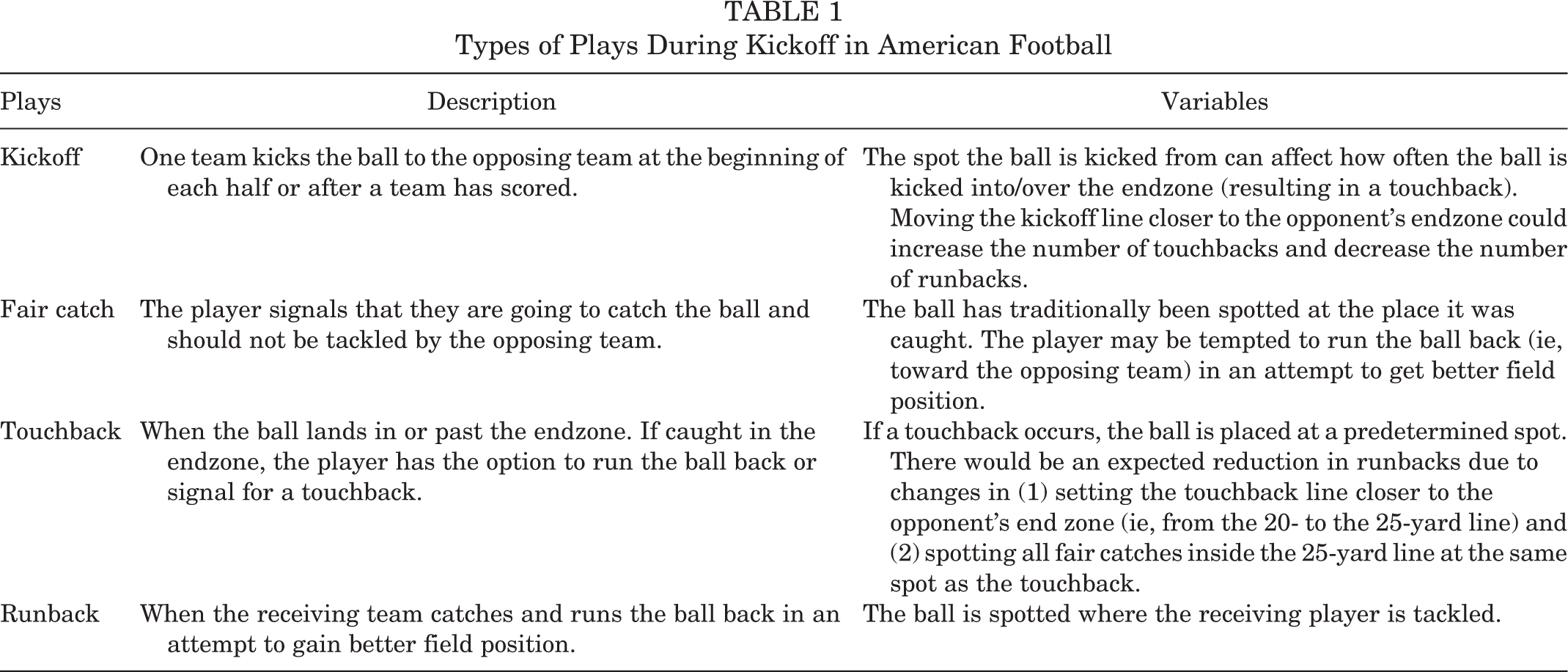
At the point where the the ball is caught after the kickoff, a complex calculus is initiated by the receiving player to achieve the best field position for their team. If the opposing team is advancing too quickly or the receiving team’s position after making the catch is not optimal, they may elect to forego a runback and signal for a fair catch or touchback because of the guaranteed placement. Adjustments to rules are intended to alter this calculus. It intuitively makes sense that decreasing the number of runbacks during kickoff plays will decrease the rate of concussion. Advancing the kickoff line should increase the number of touchbacks by increasing the number of times the ball will be kicked into or over the endzone. Allowing a fair catch within the 25-yard line to be spotted at the 25-yard line could decrease the number of runbacks, as players may decide that the 25-yard line is likely farther downfield than they could advance the ball by running.
There have been various rule changes to the kickoff rules by football organizations in an attempt to make the game safer 5 –7 (Table 2). In 2015, rule changes to the kickoff line and spot of a touchback by the Ivy League were associated with an increase in touchbacks and corresponding decrease in the risk of concussion on kickoff plays. 12 In 2018, the NCAA Football Rules Committee altered the kickoff rules so a fair catch by the receiving team inside the 25-yard line results in a touchback, with the ball spotted at the 25-yard line. Before this rule, a fair catch inside the 25-yard line resulted in the ball being spotted where it was caught, making it more likely that a player receiving the ball between the 0- and 25-yard line would attempt to run the ball back toward the opposing team.
Kickoff Rule Changes and Effect on Kickoff Concussion Rate a

a Dashes indicate areas not studied.
In the current study, we evaluated whether there was the intended reduction in concussions in an NCAA Division 1 conference after the 2018 rule change.
Methods
Data Collection
This study was determined to be exempt from institutional review board approval, as deidentified data were used. All data were collected from the NCAA Pacific-12 (Pac-12) intraconference competition during the 2016 to 2021 seasons; data before 2016 were not available. Play counts were obtained from the Pac-12 conference analytics team for the following play types for each year: total defensive, total offensive, kickoff coverage, kickoff return, punt coverage, punt return, field goal, field goal blocks, extra point, extra point blocks, 2-point conversion attempts, and 2-point conversion blocks. For analysis of concussion incidence, these plays were grouped into the following mutually exclusive categories: (1) kickoff return and kickoff coverage were analyzed together as “kickoffs”; (2) punt return and punt coverage were analyzed together as “punts”; and (3) all other play types were analyzed together as “all plays excluding punts and kickoffs.” When reporting on differences in rates of play types, raw play counts were used. When evaluating concussion rates, we used the number of exposures for each team on a given play (ie, each individual play counted as 2 exposures, 1 for the offensive team and 1 for the defensive team). We did this to create an accurate denominator (exposures) for each team to calculate the rate of concussions per team per play. The incidence of concussion was calculated as the rate per 1000 plays.
Deidentified concussion data stratified by play type were obtained from each Pac-12 institution’s medical staff through the Pac-12 Health Analytics Program, which was used to ensure accurate and complete data collection. Information about the Pac-12 Health Analytics Program has been described elsewhere. 10 Concussions were diagnosed (identified) by team physician or designee (athletic trainer) on the medical staff at each institution according to the definition established by the 2017 Concussion in Sport Group consensus statement. 4 Concussion counts for the years of the study were obtained directly from the head football athletic trainer at each institution. Athletic trainers obtained counts of concussions and play type by reviewing concussion diagnoses and notes from the electronic medical record used at each school.
Statistical Analysis
The incidence of concussion and average concussions during kickoff plays (coverage and return), punt plays (coverage and return), and all other plays excluding kickoffs and punts were calculated for each year of the study period. Relative risk of concussion during kickoff was calculated by comparing concussions occurring during kickoffs to all other plays and punts to all other plays. Rate differences and 95% confidence intervals were calculated of concussion incidence during kickoff plays from before the rule change (2016-2017 seasons) and after the rule change (2018-2021 seasons).
In addition, concussion counts for each year were modeled by play type, time relative to the rule change, and the interaction of play type and time relative to the rule change using Poisson regression difference-in-differences analysis. Play type was coded as “kickoff” or “all other plays,” and time was coded as “before” or “after” the rule change. The logarithm of total plays for each play type and year was included as an offset in the model. Finally, the rates of touchbacks, fair catches, and kickoff returns on kickoff plays were calculated, and the Fisher exact test was used to evaluate the difference in rates of these play types from before to after the rule change. Statistical analysis was performed using R statistical software version 1.1.447 (R Project for Statistical Computing).
Results
A total of 242 concussions were reported during 108,774 plays between 2016 and 2021, for an overall concussion rate (all plays) of 2.20 per 1000 plays. The annual number of concussions ranged from 34 to 47 with an average of 40.33 concussions per year. The annual number of concussions during kickoffs ranged from 3 to 10 with an average of 5.33 kickoff concussions per year (Table 3). From 2016 to 2021, 32 concussions were reported during 6958 kickoff plays for a concussion rate of 4.60 per 1000 plays (Table 4). The relative risk of a concussion during a kickoff play compared to other plays was 2.21 [95% confidence interval (CI), 1.53-3.21; P < .001; data not shown].
Concussions in the Pac-12 Conference from 2016 to 2021 Overall and According to Play Type

Kickoff Play Counts a

a Data are reported as n (%).
There was a significant increase from before to after the rule change regarding the rate of touchbacks (from 45% to 51%; P < .001) and the rate of fair catches (from 1% to 7%; P < 0.001), with a corresponding significant decrease in the rate of runbacks from 51% to 38% (P < .001) (Table 4). Kickoffs accounted for 7% of plays before and 6% after the rule change but 11% of concussions before and 14% after the change (punts accounted for 7% of plays before and 2% after the rule change, although raw numbers were low, so we could not draw any conclusions; all other plays accounted for 81% before and 83% after the rule change). The mean annual concussion rate (per 1000 plays) on kickoffs was 3.42 before and 5.31 after the rule change (rate difference: 1.89; 95% CI, -1.22 to 5.01), which was not statistically significant (Table 5). Finally, the difference-in-difference analysis showed the rule change was associated with a rate increase of 1.38 concussions per 1000 plays, but this was not statistically significant (P = .44; data not shown).
Concussions, Plays, and Concussion Incidence Before and After Rule Change a

a Data are reported as n (%) unless otherwise indicated.
b Measured as concussions per 1000 plays.
c Difference between before and after the rule change.
Discussion
A significant increase in the rate of touchbacks (from 45% to 51%; P < .001) and fair catches (from 1% to 7%; P < .001) was seen in the Pac-12 Conference after the 2018 NCAA kickoff rule change, but it did not lead to a statistically significant decrease in the number of concussions during kickoff plays. Instead, the concussion rate during kickoff increased from 3.42 before the rule changed to 5.31 after. There was also an increase in the relative risk (2.21; 95% CI, 1.53-3.21). While not statistically significant, this finding was not anticipated and may be due to limited statistical inference and power considering the relatively small number of kickoff concussions and high variability year over year. The number of concussions during kickoff plays ranged from 3 to 10 during the study period. The first year after the rule change, 2018, appears to be an outlier with 10 concussions compared with 3 to 6 concussions in other years. We distinguished punts in the data given the similarity in player position to kickoffs, using the evaluation of risk change for punts as a barometer to compare the risk change in kickoffs where the rule change was incorporated. Similar to previous research, we confirmed that kickoff plays are more likely to result in a concussion than other play types. 2,3,8,9,12
There are 2 other studies that specifically compared kickoff concussion rates before and after a rule change. In 2015, Ruestow et al reported that kickoff rule changes in the NFL led to an increased number of touchbacks and fewer runbacks, but that it did not result in a statistically significant change in concussion kickoff rate. 11 Their study only encompassed a year before and a year after the rule change and attributed the lack of significance to a small sample size. In contrast, the Ivy League found that moving the kickoff line from the 35-yard line to the 40-yard line increased the percentage of kickoffs resulting in touchbacks from 17.9% to 48% and did result in a statistically significant decrease in kickoff concussion rate. 12 Although touchbacks also increased in the Pac-12, the magnitude of increase was not as large (45.7%-50.6%) as in the Ivy League after their kickoff line rule change, which may account for the difference in findings. In addition, the concussion rate during kickoffs in the pre-rule-change era in the Ivy League was higher at 10.9 concussions per 1000 plays compared with 3.4 concussions per 1000 plays in pre-rule-change era in the Pac-12 leaving less room for improvement. Concussion rates are not directly comparable between the Pac-12 and Ivy League as the Ivy League calculated the denominator (number of plays) differently, including plays for all games (7 conference games and 3 nonconference games), but only including concussions occurring during in-conference games. This effectively increased the play-count (denominator) as compared with the Pac-12 which included only in conference games.
The takeaway from our study and other studies evaluating concussions, kickoff plays, and rule changes remains that kickoff plays are riskier plays than other play types and that decreasing the number of runbacks should enhance safety. However, given the relatively low annual number of concussions occurring during kickoff plays, an extremely large sample size is needed to account for variability from year to year.
Many factors may affect kickoff concussion rates including changes in equipment, education and awareness, diagnostic strategies, and individual player practices. Factors other than the change in the kickoff rule may have influenced the kickoff concussion rate although those changes are also intended to drive concussion rate down (use of equipment intended to reduce impact, etc). Given the relative risk for concussion went up while the number of runbacks went down could also be explained by data limitations, including small numbers for some groups. In addition, much of the contact that occurs during a kickoff happens before the kick returner choosing to fair catch or take a touchback, which may also account for the lack of a statistically significant decrease.
Limitations
Limitations of our study included only having 2 years’ of data from before the rule change and the use of data from 2020, a shortened season due to the COVID-19 pandemic, which may have affected players and their motivations differently than other years. We elected to keep this year in the analysis because even though it was a shortened season, it was proportionally accurate given exposures and incidence were measured in plays as opposed to years or games. Generalizability to other levels of play such as other NCAA divisions or high school is unknown although this should be applicable to other Power 5 conferences.
Conclusion
The NCAA kickoff rule change did not have the intended effect of decreasing kickoff concussions in the Pac-12 but did increase the number of touchbacks and decrease the number of runbacks. Kickoff plays continued to cause a disproportionate number of concussions compared with all other plays. Objective evaluation of how rules intended to change injury rates perform is essential for continuous process improvement and progressive safety of the game as is understanding those rules in the context of the game.
Footnotes
Acknowledgment
The authors thank Mike Ortiz, vice president of video operations for the Pac-12 Conference, and the individuals at each institution who assisted with data collection. We also appreciated the contributions by the Pac-12 Brain Trauma Task Force in their review of this article.
Final revision submitted March 17, 2023; accepted April 14, 2023.
The authors have declared that there are no conflicts of interest in the authorship and publication of this contribution. AOSSM checks author disclosures against the Open Payments Database (OPD). AOSSM has not conducted an independent investigation on the OPD and disclaims any liability or responsibility relating thereto.
Ethical approval for this study was waived by Oregon State University (No. IRB-2019-0071).