




Abstract
Background:
The targeting rule was adopted by the National Collegiate Athletic Association (NCAA) in 2008 to discourage dangerous contact during collegiate American football competition. Although targeting rules have been emphasized as a means to reduce concussion rates, there is currently no evidence that targeting plays are higher risk for concussion than other plays in American football.
Purpose:
To compare the rate of concussion occurring during targeting versus nontargeting plays in American collegiate football.
Study Design:
Cross-sectional study.
Methods:
Concussions occurring in games in the 2016-2019 Pac-12 Conference were classified as having occurred during either (1) a play where a targeting penalty was called or (2) all other plays. Targeting plays were further categorized to either those in which the call was upheld or those overturned by the on-field official after replay review. The number of targeting plays and the total number of plays during games were also recorded. Concussion incidence (per 1000 plays) and risk ratios were calculated.
Results:
Overall, 538 games with 68,670 plays were reviewed, during which 213 concussions occurred (15 during plays where targeting was called and 198 on other plays) and 141 targeting penalties were called. The incidence of concussion was 106.4/1000 plays for targeting plays (including 141.2/1000 upheld targeting fouls and 53.6/1000 overturned targeting fouls) and 2.9/1000 plays for nontargeting plays. The risk of concussion during targeting plays was 36.9 (95% CI, 22.4-60.7) times greater than that for all other plays. The risk of concussion during targeting plays upheld was 49.0 (95% CI, 28.5-84.2) times greater than that for all other plays.
Conclusion:
Concussion risk was significantly higher during plays in which targeting was called, especially those in which targeting fouls were upheld.
Clinical Relevance:
This study supports eliminating or reducing targeting from American football. The results of this study suggest that players should be screened for concussion after targeting plays are called.
Sport-related concussion (SRC) is common in American football, and there is increasing concern regarding both short- and long-term consequences of concussion. 9 –11,14 SRC is defined as a traumatic brain injury induced by biomechanical forces resulting in rapid onset of short-lived impairment of neurological function. 9,13 From 2010 to 2014, one-third of the roughly 10,000 concussions across the National Collegiate Athletic Association (NCAA) occurred during football. 20 Concussion is the leading cause of injury in NCAA football players, accounting for 7.5% of football injuries. 5 These injuries most commonly occurred while blocking (20.4%) or tackling (19.9%). 20 Emphasis and formal rules have been placed on removing unnecessary contact to the head and neck area during these activities in order to reduce the incidence of concussion.
With increasing attention on the prevention of concussion and in an effort to improve player safety, the NCAA instituted rule changes in 2008 that prohibited targeting: making forcible contact with the crown of the helmet (Rule 9-1-3) or making forcible contact to the head or neck of a defenseless opponent (Rule 9-1-4). 15 Deviations from the targeting rule are punishable by a personal foul penalty. 15 The current NCAA Football Rules and Interpretations guide indicates several characteristics of a “defenseless player” (Rule 27-1-4), including, but not limited to, a player in the act of throwing a pass, a player on the ground, a player obviously out of play, a player who receives a blind-side block, and a receiver attempting to catch a forward pass or in position to receive a backward pass, or one who has completed a catch and has not had time to protect themselves or has not clearly become a ball carrier. If there is ambiguity of the presence of one of these indicators, players are considered defenseless. 18 All targeting penalties are subject to a replay review and can be upheld or overturned by the on-field official.
Since the initial adoption of the 2008 changes, subsequent rule changes have made the consequences of an upheld targeting penalty more severe. In 2013, the NCAA increased the penalty, requiring ejection of a player who targets an opponent. 16 Changes to the rule in 2019 required all elements of targeting (forcible contact, defenseless player, and indicator of targeting) to be present for the penalty under review to be confirmed. 17 As of the fall of 2021, the NCAA Football Rules and Interpretations guide indicates in its points of emphasis that the “NCAA Football Rules Committee continues to embrace the targeting rule in order to promote player safety, reduce head contact, and eliminate specific targeting actions from the game.” 18
The targeting penalty in collegiate American football is intended to decrease the incidence of dangerous contact. Strict consequences on an upheld targeting penalty are meant to encourage players to alter the way they tackle, hit, and block to avoid disqualification from the game. Recently, there have been increased calls to reduce the penalty for targeting, and there have been suggestions that increased attention to targeting and altered tackling technique may lead to increased lower extremity injuries. 2,7,19 However, the risk of sustaining concussion secondary to a targeting play remains unknown, and it is unclear if the game is safer when these types of hits are eliminated. The purpose of this study is to compare the rate of concussion occurring during targeting versus nontargeting plays. This study examines concussion, targeting, and play data from the Pacific-12 (Pac-12) Conference from 2016 to 2019.
Methods
Data Collection
The study was determined not to be human participant research by the Oregon State Human Research Protection Program and Internal Review Board. As such, patient consent was not required for this study. Incident concussion data for all Pac-12 Conference and nonconference football competitions during the 2016-2019 seasons were obtained from each Pac-12 institution’s athletic training records. Concussion diagnoses were made by team physicians at each institution. All Pac-12 institutions have a Concussion Safety Protocol on file with the NCAA consistent with current standard of care guidelines. 6 Physicians used the Standardized Assessment of Concussion, neurocognitive assessments, and an athlete’s self-reported symptoms in evaluating each possible concussion. 9,13 Concussion data were deidentified, and the authors were blinded to the identities of the concussed athlete (ie, targeted or targeting player).
Concussions were tracked and categorized as occurring during (1) a targeting penalty that was upheld; (2) a targeting penalty that was overturned by the on-field official after replay review; and (3) all other plays during the game. We received raw concussion counts for these defined plays from each participating institution. Video of each targeting penalty was reviewed by the authors during play categorization. Additionally, position and play type were available for targeting penalties called during the 2018 and 2019 football seasons. Play types were classified as run plays, pass plays, or special teams plays. Positional groups were defensive line, defensive back, linebacker, quarterback, running back, wide receiver, tight end, offensive line, and kickoff/punt returner. For each penalty, the position targeted and the targeter were identified.
Data Analysis
Concussion incidence, stratified by year and play type, was calculated as the number of concussions per 1000 plays. Risk ratios with 95% confidence intervals (CIs) were calculated for risk of concussion from (1) all targeting calls (vs all other plays), (2) targeting calls upheld (vs all other plays), and (3) targeting calls upheld (vs targeting calls overturned). Play type and position-specific descriptive counts and proportions for both the targeted player and the targeter were generated for 2018 and 2019.
Results
All 538 football competitions and 68,670 total plays were reviewed. Targeting was called on 141 of those plays; 85 of the calls (60%) were upheld, and 56 (40%) were overturned.
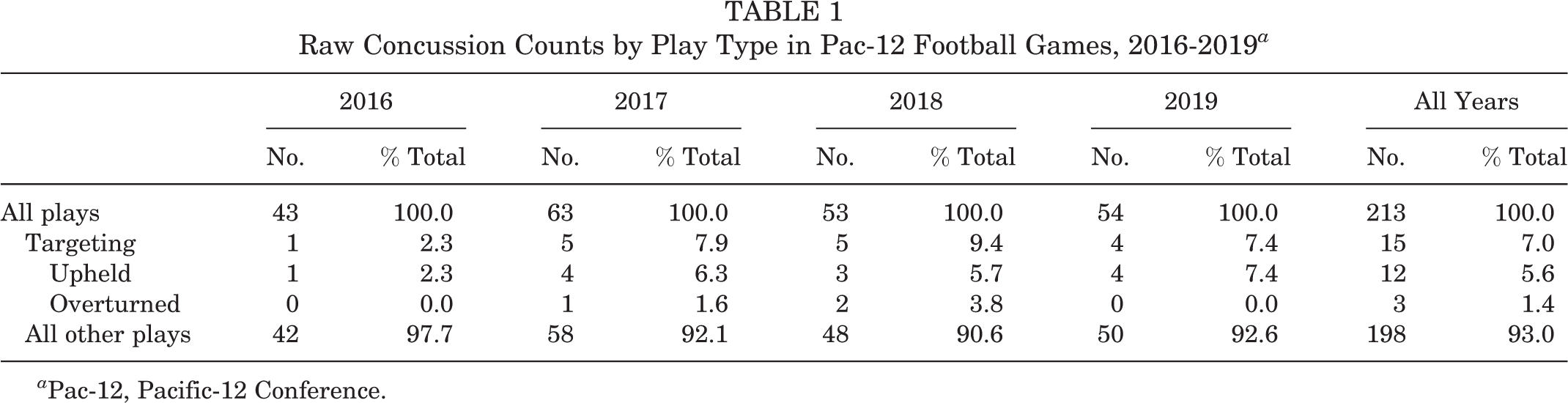
A total of 213 concussions occurred during these events. Concussion diagnosis was associated with 15 targeting events (12 upheld, 3 overturned), and 198 concussions occurred during nontargeting plays. Raw concussion counts by play type and year are summarized in Table 1. During all years of the study, only 0.21% of plays resulted in targeting penalties, but these plays accounted for a disproportionate number of concussions (7.04% of concussions across all years of study).
Raw Concussion Counts by Play Type in Pac-12 Football Games, 2016-2019 a
a Pac-12, Pacific-12 Conference.
Concussion incidence across all years of the study was 3.1/1000 plays for all plays and 2.9/1000 plays on nontargeting plays. Concussion incidence among targeting penalties was 106.4/1000 plays and was greater among upheld targeting penalties (141.2/1000 plays) than overturned targeting penalties (53.6/1000 plays) (Table 2). The incidence of concussion was fairly consistent during the 4-year study period (2.4/1000 plays [2016], 3.4/1000 plays [2017], 2.9/1000 plays [2018], and 2.9/1000 plays [2019]).
Concussion Incidence in Pac-12 Football Games, 2016-2019 a

a Pac-12, Pacific-12 Conference.
Play type and positional data are presented in Table 3. The majority of targeting penalties were called on passing plays (59.0%), while running plays accounted for 32.1% of all targeting penalties called. Offensive players or kick/punt returners were the targeted player on 72 of 78 (92%) targeting penalties called during the 2018 and 2019 seasons. It is rare for defensive players to be targeted; only 6 of 78 (7.7%) involved defensive players as the targeted player, and 3 of those 6 penalties occurred during special teams plays. Most targeting flags were thrown in plays involving quarterbacks (43.6%), and quarterbacks, wide receivers, and running backs accounted for 85.9% of all plays in which targeting was called.
Targeting Penalties for 2018-2019 by Play Type, Targeted Position, and Targeter Position a

a Data are reported as No. (%).
The relative risk (RR) of concussion during targeting plays was 36.9 (95% CI, 22.4-60.7; P < .001) times greater than the risk during all other nontargeting plays. This effect was greater when comparing only targeting plays upheld versus all other plays (RR, 49.0; 95% CI, 28.5-84.2; P < .001). Finally, the RR of concussion during upheld targeting penalties was 2.6 times greater than the risk during overturned targeting penalties, although this result was not statistically significant (95% CI, 0.8-8.9; P = .12). The results of the risk ratio analysis are presented in Table 4.
Relative Risk of Concussion in Pac-12 Football Games, 2016-2019 a

a Pac-12, Pacific-12 Conference. RR, relative risk.
b Calculated as the number of concussions divided by the total number of plays per category.
Discussion
We found that the risk of sustaining a concussion during collegiate American football was 37 times higher during a targeting play than nontargeting plays, reflecting the importance of eliminating targeting to decrease concussions. Continued emphasis on tackling technique that avoids head contact above the shoulders of a defenseless player is warranted as well as the enforcement of targeting penalties by officials. Because the rate of a concussion is significantly higher when a targeting flag is warranted, medical providers should screen those involved in a targeting play for concussion.
Study findings indicated that 15 total concussions occurred during targeting plays over a 4-year period in the Pac-12 Conference, but concussion secondary to targeting is likely to result in a large number of concussions across college football. Extrapolating the number of concussions that occurred during targeting plays across the top 2 divisions of NCAA football (Division I Football Bowl Subdivision [FBS] and Division I Football Championship Division [FCS]) highlights the scope of the problem. There were 525 targeting penalties called in the Power 5 athletic conferences (Pac-12, Atlantic Coast Conference, Big-12, Big-10, and Southeastern Conference) from 2017 to 2019. Extrapolating the average of 35 targeting penalties called per year per conference to the 10 FBS conferences, 7 independent teams, and 15 FCS conferences, it is estimated that there were 3640 targeting penalties in all of Division I football from 2016 to 2019. Applying the rate of concussion on targeting penalties identified in this paper (106.4/1000 plays), an estimated 387 concussions occurred during targeting plays in all of Division I football during the study period.
While the targeting penalty remains a point of emphasis for officials, rule makers, and pundits, there are little empirical data regarding the topic. A recent study addressing targeting examined National Football League (NFL) concussion rates after the implementation of Article 8, a rule that expanded the definition of targeting and increased the penalty. 1 This study used publicly available information and found that concussion rates decreased by 40% after the implementation of stricter targeting rules. 1 The decreased concussion rate was attributed to stricter targeting rules. This conclusion, however, must be interpreted with caution. Although changes in the targeting rule are one possible reason for the decrease in NFL concussions, there are other potential reasons, including player education, improvements in helmets, and other rule changes (kickoff), and the retrospective observational design of the study cannot establish causation.
Another study examining both lower extremity injuries and concussion from 2009-2010 to 2014-2015 using the NCAA Injury Surveillance Program (NCAA-ISP) found both increasing lower extremity injury rates and increasing concussion rates. 19 That study suggested that the increased lower extremity injuries may be an unintended consequence of the targeting rule and that the targeting rule may have been ineffective in decreasing concussion. 19 That study did not compare pretargeting and posttargeting time frames because the manner in which data were collected changed in 2009, and thus, those data could not be directly compared with the data collected in 2008 and earlier. In addition, that study did not look specifically at targeting plays but at overall concussion rates, and the authors point out that the increase in concussion rate may have been due to increased reporting and diagnosis. 19
This study was unique because we specifically looked at targeting and examined concussion rate per play. Other studies have looked at the percentage of concussion that occurred during special teams plays or the rate of game concussions compared with practices, but there have been no direct comparisons of concussion rate by play type comparing targeting with all other plays. 3,12 This method offers a granular way to assess specific risks and highlights the risk of concussion that occurs during targeting plays and is the only way to examine the risk of targeting specifically. Targeting penalties represent a very small percentage of total plays but a disproportionate number of concussions. If targeting was confirmed, the risk of concussion was even greater than if targeting was overturned, although this did not reach statistical significance with the limited numbers in our study.
Medical staff should screen players (both the targeted and the targeter) for concussion after a targeting penalty is called, even if the penalty is overturned. Every targeting play called is reviewed, which takes considerable time that can be used to check in with athletes. Concussion behaviors such as gripping or shaking of the head may not be reliable in targeting calls, as the athlete who was targeted may exaggerate or feign injury to encourage the call to be upheld. 4,8
Limitations
This study used data from the Pac-12 Conference and may not be generalizable to all NCAA institutions. The results of this study did not aim to examine if the targeting foul has been an effective deterrent to reduce dangerous contact in collegiate football. As the current study did not measure the risk of concussion during competition before the adoption of the rule in 2008, we are unable to report if concussions/play during competition have decreased after the rule change. In addition, there have been other policies put in place other than targeting rules in an attempt to reduce concussion rate.
The study data consisted of a small sample of targeting concussions. As such, the study was underpowered to detect a statistically significant difference in risk of concussion between targeting plays upheld and targeting plays overturned.
Finally, the study was limited because of access to only deidentified data. The authors were blinded to whether the targeting or targeted player sustained the concussion. This prevented further analysis to assess if the risk of concussion differs between targeted or targeting players.
Conclusion
Concussion risk was significantly higher during plays in which targeting was called, especially those in which targeting fouls were upheld. This finding highlights the importance of continued monitoring of any changes to interpretation or enforcement of the targeting rule. There should be continued emphasis on athlete education to improve tackling technique and avoid targeting behavior in collegiate football, and targeting calls remain a continued point of emphasis with officials. Finally, medical providers should evaluate those involved in targeting plays for concussion. Decreasing targeting in football represents an opportunity to decrease concussion rate and increase the safety of the game. Future research to determine if the targeting foul is an effective deterrent is warranted to determine (1) if concussions are decreasing over time and (2) if targeting penalties are decreasing over time.
Footnotes
Acknowledgment
Data collection was supported by Mike Ortiz of Video Operations of the Pac-12 Conference and football athletic trainers at all Pac-12 Conference institutions. Mike procured all play data used as exposure measures in the project. Athletic trainers provided raw concussion counts for targeting and nontargeting plays at each institution.
Final revision submitted December 7, 2021; accepted December 22, 2021.
One or more of the authors has declared the following potential conflict of interest or source of funding: Support was received from the Pac-12 Conference’s Student Athlete Health and Well-Being Initiative, the Grand Alliance Concussion Assessment, Research, and Education (CARE) Consortium. S.K.P. has received grant support from Sanofi-Aventis US. C.C.G. has received consulting fees from Avanir Pharmaceuticals and Novartis Pharmaceuticals. AOSSM checks author disclosures against the Open Payments Database (OPD). AOSSM has not conducted an independent investigation on the OPD and disclaims any liability or responsibility relating thereto.
Ethical approval for this study was waived by Oregon State University.