




Abstract
Background:
In orthopaedic surgery and other fields, the effect of influential journal articles has been evaluated by their citation counts and their correlation with methodological quality.
Purpose:
To identify and characterize the 50 most cited articles on shoulder instability, examine trends in publication characteristics, and evaluate the correlation of citations with quality of evidence.
Study Design:
Cross-sectional study.
Methods:
The Web of Science and Scopus online databases were searched to identify the top 50 most cited articles on shoulder instability, based on the average number of citations from each database. Article characteristics were recorded, and level of evidence and methodological quality were assessed using the modified Coleman Methodology Score (mCMS), Jadad scale, and Methodological Index for Non-Randomized Studies (MINORS). Spearman correlation was used to evaluate relationships between citations or citation density (citations/y) and level of evidence or methodological scoring. Top cited articles from recent years were also aggregated.
Results:
The top 50 most cited papers had a mean ± SD number of citations of 381.5 ± 166.7, with a mean of 15.0 ± 8.8 citations/y. Overall, 15 articles (30%) were biomechanical/cadaveric studies, and 15 (30%) were case series. Only 3 (6%) were considered to have level 1 evidence. The mean ± SD mCMS was 54.4 ± 12.7, mean ± SD Jadad score was 3.1 ± 1.4, and mean ± SD MINORS score was 10.5 ± 3.3. There were no significant correlations between citation rank or density and methodological assessments. There were weak correlations between citation rank and publication year (rs = 0.32; P = .022) and between rank and level of evidence (rs = –0.38; P = .047). The correlation between citation density and publication year was moderate (rs = 0.70; P < .0001). There was no difference in citation density of the top 10 articles from 2010 to 2020 compared with the top 10 from the overall list (23.8 ± 5.3 vs 28.8 ± 9.5; P = .16).
Conclusion:
Influential articles in shoulder instability included a high proportion of biomechanical/cadaveric studies. The majority of top cited articles had lower evidence levels and poorer methodological quality without strong correlation with citations or citation density. There was a moderate correlation between citation density and year of publication.
The modern understanding of shoulder instability derives from the description of the essential lesion of the glenoid labrum. The presence of this lesion was initially hypothesized in 1890 by Broca and Hartmann and ultimately confirmed in 1906 by Georg Clemens von Perthes and in 1923 by A.S. Blundell Bankart. 6,59 Bankart described his technique for fixing the anteroinferior labral detachment seen in cases of recurrent shoulder instability, and he would become the namesake of the Bankart lesion and Bankart repair. 6,7 Since that time, the understanding of the pathoanatomy, biomechanics, natural history, and treatment modalities—including soft tissue and bony procedures to restore shoulder joint stability—of shoulder instability has evolved significantly. Arthroscopic shoulder surgery has become a mainstay of restoration of shoulder stability, and our understanding of its limitations---particularly relating to bone loss patterns---has also allowed for advancement of open operations such as the procedure described by Latarjet in 1954. 46
As with other complex orthopaedic pathologies, it is critical to understand previous literature and the progression of knowledge to continue to advance treatment strategies to improve patient outcomes. There has been a recent emphasis on evaluating influencial articles relating to various topics in orthopaedics and shoulder surgery. 40,42,47,50,51,54,70 Evaluation of influential articles may be assisted by reviewing articles from high-impact journals. However, in orthopaedics, a journal’s impact factor has been shown to result largely from several highly cited articles within the journal, skewing the mean number of citations upward, resulting in 85% of orthopaedic articles being cited fewer times than expected by the impact factor. 12 Therefore, studies have measured an article’s influence by the mean number of citations. 40,42,47,50,51,54,70 Aggregating the most commonly cited studies may provide clinicians and researchers with a foundational set of literature.
Although the most cited studies may be influential, authors have recently highlighted the lack of correlation of quality of evidence and number of citations. 70 Evaluation of study quality and additional study characteristics may elucidate why some studies are more cited than are others. Despite several recent studies on highly cited articles on various topics in orthopaedics, no similar study has been performed regarding shoulder instability.
The purpose of the present study was to identify and characterize the 50 most cited articles relating to shoulder instability, examine trends in publication characteristics, and evaluate correlations of study citations with quality of evidence. We hypothesized that the top 50 cited articles would have poor correlation with methodological quality and would have more historical and foundational value than value as literature that encompasses more modern concepts.
Methods
The methods were adapted from previous recommendations and strategies for bibliometric analysis. 70 An online search was performed utilizing 2 databases: (1) Web of Science (all databases) and (2) Scopus. These databases were selected for their ability to search independent terms and present the number of citations per article. The following search terms and Boolean operators were utilized to identify articles relating to shoulder instability: (shoulder instability) OR (shoulder stabilization) OR (shoulder dislocation) OR (shoulder subluxation) OR (Bankart) OR (glenoid bone loss) OR (shoulder labrum). The search was performed on August 28, 2020, on both databases. All articles extracted from the search were included in initial screening. Articles were sorted from most to least number of citations on each database individually. Three authors (S.A., B.T.F., and D.A.L.) evaluated up to 100 articles from each database for inclusion and relation to shoulder instability. Articles relating to shoulder arthroplasty were excluded. The number of citations from each database was averaged for each study, and the articles were re-sorted using the new means from most to least citations to generate the top 50 list.
In addition to the number of citations on each database, the following data were collected from each article: digital object identifier or PubMed identifier, title, author list, year of publication, journal name, country of origin, study type (ie, case series, cohort study, case control, randomized controlled trial, biomechanical/cadaveric, imaging/diagnostic, technique/review), study category (diagnostic, prognostic, therapeutic), and level of evidence. Each article was assigned a decade of publication based on the publication year. The level of evidence was agreed upon by the authors; the level of evidence was not scored for biomechanical/cadaveric studies or technique/review studies. The methodological quality of studies was evaluated using the modified Coleman Methodology Score (mCMS) (scoring range, 0-100), a modified version of the Jadad scale (scoring range, 0-8), and Methodological Index for Non-Randomized Studies (MINORS) (scoring range, 0-16 for noncomparative studies and 0-24 for comparative studies). 19,37,69 mCMS was only applied to studies on surgical treatment, and MINORS was not applied to randomized trials. Biomechanical/cadaveric studies, imaging/diagnostic studies, and technique/reviews were not assessed for methodological quality. The number of citations per year (citation density) was calculated from the mean obtained divided by the number of years since publication.
The search was repeated with the years of inclusion limited to between 2010 and 2020 to generate a top 10 list of more recent publications, which were ranked by citation density.
Data were aggregated and presented utilizing descriptive statistics. The Spearman correlation coefficient (rs) was used to evaluate correlations between citation values (mean number citations, citation density) and level of evidence and methodological quality, in addition to between year of publication and level of evidence. The strength of correlation was denoted by the absolute value of rs: weak, <0.4; moderate, 0.4 to 0.7; and strong, >0.7. 21 One-way analysis of variance was performed to evaluate for differences in articles between citations per year and level of evidence. Independent-samples t tests were performed to compare the citation density of the top 10 from the overall top 50 cited articles list and the top 10 between 2010 and 2020. Significance was set at P < .05 for 2-tailed testing. Statistical analysis was performed on STATA v16.1 (StataCorp, College Station, TX).
Results
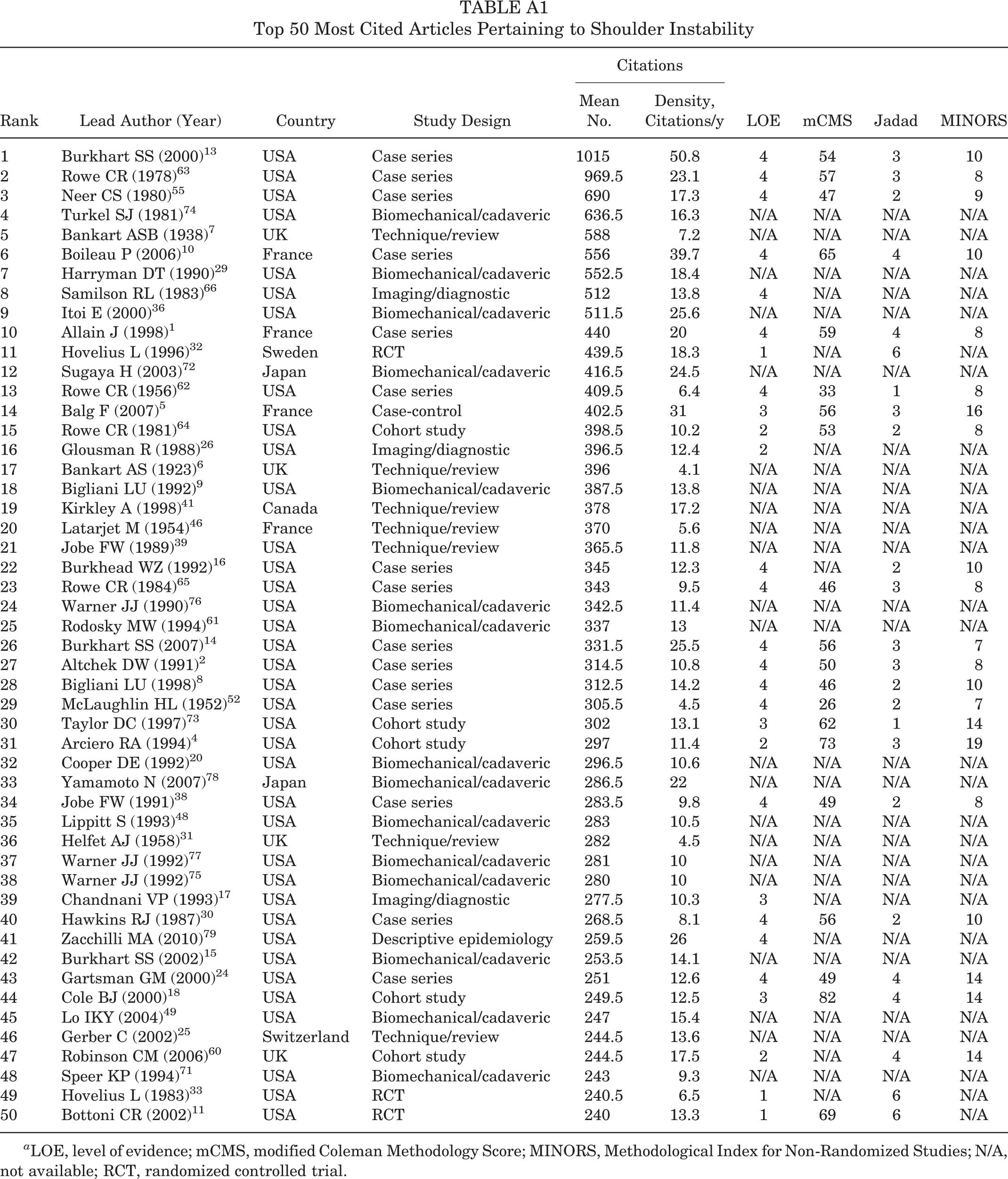
The top 50 most cited articles relating to shoulder instability were published between 1923 and 2010 (Appendix Table A1). The mean difference in citation numbers between the Web of Science and Scopus databases was 59.3 ± 31.2 (range, 12-139). The Scopus database yielded a larger number of citations than did the Web of Science database for all articles except 1. 7
The majority of publications (n = 33; 66%) were published in the 2 decades between 1990 and 2009 (Figure 1). Articles were published in 12 different journals. The majority (n = 27/50; 54%) were published in the affiliated journals of The Journal of Bone and Joint Surgery (Figure 2). The most common country of origin was the United States, representing 37 of 50 (74%) publications (Figure 3).
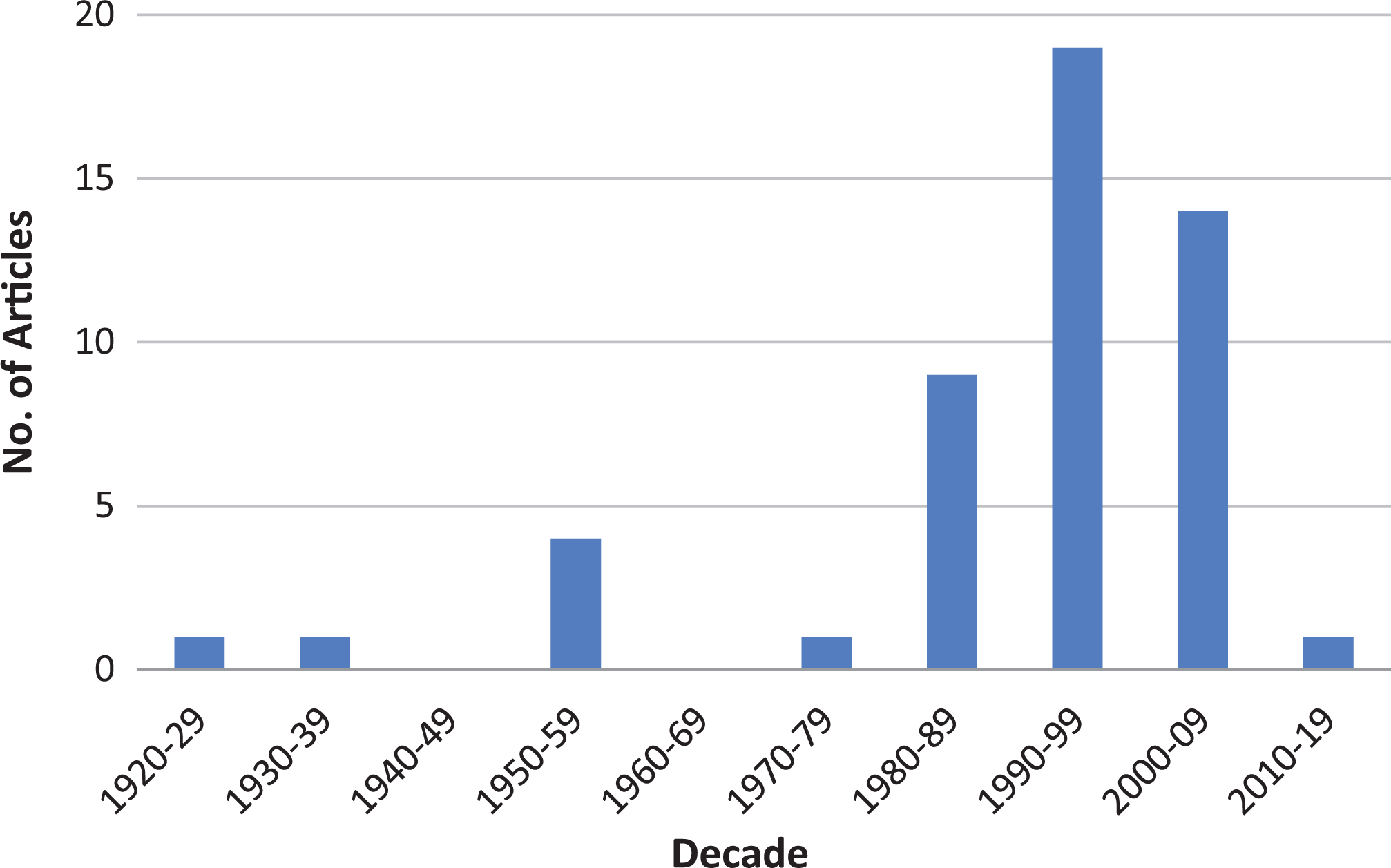
Number of 50 most cited articles relating to shoulder instability by decade of publication.

Number of 50 most cited articles relating to shoulder instability by journal of publication. AJR, American Journal of Roentgenology; AJSM, American Journal of Sports Medicine; Arthroscopy, The Journal of Arthroscopic and Related Surgery; BJS, British Journal of Surgery; BMJ, British Medical Journal; CORR, Clinical Orthopaedics and Related Research; JOR, Journal of Orthopaedic Research; JBJS, Journal of Bone and Joint Surgery (-Am, American Volume; -Br, British Volume); JSES, Journal of Shoulder and Elbow Surgery; Orthop Rev, Orthopedic Reviews.

Map of countries of origin for the most cited articles pertaining to shoulder instability.
The mean ± SD number of citations was 381.5 ± 166.7 (range, 240-1015) (Appendix Table A1). The mean ± SD citation density was 15.0 ± 8.8 citations/y (range, 4.1-50.8 citations/y), with the same paper 13 being the most cited for both mean number of citations and citation density.
The majority of studies evaluated for level of evidence were Level 4, with only 3 studies (6%) considered Level 1 (Figure 4). Of the studies, 30% were classified as case series, and 30% were classified as biomechanical/cadaveric (Figure 5). The majority of studies were categorized as diagnostic (n = 28/50; 56%). Two studies (4%) were on posterior instability. 30,52
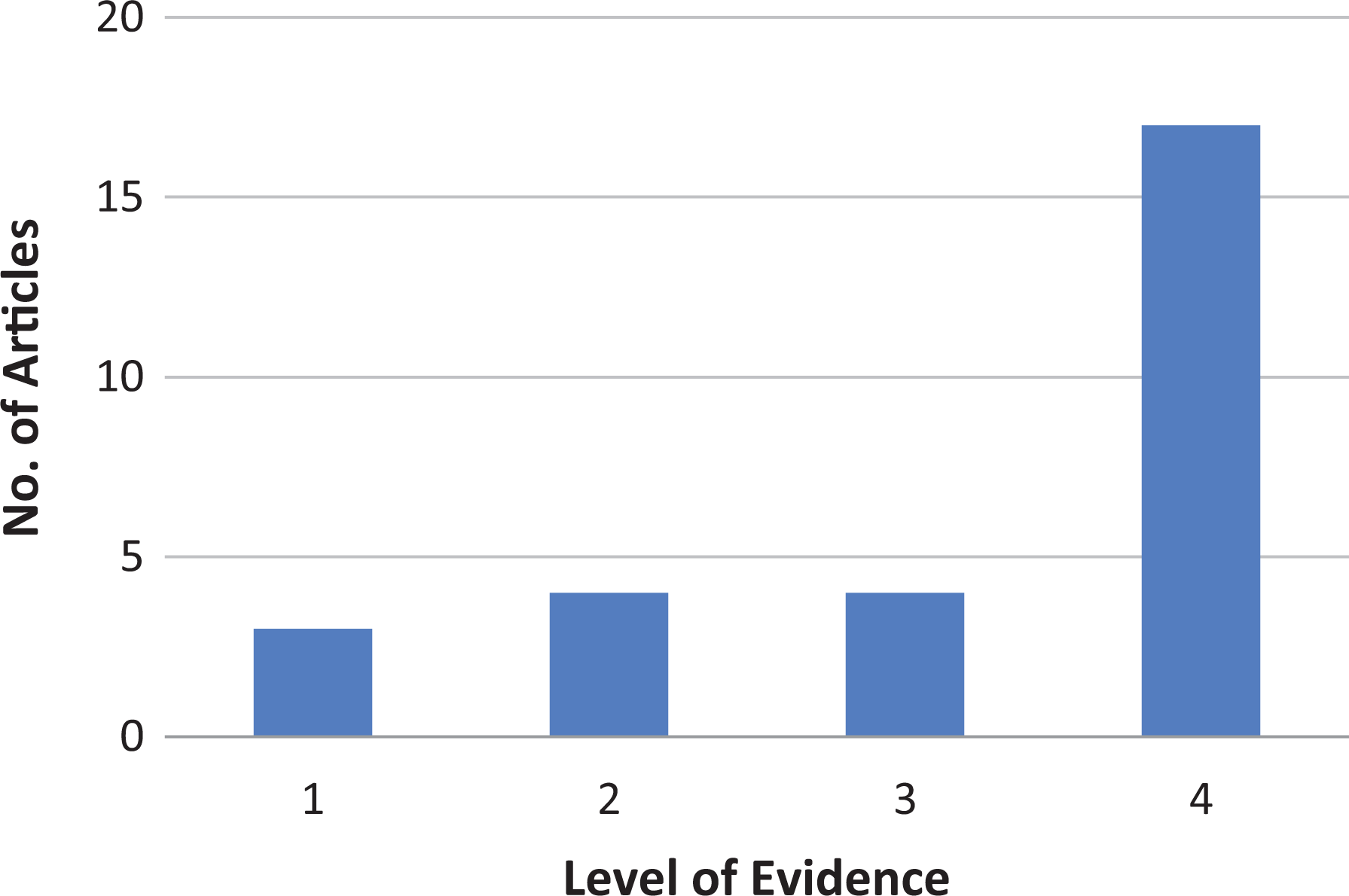
Number of 50 most cited articles relating to shoulder instability by assigned level of evidence. Articles classified as biomechanical/cadaveric or technique/review were excluded from level of evidence analysis (n = 22 excluded; n = 28 included in level of evidence analysis).

Number of 50 most cited articles relating to shoulder instability by study design type. RCT, randomized controlled trial.
A total of 24 studies were assessed for methodological quality in total (Appendix Table A1). The 26 studies not evaluated for methodological quality included 15 biomechanical/cadaveric, 7 technique/review, 3 imaging/diagnostic, and 1 descriptive epidemiology.
The mean ± SD mCMS was 54.4 ± 12.7 (range, 26-82). The mean ± SD modified Jadad scale score was 3.1 ± 1.4 (range, 1-6). The mean ± SD MINORS score was 10.5 ± 3.3 (range, 7-19). There was no significant correlation between year of publication and level of evidence (rS = –0.13; P = .53). There was a statistically significant, although weak, correlation between citation rank and year of publication (rS = 0.32; P = .022. There was a weak correlation between citation rank and level of evidence (rS = –0.38; P = .047). The correlation between citation density and year of publication was moderate and statistically significant (rS = 0.70; P < .0001). Tables 1 and 2 demonstrate the Spearman correlation coefficients for the mean number of citations and citation density.
Spearman Correlations Between Number of Citations and Level of Evidence and Methodological Quality Assessments a
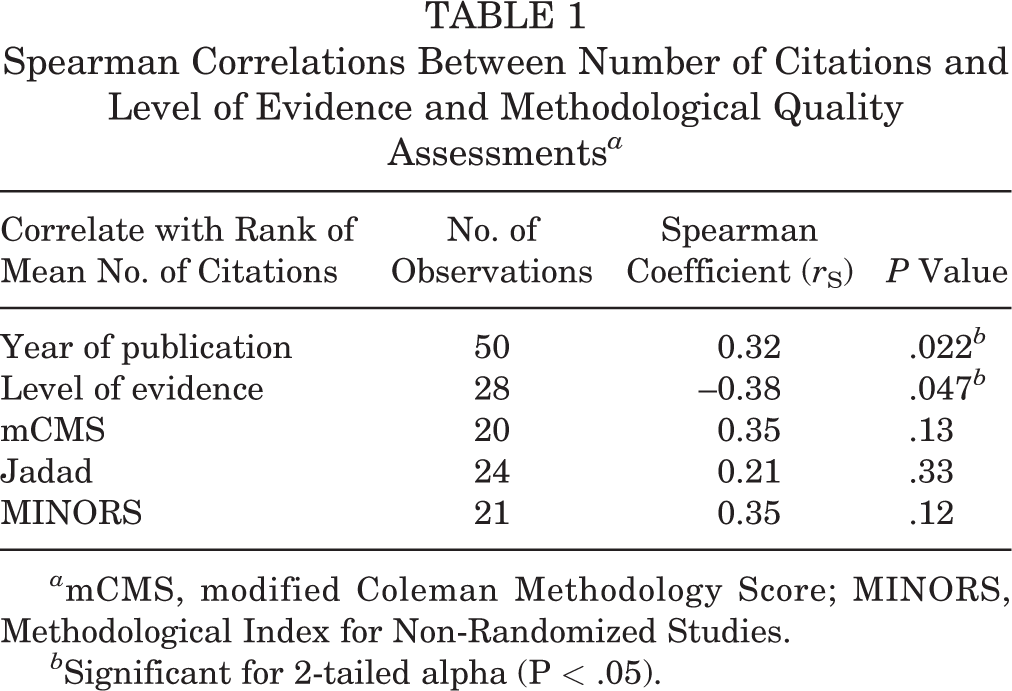
a mCMS, modified Coleman Methodology Score; MINORS, Methodological Index for Non-Randomized Studies.
b Significant for 2-tailed alpha (P < .05).
Spearman Correlations Between Citation Density and Level of Evidence and Methodological Quality Assessments a

a mCMS, modified Coleman Methodology Score; MINORS, Methodological Index for Non-Randomized Studies.
b Significant for 2-tailed alpha (P < .05).
There was no significant difference in citation density by level of evidence group (P = .77).
The top 10 most cited articles by citation density between 2010 and 2020
‡
are listed in Table 3. The mean ± SD citation density of the top 10 between 2010 and 2020 was 23.8
10 Most Cited Articles by Approximate Citation Density, 2010-2020

a A publication by Zacchilli and Owens 79 that was included in the overall top 50 list was ranked fourth on citation density in this time frame.
Top Cited Article From Each Year, 2015-2019

Discussion
The present study identified the top 50 articles relating to native shoulder instability. The vast majority of the most cited articles on shoulder instability are of a lower level of evidence, with only 3 included studies that were level I evidence. Of the studies for which methodological quality was assessed, there were no significant correlations between methodology scores and number of citations.
The topics within the realm of shoulder instability represented in the presented list are vast, ranging from studies critical to the anatomic considerations to those on the natural history of shoulder instability and those on outcomes after surgery. In the present study of the top 50 articles, 15 (30%) were classified as biomechanical/cadaveric, whereas in a study on most cited articles on rotator cuff surgery, 8 articles (16%) were classified as animal or cadaveric. 70 Although the inclusion of articles was confounded by search terms used, author screening methods, and article classifications, the higher proportion of biomechanical/cadaveric studies on shoulder instability may reflect the relative effect of studies illuminating the mechanisms underlying the unstable shoulder.
Only 2 (4%) of the studies were specifically on posterior instability, which reflects the epidemiology of the pathology relative to anterior instability. 30,52 McLaughlin 52 initially described posterior instability as a “diagnostic trap for the unwary surgeon” in 1952, citing a rate of 3.8% of unstable shoulders with posterior instability at that time. Similarly low rates relative to those of anterior instability have been cited since then, with a slightly higher incidence in young athletic populations. 56,57 While the proportion of articles in the top 50 on posterior shoulder instability was small, there has been increasing attention on the pathology in recent years.
The majority of studies included were published between 1999 and 2009. Relative to the date of the present evaluation, 1999 to 2009 would allow for approximately 10 to 20 years for studies to be cited. This would allow for not only some recency but also adequate time for citations to accrue. In the same fashion, more recent studies would be less likely to be included in the top 50 mosts cited studies based on number of citations. Of note, the Multicenter Orthopaedic Outcomes Network (MOON) Shoulder Instability Cohort has published several recent studies with the largest cohorts of patients undergoing shoulder stabilization to date, but none of the MOON group papers were in the top 50, likely attributable to their recency. 43 Additional modern concepts that were not emphasized in this list include that of the glenoid track, with only the original article from 2007 focusing on this subject. 78 Correspondingly, descriptions of Hill-Sachs lesions were also not emphasized in this list, although the top cited article does reference these lesions. 13 When evaluating the top 10 most cited articles by citation density in more recent years (2010-2020), we found an increased emphasis on the topics of bone loss and Latarjet procedures relative to the overall top 50 most cited articles list. It is likely that future analysis of more recent years will highlight concepts of glenoid and bipolar bone loss, glenoid track, bone block procedures, and remplissage. The most common journals in which the studies were published were affiliations of The Journal of Bone and Joint Surgery and The American Journal of Sports Medicine. Each of these journals has high impact factors in orthopaedics and therefore would be expected to contain meaningful or influential papers.
For the papers describing shoulder instability, we did not identify a relationship between the number of citations and any measure of study quality, including level of evidence and various scoring systems for study quality. This finding is in contrast to a previous report on influential articles in rotator cuff surgery. 70 In that study, a weak correlation was identified between number of citations and Jadad score (r = –0.36). 70 However, no significant correlations were identified for mCMS or MINORS score. 70 Therefore, the methodological quality of a study may not appropriately capture a study’s literature influence, at least that measured by citations. The effect of a study may derive from its contribution to foundational understanding or development of new concepts from which further higher-level research may arise. Longer-term follow-up studies are more likely to be retrospective in nature and therefore have a lower level of evidence that may not capture the benefit of elucidating long-term outcomes. The lack of correlation between methodological quality and citations also highlights the trend of lower quality studies in orthopaedics in general. 47,54
The studies identified through this search were also different from previous bibliometric publications. In a recent update article citing the top 100 most cited articles in orthopaedic surgery, 50 the only study on shoulder instability included was that by Rowe et al 63 on the Bankart procedure, which was ranked as the second-most cited article on shoulder instability in the present study. Interestingly, the most frequently cited article in the present study, which was by Burkhart et al, 13 was not present in the most recently published or previously published top 100 most cited articles lists. 40,47,50 A study by Namdari et al 54 evaluating the top 50 most cited articles in shoulder surgery also did not include Burkhart et al. 13 Differences in study technique, including databases searched and search terms, likely accounted for the discrepancies in articles included. Namdari et al 54 and Lum et al 50 both utilized the Web of Science database for expanded citations of articles published in journals classified as orthopaedics. On the other hand, the methods of Sochacki et al 70 and the present study included a search for specific terms among 2 databases with averaging of citation numbers to generate the highly cited article list. However, 11 of the listed top 50 (22%) cited studies in shoulder surgery were also aggregated in the present study. §
This study has several limitations that largely derive from the nature of the study. The decision to analyze the top 50 most cited articles was arbitrary, and numerous influential and groundbreaking studies exist outside of the top 50. There was inherent bias toward studies published earlier, with more recent studies unlikely to make the top 50 most cited articles list. For example, the most recently published study in the overall top 50 list was from 2010. 79 Current topics of interest, such as those on subcritical glenoid bone loss, glenoid track, remplissage, and arthroscopic bone block procedures, were minimally represented. Earlier published studies may have been cited frequently for historical purposes, although there may have been less current clinical relevance of these papers. A “snowball” effect may have occurred where new articles cited review papers more frequently than previously. 44 On the contrary, it is also possible that over time, more historical studies began to be cited less frequently as their contents became a part of the accepted body of knowledge. The number of citations an article has is always in flux, and perhaps analyzing citation density within a shorter time frame (ie, first 5 years after publication) may be more indicative of the current or immediate effect and relevance of a study. In the present study, the correlations evaluated were limited by small numbers because of the higher proportion of studies that were not assessed for level of evidence or methodological quality.
Conclusion
Influential articles in shoulder instability included a high proportion of biomechanical/cadaveric studies. The majority of data in top cited articles in shoulder instability were lower-level evidence and poorer methodological quality without strong correlation with citations or citation density. There was a moderate correlation between citation density and year of publication.
Footnotes
Notes
Final revision submitted August 29, 2020; accepted November 3, 2020.
One or more of the authors has declared the following potential conflict of interest or source of funding: B.T.F. has received consulting fees from Kaliber and hospitality and education payments from Zimmer Biomet. D.A.L. has received research/education funding from Arthrex and Smith & Nephew; education payments from Medwest; and hospitality payments from Wright Medical. AOSSM checks author disclosures against the Open Payments Database (OPD). AOSSM has not conducted an independent investigation on the OPD and disclaims any liability or responsibility relating thereto.
Ethical approval was not sought for the present study.
APPENDIX
Top 50 Most Cited Articles Pertaining to Shoulder Instability
| Citations | |||||||||
|---|---|---|---|---|---|---|---|---|---|
| Rank | Lead Author (Year) | Country | Study Design | Mean No. | Density, Citations/y | LOE | mCMS | Jadad | MINORS |
| 1 | Burkhart SS (2000) 13 | USA | Case series | 1015 | 50.8 | 4 | 54 | 3 | 10 |
| 2 | Rowe CR (1978) 63 | USA | Case series | 969.5 | 23.1 | 4 | 57 | 3 | 8 |
| 3 | Neer CS (1980) 55 | USA | Case series | 690 | 17.3 | 4 | 47 | 2 | 9 |
| 4 | Turkel SJ (1981) 74 | USA | Biomechanical/cadaveric | 636.5 | 16.3 | N/A | N/A | N/A | N/A |
| 5 | Bankart ASB (1938) 7 | UK | Technique/review | 588 | 7.2 | N/A | N/A | N/A | N/A |
| 6 | Boileau P (2006) 10 | France | Case series | 556 | 39.7 | 4 | 65 | 4 | 10 |
| 7 | Harryman DT (1990) 29 | USA | Biomechanical/cadaveric | 552.5 | 18.4 | N/A | N/A | N/A | N/A |
| 8 | Samilson RL (1983) 66 | USA | Imaging/diagnostic | 512 | 13.8 | 4 | N/A | N/A | N/A |
| 9 | Itoi E (2000) 36 | USA | Biomechanical/cadaveric | 511.5 | 25.6 | N/A | N/A | N/A | N/A |
| 10 | Allain J (1998) 1 | France | Case series | 440 | 20 | 4 | 59 | 4 | 8 |
| 11 | Hovelius L (1996) 32 | Sweden | RCT | 439.5 | 18.3 | 1 | N/A | 6 | N/A |
| 12 | Sugaya H (2003) 72 | Japan | Biomechanical/cadaveric | 416.5 | 24.5 | N/A | N/A | N/A | N/A |
| 13 | Rowe CR (1956) 62 | USA | Case series | 409.5 | 6.4 | 4 | 33 | 1 | 8 |
| 14 | Balg F (2007) 5 | France | Case-control | 402.5 | 31 | 3 | 56 | 3 | 16 |
| 15 | Rowe CR (1981) 64 | USA | Cohort study | 398.5 | 10.2 | 2 | 53 | 2 | 8 |
| 16 | Glousman R (1988) 26 | USA | Imaging/diagnostic | 396.5 | 12.4 | 2 | N/A | N/A | N/A |
| 17 | Bankart AS (1923) 6 | UK | Technique/review | 396 | 4.1 | N/A | N/A | N/A | N/A |
| 18 | Bigliani LU (1992) 9 | USA | Biomechanical/cadaveric | 387.5 | 13.8 | N/A | N/A | N/A | N/A |
| 19 | Kirkley A (1998) 41 | Canada | Technique/review | 378 | 17.2 | N/A | N/A | N/A | N/A |
| 20 | Latarjet M (1954) 46 | France | Technique/review | 370 | 5.6 | N/A | N/A | N/A | N/A |
| 21 | Jobe FW (1989) 39 | USA | Technique/review | 365.5 | 11.8 | N/A | N/A | N/A | N/A |
| 22 | Burkhead WZ (1992) 16 | USA | Case series | 345 | 12.3 | 4 | N/A | 2 | 10 |
| 23 | Rowe CR (1984) 65 | USA | Case series | 343 | 9.5 | 4 | 46 | 3 | 8 |
| 24 | Warner JJ (1990) 76 | USA | Biomechanical/cadaveric | 342.5 | 11.4 | N/A | N/A | N/A | N/A |
| 25 | Rodosky MW (1994) 61 | USA | Biomechanical/cadaveric | 337 | 13 | N/A | N/A | N/A | N/A |
| 26 | Burkhart SS (2007) 14 | USA | Case series | 331.5 | 25.5 | 4 | 56 | 3 | 7 |
| 27 | Altchek DW (1991) 2 | USA | Case series | 314.5 | 10.8 | 4 | 50 | 3 | 8 |
| 28 | Bigliani LU (1998) 8 | USA | Case series | 312.5 | 14.2 | 4 | 46 | 2 | 10 |
| 29 | McLaughlin HL (1952) 52 | USA | Case series | 305.5 | 4.5 | 4 | 26 | 2 | 7 |
| 30 | Taylor DC (1997) 73 | USA | Cohort study | 302 | 13.1 | 3 | 62 | 1 | 14 |
| 31 | Arciero RA (1994) 4 | USA | Cohort study | 297 | 11.4 | 2 | 73 | 3 | 19 |
| 32 | Cooper DE (1992) 20 | USA | Biomechanical/cadaveric | 296.5 | 10.6 | N/A | N/A | N/A | N/A |
| 33 | Yamamoto N (2007) 78 | Japan | Biomechanical/cadaveric | 286.5 | 22 | N/A | N/A | N/A | N/A |
| 34 | Jobe FW (1991) 38 | USA | Case series | 283.5 | 9.8 | 4 | 49 | 2 | 8 |
| 35 | Lippitt S (1993) 48 | USA | Biomechanical/cadaveric | 283 | 10.5 | N/A | N/A | N/A | N/A |
| 36 | Helfet AJ (1958) 31 | UK | Technique/review | 282 | 4.5 | N/A | N/A | N/A | N/A |
| 37 | Warner JJ (1992) 77 | USA | Biomechanical/cadaveric | 281 | 10 | N/A | N/A | N/A | N/A |
| 38 | Warner JJ (1992) 75 | USA | Biomechanical/cadaveric | 280 | 10 | N/A | N/A | N/A | N/A |
| 39 | Chandnani VP (1993) 17 | USA | Imaging/diagnostic | 277.5 | 10.3 | 3 | N/A | N/A | N/A |
| 40 | Hawkins RJ (1987) 30 | USA | Case series | 268.5 | 8.1 | 4 | 56 | 2 | 10 |
| 41 | Zacchilli MA (2010) 79 | USA | Descriptive epidemiology | 259.5 | 26 | 4 | N/A | N/A | N/A |
| 42 | Burkhart SS (2002) 15 | USA | Biomechanical/cadaveric | 253.5 | 14.1 | N/A | N/A | N/A | N/A |
| 43 | Gartsman GM (2000) 24 | USA | Case series | 251 | 12.6 | 4 | 49 | 4 | 14 |
| 44 | Cole BJ (2000) 18 | USA | Cohort study | 249.5 | 12.5 | 3 | 82 | 4 | 14 |
| 45 | Lo IKY (2004) 49 | USA | Biomechanical/cadaveric | 247 | 15.4 | N/A | N/A | N/A | N/A |
| 46 | Gerber C (2002) 25 | Switzerland | Technique/review | 244.5 | 13.6 | N/A | N/A | N/A | N/A |
| 47 | Robinson CM (2006) 60 | UK | Cohort study | 244.5 | 17.5 | 2 | N/A | 4 | 14 |
| 48 | Speer KP (1994) 71 | USA | Biomechanical/cadaveric | 243 | 9.3 | N/A | N/A | N/A | N/A |
| 49 | Hovelius L (1983) 33 | USA | RCT | 240.5 | 6.5 | 1 | N/A | 6 | N/A |
| 50 | Bottoni CR (2002) 11 | USA | RCT | 240 | 13.3 | 1 | 69 | 6 | N/A |
a LOE, level of evidence; mCMS, modified Coleman Methodology Score; MINORS, Methodological Index for Non-Randomized Studies; N/A, not available; RCT, randomized controlled trial.