




Abstract
Background:
Clinical research on the rotator cuff tendon is increasing, and new approaches are being applied to rotator cuff disease. Considering the integration of research resources and research trends, it is necessary to conduct an analysis of recent research on the topic.
Purpose:
To identity the research trends, influential journals, key researchers, and core countries of rotator cuff tendon research between 2000 and 2019.
Study Design:
Cross-sectional study.
Methods:
All the literature related to rotator cuff tendon research was retrieved from the Web of Science Core Collection on January 7, 2020. Qualitative and quantitative analyses were processed based on Web of Science and CiteSpace.
Results:
A total of 4131 studies, which included 3830 articles and 301 reviews, were obtained. There was an upward trend of studies on the topic, with small fluctuations in the past 2 decades. The United States had the most studies, and the number of studies from other countries increased over the study period. Most of the funding sources came from the United States. Articles in the Journal of Shoulder and Elbow Surgery had the most citations for rotator cuff research. Frontier topics, such as arthroscopic repair, mesenchymal stem cell, and “platelet-rich plasma, were identified. The number of citations in 2018 (r = 0.280; P = .005) and 2019 (r = 0.307; P = .002) had a weak positive correlation with publication date, indicating that the more recently published articles had a higher number of citations.
Conclusion:
Valuable information on rotator cuff research based on bibliometric analysis was identified. Arthroscopic repair, mesenchymal stem cell, and platelet-rich plasma might be the research frontiers in this field, and researchers should focus on these topics in future studies.
Much new knowledge has been gained regarding the rotator cuff tendon in areas, such as biomechanics 18 and functional anatomy. 40 The better understanding of the function of rotator cuff tendons is important for clinical evaluation and treatment of rotator cuff disease (RCD), such as the choice of surgical procedure 42 or rehabilitation programs. 29 Many new approaches, such as regenerative therapy, platelet-rich plasma, and stem cells, are being used to treat RCD. 19,36 However, the incidence of shoulder pain related to the rotator cuff is very high, 30 and the causes of RCD are diverse. 41 Therefore, a large number of scholars and institutions are committed to research on the rotator cuff, and many papers have been published. 18,26,31 To integrate research resources and identify trends, it is necessary to conduct a bibliometric analysis based on the research output regarding the rotator cuff.
Bibliometric analysis is a method of tracing the overall research trend in a specific field and can identify the most valuable literature. 33 An increasing number of bibliometric studies have been conducted to point out hotspots and trends in particular research areas. 5,17 Two bibliometric analyses have focused on rotator cuff repair research. Kraeutler et al 23 identified the 50 most cited articles in rotator cuff repair research, and Sochacki et al 38 conducted a correlation analysis between methodological quality and the mean number of citations of rotator cuff repair research in the top 50 most cited articles. To our knowledge, no authors have conducted a comprehensive analysis of rotator cuff research over the past 20 years.
We aimed to provide researchers with the current research status and potential directions of rotator cuff tendon research by performing a bibliometric analysis to identify research trends, influential journals, key researchers, and core countries in this field.
Methods
We performed a systematic search regarding the rotator cuff in the Web of Science (WoS) database on January 7, 2020. The search items were “rotator cuff” OR “supraspinatus” OR “infraspinatus” OR “teres minor” OR “subscapularis,” and the publication dates were between 2000 and 2019. Our search included articles and reviews, and only English-language literature was included. The WoS search identified types of articles, authors, institutions, countries, languages, funds, and journals. In addition, co-word network analysis of keywords was used to identify hotspots and research trends in this field.
We included the following commonly used indicators in our analysis: Journal Citation Reports (JCR), 22 a journal analysis tool that assesses the influence of research indexed in the WoS Core Collection, and impact factor (IF), 13 which represents the average number of times that articles published in the past 2 years within a specific journal have been cited in a specific year. We also used the h-index. 4 It measures author productivity and research effect and is defined as the maximum value of h, where a given author has published h papers, each of which has been cited at least h times.
In this research, CiteSpace (5.3.R4.8), based on the Java platform, was used to visualize and analyze networks. 7 Nodes and links were used to form visualization knowledge maps. The size of a node represents the frequency of occurrence. For the clustering network analysis, the quality of the clustering results was evaluated using the modularity (Q value) and the mean silhouette (S value). The closer the Q value is to 1, the better the clustering network is. S value represents the homogenization of the nodes in 1 cluster; when the S value exceeds 0.7, the result of the cluster is trustworthy. We used Pearson correlation coefficient (r) to identify the critical influential factors related to the citation frequency of the top 100 articles. If P ≤ .05, the result was considered statistically significant.
Results
Output of Studies on Rotator Cuff Research
The total number of documents retrieved from the WoS using the study method was 5037. There were 4267 original research articles and reviews on rotator cuff research. When the language was limited to English, there were 4131 studies, including 3830 articles and 301 reviews. Figure 1 shows the number of studies published by year. The studied period can be divided into 2 stages: the first is between 2000 and 2002, and the second is between 2003 and 2019. In the first stage, the annual output was around 70 articles without obvious growth. In the second stage, overall, the publication number increased at a rate of about 20 studies per year, with some small fluctuations. In 2002, there were 71 studies in the literature, and this number first exceeded 100, 200, and 300 in the years 2003, 2010, and 2015, respectively. In 2019, the number reached a peak of 396 studies.
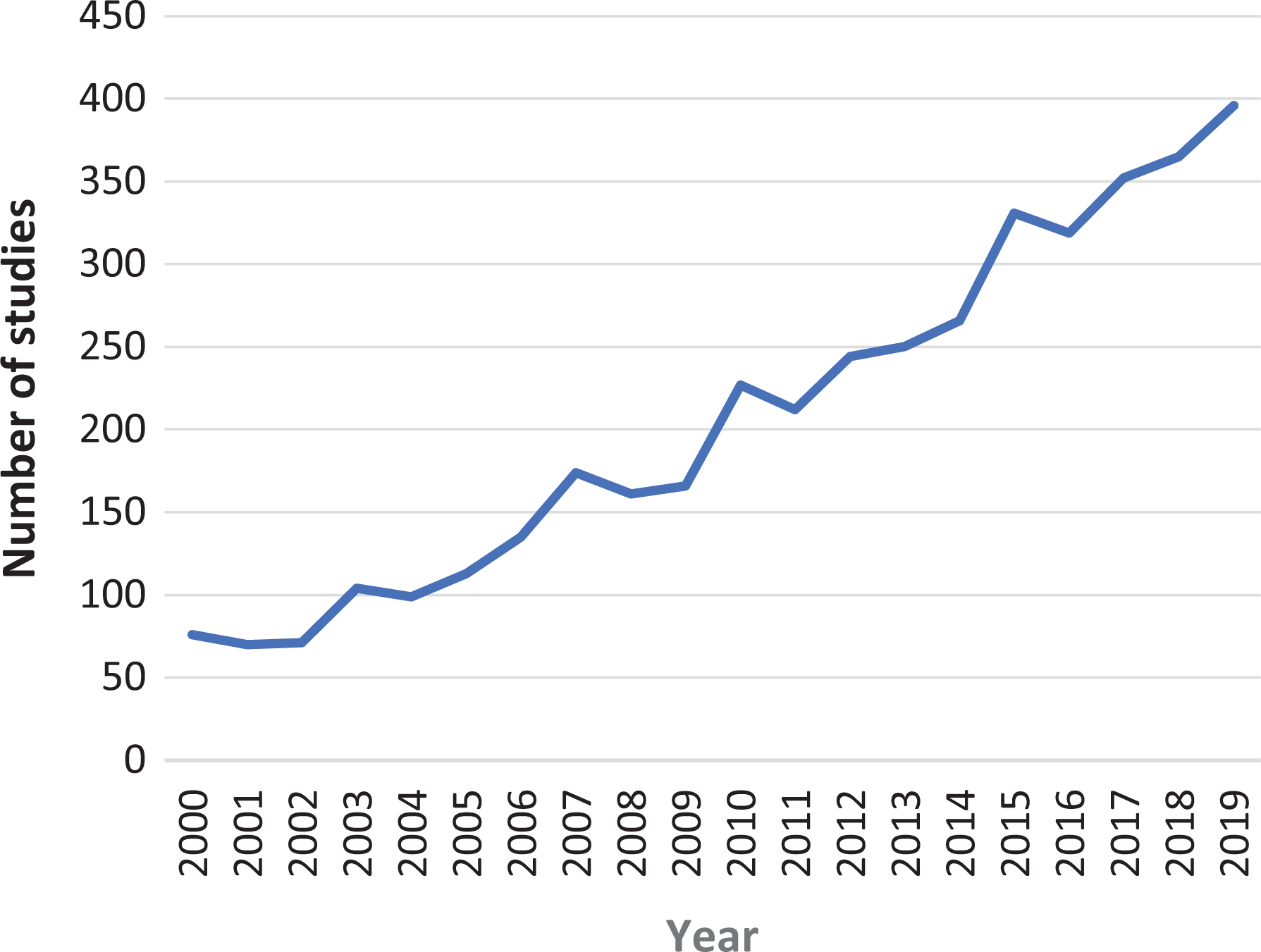
Number of studies on the rotator cuff tendon between 2000 and 2019.
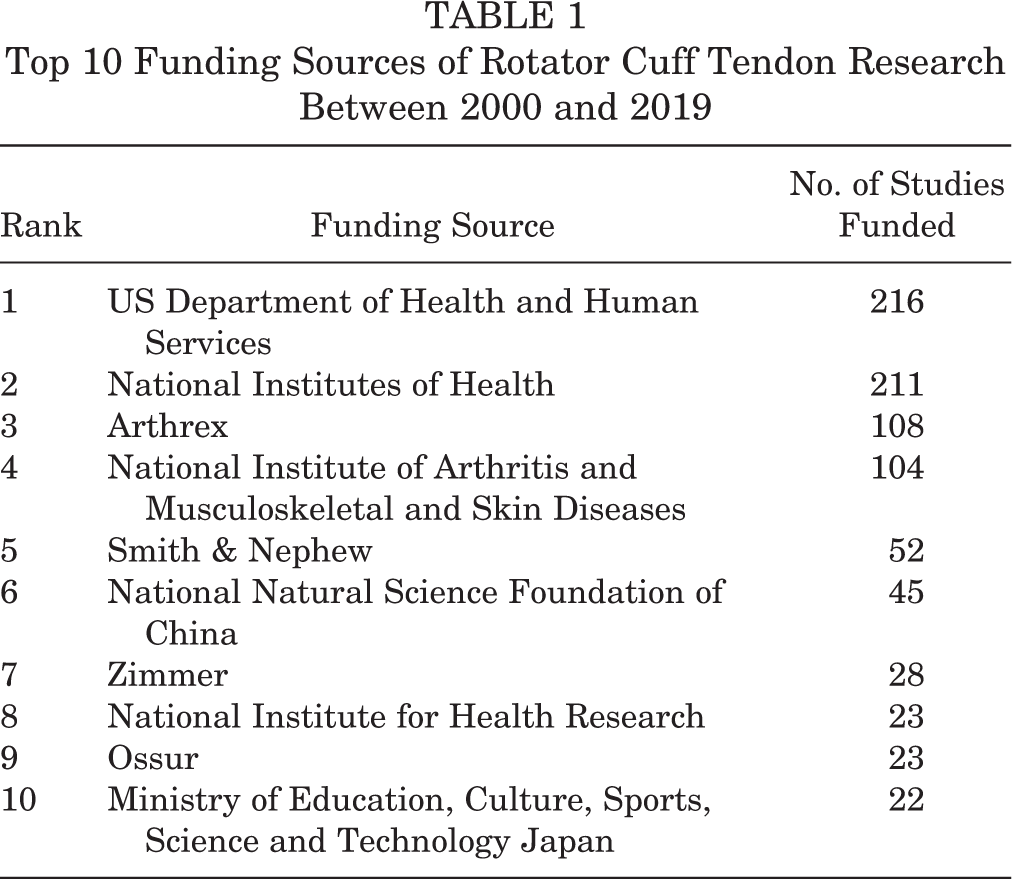
A total of 1273 funding resources from different countries supported 1202 of the 4131 studies in the literature. Table 1 shows the top 10 major funding resources. The US Department of Health and Human Services was the most active funder, followed by the National Institutes of Health and Arthrex. All of the top 5 funding resources came from the United States. Three companies, Arthrex, Zimmer, and Ossur, were listed in the top 10 funding resources. One of China’s most influential fund institutions, the National Natural Science Foundation of China, provided funding support for 45 studies.
Top 10 Funding Sources of Rotator Cuff Tendon Research Between 2000 and 2019
Journal Analysis
A total of 390 journals had published research on the rotator cuff tendon between 2000 and 2019. Table 2 shows the top 10 journals. They were representative journals in this area, especially the top 5 journals, which published 46.5% of the literature. Journal of Shoulder and Elbow Surgery published the most articles in this field, followed by Arthroscopy and American Journal of Sports Medicine. The fourth-ranked journal, Journal of Bone and Joint Surgery–American Volume, had the highest average number of citations (n = 90). Except for the 10th-ranked journal, Orthopedics, all journals belonged to the Q1 or Q2 zone of the Journal Citation Reports, indicating that they are among the top 50% of journals for their subject category. The IF of the 10 journals varied between 1.608 and 6.093. There were 2 journals with an IF <2.000, 7 journals with an IF between 2.000 and 5.000, and 1 journal with an IF >5.000. American Journal of Sports Medicine had the highest IF (6.093) among the group. Furthermore, a small portion of the articles were published in high-IF journals, such as New England Journal of Medicine (IF = 70.67), 1,27 Lancet (IF = 59.102), 2 and Journal of the American Medical Association (IF = 51.273). 16
Top 10 Journals With Published Studies on the Rotator Cuff Tendon, 2000-2019a

aData are presented as No. unless otherwise stated. JCR, Journal Citation Reports.
bQ1 denotes a journal in the top 25% of the impact factor distribution for its subject category; Q2 denotes a journal between the top 50% and top 25% of the impact factor distribution; Q3 denotes a journal between the top 75% and top 50% of the impact factor distribution.
Country
The 4131 publications came from 41 different countries. The United States had the largest total number of annual publications. However, as the articles published in other countries increased, the proportion of articles published in the United States decreased year by year. The top 10 countries with the most published articles are presented in Table 3. The top 3 countries with the most literature were the United States, the Republic of Korea, and Japan. Articles published in the United States ranked first, followed by Switzerland, regarding total number of times cited and h-index. For mean number of citations per article, articles published in Switzerland ranked first, followed by the United States. China was the only developing country in the top 10, and articles published in China had the lowest h-index and citation times.
Top 10 Countries With Published Studies on the Rotator Cuff Tendon, 2000-2019a

aData are presented as No. unless otherwise stated.
Institution
A total of 3428 institutions had published studies related to rotator cuff research over the past 2 decades. Table 4 shows the top 10 institutions. The top 3 institutions with published studies were the Hospital for Special Surgery (n = 128), Rush University (n = 92), and Seoul National University Hospital (n = 90). Studies published by the following 3 institutions had the most citations: Washington University in St Louis, University of Zurich, and Hospital for Special Surgery. The top 3 institutions in regard to h-index were Hospital for Special Surgery, Washington University in St Louis, and Rush University.
Top 10 Institutions With Published Studies on the Rotator Cuff Tendon, 2000-2019a

aData are presented as No. unless otherwise stated.
bCitation density is the average number of citations of the study within a citing article.
Authors
In total, 10,907 authors published the 4131 articles. The top 10 authors are listed in Table 5. The 3 authors with the most publications were Stephen S. Burkhart, Christian Gerber, and Joo Han Oh. In terms of mean number of citations, the top 3 authors were Ken Yamaguchi, Christian Gerber, and Stephen S. Burkhart. For the h-index, the top 3 authors were Stephen S. Burkhart, Christian Gerber, and Ken Yamaguchi.
Top 10 Active Authors With Published Studies on the Rotator Cuff Tendon, 2000-2019a
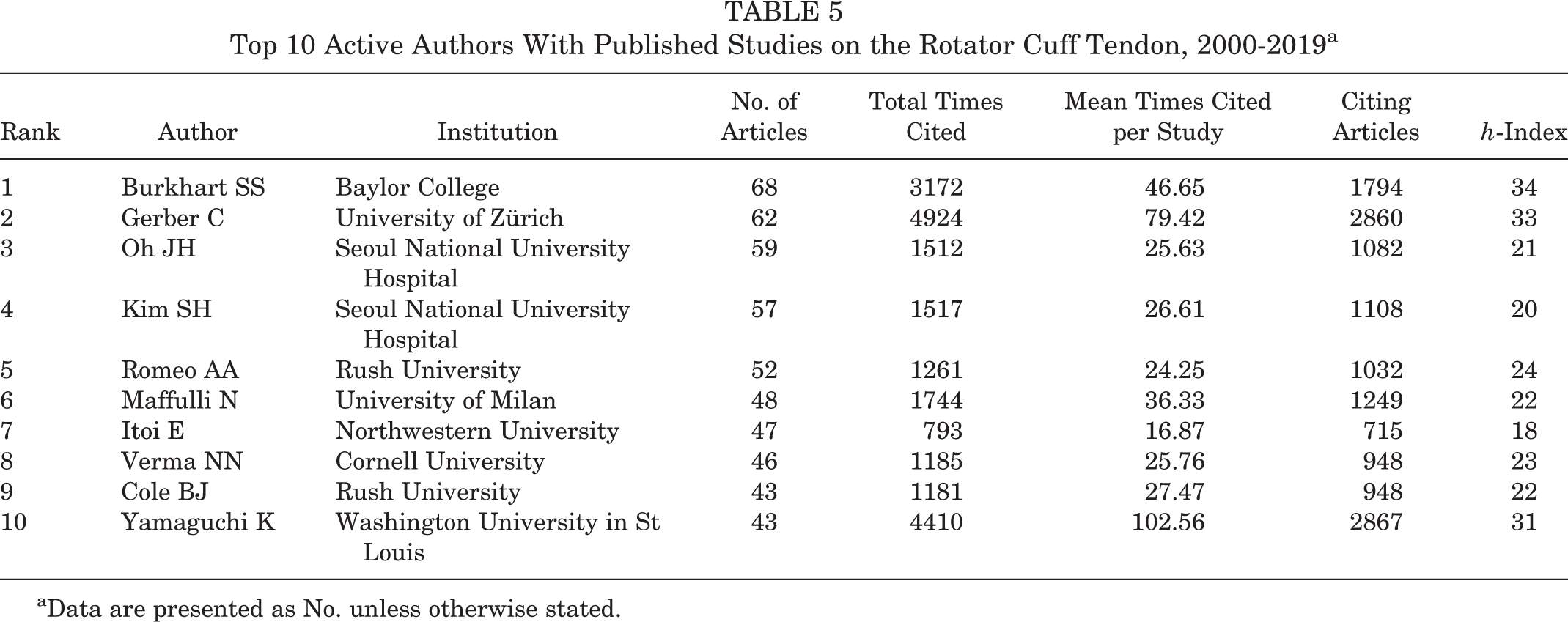
aData are presented as No. unless otherwise stated.
The Top 100 Articles
The paper published by Galatz et al 12 was the most frequently cited reference. This article received 1081 citations during the study period.
By the time we conducted our search, the top 100 articles had been cited 22,163 times overall. The overall average number of citations per article was 222 (range, 136-1081), and the yearly average number of citations was 15 (range, 7-64). All of the top 100 articles had been published before the year 2013. We found no significant correlation among the citation rate and the IFs of the journals (r = 0.000; P = .999), publication date (r = –0.105; P = .299), number of authors (r = 0.005; P = .960), or number of institutions (r = –0.109; P = .281). The number of citations demonstrated a significantly strong positive correlation with the average number of citations per item (r = 0.888; P < .001). The publication date had a moderate positive correlation with the average number of citations per item (r = 0.311; P = .002). The number of citations in both 2018 (r = 0.002; P = .982) and 2019 (r = –0.069; P = .494) had no significant correlation with the IF of the journal. The number of citations in 2018 (r = 0.280; P = .005) and 2019 (r = 0.307; P = .002) had a weak positive correlation with publication date, indicating that the more recently published articles had a higher number of citations.
Co-Word Analysis of Keyword
A visual knowledge map of keyword co-occurrence was generated to identify the keywords that could reflect trends in the entire research field. The most frequent keywords and a cluster map of the keyword subnetwork are shown in Figure 2, A and B. In total, 14 clusters with an overall Q of 0.7458 composed the co-word network of keywords. All of them had a node size >15, and only 1 cluster had a silhouette <0.8. The most frequent keywords were rotator cuff, arthroscopic repair, supraspinatus, single row, full-thickness tear, ultrasound, biomechanics, fatty degeneration, rehabilitation, suture anchor, animal model, mesenchymal stem cell, platelet-rich plasma, retear, growth factor, and tension overload. Debridement, subscapularis tendon, and tension overload were the strongest citation burst keywords (Figure 2C).
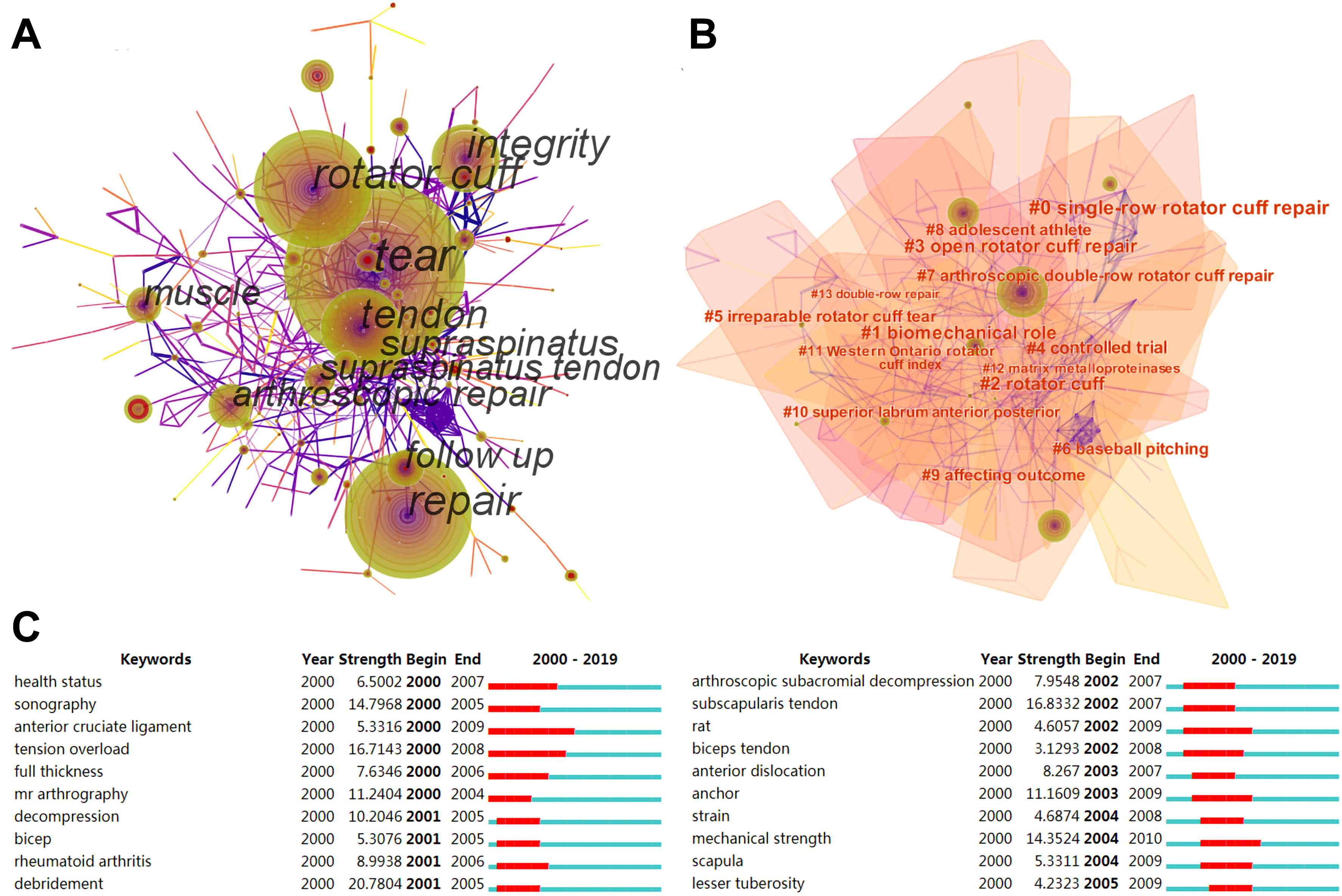
Co-word analysis of keywords. (A) Top 10 keywords with most co-occurrence counts. (The node represents the keyword, and its size is associated with the keywords occurrence counts. The higher the frequency of keywords appear, the larger the size of the node. The link between two nodes indicates the co-occurrence of the two keywords.) (B) Cluster map of co-words of keywords. (C) Top 20 keywords with the strongest bursts.
Discussion
Our study is the first bibliometric and visualized analysis of the rotator cuff. We found 4131 publications on rotator cuff research indexed in WoS between 2000 and 2019. Journal of Shoulder and Elbow Surgery was the most productive journal. Stephen S. Burkhart from Baylor College was the most active author. The most productive institution was the Hospital for Special Surgery. The United States was the dominant country. Researchers and institutions from North America, Europe, and Asia contributed the most. The number of publications increased between the years 2000 and 2019, an upward trend indicating that the rotator cuff, a basic structure to maintain stability of the shoulder joint, is attracting more attention among researchers.
International research on the rotator cuff has maintained an increasing trend over the past 20 years, which might be related to the following factors. First, the number of shoulder surgeon and sports medicine experts focusing on rotator cuff injury has increased. For example, between 2000 and 2010, the number of shoulder surgeons increased by 164% in the United Kingdom. 21 Second, the number of institutions that can perform rotator cuff surgery has increased by 2.5 times, which also indirectly suggests that the number of surgeons performing rotator cuff surgery has increased. Third, Mauro et al 28 found that an increasing number of surgeons prefer to manage rotator cuff injury.
The global distribution of rotator cuff research is unbalanced. In terms of publication number, the United States was far ahead of other countries. The reason might be related to the rapid development of education and increasing graduation of American sports medicine and shoulder surgeons, particularly in the area of rotator cuff treatment. Between 1996 and 2006, the rate of rotator cuff repair increased sharply after arthroscopic rotator cuff repair become available in the United States 8 and allowed such procedures to be conducted as outpatient surgery. The large number of funding resources in rotator cuff research was also a crucial factor. We found that 5 of the top 10 funding sources were from the United States. In terms of the publishing number, the Republic of Korea and Japan ranked high in the rotator cuff field, suggesting that Asian researchers are becoming interested in rotator cuff research. The rate of rotator cuff surgery in the Republic of Korea increased yearly since 2007 and then in 2012 the rate of rotator cuff surgery remained stable. The surgical rate in the Republic of Korea in 2012 was similar to the level in the United States in 2006. 20 Asian researchers have made some significant progress in deepening our understanding of the rotator cuff. Shinagawa et al 37 found that the critical shoulder angle was higher in patients with rotator cuff injury, indicating that critical shoulder angle might be an independent risk factor for rotator cuff injury in Japanese people. Kumar et al 24 reported that the prevalence of os acromiale is 0.7% in Korean outpatients, lower than in other ethnic groups, and no significant correlation was found between os acromiale and rotator cuff injury.
When evaluating journals, we found that the top 5 journals each had >100 publications on the rotator cuff. The relative concentration of journals in rotator cuff research has reduced the difficulty of selecting suitable journals. Based on the Bradford law, 39 these journals were identified as core journals in this area. The results suggested that rotator cuff research is relatively full-fledged in the field of orthopaedics. IF is a classic indicator in evaluating journal academic effect. In recent years, evaluating journals using IF alone might not be sufficiently comprehensive; the research field of the journals is also an important factor that needs to be considered. 13 JCR, a journal analysis tool provided by Clarivate Analytics, could be used to assess the influence of research in the WoS Core Collection. 22 A study showed that JCR partition could be combined with IF and citation to evaluate the quality of journals. 44 Although the IF scores of the top 10 journals were not very high, 9 of the journals were JCR partition Q1 or Q2 in sport sciences, orthopaedics, and surgery. Therefore, these journals are considered authoritative in rotator cuff research.
Many indicators, such as the IF of journals, citation, and h-index, are used to quantitatively analyze the influence of scientific research. 3,45 However, each indicator has its limitations. Citation is one of the most common indicators, which mainly includes the total citation (the total number of citations from the date of publication to the deadline of search), the citation density (the average number of citations per year from the date of publication to the deadline of search), and the citation in a given year. For articles, the most common indicator is the total citation. For journals, countries, institutions, and authors, the mean number of citations of the articles is a common indicator. Although some countries, institutions, or authors do not dominate the number of articles, they have a good performance in citation. For instance, Switzerland ranked ninth in publication number and first in citation density; Ken Yamaguchi ranked 10th in publication number and first in citation density, which was 102.56. He focused on the outcome of rotator cuff repair, ultrasonography for rotator cuff injury, and asymptomatic rotator cuff injury. Furthermore, Yamaguchi’s institution, Washington University in St Louis, also ranked first in the average number of citations. Therefore, we would consider that Yamaguchi’s team has had a crucial influence on rotator cuff research. The h-index, comprehensively considering the publication number and the citation, has become more popular for evaluating the academic output of researchers in recent years. Different indicators have different rankings. Multiple indicators can be integrated when evaluating scientific research output, evaluating scientific influence, and searching for potential collaborators.
We obtained the top 100 articles by ranking the total number of citations. Article citations may be related to many factors, such as the IF of the journals, publication age, and accessibility. Positive correlation was found between publication date and average number of citations per item, similar to the trial conducted by Kraeutler et al. 23 Publication date also had a positive correlation with number of citations in 2018 and 2019, demonstrating that current researchers may be more inclined to cite newer literature.
Our finding that Galatz et al 12 was the most frequently cited study was consistent with the findings by Kraeutler et al. 23 Citation density, instead of citation number, is important for indicating an article’s status in a particular area. The average number of citations of the paper by Galatz et al was 67.7 per year between 2004 and 2019, which suggested that the publication was vital in this research field. The authors suggested that the effects of arthroscopic repair were not present at long-term follow-up, and they found a high percentage of recurrent defects after arthroscopic repair of large and massive rotator cuff tears. The outcomes of this trial prompted subsequent researchers to find a better surgical approach to reduce the retear rate.
An article by Gerdesmeyer et al 14 was listed in the top 100 articles with the highest IF (IF = 51.273) and was published in Journal of the American Medical Association in 2003. The Physiotherapy Evidence Database 25 score of this trial is 8/10 for providing reliable evidence of the effects of shock wave for patients with calcifying tendonitis. Shock wave therapy might be a hotspot in rotator cuff research.
The choice of nonoperative versus operative treatment for patients with rotator cuff injury depends on a highly accurate diagnosis. At present, magnetic resonance (MR) imaging is considered the gold standard for diagnosing rotator cuff injuries. 43 Many researchers focused on sonography and MR arthrography between 2000 and 2005. In a meta-analysis that was in the top 100 articles, the authors 9 found that MR arthrography had higher sensitivity and specificity than did MR imaging and ultrasound and the diagnostic value of MR imaging was similar to ultrasound in diagnosing rotator cuff injuries. MR arthrography, with high sensitivity and specificity, is invasive and increases discomfort for patients, 11 so it is not recommended for routine use. We found that ultrasound was the research frontier in rotator cuff assessment. Compared with MR imaging, ultrasound was more cost-effective and provided the same detection of rotator cuff injuries. 9 A recent, updated meta-analysis has summarized that ultrasound is the best option for rotator cuff injury. 35 However, ultrasound examinations have high demands for ultrasound physicians; the diagnostic accuracy might depend on their skills. A standardized scanning protocol is needed to improve the accuracy of ultrasound.
A co-word analysis of keywords revealed that rotator cuff, tendon, tear, arthroscopic repair, supraspinatus, integrity, and muscle were the research hotspots. Furthermore, sonography, mechanical strength, arthroscopic subacromial decompression, subscapularis tendon, and full-thickness represented the research frontiers. Biceps tendon had the strongest citation bursts between 2000 and 2008. Biceps tendon provides functional stability to the glenohumeral joint and helps decrease pressure on the inferior glenohumeral ligament. 34 For RCD, 1 common cause of anterior shoulder pain is long head of the biceps tendon pathology, 32 which often is concomitant with large and massive full-thickness reparable rotator cuff tears. 10 How to treat the abnormal biceps tendon (ie, by tenotomy or tenodesis) remains controversial. 6,15
Limitations
Some limitations of our study are acknowledged. First, we retrieved the literature only from WoS, ignoring the literature from other databases. Second, the language of all the literature was English, which might not represent all literature related to the rotator cuff.
Conclusion
Using a bibliometric analysis, we summarized the valuable information and research trends in rotator cuff research. The Hospital for Special Surgery was the most active institution in rotator cuff research. Although the United States was in the dominant position for countries in which studies were published, the strength from Asian countries should not be underestimated. Stephen S. Burkhart had the most publications, and Ken Yamaguchi had the highest mean number of citations. Analysis of keywords indicated that arthroscopic repair, mesenchymal stem cell, and platelet-rich plasma might be the research frontiers in this field. Therefore, researchers should focus on these topics in their future work.
Footnotes
Final revision submitted June 18, 2020; accepted July 28, 2020.
The authors declared that there are no conflicts of interest in the authorship and publication of this contribution. AOSSM checks author disclosures against the Open Payments Database (OPD). AOSSM has not conducted an independent investigation on the OPD and disclaims any liability or responsibility relating thereto.