




Abstract
Background:
We conducted a study of recommendations from the American Academy of Orthopaedic Surgeons (AAOS) guideline, “Optimizing the Management of Rotator Cuff Problems.” Using these recommendations, we conducted searches of clinical trial registries and bibliographic databases to note the extent to which new research has been undertaken to address areas of deficiency.
Hypothesis:
Newly conducted research regarding rotator cuff repair and injury is available that will fill knowledge gaps identified by the AAOS guideline.
Study Design:
Cross-sectional study.
Methods:
For each recommendation in the AAOS guideline, we created PICO (participants, intervention, comparator, outcome) questions and search strings. Searches were conducted of ClinicalTrials.gov, the World Health Organization’s International Clinical Trials Registry Platform, MEDLINE via PubMed, and EMBASE to locate studies undertaken after the final literature search performed by the AAOS work group.
Results:
We located 210 newly registered trials and 448 published studies that are relevant to the recommendations made in the rotator cuff guideline. The majority of the recommendations have been addressed by relevant registered trials or published studies. Of the 448 published studies, 185 directly addressed the guideline recommendations. Additionally, 71% of the 185 published studies directly addressing the recommendations were randomized trials or systematic reviews/meta-analyses. The most important finding of our study was that the recommendations in the AAOS rotator cuff guideline have been adequately addressed.
Conclusion:
Orthopaedic researchers have adequately addressed knowledge gaps regarding rotator cuff repair treatment and management options. As such, the AAOS may consider a guideline update to ensure that recommendations reflect current findings in orthopaedic literature.
Rotator cuff tears are the most common musculoskeletal shoulder injury. 8 These tears affect at least 10% of people over the age of 60 in the United States, 10 and it is estimated that 250,000 rotator cuff repairs are performed in the United States per year. 17 Furthermore, the volume of rotator cuff repairs is increasing. Colvin et al 7 reported an increase of 141% between 1996 and 2006, with arthroscopic procedures increasing by 600% and open repairs increasing by 34%. Treatment options for rotator cuff tears include nonoperative management, arthroscopic debridement with a biceps tenotomy or tenodesis, partial repair, complete repair, patch augmentation, superior capsular reconstruction, muscle-tendon transfer, and reverse total shoulder arthroplasty. 13 Given the high incidence of rotator cuff repairs and the diversity of treatment options, the American Academy of Orthopaedic Surgeons (AAOS) developed a clinical practice guideline that addressed the management of rotator cuff problems. 3 This evidence-based guideline categorized evidence and assigned confidence to recommendations based on the quality of evidence that underpinned them; however, the majority of recommendations (55%) in the guideline were inconclusive. Even the most robust recommendations were classified as moderate. Criticisms surrounding potential bias and the large number of inconclusive recommendations ensued. 19,27 The American Orthopaedic Society of Sports Medicine, the Arthroscopy Association of North America, as well as specialty societies of the AAOS, such as the American Shoulder and Elbow Surgeons, expressed concerns culminating in a request by the Council of Specialty Societies that the AAOS not publish the guideline due to lack of evidence, risk of misinterpretation, and potential for misuse. 19 A continuous theme of these exchanges was the need for further research on rotator cuff disease. As Lubowitz et al 19 concluded, “The real conclusion of the Guideline is that future and better research is required.”
Recommendations based on insufficient or inconclusive evidence (“moderate,” “limited,” “inconclusive,” or “consensus statement” ratings) serve as the basis for identifying research gaps in rotator cuff research. Chalmers and Glasziou 6 estimated that up to 85% of research is wasted or of little value because of factors such as poor method, studies being underpowered, bias, and, pertinent to this study, addressing of the wrong research questions. In 2015, the Orthopaedic Research and Education Foundation (OREF) awarded US$2.5 million to 63 grant and award recipients. 24 A more well-established connection between the research gaps identified during guideline development and the research enterprise is a viable solution for reducing research waste in rotator cuff studies and could allow funders such as OREF to better allocate funding to areas where research and treatment guidelines are least conclusive. Recent editorials regarding rotator cuff repair methods covered in the AAOS guideline also suggest that addressing knowledge gaps in rotator cuff repair with high-quality, methodologically sound studies should be a priority. 9,11,23,25
The primary purpose of the current study was to explore whether orthopaedic surgery researchers are addressing the research gaps identified by low-level recommendations in the AAOS clinical practice guideline, “Optimizing the Management of Rotator Cuff Problems.” 3 Using recommendations from this guideline, we conducted searches of clinical trial registries, PubMed, and EMBASE to note the extent to which new, ongoing, and published research is being undertaken to address areas of deficiency. We hypothesized that the areas of deficiency in the rotator cuff guideline will have been addressed by new, ongoing, or published research.
Methods
Oversight and Reporting
We applied relevant Statistical Analyses and Methods in the Published Literature (SAMPL) reporting guidelines for reporting descriptive statistics. 18 These guidelines instruct authors on reporting basic statistical methods and results and were created to prevent most reporting deficiencies routinely found in published scientific reports.
We located the latest clinical practice guideline for rotator cuffs from the AAOS website. 3 The strength of recommendations ratings are located in Table 1. For each recommendation, we constructed 1 or more research questions using the PICO (participants, intervention, comparator, outcome) format. This method is used to identify clinical components for systematic reviews and is endorsed by the Cochrane Collaboration. 14 It was chosen over other methods, as evidence suggests that the PICO method produces searches with greater sensitivity. 22 One investigator (M.F.) constructed all initial PICO questions, and 2 investigators (J.J., J.W.) reviewed them for accuracy and drafted the final questions.
American Academy of Orthopaedic Surgeons Recommendation Classifications a
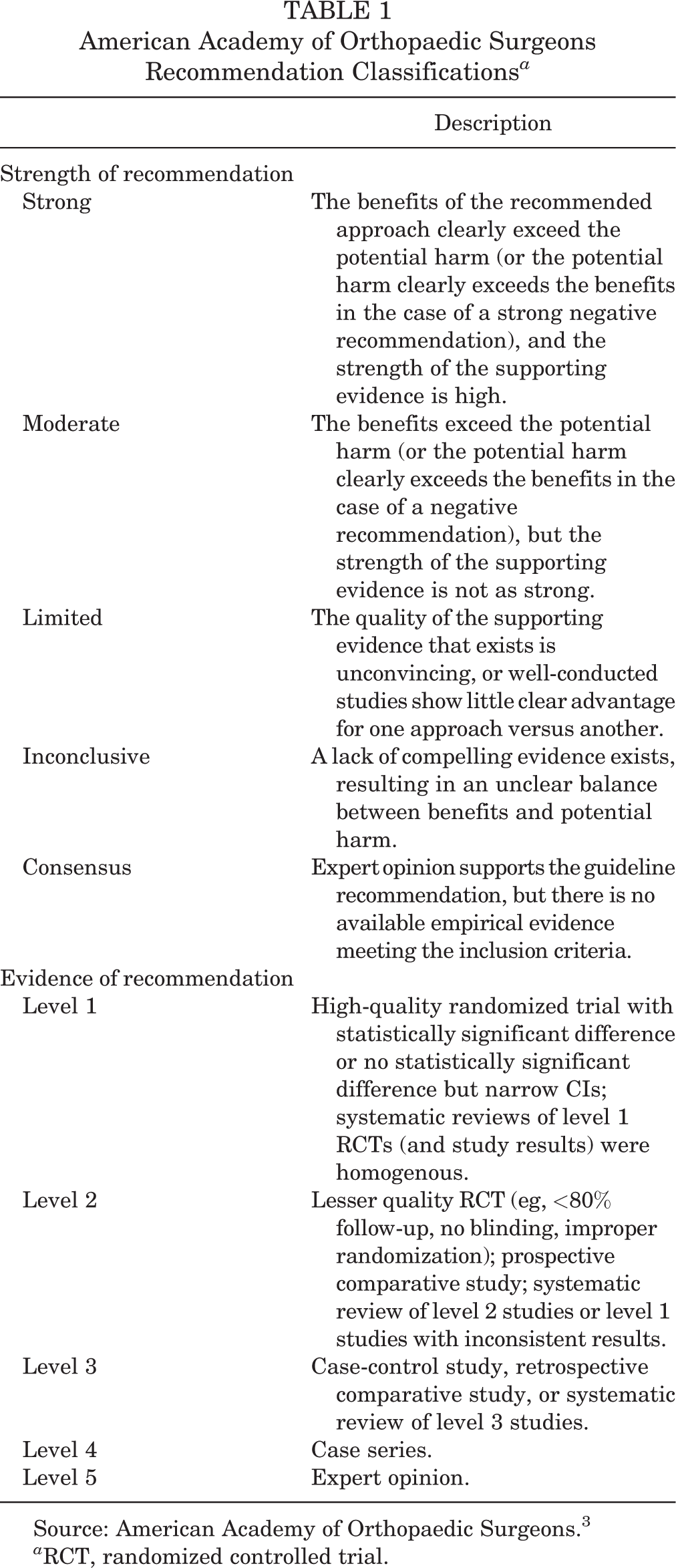
Source: American Academy of Orthopaedic Surgeons. 3
a RCT, randomized controlled trial.
Development of the Search Strings
For our study, we used the search strategies found in Table A3 of the AAOS guideline, which included search strings for PubMed and EMBASE. 2 The guideline work group did not perform searches of ClinicalTrials.gov or the World Health Organization (WHO) International Clinical Trials Registry Platform (ICTRP); therefore, keywords from the PubMed and EMBASE search strings were used to construct search strings for these trial registries. Search strings were formulated leveraging Boolean operators (eg, OR, AND) and parenthetical groupings to optimize the use of key terms. Although both ClinicalTrials.gov and the WHO ICTRP databases use the Unified Medical Language System to enhance interoperability of vocabularies, their search engines work differently. For example, on ClinicalTrials.gov, a search using the term “pre hospital” (space between) returns records that include the word “pre-hospital” or “prehospital,” whereas on the ICTRP site, the word “pre-hospital” (hyphenated) also returns the forms “pre-hospital” and “prehospital.” For this reason, we developed 2 separate search strings for each clinical trial registry used in this study. We consulted Glanville et al 12 to accurately translate these search strings between the trial registries. We also consulted an expert on searching these trial registries to verify the accurate translation of our search strategy between the sites (M. Arber, personal communication, May 2017). The search strings used in this study are located in Appendix Table A1.
Searching the Trial Registries
Using the search strings for ClinicalTrials.gov, we retrieved studies using the “expert search” feature. Registry-listed information included study identification number, title, recruitment status, condition, intervention, phase, enrollment status, and study type.
Using the search strings for ICTRP, we retrieved studies using the basic search function. By performing a basic rather than advanced search, we were able to achieve a more sensitive search. 12 These studies were then added to those identified through ClinicalTrials.gov. After the 2 files were merged, duplicate studies were deleted, and the remaining studies were subject to screening.
Searching PubMed and EMBASE
Using the search strings for PubMed, we retrieved studies using the advanced search function, limiting the date range for included studies from October 2008 to July 24, 2017, when this study concluded. This date was chosen because October 1, 2008, was the final date included in the literature search for the guideline. Additionally, we limited the search to clinical trials, systematic reviews and meta-analyses, and observational studies. For EMBASE we used the same method; however, this database allows for limiting date only by year, so January 2008 was used as the start date for the search. Studies published between January 1 and October 1, 2008, were then omitted. We also applied an EMBASE limiter to search only for included studies not published in PubMed/MEDLINE to limit duplication.
Screening Studies for Eligibility
A single investigator (J.X.C.) screened studies for relevance. First, this investigator evaluated whether studies retrieved from the searches were relevant to rotator cuff injury and/or treatment. Studies that were not relevant were immediately excluded. Studies relevant to the PICO questions were retained, and those that were unclear were reviewed for relevance by 2 other investigators (M.V., J.J.), if needed. To qualify for inclusion, at least 1 of the study’s arms had to fit the PICO question, either directly or indirectly (ie, data from the study could improve knowledge related to the research gaps even though the study did not directly address the research question). For example, recommendation 10B states, “We cannot recommend for or against the preferential use of suture anchors versus bone tunnels for repair of full-thickness rotator cuff tears.” For a study to be designated as relevant to this recommendation, the study would have to include 1 arm or objective evaluating the outcomes of bone tunnels or suture anchors for full-thickness rotator cuff repair.
Second, we screened relevant studies by completion date. Only studies completed or published after the end of the literature search stated in the guideline (October 2008) and ongoing studies were included. After screening, studies were mapped to their corresponding recommendation (Appendix Tables A2 and A3).
Identification of Studies Directly Addressing the AAOS Recommendations
Next, all published studies determined as relevant to the guideline recommendations from our search of PubMed and EMBASE were separated, and the full-text versions of the manuscripts were screened. In this analysis, 3 authors (J.X.C., J.S., J.H.) determined whether studies directly addressed the recommendations in the guideline through at least 1 arm and therefore would aid in increasing the evidence base of the corresponding recommendation. For example, recommendation 10B states, “We cannot recommend for or against the preferential use of suture anchors versus bone tunnels for repair of full-thickness rotator cuff tears.” For a study to be designated as one directly addressing this recommendation, it would have to include 1 arm or objective that directly compared the outcomes of bone tunnels against those of suture anchors for full-thickness rotator cuff repairs. Two investigators (J.C., J.S.) independently screened the studies, each blinded to the other’s determinations. Once screening was complete, consensus was reached among the authors, and a third author (J.H.) provided a third review of the studies to confirm accuracy. Next, the study type (eg, randomized trial, systematic review, meta-analysis) was evaluated to establish the quality of evidence among the studies directly addressing the recommendations.
Identification of Studies Funded by OREF
We evaluated studies funded by OREF to determine whether recently funded studies addressed the research gaps we identified from the clinical practice guideline. We used the 2013-2015 OREF Annual Reports 24 to gather the titles of all funded research projects. We included studies that indirectly addressed the recommendations and those that directly addressed recommendations. Only studies funded after the publication of the rotator cuff clinical practice guideline (2010) were included.
Results
Results From Trial Registries
Our search of ClinicalTrials.gov and ICTRP yielded 868 studies; 409 studies were retrieved from ClinicalTrials.gov, and 459 trials were retrieved from the ICTRP database. After removing duplicate studies and those with completion dates prior to October 1, 2008, we were left with 532 studies (Figure 1).
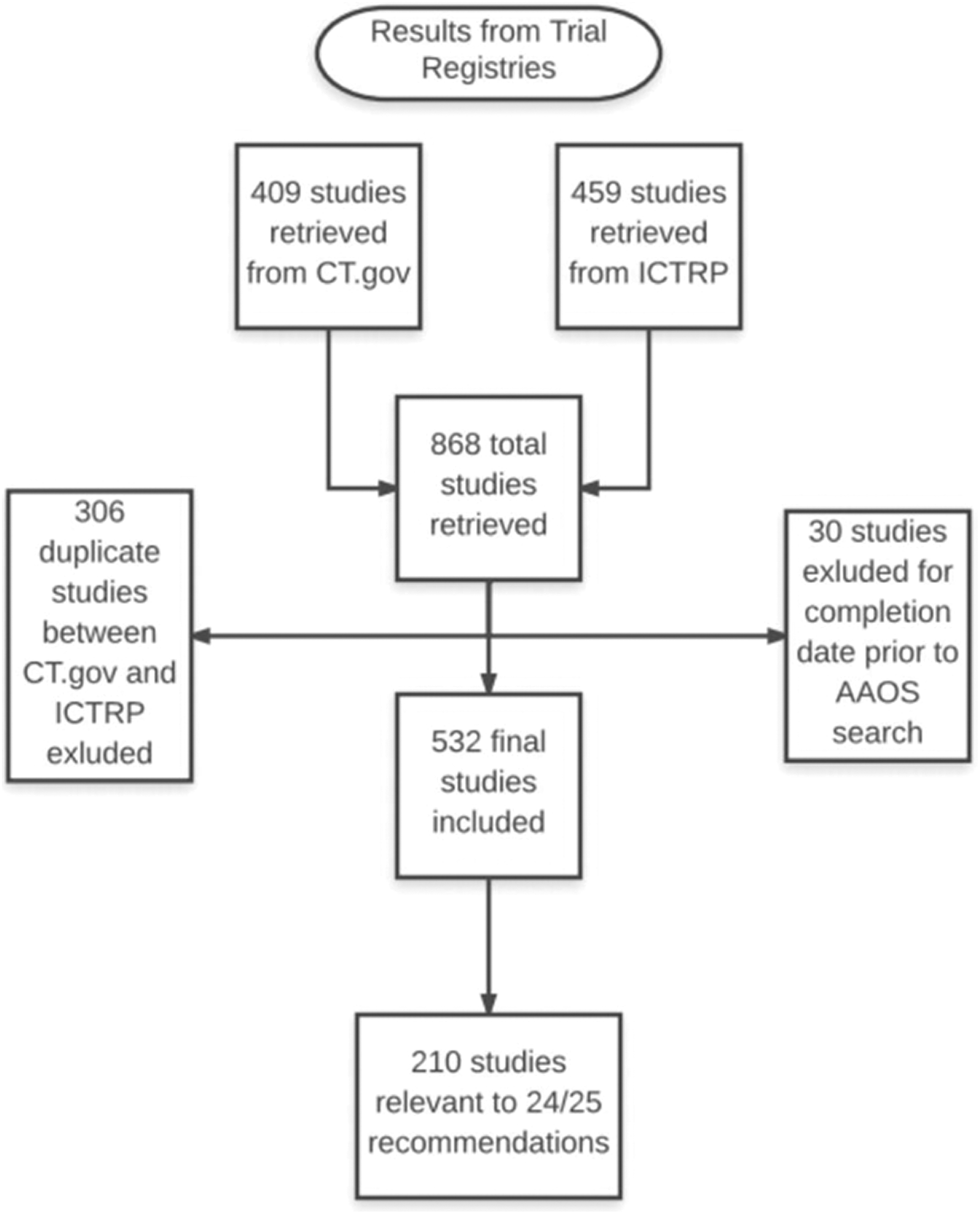
Flow diagram detailing the search results of ClinicalTrials.gov (CT.gov) and the World Health Organization International Clinical Trials Registry Platform (ICTRP). AAOS, American Academy of Orthopaedic Surgeons.
Of the 532 studies included in our sample, 210 (39%) were relevant to the 25 recommendations made in the AAOS rotator cuff clinical practice guideline. Additionally, of the 25 recommendations made in the guideline, 24 (96%) were being addressed by new or ongoing research. The recommendation with the greatest number of new and/or ongoing trials was recommendation 4A, regarding patients with rotator cuff symptoms in the absence of a full tear being treated nonoperatively with exercise or nonsteroidal anti-inflammatory drugs. This recommendation was being addressed by 65 (31%) new or ongoing studies (Table 2). The recommendation with the next highest number of new and/or ongoing studies was recommendation 2, regarding the use of surgical rotator cuff repair in patients with symptomatic full-thickness tears, which was being addressed by 37 (18%) new and/or ongoing studies (Table 2). We found no new or ongoing studies evaluating recommendation 7B (the effects of diabetes, comorbidities, smoking, infection, and cervical disease on outcomes of rotator cuff surgery). The most common recruitment status for the 210 studies was “completed” (51; 24%), and the next most common recruitment status for the studies was “recruiting” (34; 16%) (Table 2).
AAOS Guideline Recommendations Addressed by New, Ongoing, or Published Research a

a AAOS, American Academy of Orthopaedic Surgeons; CT.gov, ClinicalTrials.gov; ICTRP, International Clinical Trials Registry Platform; NSAIDs, nonsteroidal anti-inflammatory drugs; PEMF, pulsed electromagnetic field; TENS, transcutaneous electrical nerve stimulation.
Of the 210 registered trials determined as relevant to the recommendations in the guideline, only 99 (47%) have been updated as “completed” within their respective clinical trial registry database. Furthermore, of the 99 completed trials, only 17 (17%) were updated with the results of their study.
Results From PubMed and EMBASE
Our PubMed search yielded 1703 studies that were published between October 2008 and July 24, 2017. Our EMBASE search yielded 422 studies published between January 2008 and July 24, 2017. When combined, 2125 studies were screened for relevance. Of these, 448 (21%) were relevant to the 25 recommendations made in the guideline. Additionally, of the 25 recommendations made, all 25 (100%) were addressed by at least 1 published study (Figure 2). Recommendation 2, regarding the use of surgical rotator cuff repair in patients with symptomatic full-thickness tears, had the highest number of published studies (n = 158). The recommendation with the next highest number of published studies was recommendation 10C, regarding specific technique (arthroscopic, mini-open, or open repair) when surgical repair is indicated (n = 81) (Table 2).
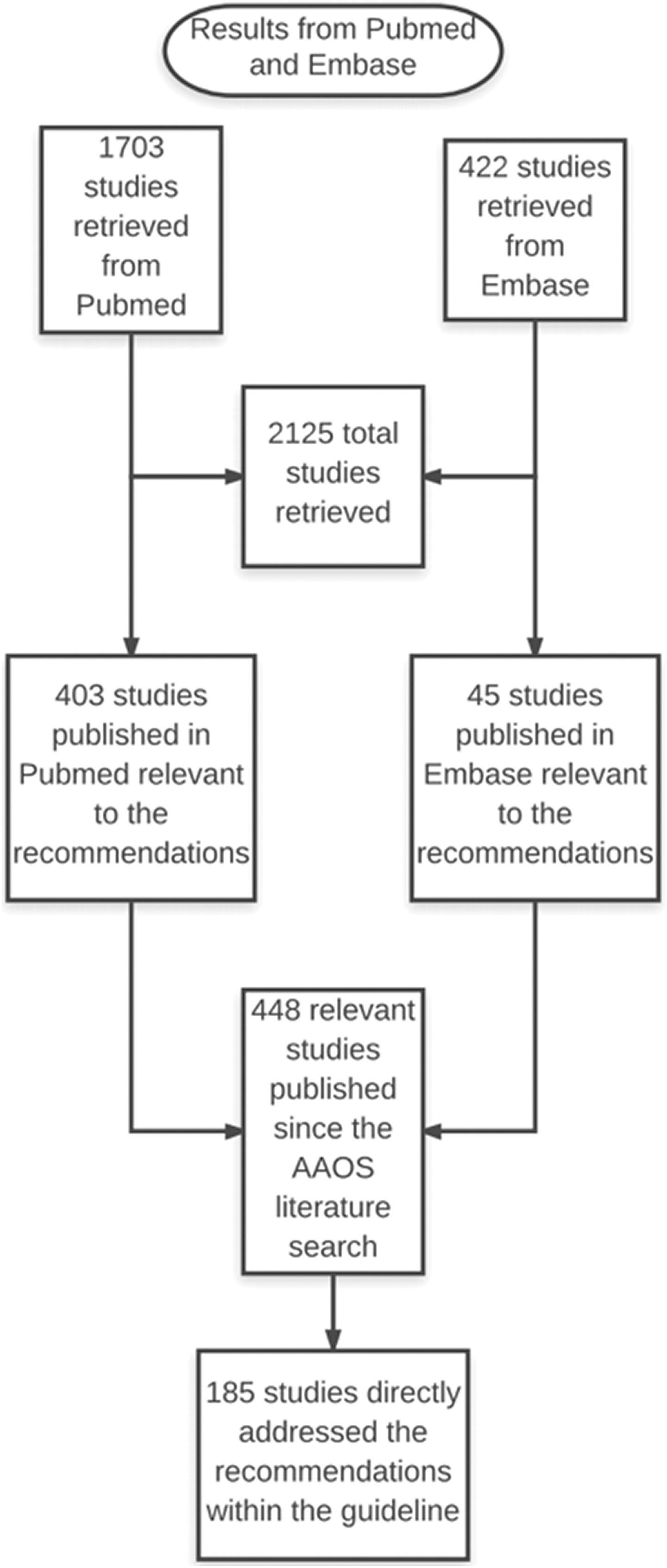
Flow diagram detailing the search results of PubMed and EMBASE. AAOS, American Academy of Orthopaedic Surgeons.
Results of Full-Text Screening to Determine Studies Directly Addressing the AAOS Recommendations
Of the 448 published studies deemed relevant to the 25 recommendations made in the guideline, 185 (41%) were determined to directly address the recommendations in the guideline (Appendix Table A4). Collectively, the 185 studies directly addressed 21 (84%) of the 25 guideline recommendations. Of the 25 recommendations, recommendation 2 regarding the use of surgical rotator cuff repair in patients with symptomatic full-thickness tears was found to have the highest number of published studies directly addressing it (n = 33). The recommendations with the next highest number of published studies directly addressing them were 4C (regarding the use of iontophoresis, transcutaneous electrical nerve stimulation, ice, heat, massage, or activity modification for symptomatic non–full-thickness tears), and 4B (regarding subacromial corticosteroid injection or pulsed electromagnetic field in treating symptomatic non–full-thickness tears), which were directly addressed by 24 and 20 published studies, respectively. Recommendations 3C (mechanisms of nonoperative management of rotator cuff tears), 5 (early surgical repair after acute rotator cuff tears), 10A (tendon to bone healing), and 10B (suture anchors vs bone tunnels) were not directly addressed by any published studies.
Of the 185 studies directly addressing the recommendations, the most prevalent study type was randomized trial, accounting for 68 (37%) published studies directly addressing the recommendations; the next most prevalent study type was systematic review/meta-analysis, accounting for 64 (35%) published studies directly addressing the recommendations (Table 3). Of the 25 recommendations, 20 (80%) were directly addressed by at least 1 randomized trial or systematic review/meta-analysis.
Classification of Published Studies Directly Addressing the Recommendations in the AAOS Guideline a

a AAOS, American Academy of Orthopaedic Surgeons; NSAIDs, nonsteroidal anti-inflammatory drugs; PEMF, pulsed electromagnetic field; TENS, transcutaneous electrical nerve stimulation.
Results From OREF
We identified 150 studies funded by OREF from 2012 to 2015. Of these, 20 concerned rotator cuff repair, and 6 addressed research gaps identified from the rotator cuff clinical practice guideline (Table 4). Two funded studies contributed to recommendation 7B (concerning the effects of diabetes, comorbidities, smoking, infection, and cervical disease on rotator cuff repair), and no studies registered in the 2 databases contributed to recommendation 7B. The 4 other grant-funded studies evaluated recommendations 6, 9, 3B, and 7A (Table 4).
Studies Funded by OREF Addressing Recommendations in the Rotator Cuff Clinical Practice Guideline a

a OREF, Orthopaedic Research and Education Foundation.
Discussion
Rotator cuff injury is the most common injury of the shoulder for which patients seek treatment, and research to improve methods for diagnosis and management should be a high priority. Our results suggest that all recommendations that lacked sufficient evidence at the time of guideline publication are receiving attention from orthopaedic researchers. These efforts suggest that the orthopaedic community is working to address the skepticism regarding “evidence not opinion” 27 after the publication of this controversial “evidence-based” guideline. 19,28 The AAOS standards affirm that clinical practice guidelines should be updated, reviewed, or retired every 5 years. 2 Evidence indicates that waiting more than 3 years to review a guideline may be problematic, as up to 22.2% of recommendations may no longer be valid. 21 No data exist to describe the validity of recommendations, especially those called into question for suspect levels of evidence, despite availability of 9 years of new research data.
Rotator cuff disease is a common and complicated condition. With both surgical and nonsurgical treatments being viable options, a paucity of data are available to support a definitive treatment algorithm for practitioners. 16 In fact, algorithms for diagnosis and management of rotator cuff injuries exist as a matter of expert opinion, animal studies, and observational studies. 20 For most patients, conservative physical therapy and pain management are used; however, if such options fail, surgery is the inevitable option. 15 Although the specific indications for surgery remain unclear, our results show that nearly 220 studies have been performed, or are under way, to investigate techniques for surgical repair of rotator cuff injuries since the 2010 release of the AAOS guideline. Our findings also indicate that 185 of these studies directly address the recommendations in the guideline, and of these 185 studies, 132 (71%) are randomized trials or systematic reviews/meta-analyses, which are generally regarded as having a high level of evidence assuming they have robust methods. With 185 new studies directly addressing the recommendations in the guideline and with 80% of the recommendations being directly addressed by at least 1 randomized trial or systematic review/meta-analysis, our findings suggest there may be sufficient research to warrant an evaluation of the recommendations and to determine whether the stances made by the AAOS in the guideline still reflect the evidence base. Doing so may give the AAOS the opportunity to establish a truly evidence-based guideline regarding rotator cuff repair.
Our study suggests that areas not addressed in the AAOS guideline are also receiving much attention by the orthopaedic research community. Interestingly, nearly 70 ongoing or recently published studies have focused on the use of platelet-rich plasma (PRP) injections. While some believe that no definitive evidence supports improved patient outcomes with PRP or stem cell injections, our search results point to an increasing interest in the topic from the orthopaedic community. 1,30 Despite the increased interest, the AAOS guideline contains no definitive statement regarding its stance on this type of therapy. We believe the abundance of new evidence for this less invasive treatment is one of the clearer indications that a guideline update is necessary. With this in mind, we must still consider the potentially prohibitive factors of such a treatment option for our patients. A recent meta-analysis of PRP showed an incremental cost-effectiveness ratio of US$127,893 per quality-adjusted life-year gained. 30 This study suggested not only that this value is prohibitive and noneffective in small and medium-sized tears but that using PRP after large tears is economically and clinically ineffective due to the extent of tissue damage. 30 Safety was not addressed in that meta-analysis, but other studies have made conclusions regarding the safety of the therapy 26 ; however, as stated, cost is a prohibitive factor for the use of PRP.
These conclusions, while interesting, are supported by only 13 studies from 2010 to 2014, and a definitive position on PRP injections by the AAOS may provide guidance and clarity for future research into similar, less invasive treatment options. Furthermore, treatment options for rotator cuff tear such as patch augmentation, superior capsular reconstruction, and reverse total shoulder arthroplasty are not thoroughly addressed by the guideline. An evaluation of the literature and updated recommendations from the AAOS regarding these options may be of value to orthopaedic surgeons and patients alike.
With recognition that repairs leading to retear can negatively affect patient outcome measures, further research into conditions that most commonly lead to retear are of great importance. While some studies indicate that many common comorbid conditions such as osteoporosis (200 million patients worldwide) and diabetes (29.1 million Americans in 2012) have been shown to negatively influence tendon healing, 1,4,31 our study found that there are currently no ongoing trials to address how these factors affect rotator cuff repair or management. Although the number of diseases associated with poor outcomes of rotator cuff repair is high, the research community’s commitment to discovering new and improved methods to incorporate this information into treatment and management options is miniscule in comparison with the efforts to improve surgical technique or evaluate the use of PRP or other such injections in nonoperative patients. Although Tashjian et al 29 suggested that patients with an increasing number of medical comorbidities had a greater improvement in postoperative functional outcomes from baseline compared with those without medical comorbidities, the patients with comorbidities began the study with lower preoperative functional status and failed to reach the functional outcomes of those without comorbidities. While this finding is statistically significant for researchers, further studies are needed to illuminate its basis in patient satisfaction and perception of treatment success. The finding also fails to provide a conclusion or resolution to any concerns about treatment selection for those with comorbidities, as all patients were standardized to the same treatment. 29 This confusion provides another opportunity for expert work groups to synthesize the literature and provide evidence-based suggestions for treatment.
Limitations
Our study had limitations. Although we used both ClinicalTrials.gov and the WHO ICTRP, a known comprehensive strategy for searching trial registries, 5 it is possible that our searches did not locate studies that may have been relevant to this investigation. Furthermore, only a small percentage of the registered trials were updated as “complete,” and a smaller percentage had uploaded results. This finding could indicate that these studies are not surviving to publication and will not benefit rotator cuff repair evidence or orthopaedic surgery as a whole. While other databases exist, we believe that using PubMed and EMBASE provided an adequate evaluation of the published literature regarding rotator cuff injury; however, using only these databases could have inadvertently excluded relevant studies found in other databases. Although all studies were screened by multiple investigators, there is a chance that studies were incorrectly classified as to whether they addressed the recommendations. Furthermore, while we discovered many studies that directly addressed the recommendations, these studies may have methodological shortcomings that would preclude their inclusion in an AAOS clinical practice guideline, and thus our findings may have overestimated the number of studies that would actually be used as the evidence base for rotator cuff repair recommendations. In addition, because those evaluating grant proposals for the OREF likely distribute funding based on the strength of the proposal, it is possible that the reason rotator cuff recommendations are not being addressed by OREF funding is because proposals that would address these recommendations are not as strong as research focused on other areas of orthopaedics. As such, our findings may have underestimated the interest in addressing rotator cuff repair by those submitting proposals for OREF funding.
Conclusion
Our study located 210 newly registered trials and 448 published studies that are relevant to the recommendations made in the AAOS rotator cuff guideline. The majority of the recommendations have been addressed by relevant registered trials or published studies. Of the 448 published studies, 185 directly addressed the guideline recommendations. Additionally, 71% of the 185 published studies directly addressing the recommendations were randomized trials or systematic reviews/meta-analyses.
Footnotes
The authors declared that they have no conflicts of interest in the authorship and publication of this contribution. AOSSM checks author disclosures against the Open Payments Database (OPD). AOSSM has not conducted an independent investigation on the OPD and disclaims any liability or responsibility relating thereto.
Ethical approval was not sought for the present study.
APPENDIX
List of Search String by Database Identified Trials Addressing the Recommendations Made in the AAOS Rotator Cuff Clinical Practice Guideline Included Studies From PubMed and EMBASE Addressing the AAOS Recommendations Studies Directly Addressing the AAOS Recommendations, by Study Type and Recommendation Addressed
Database
Search String
ClinicalTrials.gov
rotator cuff OR shoulder impingement OR supraspinatus tendonitis OR subacromial bursitis OR glenohumeral instability OR cuff tear OR cuff tears OR supraspinatus atrophy OR subacromial atrophy OR ((infraspinatus OR supraspinatus OR subscapularis OR teres minor) AND (tear OR impingement OR augmentation))
ICTRP
rotator cuff OR shoulder impingement OR supraspinatus tendonitis OR subacromial bursitis OR glenohumeral instability OR cuff tear OR cuff tears OR supraspinatus atrophy OR subacromial atrophy OR infraspinatus tear OR infraspinatus impingement OR infraspinatus augmentation OR supraspinatus tear OR supraspinatus impingement OR supraspinatus augmentation OR subscapularis tear OR subscapularis impingement OR subscapularis augmentation OR teres minor tear OR teres minor impingement OR teres minor augmentation
PubMed
rotator cuff OR shoulder impingement OR supraspinatus tendonitis OR subacromial bursitis OR glenohumeral instability OR cuff tear OR cuff tears OR supraspinatus atrophy OR subacromial atrophy OR ((infraspinatus OR supraspinatus OR subscapularis OR teres minor) AND (tear OR impingement OR augmentation)) AND ((Observational Study[ptyp] OR Clinical Trial[ptyp] OR Review[ptyp] OR systematic[sb] OR Meta-analysis[ptyp] OR Multicenter Study[ptyp]) AND (“2008/10/01”[PDat]:”2017/07/24”[PDat]))
EMBASE
‘rotator cuff’ OR ‘shoulder impingement’ OR ‘supraspinatus tendonitis’ OR ‘subacromial bursitis’ OR ‘glenohumeral instability’ OR ‘cuff tear’ OR ‘cuff tears’ OR ‘supraspinatus atrophy’ OR ‘subacromial atrophy’ OR ((infraspinatus OR supraspinatus OR subscapularis OR teres minor) AND (tear OR impingement OR augmentation)) AND ([article]/lim OR [conference paper]/lim OR [review]/lim) AND [english]/lim AND [humans]/lim AND [embase]/lim

Title
Registry No.
Recruitment Status
Recommendation Addressed
Longitudinal study of asymptomatic rotator cuff tears
NCT01085942
Completed
1
Features to predict success with nonoperative treatment of patients with rotator cuff tears
NCT00762580
Active, not recruiting
1
The natural history of asymptomatic rotator cuff tears
NCT00923858
Enrolling by invitation
1
Outcome of arthroscopic repair of chronic rotator cuff tears between 2005-2008
NCT00828256
Unknown status
2
Rotator cuff repair (RCR) with and without OrthoADAPT augmentation
NCT00957255
Withdrawn
2
Arthroscopic surgical outcome study in subjects with rotator cuff tears
NCT00739947
Completed
2
Outcome following surgery to repair rotator cuff tears
NCT00260949
Completed
2
Pilot study of augment rotator cuff for surgical treatment of full thickness rotator cuff tears
NCT01256242
Unknown status
2
Study comparing patient function and satisfaction with arthroscopic subacromial decompression before and after repair of complete rotator cuff tears
NCT01430598
Unknown status
2
Results of shoulder arthroscopic surgery for rotator cuff, biceps tendon, labrum and capsule
NCT01401738
Unknown status
2
Postoperative multiparameter outcomes during the six months after rotator cuff repair
NCT01608997
Unknown status
2
A pilot cohort study of surgical and non-surgical management of rotator cuff tears
NCT03021733
Completed
2
Can shoulder arthroscopy work
NCT01623011
Active, not recruiting
2
Rotator cuff injury to surgery
NCT01744080
Withdrawn
2
Functional and radiographic outcomes after shoulder surgery
NCT01405781
Enrolling by invitation
2
Arthroscopic rotator cuff repair with synovectomy
NCT03061942
Recruiting
2
Comparing the outcomes between rotator cuff repair with and without suprascapular nerve decompression
NCT02107573
Recruiting
2
InSpace™ system over rotator cuff repair in comparison to repair alone
NCT02210910
Active, not recruiting
2
Tenotomy or tenodesis of long head biceps in arthroscopic rotator cuff repair
NCT02655848
Recruiting
2
InSpace™ system in comparison to best repair of massive rotator cuff tear
NCT02208440
Recruiting
2
Impact of humeral component version on outcomes following RTSA
NCT03111147
Recruiting
2
Rotator cuff surgical outcomes in women
NCT02725320
Recruiting
2
Clinical outcomes after arthroscopic tenotomy or tenodesis of the long head of the biceps
NCT02811757
Recruiting
2
Assessing the post-operative quality of recovery and chronic pain rates after elective shoulder surgery
ACTRN12616000878471
Not recruiting
2
Functional reconstruction for irreparable rotator cuff tears
ChiCTR-INR-16008114
Not recruiting
2
Patients with impingement syndrome with and without rotator cuff tears do well 20 years after arthroscopic subacromial decompression
DRKS00006776
Not recruiting
2
Treatment of long head of biceps tendon lesions together with rotator cuff tears: which method is preferred? Tenotomy or tenodesis
IRCT201406117274N10
Not recruiting
2
Comparison between two tenodesis methods in the treatment of biceps tendon and shoulder pathology
IRCT201309247274N9
Not recruiting
2
Tenotomy or tenodesis for long head biceps lesions associated with reparable rotator cuff tears
ChiCTR-TRC-12002649
Recruiting
2
United Kingdom rotator cuff trial
ISRCTN97804283
Not recruiting
2
Outcomes after repair of acute rotator cuff tears
NCT01140230
Completed
5
Clinical and structural outcome after early repair of the traumatic rotator cuff tear
NCT01557309
Completed
5
ACCURATE trial—operative treatment of acute rotator cuff tear related to trauma
NCT02885714
Recruiting
5
Effect of ibuprofen on postoperative opiate medication use and shoulder
NCT02588027
Recruiting
6
The effect of NSAIDs after a rotator cuff repair surgery
NCT02153177
Suspended
6
Dexamethasone effect on the duration of interscalenic brachial plexus block guided by ultrasound for videoarthroscopic shoulder surgery
RBR-86mhm2
Not recruiting
6
Radiofrequency microtenotomy for treatment of rotator cuff tendinopathy
NCT02275689
Completed
8
ArthroPlanner: a surgical planning solution for acromioplasty
NCT02725346
Active, not recruiting
8
Latissimus dorsi tendon transfer or partial arthroscopic repair of massive rotator cuff tears
NCT01481480
Recruiting
9
Compression and cold therapy on the post-operative shoulder
NCT00703729
Completed
12
Post-operative pain relief for patients undergoing arthroscopic shoulder surgery—an investigation of the efficacy of cryotherapy
JPRN-UMIN000026796
Not recruiting
12
Post-op rotator cuff pain study with subacromial bupivacaine infusion
NCT01126593
Completed
14
Continuous subacromial bupivacaine
NCT01377415
Completed
14
Post-operative quality of life evaluation for different anesthesia techniques for arthroscopic shoulder surgery
NCT01355757
Completed
14
Use of catheter for patient controlled interscalene analgesia
JPRN-UMIN000025781
Not recruiting
14
Operative versus non-operative management of rotator cuff tear
NCT00695981
Active, not recruiting
1, 2
Comparative effectiveness of operative versus non-operative treatments for rotator cuff tears
NCT02287090
Active, not recruiting
1, 2
Functional and radiological outcome of non-surgical vs surgical treatment for the atraumatic cuff rupture after 1 year (COPACABANA trial)
NTR2343
Recruiting
1, 2
Treatment of atraumatic rotator cuff rupture in elderly patients
NCT01116518
Completed
1, 8, 3A
A comparison of two adjunctive treatments in arthroscopic cuff repair
NCT01706978
Active, not recruiting
10A
Trephination in arthroscopic cuff repair: a prospective randomized controlled trial
NCT01877772
Recruiting
10A
Evaluation of tendon-to-bone healing potential in arthroscopic rotator cuff repair through biological stimulation
NCT03060928
Not yet recruiting
10A
The effect of synovium for tendon-to-bone insertion healing—microvascularity analysis
JPRN-UMIN000017349
Not recruiting
10A
A study in healing process of tendon-to-bone insertion—microvascularity analysis
JPRN-UMIN000017312
Not recruiting
10A
Types of fixation in arthroscopic rotator cuff repair
NCT00508183
Completed
10B
Arthroscopic rotator cuff repair: suture anchors versus arthroscopic transosseous fixation
NCT01815177
Completed
10B
Rotator cuff repair using standard double row technique with platelet rich fibrin membrane vs. standard double row technique
NCT02256891
Completed
10B
Evaluation of the Healicoil suture anchor for rotator cuff repair
NCT02759458
Enrolling by invitation
10B
Suture anchor comparison in rotator cuff repairs
NCT02350647
Recruiting
10B
Optimal insertion angle for suture anchors—an assessment using three dimensional finite element method
JPRN-UMIN000002190
Not recruiting
10B
Comparison of clinical outcomes in all-arthroscopic versus mini-open repair of rotator cuff tears
ChiCTR-IOR-17011244
Not recruiting
10C
Early mobilization following mini-open rotator cuff repair
NCT01741272
Completed
10C, 13A
Outcomes in rotator cuff repair using graft reinforcement
NCT01025037
Completed
11B
Rotator cuff reconstruction with xenologous dermis-patch augmentation and ACPÒ - injection
NCT01586351
Completed
11B
Use of human dehydrated umbilical cord allograft in supraspinatus tendon repair
NCT03084068
Enrolling by invitation
11B
Outcome evaluation of allograft scaffold augmentation for arthroscopic repair of full thickness of rotator cuff tear
KCT0002134
Not recruiting
11B
Duration of immobilization after rotator cuff repair: its clinical impact
NCT00891566
Completed
13A
The role of postoperative immobilization after arthroscopic rotator cuff repair
NCT02050087
Unknown status
13A
Prospective sensor controlled compliance analysis of shoulder abduction splint after rotator cuff repair
NCT03054753
Enrolling by invitation
13A
Early mobilization following arthroscopic rotator cuff repair
NCT01333527
Active, not recruiting
13A
Effect of postoperative immobilization on healing after rotator cuff arthroscopic repair
NCT01502098
Unknown status
13A, 13B
Early range of motion following arthroscopic rotator cuff repair
NCT00845715
Completed
13B
Rehabilitation after rotator cuff repair
NCT02261701
Recruiting
13B
Allograft reconstruction of massive rotator cuff tears vs partial repair alone
NCT01987973
Recruiting
13B
Post-operative mobilisation after rotator cuff repair
NCT02943005
Recruiting
13B
Shoulder proprioception following open and arthroscopic instability repair
NCT00889109
Unknown status
13B
Immediate or delayed passive motion for rotator cuff repair
ChiCTR-TRC-12002869
Not recruiting
13B
Is early passive motion exercise necessary after arthroscopic rotator cuff repair?
KCT0000123
Not recruiting
13B
Progressive exercise after operation of rotator cuff rupture and anterior labrum rupture
NCT00624117
Completed
13B, 13C
Post-op rehabilitation’s influence on tendon healing & clinical outcomes following arthroscopic rotator cuff repair
NCT00756015
Completed
13B, 13C, 13D
Rehabilitation of reconstructed shoulder rotator cuff
NCT01499992
Completed
13B, 13C, 13D
Effectiveness study of postoperative rotator cuff repair rehabilitation
NCT01819909
Unknown status
13B, 13C, 13D
Early active rehabilitation after arthroscopic rotator cuff repair
NCT02915588
Completed
13B, 13C, 13D
Supra-spinatus rehabilitation program comparison
NCT01467336
Unknown status
13B, 13C, 13D
Enhanced function and quality of life following 5 months of exercise therapy for patients with rotator cuff tears
NCT02740946
Completed
13B, 13C, 13D
Impact of postoperative management on outcomes and healing of rotator cuff repairs
NCT01383239
Completed
13B, 13C, 13D
Progressive active exercise after surgical rotator cuff repair
NCT02969135
Recruiting
13B, 13C, 13D
Accelerated versus conservative rehabilitation following rotator cuff surgery to repair full-thickness tears: clinical outcomes and recovery of muscle function
ACTRN12615000644561
Not recruiting
13B, 13D, 13C
Single versus double row suture anchor repair in medium to large rotator cuff tears
NCT01039571
Completed
2, 10B
Prospective randomized comparative study of outcome of subscapularis tear
NCT01996904
Completed
2, 10B
All-arthroscopic versus mini-open repair of small or moderate rotator cuff tears
NCT00128076
Completed
2, 10C
Arthroscopic rotator cuff repair of full thickness tears with and without arthroscopic acromioplasty
NCT00290888
Completed
2, 8
Rotator cuff repair with arthroscopic acromioplasty (shaving the acromion bone) versus repair without acromioplasty
NCT00664794
Completed
2, 8
The effect of a pre-operative exercise program for patients with full thickness rotator cuff tear waiting for surgical repair
NCT02208752
Unknown status
3A
Anatomic and clinical long-term follow-up of conservatively treated rotator cuff tears
NCT01829633
Enrolling by invitation
3A
Regenexx™ SD versus exercise therapy for rotator cuff tears
NCT01788683
Recruiting
3A
Rehabilitation: closed-chain exercises for rotator cuff tears
NCT02750176
Recruiting
3A
Efficacy of balance training in patients with rotator cuff disease
NCT03054129
Not yet recruiting
3A
Exploring shoulder muscle activity levels during low-intensity exercise in asymptomatic individuals
ACTRN12616000253404
Not recruiting
3A
Preoperative group shoulder program for patients awaiting shoulder surgery
ACTRN12615000764538
Not recruiting
3A
Predicting the outcome of conservative treatment with physiotherapy for shoulder pain in the presence of atraumatic partial-thickness tears of the rotator cuff
DRKS00004462
Not recruiting
3A
A self-managed exercise programme versus usual physiotherapy for chronic rotator cuff disorders
ISRCTN84709751
Not recruiting
3A, 4A
Platelet rich plasma vs. corticosteroid injection in the treatment of partial rotator cuff tears
NCT01688362
Terminated
3B
Ropivacaine block alone or with perineural or systemic dexamethasone for pain in shoulder surgery
NCT01450007
Completed
3B
Evaluation of the efficacy and suppression of the hypothalamic-pituitary-adrenal axis resulting in intrabursal single administration of cortisone in patients with calcific tendonitis of the rotator cuff: randomized controlled clinical trial
EUCTR2012-000866-40-IT
Authorized
3B
Ultrasound as a diagnostic tool for rotator cuff tears
NCT01242761
Unknown status
3C
Effectiveness of fascial manipulation in rotator’s cuff surgery patients
NCT01888016
Completed
3C
Supervised exercises compared with radial extracorporeal shock wave therapy (rESWT) in patients with SIS
NCT00653081
Unknown status
4A
Progressive resistance training of the biceps in subacromial impingement syndrome
NCT01314196
Completed
4A
Shoulder training: muscle recruitment patterns and the effect of an exercise program
NCT00774956
Completed
4A
Subacromial impingement—the need of arthroscopic subacromial decompression after eccentric physical therapy exercises
NCT01037673
Completed
4A
Effectiveness of physical therapy program to treat rotator cuff disorders among nursing professionals
NCT01465932
Completed
4A
Effect study of an eccentric training program and stretching for patients with chronical rotator cuff tendinopathy
NCT00782522
Completed
4A
Randomized clinical trial of rehabilitation for subacromial impingement syndrome
NCT00633451
Completed
4A
Study of neurocognitive therapeutic exercise in the shoulder impingement syndrome in comparison with traditional therapeutic exercise
NCT01785745
Completed
4A
Supervised exercise therapy vs home exercises for patients with subacromial impingement
NCT01257113
Completed
4A
Exercise in the physiotherapy management of shoulder impingement
NCT01691157
Unknown status
4A
Exercise and manual therapy for shoulder subacromial impingement syndrome
NCT00632996
Completed
4A
Comparison of exercise interventions in adults with subacromial impingement syndrome
NCT01508715
Completed
4A
Effects of a movement training for subacromial pain syndrome
NCT02395770
Completed
4A
Exercise training sequence for subacromial impingement syndrome
NCT02478567
Completed
4A
Eccentric exercises for shoulder pain
NCT02092272
Terminated
4A
The influence of eccentric training on the volume and vascularisation of the rotator cuff in patients with rotator cuff tendinopathy and healthy subjects
NCT01423682
Unknown status
4A
Rotator cuff tendinopathy exercise trial
NCT01984203
Completed
4A
SWESS: the Swedish exercise shoulder study in primary care for patients with subacromial pain
NCT01885377
Completed
4A
Shoulder eccentric external rotator training for subacromial pain syndrome
NCT02153827
Completed
4A
Effect of exercise programs on 3-dimensional scapular kinematics, disability and pain
NCT02286310
Unknown status
4A
The effects of exercise training on shoulder neuromuscular control
NCT02164305
Active, not recruiting
4A
Effectiveness of telerehabilitation program in subacromial syndrome (Telerehab Sis)
NCT02909920
Recruiting
4A
Effects of overload progressive in the treatment of shoulder
NCT02870257
Active, not recruiting
4A
Effectiveness of supervised motor control exercises on rotator cuff tendinopathies
NCT02926443
Recruiting
4A
Effect of muscle coactivation strengthening for rotator cuff tendinopathy
NCT02837848
Recruiting
4A
Effects of isoinertial training on rotator cuff tendinopathy
NCT02982460
Not yet recruiting
4A
Effects of kinesiotaping on symptoms, functional limitations, and underlying deficits of patients with rotator cuff tendinopathy
NCT02881021
Recruiting
4A
The effect of an evidence-based physiotherapy regimen for patients with rotator cuff tendinopathy
NCT02304003
Recruiting
4A
Neurophysiology of weakness and exercise in rotator cuff tendinopathy
NCT02971072
Recruiting
4A
Does early mobilisation improve outcomes after rotator cuff repair?
NCT02631486
Recruiting
4A
Influence of kinetic chain training on the treatment outcome of overhead athletes with impingement
NCT02670174
Active, not recruiting
4A
Glenohumeral re-centering during closed kinetic chain for shoulder physiotherapy: a prospective and randomized study
NCT02874105
Not yet recruiting
4A
Strengthening exercises in shoulder impingement (SExSI) trial
NCT02747251
Recruiting
4A
Exercise application in the treatment of patients with shoulder impingement
NCT02695524
Not yet recruiting
4A
Type of exercise and education in patients with subacromial pain syndrome
NCT03127839
Recruiting
4A
Platelet-rich plasma injections and physiotherapy in the treatment of chronic rotator cuff tendinopathy
NCT03133416
Recruiting
4A
Exercises associated or not with manual therapy shoulder impingement
NCT02035618
Completed
4A
Trial to compare the effectiveness of group versus individual therapy on alternate days in patients with subacromial impingement syndrome
NCT02833779
Completed
4A
A pilot randomised controlled trial comparing three different physiotherapy interventions to treat rotator cuff tendinopathy/subacromial pain syndrome
ACTRN12616001676404
Not recruiting
4A
Efficacy of a motor control program on pain and functionality in patients diagnosed with shoulder impingement syndrome: randomized clinical trial
ACTRN12616001480471
Not recruiting
4A
Comparison of two exercise protocols for the rotator cuff and scapular stabilizers in patients with subacromial syndrome: a randomized controlled pilot study
ACTRN12616000196448
Not recruiting
4A
Specific physiotherapy management for subacromial impingement
ACTRN12615001303538
Not recruiting
4A
Exercise intervention for subacromial impingement syndrome: a randomised controlled trial of two rehabilitation protocols
ACTRN12615000704594
Not recruiting
4A
Pain modulation characteristics in people with shoulder impingement and predictors of successful outcomes following physiotherapy treatment
ACTRN12615000351516
Not recruiting
4A
Nordic-walking as an adjunct to conventional physiotherapie bei shoulder-impingement syndrome
DRKS00005780
Not recruiting
4A
The effect of an eccentric exercise program on patients with shoulder pain and disability which is caused by dysfunction of the rotator cuff
ISRCTN78361279
Not recruiting
4A
A comparison between a traditional exercise program and an eccentric exercise program in patients with anterior shoulder pain
NTR4427
Recruiting
4A
The effects of a therapeutic exercise programme plus or minus manual handling and tape for painful restriction of shoulder movement and function
ACTRN12613000859785
Not recruiting
4A
Use of adhesive strip compared to physiotherapy in treating shoulder pain
RBR-5rt76n
Recruiting
4A
Physiotherapy for shoulder impingement syndrome
ISRCTN86900354
Not recruiting
4A
Effect of physical therapy in patients with shoulder impingement syndrome
ISRCTN20736216
Not recruiting
4A
Exercise therapy for shoulder impingement syndrome
ISRCTN76701121
Not recruiting
4A
Physical therapy versus steroid injection for shoulder impingement syndrome
NCT01190891
Completed
4A, 4B
Exercise therapy and ultrasound guided injections in painful shoulder
NCT01506804
Completed
4A, 4B
Psychomotor therapy as complimentary treatment to patients with shoulder pain
NCT02629783
Recruiting
4A, 4B
Diacutaneous fibrolysis and subacromial syndrome
NCT01424579
Completed
4A, 4C
Noxipoint therapy versus standard physical therapy using electrical stimulation for chronic pain
NCT01578148
Completed
4A, 4C
Teres major muscle and subacromial impingement syndrome
NCT02374125
Unknown status
4A, 4C
Influence of interferential current therapy in the treatment of individuals with shoulder impact syndrome: a randomized, placebo controlled clinical trial
NCT02964819
Completed
4A, 4C
Comparison of two treatments for acute rotator cuff tendinopathy
NCT02813304
Recruiting
4A, 4C
The effects of yoga on patients with rotator cuff injuries
NCT02528084
Completed
4A, 3A
Comparison of 2 doses of corticosteroid subacromial injections for the treatment of painful shoulder
NCT00914836
Withdrawn
4B
Effects of intra-articular versus subacromial steroid injections on clinical outcomes in adhesive capsulitis
NCT00742846
Withdrawn
4B
Pulsed electromagnetic field (PEMF) in impingement shoulder
NCT01452204
Completed
4B
TRARO (Traumeel® S in rotator cuff syndrome)-study
NCT01702233
Completed
4B
Ultrasound guided needling versus ultrasound guided corticosteroid injection alone, a randomized controlled trial
NCT01538758
Unknown status
4B
Relationship to dose of triamcinolone acetonide and methylprednisolone to improvement in subacromial bursitis
NCT02242630
Completed
4B
Combined corticosteroid with low volume compared to high volume in impingement syndrome
NCT03120923
Completed
4B
Effect of ultrasound-guided hyaluronic or corticosteroid injections in patients with chronic subacromial bursitis
NCT02702206
Completed
4B
Efficacy and tolerance of ultrasound-guided needling and lavage of calcific tendinitis of the rotator cuff performed with or without subacromial corticosteroid injection
NCT02403856
Recruiting
4B
Standardized and modified corticosteroid subacromial injection for shoulder impingement syndrome
NCT03148353
Not yet recruiting
4B
A dynamic elastic garment (DEG) in patients with rotator cuff tendinopathy
NCT03032432
Not yet recruiting
4B
The pull test to determine responders to subacromial injection in patients with shoulder impingement
NCT02686671
Recruiting
4B
Treatment of calcific tendinitis of the rotator cuff
NCT02419040
Recruiting
4B
Effectiveness of multidirectional compare with single directional approach for subacromial injections in shoulder impingement syndrome
TCTR20170316002
Not recruiting
4B
Comparison between intra-articular injection of corticosteroids and intra-articular injection of hyaluronic acid in the treatment of rotator cuff tendinopathy: a prospective clinical trial
EUCTR2011-003207-37-IT
Authorized
4B
Treatment of chronic rotator cuff tendinopathy with local steroid injection or hyperthermia: a randomized prospective clinical study—ND
EUCTR2008-003952-31-IT
Not recruiting
4B
Defining a randomised controlled study of Ortho-ATI (Trademark) vs corticosteroid injection for treatment of rotator cuff tendinopathy and tear
ACTRN12617000684325
Not recruiting
4B, 3B
Rotator cuff calcific tendonitis: needle us-guided treatment vs. subacromial corticosteroids—a randomized controlled trial
NTR2282
Recruiting
4B, 4C
Extracorporeal shock-wave therapy for supraspinatus calcifying tendonitis: a randomized clinical trial comparing two different energy levels
NCT01602653
Completed
4C
Efficacy and safety of spa treatment in chronic shoulder pain due to rotator cuff tendinopathy
NCT01692249
Completed
4C
Efficacy of electrotherapy in subacromial impingement syndrome
NCT01073956
Unknown status
4C
Ultrasonography guided subacromial sodium hyaluronate injection in rotator cuff disease
NCT01735058
Unknown status
4C
Effectiveness of two electrotherapy techniques to treat subacromial impingement syndrome
NCT02110030
Completed
4C
Low level laser therapy associated with exercise in subacromial impingement syndrome
NCT02725749
Completed
4C
Functional massage of teres major muscle
NCT02374073
Completed
4C
Effects of cryotherapy on joint function and pressure pain threshold in patients with subacromial impingement syndrome
NCT02351986
Completed
4C
Transcranial direct current stimulation to enhance rehabilitation in individuals with rotator cuff tendinopathy
NCT03104218
Recruiting
4C
Subacromial impingement syndrome approach using high intensity laser therapy
NCT02971215
Active, not recruiting
4C
Calcific tendinitis: comparing minimally invasive modalities
NCT02367560
Recruiting
4C
Radial extracorporeal shock wave therapy (rESWT) treatment of subacromial shoulder pain
NCT01441830
Unknown status
4C
An experimental study of low-intensity pulsed ultrasound (LIPUS) treatment for shoulder disorders
JPRN-UMIN000020149
Not recruiting
4C
Treatment of small acute cuff tears, a randomized study
NCT02059473
Recruiting
5, 3A
Long term prognosis of MRI diagnosed partial thickness tears of the rotator cuff
NCT00779415
Completed
7A
Workers compensation board: rotator cuff tear management
NCT01498198
Unknown status
7A
A study of quantitative evaluation of muscle atrophy and fatty infiltration of the rotator cuff muscle using magnetic resonance imaging
JPRN-UMIN000018961
Not recruiting
7A
Cost-effectiveness of biceps tenotomy with or without cuff repair in patients with stage 2-3 Goutallier fatty degenerative cuff lesions: a randomized controlled trial
NTR4182
Not recruiting
7A
Operative versus non-operative management of subacromial impingement
NCT00637013
Active, not recruiting
8, 4A
Comparison of tendon repair and physiotherapy in the treatment of small and medium-sized tears of the rotator cuff
NCT00852657
Active, not recruiting
8, 4A
Operative or conservative treatment for subacromial impingement syndrome?
NCT00428870
Active, not recruiting
8, 4A
Intra-operative corticosteroid injection during arthroscopic shoulder surgery
NCT02867904
Not yet recruiting
8, 2, 9
Study evaluating heated lidocaine/tetracaine topical patch in treatment of patients with shoulder impingement syndrome
NCT01055444
Completed
11B
Pilot study to evaluate the restore orthobiologic implant in rotator cuff tear repair
NCT00208338
Completed
11A

Recommendation Addressed
Title
Identification
PubMed Results
2
Surgical treatment of rotator cuff tears after 65 years of age: a systematic review
/pubmed/28555558
2
One-stage surgical treatment for concomitant rotator cuff tears with shoulder stiffness has comparable results with isolated rotator cuff tears: a systematic review
/pubmed/28478897
2
Patient outcomes as a function of shoulder surgeon volume: a systematic review
/pubmed/28456358
2
Predictors of outcomes after rotator cuff repair—a meta-analysis
/pubmed/28237073
2
Difference in vascular patterns between transosseous-equivalent and transosseous rotator cuff repair
/pubmed/27545051
2
Initial treatment of complete rotator cuff tear and transition to surgical treatment: systematic review of the evidence
/pubmed/27331030
2
[Current concepts for treatment of massive rotator cuff tears]
/pubmed/26662370
2
A systematic review and meta-analysis comparing clinical outcomes after concurrent rotator cuff repair and long head biceps tenodesis or tenotomy
/pubmed/26137174
2
Are delayed operations effective for patients with rotator cuff tears and concomitant stiffness? An analysis of immediate versus delayed surgery on outcomes
/pubmed/25306517
2
Is rotator cuff repair appropriate in patients older than 60 years of age? Prospective, randomised trial in 103 patients with a mean four-year follow-up
/pubmed/25155203
2
Repair of full-thickness rotator cuff tears in patients aged younger than 55 years
/pubmed/25064751
2
Rotator cuff repair: published evidence on factors associated with repair integrity and clinical outcome
/pubmed/24753240
2
Assessment of rotator cuff repair integrity using ultrasound and magnetic resonance imaging in a multicenter study
/pubmed/24751529
2
Efficacy of surgery for rotator cuff tendinopathy: a systematic review
/pubmed/24682606
2
[Evidence-based treatment of combined rotator cuff and SLAP lesions]
/pubmed/24129723
2
Deep partial rotator cuff tear: transtendon repair or tear completion and repair? A randomized clinical trial
/pubmed/23689964
2
Articular-sided rotator cuff tears: which is the best repair? A three-year prospective randomised controlled trial
/pubmed/23580030
2
General surgical principles of open rotator cuff repair in the management of failed arthroscopic cuff repairs
/pubmed/23395018
2
Transosseous-equivalent rotator cuff repair: a systematic review on the biomechanical importance of tying the medial row
/pubmed/23369482
2
Intraoperative determinants of rotator cuff repair integrity: an analysis of 500 consecutive repairs
/pubmed/23104609
2
Reparable rotator cuff tears with concomitant long-head biceps lesions: tenotomy or tenotomy/tenodesis?
/pubmed/22349543
2
The role of subacromial decompression in patients undergoing arthroscopic repair of full-thickness tears of the rotator cuff: a systematic review and meta-analysis
/pubmed/22305327
2
Repair of partial tears of the rotator cuff
/pubmed/22089290
2
Operative management of partial- and full-thickness rotator cuff tears
/pubmed/21986049
2
Results of surgical management of symptomatic shoulders with partial thickness tears of the rotator cuff
/pubmed/21186203
2
Does the literature confirm superior clinical results in radiographically healed rotator cuffs after rotator cuff repair?
/pubmed/20206051
2
Prospective analysis of arthroscopic rotator cuff repair: subgroup analysis
/pubmed/19269861
5
Acute shoulder injuries in adults
/pubmed/27419328
6
Dexamethasone for pain after outpatient shoulder surgery: a randomised, double-blind, placebo-controlled trial
/pubmed/24825530
8
Does concomitant acromioplasty facilitate arthroscopic repair of full-thickness rotator cuff tears? A meta-analysis with trial sequential analysis of randomized controlled trials
/pubmed/27350920
8
Is acromioplasty necessary in the setting of full-thickness rotator cuff tears? A systematic review
/pubmed/26003837
8
The role of acromioplasty for rotator cuff problems
/pubmed/24684915
8
The efficacy of acromioplasty in the arthroscopic repair of small- to medium-sized rotator cuff tears without acromial spur: prospective comparative study
/pubmed/22261136
8
Arthroscopic subacromial decompression: acromioplasty versus bursectomy alone: does it really matter? A systematic review
/pubmed/22096430
8
Does arthroscopic acromioplasty provide any additional value in the treatment of shoulder impingement syndrome? A two-year randomised controlled trial
/pubmed/19794168
8
Bursectomy compared with acromioplasty in the management of subacromial impingement syndrome: a prospective randomised study
/pubmed/19336812
9
Improved external rotation with concomitant reverse total shoulder arthroplasty and latissimus dorsi tendon transfer: a systematic review
/pubmed/28699404
9
Latissimus dorsi transfer in posterior irreparable rotator cuff tears
/pubmed/28400877
9
Arthroscopic repair of articular surface partial-thickness rotator cuff tears: transtendon technique versus repair after completion of the tear—a meta-analysis
/pubmed/27462471
9
[Irreparable rotator cuff tears: debridement, partial reconstruction, tendon transfer or reversed shoulder arthroplasty]
/pubmed/26768144
9
The CSAW Study (Can Shoulder Arthroscopy Work?)—a placebo-controlled surgical intervention trial assessing the clinical and cost effectiveness of arthroscopic subacromial decompression for shoulder pain: study protocol for a randomised controlled trial
/pubmed/25956385
9
Tendon transfer for irreparable rotator cuff tears: indications and surgical rationale
/pubmed/25767779
9
Arthroscopic-assisted latissimus dorsi tendon transfer for irreparable posterosuperior cuff tears
/pubmed/25498458
9
Pectoralis major transfer for treatment of irreparable subscapularis tear: a systematic review
/pubmed/25145944
9
Humeral resurfacing arthroplasty in combination with latissimus dorsi tendon transfer in patients with rotator cuff tear arthropathy and preserved subscapularis muscle function: preliminary report and short-term results
/pubmed/24664451
9
Pectoralis major tendon transfer for irreparable subscapularis tears
/pubmed/24656310
9
Tendon transfers for irreparable rotator cuff tears
/pubmed/23908255
9
[Latissimus dorsi transfer for the treatment of irreparable rotator tears: indication, surgical technique, and modifications]
/pubmed/23104498
9
Latissimus dorsi tendon transfer for irreparable rotator cuff tears: a systematic review
/pubmed/22617916
9
Latissimus dorsi tendon transfer for massive irreparable rotator cuff tears: a systematic review
/pubmed/22089293
9
Massive rotator cuff tears: functional outcome after debridement or arthroscopic partial repair
/pubmed/20198404
9
Modified minimally invasive latissimus dorsi transfer in the treatment of massive rotator cuff tears: a two-year follow-up of 26 consecutive patients
/pubmed/19415274
9
Calcifying tendinitis of the shoulder: advances in imaging and management
/pubmed/19296885
12
Compressive cryotherapy versus ice—a prospective, randomized study on postoperative pain in patients undergoing arthroscopic rotator cuff repair or subacromial decompression
/pubmed/25825138
14
Effect of preemptive intra-articular morphine and ketamine on pain after arthroscopic rotator cuff repair: a prospective, double-blind, randomized controlled study
/pubmed/26476719
14
Administration of analgesics after rotator cuff repair: a prospective clinical trial comparing glenohumeral, subacromial, and a combination of glenohumeral and subacromial injections
/pubmed/25648969
14
Postoperative fentanyl patch versus subacromial bupivacaine infusion in arthroscopic shoulder surgery
/pubmed/23809446
14
Efficacy of continuous subacromial bupivacaine infusion for pain control after arthroscopic rotator cuff repair
/pubmed/23668921
14
Pain pump use after shoulder arthroscopy as a cause of glenohumeral chondrolysis
/pubmed/19501296
2, 8
Arthroscopic treatment of rotator cuff tear in the over-60s: repair is preferable to isolated acromioplasty-tenotomy in the short term
/pubmed/21798838
1, 3A
Effectiveness of physical therapy in treating atraumatic full-thickness rotator cuff tears: a multicenter prospective cohort study
/pubmed/23540577
1, 3A, 2
Clinical and radiological outcome of conservative vs. surgical treatment of atraumatic degenerative rotator cuff rupture: design of a randomized controlled trial
/pubmed/21269421
1, 2, 8, 3A
Treatment of non-traumatic rotator cuff tears: a randomised controlled trial with one-year clinical results
/pubmed/24395315
10A
Augmentation of rotator cuff repair with soft tissue scaffolds
/pubmed/26665095
10B
A biomechanical analysis of anchor placement for Bankart repair: effect of portal placement
/pubmed/26942475
10B
Predicting failures of suture anchors used for rotator cuff repair: a CT-based 3-dimensional finite element analysis
/pubmed/26407199
10B
Does suture technique affect re-rupture in arthroscopic rotator cuff repair? A meta-analysis
/pubmed/25828166
10B
Adverse events associated with biodegradable lactide-containing suture anchors
/pubmed/24650833
10B
Clinical and radiologic results of arthroscopic biceps tenodesis with suture anchor in the setting of rotator cuff tear
/pubmed/24021158
10B
The evolution of suture anchors in arthroscopic rotator cuff repair
/pubmed/23876609
10B
Tissue anchor use in arthroscopic glenohumeral surgery
/pubmed/22751165
10B
Arthroscopic knots and strength sutures for rotator cuff repair
/pubmed/21822109
10B
Proximal humerus osteolysis after revision rotator cuff repair with bioabsorbable suture anchors
/pubmed/21720602
10B
Arthroscopic rotator cuff repair with metal and biodegradable suture anchors: a prospective randomized study
/pubmed/20692119
10B, 2
Arthroscopic knotless-anchor rotator cuff repair: a clinical and radiological evaluation
/pubmed/24792075
10B, 2
Prospective randomized clinical trial of single- versus double-row suture anchor repair in 2- to 4-cm rotator cuff tears: clinical and magnetic resonance imaging results
/pubmed/21444007
10B, 2
Single-row versus double-row arthroscopic rotator cuff repair in small- to medium-sized tears
/pubmed/20303287
10B, 2
Outcomes of single-row and double-row arthroscopic rotator cuff repair: a systematic review
/pubmed/20194334
10B, 2
Single-row versus double-row rotator cuff repair: techniques and outcomes
/pubmed/20118325
10B, 2
Does the literature support double-row suture anchor fixation for arthroscopic rotator cuff repair? A systematic review comparing double-row and single-row suture anchor configuration
/pubmed/19896055
10B, 2
Clinical outcomes of double-row versus single-row rotator cuff repairs
/pubmed/19896054
10B, 2
Double-row vs single-row rotator cuff repair: a review of the biomechanical evidence
/pubmed/19833290
10B, 2
A prospective randomized clinical trial comparing arthroscopic single- and double-row rotator cuff repair: magnetic resonance imaging and early clinical evaluation
/pubmed/19204365
10B, 2
Single-row versus double-row arthroscopic rotator cuff repair: a prospective randomized clinical study
/pubmed/19111212
10B, 2
Summary of meta-analyses dealing with single-row versus double-row repair techniques for rotator cuff tears
/pubmed/27708735
10C
The impact of re-tear on the clinical outcome after rotator cuff repair using open or arthroscopic techniques—a systematic review
/pubmed/28400878
10C
Comparison of clinical outcomes in all-arthroscopic versus mini-open repair of rotator cuff tears: a randomized clinical trial
/pubmed/28296750
10C
Radial extracorporeal shock-wave therapy in patients with chronic rotator cuff tendinitis: a prospective randomised double-blind placebo-controlled multicentre trial
/pubmed/24151273
10C, 10B, 2
Which method of rotator cuff repair leads to the highest rate of structural healing? A systematic review
/pubmed/20357403
10C, 10B, 2
Meta-analysis of clinical and radiographic outcomes after arthroscopic single-row versus double-row rotator cuff repair
/pubmed/23016017
10C, 2
[Arthroscopic subacromial decompression]
/pubmed/27259482
10C, 2
Systematic review of all-arthroscopic versus mini-open repair of rotator cuff tears: a meta-analysis
/pubmed/26947557
10C, 2
Clinical effectiveness and cost-effectiveness of open and arthroscopic rotator cuff repair [the UK Rotator Cuff Surgery (UKUFF) randomised trial]
/pubmed/26463717
10C, 2
Systematic review of biceps tenodesis: arthroscopic versus open
/pubmed/26427631
10C, 2
Recovery of subscapularis and shoulder function following arthroscopic treatment of isolated anterior and combined anterosuperior rotator cuff lesions
/pubmed/26388036
10C, 2
Arthroscopic repair for chronic massive rotator cuff tears: a systematic review
/pubmed/26364549
10C, 2
Strength recovery after arthroscopic anterosuperior cuff repair: analysis of a consecutive series
/pubmed/25957552
10C, 2
Clinical and structural outcomes after arthroscopic repair of full-thickness rotator cuff tears with and without platelet-rich product supplementation: a meta-analysis and meta-regression
/pubmed/25450417
10C, 2
Arthroscopic versus mini-open rotator cuff repair: an up-to-date meta-analysis of randomized controlled trials
/pubmed/25442664
10C, 2
Comparison of functional gains after arthroscopic rotator cuff repair in patients over 70 years of age versus patients under 50 years of age: a prospective multicenter study
/pubmed/25442647
10C, 2
Arthroscopic treatment options for irreparable rotator cuff tears of the shoulder
/pubmed/25405083
10C, 2
Long-term outcome after arthroscopic rotator cuff treatment
/pubmed/25145945
10C, 2
All-arthroscopic versus mini-open repair of small to large sized rotator cuff tears: a meta-analysis of clinical outcomes
/pubmed/24728326
10C, 2
A randomized clinical trial comparing open and arthroscopic stabilization for recurrent traumatic anterior shoulder instability: two-year follow-up with disease-specific quality-of-life outcomes
/pubmed/24599195
10C, 2
Arthroscopic subscapularis repair
/pubmed/24486754
10C, 2
Results of arthroscopic treatment of rotator cuff tear with the resection of symptomatic acromioclavicular joint with degenerative changes
/pubmed/24231671
10C, 2
Arthroscopic repair of the rotator cuff: prospective study of tendon healing after 70 years of age in 145 patients
/pubmed/24200997
10C, 2
Arthroscopic versus mini-open rotator cuff repair: a prospective, randomized study with 24-month follow-up
/pubmed/23812851
10C, 2
Shoulder arthroscopy: basic principles of positioning, anesthesia, and portal anatomy
/pubmed/23728958
10C, 2
Clinical outcome in all-arthroscopic versus mini-open rotator cuff repair in small to medium-sized tears: a randomized controlled trial in 100 patients with 1-year follow-up
/pubmed/23206691
10C, 2
Arthroscopic repair of subscapularis tears: preliminary data from a prospective multicentre study
/pubmed/23153667
10C, 2
[The isolated subscapularis tendon tear: arthroscopic and open repair]
/pubmed/23104499
10C, 2
Arthroscopic rotator cuff repair: techniques in 2012
/pubmed/23040550
10C, 2
Early postoperative outcomes between arthroscopic and mini-open repair for rotator cuff tears
/pubmed/22955400
10C, 2
Outcomes of arthroscopic and open surgical repair of isolated subscapularis tendon tears
/pubmed/22607828
10C, 2
A comparison of 2 repair techniques for partial-thickness articular-sided rotator cuff tears
/pubmed/22000411
10C, 2
Combined tears of the subscapularis and supraspinatus tendon: clinical outcome, rotator cuff strength and structural integrity following open repair
/pubmed/21990030
10C, 2
Arthroscopic transosseous rotator cuff repair
/pubmed/21986052
10C, 2
Outcomes of arthroscopic versus open rotator cuff repair: a systematic review of the literature
/pubmed/21720577
10C, 2
Prevention and management of stiffness after arthroscopic rotator cuff repair: systematic review and implications for rotator cuff healing
/pubmed/21624680
10C, 2
Long-term follow-up of arthroscopic rotator cuff repair
/pubmed/21620635
10C, 2
Prospective randomised comparison of arthroscopic versus mini-open rotator cuff repair of the supraspinatus tendon
/pubmed/21533643
10C, 2
Multimedia article: The arthroscopic management of partial-thickness rotator cuff tears: a systematic review of the literature
/pubmed/21296545
10C, 2
Trans-tendon arthroscopic repair for partial-thickness articular side tears of the rotator cuff
/pubmed/21229232
10C, 2
[Arthroscopic treatment strategies for the long head of the biceps tendon]
/pubmed/21161169
10C, 2
Rotator cuff integrity after arthroscopic repair for large tears with less-than-optimal footprint coverage
/pubmed/19801287
10C, 2
Evaluating equivalency of treatment effectiveness: the example of arthroscopic and mini-open rotator cuff repairs
/pubmed/19232917
10C, 2
Open, mini-open, and all-arthroscopic rotator cuff repair surgery: indications and implications for rehabilitation
/pubmed/19194025
10C, 2
[Arthroscopic versus open anterior shoulder stabilization: a systematic validation]
/pubmed/19093098
10C, 2
Treating full-thickness cuff tears in the athlete: advances in arthroscopic techniques
/pubmed/19064152
10C, 2
New approaches to diagnosis and arthroscopic management of partial-thickness cuff tears
/pubmed/19064151
10C, 2
Rotator cuff tears after 70 years of age: a prospective, randomized, comparative study between decompression and arthroscopic repair in 154 patients
/pubmed/24211128
10C, 2
Massive rotator cuff tears: arthroscopy to arthroplasty
/pubmed/20415384
10C, 2, 10B
Arthroscopic rotator cuff repair: suture anchor properties, modes of failure and technical considerations
/pubmed/21542709
10C, 2, 13B
Early mobilisation following mini-open rotator cuff repair: a randomised control trial
/pubmed/26330594
10C, 2, 13B
Prospective randomized study of arthroscopic rotator cuff repair using an early versus delayed postoperative physical therapy protocol
/pubmed/22554876
10C, 8
Arthroscopic versus open acromioplasty: a meta-analysis
/pubmed/19188562
10C, 8, 2
Arthroscopic repair of full-thickness rotator cuff tears with and without acromioplasty: randomized prospective trial with 2-year follow-up
/pubmed/24733157
10C, 2
Complications following arthroscopic rotator cuff tear repair: a systematic review of terms and definitions with focus on shoulder stiffness
/pubmed/26665096
11A
A randomized clinical trial to compare the effectiveness of rotator cuff repair with or without augmentation using porcine small intestine submucosa for patients with moderate to large rotator cuff tears: a pilot study
/pubmed/27545050
11A
[Patch augmentation of the rotator cuff: a reasonable choice or a waste of money?]
/pubmed/26754656
11A
Synthetic and degradable patches: an emerging solution for rotator cuff repair
/pubmed/23837794
11A, 11B
Graft utilization in the bridging reconstruction of irreparable rotator cuff tears: a systematic review
/pubmed/28345960
11A, 11B
Can grafts provide superior tendon healing and clinical outcomes after rotator cuff repairs? A meta-analysis
/pubmed/28203585
11A, 11B
Graft augmentation versus bridging for large to massive rotator cuff tears: a systematic review
/pubmed/27956233
11A, 11B
Use of grafts in rotator cuff re-rupture
/pubmed/27453346
11A, 11B
Outcomes after patch use in rotator cuff repair
/pubmed/27157657
11A, 11B
A prospective, multicenter study to evaluate clinical and radiographic outcomes in primary rotator cuff repair reinforced with a xenograft dermal matrix
/pubmed/27130784
11A, 11B
Graft utilization in the augmentation of large-to-massive rotator cuff repairs: a systematic review
/pubmed/26847487
11B
Acellular dermal matrix in rotator cuff surgery
/pubmed/27552454
11B
Orthopedic applications of acellular human dermal allograft for shoulder and elbow surgery
/pubmed/26043051
11B
Early versus delayed passive range of motion after rotator cuff repair: a systematic review and meta-analysis
/pubmed/25296646
11B
Orthopedic interface tissue engineering for the biological fixation of soft tissue grafts
/pubmed/19064172
11B, 11C
Effects of slow and accelerated rehabilitation protocols on range of motion after arthroscopic rotator cuff repair
/pubmed/25637728
13A
Does a brace influence clinical outcomes after arthroscopic rotator cuff repair?
/pubmed/25957544
13A
Does early versus delayed active range of motion affect rotator cuff healing after surgical repair? A systematic review and meta-analysis
/pubmed/25943112
13A
Early versus delayed rehabilitation following arthroscopic rotator cuff repair: a systematic review
/pubmed/25797067
13A, 13B, 13C
Rehabilitation following rotator cuff repair: a systematic review
/pubmed/27582966
13A, 13B, 13C
Knowing the speed limit: weighing the benefits and risks of rehabilitation progression after arthroscopic rotator cuff repair
/pubmed/25818711
13B
Does early motion lead to a higher failure rate or better outcomes after arthroscopic rotator cuff repair? A systematic review of overlapping meta-analyses
/pubmed/28619382
13B
Early versus delayed motion after rotator cuff repair
/pubmed/28288280
13B
Immobilization after rotator cuff repair: what evidence do we have now?
/pubmed/26614931
13B
Passive mobilization after arthroscopic rotator cuff repair is not detrimental in the early postoperative period
/pubmed/26435245
13B
Rehabilitation protocol after arthroscopic rotator cuff repair: early versus delayed motion
/pubmed/26309485
13B
Early versus delayed passive range of motion exercise for arthroscopic rotator cuff repair: a meta-analysis of randomized controlled trials
/pubmed/25143489
13B
Delayed versus early motion after arthroscopic rotator cuff repair: a meta-analysis
/pubmed/25127908
13B
Does immobilization after arthroscopic rotator cuff repair increase tendon healing? A systematic review and meta-analysis
/pubmed/25027677
13B
Early passive motion versus immobilization after arthroscopic rotator cuff repair
/pubmed/24813324
13B
Effect of immobilization without passive exercise after rotator cuff repair: randomized clinical trial comparing four and eight weeks of immobilization
/pubmed/24647511
13B
Immediate passive motion versus immobilization after endoscopic supraspinatus tendon repair: a prospective randomized study
/pubmed/22944392
13B
Is early passive motion exercise necessary after arthroscopic rotator cuff repair?
/pubmed/22287641
13B
The effectiveness of continuous passive motion on range of motion, pain and muscle strength following rotator cuff repair: a systematic review
/pubmed/20943710
13B, 13C
Rehabilitation after rotator cuff repair
/pubmed/28400883
13B, 13C
Effectiveness of early compared with conservative rehabilitation for patients having rotator cuff repair surgery: an overview of systematic reviews
/pubmed/28039127
13B, 13C
Effectiveness of standardized physical therapy exercises for patients with difficulty returning to usual activities after decompression surgery for subacromial impingement syndrome: randomized controlled trial
/pubmed/26916927
13B, 13C
Efficacy of informed versus uninformed physiotherapy on postoperative retear rates of medium-sized and large rotator cuff tears
/pubmed/26190666
13B, 13C
Effects of one-month continuous passive motion after arthroscopic rotator cuff repair: results at 1-year follow-up of a prospective randomized study
/pubmed/20383685
13B, 13C
Early loading in physiotherapy treatment after full-thickness rotator cuff repair: a prospective randomized pilot-study with a two-year follow-up
/pubmed/19482895
13B, 13C
Are pulley exercises initiated 6 weeks after rotator cuff repair a safe and effective rehabilitative treatment? A randomized controlled trial
/pubmed/27159310
13B, 13C, 13D
Rehabilitation following surgical repair of the rotator cuff: a systematic review
/pubmed/26510584
13B, 13C, 13D
A comparison of rehabilitation methods after arthroscopic rotator cuff repair: a systematic review
/pubmed/26137178
13B, 13C, 13D
Rehabilitation following rotator cuff repair: a survey of current UK practice
/pubmed/27582979
13B, 13C, 13D
Does adding a 12-month exercise programme to usual care after a rotator cuff repair effect disability and quality of life at 12 months? A randomized controlled trial
/pubmed/25172089
13B, 13C, 13D
Rehabilitation following arthroscopic rotator cuff repair: a review of current literature
/pubmed/24382874
13B, 13C, 13D
Rehabilitation following arthroscopic rotator cuff repair: a prospective randomized trial of immobilization compared with early motion
/pubmed/24382719
13B, 13C, 13D
[Comparison of the results of supervised physiotherapy program and home-based exercise program in patients treated with arthroscopic-assisted mini-open rotator cuff repair]
/pubmed/22085347
13B, 13C, 13D
Effect of two rehabilitation protocols on range of motion and healing rates after arthroscopic rotator cuff repair: aggressive versus limited early passive exercises
/pubmed/22014477
13B, 13C, 13D
Comparison of slow and accelerated rehabilitation protocol after arthroscopic rotator cuff repair: pain and functional activity
/pubmed/21478659
13B, 13C, 13D
Rehabilitation following arthroscopic rotator cuff repair
/pubmed/20226314
13B, 13C, 13D
Post-operative rehabilitation after surgical repair of the rotator cuff
/pubmed/19711171
13B, 13C, 13D
Rotator cuff repair rehabilitation: a level I and II systematic review
/pubmed/23015863
13B, 13C, 13D
Supervised versus uncontrolled rehabilitation of patients after rotator cuff repair—clinical and neurophysiological comparative study
/pubmed/22287203
13C, 13D
Supervised strengthening exercises versus home-based movement exercises after arthroscopic acromioplasty: a randomized clinical trial
/pubmed/22124602
2, 10B
Double-row repair lowers the retear risk after accelerated rehabilitation
/pubmed/26797698
2, 10B
[Rotator cuff repair: single- vs double-row: clinical and biomechanical results]
/pubmed/26694067
2, 10B
[Open double-row rotator cuff repair using the LASA-DR screw]
/pubmed/25900829
2, 10B
Incidence of retear with double-row versus single-row rotator cuff repair
/pubmed/25361362
2, 10B
Is double-row rotator cuff repair clinically superior to single-row rotator cuff repair: a systematic review of overlapping meta-analyses
/pubmed/24821226
2, 10B
Clinical and structural outcomes after arthroscopic single-row versus double-row rotator cuff repair: a systematic review and meta-analysis of level I randomized clinical trials
/pubmed/24411671
2, 10B
Meta-analysis comparing single-row and double-row repair techniques in the arthroscopic treatment of rotator cuff tears
/pubmed/24183478
2, 10B
Ultrasound evaluation of arthroscopic full-thickness supraspinatus rotator cuff repair: single-row versus double-row suture bridge (transosseous equivalent) fixation: results of a prospective, randomized study
/pubmed/24012360
2, 10B
Single-row or double-row fixation technique for full-thickness rotator cuff tears: a meta-analysis
/pubmed/23874649
2, 10B
Outcomes of single-row versus double-row arthroscopic rotator cuff repair: a systematic review and meta-analysis of current evidence
/pubmed/23711754
2, 10B
Arthroscopic single-row versus double-row rotator cuff repair: a meta-analysis of the randomized clinical trials
/pubmed/23369480
2, 10B
A multicenter randomized controlled trial comparing single-row with double-row fixation in arthroscopic rotator cuff repair
/pubmed/22810395
2, 10B
Single-row versus double-row arthroscopic repair in the treatment of rotator cuff tears: a prospective randomized clinical study
/pubmed/22584619
2, 10B
Does double-row rotator cuff repair improve functional outcome of patients compared with single-row technique? A systematic review
/pubmed/22156169
2, 10B
Double row repair: is it worth the hassle?
/pubmed/22089283
2, 10B
Repair integrity and functional outcome after arthroscopic rotator cuff repair: double-row versus suture-bridge technique
/pubmed/22074913
2, 10B
Single- and double-row repair for rotator cuff tears—biology and mechanics
/pubmed/21986051
2, 10B
Clinical outcome and imaging of arthroscopic single-row and double-row rotator cuff repair: a prospective randomized trial
/pubmed/21982391
2, 10B
A systematic review of the clinical outcomes of single row versus double row rotator cuff repairs
/pubmed/21281917
2, 10B
Medial versus lateral supraspinatus tendon properties: implications for double-row rotator cuff repair
/pubmed/20929937
2, 10B
Single versus double-row repair of the rotator cuff: does double-row repair with improved anatomical and biomechanical characteristics lead to better clinical outcome?
/pubmed/20737134
2, 10B
Bridging self-reinforcing double-row rotator cuff repair: we really are doing better
/pubmed/20434667
2, 10B
Single-row repair versus double-row repair of full-thickness rotator cuff tears
/pubmed/21693349
2, 10C
Arthroscopic repair of isolated subscapularis tears: a systematic review of technique-specific outcomes
/pubmed/28082063
2, 10C
Effectiveness of open and arthroscopic rotator cuff repair (UKUFF): a randomised controlled trial
/pubmed/28053265
2, 10C
Costs, quality of life and cost-effectiveness of arthroscopic and open repair for rotator cuff tears: an economic evaluation alongside the UKUFF trial
/pubmed/27909127
2, 10C
Complications associated with arthroscopic rotator cuff tear repair: definition of a core event set by Delphi consensus process
/pubmed/27496354
2, 10C
The etiology and arthroscopic surgical management of cam lesions
/pubmed/27343392
2, 10C, 10B
The clinical effect of a rotator cuff retear: a meta-analysis of arthroscopic single-row and double-row repairs
/pubmed/27416991
2, 10C, 10B
Retear rates after arthroscopic single-row, double-row, and suture bridge rotator cuff repair at a minimum of 1 year of imaging follow-up: a systematic review
/pubmed/26188783
2, 10C, 10B
Arthroscopic single-row versus double-row technique for repairing rotator cuff tears: a systematic review and meta-analysis
/pubmed/25430714
2, 10C, 8, 13B
Efficacy of different rotator cuff repair techniques
/pubmed/26055023
2, 11A, 11B
Outcome of large to massive rotator cuff tears repaired with and without extracellular matrix augmentation: a prospective comparative study
/pubmed/25891222
2, 3A
Surgery or conservative treatment for rotator cuff tear: a meta-analysis
/pubmed/27385156
2, 3A
Tendon repair compared with physiotherapy in the treatment of rotator cuff tears: a randomized controlled study in 103 cases with a five-year follow-up
/pubmed/25232074
2, 3A
Comparison between surgery and physiotherapy in the treatment of small and medium-sized tears of the rotator cuff: a randomised controlled study of 103 patients with one-year follow-up
/pubmed/20044684
2, 3A
Comparing surgical repair with conservative treatment for degenerative rotator cuff tears: a randomized controlled trial
/pubmed/26189808
2, 8, 10C
Arthroscopic rotator cuff repair with and without acromioplasty in the treatment of full-thickness rotator cuff tears: a multicenter, randomized controlled trial
/pubmed/22048089
3A
PEDro systematic review update: the effectiveness of physiotherapy exercises in subacromial impingement syndrome
/pubmed/23881891
3A
A prospective randomized controlled trial comparing occupational therapy with home-based exercises in conservative treatment of rotator cuff tears
/pubmed/23523073
3A, 12, 13C, 13D
A systematic review of cost-effective treatment of postoperative rotator cuff repairs
/pubmed/28314695
3A, 3C, 4A, 4B
Effectiveness of conservative interventions including exercise, manual therapy and medical management in adults with shoulder impingement: a systematic review and meta-analysis of RCTs
/pubmed/28630217
3A, 3C, 4A, 4B, 4C
Manual therapy and exercise for rotator cuff disease
/pubmed/27283590
3A, 3C, 4A, 4C
Systematic review of nondrug, nonsurgical treatment of shoulder conditions
/pubmed/28554433
3A, 4A
Prognostic models in adults undergoing physical therapy for rotator cuff disorders: systematic review
/pubmed/26637648
3A, 4A
Self-managed loaded exercise versus usual physiotherapy treatment for rotator cuff tendinopathy: a pilot randomised controlled trial
/pubmed/23954024
3A, 4A
A mixed methods study to evaluate the clinical and cost-effectiveness of a self-managed exercise programme versus usual physiotherapy for chronic rotator cuff disorders: protocol for the SELF study
/pubmed/22545990
3A, 4A
Exercise for rotator cuff tendinopathy: a systematic review
/pubmed/22507359
3A, 4A
Early activation or a more protective regime after arthroscopic subacromial decompression: a description of clinical changes with two different physiotherapy treatment protocols: a prospective, randomized pilot study with a two-year follow-up
/pubmed/18955427
3A, 8, 2
Treatment of nontraumatic rotator cuff tears: a randomized controlled trial with two years of clinical and imaging follow-up
/pubmed/26537160
3A, 3B, 3C
Nonsurgical treatment for rotator cuff injury in the elderly
/pubmed/18992694
4B
Ultrasound-guided versus blind subacromial-subdeltoid bursa injection in adults with shoulder pain: a systematic review and meta-analysis
/pubmed/26590864
4B
Comparison of efficacy of kinesiological taping and subacromial injection therapy in subacromial impingement syndrome
/pubmed/25403253
3B
Corticosteroids injection in rotator cuff tears in elderly patient: pain outcome prediction
/pubmed/24131759
3B
Injection of the subacromial bursa in patients with rotator cuff syndrome: a prospective, randomized study comparing the effectiveness of different routes
/pubmed/22992814
3B
Effects of corticosteroids injection in rotator cuff tears
/pubmed/21951654
4B
Ultrasound-guided versus blind subacromial corticosteroid injections for subacromial impingement syndrome: a randomized, double-blind clinical trial
/pubmed/26717970
3B, 4B
Intra-articular and soft tissue injections, a systematic review of relative efficacy of various corticosteroids
/pubmed/24651914
3B, 4B
Imaging-guided subacromial therapeutic injections: prospective study comparing abnormalities on conventional radiography with patient outcomes
/pubmed/24059377
4B
Calcific tendinitis of the rotator cuff: a randomized controlled trial of ultrasound-guided needling and lavage versus subacromial corticosteroids
/pubmed/23696211
3B, 4B
Subacromial ultrasound guided or systemic steroid injection for rotator cuff disease: randomised double blind study
/pubmed/19168537
3C
Tendonitis of the rotator cuff treated with extracorporeal shock wave therapy: radiographic monitoring to identify prognostic factors for disintegration
/pubmed/28078874
3C, 4C
Ultrasound-guided interventional procedures about the shoulder: anatomy, indications, and techniques
/pubmed/27468666
3C, 4C
Efficacy of transcutaneous electrical nerve stimulation for rotator cuff tendinopathy: a systematic review
/pubmed/26619821
3C, 4C
Intense focused ultrasound stimulation of the rotator cuff: evaluation of the source of pain in rotator cuff tears and tendinopathy
/pubmed/26058842
3C, 4C
[Functional results of type A botulinum toxin versus oral anti-inflammatory agents in the rehabilitation of painful shoulder syndrome caused by rotator cuff lesion]
/pubmed/26021089
3C, 4C
The efficacy of therapeutic ultrasound for rotator cuff tendinopathy: a systematic review and meta-analysis
/pubmed/25824429
3C, 4C
A systematic review of shockwave therapies in soft tissue conditions: focusing on the evidence
/pubmed/23918444
4A
Specific or general exercise strategy for subacromial impingement syndrome—does it matter? A systematic literature review and meta analysis
/pubmed/28416022
4A
Efficacy of exercise therapy in workers with rotator cuff tendinopathy: a systematic review
/pubmed/27488037
4A
Effects of stretching and strengthening exercises, with and without manual therapy, on scapular kinematics, function, and pain in individuals with shoulder impingement: a randomized controlled trial
/pubmed/26471852
4A
Effectiveness of the eccentric exercise therapy in physically active adults with symptomatic shoulder impingement or lateral epicondylar tendinopathy: a systematic review
/pubmed/26304796
4A
A self-managed single exercise programme versus usual physiotherapy treatment for rotator cuff tendinopathy: a randomised controlled trial (the SELF study)
/pubmed/26160149
4A
Efficacy of proprioceptive exercises in patients with subacromial impingement syndrome: a single-blinded randomized controlled study
/pubmed/26098920
4A
Home exercises and supervised exercises are similarly effective for people with subacromial impingement: a randomised trial
/pubmed/26093810
4A
Evaluation of the effectiveness of three physiotherapeutic treatments for subacromial impingement syndrome: a randomised clinical trial
/pubmed/26051846
4A
[Eccentric strength training for the rotator cuff tendinopathies with subacromial impingement: current evidence]
/pubmed/25982614
4A
Is exercise effective for the management of subacromial impingement syndrome and other soft tissue injuries of the shoulder? A systematic review by the Ontario Protocol for Traffic Injury Management (OPTIMa) Collaboration
/pubmed/25920340
4A
Short-term effectiveness of precut kinesiology tape versus an NSAID as adjuvant treatment to exercise for subacromial impingement: a randomized controlled trial
/pubmed/25915145
4A
Therapeutic exercise for rotator cuff tendinopathy: a systematic review of contextual factors and prescription parameters
/pubmed/25715230
4A
Progressive high-load strength training compared with general low-load exercises in patients with rotator cuff tendinopathy: study protocol for a randomised controlled trial
/pubmed/25622594
4A
Eccentric training as a new approach for rotator cuff tendinopathy: review and perspectives
/pubmed/25405092
4A
The impact of adding an eccentric-exercise component to the rehabilitation program of patients with shoulder impingement: a critically appraised topic
/pubmed/25364914
4A
Effectiveness of physiotherapy and costs in patients with clinical signs of shoulder impingement syndrome: one-year follow-up of a randomized controlled trial
/pubmed/25211291
4A
The clinical and sonographic effects of kinesiotaping and exercise in comparison with manual therapy and exercise for patients with subacromial impingement syndrome: a preliminary trial
/pubmed/25108752
4A
Physiotherapy assessment of patients with rotator cuff pathology
/pubmed/27582940
4A
A specific exercise strategy reduced the need for surgery in subacromial pain patients
/pubmed/24970843
4A
Conservative treatment or surgery for shoulder impingement: systematic review and meta-analysis
/pubmed/24694286
4A
Optimal management of shoulder impingement syndrome
/pubmed/24648778
4A
The efficacy of oral non-steroidal anti-inflammatory drugs for rotator cuff tendinopathy: a systematic review and meta-analysis
/pubmed/24626286
4A
Effect of isokinetic training on shoulder impingement
/pubmed/24615039
4A
The therapeutic role of motor imagery on the functional rehabilitation of a stage II shoulder impingement syndrome
/pubmed/24575717
4A
Neurocognitive therapeutic exercise improves pain and function in patients with shoulder impingement syndrome: a single-blind randomized controlled clinical trial
/pubmed/24429918
4A
Subacromial impingement syndrome: effectiveness of physiotherapy and manual therapy
/pubmed/24217037
4A
Does kinesio taping in addition to exercise therapy improve the outcomes in subacromial impingement syndrome? A randomized, double-blind, controlled clinical trial
/pubmed/23619543
4A
Physiotherapy in patients with clinical signs of shoulder impingement syndrome: a randomized controlled trial
/pubmed/23584840
4A
Mobilization with movement and kinesiotaping compared with a supervised exercise program for painful shoulder: results of a clinical trial
/pubmed/22921332
4A
The effectiveness of physiotherapy exercises in subacromial impingement syndrome: a systematic review and meta-analysis
/pubmed/22607807
4A
Does adding heavy load eccentric training to rehabilitation of patients with unilateral subacromial impingement result in better outcome? A randomized, clinical trial
/pubmed/22581193
4A
Effect of specific exercise strategy on need for surgery in patients with subacromial impingement syndrome: randomised controlled study
/pubmed/22349588
4A
Conservative treatment and rotator cuff tear progression
/pubmed/21986048
4A
The effectiveness of scapular stabilization exercise in the patients with subacromial impingement syndrome
/pubmed/21849731
4A
[May eccentric training be effective in the conservative treatment of chronic supraspinatus tendinopathies? A review of the current literature]
/pubmed/21157654
4A
High-dosage medical exercise therapy in patients with long-term subacromial shoulder pain: a randomized controlled trial
/pubmed/21110409
4A
Comprehensive impairment-based exercise and manual therapy intervention for patients with subacromial impingement syndrome: a case series
/pubmed/20710088
4A
Effectiveness of individualized physiotherapy on pain and functioning compared to a standard exercise protocol in patients presenting with clinical signs of subacromial impingement syndrome: a randomized controlled trial
/pubmed/20534140
4A
Efficacy of standardised manual therapy and home exercise programme for chronic rotator cuff disease: randomised placebo controlled trial
/pubmed/20530557
4A
[Comparison of the effects of two different exercise programs on pain in subacromial impingement syndrome]
/pubmed/20134218
4A
Clinical outcomes of exercise in the management of subacromial impingement syndrome: a systematic review
/pubmed/20103573
4A
Effects of physiotherapy in patients with shoulder impingement syndrome: a systematic review of the literature
/pubmed/19841837
4A
Progressive resistance training in patients with shoulder impingement syndrome: literature review
/pubmed/19633794
4A
Exercise in the treatment of rotator cuff impingement: a systematic review and a synthesized evidence-based rehabilitation protocol
/pubmed/18835532
4A, 3A
Rehabilitation of shoulder impingement syndrome and rotator cuff injuries: an evidence-based review
/pubmed/20371557
4A, 4B
One-year outcome of subacromial corticosteroid injection compared with manual physical therapy for the management of the unilateral shoulder impingement syndrome: a pragmatic randomized trial
/pubmed/25089860
4A, 4B
Subacromial impingement syndrome and pain: protocol for a randomised controlled trial of exercise and corticosteroid injection (the SUPPORT trial)
/pubmed/24625273
4A, 4B
Pulsed electromagnetic field and exercises in patients with shoulder impingement syndrome: a randomized, double-blind, placebo-controlled clinical trial
/pubmed/24139986
4A, 4B
Cost-effectiveness of exercise therapy after corticosteroid injection for moderate to severe shoulder pain due to subacromial impingement syndrome: a trial-based analysis
/pubmed/23630367
4A, 4B
Subacromial impingement syndrome: effectiveness of pharmaceutical interventions—nonsteroidal anti-inflammatory drugs, corticosteroid, or other injections: a systematic review
/pubmed/23246416
4A, 4B
A double-blind randomized controlled trial comparing the effects of subacromial injection with corticosteroid versus NSAID in patients with shoulder impingement syndrome
/pubmed/23177167
4A, 4B
Subacromial corticosteroid injection or acupuncture with home exercises when treating patients with subacromial impingement in primary care: a randomized clinical trial
/pubmed/21378086
4A, 4B
Exercise therapy after corticosteroid injection for moderate to severe shoulder pain: large pragmatic randomised trial
/pubmed/20584793
4A, 4B, 4C, 9
Treatments for shoulder impingement syndrome: a PRISMA systematic review and network meta-analysis
/pubmed/25761173
4A, 4C
Is extracorporeal shockwave therapy combined with isokinetic exercise more effective than extracorporeal shockwave therapy alone for subacromial impingement syndrome? A randomized clinical trial
/pubmed/27477254
4A, 4C
Effects of low-level laser therapy in combination with physiotherapy in the management of rotator cuff tendinitis
/pubmed/22052627
4A, 4C
Are ultrasound, laser and exercise superior to each other in the treatment of subacromial impingement syndrome? A randomized clinical trial
/pubmed/21946399
4A, 4C
Additive effects of low-level laser therapy with exercise on subacromial syndrome: a randomised, double-blind, controlled trial
/pubmed/21538218
4A, 4C
Supervised exercises compared with radial extracorporeal shock-wave therapy for subacromial shoulder pain: 1-year results of a single-blind randomized controlled trial
/pubmed/21088117
4A, 4C
Radial extracorporeal shockwave treatment compared with supervised exercises in patients with subacromial pain syndrome: single blind randomised study
/pubmed/19755551
4A, 8
Which patients do not recover from shoulder impingement syndrome, either with operative treatment or with nonoperative treatment?
/pubmed/25809315
4A, 8
Comparison of open acromioplasty, arthroscopic acromioplasty and physiotherapy in patients with subacromial impingement syndrome: a prospective randomised study
/pubmed/25385527
4B
Injectable corticosteroids: take precautions and use caution
/pubmed/28002861
4B
Efficacy of triamcinolone acetate and methylprednisolone acetonide for intrabursal injection after ultrasound-guided percutaneous treatment in painful shoulder calcific tendonitis: a randomized controlled trial
/pubmed/27856801
4B
The comparative efficacy of kinesio taping and local injection therapy in patients with subacromial impingement syndrome
/pubmed/27670388
4B
CORR Insights(®): corticosteroid injections give small and transient pain relief in rotator cuff tendinosis: a meta-analysis
/pubmed/27572298
3B
Subacromial injection of autologous platelet-rich plasma versus corticosteroid for the treatment of symptomatic partial rotator cuff tears
/pubmed/27544678
4B
Corticosteroid injections give small and transient pain relief in rotator cuff tendinosis: a meta-analysis
/pubmed/27469590
3B
The effect of subacromial injections of autologous conditioned plasma versus cortisone for the treatment of symptomatic partial rotator cuff tears
/pubmed/26017742
4B
Comparison of subacromial tenoxicam and steroid injections in the treatment of impingement syndrome
/pubmed/25741915
4B
A multi-center, double-blind, randomized, placebo-controlled trial protocol to assess Traumeel injection vs dexamethasone injection in rotator cuff syndrome: the Traumeel in rotator cuff syndrome (TRARO) study protocol
/pubmed/25649543
4B
Effectiveness of blind & ultrasound guided corticosteroid injection in impingement syndrome
/pubmed/26925901
4B
The pain quality response profile of a corticosteroid injections and heated lidocaine/tetracaine patch in the treatment of shoulder impingement syndrome
/pubmed/25329142
4B
Determination of steroid injection sites using lidocaine test in adhesive capsulitis: a prospective randomized clinical trial
/pubmed/24965759
4B
Corticosteroid injection for shoulder pain: single-blind randomized pilot trial in primary care
/pubmed/24325987
4B
Is radiofrequency treatment effective for shoulder impingement syndrome? A prospective randomized controlled study
/pubmed/23994459
4A
Eccentric training for the treatment of tendinopathies
/pubmed/23669088
4B
Efficacies of corticosteroid injection at different sites of the shoulder for the treatment of adhesive capsulitis
/pubmed/22999847
4B
The effectiveness of injections of hyaluronic acid or corticosteroid in patients with subacromial impingement: a three-arm randomised controlled trial
/pubmed/22933498
4B
Image-guided versus blind glucocorticoid injection for shoulder pain
/pubmed/22895984
4B
Blind or ultrasound-guided corticosteroid injections and short-term response in subacromial impingement syndrome: a randomized, double-blind, prospective study
/pubmed/22561385
4B
Efficacy and safety of corticosteroid injections and other injections for management of tendinopathy: a systematic review of randomised controlled trials
/pubmed/20970844
4B
A double-blind randomised controlled study comparing subacromial injection of tenoxicam or methylprednisolone in patients with subacromial impingement
/pubmed/20044683
4B
[The contribution of subacromial injection to the conservative treatment of impingement syndrome]
/pubmed/19809230
4B, 10C, 2
Efficacy of multimodal analgesia injection combined with corticosteroids after arthroscopic rotator cuff repair
/pubmed/26563923
4B, 3B
Corticosteroid and other injections in the management of tendinopathies: a review
/pubmed/22064721
4B, 4C
Shockwave therapy for pain associated with upper extremity orthopedic disorders: a review of the clinical and cost-effectiveness [internet]
4B, 4C
Extracorporeal shock wave therapy, ultrasound-guided percutaneous lavage, corticosteroid injection and combined treatment for the treatment of rotator cuff calcific tendinopathy: a network meta-analysis of RCTs
/pubmed/27554465
4B, 4C
Electrotherapy modalities for rotator cuff disease
/pubmed/27283591
4B, 4C
Extracorporeal shockwaves versus ultrasound-guided percutaneous lavage for the treatment of rotator cuff calcific tendinopathy: a randomized controlled trial
/pubmed/26365144
4B, 4C
Current knowledge on evidence-based shockwave treatments for shoulder pathology
/pubmed/26361863
4B, 4C
Are intra-articular corticosteroid injections better than conventional TENS in treatment of rotator cuff tendinitis in the short run? A randomized study
/pubmed/20926997
4B, 4C, 10C, 2
The effectiveness of high-energy extracorporeal shockwave therapy versus ultrasound-guided needling versus arthroscopic surgery in the management of chronic calcific rotator cuff tendinopathy: a systematic review
/pubmed/26382637
4B, 4C, 4A
Is radial extracorporeal shock wave therapy (rEWST) combined with supervised exercises (SE) more effective than sham rESWT and SE in patients with subacromial shoulder pain? Study protocol for a double-blind randomised, sham-controlled trial
/pubmed/26361756
4C
Short-term effects of high-intensity laser therapy, manual therapy, and kinesio taping in patients with subacromial impingement syndrome
/pubmed/27220527
4C
Efficiency of therapeutic ultrasound on pain, disability, anxiety, depression, sleep and quality of life in patients with subacromial impingement syndrome: a randomized controlled study
/pubmed/27002665
4C
Comparative effectiveness of ultrasonophoresis and iontophoresis in impingement syndrome: a double-blind, randomized, placebo controlled trial
/pubmed/25862770
4C
The efficacy of low-level laser therapy for shoulder tendinopathy: a systematic review and meta-analysis of randomized controlled trials
/pubmed/25450903
4C
High-energy extracorporeal shock-wave therapy for treating chronic calcific tendinitis of the shoulder: a systematic review
/pubmed/24733195
4C
Extracorporeal shock wave therapy for non-calcific supraspinatus tendinitis—10-year follow-up of a randomized placebo-controlled trial
/pubmed/24728846
4C
Low-level laser therapy versus ultrasound therapy in the treatment of subacromial impingement syndrome: a randomized clinical trial
/pubmed/24346151
4C
Clinical improvement and resorption of calcifications in calcific tendinitis of the shoulder after shock wave therapy at 6 months’ follow-up: a systematic review and meta-analysis
/pubmed/23499780
4C
Extracorporeal shock-wave therapy for supraspinatus calcifying tendinitis: a randomized clinical trial comparing two different energy levels
/pubmed/22745199
4C
Short-term outcomes of extracorporeal shock wave therapy for the treatment of chronic non-calcific tendinopathy of the supraspinatus: a double-blind, randomized, placebo-controlled trial
/pubmed/22672772
4C
Radial extracorporeal shock wave therapy in the treatment of shoulder calcific tendinitis
/pubmed/22220440
4C
Extracorporeal shockwave therapy in calcifying tendinitis of the shoulder
/pubmed/21431373
4C
Evidence for effectiveness of extracorporeal shock-wave therapy (ESWT) to treat calcific and non-calcific rotator cuff tendinosis: a systematic review
/pubmed/21396877
4C
Reduced local perfusion after shock wave treatment of rotator cuff tendinopathy
/pubmed/21316560
4C
The midterm effectiveness of extracorporeal shockwave therapy in the management of chronic calcific shoulder tendinitis
/pubmed/21232988
4C
[Extracorporeal shock wave therapy (ESWT) and radial extracorporeal shock wave therapy (rESWT) in chronic musculoskeletal pain]
/pubmed/21139662
4C
The effectiveness of low laser therapy in subacromial impingement syndrome: a randomized placebo controlled double-blind prospective study
/pubmed/21120304
4C
High- versus low-energy extracorporeal shock wave therapy of rotator cuff tendinopathy: a prospective, randomised, controlled study
/pubmed/19774810
4C
Short-term effects of high-intensity laser therapy versus ultrasound therapy in the treatment of people with subacromial impingement syndrome: a randomized clinical trial
/pubmed/19482902
4C
Extracorporeal shock wave therapy in chronic calcific tendonitis of the shoulder: is it effective?
/pubmed/19358394
4C
Low-level laser therapy in subacromial impingement syndrome
/pubmed/19250050
4C
The effectiveness of low-level laser therapy on shoulder function in subacromial impingement syndrome
/pubmed/19031167
4C
Methylprednisolone versus triamcinolone in painful shoulder using ultrasound-guided injection
/pubmed/19023644
4C, 3C, 4A, 3A
Effectiveness of low-level laser therapy combined with an exercise program to reduce pain and increase function in adults with shoulder pain: a critically appraised topic
/pubmed/23069702
7A
A systematic review of preoperative fatty infiltration and rotator cuff outcomes
/pubmed/27385947
7A
Immunobiological factors aggravating the fatty infiltration on tendons and muscles in rotator cuff lesions
/pubmed/27160936
7A
Does preoperative subscapularis fatty muscle infiltration really matter in anterosuperior rotator cuff tears repair outcomes? A prospective multicentric study
/pubmed/24947497
7A
Fatty infiltration and rotator cuff atrophy
/pubmed/24084435
7A
Systematic review of rotator cuff tears in workers’ compensation patients
/pubmed/22016341
7A
Role of fatty infiltration in the pathophysiology and outcomes of rotator cuff tears
/pubmed/21770040
7A
Do outcomes differ after rotator cuff repair for patients receiving workers’ compensation?
/pubmed/18784971
7A
Difference in outcome of shoulder surgery between workers’ compensation and nonworkers’ compensation populations
/pubmed/18094970
7A, 7B
Systematic review on risk factors of rotator cuff tears
/pubmed/28211286
7A, 7B
Risk factors, pathobiomechanics and physical examination of rotator cuff tears
/pubmed/27708731
7A, 7B
2013 Neer Award: predictors of failure of nonoperative treatment of chronic, symptomatic, full-thickness rotator cuff tears
/pubmed/27422460
7A, 7B
Impact of cardiovascular risk factor on the prevalence and severity of symptomatic full-thickness rotator cuff tears
/pubmed/26321466
7A, 7B
Prognostic factors influencing the outcome of rotator cuff repair: a systematic review
/pubmed/26197937
7A, 7B
Factors affecting healing after arthroscopic rotator cuff repair
/pubmed/25793161
7A, 7B
Specific patient-related prognostic factors for rotator cuff repair: a systematic review
/pubmed/24725900
7A, 7B
Clinical, socio-demographic and radiological predictors of short-term outcome in rotator cuff disease
/pubmed/20950433
7B
Arthroscopy and obesity
/pubmed/26552647
7B
Smoking predisposes to rotator cuff pathology and shoulder dysfunction: a systematic review
/pubmed/25801046
7B
Obesity as a risk factor for tendinopathy: a systematic review
/pubmed/25214839
7B
The effect of smoking on rotator cuff and glenoid labrum surgery: a systematic review
/pubmed/24859982
7B
Does body mass index affect outcomes of ambulatory knee and shoulder surgery?
/pubmed/24731386
7B
Impact of diabetes mellitus on surgical outcomes in sports medicine
/pubmed/24231598
7B
The impact of aging on rotator cuff tear size
/pubmed/23588834
7B
Outcomes of arthroscopic rotator cuff repairs in obese patients
/pubmed/21324416
EMBASE Results
2
Isolated subscapularis repair for massive rotator cuff tear
Orthopedics. 2014;37(11):e962-e967.
2
Outcome of rotator cuff repair in large-to-massive tear with pseudoparalysis: a comparative study with propensity score matching
Am J Sports Med. 2011;39(7):1413-1420.
2
Long-term survivorship and outcomes after surgical repair of full-thickness rotator cuff tears
J Shoulder Elbow Surg. 2011;20(4):591-597.
2
Surgical treatment of confirmed intratendinous rotator cuff tears: retrospective analysis after an average of eight years of follow-up
J Shoulder Elbow Surg. 2010;19(6):837-846.
2
Glenohumeral joint motion after subscapularis tendon repair: an analysis of cadaver shoulder models
J Orthop Surg Res. 2014;9:41.
2
Combined subscapularis tears in massive posterosuperior rotator cuff tears: do they affect postoperative shoulder function and rotator cuff integrity?
Am J Sports Med. 2016;44(1):183-190.
8
Biomechanical effects of acromioplasty on superior capsule reconstruction for irreparable supraspinatus tendon tears
Am J Sports Med. 2016;44(1):191-197.
9
Biomechanics of latissimus dorsi transfer for irreparable posterosuperior rotator cuff tears
Clin Biomech. 2009;24(3):261-266.
9
Recovery of active external rotation and elevation in young active men with irreparable posterosuperior rotator cuff tear using arthroscopically assisted latissimus dorsi transfer
J Shoulder Elbow Surg. 2016;25(9):e265-e275.
9
Pectoralis major transfer for the treatment of irreparable anterosuperior rotator cuff tears
Int Orthop. 2010;34(5):689-694.
9
Time-dependent changes after latissimus dorsi transfer: tenodesis or tendon transfer?
Clin Orthop Relat Res. 2014;472(12):3880-3888.
9
Latissimus dorsi tendon transfer for treatment of irreparable posterosuperior rotator cuff tears: long-term results at a minimum follow-up of ten years
J Bone Joint Surg Am. 2013;95(21):1920-1926.
9
Biomechanical effect of thickness and tension of fascia lata graft on glenohumeral stability for superior capsule reconstruction in irreparable supraspinatus tears
Arthroscopy. 2016;32(3):418-426.
9
Are there any prognostic prediction parameters (PPPs) in the treatment of the massive rotator cuff tear with latissimus dorsi transfer? Latissimus dorsi transfer in massive rotator cuff tears
Acta Chir Orthop Traumatol Cech. 2013;80(2).
9
Pigmented villonodular synovitis of the shoulder associated with massive rotator cuff tear treated by arthroscopic synovectomy and debridement
Musculoskelet Surg. 2013;97(suppl 1):S79-S84.
10C, 2
Clinical results of arthroscopic superior capsule reconstruction for irreparable rotator cuff tears
Arthroscopy. 2013;29(3):459-470.
10C, 2
Lesions of the rotator cuff footprint: diagnostic performance of MR arthrography compared with arthroscopy
Musculoskelet Surg. 2013;97(suppl 2):S197-S202.
10C, 2
Does open repair of anterosuperior rotator cuff tear prevent muscular atrophy and fatty infiltration?
Clin Orthop Relat Res. 2012;470(10):2776-2784.
10C, 2
Arthroscopic treatment of anterosuperior rotator cuff tears
Orthopedics. 2013;36(11):e1394-e1400.
10C, 2
Arthroscopic partial repair of irreparable, massive rotator cuff tears
Arthrosc Tech. 2017;6(1):e143-e147.
10C, 2
Arthroscopic repair of anterosuperior rotator cuff tears: InContinuity technique vs disruption of subscapularis supraspinatus tear margin comparison of clinical outcomes and structural integrity between the two techniques
J Bone Joint Surg Am. 2014;96(24):2056-2061.
10C, 2
An arthroscopic-plus-open method of repair for combined tears of the subscapularis, supraspinatus, and infraspinatus tendons
Am J Orthop (Belle Mead NJ). 2009;38(12):602-605.
10C, 2
The isolated subscapularis tendon tear: arthroscopic and open repair [German]
Operative Orthopadie und Traumatologie. 2012;24(6):468-478.
10C, 2
The clinical and structural long-term results of open repair of massive tears of the rotator cuff
J Bone Joint Surg Am. 2008;90(11):2423-2431.
10C, 2
Arthroscopic partial repair of irreparable rotator cuff tears: preoperative factors associated with outcome deterioration over 2 years
Am J Sports Med. 2015;43(8):1965-1975.
10C, 2
Outcome of arthroscopic rotator cuff repair in large tears: the exposed footprint
Acta Orthop Belg. 2011;77(6):743-750.
10C, 2
Arthroscopic repair techniques for massive rotator cuff tears
Inst Course Lect. 2012;61:121-130.
10C, 2
Arthroscopic repair of concomitant type II SLAP lesions in large to massive rotator cuff tears: comparison with biceps tenotomy
Am J Sports Med. 2012;40(12):2786-2793.
10C, 2
Transtendon arthroscopic repair of high grade partial-thickness articular surface tears of the rotator cuff with biceps tendon augmentation: technical note and preliminary results
Arch Orthop Trauma Surg. 2011;1-8.
11A
Effect of platelet-rich plasma and porcine dermal collagen graft augmentation for rotator cuff healing in a rabbit model
Am J Sports Med. 2013;41(12):2909-2918.
11A
The benefit of synthetic versus biological patch augmentation in the repair of posterosuperior massive rotator cuff tears: a 3-year follow-up study
Am J Sports Med. 2014;42(5):1169-1175.
11A
Treatment of massive rotator-cuff tears with a polyester ligament (LARS) patch
Acta Orthop Belg. 2013;79(6):620-625.
11B
Dermal tissue allograft for the repair of massive irreparable rotator cuff tears
Am J Sports Med. 2012;40(1):141-147.
13A
Optimal shoulder immobilization postures following surgical repair of rotator cuff tears: a simulation analysis
J Shoulder Elbow Surg. 2013;22(8):1011-1018.
13A
Estimating optimal shoulder immobilization postures following surgical repair of massive rotator cuff tears
J Biomech. 2013;46(1):179-182.
2, 11B
Massive or 2-tendon rotator cuff tears in active patients with minimal glenohumeral arthritis: clinical and radiographic outcomes of reconstruction using dermal tissue matrix xenograft
Am J Sports Med. 2013;41(4):872-879.
3A
Predictors of pain and function in patients with symptomatic, atraumatic full-thickness rotator cuff tears: a time-zero analysis of a prospective patient cohort enrolled in a structured physical therapy program
Am J Sports Med. 2012;40(2):359-366.
3A
Effects of exercise therapy for the treatment of symptomatic full-thickness supraspinatus tears on in vivo glenohumeral kinematics
J Shoulder Elbow Surg. 2016;25(4):641-649.
7A
Fatty degeneration of the rotator cuff muscles on pre- and postoperative CT arthrography (CTA): is the Goutallier grading system reliable?
Skeletal Radiol. 2013;42(9):1259-1267.
7A
Fatty degeneration and atrophy of the rotator cuff muscles after arthroscopic repair: does it improve, halt or deteriorate?
Arch Orthop Trauma Surg. 2014;134(7):985-990.
7A
Changes in appearance of fatty infiltration and muscle atrophy of rotator cuff muscles on magnetic resonance imaging after rotator cuff repair: establishing new time-zero traits
Arthroscopy. 2013;29(3):449-458.
7A
Morphologic risk factors in predicting symptomatic structural failure of arthroscopic rotator cuff repairs: tear size, location, and atrophy matter
Arthroscopy. 2016;32(10):1947-1952.
7A
The factors affecting the clinical outcome and integrity of arthroscopically repaired rotator cuff tears of the shoulder
Clin Orthop Surg. 2009;1(2):96-104.
7A, 10C, 2
Effect of fatty degeneration of the infraspinatus on the efficacy of arthroscopic patch autograft procedure for large to massive rotator cuff tears
Am J Sports Med. 2015;43(5):1108-1117.

Title
Type of Study
Recommendation
Clinical and radiological outcome of conservative vs. surgical treatment of atraumatic degenerative rotator cuff rupture: design of a randomized controlled trial
Randomized trial
1
Treatment of non-traumatic rotator cuff tears: a randomised controlled trial with one-year clinical results
Randomized trial
1
Surgical treatment of rotator cuff tears after 65 years of age: a systematic review
Systematic review
2
Initial treatment of complete rotator cuff tear and transition to surgical treatment: systematic review of the evidence
Systematic review
2
Repair of full-thickness rotator cuff tears in patients aged younger than 55 years
Systematic review
2
Intraoperative determinants of rotator cuff repair integrity: an analysis of 500 consecutive repairs
Cohort
2
Operative management of partial- and full-thickness rotator cuff tears
Review
2
Prospective analysis of arthroscopic rotator cuff repair: subgroup analysis
Case series
2
Isolated subscapularis repair for massive rotator cuff tear
Retrospective
2
Outcome of rotator cuff repair in large-to-massive tear with pseudoparalysis: a comparative study with propensity score matching
Cohort
2
Long-term survivorship and outcomes after surgical repair of full-thickness rotator cuff tears
Retrospective
2
Combined subscapularis tears in massive posterosuperior rotator cuff tears: do they affect postoperative shoulder function and rotator cuff integrity?
Cohort
2
Arthroscopic partial repair of irreparable, massive rotator cuff tears
Case series
2
Arthroscopic repair of anterosuperior rotator cuff tears: InContinuity technique vs. disruption of subscapularis supraspinatus tear margin comparison of clinical outcomes and structural integrity between the two techniques
Review
2
The clinical and structural long-term results of open repair of massive tears of the rotator cuff
Case series
2
Arthroscopic partial repair of irreparable rotator cuff tears: preoperative factors associated with outcome deterioration over 2 years
Case series
2
Outcome of arthroscopic rotator cuff repair in large tears: the exposed footprint
Retrospective
2
Arthroscopic repair of concomitant type II SLAP lesions in large to massive rotator cuff tears: comparison with biceps tenotomy
Cohort
2
Massive or 2-tendon rotator cuff tears in active patients with minimal glenohumeral arthritis: clinical and radiographic outcomes of reconstruction using dermal tissue matrix xenograft
Case series
2
Arthroscopic repair for chronic massive rotator cuff tears: a systematic review
Systematic review
2
Clinical and structural outcomes after arthroscopic repair of full-thickness rotator cuff tears with and without platelet-rich product supplementation: a meta-analysis and meta-regression
Meta-analysis
2
Comparison of functional gains after arthroscopic rotator cuff repair in patients over 70 years of age versus patients under 50 years of age: a prospective multicenter study
Case series
2
Arthroscopic treatment options for irreparable rotator cuff tears of the shoulder
Review
2
Arthroscopic versus mini-open rotator cuff repair: a prospective, randomized study with 24-month follow-up
Randomized trial
2
Combined tears of the subscapularis and supraspinatus tendon: clinical outcome, rotator cuff strength and structural integrity following open repair
Prospective nonrandomized
2
Outcomes of arthroscopic versus open rotator cuff repair: a systematic review of the literature
Systematic review
2
Treating full-thickness cuff tears in the athlete: advances in arthroscopic techniques
Review
2
Massive rotator cuff tears: arthroscopy to arthroplasty
Review
2
Arthroscopic repair of full-thickness rotator cuff tears with and without acromioplasty: randomized prospective trial with 2-year follow-up
Randomized trial
2
Single-row or double-row fixation technique for full-thickness rotator cuff tears: a meta-analysis
Meta-analysis
2
Single-row repair versus double-row repair of full-thickness rotator cuff tears
Meta-analysis
2
The clinical effect of a rotator cuff retear: a meta-analysis of arthroscopic single-row and double-row repairs
Meta-analysis
2
Arthroscopic single-row versus double-row technique for repairing rotator cuff tears: a systematic review and meta-analysis
Systematic review
2
Surgery or conservative treatment for rotator cuff tear: a meta-analysis
Meta-analysis
2
Arthroscopic rotator cuff repair with and without acromioplasty in the treatment of full-thickness rotator cuff tears: a multicenter, randomized controlled trial
Randomized trial
2
Predictors of pain and function in patients with symptomatic, atraumatic full-thickness rotator cuff tears: a time-zero analysis of a prospective patient cohort enrolled in a structured physical therapy program
Cohort
3A
Effects of exercise therapy for the treatment of symptomatic full-thickness supraspinatus tears on in vivo glenohumeral kinematics
Case series
3A
Effectiveness of physical therapy in treating atraumatic full-thickness rotator cuff tears: a multicenter prospective cohort study
Cohort
3A
Treatment of non-traumatic rotator cuff tears: a randomised controlled trial with one-year clinical results
Randomized trial
3A
Surgery or conservative treatment for rotator cuff tear: a meta-analysis
Meta-analysis
3A
Treatment of nontraumatic rotator cuff tears: a randomized controlled trial with two years of clinical and imaging follow-up
Randomized trial
3A
Injection of the subacromial bursa in patients with rotator cuff syndrome: a prospective, randomized study comparing the effectiveness of different routes
Randomized trial
3B
Effects of corticosteroids injection in rotator cuff tears
Randomized trial
3B
Exercise for rotator cuff tendinopathy: a systematic review
Systematic review
4A
Evaluation of the effectiveness of three physiotherapeutic treatments for subacromial impingement syndrome: a randomised clinical trial
Randomized trial
4A
A specific exercise strategy reduced the need for surgery in subacromial pain patients
Randomized trial
4A
The efficacy of oral non-steroidal anti-inflammatory drugs for rotator cuff tendinopathy: a systematic review and meta-analysis
Systematic review
4A
The effectiveness of physiotherapy exercises in subacromial impingement syndrome: a systematic review and meta-analysis
Systematic review
4A
Effect of specific exercise strategy on need for surgery in patients with subacromial impingement syndrome: randomised controlled study
Randomized trial
4A
High-dosage medical exercise therapy in patients with long-term subacromial shoulder pain: a randomized controlled trial
Randomized trial
4A
Efficacy of standardised manual therapy and home exercise programme for chronic rotator cuff disease: randomised placebo controlled trial
Randomized trial
4A
Exercise in the treatment of rotator cuff impingement: a systematic review and a synthesized evidence-based rehabilitation protocol
Systematic review
4A
A double-blind randomized controlled trial comparing the effects of subacromial injection with corticosteroid versus NSAID in patients with shoulder impingement syndrome
Randomized trial
4A
Intra-articular and soft tissue injections, a systematic review of relative efficacy of various corticosteroids
Systematic review
4B
Imaging-guided subacromial therapeutic injections: prospective study comparing abnormalities on conventional radiography with patient outcomes
Systematic review
4B
Calcific tendinitis of the rotator cuff: a randomized controlled trial of ultrasound-guided needling and lavage versus subacromial corticosteroids
Randomized trial
4B
Subacromial ultrasound guided or systemic steroid injection for rotator cuff disease: randomised double blind study
Randomized trial
4B
One-year outcome of subacromial corticosteroid injection compared with manual physical therapy for the management of the unilateral shoulder impingement syndrome: a pragmatic randomized trial
Randomized trial
4B
Subacromial impingement syndrome and pain: protocol for a randomised controlled trial of exercise and corticosteroid injection (the SUPPORT trial)
Randomized trial
4B
Pulsed electromagnetic field and exercises in patients with shoulder impingement syndrome: a randomized, double-blind, placebo-controlled clinical trial
Randomized trial
4B
Subacromial impingement syndrome: effectiveness of pharmaceutical interventions-nonsteroidal anti-inflammatory drugs, corticosteroid, or other injections: a systematic review
Systematic review
4B
A double-blind randomized controlled trial comparing the effects of subacromial injection with corticosteroid versus NSAID in patients with shoulder impingement syndrome
Randomized trial
4B
CORR Insights®: corticosteroid injections give small and transient pain relief in rotator cuff tendinosis: a meta-analysis
Meta-analysis
4B
Corticosteroid injections give small and transient pain relief in rotator cuff tendinosis: a meta-analysis
Meta-analysis
4B
Comparison of subacromial tenoxicam and steroid injections in the treatment of impingement syndrome
Randomized trial
4B
A multi-center, double-blind, randomized, placebo-controlled trial protocol to assess Traumeel injection vs dexamethasone injection in rotator cuff syndrome: the Traumeel in rotator cuff syndrome (TRARO) study protocol
Randomized trial
4B
Effectiveness of blind & ultrasound guided corticosteroid injection in impingement syndrome
Randomized trial
4B
The effectiveness of injections of hyaluronic acid or corticosteroid in patients with subacromial impingement: a three-arm randomised controlled trial
Randomized trial
4B
Blind or ultrasound-guided corticosteroid injections and short-term response in subacromial impingement syndrome: a randomized, double-blind, prospective study
Randomized trial
4B
A double-blind randomised controlled study comparing subacromial injection of tenoxicam or methylprednisolone in patients with subacromial impingement
Randomized trial
4B
Extracorporeal shock wave therapy, ultrasound-guided percutaneous lavage, corticosteroid injection and combined treatment for the treatment of rotator cuff calcific tendinopathy: a network meta-analysis of RCTs
Meta-analysis
4B
Are intra-articular corticosteroid injections better than conventional TENS in treatment of rotator cuff tendinitis in the short run? A randomized study
Randomized trial
4B
The effectiveness of high-energy extracorporeal shockwave therapy versus ultrasound-guided needling versus arthroscopic surgery in the management of chronic calcific rotator cuff tendinopathy: a systematic review
Systematic review
4B
Efficacy of transcutaneous electrical nerve stimulation for rotator cuff tendinopathy: a systematic review
Systematic review
4C
The efficacy of therapeutic ultrasound for rotator cuff tendinopathy: a systematic review and meta-analysis
Systematic review
4C
Are ultrasound, laser and exercise superior to each other in the treatment of subacromial impingement syndrome? A randomized clinical trial
Randomized trial
4C
Supervised exercises compared with radial extracorporeal shock-wave therapy for subacromial shoulder pain: 1-year results of a single-blind randomized controlled trial
Randomized trial
4C
Radial extracorporeal shockwave treatment compared with supervised exercises in patients with subacromial pain syndrome: single blind randomised study
Randomized trial
4C
Extracorporeal shockwaves versus ultrasound-guided percutaneous lavage for the treatment of rotator cuff calcific tendinopathy: a randomized controlled trial
Randomized trial
4C
Are intra-articular corticosteroid injections better than conventional TENS in treatment of rotator cuff tendinitis in the short run? A randomized study
Randomized trial
4C
The effectiveness of high-energy extracorporeal shockwave therapy versus ultrasound-guided needling versus arthroscopic surgery in the management of chronic calcific rotator cuff tendinopathy: a systematic review
Systematic review
4C
Efficiency of therapeutic ultrasound on pain, disability, anxiety, depression, sleep and quality of life in patients with subacromial impingement syndrome: a randomized controlled study
Randomized trial
4C
Comparative effectiveness of ultrasonophoresis and iontophoresis in impingement syndrome: a double-blind, randomized, placebo controlled trial
Randomized trial
4C
The efficacy of low-level laser therapy for shoulder tendinopathy: a systematic review and meta-analysis of randomized controlled trials
Systematic review
4C
High-energy extracorporeal shock-wave therapy for treating chronic calcific tendinitis of the shoulder: a systematic review
Systematic review
4C
Extracorporeal shock wave therapy for non-calcific supraspinatus tendinitis—10-year follow-up of a randomized placebo-controlled trial
Randomized trial
4C
Low-level laser therapy versus ultrasound therapy in the treatment of subacromial impingement syndrome: a randomized clinical trial
Randomized trial
4C
Clinical improvement and resorption of calcifications in calcific tendinitis of the shoulder after shock wave therapy at 6 months’ follow-up: a systematic review and meta-analysis
Systematic review
4C
Extracorporeal shock-wave therapy for supraspinatus calcifying tendinitis: a randomized clinical trial comparing two different energy levels
Randomized trial
4C
Short-term outcomes of extracorporeal shock wave therapy for the treatment of chronic non-calcific tendinopathy of the supraspinatus: a double-blind, randomized, placebo-controlled trial
Randomized trial
4C
Radial extracorporeal shock wave therapy in the treatment of shoulder calcific tendinitis
Cohort
4C
Extracorporeal shockwave therapy in calcifying tendinitis of the shoulder
Prospective
4C
Evidence for effectiveness of extracorporeal shock-wave therapy (ESWT) to treat calcific and non-calcific rotator cuff tendinosis: a systematic review
Systematic review
4C
The midterm effectiveness of extracorporeal shockwave therapy in the management of chronic calcific shoulder tendinitis
Systematic review
4C
The effectiveness of low laser therapy in subacromial impingement syndrome: a randomized placebo controlled double-blind prospective study
Randomized trial
4C
High- versus low-energy extracorporeal shock wave therapy of rotator cuff tendinopathy: a prospective, randomised, controlled study
Randomized trial
4C
Short-term effects of high-intensity laser therapy versus ultrasound therapy in the treatment of people with subacromial impingement syndrome: a randomized clinical trial
Randomized trial
4C
Dexamethasone for pain after outpatient shoulder surgery: a randomised, double-blind, placebo-controlled trial
Randomized trial
6
A systematic review of preoperative fatty infiltration and rotator cuff outcomes
Systematic review
7A
Does preoperative subscapularis fatty muscle infiltration really matter in anterosuperior rotator cuff tears repair outcomes? A prospective multicentric study
Cohort
7A
Fatty infiltration and rotator cuff atrophy
Review
7A
Systematic review of rotator cuff tears in workers’ compensation patients
Systematic review
7A
Role of fatty infiltration in the pathophysiology and outcomes of rotator cuff tears
Review
7A
Do outcomes differ after rotator cuff repair for patients receiving workers’ compensation?
Prognostic
7A
Difference in outcome of shoulder surgery between workers’ compensation and nonworkers’ compensation populations
Systematic review
7A
Prognostic factors influencing the outcome of rotator cuff repair: a systematic review
Systematic review
7A
Factors affecting healing after arthroscopic rotator cuff repair
Review
7A
Specific patient-related prognostic factors for rotator cuff repair: a systematic review
Systematic review
7A
Clinical, socio-demographic and radiological predictors of short-term outcome in rotator cuff disease
Randomized trial
7A
Changes in appearance of fatty infiltration and muscle atrophy of rotator cuff muscles on magnetic resonance imaging after rotator cuff repair: establishing new time-zero traits
Case series
7A
Morphologic risk factors in predicting symptomatic structural failure of arthroscopic rotator cuff repairs: tear size, location, and atrophy matter
Retrospective
7A
The factors affecting the clinical outcome and integrity of arthroscopically repaired rotator cuff tears of the shoulder
Retrospective
7A
Long-term functional outcomes after repair of rotator cuff tears correlated with atrophy of the supraspinatus muscles on magnetic resonance images
Case series
7A
2013 Neer Award: predictors of failure of nonoperative treatment of chronic, symptomatic, full-thickness rotator cuff tears
Cohort
7B
Prognostic factors influencing the outcome of rotator cuff repair: a systematic review
Systematic review
7B
Factors affecting healing after arthroscopic rotator cuff repair
Review
7B
Specific patient-related prognostic factors for rotator cuff repair: a systematic review
Systematic review
7B
Smoking predisposes to rotator cuff pathology and shoulder dysfunction: a systematic review
Systematic review
7B
The effect of smoking on rotator cuff and glenoid labrum surgery: a systematic review
Systematic review
7B
Impact of diabetes mellitus on surgical outcomes in sports medicine
Review
7B
Outcomes of arthroscopic rotator cuff repairs in obese patients
Retrospective
7B
Does concomitant acromioplasty facilitate arthroscopic repair of full-thickness rotator cuff tears? A meta-analysis with trial sequential analysis of randomized controlled trials
Meta-analysis
8
Is acromioplasty necessary in the setting of full-thickness rotator cuff tears? A systematic review
Systematic review
8
The efficacy of acromioplasty in the arthroscopic repair of small- to medium-sized rotator cuff tears without acromial spur: prospective comparative study
Prospective comparative study
8
Arthroscopic treatment of rotator cuff tear in the over-60s: repair is preferable to isolated acromioplasty-tenotomy in the short term
Randomized trial
8
Arthroscopic repair of full-thickness rotator cuff tears with and without acromioplasty: randomized prospective trial with 2-year follow-up
Randomized trial
8
Arthroscopic rotator cuff repair with and without acromioplasty in the treatment of full-thickness rotator cuff tears: a multicenter, randomized controlled trial
Randomized trial
8
Improved external rotation with concomitant reverse total shoulder arthroplasty and latissimus dorsi tendon transfer: a systematic review
Systematic review
9
Latissimus dorsi transfer in posterior irreparable rotator cuff tears
Review
9
[Irreparable rotator cuff tears: debridement, partial reconstruction, tendon transfer or reversed shoulder arthroplasty]
Review
9
Tendon transfer for irreparable rotator cuff tears: indications and surgical rationale
Review
9
Arthroscopic-assisted latissimus dorsi tendon transfer for irreparable posterosuperior cuff tears
Case series
9
Pectoralis major transfer for treatment of irreparable subscapularis tear: a systematic review
Systematic review
9
Humeral resurfacing arthroplasty in combination with latissimus dorsi tendon transfer in patients with rotator cuff tear arthropathy and preserved subscapularis muscle function: preliminary report and short-term results
Case series
9
Tendon transfers for irreparable rotator cuff tears
Review
9
Latissimus dorsi tendon transfer for irreparable rotator cuff tears: a systematic review
Systematic review
9
Latissimus dorsi tendon transfer for massive irreparable rotator cuff tears: a systematic review
Systematic review
9
Time-dependent changes after latissimus dorsi transfer: tenodesis or tendon transfer?
Therapeutic
9
Latissimus dorsi tendon transfer for treatment of irreparable posterosuperior rotator cuff tears: long-term results at a minimum follow-up of ten years
Therapeutic
9
Improved external rotation with concomitant reverse total shoulder arthroplasty and latissimus dorsi tendon transfer: a systematic review
Systematic review
9
Comparison of clinical outcomes in all-arthroscopic versus mini-open repair of rotator cuff tears: a randomized clinical trial
Randomized trial
10C
Which method of rotator cuff repair leads to the highest rate of structural healing? A systematic review
Systematic review
10C
Systematic review of all-arthroscopic versus mini-open repair of rotator cuff tears: a meta-analysis
Systematic review
10C
Clinical effectiveness and cost-effectiveness of open and arthroscopic rotator cuff repair [the UK Rotator Cuff Surgery (UKUFF) randomised trial]
Randomized trial
10C
Arthroscopic versus mini-open rotator cuff repair: an up-to-date meta-analysis of randomized controlled trials
Meta-analysis
10C
All-arthroscopic versus mini-open repair of small to large sized rotator cuff tears: a meta-analysis of clinical outcomes
Meta-analysis
10C
Arthroscopic versus mini-open rotator cuff repair: a prospective, randomized study with 24-month follow-up
Randomized trial
10C
Clinical outcome in all-arthroscopic versus mini-open rotator cuff repair in small to medium-sized tears: a randomized controlled trial in 100 patients with 1-year follow-up
Randomized trial
10C
Early postoperative outcomes between arthroscopic and mini-open repair for rotator cuff tears
Randomized trial
10C
Outcomes of arthroscopic versus open rotator cuff repair: a systematic review of the literature
Systematic review
10C
Prospective randomised comparison of arthroscopic versus mini-open rotator cuff repair of the supraspinatus tendon
Randomized trial
10C
Evaluating equivalency of treatment effectiveness: the example of arthroscopic and mini-open rotator cuff repairs
Review
10C
Open, mini-open, and all-arthroscopic rotator cuff repair surgery: indications and implications for rehabilitation
Commentary
10C
Effectiveness of open and arthroscopic rotator cuff repair (UKUFF): a randomised controlled trial
Randomized trial
10C
Costs, quality of life and cost-effectiveness of arthroscopic and open repair for rotator cuff tears: an economic evaluation alongside the UKUFF trial
Randomized trial
10C
Efficacy of different rotator cuff repair techniques
Review
10C
A randomized clinical trial to compare the effectiveness of rotator cuff repair with or without augmentation using porcine small intestine submucosa for patients with moderate to large rotator cuff tears: a pilot study
Randomized trial
11A
Can grafts provide superior tendon healing and clinical outcomes after rotator cuff repairs? A meta-analysis
Meta-analysis
11A
Graft augmentation versus bridging for large to massive rotator cuff tears: a systematic review
Systematic review
11A
Outcomes after patch use in rotator cuff repair
Systematic review
11A
Graft utilization in the augmentation of large-to-massive rotator cuff repairs: a systematic review
Systematic review
11A
Graft utilization in the bridging reconstruction of irreparable rotator cuff tears: a systematic review
Systematic review
11A, 11B
Can grafts provide superior tendon healing and clinical outcomes after rotator cuff repairs? A meta-analysis
Meta-analysis
11A, 11B
Graft augmentation versus bridging for large to massive rotator cuff tears: a systematic review
Systematic review
11A, 11B
Graft utilization in the augmentation of large-to-massive rotator cuff repairs: a systematic review
Systematic review
11A, 11B
Dermal tissue allograft for the repair of massive irreparable rotator cuff tears
Observational
11B
Compressive cryotherapy versus ice—a prospective, randomized study on postoperative pain in patients undergoing arthroscopic rotator cuff repair or subacromial decompression
Randomized trial
12
Does a brace influence clinical outcomes after arthroscopic rotator cuff repair?
Prospective nonrandomized
13A
Immobilization after rotator cuff repair: what evidence do we have now?
Review
13B
Does immobilization after arthroscopic rotator cuff repair increase tendon healing? A systematic review and meta-analysis
Systematic review
13B
Early passive motion versus immobilization after arthroscopic rotator cuff repair
Meta-analysis
13B
Effect of immobilization without passive exercise after rotator cuff repair: randomized clinical trial comparing four and eight weeks of immobilization
Randomized trial
13B
Immediate passive motion versus immobilization after endoscopic supraspinatus tendon repair: a prospective randomized study
Randomized trial
13B
Rehabilitation following arthroscopic rotator cuff repair: a prospective randomized trial of immobilization compared with early motion
Randomized trial
13B
Rehabilitation after rotator cuff repair
Review
13C
Effectiveness of early compared with conservative rehabilitation for patients having rotator cuff repair surgery: an overview of systematic reviews
Systematic review
13C
A comparison of rehabilitation methods after arthroscopic rotator cuff repair: a systematic review
Systematic review
13C
Rehabilitation following arthroscopic rotator cuff repair: a review of current literature
Review
13C
[Comparison of the results of supervised physiotherapy program and home-based exercise program in patients treated with arthroscopic-assisted mini-open rotator cuff repair]
Prospective nonrandomized
13D
Supervised versus uncontrolled rehabilitation of patients after rotator cuff repair—clinical and neurophysiological comparative study
Randomized trial
13D
Supervised strengthening exercises versus home-based movement exercises after arthroscopic acromioplasty: a randomized clinical trial
Randomized trial
13D
Massive or 2-tendon rotator cuff tears in active patients with minimal glenohumeral arthritis: clinical and radiographic outcomes of reconstruction using dermal tissue matrix xenograft
Case series
2, 11B
Administration of analgesics after rotator cuff repair: a prospective clinical trial comparing glenohumeral, subacromial, and a combination of glenohumeral and subacromial injections
Randomized trial
14
Postoperative fentanyl patch versus subacromial bupivacaine infusion in arthroscopic shoulder surgery
Randomized trial
14
Efficacy of continuous subacromial bupivacaine infusion for pain control after arthroscopic rotator cuff repair
Randomized trial
14