




Abstract
Background:
Generalized joint laxity has been linked to ligamentous injuries such as anterior cruciate ligament tear and ankle sprain.
Purpose/Hypothesis:
The purpose of this study was to investigate generalized joint laxity and incidence of ligament injuries in high school–aged female volleyball players. It was hypothesized that volleyball players with a past history of sprains would have increased generalized joint laxity compared with those without any history and that athletes with multiple sprains would demonstrate with a higher generalized joint laxity score than those who had only 1 sprain.
Study Design:
Case-control study; Level of evidence, 3.
Methods:
Forty-seven subjects were tested for generalized joint laxity using the Beighton and Horan Joint Mobility Index (BHJMI). They were categorized into 2 groups based on the presence of past ligament injury: injury group (IG) and noninjury group (NG). The IG group was further divided into 2 groups based on whether they had a single ligamentous injury (IGS) or multiple injuries (IGM) in the past to study whether there was any difference in scores between the subgroups. The collected data were analyzed statistically with 1-way analysis of variance.
Results:
Subjects in the IG group scored significantly higher on the BHJMI than those in the NG group. The mean score for the IG group was 2.40 ± 1.42, as opposed to 1.24 ± 1.09 for the NG group (P = .006). Eleven subjects in the IG group had suffered multiple injuries or recurrent injuries (IGM) and scored significantly higher than the remaining 19 individuals in the IG group, who had only sustained a single injury (IGS). The mean BHJMI scores were 3.18 ± 1.47 and 1.95 ± 1.22 for IGM and IGS, respectively (P = .02).
Conclusion:
Female athletes with a high generalized joint laxity score may be more prone to ligament injury and potentially to recurrent ligament injuries.
Keywords
Children usually have significantly more hypermobile joints than adults, without any symptoms that require medical attention. 1 Joint hypermobility is described as having an excessive range of motion when taking into account the age, sex, and ethnic group and is more common in females than males. 14,18,33,40 Generalized joint hypermobility may be present in up to one-third of boys and up to two-thirds of girls and is observed more often in Asians and Africans. 21,36
It is reported that generalized joint hypermobility and musculoskeletal pain not related to an injury are common in preadolescents; however, musculoskeletal pain may not be related to generalized joint hypermobility. 19,24,26 Also, a study suggested that symptoms were not localized to joint tissues in hypermobile children with musculoskeletal symptoms. 13 Roussel et al 34 conducted a study on dancers who tend to display joint hypermobility and suggested that generalized joint hypermobility evaluated with the Beighton score was not predictive of injuries. There are several studies that also suggest that generalized hypermobility is not a risk factor for ligamentous injury such as lateral ankle sprain. 4,5,12
On the other hand, it has been reported that generalized joint hypermobility may be a risk factor for ligamentous injury. Alentorn-Geli et al 2 suggested that generalized joint laxity was an intrinsic risk factor for noncontact anterior cruciate ligament (ACL) injuries. Athletes with generalized joint hypermobility often display a lax patellofemoral joint with or without history of subluxation or dislocation. Association between patellofemoral pain/maltracking and generalized joint laxity has also been reported. 38 Contrary to work done by Roussel et al, 34 McCormack et al 25 suggested that benign joint hypermobility syndrome in female dancers might have a negative influence, and training to prevent injuries might be indicated. Whether generalized joint hypermobility causes joint or ligament injury is up for debate and is not clearly understood.
Historically, the Beighton and Horan Joint Mobility Index (BHJMI) is commonly used to assess generalized joint laxity, and its validity and reliability have been established. 3,7,20,41 Thus, we used this score to measure generalized joint laxity. The purpose of this study was to investigate generalized joint laxity and a history of ligament injury in high school–aged volleyball players. We hypothesized that volleyball players with a history of past sprains would score significantly higher on the BHJMI and that athletes with multiple past sprains would score significantly higher than those with a single sprain.
Methods
This study was approved by the institutional review board of Emoto Knee and Sport Clinic, where all the data were collected. A total of 47 female volleyball players from a nearby local high school in Fukuoka, Japan, were recruited for this study. All recruited subjects were on the school’s varsity volleyball team at the time, and all agreed to participate and provided signed informed consent prior to the study (signed by a parent if a subject was a minor). Subjects were asked to provide their past medical history regarding volleyball-related injuries and frequency. Any volleyball-related injury that occurred after they started playing competitive volleyball was included. Subjects were evaluated for generalized joint laxity according to the BHJMI; a standard goniometer was used to measure all joint angles. The tester was blinded to the presence of past ligamentous injury during data collection. The collected data were analyzed using SPSS software (IBM Corp). Analysis of variance (ANOVA) was used.
After data collection, based on past and current medical histories, subjects were categorized into 2 groups, with 1 group consisting of players with a history of ligament injuries such as ankle sprain and knee sprain and/or dislocation/subluxation (injury [IG] group) and the other without a history of such injury (noninjury [NG] group). The IG group was further subdivided into 2 groups, with 1 group including players with a history of a single injury (IGS group) and the other with a history of more than 1 injury (IGM group).
Beighton and Horan Joint Mobility Index
The BHJMI consists of 5 objective measurements of joint mobility, 4 of which are measured bilaterally (Table 1). One point is given if the elbow extends past 10° (Figure 1), if the knee hyperextends over 10° (Figure 2), if a subject’s little finger extends past 90° (Figure 3), if a subject’s thumb touches the forearm (Figure 4), and if a subject’s palm completely touches the floor with forward bending (Figure 5). The total number of positive tests were calculated and scored, with the maximum possible score being 9 points.
Beighton and Horan Joint Mobility Index a

a Positive (1 point each) if the elbow hyperextends >10°, the knee hyperextends >10°, the little finger extension is >90°, the thumb touches the forearm, or the athlete is able to bend forward with the palms completely touching the floor.
b Measured bilaterally.

Beighton and Horan Joint Mobility Index measure: elbow extension.
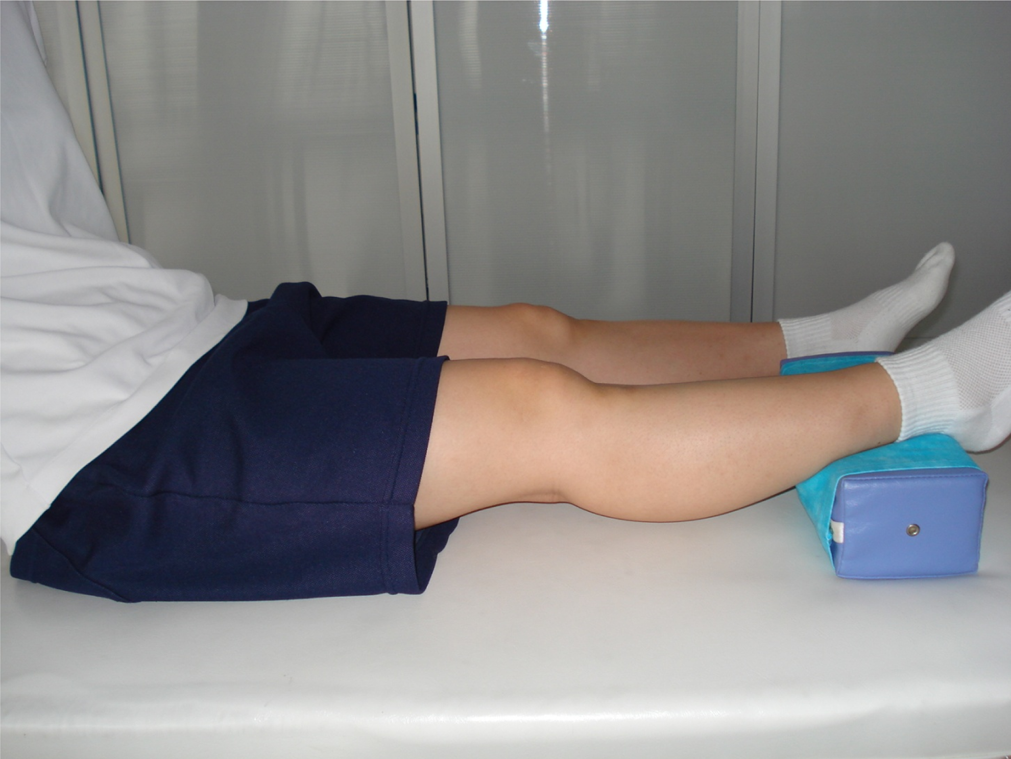
Beighton and Horan Joint Mobility Index measure: knee extension.

Beighton and Horan Joint Mobility Index measure: little finger extension.
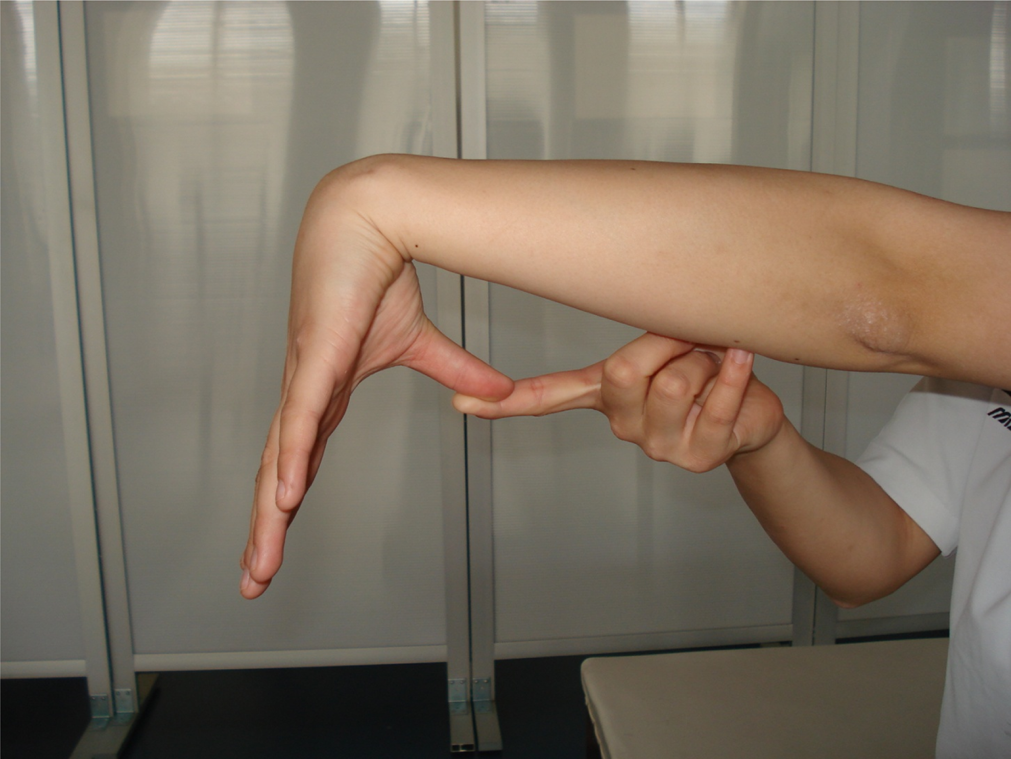
Beighton and Horan Joint Mobility Index measure: thumb to forearm test.

Beighton and Horan Joint Mobility Index measure: forward bending.
Results
There were 30 subjects in the IG group and 17 in the NG group. Of those in the IG group, 2 subjects had a torn ACL and had reconstructive surgery 14 months before the study. Both had returned to full volleyball activities prior to data collection. Table 2 shows the injuries seen in the subjects. The mean age (±SD) of the study subjects was 15.83 ± 0.87 years in the IG group and 16.13 ± 0.95 years in the NG group (P = .3). The mean BHJMI score was 1.98 ± 1.42 overall, and 2.40 ± 1.42 and 1.24 ± 1.09 in the IG and NG groups, respectively (P = .006).
Injuries Seen in Study Subjects a

a ACL, anterior cruciate ligament.
b Nine of 30 subjects who sustained a sprained ankle had a history of multiple ankle sprains. Both athletes who tore their ACL also had a history of ankle sprain.
Thirty subjects in the IG group were further categorized into either the IGM or IGS group; there were 11 subjects in the IGM group and 19 subjects in the IGS group. Subjects in the IGM group scored 3.18 ± 1.47 on the BHJMI, which was significantly higher than those in the IGS group (1.95 ± 1.22; P = .02) (Table 3).
Beighton and Horan Joint Mobility Index Scores by Group

a Statistically significant difference between noninjury and injury groups.
b Statistically significant difference between multiple-injury and single-injury groups.
Thumb extension (both dominant and nondominant sides) was the only individual test that reached statistical significance (P = .03 and .04, respectively) when comparing IG and NG groups. Only thumb extension and knee extension on the dominant side, but not on the nondominant side, were statistically significantly different between IGM and IGS groups (P = .04 and .02, respectively).
Discussion
The aim of this investigation was to study generalized joint laxity and a history of ligament injury in high school–aged female volleyball players. The results of this study supported our hypothesis that volleyball players with past history of sprains would display a significantly higher score on the BHJMI. Subjects with a history of multiple sprains demonstrated significantly higher generalized joint laxity than those with a single injury, as predicted. This is supportive of past studies that suggested generalized joint hypermobility might be predictive of ligament injury in athletes.
Sprains are very common in sports and often force athletes to miss practice or/and competition. They may also require surgical intervention in some cases such as ACL sprain and lateral ankle instability resulting from recurring ankle sprains. Past studies have investigated risk factors for ligamentous injuries and suggested that generalized joint hypermobility might be one of the risk factors. Also, it was suggested that injured athletes with generalized joint hypermobility might require more time to rehabilitate before returning to sports to avoid reinjury. 11 Foss et al 16 investigated whether generalized joint laxity was correlated with dynamic plantar pressure in female soccer players and found that athletes with high generalized joint laxity demonstrated increased midfoot loading resulting from medial foot collapse, suggesting that those athletes might be at a greater risk of lower leg injuries. Similarly, a systematic review conducted by Pacey et al 29 indicated that athletes with generalized joint laxity might be at an increased risk of knee injuries during contact activities. Interestingly, the same study found no correlation between generalized joint laxity and ankle injury. In our study, all but 1 subject in the injury group had suffered at least 1 ankle sprain. Because of the retrospective nature of our study, it is difficult to determine whether generalized joint laxity is directly associated with the injuries suffered by the subjects.
Knee sprain was another common injury in our study. Two athletes in the injury group had had a torn ACL and had undergone reconstructive surgery 14 months prior to the study. In the literature, generalized joint laxity and its correlation to knee laxity have been reported. According to past studies, knee laxity is more common in females and decreases with age and maturation. 15,17 Several authors have studied whether a correlation between knee sprains and generalized joint laxity and knee laxity exists, and some suggested that generalized joint laxity and knee hyperextension were risk factors for ACL injuries. 23 Myer et al 27 conducted a prospective study on female soccer and basketball players to find out the effects of generalized joint laxity on risk of ACL injury and reported that knee laxity measured by knee hyperextension and anterior-posterior tibiofemoral translation might contribute to an increased risk of ACL injury. One can argue whether ACL injury in athletes with generalized joint laxity is a direct result of joint laxity or whether it is secondary to other possible risk factors affected by joint laxity. Several studies have suggested that generalized joint laxity and knee laxity may affect athletes’ lower extremity joint mechanics and muscle recruitment patterns, neuromuscular function, and other factors associated with an increased risk for ACL injury. 30,35,39 Although there seems to be a connection between generalized joint laxity and knee laxity according to past studies, others reported that knee laxity independent of generalized joint laxity was predictive of postoperative function after ACL injury 22 and that knee laxity might be joint specific and might not be generalizable. 31
Generalized joint laxity is affected by certain factors such as sex, race, and maturation. For example, females are more hypermobile in general when compared with males, and they may have increased generalized joint laxity after puberty. 32 As previously discussed, there may be a link between generalized joint laxity and knee laxity. The glenohumeral joint may also be another joint where generalized joint laxity is prominently displayed, 6,37 and shoulder instability is a relatively common injury suffered by athetes. 28 Past studies have reported a correlation between generalized joint laxity and shoulder laxity 6,8,9 and shoulder injury such as anterior dislocation. 10
As hypothesized, the results of our study showed that the volleyball players with a history of ligament injury had increased generalized joint laxity measured with the BHJMI, and athletes with multiple injuries were more hypermobile than those with a single injury. Our study was limited in that only female volleyball players from a single high school were included, and we are unsure of whether the results of this study are generalizable to other populations. The results of this study might have been affected by the injuries suffered by the subjects; however, the most frequent injury incurred was ankle sprain, and 2 subjects who received ACL reconstructive surgery 14 months prior to data collection had returned to full participation without limitation. Thus, it is unlikely that the past history of ligament injuries interfered with the results because ankle hypermobility is not a part of the BHJMI.
Conclusion
Athletes with a history of past sprains tend to score higher on BHJMI when compared with those without. It may be indicative that those athletes may benefit from a prevention program. Also, hypermobile athletes may be more likely to suffer multiple sprains at the same joint or at other joints. Prospective studies will be needed to truly understand whether generalized joint laxity is a contributing factor to ligament injuries such as ankle and ACL sprain.
Footnotes
The authors declared that they have no conflicts of interest in the authorship and publication of this contribution.