



Abstract
Background:
Anterior cruciate ligament (ACL) tears are common in female athletes, with most injuries caused by noncontact mechanisms. Beyond the sex factor, it is important to identify modifiable risk factors for an ACL tear, such as the type of shoe and playing surface.
Purpose:
To evaluate the association between shoe type and the risk of ACL injury.
Study Design:
Case-control study; Level of evidence, 3.
Methods:
A retrospective review of 256 female athletes was conducted: 128 female soccer and lacrosse athletes who had torn their ACLs and 128 age- and sport-matched athletes who had never torn their ACL. Sports, level of competition, mechanism of injury, type of shoe, type of stud in the shoe, and playing surface were identified.
Results:
In this study, 75% of participants who tore their ACLs were wearing cleats. In contrast, only 55.5% of the age-matched group with normal ACLs wore cleats. A significant association was found between ACL tear and the type of shoe they were wearing (P < .05). In athletes who tore their ACL, 46.4% of their cleats had conical studs, 14.4% had blades, and 15.2% had a mix of the 2, compared with those who have never torn their ACL, with 30.5% having conical studs, 18.8% blades, and 6.3% mixed. The odds of sustaining an ACL tear while wearing conical studs were 2.02 times higher than wearing blades (95% CI, 0.97-4.20) and 2.87 times higher than wearing turf shoes (95% CI, 1.58-5.23).
Conclusion:
Female athletes who wore cleats were more likely to tear their ACL when compared with sport- and age-matched athletes who wore turf shoes. Wearing turf shoes as opposed to cleats appears to be associated with a reduced risk of ACL tears in high-level female athletes. Cleats with long, conical studs, especially around the perimeter of the cleat, were associated with increased odds for ACL tear and were more common in the 128 athletes in this study who tore their ACLs. Based on this information, we recommend further exploration for a shoe that prevents shoe wear from being an additional risk factor for ACL injuries in female athletes.
Anterior cruciate ligament (ACL) tears are common in female athletes; female athletes are 2 to 8 times more likely to sustain this injury than their male counterparts. 13 This increased risk is attributed to multiple factors. Women have higher valgus hip and knee forces and increased foot pronation, both of which contribute to knee abduction. 3 They also have an increased quad-to-hamstring ratio, which contributes to an additional risk for tear by putting excessive strain on the ACL, often without sufficient hamstring forces to counteract it. 1 Fluctuating estrogen levels may further contribute to this risk, as higher concentrations are associated with increased ligament laxity. 11 In sum, female athletes are more susceptible to ACL injuries, indicating that different tear mitigation methods should exist for men and women, and underscoring the necessity for further research concentrating on the female athlete.
In 2005, the incidence rate of ACL tears among young female athletes was 8.14 cases per 100,000 per year. 5 An increase in the number of injuries may be related to the growing prevalence of turf fields and the rising number of women participating in sports. 8 While there is some debate surrounding the risk of lower extremity injury on grass versus turf surfaces, Xiao et al 14 showed a higher incidence of ACL injuries in soccer games played by female athletes on artificial turf than on natural grass. 14 Previous studies have also examined the biomechanics of shoe-surface traction as a possible risk for ACL injuries. 9 ACL tears often result from a sudden pivot motion while the foot remains planted, and shoes with an outsole that provides increased traction may increase the risk of injury. Cleats with equal or shorter stud lengths reduce traction levels, potentially lowering injury risk. 9 This suggests that an ideal shoe design may feature significantly shorter stud lengths than traditional cleats, with no peripheral spikes along the edge. It is important to distinguish whether the artificial surfaces directly cause this surge in ACL injuries, the footwear used on these fields, or the combined shoe-surface interface. Ultimately, the ideal shoe for these athletes may not exist, as current shoe options neglect the balance between the risk of cleats and the player’s perceived benefit of traction.
This study aimed to examine the female athlete's risk of ACL injury by investigating a controllable risk factor—the type of shoe worn at the time of injury. Soccer and lacrosse were selected for examination because of their similarities in gameplay, including cutting and twisting movements, as well as their geographic popularity, which facilitated participant enrollment. Our study included (1) determining whether there is a significant correlation between the type of shoes female players wear when they tear their ACLs, (2) report possible trends in the design of the shoes worn by female athletes when they get injured, and (3) suggestions for components that manufacturers, teams, and players should consider when designing or selecting shoes.
Methods
This retrospective observational study included 256 female athletes aged 13 to 23 years (M = 18). All participants were either high school or college athletes competing in high-level lacrosse or soccer. A total of 128 female athletes had suffered a previous noncontact ACL tear, while the other 128 age- and sport-matched (soccer or lacrosse) athletes had never torn their ACL. Participants were interviewed electronically or in person to answer questions pertinent to the study. Questions for the experimental group included the sport played by the athlete, the surface they played on, and the type of shoe worn at the time of injury (Table 1). The playing surface was identified as the surface where the injury took place for those in the tear group and the surface most commonly played on (typically their home playing surface) for those in the control group. Because of the retrospective design of the study, the specific type of turf surface played on during the time of injury was not recorded, as participants were only able to differentiate between turf and grass. If participants wore cleats, an image of the specific cleat was obtained so the type of stud on the shoe could be evaluated. Cleat studs were determined to either be conical, bladed, or a mix of the 2 (Figure 1). Conical studs are round and typically longer, while blades are flat with a tapered edge. Cleats featuring both types of studs were classified as mixed. Shoes were placed into 1 of these 3 categories. In contrast, a turf shoe was considered a different shoe, which features small, shallow nubs across the sole instead of individual studs. The control group was asked the same questions and similarly provided images of their shoes to ensure accurate classification of shoe and stud type.
List of Questions Asked of Each Group a

ACL, anterior cruciate ligament.

Images of (A) conical studs, (B) bladed studs, (C) mixed (blade/conical), and (D) turf shoes.
Collected data were organized into an Excel spreadsheet so that data evaluation could be performed. Statistical analysis was obtained using a chi-square test and odds ratios (ORs). ORs were calculated for the type of shoe worn (turf shoe vs cleat) and for the different types of studs (conical vs blade vs mix vs turf). The 2 data sets, including both the experimental and control groups, were compared with one another, and a chi-square test was performed. The statistical significance was set at an alpha value of .05. Because the age range of 13 to 23 years spans both adolescents and adults, an additional subgroup analysis was conducted within the ACL tear group to account for age as a potential confounder. The analysis examined cleat use among participants aged <18 years and >18 years to better control for age-related differences.
Results
In the ACL tear group, 105 of the athletes played lacrosse, and 23 played soccer. In the nontear group, 120 athletes played lacrosse, and 8 played soccer. Across both groups, nearly 90% of athletes reported playing on a turf surface (88.3% in the ACL tear group and 89.7% in the nontear group). A significant association was found between whether someone tore their ACL and the type of shoe they were wearing (P < .05). Also, 75% (n = 96) of the athletes who tore their ACL were wearing cleats, while only 55% (n = 71) of those in the nontear group wore cleats (Table 2). Those athletes who do not wear cleats either wear turf shoes or, in the case of 2 athletes from the team, wear sneakers. The odds of having an ACL tear were 2.57 times higher in those wearing cleats compared with those wearing turf shoes (OR, 2.57 [95% CI, 1.49, 4.40]) (Figure 2).
Percentage of Athletes Wearing Cleats in Each Group a
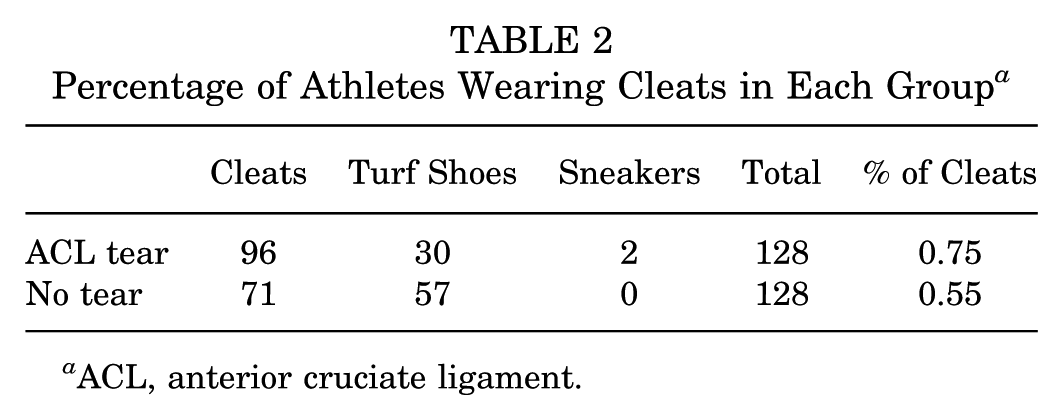
ACL, anterior cruciate ligament.

The odds of sustaining an ACL tear with cleats and turf shoes. ACL, anterior cruciate ligament.
An additional subgroup analysis was conducted within the ACL tear group to compare athletes aged <18 years and >18 years, distinguishing adolescents from adults. No significant difference was found between the 2 subgroups, with the percentage of athletes wearing cleats mirroring that of the ACL tear group as a whole.
In athletes who had torn their ACL, 46.4% (n = 58) of their cleats had conical studs, 14.4% (n = 18) had blades, and 15.2% (n = 19) had a mix of the 2. Although not statistically significant (P = .06), the odds of sustaining an ACL tear while wearing conical studs were 2.02 times higher than wearing blades. When compared with turf shoes, the odds of injury were 2.87 times higher while wearing conical studs (P = .001). However, in the athletes who had never sustained an ACL tear, only 30.5% (n = 39) of their cleats had conical studs, 18.8% (n = 24) had blades, and 6.3% (n = 8) had mixed studs. Again, although not statistically significant, the odds of tearing the ACL while wearing blades were half that of conical studs (P = .06). Despite this, when compared with turf shoes, the odds of injury while wearing blades were still 1.43 times higher (P = .36) (Table 3).
The Odds of Sustaining an ACL Tear With Different Stud Types a

The bold P values indicate statistical significance. ACL, anterior cruciate ligament; OR, odds ratio.
Discussion
In this study, we found that female athletes had higher odds for sustaining an ACL tear when wearing cleats as opposed to turf shoes. This simple observational study further points to the playing surface-shoe interface as an important area that plays a role in ACL injury and requires further investigation to reduce the risk of injury in this vulnerable population. The magnitude of these findings has a far reach, as each year, nearly 200,000 ACL surgeries are performed in the United States. 12 This injury disproportionately affects female athletes and represents a transformative pivot point in these patients’ lives, carrying further risk for subsequent surgeries on the ipsilateral side in close 7 to 20%.
This study focused on 1 component of the playing surface interface that is modifiable, shoe wear. When choosing which shoes to wear for their sport, players should not have to significantly compromise their performance to reduce injury risk or vice versa. Given our findings suggesting that cleat use is more common among athletes who tear their ACL, cleat design may be an important factor to consider in injury prevention strategies.
Previous studies have examined the difference in biomechanics between conical and bladed studs (Table 4). One study found that conical studs cause a greater electromyographic signal in the quadriceps muscles than do bladed studs. They also found that bladed studs reveal no higher risk of sustaining a noncontact knee injury, suggesting that they may be a safer design option. 6 In addition, rounded studs have been shown to significantly increase activation of the quadriceps femoris during weight acceptance, which may place additional internal load on the ACL. 6 In a study by McGhie et al, 10 peak impact forces during cutting sprints were significantly higher with rounded studs than with both turf shoes and bladed cleats. 10 In fact, Butler et al 4 showed that female soccer players displayed a 3° decrease in peak knee flexion when wearing a bladed cleat. 4 While this study focused solely on shoe types, it is also important to consider the playing surface, which we were unable to control for. Ongoing research is exploring various turf designs to assess whether certain patterns influence foot release. These findings may offer valuable insights into the interaction between shoe wear and playing surfaces, providing a more comprehensive understanding of injury risk factors.
Previous Research on Conical and Bladed Studs a

ACL, anterior cruciate ligament.
While we found that female athletes have higher odds of tearing their ACL while wearing cleats compared with turf shoes, we also found that certain types of cleats were associated with a further increase in these odds. More specifically, cleats with rounded conical studs appear to be associated with a greater risk of ACL tears than those with bladed studs, likely because of their greater traction with the playing surface. Conical studs may allow cleats to penetrate the surface more easily, causing the foot to become more fixed in place and potentially leading to injury. In addition to identifying the type of shoe worn, some athletes responded to a follow-up question asking them to explain their choice of footwear. Although the response rate was low for this question, most athletes who wore cleats indicated that they preferred them because they enhance performance, giving them increased grip and reduced sliding compared with turf shoes. Given this preference for cleats among athletes, it is crucial to explore potential modifications that could enhance their safety. Further research has suggested that incorporating silica nanoparticles into shoes may reduce valgus forces associated with knee abduction by improving viscoelasticity. 2 While not the focus of this study, it is relevant to understand, as this innovation could be a valuable consideration for shoe manufacturers looking to design safer cleats.
Limitations
This study has significant limitations, as it is a simple observational study that does not provide direct causation between shoe wear and ACL tear. In addition, the study is underpowered to address any specific variation in the cleat type. It also fails to consider the differences in types of turf, which may play a role in injury and may limit the generalizability of the findings. Because of the retrospective nature of the study, athletes had difficulty recalling the exact type of turf, leading them to only identify their playing surface as either grass or turf. Similarly, the type of shoe worn may be subject to recall bias, given the time gap between the injury and data collection. Moreover, this study does not consider individual risk factors associated with ACL tears, such as phase of the menstrual cycle, level of play, limb alignment, muscle imbalance, and history of previous injury. However, confounding variables such as age group differences were addressed through subgroup analysis. By separating the tear group into adolescents and adults, it was determined that the percentage of athletes wearing cleats at the time of injury was similar across both subgroups, suggesting that age did not significantly influence the results. Despite these limitations, this study does demonstrate a clear relationship between the foot and surface interface, highlighting increased odds of sustaining an ACL injury among female athletes wearing cleats, particularly those with conical studs. In directly addressing the shoe, we target a simple and relatively inexpensive intervention that can be easily modified and adopted universally.
Efforts should continue to be made to develop new footwear that minimizes the additional risk of shoe wear for injury in female athletes. Our preliminary findings, in conjunction with other studies, suggest that a flatter, shorter stud design is beneficial. However, further research is needed to fully understand the biomechanics of the turf versus the cleat itself and account for additional interacting factors.
Conclusion
Of the athletes who tore their ACL, a statistically significant number were wearing cleats, and of those who were wearing cleats, a greater number were wearing conical studs than blades or mixed studs. When both conical studs and blades are compared with turf shoes, the odds of tearing the ACL significantly increase, leading us to conclude that turf shoes or shoes with similar mechanics may be a better option for these female athletes than the standard cleat. Further research is necessary to fully understand the comprehensive effect of each stud type, accounting for additional factors that may have an impact on injury.
Footnotes
Final revision submitted April 23, 2025; accepted May 15, 2025.
One or more of the authors has declared the following potential conflict of interest or source of funding: P.S. receives royalties from Arthrex and has received consulting fees from Arthrex, Zimmer, and Pacira. AOSSM checks author disclosures against the Open Payments Database (OPD). AOSSM has not conducted an independent investigation on the OPD and disclaims any liability or responsibility relating thereto. Ethical approval was waived (Greenwich Hospital IRB) for the present study.
