




Abstract
Background:
Knowledge of risk factors for HIV transmission in high-risk population plays a critical role in averting the risk of HIV transmission. In Pakistan, injection drug users (IDUs) constitute the core risk group of HIV prevalence, where the epidemic has transitioned to a “concentrated level.” Still nothing is known about the role of knowledge in HIV transmission and HIV sero-conversion among IDUs in Pakistan.
Methods:
From 2009 to 2011, a nested case–control study was conducted in a cohort of 636 IDUs receiving harm reduction services in the mega city of Karachi.
Results:
In multivariable regression analysis, 3 factors, namely HIV does not spread through unprotected sex (adjusted odds ratio [AOR]: 3.1, 95% confidence interval [CI] 1.39-6.90, P value .01), HIV does not transmit by sharing syringes (AOR: 3.5, 95% CI 1.97-6.40, P value <.00), and the risk of HIV cannot be minimized by using new syringe every time (AOR: 2.0, 95% CI 1.16-3.60, P value .01), were significantly associated with the incident cases of HIV.
Conclusion:
The study findings suggest the association between knowledge of HIV transmission and HIV sero-incident cases.
Introduction
HIV/AIDS is the growing health concern in Pakistan. The epidemic has expanded since 1987 when the first indigenous case of HIV was detected in Pakistan. 1 Although the HIV prevalence among general population is low (<1%), yet it is more than 5% in certain high-risk groups. Injection drug users (IDUs) constitute the major high-risk group where the prevalence has risen to 23%. 2 Although preventive programs have been initiated in Pakistan to manage the epidemic among the IDUs, the infections are soaring in this population.
The global literature shows that education regarding HIV/AIDS among young people plays a remarkable role in reducing the risk of HIV infection. It also exerts influence in reducing and avoiding risky behaviors that have the potential for HIV acquisition. 3 -5 It is also documented that programs focused on sexual and HIV education targeted for youth in schools and communities have shown outstanding results in reducing risky adolescent sexual behaviors. 6 Programs providing sex education have reported as having positive health impacts and avoidance from the risky sexual behaviors. 6 -8
The experience of our program stakeholders demonstrates that education for HIV/AIDS plays an important role in averting risky behaviors and attitudes of IDUs, therefore, positively affecting the risk of HIV transmission. Yet, in Pakistan, nothing is scientifically known to influence the knowledge about HIV transmission among IDUs. Therefore, we assessed the knowledge of risk factors for HIV transmission among incident cases of HIV in IDUs, in a harm reduction program at Karachi, Pakistan.
Methods
Study Design
A nested case–control study was conducted at 3 drop in centers managed by a not-for-profit organization providing needle exchange services to the IDUs in Karachi. The cases and controls were identified from a cohort of 636 IDUs followed from March 2009 till June 2011 for the sero-incidence of HIV. In all, 162 (26%) were lost to follow-up. A total of 118 cases (HIV positive) and 356 controls (HIV negative) were enrolled in the study. The data were collected through a field-tested questionnaire (developed in English and translated in local Urdu language) containing biologically important questions regarding the knowledge of risk factors for HIV transmission.
Statistical Analysis
The data were entered into Epidata version 3.1 (Epidata Association, Odense, Denmark) and analyzed by SPSS version 17. For continuous data, the mean and standard deviations were calculated, while for categorical variables the percentages were calculated. Bivariate analysis was done to estimate the crude odds ratio and 95% confidence intervals (CIs). The variables having P value ≤.20 were selected for the multivariable regression analysis for the estimation of adjusted odds ratio (AOR) and 95% CIs. All findings in multivariate regression analysis were interpreted at a 5% significance level.
Ethical Considerations
The ethical approval for the study was taken from ethical review committee of Bridge Consultants Foundation. An informed consent was taken from the participants prior to the administration of the questionnaire.
Results
Characteristics of IDUs
A total of 118 (24.9%) study participants were recently HIV sero-converted cases and 356 (75.1%) HIV sero-negative controls. The mean age of the participants was 31 ± 8 years. Most (n = 398, 84%) of the participants were Pakistani by birth. More than half (n = 280, 59.1%) of the participants were unemployed. Majority (n = 422, 89.0%) of the participants were Muslims. Formal education was reported by 155 (32.7%). More than half of the participants (n = 281, 59.3%) belonged to Sindh Province, followed by North-West Frontier Province (n = 85, 17.9%) and Punjab (n = 84, 17.7%). Majority (n = 350, 73.8%) of the participants were unmarried (Table 1).
Descriptive Characteristics of Injection Drug Users.a

Abbreviation: NWFP, North-West Frontier Province.
aN = 474.
Most (n = 388, 81.9%) of the participants believed that HIV does not spread through unprotected sex. A large number (n = 335, 70.7%) of participants was aware that HIV transmits by sharing of syringes. Borrowing syringes from others increases the risk of HIV transmission, which was reported by 391 (82.5%) participants (Tables 1 and 2).
Knowledge of Risk Factors for HIV Transmission.a
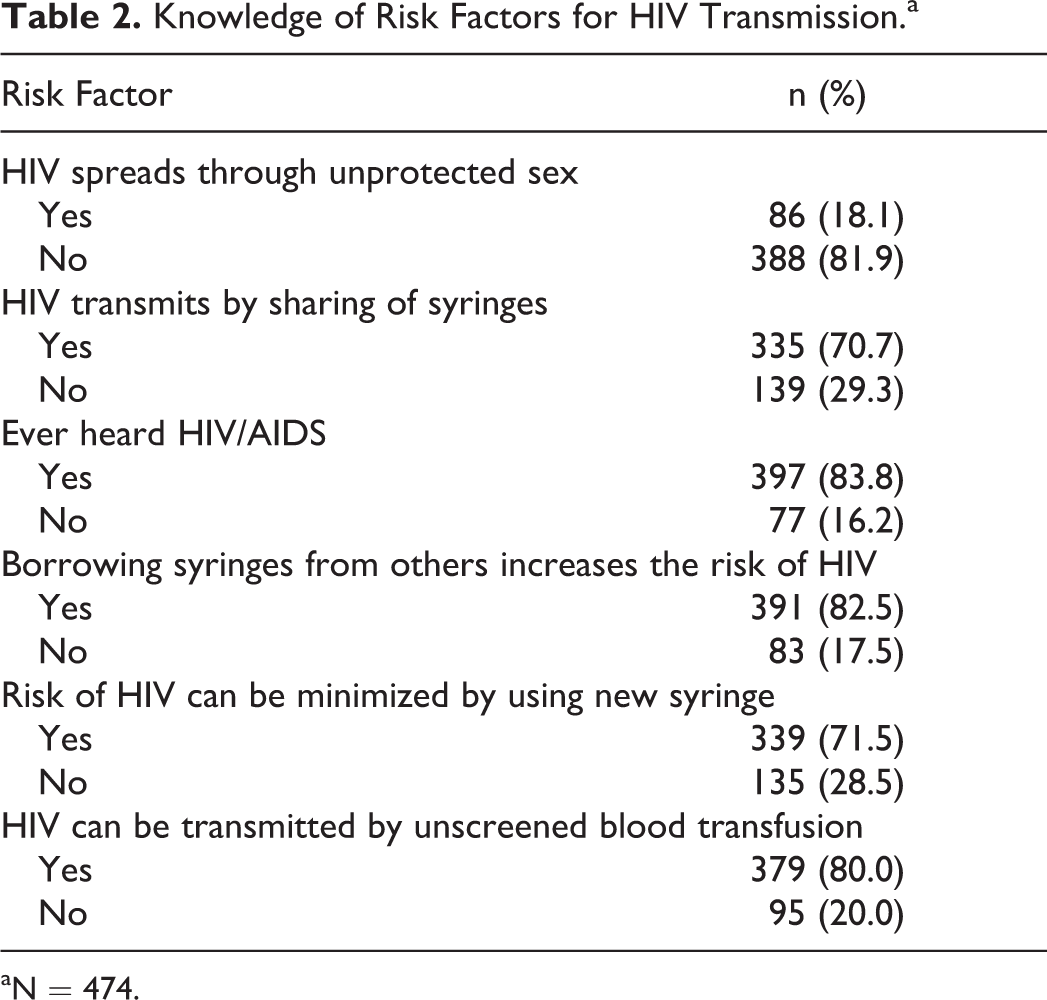
aN = 474.
Univariate Analysis
In univariate analysis, IDUs who had never heard of HIV/AIDS (P value .000) and not knowing that HIV spreads through unprotected sex (P value .000), HIV does not transmit by sharing of syringes (P value .000), borrowing syringes from others does not increases risk of HIV (P value .078), risk of HIV cannot be minimized using new syringe (P value .002), and HIV cannot be transmitted by unscreened blood transfusion (P value .028; Table 3) were selected for the multivariable regression analysis for the estimation of AOR and 95% CIs.
Univariate Regression Analysis.

Abbreviations: CI, confidence interval; OR, odds ratio.
Multivariable Regression Analysis
In multivariable regression analysis, 3 factors, namely (1) not knowing that HIV spreads through unprotected sex (AOR: 3.1, 95% CI 1.39-6.90, P value .01), (2) HIV does not transmit by sharing of syringes (AOR: 3.5, 95% CI 1.97-6.40, P value <.00), and (3) risk of HIV cannot be minimized using new syringe every time (AOR: 2.0, 95% CI 1.16-3.60, P value .01) were significantly associated with HIV sero-conversion (Table 4).
Multivariable Regression Analysis.
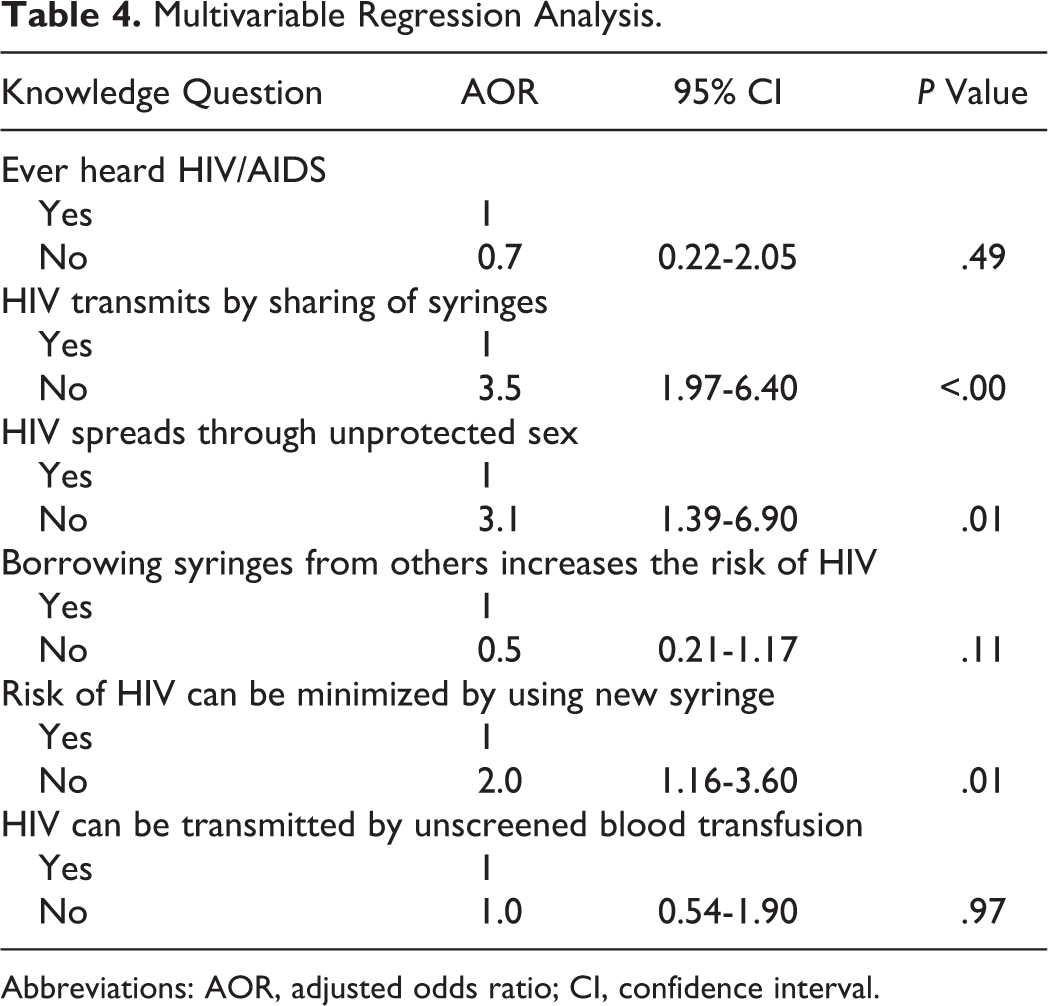
Abbreviations: AOR, adjusted odds ratio; CI, confidence interval.
Discussion
This is the first study from Pakistan reporting the association between knowledge of risk factors of HIV transmission and sero-incident cases of IDUs enrolled in a harm reduction program at Karachi. Our study findings suggest a strong link between the knowledge of risk factors for HIV transmission and HIV sero-conversion among IDUs.
The study findings suggest that IDUs who did not know that HIV spreads through unprotected sex (P value .01), HIV transmits by sharing of syringes (P value <.00), and the risk of HIV can be minimized by using new syringe every time (P value .01) were significantly associated with HIV sero-incident cases.
Education regarding sex and HIV/AIDS has proved to play a role in shaping behaviors among young people, and sexual health education has the potential for averting the risky behaviors of HIV transmission. 6 -8 The role of unprotected sex is well documented, and unsafe anal sex is a vital mode for HIV transmission. 9 -14 It is also documented that more than 90% of the new adult HIV infections are associated with sexual activity. 15 Our study findings suggest that the odds of HIV sero-conversion among those IDUs who were not aware of the fact that HIV can spread by unprotected sex had 3 times the higher risk (P value .01) of sero-conversion than the IDUs who were aware that HIV can spread by unprotected sex. Our experience shows that IDUs in Karachi engage themselves in risky sexual behaviors. They sell sex and engage themselves in receptive sex for want of money. They even exchange sex in their groups in lieu for drugs. This sexual behavior in IDUs in Karachi definitely exposes this population to the risk of HIV and other sexually transmitted diseases. Several programmatic initiatives educated IDUs regarding unprotected sex and provide condoms at drop in centers for minimizing the sexual risk of HIV transmission, yet there is a need for strengthening the services to mitigate the transmission.
Sharing of contaminated syringes is an important risk factor for HIV transmission. 16,17 Injection drug users who share syringes and needles are at a higher risk of acquiring and transmitting HIV than those who do not share the syringes. Our study findings indicate that education regarding sharing syringes has a positive role in averting the risk of HIV among IDUs. The study findings suggest that those IDUs who were not aware that HIV transmission occurs by sharing of syringes had 3½ times the odds of HIV sero-conversion (P value <.00). This finding suggests that education of sharing syringes can minimize the risk of HIV transmission and there should be a strong education component in the preventive programs.
The role of needle sharing program is well documented, and some studies have shown its protective effect. 18 -23 Using a new syringe every time is biologically plausible for minimizing the risk of HIV infections. Education regarding the use of a new syringe might influence the behaviors and practices among IDUs. The study findings indicate that the odds of HIV sero-conversion among those IDUs who were not aware that the risk of HIV can be minimized using new syringe were 2 times that among those who were aware that the risk of HIV can be minimized by using new syringe every time (P value .01). This finding indicates that we should emphasize the IDUs for using a new syringe every time with the provision of uninterrupted accessibility to new syringes at drop in centers and mobile service units.
Strengths and Limitations
This is first ever study from Pakistan reporting the association between the knowledge of risk factors for HIV transmission and HIV sero-incidence. The study was nested in a cohort of IDUs, therefore, providing cost-effective opportunity for conducting the study. The major limitations included information bias and reliability of the responses given by the IDUs. The results of this study cannot be generalized to the whole population of IDUs enrolled in harm reduction program in Pakistan. Studies with more representative sample are required to reach a generalized conclusion.
Conclusion
There is an association between knowledge of HIV transmission and HIV sero-conversion in the high-risk population of IDUs. In Karachi, the burden of the disease can be mitigated by educating efficiently the core, high-risk group for sexual and drug-related vulnerabilities with programmatic initiatives with a strong component of education.
Footnotes
Declaration of Conflicting Interests
The author(s) declared no potential conflicts of interest with respect to the research, authorship, and/or publication of this article.
Funding
The primary data collection for the study was supported through National Institutes of Health-AIDS International Training and Research Program grant #D43TW001035. The funders played no role in the design of the study, collection of data, or preparation of the manuscript.