




Abstract
The global drive for collaboration towards addressing society’s growing complex challenges is gaining more credence in land administration. Collaborative land governance is crucial in Africa, where the duality in land governance, as expressed in the coexistence of statutory and customary land governance institutions, has been a longstanding source of land conflicts. Drawing theoretical insights from collaborative governance and using in-depth interviews with stakeholders across both customary and statutory land governance systems, this study examines the interplay of factors that militate against effective collaborative land governance in Ghana. Findings show that while the legislative framework on land administration in Ghana authorises collaboration, the challenges of limited trust and awareness of land laws, poor facilitative leadership and inadequate resources militate against collaborative land governance. We argue that the weak manifestation of the well-intentioned legislative frameworks for collaborative land governance calls for increased attention to implementation gaps in equal footing to policy formulation.
Keywords
Introduction
Globally, there is an emergent interest in collaborative governance systems in dealing with the increasingly intricate and multilayered socioecological, political and economic problems of society (de Abreu & de Andrade, 2019; Mosley & Park, 2022; Olvera-Garcia & Neil, 2020; Tando & Haryanti, 2020). Specific to land governance, this emergent interest in collaborative governance has been largely influenced by land reform initiatives and debates championed by international development organisations such as the World Bank, UN-Habitat and the Food and Agriculture Organization (FAO) (Byamugisha, 2014; Ibrahim et al., 2020; Knight, 2010). Collaborative platforms are seen as novel strategies for the attainment of the United Nations Sustainable Development Goals (Florini & Pauli, 2018; Naert, 2021).
In most African countries, land administration is effectually decentralised to traditional authorities who administer land under customary law, with or without a legal foundation in national law (Bruce, 2014; Waeterloos, 2021). However, with increasing pressure from diverse land uses and the consequent involvement of the state in land administration, collaborative land governance between the state and custodians of customary land is seen as a timely approach to minimising conflicts (Byamugisha, 2014). The customary land system involves the management of land based on the customs and traditions of landowning groups, while the formal land governance system is chiefly state-driven and based on formal legislative provisions (Ibrahim et al., 2023). The customary land sector is often as contemporary as the formal sector, and the formal legal framework often bases itself on developments within the informal customary sector (Arko-Adjei, 2011). Thus, in the process of integrating statutory and customary land administration systems, formal institutional, legal and technical arrangements need to be flexible to accommodate customary practices (Enemark et al., 2014; Obeng, 2018).
The accentuation of the dynamism of the customary sector in terms of its flexibility, negotiability and adaptability and its embeddedness in social relations has sparked new policy-oriented research, which focuses on the institutional relationship between formal and informal land tenure systems (Edwin et al., 2020). This research sees the customary land system as largely more inclusive and equitable than the state-led formal system, which is deemed exclusive and inequitable, and favours the interests of political elites (Ayitio, 2019). That notwithstanding, both systems of land administration are not without setbacks, which bring to the fore the need for collaboration to address these weaknesses. In the formal land sector, red tape and expensive land administration services give rise to bribery, corruption and a rise in informal practices (Banda, 2019). Forced evictions, manipulation of customary law, abuse of power by chiefs, lack of transparency and abuse of minority groups in land allocations, as well as the prevalence of outdated tenure practices are typical in the customary land sector (Arko-Adjei, 2011). Obeng (2018) argued that these unique land administration challenges can be reduced through joint customary and statutory processes in land administration.
In Ghana, efforts to provide a structured interface between customary and statutory land governance led to the establishment of Customary Land Secretariats (CLSs) under Ghana’s Land Administration Project (LAP). CLSs are set up as decentralised land administration units, owned and managed by landowning communities, and serve as the interface between customary and public land sector agencies such as the Lands Commission (LC), Office of the Administrator of Stool Lands (OASL) and local planning authorities (District Assemblies) (Ibrahim et al., 2020). CLSs are operated by customary landowning groups through Land Management Committees (LMCs) (Ayitio, 2019; Ibrahim, Akanbang et al., 2022). This approach advocates the harmonisation of formal and informal systems through greater recognition of customary institutions for land management, which enables landowners to proffer solutions for securing access to land in collaboration with the state land agencies.
Despite these efforts towards collaborative governance, recent studies show that there is an unclear relationship between the CLS and the state land administration institutions in the Upper West Region (UWR) of Ghana (Biitir et al., 2017; Ibrahim, Akanbang et al., 2022). Though Ghana’s Land Act 2020 (Act 1036) sought to regularise the relationship between the customary and state land institutions, the manifestation of this ideal in practice, is yet to be realised (see Ibrahim et al., 2020). This is consequently having an impact on land administration in the country as CLS are often in constant conflict with state institutions. Thus, although Ghana is touted as one of the success stories of land reform in Africa, there is still a major disconnect in terms of achieving collaborative land governance in the country. This reinforces the need to understand the complex set of factors militating against any meaningful collaboration between statutory and customary land governance systems.
Drawing theoretical insights from collaborative governance, we examined the collaborative relationship and the challenges thereof between customary and statutory land institutions based on the existing legal and institutional framework in Ghana. The rest of the manuscript proceeds as follows. The next section describes the theoretical bases of the study, followed by the section defining the study context and methods. The subsequent section presents the findings. The discussion and conclusion are presented in the last section.
Collaborative Governance Theory
Collaborative governance refers to the process of public decision-making that constructively engages stakeholders across different frontiers to collectively pursue a purpose that cannot be accomplished by one stakeholder (Ansell & Gash, 2008; Emerson et al., 2012). Collaborative governance provides pathways for joint action by stakeholders in line with their theory of action for achieving a collective purpose (Emerson & Nabachi, 2015). The theory of action details stakeholders’ appreciation of the problem to be addressed and the specific group strategies for addressing it (Emerson et al., 2012; Koontz et al., 2010).
Collaborative governance theory acknowledges numerous factors that could possibly affect collaborative action. Key among them includes power dynamics among participants, leadership, inclusiveness and trust (Ansell et al., 2020; de Abreu & de Andrade, 2019; Emerson & Nabachi, 2015; Margerum, 2016; Purdy, 2016; Siddiki et al., 2017). These factors are not standalone but are interrelated. For example, power dynamics among participants could affect the level of inclusiveness in collaboration as weaker actors may not be able to contribute in equal terms to decision-making. On the other hand, if executed with attention to unequal power structures, collaborative leadership could mediate power dynamics among participants in land governance by creating an equal playing field (see Ibrahim, Akanbang et al., 2022). Power dynamics among collaborative partners shape collaborative action and outcome; who possesses what power is defined by who controls what resource, who possesses which authority and discursive legitimacy (Ran & Qi, 2019). Power imbalances manifested in resource inequalities are pervasive in sociocultural contexts where customs and culture hinder collaborative action (Choi & Robertson, 2014). Thus, the apparent and overt evenhandedness, legitimacy and efficacy of the collaborative process rest on how well these resource differences are managed (Emerson et al., 2012). Brisbois et al. (2019) in a study of two Canadian collaborative processes found that statutory actions provided the ground for powerful interest to fester in a manner that subverted the capacity of collaboration to deliver impartial, inclusive and ecologically liberal strategies. Hence powerful actors triumphed in decisions and became direct beneficiaries of agendas deliberately crafted in line with their interests (Brisbois et al., 2019).
In the African context, where the formal land tenure system is considered formal and backed by statutory authority, some traditional custodians of customary land continue to struggle for legitimacy and authority in the face of increasing land formalisation and commodification (Cotula & Neves, 2007). These unequal power dynamics between the statutory and customary governance systems have the potential to eat into collaborative initiatives if not managed carefully. Facilitative leadership is thus essential to collaborative governance.
Leadership provides a suitable context for collaborative governance by nurturing shared motivation, championing constructive dialogue, upholding the integrity of the collaborative process and eliciting the participation of weaker stakeholders (Agbodzakey, 2020; de Abreu & de Andrade, 2019; Kinder et al., 2021). Inclusiveness entails ensuring diverse representation in the collaborative process (Lahat & Sher-Hadar, 2021). Diverse representation makes the collaborative process more democratic (Dobbin & Lubell, 2019). According to Johnston et al. (2011), collaborative leadership should purposively build trust and commitment among stakeholders to secure their equal participation. Ansell et al. (2020) identified incentives, mutual interdependence and trust as essential preconditions for inclusiveness. Inclusiveness improves internal legitimacy and trust among interdependent actors (Mosley & Wong, 2021). Trust improves coordination at inter- and intra-organisational levels by actors predisposed to believing and acting on the words or decisions of others and hence improves inclusiveness (see Getha-Taylor et al., 2019). On the other hand, excluding key stakeholders or the inability to secure their participation could dent the legitimacy and efficacy of the collaborative process. Stakeholder exclusion can also contribute to the loss of valuable knowledge and make downstream implementation cumbersome (Ansell et al., 2020; Innes & Booher, 2018).
Though other scholars have advanced other factors that could define the success of collaborative processes, we focus on these four as they provide a useful theoretical background to understand collaborative dynamics among statutory and customary institutions in land governance (see Ibrahim, Akanbang et al, 2022).
Study Context and Methods
Study Context
Land administration in Ghana operates within a dual setting with customary and statutory institutions operating concurrently. Ghana’s Land Act 2020 (Act 1036) mandates collaboration among these two systems by providing that the statutory land institutions ‘shall collaborate in the establishment and performance of functions in relation to a Customary Land Secretariat under this Act’ (Land Act, 2020, p. 20).
Within the existing legislative framework, the customary land institutions in Ghana do not directly interact with the Land Use and Spatial Planning Authority (LUSPA), but rather the District/Municipal Assemblies. The District Assemblies according to the Local Government Act (462, 1993 with amendments in 2016 as Act 936) and the Land Use and Spatial Planning Act 2016 (Act 925) are planning authorities. The manifestation of the LUSPA at the local level is through the Physical Planning Department and the Spatial Planning Committees (SPCs) of the District Assemblies. The District Assemblies through the District SPC coordinated by the Physical Planning Department are expected to collaborate with landowning groups under their jurisdiction in the development of local plans. Also, according to the Land Act 2020 (Act 1036), the decision on the land revenue to be paid to the customary landowning groups must be made in collaboration with the OASL, the affected stool, skin, clan or family and District Assembly.
The UWR is one of the few jurisdictions in Ghana where land is owned by families. Family heads are entrusted with absolute title to land with the responsibility to ensure maximum benefit to the entire family (Ibrahim, Abubakari et al., 2022; Kansanga et al., 2018). This makes families central to customary land ownership in the region. The institution of CLS provides for families in the structure of customary land governance and by extension recognition by the statutory land institutions (World Bank, 2003).
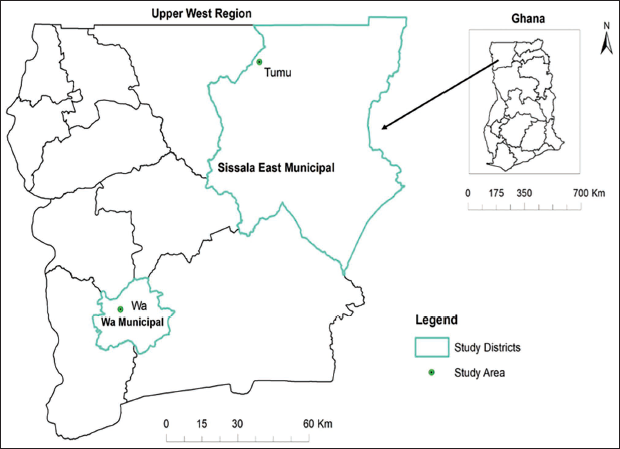
In 2003, the government of Ghana, with the support of development partners, initiated the LAP. Through the LAP, CLSs are designed as the central customary land institutional structure at the local level with the power to represent the interest of the landowning groups, record and maintain up-to-date records of land transactions, facilitate land dispute resolution processes and the preparation of local planning schemes (Ibrahim, Akanbang et al., 2022; Land Act, 2020). As of 2021, seven CLSs were established in seven traditional areas in the UWR. Among the CLSs include Wa-central CLS and Tumu CLS in Wa Municipality and Sissala East Municipality, respectively (see Figure 1). Wa-central CLS has an LMC membership of 35, whilst the Tumu CLS has an LMC membership of 13 (Ibrahim, Akanbang et al., 2022). The LMCs are composed of landowning families with the responsibility of supervising the operations of the CLS (Kakraba-Ampeh, 2008).
In Wa, the regional capital, there exists the Wa Municipal Assembly—Physical Planning Department―as well as the regional office of the LC and the LUPSA. However, the OASL has no office in the region. In Tumu, the only statutory land institution in the municipality is the Municipal Assembly. All other statutory land institutions, with the exception of OASL, are in the regional capital (Wa). Wa-central and Tumu CLSs are expected to work with the statutory land administration institutions in the formalisation of customary land rights. However, studies show that the customary land institutions view their relationship with the statutory structures as dysfunctional with no clear paths for developing their collaborative relationship for sustainable customary land administration (see Akanbang et al., 2021; Ibrahim et al., 2020).
Map of Upper West Region Showing Study Districts and Communities.
Methods
The study used a qualitative research approach guided by a multiple case study research design (see Stewart, 2012). Two CLSs, in Wa and Tumu, were purposively selected for the study. These towns are the only rapidly urbanising municipalities with functional CLSs in the UWR of Ghana. Whilst Wa CLS is managed by family heads from the Waala ethnic group, the Tumu CLS is managed by family heads from the Sisaala ethnic group in the UWR of Ghana. Each CLS comprised a secretary and coordinator appointed by the LMC, responsible for the day-to-day running of the CLS. Ten key informant interviews were conducted involving the secretaries and coordinators of the two CLSs, the physical planning and development planning officers of Sisaala East and Wa Municipal Assemblies, and one staff each of the LC and the LUSPA. The key informant interviews focused on functional relationships and the challenges thereof between the CLS and the LC, the OASL and the Physical Planning Department of the Municipal Assemblies—Tumu and Wa. The interviews were audiotaped and later transcribed and analysed thematically together with a content analysis of the documents from the CLS and the statutory land administration institutions. Official correspondence—reports, letters, memoranda and minutes of meetings—between the CLS and the statutory land administration agencies were obtained from these institutions for document analysis. The document analysis was meant to understand how collaborations manifest in the official correspondence between the agencies. The results were analysed with reflections on the propositions of the collaborative governance theory.
Findings
Understanding the Relationship between the CLS and Statutory Land Agencies
Our analysis revealed that the CLS works with the LC in three major areas in the land administration system. First, the CLS works with the Survey and Mapping Division (SMD) of the LC in the survey of land prior to sale by landowning groups and subsequent registration at the CLS. We observed that most of the areas in the study context do not have land use plans to guide physical development. The services of the SMD of the LC are seen as a much cheaper option by landowners compared to obtaining planning schemes through the Physical Planning Department of the District Assemblies. The cadastral plans the SMD prepares are less complex in terms of scope compared to the planning schemes of the Assemblies. A cadastral plan can be prepared for just one plot and the same cannot be said for a physical plan. Due to the cost involved in designing a planning scheme, it is often done for an extended area belonging to one or more families or communities. Consequently, most landowners, through the CLS, engage the officials of the SMD of the LC in land surveys and subsequent sales. An informant at the Wa-central CLS expressed that:
You see this area does not have a physical plan, however, development is catching up with the area. People are demanding we sell the land to them and we do not have enough money to prepare plans for the whole area. In our private engagements, some officials of the Survey and Mapping Division of the LC have been very helpful in parceling out our lands for us to sell to prospective buyers (23.03.2019)
The second working relationship between the CLS and the LC is in the preparation of lease documents. The lease documents are legal documents that require a certain level of legal expertise. Except for Wa-central CLS, which has an independent lawyer, the Tumu CLS does not have any lawyer to prepare such documents and hence they often rely on the officials of the LC in this regard. A key informant at the Tumu CLS expressed that:
The lease is a bit technical, and we don’t have any legal professionals to help in its preparation. Therefore, when all the customary registration processes are done at our CLS, we refer our clients to the LC in the regional capital for them to obtain lease documents through its Land Registration Division (29.01.2019)
Third, the LC works with the CLS in the collection and disbursement of ground rent in the region. The OASL has the responsibility for the collection and distribution of ground rent. However, the Land Act (2020) permits the LC to collect and disburse ground rent in areas where the OASL has no offices. The absence of the OASL in the UWR puts the Regional Lands Commission in such a position. Consequently, in 2009, the LC signed a memorandum of understanding with landowning families in Wa to collect ground rent on their behalf and to disburse the same based on the provisions of Ghana’s 1992 constitution under Article 267(2). A key informant at the LC in Wa articulated that:
Due to how sensitive the issue of money is, we thought it wise to engage the landowners through the CLS on the collection and disbursement of ground rent within the context of the non-presence of OASL in the Region. All the land-owning groups agreed for us (LC) to collect the ground rent and disburse it as provided for by the Land Bill 2019.
1
This is to ensure harmony and mutual respect in the collection and disbursement of the ground rent (26.03.2019)
Though the members of the Wa-central CLS acknowledged this memorandum of understanding with the LC, we identified several misgivings by landowning groups with regard to the role of the LC in the collection and disbursement of ground rent (see Section ‘Factors Affecting Collaboration between the CLS and Statutory Land Agencies’).
Moreover, the Tumu and Wa-central CLSs work with the LUSPA indirectly through the SPC of Sisaala East and Wa municipalities, respectively, in the preparation of planning schemes. The Physical Planning Departments of the Municipal Assemblies coordinate the preparation of plans to guide physical development in their areas of jurisdiction. Although the preparation of planning schemes is the responsibility of the Municipal Assemblies, we found that except for the Central Business District in Wa and Tumu, most of the existing physical plans were initiated by the landowning groups. In these processes, the landowning groups collaborate with officials of the Physical Planning Department to prepare the plans. We found that some landowners privately engaged officials of the Physical Planning Department of the Assembly such that officials were given plots to sell to cover the cost of the preparation of schemes. The CLS mediates the relationship between the Physical Planning Department and the landowning groups. In Tumu, the CLS entirely represents the interests of landowning groups in discussions leading to the preparation of planning schemes. A key informant at the Tumu CLS narrated as follows:
Our CLS influenced the landowners in the few areas that have planning schemes to understand the need for layout to facilitate land transactions. In one of the areas which is very close to the center of town, there were growing disputes over indeterminate boundaries among different plot owners. When the secretariat began receiving such reports, we had a meeting with the family heads of that area. We then sent letters to the Physical Planning Department of the Assembly on behalf of the family heads requesting them to commence the process of preparing a scheme for the area (29.01.2019)
In Wa, however, some landowning groups directly work with the Physical Planning Department of the Assembly in the preparation of planning schemes for their family lands. We identified three main reasons for this. First, there is a lack of trust in the CLS by some of the landowning groups in the area. Second, the families bear the cost of plan preparation and hence do not see the need to involve any intermediary—CLS. Third, the families in Wa seem to have more enlightened family members capable of successfully executing such transactions. The leading role of the Tumu and Wa-central CLSs and/or some landowning groups in the preparation of the planning schemes is because of inadequate resources on the part of the Municipal Assemblies. According to the Land Use and Spatial Planning Act, 2016 (Act 925), a local government unit—Municipal Assembly—is ‘the spatial, human settlement and planning authority for its area of authority’ (p. 23). The Assembly is expected to provide the needed technical, logistical and financial resources to prepare planning schemes. However, the two Municipal Assemblies are not able to live up to their respective mandates of preparing planning schemes to guide the physical development of their areas of jurisdiction.
Factors Affecting Collaboration between the CLS and Statutory Land Agencies
Limited Trust
There is limited trust between the CLS and the statutory land agencies in the region. Among the statutory land agencies in the region, the LC is the least trusted institution by the Tumu and Wa-central CLSs. Whilst the Tumu CLS accused the LC of not paying their members’ ground rent, the Wa-central CLS accused the LC of short-changing landowners in the payments of ground rent. An informant at Wa-central CLS stated that:
If you look at the area of land our family owns and the amount of ground rent the LC pays to our family, you will know that the LC is cheating our families. They will give us something small and keep the rest of the money at their office. When we confront them, they give the excuse of using part of the rent for administrative expenses which we don’t understand (23.03.2019)
Interviews with key informants who are landowners at the Tumu CLS revealed that most of them are not aware that they are supposed to receive such revenue from the LC. An informant at Tumu CLS stated that:
The LC do not pay ground rent to the original landowners here. The first time I heard about ground rent was when the regional lands officer paid a courtesy call on the paramount chief of the Tumu traditional area. Since then, we have not heard anything from the LC again (29.01.2019)
The CLSs also accuse the LC of selling unused government lands without the consent of the landowning families. An informant at Tumu CLS opined that:
The government compulsorily acquired land for some projects. Most of these projects have been abandoned and we have seen that some private developers in recent times have started putting up structures on these lands. When the families approached them, they said they acquired such land legally. And you ask yourself who sold such land to them if not the LC? How come they have leases to such land without the involvement of any of the families? (29.01.2019)
We observed that all these opaque transactions create mistrust between the CLS and the LC in customary land administration in the region. The landowning groups in Tumu and Wa, therefore, view the LC as a threat to their land rights.
Also, some landowners indicated that the Physical Planning Departments deliberately create more open spaces and public land use areas in planning schemes, which reduce the number of residential plots available for the landowners to sell. An informant at Wa CLS expressed that:
When you allow the Assembly to prepare a planning scheme on their own terms, they will bring in plenty protocols in the plan and you will end up not having many plots to sell to recover your cost (23.03.2019)
Thus, some of the families prefer to hire private physical planners to prepare planning schemes that do not make provision for open spaces and other public land uses such as recreational, educational and health centres. With such planning schemes, the standard protocols for the preparation of planning schemes are not followed leading to the drawing up of plans that serve the interest of the landowning families with little regard to the public interest. These solitary decisions the landowning groups take could dent the legitimacy and efficacy of the collaborative process as well as risk losing valuable knowledge and expanding the opportunity that alienated actors such as the LC and the Physical Planning Department of the Municipal Assemblies may decline collaboration in downstream implementation (see Ansell et al., 2020; Innes & Booher, 2018).
Inadequate Resources
The study’s findings show that limited resources militate against collaborative processes. Consequently, the Municipal Assemblies of Tumu and Wa are not able to effectively work with landowners in the preparation of planning schemes. Interviews with officials of the Physical Planning Department of Wa and Tumu revealed that the preparation of physical plans requires huge financial resources due to the technical requirements as well as the complexity of the actors and processes involved. The weak revenue-generating capacity of the Municipal Assemblies does not put them in a better position to support their Physical Planning Department through their SPC to prepare planning schemes for their areas of jurisdiction. A key informant at the Wa Municipal Assembly stated:
If we as an assembly prepare planning schemes in collaboration with the landowning families, it will bring about orderliness in our development trajectory. But the truth is, we simply do not have the resources to do that. As a department we are willing to do that with very limited resources but there is no political will to make a small investment towards that. And that explains the topsy-turvy planning schemes we have here (27.03.2019)
We observed that though the Physical Planning Department of Tumu and Wa Municipal Assemblies often include the preparation of planning schemes in their Medium-Term Development Plans, they are often not realised due to limited revenue generation and lack of political commitment to invest in physical plan preparation. This limits their level of engagement with the customary landowners in the preparation of planning schemes.
Also, the LC points to a lack of resources for their inability to regularly organise sensitisation workshops for the customary landowners and the CLS. A key informant opined that:
As the de facto representative of the OASL in this region, we are supposed to periodically organize sensitization workshops for all the CLS in the region. This is to improve their level of understanding of Ghana’s land laws and modern land management practices. But we don’t have the resources to do that. The last time we had a meeting with them was when we were seeking their inputs into Ghana’s Land Bill 2019 (26.03.2019)
Poor Facilitative Leadership by Statutory Land Agencies
The legal and institutional framework for customary land administration in Ghana puts the statutory land agencies in a strategic position to provide facilitative leadership for collaboration in land administration. However, the statutory land agencies do not provide a platform, which effectively engages the customary structures. For instance, there are no avenues for the CLS to express their concerns about the collaborative processes, especially on issues that the CLS thinks could derail the land administration system. In Tumu and Wa, we observed that landowners in most instances took the initiative to prepare planning schemes and then reached out to the Physical Planning Department of the Municipal Assemblies. Also, in both cases, the needed strategic direction expected from the LC is often very limited. In most instances, the LC takes decisions which affect customary lands, without any form of consultation with the customary landowners. A landowner who is a member of the Wa-central CLS stated that:
The LC takes decisions as if we are not part of the land administration set up in Ghana. Sometimes we even go to their office to demand explanations for some of their actions. And you will hear a whole regional lands officer telling us they do not owe us any explanation. Is that how partners behave in a collaborative relationship? (23.03.2019)
We found that the Tumu and Wa-central CLSs feel more comfortable working with the Physical Planning Department compared to that of the LC. The LC views CLS as trying to intrude into their functions and hence their indifferent disposition. This shows the ambivalence of some state actors towards collaborative processes which not only thwart collaboration in attaining impartial, inclusive and ecologically liberal strategies but also make the environment conducive for local elites to dominate and become the principal beneficiaries of the collaborative processes (see Brisbois et al., 2019).
Limited Understanding of the Land Laws by the CLS
The study revealed that some of the challenges the Tumu and Wa-central CLSs have with the statutory land agencies are a result of a limited understanding of the role of each party outlined in Ghana’s land laws. The various land laws in Ghana have clearly spelt out the working relationship between the CLS and the LC and the Physical Planning Department of the Municipal Assemblies. However, due to limited awareness about these provisions, the CLS often wants to undertake tasks that fall within the domain of either the LC or the Physical Planning Department of the Municipalities. For example, the issue of who has the mandate to issue lease documents as well as the collection and disbursement of ground rent is expressly stated in the Lands Commission Act 2008 (Act 767) and the Land Act 2020 (Act 1036). Also, the Tumu CLS accuses the LC of selling unused government land originally acquired from the landowners by the government. The CLSs in this case expect such lands to be returned to landowners for onward sale to private developers. On the contrary, a key informant at the LC clarified that:
We don’t have any problem with any CLS in this region. We know what we are supposed to do based on the legislative frameworks guiding our operations. The ground rent we collect is distributed based on the formula set out in the 1992 Constitution of Ghana. We cannot shortchange any landowning group because we make public the total amount we collect and how we disburse same. The commission or any of its officials cannot sell any government land because on what bases are we going to do that. So why should we take-up the functions of the CLS when we as a Commission already have a lot on our heads? (26.03.2019)
Some officials of the CLS argue that they are in a better position to perform functions such as the collection and disbursement of ground rent, preparation of lease documents as well as facilitating the preparation of planning schemes. Officials of the CLS make these propositions pointing to the fact that some of the officials of the state agencies are not indigenes and hence do not understand the dynamics of the landownership system in the area. The CLS further justifies that as the representative of the custodians of customary lands in their areas, they better understand the dynamics of the landownership system and the performance of the above functions will be much easier in their hands. This power struggle between customary and statutory structures affirms Adams et al. (2003) contention that the collaborative land administration system is negatively affected when local actors who understand the customary systems lack an understanding of modern land governance processes and also, official actors who are literate lack understanding of the intricate customary land practices.
Discussion and Conclusions
This study brings to the fore the interplay of factors that militate against effective collaborative land governance in Ghana. These factors include power dynamics, facilitative leadership, inclusiveness and trust. Whilst legislative frameworks on land governance in Ghana authorise collaboration, we found that the challenges of limited trust and awareness of land laws, poor facilitative leadership and inadequate resources confound the collaborative governance processes. The absence of these key features explains the prevailing acrimonious relationship between the CLS and statutory land agencies in Ghana.
Unequal power dynamics between the statutory and the customary land structures are evident in the customary land administration system in the study context. Many scholars (Brisbois & de Loë, 2016; Olvera-Garcia & Neil, 2020) acknowledge that power disparities between actors in a collaborative arrangement could stifle consensus building and the implementation of sustainable environmental outcomes. What is unique about our finding is the direction and nature of control. When issues of power are discussed in land management, the literature has widely cited the power of the state in exercising control over communal lands through statutory institutions (McCreery, 2021; Van Leeuwen et al., 2018). Our findings, however, show that the exercise of power is not the sole preserve of the state. The evidence shows that CLS, due to the power they exercise over their customary land, attempted to dominate the collaborative process thereby making it difficult to reach consensus with the state land agencies. Attempts by the CLS to perform functions such as the preparation of lease documents as well as the collection and disbursement of ground rent—legally the preserve of the statutory agencies—can be seen as a way of exerting their power in the land administration system. However, the state structures deriving their authority from legislative frameworks sought to assert their authority in the collaborative governance spaces. This brings into contention which of the two power blocks gets to exercise power through discursive legitimacy. As argued by Purdy (2016), contesting institutions may often derive legitimacy from unopposed structural provisions including the constitution, cultural norms and social order. Yet, such conflicting exercise of power could stifle consensus building in a collaborative arrangement.
Ran and Qi (2019) espoused that authority, resource control and discursive legitimacy are important sources of trust in collaborative arrangements. In this study context, the state structures do not trust the customary structures as much as the customary does not trust state structures. This stakeholder mistrust affected inclusiveness in the collaborative process as neither of the parties was willing to act based on the words or decisions of the other (see Getha-Taylor et al., 2019). The CLS viewed the statutory land sector agencies as a threat to their land rights following the sale of unused government land allegedly by officials of the LC as well as the non-payment of ground rent to some landowning families. Though officials of the commission denied these allegations by attributing the same to ignorance of the land laws by the CLS, this suspicion is further fuelled by mistrust between the two land administration structures. Moreover, the exclusion of the CLS in some of the activities of the LC is a course of concern. We posit that inclusiveness should be preferred to exclusion in the collaborative process, particularly within the context of the authority, control and overt legitimacy of customary landowners over their lands. Inclusiveness will advance internal legitimacy and increase trust among the collaborative partners (Ansell et al., 2020; Innes & Booher, 2018; Mosley & Wong, 2021). Inclusion under ongoing efforts for collaborative governance should be embedded in legislative provisions that duly specify the rights and roles of all stakeholders in the collaborative process.
Facilitative leadership expected from the statutory land agencies to help deal with the issues of power dynamics, trust and inclusiveness have not been forthcoming (see Olvera-Garcia & Neil, 2020). The collaborative governance literature accentuates the relevance of leadership in developing shared motivation, fostering constructive dialogue, safeguarding the diligence of the collaborative process and engendering the inclusion of vulnerable actors (Agbodzakey, 2020; de Abreu & de Andrade, 2019; Hsieh & Liou, 2018; Kinder et al., 2021). However, in our study context, statutory land agencies in their leadership role failed to provide a conducive environment to elicit participation or collaboration from the customary sector. We observed that they often want to exert control over the collaborative process by referring to legislative provisions, which define their functions and legitimise their actions. These references were often selective as the same legislations encourage collaboration between the two structures in customary land governance. As clear as those legislations may be, they were selectively defined by officials of the state agencies sometimes employed to usurp the powers of the customary structures. Thus, the state agencies anticipated to provide facilitative leadership in collaborative land governance, acted as active stakeholders in land markets, thereby creating unnecessary competition with the CLS.
Moreover, resource constraints have been identified by many scholars (Hossu et al., 2018; Ibrahim et al., 2020; Margerum, 2016) as a key challenge to the successful functioning of collaborative systems. Hossu et al. (2018), for example, in an analysis of the drivers of collaboration in natural resource conflict management in Romania, found that collaboration thrives within the context of sustainable funding regimes and the absence of funding thwarts the initiation of collaborative systems. This is consistent with our finding that inadequate resources within state land institutions weakened their ability to advance collaborative mandate spelt out in the legislative provisions guiding their operation. This resource scarcity further creates room for CLSs to circumvent collaborative governance provisions by single-handedly undertaking tasks outside regulatory control to generate income.
Policy Recommendations
We argue that the weak manifestation of the well-intentioned legislative frameworks for collaborative land governance in Ghana and most parts of Africa calls for increased attention to implementation gaps in equal footing to policy formulation. Good legislation in itself cannot yield desired outcomes if attention is not paid to the complex mix of factors that shape the implementation of these policies, particularly, the pervasive nature of individuals and groups in the collaborative relationship. The gaps identified in this study provide new insights into addressing the institutional duality problem in land use policy in Africa. We recommend that existing legislation on collaborative land governance must make provisions for checks and balances to prevent abuse of power by stakeholders, including the integration of a neutral body to periodically review the activities of the two major parties in the collaborative management framework. Also, dedicated annual funding from the state should be reserved for the physical planning activities of Municipal Assemblies at the local levels and the facilitative role of the LC. This is to empower local planning authorities and the LC financially to carry out their mandates. Routine deliberative opportunities between the customary and statutory land governance institutions should be fostered to enhance trust and create opportunities for cross-sectoral learning.
Footnotes
Declaration of Conflicting Interests
The authors declared no potential conflicts of interest with respect to the research, authorship and/or publication of this article.
Funding
The authors disclosed receipt of the following financial support for the research, authorship and/or publication of this article: The first author is grateful to the German Academic Exchange Service (DAAD) for funding the research.
