




Abstract
Religious division formed the basis for the subcontinent’s partition and has continued to be a major social cleavage in local relations. Yet remarkably religious parties have rarely been successful in India. This may be changing with an ascendant Bharatiya Janata Party mobilizing the Hindu vote. Accordingly, this article seeks to explicate the conditions under which successful religious parties may emerge. In order to do so, I conceive of electoral mobilization on religion as a form of ethnic mobilization, what I refer to as religion-as-ethnicity voting. I argue that religion-as-ethnicity voting emerges when the religious group meets certain spatial demographic criteria (density and pivotality) and when a governing party representing these interests can use state power to reify boundaries between religious groups. I use this framework to explain the emergence of the Hindu vote in the Indian state of Assam.
Keywords
Introduction
In 2014, the Bharatiya Janata Party (BJP) stormed to power, winning a single-party majority in the lower house of India’s parliament (Lok Sabha). In the next election, it bettered its performance—growing from 282 seats in 2014 to 303 seats in 2019 out of a total of 543 seats in the Lok Sabha. Since it has come to power, the BJP has sought to inject the politics of Hindu nationalism into the public discourse—from rewriting citizenship laws that disadvantage Muslims to renaming streets and cities to reflect ‘Hindu identity’.
Yet, as Sitapati (2020) notes, winning elections is part and parcel of the present Hindu nationalist strategy (if not previous iterations of it). The ruling BJP has been unapologetic in its focus on winning elections across India. If we are indeed in a period in which a stable ‘Hindu vote’ across India will determine national electoral outcomes, then this would be a major departure from the past. India’s electoral history is suffused with parties that contest elections on a caste or linguistic basis, with little electoral success for religious parties, Hindu or otherwise. A key project of Hindu nationalism is to electorally construct a version of Hinduism that behaves as an ethnic group for whom finer distinctions of caste and language are less salient to identity. This is what I call ‘religion-as-ethnicity’ voting.
In this piece, I explore the structural factors that shape religion-as-ethnicity voting for the Hindu and non-Hindu communities in India. I argue that the emergence of religious voting hinges on two factors. First, the spatial demography of the group—adhering to ‘density’ and ‘pivotality’—must be such that it is possible for religious parties to form the government from time to time. Second, a governing party often uses the capacity of the state, through policymaking and narrative building, to reify boundaries between religious groups and engender religion-as-ethnicity voting. As I show in some detail, these conditions plausibly explain the emergence of Hindu religion-as-ethnicity voting in the north-eastern Indian state of Assam.
Religion-as-Ethnicity Voting and Minority Parties
In India, a number of electorally successful parties have mobilized caste or linguistic groups in ethnic terms, with notable electoral success beginning from the 1990s onward (Thachil & Teitelbaum, 2015). These are parties that mobilize a particular identity as an ‘ethnic group’ by making explicit political appeals or offering patronage to specifically benefit the group, and often in contrast to or against another ethnic group. Yet, despite the prominence of religious conflict in South Asia, Indian parties have rarely been successful in mobilizing religious groups that do not fragment into finer caste and linguistic distinctions. A pattern in which a religious group is the most prominent identity upon which voters decide political preferences is what I call ‘religion-as-ethnicity’ voting. In this section, I describe the spatial distribution of religious groups required for the emergence of religion-as-ethnicity voting, with an analytic focus on minority religious parties.
Following Chandra (2006), I define an ethnic category as an identity-based category in which membership is determined by ‘descent-based attributes’. In short, this implies that individuals are ascribed an ethnic identity because it is how their parents (or a parent) were defined. Certain important identities like gender and age, thus, are not ethnic categories. One can be defined as a Muslim because her mother was a Muslim even if there is little similarity in practice or adherence between mother and child. Crucially, while an individual may convert to Islam, such individuals are not ascribed the category of Muslim in ethnic terms—underlining a difference between practice and ‘ascribed’ ethnic identity.
Religious parties are not always seen in ethnic terms. For example, Christian democratic parties are broadly believed to be the embodiment of a ‘mass Catholic movement that challenged the ascendancy of liberalism in Europe’ (Kalyvas & van Kersbergen, 2010). This perspective sees religious voting as derived from doctrinal or ideological differentiation, not differences in group identification. Democrazia Cristiana (DC) was a major Christian democratic party in Italy through the mid-1990s even though more than 90 per cent of Italy was ostensibly Catholic, so that, it was not mobilized for Catholics against or with respect to a defined non-Catholic group or groups.
A number of political contexts outside of India, however, do exhibit religion-as-ethnicity voting. Elections in Northern Ireland feature electoral competition between Protestant-backed ‘unionist’ parties, like the Democratic Unionist Party (DUP), that swear allegiance to the British crown and Catholic-backed ‘nationalist’ parties, like the Sinn Féin, that support Irish (re-)unification. Yet this religion-as-ethnicity conflict is actually grafted on to a historical conflict of ‘native’ Irish against British ‘settlers’ (Crowley, 2018). In Lebanon, elections take place under a ‘confessional system’, which reserves seats for various sects in the Muslim and Christian communities—although the number of reserved seats is not based on a demographic calculation but rather a historical political settlement (Faour, 2007).
The Indian case differs from these prototypes of religion-as-ethnicity voting in important ways. Unlike Northern Ireland, religious conflict in India cannot typically be mapped onto another ethnic cleavage. A core challenge for religion-as-ethnicity mobilization in India is to aggregate over other prominent ethnic cleavages, namely, caste and language. Indeed, a focus of Hindu nationalist cultural organization Rashtriya Swayamsevak Sangh (RSS) has been to make Hindu nationalism compatible with caste across the hierarchy. Furthermore, unlike Lebanon, there are no obvious institutional incentives for religious parties in India. Successful religious parties must necessarily gain a foothold in the polity through first-past-the-post elections.
When political parties mobilize their bases of support as ethnic groups, and where parties must win elections to gain power for their ethnic group, the ‘arithmetic’ of the group becomes a crucial factor. This arithmetic calculation generates necessary spatial constraints for successful religious parties, namely, density and pivotality. A condition of density implies that there is sufficient spatial concentration of the religious group so that a religious party could plausibly win electoral constituencies by mobilizing the religious group as a bloc. The condition of pivotality implies that, given the electoral performance of other parties, the religious party is consequential in deciding the coalition of parties that will form government.
The condition of density is a minimal condition that allows a party to be successful at the constituency level, as it implies that a religious group voting as a bloc can be consequential to electoral outcomes. But this is not sufficient, as a religious party must be impactful at the level of the polity in order to be successful. If a religious party is to benefit from the spoils of state power, then it must win enough constituencies to decide which coalition of parties can form government through pivotality, so that, it can extract benefits either for the party or for the group that it represents.
Religious Parties in Historical Perspective
In operationalizing ethnic parties, Thachil and Teitelbaum (2015) only find one electorally successful religious (religion-as-ethnicity) party, the Shiromani Akali Dal (SAD). Notably, the BJP has often not been thought of as a religious party (including by Thachil and Teitelbaum). The BJP has typically operated by winning the support of upper caste and mercantile communities in north and central India. In some areas of expansion like West Bengal, its focus has been the lower caste and tribal communities, rather than a cross-caste coalition of Hindus. This means that, in practice, what is often thought of as Hindu mobilization has really been focused on the mobilization of certain caste communities.
In the colonial era, the Congress Party and the Muslim League could plausibly be characterized as religion-as-ethnicity parties, given their bases of political support and patterns of political representation (Talbot, 1980). It should be emphasized, however, the crystallization of support for the Muslim League among India’s Muslims occurred in the 1946 parliamentary election, in which the issue of the creation of Pakistan became particularly salient.
One may reasonably see this voting pattern as a consequence of cleavage theory, a sociological principle that holds that divisions created through social and historical processes in turn frame the social bases for various political parties (Lipset & Rokkan, 1967). Cleavage theory plausibly holds great explanatory power for party systems in Western European democracies, but the post-colonial moment disrupted a similar process of grafting religious cleavages onto the party system in India (Chhibber & Verma, 2018).
The partition of the subcontinent into India and Pakistan in 1947 generated two radical consequences for religious parties. First, the administrative delimitation of India into provinces rendered India’s non-Hindu communities minorities in the provinces in which they resided, with the notable exception of Muslims in the contested province of Jammu and Kashmir. 1 Second, given the relatively low levels of per capita income in a newly independent India, control of state resources at both the central or provincial levels proved to be key in forging political loyalties through state patronage, party financing and appeals to voters.
These changes structured the party system in India in key ways. The centrality of state resources implied that the survival of political parties was, and continues to be, dependent upon being a part of the ruling coalition somewhat regularly—which, in turn, induces the necessity of the conditions of density and pivotality. The dependence on access to state resources implies that parties representing minority religions have had to forge alliances with parties representing groups outside of the religion in order to survive. In the remainder of this section, I detail how the principles of density and pivotality structure the persistence of minority religious parties.
The Pivotality of Shiromani Akali Dal
The history of the SAD, a party that primarily represents the Sikh community in the state of Punjab, is useful to understand the mechanisms at play. In 1947, the Sikhs in the ‘undivided’ Punjab province in India made up approximately one-third of the population (Hill et al., 2008). In 1966, the hill regions of the state were added to the erstwhile union territory of Himachal Pradesh, and a largely Hindi-speaking region was separated to form the state of Haryana. Sikhs in the resulting ‘new’ state of Punjab, which hews to current state boundaries, made up about 60 per cent of the population.
Before the division of the state, in the elections of 1952, 1957 and 1962, the Congress Party won at least 58 per cent of the seats. In 1967, after the division of the state, an unwieldy coalition of parties, including pro-Sikh parties, came together to defeat the Congress Party. This coalition would not last, but the SAD became the single largest party and formed government in 1969. Thereafter, it has been a major force in the state’s politics. In short, Sikh majorities in many constituencies in undivided Punjab implied that a Sikh party plausibly met the condition of density in 1947, but it was only when the state was further divided that a polity-wide Sikh majority allowed the SAD to attain pivotality.
When Do Muslim Parties Survive?
The challenges facing Muslim parties are different, as they must persist in states in which the Muslim community is a minority. An analysis of Muslim parties, thus, provides another dimension to understanding successful religious parties.
In the Indian state of Assam, Badruddin Ajmal formed the All India United Democratic Front (AIUDF) just before the 2006 Assembly election to represent the interests of Assam’s relatively large Muslim population. By the 2014 national election, AIUDF’s vote share had increased to a respectable 15 per cent (and 13 per cent in the subsequent 2016 state election), but the party was unable to join a viable coalition to be in government. By the 2019 national election, this vote share would drop to 8 per cent—forcing AIUDF to form a pre-electoral coalition with once bitter rival Congress in the 2021 state election.
We can contrast the challenges of the AIUDF to the relative persistence of the All India Majlis-e-Ittehad-ul-Muslimeen (AIMIM) led by Asaduddin Owaisi. In the last two elections, in 2015 and 2020, for the Greater Hyderabad Municipal Corporation (GHMC) in the state of Telangana, the AIMIM has won 44 out 150 wards—specifically in those areas with large Muslim populations where the condition of density is met. In 2020, it became a part of the government by forming a coalition with the Telangana Rashtra Samithi (TRS). It is this regular access to power in Hyderabad (through pivotality) that has allowed AIMIM to persist. 2
The Indian Unionist Muslim League (IUML) in the state of Kerala demonstrates another way to achieve pivotality. After previously allying with the Left Front, the IUML has been an ally of the Congress Party since 1976. The IUML has contested nearly a fixed number of seats from 1987 onward (21–25 out of 140) and has won a vast majority of the seats it has contested in every election since 1967 (except in 2001). Thus, the IUML’s support base meets the condition of density. By allying with a larger coalition that forms government from time to time, the stable coalition with Congress allows the IUML to achieve pivotality.
In sum, this analysis shows while a number of Muslim parties may plausibly meet the conditions of density, they are obliged to ally with non-Muslim parties to achieve pivotality—as Muslims are typically the minority in any large polity. These strategies to achieve pivotality explain which Muslim parties can persist.
State Control and the Emergence of the ‘Hindu Vote’
Since 1947, Hindus have made up about 80 per cent–85 per cent of the population according to the Indian Census. The Hindu population forms a large supermajority in most provinces and electoral constituencies, so that, the conditions of density and pivotality are met. But the challenges for a Hindu party are different than those of minority religious parties. Sustaining a cohesive Hindu religious party is difficult, as voter support may fragment due to caste, linguistic and regional distinctions. One should then expect a governing party that mobilizes its supporters through religion-as-ethnicity to be invested in the reification of boundaries between religious groups and the engendering of competition and conflict between these identities.
A basic law of strategic electoral behaviour is that such supermajorities cannot persist in the long run in free and fair elections. To understand why, consider two parties A and B, in which A has the support of 70 per cent of the population and B has the support of the remaining 30 per cent. The optimal strategy for B is to pander to a little over 20 per cent of the electorate that is currently supporting party A. This pandering is typically done by taking advantage of internal differentiation between party A’s supporters. This minimum winning coalition logic makes it easier to mobilize voters along these internal differentiations, a fact attested to by the numerous caste and linguistic parties in India. A similar logic explains the lack of successful Christian parties in the relatively newly created states of Meghalaya, Mizoram and Nagaland, in which the Christian population makes up more than three-quarters of the population according to the Indian Census.
Social cohesion is arguably easier for minority religious groups but, even in the face of the rhetoric of Hindu polarization in the 2019 Indian national election, the Muslim community hardly voted as a consolidated bloc and is defined by more than religion (Ahmed, 2019). Indeed, the electorally successful Muslim parties described above often rely on the intersection of languages, region, and religion to construct bases of support.
Genuine religion-as-ethnicity voting for the Hindu vote requires religion, and not caste or linguistic group, to be the predominant ethnic identity upon which voters are mobilized. In particular, the primary ‘electoral language’ of mobilization is focussed on appealing to voters as Hindus, rather than these other identities. As Hindus typically make up the majority of larger polities, political outcomes under a stable Hindu vote would exhibit characteristics of ‘census elections’ (Ferree, 2010)—where Hindu parties build stable majorities by simply winning virtually all constituencies in which Hindus are more numerous than non-Hindus. Here, control of state resources—particularly over the means of media communication—is critical in reifying boundaries between Hindus and non-Hindus.
The State-driven Model of Hindu Preferences
From the perspective of ‘constructivist’ theories, the relationship between Hindu–Muslim violence and the Hindu vote is generated from a narrative of conflict and competition with the Muslim community (Brass, 2011; Wilkinson, 2006). A recent literature shifts the focus from the message to the messenger (i.e., the role of political or governing elite in shaping religious preferences). This perspective flips cleavage theory on its head. For example, Margolis (2018) argues that, even in the United States, party attachment strongly influences the strength of religious (Christian) identities. Indeed, religious sermons and sloganeering have proven to be impactful on political preferences and modes of political engagement in the context of religious competition in developing world contexts like Africa (McClendon & Reidl, 2019).
This state-driven perspective of religious preference formation can be contrasted from an issue-driven perspective—where demands are seen as relatively constant which can be acted upon when a Hindu nationalist party, like the BJP, comes to power. It is common, for instance, to refer to ‘longstanding demands’ from the Hindu community on issues as varied as land status in Kashmir, civil codes in India and construction of temples.
The litmus test for state-driven voting is whether ‘Hindu issues’ become more pervasive as political actors associated Hindu nationalism gain power. This differs from much of the political science literature where preference formation is focussed only on a political party’s adherents. Here, the claim is that control over the means of policymaking and communication expand the population that articulate politics in terms of ‘Hindu issues’.
The Ram Temple
For the Hindu vote in India, perhaps, no issue has been more of a lightning rod than building a mandir (temple) to the Lord Ram on the site of a mosque known as the Babri Masjid in the town of Ayodhya in the Indian state of Uttar Pradesh. The dispute concerns whether the mosque in Ayodhya was built (some time after the sixteenth century) by destroying a major temple commemorating the birthplace of the Lord Ram, although there is scant historical evidence that such an event ever took place. Despite intermittent periods of tension, the issue of building the Ram Mandir does not seem to have been a major issue political issue for the Hindu community historically. 3
This changed in the 1980s, as the Vishwa Hindu Parishad (VHP)—an affiliate of the RSS, the BJP’s ideological guide—initiated a movement to ‘reclaim’ the birthplace of the Lord Ram. The BJP sought political consolidation by backing the VHP’s demand in Ayodhya through a Ram rath yatra (a chariot journey across India), yielding increased vote share for the BJP and a greater onset of Hindu–Muslim riots (Blakeslee, 2014). The movement came to a head in December 1992 when a crowd as large as 150,000 people associated with the VHP and BJP, spurred on by fiery speeches from BJP leaders, stormed the Babri Masjid and demolished it. 4 In 2019, the Supreme Court of India, in a highly controversial decision, awarded the land upon which Babri Masjid was built to a trust to build a mandir, while land for a mosque was given elsewhere.
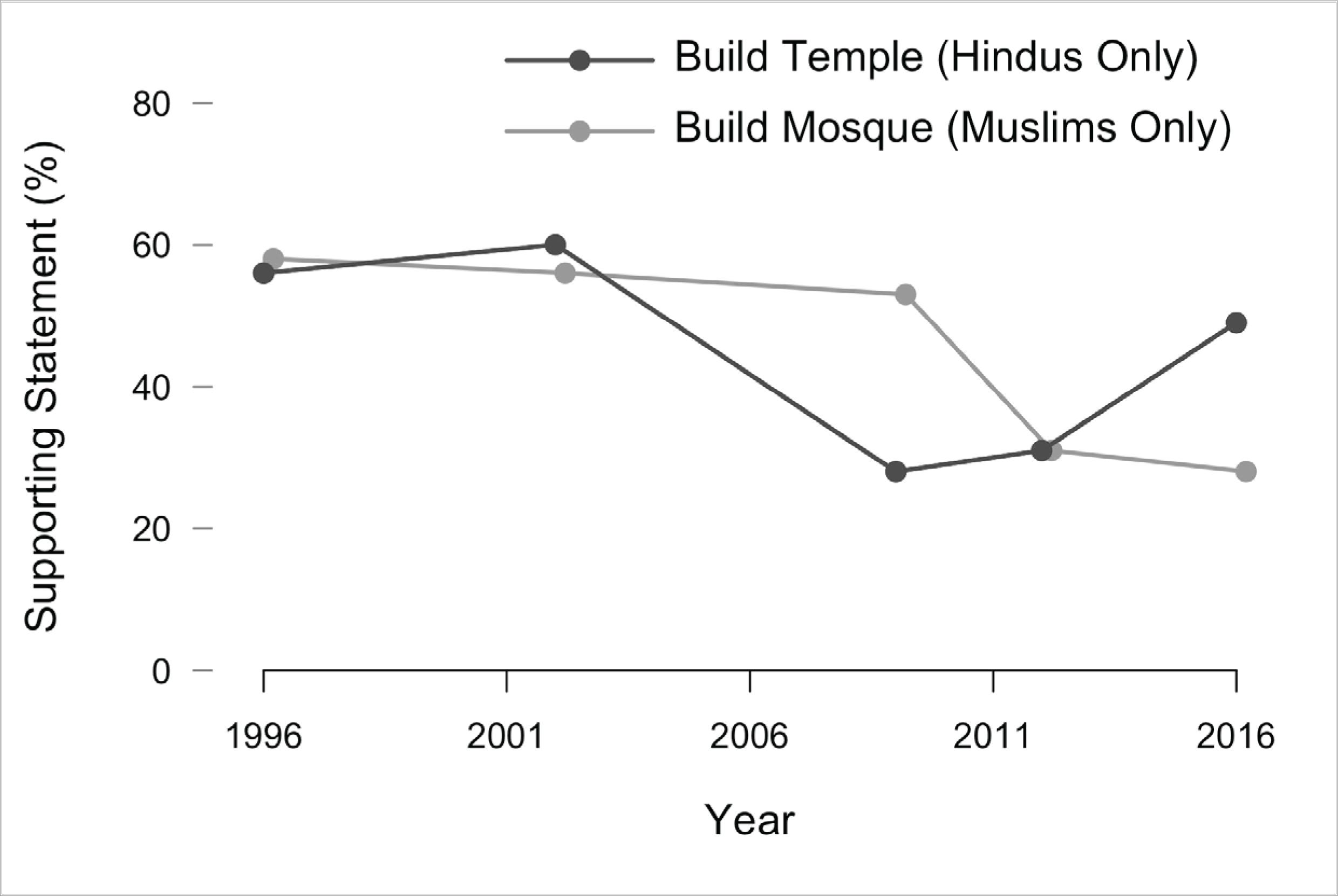
The Lokniti Programme of the Centre for the Study of Developing Societies (CSDS) has tracked public opinion in the state of Uttar Pradesh on this issue since 1996. The restriction to Uttar Pradesh provides a hard test of the state-driven hypothesis, as the demand for the Ram Mandir among Hindus in the state is plausibly the strongest and most consistent. Figure 1 displays the percentage of Hindu voters who prefer only a mandir to be built on the site, as well as the percentage of Muslim voters who prefer only a mosque to be built on the site—corresponding to extreme positions on the matter as opposed to a moderate answer which would allow both Hindus and Muslims to share the space.
Until 2002, corresponding to the time that the Hindu nationalist BJP controlled the central government in New Delhi, the surveys pick up significant Hindu–Muslim polarisation, with approximately 60 per cent of both Hindus and Muslims preferring to only have a mandir and a mosque on the site, respectively. In the period in which the BJP was out of power in the centre, the support for the extreme positions drops 30 percentage points among both Hindus and Muslims by 2012. After the BJP ascended to power in 2014, the survey picks up a significant increase only among the Hindu population in supporting the extreme position, up to around 50 per cent.
The data presented here show that state control, in and of itself, can be impactful for building support for Hindu issues like the Ram Mandir. More to the point, rather than support for Hindu nationalist ideas or polarization driving the support for a party, the state-driven theory implies that control over the levers of government may allow governing leaders to ‘frame’ religious issues for the population and plausibly generate a Hindu vote.
The Emergence of Religion-as-Ethnicity Voting: Assam Versus West Bengal
The states of Assam and West Bengal provide a useful comparison to understand when and how a Hindu vote emerges. Both of these states are located in the east of India, bordering on Bangladesh, with the highest proportions of the population belonging to the Muslim community among all states in India. According to the 2011 Indian census, the percentage of the population belonging to the Muslim community was 34 and 27 per cent in Assam and West Bengal, respectively. 5 Notably, while both of these states were strongly affected by the partition of the subcontinent and had periods of serious conflict in the 1970s, Hindu nationalism had yet to be much of a political factor until recently.
However, with a spatially concentrated distribution of Hindus and Muslims and a state government that was willing to use state power to sow division between religious communities, Assam displays conditions for the emergence of the Hindu vote (conditions not present in West Bengal). While many scholars have looked to North India, particularly Uttar Pradesh, to understand the evolution of the Hindu vote, the BJP has longer historical roots in North India. As such, the popularity of the BJP is a function of its upper caste support base in these regions (Verniers & Jaffrelot, 2020). With very different caste hierarchies and a complicated set of social cleavages, Assam is a better place to understand the emergence of the Hindu vote.
Spatial Demography of Assam and West Bengal
In Table 1, 6 I consider the demographic composition of assembly constituencies (ACs) and their relationship to electoral performance in Assam and West Bengal. In order to construct this table, I identified the percentage of Muslims reported in the 2011 census at the district level and looked at the ACs contained therein. The data are classified into four demographic categories: ACs in districts with (a) less than 15 per cent Muslim population; (b) between 15 and 35 per cent Muslim population; (c) between 35 and 50 per cent Muslim population; and (d) greater than 50 per cent Muslim population. The second column displays the percentage of Assam’s 126 constituencies that fall into each demographic category and the third column displays the percentage of West Bengal’s 294 constituencies that fall into each demographic category. The fourth and fifth columns display the strike rate of the National Democratic Alliance (NDA) (BJP’s alliance) in each demographic category for Assam and West Bengal, respectively. 7
Muslim Composition and Electoral Performance in Assam and West Bengal (2021)

The spatial segregation at the AC level of Hindus and Muslims is far greater in Assam. Only 26 per cent of ACs in Assam fall in districts with 15 per cent–50 per cent Muslim population, whereas 63 per cent of ACs in West Bengal fall in districts with this demographic composition. Furthermore, 35 per cent–40 per cent constituencies in Assam are plausibly core constituencies for each of Hindus and Muslims (i.e., ACs in districts with either less than 15 per cent or more than 50 per cent Muslim population). This meets the ‘density’ condition, as a politics focused on Hindu and Muslim consolidation can plausibly win a large share of constituencies due to the demographic composition of ACs. Furthermore, the small share of constituencies with a mixed Hindu–Muslim population in Assam implies that a party focused on Hindus or Muslims can win the election by pandering to a small number of ACs. As such, a religious party can meet the condition of pivotality.
Constructing the Hindu Vote in Assam
Assamese politics has traditionally been known for its complicated set of political cleavages. The late Tarun Gogoi, a three-time chief minister from the Congress Party, was widely lauded for negotiating such complexities for an extended period of peace in a state prone to conflagrations (Hazarika, 2020). In the 2016 state election, a Gogoi-led Congress Party facing severe anti-incumbency lost to an ascendant BJP. While Sarbananda Sonowal was named the chief minister, Congress defector Himanta Biswa Sarma emerged as one of the most popular BJP leaders in the state.
The 2021 state election in Assam displayed a ‘flattening’ of social cleavages to Hindu–Muslim polarization, in which the BJP was explicit about the arithmetic need for a ‘census election’ (Sircar, 2021b). As the 2021 state election approached, Sarma declared that the BJP did not need a single vote from ‘Miya Muslims’—a colloquial term for the Bengali-speaking Muslim community—which he derided as ‘very, very communal and fundamental’ (Saha, 2021). The vast majority of Assam’s Muslim population falls in the Bengali-speaking category, with the Lokniti/CSDS survey estimating Bengali-speakers comprise around two-thirds of the Muslim community in Assam. But it was not just about narrative, but also about state policy. During the electoral campaign, Sarma promised that the BJP would introduce a law in which a potential bride and groom would have to declare their respective religions and incomes a month before marriage. With a law reminiscent of those adopted in other BJP-ruled states, the implicit goal of the law was to curb ‘love jihad’—a conspiracy theory in which Muslim men entrap Hindu women in marriage. Sarma himself had earlier stated that social media was a ‘menace’ that was promoting love jihad in Assam (Choudhury, 2020).
Support for Parties by Religion in the Assam Election (%)

After the BJP won the election, Sarma was rewarded by being named as the chief minister of the state. Since he has come to power, Sarma has become even more aggressive in sowing division between Hindus and Muslims. 8 He has regularly painted Muslims as criminals and led a forced eviction drive of largely Bengali-speaking Muslims in Darrang district (Saikia, 2021). The forced evictions have led to shocking scenes that are likely to create greater religious polarization, 9 including a notable incident in which a protesting Muslim villager was shot dead by police after which a government employee proceeded to repeatedly stomp on the dead body (Scroll Staff, 2021).
This sort of rhetoric, combined with the spatial demography of Assam, have hardened boundaries between Hindu- and Muslim-dominated constituencies—creating extraordinary stability in electoral outcomes. In 2016, the BJP and its ally Asom Gana Parishad (AGP) won 74 ACs in Assam and led in 78 ACs in the 2019 national election. Similarly, the Congress and the AIUDF, which had yet to form a coalition, were ahead in 39 and 38 seats combined in 2016 and 2019, respectively. In 2021, the BJP and AGP won a combined 69 seats, with ally United People’s Party Liberal (UPPL) winning another six seats. The Congress and AIUDF, now in alliance popularly referred to as the mahajot (grand alliance), combined to win 46 seats.
This religious polarization of the electorate has generated largely uncompetitive electoral contests. In the 2019 election, the average AC-wise margin of victory for the winning party was 23 per cent, with only 18 (14 per cent) of Assam’s 126 ACs showing a margin of victory less than 5 per cent. The results in 2021 were similar, with the average AC-wise margin of victory for the winning party at 19 per cent and only 19 (15 per cent) ACs showing a margin of victory less than 5 per cent. Such extraordinary constituency-wise margins of victory explain the stability of seat shares, which are resistant to moderate changes in political support at the constituency-level.
Data at the individual level demonstrate that during the period of BJP rule in Assam, greater religious differentiation in voting (i.e., a stronger religious vote) has emerged. Table 2 displays the support for the NDA and the mahajot (the main opposition alliance consisting of Congress, AIUDF and the Bodo People’s Front) in the 2021 Assam election among religious groups according to the Lokniti/CSDS Assam election post-poll survey. Notably, more than 2 out of 3 Hindu voters supported the NDA, while more than 4 out of 5 Muslim voters supported the mahajot in 2021. Furthermore, there is a 10 percentage point increase in support for the NDA among Hindus from 2016 to 2021, and a 13 percentage point drop in support for the mahajot among Hindus from 2016 to 2021—suggesting significant religious consolidation over the period.
Preventing Religious Polarization in West Bengal
In the 2019 national election, the BJP surged to win 18 out of 42 parliamentary constituencies in West Bengal. When disaggregated further to the AC level, the BJP was ahead in 121 of West Bengal’s 294 ACs in 2019, with the ruling Trinamool Congress (TMC) ahead in 164 ACs. With little Muslim support, the arithmetic calculation held that the BJP would need around 60 per cent–65 per cent support among the state’s Hindu population. This seemed doable because, according to CSDS/Lokniti, the BJP cornered 57 per cent of the state’s Hindu population in 2019 and, as shown in Table 2, these are numbers that were achieved in Assam.
Table 3 displays the vote shares for the BJP and the TMC in the 2016, 2019, and 2021 elections in West Bengal among religious groups, according to the Lokniti/CSDS West Bengal election post-poll survey. While there is some degree of Muslim consolidation behind the TMC, the empirical story hinges on the Hindu vote in West Bengal. Table 3 shows that the share of support among Hindus for the BJP dropped from 57 per cent in 2019 to 50 per cent in 2021, with a corresponding swing of 7 percentage points towards the TMC.
Support for Parties by Religion in the West Bengal Election (%)

As in Assam, there were attempts to polarize the electorate. The current leader of the opposition from the BJP, Suvendu Adhikari, stated TMC chief and West Bengal Chief Minister Mamata Banerjee would turn the state into a ‘mini-Pakistan’ (Bhattacharya, 2021). The 2021 West Bengal election also saw the BJP deploy significant resources in an aggressive, communal social media strategy, a method that had been effective in the 2019 election (Daniyal, 2019). What explains the difference in outcomes with respect to the Hindu vote in Assam versus West Bengal?
Just as state power was used in Assam to exacerbate religious tensions, West Bengal’s government used its power to mollify Hindu–Muslim tensions by activating cross-cutting social cleavages (Sircar, 2021a). Banerjee’s TMC has assiduously built a base of support through a series of welfare schemes targeting girls’ education as well as stymying patriarchal practices like underage marriage, in addition to other schemes ranging from farmer welfare to healthcare. In many of these schemes, the main beneficiary is either the daughter or the senior female member of the household. This has naturally built a strong base of support for the TMC among women in the state. Furthermore, the sheer scale of targeted benefits has allowed Mamata Banerjee to develop an image as a provider for the poor. This solid base of support among the poor and among women engendered a large base of political support cutting across Hindu and Muslim communities, thwarting the BJP’s attempts at Hindu–Muslim polarization (Kumar, 2021).
The comparison of Assam and West Bengal puts a focus on the impact of state control in generating religion-as-ethnicity voting. It also demonstrates that spatial demography is a critical factor in shaping successful campaign and narrative strategies. Furthermore, as a relatively ‘new laboratory’ for Hindu nationalism in an electoral sense, the rise of the Hindu vote in Assam holds lessons for the plausible emergence of the Hindu vote across India.
Concluding Thoughts
In this piece, I have outlined the conditions that generate religion-as-ethnicity voting in India. First, the spatial distribution of the religious group must make it possible for the group to win elections from time to time. Second, a governing party that aims to mobilize religion-as-ethnicity can use policymaking and media communication to exacerbate religious divisions. What, if any, lessons do this framework offer for the future of religious voting in India?
Demographic constraints imply that Muslim parties cannot easily generate large-scale religious polarization, as they must necessarily ally with non-Muslim parties to form government. However, the recent national electoral success of the BJP has raised the spectre of a long-term consolidated Hindu vote in India. To be clear, the BJP’s electoral support is not just about Hindu nationalism, but also a narrative strategy using media control and strong party machinery that preaches vishwas (trust/belief) in the prime minister (Sircar, 2020). Nonetheless, the observable implication of BJP’s dominance has been the beginnings of what Jaffrelot (2021) has called a ‘de facto’ Hindu state.
It is possible that the hold of the BJP, as the only electorally successful Hindu nationalist party, will crumble. In such a scenario, political preferences among Hindus may become fragmented into various language- and caste-based parties as has traditionally been the case in India. Alternatively, the changes to Hindu identity and to the institutions of the country could generate robust electoral competition among new parties that appeal to the Hindu vote. But, here too, multiple competitive parties with respect to the Hindu vote would necessitate differentiation on dimensions, such as region, language, caste, and class.
Naturally, the BJP seeks to prevent this sort of fragmentation and maintain consolidated religion-as-ethnicity voting. In order to do so, the BJP will continue to attempt to use its prodigious institutional, financial, and state power (not to mention Hindutva ideology) to shape popular attitudes about who is and who is not a Hindu. These definitions include dietary habits, which Gods are worshipped, and social attitudes towards Muslims. The consequence of these actions is a more restrictive politically constructed definition of what is considered ‘legitimate’ Hindu practice—and the elevation of a significant subset of India’s Hindu population.
India’s post-independence political history may induce complacency about the lack of religious voting at the national level. Yet, as the Assam case shows, under the right conditions religious voting can emerge. The past is no guarantee of the future, a lesson that may be all the more apparent as one watches the evolution of the Hindu vote in India.
Footnotes
Declaration of Conflicting Interests
The author declared no potential conflicts of interest with respect to the research, authorship and/or publication of this article.
Funding
The author received no financial support for the research, authorship and/or publication of this article.