




Abstract
This paper explains how presidential candidates in Africa’s highly diverse states appeal across ethnic lines when ethnic identities are salient, but broader support is needed to win elections. I argue that election campaigns are much more bottom-up and salience-oriented than current theories allow and draw on the analysis of custom data of campaign appeals in Ghana, Kenya, and Uganda, as well as interviews with party strategists and campaign operatives in Ghana and Kenya to demonstrate clear patterns in presidential candidates’ cross-ethnic outreach. Where ethnic salience is high, incumbents offer material incentives and targeted transfers to placate supporters, challengers fan grievances to split incumbents’ coalitions, and also-rans stress unity and valence issues in the hope of joining the winner. The research contributes to our understanding of parties’ mobilization strategies in Africa and further clarifies where and how ethnic divisions are politicized in elections in plural societies.
Keywords
“The difference this time round is between change and status quo. Those fronting status quo should know that we cannot accept suffering of our people anymore, our people being killed anymore.”
Introduction
Much research has focused on understanding how parties assemble winning majorities in plural societies because this process has far-reaching implications for peace, democracy and development in these societies (Arriola, 2013a; Ferree, 2010; Horowitz, 1985; Posner, 2005; Rabushka & Shepsle, 1972; Rothchild, 1970). Scholars often argue that where ethnic differences are salient, politicians rally voters around shared ethnic identities. 1 In Africa, standard explanations point to the selective and targeted channeling of patronage to coethnics for votes (Posner, 2005; Van de Walle, 2003; Wantchekon, 2003). Yet states on the continent are also among the most diverse in the world so coethnic votes alone are often not enough to ensure electoral victory. 2 Winning elections requires broader support spanning ethnic divides.
This poses a challenge for presidential contenders in particular: they must garner the votes of a significant number of non-coethnics, while mobilizing their core voters. And despite expectations that candidates would focus on rallying their ethnic bases and outsource cross-ethnic mobilization to loyal “big men,” in one of the few rigorous empirical studies of campaign targeting in Sub-Saharan Africa, Jeremy Horowitz finds exactly the opposite: even in places where ethnic block voting is common, presidential candidates delegate co-ethnic mobilization to lower party operatives and devote the lion’s share of their time and resources to courting non-coethnics (Horowitz, 2016).
What appeals do presidential candidates make when reaching across ethnic lines in Africa’s highly diverse states? Do their outreach strategies differ in systematic ways? Are there incentives to fan ethnic grievances and fears even while seeking to build broader coalitions? These questions are important because campaign rhetoric is a major source of polarization in diverse societies. The framing of social differences can have very real consequences: the appeals politicians make in national campaigns underlie ethnic census elections, structure expectations regarding political outcomes, articulate and justify political contests, and provide broader frames for local practices. A large literature on campaign effects shows that campaigns can educate, mobilize, raise awareness, activate predispositions, and change minds (Claassen, 2011; Hillygus & Jackman, 2003; Jacobson, 2015). In Africa, recent studies demonstrate that citizens update their voting preferences in response to new information on candidates’ performance (Carlson, 2015; Conroy-Krutz, 2013), suggesting that campaigns can influence voters by making such information widely available.
Further, politicians’ campaign appeals can have strong priming effects and can raise the salience of various issues and identities (Hillygus, 2010), particularly when containing negative messages (Lau et al., 2007). Research on communal violence affirms the importance of master conflict narratives in providing justifications allowing individuals to settle scores locally (Brass, 2011; Kalyvas, 2006). Elites’ rhetorical focus on communal grievances increases polarization and can result in electoral violence in plural societies (Ajulu, 2002; Aspinall, 2007; Klaus & Mitchell, 2015). Within the ethnic politics literature, the need to appeal across ethnic lines is seen as an electoral incentive for compromise and moderation, yet Kenya, where this need was constitutionally-mandated, 3 witnessed some of its worst post-electoral violence in 2008 after a bitter and ethnically-divisive presidential campaign, in which the main candidates focused on persuading non-coethnics (Horowitz, 2016; Kagwanja, 2009; Kanyinga, 2009). In sum, campaign appeals in Africa’s highly diverse states require rigorous study to uncover their underlying logic and anticipate their consequences for political accountability, representation, and communal relations.
In this paper, I develop a theory of presidential candidates’ cross-ethnic campaign appeals in Africa and test it using data from Ghana, Kenya, and Uganda. I argue that where ethnicity is salient but no group is large enough to govern alone, cross-ethnic outreach seeks to make or break coalitions in search of a winning majority and that presidential candidates’ campaign appeals play a key role in this effort. When courting non-coethnics, candidates evoke the instrumental and affective dimensions of ethnicity by offering material inducements or symbolic rewards. Incumbents’ rhetoric reflects their aim of defending the status quo and maintaining their existing coalitions. They enjoy a significant resource edge so are in a better position to appeal to voters’ instrumental motivations. In “patronage democracies” where voters value material rewards (Barkan, 2000; Bratton & Van de Walle, 1994; Chandra, 2007), incumbents’ resource advantage gives them a competitive edge and a credibility advantage over other candidates. Thus, they campaign on their ability to offer various types of material benefits and local public goods (in the form of patronage or “pork”).
Challengers seek to put together a new winning majority by subverting incumbents’ coalitions. What they must do to win is turn some of the regime’s supporters away, but without ruling parties’ resources and state control. Thus, challengers bring up grievances related to ethnic communities’ symbolic concerns or access to representation and resources. By fanning grievances, challengers homogenize preferences among the targeted groups and create anti-status quo constituencies likely to favor them over incumbents. 4 This is a risky strategy, however, and it may backfire by turning some voters away. Challengers thus bring up grievances in places where these are most likely to resonate, but abstain in areas where the dangers of a backlash are too great, such as in capitals and large urban centers, or in highly ethnically-diverse locales.
Candidates from smaller opposition parties seek to remain positive and avoid attacking competitors in the hope of being included in a future government. They are weary of disrupting the status quo lest the incumbent should succeed in maintaining it, so stress unity and reconciliation, make positive appeals seeking to valorize communities, or speak about broader valence issues of universal agreement, such as democracy, peace, security, good governance.
Because appeals must resonate in order to succeed, candidates take into account the relative salience of ethnicity locally. In urban areas, for example, patronage is less effective, traditional authorities have little sway, and other issues and identities are more salient. Therefore, all candidates avoid politicizing ethnicity in large urban centers and in places with no history of ethnic grievances or inequalities.
I test the argument using several sources of data. The first is an original dataset of electoral appeals made by presidential candidates in the following campaigns: Uganda (2006), Kenya (2007), and Ghana (2008) from newspaper and campaign sources. Further, to verify the results from the newspaper coding, I also rely on data from 120 rally recordings from Kenya’s 2007 election campaign—the most complete and exhaustive primary source of electoral appeals for that particular race. 5 To connect the analysis of campaign appeals with politicians’ strategic motivations, and examine how campaign strategies shift over time, I draw on over 80 interviews with party officials, campaign strategists, and analysts with knowledge of these and subsequent campaigns carried out during fieldwork in Ghana and Kenya between 2014 and 2017. Finally, to demonstrate the broader generalizability of the argument, I discuss campaign appeals and targeting in more recent campaigns in the three countries and in other cases where the same logic of cross-ethnic outreach applies.
The paper makes a theoretical, conceptual, and empirical contribution to the study of politics in Sub-Saharan Africa. First, it puts forward a theory of presidential contenders’ campaign appeals to non-core voters in Africa’s highly diverse states, which accounts for variation both between candidates and within states over the course of a single campaign. The theory has implications for how candidates’ strategies and issue positions might shift over time as well. Second, the paper develops a typology and presents a conceptual vocabulary of cross-ethnic campaign appeals. It complements existing conceptualizations by elaborating on the puzzling, yet common, practice of candidates courting non-coethnics in plural societies by speaking directly to their ethnic issues and concerns. Third, it presents new data on campaign appeals in Sub-Saharan Africa, which allows for rigorously testing competing theories of politicians’ incentives and outreach strategies.
Existing Approaches to Cross-ethnic Campaigning in Africa
While scholars have recognized that parties need to build cross-ethnic ties to voters in order to win elections in Africa’s multi-ethnic states, most have dismissed campaign appeals as viable electoral strategies and focused on indirect mobilization through proxies and the provision of patronage instead. Thus, campaign appeals have remained relatively understudied and under-theorized, leaving us unable to grasp the full range of mobilization strategies parties seeking votes in Africa employ, and how these strategies vary and influence campaign rhetoric.
A key challenge for any politician seeking cross-ethnic support is how to overcome the credible commitment problem inherent in sharing resources with non-coethnics. One solution is to rely on various intermediaries or brokers who can campaign on behalf of the candidate and deliver their communities’ support. These can be either co-partisans (Koter, 2016), allies in formalized coalition agreements (Arriola, 2013b), traditional authorities (Baldwin, 2014), or spouses (Adida et al., 2016). However, intermediaries or brokers may be unreliable, unavailable, cross-pressured, or fail to carry out their end of the deal. Party defections in Africa are common and clientelistic bargains are difficult to enforce: brokers shop around for the best bargains and may switch alliances even as campaigns are ongoing (Weghorst & Bernhard, 2014; Young, 2014).
A second solution is to redefine ethnic boundaries to include a wider set of voters in the ethnic category a candidate can claim nominal membership of and hence directly appeal to (Posner, 2005). This may be impractical within the short time span of an electoral campaign, however, particularly where identities are not fluid or multi-dimensional (Ferree, 2012). If no readily-available cross-ethnic identity dimension exists, candidates would need to engage with the salient identities and cleavages if they want to connect with voters. A few examples can illustrate such efforts: in Uganda in 2006, John Ssebaana Kizito, a presidential candidate from the Baganda ethnic group, promised the Bakhonzo tribe “Obusinga” (kingship) if he is elected.
6
In Zambia, Michael Sata, an ethnic Bemba, vowed to restore the Barotseland agreement granting autonomy to the Lozi tribe when campaigning in the country’s Western region “within 90 days of coming into office.”
7
In Kenya, Uhuru Kenyatta, a Kikuyu, pledged he would return 4,000 acres of his family’s land to the small Taita community if elected in 2013.
8
All of these are
A number of studies have drawn attention to parties’ attempts at direct voter persuasion through framing in Africa. Ferree (2010) argues that behind South Africa’s racial census elections lies a deliberate attempt by the ruling party to discredit the opposition. Resnick (2014) and Cheeseman and Larmer (2015) show that opposition candidates have combined ethnic and populist appeals to retain the reliance on charismatic leadership but send a message of common marginalization resonating across ethnic lines. Bleck and Van de Walle (2013, 2019) argue that uncertainty regarding voting allegiances leads politicians to prioritize valence issues in national elections and Brierley et al. (2019) add that parties can offer different policy solutions to common valence concerns. Klaus and Paller (2017) show that parties vary in the extent, to which they make inclusive versus exclusive appeals in urban Ghana. In LeBas’s (2013) account, cross-ethnic coalitions are more successful when parties can draw on pre-existing organizational structures, such as trade unions or other national associations and mobilize these cross-cutting identities. Taylor (2017) argues that parties with a large core ethnic base appeal across ethnic lines by promising national public goods in order to eschew accusations of ethnic favoritism.
The perspectives above shift the focus of cross-ethnic coalition building from contingent direct exchange and the reliance on proxies to persuasion through direct campaign appeals, which can also vary between parties. Here, message resonance is key to credibility and African voters are seen as motivated by a range of issues and identities beyond exclusive preferences for patronage resources. But what determines which cross-ethnic campaign appeals will resonate? What explains differences in candidates’ campaign rhetoric? How else might candidates respond to uncertainty regarding voter preferences or address voters for whom ethnic issues are known to be highly salient? These questions remain and are central to understanding what form direct cross-ethnic outreach takes and whether candidates will converge on a single rhetorical strategy or seek to differentiate from competitors.
This paper contributes to the emerging literature on campaign appeals in Sub-Saharan Africa by theorizing the determinants of credible cross-ethnic outreach and their implications for presidential candidates’ campaign rhetoric. It also explains how politicians seeking broader support deal with treacherous ethnic issues, and under what conditions they will seek to either emphasize or reconcile ethnic divides.
Between Issue Salience and Relative Credibility: How Candidates’ Cross-ethnic Campaign Appeals Differ in Africa’s Highly Diverse States
For campaign appeals to be effective, candidates must establish credibility on some issue voters care about (Popkin, 1994). Linking credibility with issue salience is particularly important when mobilizing voters who are not tied to presidential candidates by either coethnicity or established clientelistic networks. As a number of scholars have acknowledged, Africa’s ethnic diversity is a major source of campaign uncertainty in national elections. However, unlike existing approaches, I argue that presidential candidates faced with uncertainty regarding voter preferences have strong incentives to discover and address voters’ salient issues and concerns or risk being overtaken by competitors if they do not. In other words, uncertainty should contribute to more targeted, not more general, campaign appeals over time.
Subnational variation in the salience of ethnicity in turn influences whether appeals addressing communities’ ethnic interests and concerns will resonate. 9 In line with much of the literature on ethnic politics, I assume that voters for whom ethnic identities are salient desire material benefits in the form of local public goods and targeted transfers, or symbolic rewards in the form of group recognition and representation. I also assume these voters reward credible offers of such material or symbolic goods and that they prefer targeted over general benefits (McCauley, 2014; Wantchekon, 2003).
Incumbency is the most important determinant of candidates’ resources in Africa. Because of their significant resource advantage, incumbents have strong incentives to engage in pork barrel politics, parade wealth, both immediately deliver and make promises of future benefits, or threaten to withhold these as punishment for voter disloyalty. Material inducements and exclusion threats are seen as more credible when coming from regimes in power (De Mesquita et al., 2005; Magaloni, 2008), so incumbents are rewarded at a higher rate for making such offers (Wantchekon, 2003). Therefore, incumbents pursue a pro-status quo patronage strategy and offer material benefits and local public goods to non-core voters.
Because of incumbents’ resource advantage and hence credibility edge, opposition candidates cannot win by emphasizing their own capacity to deliver patronage or targeted transfers. Even in cases when the opposition can credibly unseat incumbents, they can at best promise future benefits, while incumbents are in a position to deliver patronage immediately. Immediate rewards are a priori more credible than deferred ones, which drives a rush towards the delivery of “visible patronage” by incumbents in election campaigns (Green, 2011).
What challengers can do to offset incumbents’ patronage advantage is go negative: cast doubt on the incumbents’ promises and highlight differences from other candidates to improve their chances. Bates (1974) writes of the competition over the “goods of modernity” giving rise to envy, resentments, and fears among ethnic groups in Africa. Challengers can emphasize such relative status concerns, blame the incumbent for group inequalities in access to resources, and promise redistribution and status quo overhaul.
This strategy relies on fanning negative emotions to get voters to abandon incumbents and can address both material and symbolic concerns: individuals worried about access to resources may also experience fears of loss of status, concerns about lack of recognition, and feel emotional attachment to their ethnic identities. Such rhetorical “constructions of grievance” can effectively spur collective action in the name of common identities, even when conflicts have ostensibly material origins as with disputes over land or natural resources (Aspinall, 2007; Boone, 2011; Lynch, 2011). Challengers can also formulate “ethnic wedge issues”—policy positions with clearly-defined ethnic winners and losers targeting aggrieved minorities within incumbents’ coalitions—in order to peel some voters away (Gadjanova, 2017).
Negative campaigning is strongly associated with opposition status (Harrington & Hess, 1996; Lau & Pomper, 2001; Sigelman & Buell, 2003) so we can expect the strategy of fanning ethnic grievances to be attractive to challengers in particular. While it can create a boomerang effect and hurt them with some groups, challengers will go negative as long as this hurts incumbents more. When will this be the case? Grievances and perceptions of discrimination and neglect arising from experiences of poverty, inequality, and lack of opportunity preceding the campaigns make ethnicity salient and create political opportunities for challengers. Constrained by their records, incumbents are prima facie less credible in addressing such grievances, giving challengers’ grievance rhetoric a credibility advantage among impoverished and resentful groups in particular. Thus, challengers pursue an anti-status quo strategy by fanning grievances and promising remedies to groups who harbor resentments against incumbents.
Opposition candidates who are too far behind the frontrunners 10 but desire to be included in a future coalition, have incentives to abstain from attacking potential coalition partners. One way to remain positive for a candidate unable to credibly offer tangible benefits in places where ethnicity is salient, is to stoke communities’ ethnic pride, offer symbolic rewards in the form of recognition and valorization, or appeal to unity and reconciliation. Thus, also-rans pursue a status-quo campaign strategy relying on ethnicity’s positive emotional pull.
The above discussion of candidates’ strategies needs to be placed in the context of recent findings regarding voters’ heterogeneous preferences in Africa (Bleck & Van de Walle, 2019; Weghorst & Lindberg, 2013) and willingness to update vote choices in response to new information (Carlson, 2015; Conroy-Krutz, 2013). It is clear that not all voters are equally persuadable and receptive to promises of patronage and symbolic recognition on the one hand, or attempts to fan ethnic grievances on the other. Other issues dominate politics in Africa’s large urban centers and countries vary in the centrality of ethnicity for politics. Therefore, when addressing voters for whom ethnic identities are not salient, politicians will attempt to make or break coalitions by campaigning on the strength of their records in delivering on valence issues such as development, democracy, and fighting corruption, attacking opponents’ records on these issues, or appeal to non-ethnic identities—women, youth, urban residents, farmers, teachers, LGBTs, etc.
In sum, while all contenders will diversify their campaign messages conditional on the salience of ethnicity locally, I expect incumbents to offer more resources, local public goods and targeted transfers relative to other candidates, and challengers to fan ethnic grievances more often relative to other candidates. Also-rans who hope to enter into a post-electoral coalition will refrain from attacking competitors. In result, we should observe variation in campaign appeals on two dimensions: (1) between candidates depending on their position in the race and (2) for the same candidate over the course of a single campaign depending on the salience of ethnicity locally. Differences will be starker when incumbents’ resource advantage is stronger (as in electoral authoritarian regimes) and in countries where ethnicity varies in salience and past inequalities have given rise to communal grievances along ethnic lines.
Another implication from the theory is that candidates’ electoral appeals will change between campaigns if their relative position changes from incumbency to opposition or vice-versa. This is a departure from the existing literature, which largely expects all candidates to converge on a single strategy—either patronage, populism, or valence appeals—throughout campaigns, and does not anticipate how candidates’ strategies might shift over time.
A Categorization of Cross-ethnic Campaign Appeals in Africa
In order to examine the implications of the theory empirically, I develop a categorization of cross-ethnic campaign appeals in two steps. First, I outline the ways, in which candidates can appeal to voters for whom ethnic identities are salient and second, I discuss how candidates can reach out to voters for whom ethnic identities are not salient. In drawing distinctions between the types of appeals candidates make to voters for whom ethnic identities are salient, I rely on two relevant literatures: on the centrality of material incentives in the form of patronage to ethnic politics from political science, and on the affective dimensions of ethnic belonging from social psychology.
The use of patronage has a long history of being associated with ethnic accommodation in Sub-Saharan Africa, particularly by incumbent regimes (Jean-François, 1993; Rothchild, 1997; Van de Walle, 2003). The geographically-targeted construction of roads, schools, hospitals, boreholes, the provision of electricity, the allocation of government funds and contracts during electoral campaigns are commonly regarded as examples of ethnic politics in general (Chandra, 2007) and within the literature on clientelistic states in Africa in particular (Wantchekon, 2003). Van de Walle sees these as “the most common electoral promises by politicians” (2003, p. 313). McCauley (2014) shows empirically that ethnic group mobilization in Africa tends to evoke individual preferences over such locally-excludable club goods.
Of the emotional corollaries of ethnic attachments, research shows that positive self-esteem and pride are most commonly fostered by acts of recognition and valorization (Eisenstadt, 2011; Phinney, 1991; Thompson, 1997). Attempts to stoke communities’ ethnic pride involve the recognition of languages or symbols, commemorations of historical events, extolling communal values, and valorizing communities’ traits or achievements. Denied recognition, unfair treatment and perceived discrimination, on the other hand, are linked to intense negative emotions and reactions (Horowitz, 1985). Politicians can play on communities’ fears and anxieties by using tropes and narratives of neglect, clannishness, exclusion, victimization, encroachment or imposition, and threat (LeVine & Campbell, 1972; Petersen, 2002). In what is commonly referred to as “political tribalism,” politicians employ narratives of ethnically-motivated discrimination, marginalization, or exclusion for electoral gain (Klopp, 2002). Such rhetoric blurs the line between the instrumental and affective ties of ethnic belonging and plays on ethnic grievances and fears to pit some groups against others.
Conversely, candidates can advocate the overcoming of ethnic divisions by making calls for unity and reconciliation, offer or accept an apology for past injustice, speak of the benefits of (ethnic) diversity, and extol a common, often national, identity.
Finally, candidates can stress a range of other issues and identities when appealing across ethnic lines. In line with the recent literature on African politics, these fall within three broad categories: valence, cross-ethnic populism, and appeals to non-ethnic constituencies. Valence appeals are those evoking issues “positively or negatively valued by the electorate” (Stokes, 1992) such as peace, development, democracy, good governance, personal qualities such as competence, empathy, charisma, or behaviors and traits subject to universal disdain, such as corruption or incompetence (Bleck & Van de Walle, 2013). Cross-ethnic populism relies on narratives of common poverty and marginalization, anti-establishment or anti-elite protest (Resnick, 2014). Appeals to non-ethnic constituencies involve taking positions on issues of concerns to groups identified by some non-ethnic attribute: women, youth, teachers, farmers, LGBTs, etc.
In practice, the distinctions between valence, cross-ethnic populism, and non-ethnic appeals are not as clear-cut: Resnick considers charisma and anti-corruption rhetoric as populism, while Van De Walle would likely see these as examples of valence issues. Populism in Africa is almost exclusively an urban phenomenon and includes policies intended to appeal to the urban poor as a distinct constituency so it could have a targeted programmatic dimension as well. For the purposes of the theory, these three types of messages (valence, populism, and non-ethnic) have been grouped together because they represent ways to build or break electoral coalitions by appealing to non-ethnic issues and identities. While peace and unity messages can also reasonably be categorized as valence, I treat them as a distinct category here because they are often aimed at communities for whom ethnic identities are highly salient. They frequently evoke (past) ethnic divisions, conflict, or injustice, but unlike ethnic grievance appeals, appeals to unity seek de-escalation and reconciliation (e.g., see the Appendix).
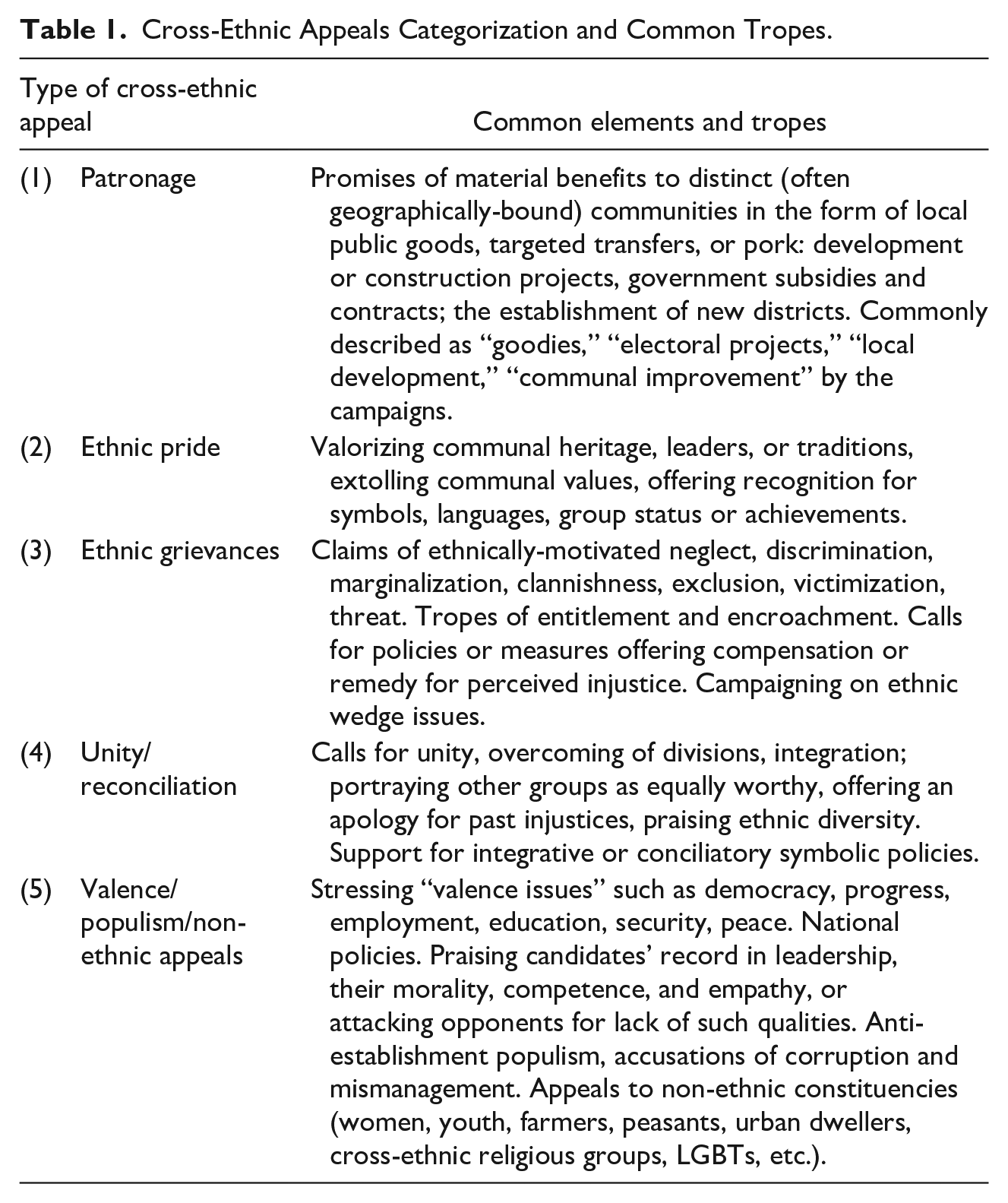
The common themes and the distinctive tropes for each category are summarized in Table 1. Together, they form a conceptual vocabulary of politicians’ direct cross-ethnic appeals in Africa’s plural societies. This conceptualization advances our understanding of how politicians reach out to non-coethnics by elaborating on appeals to ethnic pride and ethnic grievances as viable cross-ethnic strategies in particular. Empirically, such appeals are common, yet scholars have so far treated them as reserved for coethnic voters only. Endorsements by local notables, candidates’ past records, and competitors’ unfulfilled promises can make such messages resonant to non-coethnics, as I show below.
Cross-Ethnic Appeals Categorization and Common Tropes.
Case Selection and Data
I construct a custom dataset of the appeals presidential candidates made in the following election campaigns: Uganda (2006), Kenya (2007), and Ghana (2008). The three countries are highly diverse presidential regimes with salient ethnic divisions, are often described as “patronage democracies,” and were categorized as “free” (Ghana) or “partly free” (Kenya and Uganda) at the time. 11 Thus, they are likely cases for the theory. These particular campaigns were selected because they offer variation on ethnic geography, party strength, and campaign competitiveness, which are key alternative explanations to campaign dynamics in these settings. In Uganda’s 2006 campaign the incumbent was from one of the country’s smaller groups, in Ghana in 2008 and in Kenya in 2007, incumbents were from the plurality groups. Party strength and institutionalization are low in Kenya and Uganda, and relatively high in Ghana. The plurality group (the Akans) is close to a majority in Ghana, while Uganda has one of the highest ethno-linguistic fractionalization in Sub-Saharan Africa. 12 The campaigns in Ghana and Kenya were closely fought, while the Uganda 2006 election was a landslide. In Kenya and Uganda, opposition candidates challenged sitting incumbents, in Ghana the president’s successor and the candidate of the ruling party (Nana Akufo Addo) is treated as the de facto incumbent. 13 The elections also took place at a time of strong economic growth for all three countries, bolstering incumbents’ credibility in delivering on patronage promises (an assumption within the theory). 14 Finally, the previous contests in all three cases were peaceful minimizing concerns about repeated violence as a potential confounder.
Data on presidential contenders’ campaign appearances and addresses was collected from news clippings published in national newspapers, official campaign and party communication, recordings of interviews and press briefings, televised debates, and videotaped rallies. Research on election campaigns regularly draws on newspapers’ campaign coverage to study strategy (Flowers et al., 2003; Franklin, 1991; Lau & Pomper, 2001), including in African elections (Bleck & Van de Walle, 2013; Taylor, 2017).
A campaign address (a speech, interview or rally recording) can include one or several appeals. In delineating separate appeals, I draw on analyzes of political communication focusing on arguments, idea units, or frames (Chong & Druckman, 2007; Sigelman & Buell, 2003). This literature highlights the need for such units to be self-contained and include a single theme. Thus, appeals are self-contained narratives or arguments urging voters to support a candidate drawing on a single theme and are coded as falling into one of the categories in Table 1.
I take contenders’ campaign visits to given areas as attempts to make appeals to voters resident in those areas. In cases where candidates made national addresses (either in national newspapers, or on TV), these were coded as having a national audience. Such appeals account for 8% of the data across the three campaigns. Addresses made in capital cities are a special case because these often also target broader audiences. The empirical section discusses and includes controls for such appeals.
Over 660 discrete appeals were identified and coded by hand from more than 1,500 newspaper clippings, rally recordings, and campaign press releases (see the Appendix for sources, the coding procedure, codebook, and examples). Only campaign appeals by the presidential contenders and their running mates are included. This is in order to maintain comparability between the three country cases, and for practical reasons—news sources often report only on the leading candidates’ rhetoric during rallies so reliable data on how other politicians addressed audiences is difficult to obtain and is unlikely to be representative.
There are four potential sources of bias in the data: selection bias, description bias, incomplete information, and mis-categorization. I discuss each in the Appendix, together with measures taken to overcome them. The newspaper data and coding for Kenya are validated using an additional dataset of 120 recorded rallies (over 142 hrs of material including rhetoric in vernacular languages) from the 2007 campaign. This data rendered 1,572 coded appeals for the Kenya 2007 campaign alone. The recordings allay potential concerns about speakers making different appeals in vernacular, biased event selection, and biased media coverage for the Kenyan case—the most ethnically-polarized of the three campaigns.
Despite all measures taken to overcome bias in the data, some undoubtedly remains. Therefore, I complement the quantitative analysis with qualitative evidence from interviews with party strategists, campaign operatives, and analysts carried out in Ghana and Kenya during extensive fieldwork between 2014 and 2017, as well as evidence from other academic research and more recent campaigns.
The categorization is intended to capture how ethnic cleavages are evoked and talked about by the presidential candidates in their public appearances, not which ethnic categories speakers are appealing to. Nevertheless, a key challenge was to distinguish between ethnic and non-ethnic references, and tropes. In addition to direct references to ethnic groups, such as “the Baganda,” “Bakhonzo,” “Maasai,” “Gas,” I have taken references to geographical areas (regions in particular) to denote appeals to ethnic groups in line with the extensive literature demonstrating these are synonymous with ethnic identities in Sub-Saharan Africa (Bates, 1974; McCauley, 2014). For ambiguous cases, I rely on the existing literature and interviews with campaign operatives and local experts with in-depth knowledge of the campaigns. The Appendix details my approach and lists common categories and tropes taken to signify ethnic appeals in each country.
Method and Results
I examine both the broader patterns of the appeals made by incumbents, challengers, and also-rans over the course of the campaigns, and how these appeals varied sub-nationally. Figures 1 to 3 juxtapose the geographic and thematic focus of the incumbents’ and challengers’ public addresses in Ghana’s 2008, Kenya’s 2007, and Uganda’s 2006 presidential campaigns (maps for the various also-rans are not shown, but their appeals are discussed below). Contenders’ ethnic bases or core ethnic regions 15 are shaded in gray.
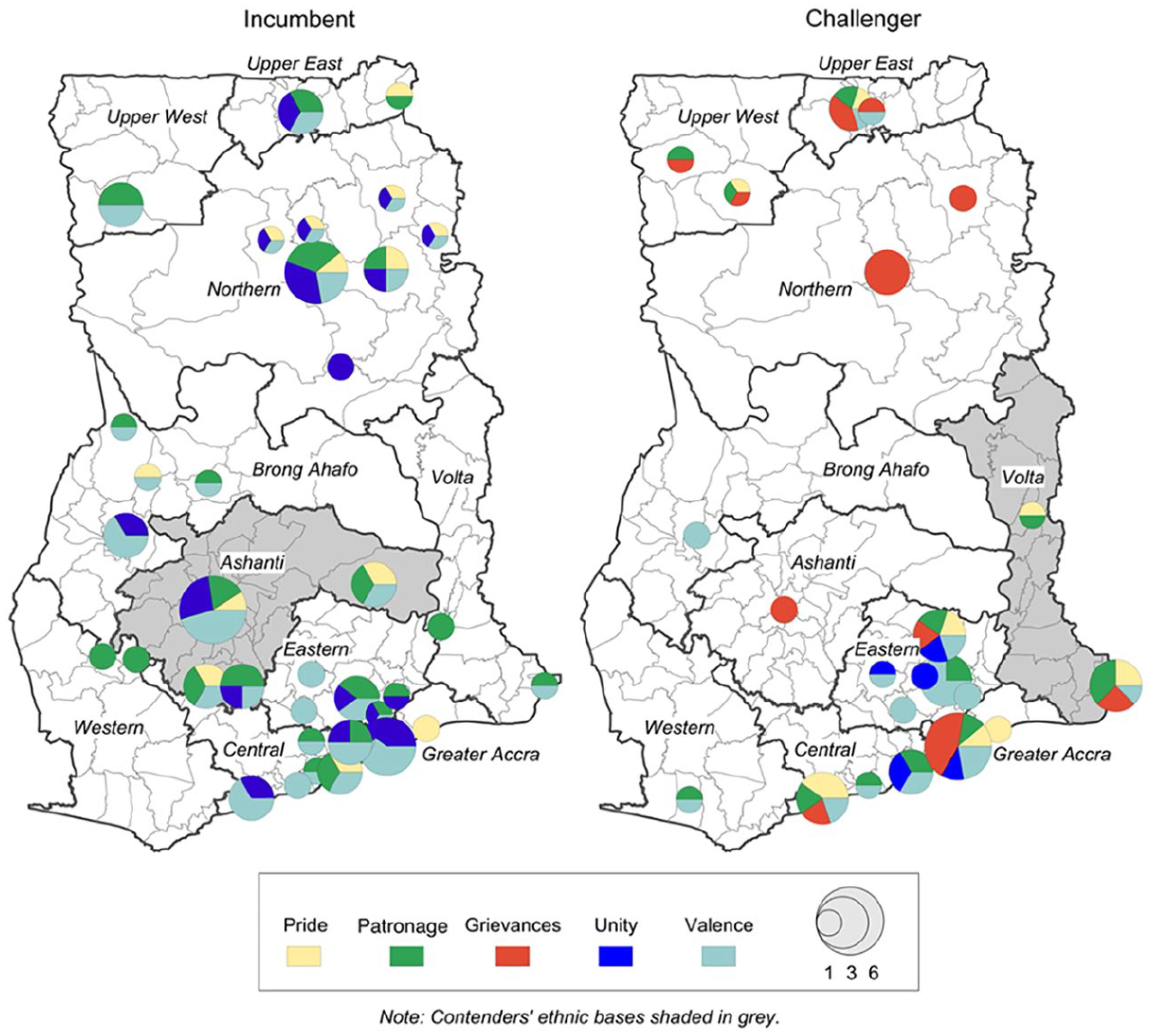
Types of appeals by contender and district in Ghana’s 2008 presidential campaign.
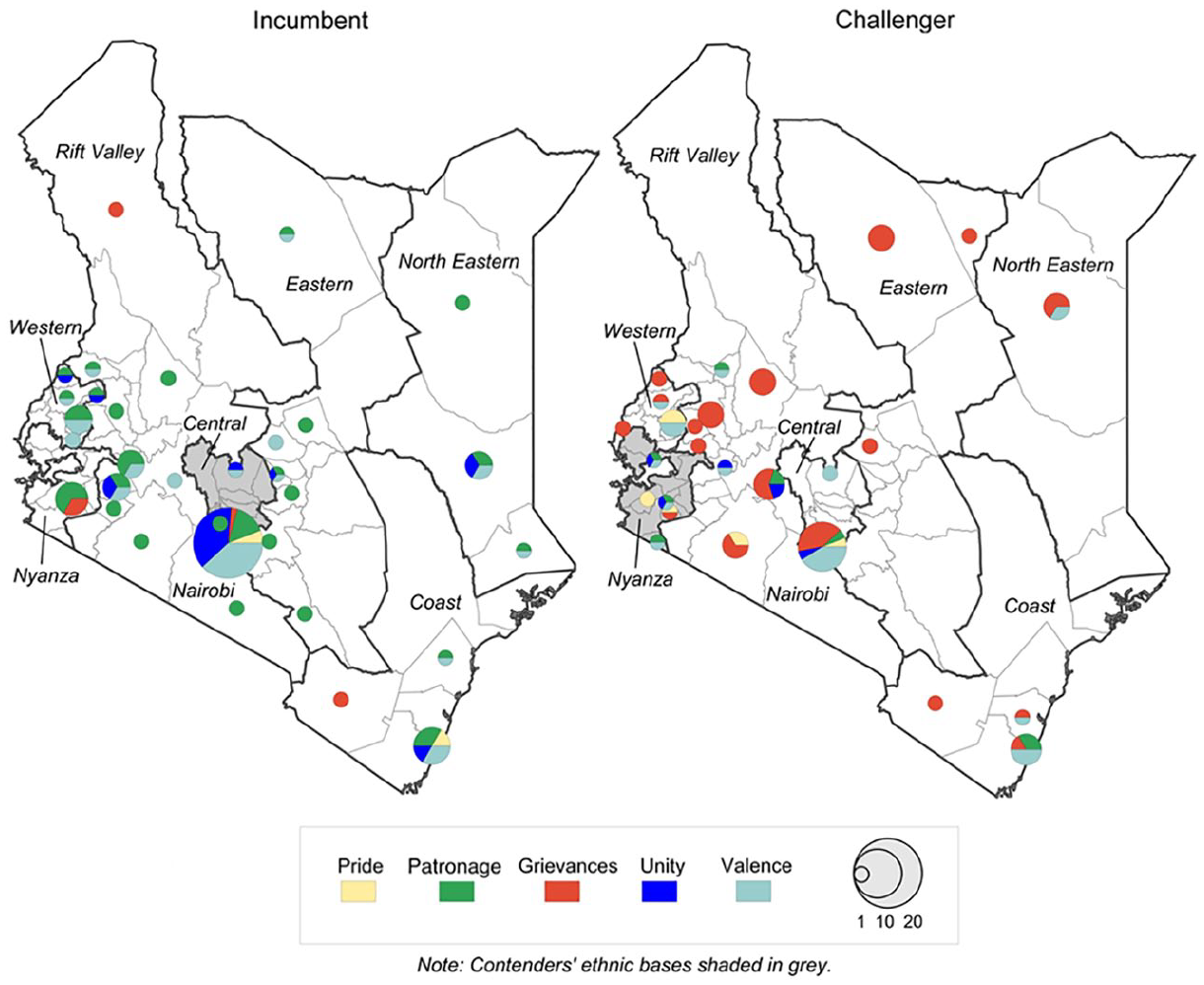
Types of appeals by contender and district in Kenya’s 2007 presidential campaign.
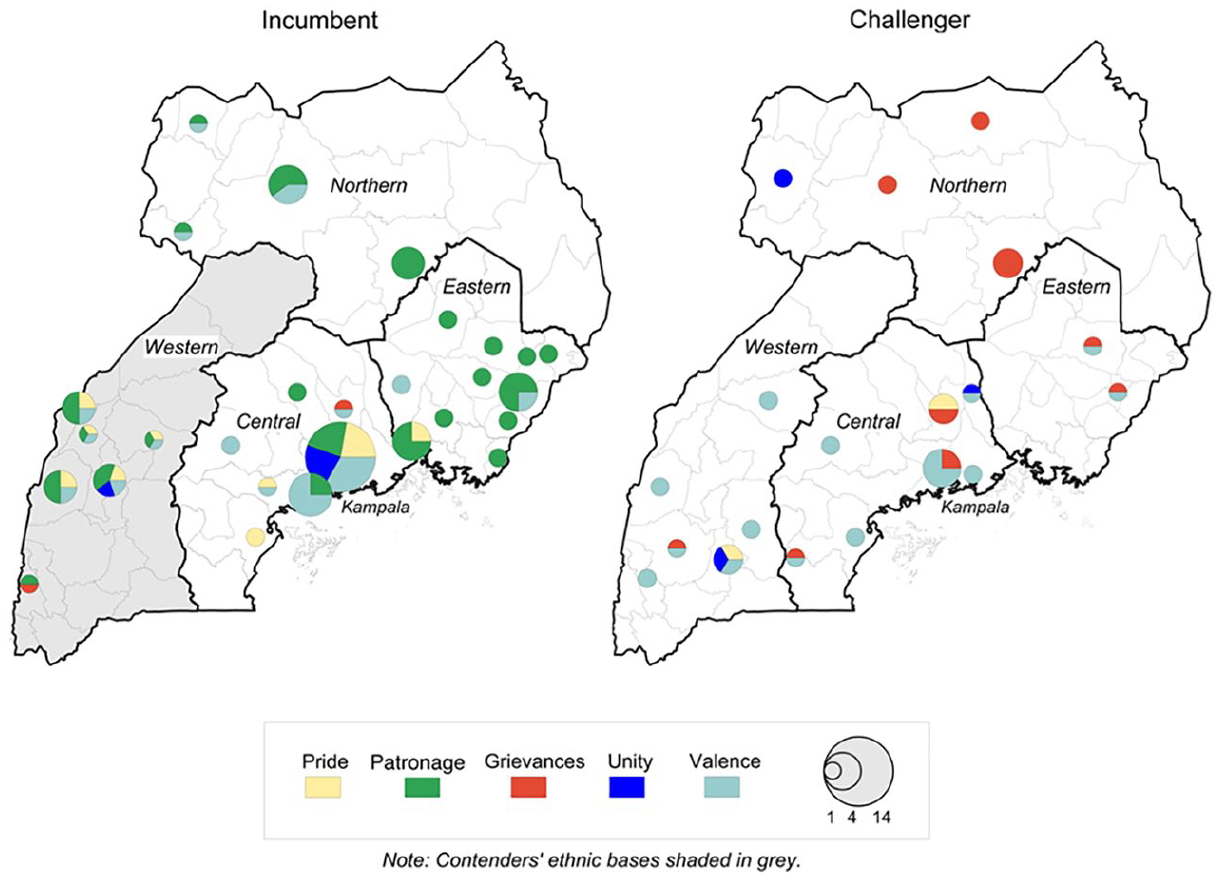
Types of appeals by contender and district in Uganda’s 2006 presidential campaign.
As evident from the maps, all incumbents and challengers made most of their campaign appearances in non-core areas and chose to reach out through a mixture of appeals. This contradicts expectations that candidates would avoid making direct distributive or symbolic appeals when attempting to reach out across ethnic lines. 16 It is notable that even in Ghana, where the Akans are close to a majority, their co-ethnic, incumbent Nana Akufo-Addo spent most of his time courting other communities. I attribute this to the proximity of the race: when elections are as closely-fought as they have been in Ghana since the re-introduction of multi-party democracy, even parties with large core groups cannot rely on core voter mobilization alone, but must reach out widely. Evidence from interviews with campaign strategists, cited in the next section, supports this claim. Alternatively, sending principals to campaign among non-core groups can help incumbent parties project an image of inclusivity and deflect accusations of tribalism and neglect, which the NPP had suffered from and the opposition NDC had frequently exploited (Gyimah-Boadi, 2009; Taylor, 2017).
While valence themes and appeals to non-ethnic identities were common, of the total 608 local cross-ethnic appeals documented in the three countries, 142 (23%) sought to valorize communities and offered symbolic rewards, or evoked ethnic grievances and promised remedies. A further 145 appeals (24%) were direct offers of local public goods and targeted transfers by the candidates to non-coethnics.
Appeals made in countries’ urban areas and capitals are much more varied and valence-centered, feature fewer offers of patronage or attempts to fan ethnic grievances. This is in line with recent research on a deepening rural/urban cleavage on Sub-Saharan Africa (Cheeseman & Larmer, 2015; Resnick, 2014). Urban areas are more diverse and are home to organized non-ethnic political interests: trade unions, women’s groups, students and youth groups among others. The maps suggest that presidential candidates take these into account and tailor their messages accordingly. Hence, differences between the appeals made by incumbents and challengers are more pronounced outside of countries’ urban areas.
Some differences between the three countries also deserve attention. The incumbent in Uganda (Museveni) was most likely to offer “electoral projects” and targeted transfers throughout the country, while the incumbent in Ghana (Nana Akufo-Addo) had the most varied outreach strategy touching on a wide range of issues and highlighting the benefits of unity and reconciliation in almost every public address. And while the challenger in Kenya spoke about ethnically-motivated discrimination and victimization broadly, the challengers in Uganda and Ghana did so in select areas (the North and East in Uganda, and the three Northern regions in Ghana respectively). Given the centrality of ethnicity to electoral politics in Kenya (Ajulu, 2002; Klopp, 2002; Lynch, 2011; Oloo, 2007; Oucho, 2002), the protracted civil war that has ravaged Uganda’s North (Haynes, 2007; Lindemann, 2011; Okuku, 2002), and the extensive literature on chieftaincy disputes in Ghana’s North (Lentz & Nugent, 2000; Lund, 2003; MacGaffey, 2006; Tonah, 2012), these findings are not surprising.
Indeed, in Uganda’s 2006 campaign, the challenger Kizza Besigye claimed the Karimonjong incursions in the North of the country were “a deliberate policy of this government to ruin you.” 17 He warned the Acholi that the ruling party was “scheming to grab their land,” claimed the community’s lack of representation in government was “marginalization of the highest order” and vowed to help them “regain their glory” once in power. 18 Analysts noted that largely in result of giving voice to pre-existing grievances, “Besigye benefited from a large northern protest vote” despite being “a southerner and a former ally of Museveni (another southerner)” (Izama & Wilkerson, 2011, pp. 71–72). In Ghana, the opposition brought up tribal disputes in the country’s North repeatedly. When campaigning in the Northern region in 2008, the challenger John Mahama accused the ruling party of dragging its feet on investigating the murder of chief Ya Na (the Dagomba king) and a number of his followers in 2002 in an effort to favor members of one of the competing clans. This was in sharp contrast to Besigye’s and Mahama’s rhetoric in other parts of Uganda and Ghana respectively, where they stressed valence issues, the need for unity, and accused incumbents of corruption and incompetence in more general terms. The larger point is that candidates’ appeals vary sub-nationally, and this variation cannot be explained by country-level characteristics (such as the degree of party institutionalization or ethnic groups’ relative sizes) or campaign-invariant candidate traits (such as ethnicity).
To rigorously examine how sub-national factors influenced campaign appeals, I estimate a series of multinomial probit models with candidate and region variables. 19 Regional characteristics and identities in Africa are often regarded as more consequential in national elections than district or constituency ones (Posner, 2005). Because of colonially-determined demographic and redistribution patterns in Africa, regional administrative units often contain and define common socio-economic interests and preferences (Lentz & Nugent, 2000; Lund, 2003; Tonah, 2012) and differ in terms of infrastructure and educational attainment (Alwy & Schech, 2004).
The main regional variables of interest are the relative salience of ethnicity and the presence of ethnic grievances. I expect candidates to be less likely to fan ethnic grievances among less aggrieved communities, or in wealthier, urban, and diverse locales where such appeals may backfire and other political issues or identities are salient. A number of sub-regional characteristics may also influence appeals and thus confound the regional variables. These are the varying levels of urbanization, local ethnic heterogeneity, district poverty, and the presence of sub-regional (ethnic) strongholds in non-core regions. Thus, I also include dummies for urban districts, for whether district majority groups were coethnics of the presidential candidates, and measures of district poverty and district-level ethno-linguistic fractionalization.
While lower political administrative units exist (electoral constituencies), most sources reported the appeals contenders made at the district level, often addressing several constituencies consecutively and with the same message. Rally recordings of campaign speeches at separate locations within the same district also do not show significant sub-district variation in the appeals made. All models include country fixed effects and observations are weighted by 1/total number of observations per country. Because a speech or rally address can feature several appeals, I cluster standard errors at the address level in all models. 20 The main results are summarized in Figure 4. The Appendix provides detailed tables, different model specifications, additional controls, and robustness checks.
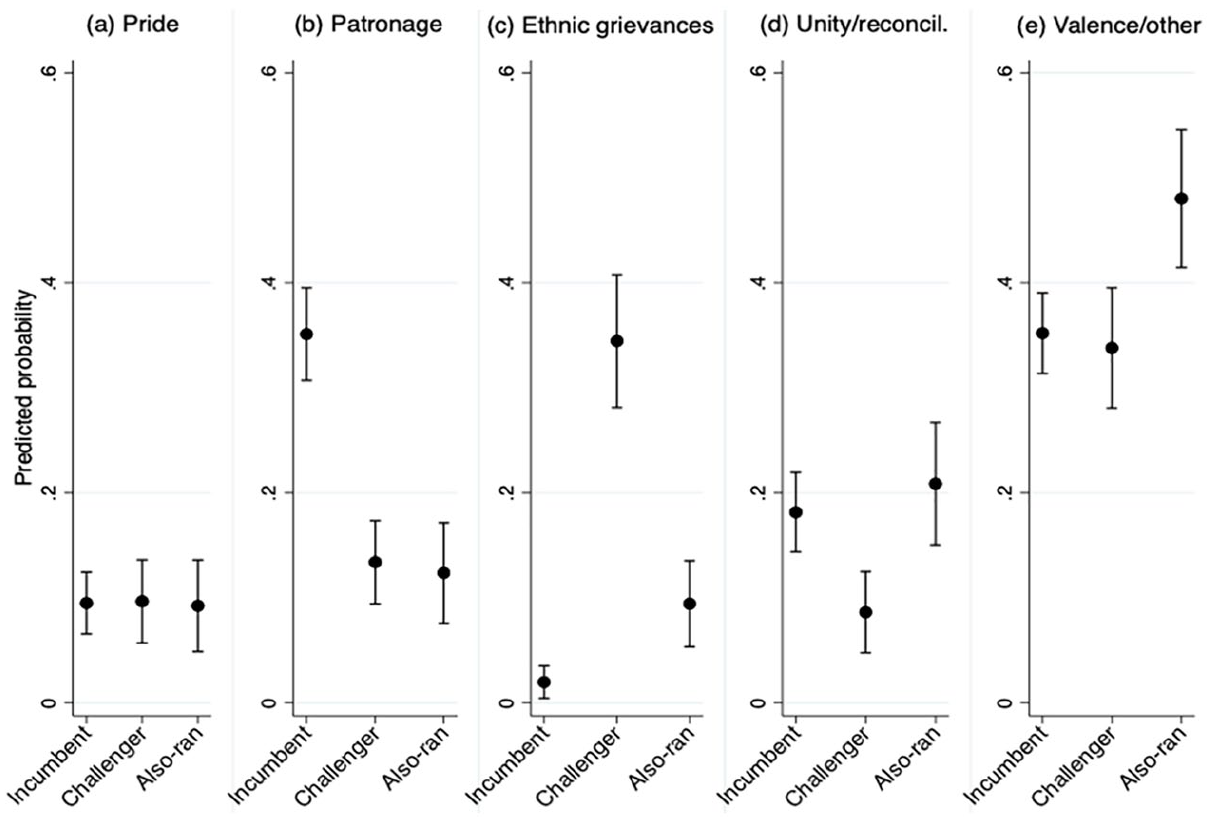
Predicted probabilities of the types of appeals by contender (95% CI).
Incumbents’ strategy combines offers of patronage with valence/non-ethnic appeals, while challengers most commonly use narratives of ethnically-motivated discrimination, victimization, and exclusion alongside valence and other non-ethnic appeals (Figure 4). In line with these findings, data on parties’ campaign expenditure in Kenya’s 2007 campaign shows that the incumbent PNU spent seven times more on “constituency support” for local development projects than the opposition ODM (Masime & Otieno, 2010). The Appendix provides examples of the various appeals coded and the codebook details how ethnic grievances are distinguished from broader accusations of corruption.
In contrast to the main challengers, also-rans stress peace, unity and valence issues. Much of the literature on African politics treats the opposition as a unitary actor and assumes opposition candidates engage in similar campaign strategies. I theorize instead that the incentives of the main challengers and other opposition candidates differ, which results in differences in their respective campaign outreach efforts: also-rans engage in less negative rhetoric and avoid alienating communities in the hope of joining the eventual winner. Further, the finding that also-rans make more valence appeals or appeals to non-ethnic issues and identities than the main candidates suggests that they may be seeking to distinguish themselves in additional ways: either by appearing as principled politicians and competent anti-corruption crusaders as has been the case with Kenya’s Martha Karua and Peter Kenneth for example, or by claiming ownership of non-ethnic issues, like Ghana’s Ivor Greenstreet campaigning to raise awareness of the plight of people with disabilities. 21
The same patterns are also clearly evident in data from rally recordings for the Kenya 2007 campaign. In the Appendix, I show results from the coding of 1,572 discrete appeals extracted from recorded speeches by politicians from the three main parties (PNU, ODM, and ODM-K) and compare the rhetoric of the incumbent PNU and challenger ODM in rallies held in the same non-core areas as close in time to each other as the data allows.
Did contenders tailor their messages to subnational variation in the salience of ethnicity and the presence of ethnic grievances? As the percent of the regional population identifying in ethnic terms in the year prior to the campaigns grows, so do attempts to fan ethnic grievances by challengers. The predicted probability of appeals stressing grievances by challengers almost triples over the range of the ethnic salience variable (Figure 5). 22
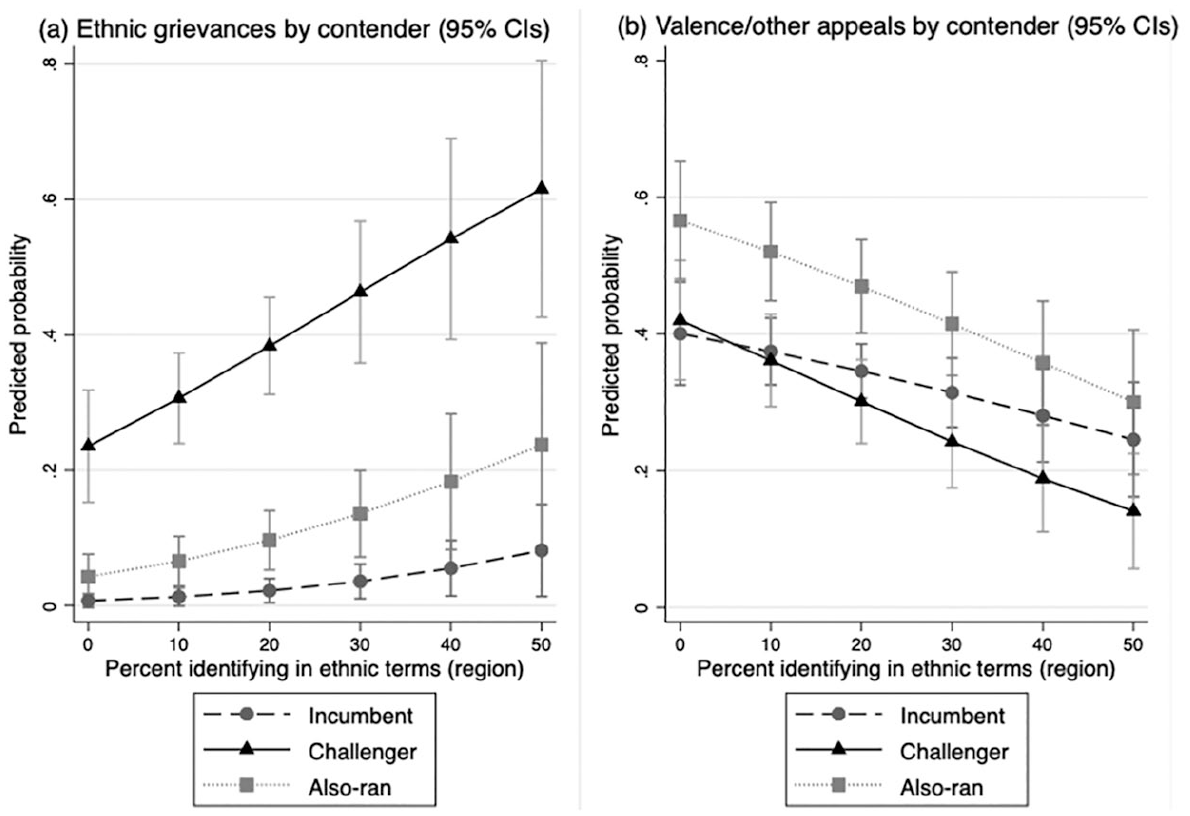
Campaign appeals at different levels of regional ethnic identification.
I also construct an ethnic grievance variable as a factor score of Round 3 Afrobarometer responses to questions 80a: “Ethnic group’s economic conditions relative to other groups,” 80b: “Ethnic group’s political influence relative to other groups,” and 81: “How often is [your] ethnic group discriminated by the central government,” aggregated at the regional level. 23 To avoid endogeneity, the variable is calculated using Afrobarometer data preceding the campaigns in each country. 24 Figure 6 shows that incumbents were more likely to offer material rewards and challengers to fan ethnic grievances in regions where there were subjectively-felt ethnic resentments prior to the campaigns.
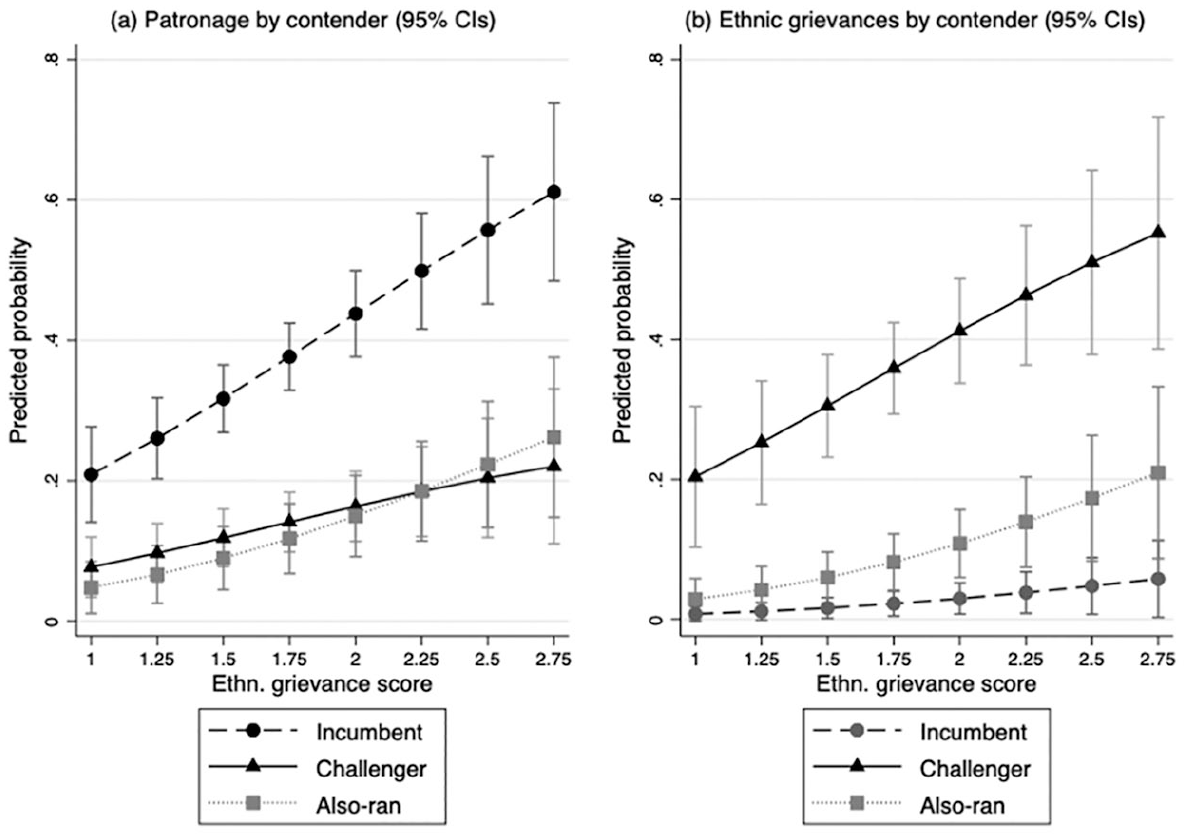
Campaign appeals at different levels of the regional ethnic grievance score.
The Appendix shows similar patterns for one additional regional variable of interest: relative poverty (Figure B1). Incumbents are more likely to offer material benefits and challengers are more likely to blame incumbents of ethnically-motivated discrimination, victimization, and marginalization as relative poverty grows within countries. This supports the argument that contenders take into account the potential of messages to resonate locally and adapt their strategies accordingly.
In sum, there are systematic differences in the types of cross-ethnic outreach not just between incumbents, challengers, and also-rans, but also in the strategies candidates pursue sub-nationally over the course of campaigns. The findings are in line with the theory of strategic incentives as a combination of relative credibility and message resonance developed in this paper. In the next section, I cite evidence from interviews with campaign strategists in Ghana and Kenya showing that message resonance and calculations of relative credibility were indeed the key drivers of cross-ethnic campaign outreach both in these, and in more recent campaigns
Evidence from Interviews, Country Case Studies, and Additional Campaigns
To gain insight into the strategic incentives and the reasoning behind appeals, I carried out interviews with strategists, campaign operatives and analysts in Ghana and Kenya with knowledge of both the 2008 and 2007 campaigns respectively, as well as subsequent races. I asked questions related to targeting decisions, the process through which parties arrived at messages, how they evaluated the relative strengths of competitors, and what they thought their candidate’s most effective messages were.
Campaign strategists in both countries confirmed that presidential candidates’ focus on the “swing” or “battleground” regions was a deliberate attempt to sway voters in the hope of winning the election: “battlegrounds are the only places where campaigns make sense.” 25 Campaigning for the base and the swing areas was characterized as a “two-level game”: lower-level party officials were tasked with mobilizing core voters, while presidential candidates were dispatched to other regions to attempt to persuade non-core voters. 26
Tailoring appeals to local realities was seen as the key to success in the battlegrounds. The process, through which campaigns arrived at themes and formulated messages, is revealing: it was common that before addressing non-core communities during campaign visits, presidential candidates met with local leaders (including chiefs and elders), and held broadly-attended “listening sessions.” Campaign strategists talked about “picking issues from the ground,”
27
of “adapting to local issues
Thus, campaigns in Sub-Saharan Africa are much more bottom-up and salience-oriented than existing theories allow. “Honing” campaign messages was seen as the best way to navigate the uncertainty of presidential races. In Kenya, analysts pointed to past miscalculations of both incumbents and the opposition as a major source of such uncertainty. 33 In Ghana, given also the razor-thin margins of previous elections, campaign operatives constantly fretted about the uncertainty of the electoral outcome and their hope that they “would get something [in terms of votes]” if they paid attention to what voters care about. In result, as a Kenyan academic put it: “everyone speaks to the local issues, but [the question is] who do you believe?” 34
I argue that relative credibility to deliver on what voters care about and the desire to maintain or challenge the status quo leads incumbents to privilege material inducements, challengers to fan grievances, and also-rans to abstain from attacking competitors. Much qualitative evidence and secondary literature can be cited in support of these patterns for the 2006 to 2008 campaigns in Ghana, Kenya, and Uganda, as well as for subsequent races. Incumbents often promised to “reward” constituents with the establishment of new districts, the unveiling of infrastructural projects (boreholes, roads, dams, hospitals, factories), group or sector-specific subsidies and bonuses, such as the ones made to cocoa farmers in Ghana and sugar producers and pastoralists in marginalized areas in Kenya, among many others. As one campaign strategist bragged, “we control resources and government, so we can take development to the people,” while another stated “appointments and projects are a big selling point [for us].” 35
Incumbent parties were of the opinion that most issues could be resolved through “projects” or “mega-projects.” An analyst characterized this approach as “development politics” but went on to add that “once you are in opposition, you cannot play developmental politics.” 36 On their part, opposition strategists were keenly aware of incumbents’ resource advantage and their inability to match it: “They [the government] focus on service delivery, which they have the capacity to deliver. . . [opposition presidential candidate] Raila cannot deliver the same.” 37
Instead, Odinga and the opposition ODM relied on a message of “common marginalization and immense historical injustices to unite communities against Kikuyu domination” in Kenya in 2007. 38 Such victimization narratives were seen as very effective ways to foster a strong common identity within communities: “when you feel threatened, you want to unite.” 39 One analyst summarized the essence of opposition campaigning in the following manner: “you try to create a personal bond by visiting an area, then exploit a perceived grudge [by saying that] the reason your road is not paved is because you are not the incumbent’s people.” 40 A campaign strategist characterized this approach as “the politics of redistributive justice” 41 in poorer rural areas.
In Ghana, apart from bringing up chieftaincy issues in the North, 42 the opposition promised to revise “unfair” land property laws, which “discriminated against the Ga-Dangbe people” in Accra. 43 The migrant Zongo communities were also targeted with remedial policies intended to exploit the resentments they hold against the NPP dating back to the Aliens Compliance Order issued by the Busia regime (the NPP’s precursor). 44
In contrast to the main challengers, also-rans frequently stressed valence and the need to bridge ethnic divides. In Uganda, Miria Obote of the United People’s Congress (UPC) issued an apology to the Buganda for historical injustices 45 and Ssebaana Kizito of the Democratic Party dropped his objection to a protestant being elected to Buganda’s highest office (katikiro). The independent Abwed Bwanika was widely suspected of being a front for Museveni because of his frequent praise for the president and refusal to articulate a specific electoral agenda. In Kenya, Kalonzo Musyoka publicly declared he was open to forming a post-electoral coalition with both Kibaki and Odinga and adopted a conciliatory stance on the divisive issue of “majimbo.” 46 In Ghana, campaign operatives from the smaller parties—the Convention People’s Party (CPP) and People’s National Convention (PNC) were candid about seeking to maximize their votes in order to leverage those for a position in government and their openness to forming a coalition with “the highest bidder.” 47
One clear implication from the theory is that a candidate will switch strategy once their position has changed. There is evidence to support this from campaigns across Africa. Kenya’s Raila Odinga opposed devolution when part of Kibaki’s government prior to 2007, but supported it once in opposition. In Ghana, the two main parties (the National Patriotic Party and the National Democratic Congress) have frequently switched positions on the Dagbon Chieftaincy dispute: urging for de-escalation and a peaceful resolution when in power, and fanning grievances and accusing the government of neglecting the issue when in opposition (Tonah, 2012). In Zambia—another highly-diverse presidential regime with salient ethnic cleavages - former president Michael Sata (an ethnic Bemba) opposed the Barotseland Agreement giving autonomy to the country’s Lozi tribe when in government prior to 2002, supported it in 2008 and 2012 when he was the main opposition presidential candidate, and again opposed it when elected president in 2012 (Gadjanova, 2017).
The trends laid out in the paper continue in more recent campaigns: Kenya’s current president, Uhuru Kenyatta, was described as “wooing the opposition-leaning Ukambani” and North Eastern regions with “a bag full of goodies.” 48 The NPP in Ghana, while in opposition in 2016, accused the ruling NDC of neglecting and ‘starving’ the people in the country’s North-Eastern region, 49 while the challenger-turned-incumbent Mahama was “giving out cars” in Yendi. 50
In sum, evidence from interviews with strategists and analysts with first-hand knowledge of electoral campaigns in Ghana and Kenya, and country case studies confirm the results of the quantitative analysis presented above. Similar patterns were identified elsewhere in Sub-Saharan Africa (Zambia) and also guide more recent electoral campaigns.
Conclusion
In this paper, I theorize and show empirically two main features of presidential campaigns in Africa’s highly diverse presidential regimes: first, that there are systematic differences in how incumbents, challengers, and other opposition candidates target non-core voters, and second, that candidates differ in the appeals they make to various communities over the course of a single campaign. I attribute these patterns to candidates’ relative standing in the race and differences in salient issues locally, which in turn determine what messages will resonate. To win, all candidates must court non-coethnics, but how they do so depends on whether they need to maintain existing coalitions or break them in an effort to form a new majority. Among aggrieved and impoverished groups, incumbents dish out goodies, while challengers fan grievances in order to peel voters away. Also-rans play the long game and avoid attacking competitors. In countries’ highly diverse urban areas and capitals, all candidates largely abstain from ethnic politics and focus on valence issues and appeals to non-ethnic constituencies.
What are the implications of these patterns for politics in Africa’s plural societies in the multi-party era? The research reveals a more complex picture of when and where ethnic divisions are exploited for political gain and what issues and cleavages are likely to dominate national debates and inform policies in these states. Smaller groups are not necessarily ignored or side-lined by presidential candidates seeking votes. And while such efforts may sometimes be dismissed as “cheap talk,” it is worth noting that Kenya adopted a devolved constitution despite opposition from the plurality group (the Kikuyus), and tribal issues salient to the Dagombas in Ghana and the Barotse Lozi in Zambia have featured prominently in recent presidential campaigns in the two countries despite the two groups being relatively small minorities nationally. The incumbent in Uganda, Museveni, granted the Bakhonzo tribe their coveted “obusinga” (kingdom) status after the issue had continuously been brought up by the opposition. Conversely, presidential candidates’ attempts to fan ethnic grievances and fears even while reaching across ethnic lines can increase polarization among “swing” groups and result in electoral violence, as Kenya’s 2008 crisis demonstrates.
This research also suggests that we need to rethink the notion of pivotal groups in Africa’s plural societies to take into account various communities’ likelihood of delivering the decisive vote. If presidential elections are close and candidates operate in conditions of uncertainty, pivotal groups need not be numerous, which could give even small minorities a potentially oversized influence in national politics.
There are also clear differences in the extent to which ethnicity dominates presidential campaigns in countries’ urban centers and capitals in contrast to ethnically homogenous and poorer rural areas. This trend is likely to continue as urbanization advances and underscores the importance of the relative salience of ethnic vis-à-vis non-ethnic issues and concerns, which varies sub-nationally. Assuming either that ethnicity alone dominates politics, or that countries “modernize out” of ethnic logics will obscure this sub-national variation. Whether ethnicity remains a dominant political cleavage in Sub-Saharan Africa and the form it takes in the future will depend on how successive governments handle perceived ethnic inequalities in recognition, representation, and redistribution, and not only on the relative size of the communities involved.
Supplemental Material
appeals_replication – Supplemental material for Status-quo or Grievance Coalitions: The Logic of Cross-ethnic Campaign Appeals in Africa’s Highly Diverse States
Supplemental material, appeals_replication for Status-quo or Grievance Coalitions: The Logic of Cross-ethnic Campaign Appeals in Africa’s Highly Diverse States by Elena Gadjanova in Comparative Political Studies
Supplemental Material
Appendix_CPS_web – Supplemental material for Status-quo or Grievance Coalitions: The Logic of Cross-ethnic Campaign Appeals in Africa’s Highly Diverse States
Supplemental material, Appendix_CPS_web for Status-quo or Grievance Coalitions: The Logic of Cross-ethnic Campaign Appeals in Africa’s Highly Diverse States by Elena Gadjanova in Comparative Political Studies
Research Data
appeals_data_web – Research Data for Status-quo or Grievance Coalitions: The Logic of Cross-ethnic Campaign Appeals in Africa’s Highly Diverse States
Research Data, appeals_data_web for Status-quo or Grievance Coalitions: The Logic of Cross-ethnic Campaign Appeals in Africa’s Highly Diverse States by Elena Gadjanova in Comparative Political Studies
Footnotes
Acknowledgements
I am grateful to Deborah Yashar, Paul Nugent, Leonard Wantchekon, Sandra Brunneger, Laavanya Kathiravelu, Amy Niang, Tamara Trost, Mathias Vom Hau, Madhavi Devasher, Jeremy Horowitz, Danny Choi, Michalis Moutselos, Alex Street, and Elizabeth Sperber for feedback and comments on earlier versions of this paper, and to Norbert Winnige for research help. I am deeply indebted to all my interviewees in Ghana and Kenya for their time, generosity, and insight. I also thank three anonymous reviewers and the editors for constructive feedback.
Declaration of Conflicting Interests
The author declared no potential conflicts of interest with respect to the research, authorship, and/or publication of this article.
Funding
The author disclosed receipt of the following financial support for the research, authorship and/or publication of this article: The research for this article was funded by grants from the Max Planck Institute for the Study of Religious and Ethnic Diversity, the Fritz Thyssen Foundation (2016-01129), and a Fung Global Fellowship from the Princeton Institute for International and Regional Studies.

Notes
Author Biography
References
Supplementary Material
Please find the following supplemental material available below.
For Open Access articles published under a Creative Commons License, all supplemental material carries the same license as the article it is associated with.
For non-Open Access articles published, all supplemental material carries a non-exclusive license, and permission requests for re-use of supplemental material or any part of supplemental material shall be sent directly to the copyright owner as specified in the copyright notice associated with the article.
