



Abstract
On a global scale, India ranks very poorly in terms of gender equality. This overall indicator masks important heterogeneities across the separate measures of female empowerment. India scores very highly with regards to equality of civil liberties and the political participation of women. But the country falls well below the global average with respect to equal access to economic resources and protection from gender-based violence. These poorer empowerment indicators have persisted not only in the wake of strong economic progress, but also in the context of an impressive set of government led reforms and policies targeting women. These different initiatives have successfully augmented women’s agency in both the private and public spheres of life, but women and girls still face extreme discrimination and violence. The salience of restrictive local customs appears to be a core hindrance towards transformative change. This paper reviews the economics literature which examines this complexity across the different dimensions of female empowerment in India. It highlights the newly emerging research focused on ameliorating gender biased norms and discusses potential steps forward.
Introduction
According to the Global Gender Gap Report (World Economic Forum, 2022), India ranks 135th worst out of a total of 146 countries in terms of gender equality. The Gender, Institutions, and Development Database (GID-DB) 1 breaks their gender equality indices into different spheres. With respect to equality of civil liberties 2 India ranks very highly, on par with the set of Western European countries. By contrast, the country falls well below the global average with respect to equal access to productive and financial resources, as well as discrimination faced within the family. But it is sixth worse globally with regard to protection from all forms of gender-based violence, which includes intimate partner violence (IPV), rape and sex-selective abortion.
Responses from nationwide individual-level surveys concur with these aggregate indices. A recent PEW Research Centre (2022) report reveals that a majority of Indians accept women as political leaders while at the same time favouring traditional gender roles in family life. A minority of the population (only 25%) report that men make better political leaders than women, but nine in ten Indians agree with the notion that a wife must always obey her husband. Moreover, Indian women are only slightly less likely than Indian men to be in accord with these gender-biased beliefs. In consequence, even though equality in the political sphere is accepted, it is not so in the economic sphere, where a large majority believe men should have greater rights to employment than women. Accordingly, an overwhelming majority of the Indian population (81%) believe that when a mother works for pay, the children suffer.
These divergent beliefs are reflected in the levels of political and economic participation of women in India. Gender equality in elected office has grown into a global commitment in recent years. India led the way in this endeavour more than 30 years ago when the 73rd amendment to the Constitution mandated that women fill a third of seats in the village-, block- and district-level councils of the Panchayati Raj Institutions. Further to this, at least a third of the offices of chairpersons of these councils were also reserved for women. More recently, a number of states have increased this female representation to 50%. 3 This high political representation contrasts enormously with women’s labour force participation, which remains exceptionally low compared to global levels, and has been on a downward trend over the past couple of decades. Estimated rates have dropped to as low as 21% in recent years; the global average is above 50%. 4
These stark differences with regard to female participation in political and economic activities make clear that female empowerment in India is a complex phenomenon. It is evident that female agency in the different spheres of life—political/economic; private/public; informal/formal—does not necessarily move in tandem, and this makes for complicated policy prescriptions. For instance, improving women’s agency in one sphere may lead to unintended consequences in another. These different dimensions interact and co-evolve with each other, ultimately leading to complex feedback mechanisms which are not very well understood. Added to this, there is extensive within-country heterogeneity with respect to the many facets of female empowerment, so that broad-sweeping pan-India interventions may lead policy astray.
This paper reviews the economics literature which highlights the complexity of the different dimensions of female empowerment in India. The paper begins with a discussion of the observed heterogeneity in these measures across the country, and the research aimed at explaining this variation. The next section reviews the literature that evaluates the impacts of recent policies and interventions aimed to improve female agency. What becomes clear is the salience of restrictive local customs as a core hindrance towards transformative change. The final section summarizes the newly emerging literature focused on ameliorating gender-biased norms and discusses potential steps forward.
Background
Regional variation in female empowerment indicators across India has long been observed. Boserup (1970) compared female labour force participation rates in agriculture, noting significantly higher rates in the southern and western parts of the country and identifying variation in traditional agricultural practices as a central explanation. 5 Subsequently, Dyson and Moore (1983) emphasized fundamental differences in kinship systems and marriage traditions which generated greater female autonomy in the southern states compared to the northern. 6 Other research highlighted the relevance of more formal doctrines, noting that the different schools of Hindu law, which prevailed prior to Independence, exhibited variation in their recognition of property rights for women, whereby the Dravida (Madras) and Maharashtra (Bombay) schools were somewhat more liberal (Agarwal, 1994; Halder & Jaishankar, 2008).
More recent work has considered the influence of the colonial period. Nandwani and Roychowdhury (2023) compare areas under British rule to the Princely states and note higher contemporary female empowerment measures in the former. The authors suggest that Western-inspired legal and institutional changes to improve the rights of women may explain this persistence. 7 In related work, Calvi et al. (2022) demonstrate how districts with greater historical exposure to Protestant missions are today characterized by more gender-equal literacy outcomes.
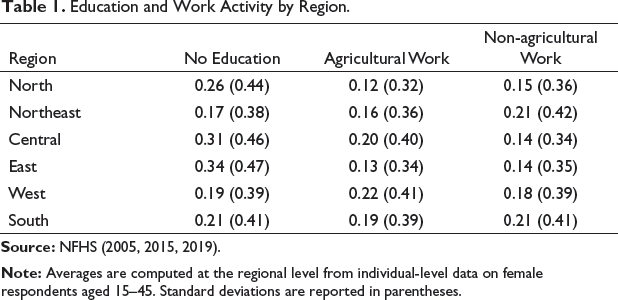
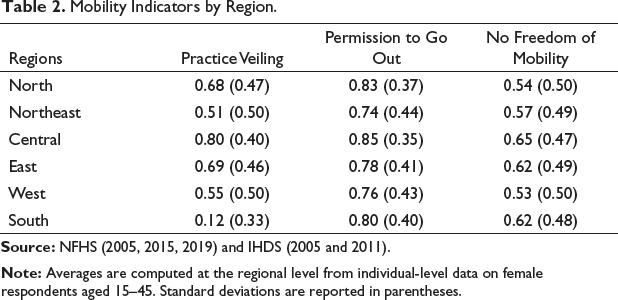
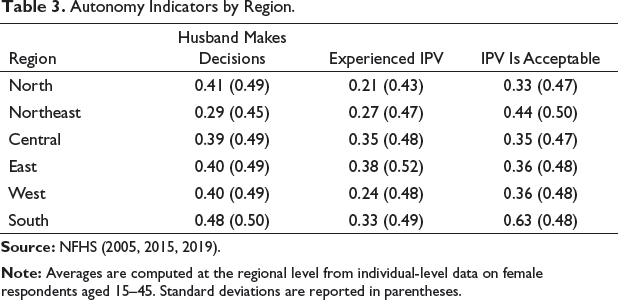
Tables 1 to 3 below document the variation we still currently observe across the main regions of India along several dimensions of female empowerment. 8 We will see that some of the purported historical patterns persist to an extent, but that there are also some unanticipated contemporary patterns. The tables report summary means (and standard deviations in parentheses) using individual-level data aggregated up to the region level using two main nationally representative surveys of adult women. 9
Education and Work Activity by Region.
Mobility Indicators by Region.
Autonomy Indicators by Region.
We begin with overall educational attainment. As seen in the first column of Table 1, there is significant regional variation with, for example, the proportion of adult women surveyed (between 2005 and 2021) with no education at all being highest in the central and eastern regions, where close to a third of women have not completed any schooling, and lowest in the southern and northeastern parts of the country. As reported in the Appendix, the data further reveal that the proportion of uneducated women has decreased across the last two decades, from 32% in 2005 to 23% in 2021. Across the board, the proportion of rural women who have no education is close to twice that of their urban counterparts.
The next two columns of Table 1 report whether women who are surveyed (between 2005 and 2021) are currently involved in either agricultural or non-agricultural work (in either the formal or informal sectors of the economy). Consistent with the historical patterns, we do see lower rates of participation in the North (a total of 27% of women working) relative to the South (a total of 40%). The incidence of females working is also relatively low in the eastern states. As reported in the Appendix, the data further reveal that the proportion of women working over the survey period has been declining, particularly those participating in agricultural work in rural areas. This decline is especially noticeable in the northern, central and eastern parts of the country. Researchers have aimed to understand why, in the context of increasing educational attainment (as well as declining fertility and rising economic growth), female labour force participation in India is generally in decline. Some work emphasizes structural changes (like increased mechanization of agriculture) and income effects whereas other research investigates the role of conservative gender norms. 10
This experience of restrictive social norms is evident in the first column of Table 2, which presents summary statistics on whether women report that they practice a form of veiling (ghungat/burkha/purdah/pallu). It is here that we find the starkest differences with regard to the South relative to the rest of the country. We see that only 12% of women practice veiling in southern states, whereas roughly 80% do so in the central region of the country. As reported in the Appendix, the data further reveal that, in general, veiling is more common in rural (60% across the country) compared to urban areas (47%), and there are further differences among culturally distinct groups. Veiling is more prevalent among the Muslim populations (84%) compared to Hindu (53%), and the incidence can increase with caste rank. For example, 62% of Brahmins practice veiling across the country compared to 57% of Dalits and 46% of Adivasis. But within cultural groups, there remain regional differences. For instance, among the OBC caste groups, 81% practice veiling in the North, 51% in the North East, 84% in the Central states, 76% in the East, 62% in the West and 4% in the South.
Although women in the South report to work more, and do not typically follow veiling customs, we see from the last two columns of Table 2 that southern women are equally likely to state that they experience restricted mobility. The second column reports on whether women require permission from their husbands to leave the home 11 and the third reports whether they are allowed to leave the home unaccompanied. 12 We see that across the board, the vast majority of women (more than 80%) require permission to leave their homes under typical circumstances and upon further investigation of the data (as described in the Appendix), these restrictions appear to apply to all cultural groups (by religion and caste) relatively equally. Correspondingly (as seen from the third column of Table 2), 60% of women must be accompanied when they do leave the home. Here the differences are also not too stark between rural and urban areas, where such norms still apply to more than 50% of urban women. With regard to accompaniment, there are some distinctions by cultural groups, but once again these are not sharp differences; for example, 57% overall for Hindu women and 67% overall for Muslim women (refer to the Appendix for more details).
The first column in Table 3 aims to capture relative decision-making in the household. The variable is equal to one if a female respondent reports that their husband alone typically makes household decisions. 13 Somewhat surprisingly, husband’s relative decision-making power appears to be highest in the southern states, even though this is where female work participation is highest. This unanticipated relationship is further reflected in IPV numbers. The second column of Table 3 summarizes whether the respondent has experienced any form of physical violence by their husbands. 14 The rates of IPV are highest in the eastern, central and southern regions of the country, where more than a third of women have experienced some form of IPV. The relatively low incidence in the North is somewhat unexpected, and one may conjecture that this is also a manifestation of lower female empowerment, leading relatively empowered southern women to be more likely to report violence. 15 However, this does not appear so given the evidence reported in the final column of Table 3, which reflects a measure of whether women discern IPV as acceptable. Women are defined as accepting IPV if they respond that it is justified for a husband to beat their wife under certain circumstances. 16 We see that overall, more than a third of women condone IPV and that these beliefs are surprisingly most common in the southern part of India, where almost 65% of women deem it justifiable. As demonstrated in the Appendix, this acceptance of IPV is generally higher in rural areas, but still also persists at high rates in urban areas.
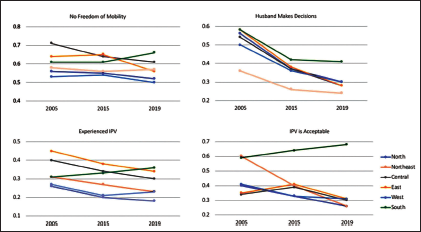
These tables make clear that women across India face significant restrictions on their autonomy inside their homes. Added to this, there are noteworthy regional differences and some disturbing new trends. Figure 1 depicts how some of these indicators vary across survey rounds. In general, there are some observed improvements, though some indicators remain relatively constant, like freedom of mobility. Of particular alarm is the increasing acceptance of IPV in the southern states.
Feedback Mechanisms
These poor indicators of female empowerment in the private sphere seem to persist, and may even have worsened, in some regions (like the southern states). These trends persist, not only in the wake of economic progress but also in the context of an impressive set of policies targeted towards women. In addition to India’s visionary female quota system in the sub-national political units, the country has been home to several large-scale legal reforms, as well as an extensive set of empowerment programmes.
There have been legal prohibitions against dowry since 1961, child marriage (before the age of 21) since 2006, pre-natal diagnostics since 1994, sati since 1987 and IPV since 2005. Women have been entitled to equal rights to remuneration since 1976 and inheritance since 2005. There are numerous government-led programmes addressing different facets of female empowerment, including introducing provisions into the education system; creating safe work environments; providing childcare; protection from violence in public and private spaces; access to financial platforms; and skills training. Added to this, there are countless NGOs devoting their efforts to the plight of women and girls.
These different initiatives have the great potential to augment women’s agency in both the private and public spheres of life. The observed sluggishness in improvements along several dimensions of female welfare may simply be that smaller initial efforts belie long-term impacts that take time to materialize. Alternatively, it could be that there are important feedback mechanisms inherent in reaching gender equality that we need to better comprehend. Female empowerment at the individual level interacts with household dynamics, societal norms and institutions. Women’s empowerment is driven not only by individual access to choices but also by societal acceptance of those choices. Moreover, given the complex picture of female empowerment in India laid out in the previous section, with different dimensions of female empowerment not necessarily moving in tandem, it is easy to anticipate that the consequences of targeted policies are correspondingly multifaceted. This section summarizes the economics literature which has aimed at carefully identifying those consequences.
Targeted Benefits
The past few decades have witnessed unprecedented changes in national-level policies, state-initiated changes and NGO-driven interventions to benefit women. Economists aim to empirically identify the consequences of these programmes and initiatives.
At the national level, researchers have been able to exploit the staggered timing of policy changes across states, and the fact that they typically apply differentially to distinct groups (defined by age or religion) to isolate effects. Amendments to the Hindu Succession Act of 1956 (implemented differentially across states between 1976 and 1994), which increased inheritance rights to daughters, are a well-studied case. These improved legal rights appeared to have led to increases in female labour supply and autonomy (Heath & Tan, 2020) and larger investments in girl education (Deininger et al., 2013; Roy, 2015). Researchers have likewise exploited staggered amendments to the Dowry Prohibition Act between 1985 and 1986 as a natural experiment. These amendments, which tightened existing anti-dowry legislation, were successful at reducing dowry payments (Alfano, 2017) and further led to increased female human capital investment (Calvi & Keskar, 2023).
Not only was India a world leader in instigating large-scale female quotas into local politics but the rotational selection of voting wards across election cycles rendered these the most extensively studied natural experiments for analysing the direct impact of placing women in leadership positions. Mandated female political representation has been shown to impact the types of public goods and expenditures chosen by village governments, and hold local officials more accountable (Chattopadhyay & Duflo, 2004; Deininger et al., 2014); increase the educational attainment and aspirations of girls (Beaman et al., 2009; 2012); reduce the incidence of child marriage (Castilla, 2018); expand female entrepreneurship, NREGS participation and access to land rights (Bose & Das, 2017; Brule, 2020; Ghani et al., 2014); improve female political engagement and sustain their political representation (Bhavnani, 2009); and refine male perceptions towards women in leadership positions (Beaman et al., 2009).
The sequential roll-out of large-scale programmes such as MGNREGS enabled researchers to quantify impacts. Access to guaranteed employment periods, as well as equal wages paid to both men and women, increased female labour force participation, food security and household decision-making power (Afridi et al., 2016; Carswell & De Neve, 2013; Khera & Nayak, 2009). 17
The growing movement of self-help groups (SHGs), brought in by the National Rural Livelihoods Mission of India, has been targeted to poor women. Female-run SHGs are typically set up for collective credit and financial support. By exploiting randomized implementation of the programme across villages, researchers have been able to ascertain impacts. Increased female participation in savings programmes is correspondingly observed (Desai & Joshi, 2014; Hoffmann et al., 2017), as well as higher female empowerment scores (Kumar et al., 2021). There is further evidence of significant behavioural shifts such as increased willingness to pool risk (Feigenberg et al., 2013), greater social capital formation and civic engagement amongst women (Desai & Joshi, 2014; Feigenberg et al., 2014; Kumar et al., 2019; Prillaman, 2023).
Smaller-scale interventions to aid female entrepreneurship such as microfinance and skills-based training have also been evaluated through randomized control trials with researchers working in conjunction with MFIs and NGOs. Banerjee et al. (2015) evaluate access to the canonical group-loan product for women 18 in Hyderabad and find that treatment women did increase their borrowing and were more likely to open and invest in a business. Field et al. (2013) evaluated individual-liability loans to female entrepreneurs in poor neighbourhoods of Kolkata and also found increased business-related expenditures.
Often these credit-style interventions are accompanied by a form of skills-based training. The study by Desai and Joshi (2014) on the implementation of SHGs also offered vocational and financial training services, the authors highlight that it was this component of the intervention which led to increasing the access to labour and credit markets for women. Banerjee et al. (2015) analyse an RCT which implemented the BRAC’s ‘graduation’ programme which provides a multifaceted set of services, including enterprise-related training as well as general life skills coaching. The programme typically targets female household members, and this programme was demonstrated to be successful in terms of increasing household economic status, and at least temporary improvements to female empowerment indicators. Digging deeper into these issues, Field et al. (2016) randomly allocated a two-day business counselling programme to female bank clients in Ahmedabad, Gujarat. The researchers varied whether a friend could accompany women to the training. Women who attended with a friends were more likely to take out a business loan, shift to entrepreneurial activities and also reported higher household income. The impacts were particularly strong among women belonging to social groups with more restrictive gender norms. Accessing social networks seemed to play a crucial role in alleviating the constraints faced by these women.
Unintended Consequences
As the previous section demonstrates, there is ample evidence speaking to the success of a diverse set of programmes targeting different dimensions of female empowerment. We do, however, need to remain mindful of the potential backlash effects within families in response to women’s increased agency and expanded economic prospects. Since marriage is almost universally observed in India, women typically reside in joint households. So any policy directly targeting individual women also impinges on the dynamics of household behaviour. Because of this, the effects of a single policy can be complex. Targeting individual women with economic benefits alters dynamics within the household, and can have broader societal impacts.
Economists model this behaviour by assuming that household members have different preferences, with preferences impacting household decision-making in heterogeneous ways, and the strength of one member’s impact depending on their relative bargaining power and the quality of their outside options. Therefore, placing economic resources directly into the hands of women will in turn increase their agency within their household. This simple conceptual framework is very consistent with overall policy aims and with the empirical evidence described in the previous section. However, this simple and benign household bargaining framework appears in reality to be much more complicated. In particular, the potential for heightened household conflict appears pervasive.
The standard model of household decisions as a bargaining process assumes members have full information and are able to perfectly communicate. However, there is significant empirical and experimental evidence to the contrary. The ability (and willingness) to conceal information appears critical to affecting how resources are allocated. Castilla (2019) evaluated an experiment amongst married couples in Uttarakhand which speaks directly to this issue. The author tested whether spouses would select to hide information from their partners at the expense of maximizing household income. A significant proportion chose to hide the information and forgo the increased returns from a household-level account.
Aside from information asymmetries, there is evidence that husbands (and possibly other family members) expropriate the resources directed towards wives. This has been a core explanation for why, in many settings, it has been found that female-operated micro-enterprises do not seem to benefit directly from access to cash grants. Bernhardt et al. (2019) demonstrate, from a sample of women from low-income neighbourhoods of Kolkata, that capital directed towards female entrepreneurs is often allocated to other household enterprises (primarily male owned). 19
A more complex model of household dynamics may also explain why, although microfinance has indeed increased the potential to help women grow their individual businesses, in most cases it does not lead to significant increases in female income, household consumption or reductions in poverty, nor are there clear direct impacts on female autonomy measures (Banerjee et al., 2015; Bernhardt et al., 2019).
These findings suggest that successful policies to improve female empowerment not only need to target women but also protect their accrued benefits from husbands (and other household members). Field et al. (2021) worked with banks in Madhya Pradesh to open individual accounts for women to receive their MGNREGS wage deposits. Access to these private accounts, together with training on how to use them, was demonstrated to increase recipient women’s labour supply.
In general, evidence suggests that the programmes proven to be most successful in improving women’s economic empowerment were designed to enable women to hide decisions from their spouses (Chang et al., 2020). This design feature is not well suited to long-term development strategies and may also lead to significant unintended consequences.
Research does show that in some contexts, development programmes that aim to benefit women and girls may not ultimately empower them and can even reinforce their lack of power. A channel would seem to be via female economic empowerment increasing the potential for conflict within the household. There is indeed mounting evidence of a backlash effect. Increasing resources available to women may strengthen men’s incentives to use violence, or threats of violence, in order to control these newly obtained resources. Alternatively, improving women’s outside options can challenge the socially prescribed dominance of men and trigger a male backlash.
Using data from rural Karnataka, Bloch and Rao (2002) demonstrate how husbands are more likely to beat their wives when the wife’s family is rich because there are more resources to extract and the returns are greater. In related work, Luke and Munshi (2011) show how a relative increase in female income leads to an increase in marital violence in a sample of tea estates in South India. Exploiting district and time variation in the implementation of NREGS, Amaral et al. (2015) show how increased access to female employment in turn increased gender-based violence (kidnapping, sexual harassment, domestic violence and dowry deaths). On the other hand, Chin (2012) found some evidence supporting the backlash or extraction effects when women engage in agricultural labour, but that there was an overall reduction in violence primarily due to exposure reduction—the more time women spent outside of the home working, the less contact with their potential abuser within the home.
Calvi and Keskar (2023) find that the amendments to the Dowry Prohibition Act ultimately led to a decline in women’s bargaining power and an increase in domestic violence. The improved inheritance rights associated with the amendments to the Hindu Succession Act also led to a series of unintended consequences including higher dowries (Roy, 2015), increases in female foeticide, female child mortality and son-biased fertility stopping rules (Bhalotra et al., 2020; Rosenblum, 2015), as well as higher relative suicide rates for married women (Anderson & Genicot, 2015).
This latter finding by Anderson and Genicot (2015) demonstrates that the impacts of costly conflict in the household may extend to both genders. They show that the improved female property rights in India lead to increases in both male and female suicide rates (but by more for women). This highlights the extreme psychological costs that may temporarily arise, for both men and women, when policies suddenly oppose conservative gender roles. In this sense, increasing relative female economic empowerment plays out in both private and public spheres, suggesting that backlash reactions from husbands, or other male family members, may not just be an effort to control household resources but a resistance to changing gendered norms.
Gendered Norms
Most of the unintended consequences in India which follow from female-focused policies appear rooted in sticky gender-biased norms. Challenging the long-standing restrictions which constrain the choices of women seems to be a central hindrance to unleashing the potentially transformative effects from female-targeted policies. In some sense, gendered norms are fundamentally different from other norms in that they can be construed as zero-sum: if more is given to women, this often comes at the expense of men. It could be why backlash seems ubiquitous and needs to be seriously considered.
One approach is to try to avoid increasing conflict in the household. With regard to individually targeted economic benefits, a strategy is then to hide the newly accrued resources from husbands: in the form of a female-owned bank or mobile-money accounts, or in-kind transfers for female-use only. However, unlike physical resources targeted towards women, skills-based training cannot be as easily expropriated. Given this, one might expect that training interventions are a more promising route with regard to delivering longer-term benefits. Community-based interventions could also potentially witness less conflict. Empowering women as a group, outside of their own households, could minimize individual-level conflict. Encouraging female networks (say through SHGs) as a source of broader female empowerment could be more effective than a single woman challenging her husband on her own.
Another approach is to aim to change norms directly. There is research documenting how simply increasing exposure to less-biased gender norms leads to dramatic changes in behaviour. Jensen and Oster (2009) analyse the introduction of cable television into rural villages across several Indian states and observe significant changes in gender attitudes with women being less likely to report that IPV is acceptable, and also experiencing increased decision-making autonomy and greater mobility. The most popular cable programming featured urban settings where female lifestyles differed in influential ways. Likewise, Agte and Bernhardt (2023) show how in Adivasi majority villages (in Central India), women from other caste groups report behaviours consistent with greater freedom of movement, in accord with the norms of the dominant Adivasi groups but contrary to their own traditional practice of purdah.
Role models and leaders can also have an influencing role. The study by Beaman et al. (2009) demonstrates how exposure to female politicians led to a change of perceptions with respect to male beliefs in the effectiveness of female leaders. The follow-up study by Beaman et al. (2012) further showed how just witnessing women in leadership positions also improved not only the aspirations of girls themselves but also how their parents perceived their own daughter’s potential.
On the other hand, experiencing greater agency can also lead to shifts in beliefs. The intervention by Field et al. (2021), where increased access to private bank accounts induced greater participation in the workforce, in turn, led to more liberalized gender norms in the long run. Targeted women grew more accepting of female work and their husbands perceived fewer social costs to having a wife who works. These findings were concentrated in households for women with little prior work experience.
Another approach is to directly intervene in changing gender-biased attitudes. With this strategy, attitudes are perhaps most malleable at the adolescent stage. Dhar et al. (2022) analysed an intervention, randomly introduced into select secondary schools in Haryana, which engaged students (male and female) in regular classroom discussions around gender equality for two years. The programme resulted in more progressive gender attitudes, particularly for boys. Leventhal et al. (2015) studied a resilience-based programme (to identify strengths and plan goals) for middle-school girls in rural Bihar, which brought about improvements in several psychosocial indicators. Sharma (2022) introduced class-based sexual harassment awareness training for male students, which led to some reduction in the incidence of sexual harassment, at least in the short run.
Other experiments target adult women and their families. Light-touch video interventions, informing women’s family members on the benefits of employment (Dean & Jayachandran, 2019; McKelway, 2021), do not appear to lead to significant long-term changes in attitudes. Neither were there persistent improvements in gender attitudes resulting from an intervention which targeted married men with male healthcare providers being the informants (Fleming et al., 2018).
Group-based support initiatives are also currently underway. In Bihar, Jejeebhoy et al. (2017) studied an intervention which engaged SHG members in prevention methods against IPV. Female group members as well as their husbands were the targets and there were changes in masculine controlling behaviours and some improvement in gender role attitudes. Unlike the previous household-level studies, there was no extensive examination as to whether these effects persisted in the longer term.
Other interventions are at the institutional level. In Madhya Pradesh, Sukhtankar et al. (2022) analysed the introduction of women’s help desks in police stations. The researchers detected an increase in registrations of crimes against women but that deep-seated police attitudes about gender did not appear to shift. In related work, Amaral et al. (2021) exploited the staggered introduction of women police stations across India. These stations are staffed with female officers specialized in handling crimes against women. The authors find that the opening of such stations lead to an immediate and persistent increase in reported violence against women. 20 The authors conclude their presence encouraged reporting as opposed to increasing incidence rates.
Discussion
India has an impressive record of policies and legal reforms aimed at increasing women’s agency in all spheres of life. Significant progress has ensued, but women and girls still face extreme discrimination and violence. 21 A core hindrance appears to be inherently biased norms with regard to women’s place in the family. When a majority of the population follows strong patriarchal norms, the potential for negative repercussions from challenging these views is vast.
Progress can be made by policy interventions aimed at directly changing these views, but we need to be cautious of the paternalistic nature of this endeavour. Added to this, using the template of pro-women norm shifts in the history of developed countries should not necessarily serve as a normative guide for policy elsewhere. There is little reason to expect that cultural changes in India will mimic the paths followed in the West. The heterogeneity in how such norms appear to be changing within the developed world today also suggests that local cultures may persist or change in differing ways under similar economic pressures. Added to this, the timing of structural changes is different. India experienced an expansion of education and growth in the service sector at much lower levels of development than when they took off in the West. The legal context is also markedly different. The formal legal structure is more progressive and favourable to women than the corresponding legal structures that prevailed at comparable levels of development in the West. At the same time, inherently gender-biased norms coexist such as purdah, sex-selective abortion, dowry violence and child marriage. These norms were not widely present in today’s developed countries during their transition to pro-women norms.
We also need to be mindful of the re-emergence of regressive gender norms in response to formal policy changes. An example is the custom of haq tyag (sacrifice of rights), practised in parts of Rajasthan, Uttar Pradesh, Haryana and elsewhere. These involve women legally relinquishing their newly awarded claims to ancestral property. Also, the phenomenon of Sanskirtization (or Brahmanization), where lower castes emulate the social norms of upper castes groups, may explain some of the contemporary patterns. Several gender-biased practices, such as dowry and purdah, were traditionally associated with upper caste groups but have since spread amongst the lower castes.
The traditional relative economic standing across the strict caste hierarchy in India has been challenged by decades of affirmative action policies and emerging opportunities. Yet, the social caste hierarchy remains relatively robust, due in part to the persistent practice of caste endogamy. 22 When relative caste rank is no longer defined by relative economic status, the salience of caste-specific rituals and behaviours, which delineate the social groups, are paramount for the endurance of the caste system. In this sense, newly acquired economic status among lower caste groups could coincide with growing incentives to adopt the practices of the higher caste groups in order to secure a higher social rank. This could imply that a precursor to significant shifts in attitudes towards women’s role in the family is that caste (jati specifically) ceases to determine marriage patterns.
In general, our understanding of gender norm formation and evolution (in India and elsewhere) is quite nascent, and it is important to fully appreciate the complex feedback mechanisms inherent in shifting long-standing societal beliefs. Some long-term changes may not require risking major turmoil, others may lead to significant social upheaval. Disruptions with respect to beliefs about gender are distinct from other attitudes, say towards other caste groups, in that they play out in both the private and public spheres of life. Any large-scale challenge to societal-level norms also has repercussions within the family. Norms and rules dictating family relations have greater contact with the personal lives of individuals, relative to rules that outline economic and political rights. As such, family behaviours are often held sacred and the slowest to evolve.
Supplemental Material
Supplementary material for this article is available online.
Supplemental Material for The Complexity of Female Empowerment in India by Siwan Anderson, in Studies in Microeconomics
Footnotes
Acknowledgement
The author would like to thank Prerna Kundu for excellent research assistance.
Declaration of Conflicting Interests
The author declared no potential conflicts of interest with respect to the research, authorship and/or publication of this article.
Funding
The author would like to thank the Social Sciences and Humanities Research Council of Canada for financial support.
Notes

References
Supplementary Material
Please find the following supplemental material available below.
For Open Access articles published under a Creative Commons License, all supplemental material carries the same license as the article it is associated with.
For non-Open Access articles published, all supplemental material carries a non-exclusive license, and permission requests for re-use of supplemental material or any part of supplemental material shall be sent directly to the copyright owner as specified in the copyright notice associated with the article.
