




Abstract
The current international approach to child marriage is the complete prohibition of marriage under the age of 18. Child marriage is considered a problem internationally, and those who practice it tend to be viewed as ‘traditional’, that is, insufficiently modern. This article aims to challenge this viewpoint, by discussing data that show that these young people use under-age marriage as a solution to navigate the modern world in which they live. As child marriage is rather a symptom of unplanned pregnancy outside of wedlock, the policies and programs should be redirected to address this root cause.
Introduction
Girls Not Brides (2020a, 2020b), a global network of over 1000 civil society organizations that are committed to end child marriage, defines child marriage as marriage below the age of 18. International development organizations tend to frame child marriage as a human rights violation and an obstacle to global development, perpetuating poverty, inequality, and insecurity (Equality Now, 2014; Girls Not Brides, 2020a, 2020b). Throughout their campaigns, those international organizations heavily emphasize what they consider negative consequences of child marriage (e.g., female genital mutilation, domestic and sexual violence, exploitation as domestic services, reduced educational opportunities, health hazards and sex trafficking; Equality Now, 2014, p. 5). Bunting and Merry (2007: 330) have argued that child marriage is salient by being at the intersection of various themes on the human rights agenda (e.g., slavery, health hazards of traditional harmful practices, violence against women, and child welfare).
Most human rights advocates argue that child and early marriages are by definition ‘forced marriages’, even when the child appears to give his or her consent (Equality Now, 2014: 53). The reasoning behind this argument varies. The United Nations Children’s Fund Innocenti Research Centre (2001) bases its argument on the UDHR, which recognizes ‘the right to free and full consent to a marriage’ and claims that consent cannot be ‘free and full’ when at least one partner is ‘immature’. The CEDAW Committee comments, ‘[w]hen men and women marry; they assume important responsibilities. Consequently, marriage should not be permitted before they have attained full maturity and capacity to act’ (UN Committee on the Convention of the Elimination of All Forms of Discrimination Against Women, 1994: para 36). UNICEF Indonesia (2015) clarifies that even if the child consents to their marriage, it is to be considered a forced marriage, as such ‘consent’ is an outcome of prevailing social norms whereby children are expected to marry as children.
As shown in Horii’s (2019a) analysis on major international organizations’ reports, despite a large number of campaigns and reports on this topic, the definition, discourse, and the relevant legal rules regarding child marriage remain uniform, unchallenged, and simplistic. This generalizing approach to child marriage risks encouraging a ‘right discourse’ (Grugel, 2013: 20), which focuses on individuals who have been deprived of their ‘rights’. Grugel argues that the rights discourse risks detracting attention from underlying structures that shape inequalities and their reproduction (Grugel, 2013: 20). As argued elsewhere, aiming to ‘end child marriage’ altogether is not an effective approach (Horii, 2018), considering that types and motivations for child marriages are diverse (Horii and Grijns, 2019). Boyden et al. (2012: 520) have also highlighted the risk of the abolitionist approach, which could neglect the most critical social and economic problems. What then are the motivating factors for child marriage to which we need to redirect our attention?
Several studies show that zinah (extra- and pre-marital sexual intercourse) is a significant contributor to child marriages in Indonesia. For instance, in West Java, parents go to Islamic court to ask for marriage dispensation (legalization of marriage below the legal marriageable age, currently 16 for girls and 19 for boys) to marry their young children, in order to avoid zinah (Horii, 2020). Ethnographic research in a village in West Java by Grijns et al. (2016) confirmed that the key element in most child marriage cases is fear of committing zinah. A 2015 study by Rumah Kita Bersama also showed that in 36 out of the 52 studied cases of child marriage, the marriage was motivated by pregnancy (Marcoes and Dwianti, 2016). Zinah is also used as a political discourse to advocate for child marriage. In 2014, when human rights advocates started a petition for judicial review at the Constitutional Court to raise the marriageable age for girls from 16 to 18, representatives from major Islamic organizations in Indonesia argued that maintaining the current marriageable age was a solution to prevent ‘free sex’—a word commonly used in Indonesia to criticize any kinds of sexual relationship before marriage. These data suggest that sexual norms and behaviors are the crucial factors to address child marriage practice. This article uses empirical data to investigate this factor, drawing on real-life case histories of child marriage studied during the author’s fieldwork in Bali.
Following this introduction, Section II introduces the conceptual framework used in this article, namely, modernity, normative systems, and agency. Section III clarifies the research context, adolescents’ sexuality, and its morality in Indonesia and Bali, based on previous research done in the area. After explaining the methodology used in Section IV, Section V discusses the data from the author’s fieldwork in Bali, drawing attention to a normative gap that is observed between teenagers and the older generation today. By characterizing modernity with the expansion of life choices now available to the youth, the author explains the plurality of the normative system adolescents live with. The conceptual framework developed in Section II is used to understand the influence that the pluralized normative system has in adolescents making decisions about marrying at an early age. The conclusion considers implications for policy and programs addressing child marriage.
Conceptual Framework
To analyze the structural reasons why young people are marrying, the author uses a conceptual framework consisting three elements—modernity, normative systems, and agency. This section explains these three concepts and the linkages between them.
Modernity
Modernization theory, which has focused on studying global social change and consequences of the spread of ‘modernity’, has been widely criticized for its high levels of abstraction and the confinement to the ‘West’ (Chong, 2007; Schmidt, 2010). On the one hand, the ‘myth’ of modernity has led to misperceptions about the non-Western countries (see, for instance, Ferguson, 1999). On the other hand, ‘modernity’ has become a truly global phenomenon (Schmidt, 2010) and what Giddens (1991) conceptualizes as ‘late-modernity’ could be a useful analytical tool to examine the impact of globalization and information revolution. This conceptualization of modernity has been used to analyze the contemporary life of Indonesian youth (Smith-Hefner, 2019: 174), and Section III of this article applies this framework in the Indonesian/Balinese context. According to Giddens (1991: 6), the modern world is where social life is ‘open’ with multiple lifestyle choices. Consider the educational opportunities that are increasingly available to young generations in Bali. ‘Children are already open (terbuka). They want to continue with school, and they want to continue until university’, a lawyer working for social programs told me. The wide variety of life choices now open to these individuals emancipates them but also can threaten traditional communities and creates a normative gap between generations. Parents and children today have different perspectives on the world, lifestyles, courtship, and marriage. The ‘relational self’, which is shaped by ties to traditional kin and community (Merry, 2009: 404), becomes conflicted with one’s desire for the ‘new world’.
Pluralized Normative System
Emancipation and increasing individual autonomy are at the core of modernity, which implies individual detachment from the traditional identity, which is externally shaped by custom, religion, and family. Giddens (1991: 6) describes this as the ‘openness’ of social life in modernity, which consequently forces individuals to navigate a diversity of options and of contexts of actions. Here, each individual’s normative system becomes pluralized. Interestingly, such changes are also dangerous, in that feelings associated with sexual and marital life become more mobile, unsettled, and open (Giddens, 1991: 13). In a modernizing world where the power of the traditional structures is arguably undermined, individuals have to guide themselves across fragile ground.
To unpack this phenomenon of pluralized normative system, the author uses the socio-psychological concept of ‘reference network’. A reference network is defined as a set of individuals whose actions and opinions we care about when we make our choices (Bicchieri, 2016: xiii). We constantly observe what others do, and from these observations, we get clues about appropriate behavior, other’s preferences, beliefs, and so forth. Accordingly, individuals prefer to conform to the socials norms of their reference network. They prefer this on the condition that (a) they believe that most people in their reference network conform to it (empirical expectation) or (b) that most people in their reference network believe they ought to conform to it (normative expectation; Bicchieri, 2016: 41–51). What Giddens (1991: 6) calls the ‘diversity of authorities’ can be explained as the multiplication of an individual’s reference networks.
Agency
How then do adolescents make decisions for their lives in their co-existing, and often conflicting, reference networks? Gidden’s notion of agency considers persons as reflexive beings and agency as a capacity to observe one’s experience and give reasons for one’s actions (Tucker, 1999: 80). Individuals can then both resist ‘structures’ (i.e., rules and patterns of social relationships) and consciously follow the rules from different reference networks. This is consistent with Mahmood’s (2004: 15) concept of ‘agential capacity’ that is entailed not only in acts that resist norms but also in the multiple ways one inhabits norms. Some adolescents are in between contemporary and customary ideas of sexuality and marriage. Such adolescents’ marital decision should be considered in light of ‘relational autonomy’ and how much their autonomy is limited by corrosive disadvantage (e.g., social, political, economic, and educational) or coercive, abusive, or violent social relationships (Mackenzie, 2013: 43).
This understanding of autonomy or agency is useful towards overcoming the dismissal of agency of women in developing areas (Mohanty, 1984). Alongside respecting non-western women’s agency, there is also an increasing need to respect children’s agency (Bourdillon, 2004). The common protectionist approach of ‘saving’ children is increasingly considered unproductive, as it deprives those under 18 of agency and choice (Grugel, 2013: 23; Hart, 2006). For instance, in her study on Senegalese young women, Newman (2020) indicates that development programs and education scholars tend to fail to respect their aspirations to marry and to leave school early. In this sense, the agency of girls in the Third World is the most precarious in international development discourse. Recognizing the relational aspects of agency and ‘relational self’ is a way to ‘open up space for the agency of non-Western peoples’ in development discourse (McEwan, 2001: 95) and to challenge paternalistic notions of development that rely on ‘assumptions of superiority, linear progress and Western women’s freedom’ (MacDonald, 2016: 6).
Research Context
Modernity, conceptualized as the expansion of life choices now available to young people, elucidates the link between child marriages and adolescents’ sexual behavior. Factors such as increased educational opportunities and mobility and an expansion of choices and social networks for youngsters distinguish today’s young generation from their elders’ generation. In Indonesia, like many other countries of the Global South, the younger generations today are better educated than the previous generation (Naafs and White, 2012: 10). In Bali, too, both boys and girls are now seeking higher educational opportunities and engage in career planning. An increased prevalence of mobile-phone usage gives youngsters access outside of their communities and provides tools to communicate with their love interests via texts. As Naafs and White (2012:16) highlighted, young people who have access to cell phones and the Internet can connect themselves to a wider world. Since this new lifestyle is often incomprehensible to parents, it regularly becomes subject to moral panic (Bennett, 2013; Harding, 2008) and is criticized by the older generation for embodying excessive materialism, individualism, and a loss of important cultural and religious values (Naafs and White: 13–14). This expansion has led to increasing freedom in terms of dating patterns. For example, ECPAT International, an NGO network, released a report mentioning a growing number of children’s ‘love marriages’, as a result of increasing educational opportunity and mobility (Chaudhuri, 2015).
Statistical data have highlighted trends in recent marriage patterns of young people including the rise in female (mid to late) teenage marriage in urban areas. First, Jones’s research analyzed the difference in 2005 marriage patterns between a 20–24- and 50–54-year-old female cohort (Jones and Gubhaju, 2008). The younger cohort had almost half the number of teenage marriages, but more marriages in their late teenage years (i.e., aged 18 and 19; Jones and Gubhaju, 2008). UNICEF Indonesia (2016) also finds that the number of marriages increased amongst girls aged 16–17 between 2008 and 2012. Second, the 2013 National Household Survey shows a slight increase in child marriage rates in Indonesia between 2010 and 2012, associated with an increase in urban child marriage rates since 2008 (Badan Pusat Statistik, 2016). Between 2008 and 2012, the child marriage rate steadily decreased in rural areas (33.5%–29.2%) while increasing in urban areas (18.8%–19.0%; Badan Pusat Statistik, 2016). A comparison of 2008 and 2012 census data revealed that the child marriage rate increased in nine provinces, including DKI Jakarta (12.8%–14.9%) and Bali (15.9%–16.5%; Badan Pusat Statistik, 2016).
One of the possible explanations for the puzzling rise in urban female teenage marriages is the changing lifestyle and consequent anxiety about moral decay. While some middle-class Indonesian youth are calling for their sexual rights (Bennett and Davies, 2014: 9), at the same time any types of sexual relationships outside of marriage have always been considered to be in need of surveillance (Davies, 2014). In a society like Indonesia where pre-marital sex is a religious sin, the rising pre-marital sexual activities are regarded as a threat to traditional Indonesian cultural and religious values. In relation to this, the social anxiety associated with adolescents’ sexual behavior pressures girls to marry early. For urban middle-class youth in Indonesia, the education and social mobility of the contemporary life have generated two options—to marry early and start intimate relationship with their romantic partner, or to wait to have intimate relationships until they complete their education, have a job, and identify an ideal partner (Smith-Hefner, 2019). Increasingly, urban middle-class youth exercise chosen piety and prefer to marry by religious arrangement to avoid sin and anxiety of socializing with the opposite sex (Smith-Hefner, 2019: 184).
In Muslim-majority rural West Java, pre-marital sexual intercourse is cast as a sin and is thus taboo. By contrast, pre-marital sex is somewhat more socially accepted in Muslim-minority Bali, where more permissive attitudes regarding the sexual behaviors of young people prevail (Lewis and Lewis, 2009; Van Bemmelen, 2006). Singarimbun’s research (1991) comparing adolescents’ sexual behavior in urban/rural Yogyakarta and urban/rural Bali concluded that respondents in Bali had engaged in more sexual experiences than those in Yogyakarta. Utomo (1997) also found that adolescents who live in Muslim-minority provinces in Indonesia show more permissive attitudes concerning sexual relationships than those living elsewhere. Notably, the ‘permissiveness’ discussed in the 1990s and 2000s referred to sexual behavior, not sexual norms, although the two are interlinked. Section V elaborates on this and explains how Hinduism influences sexual norms.
The ambiguous relation between sexual norms and behavior is demonstrated in Jennaway’s (2002) ethnographic fieldwork in a rural village of North Bali in 1992. It showed general societal disapproval of young girls’ promiscuity: when a girl lost her virginity without a guarantee of marriage, it implied ‘moral laxity’ (Jennaway, 2002: 163). The girls involved in the study spoke of being torn between upholding norms of chastity and their romantic and sexual desires (Jennaway, 2001: 93). Jennaway (2002: 144) also suggested the generalized image of love had an indirect influence, shared via mass media outlets such as village televisions. Bellow’s study also documented anxieties among the Balinese about the influences of Western modes of dating and marriage for love, introduced through tourism, social interaction, television, or imported pornographic videos (Bellows, 2003: 8, 16). This raises important questions as to how the local societal conditions of sexuality and marriage affect decision-making of Balinese youth today.
Methodology
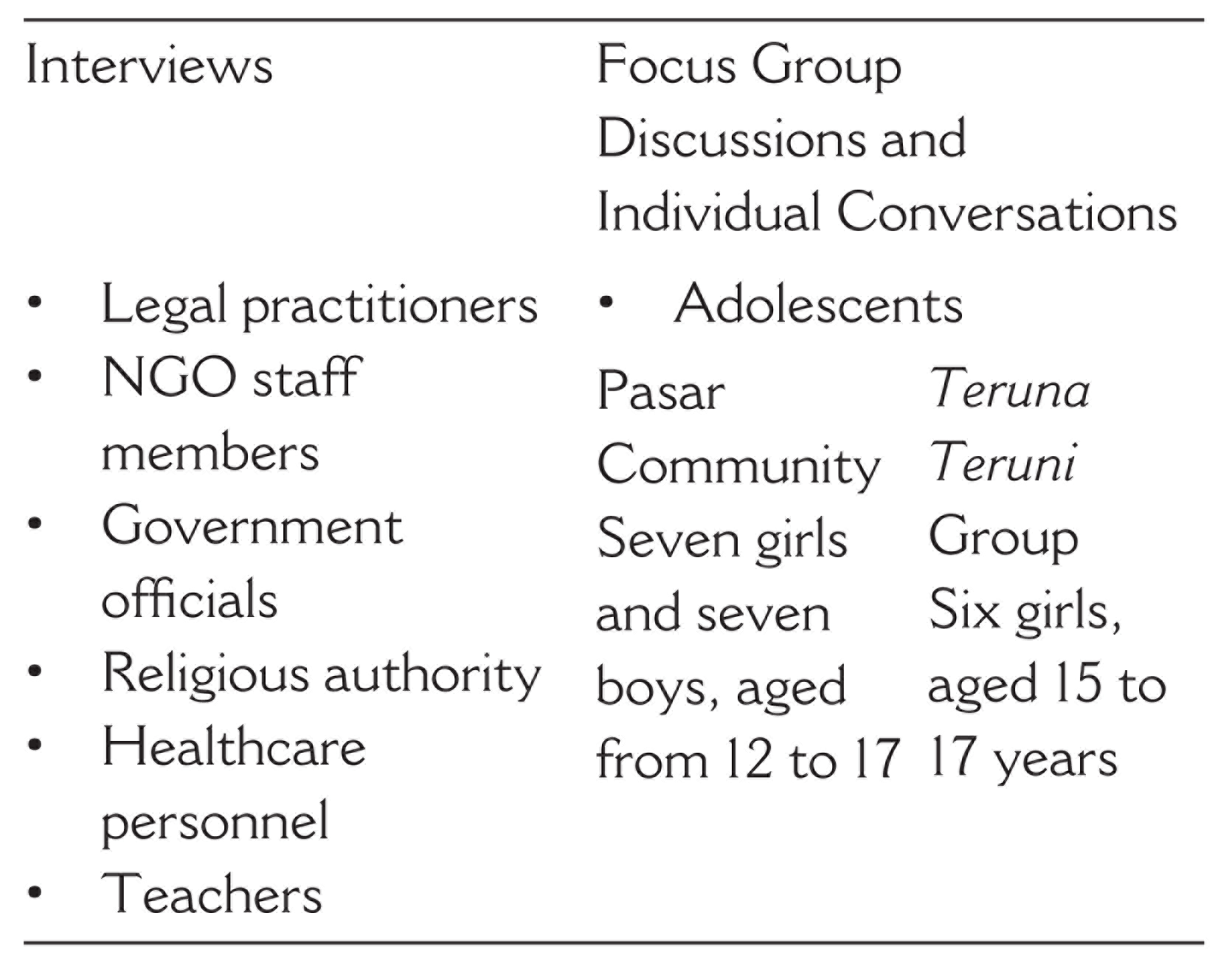
This article’s analysis builds on interviews and focus group discussions (FGDs) that the author conducted during her six-month fieldwork in Bali in 2017. To understand the link between child marriage and adolescents’ sexuality, the author interviewed legal practitioners, NGO staff members, government officials, religious authorities, healthcare personnel, and teachers. She also spoke with twenty adolescents about their ideas and practices of sexuality and marriage through FGD and interviews. She selected two groups of Balinese Hindu adolescents whose class and lifestyles differed significantly, in order to explore diverse understandings of sexual norms among Balinese adolescents. As the analysis will show, despite these differences, it emerged that two groups share similar ideas on sexual norms. The author calls one of the groups the ‘Pasar Community’, as most of them work in the pasar (traditional market) as carriers and were all from a specific remote rural area in East Bali. They suffered a range of material deprivations including poor housing, and nutrition and few educational and work opportunities, with the majority never having benefited from formal education. This group comprised seven girls and seven boys, aged from 12 to 17. The second adolescents’ group is referred to as the ‘Teruna Teruni Group’. This is one of the adat (customary) communities for youth teruna teruni in Denpasar. In this group, adolescents gather for community adat ceremonies or perform Balinese dancing for hamlet ceremonies. They are from upper-middle-class families, tend to be followers of Balinese customs, and are knowledgeable about local practices. This group comprised six girls, aged 15–17 years.
The author also refers to 20 cases of child marriage that she studied (also during her fieldwork in Bali in 2017) as part of doctoral research. Eleven of them involved first teenage pregnancy and then child marriage. Five of them involved child marriage without pregnancy, while four involved teenage pregnancy without marriage. In this article, the author uses these cases to examine the causality between teenage pregnancy and child marriage and to illustrate how adolescents decide to marry in pluralized normative systems. To study these cases, she interviewed the young women and men involved (sometimes together, sometimes separately), and their parents and family members. Most were interviewed in Denpasar, the capital city of Bali, though some of the informants were originally from other areas of Bali. When she interviewed those who had married before the age of 18, she deliberately did not apply the label ‘child bride’ to them. She considers this label as one of the ‘Western diagnostic labels’ (Wikan, 1990: 137) that prevent researchers from truly understanding local reality. Such labels obscure more complex realities in studying individual cases. For instance, contrary to the stereotype of child marriage involving a young girl, there were many boys who married before the age of 18. Fifteen of the twenty case studies involve both girls and boys as underage parties (including Krisna whom the author introduces in Section IV). 1
The author also worked closely with local research assistants. They were two young women and one young man, all Balinese and in their 20s. She held regular meetings with them, where she encouraged them to take the initiative and freely express their opinions about the research approach, methods, and interpretations. Over time, they also started to confide in me enough to share the most intimate and private information about young Balinese’s life. They were of great help in expanding her network in Bali for finding informants. The author conducted most interviews with one of them, although sometimes with more than one. During the interviews, they helped me linguistically (especially when informants talked in Balinese), as well as in understanding the social codes, and in interpreting what informants had said.
Finally, for conducting this study, the author relied on ERIC (Ethical Research Involving Children), an international guideline for researchers who conduct ethical research involving children, ensuring that the children’s rights and wellbeing are respected in every phase (Graham et al., 2013). The guideline covers four main concerns: harms and benefits, informed consent, privacy and confidentiality, and payment and compensation. All of these concerns are applicable to research in general, but some contain particular or additional challenges in research involving children. For instance, one such issue is informed consent. Following the guidelines, the author ensured that she provides information in a way that children could understand the consequences of their consent (Graham et al., 2013: 59).
Findings and Discussion
Sexual Norms, Normative Gap and Pluralized Normative System
As described in Section III, sexual norms in Bali are somewhat ambiguous. When the author asked adults in Bali across classes and from various positions, ‘Is it okay to have sex before marriage?’ they avoid answering ‘yes’ or ‘no’, instead responding: ‘It’s already common’. This answer seemingly indicates that adult generally still consider pre-marital sexual intercourse as taboo since it is prohibited by local religious and customary norms. Therefore, instead of explicitly suggesting ‘Yes pre-marital sex is okay’, they instead simply acknowledged that it is happening. In the following paragraphs, the author will demonstrate the normative gap regarding pre-marital sexual intercourse that exists between young people and the older generation.
In an interview with a senior figure at Parisada Hindu Dharma Indonesia (PHDI), a major organization involved in rallying for the preservation of Hindu and adat customs, he explained that the concept of zinah exists in Balinese adat as ‘mitra ngalang’. The idea prohibits sexual intercourse without an adat marriage. A marriage registrar at the Civil Marriage Registration Office (Kantor Catatan Sipil) explained that young people’s marriage is mostly due to ‘marriage by accident’ (marriage because of pregnancy), stating: ‘We always tell them that it is not correct. We tell them, if you want to have sex, please wait until marriage’. This is the official discourse on pre-marital sexual intercourse.
According to Gajah Mada University researchers (Arida et al., 2005), adat leaders or old generations still maintain these official adat norms. However, adolescents’ behavior and their perspectives on pre-marital sexual intercourse differ from the old adat norms. In one of the author’s FGDs, participants from both the Pasar Community and Teruna Teruni Group expressed their opinion about pre-marital sexual intercourse, being aib (disgrace) and dosa (sin)—‘it is salah (wrong) according to Hindu’. However, a participant later told me individually, ‘That’s what our parents say. We are the generation of millennials, globalization, and such. For us, it is okay to have sex (sex boleh aja). We know about those things’. This shows the normative gap between parents and children. 2 What this girl said around peers and in private also emphasizes the moral ambivalence that exists surrounding pre-marital sex.
Utomo and McDonald (2009) have described the conflicting moral values among young Indonesians. Liberal values are promoted through Westernized education, media marketing propaganda, and peer pressure, while traditional Indonesian Islamic teachings are promoted by religious schools and groups, families, and the state (Utomo and McDonald, 2009). Although Bali has a majority of Hindu population, they also have a similar structure of conflicting values. Novi, a girl from the Pasar Community, suggested at the FGD that ‘I have 3 boyfriends!’ but when we asked about what she does with her boyfriends, she said ‘it’s private, it’s not your business!’ She stated that ‘sex before marriage is sin’, but was eager to know the functions of condoms when we explained them to her while remarking, ‘but we are ashamed to buy condoms, they are only for adults’. These conflicting remarks and behaviors reflect the different reference networks with which she lived. Novi wanted to look ‘cool’ in front of her peers. However, she also disliked appearing immoral or promiscuous in front of older people, such as those interviewing her. In other words, these young people have several reference networks, which sometimes have conflicting social norms.
The multiplication of an individual’s reference networks is consistent with Gidden’s theory of modernity. However, this also shows that there is a certain illusion in the modern idea of freedom and openness. Children or adolescents specifically are not as ‘free’ and ‘open’ as they might think because they are always constrained by different normative frameworks. This was exemplified by one of the girls from Teruna Teruni Community:
This friend of mine who got pregnant used to go home early morning, drunk, and in open clothes. Even more open than people in the West. […] In the West they can be open about relationship between boys and girls, but here rumor can spread and taint a good name of the family.
Bellow (2003: 8–9, 442) has also pointed out the continuous implication of Balinese cosmologies in sexual norms (i.e., sex is intended for procreation rather than pleasure).
The Exercise of Agency in Pluralized Normative System
In this pluralized normative system in which modern youth in Bali live, their decision to marry is not only about their autonomy, choice, and bodily integrity, but also about a sense of community, religious faith, and family. One of the case studies illustrates this dilemma:
Swasti, aged 29, lived in a rural village in Bali running her own beauty salon. She proudly showed me some photos of Balinese style weddings she had arranged for her customers. She seemed reluctant to talk when her daughter was present, so we arranged to conduct our interview when she was alone. She was afraid that her 13-year-old daughter might ‘do the same (takut dia ikut)’ (i.e., ‘marrying young (kawin muda)’) if she heard the story of her mother’s teenage marriage. Swasti did not want her daughter to marry young since she wanted her to continue her education.
Swasti became pregnant when she was 15 years old and had a customary (adat) marriage before giving birth at the age of 16. She had then been courting (pacaran) her boyfriend for over a year, who was six years older than her. When her boyfriend asked to have sex as ‘proof of love’, she agreed although she admitted she was scared. She later found out she was three-month pregnant suggesting: ‘Maybe I was too free at that time’ (Mungkin terlalu bebas saat itu). Her parents were busy working away from home, so she was free (makanya bebas)—she repeated the word bebas.
When she told her boyfriend that she was pregnant, he first denied that it was his child and he refused to marry her. After a week, he eventually agreed to get married since he was ‘ashamed (malu)’ because their relationship was known in their small village. The news about her pregnancy upset her parents. Her mother told her to have an abortion, as they were still too young. She wanted her to continue studying, and that was not possible while being pregnant. However, Swasti decided not to have abortion because she was ‘scared’.
Although she does not regret having a child, she regrets marrying her husband. ‘If I could go back to the time when I became pregnant, I would choose to be a single mother’. However, at that time, it was not an option. People in the village did not accept single mothers. If she gave birth without getting married, she and her family would have been ostracized from the local community (banjar).
Swasti’s case is one of the many cases the author studied that demonstrates the customary and communitarian normative system that affects autonomous decisions. Particularly in rural areas where the community is so central and strict in their rule enforcement, pregnant teenagers are left with no choice but to marry (at least from Swasti’s perspective). In the Balinese patrilineal kinship system, a marriage regulates the transfer of women from one lineage to another (Jennaway, 2002: 60) and babies ‘belong’ to the father’s lineage. So, in extra-marital pregnancies, marriage under the Balinese adat system is a practical necessity to identify the father of the babies (Jennaway, 2002: 69). In Yuri’s case where she became pregnant at the age of 17, her mother expressed her concern:
I am afraid if we don’t accept apology and marriage proposal from family of the boy (Yuri’s boyfriend), Yuri’s baby will have problems in the future. As an adult, he must have his ancestral temple, and at any kinds of life events (e.g., when he wants to marry), he must ask permission from his father’s family. And the baby cannot enter our family’s temple according to religion and adat.
The examples of Yuri and Swasti indicate the significance of ‘relational self’. Belonging to their community is crucial for them. Within this framework of their life, marriage was the only ‘solution’ to the more urgent problem of an extra-marital pregnancy.
‘Unwanted’ Pregnancy
Kehamilan Tak Diinginkan (‘unwanted’ pregnancy), known as KTD, is often discussed as a problem in Bali. Since pre-marital sex is not permitted in principle, in-school sex education is very poor, and communication about the topic is difficult. In most cases, teenagers acquire knowledge about contraception only through the Internet or social media (including pornographic videos), where the information shared is often misleading. Many of the teenage informants told me that they did not know that sex can cause a pregnancy and often believe that pregnancies do not happen if sexual intercourse occurs only once, or if they take a shower after intercourse. Teenagers also often expressed difficulties in purchasing contraception. They feel ‘embarrassed (malu)’ to buy condoms, although they are available in shops. However, the practice of sexual intercourse is not strictly stigmatized, and so teenagers engage in sexual relationships without knowledge or contraceptive use. This explains the frequency of ‘unwanted’ teenage pregnancies.
National policies and regulations explain why safe sex is not common practice. First, contraceptives are only officially available to married people. Badan Kependudukan dan Keluarga Berencana Nasional, the national family planning institute, is in charge of their distribution. Perkumpulan Keluarga Berencana Indonesia (PKBI) is an NGO providing family planning in Indonesia, which is slightly more liberal with its distribution of contraception and with abortion practices. Still, it must handle these sensitive issues very carefully. Second, according to Article 75 of Law No. 36 of 2009, abortion is illegal except, for example, when a rape has occurred or where a pregnancy could cause health problems to the mother or the baby. The general inaccessibility of abortions obviously affects the rate of teenage pregnancies. Young pregnant girls perceive they must choose between having the baby and protecting themselves from ‘shame’ by marrying young or having an illegal abortion. PKBI has to refuse most teenage requests for abortions since they do not meet the conditions established in Article 75. The high refusal rate of PKBI is dangerous since young girls or women might then look elsewhere for an abortion. Unofficial forms of abortion are available, such as a medicine (cytotec) available at jamu (traditional medicine) sellers or private medical practitioners. According to the head of PKBI, many midwives and doctors practice abortion illegally.
In four out of 15 cases of extra-marital pregnancies the author studied, the girls had an abortion or miscarriage. One of the informants told me that she intentionally had an abortion by taking ‘medicine’. For the rest, it remained unclear whether they intended to have an abortion. Some informants told me that they had a ‘miscarriage’, but they did not prevent it and some even prompted it to occur. One kept working as a carrier, carrying heavy bags every day. Another kept eating young pineapples, a method a couple found when they searched online posing the question ‘how to have a miscarriage’. The other 11 cases of pregnancy led to marriage. When the author asked the couples if they considered abortion, one of them told me that she and her boyfriend married because they had failed to have an abortion using traditional medicines. Many others replied that they did not consider this because they were ‘ashamed (malu)’, or ‘afraid (takut)’ ‘of the risks’ or ‘of karma’. These findings demonstrate that abortion is not a safe and legal option for adolescents in Bali.
While dating and pre-marital sexual intercourse are somewhat accepted in Bali, social stigmas and heavy penalties are attached to birth outside wedlock. Krisna discussed his school friends who married because of pregnancy and said, ‘If you get pregnant, the only way is to get married (jalan satu-satu nya kawin)’. When an unmarried woman gives birth, the family is expected to perform a ceremony in their community. These ceremonies can be costly and sometimes involve several people from the community, so they function as both economic and social sanctions (Horii, 2019b: 298).
Thus, when teenagers become pregnant, their options are limited. They can have a legal abortion if they fulfill the requirements or attempt an illegal abortion. They can give birth without marrying and face the consequences, or marry young. It is understandable why many choose to marry, considering the difficulties associated with having an abortion or giving birth outside of marriage. When the author discussed these options at the workshop she organized with LBH Apik Bali (a legal aid association), all of the participants (e.g., a staff from the Marriage Registration Office, members from religious/adat organizations, organizations for the protection of women and children) agreed that the best possible reaction to a teenage pregnancy was marriage. A participant from Wanita Hindu Dharma Indonesia (the female division of PHDI) also suggested making divorce easier for women under Balinese adat law. This would add another dimension to the options available to pregnant teenagers—exiting child marriages. However, in Bali, divorce is extremely difficult and has been disadvantageous for women (Jennaway, 2002: 87–88). Swasti, having divorced her husband, does not have legal custody of her children or the right to their shared property (e.g., the family home). Additionally, divorce carries such a negative stigma that Swasti still wears a ring on her finger to pretend that she is married. ‘I just bought it myself. (pause) Well … if I wear this, people think I am married’.
Managing the Hearts
From the 16 cases of child marriage that the author studied during her fieldwork in Bali, at least 11 were caused by an unplanned teenage pregnancy, including Swasti’s and Yuri’s. Two of the other cases were as a result of a fear of pregnancy, as illustrated in the following case of Krisna and Sri who had been in a relationship for two years. They lived together in an apartment in Denpasar for three months when they decided to marry. Krisna was 15 and Sri was 17 when they married through the adat ceremony. Their cohabitation was unsettling to Sri’s family who worried she might become pregnant. To ensure that Krisna would be responsible for the consequences of a possible pregnancy, Sri’s family insisted that they marry. Sri also said, ‘My family wanted me to marry to avoid shame (malu) in the village as the neighbors and relatives already knew about our relationship’. Krisna’s father initially disagreed with the marriage, arguing that Krisna was still too young, but Sri’s family insisted. Despite the fear and social pressure, Krisna and Sri’s case also illustrates the exercise of relational autonomy. Although it was Sri’s parents who initiated and insisted on the marriage plan, Krisna suggested that they were ‘very keen to get married’ as they did not want to be separated. The thin line between their motivations (to marry) and the underlying social factors (customary rules, shame, peer norms, and pressure from parents) exemplifies the conflicting normative systems that adolescents deal with when making decisions at critical life junctures. Swasti’s regret indicated in her statement: ‘If I could go back to the time when I became pregnant, I would choose to be a single mother’ shows the ambiguous line between social or coercion and personal agency that can become increasingly ambiguous over time.
Second, a seemingly peculiar aspect of Balinese decision-making has been suggested by Wikan (1990: xvii, 137, 139)—that from a Balinese point of view, there is no difference between feeling and thought, and ‘keneh’ (‘feeling-thoughts’) is the person’s choice and responsibility. Therefore, ‘ngabe keneh’ (‘bringing the feeling-thought’) and ‘managing the hearts’ is at the root of a Balinese design for living (Wikan, 1990: xvii, 95). Today, in Bali, adolescents manage ‘their heart’ (the feeling-thoughts in their romantic and sexual relationship) by balancing the demands of the modern era within the customary and communitarian normative system. In the modern social conditions with increased mobility and education, individual choices have diversified and expanded, so norms have pluralized (referred to here as ‘pluralized reference networks’). Krisna and Sri, for instance, moved to the city from North Bali. Their marriage decision was a compromise between their living situation and the rural village’s customary rules and sentiments. Consequently, the references networks for modern Balinese youth are more fragile as their generation is in an ambiguous relationship with their elders’ generation. Navigating their modern world thus means trying to make the best of their lives within their context of family and community relations. This process of decision-making in multiplied normative frameworks is the essence of relational autonomy and the way such autonomy can be maximized.
Swasti wants her daughter not to marry until she was twenty suggesting; ‘She should finish school and work first’. When asked if she had spoken with her daughter about how to prevent unwanted pregnancies, she suggested: ‘I talk about sex and such a little bit, but not much, because I do not want to confuse her. It’s hard to communicate about it’. While Swasti’s parents forbid her from dating a boy and engaging in sexual activity before marriage, she allows her daughter to have pacaran (courtship), but ‘with limits’ (dengan batas). Swasti herself ‘managed her hearts’ by secretly dating a man with whom she was in love. She agreed to have sexual intercourse with him before marriage and married him when she became pregnant. This begs the question as to how her daughter will herself ‘manage her heart with limits’ when she—as her mother previously was—is in love.
Conclusion
This article has demonstrated that for modern youth in Bali, ‘child marriage’ is a way to manage their romantic and sexual relationships within the customary normative system. In the modern era, increased educational opportunities provide them with more possibilities and spaces to socialize with the opposite sex. Mobile phones give them access to people outside of their community and provide chances to communicate with their romantic partners. Such emancipation is at modernity’s core, resulting in an individual’s detachment from traditional identity, which is shaped by custom, religion, and family. Individuals’ normative system becomes pluralized, and feelings associated with romantic life become more open and unsettled.
For adolescents who are negotiating different ideas of sexuality and of marriage, the decision to marry should be understood though the lens of relational autonomy. International advocacy surrounding child marriage is based on modernity’s ideals of libertarian agency and the normative principle that we all (especially women) should be able to decide how to live our lives instead of submitting to the traditional order. Relational autonomy suggests that such a conceptualization of agency is an illusion, given an individuals’ embeddedness in social interaction and relationships. Though the lens of relational autonomy, child marriage was a choice for adolescents in Bali—a way of ‘managing the hearts’.
By acknowledging that some children can exercise their agency to marry, the hidden core problem emerges—although the frequency of KTD (‘unwanted’ pregnancy) is a problem in Bali, the problem is not sexual relationships before marriage itself. In an increasingly permissive society where teenage pre-marital sexual activity is allowed and accepted, they can safely participate in these activities by being well informed about sex and the use of contraception, resulting in lower rates of unwanted pregnancies. However, this is not the case in Bali, and in Indonesia more broadly. Teenage pregnancy is caused by a gap between reality and moral ideals. Child marriage is not per se a problem. On the contrary, it is the present solution to lack of access to reproductive health advice and contraceptives. In the case of Indonesia, it could be argued that early marriage is a way to control youth’s sexual behavior without directly discussing issues related to safe sex. Thus, policies and programs for reducing child marriage will be more effective if they address this core problem directly. The asexual term ‘child’ from ‘child marriage’ also obscures the reality, considering that those who marry early may in practice be mid-or late-teenagers who are (or fear the implications of becoming) sexually active. Finally, in the same way that Swasti wants to prevent her 13-year-old daughter from following the same path as her but equally feels that it is ‘too early’ to teach her about pregnancy, so too the international child marriage discourse currently overlooks considerations regarding sexuality and the sexual autonomy of children.
Footnotes
Declaration of Conflicting Interests
The author declared no potential conflicts of interest with respect to the research, authorship and/or publication of this article.
Funding
The author received no financial support for the research, authorship and/or publication of this article.