




Abstract
Ethiopia has recently seen a remarkable fall in the proportion of girls who marry in early adolescence, reflecting the country’s lauded efforts to tackle child marriage. However, aggregate national figures mask a more complex reality. This article explores this complexity, drawing on qualitative data with adolescent girls and boys, their caregivers, service providers and community leaders, from the Gender and Adolescence: Global Evidence (GAGE) longitudinal study baseline. Our findings highlight the complex interplay between cultural norms, economic factors, individual voice and agency, and collective support thereof, on the part of leaders and service providers, from grassroots to national levels.
Introduction
Ethiopia has seen the world’s sharpest decline in the prevalence of child marriage over the past decade. Rates have fallen by one-third (Wodon et al., 2018) due to investments in girls’ education, growing awareness of the legal age of marriage (18 years) and community efforts to highlight the health and economic risks of child marriage and early childbearing (Harper et al., 2018). Marriage in early adolescence is falling especially quickly. The most recent Ethiopia Demographic and Health Survey (Central Statistical Agency [CSA] and ICF, 2017) reports that of girls age 15–19, only 5.7% were married before age 15, compared to 14.1% of young women aged 20–24. Of young women aged 20–24, 40.3% were married by age 18, compared to 49.3% of women aged 25–29. However, aggregate national figures mask a considerably more complex reality in terms of the prevalence of child marriage at the sub-national level (Jones et al., 2016a, 2016b; Harper et al., 2018). Attending to this variance, and moving beyond a ‘one size fits all’ approach, is critical if programming interventions are to have maximum impact and contribute to the realization of the Government of Ethiopia’s national commitment to eradicate child marriage by 2025 and its international commitments in line with Sustainable Development Goal 5.3 to end child marriage within the next decade.
This work draws on baseline qualitative data collected in 2018 for the Gender and Adolescence: Global Evidence (GAGE) longitudinal study. GAGE is exploring adolescents’ gendered transitions through the second decade of life in six developing countries, including Ethiopia. Our work is grounded in development actors’ recent efforts to understand and shift gendered social norms—which moved centre stage in 2012 when the World Bank published both a World Development Report dedicated to gender equality and development (World Bank, 2012) as well as a lengthy report on the role of gender norms in shaping equality (Boudet et al., 2013). GAGE’s conceptual framework is rooted in a gendered capabilities approach informed by the work of Martha Nussbaum (2011) and Naila Kabeer (1999). While it recognizes the centrality of agency and voice for setting and achieving goals, it acknowledges Bourdieu’s (1977) habitus and doxa and the ways in which culture and tradition can render ostensibly freely chosen actions anything but free.
This article is aimed at strengthening and extending the empirical evidence base regarding child marriage in Ethiopia in ways that contribute to identifying new policy and programming entry points for eliminating child marriage and promoting girls’ voice and agency. It seeks not only to highlight the diversity of girls’ experiences with marriage—and how they are shaped by and in turn shape girls’ broader capabilities—but to underscore how over-simplification has prevented progress in some areas even as it has encouraged it in others. Stemming from our conceptual framing, this article addresses four core research questions: (a) How do the patterning and drivers of child marriage differ across regions in Ethiopia?; (b) How do adolescents’ broader individual and collective capabilities impact girls’ vulnerability to and in child marriage; (c) How does child marriage affect adolescents’ broader individual and collective capabilities?; (d) What entry points exist to tackle and mitigate individual adolescent girls’ risks and to promote their agency and collective capabilities? To address these, child marriage is examined across three different Ethiopian contexts: the highlands of Amhara, the lowlands of Oromia, and pastoralist Afar. These three regions were purposively selected in order to capture variation in the patterning, drivers, and impacts of child marriage, especially vis-à-vis their relationship with girls’ agency (refer to Jones et al., 2018). The article begins with an overview of our conceptual framing and the research context. After a discussion of our methodology, we then present our findings, exploring differences across contexts before highlighting existent change strategies and how far they are effective in eliminating child marriage. We conclude by discussing implications for future policy and programming.
Conceptual Framework: Interrogating Societal Norms via a Capabilities Approach
Our work is rooted in two bodies of literature—the first on social norms and the second on capabilities. Social norms are the widely accepted informal social rules that govern behaviour and have, over the last decade, received increasing attention from not only theorists but also from development practitioners seeking to expedite social change (Boudet et al., 2013; Harper et al., 2018). The capabilities approach is premised on the notion that individual and collective freedom is both the end and the means of development and that incomes are a poor proxy for progress (Sen, 1999).
Norms
Recent approaches to understanding how to change social norms—from open defecation to child marriage—have drawn on social psychological analysis of conformity and social convention theory (Mackie and Le Jeune, 2009, Mackie et al., 2015) and on philosophical economics and game theory (particularly as developed by Bicchieri, 2015). In this tradition, social norms are commonly understood to be perpetuated because people believe that they are expected to conform and that they will suffer sanctions, including social ostracization, if they fail to do so. Compliance or noncompliance is seen as an active choice and change is largely postulated to derive from shifting perceptions about what the reference group believes. In the case of child marriage, this has meant not only educating adolescents and parents about the risks of child marriage and the benefits of delaying marriage until legal adulthood but also engaging whole communities in conversations about beliefs surrounding the practice (de Cao et al, 2017; Jones et al., 2016a, 2016b).
Sociological approaches to understanding and accelerating norm change are less mechanistic, distinguish between types of norms, and emphasize power relations in formal and informal institutions. As highlighted by a World Bank report on gender equity (2012) and study on the role of gender norms in shaping that equality (Muñoz Boudet et al., 2013), norms related to gender are seen as especially resistant to change (refer to also Harper et al., 2018). Indeed, because of the way gender socialization begins at birth and permeates every aspect of our daily lives, gendered practices—including child marriage—move into the realm of ‘doxa’, which Bourdieu (1977) defines as ideas and actions that are taken for granted and are beyond questioning. In this conceptualization, compliance or noncompliance is not seen as a true choice, because ‘habitus’ conditions present actions and choices on past experience—with only limited room for freedom—and leads to behaviours of self-exclusion (Bourdieu, 1986). Rendering doxa visible—so that people can imagine options—is seen as the first step in creating social change. In the case of child marriage, these approaches include providing girls with programmes aimed at increasing their empowerment, exposing adolescents and parents to alternative role models, and working with community and religious leaders who uphold social norms.
Capabilities
Our work is also framed within a capabilities approach. Introduced originally by Amartya Sen (1985), and nuanced to better capture complex gender dynamics at intra-household and societal levels by Nussbaum (2011) and Kabeer (1999), the capabilities approach has evolved as a broad normative framework exploring the kinds of assets and entitlements that expand the freedom of individuals to choose what they wish to do and who they wish to be. At its core is a sense of competence and purposive agency: it goes beyond a focus on a fixed bundle of external assets, instead emphasizing investment in an individual’s skills, knowledge, voice, and freedom. GAGE’s broader conceptual framework focuses on six core adolescent capabilities: education and learning, health and nutrition, bodily integrity and freedom from violence, psychosocial well-being, voice and agency, and economic empowerment (GAGE Consortium, 2017). It, like Sen, recognizes that these capabilities are interconnected, with girls’ limited freedom to pursue education or employment, for example, inexorably linked to child marriage—which has cascading implications for their access from social networks and friendships to quality health care and contraception.
In large part because of the ways in which social norms can work to limit—and co-opt—agency at the individual level, we also recognize that it is important to consider adolescent girls’ collective capabilities and the structural ‘unfreedoms’ that they must contend with in order to realize their individual capabilities. Kabeer defines collective capabilities as ‘group-level capabilities that emerge through collective action, refer to forms of cognitive and practical agency that emerge out of social relationships as a result of sustained interaction and that are often supported by champions’ (GAGE Consortium, 2019; Kabeer and Sulaiman, 2015). Collective capabilities not only help strengthen individual capabilities but can ultimately benefit others who are not directly involved in these interactions by challenging doxa and opening space for them to imagine options—such as not marrying in childhood (refer to Ibrahim, 2006; Kabeer, 1999). Our framework envisions that collectively empowering girls means that adolescent girls—and the discriminatory gender norms that curtail their voice and agency—are made more visible on policy and programming agendas and that leaders (formal and informal) engage with girls and their families to address their age- and gender-specific needs in order that girls can develop their full capabilities and be entitled to do so.
GAGE’s conceptual framework situates girls ecologically and recognizes not only that adolescent girls at different stages in the life-course face different needs and constraints, but that these are also highly dependent on girls’ contexts at family or household, community, state and global levels. These contextual realities also determine the change strategies that can be employed to improve girls’ capability outcomes. Our approach emphasizes that in order to nurture transformative change—and permit girls to freely make the choices that shape their own futures—potential change strategies must simultaneously invest in integrated intervention approaches at different levels, weaving together policies and programming that support girls, their families and their communities while also working to effect system-level change.
Research Context
Ethiopia has made remarkable progress in terms of poverty alleviation over the last decade. Its annual economic growth has averaged over 10%, its poverty rate dropped from 30% in 2011 to 24% in 2016 (World Bank, 2019a), and since the turn of the millennium, its fertility rate has declined from 6.5 to 4.1 and its net primary school enrolment rate has climbed from 40 to 85 (World Bank, 2019b). The challenges that Ethiopia faces, however, continue to be pressing. It remains one of the world’s poorest countries, with a GDP/capita half the regional average ($767 vs. $1,575) and net enrolment in secondary school is only 31% at the national level—and in the single digits in some regions (such as Afar). In addition, job creation is unable to keep pace with population increases. Combined with the climate change that is jeopardizing agriculture, this has resulted in rampant youth unemployment (World Bank 2019a, 2019b). Progress towards eliminating child marriage reflects these broader trends. Recent improvements notwithstanding, child marriage is still widespread in Ethiopia. While Ethiopia now ranks 15th for prevalence (22% of girls 15–19 in a union; 14% of women 20–24 married by age 15; 40% of women 20–24 married by age 18), it accounts for the fifth-highest number of girls and young women affected globally with an estimated 2.1 million girls married as children (Girls Not Brides, 2019).
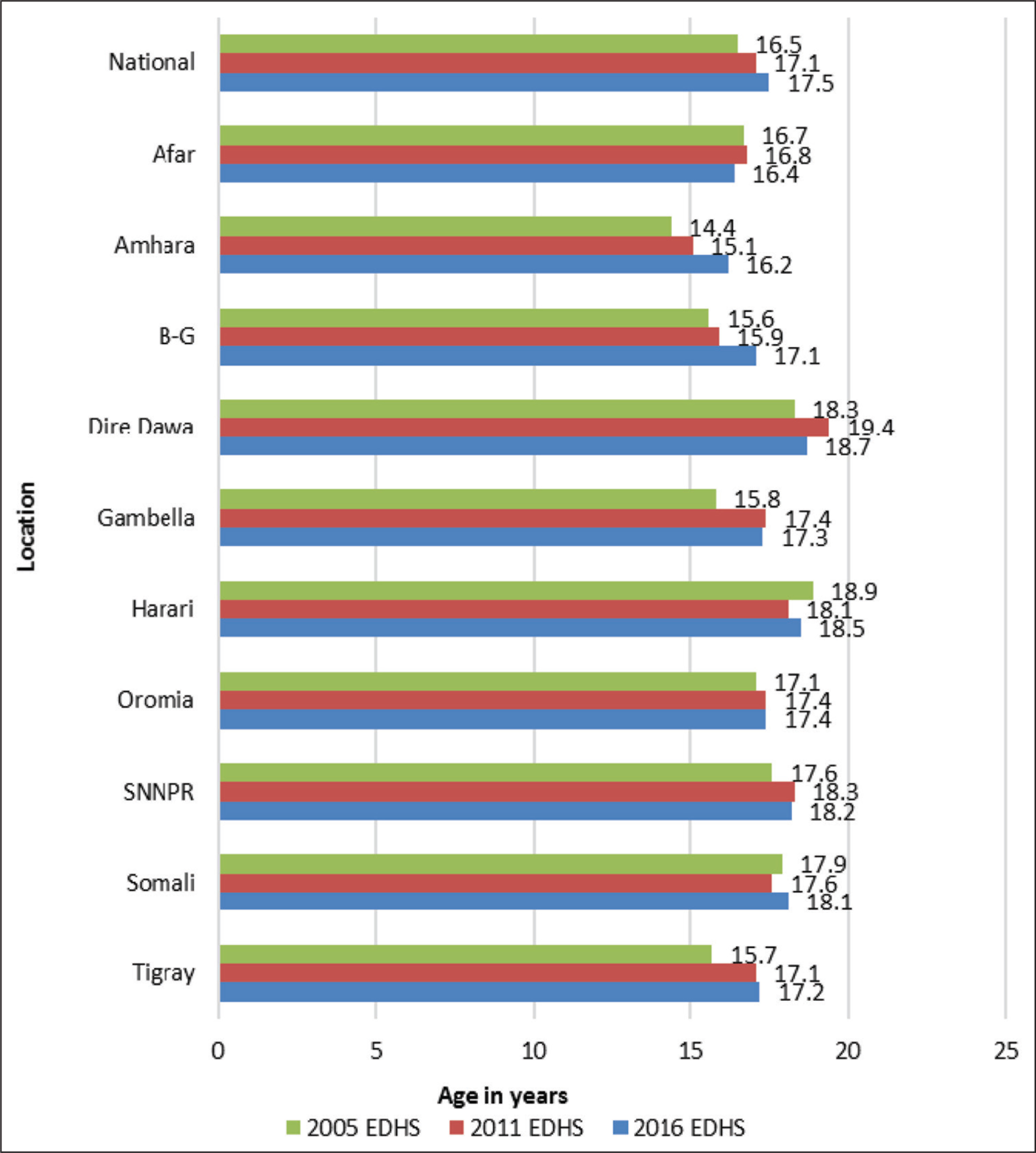
Recent evidence highlights that the risk of child marriage is far from uniform and that further divergence is likely given Ethiopia’s cultural and religious diversity and uneven development. The 2016 Ethiopian Demographic and Health Survey reports that the median age of first marriage—while increasing nationally—varies by region (which in Ethiopia is closely tied to ethnicity given that regional states are ethno-linguistically based), urban-rural residence and education level (CSA and ICF, 2017). Figure 1 shows that over the last decade the age of marriage has climbed rapidly in some regions (e.g., Amhara), has been static in others (e.g., Oromia), and is even declining in a few (e.g., Afar). Using data from the most recent national census (2007), which can be disaggregated to the district level, Jones et al. (2016b) further nuanced these findings by demonstrating the existence of intra-regional child marriage ‘hot spots’ that do not conform to regional patterns. Also complicating attempts to understand the risk of child marriage is diversity in what the concept means. Jones et al.’s (2016a, 2016b) qualitative work found that in some cases marriage was purely ceremonial (e.g., for the youngest girls in Amhara) and posed little longer-term threat to girls’ well-being, while in other cases, it resulted in immediate cohabitation, sexual initiation and exposure to violence.
Recent evidence has emphasized that child marriage can have highly diverse drivers. In some cases, income poverty and lack of access to education leave girls with few options other than child marriage (Iossifov and Wassie, 2016; Jones et al., 2016a, 2016b). In other cases, child marriage is more about improving individual and household economic status, rather than mitigating poverty per se (Boyden et al., 2013; Jones et al., 2016a, 2016b). The impact of adolescent agency on child marriage appears similarly complex, with Jones et al. (2016a, 2016b) finding that in some cases it allows girls to refuse arranged marriages and in other cases permits them to demand to undertake them of their own accord. Overall, research suggests that social norms that situate marriage and motherhood as central to girls’ ‘value’, and see their sexual purity as key to family honour, are critical to understanding child marriage—as they shape both parents’ and girls’ choices (Boyden et al., 2013; Jones et al., 2016a, 2016b).
To answer our research questions, we draw on baseline data collected for GAGE in late 2017 and early 2018 (refer to Jones et al., 2018). While the broader GAGE data set includes a quantitative component (over 6,700 adolescents and their caregivers completed our survey), this article draws exclusively on qualitative research, due to sample construction. 1 Forthcoming work, weaving together baseline and midline findings, will highlight our quantitative evidence.
Using the World Health Organization’s definition of adolescence, the second decade of life, we undertook individual interviews with 240 young people aged 10–19 (140 girls and 100 boys) and their siblings, 200 caregivers, and 80 key informants—as well as group interviews with 160 adolescents and 248 adults (refer to Table 1). Because GAGE is longitudinal, and aims to follow young people over the course of adolescence and into early adulthood, our sample includes two age cohorts: a younger (aged 10–12 years) and an older (aged 15–17 years). To better speak to the Sustainable Development Goal’s ‘leave no one behind’ agenda, we also took care to include the most vulnerable young people—especially married girls and adolescents with disabilities.
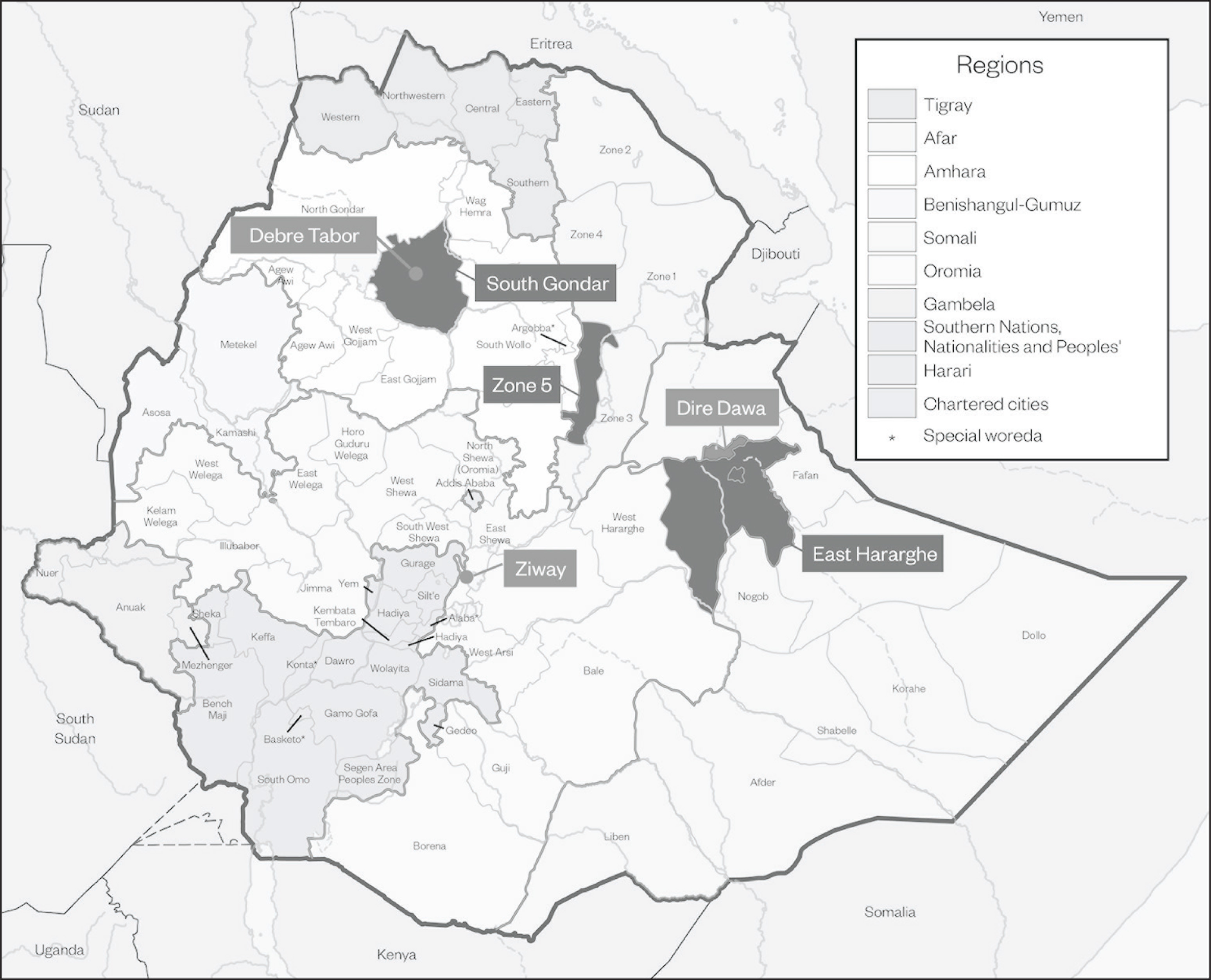
GAGE is working in rural and urban sites in three regions: Afar (Zone 5), Amhara (South Gondar Zone), and Oromia (East Hararghe Zone), which were chosen because they are home to particularly vulnerable pastoralists and the largest and most diverse populations respectively (refer to Figure 2). In rural sites, we sought to combine economic and social vulnerability criteria, selecting geographical areas that were economically disadvantaged and/or food insecure, and child marriage ‘hotspots’ (districts with a high child marriage prevalence as a proxy for conservative gender norms) (refer to Jones et al., 2016b). We also selected sites of varying distances from the district town to explore the relative importance of distance to services and markets.
Individual and group research instruments per respondent type and number

Individual and group research instruments per respondent type and number
Prior to commencing research, we secured approval from the Overseas Development Institute Research Ethics Committee, as well as from the relevant regional research ethics boards in Ethiopia. We also secured informed assent from adolescents aged 17 and under, and informed consent from their parents (minors under 18 are not legally able to give consent) and from adolescents aged 18 and 19 years. Interviews were conducted in the relevant local languages (Amharic, Afaan Oromoo and ‘Afar Af, respectively), with researchers and interpreters interviewing adolescents of the same sex only. Research instruments designed by GAGE (building on published good practice in terms of generating high-quality evidence in developmentally appropriate ways [e.g., Chong et al., 2006; Crivello et al., 2013; Hill et al., 2009; Samuels et al., 2015; Tekola et al., 2009]) were first trialled in a round of formative work to ensure that they were appropriately adapted. All instruments were interactive and allowed respondents to discuss themes in their own terms (refer to Table 1). Some (e.g., vignettes and timelines) were directly aimed at exploring child marriage and change over time. Preliminary data analysis took place during daily and site-wide debriefings with the research team, exploring emerging findings and probing surprising findings or emerging patterns. This process helped to inform the development of the thematic codebook. Following data collection, all interviews were transcribed and translated by native speakers of the local language, then coded thematically using the qualitative software analysis package MAXQDA.
Our findings underscore Ethiopia’s socio-cultural and economic diversity, and how these shape inter-regional differences in the prevalence and drivers of child marriage—and its impacts on adolescent girls. Indeed, because context is central to understanding differences in social norms and how they shape the interactions between child marriage and girls’ other capabilities, we present the majority of primary research—that aimed at answering the first two research questions (a) How do the patterning and drivers of child marriage differ across regions in Ethiopia? and (b) How do adolescents’ broader individual and collective capabilities impact girls’ vulnerability to and in child marriage)—by region.
Marriage Practices in Pastoralist Afar
Afar, where fewer than 30% of adolescents successfully complete Grade 4 and the gender parity index for secondary school is only .71 (Ministry of Education [MoE], 2018), has the second-lowest median age at first marriage (16.4 years in 2016) and has seen limited progress over time (refer to Figure 1). Afar girls continue to marry in mid-adolescence. As a 12-year-old girl from Community A noted, ‘Most girls marry at the age of 16 and 17 years’. Key to understanding regional stasis is the local absuma marriage system, by which marriages (for girls and boys) are arranged to maternal cousins. Each girl may have dozens of abus (potential partners), but the final choice is made by her parents. Parents are deeply committed to the absuma system, as it reinforces kinship ties. ‘If my daughter married to someone outside of our kinship, our family line would discontinue’ (father, Community A). Many adolescent boys also support the practice: ‘The absuma marriage system is our traditional norm and we strongly support it’ (15-year-old adolescent boy, Community B). Our research found that adolescent girls, on the other hand, are simply resigned. ‘Unless we die, it is our absuma that we are going to marry’ (17-year-old adolescent girl, Community A).
While ‘both females and males are forced to marry under the absuma marriage system’ (adolescent boy, Community A), girls’ lives are far more constrained by the system than boys’. First, boys largely marry as adults rather than as adolescents because gender norms dictate that they must be able to provide for a household before establishing it. Where boys do marry in mid-adolescence, it is typically not because of economics but because of pressures from the clan to marry a particular absuma while she is still at a socially acceptable age—and to avoid her being taken as the bride of another clan member. Second, boys are often allowed some input into which absuma they will marry; girls have no choice at all. An adolescent boy from Community A explained, ‘I chose my absuma by my own. I chose her for her beauty’. A critical result of these two differences is that boys tend to marry girls who are their own age or younger whereas girls are often made to marry much older men (sometimes even by 10 or 20 years). This age gap can result in a lifetime of constrained agency and violence, as the adolescent girls in our sample were only too aware: ‘Especially if she is going to get married to adult who is older than her; she hates him, since he is going to beat her when they get married’ (15-year-old girl, Community A). In addition, although boys and young men have the possibility of combining school and marriage—at least in the larger communities that host one of the region’s 34 secondary schools (MoE, 2018)—girls seldom have this option. Indeed, adults admitted that because educated girls are increasingly voicing opposition to the absuma system, there is now a community agreement to deny girls the freedom to attend secondary school.
Due to the ways in which gender norms shape not only the behaviours which girls are expected to demonstrate daily but also the stability of the clan-based safety nets that have long protected families in times of need, opportunities for girls to make alternate choices that might broaden their capabilities are effectively non-existent in Zone 5. According to focus group participants from Community A, while a few girls try to ‘escape to the river’ or seek to run away to Djibouti (where there is a sizeable Afar population and opportunities for adolescent girls to gain employment as domestic workers), parents ‘bring them back to the house’ and ‘beat you seriously if you do not want to get married’. Because clan power is hegemonic, even attempted suicide offers no relief for girls. An older adolescent boy in Community A explained that one girl, who ‘drunk a poison because … she disliked the person whom she was forced to marry’, was told by clan leaders to ‘stick to her marriage and to respect the absuma marriage system’.
Marriage Practices in the Amhara Highlands
Historically, Amhara has had the lowest median age at first marriage—driven largely by the region’s tradition of ‘ceremonially’ marrying very young girls to solidify ties between families and build prestige in the community (Jones et al., 2016a). As this tradition has become less common, the age of marriage has risen rapidly (from 14.4 to 16.2 between 2005 and 2016; refer to Figure 1). Child marriage, however, still remains common—because the marriage of adolescents, especially those in middle adolescence, is not locally conceptualized as child marriage. As a 12-year-old girl from Community F noted: ‘Above the age of 13 years is considered to be the age limit for girls to get into marriage’. Interestingly, despite the historical correlation between poverty and child marriage, girls from better-off, landed families are the most at risk in the communities in which we worked—as young men (and their families) often make marriage offers to secure access to land, which is in increasingly short supply given population pressure and climate change.
Unlike in Afar, where girls have no space for input into marriage timing or partners, a growing number of girls in Amhara are allowed at least some choice. This is especially the case for older girls and those who are in school, a group that is rapidly growing 2 due to increased recognition that agriculture no longer provides a secure future and that education expands livelihood options. As a father in Community D explained, ‘I promised to marry my daughter to a boy when she was one-year-old. Now when she grew up she refused to marry him, so I respected and accepted her interest, then I stopped’.
Girls’ ‘choice’, however, is often more illusory than real. Some elect to marry—even against their parents’ wishes—because they view sacrificing their own futures as the only option they have to protect those of their younger siblings. A 17-year-old girl from the city of Debre Tabor noted, ‘I did not want to become an obstacle for my younger siblings’. However, given that most marriages in Amhara continued to be arranged by parents—generally to men five to ten years older—the majority of girls are presented with only a simple choice: comply with their parents’ wishes or not. A mid-adolescent girl from Community C explained, ‘My family asked me if I want to get married, I said yes and they got me married to him. I know he is from our area but I don’t know him in-depth’. For the youngest girls, marriages are often still forced. As a 12-year-old married girl in Community C explained: ‘I had no idea that I was going to get married. And then the day approached and they told me … I said “no way.” I was tempted to flee but had nowhere to go. So I got married not to disobey my parents’. Forced marriages are particularly common when husbands are priests or deacons in the Ethiopian Orthodox Church, as custom dictates that religious men must marry girls who are virgins.
The adolescent girls involved in our research reported that most arranged marriages are driven by parents’ need to ensure that family honour is protected by controlling girls’ sexuality. Girls are widely perceived to have a ‘fire age’ during which they are believed to have a strong interest in sex. ‘If they are physically big, parents fear they will become wild. So they limit them with marriage’, explained a 12-year-old girl from Community C. With unmarried, out-of-school girls’ potential sexual behaviour the subject of community gossip, several older girls admitted that they had acquiesced to parental demands regarding marriage to silence inuendo. Parents focused less on ‘protecting’ girls’ from their own sexuality and more on sexual violence. Pregnancy before marriage carries enormous social stigma—to the extent that it is not uncommon for parents to ensure their unmarried daughters are using contraception in case they are raped. Embedded in communities where girls’ own sexual desire is believed central to their susceptibility to rape, other parents choose to marry their daughters to keep them—and their putative honour—‘safe’.
Marriage Practices in Lowlands Oromia
In Oromia, where fewer than half of adolescents complete fourth grade and the gender parity index for secondary school is only .81 (MoE, 2018), there are few signs of progress towards ending child marriage. The median age at first marriage is slightly over 17—and has been since 2000 (refer to Figure 1). Indeed, our current research, like previous work (Jones et al., 2016a; 2016b), suggests that age at marriage may be contravening national progress and declining rather than rising. Critically, and unlike in Afar, reasons for stasis are not related to rigid traditions that deny girls even the semblance of choice. Girls’ improved access to agency—in an environment in which child marriage is doxa and alternative pathways inconceivable—appear to explain this trend since girls themselves are now ‘interested’ in marriage and sometimes frame their choice using rights-based language learned in school, as soon as their bodies begin to look mature.
Although key informants reported that girls have typically married soon after puberty in Oromia, parents and adolescent girls involved in our research emphasized that not only is child marriage becoming more common, but the age of marriage is dropping—perhaps as the age of puberty declines with better nutrition. A 12-year-old girl from Community J explained, ‘When they reach Grades 6 and 7, they get married. They get married at the age of 12. Finishing education is not usual for girls in this area. I do not know the reason’. Another 12-year-old girl from Community I added, ‘They get married because it is in their interest. You can’t enforce them not to marry if they want to marry’.
The narratives surrounding the drivers of this putative change are complicated. In some communities, respondents implicated traditional shegoye dancing, which is facilitating adolescents to form ‘love matches’—and engage in sexual activity—by allowing them to stay out all night in the absence of adult supervision. Given that shegoye used to be short-season and is now year-round, that contraception is socially unacceptable until girls have demonstrated their fertility by giving birth to at least one child and that children are expected to be born into marriage, many people emphasized that shegoye is driving child marriage. ‘Once they have started spending the night at shegoye, they plan to marry within the same time of the year’, explained a young adolescent girl from Community H. Other adolescents reported that they married due to peer pressure—or a fear of being haftu (leftover or unwanted), which has wide-ranging impacts across capabilities given that girls who are haftu are often left to marry ‘an old man who has seven or eight children [because she is] strong enough she can carry out many works’ (female focus group discussion participant, Community I). Adults also linked recurring and severe drought with girls’ vulnerability to child marriage as families struggle to invest in education—and out-of-school girls have limited options outside of marriage. A father from Community K explained, ‘As a result of drought, families, due to economic problems, are unable to buy pens let alone buy other necessities.… Girls prefer marriage than to simply sit idle’. While most respondents emphasized—at times quite forcefully—that child marriage was girls’ choice, a 10-year-old girl from Community I articulated that even those choices that appear to be girls’ are most often not, in large part due to the age differences between partners: ‘It is her husband who makes the choice’.
Parents’ reactions to these very early, ostensibly free-choice marriages are mixed. On the one hand, there is considerable agreement that girls ‘are getting married early while they are not ready for marriage’ (community key informant, Community I). The extent to which this sentiment reflects parental concern for girls’ well-being, rather than frustration over their own diminishing input into their daughters’ marriages, is however unclear. A focus group participant in Community I explained that in the past, parents took care to choose suitable partners for their daughters: ‘Before, we used to consider the behaviour of the prospective husband and his family for the well-being of our daughters’. The same participant blamed the government for recent changes because it has been ‘stressing the interests of girls’, teaching children about their ‘rights’ in civics class. Some adolescent girls, on the other hand, perceived that their mothers in particular tacitly approved of their involvement in shegoye and their ‘choice’ to marry as children. For example, a 16-year-old girl from Community I explained: ‘Some parents are happy when adolescent girls go to shegoye as it opens an opportunity to get married. Although the right age for marriage is 18, our parents fear that girls cannot get married once they turn 15’.
The Impacts of Child Marriage on Adolescent Girls
Many of the impacts of child marriage on adolescent girls’ broader capabilities reflect regional diversity. In Amhara, for example, where it is becoming more common for students to attend secondary school, married girls can sometimes negotiate with their parents to continue their schooling—and delay cohabitation. In Oromia and Afar, where relatively few girls transition to even upper-primary school (e.g., fifth grade), negotiation at this critical life juncture is not possible, given that the overwhelming majority of girls in our research sites are already out of school before marriage. Likewise, while in Amhara there is a widespread understanding that girls should ‘grow up before they are able to give birth’ (15-year-old boy), in Oromia and Afar, married girls are under pressure to become pregnant immediately. As noted by a 14-year-old married girl in Oromia, ‘If you stay without a child for a longer time, they will tell you, you are barren’. Married girls in Amhara are also more likely to have paid work than their peers in Oromia and Afar. Several factors shape this difference. First, the region’s ‘micro-farms’ are no longer able to provide subsistence, forcing households to diversify their livelihoods. Second, girls are typically required to spend less time daily on water collection, freeing their time for other activities. Finally, as households do not migrate seasonally, it is easier for adolescent girls to develop and sustain their own businesses.
Other impacts of child marriage on girls are similar across regions. For example, because girls tend to marry young men several years older than they are, married girls have very little input into household decision-making. They are also socially isolated—kept at home by heavy domestic workloads and social norms that limit their physical mobility. Married girls in all three regions are also at high risk of intimate partner violence. A 12-year-old married girl in Amhara explained, ‘Sometime there is beating. He might ask me to pass him some item. When I don’t respond and just sit there, he would say why I am not complying? Then he has a beating stick’.
Change Strategies
Critical to identifying new entry points to tackle child marriage is first exploring the strategies currently being pursued by policy actors and practitioners. Given that Ethiopia has a robust policy and legal framework for tackling child marriage—including setting 18 as the legal minimum age for marriage, laws that specify prison terms for perpetrators, a National Strategy and Action Plan on Harmful Traditional Practices against Women and Children, and a National Road Map to End Child Marriage and Female Genital Mutilation (Jones et al., 2016c)—the critical question is the extent to which these legal rights and policy commitments are being implemented in practice and in a way that is sensitive to the context complexities discussed above. Following the GAGE conceptual framework, we briefly discuss programmatic efforts at the individual, household, service and systems strengthening levels—and highlight specific openings by location.
Empowering girls:
There have been numerous efforts to prevent child marriage by improving girls’ access to information and developing their voice and agency. Through civics classes in schools—which teach Ethiopian law regarding child marriage as well as the Convention on the Rights of the Child—and biology classes—which cover the health risks of early pregnancy and girls’ rights to contraception—the school curriculum lays the foundation for girls to think about their rights to bodily integrity and freedom from violence. Starting in Grade 5 (approximately age 12), many girls, especially in Amhara, have access to school-based girls’ clubs, which reinforce messaging about the multi-dimensional risks of child marriage for girls.
Efforts to raise girls’ awareness about the risks of child marriage have been less effective in Afar and Oromia. In the former, not only does custom limit girls’ voice and agency, but club leaders admitted that they are afraid to contravene local norms—because doing so might provoke violence: ‘When we are teaching in girls’ club, sometimes we face challenges or conflicts. If we teach them directly to stop early marriage and cross-cousin marriage (absuma), we will provoke conflict’, explained a teacher in Community A. In the latter, while teachers reported that they took young adolescent girls on field trips to secondary school to demonstrate to them that it is possible for older girls to continue studying, they added that child marriage is so embedded that girls increasingly deploy child rights arguments to demand that they be allowed to marry as they choose.
Engaging with boys and young men, families and communities:
We found that efforts to prevent child marriage by directly engaging boys and young men, as brothers and future partners, and girls’ parents, in their role as parents, were minimal. Community-wide messaging, on the other hand, was more common. Government messages are largely delivered by health extension workers, through women’s groups, and via 1:5 groups. 3 NGOs are also working to end child marriage—and are encouraging religious leaders to preach against the practice. Messages are varied; some focus on gender explicitly and the importance of girls’ education, in line with the government’s drive to empower women as a route to growing the economy. Other messages are more pragmatic—and emphasize the health risks of early pregnancy (e.g., fistula) or the benefits of saving money rather than demonstrating social status through elaborate wedding ceremonies.
In Amhara, messages are creating visible change. Many school-going adolescent girls were emphatic that their parents would not pressure them into marriage at the expense of their education. As a 12-year-old girl in Community D exclaimed: ‘No way! They don’t want me to get married now. They tell me that they want me to finish school and then get married afterwards’. In Oromia and Afar, change is more nascent. Community buy-in appears most enthusiastic where efforts ultimately result in strengthening parents’ input (and accordingly limiting girls’)—such as ensuring that marriage brokers play no role in shegoye dances. ‘This year we started discussing with religious leaders through girls’ clubs that we should stop the bribing that is happening on girls’, explained a teacher in Community J. In Afar, community key informants admitted that messaging is not resonating, as the community is ‘not willing’ to abandon traditional practices and allow girls input into their own lives.
Delivering adolescent-friendly services:
Schools, sometimes in tandem with formal justice approaches, also play a role in protecting girls from child marriage. Teachers, particularly those who lead girls’ clubs, provide adolescents with a safe way to report planned marriages (their own and those of siblings and friends) in time to have them cancelled. A 12-year-old girl in Community G (Amhara) explained, ‘When we hear anything about this, we tell our teachers. The teachers tell the parents not to force their children to get married at an early age’. Should parents refuse to cooperate, an 11-year-old girl from that same community reported that kebele officials have recently started to arrest offenders.
Oromia and Afar are again quite different from Amhara. In Oromia, schools rarely serve as a reporting venue—as relatively fewer adolescent girls are in school and more child marriages are adolescent-driven rather than arranged by parents. Justice approaches focus on finding and returning girls who have been duped into marriage by brokers and ensuring that those who insist on child marriage ‘meet with a counsellor to check her emotional and psychological readiness for marriage’ (kebele manager, Batu) as a threshold for claiming agency over the decision to marry. In Afar, although very few girls are in school at the time of marriage, teachers reported some success with helping schoolgirls negotiate with their parents to delay marriage. Justice officials reported that they attempt to inculcate patience in parents by emphasizing girls’ risk of suicide—not the law.
A constant across all locations was how rarely systems-level approaches are brought to bear. Few girls—who are socialized since birth to be acquiescent—report planned marriages. Even when they do, a reliance on traditional—rather than formal—justice mechanisms mean that few perpetrators are successfully prosecuted. For adolescent-driven marriages, the impact of counselling appears minimal, because even when girls are married quite young—to substantially older men and with evidence of broker intervention—the marriage is permitted to continue as long as officials verify that ‘nobody forced me to get married’ (15-year-old married girl, Batu, Oromia).
Conclusion
Our research highlights that there is no single model of child marriage and that the patterning and drivers and impacts of child marriage reflect Ethiopia’s diversity. Indeed, there is evidence—in the three regions in which we are working—of three divergent trajectories, with Amhara showing marked progress and Afar and Oromia evidencing stasis for very different reasons (i.e., the traditional practice of ‘absuma’ versus adolescent ‘choice’). How adolescents’ broader individual and collective capabilities impact girls’ vulnerability to and in child marriage, are also highly variable—depending on, for example, the age at which girls are married; whether and how marriage impacts’ girls’ access to education; whether marriage is forced, accepted, or chosen; the age gap between girls and their husbands; what options outside of marriage are locally available to girls; and the social and economic costs that girls might be forced to bear should they choose to wait. As evidenced by recent progress in Amhara, unpacking this complex interplay is vital to identifying effective entry points to tackle and mitigate individual adolescent girls’ risks and to promote their agency and collective capabilities.
The need to recognize and tailor for diversity, however, is only half the story we wish to tell. Our research also underscores that across contexts, girls’ life-course trajectories remain circumscribed by both socio-cultural norms and practices and economic realities. Because marriage and motherhood are central to girls’ social value, and access to alternate pathways all but non-existent for the majority of girls—especially in rural areas and even in Amhara—even girls who ‘choose’ to marry as children are effectively choosing to assume the traditional mantle of womanhood earlier than their peers. If girls are to have real, rather than illusory, choices, it is important to pair messages aimed at raising awareness about the immediate and life-course risks of child marriage with economic and social policies that support alternative pathways for girls and their families. Supporting girls to seek independence and adult status in ways other than marriage and parents to feel pride in and accrue social standing through the expansion of their daughters’ broader capabilities rather than the control of their sexuality, requires that girls, parents, and communities have both exposure to possibilities as well as open doors through which to pursue them. This requires that secondary schools be both locally available and free, that parents are able to bear the opportunity costs of educating their daughters beyond primary school, that girls are supported to use contraception to prevent the pregnancies that would interfere with their future-seeking and that decent employment options are vastly expanded so that girls (and their parents) see that education is worthwhile and that girls can be economic assets rather than liabilities. If the 2030 Sustainable Development Goals’ agenda to eliminate child marriage is to be realized, the Ethiopian government and development actors must devote more—and more strategic—political and economic resources and expend them in ways that raise girls’ status and support their access to meaningful, rather than constrained, choices.
Footnotes
Acknowledgements
The authors wish to thank Kathryn O’Neill for her editorial support.
Declaration of Conflicting Interests
The authors declared no potential conflicts of interest with respect to the research, authorship and/or publication of this article.
Funding
The authors disclosed receipt of the following financial support for the research, authorship and/or publication of this article: The authors acknowledge funding from UK aid for the GAGE research upon which this article is based.