




Abstract
With more than 29 million confirmed cases of COVID-19 in the USA and 119 million cases worldwide, the pandemic has affected companies, households and the global economy. We explore the effect of the economic shock which resulted from this specific health event on labour market outcomes, and the changes in labour market disparities between ethnic groups and genders. The results provide evidence of an adverse effect of COVID-19 on labour market outcomes of all demographic groups, a widening gap between the employment prospects of minorities and whites, but no change in the earnings gaps between ethnic groups. We also do not find a deterioration of the differentials between genders, except the increase in the difference in the duration of unemployment between women and men with children. The findings have implications related to the priorities of policy decision-makers when implementing policies to combat ethnic and gender gaps in the labour market.
Highlights
This paper examines the association between COVID-19 and labour market outcomes in the USA, and the effect of the shock on the disparities in these outcomes between ethnic groups and genders and discusses some policy implications.
The results provide evidence of a reduction in the employment prospects and the hours worked of all individuals, and a widening of the gap in the likelihood of employment between ethnic groups, but we do not observe a change in the earnings gap between ethnic groups of workers after compared to prior to the pandemic.
We also find that minorities became more likely to be out of work than Whites, when compared to before COVID-19.
Compared to Whites, Hispanic individuals became less likely to be employed relative to before the outbreak, with the effect being primarily driven by workers with children.
We find a larger gap in the duration of unemployment between men and women in the presence of children relative to before the pandemic, but we do not observe a widening of the gap in the employment prospects and the earnings between genders.
Introduction
COVID-19 is an infectious disease caused by a severe acute respiratory syndrome Coronavirus 2 (SARS-CoV-2). The first cases were registered in Wuhan, China in December 2019 (WHO, 2020). The disease rapidly spread across the globe and the first non-travel related case in the United States occurred at the end of February (CDC, 2020). As of March 2021, there have been more than 119 million confirmed and 2.64 million lethal cases worldwide, out of which more than 29 million confirmed and about 532,000 lethal instances were in the USA. (John Hopkins University, 2021). Social distancing requirements and uncertainty have led many businesses to shut down, leading to about 30 million workers losing their jobs in the spring of 2020 (Morath, 2020), and a 32.9% decline in GDP in the second quarter of 2020, pushing the USA economy into the most severe recession in its history (Trading economics, 2020). However, COVID-19 has affected different sectors of the economy disproportionately. This raises concerns about the differential effect of the pandemic on different ethnicities and genders. These effects are useful for re-evaluation of the target groups of public policies addressing inequality.
This paper explores the impact of COVID-19 on labour market outcomes and disparities in these outcomes between individuals of different gender and ethnic groups. Our emphasis is on whether there is a difference in the disparity between demographic groups compared to before the outbreak. Specifically, we test the hypothesis that the pandemic has deteriorated the ethnic and gender gap in labour market experiences in the USA.
Existing literature provides evidence of discrimination against minorities and women in the labour market. It also documents that recessions have different impact on distinct demographic groups. For instance, the Great Recession and the economic downturn in the 1980s affected workers of different ethnicities, ages, gender and educational attainment to different extent (Elsby et al., 2010; Hoynes et al., 2012). This is why it is possible that more recent shocks might have varied effects on the outcomes of different groups of the population. Given the recent outbreak of COVID-19, there is not much research of the differential effect of this exogenous shock on labour market outcomes. We extend the literature in several ways. First, we explore whether there is a statistically significant association between COVID-19 and labour market outcomes, including employment, absence of employed workers from work, earnings, hours worked per week and weeks of unemployment. Second, we investigate the differential impact of the shock on the disparities in labour market outcomes between demographic groups, that is the change in labour market gaps between ethnic groups and genders. Finally, we discuss the implications of the results for policy decision-making.
The results provide evidence of the adverse effect of COVID-19 on labour market experiences of all workers. Specifically, the likelihood of employment declined by 5.2%, the chances of not being at work increased and the weekly hours worked declined. Hispanics and other, non-Black ethnic groups became less likely to be employed than Whites relative to prior the pandemic, implying a widening gap in the employment prospects of individuals of different ethnic groups. The differential between Hispanics and Whites increased the most. In addition, the change in the gap in the employment opportunities of different ethnicities was primarily driven by families with children. However, we do not observe a significant change in the earnings gap of different ethnicities, compared to prior to March 2020. Additionally, although women tend to work and earn less than men in general, the gap in the employment prospects and the earnings gap of the two genders narrowed as a result of the shock, although the magnitude of the difference is economically small. Only in the subsample of workers with children, women’s duration of unemployment slightly increased compared to men, relative to before the pandemic. In summary, our findings imply that the adverse effect of COVID-19 was reflected mostly in the gap between ethnic rather than gender disparities.
The remainder of this paper is structured as follows. The second section summarizes the most relevant aspects of the literature. We explain the methodology in the third section. Data and summary statistics are provided in the fourth section. The fifth section presents the results. In the sixth section, we discuss the policy implications of our research. The seventh section concludes the paper.
Literature Review
Literature on labour market discrimination predominantly focuses on gender, ethnicity and age disparities in earnings and employment.
Ethnicity
In a detailed review of this literature, Neumark (2018) states that the wage and employment gap between Black and White men has been persistent in the USA. Controlling for productivity and age narrows the wage gap between races (Neal & Johnson, 1996). Yet, Kochhar (2008) find that the median weekly earnings of full-time Hispanics are about 32% lower than those of Whites (Kochhar, 2008). Similarly, McCall (2001) finds that the wages of Latina women are 85.3% and 97.4% of those of White women, respectively when education and other differences across groups are not and are controlled for. However, they do not find a significant difference in the average hourly wage between Asian and White men (McCall, 2001).
Most of the wage gap between minorities and Whites is explained by productivity differences (O’Neill & O’Neill, 2005). Carneiro et al. (2005) suggest that expectations can also be a source of this gap and show that for all minorities, except Black male, the wage gap disappears once ability is taken into account. Although Hispanics and Blacks begin with similar cognitive and non-cognitive deficits, live in similar disadvantaged neighbourhoods, go to schools of similar quality, and Hispanics have less schooling than Blacks, Hispanics have significantly higher test score by the time they reach adulthood. Conditional on these test scores, Carneiro et al. (2005) finds no wage gap between Hispanics and Whites, which contradicts with the findings of Kochhar (2008) and McCall (2001). Quantitatively, Snipp and Yi Cheung (2016) find that the wage gap between Black and White men, which cannot be explained by education and other differences, has been declining since 1969 (Snipp & Yi Cheung, 2016).
Ethnicity also serves as a signal in the labour market and as such, influences employment and promotion opportunities. Specifically, a vignette study conducted by Blommaert et al. (2014) in the Netherlands finds that when employers examine resumes which signal ethnicity and parents’ country of birth, they think that minority applicants are less suitable for the job, although the differences are small. Similarly, a field experiment that involves sending resumes to job ads by randomly assigning names which sound African American or White shows that perceived race matters in that people with White-sounding names receive 50% more call-backs for interviews. This trend persists across industries, occupations and employer size (Bertrand & Mullainathan, 2004). It is also consistent with the findings of Lang and Lehmann (2012), which show a difference of 7.8 percentage points between labour force participation rate of Black compared to White men at ages 25–54 and an unemployment rate gap of 4.6 percentage points.
Gender
Blau and Kahn (2017) find about 22% difference in the annual earnings of full-time, year-round men and women, and 18% difference in their earnings per week (Blau & Kahn, 2017). Wage differences between genders can be explained by the years of job experience (O’Neill & O’Neill, 2005), choice of part-time and full-time work (O’Neill & O’Neill, 2005), occupational choice and time allocation (Erosa et al., 2017), job characteristics chosen by men and women (O’Neill & O’Neill, 2005), or differences in expected productivity (Aigner & Cain, 1977). Women are disproportionately represented in lower average hours occupations in the USA (Erosa et al., 2017), and tend to have less work experience because of the division of labour within a family (Blau & Kahn, 2000). They expect shorter and discontinuous work, which gives them an incentive to invest less in education and on-the-job training. This results in lower human capital accumulation, leading to a lower wage (Blau & Kahn, 2000).
The remaining, unexplained wage differentials between genders, the literature considers as discrimination (Becker, 1957). It does not necessarily have to be conscious. There is evidence of unconscious or implicit discrimination (e.g., Devine, 1989). For example, a lab experiment study conducted by Reuben et al. (2014) shows that when employers do not have information about workers’ ability, they are more likely to hire males to perform a math task. A similar vignette study shows that bank managers are less willing to promote females (Rosen & Jerdee, 1974).
Yet, gender-based discrimination has been declining since 1975, and is less persistent than ethnicity disparities (Blau & Kahn, 2000; Neumark, 2018). It is yet to be seen how COVID-19 would change these trends. Alon et al. (2020) show that in the short run, social distancing has had a more adverse effect on jobs dominated by women and working women have been more negatively affected by school closures than men. However, despite these short-term challenges, particularly for single mothers and families which are unable to provide adequate childcare while working, Alon et al. (2020) warn that COVID-19 has led to more flexible workplace arrangements and changes in the gender norm that the mother is the primary caregiver. A persistence of these trends might lead to greater gender equality (Alon et al., 2020). Further, recent literature finds that in terms of the effect of COVID-19 on employment of male and female workers, there is heterogeneity across countries, along both the extensive and intensive margins. Bluedorn et al. (2021) find a larger decline in the employment rate of women than men in about half to two-thirds of advanced and emerging economies. At the same time, they find that the average number of hours worked declined more for men than for women (Bluedorn et al., 2021). For Korea, Aum et al. (2021) find that men lost more jobs due to within-industry effects, and generally, the recession itself rather than the lockdown leading to a reduction in employment of both genders, with the effect being the largest for low-educated, young workers, workers in small establishments, workers on temporary contracts, and those in high-contact industries such as accommodation, food, education, real estate and transportation.
Other Sources of Discrimination
Another potential discrimination criterion is age. Younger workers generally find jobs more easily (Neumark, 2018) and are more likely to be recommended for promotion (Rosen & Jerdee, 1977), but older workers earn more (Neumark, 2018). Studies on discrimination also find a positive association between physical attractiveness of workers and their earnings (Hamermesh, 2011) and a positive association between height and average earnings (Cinnirella & Winter, 2009). Cinnirella and Winter (2009) find that the latter is true only for employed workers and not self-employed, so at least part of the relationship has to be explained by employer discrimination rather than sorting of taller people into more highly paid jobs. There is also evidence of job discrimination against obese applicants (Baum et al., 2004; Lundborg et al., 2014; Rudolph et al., 2009).
Exogenous Shocks and Labour Market Discrimination
Despite the evidence that discriminatory practices have been declining since 1975, there are still unexplained wage differentials in the labour market. Recessions have a different adverse impact on different demographic groups based on ages, gender, ethnicity and education (Elsby et al., 2010; Hoynes et al., 2012). The adverse effect of both the Great Recession and the recession in the early 1980s on labour market outcomes was the largest for men, Black and Hispanic, young and less educated people (Elsby et al., 2010; Hoynes et al., 2012). Hoynes et al. (2012) find that the economic downturn during the Great Recession was longer and more severe than that in the 1980s, while Elsby et al. (2010) show that employment, labour force participation and adjustment of labour input (hours worked and workers) until the latter half of 2009 were similar to those in earlier recessions. Elsby et al. (2010) also find a significant increase in long-term unemployment.
Finally, a recent working paper by Montenovo et al. (2020) shows that the decline in employment due to COVID-19 was larger for Hispanics, individuals with high school diplomas and younger workers. More layoffs were observed in occupations which are hard to be performed remotely because they require interpersonal contacts.
Provided that previous studies show that economic shocks have varied effects on labour market outcomes of different genders and ethnicities (Elsby et al., 2010; Hoynes et al., 2012; Montenovo et al., 2020) and prior evidence of discrimination in the labour market, it is likely to find evidence of a differential effect of COVID-19. The declining discriminatory practices in the recent years (Blau & Kahn, 2000; Neumark, 2018), however, make it interesting to explore whether this recent shock to the economy changed the gap between groups.
Additionally, despite the latter evidence and interest in the literature on discrimination, there are surprisingly not many papers which examine the effects of health events and economic shocks on ethnic and gender disparities in the workplace. We extend prior literature by investigating the consequences of an exogenous economic shock determined by the COVID-19 pandemic on labour market outcomes. We also examine the effect of this shock on disparities between demographic groups, specifically ethnic groups and genders. To the best of our knowledge, this is the first article that examines the changes in these disparities in the context of COVID-19.
Methodology
Common approaches to test for labour market discrimination in the literature include regression decompositions (e.g., Neumark, 2018; Oaxaca, 1973) and comparisons of productivity differences to wage differentials (Hellerstein & Neumark, 1999). Alternatively, in order to overcome the limitations of specific approaches, Veenman (2010) recommends using a combination of approaches to study discrimination, such as statistical observation data analysis, attitude and behavioural approach because every method has limitations.
The Oaxaca-Blinder decomposition method is primarily used to study differences in the mean outcomes between groups of individuals. Rather than focusing on the difference in the labour market outcomes of different groups, we compare how gender and ethnicity are related to changes in these outcomes over time, specifically, after relative to before the pandemic. We test the hypothesis that ethnic and gender disparities in the labour market have deteriorated due to COVID-19. In other words, we explore whether there is a change in the differences in labour market outcomes between ethnic groups and genders as a result of the pandemic. In some regressions, we also include additional interaction terms between ethnicities and gender to further analyse combinations of ethnic and gender differences. Further advantages of using our approach with interaction terms are specified later in this section. The empirical strategy uses the pandemic and differences across demographic groups as a source of variation in labour market outcomes. There are differences over time because of the outbreak of the virus. There is also variation across demographic groups classified by ethnicity and gender.
We consider distinct labour market outcomes, denoted by LmktOutcome, as dependent variables in separate regressions. The following is the equation we estimate to test for disparities between ethnic groups:

In this equation, subscripts i and r denote individuals and ethnicity, respectively. Ethnicity is a set of indicators denoting whether an individual is Black, White, Hispanic or another ethnicity. The omitted category is White. The variable Post is a dummy variable which equals 1 if the time of the interview was after March 2020, that is after the beginning of the COVID-19 pandemic and takes a value of zero for earlier time periods. The term X is a vector of control variables, which account for gender, age, marital status, household size, number of children, age of the youngest child, educational attainment and employment status of the spouse. Since seasonality may exist for some jobs, we also include indicators for each month except January. We cluster standard errors by region. Finally, ε is a random disturbance term.
The coefficients of interest are
The different labour market outcomes LmktOutcome we consider include employment, an indicator for employment but not at work in the previous week, natural logarithm of the hours worked per week, number of weeks of being unemployed (if unemployed) and natural logarithm of weekly earnings. In the instances where the dependent variable is binary, we estimate a modified version of Equation 1 in the form of a Probit regression model as follows:

We fit models similar to (1) and (2) to investigate differences in the effect of the pandemic on gender inequality in the labour market:

In this equation, Gender is an indicator that takes a value of 1 if the respondent is a female, and 0 otherwise. The omitted category is male. Here, we control for ethnicity, age, marital status, household size, number of children, age of the youngest child, educational attainment and employment status of the spouse. The coefficient of the interaction term δ reflects the differential impact of COVID-19 on labour market outcomes of female relative to male workers. Similarly, to the investigation of ethnic differences, we transform Equation 3 to a Probit model to estimate the effects of the pandemic on binary labour market outcomes:

Further, we estimate a model in which, in addition to the forementioned interaction terms, we also include such terms of different ethnicity indicators with Gender and Post, as well as ethnicity—gender interactions. In these regressions, the coefficients of the ethnicity—gender—post variables indicate the impact of the shock on labour market differentials of individuals of different ethnicity and gender relative to the baseline group of White male workers before the outbreak of COVID-19. This intersectionality analysis is a natural continuation of investigating ethnic disparities separately from gender ones.
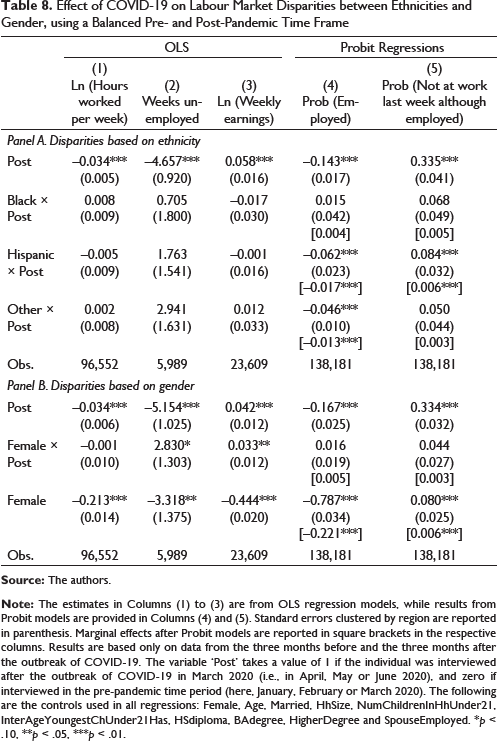
To examine the main drivers of the effects of interest and to check the sensitivity of the findings, we estimate the major regressions in subsamples of individuals who are married, single, with and without a child under 21. In addition, we estimate logit in addition to Probit regressions when the outcome is dichotomous to check the sensitivity of the estimates to a change in the distribution assumption for the error term. Finally, the time period used in the paper, specifically from January 2018 to June 2020, with a March 2020 cut-off for the pandemic produces an unbalanced pre-post periods. To explore the effects of interest ‘right before’ compared to ‘right after’ the threshold date, we estimate the main regressions using data only from the three months before and the three months after the outbreak. This experiment serves as an additional robustness test.
Data and Descriptive Statistics
Data for this study are collected from the Current Population Survey (CPS) (U.S. Bureau of Labor Statistics, 2020) from January 2018 to June 2020. CPS is a monthly, voluntary survey of about 60,000 households per month, conducted to provide major labour force statistics in the USA, including information about employment and well-being of Americans. Our sample consists of 3,537,120 observations. The survey is administered by the U.S. Census Bureau. Participants can be from any of the 50 states or the District of Columbia and must be 15 years old or older to participate.
In our analysis, we utilize data on the employment and earnings which are available in CPS. Specifically, we use variables that elicit information about respondents’ employment status (employed or not), hours worked per week (if employed), an indicator for whether the respondent is employed but has not been at work in the week prior to the interview, number of weeks of unemployment (if currently unemployed) and weekly earnings. These variables serve as outcome variables in our empirical analysis.
The main explanatory variables reflect the gender and ethnicity of the respondents. We use a dummy variable indicating gender, which takes a value of 1 if the respondent is a female, and 0 if the respondent is a man. We distinguish between White, Black, Hispanic and people of another ethnicity. The precise definitions of each of these major ethnic groups are described in detail in Appendix A1 of this paper.
The survey also allows us to construct a set of control variables, including age, marital status, household size, number of children, age of the youngest child, highest educational attainment (high school diploma and/or some college, bachelor’s degree, or higher degree), an indicator for having retired and employment status of the spouse. Education level below a high school diploma is the omitted category capturing respondents’ highest educational attainment. The variable denoting marital status is an indicator which equals 1 if the respondent is married, and zero if they are single/never married, separated, widowed or divorced.
We finally construct an indicator which takes the value of 1 if the interview was conducted after the beginning of the COVID-19 outbreak in March 2020, and 0 if data were collected prior to the pandemic. Interaction terms between dummy variables capturing gender, ethnicity and post-outbreak period are also included. All variables used in the analysis and their descriptions are provided in Appendix A1.
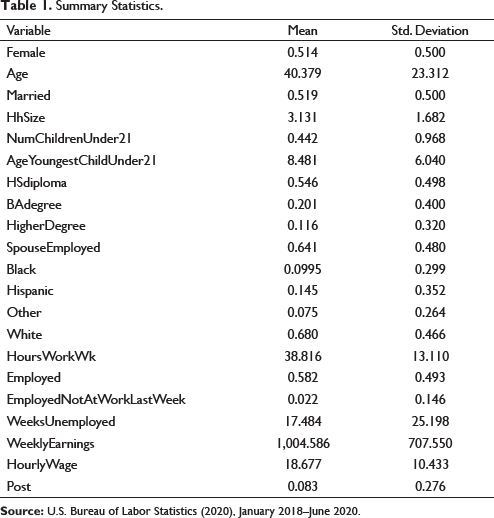
Summary Statistics.
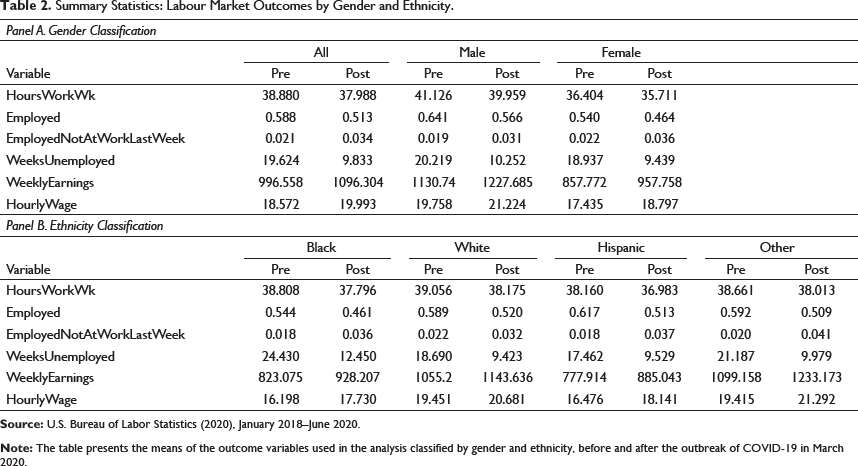
In Table 2, we summarize the outcomes categorized by ethnicity (Panel A) and gender (Panel B), pre- and post-outbreak periods.
Summary Statistics: Labour Market Outcomes by Gender and Ethnicity.
In our sample, 58.2% of the respondents are employed out of which 2.2% have not gone to work in the week prior to the interview, although they were employed. The average worker works 38.8 hours a week. The average number of weeks of remaining unemployed is 17 with a standard deviation of 25 weeks. Female respondents represent 51.4% of the sample. About two thirds of the respondents are White (68%), followed by Hispanics (14.5%), Black (9.95%) and individuals of other ethnicities (7.5%).
The average age of respondents in CPS is about 40, while the average age of the youngest child under 21 they have is a little older than 8. A little more than half of the respondents are married (51.9%) and the average household consists of 3 people. The highest educational attainment of 54.6% and 20.1% of the participants in the survey is a high school diploma and/or some college and a bachelor’s degree, respectively. About 11% of the respondents have a higher than a bachelor’s degree.
As Table 2 suggests, both male and female respondents worked fewer hours after the beginning of the pandemic and fewer individuals of both genders were employed. Specifically, while 64.1% of men and 54% of women were employed in the pre-shock period, 56.6% and 46.4% of male and female respondents, respectively, had a job afterwards. The hours worked per week declined from 41.126 to 39.959 for men and from 36.404 to 35.711 for women. Women are generally less likely to be employed and if employed, work fewer hours. The percentage of people of both genders who said they were not at work the previous week although employed increased after March 2020 although the proportion of workers in this category was still between 3% and 4% for both genders. Interestingly, the earnings of the remaining employed people increased after the outbreak. Combined with the fact that fewer people were employed after the outbreak and the average hours worked declined, these trends imply that the concentration of job loss occurred among the lowest paid workers.
We observe similar trends when we look at ethnic differences in the labour market. Based on the proportion of people employed and hours worked, all ethnicities were adversely affected by the pandemic, with the Hispanic population being the most affected. Although the hours of working Hispanics declined slightly, the percentage of people employed declined by about ten percentage points (from 61.7% to 51.3%).
Results
Effect of COVID-19 on Labour Market Disparities between Ethnicities.
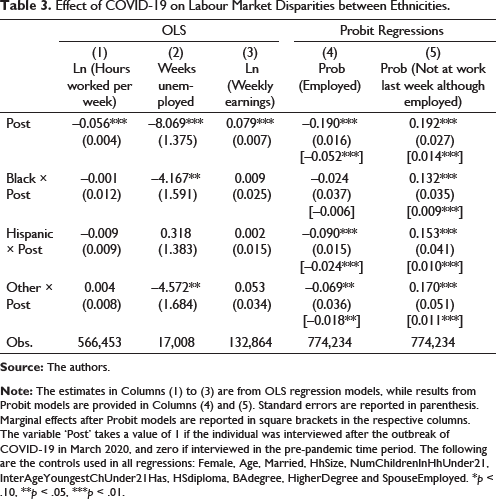
Second, Blacks, Hispanics and individuals of other ethnic groups as defined in the data section became 0.6%, 2.4% and 1.8%, respectively, less likely to be employed compared to Whites, relative to prior to the outbreak. This difference between Black and White workers, however, is statistically insignificant. The result that employment prospects of Hispanics were most adversely affected compared to those of other ethnicities is consistent with the results of Montenovo et al. (2020). In addition, all three groups became about 1% more likely to not be at work despite being employed compared to White workers, compared to before the pandemic. These effects are also highly statistically significant, implying that the shock caused by COVID-19 has worsened the pre-existing gap between Whites and disadvantaged groups in the labour market. Further, Hispanics’ hours worked relative to the hours worked by White workers declined after relative to before the COVID-19 outbreak although the magnitude of the effect is small and also not statistically significant. A potential explanation of the reduction might be that the Hispanic population may be concentrated in jobs which cannot be performed remotely. The results in Table 3 also suggest that the difference in the average number of weeks Black and White individuals remain unemployed decreased by about 4 weeks, which is interesting provided that widening gap in the employment prospects of minorities and Whites. This effect is statistically significant at 5% significance level. However, we do not observe a significant change in the difference between the hours worked between Black and White, and in the difference between the average length of unemployment between White and Hispanic, compared to before the pandemic. The results also do not provide evidence of a widening gap in the earnings of any ethnic group of workers. Therefore, although the COVID-19 crisis is responsible for a widening gap in the employment prospects of workers of different ethnic groups, it does not deteriorate the gap in earnings if one existed prior to the pandemic.
Effect of COVID-19 on Labour Market Disparities between Genders.
To further investigate the differential effect of the pandemic on labour market disparities of male and female individuals of distinct ethnicities, in addition to interactions of the post-outbreak indicator with ethnicity and female dummy variables, we add ethnicity–gender and ethnicity–gender—post-outbreak interactions to the major regressions. This intersectionality analysis is a natural extension of the analysis of ethnicity separately from gender. It is also a novelty in that it has not been done by previous authors in the context of COVID-19.
Effect of COVID-19 on Labour Market Disparities between Ethnicities and Genders.
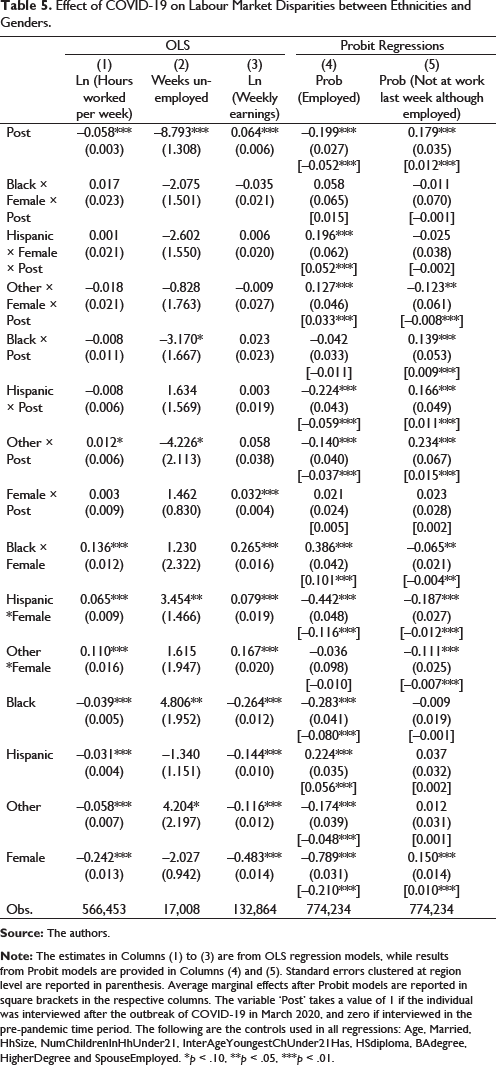
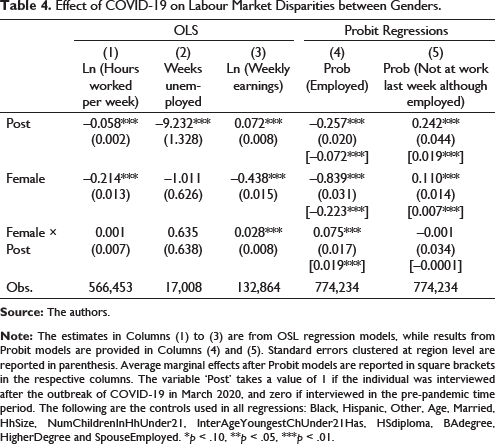
In summary, although the results provide evidence of differences across ethnic groups and genders and an adverse effect of the COVID-19 pandemic on labour market outcomes of all demographic groups, there is only small evidence of a widening gap in these experiences across groups as a result of the shock, more pronounced between ethnic groups than between genders.
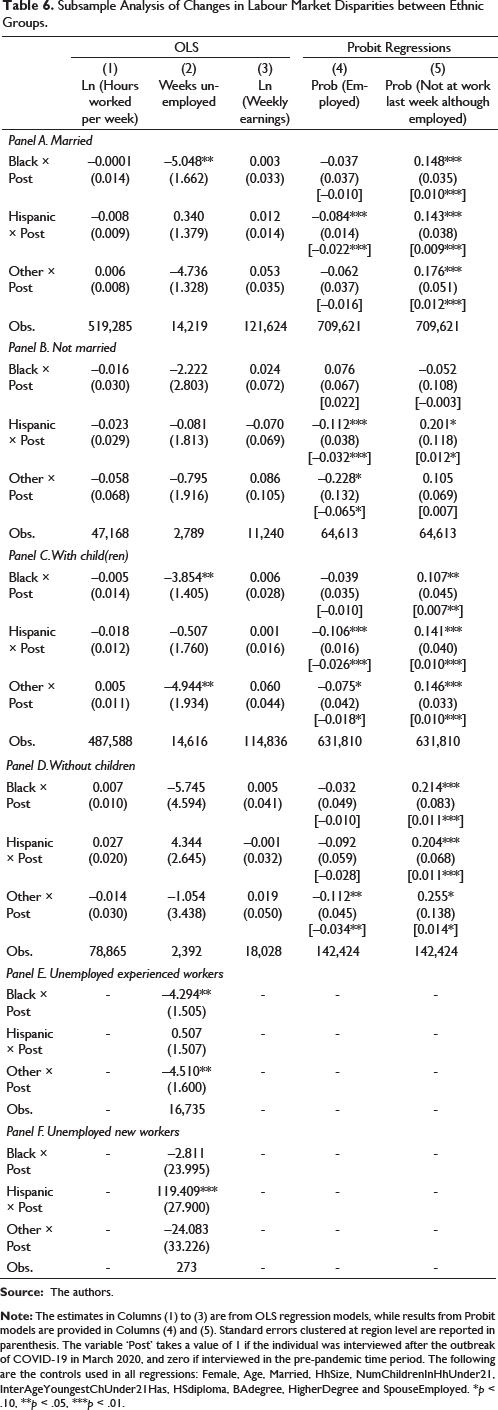
Subsample Analysis of Changes in Labour Market Disparities between Ethnic Groups.
Subsample Analysis of Changes in Labour Market Disparities between Genders.
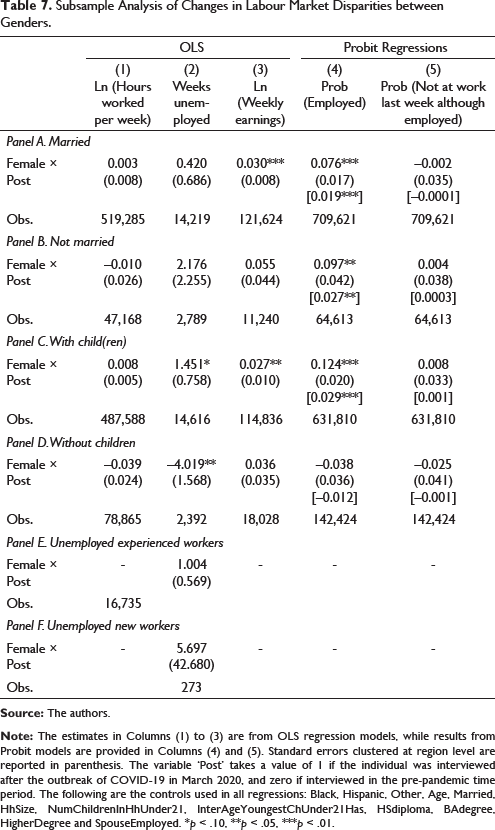
In the context of the existing literature on gender inequality, we confirm the general consensus that women on average earn less and are less likely to be employed than men, mainly because they are disproportionately represented in low-paying jobs and because of childcare (Bateman & Ross, 2020; Erosa et al., 2017). The effect of COVID-19 on the gaps in labour market outcomes between men and women is more controversial. Our result in the subsample of women with children indicating a widening gap in the duration of unemployment between male and female workers is consistent with the hypothesis that COVID-19 hurt women more than men because of school and childcare facilities closures (Alon et al., 2020; Karageorge, 2020). Such closures would affect only parents, so the most adverse effects being found in the sub-sample of respondents with children is intuitive and consistent with previous studies (e.g., Fuller & Quin, 2021).
Although there is a lot of research on the impact of COVID-19 on outcomes of men and women, the changes in the labour market gaps between genders have been explored less in previous literature. Yet, to compare our findings with those from other countries, Casale and Posel (2021) find that the pandemic affected women more than men in South Africa. Similarly, Fuller and Quin (2021) find gender gaps in employment due to the pandemic in Canada, but also an association between easing employment barriers and narrowing of this gap. Cook and Grimshaw (2021) show that the pandemic worsened employment prospects for women more than it did for men in Germany, Italy, the UK and Norway (Cook & Grimshaw, 2021), but the UK was affected more than Germany (Adams-Prassl et al., 2020). Reichelt et al. (2021) show that women are more likely to transition to unemployment than men in Germany and Singapore than the USA. We do not observe a widening gap in the employment prospects and earnings between genders (although we find changes in the gaps between ethnicities) due to the pandemic in the USA. This can be due to country heterogeneity, different outcomes or conditioning variables, but there is also likely to be a relationship between the gender gap and employment barriers that vary throughout the pandemic (Fuller & Quin, 2021). If this is the case, tracking gender differences between different stages of the pandemic would provide a fuller picture of the variation in these differences compared to the current research which explores only average changes before and after March 2020.
However, the results we obtain for gender differentials are consistent with two trends found in previous literature. First, while Collins et al. (2020) find that the average hours worked of women declined more than that of men during COVID-19, Bluedorn et al. (2021) find the opposite. Combining the latter finding of Bluedorn et al. (2021) that men’s working hours declined more with the fact that women are more likely to be employed in low-wage jobs (Bateman & Ross, 2020; Erosa et al., 2017), would not predict an increase in the difference between the weekly earnings of the two genders. This is consistent with our finding of a lack of a widening gap in the earnings of men and women. Second, our findings are in accordance with the changes in gender-role attitudes toward housework (Bujard et al., 2020) and childcare (Alon et al., 2020; Sevilla & Smith, 2020) and the positive impact of the pandemic on flexibility of workplace arrangements (Alon et al., 2020).
The available data also allow us to distinguish between unemployed experienced and new workers. Because these are categories respondents in CPS can classify themselves as, we caution that the distinction between experienced and new workers is unclear, and second, the subsample of unemployed new workers consists of only 273 respondents, compared to 16,735 unemployed experienced workers. Still, the last two panels of Tables 6 and 7 suggest a significant increase in the number of weeks of unemployment of unemployed new Hispanic workers relative to unemployed new White workers, compared to prior to the outbreak of the pandemic. This is consistent with the findings of Oreopoulos et al. (2012) who found nonlinear effects of first-time employment prospects for recent graduates during a recession. We do not observe a change in the gender differences in the duration of unemployment based on work experience.
Effect of COVID-19 on Labour Market Disparities between Ethnicities and Gender, using a Balanced Pre- and Post-Pandemic Time Frame
Finally, we perform a placebo test using a different threshold date instead of March 2020. Specifically, we run the major regressions (five exploring ethnic and five examining gender differences) using year 2018 as a pre-intervention period and year 2019 as a post-intervention time. In this experiment, all ethnicity-post intervention and gender-intervention interactions are insignificant, with the exception of the regression examining ethnic differences in earnings. This is expected because using the true dateline, we did not find a widening gap in earnings of different ethnic groups. The results from the placebo tests can be provided upon request. They provide evidence that the statistically significant results presented earlier can be attributed to the changes observed after March 2020, that is, during the pandemic.
Discussion of the Policy Implications
This study finds that COVID-19 has had an overall adverse effect on the labour market and has contributed to an increase in the gap between the employment prospects of individuals of different ethnicities. However, our findings do not indicate a widening gap in the differences in the earnings and the employment prospects between men and women. These results have at least the following implications for policy decision-making.
First, actions to encourage job openings are necessary to reverse the negative impact of the COVID-19 pandemic on workers of all demographic groups and to return the employment rate to its pre-pandemic level. Experiences from previous recessions show that the economy does eventually recover but the speed of recovery might vary depending on the sector and government responses. In the instance of COVID-19, it is likely to depend on the effectiveness of the intervention to sustainably contain the spread of the disease, encouraging matching of workers with businesses and understanding the trend of who the most vulnerable groups of workers were prior to the contraction because they tend to face a harder recovery.
Second, the pre-pandemic obstacles related to the disparities in the labour market across some demographic groups have worsened after March 2020, and therefore, deserve attention. However, we find that the pandemic affected the labour market experiences gap between ethnicities more severely than that of between men and women. This implies that if any policies to alleviate inequality between demographic groups are implemented, ethnic rather than gender disparities should be prioritized. We further find that Hispanics were more adversely affected compared to other workers. This suggests that they are most likely to benefit from assistance in finding jobs.
Additionally, the evidence of an expanding gap in the employment prospects of workers of distinct ethnicities and individuals’ awareness of this disparity might discourage minorities from looking for jobs because of the lower likelihood of finding one. Programs to train these workers to gain valuable skills which can increase their competitiveness in the labour market, as well as motivational programs to encourage them to search for jobs, are some potential and necessary steps towards the transition to a post-pandemic recovery.
Conclusion
In this paper, we examine the effect of an economic shock on labour market inequalities between ethnic groups and genders. We found empirical support of the hypothesis that the COVID-19 pandemic widened the gap between the employment prospects of minorities and Whites, with Hispanics being the most adversely affected. The latter group started working fewer hours compared to White workers, relative to before the pandemic. The latter effect is mainly driven by married individuals and workers who have children. However, the difference between the earnings of employed workers of distinct ethnicities did not change significantly. The shock also did not worsen gender inequality in the labour market, meaning that the gap remained in pre-pandemic levels. These results emphasize the importance of taking action to recover the economy, and specifically, the labour market from the COVID-19 crisis. They also have policy implications related to the expanding challenges to alleviate the gap in labour market experienced between ethnic groups.
Although this is among the first paper which explores the changes in the differences in labour market experiences between demographic groups in the context of COVID-19, our research has limitations. First, we do not account for years of work experience because our data are limited and because including experience as a conditioning factor might cause simultaneity issues because discriminatory behaviour is likely to affect workers’ experience. For instance, Gronau (1988) shows that discrimination might affect the years of experience of women. Second, given the available data and the fact that the pandemic had an impact on the entire population, we do not have appropriate data to define a control group, that is a group unaffected by COVID-19, although we compare the effect of the event on labour market outcomes on different groups of individuals. Third, we do not have data which we can be used as a proxy for productivity. Therefore, some of the differences in labour market disparities across genders or ethnicities might be contributed to different productivity levels. However, the fact that we compare the gaps before and after the COVID-19 outbreak is likely to alleviate this issue because differences would eliminate time-invariant characteristics of distinct demographic groups. Specifically, we are interested in the difference in the gap after as compared to before the exogenous shock.
More research is necessary to address the abovementioned limitations. Future research can also extend our analysis to other countries and distinguish between the labour market disparities in geographic locations with different numbers of confirmed COVID-19 cases to examine the effect of the severity of the disease on inequality.
Explanatory Variables and Controls:
Female: A dichotomous variable which equals 1 if the respondent is female, and zero if the respondent is a male. Black: A dichotomous variable which equals 1 if an individual is black, including black/negro, Black-American Indian, Black-Asian, Black-Hawaiian/Pacific Islander, or Black-American Indian-Asian, and zero, otherwise. Hispanic: A dichotomous variable which equals 1 if an individual is Hispanic, including Mexican, Mexican American, Mexicano/Mexicana, Chicano/Chicana, Mexican (Mexicano), Mexicano/Chicano, Puerto Rican, Cuban, Dominican, Salvadoran, other Hispanic, Central/South American, Central American, or South American, and zero, otherwise. The variables Black, White and Other ethnicity individuals exclude Hispanic. White: A dichotomous variable which equals 1 if an individual is white, White-American Indian, White-Hawaiian/Pacific Islander, White-Hawaiian/Pacific Islander, or White-American Indian–Hawaiian/Pacific Islander, and zero, otherwise. Other ethnicity: A dichotomous variable which equals 1 if an individual has classified himself/ herself as a representative of one of the following ethnic groups: White-Black, White-Black-American Indian, White-Black-Asian, White-Black-American Indian-Asian, White-Black–Hawaiian/Pacific Islander, Asian or Pacific Islander, Asian only, White-American Indian-Asian, White-Asian-Hawaiian/Pacific Islander, American Indian-Asian, Asian-Hawaiian/Pacific Islander, White-American Indian-Asian-Hawaiian/Pacific Islander, American Indian/Aleut/Eskimo, Hawaiian/Pacific Islander only, American Indian-Hawaiian/Pacific Islander, or two or more ethnicities. The variable takes a value of zero, otherwise. Post: A dummy variable equal to 1 if the respondent was interviewed strictly after March 2020, and zero if the respondent was interviewed prior to the COVID-19 outbreak. Married: an indicator which equals 1 if the respondent is married, and zero if (s)he is separated, divorced, widowed, or never married/single (6). HSdiploma: A binary variable which takes the value of 1 if the highest educational attainment of a respondent is a high school diploma and/or some college (without a formal degree), and zero, otherwise. BAdegree: A binary variable which takes the value of 1 if the highest educational attainment of a respondent is a bachelor’s degree, and zero, otherwise. HigherDegree: A binary variable which takes the value of 1 if the highest educational attainment of a respondent is higher than a bachelor’s degree (e.g., MA or PhD), and zero, otherwise. Age: Age of the respondent. HhSize: Number of individuals in the household. NumChildrenInHhUnder21: Number of children under 21 present in the household. InterAgeYoungestChUnder21Has: Age of the youngest child under 21 in the household if one or more children under 21 are present. Retired: An indicator equal to 1 if a respondent has retired, and zero, otherwise. SpouseEmployed: An indicator equal to 1 if the spouse (if present) is employed, and zero, otherwise.
Dependent Variables:
Ln (HoursWorkWk): Natural logarithm of the hours worked per week. Employed: An indicator equal to 1 if the respondent is employed, and zero, otherwise. EmployedNotAtWorkLastWeek: An indicator equal to 1 if the respondent is employed but has not been at work the week prior to the interview, and zero, otherwise. WeeksUnemployed: Number of consecutive weeks the respondent has been unemployed (if unemployed at the time of the interview). Ln (WeeklyEarnings): Natural logarithm of the respondent’s earnings per week.
