




Abstract
Purpose:
The aim of this study was to examine the effects of various sintering procedures on the color parameters, marginal, and internal fit of zirconia crowns.
Materials and Methods:
Overall, 60 zirconia crowns were produced using 3 distinct zirconia blocks (Wieland Zenostar, Zirkonzahn Ice Translucent, and Zirkonzahn Prettau). For the sintering procedure of the crowns, six groups were created as follows: Wieland-Standard, Wieland-Speed, Ice-Standard, Ice-Speed, Prettau-Slow, and Prettau-Standard programs. The crowns were assigned into groups (n = 10 in each group). The color parameters, marginal fit, and internal fit of the crowns were evaluated. The normality of data distribution was evaluated with the Kolmogrov–Smirnov test. Two independent samples t-test and Mann–Whitney U test were used to compare the sintering groups.
Results:
Acceleration of sintering caused a significant change in the color parameters of the Wieland and Ice groups but not in the Prettau group. In the Wieland group, marginal (p = .047) and internal (p = .004) gap values of speed sintering were found to be significantly lower than those in standard sintering. In the Ice group, the marginal gap values of speed sintering were found to be significantly lower than those in standard sintering (p = .019). In the Prettau group, the marginal gap values of standard sintering were found to be significantly higher (p = .035) than those in slow sintering.
Conclusions:
It was concluded that the effects of sintering procedures on color parameters, and internal and marginal fit of zirconia crowns were clinically insignificant. Speed sintering can be recommended for zirconia restorations.
Introduction
Due to their high biocompatibility, superior mechanical properties, and satisfactory applications, monolithic zirconia (MZ) restorations are produced using zirconia blocks with computer-aided design and computer-aided manufacturing (CAD-CAM). The restorations produced are subjected to sintering at different temperatures and times to achieve their final strength and density. Speed and high-speed sintering procedures reduce sintering time using special furnaces, making zirconia a preferred material for chairside one-visit restorations. However, changing sintering procedures can affect the color and compatibility characteristics of restorations.1–3
In color science, the color of an object is expressed by a numerical value. 4 Commission Internationale de l’Eclairage (CIE) uses three coordinates to represent a color. 5 In the CIE (L* a* b*) color system, the L* axis represents the lightness (value) in black and white coordinates. A value of “0” corresponds to black, and a value of “100” corresponds to white. The a* axis indicates the red (+a*) – green (–a*) value, and the b* axis yellow (+b*) – blue (–b*) value; they together express the saturation of the hue (chroma). 6 The values in these three coordinates are used to calculate the numerical value of an object’s color perception, namely, the E value. For this purpose, E = ((L*) 2 + (a*) 2 + (b*) 2 )1/2 is one of the formulas used. ΔE values are used to express the color difference between two objects.7, 8
Fit of the restoration with the prepared tooth is critical to prevent secondary caries and maintain the health of periodontal tissues. Marginal discrepancy can lead to many biological problems such as plaque accumulation, microleakage, and secondary caries formation.9, 10 In fixed prosthetic restoration, the factors influencing the marginal fit of the restoration have been investigated in many studies.11–14 In particular, the applications during the production phase of the restoration can affect the fit of the restoration. 15 The aim of this study was to examine the effects of different sintering procedures on the color parameters, marginal fit, and internal fit of MZ crowns. The null hypothesis of the study is that the color parameter, marginal fit, and internal fit of MZ crowns are not affected by the sintering procedures.
Materials and Methods
Setting and Design
This is an in vitro study performed in the Faculty of Dentistry of Erciyes University dated between May and November 2020. The total number of specimens was determined as 20 for each brand. The total number of specimens was determined as 20 for each brand. The clinically minimal meaningful difference for the E value was accepted as 1.6 unit. 16 The size (f) was 1.6, power was 0.80, and 2 groups were compared. Power analysis was performed using G Power 3.0.1 software.
Production of Zirconia Crowns
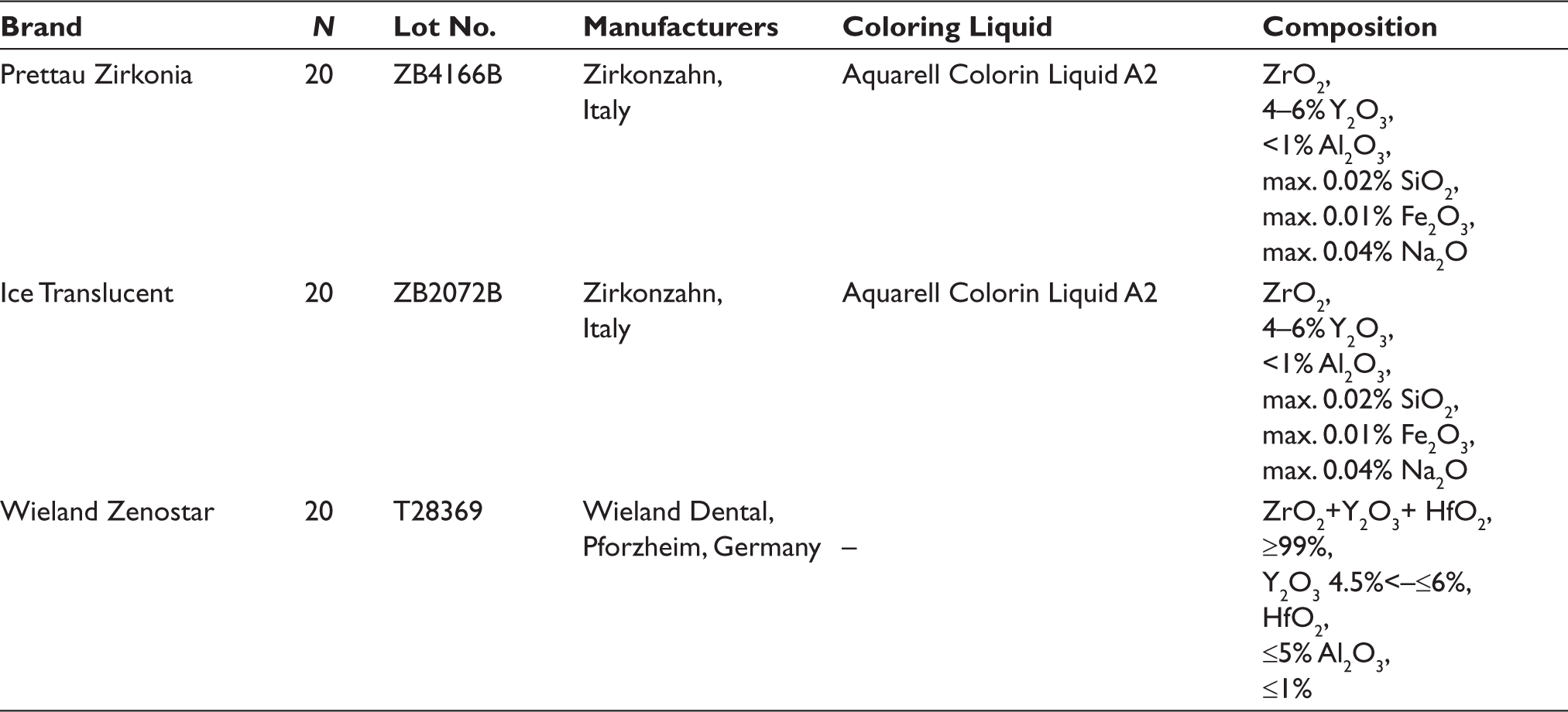
An artificial mandibular first molar tooth was prepared in anatomical form with a 1 mm chamfer finish line and 1.5 mm occlusal reduction at the cusp crest and 1 mm occlusal reduction in the central fossa, and the axial walls were checked with a parallelometer. Impression was taken from the prepared tooth with polyvinyl siloxane impression material (Elite HD, Zhermack, Badia Polesine, Italy) and inlay wax (GC Corp., Tokyo, Japan) was poured into the impression. The duplicate wax model obtained was muffled and the wax was removed. Then a metal die was obtained from a chrome-cobalt alloy, and polished. The metal die was scanned using an extraoral three-dimensional scanner (Model DW-7-140/Dental Wings Inc. 2251 Letoumeux Montreal, Quebec Canada), and the data obtained were transferred to the three-dimensional design program (Dental Wings DWOS software, Toronto, Canada). An MZ crown was designed with a cement thickness of 55 µm on the internal surface and 25 µm on the marginal area. Using three distinct zirconia blocks (Table 1), a total of 60 zirconia crowns, 20 crowns from each block, were milled in accordance with the CAD file (Table 1). Ice and Prettau samples were colored and dried according to the manufacturer’s instructions before sintering, whereas the Wieland samples were not colored as they can be used without coloring.
Main Materials and Details Used in the Study.
Sintering Procedure
For the sintering procedure of the produced crowns, six groups were created as Wieland-Standard, Wieland-Speed, Ice-Standard, Ice-Speed, Prettau-Slow, and Prettau-Standard programs. The crowns were assigned into 6 groups randomly, with 10 samples in each group (n = 10), and all sintering procedures were performed using the same furnace (Programat S1, Ivoclar Vivadent AG, Schaan, Liechtenstein).
According to the recommendations of the manufacturers, the time and temperature values of the sintering processes are as follows:
In both programs used in the Wieland group, the maximum temperature is 1500˚C. The total time in the Wieland-Speed program is 2 hours 55 minutes, whereas in the Wieland-Standard program it is 9 hours and 50 minutes. In both programs in the Ice group, the maximum temperature is 1500˚C. The total time for the Ice-Speed program is 5 hours, whereas for the Ice-Standard program it is 8 hours. The maximum temperature in both programs of the Prettau group is 1600˚C. The total time for the Prettau-Slow program is 12 hours, whereas for the Prettau-Standard program it is 8 hours.
Marginal and Internal Fit Measurement
The marginal and internal fit were measured using the silicone replicas. The intaglio surface of each crown was filled with a low-viscosity light-body silicone (Kettenbach, Panasil® initial contact X-Light, Eschenburg, Germany) and the crowns were then seated on the metal die. A 50 N pressure was applied using a press machine during the polymerization phase of the silicone. Specimens were removed carefully from the metal die without damaging the thin layer of light-body silicone adhering to the intaglio of the crowns. To stabilize the thin film of light-body, a different colored light-body silicone (Elite HD, Zhermack, Badia Polesine, Italy) was injected into it. If there were defects or tears in the silicone film, the procedure was repeated. The molded silicone was divided into mesiodistal and two buccolingual sections using a razor blade. The images of the cross-sections were obtained using a stereomicroscope (Stereomicroscope: Leica S8AP0, camera: Leica MC 170HD, Bensheim, Germany) at ×12 magnification. The thickness of the low viscosity light body was measured at predetermined points for each section. Marginal gap values were calculated by averaging 35 measurements for each crown including 5 measurements from 7 different regions. Internal spacing values were calculated by the average of 200 measurements from 19 occlusal and 21 axial points (measurements repeated 5 times from each point) in total. Internal and marginal gaps were reported as a single mean value.
Color Measurement
After marginal and internal fit measurements, all samples were aged in an autoclave (0.2 MPa pressure and 134˚C) for 5 hours and ultrasonically cleansed with isopropyl alcohol for 5 minutes. Color measurement of the crowns was performed on a neutral gray background using a spectrophotometer (SpectroShade Micro II, Niederhasli, Switzerland). Three measurements were taken from each surface of the crowns (15 measurement for each crown), and the CIELAB coordinates (L*, a*, b*) were recorded; mean values were calculated thereafter. E values were calculated using the formula E = ((L*) 2 + (a*) 2 + (b*) 2 )1/2 for each crown. The E value has been used in the literature to compare the color perception of dental materials. 17
Statistical Analysis
The conformity of the L*, a*, b*, E, marginal, and internal gap values of the samples to the normal distribution was evaluated using Kolmogrov–Smirnov test. The data of different sintering groups within same brand were compared using two independent samples t-test in case of normal distribution whereas using Mann–Whitney U test in case of skewed distribution. The data were evaluated using the SPSS 22.0 (SPSS Inc., Chicago, IL, USA). A p < .05 was considered statistically significant.
Results
In the Wieland group, marginal (p = .047) and internal (p = .004) gap values of speed sintering were found to be significantly lower than those in the standard sintering. Based on the results of two independent samples t-tests, the L* and E values were significantly increased by acceleration of sintering. Although a* and b* values were decreased, no significant difference was observed (Table 2).
Mean, SD, and Significance Between Sintering Procedures of Wieland Group.
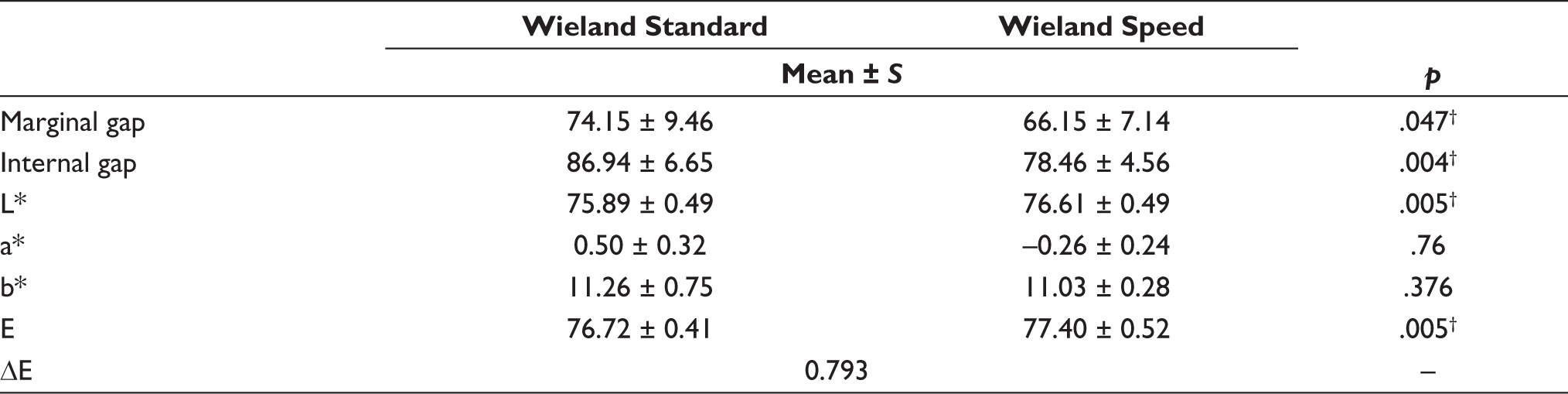
SD: Standard deviation.
In the Ice group, the marginal gap values of speed sintering were found to be significantly lower than those in the standard sintering (p = .019). Based on the results of two independent samples t-tests, the L* values were significantly increased by acceleration of sintering. Although a* and E values were increased, the difference did not reach statistically significant. A significant decrease was observed in the b* values by the acceleration of sintering (Table 3).
Mean, SD, and Significance Between Sintering Procedures of Ice Group.
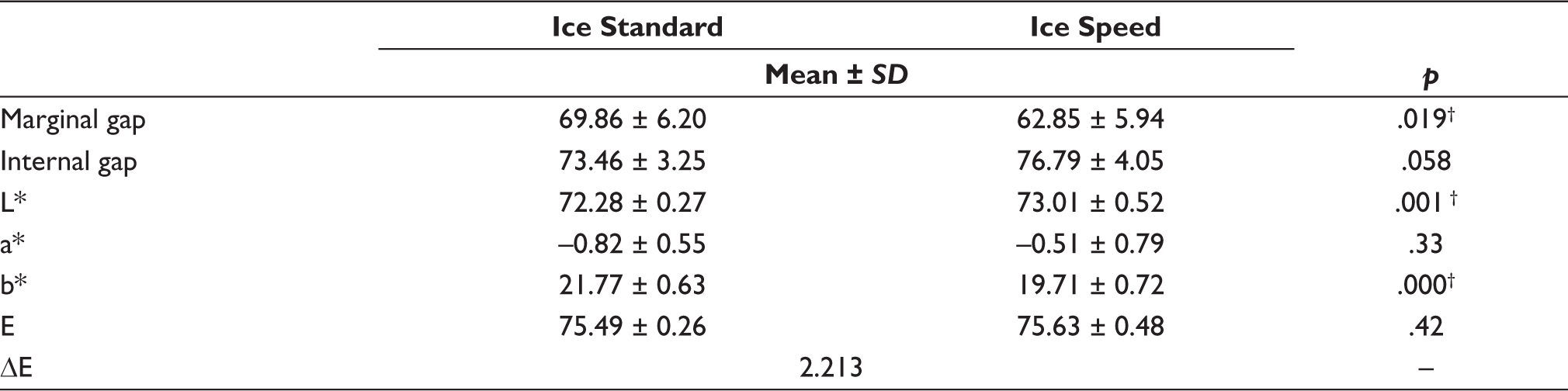
SD: Standard deviation.
In the Prettau group, the marginal gap values of standard sintering were found to be significantly higher (p = .035) than those in the slow sintering. Since the a* and b* parameters showed skewed distribution in the Prettau group they were compared using Mann–Whitney U tests while remaining parameters were compared using two independent samples t-test. No significant difference was observed in any binary comparisons of color parameters in this group (Table 4).
Mean, SD, and Significance Between Sintering Procedures of Prettau Group.
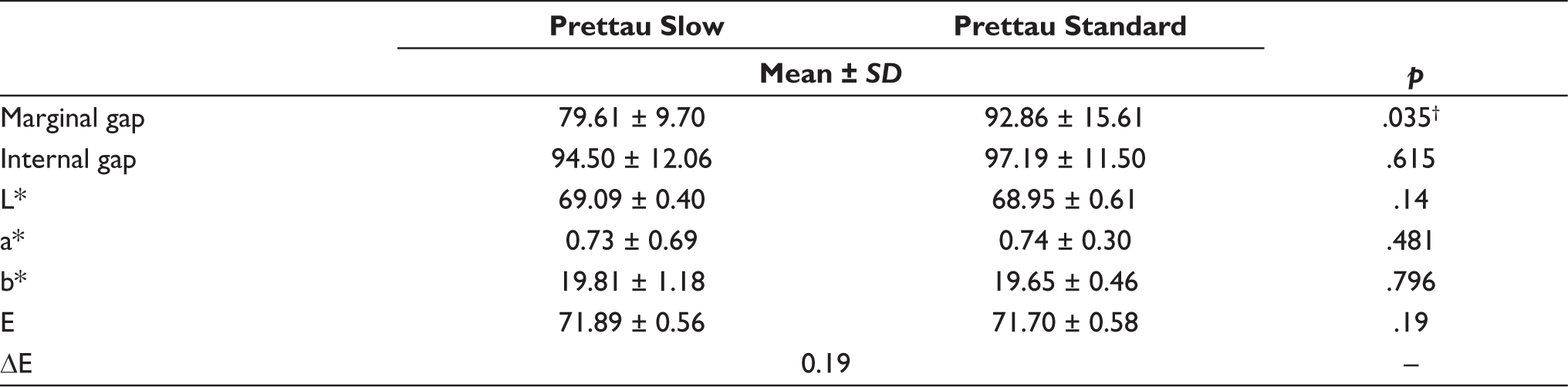
SD: Standard deviation.
Discussion
The differences in the sintering procedures affect the microstructure and optical properties of zirconia.17–19 The extent of this effect has become the subject of research, especially after the introduction of accelerated sintering procedures by manufacturers. There are many studies in the literature investigating the effects of changes in sintering time and temperature on the optical properties and restoration-tooth compatibility of zirconia ceramics.19–24 However, the effect of these changes on the properties of MZ is still questioned. In this study, the effect of different sintering procedures on the color and compatibility of different brands of MZ ceramics was evaluated. The null hypothesis was rejected, as the color parameters, marginal fit, and internal fit of MZ crowns were affected by the sintering procedures.
The CIELAB system provides a quantitative color representation and has been extensively used in dentistry to study aesthetic materials, color guides, and color reproductions.25–27 Color differences (ΔE) can be determined using CIELAB coordinates. The perceptibility and acceptability thresholds of color differences define the match or mismatch of color, translucency, and whiteness in dentistry. These thresholds are important as a quality control tool and guide for the evaluation and selection of dental materials, evaluation of their clinical performance, analysis of in vivo and in vitro research findings, and standardization in dentistry. 28 The perceptibility and acceptability thresholds of ΔE differ in the literature, mainly due to the differences regarding observers, objectives, and methodologies between studies.1, 7, 29–35 In general, statements such as ΔE < 3 “clinically imperceptible,” ΔE 3–5 “clinically acceptable,” and ΔE > 5 “clinically unacceptable” are consistent with clinical practice.1, 24, 36–38 ∆E values between slower and faster sintering procedures were below the clinically perceptible threshold for all three zirconia blocks. This result agrees with studies in the literature.1, 21, 38
To our knowledge, there is limited information regarding the effect of sintering procedures on L*, a*, b* values. In our study, besides ΔE values, L*, a*, b* values were also evaluated by statistical analysis. Kim et al. 39 found that faster sintering significantly increased the a* and b* values. In addition, they found that L* value was increased in 0.5- and 1-mm thick specimens and decreased in 1.5 mm thick specimens with faster sintering. 39 In our study, there was no significant change in a* value in any group with the change in sintering procedure. The b* value was significantly decreased by faster sintering in the Ice group, whereas there was no significant change in the remaining groups. This decrease in b* value can be interpreted as the color of the Ice group getting closer to blue.40 The L* value was significantly increased by acceleration of sintering in the Wieland and Ice groups, whereas there was no significant change in the Prettau group. The increase in L* value seen in the two groups can be interpreted as an increase in brightness. 40 The discrepancy may be due to the different brands of the zirconia block used and the use of square-shaped samples instead of full-contour zirconia in their study, unlike our study.
The thickness of zirconia crowns can affect the physical and optical properties.41–43 Tabatabaian et al. 44 reported that zirconia with a minimum thickness of 1 mm has an acceptable clinical masking ability, and zirconia with a thickness of 1.6 mm has an ideal masking ability. In addition, they suggested that the masking ability is also increased by increasing the thickness of zirconia ceramic. 44 In general, zirconia discs have been used in color change studies in the literature.1, 21, 38 To obtain realistic results, full contour restorations with a thickness of 1 mm on the axial surfaces and central fossa and 1.5 mm thickness on the cusp crests were used instead of zirconia discs in our study. There are many techniques in the literature for the evaluation of edge fit. 45 These are direct methods with the use of microscope, sectioning, micro-computer tomography (CT), and silicon replica technique. The silicone replica technique has been commonly used because of its ability to measure the internal and marginal adaptation of a dental prosthesis without damaging the specimen tested.46, 47 Therefore, we used this technique in this study.
Groten et al. 48 suggested that measurements should be made from at least 20–25 points and, ideally, from 50 points to evaluate the fit of the restoration. 48 In our study, internal and marginal fit were evaluated separately, and a total of 235 measurements were made from 47 different points for each crown. As a result of our study, with the acceleration of sintering, marginal gap values decreased significantly in the Wieland and Ice groups, whereas they increased in the Prettau group. The internal gap value was significantly decreased in the Wieland group, whereas there was no difference in the remaining groups (p < .05). McLean examined more than 1,000 restorations within 5 years and concluded that marginal gaps 120 μm were clinically acceptable. 49 These marginal discrepancies would be acceptable for CAD/CAM crowns if they ranged between 50 μm and 100 μm. 50 According to our findings, the marginal gap values in the study groups are in the clinically acceptable range. Ahmed et al. 51 stated that reduction in the sintering time causes an increase in the marginal gap values. 51 In our study, this situation was observed only in the Prettau group. Khaledi et al. 52 stated that the sintering time had no significant effect on the marginal fit. 52 On the contrary, in our study, changing the sintering time led to a significant change in all groups. Unlike our study, Khaledi et al. 52 used non-anatomical coping, not MZ crowns, which may explain inconsistent results.
This study has some limitations including color measurement of the restorations without glaze and cementation and the use of zirconia with different colors. The percentage of Y2O3 contents, shade, and surface treatments of MZ, the color of prepared teeth, and luting cement can affect the optical properties of ceramic restorations. 53
Within the limits of the study, the following conclusions were reached:
The color difference between slower and faster sintering procedures was below the clinically perceptible threshold for all three zirconia blocks. Although there were statistically significant differences in marginal and internal gap values by changing the sintering procedures, the values remained within clinically acceptable limits in all groups. Speed sintering can be recommended for MZ restorations due to advantages such as time, cost, and single-session treatment. Further studies are needed to examine the effects of sintering procedures on the color and fit of crowns to be obtained from zirconia blocks with various yttria contents.
Footnotes
Authors’ Contribution
Conceptualization: A.H., E.R., A.M., and SS.B. Methodology: A.H., E.R., T.O., and S.T.
Validation: E.R., SS.B., and A.M.
Data curation: A.H., T.O., and S.T.
Writing (original draft preparation): A.H., E.R., SS.B., and A.M.
Writing (review and editing): A.H., E.R., T.O., and S.T.
Visualization: A.H., E.R., SS.B., and A.M.
Supervision: A.H., T.O., and S.T.
Funding acquisition: None.
All authors have read and agreed to the published version of the manuscript.
Data Availability Statement
The data will not be shared; if requested, this request will be evaluated by the corresponding author.
Declaration of Conflicting Interests
The authors declared no potential conflicts of interest with respect to the research, authorship, and/or publication of this article. The manuscript has been read and approved by all the authors. The requirements for authorship, as stated earlier in this document, have been met, and each author believes that the manuscript represents honest work. This study has not previously been presented anywhere.
Funding
The authors received no financial support for the research, authorship, and/or publication of this article.
List of Abbreviations
CAD-CAM: Computer-aided design and computer-aided manufacturing
CIE: Commission Internationale de l’Eclairage
ΔE: Color differences
CT: Computer tomography
MZ: Monolithic zirconia