




Abstract
Background:
The present study was conducted to assess postoperative pain using different root canal irrigants in mandibular molars with symptomatic irreversible pulpitis.
Materials and methods:
The present study was conducted on 84 patients (40 males and 44 females) having 126 mandibular molars with symptomatic irreversible pulpitis. In all molars, access cavity preparation was done and the root canal shaping procedures were performed according to the manufacturer’s instructions for each instrument system. Teeth were divided into 2 groups. In Group I, the 5.25% sodium hypochlorite (NaOCl) solution was used as an irrigating solution. In Group II, the 2% chlorhexidine gluconate (CHX) was used as an irrigating solution. A visual analog scale (VAS) was used to assess postobturation pain on the 1st, 3rd, and 7th days.
Results:
There were 40 males and 44 females in the present study. In Group I, the 5.25% NaOCl solution was used as an irrigating solution. In Group II, the 2% CHX was used as an irrigating solution. Each group had 63 teeth. VAS was 9 in Group I and 8 in Group II on Day 1; 5 and 3 in Groups I and II, respectively, on Day 3; and 3 and 1 on Day 7 in Groups I and II, respectively. The difference was significant (P < .05).
Conclusions:
There were excellent results obtained with the 2% CHX solution as compared with the 5.25% NaOCl solution. Group II exhibited less VAS than Group I.
Introduction
Successful endodontic treatment depends on factors such as proper cleaning, shaping, obturation and postobturation. Root canal treatment (RCT) is other procedure used for endodontic therapy. The principle of endodontic therapy is the eradication of root canal irritants, cleaning and shaping, obturation of root canals, and postendodontic restoration. 1 It involves access opening, cleaning the canals using various instruments along with the use of an irrigating solution such as sodium hypochlorite (NaOCl) followed by the obturation of prepared canals with obturating materials such as guttapercha. After RCT, tooth is restored with various restorative materials such as amalgam, composite, or glass ionomers depending upon clinical condition. 2
RCT significantly reduces the severity of pain; the immediate posttreatment pain severity levels may sometimes slightly exceed the pretreatment severity levels. This results from the penetration of pulpal tissues, dentinal debris, microorganisms, and irrigants to the periapical tissues during RCT leading to periradicular inflammation. Pain perception is subjective and varies from person to person. 3 Postobturation pain depends on factors such as infection, pre-operative pain, intracanal medication, and physical and chemical damages to periapical tissues. 4
The role of the irrigating solution is vital in endodontic therapy. The most popular endodontic irrigant is the 5.25% NaOCl solution, which has been used well over 4 decades. Although it is an effective antimicrobial agent and an excellent organic solvent, it is known to be highly irritating to the periapical tissues, mainly at high concentrations. Another useful agent 2% chlorhexidine gluconate (CHX) has been suggested as an alternative irrigating solution that could replace NaOCl. 5
The present study was conducted to assess postoperative pain using different root canal irrigants in mandibular molars with symptomatic irreversible pulpitis. This study provides useful information regarding the efficacy of different root canals irrigants in controlling postoperative pain. By this, an effective treatment may be done that ensures successful endodontic therapy.
Materials and Methods
The present study was conducted in the Department of Endodontics, Restorative Dental Science (RDS). It comprised 84 patients (40 males and 44 females) having 126 mandibular molars with symptomatic irreversible pulpitis. Selection criteria were based on the number of patients visited to the department with grossly mandibular molars.
All patients were informed about the study and informed written consent was obtained. Ethical clearance was obtained prior to the study (King Khalid University; research registration no. SRC/REG/2018-2019/99, ethical approval no. SRC/ETH/2018-19/132).
General demographic information such as name, age, and gender was recorded. In all molars, access cavity preparation was done using the round diamond abrasive point and nonend cutting tapered fissure bur. The working length was measured. The root canal shaping procedures were per-formed according to the manufacturer’s instruc-tions for each instrument system. In Bone Morphogenic Protein, the canals were prepared up to size 40. Teeth were randomly divided into 2 groups irrespective of gender. In Group I, the 5.25% NaOCl solution was used as the irrigating solution. In Group II, 2% CHX was used as an irrigating solution.
In all teeth, the lateral condensation technique was followed. Temporary restoration with cavit was done. Postoperative instructions were given to all. A visual analog scale (VAS) was used to assess postobturation pain on the 1st, 3rd, and 7th days. Results thus obtained were subjected to statistical analysis using Windows software SPSS, version 14.0. A P value <.05 was considered significant.
Results
In this study, there were 40 males and 44 females. The study had 2 groups. In Group I, the 5.25% NaOCl solution was used as an irrigating solution. In Group II, 2% CHX was used as an irrigating solution. Each group had 63 teeth.
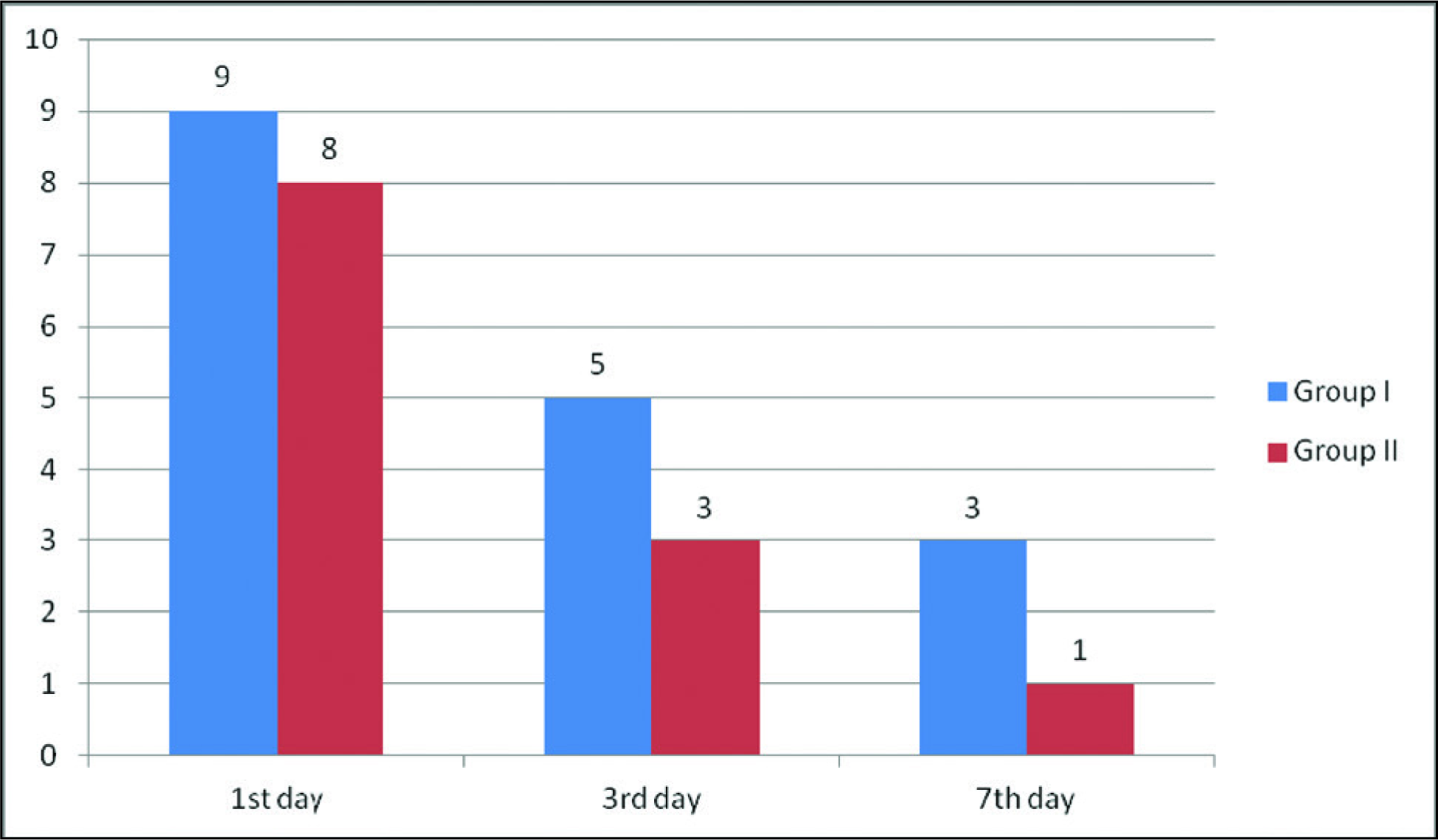
The VAS was 9 in Group I and 8 in Group II on the 1st day; 5 and 3 in Groups I and II, respectively, on the 3rd day; and 3 and 1 on the 7th day in Groups I and II, respectively. The vertical axis in Figure 1 shows the VAS score. The 2 test was applied, which showed a significant difference between the 2 groups (P < .05; Figure 1).
Assessment of Postoperative Pain in Both Groups
Discussion
There are numerous factors leading to failure in endodontic therapy, such as improper pulpectomy, insufficient canal preparation, and apical extrusion of debris. Any injury to the periapical tissue during RCT promotes more intensive secretion of inflammatory mediators, such as prostag-landins, serotonin, leukotrienes, histamine, and bradykinin, which are considered to be mediators of pain. 6 Possible causes of persistent postobturation pain involve inadver-tently missed strands of the pulp tissue, failure to adequa-tely seal the access cavity, and even noncooperation of the patient with respect to postoperative instructions. It has been observed that bradykinin shows sensitizing and excitatory effects on peripheral nociceptors, thereby em-phasi-zing its function as peripheral pain mediators. It has been shown that it mediates its effects following the cascade of the arachidonic acid-cyclooxygenase pathway. This reveals its presence of joint communications between the pain mediators. 7
In the present study, we assessed the efficacy of different root canal irrigants in postoperative pain in mandibular molars with symptomatic irreversible pulpitis. We observed that VAS was 9 in Group I and 8 in Group II on the 1st day; 5 and 3 in Groups I and II, respectively, on the 3rd day; and 3 and 1 on the 7th day in Groups I and II, respectively. The high pain score on the 1st day was due to infection that gradually decreased over a period of time.
CHX has dual action. At a lower concentration, it has a bacteriostatic effect, and at a higher concentration, it has a bactericidal effect. Its optimal antimicrobial activity is at pH 5.5 to 7.0. It also possesses broad-spectrum antimicrobial activity. It is active against both gram-positive and gram-negative microbes. This action has been discussed by Jeanssone et al 8 in their study. The recent literature has demonstrated that there is comparable antibacterial effect with CHX and NaOCl. 8
Zamany et al 9 found that a 2% CHX solution in the form of irrigant significantly reduced bacterial loads in root canals as compared with in teeth where NaOCl was used. CHX also possesses an excellent retentive character in root canal dentin, tolerable odor, nonbleaching. Similarly, in our study, 2% CHX found to be better in terms of reducing the VAS score in Group II.
Siqueira et al 10 have drawn attention to the fact that some type of balance exists between microbial aggression and host defense in asymptomatic chronic periradicular lesions. In case microorganisms are extruded apically during chemo-mechanical preparation, the balance is disrupted, with the periradicular tissues being challenged by more irritants, and an acute reaction will ensue to re-establish the balance. During mechanical instrumen-tation, the number and virulence of the extruded microorganisms are the decisive and critical factors that determine the extent of the peri-radicular reaction. Segura-Egea et al 11 confirmed that RCT in teeth with irreversible pulpitis and acute apical periodontitis was significantly more painful than that in teeth with necrotic pulp and chronic apical periodontitis.
Bashetty et al 12 in their study included 40 patients with irreversible pulpitis, pulp necrosis, and nonvital teeth. In all teeth, endodontic treatment was done and teeth were randomly divided into 2 groups. In Groups I and II, the 2% CHX and 5.25% NaOCl solutions were used as irrigants, respectively. The patients recorded the degrees of pain at various time intervals after cleaning and shaping on a VAS for 1 week. Bashetty et al found more pain in Group II as compared with Group I. They found that the 2% CHX solution was more effective than the 5.25% NaOCl solution. Similarly in our study, less pain was observed with the 2% CHX solution as compared with the 5.25% NaOCl solution.
Reddy et al 13 in their study compared formocresol with the NaOCl solution in primary molars and found NaOCl a good agent. Bourreau ML et al 14 in their study found that in teeth with previous pain instrumented with the 2% CHX gel, the incidence of postoperative pain was 22.22% (6/27) versus 11.11% (3/22) in teeth instrumented with 5.25% NaOCl. Authors concluded that the auxiliary chemical substances had no influence on postoperative pain.
The limitation of the study is that the small sample size was used. The comparison was done between the 2% CHX solution and 5.25% NaOCl solution, whereas other useful irrigating solutions could have been used and provided different results.
Conclusion
Root canal irrigants ensure proper cleaning and disinfection of canals. There were excellent results obtained with the 2% CHX solution as compared with the 5.25% NaOCl solution. Group II exhibits less VAS than Group I. Large-scale studies are required to substantiate the results obtained in this study.
Footnotes
Declaration of Conflicting Interests
The authors declared no potential conflicts of interest with respect to the research, authorship, and/or publication of this article.
Funding
The authors received no financial support for the research, authorship, and/or publication of this article.