




Abstract
Aim:
The effective delivery of irrigants into the inaccessible areas of the root canal system is the prerequisite for a proper disinfection of the root canal system. Numerous activation devices that can provide effective delivery of the irrigant and aid in the success of the root canal treatment are available. The activation of irrigants has claimed to be effective in in vitro and clinical trials. Hence, the present systematic review aims to analyze the effect of irrigants and irrigating devices in disinfecting the root canal system.
Materials and Methods:
A literature search was undertaken in PubMed, Cochrane, Web of Science, and Scopus databases. The inclusion criteria included clinical trials, both in vivo and ex vivo. The exclusion criteria included animal studies, textbooks, review articles, and case reports. The patients who required endodontic treatment along with the activation of irrigants were chosen as participants for the review.
Result:
The search strategy screened around 132 articles, out of which only 10 were selected for the present systematic review. The risk of bias was calculated based on the following scores: 3, high; 2, moderate; and 1, low. In the present systematic review, four articles were categorized into low-risk bias, three articles were classified as moderate risk, and three articles belonged to the high-risk category.
Conclusion:
The present systematic review concluded that the use of a mechanical activation device along with the irrigant will help in better removal of the smear layer and debris from the root canal system, improving the cleanliness and helping achieve more successful endodontic treatment.
Introduction
The success of root canal treatment mainly depends on the instrumentation of the root canal system followed by thorough disinfection. Root canal irrigants play an important role by mechanical, chemical, and biological action. 1 Mechanical action can be achieved by cleaning the root canal to remove the necrotic or the vital pulp tissue. This process leads to the formation of the smear layer, which contains the infected microorganisms from the dentinal tubules, root canal isthmus, and anastomosis, that needs to be removed by the chemical action of the root canal irrigants. Therefore the ideal requirement of root canal irrigant include debridement, removal of the necrotic tissue, antimicrobial activity, ability to inactivate the endotoxins. 2
The conventional method of irrigants using syringe method delivers the solution just 1 mm beyond the needle tip. This prevents the microbes to be removed from the lateral canals, the fins, and isthmus; hence, activation devices are used to agitate and improve the dynamics of the flow of the irrigants to the complexity of the root canals, ease of debridement, and removal of biofilm and smear layer with minimum extrusion of debris into the periapical area. 3 The aim of this systematic review is to analyze the effect of irrigants and irrigating devices in disinfecting the root canal system. The null hypothesis was that there is no significant difference in the reduction of the bacterial count after the activation of the irrigant using mechanical devices. The systematic review was undertaken according to the Preferred Reporting Items for Systematic Reviews and Meta-Analyses (PRISMA) guidelines.
Materials and Methods
PICOS
P: Population—endodontic procedure, root canal therapy, root canal treatment, or endodontic management;
I: Intervention—irrigants, sodium hypochlorite, chlorhexidine, MTAD, irrigating devices such as needles or cannulas, Endoactivator, passive ultrasonic activation, EndoVac, and other devices;
C: Comparison—sodium hypochlorite or chlorhexidine along with manual irrigation devices or manual irrigation or syringe irrigation or ultrasonic device or sonic device, EndoVac;
O: Outcome—cleaning efficiency, the antimicrobial effect of the irrigants, or the ability to remove the smear layer;
S: Study Design—randomized controlled trials, clinical studies (in vivo and ex vivo), and in vitro studies.
Eligibility Criteria
Inclusion criteria included healthy adult patients in the age group of 18 to 60 years, who required root canal therapy; the studies in which one irrigant and one activation device or a combination of both were selected; and the studies with effective success rate outcomes such as decreased postoperative pain, reduced bacterial load, canal and isthmus cleanliness, and delivery of irrigants to the full length were selected. Exclusion criteria included textbooks, review articles, and case reports.
Search Strategy
Study Selection
The database was searched for title, abstract, and keywords such as endodontic therapy, endodontic treatment, root canal therapy, root canal treatment, endodontic procedure retreatment, irrigants, sodium hypochlorite, chlorhexidine, MTAD, EDTA, irrigating devices, syringe method, canal brush, ruddle brush, PUI, sonic activation, irrisafe tips, vibringe, side-vented needle, and end-vented needle.
Data Collection Process
The data collection was done by the sample size, type of tooth, irrigant used, irrigation devices used, the result of the study, follow-ups, and secondary infection.
Data Synthesis
After duplicates were removed, a screening of titles/abstracts and full-text evaluation was performed independently by two reviewers (Shruthi H. Attavar and Mithra N. Hegde) using the above criteria to identify relevant studies. Any disagreement was resolved through a discussion with a third reviewer (NS). Once selected for inclusion, the same reviewers used a standardized prepiloted form to extract data for quality assessment and evidence synthesis.
Data Item
Antimicrobial efficacy, canal cleanliness, smear layer removal, the success of root canal treatment, long-term healing. 4
Risk of Bias
Assessment was done based on the Centre for Evidence-Based Medicine (CEBM) ranking.
Results
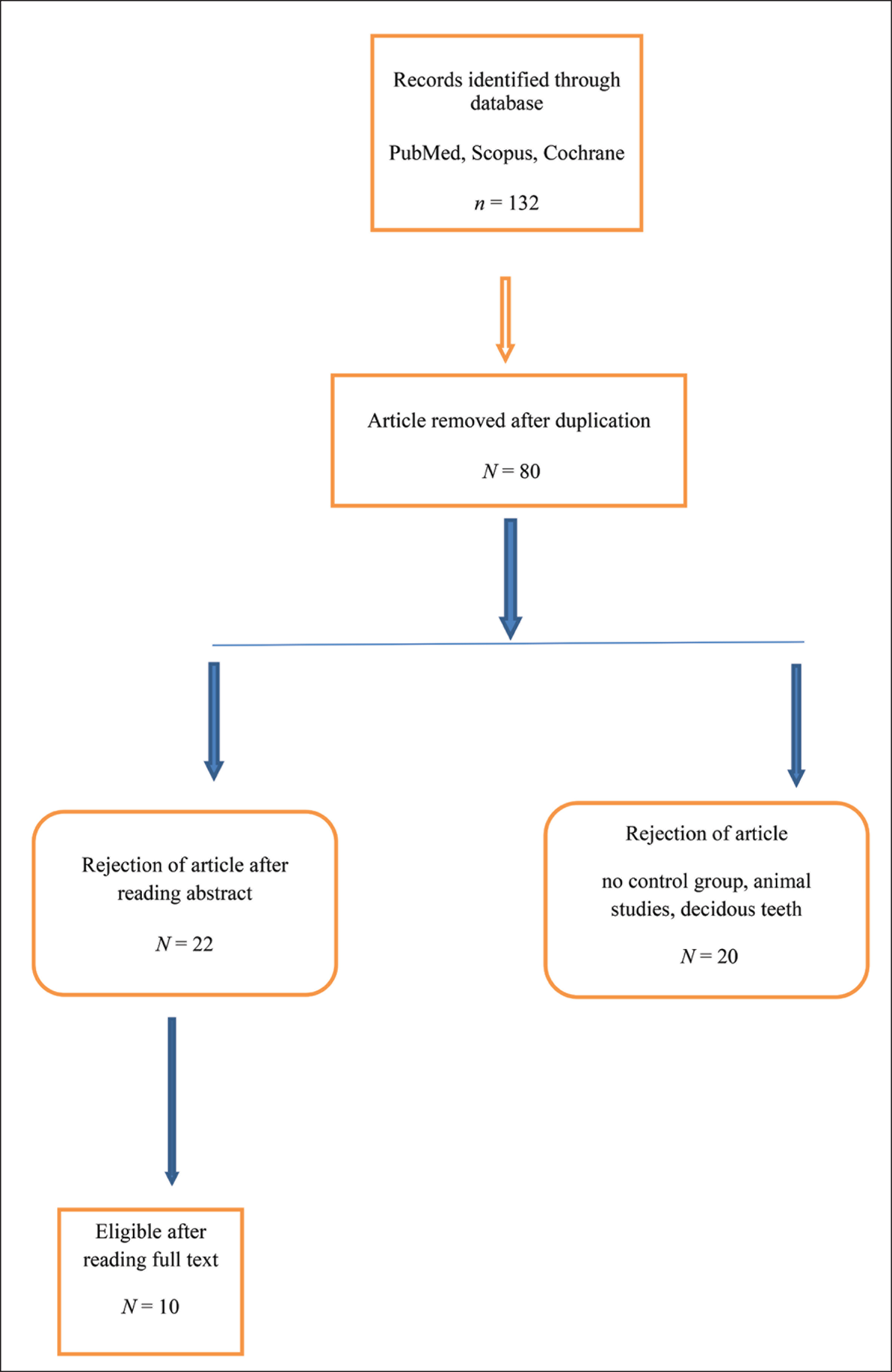
The result of the search criteria according to the PRISMA checklist has been represented in Figure 1. The qualitative analysis showed two most commonly used irrigants, i.e., sodium hypochlorite and chlorhexidine, and six activation devices.
ss
Studies Selected
In total, from the initial search, 132 citations were identified, of which 80 were eliminated due to duplications, 22 were reviewed against the inclusion criteria, and 20 were rejected due to open canal systems, i.e., no control group, animal studies, and deciduous teeth. Following title and abstract screening, 10 citations were eligible for full-text evaluation, of which they provided direct comparisons between irrigants and activation devices, under the aforementioned conditions, thereby qualifying for inclusion.
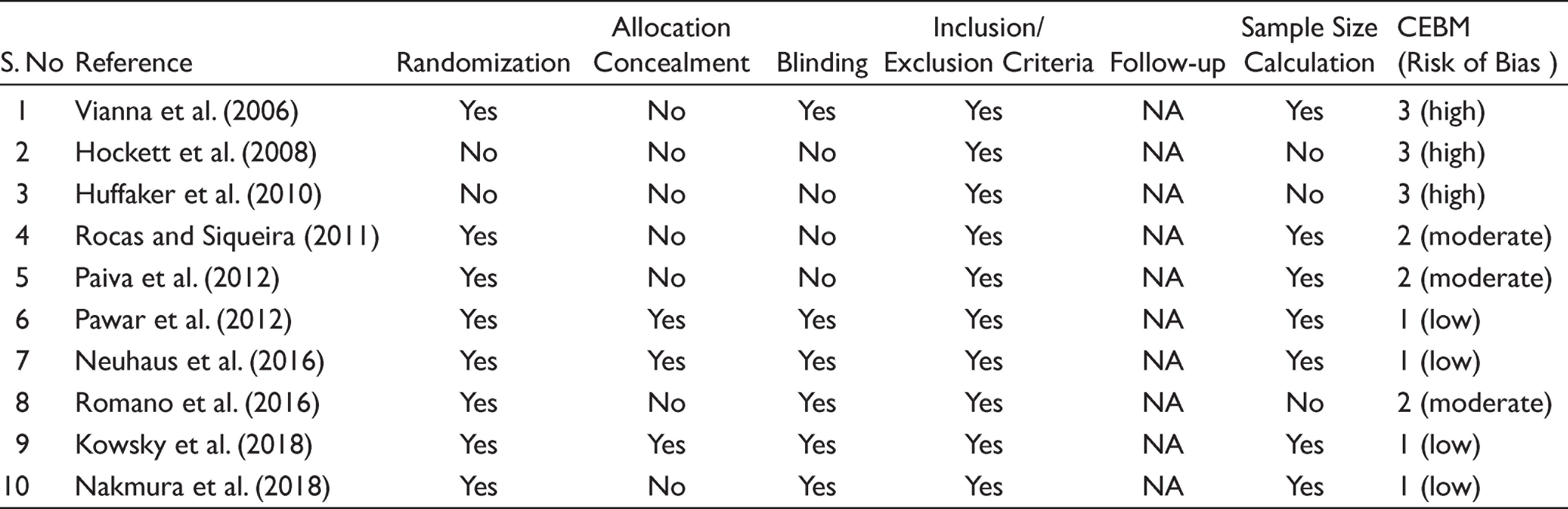
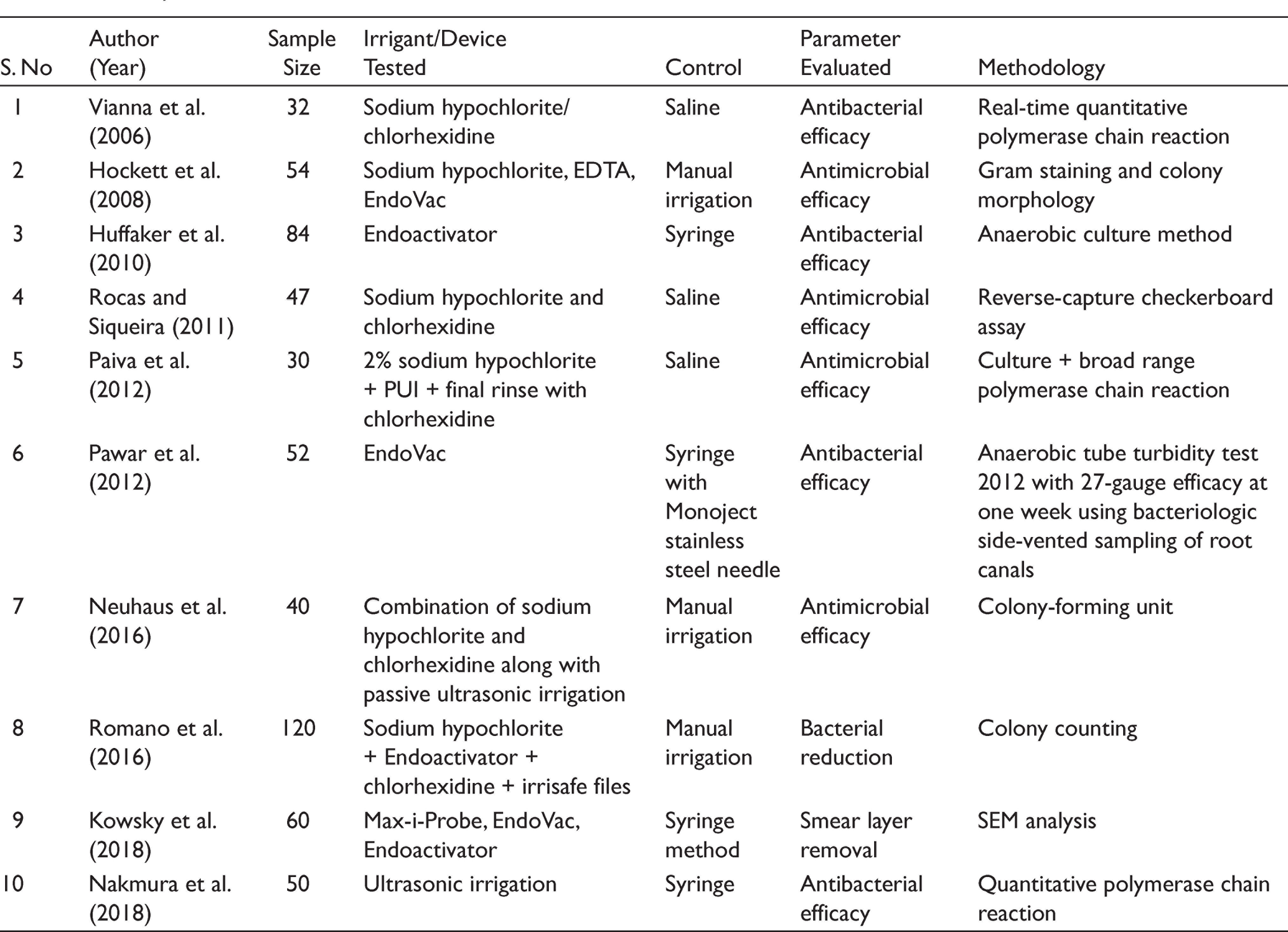
The articles were evaluated for the antimicrobial activity of the irrigants and devices on the disinfection of the root canal system, the debridement effect, and the ability to remove the smear layer. After data extraction, quality assessment was done using the CEBM ranking based on randomization, allocation concealment, blinding, inclusion and exclusion criteria, and sample size calculation. The risk of bias was calculated based on the following scores: 3, high; 2, moderate; 1, low. In the present systematic review, four articles were categorized into low-risk bias, three articles were classified as moderate risk, and three articles belonged to the high-risk category (Tables 1 and 2).
CEBM Ranking
Description of Individual Article
Discussion
The success of endodontic treatment depends on the removal of debris, smear layer, and vital and necrotic tissue from the root canal system. The role of root canal instrumentation is to mechanically disrupt the biofilms formed on the root canal walls and facilitate the flow of irrigants inside the root canal. 5 Anatomical complexities such as isthmus, fins, accessory, and lateral canals create an environment favorable to the survival of microorganisms by creating niches where irrigants cannot reach, in addition to the presence of tissue remnants that serve as a nutritional source for the microbiota. Interestingly, at least 35% of the root canal walls have been reported to be untouched by rotary instruments. 6
The apical 4 mm of the root canal remain untouched in 17.6% of cases and 34.6% of the necrotic teeth remain untouched by the reciprocating systems as demonstrated by Siqueira et al. These untouched portions of the root canal contain bacterial cells, debris, and tissue remnants which make it difficult to clean these areas using the traditional syringe method of irrigation. 7 One of the major challenges is the inability of the irrigants to penetrate into the apical portions in order to overcome the above-mentioned lacunae. There is a development of newer methods of irrigation devices which can help to exchange the irrigants within the root canal systems, and hence enhances the success of endodontic treatment. 8
In the studies included in the present systematic review, a difference was observed in the volume and concentration of the irrigating solution, tip size of the ultrasonic file, time duration of the irrigation, and concentration of irrigants. Ultrasonic activation along with sodium hypochlorite causes catalytic decomposition, i.e., degassing as a part of its mechanism of action, but this consequently reduces the efficacy with time, implying that a fresh solution must be replenished. 9
The present systematic review discussed the advantages of using activation devices along with the irrigants in disinfection. Sodium hypochlorite and chlorhexidine have been used as a gold standard in the disinfection of the root canal. The use of a traditional syringe technique of irrigation fails to achieve the proper goal of disinfection because the irrigant may get deposited 1 mm apical to the tip of the needle. 10 In an attempt to improve the delivery of the irrigating solution into the apical ramifications, various activation devices have been introduced. The activation devices work on various principles such as sonic, ultrasonic, apical negative pressure, and lasers. 11
The high and low amplitudes of ultrasonic energy cause acoustic streaming and cavitation effect within the fluids present in the root canal, which causes a movement of particles in a vortex-like motion, resulting in the fluid transmission from the apical to the coronal end. 12 The EndoVac system also showed better results as compared to other devices; because of the negative pressure concept, it delivers the irrigant to the working length where it comes in a direct contact with the dentinal wall. 13 Endoactivator works on the sonic principle where the flexible polymer tip is designed to activate the intracanal irrigant, producing a hydrodynamic effect. 14
Among the three phases of root canal treatment, disinfection is the most important factor that promotes healing of periapical pathology. 15 Presently, there are more than 13 different activation devices available, out of which ultrasonic is reported to be the most commonly used activation device followed by EndoVac. In the present systematic review, out of the 10 articles included, 6 have compared the effect of irrigation devices in the removal of microorganisms from the root canal system.
Out of the 10 articles, 5 compared the efficacy of using ultrasonic devices with the conventional needle method of irrigation. Two articles compared the use of EndoVac along with Max-i-Probe and conventional syringe method of irrigation. The results of these studies showed that the activation devices were better in removing debris, smear layer, and microorganisms from the root canal system. 16
The samples from the root canal system were obtained using paper point, dentin chips (collected by gates glidden drills, hand files, and round burs), and aspiration of the canal content using a syringe to evaluate the total bacterial load. 17
Mechanical instrumentation along with sodium hypochlorite irrigation decreases the microbial count as compared with ultrasonic activation and sodium hypochlorite alone (Pladisai et al.). Mechanical instrumentation removes the infected dentin, which is an important step along with the penetration of the irrigants. 18 Passive ultrasonic activation along with sodium hypochlorite followed by chlorhexidine reduces the Enterococcus faecalis count within the root canal system as compared to ultrasonic activation alone or instrumentation with Hedstrom file using sodium hypochlorite (Alves et al.). The major factor that influences the antimicrobial efficacy against endodontic microbes is the duration of irrigation, the type of solution used, volume and concentration of the irrigating solution, and the power of the ultrasonic unit. 19
Limitation
The use of ultrasonic and sonic activation with a more standardized protocol needs to be evaluated under in vitro and in vivo situations so as to draw clinically useful results for extrapolation.
Future Scope
The healing of periapical lesions of endodontic origin occurs by the successful reduction of the bacterial load within the root canal systems. This is influenced by the type of irrigant used and the method of activation. Hence, the development of the irrigation regime which will better eradicate the microorganisms from the root canal is the key for the success of endodontic treatment.
Conclusion
Within the limitation of this systematic review, it can be concluded that the use of mechanical activation devices is beneficial in delivering the irrigant up till the full working length, which overall improves the canal cleanliness, removes the debris and smear layer, reduces postoperative pain, and improves the overall healing. Hence, the null hypothesis that there is no significant difference in the reduction of the bacterial count after the activation of the irrigant using mechanical devices gets rejected.
Footnotes
Declaration of Conflicting Interests
The authors declared no potential conflicts of interest with respect to the research, authorship, and/or publication of this article.
Funding
The authors received no financial support for the research, authorship, and/or publication of this article.