




Abstract
Background:
A stable copper tetraamine fluoride (CTF) with low cytotoxicity has been developed for dental use.
Objective:
To investigate the antimicrobial effects of CTF against common microbes associated with dental caries and periodontal disease.
Method:
The minimum inhibitory concentrations (MIC) and minimum bactericidal/fungicidal concentrations (MBC/MFC) were used to evaluate the antimicrobial effects of CTF against eight common bacteria and one fungus associated with dental caries and periodontal disease. These nine microbes included cariogenic pathogens (Streptococcus mutans, Streptococcus sobrinus, Lactobacillus acidophilus, Lacticaseibacillus casei, Actinomyces naeslundii and Candida albicans), pulpitis-related bacteria (Enterococcus faecalis) and periodontal disease-related bacteria (Porphyromonas gingivalis and Actinobacillus actinomycetemcomitans). Transmission electron microscopy (TEM) was employed to examine the morphological changes of microbes with and without CTF treatment.
Results:
The MIC of CTF against nine microbes ranged from 80 ppm (Lacticaseibacillus casei) to 640 ppm (Candida albicans and Enterococcus faecalis). The MBC/MFC ranged from 320 ppm (Lacticaseibacillus casei) to 2560 ppm (Candida albicans). TEM revealed abnormal curvature of cell membranes, disrupted cell membranes, cytoplasmic clear zone, and cytoplasmic content leakage of the microbes treated with CTF.
Conclusion:
CTF has antimicrobial effects against common oral pathogens and presents a promising antimicrobial agent to aid management of dental caries and periodontal disease.
Introduction
Dental caries is the localized destruction to the hard tissue of teeth caused by acids generated during the fermentation of sugars by microorganisms. 1 The primary pathogenic microorganisms responsible for tooth decay include Streptococcus, Lactobacillus, Actinomyces, and Candida. 2 Pulp diseases refer to the secondary diseases of caries that can arise when the pulp becomes infected by microorganisms. Enterococcus faecalis (E. faecalis) is commonly seen in teeth that have experienced pulpal necrosis. 3 Periodontal disease, which is a chronic inflammatory disease affecting tooth-supporting tissues, is primarily attributed to bacteria such as Porphyromonas gingivalis (P. gingivalis) and Aggregatibacter actinomycetemcomitans (A. actinomycetemcomitans). 4 Therefore, the management of biofilm becomes a crucial element in the treatment of oral health problems such as dental caries and periodontal disease.
Among existing treatments, various antibacterial agents are widely used in dentistry to manage oral pathogens, with silver compounds being particularly common.5 –8 However, the oxidation of ionised silver can lead to the staining of enamel and dentin, resulting in patient dissatisfaction. 9 Additionally, some studies have shown that silver compounds exhibit high toxicity in human cells, underscoring the need for cautious use in dentistry. 10 These concerns highlight the growing need to investigate alternative chemical compounds that offer robust antibacterial properties, minimal toxicity, and no discoloration effects.
Using copper as an alternative to silver could potentially address these concerns associated with silver compounds. A bibliometric analysis indicates increasing interest in copper within medical research. 11 Copper exhibits antibacterial properties against oral bacteria, such as Streptococcus mutans (S. mutans), while maintaining low toxicity towards human cells. 12 Copper ions can penetrate bacterial cell walls, disrupting metabolic activities and causing cell death. 13 Additionally, copper compounds are readily available and widely accessible for manufacturing. 14 Given its antimicrobial properties, ease of use, and cost-effectiveness, employing copper instead of silver presents a promising strategy for developing novel antimicrobial agents in dental applications.
Ammonia is antibacterial and acts as a stronger field ligand than water. Metal ammine complexes exhibit greater stability and reduced oxidation compared to their aquo counterparts. 15 Fluoride is commonly used for remineralization in caries management and can also provide some antimicrobial ability. 16 It promotes the crystal growth of fluorapatite on partially demineralised sub-surface crystals in carious lesions.
In our earlier research, we developed a novel copper tetraamine fluoride (CTF) using copper fluoride and ammonia solution. 17 Our results indicated that CTF can inhibit the growth of S. mutans with low cytotoxicity and do not have staining effect. However, its antimicrobial effect against other prevalent oral pathogens remain unknown. Consequently, the objective of this study was to investigate the antimicrobial effects of the novel CTF against common microbes associated with dental caries and periodontal disease. Our study aims to address the unknown antimicrobial effects of CTF on a wider range of pathogens. The null-hypothesis of the study is that the CTF has no antimicrobial effects against some common microbes associated with dental caries and periodontal disease.
Methods
Microorganisms
Nine common oral pathogenic strains were selected for this study. They are cariogenic pathogens including S. mutans ATCC 35668, Streptococcus sobrinus (S. sobrinus) ATCC 33478, Lactobacillus acidophilus (L. acidophilus) ATCC 9224, Lacticaseibacillus casei (L. casei) ATCC 393, Actinomyces naeslundii (A. naeslundii) ATCC 12104 and Candida albicans (C. albicans) ATCC 10231, pulpitis-related bacteria E. faecalis ATCC 29212 and periodontal disease-related bacteria including P. gingivalis ATCC 33277 and A. actinomycetemcomitans ATCC 33384.
Brain heart infusion (BHI) medium was used for the culture of S. mutans, S. sobrinus, L. acidophilus, L. casei, A. naeslundii, E. faecalis, and A. actinomycetemcomitans. Sabouraud Dextrose broth was used for the culture of C. albicans. P. gingivalis broth was used for culture of P. gingivalis. L. acidophilus, L. casei and C. albicans were cultured aerobically. The other strains were cultured anaerobically.
Minimum inhibitory concentrations and minimum bactericidal/fungicidal concentrations
The minimum inhibitory concentrations (MICs) and minimum bactericidal/fungicidal concentrations (MBC/MFCs) were used to evaluate the antimicrobial effects of CTF against these common oral pathogens. The broth (100 μL consecutive two-fold dilutions ranging from 5120 ppm to 10 ppm of CTF) was supplemented with a 10 μL bacteria/fungi culture (106 CFU/mL). The 96-well plates were then incubated at 37°C for 24 h. The optical density (OD) value was measured at a wavelength of 660 nm (bacteria) or 520 nm (fungi) both before and after the microorganisms were cultivated for 24 h. The MIC value is defined as the lowest concentration at which the OD values before and after incubation are consistent.
After the MIC determination, 10 μL fluid from each well, which showed the same OD values, was pipetted and seeded on agars, which were then incubated at 37°C for 48 h. The MBC/MFB is determined to be the lowest concentration at which no colonies are formed on the agar plate.
Microorganisms morphology
The transmission electron microscope (TEM) was used to examine the morphology of the microorganisms. The bacteria/fungi (108 CFU/mL) were added with the CTF of MBC/MFC concentration. 18 The bacteria/fungi were harvested after incubating at 37°C for 18 h and subjected to glutaraldehyde treatment. The semi-thin sections of the bacteria/fungi were contained in grids and observed with the TEM.
Results
MIC and MBC/MFC
Table 1 displays the MIC and MBC/MFC of CTF against S. mutans, S. sobrinus, L. acidophilus, L. casei, A. naeslundii, C. albicans, E. faecalis, P. gingivalis, and A. actinomycetemcomitans.
The minimum inhibitory concentrations (MICs) and minimum bactericidal/fungicidal concentrations (MBC/MFC) of CTF against common oral pathogens.
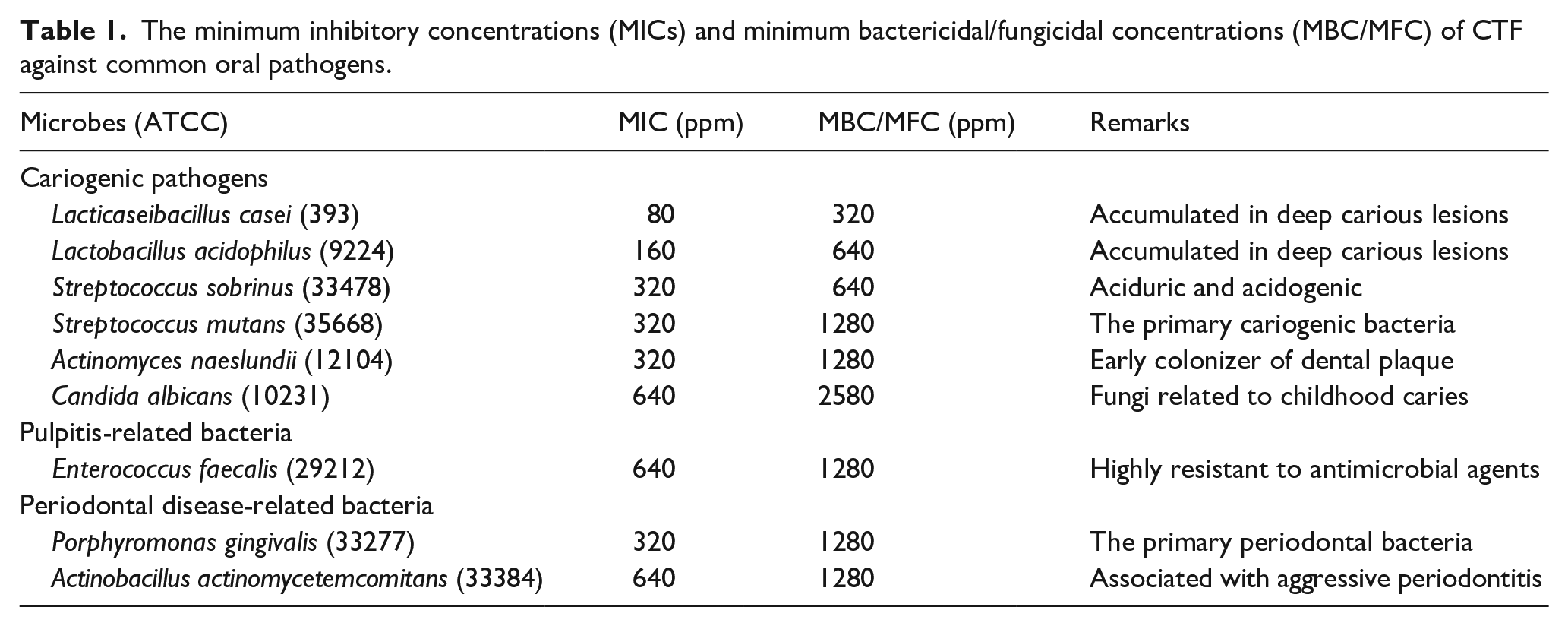
For cariogenic microbes, the MICs of the CTF against S. mutans and S. sobrinus were 320 ppm, whereas the MBCs were 1280 and 640 ppm, respectively. The MICs of L. acidophilus, L. casei, and A. naeslundii were 160, 80, and 320 ppm, and the MBCs were 640, 320, and 1280 ppm, respectively. The MIC of the CTF against C. albicans was 640 ppm and the MFC was 2580 ppm. For the pulpitis-related bacteria, the MIC and MBC of the CTF against E. faecalis were 640 and 1280 ppm, respectively. For periodontal disease-related bacteria, the MICs of P. gingivalis and A. actinomycetemcomitans were 320 and 640 ppm, respectively, and the MBCs were 1280 ppm.
Microorganisms morphology
Figure 1 presents TEM images of cariogenic pathogens with and without CTF treatment. S. mutans suffered significant damage after treated with CTF. The S. mutans cells exhibited abnormal morphology by aberrant cell curvatures and irregular cell shapes. Moreover, the cytoplasmic membranes of the cells were compromised, leading to the formation of transparent cytoplasmic zones and cytoplasmic content leakage. For S. sobrinus and L. acidophilus treated with CTF, the morphology changes were similar to CTF-treated S. mutans. These changes included the abnormal curvature of cell membranes, the transparency of the cytoplasmic zones, the disruption of the cytoplasmic membrane, and the leakage of cytoplasmic contents. For L. casei, the characteristic alterations observed were the abnormal curvature of cell membranes and the presence of cytoplasmic clear zones. After the treatment with CTF, the cell membranes of A. naeslundii abnormally curved and disrupted, and the cytoplasmic zones were transparent. When compared with untreated bacteria, CTF-treated C. albicans had abnormal morphological characteristics, such as the aberrant curvature and disruption of cell membranes, and the leakage of cytoplasmic contents.

TEM images of cariogenic pathogens with and without CTF treatment.
Figure 2 shows TEM images of E. faecalis with and without CTF treatment. E. faecalis cells exhibited abnormal morphology by cytoplasmic clear zone, disrupted cell membrane, and cytoplasmic content leakage.

TEM images of pulpitis-related bacteria with and without CTF treatment.
Figure 3 presents TEM images of periodontal disease-related bacteria with and without CTF treatment. The P. gingivalis suffered significant damage after treated with CTF, including the abnormal curvature of cell membranes, the transparency of the cytoplasmic zones, the disruption of the cytoplasmic membrane, and the leakage of cytoplasmic contents. The cell membranes of the treated A. actinomycetemcomitans abnormally curved and disrupted, and the cytoplasmic content leaked.
TEM images of periodontal disease-related bacteria with and without CTF treatment.
Discussion
In recent years, copper has garnered considerable interest as a potential antimicrobial agent in dental treatments. Our previous study developed a novel CTF solution and examined the biocompatibility, antibacterial effect against S. mutans and staining effects. In this investigation, we investigated the antimicrobial effects of the novel CTF against common microbes associated with dental caries, pulpitis, and periodontal disease.
Cariogenic microorganisms are microbes that play a significant role in the development of dental caries. When the cariogenic microbes have colonised tooth surfaces, they can metabolise fermentable carbohydrates and generate organic acids, which can result in the demineralisation of tooth tissue.19,20 Constant mineral loss erodes the tooth structure, leading to dental caries. 21 To manage dental caries, it is important to manage bacterial activity and inhibit biofilm formation, which helps lower acid production and ultimately reduces demineralisation in dental caries.
S. mutans is regarded as the primary cariogenic microbes. 22 S. mutans ferments carbohydrates and produces acid as a byproduct. 23 S. mutans can produce extracellular polysaccharides, particularly glucans, which facilitate adherence and accumulation on the tooth surface. 24 These extracellular polysaccharides also create a matrix for other microorganisms to attach, leading to a complex bacterial community that contributes to the development of dental caries. 25 S. sobrinus is another common cariogenic bacterium in the Streptococcus taxa. S. sobrinus is more acid-resistant and acidogenic than S. mutans, making it an important factor in dental caries. 26 Besides, studies have shown that S. sobrinus is associated with the progress of dental caries, especially in early childhood caries. 27 Inhibiting the growth of S. mutans and S. sobrinus could be an effective strategy for managing dental caries.
Lactobacilli are acidogenic and acid-tolerant bacteria that can produce lactic acid from fermentable carbohydrates. 28 Although S. mutans initiates the caries process, Lactobacillus species are more commonly associated with the progression of advanced caries. 29 These bacteria are frequently found in elevated quantities within deep carious lesions. 30 Furthermore, the presence of Lactobacillus species in saliva or dental plaque is frequently regarded as an indicator of caries activity and susceptibility. 31 Further research is required to elucidate the precise mechanisms through which Lactobacillus species influence the progression of dental caries.
A. naeslundii is one of the early colonizers of dental plaque, contributing to the formation of the complex oral biofilm. 32 In addition, A. naeslundii has been observed in greater quantities in cases with root surface caries, indicating its potential involvement in root caries. 33 C. albicans is a fungus, which is associated with early childhood caries. 34 Furthermore, C. albicans can cause opportunistic infections in individuals with weakened immune systems, contributing to the development of dental caries and other oral health issues. 35
For pulpitis-related bacteria, E. faecalis is frequently isolated from persistent endodontic infections, especially in cases of unsuccessful root canal treatments. 36 It can penetrate deep into dentinal tubules and form biofilms, resulting in endodontic infections. 37 Besides, E. faecalis exhibits robust resistance to a wide range of antimicrobial drugs. 38 Therefore, it is a challenge to manage oral infections caused by E. faecalis.
Periodontal diseases are chronic inflammatory diseases marked by the degradation of gingival connective tissue and the resorption of the alveolar bone, often leading to eventual tooth loss. 39 These diseases are triggered by periodontopathogenic microbes present in the subgingival plaque, notably P. gingivalis and A. actinomycetemcomitans. 40 P. gingivalis is a key pathogen in periodontal diseases, especially chronic periodontitis. It generates various virulence factors that enhance its pathogenicity. 41 For instance, gingipains can break down host proteins, disrupt immune responses and contribute to tissue damage. Lipopolysaccharides can provoke an inflammatory response, while fimbriae help the bacteria adhere to host cells and other bacteria. Furthermore, P. gingivalis can invade host cells, allowing it to evade host defenses and antimicrobial agents. 4 A. actinomycetemcomitans is often found in high numbers in aggressive periodontitis, indicating it is implicated in aggressive periodontitis. 42 It can produce a variety of virulence factors, including endo- and exotoxins. 43 These factors can directly damage host tissues and protect the bacteria from host defences. Inhibiting the growth of P. gingivalis and A. actinomycetemcomitans is crucial for managing periodontal disease.
Antimicrobial ability is a crucial factor in the selection of antimicrobial drugs, and it can be assessed using MIC and MBC. 44 The findings of the current investigation indicate that the CTF had notable antibacterial efficacy. The MIC and MBC of the CTF against the nine microbes were found to vary between 80 to 640 ppm and 320 to 2560 ppm, respectively.
Moreover, the TEM was employed to observe the morphological alterations in microbes treated with CTF, thereby providing insights into the antimicrobial mechanism of CTF. Researchers suggested that copper ions can interact with the bacterial cell membrane, causing structural damage. 45 This interaction can lead to increased membrane permeability, resulting in leakage of essential cellular contents and ultimately cell death. Copper ions can also catalyse the production of reactive oxygen species, which can cause oxidative damage to cellular components, leading to cell death. In addition, copper ions can bind to proteins, disrupting their three-dimensional structure and function. This can inhibit essential enzymatic activities and other protein functions, impairing the bacteria’s ability to survive. 46 Copper ions can also interact with bacterial DNA, causing strand breaks and other forms of genetic damage. This can lead to mutations, interference with replication, and ultimately cell death. 47 Furthermore, copper can disrupt various metabolic pathways within the bacterial cell. For example, it can inhibit enzymes involved in cellular respiration and other critical biochemical processes, leading to energy depletion and cell death. 48 Ammonia can increase the pH of its surrounding environment. Many oral microbes thrive in neutral to slightly acidic conditions, so the alkaline conditions created by ammonia can disrupt bacterial cell processes. Moreover, ammonia can diffuse across cell membranes and disrupt intracellular pH and metabolic activities. 49 Fluoride inhibits the enzyme enolase, which is crucial in the glycolytic pathway. 50
In this study, TEM images revealed that CTF treatment led to the disruption of the cell membrane, causing unusual membrane curvature, irregular cellular shapes, and intra-bacterial vacuolization. This disruption further resulted in the breakdown of the cytoplasmic membrane and leakage of cytoplasmic components from the microorganisms. These observations align with the TEM images captured in our prior study, where CTF exhibited similar effects on microbes. 17 However, this study primarily observed the antimicrobial mechanism of CTF through TEM images and did not involve a quantitative analysis of other potential factors contributing to CTF’s antimicrobial effects. These factors could include the interruption of DNA replication, denaturation of microbial proteins, and production of reactive oxygen species. In addition, the antimicrobial effect investigated in this study focused solely on single-species models. This approach provides simple, inexpensive, well-controlled, and repeatable experimental conditions. However, this strategy lacks complexity and does not account for the interactive effects between different microbial species. Future research initiatives should aim to provide a comprehensive analysis of the antimicrobial effects of CTF, including quantitative assessments of various contributing factors and investigations using multi-species models to better understand the antimicrobial effect of CTF.
Conclusion
This laboratory study showed that the novel CTF has antimicrobial effects against some common oral pathogens, specifically those associated with dental caries and periodontal disease. The CTF effectively inhibits the growth of these microbes and causes unusual cell morphology. CTF could be considered as a promising agent to manage oral infectious diseases including dental caries and periodontal disease.
Footnotes
Declaration of conflicting interests
The author(s) declared no potential conflicts of interest with respect to the research, authorship, and/or publication of this article.
Funding
The author(s) disclosed receipt of the following financial support for the research, authorship, and/or publication of this article: This study is supported by the RGC General Research Fund (GRF), Program No. 17100222.
