The analysis of nanofluids under various physical scenarios convinced the researchers and scientists because of their broad range of applications in potential area of the current time like chemical engineering, biomedical engineering and applied thermal engineering etc. To give the final shape of many industrial and engineering processes, enhanced heat transfer desired, therefore, the study of Al2O3-H2O, γAl2O3-H2O, Al2O3-C2H6O2, and γAl2O3- C2H6O2 nanofluids is reported. The model successfully achieved after mathematical operations and by appealing similarity transforms. To examine the behavior of heat transfer, numerical tools utilized and performed the results. It is observed that enhanced heat transfer in Al2O3-H2O, γAl2O3-H2O, Al2O3-C2H6O2, and γAl2O3-C2H6O2 could be attained by setting nanoparticles concentration up to 20%. For Al2O3-H2O, γAl2O3-H2O, optimum heat transfer trends noticed due to their prominent thermophysical values. Also, fewer effects of combined convection on examined.
A lot of researchers studied temperature behavior in the base fluids such as ethylene glycol, kerosene oil, and . These fluids have limited applications due to their low thermal performance, as for many industrial uses high thermal transport is required to finish the processes of different products. Therefore, researchers focused on the development of a new class of fluids with high thermal performance than the regular liquids. These fluids gained much intentions of the researches and industrialists and strengthen their roots in the modern world.
Choi1 potentially contributed in the development of nanofluids. Finally, his untiring efforts opened a new lock in the modern world. They explored that thermal performance in the regular liquids could be intensify by adding nano additives of various metals and oxides. These particles are saturated in the liquid uniformly and thermally in equilibrium. The addition of nanoparticles in the regular liquid boosts thermal performance of the fluid. These became very popular among the researcher’s community and resolved many problems of the industrialist which they faced from many decades in the context of heat transport. Therefore, the investigation of thermal transport in nanofluids prepared by various metals oxides by dispersing in various regular liquids are reported by Ashraf et al.2,3and Chu et al.4
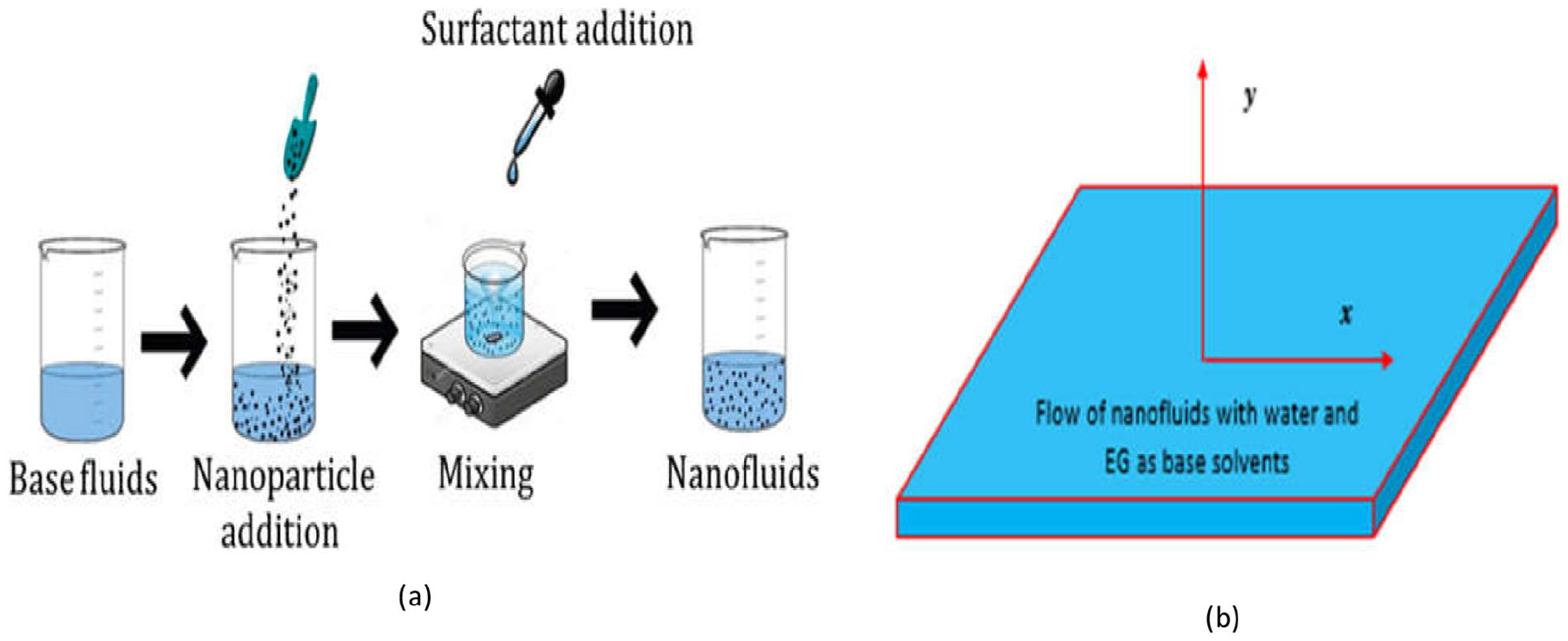
The study related to nanofluids containing and nanomaterials is described by Maciver et al.5 The effective thermal conductivity of nanofluids is imperative and playing significant role to boosts the internal energy of the nanofluids which ultimately results in rise in the fluid temperature. Therefore, numerous thermal conductance correlations were introduced and to analyze their thermal capability, researchers and engineers utilized those correlations in the modeling of nanofluids and examined their influences in the fluid thermal transport ability. The fluid dynamists made their efforts day by day and reported the nanofluid temperature behavior prepared by various metals and regular liquids. The significant studies in this regard under the impacts of various physical quantities like viscus dissipation, thermal radiations, combined convection effects, nonlinear thermal radiations, chemical reaction, and internal heat generation and absorption are reported in Hamad,6Vajravelu etal.,7 and Ashraf et al.8 Synthetization process of nanofluids given in Figure 1(a).
Synthetization of nanofluid in (a) and physical description of nanofluids flow in (b).
Thermal conductivity and thickness reproductions are expenditure for . Individually investigative in addition mathematical investigation are supported available. The flow above a stretching surface is an important problem in lots of industrial procedures with uses in manufacturing such as melt-spinning, extrusion, the boiling developing, wire illustration, glass–fiber manufacture, rubber sheets and refrigeration of a big metal plate in immersion, which may be an electrolyte, etc. The production, polymer pieces, production of plastic, and fibers are industrial in unbroken extrusion of polymer commencing die to a mechanical wave, which is placed at a limited coldness. Considered the fixed 2D incompressible flow of a Newtonian fluid instigated using the widening of an elastic smooth sheet which transfers in its specific horizontal velocity changing linearly as the distance from a steady idea due to the use of a constant pressure. Problematic is mostly stimulating since a particular result of the 2D Navier–Stokes equations has been developed by Tiwari and Das.9
Later on, Crane10 considered an effective substance to study the heat transfer mechanism and unsteady flow of nanofluid past a stretching sheet. They modeled the problem for nanofluid and examined the behavior of thermal transport under the impacts of various flow governing quantities. The important investigations of nanofluids upshot temperature under physical phenomena like thermal radiations and convective conditions etc. reports in Ashraf et al.11,12 The increase of the unusual kind of flow due to reduction was first explored by Wang13 and considered the performance of fluid over an unsteady stretching sheet. They studied the mixed convection heat transfer on a non-linear stretching geometry with inconstant fluid done by Prasad et al.14 Yazdi et al.15 conversed the slip flow and heat transfer over a non-linear porous stretching surface. The investigation of the nanofluid dynamics saturated by aluminum alloys past a stretching surface was described in Zaidi et al.16 Recently, Rana and Bhargava17 studied the boundary layer flow of nanofluid flow on a non-linearly stretching sheet. Just, Das18 considered heat transfer convective of nanofluids over a stretching sheet in the existence of partial slip-up and thermal radioactivity. First idea on show in their investigated that the stretching of the sheet may not automatically linear by Gupta and Gupta.19
Thermal enhancement and entropy20–23 study in nanofluids convinced by thermal radiations behavior made place in the scientist’s community. The forced scientists from various applied areas of research to investigate and explore fascinating insights in thermal and enhancement studies. Carbon nanotubes which are found to be very useful for enhanced heat transport due to their unique structure compelled the researchers to examine the dynamics of nanofluids. The Fluid Dynamists made several attempts to study the role of CNTs in the heat as well as entropy of the fluid. The studies conducted by adding variety of body forces and under various conditions specified at the boundary domain, such studies available in the literature.24–27 Among the distinct heat transport mode, convection with addition of CCHFM (Cattaneo Christov Heat Flux Model) is one of the prominent sources to upshot the heat transfer inside the working nanofluid. Recently, many studies28–31 reported in this regard by taking various sorts of working nanofluids synthesized by different metals and host solvents. The literature revealed that inside temperature of the nanofluids could be enriched by inducing different physical phenomena in the modeling of the heat transfer problem. Further, many fascinating and useful results presented in the studies32–35 and found excellent heat transport which would be helpful to the industrialist and engineers to cope their issues in the current time.
From the above literature, it is found that the novel comparative analysis of heat transfer in Al2O3-H2O, γAl2O3-H2O, Al2O3-C2H6O2, and γAl2O3- C2H6O2 nanofluids is absent which is significant research gap. The γAl2O3 nanoparticles are very famous due to their progressive applications in the world specifically in biomedical engineering. Therefore, in this study the behavior of Al2O3-H2O, γAl2O3-H2O, Al2O3-C2H6O2, and γAl2O3-C2H6O2 heat transfer with outstanding thermophysical attributes of two base solvents and updated nanofluid models for γAl2O3 is presented. Further, the model will be upgraded with new insights of combined convection which is an important factor in the analysis of nanofluids. This study will fulfill the above gap and help the researchers in the selection of parameters for better heat transfer.
The study will subject to the following limitations:
The nanoparticles uniformly dispersed in the base solvents (H2O, C2H6O2) and no slip exist between them.
The supporting nanofluids effective thermophysical models will be used during the analysis.
The flow is unsteady, laminar and no slip effects imposed over the surface.
Both the nanomaterial and base solvents are thermally in equilibrium.
Mixed convection effects incorporated during the model development.
Formulation of the problem
Considered an unsteady incompressible flow of nanofluids composed by nanomaterials and the regular liquids namely and above a stretching sheet. The flow is configurated due to a stretching surface in two-dimensions. The velocity of the sheet is along the x-axis and temperature at the stretchable surface is . Where a, b are constants. The configuration of nanofluid flow over a stretchable surface is depicted in Figure 1.
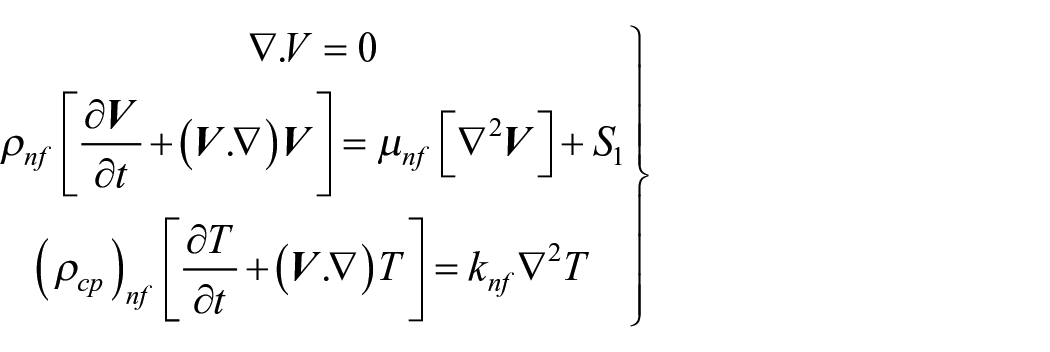
The basic physical laws that govern the flow of Al2O3-H2O, γAl2O3-H2O, Al2O3-C2H6O2 and γAl2O3-C2H6O2 over unsteady stretching surface are described as below in vector form36:
Where; incorporates the effects of combined convection.
The flow is subject to the following flow conditions:
at
as
Thermal physical values
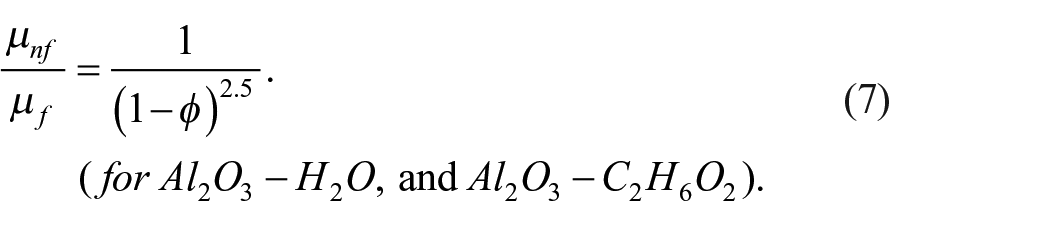
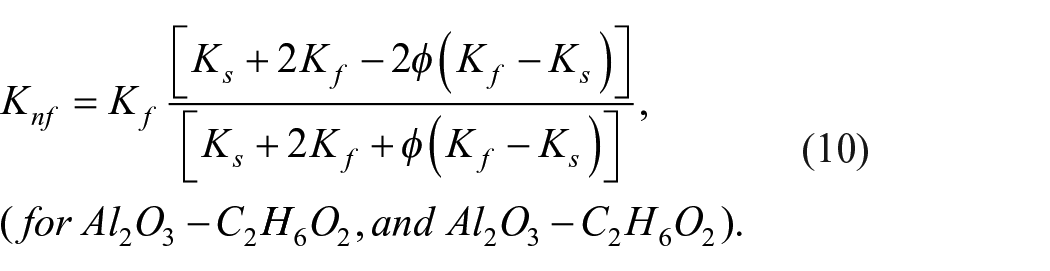
The effective correlations which work particularly for nanoparticles and by considering the base solvents are listed in equations (7)–(12). These properties of the nanofluids will be utilized in the development of Al2O3-H2O, γAl2O3-H2O, Al2O3-C2H6O2, and γAl2O3-C2H6O2 thermal transport models after incorporating in the basic governing laws37:
Wherever represent the nanoparticles volumetric fraction.
Thermal conductivity of the nanofluid is given by the relations:
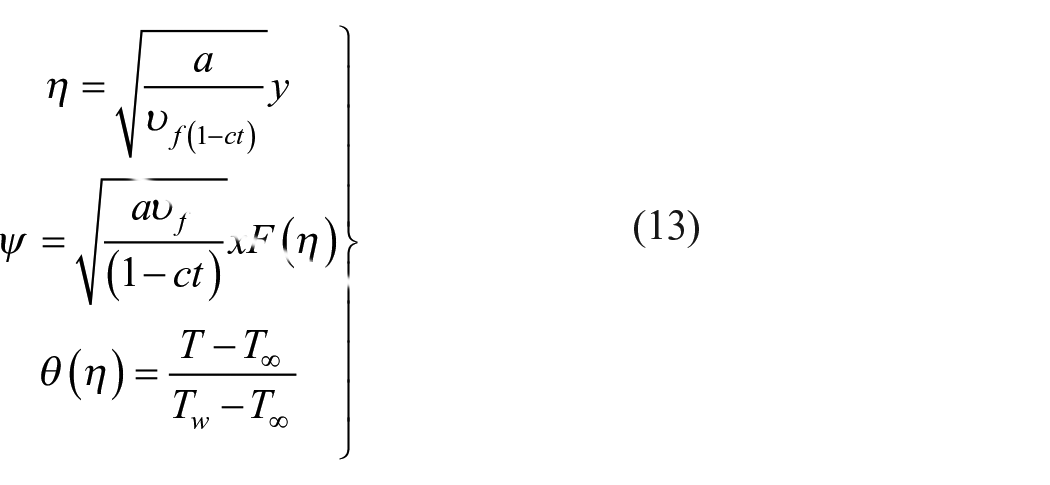
Now, we introduce the following dimensionless functions and , and the similarity variable as:
Here, is the stream function, and are the velocity components and defined as:
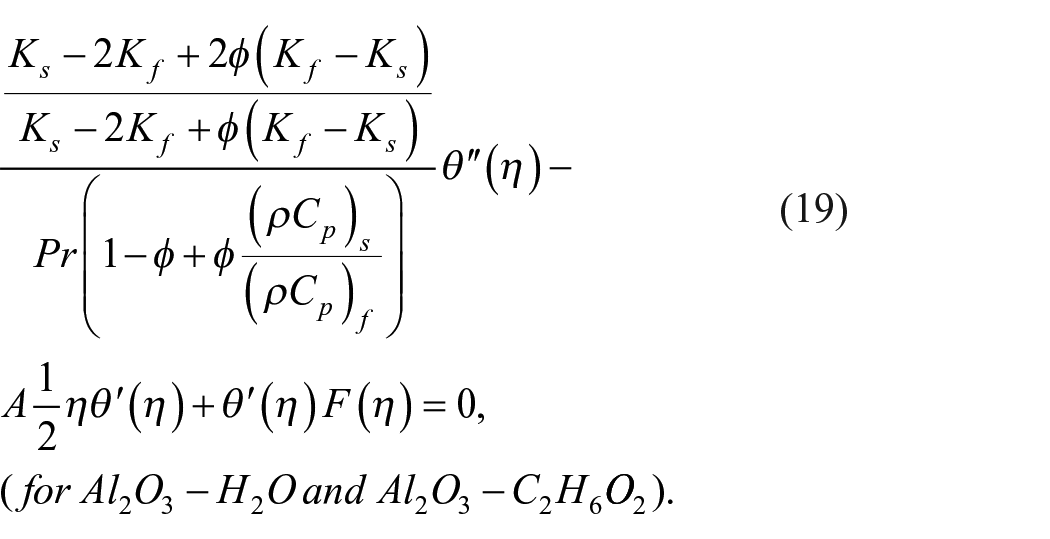
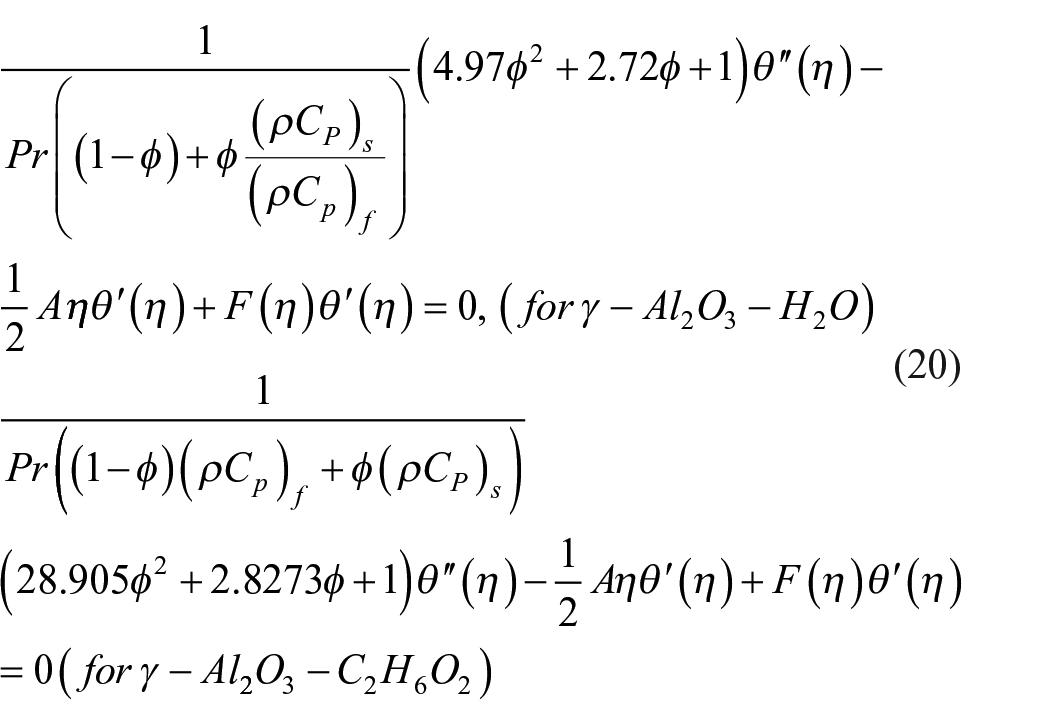
The transformed momentum and energy equations combine with the boundary conditions are given by equations (2)–(4), can be written as:
The boundary conditions are:
So, the energy equation becomes:
The dimensionless parameters appeared in the final model due to the induction of combined convection and unsteady effects are (unsteady parameter), (Prandtl number) and (buoyancy parameter).
Procedure for solution
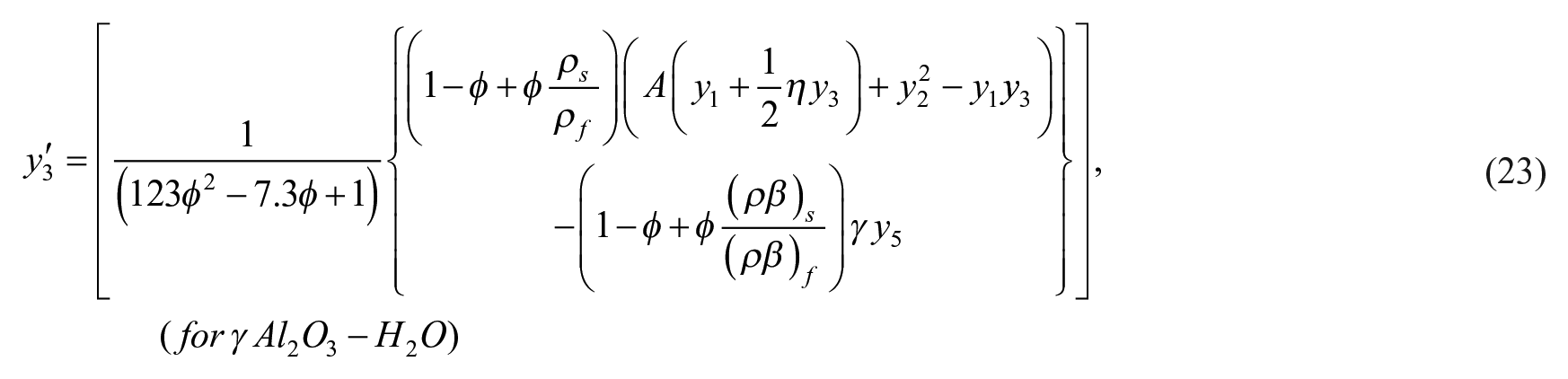
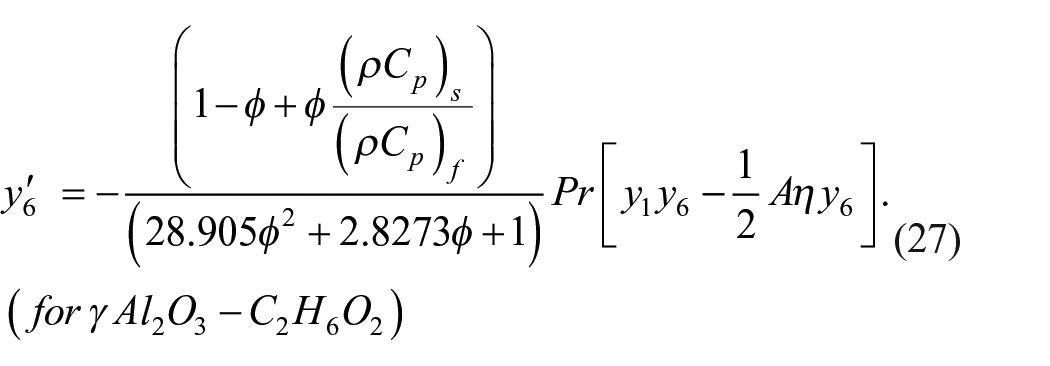
The numerical technique based on shooting algorithm is adopted to tackle the model. This technique usually based on a set of first order ordinary differential equations which are obtained from the nonlinear flow model by using some sort of substitutions. For under consideration model, these substitutions for the velocity and temperature equations are made in the following way and the method implementation is also given in the chart:
Further,
Quantities of engineering concern
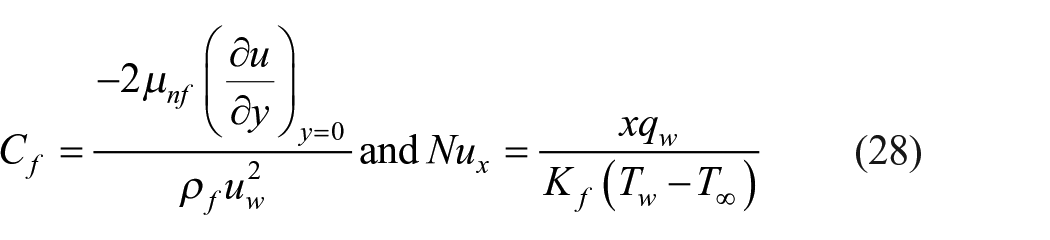
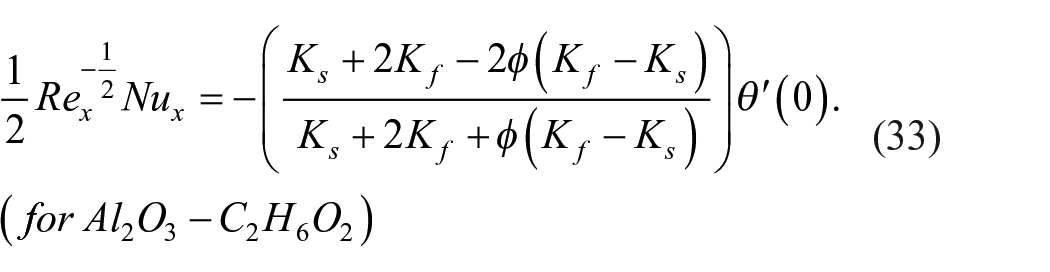
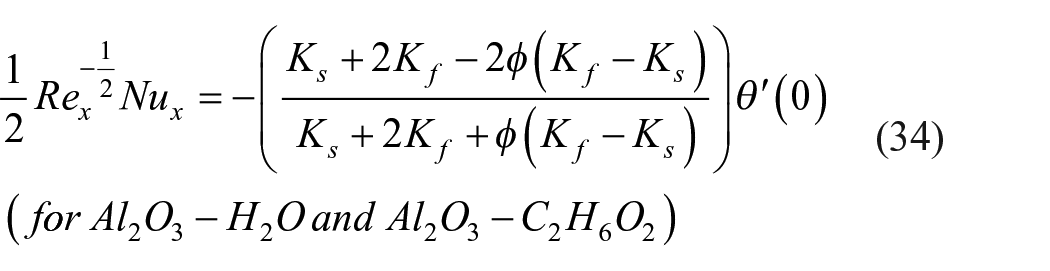
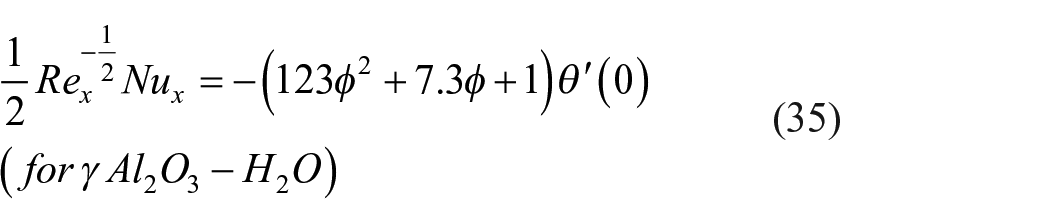
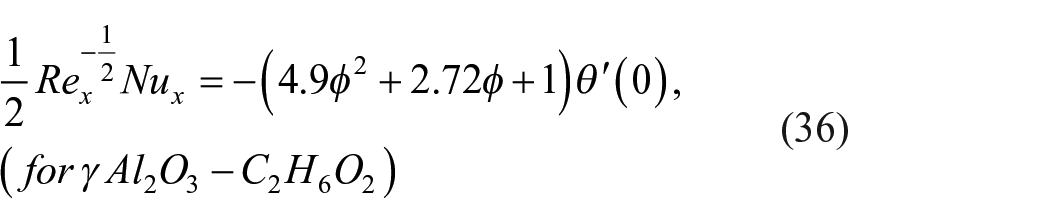
The analysis of skin friction coefficient and local heat transport mechanism is significant from industrial and technological point of view. Further, thermophysical values described in Table 1. For under consideration model, the dimensional mathematical relations define as:
Where is the heat transfer from sheet and can be written as:
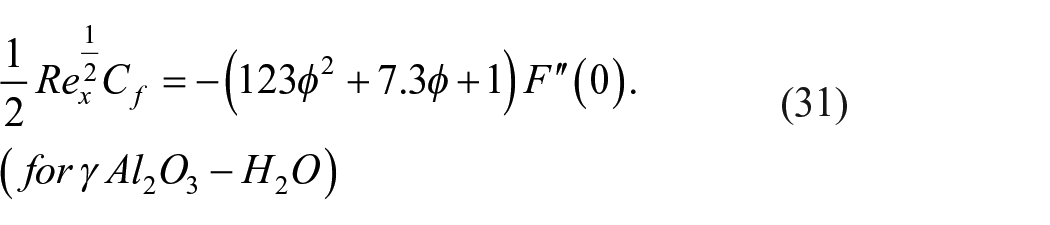
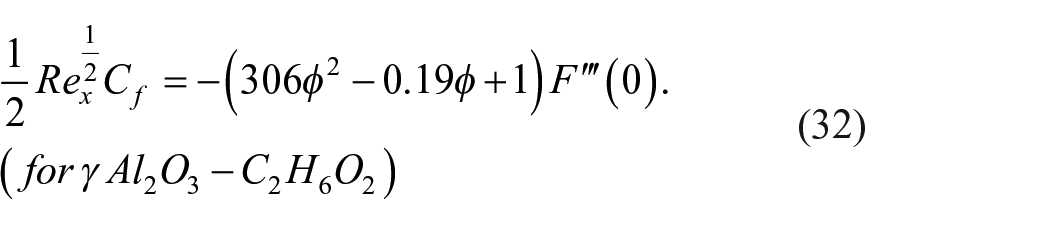
Applying the dimensional transformation (12) we obtain:
Where is the reduced Nusselt number:
Results and discussion
In the study of nanofluids, the behavior of working fluid regarding the momentum and energy transport is of huge significance which make them prominent from the common fluids. In this research, variety of nanoliquids (Al2O3-H2O, γAl2O3-H2O, Al2O3-C2H6O2, and γAl2O3-C2H6O2) which prepared by two distinct base solvents (H2O, C2H6O2) and important nanomaterial (Al2O3, γAl2O3) are taken in the existence of combined convection and unsteady effects. These nanomaterials became much popular and can be utilized significantly in industrial applications due to their superior chemical properties. The comparative alterations in the velocity () and temperature () profiles under varying flow quantities are demonstrated in this section.
The velocity variations for Al2O3-H2O, γAl2O3-H2O, due to unsteady effects are captured in Figure 2(a) and (b). Keen observations of the plotted results reveal that the motion of the both nanoliquids decays under stronger unsteady effects. The movement of nanoliquids based on simple Al2O3 promptly decays than γAl2O3. Physically, the nanoliquids Al2O3-H2O and Al2O3-C2H6O2 are more-denser and in the view of their thermophysical characteristics which opposes the motion. The viscosity inside the nanoliquids intensifies which resists the particles motion. Figure 2(c) to (f) demonstrating thermal distribution (θ (η)) for the nanofluids against increasing unsteady effects . These results reveal that nanoliquids are better for thermal transport in which thermal conductivity of Al2O3 and γAl2O3 are have important role.
Variations in the velocity field against A (a and b) and in temperature via A in (c–f).
The velocity trends against increasing are depicted in Figure 3(a) and (b) for Al2O3-H2O, γAl2O3-H2O, Al2O3-C2H6O2, and γAl2O3-C2H6O2 nanoliquids, respectively. Physically, increment in the velocity occurs because for higher fraction , viscosity and density are decreases and the fluid particles move freely within the domain. Figure 3(c) to (f) furnished to investigate the temperature behavior by enhancing volume concentration. Thermal conductivity of nanoparticles playing significant role in the temperature enhancing of the nanoliquids. Physically, additional thermal conductivity of Al2O3 γAl2O3 is a key tool for thermal enhancement because these are better conductor and intensify the heat transport inside the fluid.
The velocity via (a and b) and temperature via (c–f).
Figure 4(a) and (b) furnished for the analysis of due to increasing buoyancy effects. It is noticed that the velocity grows almost inconsequentially by strengthen . Further, momentum boundary layer portion rises for γAl2O3-H2O and γAl2O3-C2H6O2 and it decays for Al2O3-H2O and Al2O3-C2H6O2. Figure 4(c) to (f) demonstrating impacts of imposed mixed convection effects () on the temperature distribution . These results showing that the temperature drops due to upsurges in . Physically, the motion declines due to stronger as a result the particles collide slowly and friction between the successive layer of the fluid reduces. This reduction in collision affects the temperature and hence it increases very slowly.
The velocity via (a and b) and temperature via (c–f).
Conclusions
The flow of nanofluids comprising , nanomaterials is conducted under unsteady effects. The model is handled numerically and demonstrated the results against the significant physical quantities. From the graphical representation of the results, it is examined that the nanofluid motion declines abruptly for the nanofluid composed by than . The volumetric fraction of the metallic particles is a key ingredient for thermal enhancement in the nanofluid and showing dominant behavior for -nanomaterials based nanofluid. Dual behavior of the temperature is investigated against combined convection effects. Finally, it is concluded that the nanofluids are reliable for thermal enhancement and beneficial for many industrial and technological purposes as compared to that of base liquids which have low thermal performance characteristics.
Footnotes
Appendix
Acknowledgements
The authors would like to thank the Deanship of Scientific Research at Umm Al-Qura University for supporting this work by Grant Code: (22UQU4330953DSR01).
Declaration of conflicting interests
The author(s) declared no potential conflicts of interest with respect to the research, authorship, and/or publication of this article.
Funding
The author(s) received no financial support for the research, authorship, and/or publication of this article.
ORCID iD
Adnan
References
1.
ChoiSUS. Enhancing thermal conductivity of fluids with nanoparticles. In: SiginerDAWangHP (eds) Developments and applications of non-Newtonian flows. New York, NY: ASME, 1995, pp.99–105, Vol. 66.
2.
AshrafWKhanUAl-JohaniAS, et al. Impact of freezing temperature (Tfr) of Al2O3 and molecular diameter (H2O)d on thermal enhancement in magnetized and radiative nanofluid with mixed convection. Sci Rep2022; 12: 703.
3.
AshrafWKhanIAndualemM.Thermal transport investigation and shear drag at solid–liquid interface of modified permeable radiative-SRID subject to Darcy–Forchheimer fluid flow composed by γ-nanomaterial. Sci Rep2022; 12: 3564.
4.
ChuYMKhanUAhmedNMohyud-DinSTKhanI.Heat and mass transport investigation in radiative and chemically reacting fluid over a differentially heated surface and internal heating. Open Phys2020; 18: 842–852.
5.
MaciverDSTobinHHBarthRT.Catalytic aluminas I. Surface chemistry of eta and gamma alumina. J Catal1963; 2: 485–497.
6.
HamadMA.Analytical solution of natural convection flow of a nanofluid over a linearly stretching sheet in the presence of magnetic field. Int Commun Heat Mass Transf2011; 38: 487–492.
7.
VajraveluKPrasadKVLeeJLeeCPopIVan GorderRA.Convective heat transfer in the flow of viscous Ag–water and Cu–water nanofluids over a stretching surface. Int J Therm Sci2011; 50: 843–851.
8.
AshrafWAlghtaniAHKhanIAndualemM.Thermal transport in radiative nanofluids by considering the influence of convective heat condition. J Nanomat2022; 2022: 1–11.
9.
TiwariRKDasMK.Heat transfer augmentation in a two-sided lid-driven differentially heated square cavity utilizing nanofluids. Int J Heat Mass Transf2007; 50: 2002–2018.
10.
CraneLJ.Flow past a stretching plate. Z Angew Math Phys1970; 21: 645–647.
11.
AshrafWKhanIShemseldinMAMousaAAA. Numerical energy storage efficiency of MWCNTs-propylene glycol by inducing thermal radiations and combined convection effects in the constitutive model. Front Chem2022; 10. DOI: 10.3389/fchem.2022.879276
12.
AshrafWJunaid AnjumHKhanIMousaMMehrezS.Energy transformation and entropy investigation in the nanofluid composed by γ-nanomaterial over a permeable convective surface with solar thermal radiation: a numerical analysis. Front Energy Res2022; 10. DOI: 10.3389/fenrg.2022.888389
13.
WangCY.Liquid film on an unsteady stretching surface. Appl Math1990; 48: 601–610.
14.
PrasadKVVajraveluKDattiPS.Mixed convection heat transfer over a non-linear stretching surface with variable fluid properties. Int J Non Linear Mech2010; 45: 320–330.
15.
YazdiMHAbdullahSHashimISopianK.Slip MHD liquid flow and heat transfer over non-linear permeable stretching surface with chemical reaction. Int J Heat Mass Transf2011; 54: 3214–3225.
16.
ZaidiSZAKhanUAhmedNMohyud-DinSTKhanI.Heat transfer enhancement in H2O suspended by aluminium alloy nanoparticles over a convective stretching surface. Adv Mech Eng2020; 12: 9.
17.
RanaPBhargavaR.Flow and heat transfer of a nanofluid over a nonlinearly stretching sheet: a numerical study. Commun Nonlinear Sci Numer Simul2012; 17: 212–226.
18.
DasK.Slip flow and convective heat transfer of nanofluids over a permeable stretching surface. Comput Fluids2012; 64: 34–42.
19.
GuptaPSGuptaAS.Heat and mass transfer on a stretching sheet with suction or blowing. Can J Chem Eng1977; 55: 744–746.
20.
KhanSAHayatTAlsaediAAhmadB.Melting heat transportation in radiative flow of nanomaterials with irreversibility analysis. Renew Sustain Energ Rev2021; 140: 110739.
21.
HayatTKhanSAAlsaediA.Irreversibility characterization in nanoliquid flow with velocity slip and dissipation by a stretchable cylinder. Alex Eng J2021; 60(3): 2835–2844.
22.
KhanSAHayatTAlsaediA.Entropy optimization in passive and active flow of liquid hydrogen based nanoliquid transport by a curved stretching sheet. Int Commun Heat Mass Transf2020; 119: 104890.
23.
HayatTKhanSAAlsaediAZaiQMZ. Computational analysis of heat transfer in mixed convective flow of CNTs with entropy optimization by a curved stretching sheet. Int Commun Heat Mass Transf2020; 118: 104881.
24.
KhanSAHayatTIjaz KhanMAlsaediA.Salient features of Dufour and Soret effect in radiative MHD flow of viscous fluid by a rotating cone with entropy generation. Int J Hydrogen Energy2020; 45(28): 14552–14564.
25.
KhanSASaeedTKhanMIHayatTKhanMIAlsaediA.Entropy optimized CNTs based Darcy-Forchheimer nanomaterial flow between two stretchable rotating disks. Int J Hydrogen Energy2019; 44(59): 31579–31592.
26.
HayatTKhanSAIjaz KhanMAlsaediA.Theoretical investigation of Ree-Eyring nanofluid flow with entropy optimization and Arrhenius activation energy between two rotating disks. Comput Methods Programs Biomed2019; 177: 57–68.
27.
HayatTKhanSAAlsaediA.Simulation and modeling of entropy optimized MHD flow of second grade fluid with dissipation effect. J Mater Res Technol2020; 9(5): 11993–12006.
28.
ZhangYShahmirNRamzanMAlotaibiHAljohaniHM.Upshot of melting heat transfer in a Von Karman rotating flow of gold-silver/engine oil hybrid nanofluid with Cattaneo-Christov heat flux. Case Stud Therm Eng2021; 26: 101149.
29.
RiasatSRamzanMSunYLMalikMYChinramR.Comparative analysis of Yamada-Ota and Xue models for hybrid nanofluid flow amid two concentric spinning disks with variable thermophysical characteristics. Case Stud Therm Eng2021; 26: 101039.
30.
RamzanMShahmirNAlotaibiHGhazwaniHASMuhammadT.Thermal performance comparative analysis of nanofluid flows at an oblique stagnation point considering Xue model: a solar application. J Comput Des Eng2022; 9(1): 201–215.
31.
AbidNRamzanMChungJDKadrySChuYM.Comparative analysis of magnetized partially ionized copper, copper oxide-water and kerosene oil nanofluid flow with Cattaneo-Christov heat flux. Sci Rep2020; 10: 19300.
32.
GulNRamzanMChungJDKadrySChuYM.Impact of hall and ion slip in a thermally stratified nanofluid flow comprising Cu and Al2O3 nanoparticles with nonuniform source/sink. Sci Rep2020; 10: 18064.
33.
RamzanMMohammadMHowariF.Magnetized suspended carbon nanotubes based nanofluid flow with bio-convection and entropy generation past a vertical cone. Sci Rep2019; 9: 12225.
34.
RamzanMRiasatSKadrySKunthaPNamYHowariF.Numerical Analysis of carbon Nanotube-based nanofluid unsteady flow amid two rotating disks with hall current coatings and homogeneous–heterogeneous reactions. Coatings2020; 10: 48.
35.
RamzanMGulHChungJDKadrySChuYM.Significance of Hall effect and ion slip in a three-dimensional bioconvective tangent hyperbolic nanofluid flow subject to Arrhenius activation energy. Sci Rep2020; 10: 18342.
36.
SedkiAMAbo-DahabSMBouslimiJMahmoudKH.Thermal radiation effect on unsteady mixed convection boundary layer flow and heat transfer of nanofluid over permeable stretching surface through porous medium in the presence of heat generation. Sci Prog2021; 104(3): 1–19.
37.
GulTNasirSIslamSShahZKhanMA.Effective Prandtl number model influences on the γAl2O3–H2O and γAl2O3–C2H6O2 nanofluids spray along a stretching cylinder. Arab J Sci Eng2019; 44: 1601–1616.
38.
KhanUAhmedNMohyud-DinST.Surface thermal investigation in water functionalized Al2O3 and γAl2O3 nanomaterials-based nanofluid over a sensor surface. Appl Nanosci2020. DOI: 10.1007/s13204-020-01527-3
39.
AdnanUKAhmedNMohyud-DinST.Enhanced heat transfer in H2O inspired by Al2O3 and γAl2O3 nanomaterials and effective nanofluid models. Adv Mech Eng2021; 13. DOI: 10.1177/16878140211023604